Tag Archives: Financial Times

Annual medical bill $864,685

Yes, that is the price for keeping the doctor away. An Apple a day keeps the doctor away, yet at $2,369 per iPhone it will be a hefty bill, let me tell you that. And the news gets to be worse after that. Apple has been in the news and not in a good way. We all remember the big news earlier this year, when Apple announced that they had become the first trillion dollar company. It was just as the new Apple models had come to town and the impact has been seen. First we get the Financial Times 2 days ago with: ‘Apple falls into bear market territory‘ (at https://www.ft.com/content/c9dd38f0-e839-11e8-8a85-04b8afea6ea3). I thought it was merely metaphorically, yet it is not. You see, bear territory is when a company got into the state of: “The drop takes the stock’s decline from its intraday high of $233.47 on October 3 to 20.3 per cent, meeting the definition of a bear market“, the first corporation to surpass 1 trillion and lose 20% value soon thereafter. Apple did this t themselves in a few ways. It takes me to my dark Apple moment. Now do not get me wrong, I do not hate Apple, I still have the very first iPad and I will get the iPad Pro if my budget would ever allow for it, hopefully before my iPad passes away.

I bought an Mac Book Pro in 2005, I loved it and it set me back $5099, it was all I had and it after 11 months I had one line in my screen, then 3 then I went to the Apple store and I realised that my warranty had past. Two weeks later the screen was no longer usable, $5099 and nothing to show for it. When it ran it ran great, so for 11 months I never regretted buying it, and then the onslaught came. I was not happy, the $5099 was all I had, so there was nothing left for the Apple care and after 6 months I had forgotten to get it, it is my own fault, yet the longevity of Apple (lack thereof) will never be forgotten. The opposite is also true, my G5 and first iPad as well as an iPod Classic are still doing their stuff. So overall there is more good than bad. The previous parts I mentioned matter, as you are about to find out. Forbes, who also on last Thursday gives us (at https://www.forbes.com/sites/gordonkelly/2018/11/15/apple-new-iphone-xs-max-xr-upgrade-price-cost-camera-sales-face-id/#78e1e0302932): ‘Apple’s new iPhones have a Serious Problem‘. Here we see: “AMS revised its Q4 2018 revenue estimates down from highs of $610M to new lows of $480 citing “recent demand changes from a major consumer customer.” AMS is the latest in a string of iPhone suppliers to announce revenue cutbacks“. The setting here is not merely the suppliers; we see ““Many suppliers have lowered numbers because of their unnamed ‘largest customer,’ which is Apple,” Elazar Capital analyst Chaim Siegel told Reuters“. This shows that the shareholders could optionally panic before the end of the year and it will be an additional downturn for Apple, who is currently worth a mere $US886 billion, in addition the second wave might lower it to somewhere between $794-$811 billion, making Q4 2018 one of the worst moments in Apple history, lowering its value by almost 30%. So if 20% is bear territory, will passing the 30% make it the Groundhog tree stump area? #JustAsking

Yet all is not lost, there is still last moment Black Friday, Thanksgiving, Saint Nicholas (Belgium and Netherlands), and Christmas. It will mean a massive level of facilitation (by Apple mind you), but there is space for a partial turnaround and it was their own doing, this economy is not ready for upper class latest techno prices. Consider the $2365, whilst their opponent is offering a decently close solution for $1499 (Google) and $1599 (Huawei) all top end phones and the next model is 33% cheaper, in an economy where most people are turning around pennies (just look at Debenhams). It was a really bad market moment; one could argue that Apple believed their marketing whilst it was nowhere near realistic. In addition we see (at https://www.macrumors.com/2018/11/16/new-ipad-pro-bend-test/) ‘New iPad Pro Models May Be Prone to Bending‘, the image is very expressive on the curve, which might be moving towards boomerang shape over time (just guessing here). The quote “both forum complaints and a new bend test video suggest the two devices have the potential to bend without a huge amount of force“, gives us that the news is already out there, which gets us the Achilles heel of any corporation that is ruled by marketing deadlines. It is the proper testing of last minute changes. You see, if that was not done it implies that proper testing was never done and that is a lot worse at present for Apple. As the new iPad Pro could set you back $2689 that issue is a lot more important than you think. MacRumors also gives us: “Despite the video and the forum complaint, this does not appear to be a widespread issue. There are a couple of other complaints from MacRumors readers who were seeing slight curves in their devices and received replacements or sent the tablet back, but there aren’t complaints that match the complaints we saw back in 2014 with the original iPhone 6 Plus bendgate“, which should be noted too, just be certain (as it counts for me too) to keep an eye on it, and even as a prospective Apple marketeer gives us: ‘Apple released their folding display before Samsung 😉‘, we need to be certain that any gospel truth involving Apple, just in case it is still partially owned by Microsoft.

For Apple things are escalating in a few ways. First there is ‘Apple admits iPhone X ‘ghost touch’ screen issue, offers free repair‘, which we got form the Sydney Morning Herald last week (at https://www.smh.com.au/technology/apple-admits-iphone-x-ghost-touch-screen-issue-offers-free-repair-20181112-p50ffl.html), yet Apple did respond with: “Apple has announced that it has found issues affecting some of its iPhone X and 13-inch MacBook Pro products, and said the company would fix them free of charge“, which is good, but it is water under the bridge, the damage is optionally already done. The question rotates around the core of properly testing issues before the audience gets them.The issue gets worse when we see: “For the 13-inch MacBook Pro, it said an issue may result in data loss and failure of the storage drive“, no matter how repairs go, the entire matter of data loss is a nightmare for many people, the idea that a days work is lost for whatever reason is a massive push to look elsewhere for a solution and that will hurt Apple down the track as well. The battery issue has put a dent in faith in Apple with many people and the keyboard issue in the Macbook and Macbook Pro models only make matters worse, so as the list is added to the media and as the media gives more and more light to it all, Apple might be in extremely rough seas this coming January. A setting that proper testing might have avoided to a greater extent. If this was not enough, CNBC adds fuel to the fire two days ago with ‘I tested the new iPad Pro and it still can’t replace my laptop like Apple says it can‘. The article (at https://www.cnbc.com/2018/11/15/apple-ipad-pro-review.html) also gives us: “I’ve been testing the iPad for the past several days, and while it’s a very nice tablet, it’s still not capable of replacing my regular laptop. In fact, most people should probably just buy a Mac, or Apple’s cheaper $329 regular iPad“. I saw it in the store myself and the new Apple Smart Keyboard is a game changer, which is not available for the normal iPad. He might have a point to some degree, especially when we have to shell out a difference of $1200 at least. The only core issue is that the graphic part of the Pro is close to 300% faster than the not pro, so that is still a consideration to take in a graphic tablet life, but beyond that his view is harsh and optionally not wrong. I found the review of Todd Haselton extremely genuine, especially when he gives us: “The iPad Pro is great, but it isn’t for most people. Let me explain why“, he gives it the proper support, so it is a good part, yet it is also bad for Apple in another way, let’s go there together.

You see, the competition is never far behind and the device already available and several sources give it to us. In this case I selected ‘Huawei’s Matebook X Pro Is The MacBook Rival People Have Been Asking For‘ (at https://www.gizmodo.com.au/2018/11/huawei-matebook-x-pro-review/). Whilst we can look at Like Apple, Huawei starts with a solid aluminium body and then adds surprisingly powerful speakers to the sides, a big one-piece trackpad down below, and clever power button/fingerprint reader combo in the top left – and all of it is top notch. Then there’s Matebook X Pro’s backlit keyboard. While it is a bit on the shallow side, the keyboard’s relatively high actuation weight and deeper key travel feels vastly superior to the garbage you get on modern MacBooks” from more than one direction, it is the setting that gives is weight (as well as the keys I reckon). We also get two more interesting parts. The first is “the X Pro’s chin is equally thin too, resulting in a screen-to-body ratio of 91 per cent. That’s better than devices like the new XPS 13 (80.7 per cent) and the Galaxy S9 (83.6 per cent) by a fair margin“, as well as “Regardless of how shamelessly you think Huawei has copied Apple’s formula, it has absolutely improved on that template in a number of very important ways“. The second part is the most damning one. Apple had a good thing going and was willing to let marketing rule the ways, whilst improvements have been lacking (many users have made similar statements). When we see that the original has been improved upon and we see an equal in a field where they optionally did not belong, that is when the goose of Apple remains to be cooked (optionally for Christmas). With the final part “As of today we finally have Australian pricing and a release date for the Matebook X Pro, which is November 22, 2018. They start at $1,899 for the i5/8GB/256GB model and at $$2,599 for the i7/16GB/512GB model” we see the nightmare of Apple become a reality, not only is there an alternative available, as CNBC reflects on, we see that this alternative is out and it is with Huawei, which should upset Americans to no end. In addition that model comes with Windows 10 Pro Signature Edition, so you get the good stuff. Even as it is not a gaming PC, the optional Nvidia GeForce MX150 would enable you to truly enjoy places like Facebook in several ways and that is definitely an additional plus point all over the board. The battery was stated as good, not much beyond that, yet in light of the bank hey are bringing, we see that Huawei is optionally pushing into Apple territory and even as that is a really large field, the fact that Huawei moved into laptop space is something no one had really prepared for and that might be an issue over the next two months depending on how the Huawei Matebook X Pro is embraced by the audience, the fact that they are clearly on the radar should be regarded as an optional threat for Apple, they quite literally have a lot to lose at present.

There is also an IOS issue (and it goes way beyond IOS. hackers were able to exploit the JIT compiler flaw with a malicious access point, which Apple is expected to have patched in an upcoming iOS 12 update. This is always going to happen, we get that as an issue by itself it is not a biggie (or at least it is optionally not a biggie). When we see “An iOS 12 Security Flaw Allows Access to Deleted Photos on iPhone“, so OK, it is an issue and it will be fixed, in the worst case if you take photos of your wife/girlfriend you will just have to refrain from deleting them until the patch is out. It becomes a little more of an issue as the Mirror reported (at https://www.mirror.co.uk/tech/iphone-x-explodes-during-ios-13593046). The article ‘iPhone X EXPLODES during iOS 12.1 update – and Apple’s response is laughable‘. The article itself gives us: “@Apple iPhone X just got hot and exploded in the process of upgrading to 12.1 IOS. What’s going on here???“, yes it was done over twitter and the response: “That’s definitely not expected behaviour. DM us, so we can look into this with you” was indeed funny, yet not incorrect. Twitter is limited in the response usage, so it was an acceptable answer in all this. The article was not that great, but there is optionally another issue and whether this is a mere IOS 12.1 flaw, or a larger issue is unknown, leave it to the Mirror to not properly look into this and let emotions rise via responses on a mere Twitter setting and few words. The responses were exactly the ones we should expect to see and not worthy of repeating other than ‘And this deserved an article devoted to it?‘ This is acceptable and fair enough, yet the issue behind it is larger. You see if this is the update that is supposed to deal with the JIT compiler flaw; the update could optionally merely be making matters worse. The grand total is negative for Apple as a multitude of issues on devices and drop of value, as well as intensely lowered sales at present shows that Apple is in a not so good place. We cannot tell for certain because the end of year is 6 weeks away and a lot could optionally be repaired by then, yet the fact that there is a list of issues spanning the range of Apple models is not the greatest place to be in at present and proper testing could have prevented a lot of the issues involved before they happened, which leaves us to the setting: ‘Has Apple become too complacent in all this?

It is important because it only means that whatever comes out in the next 6 months could be as messy as anything they have released in the last year and it has not been a great year for Apple technologically speaking, and now that they have both Google and Huawei nipping at their heels on several fields could be a decent sign that there are more issues on the horizon making their shareholders even more nervous than in the previous 4 years altogether, so that too is likely to impact the total value of Apple over the coming quarter, they will survive, no doubt about that, yet it might be a while until they get to that 1 trillion mark again.


1 Comment

Filed under Finance, IT, Media, Science

The stagnant life

What do you do when your life stagnates? What do you do when the next step is a smaller iteration of the previous one and the one that is coming is even less than that? Have you considered this part? It all started in the Guardian, which was soon transplanted to the Verge. Vlad Savov gave the notion with ‘What was good is still good; what was missing is still missing‘, it is about the OnePlus 6T mobile phone. Yet for the same setting it could have been our life, it could have been our career and it could have been our future. It is more of the same, yet for us it is interesting as it is cheaper, and as the Verge gives us: “starts at $549 for a sizable 128GB of storage and 6GB of RAM“, we see that it is affordable. Yet when we look deeper, what do we get?

The good gives us: ‘Strong battery life‘, which is actually important in this day and age. Yet the other side is: ‘Camera remains mediocre, lacks wireless charging, still not fully, waterproof, quiet loudspeaker‘. In this the two I care about is the camera and the quiet loudspeaker. The camera is handy to have and here we see the first part. We get a Rear camera: 16 MP + 20 MP, whilst the front camera is 16MP, which is a lot more than my three year old Huawei P7. In addition a few sources give us: “the OnePlus 6 starts at just £469 for the 64GB / 6GB model, which makes it significantly cheaper than the £869 starting price for the Pixel 3 XL“, is it about the money? For many it is. It is the loudspeaker that inhibits the phone when we see: “the loudspeaker, which sounds very nice on this phone, but is woefully inadequate in terms of volume. Even at max volume, it’s only really useful in a quiet environment“. It is an inhibitor as I have missed calls in the past because I did not hear it ring.

How does a phone set a stagnant life?

You see, the second part is seen when we see the new iPad pro and it has no ‘Home’ button. Is that what we have progressed to, a massive marketing target and the fact that we ‘wow’ the home buttons demise? So as the Guardian gave us: ‘The long-rumoured iPad Pro redesign will be the first significant change to Apple’s iOS-based tablet since the release of the 12.9in iPad Pro in 2015‘, we see the issue. That is the great progress since 2015? No home button? How stagnant are we, and how stagnant has our technology become?

For example, in 2003 I saw the first virtual keyboard. It was projection technology (see image). I saw the impact it could have, to instantly switch between Roman, Cyrillic, Hebrew, Hiragana, Katakana, perhaps even Kanji and Arabic, a true push forward for all notebooks, netbooks, laptops and even tablets. More important was the fact that it took away key logging as intrusion to a much larger extent and in addition to that, a person could start working in a truly international sphere, as well as the fact that pretty much any flat surface would do, so no keyboards to mess with. It was true innovation. So when the first iPad was launched and it had the ‘keyboard’ on screen, it was progress, as it came at the expense of the screen, which was not great, yet much better than we ever had before and now I had direct access to all the Scandinavian characters which was awesome. So in 15 years, we see Apple give us ‘no home button‘, how weird is that? And the virtual keyboard need is more of a reality; the batteries are a lot better than we had them in 2003, 15 years of battery development to work with. The laser would have been a lot better, but Apple has not gone that mile forward as an accessory (even as the smart keyboard for the iPad pro is sweet), you are restricted to ONE keyboard at that point. The union of the smart keyboard and virtual keyboard could have been so much more and in 15 years they never got there?

Is this iterative technology holding us back? Is this a lack of vision, or is it merely the need to exploit the people one keyboard per purchase? If this simple innovation is withheld, how much more are we not getting? I can state that question as the technology has been there for 15 years and I know that there are innovative people out there, brighter than me. So why is Apple trailing that curve and not heading it?

Even as I initially designed what would have been the iTome (or optionally the Google Tome) and we see no plans or patents in any stage where that solution (which could solve many NHS issues) is planned, will we need Huawei to solve it for us and when they do will the USA bitch like a little girl whilst not providing any level of evidence? So whilst we get exposed to another wave of anti-Huawei, in this case by Australian Signals’ Directorate chief Mike Burgess, and when we are given “a potential security threat anywhere in the network would threaten the entire system“, yet no evidence was added to this. So when I see: ‘Fairfax Media and the ABC reported on Tuesday‘, it personally merely reads along the lines of one working the shaft and the other one was it tickling the balls of Telstra (a slightly less diplomatic view on all this). The more irritating part is that we have seen this circus go on for months now and still no evidence was ever given, clear evidence of that risk. More important, the risk by some other players (Apple) was shown as they decreased the battery efficiency of the mobile phone. Apple got a €10 million fine and had an annual revenue of one hundred and twenty seven billion. How flaccid should we consider these governmental player fucks to be (pardon my French here)?

It is even more fun to contemplate when we take Business Insider a mere 3 hours ago (at https://www.businessinsider.com.au/top-spy-explains-huawei-ban-2018-10) and we consider the following: ‘Australia’s super-secretive communications spy agency has explained why Huawei is seen as an infrastructure risk’ (actually the ASD is at Russell Dr, Russell ACT 2600. Source: Google search). So now we get the quote, and it is a good one: “One of Australia’s top spies said the electricity grid, water supplies and other critical infrastructure could not have been adequately protected if China’s Huawei or ZTE were allowed to build the country’s new 5G mobile networks“. This is a realistic setting and it is the job of the ASD to look at this. Yet the same risk would have been there with an American or even a Scandinavian system (Ericsson), even in 5G there would have been all kinds of layers and intrusion is a realistic fact in 4G and it should similarly be so in 5G. That is why you hire the proper experts to set a secure stage. So now we get to: “His warning coincided with a new report from The Australian Strategic Policy Institute, which revealed Australian universities were collaborating with Chinese military scientists at unprecedented levels and failing to mitigate national security risks“, so where is the evidence of that? We see that the Australian Strategic Policy Institute (ASPI) is ‘overly’ advertised as independent. From my personal point of view, as I have seen some networking events. People like Michael Shoebridge and Peter Jennings would have ties with Telstra that are way too strong (merely the impact of networking). So is there a chance that they are driving Telstra opportunities? I have NO evidence of that, and I am not stating that this is happening, yet in that same regard I have seen NO evidence that Huawei is an actual risk, which is what others are stating; is that not the driving part here? Now we need to also consider the second part of Mr Burgess. He was also quoted: “Mr Burgess did not specifically mention Huawei or ZTE, but said it was no longer sufficient to confine “high-risk vendors” to the edges of a telecommunications network“. OK that is fair enough, yet I have an issue with ‘high-risk vendors‘. Not because of the vendor part, but the ‘high-risk’ setting. When exactly is a risk a high risk and is that a systemic situation, or is the lack of knowledge, a knowledge that was not pursued in time, as the foundation of evolution from risk to become ‘high-risks’?

I started to evangelise the need for true non-repudiation 5 years ago, I was confronted with the need 7 years ago and we are nowhere near that today. As the designers and greed chasers were all about facilitating for greed and maximised revenue, we saw the fall of reliability and security on a global level. Windows 10, Sony, Facebook are all events that show this. I see a lack of proper testing; a lack of proper assessing; an insatiable need to quickly patch so that revenue remains up. None of it was done with the need of protecting the consumer, merely to facilitate corporate greed.

So whilst that article ends with: “Fairfax Media is investigating cyber hacking incidents in corporate Australia. Tip off our team confidentially via this secure online system“, we are confronted with two parts, the first is that Fairfax is not the greatest channel to get stuff looked at, whoever does this could be prosecuted as a whistle-blower and more importantly that a lot of these issues would not have existed with proper non-repudiation in the first place. So whilst there is no true evidence that China is the bad individual here and that Huawei is not the great technological evil, we must not remain absent from proper scrutiny and that would have been fine, if there was only true scrutiny brought to the media and that has not been done. When you consider that part you should also give another consideration to: “a potential threat anywhere in the network will be a threat to the whole network“, exactly how badly designed does a network need to be when we see: “a threat to the whole network“?  How have corporations failed us when they have not properly instigated protection layers? And in that trend how flawed is authentication technology at present that this could happen to a governmental debilitating degree?

And it is not just Australia, with the lack of evidence in any direction; the US has been pushing for this in the UK, Australia and Canada. Merely an hour ago TechAU is giving a similar view with ‘still provides no evidence‘. There will be a point when not only will we see the demand for evidence, we will demand harsh consequences who force the people in much higher expenditure impacting their quality of life. When that happens, the tidal wave of complaints will be enough to topple any government.

In our lives we need to take leaps forward, no longer relaying on iterative solutions. If we want true new innovation that is the only path that will make sense and in all that, the old farts in 4G trying to keep their fat income in a 5G environment better get with the program faster. There is enough indication that the people are getting fed up with certain settings and the numbers given merely a day ago: “Telstra had a 7.7 per cent increase in complaints” give rise to a lot more nagging by millions soon enough. Some might think that it no longer makes sense to complain. However there is always the option to switch providers and even as most are equally unworthy of our coins, some do stand out and as some are giving us: “With a three year total loss of 31%, Telstra Corporation Limited would certainly have some dissatisfied shareholders“. For me it is different, I actually do not give a hoot about the shareholders (never did, never will). Telstra can only head this up by advancing now through frog leaped technology, to get ahead of the curve, not to follow it when it is economically terrific. It is a path that is over and done with. Huawei and Google are showing that this path will not work in the long run and the consumer will merely be reflecting this as they have to pay for an outdated solution that merely has one less button and perhaps a jack taken out of the equation. We want to see true progress where we can do what we need to do anything I need to do.

You see in 5G it will not be ‘whenever we want it‘, it will be about ‘where ever we are, whenever we ask‘, it is not the same setting and the telecom providers are just not ready. It is exactly that setting that I saw in the Neom plans of Saudi Arabia where I saw the option of solution being addressed. The new stage where we see change; not one that becomes an option to one person but a change giving availability for all. A mere information stage that might seem to start with the information pylon, it goes beyond that, these things can be seen by buildings, in elevators and on the road, a mere place where we can immediately be updated or request to be updated, on the go and on the fly (literally so) and in all that governments are not ready, they left it to people who maximised on their profits with no intent of investing, a stage now coming to fruition as Google and Huawei leaped forward (OK, Samsung too). The rest is merely staging progress through marketing like ‘the most powerful console in the world‘ whilst one game (Red Dead Redemption II) requires close to 12% of the entire console storage, merely one game! That is merely one facet of the short-sightedness that we face today and 5G will bring these issues to the surface on a much larger scale. Not on the phone, but on the total infrastructure and it gets to be worse. You see, in 5G your mobile phone is not your phone anymore. It will be your personal data server whether you like it or not. So when we see ‘high-risk vendors‘, we forgot one element. That is the element we call ‘high-risk governments‘, the players behind the players who left other to do the preparations and now that they are learning the hard way (as I personally see it) that they are not ready, we see all these delays and other 11th hour grasps regarding the definition ‘high-risk‘. So as we contemplate the excuse “a threat to the whole network“, whilst we see nothing in the air of how such threats are even possible to exist. Whilst we were shown the Sony intrusion, the Facebook screw-up (Cambridge Analytica), we see nothing in the air of ‘we are prepared‘? We saw that excuse that people were prepared often enough for many years and when we look back we see articles (Financial Times) where the discussion was already on in 2012, six years ago and in all that time the danger of “a threat to the whole network” and ‘high-risk‘ did not make the headlines in all this? Is that not weird too? I personally see it as a clear example of facilitation towards greed instead of enabling safety to a much larger degree, security and reliability on a network that should have the non-repudiation ability that 4G never had, that was the foundation of the NHS solution, a safer setting, not a faster setting (which was actually a nice bonus). This is the first part in showing the players as those who propagate a stagnant life through iteration.

This has become a stage where the next generation is worse of then the two generations before us. On the upside, no, there is no upside to any of that, it is merely the recognition of facilitation of greed driven people and have we not facilitated to them enough?


Leave a comment

Filed under Finance, IT, Media, Military, Politics, Science

Clueless to the end

That is quite the statement is it not? The question that follows is is the writer clueless (aka me) or the presenter of certain statements (aka Peter Dutton, current Home Affairs Minister). I will leave that to you as I am merely presenting the facts as I see them.

It all started on a simple Wednesday (2 days ago) when I was confronted with the statement ‘Coalition calls on Google and Facebook to get on side with encryption bill‘, just another political yada yada moment and I was about to ignore it and more to the next page when I noticed ‘the internet giants have a responsibility to help combat organised crime‘, which woke me up nice and widely. So the article (at https://www.theguardian.com/technology/2018/oct/10/coalition-calls-on-google-and-facebook-to-get-on-side-with-encryption-bill) gives us: “Australia’s law enforcement agencies have been prevented from infiltrating paedophile networks and other organised crime groups because the messages they send over encrypted electronic messaging services, such as Wickr and Whatsapp, cannot be intercepted by authorities“, in light of Australia being America’s minion in the anti-Huawei activities is admitting that mere app decryption is beyond their ability? And they have the loudly shouted notion that Huawei is a 5G risk whilst ‘basic’ skills are not in their arsenal? Apart from making a case that Huawei is now basically a political fuelled exploitation game and a setting of bias (and optionally nepotism), we are interested in learning that certain skills are beyond Australian Intelligence. I am certain that Paul Symon, Mike Burgess and Duncan Lewis would have been delighted to learn of this revelation via the Guardian, but that was merely comical relief anecdote, let’s get down to the brass of it all.

We get to see the first part in “He said a new report from the Australian Institute of Criminology, released on Wednesday, estimated the cost of serious and organised crime in Australia in 2016–17 was between $23.8bn and $47.4bn, and showed how sophisticated internet-based crimes can be“. So as we take a look at that report (attached), we take a first look at the end (just like any detective story, starting at the end we see the revelations we needed to see if the story adds up). So there we see: “This paper sought to estimate the cost of serious and organised crime in Australia for the 2016–17 financial year. It was not possible to undertake new empirical research to provide more accurate baseline data to support the estimated costs, so in most cases uprating using the RBA (2018) inflation calculator was used in conjunction with the most recent reported crime statistics to assess the prevalence of the various crime types examined“, which gives us another part. The first is on page 3 where we clearly see (in bold) ‘$31.5 BILLION for the cost of serious and organised criminal activity as well as the serious and organised component of conventional crimes‘, so now we see in opposition an amount against ‘between $23.8bn and $47.4bn‘, which I admit remains a truth, yet when we do the math, we see $15.9B for prevention and $31.5B for the so called organised and serious criminal activity, which gets us to $47.4B. At this point we could surmise that Peter Dutton passed his basic math test, was it not that the same page 3 (just like in the Sun, for the longest of times) gives us an additional $8.6 on organised Fraud (debatable), and $6.5B, $9.6B, $4.1B and others adding up to almost $2.7B, so in total we have the $31.7B, yet here is the problem, the individuals cannot clearly represent 100% of organised crime. We are now getting to the miscategorised and the miss set properties of certain players, which also deflates the issue. It becomes a larger setting when we consider the ABC, who reported in May 2017: “the Australian Cybercrime Online Reporting Network, and the reported losses from online scams across the nation come in at around $300 million“. So here we get the second part. We see ‘online scams‘ and I am willing to accept that, yet against ‘PURE CYBER CRIME‘ the question becomes what is what and where are the definitions and this gets us to page 18 where we see: “It extends the conventional understanding of organised crime groups by adding all serious crime of an entrepreneurial nature or committed to support a criminal enterprise, whether by a group or an individual“, now the entire setting changes. It optionally includes all the entrepreneurial naughty people in places like Wall Street does it not? Good luck getting anything done at that point!

Then we get to the illicit drug activity. Now, I am not debating the number overall. I do not have the data to do so, yet consider the part on page 10 where the three costs are included namely Medical costs, Lost Output and Expenditure on drugs. The items are fine, it is how you set your filter, I get that, yet in all this when we consider the numbers and the setting whilst we also have been treated to the longest time to those individuals in caravans in the middle of nowhere making their acid/ecstasy junk. So when we look at Methyl​enedioxy​methamphetamine (MDMA), we can see that it is a serious crime and that we are given a dangerous setting, no one denies that, yet in all this, those singular people who do something with gallons of cough syrup (as It was presented at one point) we should also see that at this point that Peter Dutton had all the elements added together and presents it like a Ponzi scheme, or should I say that it looks like an Amway sales presentation (the one I saw at least)? You know, the one where someone states ‘replicate, don’t reinvent‘ it is a good sales pitch, no one denies that, and it is here that we see the flaw and failing of Peter Dutton.

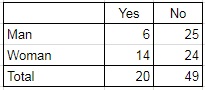
You see his presentation adds up ‘perfect’, these numbers add up, whilst a millennia of history shows us that numbers never add up, not in any criminal enterprise; to do that I have to teach you a little data basic. The best comparison is the use of a cross tabulation. Let’s take gender and shoes. For example we see 6 men and 14 women bought shoes. We also see that 24 women and 25 men did not buy shoes. So far we get the table on the left, yet now we also get the setting that a cross tabulation will not deal with.

For example the fact where we know that shoes were bought, yet the gender is unknown or we see a gender reference and that something was bought, but we cannot see if they were shoes. These are called missing values and they will not show up in that cross tabulation and there we see the first part. It gives us the setting of crimes but not by whom, they are serious in setting but that is not enough is it? You see Peter Dutton gave us ‘help combat organised crime‘, yet not all serious crime is done by organised crime and now we have a $47 billion dollar question and in addition the failing that we are now introduced to is a much larger failing. In this we now see that we saw in the beginning when we went to the end of the story. It is seen with: ‘estimated the cost of serious and organised crime‘ and that is not enough. We could argue that it should be, we can argue that (the amount involved) is way too big, but the setting is not merely that Tech companies should ‘help’, it is the prosecution setting. The setting that there is too much junk attached and the prosecution will fail in the bulk of all those cases because the evidence relies on loaded and unproven data. It is the part that we have faced for well over 7 years. The court barristers will give every jury the speech of authentication versus non-repudiation and the second one cannot be proven (in most cases), so we end up not merely not having ‘beyond all reasonable doubt‘, there will be a high and likely chance that the courts will not even be able to prove ‘on the balance of probabilities‘ or ‘is it more likely than not‘ and it is here where we see that Peter Dutton could be optionally wasting millions upon millions of costs to set the stage of presentation that will have little to no results and that is a much larger problem. The additional play is that any smudging of any presented evidence will give us the stage that a case will be thrown out of court, how is that helping anyone?

So whilst we ponder this, we need to review the statement “And it should be noted the same companies who protest about having to help police with the encryption problem, operate their business in less democratic countries and accept a compromise on privacy to allow their presence in those growth markets“. We are not those countries are we? so at this point, we get the impression that Peter Dutton is merely a minion for the intelligence services who according to him were unable to ge to places in the first place, which implies that certain players have much larger problems and the serious cirme part, which is not on their plate is already beyond them, so there!

At this point we get to the final part where we see: “It is important that tech firms understand and embrace their responsibilities to the community that has helped enrich them“, I actually do agree with that part, yet that should be set in taxation law. A flaw that I reported on yesterday (at https://lawlordtobe.com/2018/10/11/taxation-solved-the-old-way/) which I charmingly called ‘Taxation solved the old way‘ (pun intended). So when we now consider the biggest organised crime master in Common Law (Al Capone), who funny enough got scuttled not by crime fighters but by tax laws. How we get to relearn the lessons of old, do we not?

It gets us to the quote: “Currently our police and intelligence officers who have a warrant may be able to covertly recover an email or a photo or other evidence of a crime from someone’s computer, but they can’t crack encryption, which is why it is now being exploited by criminals“, so these are criminals and not organised crime. Or in a simplistic setting that every square is a rectangle, but not every rectangle is a square. It is at that point that I will teach Peter Dutton the one lesson he never learned (optionally he merely forgot the lesson).

Consider: “When sarcasm bounces it is merely irony“, a lesson that has a much wider application that the honourable youthful young Dutton might not have contemplated yet. However, we have to consider he was only reappointed his seat on August 24th, so he has time to settle in. And the lesson does not end, the second part of the lesson is not from me, it comes from Lizzie O’Shea who gives us: “they were united for the first time in their opposition to the government’s encryption bill“, when we see united tech giants, how short sighted was this encryption bill in the first place? It gets to be a larger issue when we add the setting from World Animal Day (pun intended) when we see the two parts “Telstra has won a $8.2 million contract with the Department of Foreign Affairs and Trade (DFAT) for the landing of the Coral Sea Cable System” and “Chinese technology giant Huawei was originally set to build the 2.5TB-cable linking Australia to the Pacific island nation back in July 2017. However, following concerns that Huawei’s involvement posed a security risk, the Australian government stepped in to fund the multi-million-dollar project from its foreign aid budget“, whilst clear evidence has never been presented and in that stage we see optional nepotism and ego and not fact and science based solutions. We are supposed to trust any of the reporting parties on any of this? The articles are different on different settings, yet the entire mess as it is now shows a much larger failing and a setting of doubt, not one of justified confidence and in that we see the second part of the reason why the tech giants are uniting. A certain play performed by adjusting to the notion of stupid and short sighted whilst the captains of industry have been getting their A-game in gear and others never did. It is merely another stage of the impact of iterative exploitation and profit founding, that whilst Huawei, Google, Apple and Samsung are no longer going iterative, they are now making larger leaps over the next 5 years as they want the largest slice of 5G pie possible and in an iterative setting the others can catch up and that is where we see the clash, because these hardware jumps will also prevail in software and data jumps and some players are in no way ready to play that game. That is where this so called balanced report strikes out as well. this is seen on page 21, where we see: “Because information and communications technologies are used widely throughout society and are instrumental to government, business and consumer activities, there is considerable overlap between the estimated costs of cybercrime and the costs of other crime types— particularly economic crimes, banking and financial crimes, transnational crime, online commerce and internet-facilitated crime such as consumer fraud, online dissemination of child exploitation material and intellectual property infringement“. You see in that stage we see the mention of ‘economic crimes, banking and financial crimes‘. Here we see that Financial institutions and Wall Street come into play (perhaps ‘entrepreneurial bankers’ is a much better term). This is not organised crime because Wall Street never committed any crimes did they, yet they are at the centre of a group of people in that classification are they not? And there we see not merely the adaptations of block chains, we see that organised crime will go there (as soon as they possibly can) whilst the bulk of all the players will not be ready and any encryption bill will hinder the progress of new technology as other players are not anchors of stability, they are concrete blocks of deceleration, another part not considered in any of this.

So yet, the tech companies are uniting and there is a second part in all that. When they strike a deal with Saudi Arabia and set a large part in the city of Neom; when Saudi Arabia accepts certain concessions towards the FAANG group? I personally believe that as soon as the benefit is clearly shown to the rulers of Saudi Arabia and the headway that they could make, they will adjust whatever they can according to Islamic Law, and at what point will governments realise that their only option of control will be isolation and a loss of economy? We are not that far away from that point. Even as we were told yesterday “A senior executive who works for Google’s parent company and a former US secretary of energy have dropped out of a Saudi Arabia tech and business advisory board following international outcry over the disappearance and alleged murder of a dissident Saudi journalist“, yet as Google cloud picks up more and more banks, how long until they reverse the setting? In this the Financial Times also gave us (a day earlier): “A radical blueprint to transform Saudi Arabia through socio-economic reform and ambitious development projects is persuading banks to return to Riyadh“, so at what point will we realise that Saudi Banking is growing and that all players want them as customers? It all boils to dollars and crime is merely a cost of doing business. It is that side that shows the missing data part (going back to the cross tabulation comparison). Corporations have always been about the privileges that come with a certain network and the most facilitating one is the one they will choose, that is in the heart of the flaw that I saw regarding Peter Dutton’s claims here. A bill that stops facilitation and stops optional business on much more levels, as banks need to show more and more profit. The greed driven business model will always be destructive in nature, learning that lesson 10 years ago would have made a difference, now it no longer will.

That is part of the heart of the “$40bn of foreign money is expected to flow into the stock market as a result of Saudi Arabia gaining MSCI emerging markets index status next year“, that against a flawed encryption bill, it was a bad play, played even worse on the surface of all the facts shown and I did not even bother going all the way when it comes to the initial ‘sought to estimate the cost‘, it almost reads like ‘the lady gains weight and we are trying to determine whether she is pregnant, or if she really likes pizza‘, how was that ever going to go? Perhaps asking her: ‘Have you been screwed (over) lately?‘ It could give you a truth and a lot more non-truths. That is the problem with data, whilst moulding data in one direction, you tend to open a door in another direction too, I learned to see and seek those doors, oh and that is before we consider the estimates and the application of weights to a data file, which I do not know whether it happened. this we should have consider with the statement on page 2 ‘Where data were not available for this period, the Reserve Bank of Australia (RBA) (2018) inflation calculator was used to uprate estimated costs from earlier periods‘, the part ‘uprate estimated costs‘ would have gotten us that part, also the fact that it is not data merely a ballpark idea on what the data could be, it is not the same, is it?


Leave a comment

Filed under Finance, IT, Law, Media, Military, Politics, Science

Witchcraft and/or Calculus

Well as Monday mornings go, this will be a day to try and make you giggle (actually not really). I have always been an advocate for science and common sense. I believe that there is great wisdom in applying science in most occassions, it is the easy path in defining truths. Yet, we cannot explain it all with science. We are all limited, it is a basic truth, it is what drives us forward. It also takes a while to get there scientifically, so from the Penydarren in 1804 to the Virgin Hyperloop in 2021 was not an easy trip. A little over two centuries and we have gone from 10 tonnes at 2.4 mph to 50 tonnes at 260 mph, we can see that there has been forward momentum. We all move forward, not all at the same speed, yet when we consider that I predicted on September 4th (at https://lawlordtobe.com/2018/09/04/democracy-is-dead/) after Reuters gave me the quote “Italian bond yields edged lower on Monday after Fitch left its credit rating unchanged at BBB, revising only its outlook to negative, though mixed news flow from senior ministers and manufacturing PMI data due later this morning could mean the rally is short-lived, analysts said“, to which I gave my personal view of “we need to focus on ‘manufacturing PMI data due later this morning‘ which gives me that the rating was done ‘just in time‘ to avoid having to lower it, which implies to me that it was not a reprieve, merely the application of time management to force an upped rating.

So as we move forward less than 3 weeks, we now see (Source: Forbes 2 days ago): “It is no surprise that Fitch has changed the outlook for Italy’s BBB credit rating to negative from stable“. It is not only ‘not a surprise’; it was clear three weeks ago that this was going to happen. The system was as I personally see it rigged, to give a false optimistic rating to a nation that did not deserve it. The question becomes: ‘Are we abandoning science for witchcraft? If that is true, then I would like to move the motion to make Rachel Riley the high priestess of all economic witches and warlocks on the planet!‘ You see if they abandon common sense, can that unruly mob get managed by someone intelligent and when we are on that setting, it better be a good looking one, so the number of optional choices dwindles down to …. one? And Rachel is her name!

What’s behind this?

You see, we have seen on how S&P played us in 2008 on a few sides and it took until 2015 until a ‘deal’ was struck and they got off with a $1.5 billion fine, so when I am stating that they got off whilst they were getting off, I might be more accurate than I am comfortable with. Moody’s got their load handed to them with a mere $864 million penalty. so whilst some sources (source: Huffington Post) give us that the The 2008 financial crisis cost the U.S. economy more than $22 trillion, we seem to forget the impact outside of it, the impact on Europe and how the overall quality of life returned to WW2 conditions (slight exaggeration),  and even as we see reported that the economy in in restoration, we all seem to forget that the quality of life compared to 20 years ago is still less then what is was in 1998 and in that setting we see Fitch play a managed setting of overly soft on some economies and delaying the downgrades by (what I personally see as) jumping the gun by hours, delaying the downgrade, so basically knowingly assisting in the selling of deflated bonds, that is how I personally see it.

So as we look back at the quote and we consider my view three weeks ago with: “This was done to stretch the game, not truly act on the reported value, if that was done the setting of ‘BBB’ could not have been maintained, it should have been dropped to ‘BBB-‘ (my speculated view). So whilst we think we are being told the truth, in my personal opinion, we are sold a bag of goods, because that is how the game is players and we are all being duped, just like in 2008” and we see again: “Fitch has changed the outlook for Italy’s BBB credit rating to negative from stable“, whilst I do not even have an economic degree, can we agree that if it was this obvious, we need to start doing something about Fitch and these like-minded credit rating parties?

In all this the bad news is nowhere near done. the Financial Times (at https://www.ft.com/content/f9fb99d0-bf23-11e8-95b1-d36dfef1b89a) gave us a mere 7 hours ago: “Italy’s technocratic finance minister Giovanni Tria is coming under renewed pressure to increase the country’s budget deficit to accommodate the expensive election promises of Rome’s populist coalition government“, we can understand that it happens. We get it that promises need to be kept and some spending can never be avoided. Yet at 132% of GDP, with a National debt of €2.3 trillion, one would consider that caution would not be the worst idea. In this, sources are treating us to: “a guaranteed universal income of €780 month for all unemployed Italians“, which in light of the cost of living is a decent idea, yet the fact that around 10.7% of the Italians are without a job, the pressure on government spending goes up and up and that means that the deficit increases and with the interests and budget issues in play, the setting of ‘BBB-‘ might have been a little overoptimistic in the end and the news is not getting better any day soon in Italy. Even as we see that the jobless rate is at a low point (lowest since 2012), poverty was up to 14%, so that number will go down, yet at the cost of the Italian governmental coffers. I get it, it is good if they can find any way to get poverty down, yet they need more, they need an actual economy and the EU is playing around in all the ponds, but they are not getting anything done here and the 3 trillion euro spending bill still needs to be paid for one way or another, so there is are long term pressures to deal with from that side as well.

In opposition

When we look in one way, we need to look in another direction as well. So as we accept the orchestration side, we need to disprove it as well (good luck with that). Yet I did look in other directions, I needed as much data as needed, and when we consider my part to downgrade on September 4th and Fitch to keep it stable (at that point) that whilst Bloomberg gave us on September 6thItalian Banks’ Outlook Cut by Fitch Amid Political Concerns‘ (at https://www.bloomberg.com/news/articles/2018-09-05/italy-banks-ratings-outlook-cut-by-fitch-amid-political-concerns) with the quote: “UniCredit SpA and Intesa Sanpaolo SpA were among five Italian banks that Fitch Ratings said could have their credit ratings cut along with that of the state, should the nation’s populist government relax its predecessor’s fiscal discipline“. This is merely one of the quotes and it was clearly stated as a warning which is fair, yet we also see there: “Last week, Fitch said there was an increased chance that Italy’s government will reverse some previous structural reforms, negatively impacting the country’s credit fundamentals. It also said the relatively high degree of political uncertainty compounds the risk“, so not only was there already the prospect of negativity before the government non-reforms. There was in addition the political uncertainty. So there were already two markers staging the negative twist before the setting to ‘stable’ and the non-change was (as I personally see it) falsely given. There is also the part (which was after the stable setting) the quote “While the banks’ shares were little changed, Wednesday, they have underperformed the national stock benchmark this year, with UniCredit and Intesa both down about 15 percent. While UniCredit is more geographically diversified than the other four banks, its risk profile remains highly correlated with that of Italy“. It is another negative impact, yet the downgrade would not impact Italy for another three weeks, is that not a little too strange for comfort?

I would in addition mention the quote: “Fitch said it believes that a disorderly Brexit (UK exiting from European Union) could significantly disrupt Jaguar Land Rover’s supply chain and affect the company’s earnings and cash generation. It affirmed the long-term issuer default rating of Tata Motors’ at ‘BB+’“, so it had no issues changing the forecast ahead of schedule here, whilst Italy was given an additional 3 weeks of easy does it options. And there are no questions here?

We can accept that there are timelines and that things are done at specific moments. No one will deny that, yet knowingly (according to all the sources) to set the stage whilst the stage was unrealistic is an issue and it seems that there is a need to consider that the Three rating agencies are American companies. In all this, when we consider the past US behaviour, and the fact that there is no call to get at least one rating company added that is either UK or European based is a matter for discussion as well.

From ratings to fashion

Yet it is not all about the rating company. To see the stage I need to take one leap to the far left (or far right depending on what side you are facing). The view was encouraged when we look at the Times 2 days ago. Especially with my lack of insight, is good to take that setting to the forefront. The times started with ‘Brokers can’t wait for Burberry’s success‘ (which could be read in more than one way), yet the text gives us clearly “Burberry left visitors to London Fashion Week in no doubt of the scale of its self-confidence: “Kingdom” was the grandiose title granted to the highly anticipated debut collection of Riccardo Tisci, its new creative director“, with the added “Analysts renewed their attack on the £8.2 billion company yesterday after executives indicated that it could take three seasons for changes to provide sales with a significant boost. Credit Suisse downgraded Burberry from “outperform” to “neutral,” citing a lack of potentially stock-boosting factors on the horizon.

Now, I am not debating the reality of the setting. Yet when we look at a place like Statista (at https://www.statista.com/statistics/263885/burberrys-worldwide-revenue/), we see that even as they are not reaching new heights, we see that they are still doing decently well (if one calls £2.73 billion revenue decent) and the year is not over yet. So yes, we do accept that revenue and profit are two very different types of cake and one must eat ones cake, doesn’t one? That was given to us by the independent last year in November, when they gave us: “adjusted operating profit soared 28 per cent to £185m from £144m a year earlier“, we do not know the profits for this year as the year is not done yet. Even if the profits are optionally lessened, it comes from a 28% high, as we see that, what exactly drives the attack on Burberry and how does it relate to the earlier non fashionable one (even though they have Ferrari, Maserati and of course the Ducati), they also have some fashionable brands and they might not be of the Burberry level, the ladies will still love the Italian stuff. When we consider ‘Analysts renewed their attack‘, it is my personal belief that there is a group of insiders in these places who seem to be pushing the planchette of the Ouija board on where they need it to be (optionally not in line where it realistically could be), which is clearly a foundation of orchestration. The problem is not merely on how it is done, the entire financial setting is one of close to zero transparency as analysts ‘hide’ behind their formula’s (read: magic spells) and refuse to give out the incantation that they are using. Now, that is partially fair enough, most magicians do not reveal their tricks, they did do that in ‘Deception‘, which is optionally why it got cancelled after one season. I touched on the subject before and it remains active because a lot of ratings do not seem to make sense, especially when you see the actions and the fact that in May Burberry did beat their forecast with 2%, and still they are under attack? The interesting part is that the media who should ask a lot more questions are not doing that, not even reporting on it and whilst we accept the Guardian giving us two months ago that sales were waning ever so slightly, we were also given “Instead, they have been shopping in Hong Kong, South Korea, Japan and mainland China, boosting Burberry’s sales in Asia Pacific by a mid-single-digit percentage“, as well as “Sales in the Americas grew by a high single-digit percentage as the improving US economy encouraged more consumers to buy Burberry products“. In this we could accept that analysts might decide to warn caution, the message of ‘attack’ seems too unwarranted at present, especially when it is preceding Christmas and optionally the impact of thanksgiving sales in the US. Yet is all this, we see to pussy foot around the clear dangers that the Italian markets are giving us?

In this, we need to consider that if it is all around science we need to see a lot more clarity and if they want to sell the magic like we saw last week, we might (or not) accept to some degree the dangers that Mark Carney points out. the Business Insider gave us: “Bank of England Governor Mark Carney has privately warned the UK government that a “no deal” Brexit could bring about a housing market crash and a surge in the UK’s unemployment rate, according to several reports“, this makes perfect sense. Even as I have not seen the data, there are companies overreacting and threatening that they would vacate the UK. Some will do that, it is unavoidable. There was always the premise that this would also stop new hires and there would be fewer jobs for a little while. That too makes sense. Now consider that commercial building in London is through the roof and even now we see that things are not great. They have not been great since January 2018 when the Guardian gave us: “Developers have 420 towers in pipeline despite up to 15,000 high-end flats still on the market“, so in all this there is a larger danger and we were given this in April this year with “number of empty homes in London now above 20,000”, all houses well above £1 million that for the most no one can afford. So as houses remain empty, what do you think happens to the commercial places being build? We focus on the Battersea Powerhouse and Apple new stomping grounds, whilst we need to realise that 99% of all businesses are SME’s totalling at 5.7 million of them. Where do you think they will go when houses remain empty? I am not sure that Mark Carney is wrong, he might be a little too negative, but it depends on that data he has (and the question that he was required to answer), which is going to be loads better than the data I have seen. So when we get back to the setting of politics, if given the choice by the optional ‘troll like’ person Jacob Rees-Mogg stating “Bank of England governor Mark Carney is a “wailing banshee” whose warnings about Brexit cannot be taken seriously” versus the ‘goddess’ Rachel Riley who might be known for her ‘Would you like a vowel or a consonant?‘, is no less of a math goddess, implying that the math will add up correctly is she ever replaces Mark Carney, whilst the math quality is already in doubt ahead of schedule in the peculiar case of Jacob Rees-Mogg.

It is important that we take a much deeper look at the math and even as I have great confidence in Mark Carney’s ability to do the math, we also need to consider that he has a job, a job to properly inform the government, especially when the worst case scenarios can be as dire as they would optionally be for the short term. So whilst we see the mention of “Mark Carney is a “wailing banshee” whose warnings about Brexit cannot be taken seriously“, we also see that at present 20,000 houses are not sold and some have been on the market for well over 6 months. I would suggest that JRM gives us his math and back those numbers up on a public place for everyone to scrutinise (hopefully by Rachel Riley).

The issues matter and they connect to each other, the scrutinisers seem to preload the stage in ‘their’ favour, which is understandable, yet the cold calculation formula has kept from us, so we cannot see which factors have been set on a sandwich that had been buttered too heavily; we all have a right to know those facts, do we not? In the end we accept that it is not merely about apples versus oranges and it is not about the amount of fruit we have, it is about the different scales and the setting of a stage where transparency seems to be always missing and that approach is never scrutinised giving us a growing lack of confidence as well as a level of growing mistrust in those ‘reporting’ the result; an issue that has been clearly noticed by many, and was addressed for the most by no one at all.

If you want to try magic with a money charm using green yarn and pine oil whilst chanting:

Knot of one, the spell’s begun
Knot of two, I make it true
Knot of three, prosperity
Knot of four, bring me more
Knot of five, the spell’s alive

If that does not work, try calculus and focus on spending less then you earn. Try 6 weeks of one and half a dozen weeks of the other and see which of the two gave you better results.

Have a great Monday!


Leave a comment

Filed under Finance, Media, Politics, Science

The European conglomerate of corruption

It was always going to happen, it was always going to get pushed. Yet the setting and the size of the levels of corruption is just beyond anything I could have imagined. How large corporations and politicians set hand in hand to enable corruption is just staggering and the media is assisting in this process. This is more than just Brexit. The article (at https://www.theguardian.com/politics/2018/sep/17/uk-needs-darkest-hour-in-brexit-talks-before-giving-ground), gives more than just the title ‘UK will shift Brexit stance in its ‘darkest hour’ claim EU officials‘.

Now some will throw ‘corruption’ left, right and centre, so let’s take a look at this. The dictionary gives us “dishonest or fraudulent conduct by those in power, typically involving bribery“, the problem is that most people just think it is about the money and most of the time they are correct. Yet the legal dictionary gives us: “The use of public office for private gain, Dunhaime gives us in addition the Canadian setting with: ““Corruption is understood to be the exploitation of a position of trust, typically in the public sector, in order to receive a private gain, which may or may not be financial. “Corruption is not a simple issue of right and wrong, and conditions that encourage public officials to seek out or accept corruption include (a) the expected gains from undertaking a corrupt act exceed the expected costs and (b) little weight is placed on the costs that corruption imposes on others.” We got this part from Karen Katz in the Canadian Law Journal.

In this we must also include the American version, which was discussed in In Nixon v Shrink Missouri Gove, where Justice Souter of the United States Supreme Court used these words: “Corruption is a subversion of the political process. Elected officials are influenced to act contrary to their obligations of office by the prospect of financial gain to themselves or infusions of money into their campaigns“, it is the elected officials part that matters.

When we are confronted with: ““A lot of movement is needed by the UK side before we can actually reach agreement”, said one senior diplomat. “We need a substantial change in the UK red lines still.” A second EU diplomat added: “It seems that the UK needs to have a ‘darkest hour’ moment before they will shift position. But they will have to shift their position.”” In addition, we see the fear mongering by Christine Lagarde, managing the IMF, who so far has been wrong thrice over in the last four years alone. We are given “a no-deal Brexit would deliver “reduced growth, an increase in the [budget] deficit and a depreciation of the currency“. In this we see another claim that has to be proven wrong again, all in the need of fear. You see this fear is growing. It is in part growing because the Italians are also moving on an ItaLeave (or is that iExit) path.

A path that even I did not see happening. I gave voice to the danger two years ago, but I also recognised that it was unlikely to happen, not as much as France and they pulled a rabbit named Emanuel Macron, not the Emmanuelle the European man were hoping for (see image). Yet in Italy it did go a lot further And now that Metteo Salvini is the elected group, the powers of Wall Street are getting scared, they are contemplating the end of their long reign of exploitation, so this wave is perhaps the last one, which makes the subversion of British Freedom even more essential. And in this British politicians are helping out, because London has been scared by all the fearmongering and Sadiq Khan is now worried for his town. He is shouting on the need for a second referendum. Yet, I want to set a few parts as well. The first is that the ECB gets disbanded, it is not transparent, it has taken liberties that are beyond acceptable and whenever the G30 bank elite comes to mention it had been avoided again and again. That is the setting towards what I regard to be of levels of corruption that are beyond acceptable. I personally want to add the right of targeted killing that means that any given links on politicians and the banks and large investors that is regarded to be unacceptable comes with an automated death sentence. I wonder how many politicians will get worried, they claim they will not be, but one knock on their door with the mention of the Battersea Power Station with the quote: “In an interview with the Guardian, Anwar, who was released from prison after the opposition won power for the first time in Malaysia, said the previous government had used the savings of ordinary people to cover up the multibillion-dollar embezzlement scandal at 1MDB, a state investment fund.“, and when we consider the news merely 5 days ago (source: the Guardian) with: “Peter Bingle used his longstanding relationship with Ravi Govindia, the leader of the London borough of Wandsworth, in attempts to circumvent council officials he believed were being obstructive to his clients, including over the size of payments due to public projects“, I think that my case has been decently made. In this we will hunt down and give the fear mongers the option to either show clear evidence or get executed. Is that not an easy way to get to the truth of the matter?

This reflects on Europe and the ECB, because their laughter dies down quite quickly at the point when the first ‘accidental’ fatalities hit the newsreels, after that them bitches be crying. As for the hard times. Yes, the UK would always get a few years of hardship after Brexit. Anyone stating that this is not true is lying to you. The issue becomes that after Brexit, the careless spending will no longer get pushed onto UK budgets, which also means that debts can be better dealt with quicker and also to a larger extent. That also means that as debts go down, as infrastructure issues are dealt with, it will have much better chance when the UK is not dragged down through 3 trillion stupid mistakes by Mario Draghi. OK, that was not quite true, the first Trillion we get, but when it failed he decided to add two trillion to that debt. That is the issue that the UK is confronted with and there is also the bigger crux. You see, the BBC reported last month (at https://www.bbc.co.uk/news/business-45247631) that a charity has called for tougher regulation of bailiffs, as it calculated that households have fallen behind on essential bills by £18.9bn. Staying in the EU does not fix that, the bills are still due, yet when the economy betters something can be done and that is what Europe does not want, they want that the lifestyle remains equal for all, looking at Sweden alone we see that this future is fictive and the EU is draining all funds with their gravy trains as well, making matters worse. If there was only someone who had been able to hold the ECB accountable on some of their actions, but alas, there was no option for that and there we see the one truth that Nigel Farage was correct in. If the Brits all unite for a better Britain it will work. And that is not merely those born there, anyone living in the UK, being a resident or citizen has the best interest that growing the UK is the only path that works.

The entire charity matter is also a path that matters, because it impacts life in the UK. We can agree that bills have to be paid for, but that is no longer an option as the pockets of big business are filled through exploitation and that cash is moved out of the UK through perfectly legal and creative bookkeeping.  So when we see: “Citizens Advice said it was getting a call from someone needing help owing to bailiffs every three minutes. It is calling for a bailiffs regulator in England and Wales. It points to a case of an elderly couple who owed £700 in council tax who are now afraid to open their front door after bailiffs used aggressive tactics and threatened to call in the police.” We need a much better system that allows for the return to better values and pushing out exploitative business is a requirement, yet their exploitative options are protected by the EU and Strasbourg, who want the status quo and will remain in denial for another decade, whilst the required actions are already 5 years too late. Here to we see the need to go it alone for the UK and let’s not forget that Italy is already moving on that path, no matter what happens now, when Italy gets out before the UK, the options of the UK will diminish even more, and that is still on the table, even as we see the news with “‘We Want to Change Things from Within.’ Italy’s Matteo Salvini on His Goal to Reshape Europe“, we see carefully scripted answers in regards to the Italian exit, yet the EU budget fights are implying that this path remains open to Matteo Salvini. The Financial Times (at https://www.ft.com/content/cad84ef6-b10d-11e8-99ca-68cf89602132) gave us: “But others fear a spat with Rome that could spur support for Mr Salvini in European Parliament elections in May next year and re-energise his party’s calls for a eurozone exit.” That is the dilemma that all these Europeans now face, because when the UK is officially out, the Italian exit will collapse the Euro as well as the EU. A setting that was always going to happen (at some point), yet the order in how it happens will also set the stage on how it impacts the UK and my personal view is the quicker that they are out, the better their position will be and there we see the stage of all these fearmongering players, every month less is another year of pension gone and a more medial lifestyle for those people who want their golden parachute and their golden swimming pool. That whilst 99.99934%of the people in the UK (roughly) will never ever have either.

So even as he Financial Times gives us the Top Marginal personal income tax for employees , we see that Sweden heads it and the UK is a lot below that, whilst Italy is two places below that part and Italy ‘flat tax’ is dead last. Now if we could have seen another chart that includes the levels of tax avoidance (which is perfectly legal) we could clearly see that the UK will never get the amount professed in that chart. There are too many loopholes and many nations use them, the EU gave even more options there. This gets us to 2016, when we were introduced to: “On 28 January 2016 the Commission presented its proposal for an Anti-Tax Avoidance Directive as part of the Anti-Tax Avoidance Package. On 20 June 2016 the Council adopted the Directive (EU) 2016/1164 laying down rules against tax avoidance practices that directly affect the functioning of the internal market“, which sounds awesome, was it not that 8 months later, we were treated to: “Huge sums are being lost due to tax evasion and avoidance. Estimates go up to € 1 trillion“. The mere setting of dates that were not clearly added to the page and other matters missed, gives us the uselessness setting of the EU, moreover those 8 months, the people involved, what did they achieve and how much did they get paid? It is my personal opinion, yet ec.europe.eu is filled with blunders and misgivings of a nature that should have gotten a truckload of these people fired and now they all band together, because when the UK leaves their party ends and that scares them. It is not that they merely try, it is that they for the most fail again and again.

That whilst IBM gave us the opposite setting for Brexit only a month ago with: The problem, though, is that there are some signs that Brexit isn’t going to be as bad as once feared – and may, in fact, turn into a net positive for the UK, and tech giant IBM might play an outsized role in some of the developing factors. Here’s why:

  • Foreign Investment is Growing
  • Emerging Technology Solving Trade Issues
  • Exports Climbing and
  • US Uncertainty Taking a Toll

These are all matters that work for the UK over time and that is why these levels off fearmongering anger me so and I personally would want retaliation against those trying to prolong their futures through fearmongering.

All issues ignored by the media to a much larger degree and whilst they emphasize on people like Lord Adonis, we need to make certain that those doing so are given the spotlight to the larger degree after the proof is shown, we will not allow for a simple ‘sorry’ we will set the stage for draconian change to their non-journalistic path. In the first in setting these publications as no longer to be regarded as newspapers, especially publications like the Daily Mail. They can publish of course, we would never hold their right of expression, but no longer in a 0% setting, they will become vat accountable for the 20% that any magazine and glossy gossip mag is set to, the playing field should be equal, should it not? I wonder how long it takes for them to feel that 20% pinch (good for the UK coffers) and when they start passing that onto the consumers, do you think that they will continue choosing that medium, or will they consider reading an actual newspaper?

All elements of corruption. The setting of ‘exploitation of a position of trust‘ is seen with newspapers, title of status, positions of wealth and managing policies as well as the facilitation and nepotism on smoothing paths for buildings. There is too much going on and it is hurting the UK immensely. We can argue that the EU has allowed corruption levels that we had not seen since ancient Rome and when we consider who is heading the ECB, we see and optional coincidence of correlation.

The largest danger is not when the UK gets out, but when the fear mongers win and Matteo Salvini succeeds, because at that point the UK will face close to a decade of additional hardship. Are you ready for that? Are you in the UK willing to forgo heating in the winters of 2020, 2021, 2022, 2023? Consider that, because the debt of the people adding to £18.9bn implies that they have to forgo electricity or heating; what would you chose?


Leave a comment

Filed under Finance, Law, Media, Politics

FI01, becoming offensive

I will leave the entire Novichok alone for now, there is rustling in the weeds and it is important to look at it, but only when more actual quality information is available. It is time to take a look at the FI protocols. It is time for FI01.

This might not be the article for many of my readers, I will not shun hash words and I will not shun those wading in hypocrisy. Yet to do that, we need to look at certain definitions too and that is the part we get to after we look at the Guardian article (at https://www.theguardian.com/media/2018/sep/13/social-media-firms-could-face-huge-fines-over-terrorist-content). The article ‘Remove terror content quickly or be fined, EU tells social media firms‘. the setting given is “Social media platforms such as Facebook and Twitter will be forced to take terrorist content off their sites within an hour or face multimillion-pound fines under EU proposals“, is probably the biggest part, but let’s look on; when we see some of the parts given by Julian King, the British security commissioner in Brussels. We are given a few truths that matter. “We have got a problem with content; it is not an entirely new problem, we are not starting from scratch, we have agreed to do some voluntary stuff, and we got some good progress – but not enough” is the first part and I will get back to that, yet the more important part is “Every attack over the last 18 months or two years or so has got an online dimension. Either inciting or in some cases instructing, providing instruction, or glorifying“. I get it, something needs to be done. In the first we need to see the list and the proper setting of evidence. I get it that this is not offered online for several reasons. Yet there needs to be a lot more scrutiny. As we see the utter screw up regarding Novichoks, the lack of evidence and linked statements without evidence. We also need to state clearly that the press (to a larger extent) is part of the problem, not part of the solution. Julian King needs to realise that if his peers are dragging their heels on one side, he cannot be part of anything acceptable stating the utter impossibility of: ‘take terrorist content off their sites within an hour‘.

From my point of view, this is about something else; this is about giving governments’ direct access to social media to filter ALL content (at their leisure). To get anything done within the hour is just not realistic and they know it. It is also very clear that when 5G is here, it will be too late and that is what they fear even more, and being stupid about it is just not a solution in any place.

It becomes an even more laughable setting with: “Parties could be fined up to 5% of their annual budgets for breaching data protection rules in order to deliberately influence the outcome of the European elections, including those for the European parliament in May 2019“. So instead of making it illegal and rejecting that party from elected consideration, they get a fine? Allowing for big business to sacrifice via some small institution to cop a few million whilst still getting what they want. So when we see Julian King state: “given the track record, there has to be a chance, and we have to up our game and be more resilient“. How about setting the stage that the use of social media for elections is just out of bounds? Limit it to TV, Newspapers and magazines?

We see the problem a lot clearer when we consider the ‘High-Level Commission Expert Group on Radicalisation (HLCEG-R)‘ report from May 18th 2018. Where exactly is the definition of ‘terrorist content’? You see, the EC is all about definitions all the time. Yet here we see an interaction and a level of interchangeability of ‘terrorist content‘ and ‘illegal content‘. It is found to some extent in the report referred to in footnote 19 where we see the report ‘COMMISSION RECOMMENDATION of 1.3.2018 on measures to effectively tackle illegal content online’. So is all ‘illegal content’ ‘terrorist content’? It seems to me that this sudden trivialisation is about something else entirely (at least to some degree).

When we look at the second report, we see: “At the collective level, important progress has been made through voluntary arrangements of various kinds, including the EU Internet Forum on terrorist content online, the Code of Conduct on Countering Illegal Hate Speech Online and the Memorandum of Understanding on the Sale of Counterfeit Goods. However, notwithstanding this commitment and progress, illegal content online remains a serious problem within the Union

This is reference to Article 292. Yet now we see Illegal Hate Speech Online, the Sale of Counterfeit Goods as well as terrorist content online. So is this about a Nina Ricci bottle or a Prada backpack, because the devil is not in the details, the devil wears Prada plain and simple. We see to some extent the ‘aggregation’ of stupidity (as I personally see it) in item 32, where we are treated to: “In light of the particularities related to tackling terrorist content online, the recommendations relating to tackling illegal content generally should be complemented by certain recommendations which specifically relate to tackling terrorist content online, building on and consolidating efforts undertaken in the framework of the EU Internet Forum“, so when illegal content is online, we now see the implicated setting that these people could be regarded as terrorist. With ‘be complemented by certain recommendations‘, which now becomes a rather weird setting. You see ‘political opinion’ cannot be seen as illegal speech, so not getting to barrier one, also avoids barrier two. In this setting, any political drive must be proven to give the reading of proven the need that the speech instils the drive to act illegally. Until a clear act is connected, there will be no success.

This now gets us to paragraph 33, where we see: “Considering the particularly grave risks associated with terrorist content and hosting service providers’ central role in the dissemination of such content, hosting service providers should take all reasonable measures so that they do not allow terrorist content and if possible prevent hosting it“. So at this point what exactly is ‘terrorist content‘? And the reference to that paragraph refers to ‘without prejudice to Article 14 of Directive 2000/31/EC’, are you effing kidding me? That is the privacy part on a section in ‘legal aspects of information society services, in particular electronic commerce, in the Internal Market‘.

So we get this mess presented?

In that regard when we see: ‘Commission proposes new rules to get terrorist content off the web‘ It is my personal agitated view in the matter that protocol FI01 is set to President Jean-Claude Juncker, he is the Eff…ing Idiot number 1.

When we again look at the headline: “Terrorist content is most harmful in the first hours after it appears online because of the speed at which it spreads. This is why the Commission is proposing a legally binding one-hour deadline for content to be removed following a removal order from national competent authorities“, a one hour deadline? Really? Most EC parts have not been able to clean their act in years, so now social media gets sliced and cut? Is Europe so broke that they want the millions from the three social media providers because they cannot clean their own stables?

Consider the Statistics, Facebook has 2 billion active users a month, and this is not static. We see from sources that Five new profiles are created every second, there is a registered amount of photo uploads approaching 300 million per day as well as the setting that every minute on Facebook: 510,000 comments are posted, 293,000 statuses are updated, and 136,000 photos are uploaded and that is ignoring languages and expressions. The entire setting of removal in an hour is so unrealistic it is close to hilarious. When we are confronted with that, whilst ‘the Conservative’ (not the greatest source, I admit) gives us: “The structural defects of the European Commission are plentiful: an insurmountable democratic deficit; not a hint of accountability; and an opaque process of legislative formulation to name but a few“, that whilst labelled individual FI01 is also connected to: “The president of the European Commission is embroiled in a new criminal investigation into claims that “tampered” evidence misled an inquiry into phone-tapping. Jean-Claude Juncker faces accusations that his officials presented inaccurate information under oath in a case involving an alleged illegal wiretap more than ten years ago when he was prime minister of Luxembourg” (source: The Times, December 13th 2017), that is the person giving social media providers an ultimatum of an hour? You have got to be kidding me. The Telegraph gave us in addition: “The new evidence, which led to the postponing of a trial of three senior formers members of Luxembourg’s SREL intelligence service, according to The Times, showed that a key telephone transcript had apparently been doctored

That’s the person who is part of throwing ‘illegal content’ and ‘terrorist content’ on one pile?

Good to know!

So now we get to the fact sheet!

Here we see (at https://ec.europa.eu/commission/sites/beta-political/files/soteu2018-factsheet-terrorist-content_en_0.pdf) the setting of ‘How does the new procedure for removing terrorist content work?‘ We now see the following

  1. National authority detects and makes assessment
  2. If considered terrorist content, removal order issued to host
  3. Host must remove content within one hour

That seems almost harmless, does it not?

Yet we also see:

  • Right to challenge: Hosting service or content provider may appeal the removal order. If the appeal is successful, the content is restored; if the appeal is rejected or the deadline lapses, the removal order stands and the content must be permanently removed.
  • Obligation to report: If issued with a removal order, the host must report on proactive measures taken to address terrorist content online three months after receiving the removal order.

I am missing any level of accountability, too much ambiguity. So from my point of view, anyone abusing the ‘terrorist content’ for mere filtering and censoring on behalf of anyone else needs to be held criminally liable. I reckon that after 2-3 cases there will be suddenly a large need for postponed trials.

When we investigate the member states part in all this, we see no fine for the state when wrongful removal was done, we see a pressure on removing (or else), yet there is a shallow point when it comes the other way around. In addition, we see “coordinate with other Member States and Europol to ensure that evidence of online terrorist content is flagged, and that duplication and interference in national investigations is avoided“, yet there is no registration on who ordered the removal, also, there is no registration per removal id and in that stage set penalties for those having set the stage for recurring unjustified removals giving ample voice to the earlier: “not a hint of accountability“, if this is about terrorist content, is that part not equally important?

I am all for getting all terrorist content removed, yet the systems cannot get it all, that is too unrealistic and pushing a one hour timestamp whilst the other side has no accountability at all is just a discriminating joke in the making. It is also still interesting to see that they claim to fight terrorism and terrorist online activities, whilst Iran state sponsor of terrorism in still a welcome debate and trade partner in the EU. In addition, the entire matter of Iranian diplomat Asadollah Assadi and terrorist was given light a week before the EU approved plans for the European Investment Bank to do business with Iran. So you want to stop social media, whilst still doing business with these people? How unacceptable is that part in all this? If the EU cannot clean its stables, it has no business enforcing anything on social media that is how I personally see it. Yes, we can agree that terrorist content must be removed ASAP, yet what is that? One hour? 24 Hours? 72 hours? The fact that the EU does business as usual with a terrorist funding government implies that they are clueless on several grounds and the fact that we see an increasing amount of evidence growing on the matter of Iranian Missiles fired into Saudi Arabia is further evidence still that the EU is merely the pot calling the kettle black. It is in that setting that we should conclude that they have no business ‘fine giving’ any social media, especially in light of such a massive funding failure.

You see, what angers me so is the mere filtering of politicians and that needs to stop too! In this I present two elements. The first part comes from Bloomberg last year. We are given (at https://www.bloomberg.com/news/articles/2017-11-29/facebook-says-99-of-is-al-qaeda-content-spotted-by-ai) where we are treated to: “Today, 99 percent of Islamic State and Al Qaeda-related content Facebook removes is detected by the company’s AI before any user flags it, Monika Bickert, Facebook’s head of global policy management, and Brian Fishman, head of counter-terrorism policy, said Wednesday. They said in some cases the software was able to block the content from ever being posted in the first place“. Yet the other part that the Guardian gives us is: “We have got a problem with content; it is not an entirely new problem, we are not starting from scratch, we have agreed to do some voluntary stuff, and we got some good progress – but not enough“. Now we get to the good part, what EXACTLY is ‘not enough’? From my point of view Either Bloomberg lied to us, or Julian King is what some might consider as: ‘an unacceptable piece of trash’. If he wants 100%, he better give us clearly add a few elements of EC accountability and holding them criminally liable when they abuse their power. Also is any abuse of that ‘filtering content’ is found, he is to be dishonourably discharged and shamed in the entire EU, with a clear banning from ALL official positions in the EU and the Commonwealth.

Why the overreaction?

We have been fed two versions again and again and we see a lack of accountability on the EU side too often; for example the elitist banking group of 30 with Mario Draghi as a member. When the Financial Times gave us: “the close links between central bankers and the private sector have aroused public suspicion since the global financial crisis triggered a series of bank bailouts” we see suspected levels of nepotism that raises more issues than 50 successful Islamic State attacks. The article (at https://www.ft.com/content/dc64b6e2-8060-11e8-bc55-50daf11b720d) also gives us “The Ombudsman has also attacked the ECB’s argument that it was standard practice for top central bankers to join the club. The central bank chiefs of Germany, France, Italy, Spain, Poland, India, Brazil, Russia, Canada, and Australia are not members and Janet Yellen suspended her membership during her time at the helm of the US Federal Reserve”, showing that the European Commission has a truckload of issues, it is my personal view that it has no business acting in the way it does.

Yet, defence of the actions instigated by Julian King can be seen in Forbes. The article (at https://www.forbes.com/sites/kalevleetaru/2018/05/15/the-problem-with-using-ai-to-fight-terrorism-on-social-media), an Article from last May gives us: “the general public would be forgiven for believing that Facebook’s algorithms are vastly more effective. The New York Times summarized the statement above as “Facebook’s A.I. found 99.5 percent of terrorist content on the site, leading to the removal of roughly 1.9 million pieces of content in the first quarter,” while the BBC offered “the firm said its tools spotted 99.5% of detected propaganda posted in support of Islamic State, Al-Qaeda and other affiliated groups, leaving only 0.5% to the public.” In fact, this is not at all what the company has claimed. When asked about similar previous media characterizations of its counter-terrorism efforts, a company spokesperson clarified that such statements are incorrect, that the 99% figure refers exclusively to the percent of terrorist content deleted by the company that had been flagged by AI.

This could be easily tested and as such I decided to do so and with ‘ISIS images’ I got hundreds and hundreds of images, videos and other matters in my browser and I got even more with the search term ‘Jihad Islamic state’. The video (at https://www.youtube.com/watch?v=jzCAPJDAnQA) shows actions of Islamic State, with sounds, vision and comments. It is News from Vice News, a video from 2014, still online today. At some point you need to as just how ludicrous and useless actions are. We get it that there are actions, we see that numbers become debatable. Yet in all this the mere reported numbers are already an issue, and if I added Vice News articles to me Facebook news feed, would that constitute ‘Terrorist Content’? This small part alone shows us that this is about something else and as such we better take a real hard look at the Actions of the EC, demanding that the censoring side should be held equally liable and prosecutable for their overreaction and inaction. Yet that is never ever going to happen, is it? This is making the EC actions (in my personal opinion) a lot more questionable in all this. It was the overreaction and the emphasis of ‘One Hour’ that set the tone of mistrust, I wonder what else we will see over the coming week.


Leave a comment

Filed under Finance, IT, Law, Media, Military, Politics, Science

The Digital Dilemma

Just a few hours ago, the guardian makes us aware of an interesting case. The article by Rob Davies is interesting for a few reasons, apart from the fact that it was nicely written and reads really well. We see the title ‘Google under pressure to refuse Viagogo advertising‘ (at https://www.theguardian.com/money/2018/sep/10/google-under-pressure-to-refuse-viagogo-advertising). I cannot completely agree with the premise, but I understand the setting.

When we are confronted with: ‘FA, UK Music and MPs urge Google to stop accepting payments from ticket firm‘ we are confronted with a few things, all apart from the fact on the path taken and that awareness is a good thing. You see, when the quote “The letter, sent to senior Google executives on Friday and seen by the Guardian, says that Viagogo’s prominence in search rankings is leading to consumers buying sports, music and theatre tickets that may be invalid” we are confronted with two distinct parts, the first is ‘may be invalid‘, the more interesting part is not on Google, but on why there is no criminal investigation and prosecution of Viagogo. Is it not interesting that we see ‘pressure Google‘ and not ‘prosecute Viagogo‘? That part makes little sense. If the law is clear on selling and tickets at vast mark-ups, why is that not clearly in place?

When I enter ‘Viagogo’ in my google search, I am treated to at the very top of the screen. On the Right side I see image below that, which leaves us with even more questions, if you look at that image properly. So we can see that Viagogo is setting the right stage for Digital Marketing, there is no denying this. So as we are introduced to the workings of Eric H. Baker, the American businessman (read entrepreneur), aka founder and CEO of Viagogo, and co-founder of StubHub, a Harvard and Stanford graduate, we need to consider the parts where it counts. Is he breaking the law, and moreover if he is not breaking the law, is the setting of “Labour MP Sharon Hodgson, one of the letter’s signatories, said: “I have heard too many times from distressed customers of Viagogo that they were led to the website because it was at the top of their Google search” a valid one?

You see, whenever I want to go to a concert, I go to the actual site of where the performance is and I see THERE where I can get the tickets. So the fact that some consumers are lazy is one thing, that they do not properly do their homework is another one. That aside, when the law is broken actions need to be taken, that is clear, but was it? In additional, how often did MP Sharon Hodgson look into the matter? With ‘I have heard too many times from distressed customers’ she now becomes a valid target as well, so can we get specifics please? We see her visibility again in the Financial Times (at https://www.ft.com/content/2eefe9e0-b04f-11e8-99ca-68cf89602132). Now it is the other way around. Here we see ‘Viagogo sues Ed Sheeran’s promoter for ‘fraud’‘, that different candy, is it not? We setting given here is: “Viagogo claims that Stuart Galbraith, the founder of Kilimanjaro Live, “duped” fans during Ed Sheeran’s 2017 tour by setting up fake “Viagogo booths” outside venues to attract people who had bought their tickets from the site. These tickets, which Viagogo argues were valid, were then confiscated and fans were forced to buy new ones“, an interesting ploy, the question becomes was the law broken by Viagogo? We are also informed by the Financial Times on the action with “Viagogo said that it has refunded the fans who bought from them and has sued Mr Galbraith in a court in Hamburg with further legal action likely elsewhere“, so basically Viagogo refunded the customers, which is the decent act and will seek reparations elsewhere, which is (as far as I can tell) the decent business oriented act to follow. We are also given “senior executives from Viagogo are due to be questioned by British MPs about the site’s resale practices. Mr Galbraith is also scheduled to appear before the MPs“, this implies that the resale practice is looked into, yet it also quite clearly implies that no law is broken. Here is where we see the Labour MP mentioned as ‘Sharon Hodgson, the Labour MP who co-chaired the All-Party Parliamentary Group on Ticket Abuse‘. The question is not on merely ‘Ticket Abuse‘, the question is how the seemingly given title of abuse applies. This is a market of selling and reselling, until the law clearly makes reselling illegal, we see a setting that someone found a niche for margins and applied its options here.

So basically we could go to the setting that like most Labour minded ‘officials’ she too is full of (the ess and tea word) and goes with “Google needs to take action in order to protect consumers, and I look forward to working with them on this in the very near future“, to which my slightly too emotional response is: ‘No you stupid fishmonger, you either set the law correctly, or get out of the bloody way!‘ I agree it is not really diplomatic, but the entire setting is just a joke, the way I see it (at present).

You see, Viagogo (on their website) give us: “About Viagogo. Buyers are guaranteed to receive valid tickets in time for the event. If a problem arises, Viagogo will step in to provide comparable replacement tickets or a refund. Sellers are guaranteed to get paid for the tickets they sell and fulfil on time“, to me that is clear valid and acceptable. Yet in all this, I cannot find any setting where the CPS or the DPP is in a setting to investigate Viagogo or prosecute them, so were there laws broken? Now consider the commercial other path. If it was clearly illegal, or shunned Viagogo would have let’s say 200 tickets to any event and that would per gig be 20,000 in revenue lost if no one buys them, the question then becomes why not, and how can you continue this business? It would go into administration quick enough.

Is it illegal? That is not stated anywhere, and we need to acknowledge that it is either illegal, or it is not. So instead of working with this optional digital market provider, we see mere brazen outrage, whilst there is no clear legal definition. I also acknowledge that when we look at Product review, it got 1.3 out of 5, which is actually really bad and normally in eBay terms that score is close to a death sentence, yet they are still around why? I also acknowledge that we see reviews like ‘I could go online right now to Ticketmaster and purchase better seats for a much lower price‘, added only yesterday (what a coincidence), there are also the reviews that should lead the police towards the investigation of defamation against people like ‘Annie’ giving us: “People beware: do not bug from these people as the are comming a criminal offence called FRAUD. You buy tickets off them to get falsified tickets and are useless, get to the event an cannot get it. They send then to you a few days before the event“, so if Annie (optionally a fake FB account) cannot validate that opinion with facts, her opinion becomes defamation, if it is true and validated it becomes a path for prosecution (that was simple, was it not?). There was also a very positive review there, as well as ‘Delivered what they promised and got me out of a jam‘ from a Verified Customer. Now, I get it, there will be happy and unhappy customers in every field. My initial feeling is that a 1.3 of 5 does not instil me with any level of trust, yet their own site gives clear settings, clear business settings and the people acting against Viagogo do not go to the law, do not adjust the law, no, they come crying at the Google office front desk. Pardon my French, but how fucked up is that?

We cannot disagree with the Guardian quote: “The letter has 24 signatories, including a host of MPs, trade bodies and associations from the worlds of sports, theatre and music. Sporting bodies that have signed include the Football Association, England and Wales Cricket Board, Rugby Football Union and Lawn Tennis Association“, yet there is no mention that the law is getting broken and that had to be the first action. So why is there exactly this anti Viagogo activity? Margins? Mere legal profits? The fact that someone with Harvard and Stanford goes to scam options is just too weird at times (it does on a rare occurrence happen), or is Eric Baker merely an intelligent person who found an option, an opportunity and took that to make nice coins on the side? Is that not the setting that matters?

You see, I still see idiots all over the field having no clear idea on how to properly use digital marketing, the fact that there are those who do know what to do and they can turn opportunity into profit, which is a valid choice, it is in that setting we see the valid response from google with: “The CMA has been looking at the business practices of ticket resellers. We await the conclusion of these inquiries and we hope that they will clarify the rules in the interests of consumers. We will abide by the rulings of these inquiries and local law“, that is the actual setting and it took me 35 seconds to get there from the moment I read the title (before even finishing reading the Guardian article). It is about local law. It might not even be about the inquiry. The inquiry has no legal bearing until set in law. I is that same setting that the Daily Mail needs to be investigated, as we were treated only moments ago to: “‘Worse than a street tout’: Viagogo charges woman £3,000 for two £87 tickets to take dying father on a bucket list trip to the Last Night of the Proms“. The question becomes, why are the DPP and the CPS not all over this? We now DEMAND to see the evidence. If Viagogo was part of that, then against their own settings we might have a clear setting of law breaking, if not, then the public are entitled to see the Daily Mail to be prosecuted on all fronts. there is no ‘press protection‘ here, not in this current setting, but at that point it is more likely than not that people like Labour MP Sharon Hodgson will suddenly be too busy to look at issues around anything involving ‘the freedom of the press’ and holding the press accountable for their actions, that is how is tend to pan out.

You see, this scenario is out of what, all these accusations at almost the same time, with the Daily Mail ‘hiding’ (or is that using) a kidney cancer case, with tickets merely 2 days old, it is all happening at the same time. If that is the case and the DPP and CPS are not all over this in 5-10 hours, the UK has a much bigger issue, a systemic failure of the law on several fronts and that needs to be addressed now, whilst the first question is not merely: ‘was the law broken?‘ The issue then instantly becomes ‘How many parties have been negligent in all this, and what are their names?

At that point, when that is proven then Labour MP Sharon Hodgson has a case that demands here to be in the limelight, not before and we better get to see some real answers, not some lame ‘we will look into the matter and make proper changes‘, because at that point, I will seek out Eric H. Baker myself, seeking some funding to set up digital campaigns of my own, demanding the removal from office of Labour MP Sharon Hodgson as she is seemingly too unfit for public office. I can get such a campaign started for a mere £35 a day, giving that campaign optionally 20-30 thousand views a day. With all the profits he is making, he might be up for that, did you consider that path Sharon? And in hindsight, in this inquiry, how much time and effort are you taking in regards to StubHub, Ticketmaster, Seatwave, CTs Eventim and Ticketbis? Did any of those raise flags?

You see, I do not oppose such an inquiry, I do not oppose that he law is adjusted making reselling of tickets to be illegal, and that is a valid step to take. Is it not weird that those steps cannot be found? Oh, there is that. You see the setting we get with: “UK law stipulates that the re-sale of concert tickets is not in itself illegal. But it is an offence to sell tickets in the street without a trading licence“. So there we see the first part and if Viagogo has that, we also see the flaw in the entire setting from the start. So when we consider that setting the law was a first requirement, we see the absence of the DPP and CPS and also a first indicator that Labour MP Sharon Hodgson is unfit for public office. That did not take long, did it?

I loved the article by Rob Davies. It made me question parts and that is always a good thing. Yet, when we see all this, we need to ask the Football Association, England and Wales Cricket Board, Rugby Football Union, Lawn Tennis Association, UK Music chief executive Michael Dugher and Music Managers Forum chief Annabella Coldrick, the Society of London Theatre and UK Theatre a simple question: ‘Have you sponsored a bill to make reselling of tickets illegal?‘ If not: ‘Why not?‘ Those are the questions that matter, but are we seeing those questions asked and answered?

It was that simple and crying at the front desk of Google was merely a waste of everyone’s time, plain and simple. I am not friend of Viagogo, I would have personally never gone there, not for one or the other, just because I would have taken the path of the actual venue location and the official venue website, and in all this is it not interesting that when we are confronted with the Daily Mail part: ‘Hannah Maturin, 30, wanted to take her frail father John to see the Last Night of the Proms‘, that she decided to allegedly pay £2959 over £174 and decided not to call the Royal Albert Hall first with her dad being in such a state? It is what I would have done. And we see all this news at the SAME TIME? How is this level of orchestration going for you? So much common sense absent from so many players and no one is asking the question: ‘Why is that?

#ItMustBeMe


Leave a comment

Filed under Finance, IT, Law, Media, Politics, Science

She was not ready

As subtlety goes, I am happy to throw it out of the window this morning (a lack of coffee does this to me). You see, when we get the situation that the guy states that it did not matter whether she was ready or not, mainly because it only costs him $50, regardless what comes (or is that who). You might wonder where this is going, this is not going there, we are talking about banking. It does not matter who you screw and how you screw people over, when ‘she’ is not ready (or willing), it potentially constitutes a crime and you can throw ‘potentially’, as I personally see it straight out of the window. So why are we not getting angry? Why are we confronted with ‘TSB plunges to £107.4m loss as bill for IT chaos reaches £176m‘ (at https://www.theguardian.com/business/2018/jul/27/tsb-plunges-to-107m-loss-as-bill-for-it-chaos-reaches-176m). When we see: “bank has resolved only a third of 135,403 complaints“, why is there not a front page leading with the CPS investigating issues at the TSB? When we are confronted with “The payouts that followed a botched IT transfer from its former parent Lloyds to the new owner, Sabadell, a Spanish bank, in April pushed TSB into a first-half loss of £107.4m, compared with a profit of £108.3m in the same period last year“, we see a dangerous setting and there is no investigation? When we see the Financial Times on June 22nd 2018 (at https://www.ft.com/content/32749936-7561-11e8-aa31-31da4279a601), giving us the “customer of Bank of Scotland last month asked to withdraw £5,000 at her local branch in Leven, north of Edinburgh, the cashier thought the amount was unusual and asked her to speak to the branch manager. The pensioner explained that she needed the cash to pay workmen who had asked if she would like some half-price work on her driveway. Spotting a potential scam, the branch manager called the police, invoking a scheme that came into effect last year dubbed the “banking protocol”. Officers responded immediately and arrested six men at the customers’ house“, so in that case we go all out on 6 men, but we now see a setting where ‘135,403 complaints‘ are a potential issue involving many millions, and we are not looking deeper and setting the limelight on a level of negligence close to unique in banking. So what gives?

This does not come lightly, you see, when you take a scalpel to the quote: “The bank admitted that while it’s mobile app, online and telephone banking services are “much improved”, problems remain. The chief executive, Paul Pester, who defied calls to resign over the handling of the meltdown, said: “We’re making progress in resolving the service problems customers experienced following our IT migration and we will continue to work tirelessly until we have put things right.”“, we get the following:

  • The bank admitted that with its mobile app, problems remain.
  • The bank admitted that with its online banking services, problems remain.
  • The bank admitted that with its telephone banking services, problems remain.
  • The chief executive, Paul Pester has been called to resign over the handling of the meltdown.
  • We have been currently unable to resolve the service problems customers experienced.

Reread the previous quote and you can see that it is all there.

This setting does not merely impact some parts of the IT setting; it involves failure on the levels of

  1. Documenting the changes required.
  2. Verifying the document is accurate and confirmed form the UK and Spanish side
  3. Presenting the required steps to the board members letting it be scrutinised
  4. Analysing the migration test run and testing it for the setting of trial version against the live databases
  5. Doing a small segment live run to test for optional missed failures
  6. The QA report on the path to see if any issues were missed.

These are merely 6 steps in the most shallow of tests required to see if the changes would hold, yet in all this, with the setting of ‘135,403 complaints‘, there is a clear indication that more than just a few issues were missed.

It gets to be a larger issue with “Savings balances fell by nearly £1bn, while 26,000 account holders switched to other banks. Breaking down the £176m bill, TSB has so far paid £115.8m in direct customer redress, £30.7m to fix “operating defects” and £29.9m in lost income after it waived fees and charges to customers“, when I am confronted with ‘£30.7m to fix “operating defects”‘, we are confronted with a much larger issue than the 6 points show, It implies that the preparation and QA was close to completely missed. Even as we also see the implied £0.02 from TSB Marketing towards the Guardian, the truth of the presented “TSB said it remains one of the most financially secure banks in the UK and despite the highly publicised problems it had attracted 20,000 new customers“, you see, an actual secure bank does not lose £1,000 million, and neither does it stage the setting where 26,000 account holders do the ‘Nintendo Switch’ towards another bank. In addition, there is no verification for the quality of the implied ‘20,000 new customers‘, yet the loss of optional 26,000 loyal account holders might prove to be a much larger loss down the track. That is not given and the Guardian is not giving us those goods here (because we can accept that this loss is for now unknown).

The setting intensifies with “TSB was heavily criticised for its initially slow response to the crisis but has since hired 1,800 people and redeployed 700 staff internally to help stabilise its services“, so not only are people redeployed, 1,800 staff members need to be trained (I have done that for years, so I can already see the additional dangers not shown yet), there will be a learning curve, in addition the added stresses might make the chance of introducing new flaws and errors larger.

Even as TSB is for all settings decently adapt in shifting blame, with “On 22 April 2018 TSB moved from an IT system rented from Lloyds Banking Group to a new IT system provided by Sabis. As TSB outlined to the Treasury select committee in June, from internal investigations it appears that the design of the platform itself is robust but that the deployment on to the technical infrastructure led to many of the problems. TSB and Sabis therefore shifted the focus of the internal investigation towards the testing regime in Sabis and its providers“, the mere fact that a shift like that requires a shadow run of no less than 1 quarter, even if that means hiring 60 people trailing 6,000-10,000 accounts, that would have revealed a lot of the issues. So the evidence we see with ‘the deployment on to the technical infrastructure led to many of the problems‘, the 6 points mentioned earlier, the test runs and the shadow phase would have shown this. Now we have a, what I would personally regard as a setting of corporate negligence. You see, TSB cannot shift the blame, they are part of this and the proper testing was required on both sides. I would never want a CTO who had not been in the depth of the transfer from beginning to end, and if TSB had no proper CTO, continuing should not have been an option.

It gets even worse, when we see the Independent (at https://www.independent.co.uk/news/business/news/tsb-bank-losses-it-fiasco-cost-paul-pester-a8466856.html), who gives us “some reported being able to see other people’s financial details“, it’s a phishing hackers dream to get that far in any bank, for the bank to directly allow the viewing of this is just beyond normal comprehension. So as even the Independent is slightly soft on Paul Pester, they end with “The chief executive will not receive a £2m bonus he was due to collect for successful completion of the integration between TSB and its parent company Sabadell“, which would have been the straw that breaks the camel’s back. You see, the issue is larger than you think, when you consider the additional flaws that were revealed in publications going all the way back to February 2018. The Business Insider gave us the TSB goods on Crypto currency. So consider the IT failure and the setting of: “We don’t block payments for customers wishing to purchase crypto currencies when they use a TSB credit card or debit card, however we continue to monitor the use of crypto currencies and we will review our position on an ongoing basis“, which would have required additional testing on any system moving for one to the other, so additional tests were either not done, or not properly reported on. Now also consider the IBM report mention from June 2018. Here we see (at http://www.cityam.com/287976/ibm-report-suggests-tsb-testing-not-rigorous-enough-before), when we see: “Consultants from IBM told the embattled bank’s board that it had not seen evidence of the kind of testing it would expect of the risky migration process. The meltdown started on 22 April, when TSB had planned to complete a migration of its systems to a new system, away from a platform run by former owner Lloyds Banking Group“, as well as “IBM has not seen evidence of the application of a rigorous set of go-live criteria to prove production readiness,” according to the report, which was created as an update to the TSB board on 29 April, four days after IBM was hired and almost a week after the first signs of problems at the bank. IBM would expect “world class design rigour, test discipline, comprehensive operational proving” for a task of similar complexity and scale, the report said. However, the bank’s testing before the launch may have not given enough evidence to proceed, the report suggested. Previous examples have taken place over a longer time frame, with multiple trials, and did not attempt to migrate the entire customer base simultaneously“.

Now consider that the IBM report was given on April 29th, yet the making of the report suggests that part of this visibility was there as early as March. When you consider these events, how come that the SFO and the CPS is not all over this? It will not matter whether there is a case in the end, their absence is a setting that shows that there is a much larger issue at the banks and TSB might not be alone, but merely the most visible and stupid player.

So even as the TSB hides behind the spokesperson giving us: “The IBM document contained a preliminary work plan with very early hypotheses based on observations to date, that were produced after only three days of engagement with TSB. The content is therefore now very much out of date, really? My 6-point list took a mere 5 minutes, I am certain that IBM has a lot more than I have, and for the ‘out of date‘ part? 26,000 customers leaving and 135,403 complaints, shows that the issues is a lot larger than a trivialised IBM report.

So when I see: “nor were they a validated view of what went wrong or of the actions that have subsequently been taken. Without this context, this document could be misinterpreted to the detriment of TSB’s customers“, I would like to tell this spokesperson (who seems to not be named anywhere) that ‘actions that have subsequently been taken‘, are actions when it was already too late, they should have been prevented! In addition, with well over one hundred and thirty five thousand complaints, the detriment of TSB customers have been achieved by internal actions alone, the IBM report might merely show how stupid these yet to be presented documented actions have been.

There is one additional part in this, and even as we see it as a sign for some crucifixions on banking levels, yet the given Financial Times in May that gives us ‘TSB turned down help from Lloyds during IT failure‘, with the additional “Lloyds had made an open-ended offer to use its own expertise to help TSB, but TSB declined. TSB has since recruited a team from technology group IBM to help it identify and fix the problems“, we see a path that TSB could validly have taken, yet to not include the one provider with years of experience on the TSB account and system usage seems not too great a decision. In addition, we see this (at https://www.ft.com/content/7159ae84-5798-11e8-b8b2-d6ceb45fa9d0), yet what we equally need to consider is that with “TSB’s new system was unable to cope with the volume of customers when it went live“, we see another failure, something that comes with the preparation before things transfers, the entire data load and bandwidth requirement that the new systems require to have, In my personal view it needs to be the current load +50%, not merely because customers tend to get nervous when ‘a new system‘ comes into play, the fact that there are moments when peaks come play (like Christmas shopping), systems tend to get tested to the max, not in April when no one has anything special in mind. In addition, it seems that TSB is relying again and again on ‘Our teams have continued to work around the clock‘, so how long until those teams get a burnout? The same excuse is reused for months now, so either they have been paying triple rates to staff members, or TSB ends up not even being close to a legal setting where they can walk away from anything. That view is seen in the Guardian the April edition, where we saw “Sabadell was warned in 2015 that its ambitious plan was high risk and that it was likely to cost far more than the £450m Lloyds was contributing to the effort. “It is not overly generous as a budget for that scale of migration,” John Harvie, a director of the global consultancy firm Protiviti, told the Financial Times in July 2015. But the Proteo system was designed in 2000 specifically to handle mergers such as that of TSB into the Spanish group, and Sabadell pressed ahead” that part alone should have been the setting where the board of TSB would have required to be up in arms every step of the way. So who were the board members, and which of them have actual IT, Technology and data quality experience? Is that not the weirdest question to ask when we are confronted with crash issues that should have been clearly identified in the preparation and identification phase of a project like this?

So whilst you are lulled to sleep with: ‘we will continue to work tirelessly until we have put things right‘, continue to think what else a bank could lose, or publicly propagate that impacts your life. In the end, the damage is not over and when we see the imbalance not be resolved, IBM might actually end up advising that for now, the return move towards Lloyd’s will be the only remaining sane act in play. How much more is that going to cost both TSB and Sabadell?

A setting that took a mere 5 minutes to see and I haven’t even had my first cup of coffee yet.

In the end, how ready was the bank? It seems not very ready, not ready at all.

Leave a comment

Filed under Finance, IT, Law, Media, Politics, Science

The wrong side of news

We all have those moments where we get stopped by news. Not because it was shocking, or because it was some breaking event, we all have those moments. Yet, how often did news stop you because it raised a few too many red flags?

That was the case with me this morning when I saw ‘News Corp wants limits on ABC to prevent ‘advantaged’ competition‘. The article (at https://www.theguardian.com/media/2018/jul/23/news-corp-wants-limits-on-abc-to-prevent-advantaged-competition) might be fair enough. Yet when we get treated to the story that is (at https://www.theguardian.com/australia-news/commentisfree/2018/jul/16/news-corps-promotion-of-lauren-southern-is-disturbing), merely a week ago, giving us ‘News Corp Australia’s promotion of Lauren Southern is disturbing‘ with the quote: “Her speaking engagements with rightwing YouTuber Stefan Molyneux will go ahead, as will the top-dollar dinner engagements with those willing to shell out $750. But if the notion that she might be prevented from entering Australia was credible, it’s because Southern has been banned from entering a country before“, what is an issue is that News Corp seems to be about creating visibility, but what part of all this was the news? It might be relevant, it might even fit, but all these resource draining tantrums that we get with “A temporary setback was re-purposed as precious publicity, and News Corp papers continued to unfurl the red carpet ahead of her visit“, seems to indicate that as a ‘commercial provider‘ they seem to be wasting loads of energy and resources. All these events are on their turf, so when I see “Rupert Murdoch’s Australian arm has told a government inquiry the internet has transformed the ABC and SBS into “news publishers” who have the advantage of being taxpayer-funded, while denying commercial competitors revenue” as ABC (and SBS), whilst the question on News Corp, whether it should exist at all is on the mind of many people. It’s like watching a butter salesman stating that a Brioche with margarine just tastes better. I am asking whether the limelight seeking News Corp, by their own actions (against ABC, SBS and Facebook) made their own existence debatable. As that comes into focus and people are more and more shying away from anything News Corp brings, they are now in a silly position. They painted themselves into a corner and now that they are in that corner being immobile for the time being, they are telling all the painters to stop, so that those painters will not get an actual lead on the amount of painting done.

One source gave me a partial interesting view. It is the setting of Sinclair broadcasting next to News Corp. This is seen in the Washington Post, where we get: “The Company is the largest owner of local television stations in the country, with 173 stations in 81 broadcast markets that stretch from coast to coast and just about everywhere in between, at a time when local news outpaces national news outlets both in overall viewership and trust. About 85 percent of Americans trust local news outlets, more than the 77 percent for family or friends, according to the Pew Research Center“. The article (at https://www.washingtonpost.com/news/style/wp/2018/04/02/get-to-know-sinclair-broadcast-group-the-conservative-local-news-giant-with-a-growing-reach) shows a very different setting. You see, when we see those two, we get the setting: “using local voices and optionally celebrities to push a national and even an international agenda, in this pushing any other media as an enemy creating market penetration that is set on the foundations of a political required brand or view“. When we see that places like the Sinclair Broadcast Group (headquartered in Hunt Valley, MD), we start seeing that there is a larger play, in this light we do not see ABC or SBS in an advantaged playing field, we see two players bringing newsworthy events that oppose the playing field that News Corp relies on. We see a setting of opposition in a place where News Corp can’t stomach any. Now we get a very different light and in all this we need to wonder what the hell anyone is doing allowing and paving the way for News Corp.

In addition we see the Washington Post also give us: “Interest in Sinclair picked up recently after reports exposed a seemingly Trump-friendly script the company ordered its anchors nationwide to read, lambasting “irresponsible, one-sided” and “fake” news stories. The one-minute-long script, which appeared to echo Trump’s efforts to attack the reporting he has disagreed with as “fake news,” brought to the fore long-standing critiques about what many view as the company’s rightward tilt. The fake stories promo, which was first reported by CNN in March, drew wide attention after Deadspin published a video Saturday that layered dozens of the company’s anchors around the country reading the script over one another, creating a visceral portrait of corporate message control“, now we have ourselves a party, because if that is the future of News that News Corp is bringing us, then we are a lot better off keeping ABC and SBS enshrined in the places they are now.

One source gave us regarding a similar setting: “It should feel familiar; our very own News Corp has employed these strategies“, from that point of view we need to become extra careful.

It was the Sydney Moring Herald that gave us (at https://www.smh.com.au/business/companies/news-corp-s-war-on-facebook-is-a-decade-in-the-making-20180511-p4zet3.html) the article ‘News Corp’s war on Facebook is a decade in the making‘, yet it is the quote “The company has made it very clear it thinks Facebook and Google should pay publishers “carriage fees” for running their stories. This would be a similar economic construct to the American cable television industry, where distributors such as Comcast and Time Warner Cable pay programming suppliers such as Murdoch’s Fox and Disney to carry their channels” gives a different light. You see, Murdoch took a path (one that he is allowed to. Whenever you share a story (like a link) you get transferred. In this example Google search gave me: ‘Daily Telegraph editorial: It’s time to embrace our freedoms and fight …’, which comes with the quote: “DURING the 1960s and into the 1970s, when waves of post-war Baby Boomers came of age and began to exert their demographic influence”, it might have been an interesting read, yet when we go there, we get pushed to ‘myaccount.news.com.au’, asking to log in, or take a subscription, which is fair enough. But now, all those papers like the Daily Telegraph, the Courier Mail and others are no longer used. People link others to the Sydney Morning Herald, the Guardian, the Independent, and the Financial Times. Social media is about sharing and an interesting article remains interesting when you share it with a like-minded person. So now News Corp is getting less and less traction, as others get the limelight. That is the effect on users trying to keep friends alerted. that is very much also the path and the entire ‘the foundations of a political required brand or view‘ is all about emotion (well mostly), so now as people regard News Corp to be less and less relevant, as people are relying on ‘any other source‘, we see that the long game as spoken about in the SMH, as well as the setting that the Guardian gives us is becoming more and more unacceptable to the people. for a lack of a better view, Murdoch dug his own grave and even as the coffin he has for the plot will be massively comfortable, once we cover it with dirt at roughly 6 feet deep, he starts becoming a ‘forgotten item’ from the era of the Jurassic age where the loud voice carries weight. At 6 feet deep no one can hear you scream (I just had to add some Alien factor).

So as SBS and ABC are all about sharing news, it opposes the agenda and revenue of News Corp, so now they cry like (for a lack of a better term) ‘prissy little bitches’. When we look at the Parliament page (at https://www.aph.gov.au/About_Parliament/Parliamentary_Departments/Parliamentary_Library/pubs/rp/BudgetReview201617/Publicbroadcasting), we see: “The ABC is to receive revenue of $3.1 billion in base operating funding over the three years to 2018–19“, as well as “Base funding for Special Broadcasting Service (SBS) is also included in the Portfolio Budget Statements. The broadcaster will receive $271.9 million in 2016–17, $269.8 million in 2017–18 and $272.4 million in 2018–19“, when we realise some sources giving us: “The company reported total revenue of US$8.14 billion (AU$10.35 billion) last year“, which seems to be in line of previous reporting, although there is a shift and that hurts News Corp, I think considering the waste of resources when we look at events like Lauren Southern, how much was the entire bill for News Corp?

I am not saying that they should not have done that, but this is about creating emotion, not about reporting news. News Corps creating news (through their promotions) and that makes it another matter entirely. In all this, when I see: “She believes Australia should close its borders and that there “are only two sexes — male and female”“, it is my personal view that there is one poster that does give us the actual goods. So, what do you think? Should we all revert to Aboriginalism? At that point I do wonder who would embrace Pauline Hanson as a sister (but that is merely my evil sense of humour). I would never attack freedom of speech and freedom of expression, she is allowed her views, yet from my point of view, she’s a Canadian, a British Columbian. Her views are extreme right (or is that extremely incorrect), but pushed through the internet, a libertarian with a populist focus. A 23 year old not hit with the ugly stick and those factors make her an internet personality. The issue I also see is that she is seen as a Journalist, yet she never graduated University (University of the Fraser Valley). I am a blogger and I refuse to call myself a Journalist, even as I have a Masters in IP Law as well as two other postgraduate degrees from the University of Technology Sydney, I never graduated in Journalism, so I refuse to call myself a Journalist, even as I have publications going back to 1988 in several magazines, being a reviewer of multimedia products does not make me a journalist, plain and simple.

In this case Lauren Southern matters. You see, when you consider her education, the fact that we see that in March 2017, Lauren Southern left Rebel Media to become an independent journalist (without a degree in journalism I might add), this whilst she still additionally gained access to White House press briefings, so how is that even possible? In addition, News Corp is promoting her events making the entire matter even more debatable. So in that setting, when I see the Guardian giving us: “The publisher of the Australian and Daily Telegraph wants the ABC to be barred from promoting its news stories online using Google ads“, I am of the mind that someone stupid enough to promote a non-Journalist and giving the limelight to “News Corp papers continued to unfurl the red carpet ahead of her visit“, they should realise that there are places where people (and actual Journalists) actually focus on the news, reporting on events not creating hypes through: she chose Luton because it is the home of Tommy Robinson, the currently imprisoned founder of the English Defence League. In May, Robinson was sentenced to 13 months in prison for contempt of court after broadcasting details of a trial from outside Leeds crown court that risked causing it to collapse“.

News Corp is showing to be on the wrong side of the News, their approach on spreading news, I apologise! I meant spreading the subscription page is valid. They are allowed to do that and their tactic that they should be paid by places like Facebook is a fair choice to make, but they forget that actual reliable sources (BBC, the Guardian, SBS, ABC) are allowing such a path (without subscription), and when it comes to results, the people sharing stories want to share the story, not the subscription page. Add the entire Lauren Southern promotion and we don’t get news, we get the acceleration of emotional hype’s and we have had quite enough of that.

The question becomes, will political need buckle to their needs via News Corp, and once that is out and in the open, when we investigate those politicians who allowed for this, will we tolerate answers like ‘It was a complex setting‘ and ‘there appeared to have been a level of miscommunication‘, when those quotes are given, will we be able to demand their eviction from any political seat? I am asking these questions because all those shouting on how our privacy is gone and how we are all monitored whilst the political setting is in a stage where smothering real news is a reality that we are optionally allowing for. In that part we are actively allowing for media outlets to create fake news. When we are not allowed to see the whole story, when we merely see a carefully scripted partial side, are we not in the foundation where we are being fed fake news?


Leave a comment

Filed under Finance, Media, Politics

Iterative diversity never goes anywhere

Facebook has been on the minds of many people, so merely on how to procrastinate (a student thing), some on the value of the company and some are investigating on how data issues were reported. CNet reported merely a few hours ago ‘SEC asking if Facebook properly warned investors of data issue‘ (at https://www.cnet.com/news/sec-investigating-if-facebook-gave-investors-enough-warning-about-data-issue-wsj-says/), the origin is the Wall Street Journal. My issue is at the top when we consider the quote “The agency is looking into how much Facebook knew about Cambridge Analytica’s misuse of data, says a report in The Wall Street Journal“, do you think that any evidence is still there to be found? Even if the brightest minds unite to finding anything, by the time all the proper access is granted, the decisionmakers will be facing a new government resetting priorities.

Now, I get it. That is the job of the SEC. With “The SEC has requested information from Facebook to learn how much the social-networking company knew about Cambridge Analytica’s data use, according to the Journal. In addition, the SEC reportedly wants to learn how Facebook analyzed its risk as developers shared data with others against Facebook’s policies“, we see that the SEC is merely doing its job and even if we believe the meida and some of the revelations that passed our screens, the SEC has a clear directive, merely set in factual evidence. Yet the can of goods is seen with “The SEC is also looking into whether the company should’ve told shareholders about Cambridge Analytica’s policy violation when Facebook found out about it, in 2015“, it is not the game, but it is a setting of the stage. In my view there is doubt that this was properly done. The issue is not whether it happened, it is the setting that we must speculate on what would have happened next, and that whilst there is no evidence that something was done. Not the acts of Cambridge Analytica their part is a foregone conclusion. The issue is as long as there is no evidence showing that the data was sold on to other parties. The value of the company would not have been impacted, which would have negatively impacted shareholders. That is the game the SEC is set with that is their duty and they are doing that just fine.

The question becomes on what stage is speculation of something that might have happened set in actionable consideration two years after the fact, that is the setting and that will be a dry bone as far as I can tell. Still the SEC has a duty to perform and they are doing that. Even as Endgadget goes with “the agency might disagree with Facebook’s perspective and find the company at fault for not properly informing shareholders“, the setting is not a given. You see, the impact of value was after the revelation and after the shareholders were spooked by the fear mongering media. As long as there is no evidence that a third party has all the raw data, the value impact is close to nil. The only impact that the SEC should be allowed to consider is the negative impact of value, if proven that data left control of Facebook and only when that evidence is proven to have impacted Facebook before Jan 2018, only at that point is there an optional issue and there is a second tier in all this. If any shareholder is in both companies, it becomes a little murky, because at that point the shareholders themselves will be up for investigation. Whether this is true cannot be said because the first part for the SEC is proving that the second player actually has the raw Facebook data, in all this aggregated data lacks value and interactions on aggregates data is just too shallow for consideration.

And this is just one of the settings. The second and main setting is the Diversity report that Facebook has presented. The Verge is all about the focus on ‘Change is coming slowly, if it comes at all‘, which is a given in most companies (Apple and Google are optionally the exception). The setting is however no longer just about optional diversity, it is about bankable value and the national patent value that these places have in that setting diversity be damned and Endgadget knows this the fact that they took a page to focus on ‘diversity’ whilst there are much larger fish swimming in the Facebook pond is to some a total mystery. The IP Watchdog gives us another side and a side that in this day and age are actually really important. There we see (as a small grasp):

  • U.S. Patent No. 8732802, titled: ‘Receiving Information About a User From a Third Party Application Based on Action Types’. Issued to Facebook in May 2014.
  • U.S. Patent No. 8938411, titled: ‘Inferring User Family Connections From Social Interactions’. Issued to Facebook in January 2015.
  • U.S. Patent No. 9740752, titled: ‘Determining User Personality Characteristics From Social Networking System Communications and Characteristics’. Issued to Facebook August 2017.
  • U.S. Patent No. 9798382, titled: ‘Systems and Methods of Eye Tracking Data Analysis’. Issued to Facebook October 2017.
  • U.S. Patent No. 9923981, titled: ‘Capturing Structured Data About Previous Events From Users of a Social Networking System’. Issued to Facebook March 2018.

These are only 5 out of a large basket of patents and the issue is not about diversity of staff, it is about the diversity of the population. The setting does not change that much, because changes might be small, but consider that in this case we have an additional 1 TB a day that can now be used very effectively. So even as the Verge reminds us with “Rep. G.K. Butterfield (D-NC) took some time out of a congressional hearing in the wake of the Cambridge Analytica scandal to grill CEO Mark Zuckerberg about increasing diversity at the company, something that Zuckerberg said that Facebook was “focused on.”“, we can take diversity as stated with ‘increasing diversity at the company‘ as either staff diversity or data diversity, I guess that I am going with number two on that one. You see, even as I tipped on ‘diversity’ we all recollect places like Forbes and the Financial Times on how it leads to better profits. It is the reason it reflects on the shareholders on how that notion gives them an on the spot hard on, male and female shareholders alike. Yet, the much larger revenue boost is seen when we combine the setting of the patents, the data that Facebook has and now we get to yesterday’s story, In yesterday’s article (at https://lawlordtobe.com/2018/07/12/seeking-security-whilst-growing-anarchy/), I left a few screws fall all over the place. With ‘Seeking security whilst growing anarchy‘, I gave a title that could be read in more than one way. The part I just skipped yesterday (as the story would have been too large) was seen with “So now we get the setting of ‘who is exactly waging war on who’, or is that whom?“, as well as “the defense ‘laws governing wars were devised with conflicts between states in mind‘ can no longer be upheld“. These were true settings, yet the setting of the data was partially set in “how many flags were raised by that one person, yet now not on 5 tests, but on dozens of tests, against people, places, actions and locations at specific times“, there we see the issue, but there is a complication, the bulk of the people actively sought all use burner phones, they tend to be nervous and do not call, yet they are closely grouped together and that is a first setting. Now consider that for the most burner phones are useless, now consider these people taking hours to keep busy and some will go for the silliest diversion. A diversion like a simple Candy Crush, now take another look at the 5 patents, consider that the burner phone is useless for intelligence, but now reconsider that value when these patents are used, not merely for tracking needs, but reconsider the ‘Eye Tracking Data Analysis‘ add the camera to take a silent image of the iris, it is almost as good as a fingerprint. Now add ‘Structured Data About Previous Events From Users‘. Two of the five added to the billions of users on Facebook and now we have a system that does a lot more, it is the 32% that Palantir inc. does not have, the patents that Facebook has allows not merely for a diversity growth factor, it will be one of the few times that any company had two massive niches in data, when Combined it allows the US to have a grasp of a system that allows near real time tracking of anyone they seek, this system can void well over 80% of the false flags making the data system well over 10 times as efficient than ever before. So yes, we can argue the truth of “Not to worry, says Facebook VP Allen Lo, head of intellectual property. “Most of the technology outlined in these patents has not been included in any of our products, and never will be,” he told the Times in an email” as a master of IP I do know the length that Facebook has been through with patents and he is telling the truth, the product of Facebook is Facebook, that system will not go there, but will be in all kinds of different technical solutions that allows for new methods of data gathering. Even as it is a burner phone, when they take it for a mere leap into betting solutions and gaming procrastination, they will hit some top 10 app of the month and that is when one element of data is connected to the ones that matter for those seeking these really welcome people for personal one on one interviews. And there we see the link between places like Palantir and Zuckerberg (not Facebook). Sen. Maria Cantwell was asking around the edges for a reason, the April interview had another reason, one that I was never aware off (or considered). It seems that she heard water cooler chats on settings of Palantir, this was about a larger issue and the Patents had clearly indicated options for Facebook, it was not about the setting (as she put it) ‘the talent and the will to solve this problem‘ it is given that Palantir knows that Facebook Inc. can become a contender and with the data that could be available, we see a setting where Palantir would be going up against a new player having 500% of the data that the Palantir customer has and more important, Facebook has the patents to partially solve the burner phone issues much better then Palantir ever had the option for and that is a real new path in this field. So as I personally read it, Sen. Maria Cantwell was asking whether Mark Zuckerberg was ready to become a player in this field.

So yes, even as we see that some steps are small (like diversity and torts law), Facebook has an optional setting to take a leap forward, not by a mere length, but by an entire class of data options, which is new and that is where those investigating Cambridge Analytica never looked at, or so we were meant to believe, Sen. Maria Cantwell might be the first through orders or insight to do just that.

That setting is now still under debate, not because of the tech, but because of a case of OIL STATES ENERGY SERVICES, LLC v. GREENE’S ENERGY GROUP, LLC, ET AL. No. 16–712 (decided April 24th, 2018), this case changes the game all over, because until overruled by the US Congress, we now have a setting where we see that the possibility that patents are no longer property rights is close to an absolute. Patents are not property rights and will not be property rights until Congress overrules the case, so in this the entire patents side is now a new setting that it is set as a government franchise, so in all this Facebook has the one play to set themselves apart from the rest of the data players, and some might state that the setting of the decision of the Supreme Court was a forgone conclusion close to two weeks earlier, so Sen. Maria Cantwell was either on the ball or asked the perfect questions two weeks in advance, I wonder who ended up with a boatload of speculated wealth, because someone definitely got rich in that process (happy speculation with a smile from the writer).

In all this it was not merely the setting of diversity and how to see it, but the fact that a place like Facebook might think iterative within its Facebook app, it has options and therefor opportunities in a much larger field than merely the Facebook app. So if Palantir is not worried on what comes next, they are more asleep at the wheel than you imagine; a small spoiler alert here: the people at Palantir are a lot of things, they have never ever been asleep so they know what is coming and as the path of Facebook is allegedly on now is regarded as government Franchise terrain, we need to wonder where this goes next as they are still all about finding those illusive extremists, all depending on burner smart phones.

I wonder when the rest realises what the patent holders have been able to achieve in mobile communications, now consider 350% of speed increase and 700% of data markers with the release of 5G, now revaluate the Patents that the Facebook corporation has and consider how much larger they could optionally become by 2021. Now reconsider the Forbes list of ‘The World’s Most Valuable Brands‘ and consider its position in 2021. I doubt that it will be #1 at that time, but it will be equal if not bigger then Google by then taking its #2 position away from them, and leaving Microsoft a distant #4. Although Microsoft is doing plenty to diminish its value all by themselves, they do not need to rely on Google and Facebook to reduce their position for them.

Iterative act never go anywhere, it is the setting of new stages where true fortunes are gathered.

Happy Friday 13th everyone! (Please don’t meet a guy named Jason today)


Leave a comment

Filed under Finance, IT, Law, Military, Politics, Science