Tag Archives: Germany

Cheese Pizza with Oregano

I love Pizza, I hardly ever get it, merely because the people here tend to rely on Domino’s and Pizza Hut and neither tends to be a true pizza (as I personally see it). As I walked through Sydney over the last week, it dawned on me just the massive lack of actual decent Pizza places in Sydney. It is almost like they are no longer in a sustainable environment. People got used to the cheap solutions two chains bring and they call it Pizza. All the people in the neighbourhood accepted it as the real deal and now, we forgot what true awesome Pizza is like. Now, I am a little off the wall here. I love my Cheese Pizza, with the 5 cheeses and loads of Oregano on top. So when I think Pizza, I always think of the Bravo Trattoria Pizza’s at Crow’s Nest, they are my favourite! Yet, is it about pizza, or the place, or what Pizza actually is? You see, it does matter when we consider the Financial Review (at https://www.afr.com/personal-finance/italys-debt-barely-sustainable-ubs-chief-economist-20180601-h10uun), we see here what I said weeks ago and last week to some degree. When we see “Italy’s debt-to-GDP ratio of 130 per cent is “borderline sustainable”, the UBS top economist says. There is a level of the primary budget surplus which keeps debt stable, and above which you can begin to pay down your obligations, Kapteyn explains. For Italy this figure is a surplus of 1.3 per cent of GDP, versus the actual surplus of 2 per cent. It’s a skinny buffer of around 0.8 percentage points which at current debt levels “doesn’t inspire confidence”, Kapteyn says“. That is merely the tip of the iceberg. The issue is not that it is Italy, it matters more that it is one of the big four. UK, France, Germany and Italy are the large economic suppliers of a 27 nation bloc where they basically represent well over 50% of the EU economy, the fact that they all are in deep debt does not help and the fact that the UK is getting out, or is that ‘was trying to get out‘? So when we see add the issues of the UK and now we see how the Italian issues are growing and France is not far behind. A 27 nation failure due to the inability to set proper budgets, deal with debt levels and add to that a failed economy jump start that is now close to 3 trillion Euro printed with no real prospects to pay for any of it. That revelation is why Italy seems to be vacating the union. The action by President Sergio Mattarella by rejecting the Eurosceptic finance minister and put in his place Giovanni Tria a pro-EU professor. This is perhaps the first setting where we see that voting is no longer an issue for any government, the holier than thou setting of protecting the Euro and the EU against all odds, whilst those in the EU commissions are massively overpaid is setting the foundation of a dangerous mindset. The issue that the AFR is bringing to light is “markets are not pricing in the risk of an Italian exit, they are repricing the risk of a Italian default“. I always rated the Iexit (aka iLeave) setting very low, the two populist parties in charge was not that realistic in 2016 and when Marine Le Pen was ‘surpassed’ by a former investment funds manager we were all wondering what would come next and I thought it would lower the chances of the populists in Italy. And the news is not getting any better. We see that with “The European economy hit a wall over the final months of last year, with growth dropping from a quarterly growth rate of 0.7 per cent to more like 0.4 per cent. Economists are unclear of the reasons for the slowdown, but broadly believed the European economy would quickly rebound“, the issue I personally see is ‘broadly believed the European economy would quickly rebound‘, not the slowdown. You see there is no evidence that there is an actual quick rebound. There is every chance that there will be a rebound, but it will not be quick. The fact that these so called experts are all thumbs when it comes to their forecasting and with 0.3% unaccounted for, we can see that they are in the dark or playing the bad news cycle. I personally believe it to be the second one. And the Italian issues are increasing. Not merely the debt settings, it is a changed political landscape. Even as Paolo Savona was replaced by Giovanni Tria, there is still “Mr Di Maio will be vice-premier and minister for labour and economic development, including trade policy. Matteo Salvini, head of the League, will also be vice-premier and interior minister in charge of immigration“. This we got from the Financial Times (at https://www.ft.com/content/79cf905c-64a8-11e8-90c2-9563a0613e56). This duo is going to be a lot more important than even I initially thought. They now have a handle on labour economic development and immigration will see larger changes. There is no way to predict whether that is good or bad. If we listen to people like George Soros we are instantly rejecting liberalism, because it is easy to be a liberalist when you are a multi billionaire, yet he had no issues to short sell US$10 billion worth of Pound sterling, earning a billion in the process during the 1992 Black Wednesday UK currency crisis. He did nothing wrong, he played the system when he could and make a billion. Things like that never go away and he must regard the EU zone as a very profitable short sell opportunity, which makes whatever he is trying to do dangerous, so in that light all his settings for “Best for Britain pushes for second referendum on Theresa May’s deal with EU“, a cause he is backing is very dangerous. In this by pushing the UK away from Brexit, the pressure on Italy decreases. The dangers become that irresponsible spending in the big four can go on for several more years and there is no way to control the ECB and their puppet masters. Unelected people deciding on the descent of financial futures in 27 nations that is how I personally see it. You can agree or disagree, yet ask yourself when was the last time that any European got a decent explanation on who of how the 3 trillion euro spend was going to be dealt with? You see over a decade in an economic setting that is close to the late 90’s, whilst keeping strict austerity in play all over Europe. There is quite literally no way that this will happen, because politicians will adjust their policy towards any speculative proclaimer of ‘the European economy would quickly rebound‘ economists, whilst not prosecuting them when they get it wrong (merely because making any claim of expectation is not a crime, is it?). A setting that the people have no chance of winning, hell, they won’t ever be able to break even on this. This shows that Brexit will be a hard, but the better way to go. When billionaires start proclaiming how bad it is and how ‘we all’ can get a better deal that is when you become afraid for your life and that is what is at stake. And we see this in the Australian Financial Review with ““creeping into the market”, Kapteyn says – “a potentially dangerous one”. After the glory days of 2017 in which investors basked in a globally synchronised upswing, markets are now faced with the potential return of the two-speed world economy: the US vs the rest“, so when we get “America’s economy is growing around 3.5 per cent; some independent analysts estimate growth as fast as 4 per cent. Europe is “at best” growing by 2 per cent“, that shows the dangers, because as George Soros is getting the winnings, the other players do not, from my point of view it is a form of leeching, leeching Europe dry for the term of a generation or better. You see again it is a personal view, it is why Best for Britain is getting the support, it is about delaying Brexit at the very least for as long as possible, merely because it stops the game people like George Soros are likely to be playing and when that stops Europe can start bringing things about, hopefully for the better, especially as the ECB will be forced to print money for all kinds of dubious reasons, dubious because kick-starting the economy after you printed 3 trillion to try it twice is just ridiculous, that money has to be paid back at some point and everyone is in denial about the latter part.

Yet this is still about Italy, not the UK. You see, Italians want what is best for Italy and I am fine with that, I believe in a healthy sense of national pride. Yet with “Italy’s debt-to-GDP ratio of 130 per cent is ‘borderline sustainable’” they are facing an ugly truth, Italy needs to face 5-15 years of Austerity, yet with the ECB trying to economically equalise Europe, at the cost of the big four, so it amounts to Italy trying on top of an economy for 60 million Italians, whilst they are weighted with invoices for close to 250 million Europeans who can’t be bothered to get their house in order. it amounts to giving an addicted gambler $500 whilst they are only allowed to use $10 for gambling, you tell me how long it takes for things to go really wrong, and that is pretty much a given on this situation. It was seen in the Netherlands 2012 and 2013, and now we see, when we look at the Dutch government statements with in September 2017 we see “The economy will grow by 3.3% in 2017 and a projected 2.5% in 2018“, we see the EU commission giving the Netherlands a ‘mere’ 3.2% last month for that same timespan. Now the 0.1% is actually pretty good, but it is still dangerous when it is a 0.1% in Italy, the issue is seen when we see that the Netherlands has a 65% debt level against Italy at 130% of GDP, and the Dutch are actually in a much better position, so the 0.1% is no actual pain level. Portugal, Spain, Greece, Belgium and Italy all have debt levels well over 100% of GDP, several other nations are somewhere between 60% and 80% of GDP, whilst France is at 99.8%. It is the debt levels that are excellent for banks and not so good for the people. You see, when the big four are required to pay €254 billion in interest each year and that is just the large 4, how do you think that this gets paid for? A decade of inability to set a proper budget and all this is before we consider the €3,000 billion that the ECB printed for what they call Quantative Easing. That is what Italy needs to get away from and at 135% they have the hardest job of all. So when you see that all that money goes all to the banks, short sold loans that they never had the money for to pay for can you see just how dangerous the George Soros setting is in all this? It all impacts Italy to some degree. These are not merely the facts; there is also presentation, representation and misrepresentation. The issue is in the Australian Review, it is the view of Arend Kapteyn. Yet where is he at when he gives us “We are only now at the beginning to find out how responsible or irresponsible [the new coalition government] are going to be on the fiscal side“, you see, the setting then becomes what is irresponsible? Being not pro Eurozone, being forced to default whilst the alternatives are just too unacceptable for the Italian people? So is he the pro greed setting, or the pro solution setting, because with such debt levels we can almost unanimously accept that these two choices are mutually exclusive. The most interesting political part is that Enzo Moavero Milanesi is now Minister of Foreign Affairs. I would have thought that the populists wanted that part for themselves, the fact that this post is now with an Italian independent is an interesting choice, if the populists can work with this setting and use it to maximise their economy by setting new option and opportunities, Italy gets an optional path where minimised immigration and maximised economy could have a setting where the Italian unemployment rates could fall to a number below 10% over the next 24 months (highly speculative on my side). If they pull that off, the entire euro sceptic setting could grow a lot faster than would have been possible with Paolo Savona in the mix.

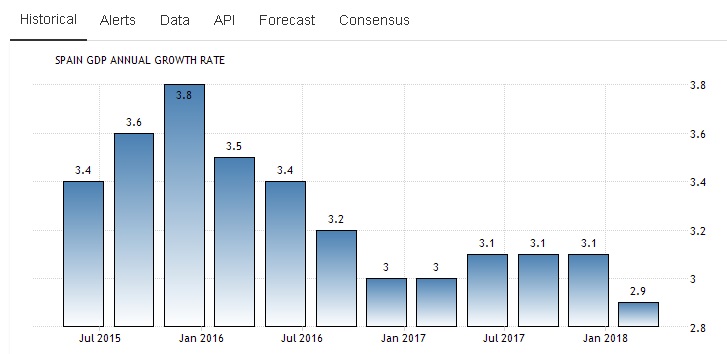
No matter how you slice the Pizza, the factual and actual quality Italian dish is under massive amounts of pressure on several sides and any Italian thinking that their life will get better in the short run is just gobbling down a [Unnamed Franchise] Pizza, bland food that look like a UFO and tastes not as great. The fact is that like Germany did earlier this decade, Italy will know 5-10 years of hardship, yet when persevered Italy could have an actual growing economy for a much longer time, something to look forward to (if you are Italian). Can this government pull it off? That is hard to say because it has been shown that the actions of the ECB are close to non-stoppable and that will still impacts the bottom line. It is good for America and George Soros in the short term, yet after that they will not care and Europe will not be going anywhere ever soon. That danger is just ignored all over the place. Just 2 days ago the Financial Times also gave us “There are still two weeks to go before Riga, but naming an end date for QE right now would be like the ECB shooting itself in the Italian boot,” said Carsten Brzeski, economist at ING-DiBa. “The Italian situation has tilted the balance towards the doves [and] clearly calls for the ECB to keep its options open and even to make clear that they will extend QE at least until December” (at https://www.ft.com/content/dd6b5d70-6413-11e8-90c2-9563a0613e56), which is already an extension of well over a year. so when we see “The ECB has pledged to reinvest an average of €15bn a month over the first four months of next year, using the proceeds of government bonds bought under QE that have now matured” in that same article, we need to consider ‘bonds that have now matured‘, so that danger is seen in the Spanish setting where we see from some sources: “Spain will have refinancing requirements that exceed €300 billion per annum before 2022. In 2018, 41.2 billion euro, in 2019, 82.4, in 2020 83.9 and in 2021 58.5 billion euro, with 60.4 billion maturing in 2022“, so this fiscal year Spain will be required to find €41 billion, or increase taxes or cut services, and it will be twice that amount next year around, so how exactly is Spain in a setting to get the economy back whilst the debts are rising beyond normal control? Italy faces “84 billion euro maturities in 2018, 161 billion in 2019, 164 billion in 2020 and 172.5 billion euro in 2021” do the Italian people know that they are in such deep and hot waters? I wonder, and when they get confronted with that part of the bad news cycle, what will the previous and opposition then proclaim? I wonder if we will see true honest coverage on that blame game. I will order a decent Pizza to watch that unfold, because there are merely the two larger players in the EU-debt zone bloc confronted with the hardships that will hit them hard. Pushing these debts forward is just not a workable solution, not when the debt exceeded 130% of GDP, if you doubt my words, just talk to the average Greek in Athens and ask him how his quality of life is nowadays.

So as you wanted that your slice of life included a slice of pizza, consider the 99% in Italy who soon face the reality that they are no longer able to afford that for a long time to come.


1 Comment

Filed under Finance, Media, Politics

Humble Pie

Merely a few hours ago, Bloomberg gave us ‘Iran Is Ready to Discuss Yemen Conflict with European Nations‘ (at https://www.bloomberg.com/news/articles/2018-05-28/iran-says-ready-to-discuss-yemen-conflict-with-european-nations). You might think that this is a good thing, but it is not. Iran is caught in a two side war, just like I predicted in the previous 3 weeks. Just like that, they are willing to talk. They have suddenly realised that time was up and now they are grasping at any side that will be willing to facilitate for them at a price. It is linked to a few escalations on more than one side. Even as we read here: “Iran will be holding a new round of talks with Europe on the Yemen conflict, negotiations that have taken on greater significance as the sides try to salvage a nuclear agreement“, the start gives the goods, Iran wants to protect the nuclear agreement at all cost. Their high farting like sounds of political boasting is coming to an end, there was never any option and now they must concede on several sides. Even as one side is taken from them, they are willing to concede on the Yemen side as it was never going to be a realistic option and as Hezbollah has failed again and again in their pursuit of successful strikes on Saudi Arabia, none happened and now they need to find the one war they might actually have a chance of winning, it is the Nuclear agreement and even that will backfire soon enough. So when we read: ““Iran, like the EU, is unlikely to want to mix fate of the nuclear deal with that of talks on other issues,” said Aniseh Bassiri Tabrizi, a research fellow at the Royal United Services Institute in London. “At the same time, it is important for them to keep a channel of communication open with the EU, whatever happens on the nuclear deal, and the best dossier to do so is Yemen for them.”“, I tend not to be in agreement. You might think that it is all the same, but it is not. It is not about ‘whatever happens on the nuclear deal‘, it is about making sure that this agreement is salvaged, Iran overplayed its hand and now that there will be hell to pay, they need to find a way out, if only they can find the right greed and ego driven Europeans to make a quick deal, at that point the media can reflect on some victory, whilst there is no actual victory. You see, there is a second side that is part of this. Iran has figured out that the only interests that Russia has in Syria are Russian ones and in that picture there is no space for Iran, Israel has made that abundantly clear and as such Iran stands alone and with the hits that Israel has been making in Syria on Iranian troops and the strike last Thursday as well as the silence (or better stated lack of loud boasting) by the Syrian governments indicates that the absence of Iran is well liked, even though they are not willing to state it out loud. Syria wants to get the most out of the Russians and Iranians as it can get, which is perfectly fine, yet Iran is too much of an issue for Israel, after years of boasting and threatening, Israel decided to act; the political field was ripe for that. With both America and Saudi Arabia opposing Iran and Russia not really caring about Iran, Iran is in an unwinnable situation, the Iranian coffers drained by enabling Hezbollah as well as the actions in Syria have drained a large chunk of their reserves, Iran need to cut its losses and it is doing so with the gesture we see in the Bloomberg article, one of many to follow I reckon. That truth becomes a lot harsher when we see: “Chagai Tzuriel, director general of the Israeli ministry of intelligence, said he believed that Moscow realised that fighting between Iran and Israel could undermine gains made by Russia during the Syrian civil war“, we know that there is no hiding for Iran, they played the game as far as they could, now that option after option falls away, they are determined to hold on to the Nuclear agreement. This also opens the second stage for Israel; they can now more effectively take care of Hezbollah, now that there is an open season on Iran, Hezbollah can (hopefully permanently) be dealt with. In that regard there is no lack of either Israel or Saudi Arabia to hunt them down and without Iran that might well happen. For Russia it is not over, you see, the Jerusalem Post gives us “Lavrov’s comments are part of an understanding reached between Israel and Russia to keep Iranian and Hezbollah forces away from Syria’s border with Israel on the Golan Heights“, that sounds nice in theory, yet over the years Hezbollah has shown never to keep any agreement (when they were not out of ammunition), so there is a setting where it is very realistic that Hezbollah will do whatever it wants and puts Russia in a pickle, as such both sides agreeing to get rid of Hezbollah makes perfect sense as such Iran is really not willing to stay there as a piggy in the middle. In addition Russia stands to make a lot of plus points in the Saudi Arabia side of things, not just by pushing Iran away from where they are, but to push Hezbollah away from Syrian and Jordanian borders which gets them nice points at the Jordanian royal court as well. In all this there is actually not one part of Hezbollah that has any redeeming value at all, and the worst part is that Hezbollah knows this too (yet they do not care).

There is one additional side that Iran needs to worry about. As Saudi Arabia has given to Germany to be the aggrieved party in Germany’s support in favour of the nuclear deal for Iran is already costing Germany a lot, the German giants who were tenders on several projects for the Saudi government are seeing them being cut from consideration, with Neom and Vision 2030, both projects totaling in value at well over 800 billion, the German economy will take larger hits, other EU nations might find themselves in a setting where they have to choose to go for a really bad nuclear deal, whilst there is no evidence that it will result in a better position and good economic settings in the longer run (more then 3-5 years) whilst Saudi Arabia is growing a setting that is getting closer to a trillion dollars over 12 years, there is no way that Iran can rely on any level of serious support, not after all the stunts they played. Their actions made it impossible and their boasting made it close to intolerable. In addition with Iran cut in every way, Turkey will now need to realise that they played the game wrong in other ways as well. Even as some might cry over the Russians not getting the F-35 due to getting culled from the program, Russia sees a second option to not just sell Turkey missiles, they could optionally sell them the SU-57 as well, which will get Turkey a new loan agreement for a few billions and let’s face it America needs to test the F-35 anyway, whether they test their F-35 against a Sukhoi, does it matter whether a Russian or a Turk is flying it? (Howls of deriving laughter in the background)

You see, they are doing this whilst their currency is at an all-time low, some might think that it is a great time to buy, yet with their economy in shambles and there should be no chance of them ascending into the EU in the next few years, the setting of spending billions on a new Sukhoi squadron (perhaps even two) seems to be folly to me. Even as there is some good news (read: numbers) coming from Turkey, its unemployment rate is still a little over 10.5% and seems to be rising over the next quarter, surpassing Italy in unemployment statistics. It is there where we see another issue. This matters as there has been a link between Iran and Turkey, so as the pressure on several sides is on Turkey, the economic pressures might force Turkey to make any deal they can, even if they have to break connections to Iran, which would for the most isolate Iran at that point, an option that both Israel and Saudi Arabia would enjoy. Israel especially as Turkey was threatening Israel with all kinds of sanctions (source: Haaretz).

So as Turkey is imposing sanctions on those deciding to recognise the Armenian Holocaust, we see the active economic impact that Turkey faces by being in denial, not the worst day in many lives.

In this there is a reflection that must be noticed, In Al Arabiya, there was an article (at http://english.alarabiya.net/en/views/news/middle-east/2018/05/25/Bitterness-confusion-among-Saudi-Arabia-s-foes.html), an opinion piece that matters. You see, the writer Abdullah bin Bijad Al-Otaibi (Twitter: @abdullahbjad) gives us “Enemies are upset and confused and the world is recalibrating its power equations so that each knows its place and capabilities. Also, so that each country can reflect on its policies and alliances through the power of politics, diplomacy, boycott and sanctions, as well as with the power of armies and weapons“, he is correct, President Donald Trump might have kicked it off with “America First“, it is a truth we have been forced to face for well over 5 years. It does not matter whether you are in the US, UK, Saudi Arabia, Sweden, Australia, Canada or New Zealand. As citizens and politicians we have a duty to protect our national interests and set that as a first essential need. When we look from that angle we get to reflect on how bad Iran is, we cannot fault Turkey for taking its national interests first, yet they did it by not honouring the allies they had for decades and that sets the sliding acceptance (towards rejection) of Turkey in all this when you consider the events from 2001 onwards.

In this his view: “Big European companies are fleeing Iran at a fast pace and everyone who has dealt with Iran, whether banks or companies, are looking for a safe way out of any ties they have with Iran, its parties, militias and ideology. Everyone now accepts the facts about Iran’s crimes such as its sponsoring of terrorism, drug dealing and money laundering in the region and the world” is not incorrect, yet the issue is that this sets the stage on greed influencing the national interest in the stage of big business versus government, a setting that Europe, the US and the Commonwealth have had for the longest time. In addition there is now a small opposition from my side. I agree with part of his statement “They have done so through the Palestinian cause which they have, from Iran, Turkey, Qatar and the Muslim Brotherhood, managed to exploit to serve their interests and fulfil their ambitions“, there is a side I cannot completely agree with (actually there is more than one side here). Not because I think he is wrong, but because there is data missing, data I never had access to, or was given by a reputable media source to the degree that there is enough shown to see it as an actual issue.

This is seen in the parties Iran and Qatar. Now, we accept the puppet game that Iran has played, we do not deny that in any way, but in the end Iran was merely playing the hand it had to show Iranian interest. We can agree that it was done badly, yet they did do this for mere national interest (or so they say). In the second part there is Qatar. I agree that there are questions, yet overall, I have not seen the evidence, the allegations going back to 2014 have been loud, yet the media and others have not given a clear path of evidence that gives light to the wrongful opposition by the Emir of Qatar, Sheikh Tamim bin Hamad Al-Thani, we can agree that there are some terrorist financiers, that was never in question, yet Qatar seems to have tried all legal ways and did not get anywhere, in addition the US state document (at https://www.state.gov/documents/organization/258249.pdf) does not give the goods either, we are confronted with “Qatar is a partner in the Global Coalition to Counter the Islamic State of Iraq and the Levant (ISIL) and has provided significant support in facilitating critical U.S. military operations in the region. Terrorist activity historically has been low in Qatar“, this does not make Qatar innocent; it merely shows that without better and more data, they remain ‘not guilty‘, which is not the same. The document is 3 years old, yet there is no new information that truly sets Qatar in a bad light (for now). In addition we see that Qatar State Security is aggressive when it comes to monitoring internal extremist or terrorism-related activities. Interestingly enough, the players from ‘team’ Qatar State Security seem to have a much better handle on internal extremism and terrorism-related activities than most European countries, so there is that to consider as well. The second issue I had with the statement by Abdullah bin Bijad al-Otaibi is the reference to ‘the Palestinian cause‘, which is not wrong to make, yet for many of us, especially those outside of Saudi Arabia, Palestine or the Middle East, we no longer know what ‘the Palestinian cause‘ actually is. You see in its origin it is directly linked to the 1948 Palestinian exodus, yet the entire Palestinian cause seemed to have been presented, projected and covered by the media in almost any setting that covered news in Lebanon, Israel, the West Bank and the Gaza strip. The entire definition has shown to have shifted over the decades and I still believe that it is shifting, even today. In addition the fact that western media over the years seemed to have made ‘the Palestinian cause‘ and ‘hatred of Jews and the State of Israel‘ close to interchangeable does not help matters either.

All these issues matter as they are connected. that connection is also part of the problem and reason why I am partially in opposition, now, I am fully aware that my opposition is wrong, or better stated incorrect, yet I am like most sensible people, I rely on data, and data is either reliable or not and I tend to regard shifted data as not that reliable, which is why I had the cause for opposition.

So as we see that Iran is facing humble pie on several fronts, we need to realise that our views and more important the views we get from information we accept as reliable is also filtering the view we have, it might be correct, or wrong. In the end we do not know and restoring our filters by attending our national interests first is not the worst place to start, as a citizen we need to do that, because when we look to our nation, our national needs and attend to that, we ground ourselves and perhaps as the economic settings have shifted, so will the national need and that is OK, as long as we do not tend towards corporate greed and consider the needs of our neighbours, we might get through the bad times in a much better way than we thought. In the end it is not about serving Iran Humble Pie, which would be the right thing to do, we need to consider when we are rightfully served Humble Pie, will we eat it when we realise that we were wrong?

That includes us all and it includes me, I have never shied away from optionally being wrong. I merely reacted to the verifiable data that I was served and I made the best of it and tried to remain true to the data based views offered and I reflected on those insights, it is the best we can do in this modern world.


Leave a comment

Filed under Finance, Law, Media, Military, Politics

Holding pattern

It feels like the world is in a holding pattern, it is awaiting events and there is no news on a few fronts. The first is on gaming; a little over two weeks remain until the E3 starts, which is when the actual (official) news is given. Part of me is sad, because there have been so many leaks that I fear we already know what is coming to the larger extent. In this I got confronted with more issues surrounding the Xbox One, and even as they proclaim it is going good, I am of the mind that good just is not it, it will not even be close to it. If the Business Insider is to be believed, there will be a lot more bad news coming to the Xbox One owners, the article (at https://www.businessinsider.com.au/playstation-4-vs-xbox-one-e3-2018-5) gives us “‘Crackdown 3’ is an exclusive Xbox One game, meaning it will work on the One X and One S“, implying that this is the first game that no longer supports the Xbox One. Pushing people into upgrading to new hardware? I see that as one more nail in the coffin called Xbox. The information (at https://www.xbox.com/en-AU/games/crackdown) is equally sketchy, yet that game cover does not have the HDR part, implying that there might be two editions, one for the Xbox One X and one for the normal Xbox, which would be very acceptable, implying that they are soft pushing people to upgrade their console which is a fair and acceptable business practice. I wanted to be certain and no misinform you, so far there is no real mention on it, yet there seems to be a version on HDR (implying Xbox One S and Xbox One X only), in addition one source had another box art, yet Amazon did not, neither did a few other shops, so this could become a very large issue close to Christmas as the latest (unconfirmed) issue is that release is planned for later this year.

The PlayStation has similar holding patters, we know the four larger titles and that is it on the exclusive front, implying that both will be a little more dependent on the makers like Bethesda, Ubisoft and EA to hold the candles for unexpected news. I am particularly interested in what Ubisoft brings. I think it was 2 years ago, when they truly hit a home run at the E3, in that time we all got overwhelmed by Ubisoft that had cleaned up its act. AC Origin exceeded everyone’s expectations (including mine) and playing on a much higher level the second time around had been fulfilling in a way I never expected. In addition, even as I kept a distance from Far Cry 5, it shows, that for those who wanted more of the same, it did satisfy, in addition its first actual setting towards open gameplay was a true evolution, so those who wanted ‘more of the same‘ got a lot more than they bargained for and that is a good thing. So we have no real idea what Ubisoft is bringing and that is good, knowing all the things that matter beforehand is not good, it takes away the WOW factor in announcements and I think the French know that. In that same setting we also look forward to Bethesda, who apart from last year tends to make homeruns, they focused on the VR setting last year and when you are not into that you tend to feel left out a little. So here’s hoping for this year. Most are hoping for a new Elder Scrolls (non-online) game announcement, which is a stretch and unlikely. I am still proud of having made an initial setting for Elder Scrolls VI: Restoration, but it seems that Bethesda had other ideas. Fair enough, it is their IP. Yet we recognise that Skyrim was 7 years ago from initial launch, we should give the cautious setting that it is time to WOW us with a new one, especially after 7 years. Fallout 4 is getting towards its 3rd anniversary, yet with the season pass giving us so much, we still feel decently satisfied for now. I personally feel that a Fallout 5 is at least 2 years away from a clear announcement and for those overwhelmed Fallout shelter can keep your blood flowing on mobile and a few other devices, the fact that it is free and no real purchase is needed just makes it an amazing extra. And that is all for the games section at present.

Rocket Men

There is a man, a Rocket Man, it is not the man in the song, not the quote from the movie; no, as we see (at https://home.treasury.gov/news/press-releases/sm0392), we are given the US Treasury setting: “the U.S. Department of the Treasury’s Office of Foreign Assets Control (OFAC) designated five Iranian individuals who have provided ballistic missile-related technical expertise to Yemen’s Huthis, and who have transferred weapons not seen in Yemen prior to the current conflict“, the issue I have voiced for a while, again I have been proven correct, and even as the media at large was all about calling Saudi Arabia names and just blindly staring at the victims (which is not entirely wrong), we are treated to “Treasury is targeting five Iranian officials who are associated with the IRGC-QF and Iran’s ballistic missile programs. Their actions have enabled the Huthis to launch missiles at Saudi cities and oil infrastructure. They have also disrupted humanitarian aid efforts in Yemen, and threatened freedom of navigation in key regional waterways“. I agree to some extent with Treasury Secretary Steven T. Mnuchin, I do not think that he is entirely correct. To give understanding to my statement, we need to look at the 5 names.

Mahmud Bagheri Kazemabad and Mohammad Agha Ja’fari who were acting for or on behalf of the IRGC Aerospace Forces Al- Ghadir Missile Command. Javad Bordbar Shir Amin and Mehdi Azarpisheh who are members of a special forces unit of Iran’s Revolutionary Guards responsible for their extraterritorial operations, they report directly to the Supreme Leader of Iran, Ali Khamenei. In addition there is Sayyed Mohammad Ali Haddadnezhad Tehrani, who is allegedly providing, financial, material, technological or other support for, or goods or services in support of, the IRGC Research and Self-Sufficiency Jehad Organization. I use allegedly because without the clearance levels I cannot vet the final part of data there. I believe that Sayyed Mohammad Ali Haddadnezhad Tehrani has at least partially and most likely fully deployed Chinese walls to isolate him away from that, yet there are at least three names missing, these people are part of the training and deployment side of the missiles. It is my personal opinion that Javad Bordbar Shir Amin and Mehdi Azarpisheh could not have arranged that by themselves, they are without doubt involved, but on that level they had higher level help, not merely the smuggling of the missiles, the deployment, training and smuggling of the missiles is specific knowledge, it is very specialist knowledge and in that (at least) three names are missing. That mess is actually growing. It is seem in the first part in Bloomberg (at https://www.bloomberg.com/news/articles/2018-05-23/doubts-emerge-at-eu-steps-to-counter-u-s-iran-sanctions-threat), in all this we see at the end “The commission is also looking at creating special purpose vehicles to allow transactions with Iran, the people said. The effectiveness may also depend on whether the U.S. treats them as a circumventing tool, one of the people said. “If in the end jobs will be lost in Germany, one has to ask whether this is the right thing to do,” German Economy Minister Peter Altmaier said in a TV interview last week“, it is an issue! It is an issue, because mere open source intelligence and common sense gave me the inside view that have been proven correctly, the entire Iranian mess as we see now, whilst the people in the Bloomberg article are all about acting or is that not acting) because jobs are lost, whilst the entire missiles on the attacks on the Saudi civilian population is just ignored as well as the plight to the Yemeni civilian population because of the acting of Iran, the EU has a much bigger problem and it is time that the people start thinking this through. From my (an admitted optional flawed view) is that the Iranian mess started with Sayyid Ruhollah Mūsavi Khomeini and never stopped being an issue, which amounts to January 1st 1980 being the setting for the mess we are in now. I am willing to admit that if the US and UK had left Iran alone in the actions of 1953, we might not be in this mess, but that is too much water under the bridge, what is the setting is that the BBC (at http://www.bbc.com/news/world-middle-east-44230983) gives us Ayatollah Khamenei’s main conditions.

  • European powers should protect Iranian oil sales from the US sanctions and continue buying Iranian crude.
  • European banks should safeguard trade with Iran.
  • The UK, France and Germany should pledge not to seek negotiations on Iran’s ballistic missile programme and regional activities, both demanded by Washington.

The supreme leader said that if the three counties were unable to meet these demands, Iran would resume its enrichment of uranium. this translates to ‘do not interfere in Yemen‘, which is a regional activity, the fact that EU politics seems to be very willing to do that makes for more concern, in addition, when we look at the newspapers in the EU, we are left in the dark on several issues, which is also a concern. They are all focused on the Saudi attacks, the Yemen events, but not on the Iranian support setting for firing missiles into Saudi Arabia, that seems to be off limits and that is a massive issue as I personally see it.

So here to is the beginning of a holding pattern, an issue that is stretched over time, allowing for non-activity to rule the setting. Now, there is a twofold part, one is positive, because there is a partial setting where waiting the next move makes perfect sense, yet the numbers give us that thousands are getting exposed to Cholera and famine, not a combination you want to see, because at that stage, even with medical hep, the chances for surviving are not that great to begin with. Even as the people on Facebook are hiding behind “Stop the Saudi-led war on Yemen that kills civilians and destroys the country infrastructure“, the bulk of everyone remains in denial of Iran’s part in all this and the fact that Yemen is used as a stage to attack Saudi Arabia whilst Iran relies on ‘I know nothing‘ is a setting that is much worse because those are the people who the EU are trying to keep their business alive within a nuclear setting, whilst there have been clear indication that Uranium enrichment is an event that will be happening in Iran. Yes, that makes all the sense in the world (implies sarcasm).

The holding patterns cannot be fought, because acting is not always the best thing to do, yet the entire Yemeni situation started in March 2015, well over three years ago, so I think it is time for the EU to actually actively respond to the actions of Iran, they have had enough time and intelligence to act. Their non-actions at present should be regarded as beyond cowardice, cowardice to facilitate to those who need a deal, who need financial blessing (read: greed). To illustrate this, WikiLeaks gave us in 2007,

In any case, France is prepared to “go beyond” multilateral Iran sanctions. A/S O’Brien suggested that the GOF make public statements about the risks of doing business with Iran and the recent decisions of major European financial institutions to cut off Iranian business. France is currently developing new legislation to criminalize arms proliferation and proliferation finance, above and beyond its criminal penalties for violations of UNSCR 1737 and 1747. O’Brien passed GOF officials two Treasury non-papers on Iranian state-owned Bank Melli’s proliferation-related activities and the Islamic Revolutionary Guard Corps (IRGC) and IRGC-Qods Force’s extensive use of the Iranian state-owned banking network. Regarding private sector outreach, A/S O’Brien met with senior officials at Paris-based Banque Natixis to discuss the risks of doing business with Iran“, for the forgetful, that was when Mahmoud Ahmadinejad was in office, so there had been a massive drive to get more ‘revenue’ for the Natixis board of directors. I guarantee you that it goes downhill from there, the settings we see are not great, it never was, yet the need for the EU to do something and not as a 27 nation block keep on sitting on their ignoranus was not what the people were signing up for. That evidence is seen at the UN (at https://www.un.org/press/en/2018/sc13225.doc.htm), in here we see “attacks against civilian targets in Saudi Arabia were unacceptable and raised concern over the Panel’s findings that Iran had provided short‑range missiles and unmanned aerial vehicles, in breach of paragraph 14 of resolution 2216 (2015).  Urging the Council to stand firm against such violations, he said that while the United Kingdom had sought to ensure a balanced and impartial text, it also had not shied away from calling out those who had violated international agreements“, in that, Russia hid behind “The Russian Federation’s representative, also speaking before the votes, said he could not support the United Kingdom‑sponsored draft, as he did not agree with its inclusion of unverified information. Assessing the Panel of Experts’ work in the manner mentioned in that draft was misguided“, so whenever a Russian firm approaches Saudi Arabia for a Neom or Vision 2030 project, we should make sure that the Saudi officials are reminded of the SC/13225 meeting on 26th February 2018. I should see if I can get an opportunity there too, my bank balance is really really low at present. So in the end we all act on economic needs, the only difference is that I am doing it upfront (making it no longer a reality), but if I can stay honest, why not the elected officials that make well over 3000% of what I end up with?

Is that not an interesting question too?

Have a great day!


Leave a comment

Filed under Finance, Gaming, Media, Military, Politics

The Sun shines regardless

There is a setting that we forge, the setting we do not see. It is the setting we experience by becoming a politically correct hive of sleepy minds. We are in a setting where yesterday is forgotten and tomorrow needs to be planned for. After spending time in the Middle East, and after seeing things you cannot fathom in nightmares, we are confronted on the edge of what we call civilisation bolstered by the reality of events. The guardian gives us (at https://www.theguardian.com/film/2018/may/15/vomitive-pathetic-lars-von-trier-film-prompts-mass-walkouts-at-cannes), the view of perhaps one of the most controversial Danes in history. I got introduced to his films in 2002 or 2003; it was Dancer in the Dark. The movie had such an impact on me that I ended up being depressed for over a week. Never before had a movie impacted me to such a degree. Bjork and David Morse were diamonds in a foul soaked universe of corruption and perceived presentations of what people want others to be like, an awesome experience. There would be another movie that would shake me to the core. Gaspar Noé would ‘grace’ us in 2002 with Irreversible. It was interesting in just one part, apart from the overly jumping between time frames, it was stated as “a movie so violent and cruel that most people will find it unwatchable“, yet it was not unwatchable, because when I grew up, this is what my father did to my mother and in the end it would quite literally be the death of him, but not before he caused her death 25 years earlier. The Dutch courts were unable to protect her until it was much too late. It sets the stage of a growing essential need towards the exposure of these ‘softies’ and their inactivity and denial towards domestic violence. To throw some facts at you, 25% of ALL women in the UK will experience domestic violence that means that 8 million women will be gotten at. That is a frightening number and that is only the UK, it is actually much worse, this is gotten from Professor Sylvia Walby as we get: “Whilst this number is shocking, we also know it is grossly underestimated. The cap on the number of violent crimes published, set at five per victim, means that even if a woman experienced 100 incidents of domestic violence, only five would make it into the official data“. The entire setting of ‘capping’ of victim events makes it even worse. It shows a nation in denial, too fixed on not acting, and it goes a lot further than the UK, in this it is a global issue and globally governments are not actually doing anything, merely painting the rooms red so that the blood is not noticed when guests arrive, so in that we see our own denial.

This year, as the Guardian shows us, we might see Lars von Trier shine again, because if a movie can make a man like me truly depressed on watching an event, it means that he is getting his point across, a point that we deny ourselves from grasping. In all this he does not work with beginners or amateurs. In the movie we see Matt Dillon and Uma Thurman. The trailer alone shows that this might be not just the highlight for Matt Dillon; it might end up being one of the most challenging roles in his life. So when we see some of the feedbacks, other thoughts go through my mind. You see, when I see “Al Jazeera’s Charlie Angela also left the screening early” with the response “seeing children being shot and killed is not art or entertainment“, it becomes an issue of debate, you see, from that point Kramer versus Kramer is not art either, neither is the Deer hunter. Yet I am willing to take Charlie Angela on a small tour into Yemen, I can take her for a small walk through Taiz, where we can look at the dozens of children cadavers, we can also look at women and men all shot dead, the reality of war, it is not art or entertainment, we can agree on that, yet it is the reality of life, a reality millions shy away from on a daily basis. The deaths in US schools, not by the NRA, but by really confused people, the mere impact of mental health issues where the government is in denial of the events, all caught in political correctness and inaction. Perhaps it is really good for people to get direct exposure to such things. So for all those people running out of that cinema, I would state: ‘Welcome to real life!‘, in a bus full of people, when you travel on it, realise that each week, one of 10-12 trips, you would have shared a bus with a person just like Jack, so when you look around in that bus, knowing that one of these men is just such a Jack, would you still travel per bus? Instead of making domestic violence and spousal abuse an element of the Human Rights Act article 3, where we would optionally see: “In prosecution spousal abuse and domestic violence will be seen as a transgression of Article 3 of the Human Rights Act as a form of torture, torture of body and mind“, so when that transgressor (mostly men) are prosecuted for beating up his partner merely because he got a little crazy as his football team lost, just how much better will the safety of any woman suddenly become when he goes to prison 5-15 years, when he loses his house, access to his children and no further future? I reckon that the unemployment numbers will suddenly drop to zero. The evidence shown by the Guardian (at https://www.theguardian.com/society/2014/jun/08/police-fear-rise-domestic-violence-world-cup), where we see: “The most detailed research into the links between the football World Cup and domestic abuse rates has revealed that in one force area in England and Wales, violent incidents increased by 38% when England lost – but also rose by 26% when they won“, so when we know that this evidence has been there for 5 years and still we see no change, is it not strange that inaction prevails?

One review (one of many) gave us: “Nicolas Barber gave the film four stars out of five and said “Undoubtedly a bold and stimulating film which no one but Denmark’s notorious provocateur-auteur could have made”” Nicholas Barber of the BBC is right.

If there is one part clear in me is that the movie has the ability of waking up the people drowning in political correctness. They need to be woken up because there is too much data showing that inaction has not worked for decades and we need to step away from it, if only to push change and t push those acting in unacceptable ways to be pushed into the limelight and then out of visibility. If those ‘Christian souls‘ are suddenly visibly forced to embrace people wearing sweaters with the term ‘Domestic abusers’, will they still be Christians? Will they act of keep silent, because the wearer is a boss, their boss or someone really wealthy? There is supporting evidence for that. In that regard we can look at Jeffrey Epstein. When we realise that the evidence which included “the FBI received accounts from about 40 girls whose allegations of molestation by Epstein included overlapping details“, when we see “In May 2006, Palm Beach police filed a probable cause affidavit saying that Epstein should be charged with four counts of unlawful sex with minors and one molestation count“, did we expect what was coming? When we see “escaped a prosecution that could have seen him jailed for the rest of his life“, now consider that the conviction: “he was sentenced to 18 months in prison. He served 13 months before being released” and no one seems surprised, is there anyone still surprised?

So when we see the dialogue of Jack in the movie, where we hear (it is in the trailer) “When I think about all the things I’ve done in my life, without it in any way resulting in punishment“, we need to realise the nightmare scenario. What happens if every domestic abusing man becomes another Jeffrey Epstein, and if caught merely needs to wait 13 months to do again what his dark soul demands of him, when we realise that our inactions are the cause of our undoing, our politically correctness gives us the setting of something so incorrect that it can no longer be corrected for. What then will you do? When we realise that it was not the gun that killed, as is the truth, but our sense of righteousness send us targeting the people and the evil that they do. What will the life of the US attorney general be like when he wakes up in some future and that morning he learns that 10 Wall street executives were shot in the head, a one clip 10 rounds magazine, one bullet per executive? Will his motivation be that these Wall Street executives had rights, that there was the onus of presented evidence against the 175,000 people they made homeless or the optionally missed taxable $293 million in revenue that the state of New York is now missing out on. What would drive him (or her) that day you think?

The House that Jack built is a very different wake up call, reality expressed through art. to some it is a very valid thought that it is not entertainment, yet now look back at Kramer versus Kramer and wonder who comprehended even in the slightest the plight of the child in Kramer versus Kramer? Now ask yourself, what else have we missed out on? What did we sleep through in our politically correct driven universe and think of 8 million women in the UK alone, battered and bruised? How would you like to wake up like that at least one day a month, after month, after month? Most people including me will not consider the House that Jack built entertainment, yet, just like the Deer hunter, can we avoid seeing it, can we turn our backs on levels of reality we are unable to deal with? Consider Wolf Creek and the reality of what happened, so when we see: “criticizing it for its realistic and unrelenting depictions of violence” and now consider “the July 2001 abduction of British tourist Peter Falconio and the assault of his girlfriend Joanne Lees by Bradley John Murdoch“, who got a life sentence for the murder of Peter Falconio. When you were unaware of the reality of it and the impact that some people made on the reality of life of their victims, we need to remain aware that at some stage we must take notice and realise that the legal system to a much larger degree is flawed, perhaps even permanently broken. I reckon I can get no less than 8 million witnesses of that fact. In addition when we see that the victim Joanne Rachael Lees was willing to do an interview as: ‘she felt the public profile of the case had diminished‘, that took merely 4 years, 4 years for people to forget what a couple had to go through in a rich world setting like Australia, not Myanmar, not Thailand or Yemen, Australia! It is a setting that is unsettling and perhaps it requires Lars von Trier to make sure that we forever remember that the reality of some settings exist through political correctness and inactions. Even as some defence goes up as the culprit in Australia was caught, take a look at this short advertisement (at https://www.youtube.com/watch?v=g9DQgai4-C0) and wonder how many did not get caught and how many events are we turning our backs on so that we need not take notice of our inaction on all of it?

They sometimes state that the rain falls on the just and unjust alike, as well as the sun shines regardless of good and evil, yet will it truly do that in the long run? Whether through politically correctness, or inactions, we are slowly turning our world into a place that is less and less liveable, perhaps it is required to give it a rude awakening every now and then, and the movie the House that Jack built is merely (a lot more than merely) a reminder to wake up every now and then.

This is reflected in other news too. When we consider the Jerusalem Post we see the words of Haim Tomer, words I actually disagree with. Haim Tomer, formerly a top official at Mossad believes that the situation is that Israel, the US and Saudi Arabia can secretly help advance Iranian regime change. I believe his thoughts are folly. They are wishful and not very realistic. The play we see ongoing as Mahmout Ahmadinejad was not re-elected is not an elected official (President Rouhani), but a person that the Clerical and military side of Iran allowed to elected in accordance to their needs, the inactions that the President showed to have as Iran military provided (speculatively with the blessing of Iranian Clerics), is that Hezbollah is provided for, in Yemen Houthi’s are provided with missiles and in all likelihood training from Iranian military advisors. The rest of the world did not intervene in any way as we saw actions in Yemen and merely the outbursts against Saudi Arabia and merely soft whispers for any Iranian missile fired from Yemen aimed at civilian populations in Riyadh. Our inactions, the inactions of elected governments; governments that sat on their hands for years whilst the slaughter in Syria continued, all inactions that have long term impacts, we merely ignore them.

So when I kill 12 people, I am a serial killer, as Hezbollah kills hundreds as quoted through “In Syria, Iran’s special forces and its mercenary recruits — Hezbollah militiamen from Lebanon and Shiite hired guns from Central Asia — have helped President Bashar al-Assad perpetrate a ruthless genocide against Syrian Sunnis, including the use of poison gas, in order to maintain a pro-Shiite, pro-Iranian dictatorship in Damascus” (source: NY Times), they are now referred to as ‘militiamen‘, not terrorists, not mass murderers, no: ‘militiamen‘. Is this merely political correctness, or a way to set the stage for inaction? How much actions against events must happen for things to truly change from bad to worse?

I think that when you coldly look at the House that Jack built, when you realise that these inhuman acts are actually happening on a near daily basis and we do nothing, we are stopped to talk about it via political correctness and the politicians and elected governments, elected by people like yourself are setting stages of inactions, will the movie not be the wakeup call that you need to make a first change?

In all this EU governments are setting the stage to keep a nuclear deal going, a nuclear deal with a nation that has visibly shown that it will act out in inhumane ways towards civilians, through the Hezbollah puppet that they fund. In the end, consider that your inaction left no trace on your soul, you still sleep like a baby because the issues in Syria did not matter and they still do not matter for the thousands dead in Yemen, so when you consider that the House that Jack built was too revolting for words, consider that your inactions have made that setting an optional reality, because in the end, those who do survive Syria and Yemen grow up, do you think that they end up being balanced people? Do you think that the watched atrocities by children in Yemen and Syria will create happy people? In the end the real difference between a soldier, a mass murderer and a serial killer is merely the willingness to wear a uniform and the willingness to end the life of another person. Two elements driven by a lack of empathy and morality, merely two elements that has seen flaws as it is impacted by political correctness on the outside of the issue and forgotten as well as ignored by those who faced the issue; in that light it became flawed, some revert to stating that political correctness is merely ‘Moral Decency‘, yet that decency is set by the masses and they are too often very willing to remain in a state of inaction (Chemical attacks in Syria is clear evidence), so in that light, how was decency served?

I wonder how long it will take for religious speakers to get to the street and force inaction to give way to ‘social radicalism‘, when that happens, do not cry, you wanted that all along, that is what we see through the inaction of too many. When those political principles make waves and hit the limelight, make no mistake, social media like Facebook will drive it to very different levels of hypes and there is no way to block it, so when you hear that there is no social radicalism, you are in error. It is already happening in the UK, in Australia, in the Netherlands, in Sweden and Germany, France has it as well as Italy and Spain; it is pretty much everywhere. The Odyssey (not the book) gives us “freedom of speech allows us to speak openly about whatever our interests may be. I feel that many people take this to the extreme, spouting bigotry and ignorance without reason“, there is also “Many people are not willing to postpone particular standpoints in order to evaluate what stands outside their own perceptive bubbles“, which I personally believe to be the driving bubble in all this. The media at large uses this to their ‘circulation advantage‘ by focussing on the emotional drive in this, like the bulk of Murdoch media has done for the longest time (not just them though, it is a globally large community that is just like Murdoch, or envisions to become like them). They focus on getting emotionally driven hypes and in absence of filtering and non-emotional evaluation, we get a collective of angry people speaking out, normally it is a good thing, yet there are globally more and more angry people and that drives another wave of chaos, fuelled by inactions we see more and more people willing to become extreme in one way or another and in that we see social behaviour in decline, empathy falls as angry people tend to not consider or allow empathy and that is where we create a larger mess.

Perhaps angry or not, sitting down and taking serious notice of a movie like the House that Jack built is essential to create a wave of opposition, a wave that shocks us to a degree where we consider our perspective on what we consider to be real and actionable and when we consider the bettered woman and consider that this was once our mother, how can we not become protective of the victim we see?

In finality, when you consider that the FBI defines mass murder as murdering four or more persons during an event with no “cooling-off period” between the murders, now consider the amount of angry people, people pushed onto the edges for various reasons, some very valid and consider that they merely need to reach the point where they are willing to take a human life. Now realise that this was not the NRA, or its members promoting this, guns do not kill people. People kill people! We allowed the setting for so many to become and remain so angry often due to inaction. We are our own worst enemy and until that situation changes, we ourselves are the driving force to create more and more victims.

The sun will shine regardless we do this actively, or whilst we remain inert and inactive to the events around us, and politicians love to mention that the sun is shining, they don’t even have to actively achieve anything for that.

This setting gets a larger exposure when we see (at https://www.theguardian.com/australia-news/2018/may/14/margaret-river-shooting-murder-suicide-could-not-be-predicted-wa-premier-says) “The murder-suicide of seven people at a rural property in Western Australia could never have been predicted and the cause may never be known, the state’s premier has said”. I do not believe that to be true. When we see: “Peter Miles, 61, his 58-year-old wife Cynda, their daughter Katrina, 35, and her four children – daughter Taye, 13, and sons Rylan, 12, Arye, 10 and Kadyn, eight – were found dead at Forever Dreaming Farm in Osmington on Friday”, we see the loss of 7 lives, something like that does not merely happen. When I see ‘embroiled in a bitter dispute with Katrina about access to the children’, I see it is not that simple, but it is still, to some part a larger issue that involves frustration and anger, the smallest of settings for what we now see evolve (compared to Syria and Yemen). In light of what I wrote earlier, I believe that anger and frustration in light of ‘political correctness’ become unwanted emotions, we turn away from them, filter them away. I believe that this is merely one additional factor in all of this, we turn away from the realistic cold light of day from what displeases us and as such we miss the dangers that grow within our very communities, it is a global issue and it is growing. Yet in the northern hemisphere, it is May, it is spring and the sun shines, it will shine regardless in too many places and what we see will happen again, on several levels. When you watch the trailer of the House that Jack built in the Guardian article (or at https://www.youtube.com/watch?v=eA0pI_k-Dmo), now consider the one scene at 1:35, where we see merely a flash, in addition consider Lukas Moodysson’s Lilya4ever. I lived in an apartment building like that, it happens for real to people around us under our very noses and we no longer see it happen. The movie Lilya4ever was loosely based on the true case of Danguolė Rasalaitė, and examines the issue of human trafficking and sexual slavery. I think that the House that Jack built is more important than we realise, if only to realise on how we react to it and when we realise that there is reality on several levels shown, consider how much in denial we all really are, regardless whether the sun shines or not.


Leave a comment

Filed under Law, Media, movies, Politics

Iranian decisions

At 00:10 Tel Aviv Time, roughly 07:10 here, the time of waiting was over, Iran has fired its missiles on Israel making the outstanding option of an impending war a lot more realistic. In this the Guardian gives us (at https://www.theguardian.com/world/2018/may/09/iran-fires-20-rockets-syria-golan-heights-israel) “Iranian forces stationed in Syria fired approximately 20 projectiles at Israeli military positions in the Golan Heights just after midnight on Thursday, Israel’s defence forces (IDF) said“, in addition we see “Several but not all rockets were intercepted by Israeli air defences, an IDF spokesman, Lt. Col. Jonathan Conricus, told reporters“, whatever happens, will happen soon, because if sch a barrage cannot completely be stopped, we can deduce that it will not take long for Iran to take a more targeted notion, yes, my version is speculative, yet the warmongering words from the last weeks gives rise to take it all a lot more serious than it has been taken in the past. So when we see ““The IDF views this Iranian attack very severely,” Conricus said. “This event is not over”“, we better believe that more is to come. There is an additional setting, this attack could only have been done with the approval of President Bashar al-Assad, so he is feeling secure enough with Iran and Russia backing him, so the picture changes on a few fronts, this is no longer merely settling whatever Iran thought it was settling, this could have much larger repercussions. Turkey is already voicing support for Iran and siding with Russia (they are playing their hand cautiously, yet Turkey is all in with their anti-Israel views. It gets to be worse, because as the US pulled out of the nuclear Iran accord, we now see ‘EU rushes to arrange crisis meeting with Iran over nuclear deal‘ (at https://www.theguardian.com/world/2018/may/09/eu-moves-to-protect-european-firms-from-us-sanctions-on-iran), so even as we know that there are several things wrong, even as Iran meddled in other business and now is responsible for direct missile attacks on Israel, we see that Europe is still trying to make some level of a deal with Iran. It goes even further when we see “Work on the package being coordinated by the European Union is at an early stage, but the EU is being urged to warn the US it will impose countersanctions if the US attempts unjustifiably to cripple EU firms trading with Iran“, yet the foundation is that there has been more and more overwhelming evidence that Iran has not been dealing in good faith. When we consider the earlier settings that I mentioned 3 days ago in ‘Stopping Slumber, Halting Hesitation‘ (at https://lawlordtobe.com/2018/05/07/stopping-slumber-halting-hesitation/), we can just quickly decide that they were prepping for all this, which would be incorrect, yet the fact that 20 missiles got there so quickly to be fired on the Golan heights also indicates that there was Iranian willingness to go that distance in several political branches and on pretty much all military levels, which is equally unsettling. The issue is that the EU remains a lot quieter when it comes to the involvement of Turkey. It is a personal view of mine, yet I believe that there will be diminished needs soon enough and there is a Turkey EU membership play coming. The beginning of ‘compliance delay messages‘ is merely an indicator, I believe that the fear mongering will get worse and too many parties are playing that game, that whilst the denial of Turkey into the EU should have been clearly made well over a year ago.  So when we are treated to “The European Union is scrambling to arrange a crisis meeting with Iran after Donald Trump pulled out of the nuclear agreement, as the Iranian president Hassan Rouhani said Europe had a “very limited opportunity” to save the deal“, we also need to keep in mind that terms like ‘could’ connected to ‘shut down UK’ on EU laws, this level of fear mongering is just beyond acceptable and we might all be better off in a direct war and whomever survives will suddenly demand near draconian treatment of the media, even as Leveson 2 is (for now) off the rails, the next crises will not go that smooth for whomever is demanding greater accountability of the media. That is not the only part, the entire Turkish economy and the S&P decision to regard Turkey. As it junkified its currency rating from ‘BB/B’ to ‘BB-/B’, we see a larger impact and when we consider that the Turkish lira (TRY) has fallen 7.4% this year and in that setting, including the corporate debt problems that Turkey is facing, the entire blow hard whilst they are not producing any music is more than merely wind in the air, as Turkish economic growth has been fueled by cheap international credit, we still see the need to pay for all that and now as we see (actually it was last month) with “Yildiz Holding—owner of the brands Godiva chocolate and McVitie’s biscuits requires a complete restructure of $6.5bn of its total $8.5bn of debt by the end of this week“, a cookie factory having an eight billion dollar debt? What else is in such disrepair? That shows just how desperate Turkey is at present to get into bed with almost anyone, that is what we are allowing in our midst and there is no level of fear that seems to be reflecting off the sides of EU Brussels and Strasbourg, which is also unsettling, now as they are optional diplomats in a really bad case of reconsideration by merely the EU to get the nuclear deal going, now we see the rise of mentions and soft press tapping on Turkish doors.

That alone should scare us beyond measure!

There is no case against it all and whilst Turkey is at a stage what some call ‘Hostage Diplomacy‘ whilst they are now upgrading their arsenal with the Russian S-400, the game switches and none of this will end up having a happy ending. For now we can leave Russia out of this as its focus is merely the US, or intermittent board hugging to make the US look bad via the EU, yet overall the setting here is not too negative (for now), the issue merely becomes hoe friendly it needs to remain with Iran in the mix, because there is the game on a different level. From my point of view there is a certain level of polarisation, even as Europe should stand next to Israel, it seems intent on standing ‘diplomatically‘ alone so that they need not stand opposing Turkey, that is merely one view, yet in light of its financial hardships and Turkish needs to be seen positive towards becoming an EU nation is not a good combination. So when we see the EU with “As long as Iran continues to implement its nuclear related commitments, as it has been doing so far and has been confirmed by the International Atomic Energy Agency in 10 consecutive reports, the EU will remain committed to the continued full and effective implementation of the nuclear deal“, which all might be very true, yet Iran has shown different colours in Syria and against Israel, so that stance is not merely wrong it promotes polarisation. On the one hand, the EU is not doing anything wrong from that one treaty point of view, yet in light of what we have seen in Syria, there are a lot more issues in play, not all are on Iran, some are allegedly issues for Iran to answer, but I wish to not use that in the examples, merely because they are allegedly part of anything, meaning they are part of nothing until confirmed and when we consider the utter uselessness on the last chemical attack reports, certain Syrian issues cannot be labelled to anyone but Syria itself. So as things in Syria escalates and as Iran is escalating them, or at least actively part of the escalation, the EU will need to take a stance sooner rather than later, they prefer later, yet when they are forced onto a corner and they select Turkey and Iran over Israel, the game will quickly change and not only is Europe feeling that drain, the impact that will happen in the middle East, is one that Europe will suffer for a much longer time than they bargained for and there is no quick solution for the wrong decision. That will be evident pretty soon at this stage.

So as we see one side evolve, we see in similar news from the Wall Street Journal (at https://www.wsj.com/articles/missiles-fired-at-saudi-arabia-signal-support-for-iran-by-its-proxies-1525886469) the mention “Iran-backed Houthi rebels in Yemen fired a barrage of missiles into Saudi Arabia on Wednesday, an early indication that Iran’s allies in the Middle East are likely to flex their muscles in a show of support for their patron—risking a wider conflict“, I think that these events which were apart by merely a few hours had some levels of coordination. So when we see “Yemeni army forces, supported by allied fighters from Popular Committees, have fired a salvo of domestically-designed and -developed ballistic missiles at “economic targets” in the Saudi capital city of Riyadh in retaliation to the Al Saud’s devastating military aggression against their impoverished country“, we need to keep a clear mind. The missiles are said to be Yemeni (Borkan H-2 missiles), yet the information on the H2 is that it is said to be a short range ballistic missile with normally a range of about 1,000 kilometres (620 mi) or less. Even as we see it is almost capable of making the 1,036 km to Riyadh, the setting that we see with ‘economic targets‘, whilst at the maximum distance, the chance of actually hitting what is aimed for at the maximum range is a lot less likely or possible, not without and ace rocket and ballistic expert at the missile site; the Houthi’s are a little short on both, so we have, in my personal opinion, either Houthi’s that want to hit any part (mainly civilian parts) of Riyadh and they merely claim to be aiming for a bank, or the optional more likely setting is that Iran has been directly involved in training the Houthi’s or firing the missiles themselves. Now, we can opt for option one, yet the training curve would be a little devastating on all minds involved (even if you use targeting computers and software, yet they have had the time to train the Houthi’s for months, so it is possible, yet I personally see it as less likely (again merely speculation from my side), so when we consider that Iran is waging war on two fronts, so far (as far as I can recall) only Napoleon and Adolf Hitler were that stupid and how did it end for them? There is an optional thought that Iran will be hiding behind European coat tails in the end, but that is still speculation without evidence (at present), perhaps that is why Turkey is in a desperate state to become part of the EU?

I am merely asking, because the Iranian decisions we are seeing over the last 24 hours give rise not to the US, but to other players hoping to wage ‘extreme’ solutions to make things go forward for them, whilst the opposing player has no intention of playing nice, the US can’t start another war and Iran might be hoping that the EU is too unwilling to see its economic setting dissolved through armed conflict. It would be a decent tactic to play, but for now it merely remains a setting of speculation. Yet, in all this, there is more than just saber rattling. When we look at Reuters we see “Turkey will continue its trade with Iran as much as possible and will not be answerable to anyone else, Economy Minister Nihat Zeybekci said on Tuesday, as U.S. President Donald Trump said the United States was withdrawing from the 2015 Iran nuclear deal“, so we see Turkey with an utter lack of accepting accountability for the economic paths that they are trying to get on (aka the EU gravy train). How can anyone expect Turkey to have any level of civility in the setting of economic partnerships? Because in the EU setting, we have seen more than one play where such acts would not have been allowed, yet Turkey is setting the pace to do just that. It is an important setting as it gives Iran a green light they should not have had, it is merely the outspoken voice to set the colour of options, and that colour is the one of explosive red. That is shown by others as the setting that is not to be allowed. Even as we understand that there is a setting that Italy, Germany and France do not want these sanctions to happen, we see that their voice gives “Patrick Pouyanné, the chief executive of the French energy firm Total, has already called for the EU to pass a blocking statute“, which makes perfect sense, and it is likely to happen, yet when we see the Turkish response with “Turkey will continue its trade with Iran as much as possible and will not be answerable to anyone else“, it merely shows that they are nowhere near ready to be allowed into the EU as a member state, because when they do something like this after they are admitted, the game changes by a lot and from that moment onward Turkey becomes merely the liability of the EU, not a member of the EU and there is a large distinct difference, even as we see them in the current setting for now, there is absolutely no guarantee that they will not continue on the undermining path that they are on, we have seen too many instances of Turkey acting that way that way in the last few years.

When we return to Iran we seem to be in deep water, not healthy waters by the way, the Riyadh/Golan actions are debatable at the very least and the fact that they are being mixed gives light to the dangers that are upcoming. Can they be avoided is the larger question, I am unsure of an answer, the fact that Yemen and Syria happened at almost the same time is a larger issue to contemplate and I have no factual useful response. Waiting for now is pretty much all we can do. I don’t think that we have to wait for too long as Israel has already announced retaliatory strikes a mere 15 minutes ago (source: Haaretz). So this cookie will not merely escalate, it is certainly the setting where other cookies get crumbled as well, the mere question is: “What are our options as per tomorrow, or the day after?

I do not know, when it comes to Yemen, we all (mainly the EU, NATO and USA) sat on our hands for far too long and they have made it part of the package deal. So the first act (at present) might just depend on how much Saudi Arabia feels threatened.


Leave a comment

Filed under Finance, Media, Military, Politics

The truth that kills you

It started in a setting that I observed and wrote about for the last few years, every now and then the NHS rears its ugly head. My look into this started when the Labour party has created a £11.2 billion fiasco that involved IT. When it comes to governmental IT issues, the UK does not score that high. In addition, when you drain a resource in one path, the other path tends to fade away and there were always politicians who claim they could do better, yet experience for over 20 years have shown me that they tend to remain clueless on the matters at hand. The moment they accept it, they go have lunch with friends who all see opportunities and before he/she knows it, the required scope has grown by 250% and soon thereafter it becomes too large to manage. From there onward it goes from bad to worse and that is how the NHS got sliced and diced (just one of many issues plaguing it).

So when I saw ‘Shock figures from top think-tank reveal extent of NHS crisis‘ (at https://www.theguardian.com/society/2018/may/05/nhs-lowest-level-doctors-nurses-beds-western-world) I was not convinced that the Guardian had even ruffled the top layer of feathers here. So I took a look. Now, the article is linked to the King’s Fund that has the numbers (at https://www.kingsfund.org.uk/publications/spending-and-availability-health-care-resources). The work by Deborah Ward and Linda Chijiko is actually really insightful, and an amazing read. So let’s take a look and they do not disappoint, the start gives us “Although it can be difficult to find data on health care resources on a comparable basis across countries, international comparisons can still provide useful context for the debate about how much funding the NHS might need in future. There is also precedent for this approach – for example, when Tony Blair famously pledged on the ‘Breakfast with Frost’ programme in 2000 to get health spending up to the European Union average“, I have to consider the value of adding flair of Blair, but it is fair enough (or was that flair enough). Yet, data is everything and proper data rules the setting, this paper recognises that and that is a massive victory.

It is important to add (pasted) the following, because it shows the value to a much larger degree.

Alongside the UK, we have chosen to look at a selection of 20 European or English-speaking countries drawn from across the OECD. For some analyses, data was available for only a subset of these countries. For some indicators, data was only available for services delivered by the NHS and did not include resources in the private or voluntary sectors.

List of UK comparator countries in this report

Australia Czech Republic Germany New Zealand Slovak Republic
Austria Denmark Ireland Norway Spain
Belgium Finland Italy Poland Sweden
Canada France the Netherlands Portugal Switzerland

Unweighted averages and medians have been used throughout this report to summarise data for the collection of countries as a whole. The amount of people who relied on weighted data cannot be underestimated on stupidity to some degree, as we get raw numbers we see that weighting would look better, yet less accurate. In this we do recognise the danger we see with ‘each country is given equal importance regardless of the size of its population‘, especially when we consider that non-rural Denmark tends to me limited to Copenhagen, and rural Netherlands (if there is any rural part left) tends to reflect Birmingham population numbers on average, so when we also take into consideration the truth of ‘The median and unweighted average are often very similar across these analyses, though the median will be less affected by extremely low or high values‘, we know that we are looking at something serious, but in the micromanaged parts (bordering rural/non-rural), there will be the sliding of values at times, not on a national scale, but where we consider certain parts per nation do not properly reflect internationally (the Netherlands vs France or Canada vs Germany).

Now we take a look at certain segments. The first one is “Under the Organisation for Economic Co-operation and Development (OECD)’s new definition of health spending, the UK spends 9.7 per cent of gross domestic product (GDP) on health care. This in line with the average among the countries we looked at but is significantly less than countries such as Germany, France and Sweden, which spend at least 11 per cent of their GDP on health care“, Sweden stands out as it has a much more refined social based system, so there is a shift there, yet as Sweden has 3 cities (Stockholm, Goteborg and Malmo), whilst the rest are basically villages some no larger than 1600 people (2 of them), the rest are between 2,500 and 140,000 in size, so in that regards, the population spread required an approach that differs from several nations, especially when you consider a place like Skellefteå and Lulea in the north. To give a little more reflection Skellefteå has 33,000 people over 8.39 square miles another 40,000 live outside of the ‘city’ limits. So it is 3,900 persons per square mile that in comparison against Birmingham that has 10,391 Ashton Villa fans per square mile. Different solutions are needed, and more often it the hardware (ambulance/helicopter) is very different especially in the winter season (in Sweden) where they actually have a white Christmas and often a white Easter as well.

Now we get to what initially was considered an issue by me, but that was because Denis Campbell Health Policy Editor of the Observer messed up a little (likely unintentionally). You see the article in the Guardian gives us “They reveal that only Poland has fewer doctors and nurses than the UK, while only Canada, Denmark and Sweden have fewer hospital beds, and that Britain also falls short when it comes to scanners“, now what is stated here is true, yet by stating “Britain falls short in several ways, especially when we compare ourselves to the Unweighted average. When we do that when it comes to nurses, only Spain, Italy and Poland have a less fortunate situation“, the Unweighted average gives a proper light per 1,000 population and that is where we need to look at the start and the King’s Fund research is doing that splendidly and shows that ‘spendingly’, the UK falls behind. It falls behind more and more is still speculative, yet if the coming 3 Financial years do not show a massive increase (read: change to the NHS approach) that will become a worsening situation for the population requiring nurses, doctors and equipment.

In the reports, I find one thing missing, that is, it would be a good idea to have that, you see, in the part Medical Technology, the CT Scanner part is partially flawed, Australia scores massively high, which is nice as I am on that island, but I also recognise the part missing there, even as there is a proper notice given with ‘Data for the UK only includes MRI and CT units in the public sector, so these comparisons should be treated with particular caution‘, the missing element is not the numbers, but the distance. As Australia is an ‘island’ nearly the size of Europe, it has its own problem, most of Queensland is rural territory and when you consider that Australia is twice the size of India, the amount of technology they have is often a burden on the size of that nation and the mere fact that the 5 large villages (Sydney, Melbourne, Brisbane, Adelaide and Perth) merely represent 65% of the population, the rest is rural.

Yet the more I read on this report, the more I respect it, it clearly shows issues that the NHS UK has, partially due to its own flaws (the report does not show that). It shows at the end that there is space for jobs “There are approximately 100,000 vacancies for clinical staff in the English NHS, and nearly half (49 per cent) of nurses do not think there are sufficient staff to let them do their job effectively“, but it does not show the ‘elitist’ approach the UK has had for decades into allowing transference of other nurses (from other nations) to become part of this workforce, yet the impossible standards that the UK have used to stop that falls short of the shortages and lack of services now thrust upon the people in need of medical services. The second part is seen (at https://improvement.nhs.uk/documents/2471/Performance_of_the_NHS_provider_sector_for_the_month_ended_31_December.pdf), here we see: “Providers have not met ambitious cost improvement targets and it is critical that these plans are recovered before year-end

Providers set out plans to deliver a total of £3.7 billion savings this financial year. The sector has outperformed the wider economy by delivering an implied 1.8% productivity improvement. This was supported by cost improvements of 3.3% – equivalent to £2,139 million of improvements in the first nine months of the year, £97 million higher than the same period in 2016/17“, so how to read that? They need to show better for the same amount, they were unable to deliver and they still got paid? Is that how it reflects, because that is merely the setting of a disastrous business model, in that the elitist overkill hire approach of nurses will never be in a proper setting in that way, or solved which would be nice too.

So when we see: “By Q3 the sector had achieved 65% of the forecast efficiency savings for the year – to meet the forecast outturn, providers will need to significantly step up the delivery of CIPs in the final quarter. However, the same pattern was seen in 2016/17, so there is evidence to support the increased delivery in the final quarter“, which sounds nice, but they would still come short by no less than 20%, so even as we complement them by getting better in the home stretch, they still did not make the delivery they promised and no matter how ‘ambitious‘ the goal is, a goal not met remains a failure. So when we do address the shortages on all levels and the setting on how ‘some top think-tank‘ gives us ‘shock figures‘, it still revolved around a much larger mess that has not been addressed for the longest of times and is still nowhere near up to scrap.

The goods we need we see on page 51, with the setting of ‘Nursing vacancy position‘ we see how most other failures are shown to fail merely due to shortages, the fact that the NHS has 35,000 vacancies also shows on how timelines cannot be met, when we see that in regard to the shortages nurses to the job of 1.4 nurses, there will be more burnout and more delays on every field. Throwing money at it will not really solve the issue, because this is the one field where we see the direct impact of service levels versus the impossible demand of nurses. So when we accept that the nurses program requires a larger overhaul in setting the stage we see that this is te first field where the military are actually becoming part of the solution.

How speculative can we get?

Here is a warning that matters, because the changing of settings is essential to shaping the future. Consider two places the first (at https://www.army.mod.uk/who-we-are/corps-regiments-and-units/army-medical-services/queen-alexandras-royal-army-nursing-corps/) where we are introduced to Queen Alexandra’s Royal Army Nursing Corps (QARANC), as well as the recruitment (at https://apply.army.mod.uk/roles/army-medical-service/army-nurse). Now consider that the army is charged with the setting of training all applicant nurses to serve the NHS. So immigrants and optionally their children get a short access path to serve the UK on medical terms and it comes with complete processed nationality (after initial screening is passed). So families get the option to become British and part of the society they moved to. Now, this will not always work, yet if you see a 35,000 shortage and you get to lower that by 1,000 each year? Let’s not forget that the shortage is not going away any day soon, so any approach we can take we should consider. Now this is not for everyone, and more importantly an army nurse is still a military function, yet in this setting, there will be training in English, UK values, medical training, language and more importantly the years to come will show whether they have what it takes, in the end we use a structured system to infuse the NHS in operational ways, in addition, as the there is a growing need at the NHS, we see other parts where such reflections would grow the power of the NHS indirectly.

Both logistical and engineering sides of the Military could spell equal options to grow the NHS, or at least grow the ability of taking care of itself sooner rather than later. When we consider that the cost of agency nurses are close to astronomical (at http://www.kentonline.co.uk/medway/news/trust-spends-11m-on-temporary-nurses-180427/) gave us “Medway NHS Foundation Trust spent more than £11m on temporary nursing staff last year, a Freedom of Information request has revealed“, so when we consider that, is calling the army to aid in setting the boundaries back by a fair amount that much of a farfetched call? When we also see “There is a shortfall of 40,000 nurses across the UK, which has been driven by a lack of nursing training places in recent times“, is my call to call in the army and its instructors that much of a leap? Now we can all agree that it does not work on all fronts, but we can either stare at the missing beaches we have now, or start creating our own beachheads and see if we can see how new solutions could be implemented. There is no certainty, only the certainty that at the present course there will never be a solution that is what needs to be addressed. We need to accept that the current approach towards solving the NHS issues is not realistically set. When we look at merely one source (at https://www.nurseuncut.com.au/how-australians-can-get-nursing-jobs-in-the-uk/), we see the language that is given even after you get the NMC (the Nursing and Midwifery Council), you passed the tests, you have shown that you are who you are, your medical knowledge has been assessed, we then see “The hard work isn’t over after this point though, as you will obviously still need to find an actual job within the NHS. Fortunately, there are places designed to help – such as agencies like Nursing Personnel, where you can find a range of jobs across different disciplines and in different UK cities“, so we see that the agencies are set as a buffer, filling their pockets, so they never ever want to see that changed. In addition there is “Following this, you must apply for and then receive a valid work visa to ensure you can legally work in the UK. Finally, when all the pieces are in place, you can begin your new nursing role. Good luck!“, So even after that path is taken, after you get your NMC pin, there are still two iterations to get through, even as the Army, or even directly via QARAN, we could see that the entire path, towards the NMC, especially by those who have a nursing degree. That was never an option? Not even as I discussed such a path almost 4 years ago? When we see the shortage and the non-actions in this, can we even have faith that those around the NHS want anything fixed? It seems that they get ‘rewarded’ no matter what, especially the agencies, so when we see the money in that, why would they want to fix it? I say start by fixing this for the nurses first, which will get delays down and will give additional rise to finding as the agencies get less work, it also states that the invoices form them disappear meaning that millions become available. More staff and alternatively also more equipment could be the beginning to solving two issues to a larger degree. After that we can start looking into addressing the shortages on doctors, yet I also feel that once the nurse shortage is addressed, the doctor shortage might partially take care of itself. Even as the Financial Times reported last year that almost 400 GP’s a month quitted the NHS, addressing the nurses shortage will lower that number and when there are enough nurses we will see that it might lower to almost zero (speculative), yet as one fixes two other issues, we will suddenly see that when nurses reach above the unweighted number of 10, other numbers are guaranteed to shift too, because as agencies make millions less, those millions will shift to optional beds, medication and technology. Suddenly the UK will not look so bad overall. Now, let’s be clear this is a path that would take no less than 3 years to see certain parts turnaround, but it is a realistic path with a realistic curve of improvement. So even as we get served “Portsmouth Hospitals NHS Trust has 9,264 4 hour breaches (25.5%)“, we can also see from the other numbers that a larger extent is due to a shortage of nurses, so when we accept that they could climb to 85%-90%, we see that the entire setting suddenly looks less grim, so even as we need to realise that there is a setting (based on location) that the overall need of 95% performance is ideal, the question becomes is it a realistic setting, when all matters are equal it might be, yet at present all things are not equal and that is the part that requires attention, it is not the top 5% made that sets the standard, it is the acceptance of those in the 90%-95% range that requires merely some scrutiny, the question becomes, which one alteration might get those in the 90%-95% range there? I believe that nurses are merely one part, technology is the second part and as we deal with nurse shortages, there is a setting that technology gets fixed to some degree in the process. This paper (Spending on and availability of health care resources: how does the UK compare to other countries?) does not answer it, but gives light to the path that requires attention, the paper gives a path to investigate and that is equally massively important, so when we consider figure 2, can the change between New Zealand (10.3 nurses) versus he Netherlands (10.5) above the unweighted average of 10.4 show that difference of attaining the ‘revered’ 95% score or higher? Because of ‘irregularities’ that national needs tend to have, it is a cautious approach, yet the idea that it solves it is one thing, yet the one part not shown here (hence I took these two reports) is that even a we accept that they cannot be used in comparison, the setting of getting the 95% mark is still an essential statistic (by some) and if so, we accept that we go by the Unweighted average as a mere indicator, is that the right indicator to use (read: rely on), or is there a number missing? Is there a ‘Nominal Coverage‘ missing that is an indicatory number that aids us towards the A&E 4-hour standard setting and the attainment of the 95% score? Now it remains indicatory as there will always be a shift towards nominal nurses and actual nurses, but we need to start somewhere and if additional nurses are the first requirement to start turning this around, these numbers will become a lot more important, that part is not addressed (which was never the setting for Deborah Ward and Linda Chijiko), yet it is an issue for the NHS and the writing and results by these two ladies, might be a first step in actually getting there. When we look at the simplicity of it, was it really that far-fetched? I am merely asking, because my flair for oversimplification can be overwhelming for a lot of ‘experienced analysts’.

Yet, my mere focus has always been, how can we fix/improve the current NHS?

It is the path to solution that we need to care for, how it can be fixed, if it can be fixed. I have forever opposed the Jeremy Corbyn approach to throw money at it, because in the current setting the only one getting a better deal are the agencies and they are already cats that are way too fat. Hence I look at the directions where training and education sets the pace and in that pace we need to find opportunities for the NHS to pick the fruits form the yard, it is merely a different set of spectacles, the spectacle is not merely about the presentation, it is about setting the right focus, because focus shows us where the flaw is and where we can initially start the focal point of repairing the situation.

The weird part is that Canada, the UK and Australia have similar issues, so there is a foundation of repair missing which is equally a worry. In all this someone is getting rich, is it so hard to look at those getting rich and why that is? The fix could have been underway as early as 2014, the fact that it is nowhere there is worthy of many more questions, yet the bulk of those who could ask them, do not seem to ask them visible enough for all people to wonder how certain matters could be fixed and when one is fixed how much the other problems diminish, an equally important question. Even if it is merely for the reason that not finding these answers could kill you, either in an ambulance, or in a corner of a hospital awaiting a nurse to get you to the proper place for treatment, would that not be nice too?

 

Leave a comment

Filed under Finance, Media, Military, Politics, Science

Milestones

We all hope to make certain milestones, some through fantasy, some through luck and some through anticipation. Your first threesome, the moment you joined the mile high club and for governments they have their own achievements, for example when they join the 100% debt club. So when we realise that Japan has well over 200% of GDP in debt, the US has passed the 100% marker and it joins those they looked down on for the longest of times. Italy, Iceland, Granada, Eritrea, Greece, Jamaica and Lebanon, all members of that 100% debt club, so when we see the Arabian Business (at http://www.arabianbusiness.com/politics-economics/395741-100-debt-club-set-to-get-new-member-from-oil-rich-gulf), treat us to the facts that Bahrain will soon join Libya and the Sudan as their debt exceeds their 100% GDP. We see more and more messages at present and even the IMF is setting a different atmosphere. We see part of that in equities.com. There we see “IMF (Page 10): Against a backdrop of mounting vulnerabilities, risky asset valuations appear overstretched, albeit to varying degrees across markets, ranging from global equities and credit markets, including leveraged loans, to rapidly expanding crypto assets.
MY TRANSLATION: In the last two major bubbles, the problems were mostly contained to dot-com stocks and housing. That is 100% not the case now. Almost every single asset on the planet – from stocks to bonds to loans and more – is wildly overpriced. There is zero room for error with prices at such dizzying heights
“. This is merely one setting; the field is expanding on a larger field and in all this, the nations that are passing the debt bar. France is set at 99%, so if they cannot contain the debt growth they will pass it this following financial year, leaving only Germany as one of the four large economies that is in a containable situation and there is where we get a partial ‘I told you so!‘ You see I wrote on part of this 5 years ago. (at https://lawlordtobe.com/2013/05/15/a-noun-of-non-profit/), I made a reference in regards to Brexit, but the setting of it all was a lot larger than merely Brexit. So as you get to contemplate “Consider a large (really large) barge, that barge was kept in place by 4 strong anchors. UK, France, Germany and Italy. Yes, we to do know that most are in shabby state, yet, overall these nations are large, stable and democratic (that matters). They keep the Barge EU afloat in a stable place on the whimsy stormy sea called economy. If the UK walks away, then we have a new situation. None of the other nations have the size and strength of the anchor required and the EU now becomes a less stable place where the barge shifts. This will have consequences, but at present, the actual damage cannot be easily foreseen. Any claim that there is no consequence and they predict no issues, remember this moment! The Barge (as is), will lose stability and the smaller members thinking they are on a big boat are now thrown left to right then left again as the storm rages on. The smaller nations will get damaged and in addition, the weaker ones (Cyprus and Greece) could still collapse, especially if the UK takes a non EU gander“, this was predominantly regarding Brexit. Yet the implications are larger as I stated. The UK is taking on Brexit and now we see that the German anchor it the only anchor giving some stability, the UK is taken away, Italy has lost its footing as it surpassed the 100% debt and now France is pushing that boundary as well. All because it was easier to play the popular fool than taking a hard stance on their debts, France is not alone, Italy and the UK are all there, the smaller ones have no options to give strength to the large 4 and as the UK figured out that going it alone is much better for the economy, we see a dangerous setting.

Even now, when we merely consider Spain in all this (not the smallest economy), we see (at https://www.southeusummit.com/europe/spain/spanish-economy-returns-grade/) that Standard & Poor’s is still playing (what I personally see) as ‘their little game’. Perhaps you remember ‘S&P reaches $1.5 billion deal with U.S., states over crisis-era ratings‘ (at https://www.reuters.com/article/us-s-p-settlement-idUSKBN0L71C120150203) the one quote (one of many) needs to be considered “S&P parent McGraw Hill Financial Inc MHFI.N said it will pay $687.5 million to the U.S. Department of Justice, and $687.5 million to 19 states and the District of Columbia, which had filed similar lawsuits over the ratings“. So when I see “S&P notes that Spain’s overall economic and budgetary performance has not been hampered by political tensions in Catalonia, as many had feared. The country’s GDP increased by 3.1% in 2017 and last week the Bank of Spain raised its economic forecast for this year to 2.7%, up from a December forecast of 2.4%“, you see, the numbers are not really in question, yet when we see the image below (source: Trading Economics).

When we realise that none of the EU nations has a grasp on their debts, in addition, the GDP for Spain went down whilst it is still below the numbers of 2016 and before, there is actually no reason to see the credit rating for Spain go up. I am personally speculating that the EU will be so much more hardship when France hits the 100% debt marker. It matters, because this will soon become the academic exercise that the question: ‘What is the difference between cooking the books and creating a false positive wave through inflated credit scores?‘ I actually do not have the answer here, but I guarantee you that the quality of life in Europe is not moving forward any day soon, not until some issues are seriously reconsidered. In addition, the US-China trade war isn’t helping anyone, not even the Europeans so that will also become a factor of debate soon enough. It partially relates to “We have revised upwards our GDP forecasts, with an intense rate of employment creation and an economic model based on the external competitiveness of our companies. With this scenario, we will achieve our objective for 20 million employed people by 2020“, the issue is that it is misrepresentation, you cannot rely on the unemployment figures and then state we will have 20 million employed, because on a population of 46 million, he might be implying that the unemployment numbers will skyrocket from 17.4% in 2017 to 56%, that would be crazy, yet that is what we are told, is it not? The best lies (read: miscommunications) are done through statistics, so that the feather matches the bird one would say. Still, back to my speculation, I believe that Spain is not the only nation in this setting; I think that some numbers in pretty much every EU nation are beefed, weighted and set to make Europe (or basically themselves in the European setting) look much better, so when the UK leaves they will not look as weak and feeble as they have actually become. It is a setting that is way too dangerous. There is no way that Mario Draghi is not part of this, so when we look at the Financial Times of last week we see ‘Mario Draghi acknowledges ‘moderation’ in Eurozone growth‘ (at https://www.ft.com/content/3e20b49e-4939-11e8-8ee8-cae73aab7ccb). So with “Analysts said that Mr Draghi’s guarded language suggested that the ECB may wait until July — a month later than previously expected — to provide the markets with updated “forward guidance” on its plans to phase out the crisis-era stimulus“. I am a little less optimistic in regards to the quotes, and when we see ““Better safe than sorry was the motto of the day,” said Dirk Schumacher, economist at Natixis“. I personally tend to see that as:

Better safe than sorry
It allows for another day without worry
As we pile the worries and woes
To a stack we can blame on crows
Those at the London Tower are best
Because when they leave the EU we can make them the jest
And when our barge is no longer secure
We move to Wall Street where we can endure

You might think that I am merely making light of all this. The issue is that people in Europe seem to ignore that over €2,000,000,000,000 was printed without the validation of treasuries or consent of the people whose funds got devaluated even further. Do you think that printing money has no cost? It is money that the EU never had, so why did you think it came without consequence?

This partially (and I mean partially) is seen in different ways when we look at an article from Reuters merely two weeks earlier (at https://uk.reuters.com/article/uk-ecb-policy-draghi/stock-volatility-no-big-factor-for-ecb-so-far-draghi-idUKKBN1HG1VR) ‘Stock volatility no big factor for ECB so far – Draghi‘, now I agree that volatility will come and go, so the ‘so far’ part is perfectly fine. When we see ““While we remain confident that inflation will converge towards our aim over the medium term, there are still uncertainties about the degree of slack in the economy,” Draghi said in the ECB’s annual report“, now I can agree with that. There will always be a certain amount of uncertainty, that is all good, no issues there, but it is set on a certain premise. When we see that Spain (the only visible one) suddenly in opposition of what I see as real has its credit score increased and as such we see the start of an optional bubble, when others do the same we see the forecast on unreal values, so we see the bubble is not set to the reality of the actuality, at that point, when a lot more start realising that some numbers do not make sense, the uncertainty grows and the closer the UK is to leaving the stronger that uncertainty becomes. At that point we see a run and a total collapse, when that happens, when the people realise that pensions before 78 is no longer optional, do you think that the people will remain calm? When they realise the impact of €2 trillion printed cash is impacting the 26 nations, how much value decline will they face? When that happens, how will people react in all this? Now we get to two elements, one is the mention in the Financial Times where we see: “But the weak economic data for the first quarter have triggered increasing speculation that the first interest rate rise will be delayed until later in 2019. A smaller number of analysts are expecting the bank to continue QE into the new year“, the second is that the entire stimulus was to set the economy right, which did not happen, now set that against inflated credit scores, inflated economies and the downturn that follows, that will happen, it can no longer be contained, merely delayed to some extent. When it does hit Europe would not have a penny left to balance against and it will leave the bulk of Europe destitute. There would be no defence against the next downturn and that is when disaster will truly strike. So as the story is pushing towards ‘protectionism’ and ‘patent values’, we should also consider that impact. Now, as a University graduated Master on Intellectual Property rights, I do comprehend some of the issues, yet I am not a patent attorney, so there are parts that I will ignore or not look at. Consider that a national economy is now more and more dependent on the national patents and the represented value that they hold. Now we get European Patents, the Unified Patent Court (UPC) allows for a simpler way to get it all registered and to some extent enforced. So it is a good thing overall, there was never too much fuss about that side, yet the one strong economy (Germany) is now setting the stage to oppose the UPC, we see this (at http://www.ippropatents.com/ippropatentsnews/europenewsarticle.php?article_id=5725), where we also see “Alternative für Deutschland (AFD) has called for the repeal of the convention on a Unified Patent Court (UPC). AFD “rejects the EU patent law reform”, according to the German Bundestag, which announced the motion on 7 March“, I believe that overall the UPC is a good thing, but there will always be small interests that are not perfect, no EU setting is 100% positive, yet overall, to get one filing for all EU nations, in light that even the UK agreed (and ratified) is a good thing. So when we see “It was based on three grounds, mainly how the UPC Agreement violates EU law, the majority requirements of basic law, and does not comply with the rule of law principle related to judicial impartiality. The complaint was scheduled to be heard in 2018 by the second Senate, appearing as the 11th item on its agenda. In Germany’s 2017 federal election, the AFD won 12.6 percent of the vote and received 94 seats, the first time it had won seats in the Bundestag“, there is an academic setting, yet with 12.6 of the council in hands of the AFD, a very Brexiting minded party, or is that Berlout or Deutchleave, we need to realise that the patent issue is a lot more biting in Germany and that cannot be ignored, as they give rise to uncertainties. So when we get back to the uncertainty there, as well as other uncertainties, and whilst we saw Mario Draghi accept that uncertainty results in stagnation, how much more stagnations are required for the next downturn, even a short term one, whilst the economic reserves have been already been drained.

Now we have a much larger setting, the EU was never about everyone agreeing on everything and the economic setting that requires that to happen at present is also making the dangers of waves that sinks the barge called EU. Now, that seems like an exaggeration, but when you realise that the German anchor is the only one giving stability, you can see the dangers the EU faces and more important, the dangers of no reserves and an utter lack to keep proper budgets in place, a setting now in more danger for the reasons that I gave supported by the economic views of many others. I believe some are downplaying the impact, yet when we realise that EVERY European Union government is downplaying the economic impact (as every nation always wants to look as good as possible, which is a PowerPoint setting of the human ago) we get a much more dangerous setting. We accept that the smaller nations have a negligible impact on the whole, but on a ship that can only remain truly stable with four anchors, losing three is a much bigger disaster than anyone realises, and that downplay will hurt all the players that are part of the EU, so when the downturn starts, we will see kneejerk movements from all the nations, all the big players and we can only speculate the fear mongering speculations that the IMF will treat the European audience to. I have no idea what form it will take, but when it happens I will take a deeper look. In a setting where every negative economic milestone could lay waste to whatever reserves its citizens wrongfully thought they had in the first place.


2 Comments

Filed under Finance, Media, Politics, Science

Something for the Silver Screen?

There is an issue in Europe, well, there are plenty of issues in Europe, but until now, I steered clear of one of them. Something does not add up and it is now more of an issue than ever before.

This trip started in the Washington Post, after I saw several articles in the Guardian. You see, with one article it has become something else and that is very much an issue. So (at https://www.washingtonpost.com/world/europe/russia-to-respond-very-soon-to-british-decision-to-expel-its-diplomats/2018/03/15/89e27b4a-2839-11e8-b79d-f3d931db7f68_story.html), we see ‘U.S., France and Germany join Britain in saying Russia likely responsible for chemical attack against former spy‘, the mere title. Now, I am not saying that this is not what happened, not even implying that it is some figment. Yet, why would we see ‘U.S., France and Germany join Britain‘? This is a simple murder, perhaps an assassination, or liquidation. Whatever word you use for the event, it does not matter to the person who got iced, he definitely no longer cares. But we, we should care, for us this entire situation matters. So when we see in the very beginning “formally backed Britain’s claims that Russia likely was responsible for a chemical toxin attack against a former spy living in England“, I personally am not convinced. There would have been any number of actions that would have resulted in the demise of that person. To get a gun is usually not hard if you know the people. There was a person in the 90’s that one could meet near Ilford, would be able to get a whole range of guns, no silencers though. Still for £350-£500 (in those days) you could get something not too fancy and it would clean the clock of whoever needed to be done. Just make sure you do not do it in the wrong place and upset the local family guy, because that tends not to work. Still, consider the ease of a mere gun against the dangers, the risks and the trouble of getting VX into the country, than getting it to the location. You only need to see the movie ‘The Rock‘ to know that it requires several things, a lot of it dodgy and that stuff is not that stable to begin with. Now, as we see that there was a nerve agent in play, so I am not opposing that. I am merely stating that this kind of work is odd to begin with. That is beside the point of any SVR RF, FSB or GRU member freaking out having to take that shit with them. It is not merely overkill; it tends to leave you without options if you fail at first. And ask any Murphy that your shit goes wrong the first opportunity nature gets their hands on you. It is a fact of life. So in that regard it seems to me that Novichok is a weird choice to use. This is also me stating that I have no evidence that it was NOT used. So when I take a little lesson in Novichok, I learned the following:

  1. At https://www.opcw.org/fileadmin/OPCW/CSP/RC-3/en/rc3wp01_e_.pdf, we see “Regarding new toxic chemicals not listed in the Annex on Chemicals but which may nevertheless pose a risk to the Convention, the SAB makes reference to “Novichoks”. The name “Novichok” is used in a publication of a former Soviet scientist who reported investigating a new class of nerve agents suitable for use as binary chemical weapons. The SAB states that it has insufficient information to comment on the existence or properties of “Novichoks”” which they state on page 3 in paragraph 8. Now this is 2013 and this is 5 years later. Yet, as some sources give us that it was developed in the 70’s up to the early 90’s, it seems interesting that there was nothing on the matter 20 years later.
  2. Yet that same OPCW gave us in April 2011, two years earlier the two following parts on page 7 at 11.1 and 11.2. With: “This has been attracting increasing attention in recent years, particularly among non-governmental organisations (NGOs). Although very little information has appeared in the public domain, there have been claims that a new class of nerve agents, known as “Novichoks”, has been developed. In December 2008, a former defence scientist published a book, which included information on structures reported to be those of the new agents. Some of these structures meet the criteria for Schedule 2 B4 (S2 B4); however, all others are non-scheduled chemicals. The author claimed that the toxicity of certain “Novichok” agents may exceed that of VX“, something that should have woken up the CIA instantly, something deadlier than VX and no defence? There is no way that they wouldn’t have been chasing that, even if it was merely to find a defence against it.

So now we have the play to some extent in view. The BBC gave first view (at http://www.bbc.com/news/uk-43377856) with “Former spy Sergei Skripal and his daughter were poisoned by a military-grade nerve agent of a type developed by Russia“, yet it is the innuendo of News.com.au that takes the limelight. With “Investigators believe the nerve agent that poisoned former Russian agent Sergei Skripal was planted in his daughter’s suitcase before she left Moscow, The Telegraph newspaper reported, citing unidentified sources. Skripal, 66, and his daughter Yulia, 33, were found slumped unconscious on a bench outside a shopping centre in the genteel southern English city of Salisbury on March 4“, so not only did they go the whole nine yards to get to both, the entire issue is that both could have been removed simple enough in Salisbury. The entire matter does not add up. Another source, The Jamestown Foundation gives us “Sergei Skripal (66), a former Russian military intelligence (GRU) colonel, was arrested in Moscow in 2004 for allegedly being an agent of the United Kingdom’s MI6 intelligence service. Skripal was convicted, in 2006, to serve 13 years in prison for treason. In 2010, he was pardoned, released and sent to the UK in a major spy exchange involving a big group of “sleeper” spies who had been arrested in the United States, promptly convicted and deported to Russia“, so if we accept these facts, than we see that he was shipped to the UK 8 years ago. So now we see such an overkill event? It does not add up!

This level of overkill implies (mind you I am saying ‘implies’) personal orchestration, this is a message, but for who the message is for (or ‘from’ for that matter) is not clear. There is enough evidence that the toxin was used, but there is a long road here. Even as we accept the Jamestown Foundation giving us “Other officials insist Novichok was never officially defined as a chemical weapon and was not destroyed, because it never officially existed (Interfax, March 14). Mirzayanov, who is apparently the main whistle-blower on Novichok, is being actively discredited by the pro-Kremlin press (Komsomolskaya Pravda, March 15). Deputy Foreign Minister Sergei Ryabkov categorically denied there ever was a secret nerve agent program named “Novichok in Russia or in the USSR,” while Russia has stopped all work on developing new chemical weapons and has completed the destruction of existing stockpiles. Ryabkov referred to Mirzayanov as a “defector,” who was not trustworthy (Militarynews, March 15)“. This now gets us to the crux of the matter. The whistle-blower Vil Mirzayanov is now living in the US. Now we get to the good stuff, which is given by The Guardian, the article (at https://www.theguardian.com/uk-news/2018/mar/16/russian-spy-poisoning-attack-novichok-chemist) gives us ‘chemist says non-state actor couldn’t carry out attack‘, that is a notion I can very well agree with. In addition, as I stated earlier “the chemical was too dangerous for anyone but a “high-level senior scientist” to handle and that even he – who worked for 30 years inside the secret military installation where novichok was developed and gained extensive personal experience in handling the agent – would not know how to weaponize it“. If this stuff has been weaponised it would be a novel usage and also a very novel situation. The fact that the luggage went from Moscow without setting off any alarms, the fact that it survived the trip (you know how luggage carriers tend to be), as well as the setting that it went off at the time it did gives rise to all kinds of technological options. Still we have the setting of who would have done it. Mirzayanov supports this with ““You need a very high-qualified professional scientist,” he continued. “Because it is dangerous stuff. Extremely dangerous. You can kill yourself. First of all you have to have a very good shield, a very particular container. And after that to weaponize it – weaponize it is impossible without high technical equipment. It’s impossible to imagine.”” and let’s not forget the target, a former GRU agent who had been in prison for 4 years and then exchanged. It seems to me that it is not impossible that Russia was behind it, but I feel that the entire approach was too personal. I speculate that this was likely a Russian with a personal axe to grind, moreover this was a test-run (a mere speculation) and the person decided to go after the one person he had hatred for and in that regard going after the daughter made perfect sense, even more so as it would hurt the person he wanted to get to even more. So was this the case?

Now the last part is all speculative but it adds up, the effort shown for stuff that is still material for denial from the original whistle-blower giving us ‘would not know how to weaponize it‘, and that is from the person who actually handled the stuff. It is the very last part that also matters; with “Mirzayanov thinks the Salisbury attack was performed with a binary version of the agent brought through customs and automatically mixed at the time of the attack“, so two elements, mixing and distributing, such a device was not seen when the luggage got to the UK?

There are too many issues and even as I agree wholeheartedly on the message that Vil Mirzayanov brought to us, I am not convinced that this was some elaborate scheme from the Russian government. Sending any officer of the SVR RF, FSB, GRU or even the Voyska Spetsialnogo Naznacheniya to go shopping in London with the message “Oh, and before you fly back, would you kindly put a bullet in the back of the head of both Sergei and Yulia Skripal?“, a simple mandate avoiding well over half a dozen of cogs that could be clogged with mere sand at any given time.

That is why it does not add up. In hindsight there is one additional part. Is it true that ONLY Russia has that stuff? The entire matter when we see some papers where the Organisation for the Prohibition of Chemical Weapons, was to some extent in the dark 5 years ago. In light of Vil Mirzayanov moving to New Jersey in 1996, so 15 years later the OPCW is still in the dark? That path makes even less sense. In addition, the Scientific Advisory Board (SAB) seemed to have been equally in the dark. From those parts alone, whilst one of the handlers was in the US for the last 22 years, the entire setting is a stretch. It does make sense that the US would have been part of the conversation, yet how do France and Germany fit in? Some presented unity on standing up against Russia?

There is little question on the timeline. So when we see the BBC (at http://www.bbc.com/news/uk-43297638), they are found by a doctor and nurse at 16:15, both unconscious. So they had made it to the Malting’s shopping centre (or so the information implies). So when we learn “A police officer who was the first to attend the scene is now in a serious condition in hospital, Assistant Commissioner Mark Rowley said“, which we get form the article (at http://www.bbc.com/news/uk-43323847) we should be able to tell more. But we cannot, the News is too chaotic, BBC, SBS and other reliable sources give us the snippets, but not an actual slice of the cake. The timeline implies that they were poisoned on the spot, the fact that Nick Bailey, a police officer who became unwell after taking part in the early response to the attack gives additional rise to the use of a toxin, but that implies that it was done there, on the spot. Even if the toxin was moved through touch, the speed at which Nick Bailey got it implies (speculative from my side) that the toxin worked fast, unless the location was less than a 4 minute walk from their house, that option would be taken away as the toxin would be pushed through the body via the bloodstream. In addition any longer would make the Novichok useless, nerve agents are that because they are close to lightning fast, even as we expect that the police officer was lucky and too little got to him.

Yet it was only a few hours ago that the Guardian is giving us a timeline (aren’t they just the best). So the article (at https://www.theguardian.com/uk-news/2018/mar/16/skripals-poisoning-what-we-know-so-far) gives us a decent timeline. I particularly liked “most likely in powder form and the means of delivery could have been as simple as a letter“, so perhaps it might be: “most likely in powder form and the means of delivery could have been as simple as the restaurant bill“, you see the hour at Zizzi as well as the fact that they were found 40 minutes later. A nerve agent will work fast, really fast so the 40 minutes would have been a stretch no matter what, yet the fact when they were found and when they were overcome is not a given, so they could have been smouldering there for over 20 minutes. It equally gives rise that the longer they were there the less impact it would have had on Constable Nick Bailey, his luck I might add. The Guardian is now showing the issues I had and that is good (for me), so as I finalise reading that article, I see a number of issues and even as I had seen most issues, the one part that they aren’t giving us (as It was not part of the timeline) was seen in the in depth of the Independent (at http://www.independent.co.uk/news/uk/crime/uk-russia-nerve-agent-attack-spy-poisoning-sergei-skripal-salisbury-accusations-evidence-explanation-a8258911.html). Here we see: “Some analysts have claimed that Novichoks could have been smuggled out of chemical weapons and storage sites after the collapse of the Soviet Union, when facilities were abandoned by unpaid staff and security was low“, “if the precursor ingredients were smuggled out in the 1990s, stored in proper conditions and mixed recently, they could still be deadly in a small-scale attack according to some experts” as well as “In 1995, a Russian banking magnate called Ivan Kivelidi and his secretary died from organ failure after being poisoned with a military grade toxin found on an office telephone. A closed trial found that his business partner had obtained the substance via intermediaries from an employee of a state chemical research institute known as GosNIIOKhT, which was involved in the development of Novichoks” give us a few things. In the first that the experts are kind of clueless, we might be blaming Russia on all this and it might be true, yet the latter part that involves Ivan Kivelidi takes away the ‘beyond all reasonable doubt’. The fact that this stuff is out in the open to some degree is a much larger issue and when we see “Leonard Rink, told police he had been storing poisons in his garage and selling them to pay off debts“, we see part that takes the Russian government optionally out of the equation and gives us the part I came with earlier “the entire approach was too personal. I speculate that this was likely a Russian with a personal axe to grind“, it fits the bill of the restaurant one might state, that is, if the timeline of the events and the timeline of the toxin can be proven, because both are the axial in the issue.

No matter how this plays out, this could become one hell of a movie and when we see it on the silver screen, will Matt Damon play the person with the grudge, or the scientist who initially played a role in developing it? However we should reserve the role of Skripal for John Larroquette, it will be nice to see him again on the big screen.


6 Comments

Filed under Law, Media, Military, Politics, Science

The G30 court

There is an issue, an issue that we are all missing, more for the reason that after January 17th the media is steering clear of this with all the might and options they had. I reckon that they will spin this in a setting that it is ‘uninteresting‘, but when was it ever uninteresting to look at a group of 30 that has the alleged advantage of getting their fingers into a pool that has 0% risk worth billions?

The more important part is that there was one mention, or at least only one that was found, on July 7th 2017 and November 3rd 2017, both come from Reuters, the media has become that much of a bean flicking, pole pulling grape flocked bunch of pussies as I personally see it. Yet, the fact is that even as the impact is speculated, the setting given is that a group of 30 had an optional exclusive insight in the 3 trillion dollar ECB spending. Consider that each of these 30 got a 1% portfolio, where 75% of it was set at 0% whilst the remaining 25% might have op to 3% risk, in this setting the underwritten $31 billion for each member would set a speculated sanctified security of a multiple factors of $31 billion each. An elite group of 30 all having the top of the financial services cream at zero risk with the optional massive returns none of us ever had insight to. Now I can see that a mere 0.01% of that 1% would set me up for life, and that is merely the one source, the ‘in-crowd’, now would that be the incestuous insider towards untapped ‘considerations of investment‘ and they would all be bringing their own portfolios and economic insight on how to maximise that? Adding the man (read: Mario Draghi) spending Europe’s $3.1 trillion would happily be allowed into their midst, it is merely the setting that this rigs the game towards 30 participants whilst giving a weighted disadvantage to all other bankers is still an issue not covered by anyone.

So as we saw last November ‘ECB says not its call to publish content of Draghi’s meetings with financiers‘ (at https://www.reuters.com/article/us-ecb-banks-ethics/ecb-says-not-its-call-to-publish-content-of-draghis-meetings-with-financiers-idUSKBN1D327U) whilst we also see “At issue is Draghi’s membership of the so-called Group of 30, where policymakers meet bankers, fund managers and academics behind closed doors to discuss economic issues. He sits alongside former and current central bankers, such as Bank of England Governor Mark Carney and the Bank of Japan’s Haruhiko Kuroda, as well as Nobel laureate Paul Krugman

Yet even as we see “Ombudsman Emily O’Reilly had asked whether the ECB would “consider proactively informing the public of the content of these meetings” in response to “a complaint by activist group Corporate Europe Observatory, which said in January it was concerned about proximity at the G30 of ECB officials and bankers they are meant to supervise“, I cannot help but wonder what both Emily O’Reilly and Corporate Europe Observatory left unmentioned. It was also mentioned by the Dutch Volkskrant where the Corporate Europe Observatory (CEO) member Olivier Hoedeman added comment.

I tried to find more, so even as we have found Mario Draghi, Mark Carney, Haruhiko Kuroda and Paul Krugman as confirmed names (from the media), I initially believed that Groupe Credit Agricole (most likely Dominique Lefebvre) would be a member, I am also speculating that Peter Smith (as director of N M Rothschild & Sons) might have been a member of that group. There are a few other players, but it becomes increasingly less certain even from a speculated point of view. What does matter is that this is not merely some ‘secretive’ babble group. Even as we see last July “In a letter to Draghi that was published on Friday, European Ombudsman Emily O’Reilly said the meetings of the Group of Thirty, where central bankers, economists and financiers talk behind closed doors, are “not transparent” and questioned the ECB president’s membership of the club” as well as “Draghi has until September to reply to the letter in writing“, in that, the media and so called journalism stayed clear of this for the largest extent and the ECB did respond in October 2017 in the attached part. In my view, it all sounds nice but a select group of 30 with a pool of a number in excess of 6 trillion, where 30 people get first dibs on a risk bonus that goes beyond the comprehension of many and the media buries it on page 62 is a much larger issue, especially when the response on page 9 gives us “Moreover, Article 130 of the Treaty on the Functioning of the European Union safeguards the independence of the ECB and of the members of its decision-making bodies” whilst we all know that a mere fraction of $6 trillion has been a case for shifted morals and readjusted (read: weighted morals) in many regards, there are countless hours on C-SPAN that saw those liquid morals and settings in regards to the 2008 events, so the idea of ’30’ members ending up with golden parachute the size of Australia is not that much of a leap, speculated or not. So when we look back to the 2008 events and we see in January 2017, nine years later “The credit rating agency Moody’s has agreed to pay nearly $864m to settle with US federal and state authorities over its ratings of risky mortgage securities in the run-up to the 2008 financial crisis, the department of justice said on Friday“, whilst the damage from the 2008 crash was set to top $22 trillion, we should ask the US Justice department on where the remaining 21.991 trillion is and who was supposed to pay for that. So in all this the fact that the media is steering clear from the G30 and asking, or actually not asking anything past the Reuters articles seen should give alarm bells on many sides, not merely the media.

The EU Parliament magazine (at https://www.theparliamentmagazine.eu/articles/news/mario-draghi-under-fire-g30-membership), also gives us “CEO’s monetary and financial policy researcher Kenneth Haar said, “The Ombudsman’s decision is timely and very positive. Draghi’s involvement with the G30 was ill-advised from the start. Since 2016, when the ECB’s mandate for banking supervision was extended, the close ties between the president and the bankers’ group has become absolutely unacceptable“, or is that gave, because it is past tense and so far the media has remained silent since January 17. It seems to me (extremely speculative) that these 30 members are either connected or involved with the shareholders, stakeholders or advertisers in the media, because the media seems to be at all times protective of these three groups, whilst merely informing on those three groups in a filtered way, or to the smallest degree unless it was already out there in the field. The fact that this group has such a global hold is an issue and I might have been a lot less speculated on this, but the lack of transparency as well as the fact that we see “Tyga Gives Kim Kardashian A Hilarious Spelling Lesson On Social Media” and other Kim Kardashian on a daily basis, whilst the media remains silent on the speculated distributors of no risk trillions is a weird setting, especially when those sources have their fingers in thousands of billions. So when we see the BBC with: ‘Is it time we all unfollowed Kim Kardashian?‘, we might wonder whether it is yea or nea, yet there is a speculated 99.9999% likelihood that the G30 members will not make the cut towards monitored inclusion on following, I am certain that the first one that acts on that is has a boss who is likely (again speculated) to get a quick phone call from a shareholder, stakeholder or large advertiser to wonder if they have any grasp on their staff members and whether they want to manage or become managed.

Do you think that this is a stretch?

From my personal point of view I would give to you Sony (2012) issues, in regards to the change to the Terms of Service. The media ignored it, even as it would impact a group of 30 million consumers. Most of those players merely just trivialised it via ‘there is a memo‘ on it. The rest did even less; some even ignored it all together. With Microsoft (2017/2018) we see even more (at https://www.computerworld.com/article/3257225/microsoft-windows/intel-releases-more-meltdownspectre-firmware-fixes-microsoft-feints-an-sp3-patch.html)

You’d have to be incredibly trusting — of both Microsoft and Intel — to manually install any Surface firmware patch at this point. Particularly when you realize that not one single Meltdown or Spectre-related exploit is in the wild. Not one“, the amount of visibility (apart from marketed Microsoft Central views) is close to null, a system with no more than 17 million users is marketed and advertised to the gills, so the media seems to steer clear, merely two examples in a field that is loaded with examples.

Back to the group

So as I gave the speculated view earlier on the ‘whom’, we can see the full list (at http://group30.org/members), these members are according to the website:

  • Jacob A. Frenkel, Chairman, JPMorgan Chase International
  • Tharman Shanmugaratnam, Deputy Prime Minister, Singapore
  • Guillermo Ortiz, Chairman, BTG Pactual Latin America ex-Brazil
  • Paul A. Volcker, Former Chairman, Federal Reserve System
  • Jean-Claude Trichet, Former President, European Central Bank
  • Leszek Balcerowicz, Former Governor, National Bank of Poland
  • Ben Bernanke, Former Chairman, Federal Reserve System
  • Mark Carney, Governor, Bank of England
  • Agustín Carstens, Former Governor, Banco de México
  • Jaime Caruana, Former Governor, Banco de Espana
  • Domingo Cavallo, Former Minister of Economy, Argentina
  • Mario Draghi, President, European Central Bank
  • William C. Dudley, President, Federal Reserve Bank of New York
  • Roger W. Ferguson, Jr., President and CEO, TIAA
  • Arminio Fraga, Founding Partner, Gavea Investimentos
  • Timothy Geithner, President, Warburg Pincus
  • Gerd Häusler, Chairman of the Supervisory Board, Bayerische Landesbank
  • Philipp Hildebrand, Vice Chairman, BlackRock
  • Gail Kelly, Global Board of Advisors, US Council on Foreign Relations
  • Mervyn King, Member, House of Lords
  • Paul Krugman, Distinguished Professor, Graduate Center, CUNY
  • Christian Noyer, Honorary Governor, Banque de France
  • Raghuram G. Rajan, Distinguished Service Professor of Finance
  • Maria Ramos, Chief Executive Officer, Barclays Africa Group
  • Kenneth Rogoff, Professor of Economics, Harvard University
  • Masaaki Shirakawa, Former Governor, Bank of Japan
  • Lawrence Summers, Charles W. Eliot University Professor at Harvard University
  • Tidjane Thiam, CEO, Credit Suisse
  • Adair Turner, Former Chairman, Financial Services Authority
  • Kevin Warsh, Lecturer, Stanford University Graduate School of Business
  • Axel A. Weber, Former President, Deutsche Bundesbank
  • Ernesto Zedillo, Former President of Mexico
  • Zhou Xiaochuan, Governor, People’s Bank of China

They also have senior members, which is interesting as they are younger than at least one of the current members, as well as the fact that most of the members in the current, senior and emeritus group have multiple titles.

  • Stanley Fischer, Former Governor of the Bank of Israel
  • Haruhiko Kuroda, Governor, Bank of Japan
  • Janet Yellen, Former Chair, Federal Reserve System

And the Emeritus members:

  • Abdlatif Al-Hamad, Former Minister of Finance and Planning, Kuwait
  • Geoffrey L. Bell, President, Geoffrey Bell and Associates
  • Gerald Corrigan, Managing Director, Goldman Sachs Group, Inc.
  • Guillermo de la Dehesa, Chairman, Aviva Grupo Corporativo
  • Jacques de Larosière, Former Director, IMF
  • Richard A. Debs, Former President, Morgan Stanley International
  • Martin Feldstein, Professor of Economics, Harvard University
  • Gerhard Fels, Former Member, UN Committee for Development Planning
  • Toyoo Gyohten, Former Chairman, Bank of Tokyo
  • John Heimann, Senior Advisor, Financial Stability Institute
  • Sylvia Ostry, Former Ambassador for Trade Negotiations, Canada
  • William R. Rhodes, President and CEO, William R. Rhodes Global Advisors
  • Ernest Stern, Former Managing Director; The World Bank
  • David Walker, Former Chairman, Barclays
  • Marina v N. Whitman, Professor; University of Michigan
  • Yutaka Yamaguchi, Former Deputy Governor, Bank of Japan

So this group of 30 is slightly larger and in the group each of these members would have the power and economic impact to tell any member of the Fortune500 what to do, or better stated and more important ‘what not to do!‘ It is in that instance that we see the first impact. A game that now looks as I personally see it rigged in several ways; so even as I was allegedly wrong about Dominique Lefebvre or a direct peer, we see Christian Noyer. So in my view, in a 2015 French article on the issue of “Who will succeed Christian Noyer as head of the Banque de France?“, we see “Mario Draghi, the president of the ECB, seems to have had the idea to see his right arm go. Benoît Coeuré would be an important ally for the Italian in the Council of the Governor“, yet in the light of the G30, it seems to me that such a discussion would have been set into a pre-emptive conclusion of who would needed to have been made king in that castle. When we see that in light of a previous article, namely ‘The Global Economic Switch‘ (at https://lawlordtobe.com/2018/03/06/the-global-economic-switch/), were well over 500 billion is to be invested and grown, in addition to the fact that the SAMA has oversight to well over 2 trillion dollars, how come that they do not have a seat at the table? In the same way that the Rothschild’s are not there, but they might be ‘represented‘ through Bernanke or Frenkel, whilst it is not impossible that Mario Draghi might be giving them the low-down to some degree, yet the Kingdom of Saudi Arabia with that much money on the ladle of expansion, that they are not part of it. In a world where that group is about (according to their own website) “The Group of Thirty, established in 1978, is a private, non-profit, international body composed of very senior representatives of the private and public sectors and academia. It aims to deepen understanding of international economic and financial issues, and to explore the international repercussions of decisions taken in the public and private sectors“, where the foundation of Saudi Arabia has been the power of OPEC and the power to instil the push to be a global player in many fields, in that sight in represented value that the repercussions of decisions are set at, to see the Bank of Israel yet not some link to SAMA (Saudi Arabian Monetary Authority) makes equally less sense in the line of thinking that the ‘about‘ section gives us, which makes me wonder what these members are about. they might be all about that, yet what else they are about, or what else they have a useful value in gives rise to my train of thought on where this train with less than 55 occupants is heading off to, and more so, in light of the power that these ‘30’ members have, the fact that the G30 is not the cover talk of many newspapers, especially the Financial Times is beyond me, because anyone coming to you with ‘No News’ or outdated news, or even worse that there is no real issue in play is clearly told what not to write.

It seems to me that not only is there more in play, the personal speculated view that I have in light of learning more and more about the G30 merely confirms my suspicions, as well as the insight that I am getting (a speculated one) where the media is steering clear from all this is a much larger issue. To what and in which direction is one I am not willing to go into, because I know that the ice is wafer thin at this point and skating on water is a realistic ‘no no’, yet the feeling that these members are getting a first view and optionally the option to dip their cups on plenty into a grape juice barrel of risk-less profit is one that I feel is very much in play. This G30 group is networking on an entirely new level, one that I have never seen before. This is not some kingmaker into presidency; this is a long term group where the optional billions will keep on flowing for decades to come. And this all in a setting of non-transparency, because this goes way beyond the 3 publications in 2016 and of course all those papers published before that. In the 2016 publication ‘Shadow Banking and Capital Markets: risks and opportunities‘, (at http://group30.org/images/uploads/publications/ShadowBankingCapitalMarkets_G30.pdf), we see in the conclusion on page 49: “Moreover, growing leverage across the global Economy can create important risks to macroeconomic stability even if the financial system itself is more resilient. And two developments are particularly concerning: the growth of emerging market foreign currency debt and the rapid growth of Chinese leverage accompanied by a proliferation of shadow banking activities are ominously reminiscent of precrisis developments in the advanced economies“, which is in view of the experts would be nothing new, yet resources available and the 36 exhibits and the recommendations would have been available to the G30 group much earlier than anyone else. In that light, we need to wonder not merely on the setting, in Exhibit 36 we see mortgage losses and the fact that there is the US, Canada and Europe, so in that light the fact that the fourth one is the Netherlands, is that not odd? In light of several settings, France, Germany, Italy and the UK, any of these four would have made perfect sense, so why the Netherlands? Exhibit 33 might have been a reason for this, yet in equal measure the absence of Scandinavia and Italy in this setting now adds to the questions. I think it is not merely choice and presentation, the absence of those players give rise to questions, perhaps even speculated questions and as there are none to be given, it makes me wonder what else is missing, what other data was filtered because in the light of data and presentation there is one golden rule I have always kept in the back of my mind.

The Analyst shows you which investment needs to be made, the presentation makes you look forward to the invoice.

So what invoice is the G30 group making you look forward to and where did it need to go? Two questions with optionally very different results, and in that setting, whilst you know the impact the European economy has had over the last 15 years, whilst we also know that Mario Draghi has been spending $3 trillion, in that setting the G30 does not make the news?

Who is getting fooled by all this and who is getting fooled by making sure that you do not get to notice this?

It is a much larger playing field that is from whatever point of view you have a field of inclusion, or a field of exclusion, yet in all this there are questions that are not asked at all, questions that even I am not asking because I decided to go into technology, engineering and law whilst giving a pass on the Economic subjects. Yet the Financial Media is not asking them either and that is an issue, especially in light of that ‘secretive‘ group set to a stage of networking inclusion, or is it networking through filtered exclusion?

I’ll let you decide on that.


Leave a comment

Filed under Finance, Media, Politics, Science

The Global Economic Switch

There is a shift going on, now this shift is still in the planning stages, but the switch is very real and as we see the crumbling switch from enabler and entrepreneur, the US is moving towards becoming a mere consumer and dependent user. That is a switch some might have seen coming, others have not seen it at all and some are still in denial, claiming it is a short term inconvenient stage. I have no idea which is true, but the events that are a given are showing to be more than a mere short term event and the diplomatic impact will equally show to be a long term impact on what the US had and what it will become. Now there are indicators, but the image is not seen in a single view, so let’s paint this picture for you whilst adding the sources.

Saudi Arabia

The Saudi Arabian announced investment (at https://www.cnbc.com/2018/03/05/saudi-arabia-and-egypt-agree-to-a-10-billion-deal-to-build-a-new-mega-city.html), is actually a lot more than the $10 billion forecasted, because the value as I showed in over the last year is more than becoming a reality, it is now in a planned stage, and planned much larger than I foresaw it going. It starts with “Saudi Arabia and Egypt have agreed to create a $10 billion joint fund to develop a mega-city in Egypt’s southern Sinai Peninsula, with both countries committing more than 1,000 square kilometres (386 square miles) of land to the new project“, you see, depending on the distance from Sharm-El-Sheikh the infrastructure will grow much faster and even as they will rely on what Sharm-El-Sheikh has, the growth of this new Mega-city could be the start of the tech-hub that benefits both Egypt and Saudi Arabia. As the technology hubs grow, so will the economy. It is also the first part to start getting combined 4G/5G preparation in place, because as this technology becomes available Saudi Arabia now has a first advantage in both upgrading its services and that gives optional access to 23-32 million out of a 95 million population. With the tech hubs, both the Sinai one as the half a trillion dollar NEOM, there will be a massive growth in dependency and requirements for technology. There is in addition, the Barcelona World Mobile Congress where on February 26th Huawei announced its full range of end-to-end (E2E) 3GPP-compliant 5G product solutions, now the other players will be following, yet Huawei has an advantage for now. With “The featured products are also the only available options within the industry to provide 5G E2E capabilities” we see that Huawei has chosen a path that allows them to grow and they will not be alone, but for now they are ahead of the crowds, so even as we see now “Huawei partnered with Zain Saudi Arabia, signing a Memorandum of Understanding promising to develop a new network strategy in the Kingdom. The aim of the MoU is to accelerate the realization of 5G networks and assist Zain in building the most advanced end-to-end networks in the region. The two companies will work together to accelerate the deployment of 4.5 to 5G networks, make further advances towards full cloudification, and produce additional strategy and planning in the field of ICT Synergy Cloud” (at https://www.arabtimesonline.com/news/huawei-outlines-vision-5g-future-co-unveils-latest-innovative-products-solutions-mwc/) merely a day ago. I gave that indication almost two weeks earlier, so how is that for a prediction. So even as the US is setting the bar at “Chicago, Los Angeles, Dallas, Atlanta, Washington, DC and Houston” to be the first with 5G at the end of the year, what happens when you need to reach out to Wall Street and Manhattan? Will that be merely 4G, or will you suddenly experience other issues (between providers, reception issues and so on; oh, and as you go from protocol to protocol switching per cell tower on the move, watch that battery power drain as the battery percentage goes down like a timer in seconds 75, 74, 73, 72, 71 and so on. Please do not take my word on this, it is much better when your own eyes see the battery counter go down, it adds to the dramatic effect when you hear me howl with laughter (stating: ‘I told you so’). So even as the article ended with “Ken Hu, Huawei Rotating CEO, said: “The intelligent world is drawing near, filled with potential and possibilities. Ground-breaking technologies like 5G and IoT promise to solve complex business challenges and improve the lives of the population. Yet challenges remain on our path before these dreams are realized. MWC 2018 was an excellent opportunity for us to meet with other leading companies and discuss how together we can overcome these obstacles, achieve sustainable business growth, and Build a Better Connected World.”“, I will admit that I have an issue with that part, you see with ‘IoT promise to solve complex business challenges‘, we see the implied solution, but the IoT (Internet of Things) is merely the applied hype word in a solution that has not been designed yet. It is true that the application of IoT is a solution in itself towards a whole shoal of options and challenges, but as we consider that the 4G smartphone brings solutions, it requires the apps to be there and solve actual settings and that takes time, like all other needs. In that regard I see the IoT as the old sales technique of selling a concept before the product exists and I always thought that to be a broken non resolving approach to the greedy salespeople coming with a ‘pay it forward’ solution that is paid for before the product has been completed. It is a dodgy need, because in the end the (business) consumer needs and actual product to work with. Yet that might just be me imagining things.

United States of America

The view here starts with the Financial Times, who brought us ‘Currency markets send a warning on the US economy‘ (at https://www.ft.com/content/de57a6a2-1e32-11e8-a748-5da7d696ccab). So even as this is about the financial markets, there are a few points to take away from that. First there is “The pattern of higher interest rates and a weakening currency suggests that on multiple dimensions US assets now have to be put on sale to convince foreigners to hold them or induce Americans not to diversify into overseas assets. This pattern is relatively uncommon in the US though it happened in the Carter administration before Paul Volcker’s appointment as chair of the Federal Reserve and in the Clinton administration before Treasury secretary Robert Rubin’s invocation of the “strong dollar” policy. It is fairly ubiquitous in emerging markets where it reflects anxiety over a country’s policy framework“. The dangerous part here is ‘convince foreigners to hold them or induce Americans not to diversify into overseas assets’; you see it is a move of limitation, either the non-American buyer holds onto the for a much longer time, which needs convincing (usually with higher yields), as well as stopping Americans to go overseas into other markets, so it is not actually an ‘or’ situation, it is actually an ‘and’ setting where the inclusion needs to be both to remove doubt and volatility. The article ends with “The confidence of global markets is much easier to maintain than to regain. Currency markets are sending a signal that the US is not on a healthy path. Its time for the US to strengthen the strong fundamentals on which a strong dollar and healthy economy depends“, you see that view is set not merely in the war of tariffs, it is set where the global markets have been seeing a decline in US activity and more important acts that show that the US economy is feeble and the US infrastructure is not in strength, it is merely getting by and that is a dangerous place to be in. Even as I predicted that the inactions and the inability to act against Russia will be felt when Russia calls the bluff of America, it is now showing that the US on a larger scale is showing to be set towards a series of hurdles that will stagnate its economy and over the long haul (within two years) will show the danger of another recession, so when that happens and projects get halted, how will Sprint and other players pay for 5G? Entrepreneurial innovation tends to demand buckets of cash, cash that is not available, certainly not readily. Protectionism is merely the first hurdle and one of at least three in the setting of the tariff war. The Financial times gave the people the biggest fear and doubt on February 21st with “US ‘too big to fail’ regime set for Trump overhaul“, that ‘too big to fail‘ has been used before and a whole bunch of billionaire grapes got bitten rather badly in Europe. It is not merely the Chapter 14 implementation with the by-line ‘to shield the tax payers’, it is the text “Both Wall Street and overseas regulators have warned the administration over the dangers of dismantling the system but the Treasury said it wanted to narrow its use so it could serve only as a last resort“, the fact that ‘narrow’ and ‘Wall Street’ imply that the Chapter 14 will lack the teeth it needs and as such it is another parachute for the 1% bankers, banks and those making upwards of $253 million a year. So how much will this marker cost the tax payers in the end? Even as there is an abundance of recession fear articles and announcements by the media at large, that part even as it is likely to happen, it is not certain to happen and that fear needs to be removed (by other means than the Chapter 14 messages). You see, the problem is that the 1% has enough wealth to survive the next two recessions, whilst the quality of life of the other 99% has not been pushing forward towards the level it needed to be. So they will get hurt really bad if another recession happens within the next 16 months, which is close to all speculated views by the media at large. Whilst that is not much of an indication, the events in Saudi Arabia is only one element, the other elements is the one we will see next

Other players

There is more than one player in all this. The first is seen by CNBC (at https://www.cnbc.com/2018/03/05/saudi-russia-oil-deal-leads-to-bigger-russia-role-in-middle-east.html), where we are treated to “The partnership with OPEC, led by Saudi Arabia, allows Russia to strengthen its hand in the Middle East at the same time the U.S. role has been diminished“, the diminishing of the US as stated by other sources closes doors to the US on several shores, a dangerous change that comes at one of the least fortunate times. The quote “it is now the foundation for a broader relationship that has the potential to reduce already waning U.S. influence in the Middle East” is foremost set to the chilling friendships with Syria and Iran, it is not merely there. Turkey has been out of control for the longest of times and now that Turkey is smelling blood, it is trying to get much more out of the US, making them a very expensive ‘friend’, more so, the question becomes was Turkey ever a friend? In that whatever bites there could hinder the US with its access to the Middle East at large. Should Incirlik and Izmir become an issue, the economic print of the US would drastically change, because that would require the US to find a way to grow the option to get a base in Saudi Arabia and optionally in Israel. Whilst neither is a given, the costs of that will be staggering and the economic footprint of the US will equally become an issue down the road. Even if there would be an option to get one in Western India (who would like that economic windfall in their region), it would be a drastic fund pressuring move for the US.
Another option would be in Egypt and if that becomes an option it would in the longer term benefit both Egypt and Saudi Arabia, whilst Egypt gets to grow its stability in the Sinai, the US would become a much larger target in Egypt, wherever its base would be placed. So that too would come at a cost for the US in a time it needs to turn over every dollar it spends. Another is Jordan, but there is no way to tell the impact, the costs and the options in that regard as I have no clear information or sources to give at this time. You see, the memorandum of understanding was signed with Jordan with Rex Tillerson a mere 3 weeks ago, so adding a conversation of adding a US base there might not be the one that would work (pure speculation from my side). In addition, the EU News (and others) who gave us “Commissioner for Trade Cecilia Malmström added: “These US measures will have a negative impact on transatlantic relations and on global markets. In addition, they will raise costs and reduce choice for US consumers of steel and aluminium, including industries that import these commodities”” gives rise that there is a cooling of ‘friendliness’ between the EU nations and the US to some degree, so there is that impact as well. I am not talking about the tariff, I am talking to the diplomatic language where Dutch Prime Minister Mark Rutte gave us “Relations with the United States can no longer be taken for granted“, which is not a good thing as the Dutch port of Rotterdam is the gateway to Germany and its industrial heart, in addition the US pressures on France regarding the Iran nuclear deal could impact the two, but that is not a given, even better, it is unlikely to be an issue, which is a plus point, for the US for now as the Italian elections are over and the anti-EU parties made a massive gain (from 4% to 18%, whilst they surpassed the Berlusconi party) is still an issue in play. I agree with the Guardian that stated that the EU-issue is not in play, but as we see (at https://www.theguardian.com/commentisfree/2018/mar/03/italian-elections-european-union-populism), the need for Berlusconi was the man to save them from populism has now become a non-reality, the impact will grow and in that matter the US would need to play nice, very nice with Italy. You see there was always going to be an issue with Matteo Salvini, yet the fact that they became the largest party with 37% was unforeseen. There is no issue with iExit as the Italian version of Brexit is called, but its anti-immigration policies will give headaches for many EU nations and as the impact of US-EU nations is cooling, becoming an enabler for Italy might be the wiser of solution for the US. The BBC (at http://www.bbc.com/news/world-europe-43294041) gives much more, but the power is at the end with “Voter frustration here in Italy but evident and ongoing in Germany too surely shows it’s time for Brussels to sit up and really pay attention“, the shown fact that Brussels have not been doing that is the anchor around the neck for the EU and that will impact the US numbers as well. Even as Germany was the biggest friend of the US in the EU, the tariff and, the EU army and the need by America for Germany to play a larger role in the EU borders (taking some pressures from the US) are all elements that put more and more pressures on the US, even as some of the needs by the US are very valid, we need to realise that Newsweek gave us “Germany’s top diplomat has told foreign policy experts that his country’s relationship with the U.S. has suffered irreparable damage under the administration of President Donald Trump“, even as the damage began in the previous administration (to a small extent), the chosen path by the Trump administration has been adding negativity to it all. Syria must be seen as the largest of catalysts in that regard, it is merely my sense of humour that the Germans see the forced ‘friendship‘ with the French as a larger issue than the actual absence of the US in all that, but that is just my take on humour.

All these elements are part of the economic switch in all this, in support of this, there are sources that show that Saudi Arabia wants to grow its arms industry and as SAMI (Saudi Arabian Military Industries) is sitting down with the Russian who are eager to accommodate, I need to wonder why the hell Raytheon and Northrop Grumman were asleep at the wheel, or decided to remain vacant from that setting. So even as Remington (American outdoor Brands) has a product of sheer excellence, they are now not at the middle Eastern table, but in a novel mentioned in Chapter 11 and seeking a quick sale, perhaps someone can tell me how much could have been gained at the Riyadh SAMI conference table? So even as we read (at http://www.business-standard.com/article/international/saudi-arabia-wants-to-make-their-own-weapons-russia-eager-to-help-118030300622_1.html) that “likely to alarm American policy makers, who worry about losing ground to Russia and China in the Middle East“, where we see that this is understated to the largest degree. With “They’re already planning to buy the Russian S-400 air-defense system, under a deal that would let them manufacture related products at home” as well as “Half of Saudi procurement is supposed to be done locally by 2030, from about 2 per cent today” we see the extent of the market lost for both Raytheon and Northrop Grumman as two of the largest players in that field. Someone (more than one player) was asleep at the helm and by playing the card of exclusivity the ended up playing the card of exclusion, which takes them out of the game as such and that is the issue in this, because as far as I see it we have not seen such a large shift of plays optionally towards Russia and away from the US since before WW2, perhaps it might be more correct that this has never happened to this degree in history, that too is a factor that must be considered; so, suddenly the extended play changes. I mentioned part of this on Feb 24th (at https://lawlordtobe.com/2018/02/24/losing-values-towards-insanity/) in ‘Losing values towards insanity‘, yet I only had some unconfirmed parts and no idea why I had some parts, I had these parts a week ago, yet all these parts came to me over the last 24 hours with 1-2 exceptions, now we see a shifted picture. When we consider LLC Megaline (as well as Concord Management and Consulting) where Yevgeniy Prigozhin and Dmitry Utkin allegedly have been preparing to grow an ICT/Mobile infrastructure in Syria, that whilst construction fortunes would be coming their way too, the entire growth with Saudi Arabia as an optional side allows those two to split a few billions between the two of them, whilst at the same time growing the other fields they have access to and get a seat at the Saudi Arabian table at the same time. A side I never saw as I did not have the information I have read over the last 24 hours. To get any additional part in that play could set me up for life within 3 years, to get a 400% better lifestyle in 36 months than the 36 years of hard work allowed me to get is what would get any person to change their pupils to dollar signs and that is merely in their need for ICT, Data farms, Mobile facilitation, Data systems, forecasting, reporting and logistical infrastructures. In all this we see the clear evidence as given by several players that is now on route in a place where the US has a setting that is diminishing, so as those currencies go elsewhere, do you think it will not impact the US economy. That is apart from the greedy pharmaceuticals that are now pushing on India for the longest time. It is an additional place where non-US players will have options to gain market share. All that because certain players in the patent field were enablers towards the few greedy US pharmaceuticals as they increasingly ‘demanded‘ more and more outside of the patent scope that was once given (the attempted Trans Pacific Partnership was clear evidence of that), now we see hat impact and the US is at the axis of an economic switch where someone else will soon decide whether that switch will be switched on or off, no longer as the setting where the US sets the status, which is something the US has not faced before ever as far as I can tell, even the 2004 and 2008 events did not remove that option from them, but that is now a reality from sources like Bloomberg, Reuters, the Financial Times, CNBC, BBC and other players are setting the view that we are getting now. Even as none as saying it outright, the news as given provides a speculated picture where that may become a reality. I do believe that it could be prevented to some extent, but at the current course of the US ‘Kingmakers’ and ‘Wall Street regents’, that reality is slowly being removed from the US table of decision makers and once that reality hits, when they have to report that the Switch is set to ‘OFF‘, the impact will hit pretty much every market where the US is policy maker.

A world where the US player involved goes from being exclusive to excluded!

I wonder how the media will then cover it and who will they blame, because they will always be about laying the blame.


3 Comments

Filed under Finance, IT, Media, Military, Politics, Science