Tag Archives: PwC

A powerhouse South of Davos

Yup, it seems like a founding setting as July usually is in the setting of Davos in the desert and the setting is ‘embossed’ as we are given by Arab News as ‘Riyadh emerging as global super hub amid economic boom: Knight Frank’ (at https://www.arabnews.com/node/2608260/business-economy) this is a super setting for several players but not in a good way. 

We are given “Saudi Arabia’s capital is rapidly transforming into a leading global wealth hub, fueled by the Kingdom’s successful economic diversification under Vision 2030, a recent Knight Frank report said. The Riyadh edition of the “Emerging Wealth Hub” series noted that the Saudi capital is transitioning from an oil-dependent economy to a powerhouse for finance, culture, and lifestyle, attracting multinational corporations, investors, and expatriates.” You see, the setting is a little more complicated than that. This is shown through the paragraph that follows “A key driver has been the Regional Headquarters Program, which has already exceeded its 2030 target, with 600 global firms, including Bechtel, PwC, and Northern Trust, setting up regional bases in Riyadh. 

This influx has pushed Grade-A office vacancy rates down to just 2 percent, while prime office rents have skyrocketed by 23 percent in the past year and 84 percent since 2020.” 

When we see the dots, there is a danger that we link the dots in the wrong direction, so we can see that there are 4 dots with at least 2 options, and the more dots we have, the clearer the image becomes. But at present we see that Saudi Arabia and the UAE are rising stars in money matters and rising economy stars, also rising stars in tourism, employments and technology. In the other corner there are the parties of America, the EU and the Commonwealth to a lesser degree. The massive inclination is that America cannot remain the nice party towards both Saudi Arabia and the UAE, then there is the UAE connection to BRICS and as they both are rocking the tourism industry, a setting where they are making the dozens of billions that America is losing. A second setting is that they have the cash to make the technology work, all whilst America is allegedly having power issues, issues that this technology cannot survive, as such the upside is clear for the Arabic worlds a little less for the other players. Some players are vying for the same defence contracts as America, as such we are all facing some version of what some might see as a civil war in the ranks. And as I personally see it, America will be pulling more and more drastic settings and it is one of the reasons that the Trump administration ‘requires’ Powell needs to be shown the door. It is a mere speculation on my side, but there is a chance that America becomes more and more desperate as the tariff setting was backfiring and it seems to be the leading cause for American tourism going back towards the stone age. The thing that also rings in my head is the setting that the millionaires and billionaires that are now investing and seeing the lucrative stages that Saudi Arabia and the UAE are ‘promising’ are all founding mergers that are now not investing and seeking these options in America. As such these players and the tourism setting where people can only spend their money once, they are now vacating to other shores. These are not connected issues, but they do become accumulative issues towards the American shores. As I see it, the America first movements is slowly but surely becoming the undoing of America. 

This reminds me of a Latin expression “Post hoc ergo propter hoc” meaning “after this, therefore because of this” it is an expression that dates back to ancient Greece where it was ‘accepted’ as a truth, but correlation does not equal causation. Apparently the Romans figured this out and as such I gave the example with four points. But the setting where the non-connected events can show that it does have a negative side towards other shores and as such we see the setting towards America. One can believe or debunk the setting that in economy, the entrepreneurial mind can only spend money once, and in a separate turn ‘we the people’ can for the most merely afford one holiday a year and that was in previous years a 20 billion dollars solely from Canadians towards America. But that milk was soured by an administration with State 51 on their mind, a setting that Canadians no longer accept, it made them reject America as a destination. Moreover, other events were also detested by others (Europeans) and as such they are also going to other places, not all, but enough to America seeing this as a massive problem. Only 10 hours ago we were given that Canadian tourism to America is now down 33% in June. In an age where tourism is banking on a near 90% full setting, Canada alone is giving America a tourism body blow and that is before the European sources are considered. So in an age where the financial situation is dire to say the least, the loss of billion will be a hardship station for the near entire industry. So, whilst some are looking towards Davos in the desert, that setting might show the new stations we see as the Future Investment Initiative (FII), which will be held in Riyadh, Saudi Arabia, from October 29-31, 2025. Some will see a setting that shows for the first time just how desperate the sewing for America and Europe might be. I believe it the news will be bad (for the west), you see, over the last 5 years I have been trying to keep eyes on the Saudi Broadcast Authority (SBA) as I expected them to reach out towards Egypt and Europe, but the news has gone silent the last year. It is my believe that the world will hear news in these directions in October. It is highly speculative (on my side), but I believe that is what will happen this year. I personally believe that this is the ‘surprise’ Saudi Arabia and Huawei is getting ready for, but I have absolutely no evidence on this. So call it what you will but these elements together will show a new dot setting and we will hear it in Q4 this year. 

No matter what we will hear, it doesn’t frame well for the America First pamphlets and photo frames. But I will be the first adjusting my ‘wrongly’ seen connected dots. Because I honestly don’t know. It is more of a gut feeling towards the image that others seem to be showing us.

Have a great day.

Leave a comment

Filed under Finance, Media, Politics, Tourism

Discrimination Legislation of America

This is not new and I have talked about it before (some time ago). This all started with a Tweet, not the most academic source, but it gave me somewhere to start.

Then I went out and looked for something more reliable and Forbes handed me (at https://www.forbes.com/sites/alangassman/2023/04/07/bidens-war-on-billionaires/) a story from April. 

The setting given is ‘Biden’s War On Billionaires’ (at https://www.forbes.com/sites/alangassman/2023/04/07/bidens-war-on-billionaires/) it is there we see “All American earners are subject to federal income taxes, but not everyone is subject to the same tax rate. While middle-class Americans pay, on average, roughly 14% in federal taxes annually, the wealthiest American families frequently use loopholes to avoid paying these tax rates.” This is one point of you and it is not an invalid one. Yet, in black letter law the US has tax laws. The law is what nations rely on and I agree it is not a fair one, but guess what. This is the fault of the US Congress and the US Senate. I have been talking about fair taxation for over 10 years. But the law is the law and there is an additional setting, the reason why people focus on Jeff Bezos, this is merely a first step. You see, that 20% will do nothing, America is in too deep, it is a sinking ship and the only thing these political people want to do is step out, so they can say not was not on their watch. It is too late for that. You see when that first law is passed, they might get a chunk of Bezos, but they will also get a chunk of Marc Zuckerberg, Elon Musk, Marc Benioff, Larry Ellison and that list goes on. My issue is that this is discrimination, Ageism (age discrimination), economic discrimination is also discrimination. So they are going after the real innovators, real inventors and what America wants is not their money, it is their IP, or at least part of it and co-controlling it. You really want all these systems to be co-owned by the USA? Whatever freedom you thought you had would be gone. The US has been playing stupid since the Clinton Administration, it was the last time that the US had green numbers, since then the allotted a debt surpassing $31,000,000,000,000 dollars. The US is broke and they are now in it to delay for whatever time they can. The USA has become a sinking ship, they are patching holes by cutting pieces out of the same leaking hull, it never ends well. I have pleaded for tax law overhauls for well over a decade. I noticed the slippery slope close to 25 years ago and it impacts the EU and Japan as well. China is growing, China is becoming the next power player in its lonesome position. BRICS is becoming an inner circle with China in the lead position, the moment it sheds Russia, their geese will be count as well. BRICS went from the elite of 5, to a group with 40 nations interested, the lead of the US is gone. No one follows the broke person who can no longer feed itself and with the the Kingdom of Saudi Arabia and United Arab Emirates added to the BRICS group the US has very little left, so now they are setting the stage to go after the billionaires and whatever more they can get. Yet in all this the numbers of what Apple (Amazon, Facebook, Google and Microsoft too) paid in taxation. That would have ben the fair setting, but no one is really digging into this, are they? Fair taxation starts with the corporations that was the first step and that has been overdue for decades, the loopholes had to be dealt with and that never was, that is the real story. Jeff Bezos et al used the legal options like tax lawyers to avoid paying more taxation than was required. Tax avoidance means “the use of legal methods to minimise the amount of income tax owed by an individual or a business”, which is perfectly legal, tax evasion is not legally stated and a crime. This is the stage that brings in the players like PwC, they are one of the leading experts in tax avoidance, this is why a tax overhaul had been essential for about 25 years and now it is too late. The us has its opponents knocking on their gates (BRICS and their members). So we get another populist call for taxing the rich, but it is the tax system and IRS who needed to clean their houses, they never did. I am no friend of Jeff Bezos, I do not think I ever was but that man took an online bookshop and turned it into something huge, then he went against the biggest tech company of all and created an equal if not a better version with his Amazon Luna (against the Google Stadia) which made Google leave the field (leaving billions on the floor), it almost destroyed Microsoft with its Azure through Amazon AWS. Two clear wins by (an online) bookshop. That is what Jeff Bezos did. You have to respect that and the others made their own innovative futures. Now the US wants to go after these innovator? So what happens to the US when these places resettle in BRICS territory? Good luck with that idea. So consider the Discrimination Legislation of America, the DLA, which by pure coincidence (LOL) also means Disability Living Allowance. The pay setting that most Americans are about to get towards to. Consider that the DLA ranges from around $1,000 – $5,000 depending on the member’s pay grade and dependency status. You can normally only receive DLA once each fiscal year. So a maximum of $5000 a year to make ends meet. Where in America can you live of that? I am not certain there is any place that will make America liveable and when the larger corporations leave that will be close to all that is left, until the money is gone. That is the future and I tried to warn you all, not to bite the hand that was feeding the US (Saudi Arabia) and when the tech players leave billions on the floor, why is that? I will let you decide.

Weekend is entering the last hours of the day, it is at the end of Sunday in the East (New Zealand) and at its start in Western Canada, enjoy.

Leave a comment

Filed under Finance, Law, Media, Politics

Greed driven goblins

It is nice to see that places like PwC are avoiding prison time whilst other people without an accountancy degree do not. This all started when I saw the article (at https://www.bbc.co.uk/news/business-66016270) called ‘PwC Australia sells division for 50p after tax leak scandal’ here we are told “The accounting giant has also announced the appointment of a new chief executive in the country. The move will allow the firm “to move forward with predictability and focus,” PwC Australia said in a statement.” Which reads like a little party line. We aren’t given the more realistic “In this day and age, we tried different approaches to cater to our overly rich clients and corporations to cater to their need for greed so that we can enjoy slices of Greed filled Lasagna as well. As we need our ground forces, we have decided on switching out our Chief Executive whose bonus will sustain him for the next decade.” So is my view flawed? Consider The Financial Times (at https://www.ft.com/content/97dcb050-49df-11e7-919a-1e14ce4af89b) alas behind a paywall, which gives us ‘PwC escapes censure over Tesco accounting scandal’, other sources gives us “Tesco has been found to have overstated it profits by £263m after revenue recognition irregularities were spotted in its half-year results, with regulators including the Financial Conduct Authority (FCA) set to decide on a suitable punishment.” The reason for this is that the Tesco Scandal (the accounting one) was in 2014, in almost 10 years they (and the courts) never learned and never achieved (nearly) anything. That conclusion comes from the fact that you do not become Chief Executive overnight and Tesco was 8 years ago. This is not some case of being creative, this is bending black letter law to the maximum effect. It is about what a company can get away with and that is a failure on a few levels. 

So when we see “The ex-partner, who was advising the Australian government, had shared drafts of corporate tax avoidance laws with colleagues, who used it to pitch to potential clients. The leaks occurred between 2014 and 2017.” We will be given a new stage. You see, for three years PwC enjoyed a stage where they could go beyond simple advantage for THEIR customers all whilst courting the government for having a ground zero in corporation tax avoidance laws. This is not a small problem. With “Earlier this month, PwC Australia said it had identified 76 current and former partners linked to the scandal and handed their names to Australian lawmakers.” As I personally see it this is not small small group, it is a large cluster of people connected to the PwC and I am willing to bet the house that the size of this group allowed certain people to remain insulated from the fallout. I agree it is speculative, but in light of of the activities by PwC since 2008 I feel that I might be spot on. We see a whole barrage of articles by Accountancy firms making accusations, but we see an amazing lack of action. As such the ‘punishment’ of “sell its government business for A$1 (50p) after a scandal over the misuse of confidential government tax plans” reads like a bloody joke. It leaves the orchestrators free form prosecution, it leaves them with their income, their bonus and a rich life to come. It is perhaps the clearest piece of evidence that in this day and age Crime Pays, even more than an honest day work.

Enjoy paying most of your coin to afford a cup of coffee today.

Leave a comment

Filed under Finance, Law

Is it good news?

Yup we all see it at times, we are offered an apple, all whilst it is not, it could be an apple and some will say it is an apple, but the judges are our whether it is fruit at all. I get it, there are some speculations on a few items in the pond, but how did we get there?

BAE Tempest

These are a few of the thoughts I got when I was confronted with ‘RAF Tempest jet will ‘add £1bn to East of England economy’’ yesterday. You see, I am happy for the RAF, I really am, but when we look at the news, we get to see “A project to develop the RAF’s new fighter jet will bring at least £1.1bn of added value to the East of England economy”, as such we need to consider that in one place we see “added value”, that is not really the same is it? Adding to the economy and added value to the economy are not the same thing, should you wonder, ask the grocer, the baker and the milkman in the east of England, they will wonder as well, because if it actually boosts the economy, their business will get better, added value does not, it infers that change, but it will not.

Then we get to “PricewaterhouseCoopers’ (PwC) report said the project would support a minimum of 22,000 “job years” in the region”, 22,000 if supporting work until at least 2035 will imply 1466 job years per year. Yet it is all speculation. It is a big deal, but it would have ben better if we would have gotten “PricewaterhouseCoopers’ (PwC) report said the project would support a minimum of 22,000 “job years” up till 2045 at present expectations in the region”, this would give us a timeline with the expected setting of 880 jobs a year at present, but for some reason PwC was intentional vague here, so hw much jobs are saved and how much workforce are the people behind all this trying to import? 

So why does it matter?

It matters when you are considering “Leonardo UK already employs 1,000 people at its site in Capability Green in Luton researching and manufacturing advanced electronics for combat aircraft such as the RAF’s Typhoon fighter jet. Missiles expert MBDA has a workforce of about 3,000 in Stevenage and both firms said they were looking to increase the size of their local workforces”, it matters that one side gives us that there is expected space for for 880 jobs, all whilst the Typhoon is winding down and there we see 4,000 employed people, we do get that there is a mention of ‘they were looking to increase the size of their local workforces’, yet is that accounting for “The aircraft is being designed to include technology to provide pilotless flying”? It is a side that the Typhoon never had and we get that, but where will that part come from in the Tempest? So when you look at the stage, there is something off in ‘the project would support a minimum of 22,000 “job years” in the region’, as such, especially as that part took 15 seconds for MY brain to work out, I wonder what the BBC writer was thinking, who was also unmentioned in the article, I wonder why? 

So is it good news, or is it orchestrated bad news? The issue is that this was screaming from the moment I saw it and the BBC is not setting a stage with follow up questions? I would have thought that the Martin Bashir case was a rude awakening for the BBC, but no, I was wrong, this article shows that deception is still at the core of a few people, especially when the identity of the writer is missing. The Tempest could be good news on a few fronts, but in all this, it seems important to give out ALL the relevant information on matters that affect the people in the East of England, and it matters, as far as I am concerned, it will inflict levels of insecurity, especially when some of the parameters that make for the “job years” would have been added. 

What will happen in the East of England? Apparently, we will have to accept that time will tell, whether that telling is a good thing or an increasingly negative one has yet to be determined.

Leave a comment

Filed under Finance, Military, Politics

FaceFlu

Yes, we have had Covid-19 v1, we are about to experience version two of that flu and neither of them speak Spanish, so now we see that the BBC is giving us ‘Facebook defends itself over virus misinformation’ less than an hour ago. Why do they have to? Who arrested David Icke over the spreading of the rumour, the false rumour that the Coronavirus was spread by 5G? Who has arrested him, who has prosecuted him? You see in all this, Facebook is fighting this fight with both hands behind their backs and every ankle has a ball and chain bound to it, not really a fair fight is it?

Another article by the BBC gives us that Malaria medication is used as a trial against the Coronavirus, why? Professor Nicholas White from Oxford University is not even sure if it is  beneficial or harmful, so as such does it even make sense to test this on 40,000 health workers? That is quite the trial, I see it as a massive overreaction, now let’s be clear, I did not study medicine, so I do not know, but I am aware that finding a vaccine is 12-18 months away and we are not even 6 months into that timeline. We see all kinds of media talk about frontrunners, with subtle undertones like “very early findings indicate the vaccine is safe and doing what it needs to do” in that path (source: ABC) can we not consider that this is corporate misinformation? Some company no one has heard of sets a record time, a record time that is close to one third? Whilst another source gives us ‘Vaccine experts say Moderna didn’t produce data critical to assessing Covid-19 vaccine’, something that ABC did not give us, or perhaps I missed it. Is misdirected hope not harmful too?

When we see “The Companies stock valuation also surged, hitting $29 billion, an astonishing feat for a company that currently sells zero products” I see that the economy is impacted several times over and all in the light of recession with a flavour of Corona (not the beer). We are so driven to slap Facebook, yet we refuse to slap the media on several fronts. 

We look at the good, we shiver at the bad, but we refuse to valuate and investigate the media bringing the news. How is that fair on Facebook? The media at large also uses Facebook to get the clicks and the views, yet they are not investigated, the balance of events is spinning out of control and we are not looking at what may be, it works for me, I am seeing an optional surge in my IP and I merely have to wait until the new Corona strikes, my IP will flourish because of it. It was never designed to do that, it was merely a happy side effect and my peers are still not looking in the directions I am and it is brilliant (for me), as there is every chance that there is another path that is opening up for me, I rejoice, yet I might have to rely on my nil existing knowledge of the Chinese language, such is life. So as the US senate is delisting China firms with a reference to the Luckin Coffee accounting scandal, I am not aware of it, but I do remember a grocery store named Tesco, how much action did the US senate take there? In 2017 the probe into PwC was called off, so as far as I can tell, we in the west have a lot more skeletons in our closets than China has. As I see it, we have plenty of problems, we do not need to inherit the short sighted, greed driven American ones. 

These are all elements that hit us and they impact our corona lockdown lives as well, because the news that we see, and the media does not care about us, it cares about its shareholders, its stakeholders and its advertisers, and they all need some bogeyman to exist, so that they can move unnoticed, and as flames are created and evidence is absent is several cases, we get handed a bag of goods, one that pleases the media and its three masters. To those four Facebook is a problem and they are making it a much larger and overly visible one, why do we not notice that? So whilst the media struggle for flames goes on, we might notice some news, but we ignore a whole lot more, because we are not informed. 

And there lies the problem, how can we know what we are not told? In some cases Al Jazeera, the BBC, the Guardian, the Washington Post and the NY Times give a decent completeview, but they are all for the most so deep into Corona issues that news slips them all. And that is the stage smeplayers need to have, yet Facebook can change that and they really do not like Facebook. Facebook can adjust instantly and that is what some do not like at present. Will we see another chapter in that? It is too soon to tell, but overall there is a stage where Facebook cold end up playing a much larger role, and if the timing is good the media will cry like a little bitch stating that they lacked resources, the only question that remains for you is how I could see this coming a mile away, the answer is simple, ithas been going on for a while now, yet the Corona virus was not anticipated, it changed a lot too fast for some and Facebook was there, like a tower, merely facilitating for the message and those messagemakers are often not in the pocket of the three controlling the media. It has been this way for years, the Coronavirus escalations are merely bringing it to the surface.


Leave a comment

Filed under Finance, IT, Media, Politics, Science

Want a cake? Buy a bakery!

There was a man (not me) who loved cakes so much (definitely me) that he decided to buy a bakery (not on my income), so he spend £1,475,000 and now he has a cake every day until he dies, and that was the happy ending, or was it?

Consider that at the Cake Store, an outlandishly super cake (birthdays) from £45 onwards (up to £850) which will give you colour choice for inscription, 4 levels of cake (the 4th being a Rubik cube cake), choice of filling and selections of candles and sparklers. So it does not get any better than that. Yet we all agree that the most expensive cake is not a daily choice, anything below that tends to be around £100, so a fair cake and there plenty of cakes are 16″ and a mere £69. So at that stage we see that the man paid upfront for 19,666 cakes, implying that he will have a daily cake for 53 years; and that is when we ignore the interest he could have gotten on the £1,475,000 which in an optimum stage is interest that pays for 983 daily cakes a year, we call that a bad choice when the goal is to have cake every day. Now when it is about government policy it is not that simple.

And this gets us to the actual story, the fact that the Guardian gives us: ‘Government spends almost £100m on Brexit consultants‘ (at https://www.theguardian.com/politics/2019/may/29/government-spends-almost-100m-brexit-consultants), I get that consultant might be needed to some degree, but Brexit is something new, so how would they know? Yes, I very much understand that one of Deloitte, PricewaterhouseCoopers (PwC), or Ernst & Young was needed, but all three? Even if that was the case, for example manpower, the issue is not merely the £100 million; it is the stage of what knowledge did these civil servants not have?

Before we go bashing civil servants left, right and centre, we need to acknowledge that you want consultancy to some degree on international tax issues, on international legislation, yet is that knowledge not available within the government? We apparently have Law lords, we apparently have treasury and tax experts and the fact that they came up short by £100 million in knowledge is a much larger issue than I am happy about.

The fact that the end of this is not near, a premise we see with: “Marked “official sensitive”, the investigation warns Whitehall spending on Brexit consultancy work could hit £240m by 2020, as officials scramble to plan for departure from the EU” should be a larger concern. Then I notice a name which I have stumbled upon. With the mention of the Boston Consulting Group (BCG), I go back to ‘The Repetitive Misrepresentation‘, A May 2016 story (at https://lawlordtobe.com/2016/05/28/the-repetitive-misrepresentation/) where I stated: “The quote in the Business Insider gives you “I got the analyst who wrote one of the reports on the phone and asked how he got his projections. He must have been about 24. He said, literally, I sh*t you not, “well, my report was due and I didn’t have much time. My boss told me to look at the growth rate average over the past 3 years an increase it by 2% because mobile penetration is increasing.” There you go. As scientific as that“, this was at the core of the issue I had with PwC earlier. The final Gem the Business Insider offered was “They took the data from the analysts. So did the super bright consultants at McKinsey, Bain and BCG. We all took that data as the basis for our reports. Then the data got amplified. The bankers and consultants weren’t paid to do too much primary research. So they took 3 reports, read them, put them into their own spreadsheet, made fancier graphs, had professional PowerPoint departments make killer pages and then at the bottom of the graph they typed, “Research Company Data and Consulting Company Analysis” (fill in brand names) or some derivative. But you couldn’t just publish exactly what Gartner Group had said so these reports ended up slightly amplified in message; even more so with journalists. I’m not picking on them. They were as hoodwinked as everybody was. They got the data feed either from the research company or from the investment bank“. This all from an article in The Business Insider from February 18th 2010! (Yes, more than 6 years ago).” I am not stating that BCG did anything wrong, illegal or immoral, I merely wonder how they got their numbers, Brexit is an unseen event and there are no scenarios that fit the bill, so how were their results gotten (or is that begotten?); these are questions that reside with Bain & Company, as well as the BCG. PwC is not out of that firing line, it is for the most only Deloitte who gets a pass (based on previous work), as well as some of the people I know (from) there.

If there is one part I get then it is the entire Defra mess (mess still an optional word). The Department for Environment, Food and Rural Affairs has to deal with all kinds of legal and policy issues that have never been transparent, I would be surprised if there is not a whole range of other issues floating up from there in regards to food matters from all over Europe (France being an obvious first). An example that was seen last year when those reading Wine magazines were introduced to: “It’s made from outlawed jacquez and herbemont grapes, he explains, and is produced by a coop of rebellious vignerons in the Ardéche region of southern France.” Wine that is banned by the EU, so that is one part that Defra might not have been prepared for at present and that is merely a top line result I looked at, when we start looking at the Romanian Equine Beef Burgers the matter becomes truly adventurous. None of it is the fault of Defra mind you, merely the stage in which they find themselves at.

That also raises the issue seen with: “Whitehall report criticises departments for lack of transparency“, at that point, what are the chances that the Border Delivery Group with £10.2m and Defra with £8m have been doubling up on data and reports? More important, if they are from different sources, the data will not match and cannot be compared, or better stated, until the questions and data are not rigorously inspected, there will never be a way to tall on a few levels how valid and optionally how replicated the issues are. There is clear overlap between the two, yet the lack of transparency implies that they are not aware of each other’s work until the final report was handed to all the players.

In addition when I see: the DHSC employed Deloitte for “management support … in ensuring the supply of medical devices in case the UK leaves the EU without a deal”“, questions are shaped in my mind. I get it; there are questions, very valid questions. Yet in all this, Philips Healthcare has 6 locations in the UK, the same for Siemens Healthineers UK. So suddenly they would not be able to provide? They had their tax breaks for decades; as such they are responsible for delivery. It is time to look at these places and see just what tax breaks they got and hold them accountable (to some degree). I am merely mentioning two elements, there are many more where they had the deductibles and now they would walk away? Did the Department of Health and Social Care ever look at that part of the equation? Because if these people ‘walk away’ we can undo these tax breaks immediately, for the next decade or two.

It could be my version of ‘the sun also rises’.

It all comes to blows when we see: “But the report says it has taken an average of 161 days for basic details of Brexit consultancy contracts to be published, compared with 83 days for all consultancy contracts“, the fact that details are withheld for almost 6 months, beckons the question, was that before or after the contract was signed? In addition to this, when we look at “In February, analysis found government and public sector bodies had awarded contracts worth £107m for “professional services” in relation to Brexit planning. Tussell, a private firm that analyses public contracts, said the figure included 28 consultancy contracts worth nearly £92m.” gives me the questions on how much Tussel costs to check all this and are these contracts checked for doubling up, or are the merely checked for validity, hours versus billed, as well as how the contract was set up and what was required to be delivered? Merely the basic stuff and as such, as these contracts are compared, will I find a doubling of data as similar questions are to be answered?

Even as I partially agree with the government spokesperson giving us: “It is often more cost-efficient to draw upon the advice of external specialists for short-term projects requiring specialist skills. These include EU exit priorities such as ensuring the uninterrupted supply of medical products and food to the UK.” I do end up with questions on the arrangement of short term contracts and the fact that the treasury coffer is now out of £100 million. The fact that we see ‘such as’ is also a problem, the people were so over the moon on being a member of the EU, the fact that the government never looked at contingency issues within any government since the UK became a member of the EU is also a failure on several levels, especially when we consider the fact that this looks like an impairment of national security (or is that on levels of national security) whilst we see unproven Huawei accusation left, right and centre, an issue that does matter as you are about to find out.

The Washington Post gave us two days ago (at https://www.washingtonpost.com/technology/2019/05/28/its-middle-night-do-you-know-who-your-iphone-is-talking) ‘It’s the middle of the night. Do you know who your iPhone is talking to?‘ with the added: “Our privacy experiment showed 5,400 hidden app trackers guzzled our data — in a single week“. It relates in a simple way, we accuse Huawei whilst apps are according to the Washington Post: “On a recent Monday night, a dozen marketing companies, research firms and other personal data guzzlers got reports from my iPhone. At 11:43 p.m., a company called Amplitude learned my phone number, email and exact location. At 3:58 a.m., another called Appboy got a digital fingerprint of my phone. At 6:25 a.m., a tracker called Demdex received a way to identify my phone and sent back a list of other trackers to pair up with. And all night long, there was some startling behavior by a household name: Yelp. It was receiving a message that included my IP address -— once every five minutes.

It seems that there is a flaw, not merely in transparency and regarding the consultancy groups, there is a flaw in the way we think, the government is set to a stage, what would we have to do, whilst the tax breaks have been ignored to the stage where companies have a responsibility to deliver, which of these reports takes a look at that part and when we see that Apple did not do enough, when we are told that the user should not have installed a certain app, the fact that the app should not have been allowed in the apple store (or android store) is equally a setting to look at, the lack of transparency implies that this was not done, not once.

So when we divert (for a moment) to: “According to privacy firm Disconnect, which helped test my iPhone, those unwanted trackers would have spewed out 1.5 gigabytes of data over the span of a month. That’s half of an entire basic wireless service plan from AT&T.” I made a similar mention in January 2017 (at https://lawlordtobe.com/2017/01/30/taking-xbox-to-court/) where in ‘Taking Xbox to Court?‘ where Microsoft uploaded almost 6 GB in a fortnight whilst playing single players games. The fact that Microsoft hid behind: “we have no influence on uploads, that is the responsibility of your ISP!“, as response the Xbox helpdesk (read: party line) that their support gave me when I called still makes me angry. But now it is not merely consoles, it is happening all over the place and the government either does not care, or has no clue, so when we see ‘privacy’ driven issues, I wonder who they are trying to fool. Especially when I was confronted with ‘possible civil contingency need‘, there are optionally so many contingency needs transgressed upon (as I personally see it), how about recognising that in all the elements clear transparency was an essential first, the fact that the large players are not willing to be transparent, we see a much larger issue all over the place.

Even as part of one of the DHSC reports gives us: “It is difficult to prepare detailed predictions or plans for such unpredictable concerns“, so if we see the impact of ‘unpredictable concerns‘, at what point do we ask more serious question on where the foundation of £100 million came from? And it is not merely the spending, those who asked the questions and the exact questions themselves would also need to be scrutinised, because the private firms merely facilitated and they did nothing wrong, the other side needs to be looked at, to a much higher degree than ever before.

Now consider a paper by DLA Piper (at https://www.dlapiper.com/en/uk/insights/publications/2019/04/no-deal-brexit/data-protection/) only a month ago where we see: “UK data protection law is governed by the General Data Protection Regulation (GDPR), which came into effect across all EU member states (including the UK) on 25 May 2018, and creates a harmonised legal framework regulating the way in which personal data is collected, used and shared throughout the EU. Should the UK leave the EU, the GDPR will cease to have direct effect in the UK. However, as the UK is committed to maintaining an equivalent data protection regime, a UK version of the GDPR will effectively apply following the departure date (exit-day)“. This is fair enough, yet as the Washington Post two days ago and I was able to show (850 days ago) that the collection of personal data is already off the wall, so at what point will we see recognition that the point of no return was passed a few hundred days ago?

So at what point are there questions on DLA Piper (who did nothing wrong) regarding; “The GDPR imposes restrictions on the transfer of personal data to a ‘third country’” and as the Washington Post gives us an iPhone example, we see that Huawei is clearly 0% guilty in that part, so how is the entire: ‘President Trump is clueless on true national security in the first place‘ not directly on the mind of all, especially when the transgressions are seemingly global. Perhaps when we realise that these are American Apps there is optional no national security infringement and privacy is merely a concept for all the players of that issue in town. At what point will the UK realise that they have much larger issues?

Even as there is complete acceptance of: “It is important to be aware that SCCs cannot be used to safeguard all transfers – for example SCCs do not exist for transfers between an EU-based processor and a UK-based controller (ie where a UK controller hosts personal data with an EU processor). This is a known area of risk to regulators, which impacted organisations may decide to ‘risk manage’ where data repatriation is not a realistic options“, I am willing to state that not only is ‘data repatriation is not realistic‘, it was not an option well over two years ago and the loss of data  (read: data copy transfer) under 5G will merely increase by a speculated 500%.

It is the realisation of these elements where we need to revisit: ‘those who asked the questions and the exact questions themselves would also need to be scrutinised‘.

I wonder if that was done and more important to what degree. We can agree that investigation on what might happen might have a steep price, I get that, yet overall there are larger issues regarding the exact question what was asked, the model, the data, the collection and the integrity of data regarding the question that needed to get answered. I wonder (because I actually do not know), how far did Tussel go regarding that part of the equation?

So how did this get from a bakery cake to 4G and 5G privacy?

It is about the cost of doing business, not merely the stage of prepared for what comes next and I feel that in light of what we are shown by the Guardian, the ‘cost of doing business’ and the ‘next stage of enterprising’ is not aligned, when we realise that there is a large non-alignment of issues, how large is the gap in these reports, not merely on legislation and policy, but on operational levels that will get hit first. The DLA Piper part makes perfect sense, yet when you realise that the mobile application status is already nowhere near it needs to be, how useful is the DLA Piper part, which is technically speaking flawless? When we see that part of non-alignment, how many reports costing £100 million have an operational discrepancy when tested to the actuality of the events?

In equal measure we get the additional question, would transparency have solved that, which is likely to give the answer that require us to take a hard look at those phrasing the questions. One led to the other, and I merely looked at the digital part, when we look at actual shipping (and ships), we see the realisation that the UK is still an island, one tunnel does not solve that, how do we see the filling of the prospect of the danger that a lot more contingency plans are missing, not because of Brexit, but because they already should have been there, the IOS data tracking part is evidence of that.


Leave a comment

Filed under Finance, IT, Media, Politics, Science

The economic insanity

We all have our limits, we all have parts we look at it and it just does not make sense. I am no different in that regard. I cannot fathom how a business survives at times. We all get that. I grew up having to walk to the grocer, the butcher and the general goods store when I was young. I got beef from one, I got cabbage from the other, we even had a potato vendor on a street called Vierambachtstraat (Rotterdam); this potato man had half a dozen of different kind of potatoes, sweet, non-sweet, large and small. We would pick up a bag 3-4 KG and it would be more than enough for a week (household of 5). At some point he left us, he stopped, the grocer remained for a while, yet I was still around when he left and it was replaced for a record store. The general goods store had already left. You see, a Supermarket called Albert Heijn had taken over and the other stores could no longer remain there. The butcher remained, yet over time he too would fall away it is now a furniture store I believe. My house is still there, yet none of the shops remained, over time they were replaced by other shops, a mere sign of the times.

So when I was confronted with ‘Interserve shares fall as growing debt sparks fears over its finances‘, I initially merely glanced. An outsourcer called Interserve; it seems to be something trivial. That is, until you realise the part “The Company, which carries out building work and provides services such as cleaning, said debts would be between £625m and £650m by the end of the year, having earlier said debts would be £575m to £600m“. So even if we would trivialise all this, in which universe would a company have any chance to survive with an initial debts of ‘£575m to £600m‘? The fact that it will be fifty million pounds more should be the fuel to the fire. A company will be in debt for well over half a billion pounds and people are worried? Why on earth were the members of that board of directors and their children (and grandchildren) not sold into white slavery on a market in Marrakech? You see, I get it, any company will have downturns and we should allow for repairs on that, yet when a company is the pressure on the existence of small companies, whilst it act as a behemoth with a workforce of an estimated 75,000 people worldwide, we need to up the ante. These people are pushing the envelope hoping that they would be like any bank ‘too big to fail‘ leaving it up to politics and wheeling and dealing to get them out of the hot waters, to save and saviour their hot potatoes some might say.

Even as we see: “It comes a week after Interserve was forced to comment on the state of its finances, after shares tumbled to a 30-year low over fears it was heading the same way as Carillion, the rival outsourcing firm that collapsed in January“, was that not a wakeup call to set the stage to push for oversight much faster?

We are also introduced by Russ Mould, investment director at AJ Bell to: “Chief executive Debbie White and her team are clearly doing their best to steady the ship at Interserve but the admission that net debt will end the year higher than expected, not helped by how the cash inflow from the troubled energy-from-waste business will be lower than hoped, means the company has yet to reassure shareholders and potential investors about the key issues that face it.” I am not sure how we should see this, in view of: ‘how the cash inflow from the troubled energy-from-waste business will be lower than hoped‘. When should we accept ‘lower than hoped‘? That implies speculative investment with funds that they never had and playing the gamble card in corporate expectations. So when these debts hit full on, who gets to pay for that, the taxpayer? It is my personal believe that until the debt is gone, none of the board of directors should be allowed any income above £100,000 with in addition all bonuses scrapped until the company goes out of the red. In addition, there should be no weight to the claim: “Interserve, which provides a range of services for schools, hospitals and government departments across the UK, agreed a £300m rescue plan in March, at a time of heightened pressure on the outsourcing sector and in the wake of Carillion’s collapse under a mountain of debt.” From my personal point of view, they took jobs and under-priced them forcing the small fish out of the water of revenue, and then they use that shortfall to push taxation to zero whilst walking that path too often in too many divisions. That is how I personally see this and I might be wrong. Yet in all this, that is seemingly the path too many large players play it, undermining services for the longer time whilst the others have no option to get into the business. The government might like the short sold services as it looks good on their costing spreadsheet, yet when group of 75,000 people end up to the larger extent being unemployed, the damage will merely increase for all the parties involved. Russ Mould also gives us: “some investors would wonder why Interserve was waiting until 2019 to unveil a new plan designed to reduce debt, whilst the share price slide suggests the company’s situation remains acute“. In light of that we see the urgent need for players like that to suffer a lot more oversight, the withdrawal of all bonuses and capping of income. In a state where we see an escalating stage of danger to staff members on almost every level (I did say almost), we see (at https://www.interserve.com/docs/default-source/investors/financial-reports/integrated-reporting/2017/2017-full-year-pdf’s/governance-report.pdf) the mention of something I will address shortly, whilst we see (at https://www.constructionnews.co.uk/companies/contractors/interserve/interserve-ceo-set-for-125-bonus-for-2017/10030955.article). Can anyone explain to me how well over half a billion shortfall gives rise to: ‘Interserve CEO set for 125% bonus for 2017‘, you might think that this was merely last year, yet consider that one company has a shortfall of well over half a billion in one year. That does not happen, this has been going on for a much longer time and whilst we accept that any company gets to have a hard time, it seems utterly unacceptable that its board of failures in managing that get to go home with £525,897 (the bonus of Chief executive Debbie White) for 4 months of work and if things go really south, to sit at home on the sofa optionally watching Netflix and porn for 5 years whilst the market ‘restores’ itself. It gets to be even less tasteful when we also see: “This includes an annual variable pay (AVP) bonus of £270,089, which is 125 per cent of her pro-rata base salary of £216,667 since she joined in September 2017 – the maximum available under the AVP scheme” are you feeling betrayed yet? She should be regarded as HMRC positive and kept in isolation, removed from income until the company is again in the non-red numbers zone.

Was that over the top?

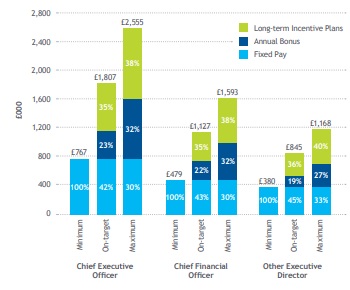
When we consider the first report which is 62 pages, we see that plenty of space was used to give rise to bonuses where three people get to go home (in a best case scenario) with £2.555, £1.593 and £1.168 million. In a setting where we see that a company minus zero setting, towards the one billion mark in the red, how is there even a case for a best case scenario? How is it that we see all kinds of share and cash deals whilst there is a real issue with this type of company? Should we not see a whole range of other questions holding the HMRC responsible for allowing this situation in the first place? Whilst the cheapest of the three (other executive director), optionally being a figure of speech for a lot more than one person the issue merely intensifies. Their minimum pay is £380K, which is close to 1,800% of the average annual UK income; giving rise that one year would enable a person to afford a person to go on a holiday for close to 10 years. I never had that option, not in two decades of loyal service, interesting how some people are just not held accountable for bad turns is it?

So whilst these high and mighty desk jockeys get to relax over Christmas, considering on how to tackle it all in 2019, as per ‘Interserve to roll-out £650m debt reduction plan‘, they will leave staff in pressure and under threat of being laid off. It gets to be even worse when they ‘hide’ behind “This deepened due to additional cash outflows on Energy from Waste as well slow payments in certain Middle Eastern markets“. If they have been there they know what the cycles of payments are. They know on what is to be expected. So if there is plenty coming in, there should not be an issue. When jobs fall through, it is known as well, so even as there is a slack from the energy from waste, it seems that merely lose statements are given and they might not hold water under accountancy scrutiny here.

As for the books

There we see that PwC are to be the financial advisors, some sources give rise to other parts. The independent report (at https://www.interserve.com/docs/default-source/investors/financial-reports/integrated-reporting/2017/2017-full-year-pdf’s/financial-reports.pdf) talks about ‘we’, but who is ‘we’? The report is 100 pages and it was set for the December 2017 point, yet there too we see a few things. If we are to accept certain previous statements, we see “We performed targeted procedures over component entities in Guernsey, Oman, Qatar, the United Arab Emirates, Saudi Arabia, Australia, Hong Kong, the Philippines and the United States of America. We performed analytical procedures over component entities in all other geographical locations“, so when we see the larger picture, how does the ‘Middle East’ reference hold water? This would imply they’re UAE, Qatar, Oman and Saudi Arabia customers. There are still plenty of other locations, even if it is largely weighted to those 4, the mention “as well slow payments in certain Middle Eastern markets” seems less valid. The shortfall of well over half a billion does not hold up, because if it was all due to investment, there would not be a shortfall to report, those debts are different. That is where the report on page 114 seems to give a little light. We see: “A further update was given to the market on 21 March 2018, indicating that short-term facilities had been extended for a further month to 30 April 2018. The Group announced that it had concluded refinancing negotiations and had arranged access to committed borrowing facilities of £834 million on 27 April 2018.“, on the other side of that page, we see: “assessing the appropriateness of sensitivities applied to the Adjusted Cash Flow Forecast to evaluate whether liquidity headroom and covenant compliance had been subjected to appropriate stress tests;” when they come up short by another £50 million, one might argue that either the stress test was wrong, or elements were unknown or merely ignored. I cannot tell what, why, who or which, yet it does not seem to add up.

So as that page ends with: “As a result of our work, we concluded that there were no matters in relation to going concern to which the ISAs (UK) require us to report to you“, I will offer that the news is giving us a £50 million reason proving that statement to be wrong (or at least partially). There is also increasing consideration that the auditing firms needs additional scrutiny, as jobs are handed over from one firm to another, there is the option that it speculatively gives rise to nepotism, as well as the danger that they all play the same game in what should not be required to be reported. The last is also highly speculative, yet the shortfall over 50 million as well as the debt surpassing half a billion proves me at least partially correct.

The question is how to move forward. There is a point of view that gives rise to a lot more than merely changing the laws towards outsourcing. There should be a long term accountability system in place, as it might all seem to be nice and correct on the balance sheet, the mere worry is that there is a long term impact. Should we see additional pressures where Interserve goes the way of Carillion, there might be a pressing point to start considering making that change. In an age of global accountancy where the costs are stored local, whilst indirectly the booked profits are staged to go to the land of the shareholder (wherever that is) we see an imbalance of accountancy that is seemingly all fine, yet makes no logical sense altogether. That might be one of the biggest settings that governments are facing in Europe and on a global stage.

Perhaps I will take tomorrow to give you a clear picture on what I mentioned here in examples. At that point I will be bringing graphics to the table as well.


Leave a comment

Filed under Finance, Media, Politics

In the back of my mind

Today is not the same as yesterday. Yes, the same issues are playing still. They will remain an issue for some time to come. Whether we look at Yemen, Iran, Grenfell or the Saudi Consulate at Istanbul, the media has decided to make this a long term event. Some events cannot be resolved easy or quickly, that is merely the stage we find ourselves in and as such I accept that. It was this mindset that was awakened rudely by a thought that I have had for the longest of times. Now, this is pure speculation and perhaps it is all utter BS. I accept that, yet it remains in the back of my mind, it will not delete itself from my thoughts and this morning it woke up again as I read the headline ‘Yes, I ‘cheat’ at video games – it’s half the fun‘.

I respectfully disagree, it just ain’t cricket!

Yet the thought has been there for a while. You see, the latest adult generation is different. It partially grew up with that thought. So as we read the article by Stephanie Munro (at https://www.theguardian.com/commentisfree/2018/oct/19/cheat-video-games-gaming-performance), we get a little more than we bargained for.

The cornerstone here is: ‘some games are worth a bit of cheating‘, we can agree that this is a thought every gamer has had, but I believe it transcends gaming. I believe that game makers have created the shits that audited Tesco (and devaluated it by billions). The people willing to quickly skate around the edges of Market Research to create a story that fits the bill, yet when we dig into the data, when we consider the weighting used, we see another issue. Some of these stories are more often than not, not worth the paper they were printed on. More importantly, the people mentoring these ‘younglings’ making (as a mere example) are achieving linear correlation by plotting two points. Even as they know that straight-line relationships between two variables can be achieved, they sometimes forget to tell them (implying that the newbie should have known) that it takes more than two observations. Yet a mentoring position is not about assumption. Even as reality is not this far-fetched, we see that there is a stage that counts. TU in Norway is one source giving us the most common example of unethical behaviour. It is: ‘Taking shortcuts / shoddy work‘ and it scored 72%, which is huge! I believe that there is a growing group of people relying on making deadlines and the entire issue is found there. It will almost always be on the new kid, getting advice left right and centre and not getting proper mentoring. Even when we see some parts not being violated, in some cases we see extreme examples of weighing data where weight values of well over 25 are achieved, an issue to be sure (when the population was increasingly small and unbalanced).

And here is where the shoe becomes too tight for comfort. You see behind this is the ‘golden rule’: ‘It’s important to realize that what is unethical may not always be illegal‘, it is a dangerous truth as it can at times be both.

Now this reflects back to the gaming article.

The quote: “I wonder whether cheating at video games is really anything to feel bad about. While downloading unverified cheat programs and exposing yourself to malware is not something to encourage, there are wider and greyer areas of game manipulation that deserve consideration“. There it is! The intentional push to consider cheating! We have all taken shortcuts; some are glitches within the game. Some are merely flaws in game design, the other part is exploiting a gaming bug and then there is God mode. God mode goes back to the beginning of gaming. A code that will set damage received to zero, or perhaps usage is now staged to a decrease of nil and the final part where build time and cost are set to zero. These are all stages that give you an immediate upper hand in the game. The codes tend to be there for testing purposes and were in the older days never removed, in some cases they still are not. Yet when we see the application done in Business Intelligence it becomes a different issue altogether, it has impact and it is too dangerous at present.

When we go back to Tesco in 2014, the Guardian gave us two parts. The first was: “what has already come out raises profound questions about how one of Britain’s biggest companies allowed itself to be run questionably – and about the role of its auditor. The making up of the profits figures was not in a report signed off by PwC. That happened in August – three months after PwC had given the supermarket chain’s figures a clean bill of health. Even then, it noted that there was something potentially funny with the numbers, and expressly warned about “the risk of manipulation” – but allowed them to pass anyway“, and the second one was “The audit is a key part of the scaffolding of shareholder capitalism. It is one of the primary ways in which investors, business partners and regulators can tell the true state of the company they are dealing with. If you can’t trust the audited accounts, you can’t really trust anything. This is why the vast bulk of public limited companies – and hospitals and charities – are legally obliged to submit audited accounts. And the vast bulk of those are done by PwC or one of the other Big Four auditing firms“. Now we get back to the gamer side. The bulk of people now becoming CPA have a gaming life. Whether they stay in the console closet is up to them, yet in a healthy life gaming will be part of it. It is a social interaction or perhaps a challenge to be among peers and see if you can Fortnite the hell out of your buddy and Overwatch him/her to death at the same time, nothing wrong with that. Yet we see more and more that the stage of normal gaming no longer suffices and we start relying on glitches and weaknesses, which is not altogether wrong, but when we knowingly have codes that give us 10% more, what then?

Gamers are actually getting pushed into that frame of mind and the industry as a whole loves it as the person willing to take every legal shortcut is a revenue asset, yet is it a long term solution and what happens when the border of legality was a grey area altogether? Consider the impact of Tesco, the most visible case in the last decade. And that is when we get to the 2017 New York Times (3 years after the event). Here we see: “The regulator said that finding did not suggest that any of Tesco’s directors “knew, or could reasonably be expected to have known, that the information in the August trading statement was false or misleading.” It did note, however, that there was knowledge at a sufficiently high level below the board as to the false and misleading nature of the trading statement to constitute market abuse under British law.” That is now the ball game. The two points ‘could reasonably be expected to have known‘, in opposition of ‘there was knowledge at a sufficiently high level below the board as to the false and misleading nature‘. So someone got a massive raise, someone got an overwhelming promotion and no one went to prison. This is what I would call an orchestrated cheat. When we look at PwC and we see: Tyco, Tesco, Taylor Bean & Whitaker, Bank of Tokyo-Mitsubishi and MF Global. All stages that are massive and all stages where in the end it is merely about the fine, the pressure for using ‘cheats’ is increasing and it seems that the gaming industry is banking on this. What is more appealing when an almost impossible task is achieved by someone who should not have been able to make it to level 2?

This is where Stephanie gives us the gem: “In the world of competitive sport, the line between a so-called clean win and one in which the performance of an athlete has been chemically enhanced is blurred – but we leave it up to governing bodies to decide what’s acceptable and what’s not. This leads us into the moral quandary of whether something being legal makes it acceptable“.

It is the moral quandary that is the switch, which is no longer an on and off switch, but a level that goes from 100 to zero. A lever that is pushed again and again a staged setting with online and single player achievements where we learn to do what it takes to get all the achievements, yet to keep a much more high profile stage to make us seemingly clean players.

So when we see a Battlefield example: “John is on the extreme end of a spectrum, because his tactics are so lethal, so outside of what the game’s creators intended, so far beyond what rival players can defend against and, oh yeah, he paid some hackers to have them. John pays to be able to kill your character instantly in Battlefield. He’s surely crossed some line, though it’s anyone’s guess just where that line must be” (source: Kotaku), we see the issue that is the stage on all this. This now directly reflects Apple and their mobile battery game. a conviction with a 10 million euro fine, whilst the payout makes crime a joke. The article (at https://lawlordtobe.com/2018/10/25/crime-as-a-business-model/) where in ‘Crime as a business model‘ we see: “Apple required the sale of 16,000 phones just to break even on that fine“, against “the means to sell 123 million iPhones through what the court is seen as deceptive conduct gets a fine that amounts to 16,000 units. A fine received that represents a mere 0.013% of their cost of doing business” and we see not only the progression of what should be regarded as unethical conduct, governments are actually encouraging it by giving fines that were a joke on a scale that is a mere 1% of what was done here.

So whilst we see: “For some of us, the idea of using a walkthrough is anathema, to others it is a means of bringing us back to a point where we can have fun. I’ll admit that I never completed the Ocarina of Time. It was too hard and I got bored. I’m sorry, Princess Zelda, I abandoned you“, we ignore that Ocarina of time is one of the best designed and most overwhelming puzzle journeys ever seen (I never got to 100%), the exclusivity of getting there is merely brushed on and the cheaters are given a pass. That is actually beyond the point where those with a gaming guide are not really cheaters, they merely walk the journey to get to the 100%. Apart from Ocarina of Time, there is Metroid Prime. A game I worshipped almost forever, I ended up only getting 98%, which is an achievement I was proud of (I never found all the missiles). And I played it a few times, loving that journey again and again. Yet the BI industry is merely hiring those with a 100% score and they had no interest how the player got there and that is actually the sad and worrying part in all this. Wall Street does not care how the revenue was achieved as long as it is and that is a much more dangerous setting in the upcoming future. To get the required numbers some analyst proclaimed no matter what. And when it is revealed in some scandal and the media is all over it, it is the mere ‘could reasonably not have been expected to have known‘ is what keeps the board members out of their well-deserved Rikers Island excursion (3-5 years). This sad evolution is not merely the creation of another Star Chamber, an old reference to a tribunal abolished in 1641, where we saw the king in council exercising criminal jurisdiction. It was inquisitorial, and torture is believed to have been used, with no accountability in any way shape or form. It is an upgraded system, evolved from those settings that allows corporations to do whatever they need to appease Wall Street and other financial centers, to exceed analyst expectations, whilst we see that these findings are increasingly becoming more and more unrealistic because that is what the market needs.

In all this holding these analysts and their formula’s up to scrutiny and accountability in the long run will not happen, making the need for these players to find the people who are willing, not to bend the rules, but to cheat their way across, increasingly more and more important to corporations and as such, the danger is that we get into a world where cheating is not half the fun, it is merely the only way to keep ahead of the curve and avoid being classified as no longer relevant.

When did we sign up for those values in our lives?


Leave a comment

Filed under Finance, Gaming, Law, Media, Politics, Science

Sleeping with the enemy

We have heard the expression; most will remember the movie with Julia Roberts and Patrick Bergin. The expression is slightly harsh and a little over the top for the setting that I find myself presently in with PwC. You see, some people are playing a dangerous game. So when I see ‘UK firm PwC criticised over bid for major Saudi Arabia contract‘ (at https://www.theguardian.com/world/2018/jul/31/uk-firm-pwc-criticised-over-bid-for-major-saudi-arabia-contract), I find myself on the side of PwC supporting them. The article is an issue on a few levels. I touched on a few two days ago with: ‘Oman’s neighbour‘ (at https://lawlordtobe.com/2018/07/30/omans-neighbour/), so this setting is actually most informative when we consider the issues seen here. I objected to the setting that Amnesty International gave a consequence, yet the original setting that started it was missing, in all this, the fact that the Houthi forces are firing missiles into Saudi Arabia, as is Hezbollah and Iran is the puppet master behind all this, so when I see “Peter Frankental, Amnesty International UK’s economic affairs programme director, urged PwC to explain what due diligence it had undertaken before pitching for the work“, I wonder if Peter Frankental has done its due diligence into the situation where a terrorist organisation (with evidence from several sources) is operation on Yemeni soil with full backing of Yemeni officials, who are also extremely aware that they are facilitating for Iran. That part is missing from the charade that Amnesty International states is ‘the humanitarian nightmare‘. We agree that too many Yemeni are in the middle of this, no one denies that, yet the actions by Iran via Hezbollah and the Houthi’s are an issue and in this they merely ignore the founding factors.

In addition, the UK, with a desperate need to improve the economy has options and opportunities in Saudi Arabia, creating a dialogue, helping Saudi Arabia move forward. We admit that it will not be fast, it might raise obstacles, which is a fact of life. So when Peter Frankental sets ‘due diligence‘, I am of the mind that he clearly did not proceed with that duly noted diligence to a rather large extent.

So when I see “The United Nations guiding principles on business and human rights make it clear that a company may be viewed as complicit if they are seen to benefit from abuses committed by another party“, in that view, Frank please explain to me how you will prosecute Northrop Grumman, Palantir, Blackberry, Dell, Pelican and Apple? I would really like to know that at present. I am going to grasp back at an expression that we get from Robocop, it was spoken by Kurtwood Smith: ‘Good business is where you find it!‘ and Saudi Arabia has business settings for up to £825 billion, so PwC is getting vetted for a chunk of business that could optionally keep thousands employed, grow optional new businesses and industries. In addition, when exactly did Peter Frankental set the stage for a similar attack on Virgin? Are they not setting up the first Hyperloop there? So where is Frankie boy in all that? Now, it is not my intent to slam out at Frank, he seems to have his heart in the right place. Especially when we look at a paper by the House of Lords called: ‘Any of our business? Human Rights and the UK private sector‘, it seems that he has forever focussed on this, the paper (Attached) is from 2009, where we see on page 15 “In particular, we contend that the UK state could and should play a greater role in the governance of corporations so as to contribute to the protection of human rights from corporate abuse, whether the abuse occurs in the UK or abroad“, that is fair enough, yet he is setting now the acts of an attacked government into a corporate right, in that same setting all exports to the US should in that light be equally questioned and regarded as illegal, you basically can’t have it both ways Frank!

So when we grasp at: “In particular, we do support the idea of some kind of international instrument for corporate accountability within the UN system, but we agree with Professor Ruggie that such an instrument would not exist to monitor the activities of tens of thousands of transnational corporations, that would be unfeasible, but it would exist to reinforce the will of states to hold companies to account within their jurisdiction” and set the dimensionality of a flaccid UN when it comes to the events in Syria, there is such overwhelming evidence of inaction (through Veto or not), which gives us that in the faced setting PwC should not even be a blip on his radar. Not when we compare it to “the US contractors are mostly focused on supporting the 2,000 US troops in Syria by delivering hot meals, gasoline and other supplies. More than 30% of them support logistics and maintenance, according to the quarterly Pentagon report, and another 27% help with support and construction of US military outposts in the region” (source: Al-Monitor, April 2018). So how much visibility did Frank give here? In all this, he does not get to hide behind the ‘It is not linked to the UK‘ you just cannot become a ‘local’ party towards a global event when you decide it is. It just does not work that way.

In this, we also see: “PwC already has a presence in Saudi Arabia, but it is the company’s UK operation that is behind the defence project“, which is true, because I applied and they were not taking any non-UK citizens. Darn!

In addition, with: “PwC has launched a “call for resources” – asking specialists and consultants in London whether they would be interested in moving to Riyadh to start the work – because, it has said, it is “currently finalising the deal”“, we see that PwC has the setting to move people to Saudi Arabia, more employment and in addition a sector growth that could lead to 10 figure long term deals, but fear not! Peter Frankental will be there to try and undo the economic boom that will benefit the UK (was that overly simplified?)

So with the upcoming opportunity and the subsequent quote “focus on how to reshape recruitment, resourcing, performance management and strategic workforce planning, and how to manage and communicate change“, it actually goes further than that, even as a lot more performance management is likely to be shown, it will also be about what is the hierarchy and what is not. In light of work safety and preparedness (yes, even in the military), the setting of ‘Own the challenge‘ is a lot harder to scribe into the soul of the person. To set ‘solving’ the issue as the forefront of ‘that what is my actual responsibility‘ tend to be a challenge even within the most flexible workers, so I predict that there is a shift that will soon be shown in places like Saudi Arabia as well. I will admit that having never worked there, that this setting is more speculative than anything else.

So when I see Frankie give us: “As any accountancy firm involved in work for the Saudi ministry of defence must know, the Royal Saudi air force has an appalling record in Yemen, with the Saudi-led military coalition having indiscriminately bombed Yemeni homes, hospitals, funeral halls, schools and factories. Thousands of Yemeni civilians have been killed and injured“, the equal question on how many missiles that Iran enabled the Houthi and Hezbollah forces allowed to be shot into Saudi Arabia, and there is the drone strike issues in the UAE to consider as well. In addition, it is called ‘Saudi Ministry of defence‘, not the Hezbollah missile strike team. It might be nit-picking on my side, but then, I was always willing to go for broke.

Then there is the setting of “the UK “should be focusing on trying to stop this terrible conflict, not assisting the Saudi government.”“, yes it is an interesting setting by Anna Macdonald (younger sister of Ronald). When we go to the site (at https://controlarms.org/meet-the-team/), we see Anna Macdonald, Raluca Muresan, Zoya Craig and half a dozen volunteers. Yet, lets also congratulate on the bang up (or is that blow up) job they did in Syria, as well as a few other places. So when I see: “a global coalition working for international arms control“, which is a good goal to have, the flow of missiles and arms from Iran into a few places was not really stopped was it? Iran has exported small arms and ammunition to Sudan and Syria, anti-tank missiles to Syria, Sudan and Somalia; rocket exports to Syria, Sudan, Libya as well as shipments to Hezbollah and Iraqi insurgents. So in that list, and the goal Anna Macdonald envisions is a noble one, no one denies that, in all that, with at least two dozen of export mentions excluded, I think that PwC should not be on her list either. Especially, as the Saudi Arabian civil population is still under threat of missiles from a terrorist organisation. No one denies that the Yemeni people caught in the middle are in a really unbearable place, but all these actions means that no actual actions are taken against Iran. So as we were given ‘the European Commission has moved to add Iran to the investment mandate of the European Investment Bank (EIB)‘ a mere 18 hours ago, it seems to me that in all this Anna Macdonald and Peter Frankental should be setting their focus in a different direction, or perhaps that will merely not give them the limelight that they so desperately need (for all the right reasons mind you).

In all this, the defence from Saudi Arabia in the person of the foreign minister, Adel al-Jubeir was reduced to a mere: “Judeir blamed the Houthi rebels for blocking aid and contributing to the humanitarian crisis“, is that not interesting too? The actual blockers of humanitarian aid was set into a mere footnote, a mere 14 words, so in all this, where is Peter Frankental at this point?


Leave a comment

Filed under Uncategorized

Pinata whacking Couper

There is a little mean streak in me, you see, it started with Tesco, and it actually started a little earlier. But the gist is that when it concerns PwC (PricewaterhouseCoopers) I tend to take a swing at them whenever possible, I just roll that way. So there I was looking at ‘PwC charges more than £20m for first eight weeks of Carillion collapse‘ (at https://www.theguardian.com/business/2018/mar/21/pwc-charges-20m-eight-weeks-carillion-collapse-final-bill) when I realised that when I wack those boys I usually have good reason and supporting documentations to test my latest sledgehammer on a member of their board of Directors. In this article, when I saw “MPs have accused the accountancy firm tasked with salvaging money from Carillion on behalf of its creditors and pensioners of charging “superhuman” fees, after it racked up a bill for £20.4m in eight weeks” it took a mere 3.2 seconds from spitting in my hands and getting ready to swing that hammer at Kevin Ellis (yes all the way from Sydney, my arms are that long). I held off and went ‘wait a minute!

You see, I always had as I saw it good cause, but who are these MP’s thinking that they have good cause? The first is Rachel Reeves, the Labour MP in charge of the business select committee. So she mentioned that ‘superhuman’ part. What does she know? The Wiki claim states that she is an economist. So how much does one charge for 112 consultants? You see at £199 an hour we get £891K for these people working a mere 40 hours a week. As it is the UK, they are more likely to work 60 hours which gets us at flat rate £1.3 million a week which leaves PwC with an overhead of a mere £100K whilst I have not taking into account any additional expenses and they tend to get high. I reckon that these people are likely to make a lot more than 60 hours a week, that is the result of “£2bn to its 30,000 suppliers” and as the article states “a week to employ 112 staff to keep the company running and to honour government contracts” we do not see the inclusion of any additional staff that was not hired and that is still assigned via PwC. So that took a mere 6 seconds to realise that I was not getting to whack Kevin Ellis. Leave it to a Labour MP to spoil a perfectly lovely Friday morning feeling. Now, let’s also realise that my calculations could be way off, there are so little actual facts in the article (I am not blaming the article here) that there are hidden traps all over the place. I think that Rachel should have gotten up from the right side of the vibrator that morning, as we need to realise what an amazing mess Carillion is. The oversight had fallen short on so many sides, with the mention of pensions and a shortfall that is close to a £1,000,000,000 should be a much larger issue and the fact that this had fallen short implies a level of what I regard to be criminal negligence that is unheard of. We merely need to look at ‘Carillion’s pension crisis defies magic legal cure‘ (at https://www.ft.com/content/5041d10e-1a1c-11e8-aaca-4574d7dabfb6). So when we see “Yet in the seven years before its collapse, Carillion made contributions to the fund of just £280m while paying out dividends worth more than £500m“, my first idea is to look at the auditors and the accountancy firm. So how much overview did Rachel Reeves give regarding KPMG? We get part of this when we see ‘Why didn’t anyone working with Carillion say it was going to fail?‘ (at https://www.independent.co.uk/voices/carillion-kpmg-auditors-audit-hbos-financial-crisis-self-regulation-deloitte-a8185356.html). Here we see: “In March 2017, the giant audit firm KPMG signed off on the annual accounts of the construction giant-cum-outsourced services provider Carillion, saying they gave a “true and fair view” of the state of the company’s affairs. For this work, KPMG received a fee of £1.4m. This followed £1.4m of fees recouped the year before. In fact, KPMG had been Carillion’s auditor every year since it was founded in 1999. You don’t need to be an accountant to work out that that adds up to a very lucrative client relationship” that whilst we get the news that a mere four months later “its contracts to provide services were worth a remarkable £845m less than they had previously been valued on its books” that is an amount that exceeds whatever Richard Branson has in his wallet on his best days, so how was this overlooked? So as Rachel Reeves was kind enough that the value of KPMG is not good enough to audit the contents of her fridge, she should also be aware that this entire audit is not merely the outstanding invoices, there is a decent concern that the audit of KPMG has been unable to correctly assess issues for 17 years. So there is a real need to set up the correct framework to be able to take a long term look to the matters as well as the ability to set the right data dimensionality so that the data does not need to migrate over and over as more is found. I would think that an MP who part of the ‘the business select committee’, as well as a graduated economist would know that. You see as an experienced IT worker and a data analyst, I saw that coming a mile away.

So here I am partially standing up for PwC (so how fucked up will my day become?), news at 23:00. So when we get back to the Financial Times article and we see “As a House of Commons report has noted, Carillion’s growing borrowings were not used to invest in the company. In fact, while the group’s debt rose 297 per cent between 2009 and 2017, the value of its long-term assets grew just 14 per cent“, can we agree that there is a side that is terribly wrong here? These matters should have been clear in the KPMG reports, which now clearly overthrows the statement “they gave a “true and fair view” of the state of the company’s affairs“, I think that we can all agree that this part has been debunked in 30 seconds flat. In addition the Independent gives us “Moreover, KPMG was not the only auditor of Carillion’s numbers. Its 2016 report relates that it had a special “internal” auditor too, in Deloitte, with which it worked even more closely than with KPMG. So why didn’t Deloitte pick up on the dodgy contract numbers?” For me that is an interesting side as I have never seen anything dodgy in Deloitte. The fact that they might be part of the mess (unlikely though) is also cause for concern. More important, as I personally see it, it will be up to PwC to get that part out in the open. What was the exact assignment of the internal auditor, what data was presented, what data was accessed and used and who was part of the entire reporting stage of this internal audit? It would show more players in all this and could optionally give a better path in seeing the navigations that the decision makers in Carillion were involved in.

That is a part that we need to realise and consider.

There is another concern that the Independent brought to light. With: “Previous probes by the FRC have produced nothing but clean bills of health for auditors. “In nearly every major financial scandal we’ve had since the financial crisis, the FRC decides none of its charges have done anything wrong,” notes Jim Armitage, city editor of the Evening Standard. Worse, these rulings come with no reports or published evidence, making a mockery of the FRC’s claims to “promote transparency”” we might think that it is merely the FRC, yet what Wall Street taught us is that the entire 2008 joke gave rise to an 8 trillion write off, whilst no actual laws were broken, or at least none that could be proven, so in that regard, if that happens again now, we can clearly look at the House of Lords, point fingers and tell them to improve laws immediately and hold any MP and minister accountable for naming and public shaming. It might work, but I doubt it. You see, until there are large and unforgiving prison sentences, whilst also remove all the rights of ownership to those involved in Carillion, nothing will change. I have seen people setting the ownership of their large estates to their wives and then deny that they had any outstanding financial responsibilities in more than one country. Until these matters are settled this game will continue because greed will always win in the end.

So when we get back to the initial article we get “Kelly, who said his personal rate was £865 an hour, said PwC’s costs would gradually fall as more parts of Carillion were sold and staff from the accounting firm stopped working on the project. He said the firm initially had 257 people working on Carillion, with a bill for about £3m for their services in the first week after its collapse“, we see where part of the costs went to, so as my calculations was based on smaller settings we see how easily these costs were attained and the end of it is not in sight. Rachel Reeves should have seen this clearly as she had access to data I still have not seen. I think it is much more interesting to look at “Finance director Richard Adam, who retired in December 2016 after nine years at Carillion received almost £1.1m in salary and bonuses in 2016“, which we get from the BBC. So if we get to see the wrongdoings of Richard Adams, this is a reasonable speculation as the entire mess goes back a lot further than 2016, will we see these same MPs demand the auctioning of the goods of Richard Adams to make up for the losses of Carillion? You see the article stated MPs, not singular. Rachel Reeves might have been the visible one, but I want to see all those names, because when we consider the BBC news (at http://www.bbc.com/news/business-42703549) as it gives us:

  • The £350m Midland Metropolitan Hospital in Sandwell: opening delayed to 2019 due to construction problems.
  • The £335m Royal Liverpool Hospital: completion date repeatedly pushed back amid reports of cracks in the building.
  • The £745m Aberdeen bypass: delayed because of slow progress in completing initial earthworks.

We need to ask questions on several MPs all over the field, all over the UK apparently. These three alone show a £1.3 billion issue are so out in the open that these three alone will constitute evidence of a much deeper required accountancy dig. Three issues shown last January and these three alone gives rise for me to think that PwC will be able to charge a lot more and in addition, the entire settling and selling could take a lot longer than some expect it to take. So these elements are the setting for additional costs, so those MPs might claim that there is a case of ‘milking the Carillion cow dry‘, but they better be ready for me to take a look at more than these three projects, because I will ask openly on their failings to get a handle on matters, because I am 99% certain that these three projects alone will lead to a dozen others all over the UK and if there are no clear memo’s from those MPs in regards to Carillion, they will be named openly to give rise to their shortcomings (perhaps also what was between their legs), because if you do not have the balls to go against the larger players, you should not be in office at all. Yet, that might be merely my warped expectation of elected officials.

Carillion is a clear mess that had been going on for a much longer time than some expect. You see, that part is seen in ‘cracks in the building‘, ‘construction problems‘ and ‘slow progress in completing initial earthworks‘ it implies optional failings going all the way back to the foundation of the works that were possibly never correctly done in the first place.

So I might still end up treating the bosses of PwC UK as piñatas, but at present there are plenty of other targets and so far (remember I say ‘so far’), in this particular case PwC seems to be in the clear (darn!).


Leave a comment

Filed under Finance, IT, Media, Politics