Tag Archives: Spain

Cheese Pizza with Oregano

I love Pizza, I hardly ever get it, merely because the people here tend to rely on Domino’s and Pizza Hut and neither tends to be a true pizza (as I personally see it). As I walked through Sydney over the last week, it dawned on me just the massive lack of actual decent Pizza places in Sydney. It is almost like they are no longer in a sustainable environment. People got used to the cheap solutions two chains bring and they call it Pizza. All the people in the neighbourhood accepted it as the real deal and now, we forgot what true awesome Pizza is like. Now, I am a little off the wall here. I love my Cheese Pizza, with the 5 cheeses and loads of Oregano on top. So when I think Pizza, I always think of the Bravo Trattoria Pizza’s at Crow’s Nest, they are my favourite! Yet, is it about pizza, or the place, or what Pizza actually is? You see, it does matter when we consider the Financial Review (at https://www.afr.com/personal-finance/italys-debt-barely-sustainable-ubs-chief-economist-20180601-h10uun), we see here what I said weeks ago and last week to some degree. When we see “Italy’s debt-to-GDP ratio of 130 per cent is “borderline sustainable”, the UBS top economist says. There is a level of the primary budget surplus which keeps debt stable, and above which you can begin to pay down your obligations, Kapteyn explains. For Italy this figure is a surplus of 1.3 per cent of GDP, versus the actual surplus of 2 per cent. It’s a skinny buffer of around 0.8 percentage points which at current debt levels “doesn’t inspire confidence”, Kapteyn says“. That is merely the tip of the iceberg. The issue is not that it is Italy, it matters more that it is one of the big four. UK, France, Germany and Italy are the large economic suppliers of a 27 nation bloc where they basically represent well over 50% of the EU economy, the fact that they all are in deep debt does not help and the fact that the UK is getting out, or is that ‘was trying to get out‘? So when we see add the issues of the UK and now we see how the Italian issues are growing and France is not far behind. A 27 nation failure due to the inability to set proper budgets, deal with debt levels and add to that a failed economy jump start that is now close to 3 trillion Euro printed with no real prospects to pay for any of it. That revelation is why Italy seems to be vacating the union. The action by President Sergio Mattarella by rejecting the Eurosceptic finance minister and put in his place Giovanni Tria a pro-EU professor. This is perhaps the first setting where we see that voting is no longer an issue for any government, the holier than thou setting of protecting the Euro and the EU against all odds, whilst those in the EU commissions are massively overpaid is setting the foundation of a dangerous mindset. The issue that the AFR is bringing to light is “markets are not pricing in the risk of an Italian exit, they are repricing the risk of a Italian default“. I always rated the Iexit (aka iLeave) setting very low, the two populist parties in charge was not that realistic in 2016 and when Marine Le Pen was ‘surpassed’ by a former investment funds manager we were all wondering what would come next and I thought it would lower the chances of the populists in Italy. And the news is not getting any better. We see that with “The European economy hit a wall over the final months of last year, with growth dropping from a quarterly growth rate of 0.7 per cent to more like 0.4 per cent. Economists are unclear of the reasons for the slowdown, but broadly believed the European economy would quickly rebound“, the issue I personally see is ‘broadly believed the European economy would quickly rebound‘, not the slowdown. You see there is no evidence that there is an actual quick rebound. There is every chance that there will be a rebound, but it will not be quick. The fact that these so called experts are all thumbs when it comes to their forecasting and with 0.3% unaccounted for, we can see that they are in the dark or playing the bad news cycle. I personally believe it to be the second one. And the Italian issues are increasing. Not merely the debt settings, it is a changed political landscape. Even as Paolo Savona was replaced by Giovanni Tria, there is still “Mr Di Maio will be vice-premier and minister for labour and economic development, including trade policy. Matteo Salvini, head of the League, will also be vice-premier and interior minister in charge of immigration“. This we got from the Financial Times (at https://www.ft.com/content/79cf905c-64a8-11e8-90c2-9563a0613e56). This duo is going to be a lot more important than even I initially thought. They now have a handle on labour economic development and immigration will see larger changes. There is no way to predict whether that is good or bad. If we listen to people like George Soros we are instantly rejecting liberalism, because it is easy to be a liberalist when you are a multi billionaire, yet he had no issues to short sell US$10 billion worth of Pound sterling, earning a billion in the process during the 1992 Black Wednesday UK currency crisis. He did nothing wrong, he played the system when he could and make a billion. Things like that never go away and he must regard the EU zone as a very profitable short sell opportunity, which makes whatever he is trying to do dangerous, so in that light all his settings for “Best for Britain pushes for second referendum on Theresa May’s deal with EU“, a cause he is backing is very dangerous. In this by pushing the UK away from Brexit, the pressure on Italy decreases. The dangers become that irresponsible spending in the big four can go on for several more years and there is no way to control the ECB and their puppet masters. Unelected people deciding on the descent of financial futures in 27 nations that is how I personally see it. You can agree or disagree, yet ask yourself when was the last time that any European got a decent explanation on who of how the 3 trillion euro spend was going to be dealt with? You see over a decade in an economic setting that is close to the late 90’s, whilst keeping strict austerity in play all over Europe. There is quite literally no way that this will happen, because politicians will adjust their policy towards any speculative proclaimer of ‘the European economy would quickly rebound‘ economists, whilst not prosecuting them when they get it wrong (merely because making any claim of expectation is not a crime, is it?). A setting that the people have no chance of winning, hell, they won’t ever be able to break even on this. This shows that Brexit will be a hard, but the better way to go. When billionaires start proclaiming how bad it is and how ‘we all’ can get a better deal that is when you become afraid for your life and that is what is at stake. And we see this in the Australian Financial Review with ““creeping into the market”, Kapteyn says – “a potentially dangerous one”. After the glory days of 2017 in which investors basked in a globally synchronised upswing, markets are now faced with the potential return of the two-speed world economy: the US vs the rest“, so when we get “America’s economy is growing around 3.5 per cent; some independent analysts estimate growth as fast as 4 per cent. Europe is “at best” growing by 2 per cent“, that shows the dangers, because as George Soros is getting the winnings, the other players do not, from my point of view it is a form of leeching, leeching Europe dry for the term of a generation or better. You see again it is a personal view, it is why Best for Britain is getting the support, it is about delaying Brexit at the very least for as long as possible, merely because it stops the game people like George Soros are likely to be playing and when that stops Europe can start bringing things about, hopefully for the better, especially as the ECB will be forced to print money for all kinds of dubious reasons, dubious because kick-starting the economy after you printed 3 trillion to try it twice is just ridiculous, that money has to be paid back at some point and everyone is in denial about the latter part.

Yet this is still about Italy, not the UK. You see, Italians want what is best for Italy and I am fine with that, I believe in a healthy sense of national pride. Yet with “Italy’s debt-to-GDP ratio of 130 per cent is ‘borderline sustainable’” they are facing an ugly truth, Italy needs to face 5-15 years of Austerity, yet with the ECB trying to economically equalise Europe, at the cost of the big four, so it amounts to Italy trying on top of an economy for 60 million Italians, whilst they are weighted with invoices for close to 250 million Europeans who can’t be bothered to get their house in order. it amounts to giving an addicted gambler $500 whilst they are only allowed to use $10 for gambling, you tell me how long it takes for things to go really wrong, and that is pretty much a given on this situation. It was seen in the Netherlands 2012 and 2013, and now we see, when we look at the Dutch government statements with in September 2017 we see “The economy will grow by 3.3% in 2017 and a projected 2.5% in 2018“, we see the EU commission giving the Netherlands a ‘mere’ 3.2% last month for that same timespan. Now the 0.1% is actually pretty good, but it is still dangerous when it is a 0.1% in Italy, the issue is seen when we see that the Netherlands has a 65% debt level against Italy at 130% of GDP, and the Dutch are actually in a much better position, so the 0.1% is no actual pain level. Portugal, Spain, Greece, Belgium and Italy all have debt levels well over 100% of GDP, several other nations are somewhere between 60% and 80% of GDP, whilst France is at 99.8%. It is the debt levels that are excellent for banks and not so good for the people. You see, when the big four are required to pay €254 billion in interest each year and that is just the large 4, how do you think that this gets paid for? A decade of inability to set a proper budget and all this is before we consider the €3,000 billion that the ECB printed for what they call Quantative Easing. That is what Italy needs to get away from and at 135% they have the hardest job of all. So when you see that all that money goes all to the banks, short sold loans that they never had the money for to pay for can you see just how dangerous the George Soros setting is in all this? It all impacts Italy to some degree. These are not merely the facts; there is also presentation, representation and misrepresentation. The issue is in the Australian Review, it is the view of Arend Kapteyn. Yet where is he at when he gives us “We are only now at the beginning to find out how responsible or irresponsible [the new coalition government] are going to be on the fiscal side“, you see, the setting then becomes what is irresponsible? Being not pro Eurozone, being forced to default whilst the alternatives are just too unacceptable for the Italian people? So is he the pro greed setting, or the pro solution setting, because with such debt levels we can almost unanimously accept that these two choices are mutually exclusive. The most interesting political part is that Enzo Moavero Milanesi is now Minister of Foreign Affairs. I would have thought that the populists wanted that part for themselves, the fact that this post is now with an Italian independent is an interesting choice, if the populists can work with this setting and use it to maximise their economy by setting new option and opportunities, Italy gets an optional path where minimised immigration and maximised economy could have a setting where the Italian unemployment rates could fall to a number below 10% over the next 24 months (highly speculative on my side). If they pull that off, the entire euro sceptic setting could grow a lot faster than would have been possible with Paolo Savona in the mix.

No matter how you slice the Pizza, the factual and actual quality Italian dish is under massive amounts of pressure on several sides and any Italian thinking that their life will get better in the short run is just gobbling down a [Unnamed Franchise] Pizza, bland food that look like a UFO and tastes not as great. The fact is that like Germany did earlier this decade, Italy will know 5-10 years of hardship, yet when persevered Italy could have an actual growing economy for a much longer time, something to look forward to (if you are Italian). Can this government pull it off? That is hard to say because it has been shown that the actions of the ECB are close to non-stoppable and that will still impacts the bottom line. It is good for America and George Soros in the short term, yet after that they will not care and Europe will not be going anywhere ever soon. That danger is just ignored all over the place. Just 2 days ago the Financial Times also gave us “There are still two weeks to go before Riga, but naming an end date for QE right now would be like the ECB shooting itself in the Italian boot,” said Carsten Brzeski, economist at ING-DiBa. “The Italian situation has tilted the balance towards the doves [and] clearly calls for the ECB to keep its options open and even to make clear that they will extend QE at least until December” (at https://www.ft.com/content/dd6b5d70-6413-11e8-90c2-9563a0613e56), which is already an extension of well over a year. so when we see “The ECB has pledged to reinvest an average of €15bn a month over the first four months of next year, using the proceeds of government bonds bought under QE that have now matured” in that same article, we need to consider ‘bonds that have now matured‘, so that danger is seen in the Spanish setting where we see from some sources: “Spain will have refinancing requirements that exceed €300 billion per annum before 2022. In 2018, 41.2 billion euro, in 2019, 82.4, in 2020 83.9 and in 2021 58.5 billion euro, with 60.4 billion maturing in 2022“, so this fiscal year Spain will be required to find €41 billion, or increase taxes or cut services, and it will be twice that amount next year around, so how exactly is Spain in a setting to get the economy back whilst the debts are rising beyond normal control? Italy faces “84 billion euro maturities in 2018, 161 billion in 2019, 164 billion in 2020 and 172.5 billion euro in 2021” do the Italian people know that they are in such deep and hot waters? I wonder, and when they get confronted with that part of the bad news cycle, what will the previous and opposition then proclaim? I wonder if we will see true honest coverage on that blame game. I will order a decent Pizza to watch that unfold, because there are merely the two larger players in the EU-debt zone bloc confronted with the hardships that will hit them hard. Pushing these debts forward is just not a workable solution, not when the debt exceeded 130% of GDP, if you doubt my words, just talk to the average Greek in Athens and ask him how his quality of life is nowadays.

So as you wanted that your slice of life included a slice of pizza, consider the 99% in Italy who soon face the reality that they are no longer able to afford that for a long time to come.
 

1 Comment

Filed under Finance, Media, Politics

Business will be booming

There are all kinds of settings in the tech industry, some we like and some we like a lot less. It is the most visible in the mobile industry, the clear discriminatory setting there is almost unheard of. No matter what the reason is, a person for the most is iOS (Apple) minded, or they tend to go the way of the Android (Google, Huawei et al). There is for the most no in-between there. The reasons are as wide as the drops of water in a lake on a rainy day and for some these reasons make sense, or they do not. Yet we all tend to have them. I have been and remain an Android follower. I have nothing against apple. The initial setting was done by their marketing departments. Where Apple gave us: ‘You can do all these things and it is a phone too‘ and Android gave us: ‘This phone can do all kinds of things, some you will not have believed was even possible‘. I went the way of Android. You see, they are stating the same thing, yet Android focussed on a phone that can do other things. Apple went towards the things they could do, including being a phone. So from my point of view, I needed a phone, so I went the non-iOS way.

I know that in the end the difference is negligible, but it did matter. So it is a little over three years when I got myself (because it was a bargain) the Huawei P7. The difference from the previous phone (Motorola) was so distinct I became a Huawei fan overnight. Now that it is time to put that phone to bed and switch it off for the last time, I find myself clinging onto the idea that I need a new Huawei. Let me be clear, apart from my distinct non liking Samsung (a past issue I had with them), I do think that the other brands are decent too. Yet, when you have the option for a Google Pixel 2 XL, or a Huawei P20 close to $500 cheaper, what will you choose? Let’s also consider that the difference is almost nil, well it is not nil but the real differences do not stand out too much, not worth $500 as I see it. For me, if I get that phone, it will be a 300% improvement of what I have now and I am not dissatisfied with what I have, it merely has been acting up and after 3 years of working 24:7, that makes perfect sense. The little workhorse has earned its retirement. So when I started to look around, and I took a new look at the P20 and P20 pro, which is a $300 difference, I wondered why I would want the P20 pro for the usage I have. I have been able to do everything I needed with 2 GB RAM, so the 4 GB and  6GB RAM issue is not one I need to worry about. Both come with 128 GB storage, which is 800% more than I have now and even as I ran out of storage merely once, it did not worry me to any degree. The camera options are not the same, yet the PRO has an additional 40 MP camera option, which is slightly over the top need for someone who uses an EOS 1 Camera. The only issue is the battery, it is 3400 mAh versus 4000 mAh and I am not sure that this constitutes the value of $300 difference, not on my budget. More important, the P20 holds its own against the $1500 phones out there and when you consider the fact that it is 30% cheaper, what would you choose? This constitutes a difference that is well over a week’s rent for some people, so there is that to consider as well.

Yet, it is not about that part, it is that Huawei has seen the light of opportunity in both Saudi Arabia and Egypt, so when we see (at https://www.albawaba.com/business/pr/huawei-announces-%E2%80%98vip%E2%80%99-service-p20-pro-saudi-arabia-1135384), the fact that branding is getting momentum in the Middle East with their Huawei Consumer Business Group and their “a ‘VIP’ service for its customers in Saudi Arabia through its authorized service centres for any customer buys Huawei P20 Pro with Huawei KSA warranty”. Some call it marketing, which in all fairness it actually is, yet with 95 million people in Egypt and 33 million in the KSA, the market could be booming for Huawei, even as an Apple store is coming in 2019, the Apple SA store is pointing towards “Apple-designed outlets located within selected Apple resellers and other retail shops. Many are staffed with Apple-trained experts who can help you to find the right solution for you“, which is a perfectly valid and acceptable text. Yet, when you can consider an ‘outlet’ versus “Huawei has announced “Huawei Flex” which is a free drop off service in which customer can drop his device for service in more than 300 locations across kingdom for Huawei device under Saudi Arabia warranty to be send for Huawei Authorized service centre for warranty repair and return“, we see that Huawei is on the ball (I am not saying that Apple is not), but the service minded sales pitch is clearly there and as we see: “Pablo Ning, President of Huawei Consumer Business Group Saudi Arabia said: “The Kingdom is a strategic market for us, and this announcement reflects our commitment to doing business in the region. It is our effort to always cater to the specific needs of the markets we operate in. Recognising the needs of our loyal customers in the Kingdom, we are very pleased to announce these services and we are looking forward to announcing many more unique offers for them in the future”“, we see that even as we realise that too is a marketing setting, it also states that Huawei means business. With a chunk of a 125 million customer base, these two alone could drive sales even further in the Middle Eastern nations; in addition, the Huawei centre is rumoured to be coming to Neom, which could drive the brand even further. Even Forbes was recognising the growth Huawei had in 2017, even though we do take notice of the fact that anti-Chinese sentiments in the US barred the phone from the US markets, we need to realise that the planet is a lot bigger than the 325 million in the US. Also consider the fact that Huawei does a lot more than merely smartphones and the opening of the market that is a third of the US population matters, in addition the 740 million Europeans are now more than ever looking for a good deal. So the group of people who have the cash to go all out and get a phone $500 more expensive is shrinking fast. Yet Huawei is not out of the woods there either. It is up against Samsung and Samsung is doing a good job of gaining ground. In there we see that Apple is losing their footing, losing sales share in the UK, France and Spain. So even as some had growth, iOS was merely growing at 0.1%, against Android 2.8%, that is a massive difference, and Huawei is tinkering very effectively on these two markets. Although, I have to admit (speculatively) that the largest growth was due to the release of the Google Pixel family. Still Huawei remains in the fight of growth and its setting in the Middle East is as assertive as it gets. I reckon that if Pablo Ning pulls it off, he might be looking forward to his new apartment overlooking Chaoyang Park in Beijing. It is that extreme because the market share that Huawei has to grow is pretty astounding. You see, not everyone is looking towards the coolest marketed phone that most cannot normally afford, in the Middle East revenue is often set towards pragmatism and that is a setting that Marketing on a global basis tends to be unfocussed on. It is in this setting that mobile phones will gain traction in sales. So when we consider the progress that Huawei is making towards growth by going via the support and customer care path, or as Pablo Ning phrases it “the needs of our loyal customers in the Kingdom“, we see not some message on selling a phone like ‘iPhone X, Say hello to the future‘ with after that ‘Sales, Apple Authorized Resellers‘ or ‘Sales, Apple Authorized Resellers‘ but with ““Huawei Flex” which is a free drop off service in which customer can drop his device for service in more than 300 locations across kingdom for Huawei device under Saudi Arabia warranty to be send for Huawei Authorized service centre for warranty repair and return“, we see that Huawei means business. It is not about the initial sale, it is putting to bed any worry the consumer has afterwards and the Huawei version sells much stronger than the other messages and that is how commercial traction leaps forward making it market share gain. The lower sales threshold only speeds it up. In that we see that “aiming of strengthening its business base, its operations and customer service in the Kingdom“, is not just vital for growth of Huawei, the commitment of 5G in Saudi Arabia as it is at present, will only fuel the need for the Huawei smartphone (and smart phones in general); with its upcoming Huawei Mate 30 (Q3 2019) Huawei could give a further boost, as those buying today would be ready for a new phone just as the Mate 30 will be released and it will drive it a lot faster if it is both 4G and 5G enabled (which is not officially confirmed), so as Apple and others are looking to open a shop at that point, we will see that if (consider that it is an ‘if) Huawei kept its services and exceeded the expectations of the consumer, they will have a much larger advantage and as such Google might profit with their own Android phones on the coattails of Huawei. This is shown in another way too. Statista (at https://www.statista.com/statistics/271774/share-of-android-platforms-on-mobile-devices-with-android-os/) gives a view that takes some mulling. When we consider the Android market share, we see that the largest part is owned by Marshmallow (v6) and Nougat (v7), so that means that those who update now to Oreo (v8) will be most likely to update the moment 5G is out, those who delay more than 6 months are not likely, or better stated less likely to update more than once, so either they miss out on 5G or are in a much smaller segment (not serious smartphone users). So they use it as a phone and that is it, which is fair enough, because a phone is a phone and for that 5G is not essential. Yet when we consider that this group is almost 37%, there is an option for smartphone sales everywhere to evolve those users towards a more smartphone driven use of apps and data, yet what are these consumers made of? There is no data that I had at my disposal, yet finding out is actually a lot more important here. If we know what the consumer needs, we can see if there is a better solution in new hardware, not merely because of the security risk that older phones hold, the fact that smartphone functionality is optionally missed out on is basically a sales opportunity missed and when it affects an optional 37% slice of smartphones it starts to matter as that involves a serious amount of cash. Now we need to accept that it is not merely the phone, for the larger places like the island of Australia mobile data was until last year pretty expensive, so why upgrade when the data used will monthly kill your budget? to go from 15GB a month for $65 in 2016 to 200Gb for $70 in 2018 is actually a massive leap and not all places have made such changes, so not everyone is on board yet, but with 5G that will change by a lot, not only will they drive down the 4G data prices, but the mobile setting in places like Egypt and Saudi Arabia (outside of Cairo and Riyadh) will drive the need of people much larger. The fact that Egyptian TV outside of the large cities is not fabulous, for these people to suddenly get a clear reception of matches of Al Ahly SC or Zamalek SC could drive sales, so the larger the part of that 37% slice is actually found in the Middle East, the easier the upgrade sales will get; when we consider the joke (that is how I personally see the Vodafone Egypt site), as well as the clarity of http://www.egyptsim.com/, we see that there is still space to improve it all and Huawei is in an interesting place to make that happen. In addition, the Egyptsim site shows a setting that was almost the 2016 setting in Australia, so they are not that far behind, so when we see the evolution where the prices reflect 500% if what they offer now (which is what we can get in places like Australia nowadays), we see a more competitive setting where upgrading any smartphone will become the essential need of anyone wanting to use such amounts of bandwidth. Even a mere 50 GB at €15 could change the game, it will drive app use, phone use and more important, the need for phone upgrades and competitive phones will become more and more desired. This is shown in direct opposition to the anti-Huawei feelings that we see from America (at https://www.politico.eu/article/huawei-china-ghost-in-europe-telecom-machine/), a story from last January. So in all this when we see “The Chinese tech giant is banned from bidding for government contracts in the U.S. over concerns that its telecommunication equipment could be used for spying by Beijing“, that whilst it refers right next to it a story regarding ‘Mark Zuckerberg hearing: As it happened‘, in all this Huawei is a concern? As the US has not even got clear legislation on data and as we see the Facebook events, I can state that some people have their mindset in the wrong place. In addition, if we can believe the Daily Mail who gave us “Google caught using $580 million worth of Australians’ phone data to spy on them by monitoring their movements“, so in that, is Google getting government contracts? And if the second is true, why is there no outcry in that setting? Is it about the company, or where the revenue is going to? It is a multiple facetted setting of greed, technology and whose ego is the largest to present. How does that help the consumer who wants a good affordable phone, if the Google Pixel and Huawei phones offer the same thing, yet Huawei can do it 30% cheaper, why would we want the more expensive one, our privacy? Facebook gave that away and there is no actual act in place to thwart that, in addition, the US senate hearing gave more and more reluctance as we seem to get the impression that these senators do not even comprehend technology in its basic foundation. We merely have to look back at the moment with Senator Orrin Hatch (R-UT), who asks on: ‘how do you sustain a business model where users don’t pay for your services‘, the answer by Mark Zuckerberg was priceless: ‘Senator, we run ads!“. When we are confronted with such a level of what I regard to be ignorance towards business reality, that is the not party we should rely on when they state to us: “its telecommunication equipment could be used for spying by Beijing“, yet in that foundation, not one piece of evidence has been presented that this is actually the case. The “potential for secret ‘backdoors’” is astounding. Not one piece of evidence, not one setting that gives any level of reliability on ‘potential‘. I wonder how many of these gentlemen have been receiving calls from Cisco, Apple, IBM and other parties on their fear of China getting a slice of American business, or perhaps it is even more simple. With American firms the government of the USA can make tax deals, because the inability of paying invoices can always get bartered on a national level, not international. And there is where Huawei has its opportunity. As it grows its segments in both Europe and the Middle East it can potentially grow the services they offer as the reach of those services and in that light and the next level of growth towards 5G, we see that Huawei has a growing distinction against all competitors. It can offer a new price range, one that consumers have not had for the longest of times and it can place a setting where customer loyalty can grow towards Huawei as it offers something affordable, now when the providers think it is time, but when the consumers need them, which is always a war that works in favour of the consumer. It is a war of settings between optionally, actually, and eventually. The first one offering it has the benefit. Yet is Huawei ready to make that commitment? I do not know, yet should Huawei grace the settings and be announced as a participant of the new high tech city Neom, at that point you can be decently certain that Huawei will become a much larger player in the Middle East and from that, growth in Europe will be a near certainty. Business for Huawei will be booming and it all started by making high end mobiles an affordable item for those not in high paying jobs, or forced to get themselves chained to a two year contract with a telecom provider.


Leave a comment

Filed under Finance, IT, Media, Politics, Science

Milestones

We all hope to make certain milestones, some through fantasy, some through luck and some through anticipation. Your first threesome, the moment you joined the mile high club and for governments they have their own achievements, for example when they join the 100% debt club. So when we realise that Japan has well over 200% of GDP in debt, the US has passed the 100% marker and it joins those they looked down on for the longest of times. Italy, Iceland, Granada, Eritrea, Greece, Jamaica and Lebanon, all members of that 100% debt club, so when we see the Arabian Business (at http://www.arabianbusiness.com/politics-economics/395741-100-debt-club-set-to-get-new-member-from-oil-rich-gulf), treat us to the facts that Bahrain will soon join Libya and the Sudan as their debt exceeds their 100% GDP. We see more and more messages at present and even the IMF is setting a different atmosphere. We see part of that in equities.com. There we see “IMF (Page 10): Against a backdrop of mounting vulnerabilities, risky asset valuations appear overstretched, albeit to varying degrees across markets, ranging from global equities and credit markets, including leveraged loans, to rapidly expanding crypto assets.
MY TRANSLATION: In the last two major bubbles, the problems were mostly contained to dot-com stocks and housing. That is 100% not the case now. Almost every single asset on the planet – from stocks to bonds to loans and more – is wildly overpriced. There is zero room for error with prices at such dizzying heights
“. This is merely one setting; the field is expanding on a larger field and in all this, the nations that are passing the debt bar. France is set at 99%, so if they cannot contain the debt growth they will pass it this following financial year, leaving only Germany as one of the four large economies that is in a containable situation and there is where we get a partial ‘I told you so!‘ You see I wrote on part of this 5 years ago. (at https://lawlordtobe.com/2013/05/15/a-noun-of-non-profit/), I made a reference in regards to Brexit, but the setting of it all was a lot larger than merely Brexit. So as you get to contemplate “Consider a large (really large) barge, that barge was kept in place by 4 strong anchors. UK, France, Germany and Italy. Yes, we to do know that most are in shabby state, yet, overall these nations are large, stable and democratic (that matters). They keep the Barge EU afloat in a stable place on the whimsy stormy sea called economy. If the UK walks away, then we have a new situation. None of the other nations have the size and strength of the anchor required and the EU now becomes a less stable place where the barge shifts. This will have consequences, but at present, the actual damage cannot be easily foreseen. Any claim that there is no consequence and they predict no issues, remember this moment! The Barge (as is), will lose stability and the smaller members thinking they are on a big boat are now thrown left to right then left again as the storm rages on. The smaller nations will get damaged and in addition, the weaker ones (Cyprus and Greece) could still collapse, especially if the UK takes a non EU gander“, this was predominantly regarding Brexit. Yet the implications are larger as I stated. The UK is taking on Brexit and now we see that the German anchor it the only anchor giving some stability, the UK is taken away, Italy has lost its footing as it surpassed the 100% debt and now France is pushing that boundary as well. All because it was easier to play the popular fool than taking a hard stance on their debts, France is not alone, Italy and the UK are all there, the smaller ones have no options to give strength to the large 4 and as the UK figured out that going it alone is much better for the economy, we see a dangerous setting.

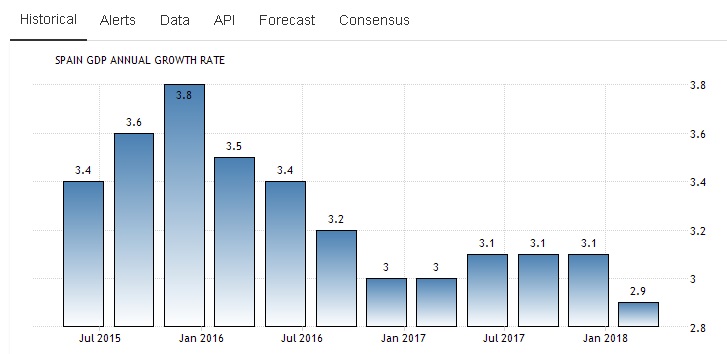
Even now, when we merely consider Spain in all this (not the smallest economy), we see (at https://www.southeusummit.com/europe/spain/spanish-economy-returns-grade/) that Standard & Poor’s is still playing (what I personally see) as ‘their little game’. Perhaps you remember ‘S&P reaches $1.5 billion deal with U.S., states over crisis-era ratings‘ (at https://www.reuters.com/article/us-s-p-settlement-idUSKBN0L71C120150203) the one quote (one of many) needs to be considered “S&P parent McGraw Hill Financial Inc MHFI.N said it will pay $687.5 million to the U.S. Department of Justice, and $687.5 million to 19 states and the District of Columbia, which had filed similar lawsuits over the ratings“. So when I see “S&P notes that Spain’s overall economic and budgetary performance has not been hampered by political tensions in Catalonia, as many had feared. The country’s GDP increased by 3.1% in 2017 and last week the Bank of Spain raised its economic forecast for this year to 2.7%, up from a December forecast of 2.4%“, you see, the numbers are not really in question, yet when we see the image below (source: Trading Economics).

When we realise that none of the EU nations has a grasp on their debts, in addition, the GDP for Spain went down whilst it is still below the numbers of 2016 and before, there is actually no reason to see the credit rating for Spain go up. I am personally speculating that the EU will be so much more hardship when France hits the 100% debt marker. It matters, because this will soon become the academic exercise that the question: ‘What is the difference between cooking the books and creating a false positive wave through inflated credit scores?‘ I actually do not have the answer here, but I guarantee you that the quality of life in Europe is not moving forward any day soon, not until some issues are seriously reconsidered. In addition, the US-China trade war isn’t helping anyone, not even the Europeans so that will also become a factor of debate soon enough. It partially relates to “We have revised upwards our GDP forecasts, with an intense rate of employment creation and an economic model based on the external competitiveness of our companies. With this scenario, we will achieve our objective for 20 million employed people by 2020“, the issue is that it is misrepresentation, you cannot rely on the unemployment figures and then state we will have 20 million employed, because on a population of 46 million, he might be implying that the unemployment numbers will skyrocket from 17.4% in 2017 to 56%, that would be crazy, yet that is what we are told, is it not? The best lies (read: miscommunications) are done through statistics, so that the feather matches the bird one would say. Still, back to my speculation, I believe that Spain is not the only nation in this setting; I think that some numbers in pretty much every EU nation are beefed, weighted and set to make Europe (or basically themselves in the European setting) look much better, so when the UK leaves they will not look as weak and feeble as they have actually become. It is a setting that is way too dangerous. There is no way that Mario Draghi is not part of this, so when we look at the Financial Times of last week we see ‘Mario Draghi acknowledges ‘moderation’ in Eurozone growth‘ (at https://www.ft.com/content/3e20b49e-4939-11e8-8ee8-cae73aab7ccb). So with “Analysts said that Mr Draghi’s guarded language suggested that the ECB may wait until July — a month later than previously expected — to provide the markets with updated “forward guidance” on its plans to phase out the crisis-era stimulus“. I am a little less optimistic in regards to the quotes, and when we see ““Better safe than sorry was the motto of the day,” said Dirk Schumacher, economist at Natixis“. I personally tend to see that as:

Better safe than sorry
It allows for another day without worry
As we pile the worries and woes
To a stack we can blame on crows
Those at the London Tower are best
Because when they leave the EU we can make them the jest
And when our barge is no longer secure
We move to Wall Street where we can endure

You might think that I am merely making light of all this. The issue is that people in Europe seem to ignore that over €2,000,000,000,000 was printed without the validation of treasuries or consent of the people whose funds got devaluated even further. Do you think that printing money has no cost? It is money that the EU never had, so why did you think it came without consequence?

This partially (and I mean partially) is seen in different ways when we look at an article from Reuters merely two weeks earlier (at https://uk.reuters.com/article/uk-ecb-policy-draghi/stock-volatility-no-big-factor-for-ecb-so-far-draghi-idUKKBN1HG1VR) ‘Stock volatility no big factor for ECB so far – Draghi‘, now I agree that volatility will come and go, so the ‘so far’ part is perfectly fine. When we see ““While we remain confident that inflation will converge towards our aim over the medium term, there are still uncertainties about the degree of slack in the economy,” Draghi said in the ECB’s annual report“, now I can agree with that. There will always be a certain amount of uncertainty, that is all good, no issues there, but it is set on a certain premise. When we see that Spain (the only visible one) suddenly in opposition of what I see as real has its credit score increased and as such we see the start of an optional bubble, when others do the same we see the forecast on unreal values, so we see the bubble is not set to the reality of the actuality, at that point, when a lot more start realising that some numbers do not make sense, the uncertainty grows and the closer the UK is to leaving the stronger that uncertainty becomes. At that point we see a run and a total collapse, when that happens, when the people realise that pensions before 78 is no longer optional, do you think that the people will remain calm? When they realise the impact of €2 trillion printed cash is impacting the 26 nations, how much value decline will they face? When that happens, how will people react in all this? Now we get to two elements, one is the mention in the Financial Times where we see: “But the weak economic data for the first quarter have triggered increasing speculation that the first interest rate rise will be delayed until later in 2019. A smaller number of analysts are expecting the bank to continue QE into the new year“, the second is that the entire stimulus was to set the economy right, which did not happen, now set that against inflated credit scores, inflated economies and the downturn that follows, that will happen, it can no longer be contained, merely delayed to some extent. When it does hit Europe would not have a penny left to balance against and it will leave the bulk of Europe destitute. There would be no defence against the next downturn and that is when disaster will truly strike. So as the story is pushing towards ‘protectionism’ and ‘patent values’, we should also consider that impact. Now, as a University graduated Master on Intellectual Property rights, I do comprehend some of the issues, yet I am not a patent attorney, so there are parts that I will ignore or not look at. Consider that a national economy is now more and more dependent on the national patents and the represented value that they hold. Now we get European Patents, the Unified Patent Court (UPC) allows for a simpler way to get it all registered and to some extent enforced. So it is a good thing overall, there was never too much fuss about that side, yet the one strong economy (Germany) is now setting the stage to oppose the UPC, we see this (at http://www.ippropatents.com/ippropatentsnews/europenewsarticle.php?article_id=5725), where we also see “Alternative für Deutschland (AFD) has called for the repeal of the convention on a Unified Patent Court (UPC). AFD “rejects the EU patent law reform”, according to the German Bundestag, which announced the motion on 7 March“, I believe that overall the UPC is a good thing, but there will always be small interests that are not perfect, no EU setting is 100% positive, yet overall, to get one filing for all EU nations, in light that even the UK agreed (and ratified) is a good thing. So when we see “It was based on three grounds, mainly how the UPC Agreement violates EU law, the majority requirements of basic law, and does not comply with the rule of law principle related to judicial impartiality. The complaint was scheduled to be heard in 2018 by the second Senate, appearing as the 11th item on its agenda. In Germany’s 2017 federal election, the AFD won 12.6 percent of the vote and received 94 seats, the first time it had won seats in the Bundestag“, there is an academic setting, yet with 12.6 of the council in hands of the AFD, a very Brexiting minded party, or is that Berlout or Deutchleave, we need to realise that the patent issue is a lot more biting in Germany and that cannot be ignored, as they give rise to uncertainties. So when we get back to the uncertainty there, as well as other uncertainties, and whilst we saw Mario Draghi accept that uncertainty results in stagnation, how much more stagnations are required for the next downturn, even a short term one, whilst the economic reserves have been already been drained.

Now we have a much larger setting, the EU was never about everyone agreeing on everything and the economic setting that requires that to happen at present is also making the dangers of waves that sinks the barge called EU. Now, that seems like an exaggeration, but when you realise that the German anchor is the only one giving stability, you can see the dangers the EU faces and more important, the dangers of no reserves and an utter lack to keep proper budgets in place, a setting now in more danger for the reasons that I gave supported by the economic views of many others. I believe some are downplaying the impact, yet when we realise that EVERY European Union government is downplaying the economic impact (as every nation always wants to look as good as possible, which is a PowerPoint setting of the human ago) we get a much more dangerous setting. We accept that the smaller nations have a negligible impact on the whole, but on a ship that can only remain truly stable with four anchors, losing three is a much bigger disaster than anyone realises, and that downplay will hurt all the players that are part of the EU, so when the downturn starts, we will see kneejerk movements from all the nations, all the big players and we can only speculate the fear mongering speculations that the IMF will treat the European audience to. I have no idea what form it will take, but when it happens I will take a deeper look. In a setting where every negative economic milestone could lay waste to whatever reserves its citizens wrongfully thought they had in the first place.


2 Comments

Filed under Finance, Media, Politics, Science

The failing Mario Draghi Kart

Just yesterday, the Deutsche Welle (at http://www.dw.com/en/eurozone-economy-still-requires-stimulus-ecbs-mario-draghi/a-42751327), gave us that the ‘Eurozone economy still requires stimulus‘, so after these years the stupid and the rich still will not learn and the people are about to pay for it dearly. That is, not the UK, they might have gotten out just in time, if they don’t add delay upon delay. Even as we are sussed to sleep with: “The bank is gradually reducing its bond purchase program but it may continue past September”, the people are sussed to sleep, in a situation, where they sleep on a luxury liner and it is going down. Like having a nice cabin on the Titanic and you decided to sleep in on April 15th and you did. You never woke up, you could if there was oxygen, yet oxygen is 3786 meters away, 3786 meters straight up!

So when we are pointed at the ECB’s asset purchase program, which began three years ago, and which has seen the central bank spend €2.55 trillion ($3.14 trillion) to buy government bonds and other financial assets. The people are not given clarity on where that money went EXACTLY, in other news, that news we got months ago on Mario Draghi being a member of a very exclusive 5 mile high club. So when we got 6 weeks ago: “European Central Bank President Mario Draghi should give up his membership of the opaque Group of 30 consultative body because it risks hurting public confidence in the ECB’s independence, the European Ombudsman said on Wednesday“, how come the near entire bloody media has not followed up on this? After that one day it was silenced, the ECB will not respond, Mario Draghi apparently keeps on getting away with whatever he needs and there are no questions, not even on an international level which is unsettling in so many ways as it leaves us with the indication that the media may be as unreliable as the politicians they are reporting on.

A program that has sunk 3 trillion dollars and everyone is just stating that the economy is great, yet nobody is asking the number one question and that is ‘How will we pay it back?

The theory of printing money

Mario Draghi, president of the ECB has profiled his place and his ‘bank’ as awesome, marketing on a near supreme level, like a politicians stating on how honest he is. Excellent standards, great breeding and stellar academic excellence, and you know that expression about a story being too good to be true?

So they have their ‘Quantative Easing’, they use it to buy government bonds and other financial assets. The purchases have helped keep borrowing costs low, which in turn have boosted spending and investment in the Eurozone economy. But is this true? You see, there are now two levels of problems and dangers. When we consider that the bond is a debt security, under which the issuer owes the holders (so the government that issued the bonds now owes the ECB), a debt and (depending on the terms of the bond) is obliged to pay them interest and to repay the principal at a later date, termed the maturity date.

So over $3 trillion is bought from these governments and those governments are paying the ECB interest until they pay back the amount at the date of maturity (could be up to 30 years). So basically they are pushing massive debts forward, it is almost like the Greek debt mess, but now close to 173 times more intense in regards to the outstanding amount. The current makers in charge get a free pass and leave the mess to the next person whilst they enjoy the millions they earned as well as the multimillions they got by being a member of an exclusive group of 30, as they get the results before any other publication and they get to the cream all without ever running the risks other ‘investors’ face.

So whilst everyone sees the interest only part, we are kept in the dark on the fact that an additional $3 trillion would be outstanding and with the UK out of play, the other nations will get to pay for it all, so when we consider that last week nations like the Netherlands told the EU that they want a freeze on EU contributions, so now we read: “Rutte has said he does not want the Dutch contribution to the EU to increase, despite the European Commission’s call for higher spending on climate change and border controls, and the gap left by Britain after Brexit. Like the Netherlands, Britain is a net payer into the EU’s coffers and will leave a large hole when it pulls out. The Commission wants to fill the gap through a combination of spending cuts and higher contributions, something which the Dutch strongly oppose” (at https://www.dutchnews.nl/news/archives/2018/02/dutch-prime-minister-begins-campaign-to-freeze-eu-contributions/), what no one is looking at, or mentioning is that the outstanding $3 trillion is going to be an additional matter to deal with, even if that is placed in a very separate part of the books. Payment will be due!

So as they give the mention how Brexit will be one reason to increase payment, the absence of the QA plan and outstanding amount remains unmentioned, it is an impact, but that is exactly why the UK got out in the first place. In this the contribution for the Dutch will go up by $4500 per person, so where is that coming from? Now consider that the impact of the matured bonds will be massive for the positive contributing nations, Germany, France, Italy, Sweden, Belgium, Denmark and Austria would end up getting a blow to their budgets unlike any they have had. The question becomes how intense depends on certain elements. So when we consider the bad curve. So, when the bonds bought reduce in value by 30%, the ECB is not hit, it might lose the value, but that means that the government it was bought from ends up with a smaller invoice to pay, and the losses for the investor (the ECB) loses 30% of their investment, now the EU nations as a bloc will have to come up with that money. So depending on where it was invested in, that government get to laugh as the other EU members need to pay for the ‘losses’, which amounts to the positive paying nations. This is one of the foremost reasons why I was all for the UK getting out as soon as possible. So these nations could end up paying an additional $1 trillion divided amongst them. So how was this ever going to be fair? Of course that is if the value of these bonds depreciates, if that does not happen, than there is no additional issue, but the fact that the outstanding amount is still due for payment and in light of the bulk of these EU nations not being able to keep a decent budget and almost no ability to pay such amounts does not help us in any way in raising confidence in regards to the EU moving forward. Greece is to the smallest extent some indication, even as many sources are positive, I have an issue with “The 2017 primary balance target of 1.75 percent of GDP is expected to be reached with a significant margin. For 2018 the primary balance target of 3.5 percent is considered achievable“, so there are two parts. The first is the use of ‘expected to be reached‘, margin or not, these numbers are not yet set in stone, so there could be a bad news cycle. The second part is ‘target of 3.5 percent is considered achievable‘, which means an almost 100% increase towards the positive result, which has never been realistic. Even as the unemployment numbers are down from 27% a few years ago, to 21%, this still implies that one out of 5 is without a job, that means the stresses on the Greek infrastructure remains and it will remain for several years to come. So when it comes to the larger nations, Spain, Italy and France are still a downward drag here in regards to the overall EU and their drag is draining their infrastructure and options towards pushing the EU economically forward, some others like the Netherlands and Sweden are ahead of the curve, but we forget that they are merely 26 million, whilst the three dragging us down represent close to 185 million people, in that regard we forget the weight that the larger nations have. So in that both the UK and Germany are the positive sides, but the UK is leaving and adding Germany only gets that group of 3 at 50% of the ones slowing the EU down, so even as the slowdown is a good thing, it is still a negative result in the end. So it is in that light that there is a growing risk to the entire Quantative Easing plan that Mario Draghi gave the EU and even as they are all on how ‘the economy is so much better‘, I agree that compared to two years ago, the people are more positive and jobs are getting better, yet this has been at the expense of unrealistic levels of spending and there is no given on when that will be resolved, so those people have a $3 trillion bill hanging over their heads.

You see, part of the problems is infrastructure, EU infrastructure mind you. So as the Australian Financial Review (at http://www.afr.com/news/economy/monetary-policy/mario-draghi-keeps-focus-on-monetary-accommodation-20180226-h0wos8) gave us “Draghi did address a question on why ABLV Bank received emergency support from the Latvian central bank before the ECB declared it failing or likely to fail. He said that the Emergency Liquidity Assistance policy – under which national central banks rather than the ECB decide to provide support to troubled lenders – is a “remnant of a past time” and should be reformed

Say What?

So basically a bank got support from its national bank, whilst the ECB had it as ‘likely to fail‘, so is this how Quantative Easing is ‘miss-spent’? It is not completely clear or fair to state it in that way, yet when we see Reuters with “The ECB said at the weekend that privately held ABLV is likely unable to pay its debts or other liabilities as they fall due. “We believe our bank will be able to settle with all of our clients in full,” ABLV, Latvia’s third-biggest bank by assets, said in a statement. “Voluntary liquidation is an important condition for it – the process has to be done as professionally and as transparently as possible, given the history of Latvian insolvency and liquidation processes”“, yet in all that is there any mention whether that included the emergency support funds? The text does not include that part, so that is money down the drain. That whilst it is not the only scandal that Latvia faces. If we consider the Stratfor view (at https://worldview.stratfor.com/article/what-watch-two-banking-scandals-unfold-latvia), we see “On Feb. 17, the Latvian anti-corruption agency detained the head of the country’s central bank, Ilmars Rimsevics, after Grigory Guselnikov, the Anglo-Russian owner of Latvia’s Norvik bank, accused him of taking bribes. Rimsevics has denied any wrongdoing, and Latvia’s Defense Ministry said that the allegations were part of a “massive information operation” by an external actor. Latvian Finance Minister Dana Reizniece-Ozola said that the corruption allegations would be investigated“, as well as “a report issued Feb. 13 by the U.S. Treasury Department detailing the results of its investigation that found ABLV had facilitated transactions linked to “large-scale illicit activity connected to Azerbaijan, Russia, and Ukraine” as well as activities circumventing sanctions on North Korea. In the wake of that report, significant assets were withdrawn from ABLV“. Now we can see that for what it is, yet we also get “the ECB’s Single Resolution Board has rebuffed ABLV’s efforts to seek financial assistance, determining that shoring up the bank “was not in the public interest.”“, so in light of the mention by Mario Draghi with ‘under which national central banks rather than the ECB decide to provide support to troubled lenders‘, I see it as instead of money wasted from the left trouser pocket, it came from right cheek pocket. How does that solve anything? The fact that the trousers came from the old tailor, the fact that the damage was not contained and allowed certain parties to take their cash out of Latvia is still cause for concern for those wearing the trousers.

That reflects also when we add the Greek issue that is playing right now with “the resignation on Monday of economy minister Dimitris Papadimitriou and his wife, the alternate labour minister, Rania Antonopoulou. Antonopoulou gave her notice after it was revealed that she had accepted €23,000 in housing benefits at a time of immense hardship for Greeks” (source: the Guardian). The issues playing do not seem like much, but it is like mopping the floor in a room where the water main has burst, it is close to pointless. In all this, especially when we hear Alexis Tsipras come with ‘praising the couple, in a speech late on Tuesday, for the “sensibility” they had exhibited in stepping down‘. To me it reads like ‘I am happy you vacated the premises as the people now know what you did and they are angry, thank you for that!‘ Is there any way that the Greeks are not getting fuming mad on that issue?

That is the part that does matter, because that is linked to whatever bonds were purchased, where they were purchased and how much is in play. We see none of that; merely that the invoice at present is set at 30 billion Euros per month, down from 60 billion per month earlier and 80 billion per month before that. So there is no way to tell how unrealistic my 30% loss is, it could be as low as 1% or as much as 41.3%, there is at present no way to tell. It is a long term gamble instigated by those in power now and left to solve for whoever gets to hold that seat when those spending’s mature and payment is due. Yet the chance of breaking even (best case scenario) is almost statistically impossible and no one has answers how to deal with it the moment it happens.

Can the Draghi failing be proven as a failure?

That remains the main event in all this and the fact is that the proof is nowhere near complete because the transparency in the spending and the path to repayment is missing. The fact that the money is printed and that the payment of the printed money is due at some point is not dealt with, by none of the media. Is it because it is not due now, or are we kept in silence because it stops us from asking questions? Perhaps like the elite group of 30 bankers, only initial questions are allowed and no response will be coming. That are merely factors in all of this and it does NOT sets any premise to the failure or success of the acts by Mario Draghi. Part of it is shown by Bloomberg a mere 15 hours ago, as they gave us: “The rate of price growth slowed to 1.2 percent this month from 1.3 percent, dropping to its weakest since 2016. The core measure was unchanged at 1 percent. The figures follow a series of releases that have checked the economy’s thundering momentum at the start of 2018, which had emboldened policy makers who want a faster unwinding of the central bank’s crisis-era monetary stimulus“, so even as that is not evidence, it seems to me that people are stalling and delaying stopping the QA wave, until the QA wave shows a positive. It is like watching a person throw more and more money in the pokeys until that person breaks even. In gambling terms it is watching a fool bleed dry. Even when we accept that a pokey returns 90% over its lifetime, that means that at the very least there is a loss of 10%, even if that person is getting lucky, the small wins are still used up whilst the player is trying to break even and in the end that money too is gone. That is how we could see the QA program to go and if that is true, a loss of 41.3% might have been optimistic, but it remains speculation. The article (at https://www.bloomberg.com/news/articles/2018-02-28/slowing-euro-area-inflation-helps-draghi-push-back-exit-debate) now gives the other parts I mentioned earlier too. With “consumer price growth almost halved in Italy and slowed in Germany” giving the line I had that with unemployment in Germany being an asset, but this slowing and 50% less gives rise to more without a job, or halted in economic growth for Italy, whilst Germany is halting to some degree their forward momentum, which translates in upcoming bad economic news cycles, or better stated less positive ones, so how will that impact the outstanding $3 trillion? The impact is only seen when that amount is due, but the impact will be there and those who pushed it onto us will no longer be around and they end up washing their hands off the dangers and leave us to pay the outstanding invoice, it makes for the most dangerous of market karts.

With ‘Buy now and pay when we make the most profit!‘ is an economic standard that has never been good commerce, or realistic for that matter; but that is exactly what Europeans signed up for, and the people in Europe end up not getting a say in the matter. That is the issue I opposed all that time and that is why I hope that the UK got out in time, because that part will drag the EU economy down to a degree it has not seen before. The only worry is what happens when that issue hits the European tax payers, because it will! No doubt about that!


1 Comment

Filed under Finance, Media, Politics

Removing the right of choice

Fox News had an opinion piece 2 days ago that only now met my eyes. Now, for the most, apart from some Guardian opinion pieces, I tend to stay away from them. Yet, this one caught my eye because not only was the situation upsetting. The issue that Americans use their right to free speech to deny others the right to choose (to some degree) is another matter and it became clear that I should give my view in all this.

The title ‘Is the West finally pushing Saudi Arabia to squelch its version of radical Islam?‘ First off, why on earth do we see the need ‘forcefully silence or suppress‘ the choice of Islam? Now, I am merely a Christian in this, but I do not see any reason here. In the second, the setting of ‘radical Islam‘ is equally an issue. What makes it radical? That is not me being clever, it is an actual question. When does any religion become ‘radical’?

Now, I am merely quoting Wiki here (just the easiest part), and important that as a Christian and not armed with a knowledge of Arabic, I might wrongfully quote her, so be aware of that. With: “In the 18th century, a pact between Islamic preacher Muhammad ibn Abd al-Wahhab and a regional emir, Muhammad bin Saud, brought a fiercely puritanical strain of Sunni Islam first to the Najd region and then to the Arabian Peninsula. Referred to by supporters as “Salafism” and by others as “Wahhabism”, this interpretation of Islam became the state religion and interpretation of Islam espoused by Muhammad bin Saud and his successors (the Al Saud family), who eventually created the modern kingdom of Saudi Arabia in 1932“, you see, my issue, perhaps partially better stated as my grievance with Nina Shea is not that she is a lawyer or a Christian, but that she is both. That one nation that has been hypocrite towards empowering outspoken Christians and Christian puritans at nearly every twist and turn of every American administration since WW1 is now speaking out against another puritan based religion? How screwed up is that?

And the fact that we also see in the Fox News pages that she currently is a leader of a campaign for Christians threatened with genocide by ISIS, is even worse. As American Presidents have refused to name the Armenian Genocide as such because of concerns over alienating Turkey, with former president Barack Obama being the latest weakling in that long line of individuals in denial. And when we get to alienating Turkey? Turkey alienated them self for a long time, going all the way back to 2001 and they only alienated themselves stronger with nearly everyone after that. So genocide is only recognised when it is in the interest of US political policies? How hypocrite is that? So even as this happened less than a year ago, we see: “But although ISIS’ genocidal intent has long been clear, the extent of the group’s atrocities has remained murky. Local authorities and human rights organizations have made some attempts to compile lists of victims. According to those lists, between 2,500 and 5,000 Yazidis had been killed by ISIS while over 6,000 had been kidnapped. But the UN has not yet been able to independently verify these figures” (source: www.foreignaffairs.com), so how should we see these differences?

Personally I have no issue with people and their religion, you see they can be a puritan as they want to be, and until they start pushing that onto us (read: me) they are fine. I have absolutely no regard for any Christian pushing their values onto others, in that I am quite happy to see the separation of state and church to be forever. There is in equal measure another issue, you see, puritan is often seen as ‘against pleasure‘, which is not always the case and that makes that discussion a lot harder, for what sets the definition of Puritan?

So when we see the quote from Nina Shea that gives us: “Now Europe is finding its voice with a new willingness to pressure the Saudi Arabian government to end its spread of extreme Islamic ideology, known in the West as Wahhabism“, so she has set ‘puritan‘ as ‘extreme version of‘. The question is on one side is what constitutes a puritan version as such and even if so, the Vatican forced Christianity into the world, whilst under its flag committed genocide by removing no less that 11 civilisations. The church and greed have gone hand in hand for centuries whilst the nobility, or should that be in modern tongue ‘Big Business’ have not been held accountable since before World War 1. The bible approved of slavery and in Matthew 19:14 and Mark 10:13 stated ‘Let the children come to me‘, Catholic priests saw that as an optional clear signal to fuck every young boy in town (whenever possible). So as the Holy See was considering thousands of priests actively taking the cherry from young boys for over 50 years, how many went to prison? In that light the media is equally to blame, until the movie Spotlight got the limelight in the Academy Awards, millions of Americans remained in denial. Even as the Boston Globe exposed it in 2002, it would take 13 years, until after the movie was released that the larger part of the media changed their tunes, the church still has that much power. So as we oppose one form of puritan religion, we see the outrages acts of our own religions and in that regard I have an issue with certain settings.

In addition we see: “As I told Congress in testimony last July, 16 years after the 9/11 attacks – led and carried out primarily by Saudis” we see yet another issue. In the first, this attack was done by Al-Qaeda, under the leadership of Osama Bin Laden, who was indeed born Saudi, yet he was banished from Saudi Arabia in 1992, 9 years before the event. More important, their family came from the Yememi Kindah, so another ‘faith’ altogether, in that regard, when we consider that Kindites converted to Judaism following the conversion of the Ḥimyarite kings, which happened roughly 1500 years ago, so why is she not blaming Israel in all this? It seems to me that Nina Shea has no religious agenda; she has a political one and is willing to play Saudi Arabia towards her needs. In the part that we accept that Al-Qaeda was made up from Islamic Extremists and Salafists, there is the legitimate question on how many of the members of Al-Qaeda are (still) Saudi, but is that even possible to grasp? There are so many splinter organisations, active all over the Middle East, In Yemen is gets even more of an issue where they are fighting the Houthi’s. The New York Post gave us two weeks ago: “An immigrant from Saudi Arabia suspected of applying to join an al-Qaeda training camp has been arrested on a visa fraud charge in Oklahoma, according to a report. The FBI recently discovered Naif Abdulaziz Alfallaj after his fingerprints matched those taken from a document found in Afghanistan“, it makes matters worse and less clear. It is not a clear picture for those getting all the information, for people like Nina Shea who are willing to ‘filter’ data before their presentation make matters worse, we do not only get a distorted picture, we get more non-truths (at times non-verifiable truths, or speculations) and as such the picture shift a little more. We can argue that to some Saudi citizens desire a life of ‘action’ in perhaps the wrong direction is preferred over whatever they had before. We have all had those moments. I myself have argued within myself to find 1-2 paedophilic priests and hang them in the nearest tree without trial, so should I join some anti-religion and blow up churches? Of course not, that would be just insane, but some might do just that.

So when we consider ‘members of the Ku Klux Klan planted and detonated dynamite at the 16th Street Baptist Church‘ we also need to see that J. Edgar Hoover had secret recordings that proving the involvement of guilty parties (according to some sources), he also ensured that a court could not use them as evidence to prosecute the attackers, making it more difficult to convict. For 14 years after the bombing, none of the men were prosecuted for their crime. The first one to be arrested (and convicted) was Robert Edward Chambliss in 1977. So we, Americans and non-American Christians alike have closets full of skeletons, perhaps when it comes to certain matters we should not be the judging or reforming parties in the matters of other nations.

Now, there are a few sides that do bare consideration.

Even if we agree with: “In 2010, a top U.S. Treasury counterterrorism official warned that without Saudi education reform “we will forever be faced with the challenge of disrupting the next group of terrorist facilitators and supporters.”“, Saudi Arabia is a sovereign state, it has its rights and it has forever been a Muslim state. You see, until the oil prices went down and the profits declined, America remained unwilling to hear any level of criticism on Saudi Arabia, making a lot of the matters in play hypocrite at best.

The next ‘wrongful representation‘ is “The West seems to be finally waking up. The new assertiveness shows official recognition of the link between Islamist ideology and terror, and our governments must keep it up“, you see, I see this as “as the profits are declining and as Saudi Arabia is now set to be a growing force beyond the petrochemical industry” we see issues because the ‘link between Islamist ideology and terror’ has been known for a long time and seen as such. Hamas, Hezbollah are the clearest ones. There is the Muslim Brotherhood, and plenty of others, whilst the PLO was delisted as a terrorist organisation is now again rearing its tail by no longer recognising the state of Israel, so that could escalate again. In addition we see that only the UK saw the Orange Volunteers as a terrorist organisation, I wonder why the US did not see it that way. So whatever makes that list is also very dependent on how they cross the United States of America (speculation on my side), so as the sovereign nation of Saudi Arabia is becoming a growing centre of commerce and an economic power we start seeing more anti-Saudi events. Yet the US will happily sell all the weapons and planes they can for now. Nina also refers to a report that was classified and forced into the open in 2016 regarding the Saudi textbooks (at https://www.nytimes.com/interactive/2016/08/17/international-home/document-state-dept-study-on-saudi-textbooks.html), it is 148 pages, so read it there (the PDF was too large to place here).

My issue in this is not the paper; it is the chance of comprehending it all, it is linked to hundreds of books, to hundreds or issues all linked to the Koran and to the rights that Saudi Arabia has as a sovereign nation. We might not agree and as Christians we might to a certain degree oppose outside of Saudi Arabia, but its sovereign rights are as they wanted it, linked to the Muslim faith. We need to recognise that we are not all alike, that others have their rights and they need not be based on democracy. However we must also recognise that ‘democracy’ in America and largely in Europe is set towards what the rich and powerful want it to be. If you disbelief that then try to change laws in America that makes Wall Street criminally accountable. Good luck getting that done within the next 50 years!

You see, in support of my view, I would like to call attention to page 3, where we see “The national identity of Saudi Arabia is deceptively simple. It is an absolute monarchy“, so what makes a monarchy absolute? The Netherlands is a monarchy, so is Sweden, Norway, Denmark, the United Kingdom, Belgium, Spain and a few others. So as these are predominantly Christian monarchies, are they not absolute or dangerous? Perhaps they are merely seeing eye-to-eye with the US and not that much of an economic threat? The EU and the ECB simmered down the European nations as threats is another view and it is for people with better economic degrees than mine to make a call on that. Again a speculation from my side, but it seems to me that the US would prefer every nation to be a republic, so that the larger corporations can sweep in and reduce that national population into a spreadsheet and reduce the abilities of those being a hindrance, a non-consumer or a liability.

We can take any view on these matters, but in the end we see a person with a rightful opinion get the centre stage all the way to the US Congress, whilst we consider her quote: “Germany finally pressed Saudi Arabia to close the King Fahd Academy in Bonn in spring 2017, according to a 2016 Deutsche Welle report. It first came under investigation 14 years earlier for alleged ties to al Qaeda“. The question that is here is ‘It first came under investigation 14 years earlier for alleged ties to al Qaeda‘, so was that ever proven? That is the part that Nina Shea does not want you to know; in addition there is the part that was in the Deutsche Welle. ‘Now, the King Fahd Academy is about to close its doors of its own accord‘, which she did not mention. In addition (at http://www.dw.com/en/controversial-saudi-school-in-bonn-to-close/a-19511109), we see the clear mention of ‘Moving beyond oil‘, it seems that Europe and the US stayed very silent whilst the oil profits were flowing their way making a lot Nina states even more hypocrite. So as Saudi Arabia’s Crown Prince Mohammed bin Salman is pushing stronger towards his “Vision 2030“, we see that slowly his reforms are catching hold, there is momentum and there is additional evidence that it is a worry for the United States, particularly the people who were having benefits on the matters before Vision 2030. When we consider the rumour from last month when we were introduced to “The new policy means Apple is administering collection and remittance of tax to authorities at a rate of 20 percent in Armenia and Belarus; 5 percent in Saudi Arabia; 18 percent in Turkey; and 5 percent in United Arab Emirates” we see the clear benefit for Apple to grow in Saudi Arabia, yet in that it could cost the US 20 cents to every dollar pushed to Saudi Arabia and as Apple tends to think in tens of billions, the US is about to lose out of a pretty penny they desperately need. In addition with Amazon and Google gaining tech hubs there, the loss of revenue and data is about to cost the US a lot more and in this greed driven economy that is what has been setting plenty of people over the rails and into the sea of chaos, frustration and outcry. So as Saudi Arabia ends up getting 5 data centres, how many will not be upgraded in the US or Europe in the near future? How much is that going to cost them?

These are all matters linked to the opinion of Nina Shea, because if that was not the case we would not have seen “These events are being driven by Western governments that are now pushing hard for the government of King Salman bin Abdulaziz Al Saud to pull back from Wahhabist support – a push that appears to be working“, you see, the fact that (some) schools closed on their own accord was not mentioned, neither is any part of Vision 2030 which has been on the front page of the Saudi plans of actions for almost 2 years now and in addition, when we see “For decades European and U.S. leaders bit their tongues while the Saudi governments spent billions of dollars indoctrinating Sunni Muslim communities“, whilst not stating that the oil money flowing into these places was too good to ignore is equally an issue because it shows us to be hypocrite and it shows Saudi Arabia to be business oriented. OK, I will give you that the last part is not entirely correct, but why did Europe and the US bite their tongues? If they were so morally high we would have seen a lot more, an issue that never happened.

So who will Nina Shea blame for that? I reckon we will leave it non-mentioned (for now).

Finally we need to look at her statement “Tiny Belgium, population 11.27 million, has sent more Islamic fighters to Syria per capita than any other European country“, so when we see the Wall Street Journal (at https://www.wsj.com/articles/europe-balks-at-taking-back-isis-fighters-1518557328) where we see the quote “An estimated two to three dozen Belgian foreign fighters are in detention in Syria and Iraq, another Belgian official said“, so as we consider an unrelated statistic like “Hospital medical errors are the third leading cause of death in the United States. That’s 700 people per day, notes Steve Swensen“, the fact that we see the mention of 36 Belgium fighters in Syria in a pool of 5000, seems to be too irrelevant to use as a focal point in her presentation, whilst in the US 700 people a day die in Hospitals through mere errors. She has the wrong focus as illumination in her presentations. You see, it would not have mattered if she had mentioned the number of Belgium fighters and the total pool of ‘extremists’ but she did not want that, she wanted the hypocrite limelight, so I will happily keep a focus on her and how she tries to misinform the people around her next.

In all this Fox News should get an equal share in the blame by not setting the stage properly. By leaving too much unstated we should consider that the reliability of Fox News and what they present is equally taking a turn downwards.

In the end

In the end this was less about speaking for Saudi Arabia (they can do that themselves perfectly well), then speaking against Nina Shea. I find this a hatched job that should not have been placed on Fox News the way it was. Whatever points she could have made was drowned out by the misrepresentation that I see them to be and in several fields in many ways. This requires me to add her mention of ‘Islamist terror has replaced chocolate as Belgium’s best known export‘, you see the best export the Belgium ever had was beer, the finest in the world. And even as we agree that their chocolates are the best, we need to see that terrorism is not their export, or their best known export. Perhaps their flaw was to have the most cordial of borders in Europe, together with Sweden, yet as Sweden is up in the north and Belgium is caught between the Netherlands, Germany and France, there is no doubt that whatever they get came initially from one of the three other nations and guess what, Nina made no mention of that either. Perhaps because she was in doubt whether it was a good idea to piss the other three nations off? Again, merely speculation from my side, but in the end, we have seen in evidence from reputable sources that the economy has been a central reason in creating extremism, a part that has hit Belgium and several other nations. That too remains unmentioned.


Leave a comment

Filed under Finance, Law, Media, Military, Politics, Science

A changing language

Europe is in several stages of unease; there is the spending of Mario Draghi, Brexit remains on the mind of many. Yet, the one change that is now more and more in the foreground of many is the problem that Turkey seems to be. There are those set on the stage to end Turkey as a NATO member and subsequent becoming part of the EU, there are things going forward and backward, but the language involved in all this is changing, so are the settings for the meetings yet to come. In all this the latest Turkish act to double down on the Russian S-400 purchases in 2020. There is, as I stated unease and as I see it the entire EU-Turkey mess is now a dance around unclear settings. Yet the settings are founded on what some would call, clear and blatant lies.

So to recap, on March 26th in the Bulgarian port city of Varna with the attendance of President Recep Tayyip Erdoğan, there will be a summit. The given setting is “to discuss EU-Turkey relations as well as regional and international issues“, this we got from the spokesperson for Donald Franciszek Tusk. The meeting held at the leaders’ level will be hosted as a working dinner, a statement signed by Tusk and Juncker said. Yet soon thereafter it begins. With: “Ankara has been stressing that the EU fails to understand the challenges that the county faces, and calls on all sides to take Turkey’s concerns into consideration, particularly against the PKK and the Gülenist Terror Group (FETÖ), which carried out the failed July 15 coup attempt“, yet how is that true when it has been clear for the longest time “Turkey witnessed the bloodiest coup attempt in its political history on July 15th, 2016, when a section of the Turkish military launched a coordinated operation in several major cities to topple the government and unseat President Recep Tayyip Erdogan“, this is the quote from Aljazeera, but they were not the only one giving this.

The Turkish government blames the failed coup attempt on Fethullah Gulen, a Turkish preacher and businessman who has lived in self-imposed exile in the United States since 1999. So as we accept that the Gülen movement is classified as a terrorist organization by Turkey under the assigned names Gülenist Terror Organisation (Fethullahçı Terör Örgütü, FETÖ) or Parallel State Organisation (Paralel Devlet Yapılanması, PDY), we see the link offered, yet another path in this is “MIT officials admitted that they received the very first intelligence report about a possible attack on July 15, only hours before their own headquarters was under heavy artillery fire“, as well as “As of today, more than 100,000 people have been sacked or suspended and 50,000 arrested in an unprecedented crackdown. The government has deemed the crackdown necessary to ‘root out all coup supporters from the state apparatus’“. When we consider those parts, we need to realise that the Millî İstihbarat Teşkilatı (MİT) was completely out of any loop, which makes Turkish Intelligence not just a flawed setting, it would implicate that it has limited counter terrorism options and no resources to speak of (in intelligence terms).

In opposition to this, there would be enough data to offer that it was an internal issue from within the Turkish military and whatever opposes Recep Tayyip Erdoğan in Turkey got a fat target painted on them. This fills and completes the view we need to have of Turkey much better. In support of this we need to consider that one exiled cleric could not have orchestrated the military support that would have been required and that was seen in action. The width of the Turkish military acting seems to be that of an internal star chamber than a clerical imprint on the military, the latter would have given more visibility to other ranking officers within the Turkish armed forces. As this becomes more and more visible and accepted, we are treated to the view on the unacceptable acts against the Kurds yet again, which followed the Turkish official view of the coup that they ‘survived’.

So in this light the setting for March will be one that is a puzzle. You see as Turkey keeps on playing this game, their credibility will only go down further. The European Council on Foreign Relations (ECFR) (at http://www.ecfr.eu/article/essay_eu_turkey_relations_the_beginning_of_the_end_7226) gives us: “Both Turkey and the EU need the continuation of this partnership. It is a matter of definition whether this partnership will be in the form of full membership or in a different form. What is important is not to break the process and not to cause alienation. The need for sustainable EU-Turkey relations obliges both sides to take steps to honour their commitment to integration“, we can accept that, but at this point, is continuation feasible? We see the shifting language that shows that Germany is less and less taken with Turkey, now siding more and more with France on the anti-Turkey alliance. It gets worse for Turkey as we now hear: “A Turkish court on Wednesday denied entry to the German ambassador to Ankara to the hearing of Selahattin Demirtas, the former co-leader of the pro-Kurdish Peoples’ Democratic Party (HDP)“, which we get from http://www.dw.com/en/turkish-court-denies-german-ambassador-entry-to-kurdish-politicians-trial/a-42579957, even as France is trying to work with Turkey regarding a ‘diplomatic road map‘ on Syria, the sounds of accusation of Turkey violating international law was not far behind it, so there is pressures on nearly every level. Only 12 hours ago, Deutsche Welle gave us “Even NATO Secretary-General Jens Stoltenberg wouldn’t hazard a guess ahead of this week’s defense ministers’ meeting. He said Turkey needs to clarify the status of the contract” (at http://www.dw.com/en/turkish-russian-missile-deal-puts-nato-on-edge/a-42572965), as I said earlier, the language is changing. As we see ‘Turkey needs to clarify the status of the contract‘ that it is about cancelling the contract? Yet in that respect, what would Turkey demand in return? How much is that going to cost and where does that invoice end up? You see, when you consider Reuters with ‘U.S. tells NATO allies spending plans still falling short‘ (at https://www.reuters.com/article/us-usa-trump-nato/u-s-tells-nato-allies-spending-plans-still-falling-short-idUSKCN1FY013), where we see “Spain has said it will not meet the 2024 target. Belgium, the Netherlands, Luxembourg, Italy, Portugal, Norway and Denmark are also lagging. Hungary expects to meet the goal only by 2026“, as well as “France will increase its defense spending by more than a third between 2017 and 2025, but Germany, is not expected to reach the 2 percent target by 2024“, this gives us that the three large economic anchors of the European Union cannot get there. It is these elements that make me wonder on the changing language involving Turkey. From a setting that would have given a clear rejection of Turkey becoming an EU member, we see the setting of new talks, new events and more ‘collaboration’ projects. I think that France is already learning the hard way that this path leads to nowhere, but the others need Turkey to be a spender here, and Erdogan is using that tactic to his own advantage, because once they are in, you cannot throw them out anymore (the EU that is), not even willingly as the UK is learning the hard way. Even as we accept that to some extent Turkey helps to reduce an influx of Syrian and other migrants and refugees into the EU bloc, the question is to what extent and for which purpose, because once these refugees make it into Turkey, Turkey is either stuck with them or they must ‘divert’ them to another place.

In this, in an earlier blog I mentioned the Visa Free EU travel for Turkey and that they had not met the demands. So as we see “Last week, Turkey manifested determination to restart a new chapter in its ailing relationship with the European bloc by submitting a paper detailing Turkey’s roadmap for the fulfilment of the remaining seven benchmarks of 72 criteria” we need to get worried on the non-committed acts from the EU on the matter which had not been met. It seems like Brussels is trying to find any way to either delay it all or give Turkey a pass, which would be disastrous for several players. This is seen in several articles, in this case the Irish Times gives us: “Instead of formally ending EU membership talks, Dr Merkel said she would look at imposing “real restrictions on economic contact” including through the European Investment Bank, EU aid, World Bank and by blocking talks on expanding Turkey’s customs union agreement with the EU, a move that could hit billions of euro in potential Turkish exports“, whilst the EU themselves was ‘dismissive of call for end to Turkey accession talks‘, stating that this is for the heads of government, European Commission says, so the EU revels in inaction and restrictions in other ways. This is a dangerous and explosive combination.

So even as one issue was the contention in the counter terrorism benchmark which has been the definition of terrorism in the counter-terrorism law that Turkey was called repeatedly to amend in order to comply with European democratic and judicial standards. Now, according to reports, a legal provision will be added soon to the current anti-terror law stating that “any critical expression that does not exceed the boundaries of journalism does not constitute a crime“, how is that enough? As we see the Kurdish issues as shown earlier as well as a new complete failure by the Millî İstihbarat Teşkilatı (MİT) should leave anyone a clear indication that not only is the counter-terrorism failing, there is an increased worry that Turkey does not really comprehends the term ‘counter-terrorism’, in support of that fact, or evidence to that, you should talk to the journalists Deniz Yücel, Huseyin Akyol, Ragip Duran, Ayse Duzkan, and Huseyin Bektas. Oh no, you can’t they are in jail! Turkey could have had a genuine excuse, but they lost that option when they denied the German ambassador to Turkey access to the court proceedings. That alone should be regarded as evidence to dismiss the ascension of Turkey to the EU.

And whilst the entire language on Turkey seems to be in a fluid state, the Brexit noise goes on, whilst some are relying on fear-mongering with noise like: “You could have a permanent Operation Stack for 20 miles” regarding shipping between the UK and the EU, ‘could‘ being the operative word. So how large was that ‘stack’ in the 70’s and 80’s? In addition we see the Financial Times (at https://www.ft.com/content/0a8799c6-1190-11e8-940e-08320fc2a277) give us: “Brussels is urging EU leaders to consider radical options such as raiding corporate tax receipts and money raised from selling carbon emission permits to fill a €15bn a year budget hole left by Brexit“, in addition it gives us: “the need to find more money for priorities such as border control and joint defence, mean negotiations are likely to be even more poisonous than previous EU tussles over money“, whilst we see “Some member states don’t want to pay more but they want to do more. Other member states want to receive more“, these elements show the desperate state the EU is in now, that whilst Mario Draghi has printed almost 2 trillion Euro in money for ‘Quantative Easing‘. This relates directly to Turkey, because it shows the desperate EU trying to open a many doors as possible, this is how I see the impact of not dismissing Turkey as an EU member at present. So when we see “impose tougher conditions on access to EU funds as a way to force the likes of Poland and Hungary to comply with EU policies on the rule of law and on asylum” as is a given view on the two needing more money, wanting a stronger voice but cannot contribute. Add to that the earlier pressure from the US for NATO member to do more gives a shifted view of the needed activities within the EU, Turkey is seen as the one floating elements that will allow a few players to keep their heads above water, but it is as I personally see it a desperate act from certain short term viewers, that whilst they also know that it will descent EU elements into chaos. As I (again merely a personal view) see it, it would cripple Strasbourg in getting issues resolved and as Turkey fails to comply with humanitarian sides, it could in equal measure become the puppet for Russia for dislodge other item in consideration, an option honoured by perhaps negating some invoices for S-400 systems, spare parts, training and consultancy? It is merely speculative thinking, but would I be wrong? It would work out very well for Turkey, for the other bloc members a lot less so.

A danger that could have been resolved almost 2 years ago, I will let you ponder on the reasons why the EU never negated this danger.


1 Comment

Filed under Finance, Law, Media, Military, Politics

Those dodgy numbers

We knew it was going to happen, we knew that there would be some term of hardship, everyone knew this. So when the media is lashing all out whilst they know that they are misinforming the people intentionally. We have to wonder why we are not making short work of the media as a whole. So as the Independent gave us (at http://www.independent.co.uk/news/business/news/eurozone-gdp-growth-rate-uk-second-quarter-2017-eurostat-ons-eu-brexit-a7870811.html), ‘Eurostat’s ‘flash’ estimate for growth in the single currency bloc was 0.6 per cent, double the 0.3 per cent estimate for the UK from the Office for National Statistics last week‘ we have to start asking questions. You see, the numbers are correct, they are all about the correct numbers, yet the clarity that is also behind it, mainly what Forbes and a few others tell us with: “We have the results of the composite PMI for the Eurozone and this is showing that the economic growth in the region is slowing. This really is not quite what is desired, especially as we’ve still got the ECB going all out on quantitative easing” we need to wonder what the game of the Independent is. In addition there is from that same Forbes piece: “in this day and age, people tend not to order the parts to make something until they’ve committed themselves to actually making it. So, what people are ordering to make things from is a really good guide to what is going to be made in the immediate future. We then standardise the measures so that we’ve an index, anything above 50 indicates expansion, below contraction. The one really great joy of PMIs is that they are a very good guide to what is about to happen” and that part of the equation is a slowing economy. Even as we see “A falling Eurozone PMI isn’t a disaster but it’s not exactly what we want either” we see what matters, in the age of 60 billion a month QE, we see in equal measure that the economy is slowing down, so in all this, did the independent give us that, or are they in a ‘lashing mode’ on how the EU is at twice the presented strength? And the term ‘presented strength’ is actually a lot more important than you think.

You see, this is important when we consider Mehreen Khan’s article in the Financial Times (at https://www.ft.com/content/edd41c68-76a4-11e7-a3e8-60495fe6ca71). Here we see: “Separate figures from a business survey showed the Eurozone’s manufacturing sector is in the grip of a jobs boom. Factories in France are hiring at their best pace since 2000 and in Spain at a rate not seen since before the start of monetary union in 1998, according to IHS Markit’s purchasing managers’ index“, interesting that both are referring to the PMI is it not? Another article in the Financial Times is giving us ‘Spain unemployment rate has fallen to a 9 year low’, which is great for Spain, yet again, it is merely part of the issue. The fact that it is over 17% is still an issue. Even as there is a drop, it is August, the tourist season is starting to peak this month and that is good for Spain, I am happy for them, I actually am. Yet, the issue is that the drop of 26,000 claims is merely a temporary one, because as tourist season winds down in 8 weeks, these people will get back on the unemployment books, so it is merely a very short term benefit. In addition, it might be better than another time, yet when we consider that the increase started in 2007 doubling the amount in 26 months is another given missing. In addition, there is still the issue not merely of the unemployed, but the internal drain it causes to the coffers (source: Statista). So in my view any benefit Spain gets at present is merely setting the clock forward a mere quarter. Unless an actual economic improvement comes to Spain, we see mere posturing through ‘presented strength‘, not by actual growth or gaining actual strength. It takes three quarters to get a true visible growth to show and the newspapers are keeping silent on that, they hide behind ‘but that is tomorrow and this is now‘, which for the most is correct, yet as they know from various sources that there is already a visible slowdown, the presentation they give is a fake, it is presented fake optimism, some might refer to it as ‘fake news‘.

The fact that the BBC gave a similar view (at http://www.bbc.com/news/business-40774654) does not make any of them a liar, they spoke the truth with “The rate dropped to 9.1% last month, from a downwardly revised 9.2% in May” the fact that France, Spain, Italy and Greece are dealing with global tourism that brings them money, so they need staff is perfectly valid, yet here too is the missed information that is not shown. These nations depend on Tourism. In France and Italy we might see the year round tourism for Paris and Rome, but those two parts are extremes. What is not an extreme is that all three rely to a part on tourism, a valid dependency. Now we consider two sources, the first (at https://www.imtj.com/news/european-tourism-figures-show-growth-2017/), gives us “Several destinations report a rebound in arrivals from Russia -Iceland (+157%) Cyprus (+122%) and Turkey (+88%)-. Overall, outbound travel from this market is projected to improve in 2017“. Now, we need to remember that this was a June article, part of it was expected growth, which is fair enough. The second source Statista (at https://www.statista.com/statistics/186657/travel-and-tourism-scores-of-countries-from-europe-in-2011/), gives us a chart with Spain, France and Germany showing a rise beyond 5% and training Italy with 4.99%, a decent growth all perfectly valid, so when you realise that, and when you see that the impact was a dropped from 9.2% to 9.1% in unemployment rate, is that still a good thing? The rise of these three nations alone (others nations all have tourism, yet not that high), consider the tourism needs; how come that the drop for the short term was not stronger to let’s say 8.7%? That would have been a clear indication of progress, 9.1% even in the short term is not progress and that part remains undiscussed by the media, is that not strange? They have been slamming Brexit through speculations in dozens of articles, and the reality of this so called double economic growth versus the UK is not set into a complete proper context. Even as several sources show the European slowdown. The EU has 8 more weeks until summer is over, what happens then? Will we see the message of a non-anticipated slowdown, or will we see that the slowdown was larger than anticipated? When you see that part, could you decide to trust the media you rely on?

However the independent also gives us “However, the UK economy has grown faster than the Eurozone’s since the 2008 financial crisis, reflecting the single currency’s multiple crises between 2010 and 2013“, which is true yet in this, they also fail to mention that there will be some level of slowdown and the Eurozone will make some level of temporary improvement, the question is for how long this happens. I am slightly less optimistic, yet also hesitant to be too negative. When the dust settles in the Middle East, we know that the Netherlands have two massive opportunities and a few other options through the large projects in Oman and the UAE, those large projects are the kind of solutions that put the Netherlands in the engineering top of the planet. The options could propel that small nation with most of it below sea level in scale and equality to Germany which is roughly 900% the size of the Netherlands. As Germany is one of the large 4, the Dutch achievement would be close to a legendary one. And if there is a large boost to the EU economy it will not be less likely to come from Germany than it will more likely to come from the Netherlands in both 2017 and 2018. This was always a reality that the EU and Germany faced, things will turn around, yet for the short term the EU numbers would probably boost. What is important is that it would not have impacted the UK in any way other than the presented numbers of difference. In this the UK is not on par with the EU on the short side, yet as European tourism falls in autumn, the numbers will no longer look against the UK to that degree and we will suddenly see different mentions, in this some of them are already a near given, so when we see “The single currency zone has now seen 17 successive quarters of growth. The unemployment rate in the Eurozone currently stands at 9.1 per cent, down from 12 per cent in 2013, but still double the UK’s current rate of 4.5 per cent“. OK, I will accept that, yet what I miss is the part that needs to be given with the quote ‘17 successive quarters of growth‘, so how much were these quarters of growth and how did they compare to the UK? It seems that this part is equally missing. In addition there is another part missing, this related to the final quote in the article. With “Other data last week showed that, within the Eurozone, France’s GDP expanded by 0.5 per cent in the second quarter and Spain’s by 0.8 per cent” you might wonder, yet when we look at Statista (at https://www.statista.com/statistics/263008/gdp-growth-in-eu-countries-compared-to-same-quarter-previous-year/) we do not see the same part. We see the Q1 numbers where France and the UK are on the same foot, Italy trails by 0.1% and Spain is ahead by a fair bit, which is the part that impacts and matters, yet the high note comes from Ireland, Estonia, Malta and Romania, which seems like a powerful impact, yet they are together a mere fraction of the EU output, which is why France, Spain and Germany are so important, they are the lion share together with the UK. Only when we look at the last 8 quarters can we see numbers that make actual sense to some and whilst the future is not a given, the knowledge that there is a slowdown coming, there we see that the hyped EU numbers are slightly over the top in my view. So as we accept that the 2 of the large 4 would have much better numbers in tourism season, the fact that the unemployment numbers were projected down by 0.1% is still a much larger issue than most people realise. What is phenomenal is the fact that the impact on tourism is better for Greece. They reported yesterday that the number of international arrivals in the first half was up by well over 10%, which is awesome, as the Greeks should be getting loads of good news after all the garbage they went through. The two sources, the first (at http://www.tornosnews.gr/en/tornos/trends/26630-greek-minister-spectacular-tourism-figures-in-2017.html) gives us: “there is a huge increase in overnight stays and hotel occupancy, ranging from 80% to 95% in most tourist destinations, as well as record arrivals in some of them. The Minister also referred to important economic benefits from the tourism industry, particularly from non-Schengen countries“, which means that the local Greeks will get a relief from the pressure they have had for the longest of times. The small issue that temperatures are up to 41 Celsius might not be the best thing to be confronted with, yet over all they heatwave will give the sun the hours of baking that the tourists love so much, it would also increase the need for windy trips (on boats with sails) and those enjoying places like the caves of Lasithi (in this, I have personal experience that visiting Knossos is a really bad idea, but several museums in Iraklion tend to be nice and cool. another source is giving us (at http://greece.greekreporter.com/2017/08/05/a-record-3-2-million-tourist-arrivals-expected-in-august/). This gives us “Russia and the Netherlands have marked the greatest rise in seats by 25.8% / 46,000 and 18.3% / 26,000 seats, respectively. Top Greek destinations include islands of Crete, Rhodes, Zakynthos, Kerkyra, Mykonos, Santorini and Halkidiki. Tourism professionals are forecasting the same performance in September, citing a total of 2.73 million seats booked for the month after“, implying that it will be a much better year than hoped for, and good for them I say!

Yet in the back of our minds will be not just for the European zone, more precisely, what will Greece do next? In this day and age tourism is great for them, yet they still have the other three quarters to deal with and in this they might have options and opportunities, it merely becomes the view on how to address it and which model to change so that it becomes a benefit.

They are all issues people want to address, yet in this we need to realise that the dodgy numbers are not a help. They are merely the approach towards undesired thoughts and in the end presented strength is no strength, it becomes strength when it is acted upon and results in a positive outcome, this is why quantative easing is never an actual solution. It is merely an option for those who are paid and reflected on the presented result with quarter on quarter growth. The fact that there is a new multi trillion debt is not what their bonus is balanced on. That is the part that people forget. I state to you here that I can go into the USA tomorrow and get a firm with $2 billion if revenue within a week. I have access to all the materials. I merely want 1% of that revenue as a bonus. Now consider that I am selling Official US currency $20 bills for $9.99. I get the bonus because I made my revenue, yet the fact that there is a $1 billion loss is not my issue, it will be for the registered owners of the business and if I set up an LLC with my finding founders, go bankrupt after the exercise one week later, I am still entitled to my $20 million severance package. This is the reality of quantative easing. People like Mario Draghi will not call it like that (and in equal measure find my example way to simplified, which is partially true), but it is the reality that they face in Europe. So as we see the reported news on how the UK is merely 50% of the Eurozone, we need to realise that there is a blowback from the actions that they are taking and in the long run only the bankers and the top of the ECB will be smiling enjoying life in the luxury estates that they own. I feel that we will see a strong impact of what happened before on the 26th October in Oslo Thursday. On that day we will see

  • Norway Central Bank announces interest rate decision – 0800 GMT.
  • Stockholm – Swedish Central Bank announces interest rate decision. Monetary Policy Report will be published – 0730 GMT.
  • Frankfurt – ECB Governing Council meeting, followed by interest rate announcement
  • Frankfurt – ECB President Mario Draghi holds a press conference, after the interest rate meeting Monday, October 30th

The press conference comes three days later, so after the 3 day speculation there will be the press meeting with even more speculation all that as the Christmas temporary need for short term staff is announced in several global places. I will let you work out what speculation will be offered. I am not having too much faith in the upcoming actions. Merely an anticipation of a media assisted manipulated bad news through overly optimism. It is merely my speculation on the matter.


Leave a comment

Filed under Finance, Media, Politics

Sanity Check

We all need a sanity check at time. There has been a need to regard what we are offered and why certain people seem to try to start to regard fear and misinformation to set people towards the need of greed of some. This is the feeling I get when I look at ‘Brexit: ‘Real risk’ UK could run out of some foods after EU exit, government warned‘ (at http://www.independent.co.uk/news/uk/politics/brexit-latest-food-supplies-shortage-warning-policy-failure-supermarkets-imports-eu-a7844751.html), it starts with the subtitle that gives us “Theresa May accused of ‘serious policy failing on an unprecedented scale’ by academics“. So what matter have they been raiding? Consider the EU nations and how things changed in the late 90’s. Now consider the foods and lives we had in for example the 60’s. We had no shortage of food, we could buy foods and outside of the UK, it was equally easy to buy a bottle of Worcester Lee & Perrins sauce. Some articles were not available (like Tripe), mainly because of the import laws already in place (and we all so loved to eat that in the first place). It was easy to get the Fortnum and Mason’s Christmas plum pudding. The entire exercise to spread fear and misinformation is actually getting to me. I am so sick on the implied creation of intentional chaos. So when you read: “A report from food policy specialists has warned the forthcoming break from Europe will lead to “chaos” unless ministers establish a clear plan on how a new food system will operate“. This reads like it will be the point that some food policy specialists will soon be without a job. Consider the need for sales and exports. Do you think that countries like the Netherlands, Belgium or even France have no export policies in play? These policies have existed for decades. So after Brexit there will be French cheeses and wines, there will be Belgium chocolates and Shrimps and there will be fresh vegetables from the Netherlands. The EU has had close to no influence; it merely seemed to digress towards red tape for the hidden unmentioned need of profitability for large corporations. There will of course be questions in some situations, yet do you think that the exporting corporations will not be ready for that? So when you read ‘without provisions in place‘, we see levels of fear mongering from people who are pushed by other people who are shy of the limelight, because we really have no need for those players fattening the invoices wherever they can, the EU gravy train is coming to a partial end and some politicians are getting nervous. All that easy income falling away, all those unwanted costs added to the prices of what people require to import. Yet the dangers of the single market are often ignored. In a single market may struggle to survive against their more efficient peers, yet how do we see places like ‘Walmart’ as an efficient peer? In that light we see that those with the approach of what should be regarded as ‘exploitative’ and being way too large, having the option to pressure their costs and buying at near 0% margin for the manufacturer has no benefit to competition, it merely makes the owners of Walmart rich fast, whilst there is no place for any number two players. That is the opposite side in all this, a side that the EU has been intentionally silent on for way too long.

The article refers to a paper which can be found (at http://www.sussex.ac.uk/spru/newsandevents/2017/publications/food-brexit), the added PDF in there gives us “Set new clear targets for UK food security (food supply, quality, health and consumption) which go beyond mere quantity of supply by addressing ecosystems and social systems resilience“, this sounds important, yet in all this my question towards Tim Lang, Erik Millstone & Terry Marsden becomes ‘When was the last time you ate an equine burger?‘, the UK was part of this so called EU food security, and as such the professors from the Universities of Cardiff, London and Sussex might have forgotten about that 2013 events, where Tesco had 27 beef burger products laced with horses and pigs.

Also consider the quote ““In the EU, UK consumers and public health have benefited from EU-wide safety standards, without which there will be a risk of the UK having less safe and nutritious products“, we could argue that with 100,000 angioplasty events per year, that issue is a non-issue at present already, ye as it is hard to get any clear EU statistics (read: could not get any reliable figures) there is no quality view to get at present. In all this, when I see certain events mentioned, it is almost like there is a hidden P&G (read: Proctor & Gamble) logo behind all this. That is a purely personal and speculative view! In addition, as I write in opposition of certain points, this is an academic paper, it gives us clear sources and we can disagree with the view of these three professors, there is the issue that their view remains a valid view.

This gets us to two parts that mention the issues that we are going towards, in my view it is a view that should have been adjusted for at least 5 years ago, Brexit might be an element, but it is not the cause and after Brexit these systems have never been adjusted, there is merely the identification that the government in general should have started to make adjustments a long time ago. The quotes “The current food policy community is fragmented and divided. There is an urgent need for a more collaborative policy platform to be created involving all the main players. If the government fails to do this, others will need to take the initiative“, as well as “Meanwhile the NHS is becoming increasingly bankrupted, not least because of the growth of an aging population suffering a dietary-health epidemic; the critical significance of the food system needs highlighting in these debates“, it is interesting that I recognised this several day ago as a hindering issue for the NHS.


There is one part that the paper definitely gets right (read: it actually gets a lot more right). It is seen on page 14 with “These aspirations and policy principles should be incorporated in the new food legislation, which Food Brexit will entail. An estimated 4,000+ pieces of regulation and law are EU based“, this is one side that truly matters. The question becomes: ‘Is it merely ‘new legislation‘ or comparing the EU legislation against that legislation that was in play?’ and as such decide on the path of adjusting the original legislation, or create new legislation. This is something that should have been discussed in the House of Lords at the very least. It seems that not only it has not happened; there is no indication at present that this will happen any day soon at present, which is odd to say the least, it is not like the entire Brexit issue dropped out of the sky last night.

Still, even as the paper is valid and valuable, it is my view that the Independent is too much about fear mongering. When we see “Even a “soft” departure from Europe, in which the UK will remain in the single market or customs union, could badly affect the food and farming industries, they add“, so even if the UK remains in a single market, there are still dangers? If that is so, what the bloody use is a single market?

Another issue (as I personally see it) is seen in “The report, which is based on more than 200 sources, continues: “Prices, which are already rising and likely to rise more, will become more volatile, especially harming poor consumers.”“, in the first, prices have always been rising and that is not likely to ever change. The cost of living has been under attack in the UK for the better part of a decade. If you are not a well off banker, or some hedge funds investor, it is extremely likely that your quality of life has been stagnant. It does not matter whether you are a cashier, a barrister or a doctor; your quality of life has been declining for the longest time. It is merely the amount of quality of life lost that differs between the three groups. In the second, volatility has been equally an issue for the longest time. If that was not the case, the mere need for equine burger was never an issue. The EU at large has been under ‘profit scrutiny‘, which just emphasises the need for better food security all over Europe, a factor the EU failed since decently before 2013. In all this another article requires the limelight. With “It cites recent research by the British Retail Consortium that the absence of a trade deal could push the price of imported food up by 22%“, the question becomes, what (and where) are these numbers based on? The article (at http://www.independent.co.uk/news/uk/home-news/christmas-dinner-price-rises-by-14-per-cent-a7453591.html), is as speculative as the evidence that the photographed Turkey tasted nice. We just do not know. With “In October, the British Retail Consortium warned shoppers could face higher prices if the Government failed to strike the right Brexit deal with the EU” as well as “the UK could be forced to use World Trade Organisation (WTO) rules, which could cause the price of meat to rise by as much as 27 per cent“. In these two quotes the operative word is ‘COULD‘, none can give any evidence on the amount it raises (or if it rises at all); it is from my point of view with the emphasis of ‘merely fear mongering’. In the end, none of them acknowledge that the UK is a willing market with 68 million consumers. Show me one salesperson who would willingly walk away from such a large group of consumers and I will introduce you to a liar. All the fear mongering we see, and in the end we see a collection of large corporations like Mars and Coca-Cola that will accept the impact on their margins as they are trying to avoid a total loss of bonuses for a much longer period of time.

I will add the paper at the end in this article, because whether I agree or not to some extent, it is a good and proper academic piece and even as we might consider elements in different light, the paper does show clear indications that there are issues that require addressing and there are also issues that should have started to be addressed several years ago. There is a policy failure to some extend in some way and in a much larger way in other views of focus. The academic paper is not in question; the method of fear mongering that the Independent is playing with is a much larger issue that should be taken a look at.

So as the Independent is fear mongering food issues and the Guardian tells us ‘Britain ‘will be less safe’ without access to EU crime databases – peers‘, yet because before the Schengen mess there was no Interpol or information available, we need to realise that some things will require adjustment, that was never ever in question and in all this the events are not due for 20 months. Now, we can all agree that things need doing, yet has anyone considered that some of these current systems will be obsolete before the 20 months deadline (read: some already are to some degree)? The EU has no firm handle on data automation (as per collecting), or the impact that 5G will give to the data stream, none of the systems will be ready before the change and some will not even be ready then. It was only Yesterday when I found it essential to message Ben Wallace MP that his ‘Accelerator Open Call for Innovation‘ is missing an encryption topic in the data challenge. (at https://www.gov.uk/government/publications/defence-and-security-accelerator-enduring-challenge/accelerator-enduring-challenge), in this age of Ransomware and security flaws, the entire encryption challenge will be a huge one, as more cloud data is no longer safe in either data in transit or at rest, any security assessment system would require new levels of encryption. This is not merely my view, when we look at the works otien Lenstra, a cryptology professor at the Ecole Polytechnique Fédérale de Lausanne (EPFL) in Switzerland, says the distributed computation project, conducted over 11 months, achieved the equivalent in difficulty of cracking a 700-bit RSA encryption key, so it doesn’t mean transactions are at risk and his 2007 article passed the deadline 5 years ago. Even now the larger military contractors like Thales are seeing Big-Data Encryption as one of today’s challenges, so how important would it be in let’s say 3-4 years?

So as we see food fears and so called ‘security‘ data issues, we see that some of the players haven’t even considered including the elements of encryption in some areas. The reason for that view is that encryption is not merely about adding some code, or encoding all data, it is a system of checks and balances, where recovery of corrupted data becomes increasingly important. For those not in the know (which is very valid) there was a virus decades ago called the DBase-virus, it came from the 90’s and decided to corrupt all the data in a DBase database. The clever part was that as long as the virus was there, the user did not know, the moment it was cleaned out, all the data was instantly corrupt, the virus was a cypher and decipher part. In these days of Ransomware, such systems require additional elements and they end up being part of the core, not merely an added element in the core, so when the paper gave me “data – cyber, information, big data, management and processing, sense making, visualisation, delivery, interoperability” as an element, whilst encryption was not part of it, whilst there were other topics like mobility and situational awareness (sensors and surveillance). It seemed to me that the crypto element was not just important, it will be vital and in that field a little innovation goes a very long way. Yet beyond all that, with larger computers and ever-growing large hi speed mobility, the need and application of encryption equally changes, so when we see the need for some European adjustment, we need to realise that not merely the policies are overdue plenty of revisions, in all this, Brexit or not, with the near daily events of data losses, we need to seriously contain certain dangers

So how of topic did I go?

From merely the food part quite a bit (seemingly), yet in all this, the policies and the data issues are connected. If we accept that some of these policies are all depending on the Department for Environment, Food & Rural Affairs (DEFRA), we see that the objectives, indicators of progress, the achievements and action points are also data driven (at https://www.nao.org.uk/wp-content/uploads/2016/10/Departmental-overview-2015-16-Department-Environment-Food-and-Rural-Affairs.pdf), now data will be at the centre of pretty much every part of life, yet from the paper that the three food boffins bring us (namely Lang, Millstone & Marsden), it will not merely a more dire need in reactive, there is an increasing view that the view needs to be transposed towards a proactive situation. The elements in that paper on Spending reduction (page 10) and workforce capability (page 13) imply that these two will impact the entire CAP (Common Agricultural Policy) in several ways, so to not go towards the fear mongering as the Independent implied with its 27% price rise, a proactive system that could counter or at least limit these events to a certain degree. The need has always been there, but the EU has gravy train driven red tape factory (as I personally see it) and as such too little forward momentum is seen and the UK parliament has been forever waiting for the EU to start something so they could be seen as a limited forward momentum party as well. So now is the perfect time to get something actual in place, but to rely on data that could be ‘mismanaged‘ by those trying to thwart the machine requires a much better digital transformation plan as well as a much better digital security and footprint approach, one that has clear boundaries of non-repudiation. Many of these elements either not mentioned, or ignored.

And here is the great part, I am not fear mongering, I am merely saying that things require attention and doing and there are still 20 months, yet doing something immediate is equally dangerous as 5G will impact on a global scale, so having proper preparations and having a system that is not set in stone, but one with certain levels of flexibility and options of evolution is much more important, so that we avoid having a massive invoice that requires paying it twice (or even thrice).

If there is one element of the entire Food report that I had an issue with than it must be ‘12. Keeping a close eye on our EU neighbours: it takes (at least) two to tango‘, there is nothing wrong with what is written, yet what I voiced earlier, the need to sell to the UK is partially ignored and the second partner in that tango is the provider of goods. The 5 scenarios read perfectly fine, yet they are all so based on the premise of the UK being the needy one, we forget that there are 27 nations all vying to get a leg up on the option to sell to 68 million consumers, it seems that the part is not that emphasised. In the end there needs to be a level of balance, yet I feel certain that once Poland is playing hard to get with the UK, I feel certain that Spain will jump up at the chance to get this market. It will not always be a balanced battle, but the UK has options and the newspapers at large have been overly silent on this part, which is why I am upset with the entire fear mongering thing. There was never an issue with being alert, but the papers at large have been completely negative again and again, focussing on the negative ‘could’ and ignoring the positive possibilities. In all this, I still personally believe that the largest players are all about the Status Quo as they have it and in that the one part that Nigel Farage got right, if this gives an option for the local smaller players to get an actual slice of the exploited market we might actually get some level of economy growing and in that, at the end the United Kingdom becomes an economic growth winner.

I think it is a mere sanity check that we try to get a level of alignment on the jobs that need to get going on and as such get a grip of what becomes a possibility, in that the ‘A Food Brexit: time to get real‘ report gives us a handle on what needs to be realised, but at times, although the report gives a really good view, as stated, my issue remains to some degree too much about the page 15 mention of; “UK ministers have failed to explain from where they expect the UK to import its food“, whilst in equality, the optional question “Which quality provider of foods is ready and willing to export to the UK?

In a world where export is essential to any government, is it not interesting that we do not see the latter version in the media, in a situation that amounts to pretty much the exact same premise?

A Food Brexit: time to get real

Departmental Overview 2015-16


Leave a comment

Filed under Finance, IT, Law, Media, Politics, Science

Confirmation on Arrival

Last week, I gave you some of the views I had in ‘Google is fine, not fined‘ (at https://lawlordtobe.com/2017/06/28/google-is-fine-not-fined/). I stated “This is not on how good one or the other is, this is how valid the EU regulator findings were and so far, I have several questions in that regard. Now, I will be the last one keeping governments from getting large corporations to pay taxation, yet that part is set in the tax laws, not in EU-antitrust. As mentioned the searchers before, I wonder whether the EU regulators are facilitating for players who seem more and more clueless in a field of technology that is passing them by on the left and the right side of the highway called, the ‘Internet Of Things’“, 5 days later we see that my views were correct, again and again I have shown that looking behind the scenes is adamant to see the levels of misinformation and betrayal. Now in ‘To tackle Google’s power, regulators have to go after its ownership of data‘ (at https://www.theguardian.com/technology/2017/jul/01/google-european-commission-fine-search-engines) we now see: “The Google workshop at the Viva Technology show last month in Paris, which brought together players who shape the internet’s transformation“, this is what it always has been about. Who owns the data? Evgeny Morozov gives us a good story on what should be and what should not be, he pictures a possible upcoming form of feudalism, all drenched in data. It is no longer just about merely data and applicability; it is more and more about governments becoming obsolete. The EU is the first evidence in this. The EU is regarded as something that is on top of governments, yet that is not the case. It seems to be replacing them through orchestration. Mario Draghi is spending massive amounts of funds none of them have, yet in all this, yesterday we see “The European Central Bank has been dealt a heavy blow after inflation in June tumbled further below target, despite extreme measures from policymakers to stoke the economic measure” as well as “Unless price rises are stronger, ECB chief Mario Draghi has signaled that he is unlikely to scale back the mammoth levels of support for the economy“, so it is he and the ECB who are now setting the precedence of spending, printing money without any value behind supporting it. So is it ‘wealth distribution‘ or ‘wealth abolishment‘?

If we agree that this economy has failed, if we believe that this way of life is no more, when we accept that ¼th of this planets population is dead in roughly 25 years, what would come next? I would not presume to know that answer, yet can we imagine that if the dollar stops, we would need something else, in that case is data not a currency?

Now, I am perfectly happy to be utterly wrong here, I am also weirdly unsettled with the notion that our money is dwindling in value day after day. Now let’s get back to the ‘view’ of Morozov. When we see “Alphabet has so much data on each of us that any new incoming email adds very little additional context. There are, after all, diminishing returns to adding extra pieces of information to the billions it already possesses. Second, it’s evident that Alphabet, due to competition from Microsoft and Amazon, sees its paying corporate clients as critical to its future. And it’s prepared to use whatever advantages it has in the realm of data to differentiate itself from the pack – for example, by deploying its formidable AI to continue scanning the messages for viruses and malware“, we see more than just an adjustment in strategy.

Yet, I do not completely agree, you see data is only truly valued when it is up to date, so as data rolls over for new data new patterns will emerge. That would be an essential need for anything towards an AI, in this Data in motion and evolving data is essential to the core of any AI. and that timeline is soon becoming more adamant than some realise.

When we consider a quote from a 2006 article relating to a 2004 occurrence “Google published a new version of its PageRank patent, Method for node ranking in a linked database. The PageRank patent is filed under its namesake, Lawrence Page, and assigned to The Board of Trustees of the Leland Stanford Junior University; US Patent 7,058,628“, we should consider that the value it has will diminish (read: be reduced) in 2024 (for Google that is). There is of course another sight that this was ‘version 2‘, so others would be able to get closer with their own version. In 6 years as the Patent ends it will be open to all to use. No matter what some have, you only need to switch to Bing for a few days to see how straggling and incomplete it is. When you realise that Microsoft has no way at present to offer anything close to it, you get the first inside of how high the current Google value is and how much it scares governments and large corporations alike.

Now we get to the ‘ground works’ of it. From this we can see that Google seems to have been the only one working on an actual long term strategy, an event that others have stopped doing for a long time. All we see from Microsoft and IBM has been short term, masquerading as long term goals with 70% of those goals falling into disrepair and become obsolete through iteration (mainly to please the stakeholders they report to), is it such a surprise that I or anyone else would want to be part of an actual visionary company like Google? If Google truly pulls of the AI bit (it has enough data) we would see a parsing of intelligence (read: Business Intelligence) on a scale never witnessed before. It would be like watching a Google Marine holding a 9mm, whilst the opposite is the IBM Neanderthal (read: an exaggeration, the IBM would be the Cro-Magnon, not Neanderthal) holding a pointy stick named Watson. The extreme difference would be that large. In all this governments are no longer mentioned. They have diminished into local governments organising streams of data and facilitating consumers, mere civil servants in service of the people in their district. Above that, those levels of workers would become obsolete; the AI would set structures and set resources for billions. We went from governments, to organisations, we left fair opportunity behind and moved to ‘those who have and those who have not‘, and they are soon to be replaced for the ‘enablers and obstructers‘ and those who are the latter would fall into the shadows and face away.

Am I Crazy?

Well, that is always a fair argument, yet in all this, we have Greece as an initial example. Greece is possibly the only European nation with a civilisation that would soon become extinct twice. So as we see reports of lagging tourism revenue, on top of high regarded rises in GDP, rises we know that are not happening as the revenues are down by a larger margin (source: GTP), Greek revenue is down by 6.8 percent, which is massive! This gives stronger notions that the ‘beckoning of Greek bonds‘ is nothing more than a façade of a nation in its final moments of life. The fact that the ECB is not giving it any consideration for its trillion spending could also be regarded as evidence that the ECB has written off Greece. So tell me, when was the last time that nations were written off? Some of the press is now considering the works of former ‘rock star’ Yanis Varoufakis. Yet in all this, when did they actually change the landscape by investigating and prosecuting those who got Greece in the state it is in now? In the end, only the journalist releasing a list of millionaires pulling their money out of Greece, only he went to prison. So, as such, Greece is a first step of evidence that governments are no longer the powers they once claimed they were, and as less and less government officials are being held to account when it comes to larger financial transgressions is also a factor as to why the people of those nations no longer give them any regard.

The second view is in the UK, here we see ‘U.K. to End Half Century of Fishing Rights in Brexit Slap to EU‘, in this Bloomberg gives us “Prime Minister Theresa May will pull Britain out of the 1964 London convention that allows European fishing vessels to access waters as close as six to twelve nautical miles from the U.K. coastline“, in here we also see “This is an historic first step towards building a new domestic fishing policy as we leave the European Union — one which leads to a more competitive, profitable and sustainable industry for the whole of the U.K.“, which is only partially true. You see, Michael Gove has only a partial point and it is seen with: “Britain’s fishing industry is worth 775 million pounds and in 2015 it employed 10,162 full-time fishermen, down from about 17,000 in 1990. In almost three decades, fleet numbers dropped a third to 6,200 vessels and the catch has shrunk 30 percent“, the part that is not given is that from 1930 onwards engineering made massive strides in the field of ship engines, not large strides but massive ones. A ship, and its crew can catch fish, yet it is the engines that allow for the nets to be bigger and for the winches to be stronger to hoist those filled nets. In the ‘old’ days 2000 horsepower was a really powerful vessel, which amounted to 1.5 megawatts. Nowadays, these boats start at well over 300% of what was, so not only are the ships larger, can hold more fish and pull more weight, these ships are also getting more efficient in finding fish. I personally witnessed one of the first colour screen fish radars in 1979. In this field technology has moved far beyond this, almost 4 decades beyond this. If there is one part clearly shown, than it is the simple fact that technology changed industries, which has been a given for the better part of three generations. Not merely because we got better at what we do or how we do it, but as fishing results show that catches has been down by 30%, there is the optional element that there is less to catch because we got too efficient. It is a dwindling resource and fishing is merely the first industry to see the actual effects that lack of restraint is leading to.

So when we see a collapsed industry, can we blame governments? Who can we blame and is blame an actual option? In this, is there any validity in the fact that this part of government has surpassed its date of usefulness? Perhaps yes and there is equal consideration that this is not the case, yet the amount of consumers remains growing and as available resources go down we see the need for other solutions.

This is merely a first part. As we now move into the US and their 4th of July part, I will now look at other sides as well, sides we stopped considering. You see, there is opposition and it is growing. CNBC gives us one side to this with ‘Google Deep Mind patient data deal with UK health service illegal, watchdog says‘ (at http://www.cnbc.com/2017/07/03/google-deepmind-nhs-deal-health-data-illegal-ico-says.html), three points were raised. “A data sharing deal between Google’s Deep Mind and the U.K.’s National Health Service “failed to comply with data protection law“, the U.K.’s Information Commissioner’s Office (ICO) said“, “The deal between the two parties was aimed at developing a new app called Streams that helped monitor patients with acute kidney disease” as well as “the ICO said that patients were not notified correctly about how their data was being used“. Now, we can agree that an optional situation could exist. So does Elisabeth Denham have a point? For now let’s agree that she does, I would reckon that there has been a communicative transgression (this is how she plays it), yet is she being over formal or is she trying to slice the cake in a different way? The strongest statement is seen with “For example, a patient presenting at accident and emergency within the last five years to receive treatment or a person who engages with radiology services and who has had little or no prior engagement with the Trust would not reasonably expect their data to be accessible to a third party for the testing of a new mobile application, however positive the aims of that application may be.” OK, I can go along with that, we need certain settings for any level of privacy to be contained, yet…..there is no yet! The issue is not Google, the issue is that the data protection laws are there for a reason and now, it will hinder progress as well. As health services and especially UK NHS will need to rely on other means to stay afloat as costs are weighing it more and more to the bottom of an ocean of shortage of funding, the NHS will need to seek other solutions that will set an upward movement whilst the costs are slowly being worked on, it will take a long time and plenty of cash to sort it out, Google is merely one player who might solve the partial issue. Yet, the news could go in other directions too. Google is the largest, yet not the only player in town, as people seem to focus on marketing and presentations, we see IBM and to the smaller extent Microsoft and we all forget that Huawei is moving up in this field and it is gaining momentum. The cloud data centre in Peru is only a first step. It is only the arrogance of Americans that seem to think that this field is an American field. With Peru, India and China, Huawei is now active on a global scale. It has hired the best of the best that China has to offer and that is pretty formidable, There is no way that Huawei could catch up with Google in the short term, yet there services are now in a stage that they can equal IBM. As we see a race for what is now at times called the IoT landscape, we see the larger players fight for the acceptance of ‘their IoT standard’, and even as we see IBM mentioned, we see clearly that Google has a large advantage in achievements here and is heading the number of patents in this field, as Huawei is pretty much accepting the Google IoT standard, we see that they can focus on growth surpassing IBM, Qualcomm and Intel. In this Huawei will remain behind Apple in size and revenue, but as it is not in that field in a true competitive way Huawei might not consider Apple a goal, yet as they grow in India, Huawei could surpass the Tata group within 2 years.

So how does this matter?

As we see the steps (the not incorrect steps) of Elisabeth Denham, the acts as we saw in the Guardian on how regulators are trying to muzzle and limit the growth and activities of Google, how much influence do they have with Huawei? Even as we see that Huawei is privately owned, there have been a few articles on Ren Zhengfei and his connection to the Chinese military. It has spooked the US in the past, and consider how spooked they will get when Huawei grows their service levels in places like Greece, Spain and Italy? What will the EU state? Something like “your money smells, we will not accept it“. No! The EU is in such deep debt that they will invite Huawei like the prodigal son being welcomed home. So whilst everyone is bitching on how Google needs to be neutered, those people allow serious opponents and threats to Google’s data future to catch up. Huawei is doing so, one carrier at a time and they are doing it in a global way.

So as we see all kind of confirmations from media outlets all over the world, we seem to forget that they are not the only player in town as their growth in EU nations like Spain with a new android base Set Top Box (STB), Huawei just now becomes the competitor for Telefonica, Vodafone and Orange, implying that it now has a growing beach head into Europe with decent technology for a really affordable price. In a place where they all complain on how there is no economy, Huawei is more than a contender and it is growing business where others had mere presence and sustainable levels of revenue. It is merely a contained view on how the EU regulators seem to be fumbling the ball for long term growth, whilst handing opportunity to China (read: Huawei), who will be eagerly exporting to Europe the products they can.

In all this, CoA can be seen as a mere confirmation, a Course of Action by regulators, the Court of Appeal for Google, the Cost of Application for Huawei, the Coming of Age for Business Intelligence and the Center of Attention that Google is calling on themselves, whether intentional or not does not matter. We are left with the question whether at this point, the limelight is the best for them, we will leave that to Mr. Alphabet to decide.

1 Comment

Filed under Finance, IT, Law, Media, Politics, Science

Conservatively valued

When I was relaxing last night, I knew that there was an issue with the UK Labour party. There has been one for the longest of times, what was not clear to me is that it went a lot further than I expected. Not only was I unaware that in all the waves of Media bias, the voters themselves had figured out a few things. Not that the voters are in need of education, because proper information tends to give voters a better view of what way not to go. No, the fact that we se (at https://www.theguardian.com/politics/2017/may/05/local-elections-tories-profit-from-ukip-collapse-amid-labour-losses), that the local pats of the Labour party have been decimated by losing over 300 seats, they are not out of the war yet. In that the General elections of June will still be a fight to consider. What seems to be the case is that on a local level, the people seem to have had enough of the Labour party. UKIP took a dive too and has now no election seats left. I am not sure how I feel about that, because it is a local thing and the people will vote for those who will achieve something for them, in that regard I cannot state that for one, how active UKIP has been, and in the second part that for the most, the charisma of Nigel Farage was the driving force of UKIP, without him active in the party, it would all be about the people of the local electorate and how they perceive their local elected youkiperino. The LibDems did OK, which was a little bit of a shock, but perhaps like in the previous elections as there was an interchangeability in electorate councils between UKIP and the LibDems, there is a chance a chunk of those people switched back. I would need the actual datasets to take a better look at that part. The quote in the article by Anushka Astana and Heather Steward is an interesting one, we see: “May’s claim that the EU was meddling in British affairs, which propelled her on to the front page of every national newspaper on Thursday morning as voters headed to the polls, was believed to have contributed to her party’s success against Ukip”, there is every bit an optional truth in that, the entire EC issues and the Europe against Britain has given Theresa May a much stronger view and an increased improved exposure and that is what the local voter are influenced by. I agree with that part, yet that would still not have been possible without Labour pooching their political game. In that Jeremy Corbyn is that larger loser, as I pointed out the day before yesterday in my previous blog. So as the UK moves forward towards next month elections, we will see levels of accusation of foul play by the Labour Party and possible UKIP too, the truth is that the people are realising that it is not one against the other, it is the UK against a non-trustworthy engine in Brussels and in addition the European Central Bank and Germany. Two sides that are trying not to get thrown of the European Gravy train. In that side, the additional usage of a German opening his mouth in, what I would classify as ‘stupidity’ with ‘Brexit: English is losing its importance in Europe, says Juncker’ (at https://www.theguardian.com/politics/2017/may/05/brexit-english-is-losing-its-importance-in-europe-says-juncker), where we read: “Slowly but surely English is losing importance in Europe,” Juncker said, to applause from his audience. “The French will have elections on Sunday and I would like them to understand what I am saying.” After these opening remarks in English, he switched to French for the rest of the speech”. It was bad form, even worse decorum and in that he is now desperately not be seen as a failure, which still has a 50/50 chance of getting getting painted as the ‘village idiot’ in the cold light of day this coming Monday.  The fact that a French election was super unpredictable in round one was pretty much a first in French modern history, the fact that t is not just party polarisation, it is the fact that the people have suffered a massive quality of life, whist in addition that level of loss has been frozen for over a decade is also an issue never addressed by those parties and the opposition is now screaming ‘everyone but Le Pen’ is doing so whilst he was part of a business that took the quality of life away from the French in the first place. It seems that the moment the voters remember their 10 years of hardship and see that one of the choices is a former investment banker, his goose is cooked and ready to get gobbled.

What we do know is that the English language has only increased in importance and it will do so for a long time to come, it does not matter whether the UK is in or out of the EC, the UK remains part of Europe, a trivial matter that Juncker overlooks, in equal measure, when people do business out of their own country in Sweden, Denmark, the Netherlands, Spain and Italy, it is the English language that they hold one too, both sides feel comfortable with. The European population has not felt comfortable with the German language since WW1 and the French in all honesty elide on the elitist ambassadorial need for French, which tens to be not used in those circles either. So Juncker strikes out twice and the hostility created here is also setting the UK population in what might be seen as ‘fighting mode’, which supports conservative values lot more than many bargain for. When a person is attacked on values, that person looks towards family, the homestead, the workplace and staying strong, all conservative values (here I mean original values, not just Conservative party values) and the Tories profited by the situation.

Even as Theresa May keeps a cool head not relying on this victory for the general election, there is a truth in he fighting stand to keep Britain together. In that the Labour party with all its infighting is hurting itself with every round that some Labour person comes out with some strong statement trying to look clever. They merely seem to alienate their own member base. The fact that the Welsh side of the Labour party feels safer doing it on their own is a second sign that shows how much they bungled their own chances (not the Welsh mind you). I have seen and heard cries for Miliband, yet I am not certain how he could fit in. We could argue that anything is better than Jeremy Corbyn, yet the strength of Labour was always coming from a local side and they los that, implying that without that momentum there is no Labour to consider. I am not certain that this is true, in that France can be a driving force for the Labour message in the UK, especially is Le Pen wins. I have stated before and a few times that ‘nationalism’ is not an ugly word, we al believe in our nationalism to drive national pride in sports and products. Do you think that ‘buy Australian’ is merely an empty gesture? As the French rely on the national pride to grow its economy, Labour could do that in the next local elections and regain their own strength (be it with an essential lack of infighting). Yet, this is for the next local elections and in that, unless a miracle happens, the General elections are a wash for the Labour Party. If you doubt me, then consider that this path had proven to be a winning strategy for UKIP and it is still giving momentum to the LibDems. Too bad that the Corbyn groups did not figure this out in time. Will there be a power shift in Labour? It essentially need to be because they have nothing left to rely on, Corbyn threw that away. I cannot state that Miliband is the solution, it is weird, but I do believe that if Ed takes the lessons of his father Ralph to heart, he could swing it all over the next elections. Those who rely on the hatched job the press did two years ago need to realise that his father a Polish Jew immigrated to the UK, fought the Germans (as all British did) and as a University professor created what is now known as ‘the New Left’, Marxist in origin or not, you need to be a person of particularly strong vision to pull that off and he Labour party grew from near nothing to true strength, historical sides that were ignored, even by junior himself. I am not going into he said, she said, and the mud slinging. We know that historically both sides have been fiercely Nationalistic as only the Brits can be. That side has been lost by Labour as it tried to be more European at times, which is now a decided disadvantage, because how did the UK fare under the ECB? Not that great, or at least not to the degree they could have been and the people are seeing the realisation of that more and more, to the detriment of the Labour numbers. Even as some people are urging that Mario Draghi is easing down from his spending spree, Draghi is defiant in his need to wave the trillion-euro credit card around, leaving whatever to come next to pay for the bills. It only resolves the need for Brexit and any anti-Brexit noises we hear will impact the voting numbers, UKIP started it, the people voted on it and now France is moving on it too, yet that outcome is not a given. In all this we see the IMF calling in negativity towards the UK, whilst they have been wrong already three times. In all this we also see the influence of Greece on all this, because it will. Ekathimerini reports: “Greek bonds are investors’ last chance to take a free ride courtesy of the European Central Bank. Athens could soon be eligible for the bank’s program of bond purchases, pushing up prices just as those of other Eurozone bonds start going the other way”, they did not learn the last time, now they have to get to be this stupid again? You see, bonds are lovely for those mediating in this, the expected windfall for those mediating was roughly 50 million Euro last time, and this time? Consider that the Greeks ended up with literally nothing t show for, so why repeat such a stupid mistake, this just drives the need for Brexit and Frexit faster and stronger. That is how Greece is impacting on Europe. We can argue on how desperately the Greeks need it, yet when we know the consequence that it merely keeps the lights on for merely a month and it will take the people years to pay it off, how good an idea do you think this is? And that is when we realise that the interest levels will only rise again giving additional hardship to the Greeks, in all this that so called ‘independent’ ECB seems to be setting the stage for themselves alone. How is that European, acceptable or even problem solving this ECB is? So far there has been no evidence that they are anything but a facilitation to a group that was not elected and seems to have an agenda that is locked down and detrimental to the heath of the entire Eurozone.

Now I agree that my previous statement s a little too strong and perhaps off the boil, yet the election over the next 48 hours are giving us the reality that the people are feeling the hurt, whilst unelected elements are paving the way for big business to get free rides and easy access to the options of profit which will not help the voting population any. Website Fortune.com is giving us “The gross domestic product of the 19-country euro zone bloc grew by 0.5 percent on the quarter in the first quarter, which translates to annualized growth of 1.8 percent in all of 2017, the European statistics agency Eurostat said”, my issue is that the year is not over and in the bulk of all instances in the past, expectations ‘suddenly’ get winded down in Q1 2018, In addition we know that after one quarter 0.5% does not make for 1.8%, and that reality has been shown to many of us too often, the issue is also that this is happening whilst Mario Draghi is spending €60 billion a month, so basically it is fuelling some commerce which is not any level of economic growth, in that realisation, the UK is growing decently and France could go the same way when it Frexit’s the hell out of the ECB jurisdiction. With every spiced report we read, with every ‘speculated translation’ we are given less of less faith in a system that is fuelling itself by plunging the European nations in deeper debt. Tell me, when was that EVER a solution to economic hardship? In my view nationalism seems to be one of the few working solutions left. We just need the right champion and so far (even as I was not a fan of her) Theresa May has been doing the right job, steering the right path, so as a conservative, I feel pretty good. I just hope that Labour gets its act together, because better politicians are forged through opposition, and in the coming four years we need Theresa May to be as strong as possible, because Brexit will not be a cake walk, as the European players are losing their power base and as their fear of a mediocre income grows they will be changing their games and tactics into something insidious, hoping to strong along weaker players and seeing what they can bank for themselves. The lack of transparency will increasingly allow for it. The fact that there is such a lack of transparency has been voiced by others for some time, yet the lack of actions ran updated code of conduct, whilst the ECB powers have grown (source: Handelsblatt Global), when we see such a failing after a decade, whilst the ECB is all about stopping people leaving the European Fraternity is a weird situation, the act that you cannot be thrown out (see Greece) and when a party seeks a better place (see UK) we are confronted with actual issues on the ECB and its spending spree, even hen its largest player (see Germany) is asking  Mario Draghi to ease off. All this is leaving a bitter taste in my mouth and that is even before we realise that the UK has big national fish to fry and solve (see NHS). In all this should we even wonder how France will react? How the French will act when Emmanuel Macron wins and makes a quick deal with his former investment banker friends? I reckon that there is the smallest of chances that in the hereafter Louis XVIII will ask Emmanuel Macron: ‘You too?’. In that, it is so Monty Python to quote that Emmanuel Macron was 171cm in life, whilst at the day of his death he was only 149 cm tall. I joke and offcourse it is unlikely to happen, yet the rage of the French people is such that 50% is siding with Marine Le Pen, a situation that would be unthinkable before Francois Hollande became president. So you tell me, if Le Pen does not win (not unrealistic) and suddenly the people see Frexit fall away (also not unrealistic), how unrealistic is it when some elements of the ECB get exposed and the French rage that follows, especially when the UK economy remains growing stronger and stronger, that not only will a Frexit referendum be demanded by well over 70% of the French, or what will happen at that point when Emmanuel Macron starts dragging his feet?

We will not know for two days, but after that, no matter who wins, France will be in for several large changes. You might have seen how Emmanuel Macron voiced his view on Frexit, yet like Jeremy Corbyn, talk is cheap and the agenda of an elected official tends to change after getting elected, that much has been proven for decades. The question is how far is Macron willing to take it and how will the French view the changes offered. This all impacts on the UK general elections as it will set the tone for Europe. It will have an impact that will last the rest of this current generation to clean up the mess that EC non-elected officials created.

For those who vote, do so, be true to yourself and your family, whilst being in support of your nation, that is as much as anyone can do, do so truthfully and you should be fine.

Leave a comment

Filed under Finance, Media, Politics