Tag Archives: Eu

Physical vs Virtual (part2)

In part 2 we look at the virtual aspect in all this and for that we need to take a look at the other part of the equation, and see where the interaction ended up, because that is also a matter that truly counts.

Virtually

It started way before now, but the now gives us ‘Facebook moves 1.5bn users out of reach of new European privacy law‘ (at https://www.theguardian.com/technology/2018/apr/19/facebook-moves-15bn-users-out-of-reach-of-new-european-privacy-law). You see the law is one thing, yet in all this, when we see “Facebook has moved more than 1.5 billion users out of reach of European privacy law, despite a promise from Mark Zuckerberg to apply the “spirit” of the legislation globally“, was anything illegal done? When we see: “when asked whether his company would promise GDPR protections to its users worldwide, Zuckerberg demurred. “We’re still nailing down details on this, but it should directionally be, in spirit, the whole thing,” he said“, did he lie?

Those are the immediate questions. The General Data Protection Regulation (GDPR), the EU in this gives us “replaces the Data Protection Directive 95/46/EC and was designed to harmonize data privacy laws across Europe, to protect and empower all EU citizens data privacy and to reshape the way organizations across the region approach data privacy“, so the people created their account long before these privacy issues were there. They never cared for the longest time, as long as the US government didn’t get any data and when we respond to pornographic images and videos on social media, oh no, that was not us, that was merely Gavin Barwell (see part 1), in a time when his mind should have been all other kinds of matters. Ah well, we all have an itch now and then. Yes, it is that itch, because we are all on social media for some reason, to share, to look, to listen and to judge. Some of them actually communicate, and that has also been proven so communication on social media is not a fab. So when we see the EU site on the GDPR: “the biggest change to the regulatory landscape of data privacy comes with the extended jurisdiction of the GDPR, as it applies to all companies processing the personal data of data subjects residing in the Union, regardless of the company’s location. Previously, territorial applicability of the directive was ambiguous and referred to data process ‘in context of an establishment’. This topic has arisen in a number of high profile court cases. GPDR makes its applicability very clear – it will apply to the processing of personal data by controllers and processors in the EU, regardless of whether the processing takes place in the EU or not“, the first thing we see is that social media has no business having offices or processing data in the EU, that basically is the signal for Facebook to vacate using the ASAP protocol and they did just that. And Mark Zuckerberg did it all in the spirit of it all, it is just not what was expected and the Senate hearing just gave themselves (allegedly) access to de data to nearly all the European users. the second part gives us “The GDPR will also apply to the processing of personal data of data subjects in the EU by a controller or processor not established in the EU, where the activities relate to: offering goods or services to EU citizens (irrespective of whether payment is required) and the monitoring of behaviour that takes place within the EU. Non-Eu businesses processing the data of EU citizens will also have to appoint a representative in the EU“, so with ‘monitoring of behaviour that takes place within the EU‘, is a much larger issue and Alex Hern makes no mention of this anywhere in the article (that is not an accusation), merely that Facebook has moved the data and that the people in the EU have less rights under US law. Was that not always the case? Was that not the initial setting when Facebook started? So when we read “This is a major and unprecedented change in the data privacy landscape. The change will amount to the reduction of privacy guarantees and the rights of users, with a number of ramifications, notably for consent requirements“, which we get from Privacy researcher Lukasz Olejnik, we actually do not get anything new, because the GDPR would not have been enforced until next month, so there! (OK, not an entirely justified outcry, but I am feeling batty)

In all this the missed issue of monitoring is actually a lot larger for some and those boasting on what they bought on the dark net (some people remain simple on every level) will have a few repercussions, yet in all this when it regards Cambridge Analytica, we see all kinds of media exploitations, rumours, alleged actions, yet no arrests, no one in the dock and still the entire mess is merely focussed on Facebook. We have seen news on a massive amount of apps collecting data, smart toys, and with the upcoming 5G, the RFID and mobile tag as well as device tags will be an exponentially growing data market with the entire Fortune 500 chomping at the bits to get their fingers on that data, yet at present the legislation has been faulty at best and nominally missing completely. All that because the people give it all away willingly, that is what the next fridge with a £250 discount will warrant, as did the 2016 Sony Smart TV as just about all following models. that is not a joke, you agreed to this when you bought the TV,
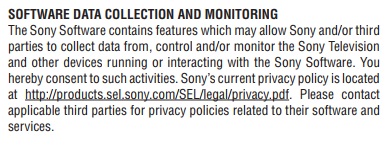
it is in the end users license agreement and they are not alone, it is a massive list of corporation that are doing this and the media was, yet they were largely silent about it and the Sony issue in 2012, where the media is what I would personally label as: ‘whoring for advertisement options‘ instead of informing 30 million consumers on the change and its impact, is what still has my nostrils flaring 6 years later and I am an actual Sony fan.

So as we see how we are singularly focussed on where our personal data is and not what we allowed it to be used for, especially as it came with the free use of Facebook, we all need to accept that nothing is for free and the corporation requires its return of investment, well in the case of Facebook merely 60 billion. Where did you think that value came from? Watching advertisement? In that Facebook and google are largely alike. So in these issues in the physical and virtual side, we are short on memory, too large on emotions and unclear on how to make the houses of Lords and Commons more accountable for the matters at hand. Even as they cannot prevent you from staying with Facebook, we all have been failed by legislation that was too slow and MP’s that are showing to be lacking the necessary skills to do something successfully. It would be so lovely if Sir Martin Moore-Bick would be kind enough to show both matters, because it would have a much larger impact. Even as we see, (what I would personally call) the failed false promises of Jeremy Corbyn regarding housing, with: “One million new “genuinely affordable homes” over a decade, mostly for social rent. That’s not quite 1m new council houses – a chunk of these would be delivered by housing associations – but it gets very close” is also a Porky Pie of the largest order. You merely have to look at google Maps to see that there is no place for even 30% of that in London, so will they mostly be in Wales, Penzance, Brighton and Scarborough? In addition, none of the sides of the houses
(Lords or Commons) have successfully done anything to make a change, regarding leasehold which will drive the entire social housing matter further and 1,000,000 houses will not nearly be enough. So, back to the Virtual part, because that is still central in this. In that part I have to thank the realtor Harcourts for bringing the juice.

You see, with: “NPP1 – Collection of Information; Agencies are prohibited from collecting personal information unless it is necessary for one or more of its functions. Personal data should only be collected in a lawful, fair, and not unreasonably obtrusive way. The agency must disclose certain information at the point of collection“, yet in all this the terms: ‘unless it is necessary for one or more of its functions‘ gives a much wider scope, does it not? In addition, with ‘only be collected in a lawful, fair, and not unreasonably obtrusive way‘. So when they (the real estate in general) offer a £199 rebate for registering you as the leasehold owner, how many people do you think that will consider it necessary and not unreasonable? It merely needs to satisfy one function and the deed is covered with the mantle of opportunity. In addition we see “Personal and sometimes sensitive information may be collected and stored on standard real estate industry forms, such as tenancy applications, listing forms, etc. These need to be secured and available for inspection by customers“, so when did you look at what some call the RP Database? In Australia there is a firm CoreLogic and it has a product called RP Data Professional. In all this we see: “RP Data Professional is the leading property data solution used by property professionals in Australia. Prepare reports for prospects and clients, generate value estimates, verify information and conduct valuable research and highly targeted marketing. Packages starting from $150 / month“. It is widely used by debt collecting agencies as well as realtors. You would be surprised to see all that data and what every address offers. Do you think that they are the only ones? Data is gold, it is the printer that allows you to print your own money and for the most it is massively unchecked. Now, I know that RP Data is merely a facilitator in all this, all perfectly valid, and nothing illegal. Yet when we consider ABC in 2016 with “The Reserve Bank has taken the highly unusual step of switching its preferred home value data, arguing that CoreLogic’s figures overstated price growth in April and May due to a methodology change“, so as you see the data goes a lot further and for the most the people, the tenants and Real Estate seekers are totally unaware of such parts and in all this do you think that the UK does not have its own options. In all this, with the explosive cladding issues, did you not think that the clad dealers were not tailoring to ‘property value increase at minimum costs’? This goes a lot wider in several lanes and the sudden much larger issue of cladding is almost not looked at (I did say almost).

So when we see “CoreLogic’s head of research Tim Lawless acknowledged that the changes to the index may have temporarily bumped up the figures for a couple of months. However, he said other data indicate that those two months were still relatively strong for Sydney and Melbourne housing sales” we forget to look at the aligned indications and what else is setting the pass in all this. Even as the last parts were the Australian side of this, CoreLogic is also active in the UK. In this no one seems to have talked to CoreLogic to see if the cladding industry has been given (through subscription) access to the UK RP Database. Is that not interesting too? You see, when we accept the January setting of “Just three tower blocks out of almost 300 with the same “dangerous” and “flammable” cladding as Grenfell Tower have had panels taken down and replaced“, how come the number of buildings is so high? Are all cladding providers so very bad, or was there a very intelligent salesperson selling cladding to the right people, when the timing was just right? I am fairly certain that this part of the conversations has not been showing up anywhere.

The virtual side to the Grenfell disaster was not seen, perhaps that part was immaterial at that time, yet when we see 297 tower blocks in a serious setting of harm, with the initial setting of finding the proper candidates, have we considered that corporate social media (like LinkedIn) could be used to get the goods (in alleged Cambridge Analytica style) to create fear in other ways? A lack of value versus a larger valuation set against a minimal investment. You show me a person who turns that down and I will introduce you to a person who is very aware of the concept of dishonesty.

You see, we have seen for the better part of 5 years the notion of taking fear from the workplace, usually in the style of ‘Corporate Leaders Must Remove Fear Factor from the Workplace‘, which we get from the Huffington Post (at https://www.huffingtonpost.com/mary-prefontaine/corporate-leaders-must-re_1_b_1437445.html) as early as 2012, so when we see “As reported in the Harvard Business Review, employees faced with incivility are likely to narrow their focus to avoid risks, and lose opportunities to learn in the process. Obviously this impacts their level of personal success and the success of the organization“, yet in equal measure, those actors never considered to take the fear factor out of the boardrooms, which are forever ruled by the bottom line and in that respect there is very little difference between a corporate boardroom, or places like the Kensington and Chelsea TMO, which has one bottom line, which is the value of housing and the rise of values of upcoming new housing. So now, the entire Metro section we saw in part one with ‘Cladding added to Grenfell Tower to ‘improve view for nearby luxury flats‘ it makes a whole lot more sense does it not? It is my personal view and opinion, yet in all that data was at the very Core and Logic of it all (pun intended). So when you think the Facebook data is an issue, guess again. The issue is a lot bigger, wider and more exploitable at the expense of yourself of course) than you would have thought.

All within the considerate view of those not looking at any of this, and you think I went deep here? I merely touched the surface and I will be very surprised if the public inquiry touches on any of those matters, not because they do not want to, but because the legal scope is unlikely to be there, as it would have been in the emotional seeking justice side. I guess that it is one of the questions that certain councils do not want to answer, so making sure that the question is not asked will be a first priority for all of them, because if it does get to the table, those who want to stiff Leaseholders with a £40,000 bill might optionally end up being not so successful and there is every indication that a fair chunk of those 297 tower blocks are currently facing a similar dilemma.

That is just my thought on the matter, and in all this, when you start realising the issues at hand and the time that this has taken, in addition that I saw some in minutes a few more in hours and one or two through my decades of data experience, are you not surprised that the elected officials remained in the dark? I know I am one of the better ones on the planet, but I know close to a dozen equal or better than me, many living in London. Do you actually think that some were in the dark or are they allegedly keeping themselves ignorant? In that case, if more happens, how many lives was the price of that ignorance? Can we afford to find out?

I’ll leave you with those questions, have a great Friday and do try to enjoy the weekend!
 

Leave a comment

Filed under Finance, IT, Law, Media, Politics

Chickie Chickie Bang Bang

Jason Burke is bringing the Guardian goods (at https://www.theguardian.com/world/2018/apr/18/arms-race-criminal-gangs-helping-terrorists-get-weapons-report-warns). You see, I am a gun lover. I loved ‘using’ guns since 1978. I love the design; I most definitely admire and love the tradecraft that the maker had which allows a mere metal object to be placed with 9mm precision over a range of 600 meters. The need and the skill for any person to get the bullet placed EXACTLY there where it needs to be, allowing your brain to correct all needed parameters, like for example wind to make sure that you aim for that point that allows the bullet to hit the bulls-eye dead centre. It is almost a fluidic interaction of skill and art, a balance between the machine, the environment and the shooter. Once you realise that part in this, the admiration for the skill that you get to hone, that passion will stay with you, probably for a lifetime. It was never about looking like the main player in Call of Duty, when I started my passion for guns, there was merely the Atari 2600, and there was no shooting game at that point, there was Pong, there was Pac-Man and there were the Space Invaders.

Even in those days, guns were expensive, so I was limited to the gun that the club had and my granny would not tolerate guns in the house and I personally had no issues with that. In addition to not having the dough to own a rifle, I also never had the initial drive to own one, so that was all fine to me, I just wanted to be on the range and shoot (and hit the mark dead centre). Of course I was a little bit blessed; the club had Feinwerkbau rifles as well as a few .22 LR’s, as well as a collection of pistols so we had all the good goods. It would be another two years until I got introduced to the 7.62 FN FAL, the UZI, the 9mm pistol and another two years until my first Remington.

So when I saw ‘Military grade firearms increasingly available to terrorists in Europe – report‘, I was not at all surprised. It is not merely the ““arms race” between criminal groups in Europe risks making it easier for terrorists to obtain high-powered, military grade firearms“, the fact remains that the image shows the Kalashnikov and the mention ‘Part of a haul of £100,000 worth of eastern European guns smuggled into the UK‘, we are missing that even those with a legal permit are willing to get their fingers on a genuine Kalashnikov. They are willing and eager to part with well over £850, making that part an easy £8500, so not only is it about the ‘arms race‘ it is a very lucrative business as well. If the movie ‘Lord of War‘ is true to some extent and the ‘entrepreneurial’ spirit can buy it per kilo, with a discount per container, making the profit even sweeter. The decently low risk and the huge returns are only going to make it worse for the foreseeable future in Europe. The stream of refugees and the Schengen open borders policies allow for transport from ‘who-gives-a-damn‘ somewhere near the Russian border to the shoreline of the Pass de Calais. That alone should be the nightmare of France (Germany has its own HK market). Even as I admit that I would still love to get my fingers on a full stock AK-47 with silencer as well as the Druganov SVD with its optional noise reduction system. We see that this market is for the collectors that have the cash (and the storage) as well as the criminal elements, so there is a larger stream of customers available. This changes the plot by a large amount. Even as one side will never be a threat to human life, it remains a larger issue. I for one would not have them in an unprotected setting, so the fact that someone (read: trigger happy doped up junk) steals it from my house is a larger worry for me than I care for, so I do not have either of them. Weirdly enough, that issue had been on my mind a lot more lately, because every shooter (or at least all I know) always had a reverence for the Remington. The fact that they went belly up means that if I would not be able to get one soon, the era of the Remington passes me by and that makes me sad, as it would any dedicated range shooter.

There is a part of debate with “The survey says long-standing barriers to obtaining firearms have broken down in recent years owing to the emergence of the internet, cross-border smuggling of military-grade assault rifles into the EU, the conversion of large numbers of blank-firing guns and the widespread reactivation of weapons previously rendered unusable to be sold to collectors“, in the first, the internet was never an issue, the darknet is a much larger issue as people can actively seek out what they need, a window shopping experience with almost complete anonymity. Smuggling operations are indeed an issue, but that is what the open border policy brought, if the government officials are in denial, they should never have been elected in the first place, so the entire matter is not new, it has been there since 1985, it was not until the 1998 Russian financial crisis that the Russian situation ‘exploded’ with container loads of Russian goods (read: military hardware) becoming readily available. So in that, this entire situation has been around for almost 2 decades, OK, 15 years is a lot more accurate. So when we see ‘a criminal gang in 2016‘, we seem to forget that these are either new player, or that the authorities remained in denial for well over 5 years. They aren’t but they seem to be. That evidence is also shown by the Guardian (at https://www.theguardian.com/world/2011/oct/05/steven-greenoe-gun-smuggling-trial). Here even the American entrepreneurs try to participate by getting a few slices of profit cake. So as the clever minded amateur goes with “Steven Greenoe, 37, bought weapons from American gun shops, broke them down to their component parts, and smuggled them into the UK in his luggage, Liverpool crown court heard on Wednesday“, I reckon that he needed to inflate his US Marine pension, it is not valued the way it ever was. You see the lesser amateur gets them ‘attached’ to the inside of the fuel tank of a truck. The Diesel nicely lubes and cleans the weapon whilst the trucker drives his trip and up to 4 AK-47’s giving him an easy £1,000 on the side per trip, a little more if the driver takes a double load of Makarov’s. What a luxury those open borders make, don’t they?

Yet the important part is that there is an issue. It is not merely the terrorists. These people become the go to guys for the Lone Wolves in the UK. With the danger rising of the dealers out for cash and not knowing who their clientele is, making it an almost ironic sense of justice for them to deal to a lone wolf only to come home and learn that the wife and kiddies were gunned down by a crazed extremists who hated all those who did not take him/her seriously, it ended up being all in a day’s work.

The previous part is more important than you think; you see the lone wolf is often in emotional turmoil. Unlike the actual terrorist who has a clear agenda, this person merely needs fame (read: infamy) and recognition, as such, emotion takes over and he/she is most likely to fail, yet not before they kill the innocent bystanders that were never part of any equation. That is what worries the intelligence community the most because there is no defence that would work and that is the ball game at present. You see the article ends with “arms races between criminal groups across the EU“, that is not the scary part. It is for ‘government officials‘ but those criminal elements remain all about exploitation and profit, so in the end they either slaughter each other (not the biggest issue of any week) or keep each other at bay, in most cases the innocent bystanders are less and less likely to get hit, merely because it makes for bad business (remember their profit based mindset). Yet another article partially opposes it with “Converted and reactivated weapons in Europe are seen as having posed an acute problem in recent years. Amedy Coulibaly, who carried out shootings in Paris in January 2015, used two reactivated automatic rifles and six handguns. The firearms had been sold in Slovakia before being reactivated and eventually smuggled into Coulibaly’s hands” which is merely one part in a setting of several. So the weapon smuggle is not merely the one part, you see the ‘reactivated‘ weapons are seemingly a much larger problem in the scheme of things and here we see the larger flaw. There is a legion of articles and papers that talk about reactivated weapons, meaning that the deactivation was improper, incomplete and actually not very inactive. The fact that the NABIS (National Ballistics Intelligence Service) gives us “The process of reactivation in respect of certain types of weapons may not require a sophisticated workshop and can be done with tools available from a DIY store. In one case, for example, reactivation was carried out in the kitchen of a one bedroom sheltered housing bedsit” (see attached) gives additional evidence that the entire ‘deactivation process‘ is as flawed as it is likely ever to get and fixing that one part will make the issue smaller, but will not make it go away. In this we have evidence for almost 7 years and the fact that they European commission is all about reports and as far as I can tell not about actual action makes the EU again merely a gravy train of income opportunity and not a resolving entity of any degree.

So when we have seen the events and the evidence, the article remains true to some point, the factual issue that works to the advantage of the police is that the real terrorist is not screaming its presence and neither is the arms dealer, so they are both in a dark room playing ‘Marco‘  (wait for it)  ‘Polo‘ hoping that the police or the intelligence workers don’t hear either of them, which works out well for the police (for now), the lone wolf is a much harder issue. that person might shout ‘I need a gun‘ and if no flags are raised on that person the police will miss the opportunity, yet the arms dealer will never miss up on a golden opportunity and will go with a go between. So the most likely part is that the wrong person ends up with the gun that is the true danger to every innocent bystander.

The availability remains, yet with open borders the goods can safely travel through Europe, making yet another case that Brexit has the option to solve issues, although in this particular instance it is not really a Brexit matter, yet the borders have been for a much longer time. Yet valid question remains: ‘Should a £12 million smuggle issue stop £200 billion in trade value‘, I think that anyone who states that it is true is absolutely loony tunes. The Brexit issue is a lot larger, and on that entire scale smuggling is almost quite literally the smallest issue of them all.


Leave a comment

Filed under Media, Military, Politics

Slicing the Tiramisu

Perhaps you remember the old days, the days where France was ruled by Marie-Antoinette, as well as King Louis XVI. In days of hunger she stated “Qu’ils mangent de la brioche”, or for those who did not serve in Etrangere: “Let them eat cake”. Yes those were the good days. It was 1789 (it was April if I remember correctly). It was around the day when those bloody colonials (now known as Americans) inaugurated George Washington as the first President of the United States of America. You see, nowadays we fend of hunger by wallowing in greed, to set our stepping stones towards gaining a piece of the action, any action and what I predicted (at https://lawlordtobe.com/2018/02/24/losing-values-towards-insanity/) in ‘Losing values towards insanity‘, is now turning into a reality. You see, when I stated on February 24th “Both Yevgeniy Prigozhin and Dmitry Utkin are now perfectly placed to rake in billions” is now as we see in the Washington Post (at https://www.washingtonpost.com/world/iran-russia-and-turkey-meet-over-syrias-future-as-trump-mulls-troop-withdrawal/2018/04/04/c607e27c-3770-11e8-af3c-2123715f78df_story.html) becoming a reality. With the quote “The three presidents — including Recep Tayyip Erdogan of Turkey, Iran’s Hassan Rouhani and Russia’s Vladimir Putin — gathered in the Turkish capital, Ankara, where they pledged to cooperate on reconstruction and aid” we see the present escalate for the facilitation towards President Assad, whilst they now are willing to state “The leaders called for more support from the international community and emphasized their opposition to “separatist agendas” in Syria“, you see now that they are at the table getting rich the rest of the Syrian oversight will be costly thing and now they are willing to let the US and the EU pick up the bill for those costs. It is the price of doing business with the wrong party, or basically staying out of it all.

In addition, with “It was the second time that Erdogan, Putin and Rouhani have met in recent months to discuss the conflict, underscoring those tensions and the extent to which U.S. power has waned in the region“, which is not news, it is a clear sign of making all the wrong choices and the US is about to make a few more. In regards of Syria, I do stand with President Trump. You see, the title ‘As Trump talks of leaving Syria, his top commander in the Middle East emphasizes the need to stay‘ (also the Washington Post) is deceptive, dangerous and not too bright. I do sympathise with General Joseph L. Votel, head of U.S. Central Command. His statement “A lot of very good military progress has been made over the last couple of years, but the hard part, I think, is in front of us,” is correct. Yet now that the Russians have delivered, the US is at the political mercy of the steps taken by President Rouhani, President Erdogan and President Putin. Each of these players with their own needs to play their games with the U.S. in any way they can and as much as possible. Turkey wants the EU membership, whilst knowingly endangering the EU values forever, Iran wants whatever Iran can lay their fingers on and Putin wants to screw with the Americans for all he can. So any US presence is like walking through a minefield day in day out for months, even years. In addition, there is no evidence that the rebels will ever stop, they will come back and by letting the Russians and Iranians and Turks take those reprisal blows is not the worst idea to have. The wise play is to move out of Syria altogether, the US can only lose here, it is almost the certainty of facing a ‘lose-lose’ situation whilst every blow delivered to the US will mean that the Russians and their Megaline LLC (or known as the delicious cake makers Prigozhin and Utkin).

It will rake in the massive wealth that they will most likely share with President Putin and a few of their friends on the inside. There is every chance that this is the year is the year where Yevgeniy Prigozhin becomes the second most important man in Russia for a very long time and with every contract that they score and deliver to the Syrian government means an additional ascension of his stardom. With the US gone they will actually have to deal with the matters themselves and as the EU stays out, their goose will be partially cooked with every act of retaliation the defeated rebels successfully make. The UK with the entire bungled Salisbury events are only the icing on the cake that Putin is lashing out with for all to see in the media. The fact that he is calling for the joint investigations on several levels whilst there is enough indications that his involvement might never be proven is one part that also works against the UK and the EU. There was never any doubt that Russia created and developed the Novichoks and as the world is seeing what a mess the OPCW and the SAB made of it all merely intensifies the need for other players to get their fingers on this technology and learn skills they never wanted earlier. That part was invigorated by the outspoken misses of the Porter Down and the bunny jumps by Gary Aitkenhead stating “we have provided the scientific information to the government, who have then used a number of other sources to piece together the conclusions that they have come to” only made matters worse. So the Russians are now slicing their Tiramisu which they will share (to some extent) with Iran and turkey, but the message is clear, the US lost massively here and staying behind is not a wise choice (as I personally see it). You see, I do respect the view of General Votel. Even as President Trump thinks short term (his ‘reign’) and General Votel has the right long term strategy view, It is the Trump action that is the wisest one. Syria is about to become cold war territory and the US military is not ready and even nowhere near trained to get into that field. The fallout of such strategic blunders would haunt anyone serving there for a very long time to come. In addition I think it is what the Syrians deserve, they wanted this, so let it be maintained in a ‘cleaned’ state by Russian troops. The US gearing up optionally against Iran by standing next to Saudi Arabia and gaining a better profile in that way is a much better option. It allows for a better humanitarian standing as they set their sights on Yemeni relief is a better option, it will set them against Iran, which is good, because at that point Iran will either back down against Saudi Arabia, or face the wrath of the Saudi, US and Israeli forces which would be quite the show, and I would love to test (for a fee of course) that solution I designed to sink the Iranian fleet (but that is merely my sense of humorous ego).

The second reason is that ISIS might have been dealt serious blows, but they are not out of the fight. The Sinai is merely one focal point, the fact that they are also in Yemen makes for a strategic need for the US to see if they can operate from Saudi Arabia. It would allow for other means to deal with ISIS and for the US to gain a much better foothold in the Middle East. With Saudi Arabia moving well over 500 billion towards a futuristic NOAM, the US have a lot more to gain, doing so before Russia gets options in NOAM is again the wise strategy to follow.

In the second view, it sickens me that ‘after the war‘ we are suddenly ‘allowed‘ to give what the Syrian four now regard as ‘aid’. That was a step they should have allowed 6 years ago. Let them solve it themselves now and live with the consequences of that aftermath and the costs that come with them.

They can have the cake, the crumbs and the table it stands on, that whilst we know that there are several players eager to set fire to that table whilst the 4 rulers are trying to eat the cake. Setting the US and the EU up as a decoy whilst they eat all the cake is a little too distasteful to my liking.

1 Comment

Filed under Finance, Media, Military, Politics

Is it merely timing?

When I looked into some off the Mario Draghi matters two days ago, I made a reference to his little kart, a kart full of tricks or is it a kart of indiscretion? So let’s take a look at the alphabet, the alphabet of ABLV

A is for Actuality

You see, the European Central Bank publishes a list where all the supervised entities are and the list starts with “Cut-off date for significance decisions: 1 January 2018“, so as we are in March (way past January 1st) and that same attached list gives us on the 81st position the ABLV Bank, AS, with the mention of ‘Among the three largest credit institutions in the Member State‘, whilst there is also (non-supervised) the ABLV Bank Luxembourg, S.A. in Luxembourg, yet stated and linked to the ABLV, should we wonder if we are being had? In light of the news two days ago when we were treated to “Draghi did address a question on why ABLV Bank received emergency support from the Latvian central bank before the ECB declared it failing or likely to fail. He said that the Emergency Liquidity Assistance policy – under which national central banks rather than the ECB decide to provide support to troubled lenders – is a “remnant of a past time” and should be reformed” (Source: Australian Financial Review), whilst the bank was being supervised according to the ECB, the fact that they are grasping at the notion that the left hand does not know what the right hand is doing, is that not an indication on how massively useless and overpaid the members of the ECB are? Just so that we are all in clear and that we all understand what is going on, let’s look at ‘supervision’, which the dictionary calls ‘the action of supervising someone or something‘, and with ‘supervising’ we get ‘observe and direct the execution of (a task or activity)‘, it seems to me that the ECB was not doing any observing or directing, so if the ABLV did not inform the supervising entity, I have a hard time to comprehend the Bloomberg article (at https://www.bloomberg.com/news/articles/2018-03-02/latvia-analyzing-rimsevics-s-role-at-ecb-as-he-returns-to-work), where we see: “Latvia is still considering the ramifications of central bank Governor Ilmars Rimsevics’s status as a suspect in a bribery probe, as he returned to work this week and weighs up how to continue his role at the European Central Bank“, in my view, either the ECB knew in advance certain matters, or we have a different puppy in our midst. Now let us be clear, one is a setting of corruption, the other is the ‘receiving of emergency support from the Latvian central bank‘, yet the fact that this all happened during the oversight of the ECB makes it twice the size of the issue. The ABLV went to the Latvian Central Bank (Governor Ilmars Rimsevics) and got emergency funds, yet what was the origin of those funds? So when we see “Both ABLV and Rimsevics deny the accusations in cases that the authorities say aren’t linked“, my response would be ‘Really? So who are exactly those authorities?’ It seems like a simple question but it is one that we will never see an honest answer to I reckon. The links are not clear, but consider the following accusations.

First we have “The U.S. Treasury Department alleges ABLV engaged in institutionalized money laundering and violated sanctions put in place to counter North Korea’s weapons program

Second we get “Rimsevics has denied any wrongdoing, and Latvia’s Defence Ministry said that the allegations were part of a “massive information operation” by an external actor.” I used them in the article (at https://lawlordtobe.com/2018/03/01/the-failing-mario-draghi-kart/), yet who exactly was the external actor?

It is the second one that is weird, so how did the Defence Ministry get involved in a banking issue? Did it come from the office of Minister Raimonds Bergmanis, it would be an interesting tug of war between him and me, because I have my own centre of gravity and he is a three time Olympic contender in the category of weightlifting. I did not have all the information I needed in that piece, and I was juggling a few issues, so I moved it all along to today.

B is for Bloomberg

Bloomberg ends with “there are no signs other Latvian banks are experiencing outflows after the ECB decided to close ABLV on the grounds that it was failing or likely to fail. What happened to ABLV is a signal to other banks to follow the rules, she said“. Yet is Finance Minister Dana Reizniece-Ozola giving us the goods? Why did the Defence Ministry get involved? Was it to emphasize the weapons accusation? Clearly that would have been an issue that resides with Latvian Intelligence. So as Reuters gives us “Ainars Latkovskis, the head of the national parliament’s anti-corruption committee of lawmakers, who also urged Rimsevics to step down” as well as “Latkovskis, who is authorized to listen to reports from the heads of the Latvian intelligence agencies, dismissed hints by some local officials and politicians that a Russian campaign of disinformation might be behind the case“, it seems that the Intelligence official is either trying to stay out of this or we can see this as a sign that the SVR RF (the Foreign Intelligence Service of the Russian Federation) has been whispering in someone’s ear and the culprits have overplayed their hand. Now no matter what has happened in that tier of the industry, it still gives us that the ABLV made a deal for funds with the Latvian Central Bank and the news as shown by the media is giving us that the ECB was either unaware or was informed after the fact with ‘Good news, we solved the problem‘ and now we see that the banks who are on the oversight list are either not getting supervised or they are ignoring their supervisors, I wonder which scenario is worse for the ECB.

L is for Liable

If you think it does not matter, think again. We pump billions into the UN and it cannot arrange a ceasefire (Syria), we pump billions into the European Union and the ECB is casually unwilling or unable to do their job and those people are fetching a lot of money every year. Two entities who are now proving to be more and more facilitators for the wealthy as well as paper tigers with a fluidic agenda that merely spells ‘compromise to keep the engine going’. So when did wee surrender our tax funds to those ends?

So was this all done through the allowed whisper via Sergey Yevgenyevich Naryshkin? I am merely speculating here, but the parts and numbers currently do not add up. You see, as Reuters gives us “The ECB appears to have been blindsided by the ABLV case, highlighting how thinly it is spread in supervising Europe’s biggest lenders and raising questions about a system of euro zone supervision just three years old“, this is seen (at https://www.reuters.com/article/us-ecb-russia-vtb/ecb-drops-supervision-of-russias-vtb-arm-in-the-euro-zone-idUSKCN1GE2N8), can we say that it is that simple? It remains pure speculation from my side, yet when we see “The European Central Bank has stopped supervising the Austrian arm of Russian state bank VTB after it slimmed down its European operations, the ECB said on Friday. A spokeswoman for the ECB said VTB’s new set-up in Europe no longer warranted direct supervision, which was now in the hands of Germany’s national regulators, Bafin and the Bundesbank” I wonder if there was anything simple on this. We could argue that Sergey Yevgenyevich Naryshkin did exactly what he was supposed to do, to serve HIS country. Yet the information gives me the feeling that this looks like a line of banks with Latvia between the Latvian ECB and the Russian ‘SVCR RF‘ bank. The two outside parties agree to keep each other afloat by shaking hands and pushing at the same time the ABLV over the edge in a combined effort. What some did in primary school (the old tactics are usually the best).

Still, this is all merely speculation from my side mind you!

V is for Voter

The question that remains is how the US authorities got to that jump and where is the evidence? Apart from the fact that one accused of bribery is allowed back into his office until the dust (read: investigation) settles is also cause for concern. You see, the news (at http://www.mod.gov.lv/Aktualitates/Preses_pazinojumi/2018/02/20-01.aspx) gives a part, but when we consider it and dissect “Latvia’s security-sector personnel have raised the alarm that outside actors could be using these current financial and banking scandals against Riga. The Latvian Ministry of Defence has pointed out that the AP news agency’s reporting on Latvia’s connection to various international financial corruption schemes has been reposted with unusual frequency on numerous websites known for distributing messages supporting Russia. As such, the defence ministry has called this media blitz a possible “hybrid”-style operation within a broader information war against Latvia“, we could agree that part of this is an issue. Yet is the foundation wrong? Is the bribery a fact? If so, why the hell is Ilmars Rimsevics allowed back in his office? If we see statements that there is proof, why not give that out to the open? So who were the outside actors? You see, accusation of bribery requires evidence and it is not out of the blue that Russia would expose bribery so that their operations could profit. That is not merely Russia, American politics and Wall Street have operated on that premise for decades, so it is not altogether weird to see Russia play a similar game, if that was the case. So even if there was an ‘information war against Latvia‘, it was done under the noses of the ECB and Mario Draghi. It was not merely a “remnant of a past time that should be reformed“, it was an option where the ‘the Emergency Liquidity Assistance policy‘ was overlooked by overpaid ECB executives, especially in light of the fact that by their own reports that the ABLV was under supervision.

Bloomberg supports my views (at https://www.bloomberg.com/news/articles/2018-03-02/draghi-confronts-limit-of-his-powers-as-latvian-standoff-endures), where we see ““This reveals the impressive lack of power of the ECB in such circumstances,” said Stanislas Jourdan, the director of Positive Money Europe, an advocacy group calling for more transparency and accountability on economic policy“, which on one side is just as it should be about the sovereignty of a nation, but the fact that the ECB are confronted with their own foot in mouth protocol at the expense of millions, if not billions is a larger worry, because they already pushed a $3 trillion debt on the people of Europe. I also support the view we see at: “Draghi already expressed dissatisfaction to ECB officials in the week after Rimsevics’s detention that enough details from Latvia hadn’t been forthcoming, according to people familiar with the matter, and that may still be the case. Latvian Finance Minister Dana Reizniece-Ozola said on Friday that the anti-corruption office is “in the process” of giving the ECB all relevant information“, it is not about the ECB, it is a Latvian situation and in this Mario Draghi gets to do what most EU puppeteers do so well, they can bloody well wait (whilst still getting paid high amounts of money). Yet, in part this is not merely a waiting game, the fact that the voters are taking more notice of this mess is not helping him any, but that is the way life works and it is not always working in your favour. So when the Globe and Mail gives us “Did European Central Bank boss Mario Draghi save Italy or merely set up the world’s third biggest debtor for permanent zombie status? As Italians head to the polls on Sunday, the parties, big and small, are showering voters with promises of goodies galore“, we see the deadlines that the ECB has, it has a few and even as there is unlikely to be a stable Italian government, the fact that they won’t worry the ECB like Frexit Marine Le Pen or Brexit Nigel Farage, so they are not too worried, but the overall financial issues will remain and Latvia is not helping any with the news that they are the cause of at present. In the end, the question should become, how come that a supervised bank was able to do this? Because the answer needs to be coming from the people who are seemingly overpaid for work they basically did not achieve and that is not merely Mario Draghi; that list is a lot larger and in this case it might just exclude the one man at the top.


Leave a comment

Filed under Finance, Law, Media, Military, Politics

A changing language

Europe is in several stages of unease; there is the spending of Mario Draghi, Brexit remains on the mind of many. Yet, the one change that is now more and more in the foreground of many is the problem that Turkey seems to be. There are those set on the stage to end Turkey as a NATO member and subsequent becoming part of the EU, there are things going forward and backward, but the language involved in all this is changing, so are the settings for the meetings yet to come. In all this the latest Turkish act to double down on the Russian S-400 purchases in 2020. There is, as I stated unease and as I see it the entire EU-Turkey mess is now a dance around unclear settings. Yet the settings are founded on what some would call, clear and blatant lies.

So to recap, on March 26th in the Bulgarian port city of Varna with the attendance of President Recep Tayyip Erdoğan, there will be a summit. The given setting is “to discuss EU-Turkey relations as well as regional and international issues“, this we got from the spokesperson for Donald Franciszek Tusk. The meeting held at the leaders’ level will be hosted as a working dinner, a statement signed by Tusk and Juncker said. Yet soon thereafter it begins. With: “Ankara has been stressing that the EU fails to understand the challenges that the county faces, and calls on all sides to take Turkey’s concerns into consideration, particularly against the PKK and the Gülenist Terror Group (FETÖ), which carried out the failed July 15 coup attempt“, yet how is that true when it has been clear for the longest time “Turkey witnessed the bloodiest coup attempt in its political history on July 15th, 2016, when a section of the Turkish military launched a coordinated operation in several major cities to topple the government and unseat President Recep Tayyip Erdogan“, this is the quote from Aljazeera, but they were not the only one giving this.

The Turkish government blames the failed coup attempt on Fethullah Gulen, a Turkish preacher and businessman who has lived in self-imposed exile in the United States since 1999. So as we accept that the Gülen movement is classified as a terrorist organization by Turkey under the assigned names Gülenist Terror Organisation (Fethullahçı Terör Örgütü, FETÖ) or Parallel State Organisation (Paralel Devlet Yapılanması, PDY), we see the link offered, yet another path in this is “MIT officials admitted that they received the very first intelligence report about a possible attack on July 15, only hours before their own headquarters was under heavy artillery fire“, as well as “As of today, more than 100,000 people have been sacked or suspended and 50,000 arrested in an unprecedented crackdown. The government has deemed the crackdown necessary to ‘root out all coup supporters from the state apparatus’“. When we consider those parts, we need to realise that the Millî İstihbarat Teşkilatı (MİT) was completely out of any loop, which makes Turkish Intelligence not just a flawed setting, it would implicate that it has limited counter terrorism options and no resources to speak of (in intelligence terms).

In opposition to this, there would be enough data to offer that it was an internal issue from within the Turkish military and whatever opposes Recep Tayyip Erdoğan in Turkey got a fat target painted on them. This fills and completes the view we need to have of Turkey much better. In support of this we need to consider that one exiled cleric could not have orchestrated the military support that would have been required and that was seen in action. The width of the Turkish military acting seems to be that of an internal star chamber than a clerical imprint on the military, the latter would have given more visibility to other ranking officers within the Turkish armed forces. As this becomes more and more visible and accepted, we are treated to the view on the unacceptable acts against the Kurds yet again, which followed the Turkish official view of the coup that they ‘survived’.

So in this light the setting for March will be one that is a puzzle. You see as Turkey keeps on playing this game, their credibility will only go down further. The European Council on Foreign Relations (ECFR) (at http://www.ecfr.eu/article/essay_eu_turkey_relations_the_beginning_of_the_end_7226) gives us: “Both Turkey and the EU need the continuation of this partnership. It is a matter of definition whether this partnership will be in the form of full membership or in a different form. What is important is not to break the process and not to cause alienation. The need for sustainable EU-Turkey relations obliges both sides to take steps to honour their commitment to integration“, we can accept that, but at this point, is continuation feasible? We see the shifting language that shows that Germany is less and less taken with Turkey, now siding more and more with France on the anti-Turkey alliance. It gets worse for Turkey as we now hear: “A Turkish court on Wednesday denied entry to the German ambassador to Ankara to the hearing of Selahattin Demirtas, the former co-leader of the pro-Kurdish Peoples’ Democratic Party (HDP)“, which we get from http://www.dw.com/en/turkish-court-denies-german-ambassador-entry-to-kurdish-politicians-trial/a-42579957, even as France is trying to work with Turkey regarding a ‘diplomatic road map‘ on Syria, the sounds of accusation of Turkey violating international law was not far behind it, so there is pressures on nearly every level. Only 12 hours ago, Deutsche Welle gave us “Even NATO Secretary-General Jens Stoltenberg wouldn’t hazard a guess ahead of this week’s defense ministers’ meeting. He said Turkey needs to clarify the status of the contract” (at http://www.dw.com/en/turkish-russian-missile-deal-puts-nato-on-edge/a-42572965), as I said earlier, the language is changing. As we see ‘Turkey needs to clarify the status of the contract‘ that it is about cancelling the contract? Yet in that respect, what would Turkey demand in return? How much is that going to cost and where does that invoice end up? You see, when you consider Reuters with ‘U.S. tells NATO allies spending plans still falling short‘ (at https://www.reuters.com/article/us-usa-trump-nato/u-s-tells-nato-allies-spending-plans-still-falling-short-idUSKCN1FY013), where we see “Spain has said it will not meet the 2024 target. Belgium, the Netherlands, Luxembourg, Italy, Portugal, Norway and Denmark are also lagging. Hungary expects to meet the goal only by 2026“, as well as “France will increase its defense spending by more than a third between 2017 and 2025, but Germany, is not expected to reach the 2 percent target by 2024“, this gives us that the three large economic anchors of the European Union cannot get there. It is these elements that make me wonder on the changing language involving Turkey. From a setting that would have given a clear rejection of Turkey becoming an EU member, we see the setting of new talks, new events and more ‘collaboration’ projects. I think that France is already learning the hard way that this path leads to nowhere, but the others need Turkey to be a spender here, and Erdogan is using that tactic to his own advantage, because once they are in, you cannot throw them out anymore (the EU that is), not even willingly as the UK is learning the hard way. Even as we accept that to some extent Turkey helps to reduce an influx of Syrian and other migrants and refugees into the EU bloc, the question is to what extent and for which purpose, because once these refugees make it into Turkey, Turkey is either stuck with them or they must ‘divert’ them to another place.

In this, in an earlier blog I mentioned the Visa Free EU travel for Turkey and that they had not met the demands. So as we see “Last week, Turkey manifested determination to restart a new chapter in its ailing relationship with the European bloc by submitting a paper detailing Turkey’s roadmap for the fulfilment of the remaining seven benchmarks of 72 criteria” we need to get worried on the non-committed acts from the EU on the matter which had not been met. It seems like Brussels is trying to find any way to either delay it all or give Turkey a pass, which would be disastrous for several players. This is seen in several articles, in this case the Irish Times gives us: “Instead of formally ending EU membership talks, Dr Merkel said she would look at imposing “real restrictions on economic contact” including through the European Investment Bank, EU aid, World Bank and by blocking talks on expanding Turkey’s customs union agreement with the EU, a move that could hit billions of euro in potential Turkish exports“, whilst the EU themselves was ‘dismissive of call for end to Turkey accession talks‘, stating that this is for the heads of government, European Commission says, so the EU revels in inaction and restrictions in other ways. This is a dangerous and explosive combination.

So even as one issue was the contention in the counter terrorism benchmark which has been the definition of terrorism in the counter-terrorism law that Turkey was called repeatedly to amend in order to comply with European democratic and judicial standards. Now, according to reports, a legal provision will be added soon to the current anti-terror law stating that “any critical expression that does not exceed the boundaries of journalism does not constitute a crime“, how is that enough? As we see the Kurdish issues as shown earlier as well as a new complete failure by the Millî İstihbarat Teşkilatı (MİT) should leave anyone a clear indication that not only is the counter-terrorism failing, there is an increased worry that Turkey does not really comprehends the term ‘counter-terrorism’, in support of that fact, or evidence to that, you should talk to the journalists Deniz Yücel, Huseyin Akyol, Ragip Duran, Ayse Duzkan, and Huseyin Bektas. Oh no, you can’t they are in jail! Turkey could have had a genuine excuse, but they lost that option when they denied the German ambassador to Turkey access to the court proceedings. That alone should be regarded as evidence to dismiss the ascension of Turkey to the EU.

And whilst the entire language on Turkey seems to be in a fluid state, the Brexit noise goes on, whilst some are relying on fear-mongering with noise like: “You could have a permanent Operation Stack for 20 miles” regarding shipping between the UK and the EU, ‘could‘ being the operative word. So how large was that ‘stack’ in the 70’s and 80’s? In addition we see the Financial Times (at https://www.ft.com/content/0a8799c6-1190-11e8-940e-08320fc2a277) give us: “Brussels is urging EU leaders to consider radical options such as raiding corporate tax receipts and money raised from selling carbon emission permits to fill a €15bn a year budget hole left by Brexit“, in addition it gives us: “the need to find more money for priorities such as border control and joint defence, mean negotiations are likely to be even more poisonous than previous EU tussles over money“, whilst we see “Some member states don’t want to pay more but they want to do more. Other member states want to receive more“, these elements show the desperate state the EU is in now, that whilst Mario Draghi has printed almost 2 trillion Euro in money for ‘Quantative Easing‘. This relates directly to Turkey, because it shows the desperate EU trying to open a many doors as possible, this is how I see the impact of not dismissing Turkey as an EU member at present. So when we see “impose tougher conditions on access to EU funds as a way to force the likes of Poland and Hungary to comply with EU policies on the rule of law and on asylum” as is a given view on the two needing more money, wanting a stronger voice but cannot contribute. Add to that the earlier pressure from the US for NATO member to do more gives a shifted view of the needed activities within the EU, Turkey is seen as the one floating elements that will allow a few players to keep their heads above water, but it is as I personally see it a desperate act from certain short term viewers, that whilst they also know that it will descent EU elements into chaos. As I (again merely a personal view) see it, it would cripple Strasbourg in getting issues resolved and as Turkey fails to comply with humanitarian sides, it could in equal measure become the puppet for Russia for dislodge other item in consideration, an option honoured by perhaps negating some invoices for S-400 systems, spare parts, training and consultancy? It is merely speculative thinking, but would I be wrong? It would work out very well for Turkey, for the other bloc members a lot less so.

A danger that could have been resolved almost 2 years ago, I will let you ponder on the reasons why the EU never negated this danger.


1 Comment

Filed under Finance, Law, Media, Military, Politics

A Turkey problem

We’ve all had them around thanksgiving, the turkey was still too deep frozen, the filling was incomplete and the oven was not firing up to the right temperature. In the US these are at times regarded as mum’s worst nightmare. Thanksgiving is a day when mum shines and her dinner is heralded and dreamed of for many nights before and a few nights after as well. No, this is not about the plumage; this is about that nation that is trying to basically piss off anyone they deal with. The first is seen (at http://www.france24.com/en/20180207-turkey-says-it-has-met-eu-criteria-visa-free-travel), where Ibrahim Kalin stated that “that Turkey had submitted all related documents to EU officials ahead of an EU-Turkey summit in March“, a Turkish official gives us: “the country has fulfilled all 72 requirements set by the European Union to secure visa-free travel for Turkish citizens to the 28-nation bloc“, this whilst we know that ‘Turkey had failed to meet the 72 criteria, including amending anti-terror laws‘, we might go so far as that of those criteria the bulk had not been met and with the additional issues now in play, there was never a more prompt moment to deny the visa-free travel options. More important, stating that ascension to the EU would not be possible within the next 50 years would equally not be out of the question. The Turkish approach to ‘securing’ Europe as discussed (at http://theconversation.com/turkey-is-using-syrian-refugees-as-bargaining-chips-as-it-moves-against-the-kurds-90904) is beyond tasteless. As I stated before, the acts by Turkey going back as far as 2002 are shown to be unacceptable. The larger issue is why Europe seems to continue to ‘find’ ways to reopen talks whilst the bulk of 72 requirements have not ever been met, even worse, their actions in Syria, their involvement with Qatar and semi union with Iran makes the matter worse. It makes a case that Turkey is the larger security threat for Europe.

The fact that Turkey is so corrupt that immigrant threats get to walk through Turkey, or via Turkish smugglers makes matters worse. Yet, there is no such mention at this time. Even more unnerving is the fact that there is still a meeting. The Commission confirmed Wednesday that Erdogan will meet in Varna, Bulgaria, on March 26 with Commission President Jean-Claude Juncker, European Council President Donald Tusk and Bulgarian Prime Minister Boyko Borissov, whose country holds the bloc’s rotating presidency. What takes the cake was the quote Commission spokesman Alexander Winterstein said the talks will focus on “subjects of mutual interest and recent developments in Turkey. That includes obviously the rule of law and fundamental rights“. Knowing that Turkey has only two elements on the brain, I wonder how this can end well. The EU is getting truly desperate. It is still facing Brexit and the news and the bitterness of Europe is showing them to be spiteful in every way. is that not nice to know that some place that ‘pretends to value’ freedoms, will not honour those who are no longer interesting in its membership? As I personally see it, the levels of corruption that flow through the ECB gravy train is making people nervous, because that part is becoming clear that this train has to stop functioning. the Financial Times (at https://www.ft.com/content/ade8e020-0b50-11e8-8eb7-42f857ea9f09) voices it in light of ‘non-compliance’, the quote “The five-page text (UKCompliance), circulated to EU member states by the European Commission and seen by the Financial Times, sets out how the EU plans to make Britain abide by union law until December 2020 while excluding it from decision-making“, does that sound like amicable? As the article states, it basically reduces the UK to a slave state having to enforce laws designed in the foundation of utter stupidity, whilst not getting a say in the matter. So, as that is pushed upon the UK, with the optional worse decision to continue talks with Turkey, The EU is basically setting a warm fire where the UK can decide to go postal, take the cold Brexit and cut all ties. The tidal wave of chaos that Turkey is likely to bring soon thereafter will make UK the best trade solution for Western Europe and Scandinavia. The document also emphasises that London must refrain from any “action or initiative which is likely to be prejudicial to the Union’s interests”, which sounds nice on one side, but the act that judicially for the UK is the national notice that counts, and that is the setting of any judicial setting in its national origin, it is not for the European Union to set that as anti-Union. Even more pronounced that in itself would constitute another reason for Turkey not to be allowed within the European Union as such. Should that be set aside for consideration, it could invalidate the terms for the UK to abide by, which is a small blessing in disguise.

It is the Financial Times, who in light of Brexit shows that Europe is filled with duality. The economic pressures it faces and the facilitation it requires as it has been playing the monopoly money printer at large for all causes worthless and overvalued. This is seen in several ways. In the first the ECB remained quiet on Mario Draghi and the G30 club, the media has silenced any actions since January 17th. In addition, Bloomberg reported “Mario Draghi said the European Central Bank has no choice but to brace for the possibility that the U.K. will exit the European Union without a transitional agreement“, form my point of view, the 5 pages that the Financial Times initially gave us, and that likelihood is only increasing. Perhaps having a few spiteful children on the Brussels side was not the cleverest of options as I personally see it, but then again. It is merely my view that some of these players want to continue their gravy train, a debatable view to say the least. Even as France has been outspoken and opposing any Turkish ascension to the European Union, there has been a silence from several other players. The fact that the Bulgarian meeting is still on for now, that in light of the Turkey violating international Law in Syria is also light for concern. The Jerusalem Post gives us “Speaking on BFM television, Jean-Yves Le Drian also said there were indications Syrian government forces were using toxic gas against civilians although the UN would need to confirm that“, that might be true, but at this point is Turkey also involved in those actions? Because that is the evidence that matters! You see the quote “Le Drian said international law “is being violated by Turkey, by the Damascus regime, by Iran and those who are attacking eastern Ghouta and Idlib”. His remarks amount to France’s toughest line yet on Turkey’s involvement in the Syrian conflict” might hold water, but only if clear evidence is given that Turkey actually broke international law. You see, from one point of view Turkey was not barred, stopped or told to leave by what should still be regarded as the legitimate government of Syria, as such Turkey ends up having an actual defence against the French claim and that could remain to be an issue. The fact that other papers are voicing the identical quotes does not make this issue more so true, the presentation of evidence does.

So even as Ankara is not meeting some thanksgiving any day soon, it basically soured the waters with the US, France, optionally Germany, Saudi Arabia and a few other members of the European Union. And there was I thinking that only Napoleon was stupid enough to wage a war on two fronts, oh no that Adolf dude made the same stupid error. Anyway, as things go we will see more news soon, because the entire march meeting even as the Netherlands has withdrawn its ambassador to Turkey, we see the Dutch former NATO secretary Jaap de Hoop-Scheffer mention that ‘Turkey is too important for the Netherlands and the Netherlands are too important to Turkey‘, the economic fires are pushed to a higher level, there is nothing like a former official to voice the needs that politicians are not able (read: allowed) to make. The ECB and its gravy train must continue. That is the imperative that the 28 bloc nations are trying to rephrase so that certain questions are not asked. I personally believe that it is all in extremely poor taste. In another source (Dutch Newspaper: Trouw) we see the Dutch Lily Sprangers, former director of the Turkey Institute in The Hague state: “Die problemen zijn geen reden om geen betrekkingen te onderhouden” (These problems are no reason not to maintain relationships), sounds nice in theory, yet when the Dutch fascist JanMaat was about to get elected you (read: the politicians at large) did not follow on that idea to improve options, you tried to silence it to death, when he ended with 3 seats you all united to get that undone. It all seems a little two-fold in the light of the events that are happening.

The Dutch have been trying to improve relationships, which remains valid and they are not the only one, but in light of the 72 non-achievements to get some report going so that they could be included in light of the hostilities shown towards Brexit, gives me the shivers. A club of inclusion tends to be the most dangerous kind, because (as I personally see it) it allows for the utter corruption of ideals that should have excluded parties from the very start.

So then the media reports on the March 26th event. Will I still sound wrong to you, or is that and the lack of response by the ECB on the G30 club a clear signal that a lot of things are wrong in Europe and Brexit might have been the one sane move to begin with?

Did I oversimplify issues again?


Leave a comment

Filed under Finance, Law, Media, Military, Politics

Strike a match

In Australia, an island with plenty of drought and as we go into the really nice and warm season, a match is not a thing we look fondly off, yet the strike of the match as we see it in France, where it is now uncomfortably cold is another matter. So is it ‘Strike a match!‘, or ‘Match a strike?‘, the strike called on regarding labour reforms could be the one that sets flame to that nation and set flame to whatever growth economy the French think they have. Reuters (at http://www.reuters.com/article/us-france-reform-protests/frances-cgt-calls-another-strike-against-labor-reform-others-refuse-idUSKBN1CE2CH) give us “the more moderate CFDT, now France’s biggest union, and the Force Ouvriere preferring negotiations” these two are starting to figure out that the long protected labour rights in France are to ancient. With a mobile workforce all over Europe, it will soon be about taxable products and services no matter where they are and as such France is pricing itself out of a market of workers, faster and faster. The weird part is that France has so much to offer, so the fact that the economy is barely reaching +2% for the longest time is less puzzling and is more and more about the uncertainty that the labour laws are bringing entrepreneurs. Now, I am all for protecting the workers over greedy corporations, yet the draconian shape that it has in France is stopping new waves from moving towards France. French publication ‘the Local‘ (at https://www.thelocal.fr/20171009/france-how-tuesdays-mass-public-sector-strikes-will-affect-you) is giving us “with particular reference to the pay freeze and rise in social security payments, plus the government’s controversial decision to dock pay for the first day of sick leave (jour de carence) to fight against absenteeism“, this implies that former president Hollande has been asleep at the wheel. The changes imposed are to some extent to top the coffers from taking too much of a hit and with minus 2.6 trillion Euro the French coffers need all the help they can get. In this, many newspapers are all about how the appeal of President Macron is wearing thin, yet the bulk of issues that we see in a few fields are ignored to a larger extent. So, when was the last time that a corporate CEO got time with a national ruler to discuss national taxation? Because that is exactly what Tim Cook CEO of Apple seems to have been doing in France. With one source giving us “So, when Tim Cook meets with French President Macron, the matter of taxes could make for an icy situation between the two men. Macron has said he wants to promote France as a place for tech companies to set up shop, but he has also been critical about the role internet companies, in particular, play in society. Macron has been pretty vocal lately about how France and other E.U. countries should close up the loopholes that Apple and other tech companies have been able to use to move their earnings around to more tax-friendly countries, such as Ireland and Luxembourg“, is it a first indication that the French economy is in a much worse shape than expected? The fact that Tim Cook is visiting Élysée Palace not because President Emmanuel Macron is buying his wife the new iMac Pro (an assumption from my side). I am not thinking the worst of the French president, but the issue is questionable, especially as Apple is about to open a massive site in the Battersea Power Station, so as Apple (as I personally see it) is trying to spend the money twice, once by spending it in London and the second time by getting tax deduction for the amount just spend in London so he can get a second building for free in Paris. We see too many people in charge giving in to large corporations too easy and too often. Mostly merely getting it done for their ego’s whilst they sell short the needy coffers of their own nation. They present it as the cost of doing business. Corporations like Apple can merely offer to go somewhere else and the politicians fold like wet paper backs, no hard backs amongst them. As Apple is now getting the news to invest in several nations, $10B for a plant in Wisconsin, $500M in China and as we now see (at http://appleinsider.com/articles/17/10/10/detente-possible-between-tim-cook-macron-over-apples-future-taxation-in-france-eu) “Macron’s staff report that past tax disputes weren’t discussed in any way, but Cook acknowledged a sea change in how companies should pay taxes specifically where they are earned, and not in one country to cover the entire EU” is just one side, so as we also see “Apple continues to deal with a ruling by the European Commission, which will force a $15 billion payment of back taxes to Ireland —when the Irish government gets the disbursing fund established. Ireland disputes the ruling, and says that Apple has paid all of its required taxes. The European Commission is suing Ireland for the lack of collection, and to force the issue“, an issue that has played for the longest time. And every time when I see that politicians are ‘offended’ by the lack of payments I wonder how they are selling the lack of their treasuries to the Irish people. Ireland must be the richest nation in the world when it regards a non-paid $15B as not an issue. So whilst public services are lowering in Ireland and as we see “Sinn Féin’s Finance Spokesperson Pearse Doherty said, however, that the government has failed spectacularly with today’s budget and suggested it was a lie to suggest you can cut taxes and solve the problem of the health and housing crises” (at http://www.irishexaminer.com/breakingnews/ireland/donohoe-defends-tax-cuts-despite-growing-pressures-on-public-services-809339.html) whilst there is an apparent issue with Apple’s outstanding $15 billion, we need to wonder on who the politicians are actually working for and who pays their income. Questions the media seems to walk away from. Yet this was not on Ireland, this is about France and the labour issues. It seems that Ireland and France are labour opposites. As Ireland is showing itself to be more flexible than a slinky in a hurricane, France is showing their flexibility to be zero degree Kelvin, which could remain detrimental to the financial growth of France in more than one way.

So as France is now huddled into a posing form of strikes all over the place, we see that emotions run high, so high that the French decided to release teargas, so that the people could cry over the matter. So as we see the news that 450.000 travelers are feeling the consequence of the French not agreeing with the labour overhaul, we need to consider how its impact is on the long term. You see everyone forgot about Marine Le Penn. After she was not elected, all the people thought they had evaded having to bite the bullet, yet in all this; the issue is not what had been surpassed, but what can haunt again. Instead of the media trying to figure out and illuminate what Front National had in store, with actual answers to how the issue could have been solved, the media bombards Macron again and again, the issue is not what happens when Macron fails. The issue is that when the dust settles, there would not be a long election, the labour parties would jump on the Le Penn bandwagon in a heartbeat leaving no options for France at all. The entire ‘Status Quo’ debate could quite literally blow up in their faces and when the next smear campaign starts, the people will in unity ignore the media to the largest degree. So as we see the nonstop battering of the strike and how bad Emmanuel Macron is doing, they are equally ignoring the fact that none of the other politicians have any better a clue or an idea on how to solve certain matters, which means that Front National is currently swimming free setting up whatever they want. Because the people might have shared some enthusiasm with some young sprout now President of France, but that trick only works once. In opposition, I doubt that Marine Le Pen has a clear path on how to fix the economy. The IMF is actually assisting her as we see Bloomberg with ‘Raising Taxes on the Rich Won’t Necessarily Curb Growth, IMF Says’ (at https://www.bloomberg.com/news/articles/2017-10-11/raising-taxes-on-rich-won-t-necessarily-curb-growth-imf-says), yet even as we see “The IMF report comes as governments in advanced economies face a backlash against the effects of globalization and technology. Voters from France to the U.K. have expressed frustration with what they perceive to be the unequal benefits of free trade and open borders”, the bandwagon that the IMF offers is equally a much larger problem. Even when we ignore the actions of Depardieu moving to Russia, the media has bungled the events for the largest degree. You see, as I mentioned before, whilst media is staring at the ‘super wealthy’ and giving rise to emotions of more inequality in an age where the people are pointed in the wrong direction by the media at large. Yet this group is a mere 330,000 souls large last year and less than half a million cannot supply the multiple billions (read: Trillion) that the treasury is already short of and the IMF knows this. This is the UK, in France, where less than 1% pay at the rate of 45%, we see an implied group of a little over half a million making it into that group. The reality that the IMF is selling is not realistic and everyone with spreadsheet skills can see that such a small group cannot address the trillions of debt that France has, so as we see that growth might not seem to e curbed, the issue is that the infrastructures are starting to collapse. In the UK the NHS is pretty much the most obvious example, but in all this France has a few issues of their own and none of it will be resolved until there is a fair setting of corporate taxation for the larger players who leech their zero tax vie Ireland and other options; options that the local shops can never rely on, which growth business inequality even more and a lot faster. Is it not weird that the IMF is in total denial through carefully phrased messages like “When it comes to corporate income taxes, the trend in lowering corporate tax rates is a pervasive trend overall in the last few decades. That is something which is often attributed to tax competition. There is, however, the interesting finding that this reduction in corporate tax rates has not been, in general, matched by a fall in corporate tax revenues”, which in my view means ‘corporate profit can be maximised through lesser taxation and increased production’, which is not for the corporations, but working a person to death whilst there is no quality healthcare is equally detrimental to the health of any nation. So how is that an option?

History has shown that again and again. This we see in the Guardian as it reported “Union leaders said they wanted to show a “profound disagreement” with the president’s plans to overhaul the state sector“, yet where will they go? That is the part the players are all ignoring and in this the media is one of the players. You see, we have seen quotes like “The main reason they voted for him was as a default, as a barrier against the risk of a Marine Le Pen fascist, far-right government“, yet when he does not deliver and as the failings of the left are stacking up. Where do you think the unions will go? They too require being ‘in power’ and they will align with anyone who gives them what they need to stay in power. The media has forgotten about that, or did they? That is the issue because the people at large are not in the know and when the bottle boiled over, they are in the ‘not caring’ team, which allows for a load of misinformation and the official media channels have lost the levels of reliability they need, they lost it the day after the election, especially when the failings started to show. So as the media blunders its way by blasting their current president, they forgot to notice that they have painted themselves in a corner. The question becomes: ‘Can it be fixed?‘ I am not certain, I actually do not know how some of the channels can regain the faith of their readers, that becomes the issue more and more and when that is too late, may Marianne symbol for the French people help them, because the others will not care and that is actually a lot more dangerous than any President Le Pen (should that ever happen).

So as we strike a match under the newspapers misstating our needs and matching the strike workers by educating on the dangers they are setting themselves up to, we might get some actual labour law evolution. President Macron is not wrong in the path he is taking. He is merely ignorant of the French population and their sentiment in certain matters. In that regard he has been a member of the Wall Street population a little too long, and regained his French feeling of solidarity much too short (as I personally see it). So this will not be resolved any day soon I reckon.

1 Comment

Filed under Finance, Law, Media, Politics

Sanity Check

We all need a sanity check at time. There has been a need to regard what we are offered and why certain people seem to try to start to regard fear and misinformation to set people towards the need of greed of some. This is the feeling I get when I look at ‘Brexit: ‘Real risk’ UK could run out of some foods after EU exit, government warned‘ (at http://www.independent.co.uk/news/uk/politics/brexit-latest-food-supplies-shortage-warning-policy-failure-supermarkets-imports-eu-a7844751.html), it starts with the subtitle that gives us “Theresa May accused of ‘serious policy failing on an unprecedented scale’ by academics“. So what matter have they been raiding? Consider the EU nations and how things changed in the late 90’s. Now consider the foods and lives we had in for example the 60’s. We had no shortage of food, we could buy foods and outside of the UK, it was equally easy to buy a bottle of Worcester Lee & Perrins sauce. Some articles were not available (like Tripe), mainly because of the import laws already in place (and we all so loved to eat that in the first place). It was easy to get the Fortnum and Mason’s Christmas plum pudding. The entire exercise to spread fear and misinformation is actually getting to me. I am so sick on the implied creation of intentional chaos. So when you read: “A report from food policy specialists has warned the forthcoming break from Europe will lead to “chaos” unless ministers establish a clear plan on how a new food system will operate“. This reads like it will be the point that some food policy specialists will soon be without a job. Consider the need for sales and exports. Do you think that countries like the Netherlands, Belgium or even France have no export policies in play? These policies have existed for decades. So after Brexit there will be French cheeses and wines, there will be Belgium chocolates and Shrimps and there will be fresh vegetables from the Netherlands. The EU has had close to no influence; it merely seemed to digress towards red tape for the hidden unmentioned need of profitability for large corporations. There will of course be questions in some situations, yet do you think that the exporting corporations will not be ready for that? So when you read ‘without provisions in place‘, we see levels of fear mongering from people who are pushed by other people who are shy of the limelight, because we really have no need for those players fattening the invoices wherever they can, the EU gravy train is coming to a partial end and some politicians are getting nervous. All that easy income falling away, all those unwanted costs added to the prices of what people require to import. Yet the dangers of the single market are often ignored. In a single market may struggle to survive against their more efficient peers, yet how do we see places like ‘Walmart’ as an efficient peer? In that light we see that those with the approach of what should be regarded as ‘exploitative’ and being way too large, having the option to pressure their costs and buying at near 0% margin for the manufacturer has no benefit to competition, it merely makes the owners of Walmart rich fast, whilst there is no place for any number two players. That is the opposite side in all this, a side that the EU has been intentionally silent on for way too long.

The article refers to a paper which can be found (at http://www.sussex.ac.uk/spru/newsandevents/2017/publications/food-brexit), the added PDF in there gives us “Set new clear targets for UK food security (food supply, quality, health and consumption) which go beyond mere quantity of supply by addressing ecosystems and social systems resilience“, this sounds important, yet in all this my question towards Tim Lang, Erik Millstone & Terry Marsden becomes ‘When was the last time you ate an equine burger?‘, the UK was part of this so called EU food security, and as such the professors from the Universities of Cardiff, London and Sussex might have forgotten about that 2013 events, where Tesco had 27 beef burger products laced with horses and pigs.

Also consider the quote ““In the EU, UK consumers and public health have benefited from EU-wide safety standards, without which there will be a risk of the UK having less safe and nutritious products“, we could argue that with 100,000 angioplasty events per year, that issue is a non-issue at present already, ye as it is hard to get any clear EU statistics (read: could not get any reliable figures) there is no quality view to get at present. In all this, when I see certain events mentioned, it is almost like there is a hidden P&G (read: Proctor & Gamble) logo behind all this. That is a purely personal and speculative view! In addition, as I write in opposition of certain points, this is an academic paper, it gives us clear sources and we can disagree with the view of these three professors, there is the issue that their view remains a valid view.

This gets us to two parts that mention the issues that we are going towards, in my view it is a view that should have been adjusted for at least 5 years ago, Brexit might be an element, but it is not the cause and after Brexit these systems have never been adjusted, there is merely the identification that the government in general should have started to make adjustments a long time ago. The quotes “The current food policy community is fragmented and divided. There is an urgent need for a more collaborative policy platform to be created involving all the main players. If the government fails to do this, others will need to take the initiative“, as well as “Meanwhile the NHS is becoming increasingly bankrupted, not least because of the growth of an aging population suffering a dietary-health epidemic; the critical significance of the food system needs highlighting in these debates“, it is interesting that I recognised this several day ago as a hindering issue for the NHS.


There is one part that the paper definitely gets right (read: it actually gets a lot more right). It is seen on page 14 with “These aspirations and policy principles should be incorporated in the new food legislation, which Food Brexit will entail. An estimated 4,000+ pieces of regulation and law are EU based“, this is one side that truly matters. The question becomes: ‘Is it merely ‘new legislation‘ or comparing the EU legislation against that legislation that was in play?’ and as such decide on the path of adjusting the original legislation, or create new legislation. This is something that should have been discussed in the House of Lords at the very least. It seems that not only it has not happened; there is no indication at present that this will happen any day soon at present, which is odd to say the least, it is not like the entire Brexit issue dropped out of the sky last night.

Still, even as the paper is valid and valuable, it is my view that the Independent is too much about fear mongering. When we see “Even a “soft” departure from Europe, in which the UK will remain in the single market or customs union, could badly affect the food and farming industries, they add“, so even if the UK remains in a single market, there are still dangers? If that is so, what the bloody use is a single market?

Another issue (as I personally see it) is seen in “The report, which is based on more than 200 sources, continues: “Prices, which are already rising and likely to rise more, will become more volatile, especially harming poor consumers.”“, in the first, prices have always been rising and that is not likely to ever change. The cost of living has been under attack in the UK for the better part of a decade. If you are not a well off banker, or some hedge funds investor, it is extremely likely that your quality of life has been stagnant. It does not matter whether you are a cashier, a barrister or a doctor; your quality of life has been declining for the longest time. It is merely the amount of quality of life lost that differs between the three groups. In the second, volatility has been equally an issue for the longest time. If that was not the case, the mere need for equine burger was never an issue. The EU at large has been under ‘profit scrutiny‘, which just emphasises the need for better food security all over Europe, a factor the EU failed since decently before 2013. In all this another article requires the limelight. With “It cites recent research by the British Retail Consortium that the absence of a trade deal could push the price of imported food up by 22%“, the question becomes, what (and where) are these numbers based on? The article (at http://www.independent.co.uk/news/uk/home-news/christmas-dinner-price-rises-by-14-per-cent-a7453591.html), is as speculative as the evidence that the photographed Turkey tasted nice. We just do not know. With “In October, the British Retail Consortium warned shoppers could face higher prices if the Government failed to strike the right Brexit deal with the EU” as well as “the UK could be forced to use World Trade Organisation (WTO) rules, which could cause the price of meat to rise by as much as 27 per cent“. In these two quotes the operative word is ‘COULD‘, none can give any evidence on the amount it raises (or if it rises at all); it is from my point of view with the emphasis of ‘merely fear mongering’. In the end, none of them acknowledge that the UK is a willing market with 68 million consumers. Show me one salesperson who would willingly walk away from such a large group of consumers and I will introduce you to a liar. All the fear mongering we see, and in the end we see a collection of large corporations like Mars and Coca-Cola that will accept the impact on their margins as they are trying to avoid a total loss of bonuses for a much longer period of time.

I will add the paper at the end in this article, because whether I agree or not to some extent, it is a good and proper academic piece and even as we might consider elements in different light, the paper does show clear indications that there are issues that require addressing and there are also issues that should have started to be addressed several years ago. There is a policy failure to some extend in some way and in a much larger way in other views of focus. The academic paper is not in question; the method of fear mongering that the Independent is playing with is a much larger issue that should be taken a look at.

So as the Independent is fear mongering food issues and the Guardian tells us ‘Britain ‘will be less safe’ without access to EU crime databases – peers‘, yet because before the Schengen mess there was no Interpol or information available, we need to realise that some things will require adjustment, that was never ever in question and in all this the events are not due for 20 months. Now, we can all agree that things need doing, yet has anyone considered that some of these current systems will be obsolete before the 20 months deadline (read: some already are to some degree)? The EU has no firm handle on data automation (as per collecting), or the impact that 5G will give to the data stream, none of the systems will be ready before the change and some will not even be ready then. It was only Yesterday when I found it essential to message Ben Wallace MP that his ‘Accelerator Open Call for Innovation‘ is missing an encryption topic in the data challenge. (at https://www.gov.uk/government/publications/defence-and-security-accelerator-enduring-challenge/accelerator-enduring-challenge), in this age of Ransomware and security flaws, the entire encryption challenge will be a huge one, as more cloud data is no longer safe in either data in transit or at rest, any security assessment system would require new levels of encryption. This is not merely my view, when we look at the works otien Lenstra, a cryptology professor at the Ecole Polytechnique Fédérale de Lausanne (EPFL) in Switzerland, says the distributed computation project, conducted over 11 months, achieved the equivalent in difficulty of cracking a 700-bit RSA encryption key, so it doesn’t mean transactions are at risk and his 2007 article passed the deadline 5 years ago. Even now the larger military contractors like Thales are seeing Big-Data Encryption as one of today’s challenges, so how important would it be in let’s say 3-4 years?

So as we see food fears and so called ‘security‘ data issues, we see that some of the players haven’t even considered including the elements of encryption in some areas. The reason for that view is that encryption is not merely about adding some code, or encoding all data, it is a system of checks and balances, where recovery of corrupted data becomes increasingly important. For those not in the know (which is very valid) there was a virus decades ago called the DBase-virus, it came from the 90’s and decided to corrupt all the data in a DBase database. The clever part was that as long as the virus was there, the user did not know, the moment it was cleaned out, all the data was instantly corrupt, the virus was a cypher and decipher part. In these days of Ransomware, such systems require additional elements and they end up being part of the core, not merely an added element in the core, so when the paper gave me “data – cyber, information, big data, management and processing, sense making, visualisation, delivery, interoperability” as an element, whilst encryption was not part of it, whilst there were other topics like mobility and situational awareness (sensors and surveillance). It seemed to me that the crypto element was not just important, it will be vital and in that field a little innovation goes a very long way. Yet beyond all that, with larger computers and ever-growing large hi speed mobility, the need and application of encryption equally changes, so when we see the need for some European adjustment, we need to realise that not merely the policies are overdue plenty of revisions, in all this, Brexit or not, with the near daily events of data losses, we need to seriously contain certain dangers

So how of topic did I go?

From merely the food part quite a bit (seemingly), yet in all this, the policies and the data issues are connected. If we accept that some of these policies are all depending on the Department for Environment, Food & Rural Affairs (DEFRA), we see that the objectives, indicators of progress, the achievements and action points are also data driven (at https://www.nao.org.uk/wp-content/uploads/2016/10/Departmental-overview-2015-16-Department-Environment-Food-and-Rural-Affairs.pdf), now data will be at the centre of pretty much every part of life, yet from the paper that the three food boffins bring us (namely Lang, Millstone & Marsden), it will not merely a more dire need in reactive, there is an increasing view that the view needs to be transposed towards a proactive situation. The elements in that paper on Spending reduction (page 10) and workforce capability (page 13) imply that these two will impact the entire CAP (Common Agricultural Policy) in several ways, so to not go towards the fear mongering as the Independent implied with its 27% price rise, a proactive system that could counter or at least limit these events to a certain degree. The need has always been there, but the EU has gravy train driven red tape factory (as I personally see it) and as such too little forward momentum is seen and the UK parliament has been forever waiting for the EU to start something so they could be seen as a limited forward momentum party as well. So now is the perfect time to get something actual in place, but to rely on data that could be ‘mismanaged‘ by those trying to thwart the machine requires a much better digital transformation plan as well as a much better digital security and footprint approach, one that has clear boundaries of non-repudiation. Many of these elements either not mentioned, or ignored.

And here is the great part, I am not fear mongering, I am merely saying that things require attention and doing and there are still 20 months, yet doing something immediate is equally dangerous as 5G will impact on a global scale, so having proper preparations and having a system that is not set in stone, but one with certain levels of flexibility and options of evolution is much more important, so that we avoid having a massive invoice that requires paying it twice (or even thrice).

If there is one element of the entire Food report that I had an issue with than it must be ‘12. Keeping a close eye on our EU neighbours: it takes (at least) two to tango‘, there is nothing wrong with what is written, yet what I voiced earlier, the need to sell to the UK is partially ignored and the second partner in that tango is the provider of goods. The 5 scenarios read perfectly fine, yet they are all so based on the premise of the UK being the needy one, we forget that there are 27 nations all vying to get a leg up on the option to sell to 68 million consumers, it seems that the part is not that emphasised. In the end there needs to be a level of balance, yet I feel certain that once Poland is playing hard to get with the UK, I feel certain that Spain will jump up at the chance to get this market. It will not always be a balanced battle, but the UK has options and the newspapers at large have been overly silent on this part, which is why I am upset with the entire fear mongering thing. There was never an issue with being alert, but the papers at large have been completely negative again and again, focussing on the negative ‘could’ and ignoring the positive possibilities. In all this, I still personally believe that the largest players are all about the Status Quo as they have it and in that the one part that Nigel Farage got right, if this gives an option for the local smaller players to get an actual slice of the exploited market we might actually get some level of economy growing and in that, at the end the United Kingdom becomes an economic growth winner.

I think it is a mere sanity check that we try to get a level of alignment on the jobs that need to get going on and as such get a grip of what becomes a possibility, in that the ‘A Food Brexit: time to get real‘ report gives us a handle on what needs to be realised, but at times, although the report gives a really good view, as stated, my issue remains to some degree too much about the page 15 mention of; “UK ministers have failed to explain from where they expect the UK to import its food“, whilst in equality, the optional question “Which quality provider of foods is ready and willing to export to the UK?

In a world where export is essential to any government, is it not interesting that we do not see the latter version in the media, in a situation that amounts to pretty much the exact same premise?

A Food Brexit: time to get real

Departmental Overview 2015-16


Leave a comment

Filed under Finance, IT, Law, Media, Politics, Science

Confirmation on Arrival

Last week, I gave you some of the views I had in ‘Google is fine, not fined‘ (at https://lawlordtobe.com/2017/06/28/google-is-fine-not-fined/). I stated “This is not on how good one or the other is, this is how valid the EU regulator findings were and so far, I have several questions in that regard. Now, I will be the last one keeping governments from getting large corporations to pay taxation, yet that part is set in the tax laws, not in EU-antitrust. As mentioned the searchers before, I wonder whether the EU regulators are facilitating for players who seem more and more clueless in a field of technology that is passing them by on the left and the right side of the highway called, the ‘Internet Of Things’“, 5 days later we see that my views were correct, again and again I have shown that looking behind the scenes is adamant to see the levels of misinformation and betrayal. Now in ‘To tackle Google’s power, regulators have to go after its ownership of data‘ (at https://www.theguardian.com/technology/2017/jul/01/google-european-commission-fine-search-engines) we now see: “The Google workshop at the Viva Technology show last month in Paris, which brought together players who shape the internet’s transformation“, this is what it always has been about. Who owns the data? Evgeny Morozov gives us a good story on what should be and what should not be, he pictures a possible upcoming form of feudalism, all drenched in data. It is no longer just about merely data and applicability; it is more and more about governments becoming obsolete. The EU is the first evidence in this. The EU is regarded as something that is on top of governments, yet that is not the case. It seems to be replacing them through orchestration. Mario Draghi is spending massive amounts of funds none of them have, yet in all this, yesterday we see “The European Central Bank has been dealt a heavy blow after inflation in June tumbled further below target, despite extreme measures from policymakers to stoke the economic measure” as well as “Unless price rises are stronger, ECB chief Mario Draghi has signaled that he is unlikely to scale back the mammoth levels of support for the economy“, so it is he and the ECB who are now setting the precedence of spending, printing money without any value behind supporting it. So is it ‘wealth distribution‘ or ‘wealth abolishment‘?

If we agree that this economy has failed, if we believe that this way of life is no more, when we accept that ¼th of this planets population is dead in roughly 25 years, what would come next? I would not presume to know that answer, yet can we imagine that if the dollar stops, we would need something else, in that case is data not a currency?

Now, I am perfectly happy to be utterly wrong here, I am also weirdly unsettled with the notion that our money is dwindling in value day after day. Now let’s get back to the ‘view’ of Morozov. When we see “Alphabet has so much data on each of us that any new incoming email adds very little additional context. There are, after all, diminishing returns to adding extra pieces of information to the billions it already possesses. Second, it’s evident that Alphabet, due to competition from Microsoft and Amazon, sees its paying corporate clients as critical to its future. And it’s prepared to use whatever advantages it has in the realm of data to differentiate itself from the pack – for example, by deploying its formidable AI to continue scanning the messages for viruses and malware“, we see more than just an adjustment in strategy.

Yet, I do not completely agree, you see data is only truly valued when it is up to date, so as data rolls over for new data new patterns will emerge. That would be an essential need for anything towards an AI, in this Data in motion and evolving data is essential to the core of any AI. and that timeline is soon becoming more adamant than some realise.

When we consider a quote from a 2006 article relating to a 2004 occurrence “Google published a new version of its PageRank patent, Method for node ranking in a linked database. The PageRank patent is filed under its namesake, Lawrence Page, and assigned to The Board of Trustees of the Leland Stanford Junior University; US Patent 7,058,628“, we should consider that the value it has will diminish (read: be reduced) in 2024 (for Google that is). There is of course another sight that this was ‘version 2‘, so others would be able to get closer with their own version. In 6 years as the Patent ends it will be open to all to use. No matter what some have, you only need to switch to Bing for a few days to see how straggling and incomplete it is. When you realise that Microsoft has no way at present to offer anything close to it, you get the first inside of how high the current Google value is and how much it scares governments and large corporations alike.

Now we get to the ‘ground works’ of it. From this we can see that Google seems to have been the only one working on an actual long term strategy, an event that others have stopped doing for a long time. All we see from Microsoft and IBM has been short term, masquerading as long term goals with 70% of those goals falling into disrepair and become obsolete through iteration (mainly to please the stakeholders they report to), is it such a surprise that I or anyone else would want to be part of an actual visionary company like Google? If Google truly pulls of the AI bit (it has enough data) we would see a parsing of intelligence (read: Business Intelligence) on a scale never witnessed before. It would be like watching a Google Marine holding a 9mm, whilst the opposite is the IBM Neanderthal (read: an exaggeration, the IBM would be the Cro-Magnon, not Neanderthal) holding a pointy stick named Watson. The extreme difference would be that large. In all this governments are no longer mentioned. They have diminished into local governments organising streams of data and facilitating consumers, mere civil servants in service of the people in their district. Above that, those levels of workers would become obsolete; the AI would set structures and set resources for billions. We went from governments, to organisations, we left fair opportunity behind and moved to ‘those who have and those who have not‘, and they are soon to be replaced for the ‘enablers and obstructers‘ and those who are the latter would fall into the shadows and face away.

Am I Crazy?

Well, that is always a fair argument, yet in all this, we have Greece as an initial example. Greece is possibly the only European nation with a civilisation that would soon become extinct twice. So as we see reports of lagging tourism revenue, on top of high regarded rises in GDP, rises we know that are not happening as the revenues are down by a larger margin (source: GTP), Greek revenue is down by 6.8 percent, which is massive! This gives stronger notions that the ‘beckoning of Greek bonds‘ is nothing more than a façade of a nation in its final moments of life. The fact that the ECB is not giving it any consideration for its trillion spending could also be regarded as evidence that the ECB has written off Greece. So tell me, when was the last time that nations were written off? Some of the press is now considering the works of former ‘rock star’ Yanis Varoufakis. Yet in all this, when did they actually change the landscape by investigating and prosecuting those who got Greece in the state it is in now? In the end, only the journalist releasing a list of millionaires pulling their money out of Greece, only he went to prison. So, as such, Greece is a first step of evidence that governments are no longer the powers they once claimed they were, and as less and less government officials are being held to account when it comes to larger financial transgressions is also a factor as to why the people of those nations no longer give them any regard.

The second view is in the UK, here we see ‘U.K. to End Half Century of Fishing Rights in Brexit Slap to EU‘, in this Bloomberg gives us “Prime Minister Theresa May will pull Britain out of the 1964 London convention that allows European fishing vessels to access waters as close as six to twelve nautical miles from the U.K. coastline“, in here we also see “This is an historic first step towards building a new domestic fishing policy as we leave the European Union — one which leads to a more competitive, profitable and sustainable industry for the whole of the U.K.“, which is only partially true. You see, Michael Gove has only a partial point and it is seen with: “Britain’s fishing industry is worth 775 million pounds and in 2015 it employed 10,162 full-time fishermen, down from about 17,000 in 1990. In almost three decades, fleet numbers dropped a third to 6,200 vessels and the catch has shrunk 30 percent“, the part that is not given is that from 1930 onwards engineering made massive strides in the field of ship engines, not large strides but massive ones. A ship, and its crew can catch fish, yet it is the engines that allow for the nets to be bigger and for the winches to be stronger to hoist those filled nets. In the ‘old’ days 2000 horsepower was a really powerful vessel, which amounted to 1.5 megawatts. Nowadays, these boats start at well over 300% of what was, so not only are the ships larger, can hold more fish and pull more weight, these ships are also getting more efficient in finding fish. I personally witnessed one of the first colour screen fish radars in 1979. In this field technology has moved far beyond this, almost 4 decades beyond this. If there is one part clearly shown, than it is the simple fact that technology changed industries, which has been a given for the better part of three generations. Not merely because we got better at what we do or how we do it, but as fishing results show that catches has been down by 30%, there is the optional element that there is less to catch because we got too efficient. It is a dwindling resource and fishing is merely the first industry to see the actual effects that lack of restraint is leading to.

So when we see a collapsed industry, can we blame governments? Who can we blame and is blame an actual option? In this, is there any validity in the fact that this part of government has surpassed its date of usefulness? Perhaps yes and there is equal consideration that this is not the case, yet the amount of consumers remains growing and as available resources go down we see the need for other solutions.

This is merely a first part. As we now move into the US and their 4th of July part, I will now look at other sides as well, sides we stopped considering. You see, there is opposition and it is growing. CNBC gives us one side to this with ‘Google Deep Mind patient data deal with UK health service illegal, watchdog says‘ (at http://www.cnbc.com/2017/07/03/google-deepmind-nhs-deal-health-data-illegal-ico-says.html), three points were raised. “A data sharing deal between Google’s Deep Mind and the U.K.’s National Health Service “failed to comply with data protection law“, the U.K.’s Information Commissioner’s Office (ICO) said“, “The deal between the two parties was aimed at developing a new app called Streams that helped monitor patients with acute kidney disease” as well as “the ICO said that patients were not notified correctly about how their data was being used“. Now, we can agree that an optional situation could exist. So does Elisabeth Denham have a point? For now let’s agree that she does, I would reckon that there has been a communicative transgression (this is how she plays it), yet is she being over formal or is she trying to slice the cake in a different way? The strongest statement is seen with “For example, a patient presenting at accident and emergency within the last five years to receive treatment or a person who engages with radiology services and who has had little or no prior engagement with the Trust would not reasonably expect their data to be accessible to a third party for the testing of a new mobile application, however positive the aims of that application may be.” OK, I can go along with that, we need certain settings for any level of privacy to be contained, yet…..there is no yet! The issue is not Google, the issue is that the data protection laws are there for a reason and now, it will hinder progress as well. As health services and especially UK NHS will need to rely on other means to stay afloat as costs are weighing it more and more to the bottom of an ocean of shortage of funding, the NHS will need to seek other solutions that will set an upward movement whilst the costs are slowly being worked on, it will take a long time and plenty of cash to sort it out, Google is merely one player who might solve the partial issue. Yet, the news could go in other directions too. Google is the largest, yet not the only player in town, as people seem to focus on marketing and presentations, we see IBM and to the smaller extent Microsoft and we all forget that Huawei is moving up in this field and it is gaining momentum. The cloud data centre in Peru is only a first step. It is only the arrogance of Americans that seem to think that this field is an American field. With Peru, India and China, Huawei is now active on a global scale. It has hired the best of the best that China has to offer and that is pretty formidable, There is no way that Huawei could catch up with Google in the short term, yet there services are now in a stage that they can equal IBM. As we see a race for what is now at times called the IoT landscape, we see the larger players fight for the acceptance of ‘their IoT standard’, and even as we see IBM mentioned, we see clearly that Google has a large advantage in achievements here and is heading the number of patents in this field, as Huawei is pretty much accepting the Google IoT standard, we see that they can focus on growth surpassing IBM, Qualcomm and Intel. In this Huawei will remain behind Apple in size and revenue, but as it is not in that field in a true competitive way Huawei might not consider Apple a goal, yet as they grow in India, Huawei could surpass the Tata group within 2 years.

So how does this matter?

As we see the steps (the not incorrect steps) of Elisabeth Denham, the acts as we saw in the Guardian on how regulators are trying to muzzle and limit the growth and activities of Google, how much influence do they have with Huawei? Even as we see that Huawei is privately owned, there have been a few articles on Ren Zhengfei and his connection to the Chinese military. It has spooked the US in the past, and consider how spooked they will get when Huawei grows their service levels in places like Greece, Spain and Italy? What will the EU state? Something like “your money smells, we will not accept it“. No! The EU is in such deep debt that they will invite Huawei like the prodigal son being welcomed home. So whilst everyone is bitching on how Google needs to be neutered, those people allow serious opponents and threats to Google’s data future to catch up. Huawei is doing so, one carrier at a time and they are doing it in a global way.

So as we see all kind of confirmations from media outlets all over the world, we seem to forget that they are not the only player in town as their growth in EU nations like Spain with a new android base Set Top Box (STB), Huawei just now becomes the competitor for Telefonica, Vodafone and Orange, implying that it now has a growing beach head into Europe with decent technology for a really affordable price. In a place where they all complain on how there is no economy, Huawei is more than a contender and it is growing business where others had mere presence and sustainable levels of revenue. It is merely a contained view on how the EU regulators seem to be fumbling the ball for long term growth, whilst handing opportunity to China (read: Huawei), who will be eagerly exporting to Europe the products they can.

In all this, CoA can be seen as a mere confirmation, a Course of Action by regulators, the Court of Appeal for Google, the Cost of Application for Huawei, the Coming of Age for Business Intelligence and the Center of Attention that Google is calling on themselves, whether intentional or not does not matter. We are left with the question whether at this point, the limelight is the best for them, we will leave that to Mr. Alphabet to decide.

1 Comment

Filed under Finance, IT, Law, Media, Politics, Science

Das altes Deutschland

Yesterday, the Guardian gave us an article that is a dangerous one. The Guardian did nothing wrong, they are reporting the news, yet this news is reporting on a change. Now, the foundation of the change is good, you see, the title does not bear this out. With ‘Germany approves plans to fine social media firms up to €50m‘ (at https://www.theguardian.com/media/2017/jun/30/germany-approves-plans-to-fine-social-media-firms-up-to-50m), we get to see another issue. It is shown in “The measure requires social media platforms to remove obviously illegal hate speech and other postings within 24 hours after receiving a notification or complaint, and to block other offensive content within seven days“, this is the beginning of a new age of censoring and it is dangerous. The terms ‘and other postings‘ as well as ‘a notification or complaint‘ are central in the chaos that might unfurl. So the people who gave us Kristalnacht, Adolf Hitler and the Nazi regime are now pushing this against social media.

Now, lets be clear, removing hate speech is fine. No one would oppose that. It is the ‘and other postings‘ where things get tricky opening up levels of ambiguity that we have never seen before. In addition, what validates ‘a notification or complaint‘? Heiko Maas, the German Justice minister is a little more clear when we see: “Freedom of speech ends where the criminal law begins” when we consider that the number of hate crimes in Germany increased by more than 300% in the last two years, we see why this step is becoming essential. Yet, now we get to the situation that Germany has laws that are a lot tougher than most other European nations and as such how will they implement this on a global system? Well, we could state that Germany has an official language called German, so if it is not in German on Twitter, would Germany be powerless at that point? Can Germany force direction of social media on other nations? These mere two small footnotes give rise to the problems of the implementation that Germany is about to make. Heiko Maas seems to smile for the camera in the article, yet will he be laughing when he is powerless to do anything voiced in Dutch, Flemish, Swedish or Spanish?

The second quote is “Aside from the hefty fine for companies, the law also provides for fines of up to €5m for the person each company designates to deal with the complaints procedure if it doesn’t meet requirements“, so what are the requirements? We can all agree on the repetitive mention of ‘obviously illegal hate speech’, we can all agree. Yet consider the following ‘mentions’

  • All gays are softies.
  • All lesbians wear comfortable shoes.
  • All Blacks suck at rugby (it’s an Australian thing).
  • The only good communist is a dead one.
  • Bundeskanzler Siegfried von Schweinestein hat entschieden, dass das Schweineknistern in München aufgrund der Hautknappheit in den Verbrennungseinheiten des Krankenhauses nicht verkauft werden kann.

So which of these are obvious mentions of hate speech? Where will the borders be drawn? The problem is not the need to deal with obvious hate speech, it is how the systems that were never designed for that reason be policed and monitored? You see, it is not the social media that is at fault, it is national legislation that failed the victims, so now, like an army of hungry swamp rats, the politicians will now push the onus onto the social media. It is a flawed approach to a non-working solution. So we have a flawed solution (as per day -1), there is no view on the procedures that are required to be in place and the issue will push into all directions no one wants to go in on the best of days soon thereafter. In all this another voice gives us ““Jews are exposed to anti-Semitic hatred in social networks on a daily basis,” the Central Council of Jews said. “Since all voluntary agreements with platform operators produced almost no result, this law is the logical consequence to effectively limit hate speech.”“. OK yet, this is as I personally see it still a failure of legislation and public prosecutions. You see, the biggest issue is that security on social media is laughable at the best of times, so we cannot even learn who the ACTUAL poster is. So on one evening I get nude pictures from Jennifer Lawrence with the request if I wanna stay the night. The next morning sitting in a lounge on LAX, I learn that her mobile was hacked (that did not really happen to me, but you get the idea). Non-repudiation is not there so prosecution is next to impossible. This is the failure that the EU is looking at and someone got the Germans to pick up the baton and run like a guppy towards a hook line and sinker that are merely a mirage. So I get it, we need to stop hate crimes, yet until AMERICAN legislation changes and makes Facebook, Twitter and others give over ALL ACCOUNT DETAILS to the prosecuting instances, there will be no resolve and the members of the EU, they all know that because they are supposed to be more intelligence than me (me with 3 University degrees). Oh and the next quote is funny when we read: “The nationalist Alternative for Germany party, which has frequently been accused of whipping up sentiments against immigrants and minorities, said it is considering challenging the law in Germany’s highest court“, so is there a link to ‘whipping up sentiments‘ and ‘challenging the law in Germany’s highest court‘, or are they seeing from the very beginning that this is a lot more than just a slippery slope. Any case opposed, any issue that goes to court will lock judges and court rooms for months, even years. Perhaps Heiko Maas would like to consider small legal phrases like ‘evidence’, ‘facilitation’ and ‘literary meaning’. The last one is also important. Because, as given in the example earlier, ‘All Blacks‘ is the New Zealand national Rugby team. You see ‘Fick I‘ could be German for ‘Fuck me‘, yet in Swedish it means ‘Got in‘, so what happens when the perpetrators start getting a little savvy and use languages in a phonetic way to spread hate speech? Perhaps you have heard of this product, for people who unlike me do not speak half a dozen languages. They get to use Google Translate, so are we still in any level of delusion that there is an easy solution to this underestimated problem? There is not, because the US does not want certain legal changes, they are abusing the system as much as anyone and they need the data to flow. They need social media to propel forward so that the largest players in the US can remain in denial of other issues hitting their shores. An emotional population is an exploitable and manipulative one. Many (also in the EU) know that and as such there is no resolve. In addition, the US will not like large fines to go to the EU, because as I see it, they are too bankrupt to afford to lose too much cash into any other directions.

And Free speech?

Well, that is just it, there will be an impact on Free speech, yet personally when it comes to hate crime, hate crime is no speech, it is not even free speech, it is intentional abuse and as such there is no real place of that in this day and age. Many agree and see that there is no real way to solve it or to dissolve it. Hate speech comes from fear, from inequality and from hardship. The EU forgot about that as it was facilitating to large corporations and gravy trains. The people have not had a decent quality of life for well over a decade and it is starting to show and it is starting to show in an increased amount of places to more and more people. Frustration, irritation, aggravation, hate speech, and hate crime. It is a slippery slope, yet the one part we see is that basically the data intelligence of origin of hate speech is also the first marker in hopefully finding a solution and more hopeful in preventing hate speech to erupt into hate crimes. For some extreme groups this can never be prevented so the intelligence should be used to see where it is coming from so that the extreme values can be dealt with. Yet in all this, in a decade of events, the politicians have no solutions, because they never set any budget for it. As their credit cards are now maximum withdraws (France, Germany and Italy), they are now faced with the situation that there is nothing left to work with on prevention. That is the hardest sell of all, they no longer have the level of funds needed to combat this all, as there is no real economy. It will return, but no one can tell anyone when and those who speculate on ‘next year’ have been wishful thinking the wrong numbers for half a decade. It was their choice of non-free speech and allowed for speculated non anticipation to grease the cogs of the gravy train and facilitate to large corporations. So what is this actually about? They know that their case is shallow as I see it.

As I see it, it is becoming a pattern, the Apple, Google and now social media are getting pushed. The EU is seeing that they are in deep water and they need to push others to start investing into Europe, Greece is not the only one in deep water, Greece is merely the most visible one. Now we see the three elemental players in this field that have actual wealth and actual levels of power. This is how I saw the Google push since the moment that ridiculous fine was brought to light. It is not merely about ‘wealth distribution‘ it is about ‘technology distribution‘ as well. As large European players sat on their hands waiting for the money to come in so that they could be with other alternative ‘bedroom’ consorts, the water tap started to give less and less, technology passed them by. Translators found that 50% of the work was gone because Google Translate can get a lot done, Market research is fusing more and more and as all the small players are gone, they realise that there are no alternatives for a lot of them. now as data streams into the two larger players Azure and Google clouds, the others are now in a stage of being fearful, the largest technology pillar has only a few large players and none of them are European, this is already a worry and even as Europe still has large pharmaceuticals, yet what happens in the next decade, or better what happens 2029 as large batches of patents will be at the end and generic medication gets a free hand in tripling their market share?

Forbes gives us (at https://www.forbes.com/sites/quora/2017/06/26/how-technology-will-change-over-the-next-decade/#23427f3f3d84) a link here. There is the quote “What could a self-driving Salesforce look like? On the sales rep side, input of activity could happen automatically. The system may source and prioritize leads that have high likelihood of closing, automatically draft correspondence for these leads, and then reach out to them in the most appropriate channels (chat, email, etc). Then it’ll go back and forth with these leads to drive them down the funnel. A human may get involved when the machine is uncertain or when it’s time for the sales rep to take the potential customers out to dinner“, now consider the issues that Joanne Chen, Partner at Foundation Capital makes.

  • A data set that is truly unique. I believe unique data sets are increasingly rare.
  • The scale of data is proprietary. For example, LinkedIn has one of the largest resume books in the world. Is each profile individually unique? Not necessarily, but the scale is proprietary
  • The weight of data network relationships is proprietary, the links between the relations are everything.

Social media is on all three here, the LinkedIn example is pretty unique here, but 2 and 3 are showing you why the EU is going after Google, its PageRank is unique, when visionaries should have been active, they decided to fill their pockets as fast as they could. Now, after 20 years Google’s strategy is paying off, they are in charge and even as the patent will run out soon, it will be a trillion dollar company before that happens, which means that the EU has no chances of growing its economic industry to the degree it desperately needs. Three might merely be Facebook, but the Internet of things will be really about relationships and 5G is coming, it sets the EU back by a lot, whilst places like Facebook and Google will merely accelerate the business they have. The first one is indicative of the visibility that unique datasets are so rare; most of us will see the bulk of data as a repetition of products, X, Y and Z, or a combination thereof.

The solution I designed to solve the NHS issue is merely a solution to issues show in the mid 80’s, I merely recognised that in regards to the NHS, all horses are currently pointing in the wrong direction.

In all this, free speech and hate crimes are merely elements in a much larger pie. For sure, the hate speech needs to be resolved, yet the path the Germans are on seems to be merely presentational, a non-sensational way of trying to beat some people over the heads with the message: ‘do this or else‘, we have waited long enough. The ‘14 months of discussion with major social media companies had made no significant progress‘ is evidence of that.

Still on the larger perspective how much hate speech is there? Is the mention: ‘You a slag and a whore and I is going to get you‘ hate speech? Yes, likely, yet now the perspective as this is a 17 year old girl who lost her boyfriend to the other girl, is it still actual hate speech? As my degrees do not involve psychology, I will refrain from stating a sound ‘Yes’ or ‘No’ in this case. So could Twitter of Facebook? Now consider that this happens to tens of thousands of girls (and boys) on a nearly daily basis. How will these procedures be implemented or enforced and more important, have we crossed the free speech line too far? I cannot say, because I feel uncertain and I know that people a lot more intelligent and expert in that field are exactly where I am as well. The algorithm that can spot this will be worth billions and as Google has a Google translate, they might have something in the works at some stage I reckon (speculative remark).

So as we see Germany in action over hate speech, we need to consider not that they are wrong, but we need to consider why they could not be right. The world is already ta little too complex on a national level, so considering this more global is almost a non-issue because it lacks certain levels of realistic application. It is not the 20 rules that apply; it will be drowned by the 25,000 exceptions to every rule. It is linguistically the issue of language one having 25,000 rules and 20 exceptions, whilst language 2 has 20 rules and 25,000 exceptions. The mere realisation of this with only 2 languages, whilst Europe has more than a dozen official languages, that is just the first stepping stone. Germany, and specifically Heiko Maas knew this from the very beginning.


Leave a comment

Filed under Finance, IT, Media, Politics, Science