This is a call, not to the gamers, but to the finance and Justice Ministers in those nations. Whatever plans you have to boost your economy/security, as present indicators go, Microsoft and likely Sony too, are uniting to make it a lot harder for you.
They will come with all kind of presentations, half-baked spins and flat out misrepresentation. The goal is for some of the fat-cat executives, who are already on 6 and 7 figure incomes to get more bonuses. Guess what! They will not pay taxations, and your economy will become harder challenge if you do not act NOW!
So, here are the facts.
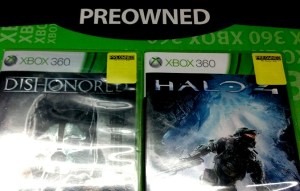
Currently game shops buy games and resell them. This is called the sale of pre-owned games. There is nothing illegal; the original purchaser is getting rid of his/her game. Often this does not even go for money, but for credit in the same store. This has been going on for at least a decade. With game shops living on the minimal margins as is, this boosts their shop enough for them to get by a little better. If this falls away, these shops will have to let go of more staff members and as such it will hurt the economy. This is what some would call: ‘the margin of the little guy’.
The last one is almost literal. Most kids, and at times also their parents cannot afford to buy new games all the time, many not even some of the time. A new console game is often between AU$80 – AU$139 (or equivalent). So, to be able to buy their kids a pre-owned game is a way to stop piracy. Personally I think it is a good solution.
This has been a thorn in the eye of some game makers as they imagine that their revenues are down because of this re-selling of games. Simply put, they are slightly nuts (yes, they might lose a little revenue, but nowhere as much as they claim). The overwhelming part CANNOT afford the amounts charged for new games. They will often buy 1-3 new games a year, but that is it. So if they want to play a little more they will have to rely on a few pre-owned games. That market is now more under threat. In addition, the solutions that will come into play, is that these people must buy an ADDITIONAL fee to unlock such a game. Interesting enough, that fee part is likely to be nicely arranged through a non-taxation nation, which means YOUR economy will not gain an inch, it will lose a mile.
There are two parts to this issue. 90% is the simple pre-owned game that is played by one person. The other part consists of games like Mass Effect 3, Call of Duty, Assassins Creed and a few others. They have a specific additional option to play online. Now often, these games have a voucher to freely unlock the multi-player part. This is only for the original buyer. Whoever buys a pre-owned game would need to buy such a seasonal pass. I do not object to that part. I think it is fair that these resources (server connections) are intended for the original buyer. This option often also affects the sport games. Information has been spread all over the gaming sites that indicate that Electronic Arts, Microsoft and likely Sony are now price arranging certain affairs to force people to such fees. This is an arrangement that is so unacceptable that Finance ministers need to step in.
Their intervention is required on two fronts!
1. In your own benefit, if these fees are forced, they are to be arranged, not only on a local level, but these fees are to be TAXATED! That means that Microsoft will start paying tax on every unlock they charge, in addition they will have to mandatory report all numbers in this regard. It might make the price of a game unlock a $3-$5 more expensive, but it is the only way to force these numbers out. These three companies are bleeding people dry and no-one is stepping up to the plate to protect them from this entertainment Cartel, because, simply put, that is pretty much what they are now.
1b. for decades the console industry has been numbered away in the margins whilst this is a multi-billion dollar industry (on a global scale). People get taxed, taxed and taxed again, whilst those big companies are taxed less and less, because it is all virtually done somewhere else. It is time that if new Digital legislation is passed in their favour, then it will not be allowed until the rights and duties on the consumers site is agreed upon, including setting the transaction location at the BUYERS location, not at some vague transaction point. Any minister looking at a deficit, well here is a possible option for more taxable revenue.
2. All the indication point to a certainty that these two companies are now expanding into data collecting on a massive scale. Soon, people will have no longer a private identity, but a digital one at the mercy of Microsoft/Sony, to use as they see fit. I think it is now becoming essential to protect your local business environment that also depends on collected data to prevent 2 companies to freely have access to hundreds of millions of records with no accountability to anyone. I feel that it is important that a digital identity must at any given time be free from all identifying marks before it is collected, not when it is cleaned. In 2011 Sony lost millions of account details including credit card details. The moment these events allow massive data files to come into the hands of cyber criminals, we will experience additional dangers to identity theft, large scale fraud and banking hazards. I regard that legislation in these fields are not ready on a global scale. When this happens it would quickly escalate to a point where the banks will no longer be able to take such damaging hits. What happens then? What happens when people lose all their money because their safety is now in the hands of 2 companies whilst the consumer has almost nothing to control in the matter?
Microsoft and Sony are both playing on hypes and marketing to unleash a sincere danger up on the world. Many will trivialise this, but when these consoles start to link to the social media, an abundance of data will be collected, including all kinds of personal details, including banking details. Should you the reader think it is all a joke, then question why Microsoft announced a growth from 15000 servers to over 200000 servers? This is a cost unlike any company has ever seen, and Microsoft does not do things from the goodness of their hearts (Neither does Sony for that matter). Whatever the business purpose it has, we can be certain that several segments of business all over the world will feel that result. It is important that business or not, it is the individual that has the right to switch these intrusions off without that hurting the option of playing a game.
It must be stated clearly that not all is known yet, however as both companies will release these systems on a global scale within 6 months, it is clear that not doing anything now, will mean that these companies will get free reign soon enough. Issues that must be properly investigated and it must be made clear to the consumer what they are in for.
First Source Gamespot (http://au.gamespot.com/news/xbox-one-has-preowned-fee-report-6408671): “Microsoft today confirmed with Wired that all Xbox One game discs must be installed to the HDD to play and that while installs to other hard drives are allowed, users will need to pay an unspecified fee to do so.”
– In this scenario a person cannot give an old game to a family member as a present. This is unacceptable. In the scenario I mention it is clear that only ONE system can access this game (as it should be). Again, I must underline that this is for single player option only. It is fair that the second person has no free access to an online option, options that cost resources and it is not fair to make these providers give away such resources for free.
In addition, as Microsoft calls their system an ‘all in one entertainment system’, whilst only adding a 500Gb drive, with all these installations and downloads, it becomes a debate whether such a system is properly equipped to deal with customer requests without forcing people to download under expensive broadband plans. An issue I raised in a previous blog (Source: https://lawlordtobe.com/2013/05/24/spin-dryers-by-microsoft).
Second Source (source: http://au.gamespot.com/news/german-commission-calls-out-xbox-one-privacy-issues-6408935): “Speaking with news site Spiegel (translated by Games Industry International), Germany’s federal data protection commissioner Peter Schaar likened the next-generation console to a ‘monitoring device.’”
– There are several issues involving the privacy of a person. If this is no longer a gaming console, but an all in one entertainment system, then this system is supposed to go to a much larger audience, and as such, monitoring activities of these advanced nature where all our actions are registered on the cloud (as some vaguely report) should raise a lot more questions then they currently are. In this case it was the German magazine Spiegel that had the inside track, yet it seems that many options to evade privacy remain possible. In another article the following quote was placed “a Microsoft representative said that the machine ‘is not always watching or always listening.’” So who decides this? Many people will not know the intricacies of such settings and as such we can paraphrase Nietzsche by “And the data collectors, they collected on”.
I did mention in the very beginning that Electronic Arts is involved. How so? (Source: http://au.gamespot.com/news/ea-killing-online-passes-for-existing-games-6409065). In this article titled: “EA killing Online Passes for existing games” it was stated that EA was no longer charging for online gaming. I do not see this as an act out of the kindness of their hearts. I read this personally as an act to smooth the way for pre-owned charging. EA needs these two consoles and it is playing nice to smooth the way for certain people to charge in the field discussed earlier. That is my personal vision. The quote read: “We heard the feedback from players and decided to do away with Online Pass altogether.” This sounds great, but those online services cost money. Normally a new game gives access; so again, it seems to me that these passes are all about the pre-owners. This is likely to evade a future discussion of double dipping the credit card of this consumer group.
The question remains, what exactly will Sony do? Until the biggest console point in the year (the E3 in America) happens, we will likely stay in the dark. It is however likely that Sony and Microsoft have completed deals; as such an advantage would not be given to any competitor to avoid a massive global shift of the console market. Such an agreement could be seen as evidence to price fixing and a Cartel approach to a consumer market. Since when has that EVER been an acceptable step?
So, now it is time to get personal in this blog.
Australia
To Mr Wayne Swan, our current treasurer and Mr Joe Hockey, our current shadow Treasurer. Australia has a deficit and we are always looking at a solution that allows for the growth of our nation. Should these issues be allowed as they are? We all pay taxation, and as such it is in all our interests that if businesses get hurt in the way they are by charging for pre-owned gaming. No matter what solution Microsoft comes up with in regards to these charges, it is revenue, and as such it should be taxed in Australia. To Mr Prof John McMillan, Australian Information Commissioner (OAIC), how protected are we from this level of data collecting? I would like to raise the case R and Credit Reporting Agency [2011] AICmrCN 12. Specifically Section 18G(a) of the Privacy Act 1988 (Cth). Even though this is not just about credit information. These consoles will hold all kinds of information as well as in many cases Credit Card details. Specifically “(b) ensure that the file or report is protected, by such security safeguards as are reasonable in the circumstances, against loss, against unauthorised access, use, modification or disclosure”. There is no way that this can there is any reasonable case of security and as such a case could be made that many levels of data collection should be controlled. I would like to add that this goes beyond normal safeguards to allow the case where an option of “Feely handed over details” is to be allowed as a defence by the collecting companies. If we consider that I showed from past events that these details can be obtained, then a clear option to block access to all these data segments should be clearly documented and should initially be switched off on all levels, so that access must be specifically allowed. However, apart from the normal credit card option, these systems should allow for alternative forms of payment (like the prepaid credit vouchers as they are currently sold by Microsoft and Sony).
United Kingdom
As our good old Australian point of historical origin, the UK also embraces the Common Law, and as such the financial parts would fall into the laps of The Rt Hon George Osborne MP and The Rt Hon Ed Balls MP. I reckon with well over a trillion pounds in debt and the additional issues they had with Google and Amazon they might be interested in a group that would not be able to get away with this. Consider that the UK has 400% more people living on an island decently smaller then Australia, the amount of revenue that this affects would be interestingly more than the numbers Australia has to deal with.
In the UK, data privacy falls in the lap of Christopher Graham who is the Information Commissioner. His office keeps eye on many issues, including Data Protection Act 1998 and the Privacy and Electronic Communications Regulations 2003. Both might have issues with these new next gen consoles and the information they could be gathering. How complete has these checks been in regards to the privacy of UK citizens?
Netherlands
Even though the Netherlands is based on Civil law (not common Law), they have their own issues with deficits. In addition, a massive source of revenue in the past from a national icon called the Free Record Shop (which is now bankrupt and also sold games) is no more, so it is even more pressing to keep a balance of affairs as they lost to all kind of on-line traders, many not operating within the Netherlands. Even at only 0.5% the size of Australia, it has the same size of population and many of those play games. They too deal with deficits and several issues where people are just too intensely taxed, whilst loads of online revenue gets away from them. In this case it involves funds that Jeroen Dijsselbloem loses as Finance minister. A man who likes the Dutch treasury coffers to be filled a lot more then they currently are. This is the man we all know as the Chairmen of the Euro group. As such he could even make a case that this is an issue that floats far beyond the Dutch borders.
The issues involving their privacy is set in “Wet bescherming persoons gegevens” (translation: “Law to protect personal details”). The law came in effect on September 1st 2001. Their Article 76 comes close to what we have in our privacy act as states in Section 18G (a). The question that rises again is on protection and security of these facts. We have learned in more than one occasion that the required level of security falls in the range of illusionary, hence again the question becomes, why allow it in the first place. (Did I oversimplify the issue here?)
In the Netherlands these issues seem to fall with the Justice department and as such it falls on the plate of Minister of Security and Justice Ivo Willem Opstelten. Another interesting fact is that his wife is Judge Mariette Opstelten-Dutilh. So these issues might make for an interesting conversation on more than one level. The second reason for adding the Netherlands in this regard is that their minister of Justice is also responsible for the coordination of counter-terrorism policy, which again gives thought to these data collection issues on another dimension. If these levels of collection enable an easier access to identity theft, then each of these members would need to take a stronger look at a danger they are trying to prevent on one side, and ignore them almost completely on the other side.
As mentioned earlier in this article. What Microsoft claims on their stated security measures comes from their ‘marketing and sales’ divisions. Their stated interest is never what we need it to be, do these politicians realise that?
Sweden
Sweden is one of the most liberal nations in the world, with a quality of life that is second to none. Civil law gets a new level of comprehension as you experience the politeness of the Swedish police officer (beyond the mass riot times we saw recently). What is interesting there is that it is regarded as one of the Nanny states (US expression), yet when we consider the Swedish Minister of Finance, Mr Anders Borg, we see a slightly different view. He is seen as the man who has been slowly dismantling the social democratic welfare state, giving it a more business like character. I think it is fair that he takes a look at this as well. Like the other nations, Sweden is dealing with unemployment rates. If we see business going the way it is on-line, whatever they have must be protected. In addition, Sweden like the UK has a sizeable segment on video games. Sweden has produced its share of games and is after the UK one of the larger producers in Europe. They have over 2 dozen developers, in a nation with a population less than half of either the Netherlands or Australia. So keeping that industry safe is in their interest, and personally, with the unacceptable steps currently under review, that industry could feel pressure.
When it comes to data matters you can see why I mentioned that if we take the previous mentioned issues. For Sweden there is the following statement in regards to data matters “Generally, it is prohibited to transfer personal data that are being processed to a country outside the EU/EEA that does not have an adequate level of protection for personal data, unless the data subject has explicitly consented to the transfer.” It is the ‘unless’ part that becomes interesting. So in these nations we have seen broadly similar, yet specifically different issues that are affected with personal data.
The Swedish data inspection board is run by Mr Hans-Olof Lindblom, Director General. Their public office takes into account the Personal Data Act (1998), the Data Act (1973) and the Credit Information Act (1973). It is important to note that these acts are at least 15 years old. There is decent question rising on technological issues that were not even an option until 5 years ago. So it stands to reason that there are concerns on issues when it involves security and cloud. Some parties have stated long before these consoles became an issue that the expressions ‘data cloud’ and ‘firm data security’ should not be mentioned in the same sentence.
In the end, this is not about just a pre-owned game. We seem to be embracing new hypes and new technologies without thinking through the danger we burden ourselves with. These new systems are about to set new levels of digital rights and new forms of data collection, where we become the marketing product on several levels. In addition, there is more and more moving towards some cloud we know not of how secure. In an age where identity theft can have a debilitating factor on us for a long time, serious questions must be asked to several companies and a non-marketing answer must be coming our way publicly, long in advance of any official hardware release. With their release dates now less than 26 weeks away, several parties on levels of government, commerce and Justice should be asking questions.
Perhaps they are, but apart from Microsoft Marketing we hear much spin and decidedly little final details. And what will Sony do?


 Lawrence van Rijn - Law Lord to be