Category Archives: Finance

Taught by the past

There will always be one TV channel that remains in my heart. It does not matter how they go, what series they have and whether they stop existing. They had one thing right, the one thing above it all was their slogan ‘the story is everything‘, it still reverberates in my heart, and for years (when I had cable) they proved that they understood their own premise. The story was indeed everything and they stood by it. It should be the cornerstone in entertainment, but it is not (for some). Some have a setting that is nowhere near there. It does not matter how they go that journey, how they pass the time in their product, they forgot that one truth that makes all the difference.

This takes us to Eidos. I had a good connection there for the longest time, so when I got an early copy in the summer of 1996 to take a look at some game called Tomb Raider I had no idea what I was in for. I loved it, apart from the part that the hero was a woman, the game was new, it was different and we all wanted more, that would be delivered a little over a year alter and for the most we were all hooked, not merely because of Lara, little Lara, but the setting from the first to the second became a much larger leap. Even as the story for both was not the greatest, the levels, the design and the challenges made up for that. Over time we saw that the story become much more important and as we went through the stages, on PlayStation, PC, PlayStation 2, Dreamcast, PlayStation 3, PlayStation 4 and Xbox One the story evolved and it became to some degree a real story. In all this there was an evolution (to some degree). Now we are confronted with ‘Tomb Raider – makes Lara Croft look boring‘. The Guardian gives us (at https://www.theguardian.com/games/2018/sep/10/shadow-of-the-tomb-raider-review-lara-croft) “This game revels in its own beauty, but the plot collapses under the slightest scrutiny“, now first the important part. I did not play it myself, but I saw a large amount of videos. First the bad part, a few games back. When the definitive version on PS4 was launched, I became very upset. Not only was the game shallow, too easy (on hard) and way too small. It became the first game I ever returned to the shop. I had finished the game in hard mode under 10 hours. It was perhaps one of the most upsetting acts I ever did, mainly because my gaming experience with Lara Croft over 4 systems had been so good. When we look deeper into that game we see something that was perfectly placed on an island, the setting could have propelled in many direction and the graphics were amazing, even now I look back (in my mind) to that level when you arrive near the ocean and you see that large tugboat in the sea, I need to acknowledge that graphically it was an amazing feat, so when we see the setting where we could have had at least 20 hours of additional play, but the makers overlooked or ignored that opportunity. In a gaming sidestep, I realised the same with Assassins Creed Rogue, the remastered edition. What could have been nice story to side missions ended up being merely the setting of running to a marker and press the dig button or simply violently resolve it. All opportunities missed (in that case) by Ubisoft. So back to Lara, after that disappointing episode, I decided to give the second game a miss, something I partially regret now, because the third game (for hat I saw was a pretty amazing result). The graphics were still really good, yet the story is, as I saw it better and they took effort with the stealth part. A much better game overall (comparing to the first relaunched PS4 game). I liked Lucy O’Brien’s review in IGN giving us the parts that count (at https://www.youtube.com/watch?v=tdEfROL2Wx8). If there is one part that I personally do not like is the use of ‘scripted moments‘. I get it that it essentially needs to be there (especially in the introduction), but in the end, the best game does not require scripted events, or requires them to be minimised to the biggest possible degree. Even as the stories are better, we need to address the Guardian verdict. We see the first quote “Shadow of the Tomb Raider nails the former, with sumptuous South American locations to climb, dive and rappel around, ranging from ancient Inca cities and missionary crypts to modern-day Peruvian jungles and towns. But it does Lara a disservice, turning her into a deadly mud-camouflaged jungle warrior without much interesting to say, pushed along by a plot that’s more concerned with prophecies and supernatural artefacts than with its main character“, so was that not always the case? I personally like the entire stealth upgrade, but is that just me? It might be, I was merely in that setting of trying to figure parts out. Yet I saw too many references towards Uncharted and Far Cry 5, which makes sense and it is not a bad thing, yet when we look back at what was and what should be, going through the other titles is not what I hoped for. Still Tomb Raider for all I saw remains Tomb Raider, so why did the Guardian give me that jump?

There were two parts in that. The first was: “Shadow of the Tomb Raider’s series of amazing places is held together by a plot that collapses under the slightest scrutiny. The narrative is an incoherent mess that goes well beyond the usual action movie/video game suspension of disbelief” and “when Lara shows up in an undisturbed native settlement filled with people who have somehow avoided the outside world for hundreds of years, is she instantly welcomed into their midst and put to work resolving their disputes? How does she communicate fluently with them? At first, Shadow of the Tomb Raider’s narrative inconsistencies are ignorable, but with every new convenient riddle or magical artefact, pointless revelation or paper-thin character, my tolerance for nonsense wore thinner“. Now, I need to tell you that I do not always agree with the assessment of the reviewer Keza MacDonald, yet that level of disagreement is more about our preference for gaming. Keza is a good reviewer, hence her view matters to me, and I have absolutely no issue accepting her view on the Tomb Raider game. I like her two issues as I saw a similar setting as an optional solution towards Watch Dogs 3. Just like I designed what might optionally become Elder Scrolls VII (6 is being made now). My setting for my version of a new Elder scrolls would have been three times the size of Skyrim with optional story lines worth 150-200 hours of gameplay. In addition, if possible I could pull it off with Watch Dogs 3 as well. This is where the FX part comes in, the story is indeed everything!

So if I can add 100% to the first PS4 Tomb Raider, which merely took me an hour or so to come up with, why can some designers not do a much better job? In case of the new Tomb Raider, we see the optional shortage, but we also see that all the Far Cry games (3 and later) gave us similar parts and so did Far Cry Primal, and the less said on the story failings of Assassins Creed (except for Origin and optionally Odyssee) the better.

The setting is extremely important, as the current Shadow of the Tomb Raider could have been 90% instead of the 81% that Metacritic gives it now, and if we translate that to the three stars Keza rating, it would translate to an optional 70% at best. This gets us back to the story is everything, when we see that this translates to an optional 15%-25% more, ignoring that element is just too weird. It is to some extent the one element that Games and movies have in common. So if we translate that to the now, we see that the right story makes the larger impact. Merely see Dev Patel in Hotel Mumbai, rated by IMDB at 93% to see how the right story makes for the impact. This translates to games as well, the better the story, the better the game. It is visible on nearly every level. Yet, that is not the only part in Tomb Raider and We see the goods on the negative side of the game as Keza gives it to us with: “Salvaged outfits for Lara offer meaningless bonuses (“gain more experience for assault kills”), crafting materials are so plentiful that they are not an exciting reward, and new skills or weapons are seldom used. Oddly, items such as lockpicks that open up new treasure-hunting possibilities are sold by merchants, not earned through exploration. It is very weird that so much of this optional content is incorporated so badly“, as well as “The places Lara visits and the things that she does, especially when she doesn’t have a gun in her hands, are beautiful and entertaining. But it lacks a coherent plot or creative vision to hold it all together, and the opportunity to make an interesting character out of Lara Croft is squandered“, that does grasp the heart in a not so good way and it matters a parts could have been dealt with in a better story setting and parts would never have been better. That negative part is exactly the impact that Ubisoft missed with AC Rogue. There we run for Viking swords, crosses on the map, opening bars with thugs, merely points to run to, yet the ‘rescuing’ of a bar from thugs could have been the start of a side quest line and in all this, much more could have been reached, when one leads to the other, instead of running over the island, from chest to chest, glitch to glitch and sometimes doing a Prince of Persia for some pirate shanty, meaningless actions that could have been a dimension all by itself in the game, all options lost and even as both franchises have amazing graphics, we see that this alone does not hold a game. I wonder how many developers are revisiting the current setting of their game that is in development, because if they are not then it does not matter to anyone how many games are being released between now and December 2019. If they do not up the ante for their own game, they will merely release something that is good, not great and it sits on the shelf until the game retail store has a large sale and the game is up for grabs at 50% or less, or people merely wait for one of the producers to add it to the ‘for free’ subscription monthly download bonus, what a waste! Merely because the simplest of all lessons was ignored by too many; It all starts with a good story, not with ‘Lara needs to look cool (or different) in the jungle, how can we do that?‘, or ‘Where is the next Assassins Creed story? When have we not yet been?


That is the part given to us in complete contrast when we realise that with the end of God of War we were treated to: [CENSORED TEXT REDACTING SPOILERS]. When I saw that unfold on my screen, my jaw dropped on the floor. It was not merely some twist, it was the setting for at least two more games in a way I never saw coming and I do remember my Nordic mythology. It was brilliant, indeed the story was everything and Santa Monica Studio’s treated us to the perfect meal (listening to Bear McCreary was an added desert that is just too surreal).

In the end, I know that I am a goof, I am creative and I can weave a tale like no one in my mind at the speed of the Deep Blue Super Mainframe, but overall, I cannot fathom why the game makers are not better at this, I never got that, because until lately I never thought I was on their level, yet recently I was shown (confirmed by a few sources) that I am on their level and even higher, but I am not a programmer. So when I see the lack of a storyline, I merely get sad, when opportunities are missed I get frustrated and when too much scripted issues show up, I tend to get angry. I do get the fact that some part requires scripted events. A certain boss fight, the introduction to one is the setting that cannot remains unscripted, yet at times it is too scripted deflating the tense moments it had been built to and the first PS4 Lara Croft had that flaw too much (as well as the shortness of the game).

So how can they do it better? Well this is seen in several clips in Shadow of the Tomb Raider and you might have missed them. Consider an optional reality, a reality we missed in the Far Cry, Assassins Creed and other games. You pick them off one at a time, I get that part. What I do not get is that when you are on a patrol and You are in a team, when one falls away their nerves are up (like in the Arkham games), yet in the earlier games, often enough they relax and go to their old ‘relaxed’ setting. In reality, my nerves would be in the stratosphere, so there will be no lapse and even as you can get the drop on others, only the first one is ‘free’, the others need to be close to perfect or all hell breaks loose. That part was never learned correctly, not in one decade of stealth gaming, weird is it not? OK, Far Cry did get that part right (to some degree). And even as the setting evolves over an act, a larger level or a chapter in the storyline, we see that some opponents are harder, yet the overall setting no longer gets to be more complex, which is also weird. It seems to me that only Far Cry 3 got that part better the most other games and here too Lara had her lesson to learn, or better stated her opponents. So even as we see her take out the enemy, in most cases when other vanished nerves did not get that much bothered, a missed opportunity.

Even if this is the optional end of Lara Croft, we see that there was a lot more to be had and it was missed. Will that lesson not be learned? The story is everything, but how to set the story properly in the frame of it all. That part will remain a challenge and solving it, or finding some level of a better solution will aid the game makers as well as the player, a win-win for all. In this, the loss is already there, but not setting the in-game bar higher, we see what looks really well is merely a 70% game, yet with the insight that should have been there, it could have been a 90% game which makes me sad. Yet I do acknowledge is that this game is a good game, everything shows that there is positive growth in several places and in many ways (especially the underwater parts, they were awesome), yet I feel that it is steps short of being a great game, whilst it could have been a great game. It is hard to put my finger on it without playing the game through until the end, but all reviews do support my view, the story could have been better making it overall better, and this game is not the only one that had that ‘flaw’.

So, as we agree that the past is a good tutor we see that partially the past is used to make this game better, that is good, some of the levels and the natural view that these levels seem to give is always good and this game got to be better at it and that matters too. In the end, on everything I faced, I regard this to be a 80%-85% game, whilst I feel that the setting and upgrade of the game would have made it a 90% game at least, and they should have done better than I would have been able to be and that makes me sad, especially as it might be the end of the Tomb Raider games for now. It will not ever be the death of the Franchise; it is in comparison very much a better game than that first relaunched game and several other Lara titles, which is a good thing. In my personal views, after seeing the play parts, seeing the reviews and watching the cut scenes, I get to the end conclusion that this is not the game to buy on day one, especially with Spiderman PS4 available, yet on special, Christmas sales and at discount sales? Yes! At that point it will definitely be my game of choice.

What a difference a stronger story makes.

I wonder if the makers will catch up to that part down the line, because higher ratings turns that, down the track to buy outright and in the end, that is still the name of the game in gaming, and not merely gaming. There is in my view every indication that the entire Chris Pine mess (OK, mess is a perhaps too strong a word), is not entirely about the money (what some sources indicated), I believe that the story is part of that too. Do you think that some starts would have given any ‘eff’ (censored) on money if they had the chance of becoming a main player in The Usual Suspects, or Silence of the Lambs? You have got to be kidding!

Yes, you want some decent remuneration. When you are a lead player in MI-Fallout, costing $178M to make, whilst the return at present is $726,386,554, one would hope that their income is slightly better than $73,559 for their part. If you are an extra, then you need to shut up, when you carry the family name Cruise, Cavill, or Pegg the amount should be larger (I have no idea what they are making, and I personally do not care either). Yet if the story would have been a legendary one, would you care? That is the part that matters in the long run, because over time, we will forget the MI titles, however we will forever remember titles like Ghandi and The Usual Suspects and that can drive a career (especially in the beginning as well). Star Trek showed in the Movie Star Trek Beyond that it did not consider that part too strong (even as I enjoyed watching it, and it had fresh looks), it did fall short of Star Trek Into Darkness and that was a shame. I have no illusions, getting to the Wrath of Khan levels is not to be expected, yet the relaunch in 2009 did pull it off (based on Rotten Tomatoes), so in that it had options and started to fall flat after that, I believe that this is also part of the decision for some actors to feel worried, Star Trek (2009) opened door, yet I personally believe that Beyond started to close doors, even with Idris Elba upping the ante by a decent amount, also in my personal view largely the reason it got an 85% rating and not an 80% rating. So when the actor is the pillar and not the story, we see a much larger flaw in all this and even as I do have idea’s to fix it, they will need a specific person to fix that for them over two movies (as I see it) and get the rating back to 94%, the number that the 2009 movie pulled off. The question is can they afford him and more important, are they willing to stick their necks out? In my personal view they have the option of doubling the 2009 box office revenue twice over and with two movies the overall cost goes down as well making it even more appealing, but in the end, their saviour will not be special effects or merely a good cast, it will be the story, it will be everything. Are people like JJ Abrams and Damon Lindelof willing to make that $250M splurge? In the end it remains an actual risk whether that $250M becomes $1.3B (hopefully better), and it the one factor is the one writer who can pull it off. It has never been done in any Sci-Fi ever, making it not merely novel, if it does work, will it be the game changer that brings 1,635% of cost (Jurassic Park), or an Iron Man 2 giving a mere 312%? Yet, what if we consider that it is like Gravity, ‘only’ 716%, yet regarded as the 4# best Science fiction movies of all time, would you still not do it?

How strong is the story in all that? I personally remain with the faith that the story will forever be everything, yet when it is all about the box office and $1 billion versus $600 million, what path would you take? In this games and movies are more alike than not; making it a fascinating setting, but also a very personal, and set on one’s own perspective. It is the ultimate objective versus subjective view and I am not sure what the best path is for either game or movie, making the setting for a movie of gaming score harder, not correct or incorrect, merely harder.

 

Leave a comment

Filed under Finance, Gaming, Media, movies, Science

The Digital Dilemma

Just a few hours ago, the guardian makes us aware of an interesting case. The article by Rob Davies is interesting for a few reasons, apart from the fact that it was nicely written and reads really well. We see the title ‘Google under pressure to refuse Viagogo advertising‘ (at https://www.theguardian.com/money/2018/sep/10/google-under-pressure-to-refuse-viagogo-advertising). I cannot completely agree with the premise, but I understand the setting.

When we are confronted with: ‘FA, UK Music and MPs urge Google to stop accepting payments from ticket firm‘ we are confronted with a few things, all apart from the fact on the path taken and that awareness is a good thing. You see, when the quote “The letter, sent to senior Google executives on Friday and seen by the Guardian, says that Viagogo’s prominence in search rankings is leading to consumers buying sports, music and theatre tickets that may be invalid” we are confronted with two distinct parts, the first is ‘may be invalid‘, the more interesting part is not on Google, but on why there is no criminal investigation and prosecution of Viagogo. Is it not interesting that we see ‘pressure Google‘ and not ‘prosecute Viagogo‘? That part makes little sense. If the law is clear on selling and tickets at vast mark-ups, why is that not clearly in place?

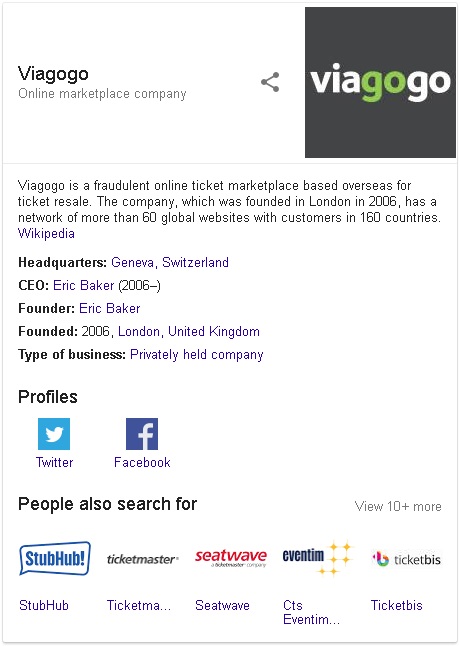
When I enter ‘Viagogo’ in my google search, I am treated to at the very top of the screen. On the Right side I see image below that, which leaves us with even more questions, if you look at that image properly. So we can see that Viagogo is setting the right stage for Digital Marketing, there is no denying this. So as we are introduced to the workings of Eric H. Baker, the American businessman (read entrepreneur), aka founder and CEO of Viagogo, and co-founder of StubHub, a Harvard and Stanford graduate, we need to consider the parts where it counts. Is he breaking the law, and moreover if he is not breaking the law, is the setting of “Labour MP Sharon Hodgson, one of the letter’s signatories, said: “I have heard too many times from distressed customers of Viagogo that they were led to the website because it was at the top of their Google search” a valid one?

You see, whenever I want to go to a concert, I go to the actual site of where the performance is and I see THERE where I can get the tickets. So the fact that some consumers are lazy is one thing, that they do not properly do their homework is another one. That aside, when the law is broken actions need to be taken, that is clear, but was it? In additional, how often did MP Sharon Hodgson look into the matter? With ‘I have heard too many times from distressed customers’ she now becomes a valid target as well, so can we get specifics please? We see her visibility again in the Financial Times (at https://www.ft.com/content/2eefe9e0-b04f-11e8-99ca-68cf89602132). Now it is the other way around. Here we see ‘Viagogo sues Ed Sheeran’s promoter for ‘fraud’‘, that different candy, is it not? We setting given here is: “Viagogo claims that Stuart Galbraith, the founder of Kilimanjaro Live, “duped” fans during Ed Sheeran’s 2017 tour by setting up fake “Viagogo booths” outside venues to attract people who had bought their tickets from the site. These tickets, which Viagogo argues were valid, were then confiscated and fans were forced to buy new ones“, an interesting ploy, the question becomes was the law broken by Viagogo? We are also informed by the Financial Times on the action with “Viagogo said that it has refunded the fans who bought from them and has sued Mr Galbraith in a court in Hamburg with further legal action likely elsewhere“, so basically Viagogo refunded the customers, which is the decent act and will seek reparations elsewhere, which is (as far as I can tell) the decent business oriented act to follow. We are also given “senior executives from Viagogo are due to be questioned by British MPs about the site’s resale practices. Mr Galbraith is also scheduled to appear before the MPs“, this implies that the resale practice is looked into, yet it also quite clearly implies that no law is broken. Here is where we see the Labour MP mentioned as ‘Sharon Hodgson, the Labour MP who co-chaired the All-Party Parliamentary Group on Ticket Abuse‘. The question is not on merely ‘Ticket Abuse‘, the question is how the seemingly given title of abuse applies. This is a market of selling and reselling, until the law clearly makes reselling illegal, we see a setting that someone found a niche for margins and applied its options here.

So basically we could go to the setting that like most Labour minded ‘officials’ she too is full of (the ess and tea word) and goes with “Google needs to take action in order to protect consumers, and I look forward to working with them on this in the very near future“, to which my slightly too emotional response is: ‘No you stupid fishmonger, you either set the law correctly, or get out of the bloody way!‘ I agree it is not really diplomatic, but the entire setting is just a joke, the way I see it (at present).

You see, Viagogo (on their website) give us: “About Viagogo. Buyers are guaranteed to receive valid tickets in time for the event. If a problem arises, Viagogo will step in to provide comparable replacement tickets or a refund. Sellers are guaranteed to get paid for the tickets they sell and fulfil on time“, to me that is clear valid and acceptable. Yet in all this, I cannot find any setting where the CPS or the DPP is in a setting to investigate Viagogo or prosecute them, so were there laws broken? Now consider the commercial other path. If it was clearly illegal, or shunned Viagogo would have let’s say 200 tickets to any event and that would per gig be 20,000 in revenue lost if no one buys them, the question then becomes why not, and how can you continue this business? It would go into administration quick enough.

Is it illegal? That is not stated anywhere, and we need to acknowledge that it is either illegal, or it is not. So instead of working with this optional digital market provider, we see mere brazen outrage, whilst there is no clear legal definition. I also acknowledge that when we look at Product review, it got 1.3 out of 5, which is actually really bad and normally in eBay terms that score is close to a death sentence, yet they are still around why? I also acknowledge that we see reviews like ‘I could go online right now to Ticketmaster and purchase better seats for a much lower price‘, added only yesterday (what a coincidence), there are also the reviews that should lead the police towards the investigation of defamation against people like ‘Annie’ giving us: “People beware: do not bug from these people as the are comming a criminal offence called FRAUD. You buy tickets off them to get falsified tickets and are useless, get to the event an cannot get it. They send then to you a few days before the event“, so if Annie (optionally a fake FB account) cannot validate that opinion with facts, her opinion becomes defamation, if it is true and validated it becomes a path for prosecution (that was simple, was it not?). There was also a very positive review there, as well as ‘Delivered what they promised and got me out of a jam‘ from a Verified Customer. Now, I get it, there will be happy and unhappy customers in every field. My initial feeling is that a 1.3 of 5 does not instil me with any level of trust, yet their own site gives clear settings, clear business settings and the people acting against Viagogo do not go to the law, do not adjust the law, no, they come crying at the Google office front desk. Pardon my French, but how fucked up is that?

We cannot disagree with the Guardian quote: “The letter has 24 signatories, including a host of MPs, trade bodies and associations from the worlds of sports, theatre and music. Sporting bodies that have signed include the Football Association, England and Wales Cricket Board, Rugby Football Union and Lawn Tennis Association“, yet there is no mention that the law is getting broken and that had to be the first action. So why is there exactly this anti Viagogo activity? Margins? Mere legal profits? The fact that someone with Harvard and Stanford goes to scam options is just too weird at times (it does on a rare occurrence happen), or is Eric Baker merely an intelligent person who found an option, an opportunity and took that to make nice coins on the side? Is that not the setting that matters?

You see, I still see idiots all over the field having no clear idea on how to properly use digital marketing, the fact that there are those who do know what to do and they can turn opportunity into profit, which is a valid choice, it is in that setting we see the valid response from google with: “The CMA has been looking at the business practices of ticket resellers. We await the conclusion of these inquiries and we hope that they will clarify the rules in the interests of consumers. We will abide by the rulings of these inquiries and local law“, that is the actual setting and it took me 35 seconds to get there from the moment I read the title (before even finishing reading the Guardian article). It is about local law. It might not even be about the inquiry. The inquiry has no legal bearing until set in law. I is that same setting that the Daily Mail needs to be investigated, as we were treated only moments ago to: “‘Worse than a street tout’: Viagogo charges woman £3,000 for two £87 tickets to take dying father on a bucket list trip to the Last Night of the Proms“. The question becomes, why are the DPP and the CPS not all over this? We now DEMAND to see the evidence. If Viagogo was part of that, then against their own settings we might have a clear setting of law breaking, if not, then the public are entitled to see the Daily Mail to be prosecuted on all fronts. there is no ‘press protection‘ here, not in this current setting, but at that point it is more likely than not that people like Labour MP Sharon Hodgson will suddenly be too busy to look at issues around anything involving ‘the freedom of the press’ and holding the press accountable for their actions, that is how is tend to pan out.

You see, this scenario is out of what, all these accusations at almost the same time, with the Daily Mail ‘hiding’ (or is that using) a kidney cancer case, with tickets merely 2 days old, it is all happening at the same time. If that is the case and the DPP and CPS are not all over this in 5-10 hours, the UK has a much bigger issue, a systemic failure of the law on several fronts and that needs to be addressed now, whilst the first question is not merely: ‘was the law broken?‘ The issue then instantly becomes ‘How many parties have been negligent in all this, and what are their names?

At that point, when that is proven then Labour MP Sharon Hodgson has a case that demands here to be in the limelight, not before and we better get to see some real answers, not some lame ‘we will look into the matter and make proper changes‘, because at that point, I will seek out Eric H. Baker myself, seeking some funding to set up digital campaigns of my own, demanding the removal from office of Labour MP Sharon Hodgson as she is seemingly too unfit for public office. I can get such a campaign started for a mere £35 a day, giving that campaign optionally 20-30 thousand views a day. With all the profits he is making, he might be up for that, did you consider that path Sharon? And in hindsight, in this inquiry, how much time and effort are you taking in regards to StubHub, Ticketmaster, Seatwave, CTs Eventim and Ticketbis? Did any of those raise flags?

You see, I do not oppose such an inquiry, I do not oppose that he law is adjusted making reselling of tickets to be illegal, and that is a valid step to take. Is it not weird that those steps cannot be found? Oh, there is that. You see the setting we get with: “UK law stipulates that the re-sale of concert tickets is not in itself illegal. But it is an offence to sell tickets in the street without a trading licence“. So there we see the first part and if Viagogo has that, we also see the flaw in the entire setting from the start. So when we consider that setting the law was a first requirement, we see the absence of the DPP and CPS and also a first indicator that Labour MP Sharon Hodgson is unfit for public office. That did not take long, did it?

I loved the article by Rob Davies. It made me question parts and that is always a good thing. Yet, when we see all this, we need to ask the Football Association, England and Wales Cricket Board, Rugby Football Union, Lawn Tennis Association, UK Music chief executive Michael Dugher and Music Managers Forum chief Annabella Coldrick, the Society of London Theatre and UK Theatre a simple question: ‘Have you sponsored a bill to make reselling of tickets illegal?‘ If not: ‘Why not?‘ Those are the questions that matter, but are we seeing those questions asked and answered?

It was that simple and crying at the front desk of Google was merely a waste of everyone’s time, plain and simple. I am not friend of Viagogo, I would have personally never gone there, not for one or the other, just because I would have taken the path of the actual venue location and the official venue website, and in all this is it not interesting that when we are confronted with the Daily Mail part: ‘Hannah Maturin, 30, wanted to take her frail father John to see the Last Night of the Proms‘, that she decided to allegedly pay £2959 over £174 and decided not to call the Royal Albert Hall first with her dad being in such a state? It is what I would have done. And we see all this news at the SAME TIME? How is this level of orchestration going for you? So much common sense absent from so many players and no one is asking the question: ‘Why is that?

#ItMustBeMe


Leave a comment

Filed under Finance, IT, Law, Media, Politics, Science

Goodness redirected

Even as I got shocked to the core yesterday with news on how certain Biological Agent accusations are going in the wrong direction (turning my paranoid into overdrive in 7.2 seconds flat), I was also slightly bewildered a few hours later on how a greed driven industry is now getting a rather large shake up. It was the Washington Post that treated us to ‘Hospitals are fed up with drug companies, so they’re starting their own‘ (at https://www.washingtonpost.com/national/health-science/hospitals-are-fed-up-with-drug-companies-so-theyre-starting-their-own/2018/09/05/61c27ec4-b111-11e8-9a6a-565d92a3585d_story.html?utm_term=.8362898ab1fe). It is a not for profit pharmaceutical company that works exclusively for hospitals. That is the first really good unbiased news of 2018. I truly wish I was part of that place. The report by Carolyn Y. Johnson gives us “A group of major American hospitals, battered by price spikes on old drugs and long-lasting shortages of critical medicines, has launched a mission-driven, not-for-profit generic drug company, Civica Rx, to take some control over the drug supply“. And even as it is for now merely the generic side of it all. We need to realise that in the UK, the NHS gives us (at https://www.nao.org.uk/wp-content/uploads/2018/06/Investigation-into-NHS-spending-on-generic-medicines-in-primary-care.pdf) and that they spend £3.5B in 2016-2017. I am using that data for the mere reason that it is more up to date and more reliable at present. Consider that an ‘island’ with only 20% of the population of the US has that bill, yet to a larger extent, they have a similar aging issue and several similarities in health care. Now consider that this is a NFP situation, so basically, we see the optional saving of close to a billion pounds a year, implying that the savings for the US should increase drastically. It is also important to see that this is merely the beginning.

So as the too laid back greed driven US pharmaceutical industry is confronted with two nightmares, the first is not merely the current generic medication part, it is that if the US and UK unite the damage increases for the pharmaceuticals. In addition to that, the Pharmaceutical industry is confronted with well over a hundred patents maturing over the next 5 years, so the generic part is increasing with leaps before 2023 and so far a lot of them cannot be ‘reset’ by altering the patent slightly and forcing exclusivity for another 15-20 years.

So there is light at the end of the tunnel, it will not happen overnight, but there is a setting that the US could remove medicine cost pressures by a much larger amount then even before. So even as we are given “Backed by seven large health systems and three philanthropic groups, the new venture will be led by an industry insider who refuses to draw a salary. The company will focus initially on establishing price transparency and stable supplies for 14 generic drugs used in hospitals, without pressure from shareholders to issue dividends or push a stock price higher“, we need to realise that this is merely the start of something much better in two directions. The first is that if the costs go down, there is more money for other hospital needs and also in the other direction, when people get affordable medication more will work on healing and in addition with added funds, the chance increases that they will adopt a healthier lifestyle and actually get better and more energised in their old age, which might change a few other things too.

Civica Rx

Yes, that will be a name to remember for a long time, especially when they start showing the results that their goals are set for. Yet this is merely the beginning. Let’s not forget that given a set of greedy hungry swine’s, when they get hungry they tend to let go of ‘morals’ and limitations, so unless severe warnings and protection is given to Civica Rx, they still have an uphill battle to fight. Forbes gives us (at https://www.forbes.com/sites/elliekincaid/2018/09/05/that-nonprofit-generic-firm-has-a-name-100-million-and-a-ceo-who-will-work-for-free/#38015e44ce06), gives us the name of the CEO Martin VanTrieste, he was also quoted with: “has agreed to work without compensation“. Now, I could never do that (due rent and such), but that shows a system where we would love to be a part of, does it not?

So when I see: “The healthcare systems involved: Catholic Health Initiatives, HCA Healthcare, Intermountain Healthcare, Mayo Clinic, Providence St. Joseph Health, SSM Health, and Trinity Health. The philanthropies: the Laura and John Arnold Foundation, the Peterson Center on Healthcare, and the Gary and Mary West Foundation“, I am actually surprised that the Bill Gates foundation has not (yet) knocked on that door offering a nice 8 figure amount, but you know, 2018 is not over yet.

So even as they start with 14 generic drugs, there is every indication that this can evolve to a number in the triple digits in the next 3-4 years making life a lot more affordable fast.

So what is the setting? Why is this given so important? Well, again we need to the UK numbers (as they are more reliable). It is not merely the setting of ‘cheaper’ that we need to realise, it is the attached setting of ‘proportion of spending on generic medicines that is in primary care, 2016-17’, which was 81% at that point. The second part is the logistics, a number that is even scarier than the margins and the exploded prices involved. You see there were 3,000 concessionary pricing requests made by pharmacists in November 2017, a few months earlier, basically before May 2017 the amount of requests made were less than 150, so an increase of 2000% of concessionary pricing requests. The impact of diminished budgets had that much a drain on logistical support for hospitals and NHS departments. When that pressure falls away, so much more can be done and that part is not visible to a much larger extent. there will remain a much larger issue when we look at the branded versus generic setting in both primary and secondary care, no one doubts that and that setting will remain, but over time that equation will change as well as speed up as the life cycle of branded patents end.

It becomes a little scarier when you consider that in the UK, Ten medicines accounted for £134 million of the net spend on price concessions. Topping this is Amlodipine 5mg, a medication for high blood pressure. This becomes important when we translate that to US numbers we can use. You see, in the United States, about 77.9 million, almost 1 out of every 3 adults have high blood pressure. Now consider when that becomes affordable and less of a drain for any health facility, the savings on this one drug could change the game for hospitals all over the US and at the same time prolong life for Americans. When we see that 18 out of 134 million is for that one prescription drug only, we start seeing the essential needs that Civica Rx is bringing to the table, and it has a much a much better impact than a salad (especially when reading about the McDonald Salads this morning).

SO what will come next? Well, they are off to a start, but I never trust anyone merely giving up their golden parachutes (referring to the current pharmaceuticals having to spread the negative news to their shareholders) and in light of the pharmaceutical patent escalations in India, I feel certain that Civica Rx is likely to face dozens of injunction meetings before the end of this year alone. After that the political engine will be turned against them as much as possible. I think it is important at that point to make sure that EVERY senator and congressman (m/f), will get the limelight set upon them to make the people aware of the elected officials that will make their lives more expensive.

Yet that is not the only part, the NHS report gives us the part that Civica Rx is trying to address as well, when the reporters investigated the underlying causes of pricing, the following parts were given on that report (attached here) on page 21.

The immediate cause of concessionary pricing is pharmacies being unable to purchase a generic medicine at, or below, the Drug Tariff price“, as well as “The Department identified three main underlying causes of the 2017-18 increase in concessionary pricing, and those three causes were:

  • The Medicines and Healthcare products Regulatory Agency and European regulators partially suspending the licences of three manufacturers of generic medicines;
  • A fall in the value of sterling; and
  • Governments and insurers in other countries putting downward pressure on the price of generic medicines, resulting in lower returns and manufacturers withdrawing from some markets or medicines: the reduced capacity and competition then increased prices within the UK market.

Now, the first is only an issue when it keeps on occurring and until more evidence is seen, the solution is not easy in this, the second is an impact, yet short lives and the US might not face that issue as it produced its own need, the UK is much more reliant on American pharmaceuticals. The setting of Civica Rx would when effective take away the cause of that element, making that a non-issue over time, it might initially still be a short term factor for Civica Rx to consider.

And it must also be stated that the elements could not be verified or quantified. There were too many elements in play in all this, but the significance on the factors seemed to clearly shown, but to the extent of how much remains a question that can only be proven over time (and with a lot more precise data).

It is my personal view that the report by Sir Amyas Morse KCB is quite extraordinary and even as it leaves us with questions (as any report does), it also raised the curtain on several issues, not merely showing the essential need of Civica Rx in any nation that is getting drained by healthcare costs, it sets the stage that the report empowers the existence of Civica Rx as well as the essential need for their sponsoring and protection ‘against’ some of the pharmaceutical companies, because generic medication or not, you introduce me to a commercial board of directors who do not care about lessened profits and I will introduce you to a group of people lying to you, it is basically that simple.

So we enter Friday with goodness form another direction, today brought to you by the Washington Post, a paper that still states that ‘Democracy dies in Darkness‘, I say that this is not entirely true, it is currently actively getting smothered with a pillow by the needy for greed and those who get their coins from a similar direction, but again, that is just me thinking with temporarily a few paranoid clouds overhead.

#MondayMorningIsOnly60HoursAway

#HappyFriday


Leave a comment

Filed under Finance, Media, Politics, Science

Democracy is dead

If there is one thing that the UK situation showed is the mere fact that not only is democracy dead, the question becomes has it even existed in the last 10 years? The fact that bullying and harassment are now the core uses of the media in facilitation towards power players (not even the political players) is at the heart of it all.

What started as an actual discussion became a trodden lane of smear campaigns and misstated innuendo. In the end a golden cage is still a prison, no matter how you slice it and even as the UK is all over the place, I do hope that they realise that they are about to become part of an additional 3 trillion in debt. The part that the media has refused to look into for the longest of times, the mindless spending by Mario Draghi and now a mere two hours ago we are confronted with “some economists argue that rapid technological development keeps a lid on prices, forcing central banks to exhaust their firepower fighting an economic paradigm shift, and leaving them with few tools for the next downturn“.

How does that relate?

Part of an issue I mentioned yesterday was (source: CNN) “Europe’s third biggest economy has suffered years of anaemic growth, high unemployment and budget deficits, while neighbours such as Germany and the U.K. have enjoyed a stronger recovery from the global financial crisis” at present the forecast is that the economy will rise by 0.2% less, giving a setting that is close to stagnant. In addition, even with the news from yesterday, we also now see: “Italian Economy Minister Giovanni Tria is pushing the parties in the governing coalition to keep next year’s budget deficit below 2 percent of output, sources close to the dossier said on Monday, lower than the party leaders have indicated so far“, as well as the part I mentioned last week as the article (at https://uk.reuters.com/article/uk-europe-view-friday/daily-briefing-italian-debt-yields-get-stretched-idUKKCN1LG0T2) was giving me “Fitch is due to provide the latest evaluation of Italy’s creditworthiness with national debt standing at 130 percent of GDP. The Italian-German bond yield spread is already at its highest since 2013 – a downgrade will widen it further and make Italy’s borrowing even more expensive“, there was an overall loss of faith, yet we are now treated to ““The actual rating wasn’t lowered, and anyone who follows Italy closely will know that a lowered outlook for the future should be taken with a grain of salt because so much of the political situation can change so quickly,” Alessandro Polli, an economic statistics researcher with Rome’s La Sapienza University” and when we add Bloomberg (at https://www.bloomberg.com/news/articles/2018-09-03/italian-bonds-get-a-respite-as-fitch-affirms-credit-rating) with: “Basically the politician with the greatest clout is saying Italy will remain within the 3 percent deficit band“, which is not only 1% deficit more, it is also an initial indication (indication mind you) that the 2% deficit marker is now more and more likely not the be a feasible one. But in all this, it would all rely on Germany and now we see the play, the EU and ECB are desperate to thwart UK democracy, because without it there is no euro, no Eurozone and no options remain and big business is willing to betray 65 million people to keep their cushy 7-8 figure income jobs, they are willing to do that at the drop of a hat, any hat.

The political players let the media be the facilitator for big business, first the banks, then tech companies and now the car industry. One by one fear mongering until the people got too scared and according to the Independent, 2.6 million people jumped ship and decided the swim to remain. So the new UK lyrics become ‘Ruled Brittannia, Brittania is the bitch! We shall never never ever trust in Fitch‘.

We get that to the setting of ‘Fitch ratings review gives reprieve to Italian govt bond yields‘ (source: Reuters). It is seen with: “Italian bond yields edged lower on Monday after Fitch left its credit rating unchanged at BBB, revising only its outlook to negative, though mixed news flow from senior ministers and manufacturing PMI data due later this morning could mean the rally is short-lived, analysts said” where we need to focus on ‘manufacturing PMI data due later this morning‘ which gives me that the rating was done ‘just in time‘ to avoid having to lower it, which implies to me that it was not a reprieve, merely the application of time management to force an upped rating. In that regards, when we see that and the UK realise that the EU barge cannot be stable, not with only one solid anchor, we get to see the equation where the UK becomes the force anchor to keep the EU dinghy from sinking on the spot. So as the industry will see ‘assurances’ of their value protection from the ECB. You see when we look at Section 9.4.5 of Part II of the AnaCredit Reporting Manual (this is about to become a massive leap of speculation on my side), we get to see:

If the appraisal aims to estimate the spot value taking into consideration market conditions, then “market value” is reported; on the other hand if the appraisal aims to estimate the market value ignoring cyclical factors, then “long-term sustainable value” is reported

Now consider that the UK is in Brexit and the Italian economy is rated down, when we now consider “APP holdings, Purchases of marketable debt instruments increase the Euro system holdings of such instruments and inject liquidity into the banking system“, we would see that under those conditions the entire ‘expanded asset purchase programme‘ would have to stop as per immediately and that is what the members of the ECB do not want to do, no matter how useless their exercise is and still seems to be regarded as (by critical outside minds). As I personally see it, the reported net acquisition of €24 billion a month, will need to stop before the current held holdings of €2.51 trillion might end up being regarded as dumped value, the setting of a ‘bad mortgage’ write-off. And do you think that this bad ‘mortgage’ is suddenly whisked away? Nope the outstanding amount becomes a taxpayer’s debt to deal with and without the UK the other players get a nightmare amount to deal with and that is what none of the 27 members want.

Now in all this I will be accused of comparing apples to oranges and that would be correct, yet what those people are (intentionally) forget to mention of illuminate that the ECB is a fruit vendor in all this. They are not the apple sales person or the banana (republic) sales vendor. In all this the ECB does not get to compartmentalise any of it. They bought 3,000,000,000 barrels of fruit at €1,000 each, so when some of these barrels contains rotten fruit, it becomes their loss, not the salesperson who they bought it from and as the barrels were unattended for the longest of times, more barrels and larger portions of every barrel become infected increasing loss over time to amounts too large to even contemplate. So, when the Italian shipper and the French shipper state: You bought it, it’s yours now; they will have no defence. In this it is the British supermarket that they need to buy some of these worthless goods or they go belly up and that is what they deserved in all this.

They should have sold the stock a year ago and stop purchasing those barrels of fruit and they are still buying junk fruit. And when we were treated to the earlier mentioned ‘manufacturing PMI data‘, when we see that it was reported down from 51.50 to 50.10, in the setting where highest was 59.00 and lowest was 48.00. So when we see the Trading Economics report and when we focus on that part and see the statement: “The reading pointed to the weakest pace of expansion in the manufacturing sector since a contraction in August 2016, as new orders fell for the first time in two years and output posted the first decline in over three years. In addition, employment growth was the weakest recorded in nearly two years and expectations slumped to the lowest since May 2013 amid concerns over future global trading conditions, particularly in relation to the US” is there any doubt on orchestration? This was done to stretch the game, not truly act on the reported value, if that was done the setting of ‘BBB’ could not have been maintained, it should have been dropped to ‘BBB-‘ (my speculated view). So whilst we think we are being told the truth, in my personal opinion, we are sold a bag of goods, because that is how the game is players and we are all being duped, just like in 2008, I would have thought that those players had learned their lesson, but apparently they did not and I truly believe that the UK needs to get out before that tidal wave hits them. When it does and they were still in that boat, they get to lose it, to drown just like the other players. So if all else fails, I hope that those players grow a set of gills, because they will need them and right quick at that point.

All this wheeling and dealing gives me the impression that the people are merely offer the choice between poor and destitute, I wonder if any of them can tell the difference from this point onwards. Oh, and if you think that I am kidding there, consider Greece that is under all that oversight. And only 12 hours ago, the Greeks decided to strand all the tourists on a strike. so as we see “Members of the union are reportedly seeking a 5 per cent increase for ferry crews, a request which they claim is long overdue as pay has remained static for eight years“, which now has two impacts. The first is that “affect around 180,000 people who have booked travel to and from some of Greece’s most popular tourist destinations“, who will optionally infect another 600,000 tourists not to consider Greece in 2019. In addition the fact that those people are demanding an additional 5%, because ‘pay has remained static for eight years‘, then those Greeks better wake up, because static incomes will be the cornerstone of their life for perhaps another 15 years. that is the long term effect of austerity, that is the impact of that massive a debt, so tax breaks are basically a thing of the past for them and the UK is still steering to a similar setting, that €3 trillion will make of that very clearly and it will over time affect all 27 member states to some degree, likely to Germany the most. In this, the Politician and environmentalist Nikos Chrysogelos has even more to deal with. the man is correct on all counts, yet until the Greeks are willing to strangle these dangers by installing Singaporean like methods (like a €500 fine for any environmental transgression) the tourists (and to some degree the people) will not change and the Greek islands will transform into an open sewer soon enough.

These are all issues that will impact the citizens of other member nations in some form or another; the impact of long term austerity and short term thinking. It will be about “some sustainable model of tourism” soon enough, but that also implies one thing. It implies that people will still be able to afford a vacation, because that group is actually shrinking and the economic upset that Europeans are currently facing makes that issue a non-option to at least some degree. That evidence was seen earlier with ‘forcing central banks to exhaust their firepower‘, so when that stagnation shifts to downturn the economic hurt will be on all over Western Europe and the ECB will have 1-2 options reserved for themselves and their ‘friends’; and the people in Europe? Well, who cared about them anyway?

So in all it is not merely the economy for the now in all this. The setting is also the backwash from the consequences we see in Saudi Arabia. Canada, Sweden and Germany are all losing business in Saudi Arabia. Let’s be honest, we see that Iran is their enemy; we see that there is more and more evidence that Iran is facilitating missiles for Yemen, who are then fired on Riyadh. All this whilst the EC nations are bending over backwards to keep a nuclear deal alive that is quite honestly not worth the paper it was printed on and they expect to rake in billions in Saudi Arabia as well, whilst criticising Saudi Arabia at almost every turn. So as I am contemplated (read fantasising) on “an $11 billion arms deal between Saudi Arabia and Canada may be scrapped“; and how I could optionally sell that deal to a few alternative players (for a 1% commission). Whilst at the same time we see the quote “To German news outlet Der Spiegel, an unidentified businessman said, “For Germans, the doors in Riyadh have suddenly been closed” here I see a few non-European options as well (the 1% commission still applies) and when I see “Saudi Arabia is Sweden’s fourth largest recipient of arms outside the EU with sale totals in 2014 reaching approximately $39 million“, I see an opportunity to consider talks to get that shifted to perhaps a ‘Northrop Grumman X-47A Pegasus‘ consideration and perhaps even more, once the abilities are confirmed. Of course for all the extra work I will be taking an additional 1% on top of the 1%, so in all this, the European Hypocrisy works well for me, providing that Wesley G. Bush is still taking my calls, or I will have to postpone that deal and start wining and dining Kathy Warden (at her expense, it is an emancipated world after all) and she might be hungry for the setting of an additional 200 million, especially as the doors to Sweden and Germany are closed. All economic settings that are clear to all and clearly visible to all, so in all that, how are we not seeing that there is an increasing realisation that economic stagnation is closer to mere millimetres away from an actual economic downturn.

All elements that will hit the UK one way or another, because if it took this little to get the economy down with the smallest of efforts on two EU nations by up to 1%, how unstable do you think that the EU economy was in the first place? You see, the ECB ‘forcing central banks to exhaust their firepower‘ is one without firepower and options, making it merely a logistic system administrating €3 trillion of debt. So how desperate do they need the UK and how dim sum is the view that being a ‘remain’ member will make their lives easier? When everyone around you says: ‘Stay with us, or else‘, how much does who need who in the end?

Consider the truth there, if it was such a bad deal for the UK and a good one for Europe, do you think that the bullying and harassment would have been this severe? Until the EU and the ECB stops facilitating for the large corporations, you need to realise that those ‘facilitating’ are merely ‘tools’ trying to get a ticket on the next gravy train and those rides always cost the taxpayer and most often way more than acceptable.


1 Comment

Filed under Finance, Media, Politics

As the car industry dies

Yes, today is the nicest day of the week. After the weekend, after all done, it is again Monday morning. So, happy, happy, joy, joy!

I am waking up with the news ‘Shaken-up Aston Martin hopes to stir investors with a public offering‘. When it comes to cars, the Aston Martin is about the coolest car in existence. I would favour it over the Jaguar XF, the Infiniti Q60, the Tesla Roadster (2020) and the Lexus LC500, yet to be honest, I cannot afford any of them.

Now, I have nothing against cars, by themselves they killed each other. It was too much about ego, all about status and too few about what mattered, to get safely from A to B. So even as I have nothing against cars, the setting of those behind them? Yes, that matters a great deal, and most of them fuelling each other, most of them pushing for more models, more options and all financed in a try before the debt phase. Just like the PC industry. Makers having a dozen models every year, the market just could not sustain it and it collapsed. The same is happening here now in a few ways. We will always have a few exotic members (like Aston Martin), or a brand that is unique because of the niche they choose (like Morris Mini Cooper). For some of them, there will always be a market, they are established. The Japanese market made a mess of close to everything and now we see an entirely different kind of fallout. So even as we are treated to the ‘threat’: “Japan’s ambassador has warned Japanese companies will quit the country if a botched Brexit hits profits“, it is not a vague threat, but overall that does not matter and it has absolutely nothing to do with Brexit. You see, I discussed this in February 2014 when the Australians got confronted with ‘The last Australian car‘. Here we see: “The world’s largest car maker announced it would stop building cars in Australia by the end of 2017 and would operate in this country only as a sales and distribution company. One additional factor needs to be told, which will have bearing down the road. Namely “Toyota is Australia’s biggest vehicle exporter with around 70,000 of the 100,000-plus cars it builds here being sold in foreign markets”“. What is even more upsetting is the part that Business Insider gave with it and my response to it in the article (at https://lawlordtobe.com/2014/02/12/the-last-australian-car/) “The car industry is estimated to have received a total of $12 billion in direct subsidies and protections over the past 20 years, including $1.8 billion to Holden in the 11 years to 2012.” is at the heart of this. So basically, 4 car makers have enjoyed an annual $600 million in subsidies a year. This is so off the wall it is not even funny!” In addition, the Australian, via Judith Sloan gave us the overall view: “Australia has subsidised almost $1900 per vehicle produced. If we take that and we add the initial quote I mentioned “Toyota is Australia’s biggest vehicle exporter with around 70,000 of the 100,000-plus cars it builds here being sold in foreign markets” leaves me with the question whether we have been sponsoring that part too“. So here is the crux. This is not about mere profits; this is about subsidies and what I personally see as legalised slave labour. This is about maximised potential without accountability or taxation. In all this, let them move away, let other nations subsidise it all and when their coffers are empty, we will see another ‘Cars from Japan’ setting soon enough. From my point of view, let them move out and lose 65 million potential consumers. When those wells dry up, when they see that the free ride is over, they will suddenly offer some price package, or is that prize package?

The nice part is when those brands fall away; we will see a revitalisation of other brands, those who will grow inside the UK. It might be a harsh reality, but it is a reality none the less. Will consumers miss out? I do not know, their ego’s might, but in the end, if a decent affordable car gets you from A to B, does it matter? This goes beyond the British car brands and who owns then nowadays, Morgan is seemingly the only one still in British hands, but again a niche market. So if the Japanese walk away and Daewoo and Kia walk in, would that be such a hard thing? Then there is China and India. They might actually like having a much better spot in the UK car industry. Many brands left life over time, all killed by the subsidised markets and drowned by subsidised cheap options. Who even remembers the Dutch brand DAF, or the German brand NSU? We have options, there are opportunities and the bottom dollar that japan wants needs to be barred. In all that, the only acceptable conflicts were the ones that Honda and BMW offered, which are about customs delays. I believe that to be the valid part and for the most, it is not merely about custom deals. It is about the EU trying to pressure into a another vote, trying to get Brexit killed, because Europe has no actual solution for the debt now moving towards 3 trillion Euro that Mario Draghi created. Now with the Italian economy is an approaching freefall, unsurmountable debts, Greece still in a bad spot, Europe cannot survive without the UK, now that France is also lowering expectations via: “The French government has revised its growth forecast for 2019 downwards to 1.7 percent from 1.9 percent, Prime Minister Edouard Philippe told the Journal du Dimanche” also implies that the Economy is not really moving forward, creating a setting that the debts of Europe are becoming a much larger issue. All those interests, when they come due there will be no infrastructure. That is the setting and the 1500 voices in charge of all that money are seemingly now scaring 15,000 politicians into pressuring others, because their life of well-being is about to end and someone must pay for their way of life.

That is the setting that is behind the cars, not merely the cars, but when you realise that your taxes were funding cheaper build cars, please show me where you signed up for that part of the equation. You cannot, can you?

I do agree with Dr Paul Nieuwenhuis of Cardiff University. He is correct Aston Martin is making a move at the right time, and when the economy truly picks up, their fortune is set for close to two generations. They are in a niche, but one with a good margin and with the growing of millionaires all over the place, they are also creating demand, because getting seen in the 007 choice of wheels does count (as your ego is able to foot that bill) even as the car looks supercool regardless. And when you consider the quote: “Issues such as Brexit are quite different for Aston compared with mainstream manufacturers because it is not as reliant on the EU for sales as the volume producers“, when you consider transport and other elements, why were they in the UK anyway? With these brands margins were always the case, for well over a decade, so in all that, why were they here? Is the reason merely because there were 65 million optional consumers in the UK or because the EU was all about big business, and a lot less about the people living there? Well, that was a rhetorical question, because Reuters in 2016 gave us:  “Compensating carmakers in Britain for any post-Brexit tariffs on exports to Europe could see the government hand the companies more money than they need to pay the salaries of all their British workers, a Reuters analysis of corporate filings shows“, that was exactly the image that we saw in Australia and there is the crux, what is the use of having a company in the UK, when we see that the UK government is paying for the wages? Where was that ever a solution? A flawed presented image on the presentation of great industrial UK revenue whilst hiding some of the costs?

So many questions and in the end, merely a drain on the coffers, so let them leave, let them move to Germany (Mercedes & BMW will love that), or France (at the loving side of Citroen, Peugeot and Renault). So when the subsidies are demanded, will those local brands even accept that? I wonder how long until they move back east and let the reality of the cost of manufacturing hit these players full on. I wonder how many brands will still be around in 5-10 years. A lot less that seems almost certain, but that is pure speculation on my side.


Leave a comment

Filed under Finance, Media, Politics, Science

That did not take long

Wow, it has been a mere 22 hours since my last Blog. In there I wrote: “The additional part where we see that Pakistan is importing close to $400 million from the Netherlands each year is optionally be getting hit as well“, which comes to pass when I see the flames on Twitter between Geert Wilders (https://twitter.com/geertwilderspvv) and the Pakistani Government (https://twitter.com/pid_gov). Even the the Pakistan Defense forum(https://twitter.com/defencedotpk), they immediately went to their copy of ‘Art of War‘ and gave us “Royal Dutch Shell, Phillips, Unilever, ABN AMRO interests in the Muslim World should be nationalised, levy heavy duties on Dutch shipping passing through the Suez, Hormoez shall be closed off for Dutch ships. Their airlines should be barred from using OIC airspace. Watch it melt!“, now a forum is not a government speakeasy, so there is time, but this riled up well over 100,000 Pakistani’s in all walks of life. Yet in here a few cool heads prevailed with: “Doesn’t matter to them, as it will hurt Pakistan itself, thousands will be unemployed, lakhs of people are working directly or indirectly in Unilever Pakistan, not even 0.1%profit generated from Pakistan, of total Unilever profits, even all oic countries ban it, it will hardly damage them“, yes it will hurt Pakistan, yet will it hurt enough? When Pakistani interests are moved from Unilever to European or American alternatives, do you think that the pain is long term? No, that is unlikely to be the case, yet the long term pain to Dutch industrials will be clear when they lost the ability to meet quota’s and to meet the expectations of analysts. That pain will be very visible. So even when we see the response by Geert Wilders with: “Don’t claim victory too soon @pid_gov I am not finished with you yet. I will expose your barbarism in many other ways“, we have to wonder if he is exposing barbarism or instigating discourse through attacks on Islam? That has always been the setting here. Perhaps we need to take another look at the setting, which started as early as 2015. I implied it in my title ‘Lollies to the Right‘ (Yesterday’s blog), in this lollies is an English slang for money. Someone is funding all this. The Cartoon competition shows another side, from the $12,500 in Garland Texas, and the amount (unknown) for the Dutch event. This is not from the pocket of Geert Wilders, someone is funding these fumes hoping that a war will erupt and we need to find out who is behind the screens on the far right, it is more important then you know. It is not merely about the hatred, the setting of economic strike backs was always going to be a clear setting. And I was right all along. We now see in the Daily Pakistan: ‘Dutch govt seeks improved bilateral ties with Pakistan after blasphemous contest saga‘, where we see: “Dutch envoy to Pakistan, Ardi Stoios-Braken announced on Twitter that the Embassy team will work with fresh energy and focus on promoting the bilateral relationship with Pakistan and mutual understanding“, yes I saw that coming a mile away and the question becomes, how much will that cost the Dutch government? By the way, in that same period of contemplating my correctness, I also designed two new (optional) Google devices, so it required close to no brainpower, so I had three other things running in the back of my head. Here too we are fed the lies by Geert Wilders. The lie “to avoid the risk of victims of Islamic violence, I have decided not to let the sacrilegious cartoon contest go ahead“, yet that was not really the case was it. The game was not set on the competition, but on the backdrop and I wonder what happened on May 1st 2018. When we were shown: ‘Far right leaders gathered in the southern French city of Nice‘, we were not in the picture on the rest. There was another player there, ready to use Geert Wilders as the tool he is. This was merely foreplay, binding the hands of certain politicians and setting the stage for others. The Independent gave on that very same day: ““The European Union today has catastrophic consequences for our countries, and yet another Europe is possible, the Union of European Nations,” she told a rally as she met with the leaders. “Europe is a good idea and the European Union is killing it.” The next European Parliament elections are scheduled for the 23 to 26 of May 2019 – after Britain is set to leave the European Union.“, that is the part that matters more, when things go out of balance, other players can come in and have some fun making money fast, that is the one part were the right seems to be blind. With Italy much more firmer in the right, with the AfD (Alternativ fur Deutchland) we see that they are still growing, even more so as Angela Merkel is now in a much lower ratings than ever before, so even as that does not indicate that AfD will push to better staging and more seats, that is not a given. Yet, in this I was proven wrong in my assumptions (based on data) on how Matteo Salvini was not really a risk and he got a much larger slice of Italian politics then we imagined and with Germany we cannot afford that mistake again. In all this it is more and more clear that the UK got out in time (a little too late though), with the European settings we all get to look at, there is a clear path that half of Europe will be in an anti-Muslim stage soon enough and not being part of that war is the only good we can hope for.

Yet the only links that I get back to in the end (thanks to some data that I found in Austria) from sources like the Wiener Zeitung and the Freedom Party of Austria and Heinz-Christian Strache is Steve Bannon of all people. Right on the same day that Cambridge Analytica became a non-entity, we see that Steve Bannon was always part of this, the question becomes: Was that why the data was needed? Was this why there was a nice dinner in Nice? OK, I admit that this is slightly too ‘conspiracy theoretic’, but the elements are there; we forgot that 87 million Facebook users are not merely there to use for the far right, they can also be used against the left and more important, once properly mined and grouped, other elements can also be addressed. We were treated to Channel 4 and their ‘Cambridge Analytica CEO filmed boasting of using entrapment, bribes and honey-traps to influence election‘, but the much larger cake is not merely the elections, it is the fact that creating discourse in Saudi Arabia as it is ready to start a trillion dollar investment setting (well over half for the creation of Neom, city of the future), we see a lot more opportunity for those players. Even in history we saw the UK push Egypt in another direction as it feared the larger hold and more importantly the hold that the UK would lose, we see a variation now by the escalations of Islam and anti-Islam and in all this Geert Wilders is the most visible tool. In this Steve Bannon played the game very well. Even as we saw him being close to Islamophobic in Breitbart and his film script, on which the Washington Post reported with “The script for the film, Destroying the Great Satan, which was never produced, opens with a fantasy scene of the US Capitol adorned with a star-and-crescent flag and broadcasting the Muslim call to prayer, according to a script obtained by the Washington Post. The film imagines a “fundamental clash of civilizations” between the west and “supremacist” Islam“. So, this is clearly not in my imagination and there is heaps of data behind it all, but there is no clear link, all the direct links are hidden. I am not speaking about ‘advertised’ open admiration between the players. No, there is a larger part in this and it is between middle men so there is nothing to prove. That evidence is not out there and it unlikely never ever will be. Steve Bannon is slightly too intelligent for that, because over time it comes knocking at his door, so he got it truly insulated against that, using tools like ‘Wilders’ as he sees fit. Marine Le Pen is in her heart too nationalistic (French) so she is an ally, but just up to a level and the same can be said for Matteo Salvini, all set in a stage of anti-Islam. Now that we see the Dutch impact others will be more cautious. When the Guardian informed us of “Steve Bannon has announced plans to establish a foundation in Europe that he hopes will fuel the spread of right-wing populism” we also got the push from Politico with “his potential European partners are ambivalent, saying they want to keep the controversial American at arm’s length even as they seek to tap his expertise on how to disrupt politics on the Continent“. I do not think it is false, but I do believe that there is orchestrated caution here. Yet as we also see: “Bannon’s connections to Europe’s leading populists, many sound unsure about letting an outsider play a central role in next year’s election, let alone one with his reputation. Some pointed out they are already working on their own pan-European alliances“, as well as “Rivière, his party’s international spokesman, said he has talked to Bannon about how he could “provide us with new ideas or share his experience.” Rivière said The Movement would be “a good non-partisan tool box” to achieve that. Bannon, who formerly ran Breitbart media, helped lead the successful Trump campaign in 2016 and went on to serve in the White House for seven months“. Here we see levels of facilitation and that facilitation will only go as far as Steve Bannon gets an industrial upper hand and it is not clear to me if these political players will be aware. What is very clear is that both Israel and Saudi Arabia need to become a lot more cautious when it comes to America. In the end, the Iranian escalations, the Syrian, Russian and Turkish setting in all this sounds nice and it sounds nice that America is on THEIR side, but only for as long as the economic fallout blows the wind to America, in the end those nations stand alone, in the end, America has a protection barrier called the Atlantic Ocean and they can retreat to ‘home ground’ , that is the play any bankrupt nation makes, lets others do the work for them, they only come when the cream is there to be scooped. When that does not happen, they walk away and we need to find a way to stop anti-Islam movements now, because they endanger the State of Israel in a similar way and even if these far right settings do not care, we should because when escalated it is a mess that no one can visit for at least a generation.

I think (as I stated before) that the seriousness of Saudi Arabia and the push for innovation has scared America and Europe. You see, the last time anyone was this driven we ended up with Google and now they are 4th in size on a global scale, that is until 2023 when they will jump back to number 2. Both IBM and Microsoft have issues and they will polarise clearly in view in 2019, at that point we will see a new shift and Google will bypass them pretty much overnight with all the 5G issues brought to the well willing hands of close to 2 billion people within a year, it is that same fear that made certain governments strike out against Huawei technologies. And that has nothing to do with security issues. When you realise that, we also see why the entire Wilders cartoon issue is a larger one. So, when you consider that the richest companies’ revenue wise in 2017 had Royal Dutch Shell on 7th with 240 billion in revenue. Now consider that the entire Wilders situation is still playing in Pakistan, with escalations still opening up in the UAE, Oman and Saudi Arabia. So when you consider that Shell could get hit and those hits are translated to additional opportunities for Exxon, which country benefits that? In the end Exxon and Shell might up trading revenue places on that same list in 2019.

There are enough markers in all this, but no direct evidence, that is likely to be seen after it is too late. At that point what will Europe do? Wake up, or just let it slide? I will let you decide, just be aware that the impact will be the economy, it usually is the first one to take a body blow in such events.


Leave a comment

Filed under Finance, Media, Military, Politics, Religion, Science

Merely a week ago

It has been eight days since ‘A haircut before the guillotine‘, which can be found at https://lawlordtobe.com/2018/08/21/a-haircut-before-the-guillotine/. The article dealt like the one ABC gave us all about Greece and I think that it is nice that they finally came to the same conclusions, it only took them a week. Yet, the part that I never looked at (before now) s the part that ABC is giving. It is the setting that Italy is the most likely next country to add the fuel of life after the Euro. When we are treated to: “The warning signs are gathering: Government borrowing stands at 130 per cent of GDP, and bond yields have been rising, a sign of low confidence by financial markets which will make it more difficult for Rome to raise money by selling long-term sovereign debt“, yet unlike Greece and other players, they really do not have that much of faith in that muzzle called the EU and the ECB. The less popular and growing situation is offered with “it is also filled with ministers who are deeply distrustful of European institutions and regularly raise the possibility of pulling Italy out of the EU“, something Greece should have considered. In the setting where the Italians can float their currency during the seasons and get a much better return, lowering debt slightly faster is an option, one that is currently being discussed in Rome. What is also a setting is that Italy now has an example on when things go pear shaped, an advantage that Greece did not have. After that, ABC, of better stated Anne Bagamery gives us “many European analysts draw a straight line from the rise of Euroscepticism and nationalism generally — trends that led directly to Britain’s vote to leave the European Union next year — to the Greek bailout and other, similar rescue plans that followed the 2008 world financial crisis“. That is likely to be true, but the element that she ignores is that Mario Draghi was also a factor. What is more and more seen as a reckless, wrecking action by a second jumpstart to the economy, one that is still failing, but now the European members are well over 2.5 trillion Euro deeper in debt, so how is that playing out?

I am still of the mind that Mario Draghi and his membership into the elite 30 bank clubs enabled them to deals and advantages that are ethically an issue, perhaps even legally so. Yet there is no intervention, no investigation and in the end, the interest on 2.5 trillion dollars will have to go somewhere, does it not?

Then we get two sides, the first one is one I agree with. With: “Ms Merkel, at the time the most powerful head of government on the continent, pushed the notion that forcing the kind of budgetary discipline that had worked in Germany was the best way to bring spendthrift countries into line. A fervent European, Ms Merkel also felt austerity was the best way to preserve both the EU and the euro” we see a harsh reality, but when you look at Germany, their debt is way down (compared to what it was) and as such a few billion euros each year gets to be spend on infrastructure and not on interest payments, so that is a clear sign. In opposition we see: “Pierre Moscovici, the European commissioner for economic affairs, acknowledged in an interview last year with the Italian daily Corriere della Sera that the handling of Greece’s bailout program was “a scandal in terms of democratic processes”“.

That might optionally be the case, but how far was the democratic path used to misrepresent the numbers, cooking the books and fraudulently give rise to economic levels that never existed? How many of those Greek cooks actually were prosecuted and ended in prison? Show me that list please Pierre Moscovici, can you?

Now we get to the BS of the part and it is seen in “Economists have now had plenty of time to evaluate whether the decision to impose austerity measures was the wisest course — and, for the most part, the verdict is negative”. Is that so? You see, I stated that in 2013 and several economists stated that I did not have an economy degree (which is true) and as such, I could never comprehend the ‘complexities’ of such macroeconomics. they optionally had a point, was it not that my version and my calculations using my fingers and an abacus gave a result that was merely a year away from their results and I published mine 5 years ago, so in all that, it seems that these economical ‘experts’ are seemingly more about the preservation of the gravy train that they are on and a lot less on finding the setting of resolution that they were supposed to have and now that Italy is on the iExit path (or was that ILeave?), we see that ‘the verdict is negative‘ part, I reckon merely 5 years late in light of the degrees they have.

Finally we need to stop at the setting we see regarding Portugal. With the quote “Joao Borges de Assuncao, a professor at the Catolica Lisbon School of Business and Economics and a former economic adviser to the Portuguese government, said recently that Portugal’s recovery only really started when it ended austerity measures and invested in job creation to keep growth alive“. I cannot completely agree, even if that was a partial correct setting for Portugal. A setting when we consider that Portugal has a population of 11.2 million, about the size of Sweden, a mere 25% of Spain. In addition, Portugal got lucky with their cork. It supplies 50% of the global needs and that gives them a huge niche market and until China starts growing their cork forests in a serious way, Portugal will have an advantage there. In addition Portugal has a similar advantage with tungsten and lithium, with lithium battery needs at an all-time high, and unlikely to slow down for now, we see that 75% is in South America, meaning that Portugal cannot rely on their amounts, but it still makes for a nice additional sandwich with what they offer. All elements that they have and plenty of other European players do not, so Portugal has a small advantage, which is why I oppose the view of Joao Borges de Assuncao, not because the view is wrong, but in the current available options, with a much smaller population there is a benefit for Portugal and that is why the investments required would have been significantly lower, whilst the ROI would have been much easier to achieve. What works for Portugal is not likely to work in Spain and Italy to the degree it needs to, not whilst the Italian population is 600% of Portugal. The sales amount of Maserati’s and Ducati’s needed to offset that difference is slightly more than realistically possible.

I expected for the longest time that there was a much larger issue within Europe, no matter how ideological the setting was, the setting of a push for big business to get the exploitative advantage over small companies was too visible and now we see those same companies giving the UK such hassle. I wonder when the UK economy picks up and those players are learning that they are missing out on 68 million consumers, I wonder what marketing scheme they will try to get back into favour with those they tried to strongarm initially. We merely have to look at the Galileo satellite navigation system, and the setting that we see now to learn that the easiest option is to merely block the Galileo from accessing that part, which the UK would be allowed to do. When we see the setting of people using their car abroad (UK in EU vs EU in UK) we see that this stage will hurt the EU a lot more, and even as we see the need for a UK satnav system, the UK one will come, 68 million people implies 30 million cars in the very least and plenty of people are relying on the satnav, so the ones who have that in good order will have access to those consumers, in addition, as we might overlook the entire ‘due to be launched in 2020 with civilian and military variants, and requires 24 satellites in orbit to be operational‘, for the UK 2-3 is all that is required, so a national market whilst those satellites would also be able to provide media and other options, will benefit the UK greatly, that whilst most people are ‘kept’ in the dark regarding both “The Galileo system went live in December last year, providing initial services with a weak signal, having taken 17 years at more than triple the original budget“, as well as “The main causes of the malfunctions have been identified and measures have been put in place to reduce the possibility of further malfunctions of the satellites already in space” commission spokeswoman Lucia Caudet said.

ESA found after an investigation that its rubidium clocks had a faulty component that could cause a short circuit, according to European sources”, so even at 300% of the original costs, they still weren’t able to properly test the systems and the faulty components are an excellent piece of evidence. The fact that the EU has the larger setting of budget overrides on several grounds and when we consider the fact that when infrastructures and facilities take well over 300% of initially projected costs, we see a failing on too large a scale and no proper penalty setting is in place and is unlikely to ever get there. The UK has had its massive bungles too, but even in the national setting it would never have been to the degree that we see here. In addition, when we are treated to the setting of a project that some state costed 30 billion, for 30 satellites, the most simple of all calculations (admitting that they might be way off) is telling me that the pricing is incorrect from the very beginning. We can agree to a quote that is up in the air in several sources. When we see “It is estimated that a single satellite launch can range in cost from a low of about $50 million to a high of about $400 million“, I am willing to believe that, yet, when we see the application of 30 satellites, we see the need of a much larger scope of electronics, verification and channels, all this implies that such a setting should require multiple safeguards, and let’s not forget that all this was merely about the launch, so the hundreds of engineers, designers, programmers and testers are also part of those costs, the electronics that were designed, developed and build will take even more resources, so here I am in a setting where the lowest estimate is close to 1.3 billion each, and I am willing to accept that I lack plenty of knowledge, so even as I expected the cost to be closer to 15 billion, the fact that my estimate was 50% higher and still 100% short of the actual costs gives us the setting that the entire Galileo project was wrongly priced, wrongly designed and in the end still flawed.

Galileo satellite navigation system has a few more issues, flaws and weaknesses. That part was shown 12 years ago (at http://news.cornell.edu/stories/2006/07/cornell-sleuths-crack-secret-codes-europes-galileo-satellite) where we are treated to ““We were told that cracking the encryption of creative content, like music or a movie, is illegal, but the encryption used by a navigation signal is fair game,” said Psiaki. The upshot: The Europeans cannot copyright basic data about the physical world, even if the data are coming from a satellite that they built“, so 12 years ago basic ‘protection’ was negated by students, so in the end, this extremely expensive project, just how secure is it, and once we learn that even as it is really really hard to hack it, what happens, when we see the system being readjusted through a hack causing time clock issues? When that happens and inter satellite group messaging is no longer reliable or valid, how long until that system crashes itself from within? It might not seem to be hackable, but the satellites rely on an uplink and a downlink, once the element is there to cause clear miscommunication from the source towards the satellite, forcing a sequence of reboots might be enough to take alignment of these satellites away from one another, and in the end, the mess that this will cost? I wonder just how much the makers did not perceive from a system that had a negated security system for the better part of 12 years. I wonder what happens when they get the option to ask each satellite for a verification protocol from each of the other satellites. Do that for an hour and how many users will be confronted with the setting when they drive home and the SAT navigator tells them: “This location does not exist“.

When we get to that part, I wonder who in the EU will be suddenly on sick leave and cut all ties from a project that has already been projected as more than 300% more expensive. When we dig into that part what else will we find?

That is merely one of many settings that was shown in a whole host of EU applicable operations and in all that Italy has their options too, whether the decide to leave the EU cannot be predicted to any near decency, but in that, when we see that the Italians are equally barred from Galileo, we will see another part where the EU will have to pay back at least two nations for their part, how will that end?

I will let you decide that, just make sure you know how to drive home and do not rely on your satnav to the degree you expected it to be useful, on how far the Italian High Speed rail from Berlin to Palermo is when the ties are announced to be cut, because that too will impact the EU in a much larger part then expected. In that regard, how many people would have ever needed the train to get to Palermo anyway, is that not an interesting question? When we are confronted with “The cost of EU infrastructure development needs in order to match the demand for transport has been estimated at over €1.5 trillion for the period 2010-2030” and we realise that Palermo has 1.2 million people, so it is a sizeable city, but let’s be honest, spending 1.5 trillion to get there, what was Europe thinking?

When we take the accounts and the pulse of such investments, whilst the ROI will never ever be achieved (not even close), how much more wasteful spending is this EU throwing on people and their additional taxation?

Remember, you must repay what they have been spending and they have been spending a lot with the additional costs of all these gravy trains, so how much out of pocket will you and those around you be for the rest of your life?


Leave a comment

Filed under Finance, IT, Politics, Science

A different day

This is a different day. It started bright and early when I woke up at 06:30 thinking of a new movie, an anti-anti-Islam movie. The idea I started with a few days ago called ‘How to assassinate a politician‘ is now called ‘The Essay‘. A setting in regards to what some people call ‘Freedom of speech’ and whilst some are calling it debatable by organising a cartoon competition, where the best drawing of the prophet Mohammed wins, the entire matter is in even worse taste as the event is taking place on the grounds of Dutch parliament.

The setting is so disgusting because Muslim faith is clearly defined as that there will be no image of Mohammed ever. We get from various sources “The Quran does not explicitly forbid images of Muhammad, but there are a few hadith (supplemental teachings) which have explicitly prohibited Muslims from creating visual depictions of figures. It is agreed on all sides that there is no authentic visual tradition as to the appearance of Muhammad, although there are early legends of portraits of him, and written physical descriptions whose authenticity is often accepted“, even as Wiki gives us the goods; they refer to the quality stuff we require. In this Sahih al-Bukhariis one of the Kutub al-Sittah of Sunni Islam. Bukhari finished his work around 846/232 AH, and spent the last twenty-four years of his life visiting other cities and scholars, teaching the hadith he had collected. In every city that Bukhari visited, thousands of people would gather in the main mosque to listen to him recite traditions. Bukhari finished his work around 846/232 AH, and spent the last decades of his life visiting other cities and scholars, teaching the hadith he had collected. In every city that Bukhari visited, thousands of people would gather in the main mosque to listen to him recite traditions. The authenticity of his work has been widely accepted by Islam scholars. So in light of this, we need to consider that certain actions are just not acceptable. Even as a Catholic, I have for the most little knowledge of Islam, but the little I know clearly shows the Dutch Politician to act in intentional travesty and hides behind what some refer to as ‘freedoms’ to insult Islam religion and whilst that is happening the Dutch government is still trying to wield ‘diplomacy’ to gain large multi-billion euro contracts all over the middle east, in Muslim nations, yielding to ‘it is out of our hands‘ whilst letting the parliament building facilitate to such biased events of hatred. So at this point, can anyone explain to me why Egyptians are considering the Dutch in ‘Dutch engineering consultancy Arcadis selected to build tunnel under Suez Canal‘, there are several alternatives available and they are willing to give Islam the respect it deserves. Egypt, Saudi Arabia, Qatar, Oman, UAE, Indonesia and several others are confronted with the insults against Islam like the Tweet shown here. Even as we accept that there will always be people who are not merely biased, they tend to be individuals, yet when Dutch Parliament is used as the host of such an event, what does that say? Why would you want to cater to a nation that willingly allows its governmental buildings be used for anti-Islam events? The fact that the official complaint by Pakistan was kept out of the large papers for well over 2 days is also a clear setting that they are setting the stage of what is a very Dutch setting of ‘toleration policy‘ of anti-Islamic events. Dutch politicians like Stef Blok who seems to embrace (to some extent) the bluntness of Geert Wilders. A larger population is now being made aware (they already knew it) that to some extent a multicultural society is for the most a dream at best, yet ‘hallucination’ is actually more appropriate in this environment.

The Dutch newspaper gives it best in an article by Hakan Kulcu. Here we see ‘Ik ben bang voor het Nederland van morgen. Zullen mijn kinderen hier nog welkom zijn?‘ (Translate: I am afraid for the Netherlands of tomorrow, will it be a welcoming place to my children?), it is a little paraphrased. The setting is that there are more and more indicators that multicultural are no longer a given, they are at best a hopeful dream. But do you feel that you are investing in what was to be an acceptable setting for the future?

In this the foreign office ‘El Jefe’ Stef Blok is making his bluntness and open wound and a drastic mistake for whatever policy seems to be in effect. So when we are treated to ‘unfortunate and careless‘ speech bubbles of non-consideration, we must accept that there is a larger issue and that is going on whilst the Dutch are hiding in their PowerPoint on settings of tolerance and multi-cultural events. A presentation in falsehood, is that not a decent reason to change that 9 figure contract to someone who is honestly merely about the money (America), or at least trying to be truly multicultural (Sweden and Switzerland)?

In all this my brain is still processing the setting for the movie concept of ‘The Essay‘. Perhaps that idea could be sold in Abu Dhabi or Riyadh, plenty of rich fish in the sea who would love to be a movie producer. A movie part tongue in cheek, so that there is plenty of satire in consideration (when assassinating a politician), having alternative explanatory paths is a good thing. Some politicians look very Arian and we can use that Germany concept easy enough. o, and I must be certain that their movie states at the beginning: ‘Any Resemblance to Actual Persons, Living or Dead, is Purely Coincidental‘, which works with the Arian look works especially well as every German dreamed of being one and there are 83 million Germans, so I should get away with it 50% of the time.

The setting should be like …better keep the rest to me, myself and I for the movie sale. That is unless I can get 3.75% of 16 billion Euros in Dutch international contacts. If I pull that off, I will just finance the movie myself. Yet even as I check, the newspapers in many nations are still taking a large detour away from Geert Wilders and the cartoon competition. I reckon that they are hoping that it passes with anyone noticing. The Dutch Parool gives us an actual view that is a lot better, an opinion piece by Frits Bosch. Here we see: “It is brewing under the shiny surface of our prosperity. The elite withdraw into a bubble and deny all existing social problems“. That is actually a lot more accurate than I expected, yet the so called powers that be, the decision makers are for the most these people in a bubble, they include the one percentage incomes and the politicians who seem to be hiding away in The Hague after they got elected, it is in this atmosphere where anti-Islam can grow unchecked and for the most unopposed.

Why should I care as a catholic?

That would be a good question; you see I believe in fair play, for the most i have always adhered to it. I was never greed driven, but the times are not merely changing, the times were never fair, so it is only fair that those hiding behind intentional miscommunication, those hiding through greed driven Status Quo are put into the limelight. Those big businesses that hide behind the corporate cloak whilst whispering at governments via facilitators need to be given the limelight. And if that deprives them of close to 17 billion so much the better. As it is essential for them to be given the option to speech on lost revenue due to ‘unfortunate miscommunications‘, it is fun to see them having to grovel to the settings of their actions and inaction. It will give me more entertainment in the end, because they now facilitate to nations willing to spend close to a trillion dollars in several fields whilst their own wells dried up long ago. Would it not be fair that those knowingly linked to anti-Islam events; that these places are now denied a seat at the table in the Middle East? It seems only fair to me, does that seem fair to you?

Consider that the Catholic bastion Italy, that nation has close to 2 million Muslims, yet in all this, I cannot be anywhere in metropolitan Italy without any church, chapel or cathedral to be within 500 metres, yet in all Italy there are only eight official mosques in that country, does that not seem odd to you?

Why should the Middle East cater to anti-Islamic presence in their country when plenty of other many not anti-Islamic are willing to cater to them?

The world is upside down, so I think it is time that we inform the people on what is actually up and what is actually down, let’s start doing that through a movie, a movie that I call ‘The Essay‘.


Leave a comment

Filed under Finance, Media, movies, Politics

When drought sets in

That is the moment that is feared, it happens all over the world. The drought in Australia had been close to legendary, and then there is New Mexico, Texas, small parts in Oklahoma, as well as Missouri. Europe is also facing issues of drought with crop failures and loads of farmers now facing bankruptcy. Countries like Spain, Greece, even parts of Southern Sweden now having more than just a dry spell. After a summer of record wildfires that burned roughly 250,000 hectares of forest, we see that the Swedes are slamming down on the change of lifestyle that has squarely hit them in this green jewel called Sweden, they record the worst drought in 74 years.

Drought is a way of life in some cases and depending on the situation you bank, drought becomes a game changer. So when we are introduced to ‘Hezbollah turns to charity amid economic woes‘, we see that it is not merely a dry spell. We are faced with the quote “Iranian excess wealth, which has funded the group with hundreds of millions of dollars a year, appears now to be drying up“, it is in line with “Hezbollah officials have been scrambling to put a lid on the aforementioned “crisis” as its coffers have been depleted in the wake of its large outlays on fighting in Syria and from the increasing squeeze of U.S sanctions on its patron Iran“. Yes there we have it, when we see ‘its patron Iran‘, we see the setting of Hezbollah, the ‘bitch’ of Iran, a tool to be used and discarded when the situation requires and it seems that Hezbollah is a tool that can no longer be afforded and now we see “resorted to the more traditional means of fundraising through its Islamic Resistance Support Organization and Imdad Committee for Islamic Charity“. It seems that those opposing Hezbollah and Iran are making gains in this path, as Hezbollah is now in an economic crises, they might consider that for every missile fired on Saudi Arabia, a thousand people need to abandon a week of food for a thousand persons. Consider that 165 missiles have been fired, where does that leave Hezbollah? OK, that was a wrongful setting, because the missiles are seemingly coming from Iran. We see more and more evidence that this is the case, yet how exactly has remained in the shadows of speculation for now. The biggest issue is not the fact that they rely on charity, it is “Nasrallah seems to understand the severity of the problem, telling members of the group’s Education Unit, which provides scholarships and operates schools, that the crisis would “endure as long as U.S President Donald Trump is in office,” sources told Annahar“. I would think that their involvement in Yemen, being one of the main causes of the absence of humanitarian aid would be a much bigger issue. In this, the National gives us “Saudi Arabia’s ambassador in Washington has set out evidence of Hezbollah’s deep involvement in the war in Yemen, including footage of commanders directing training for Houthi rebels“. In this, I personally do not think that the fact that they are a mere Iranian tool matters, their involvement is a key part in the extensive hardship on the Yemeni citizens. That part is shown in several sources giving us: “Because terrorists use human shields to protect themselves or cause civilian casualties “without facing consequences,” it is imperative that “terrorists and their sponsoring regimes must be held accountable for their brutal practice of using civilians as human shields,” argued two experts in an op-ed published Wednesday in The Wall Street Journal“. In this Hamas and Hezbollah seem to take the same approach. When we are introduced to the Hamas side with: “they exploited “the bodies of our women and children,” in the words of Hamas chief Yahya Sinwar, to protect its fighters as they attempted to infiltrate Israel. Though Salah Bawdawil, another official of the terrorist group. later admitted that most of those killed by Israel were indeed members of Hamas, Dubowitz and Kittrie observed, “the television images had already done the intended damage to Israel’s reputation.”“, so tell me, what happens when the drought of human shields sets in and the lack of children cadavers becomes overly visible? What remains at that point?

This is the setting and whilst Hezbollah is seeing its drought into new requirements for other tactics, we must ask ourselves, why was the entire Iranian-Hezbollah link allowed to continue in the first place. You see, when we are ‘treated’ to “the television images had already done the intended damage to Israel’s reputation“, we are not told that the media will not correct for the exclamatory statements that they make, they will not correct for the howling negligence or incompetence towards the true setting, because the emotional feed is too useful, as they merely focus on the needs of the shareholders, the stake holders and the advertisers.

That jump makes sense in a moment. As we were given (from various sources) “Over 1.4 million people have fled their homes in Yemen and are now struggling to find food and water. There are additional food shortages because farmers are unable to pump water to their fields“. In all this, with all the shortages we see that the Yemeni’s have to make very different decisions. When we see this pristine child, clean clothed, looking not hungry or thirsty, whilst in opposition we see levels of severe malnutrition, we need to reconsider what drought actually means.

You see the dictionary gives us “a prolonged period of abnormally low rainfall, leading to a shortage of water“, yet it also gives us, the version we forget about. With: “a prolonged absence of something specified“. That is the version we need to focus on. As I stated it a few days ago, we might see the setting of those clean kids, new clothes, shiny rifles and a cameraman, but in that setting, in a prolonged absence, we see that they are the most vulnerable, the easiest form of extremism, kill and you do not go hungry (for a while at least).

It is a setting that Hezbollah has used over time again and again. I will say that there is no evidence that this is a specific Hezbollah setting. They might be on the sidelines using whatever tools handed to them and these kids, optionally for the first time in years with new clothes, a proper feed, we see the setting that radicalisation is getting too easy for the players and that is also why Humanitarian help is essential. When we dig deeper, we see the amount of sources, photographs and videos pile up, a proxy war that seemingly has children on both sides, where will it end?

So as we get back to Hezbollah and its patron needs; when we consider: “the party has attempted to implement de facto austerity measures, cutting certain social programs it provides to large segments of Lebanon’s Shiite community yet preserving the payments to the families of dead and injured fighters“. When the issue becomes ‘payments to the families of dead and injured fighters‘, it is their choice, yet in a stage of a drought of basic needs as we see that “its donations have maintained funding to around 40 percent of its needs“. Perhaps setting different priorities like for example, stop being the tool for Iran is a first step in all this. Especially when we see that the funds are drying up. the idea of Iran having to step in and actually do the fighting themselves is a first step to recognising that Iran is no longer in a proxy war, but in an actual war theatre where they are clearly seen as the warring party that they are. I wonder how many European nations would be willing to continue the setting of “The European Commission unveiled Thursday a first tranche of 18 million euros ($21 million) — 8 million for the private sector, 8 million to cope with environmental problems and 2 million for drug abuse“, in some misguided Iran aid deal whilst we see that the involvement of Iran in Yemen is basically part of the children dying through proxy wars and barred humanitarian aid, as this benefits Iran to a much larger degree. So whilst we have seen all kinds of attachments to laws, Is there any clear attachment to the ‘50-million-euro effort to help Iran cope with economic and social challenges‘, with the setting that its involvement in Yemen, once proven will slice funding by 90%, or were the big business people of Europe unable to concede to the idea that there should be some level of morale in all this? This setting is important, because if the Iranian funds are going dry, it equally means that Iran is out of options and in that light we need to consider that Europe had more options to get a much stronger humanitarian based agreement, yet these steps are not done, is that not equally strange?

In all this, whilst the clear diminishing funds are shown, we are also treated (two weeks ago) to the ‘Hezbollah’s Ababil drone on display in Mleeta‘, as well as the misdirection of “the Pentagon estimates that each UAV can cost as little as $200 and will be used by Hezbollah in other combat fields“, It is my personal view that this is clear misdirection as the systems contain at least $300 in metal and $500 in optical parts, the electronic are close to another $1500. So someone at the Pentagon seems to be buttering someone’s sandwich in all this.

Yet the story is clear, it seems that Hezbollah is another player where hunger is inferior towards its hatred of Israel and its facilitating displeasure of Saudi Arabia through Iran, and we must recognise that in all this the US is equally guilty to some degree. Instead of the statement from John Bolton: ‘Hezbollah forces in Syria must go back to Lebanon‘, he should have clearly stated: ‘Hezbollah forces in Syria and Yemen must go back to Lebanon‘. It would have been a first step is setting the stage that Iran would be left with less and less options, by not addressing this we are faced with a Hezbollah who is now eagerly awaiting charity funding to prolong the Yemeni situation (among other options), a situation that needs to get cut short and right quick.

In the end, when the drought does set in and you are still all about a continuing war that was not about you in the first place, at that time when you rely on charity and donations, merely to pay the ammunition and drone bill, isn’t it time that a harsh look at ones priorities becomes more and more essential?

#59HoursUntilMondayMorning


1 Comment

Filed under Finance, Media, Military, Politics

A haircut before the guillotine

That is how we sometimes see life. We are all dressed up, all ready, smooth shave and a decent look, all on route to the main event where we are the guest of honour at a dinner party hosted by Joseph-Ignace Guillotin. Yes, we are the person on the chopping block. When death is all you look forward to, the way getting there will mean the most to anyone.

So out comes the master of coiffure, to make sure that the shave and the haircut were done to levels of excellence that you never considered before. Master tailor Marc de Luca will come and see you to make sure that the suit is one that Versace will look at with utter envy, the people on Saville Row will look with utter amazement on just how perfect a suit can be, because you must look your best on route to that once in a life time dinner party with Joseph-Ignace Guillotin, all the elements mattered the most on this one day.

So there is the setting you see when we consider ‘EU says Greece can ‘finally turn the page’ as bailout ends‘. The article (at https://www.theguardian.com/world/2018/aug/20/eu-greece-bailout-ends-pierre-moscovici) gives us “Greece has turned the page to become “a normal” member of the single currency“. Yes in that regard it is nice to know that a mental health setting of ignorance when it comes to the economy, is still riding high with too many individuals. I mentioned it over 3 years ago in the article ‘Dress rehearsal (part 1)‘ (at https://lawlordtobe.com/2015/07/01/dress-rehearsal-part-1/), where I stated ““Greece would face an unsustainable level of debt by 2030 even if it signs up to the full package of tax and spending reforms demanded of it, according to unpublished documents compiled by its three main creditors“, the reason that I call it questionable, is because Greece is what I call a 3G nation, which means it will take three generations for this debt to become close to manageable. So, with that I imply that the debt is still a massive form of pressure in 2061, there is no escaping it“. That part we now see with “Greece has the highest government debt in the EU, 177% of gross domestic product, and is forecast to be repaying loans until 2060“. WOW! I was off by one year and that was me using my fingers and an abacus over three years ago. Now we see that it will be all done by 2060, which is actually not a certainty. I took a few setbacks in consideration that are likely to be missing here, so considering that this started 8 years ago, we see that in the end it will take another 42 years, making my ‘three generation‘ prediction spot on. Yet the good news is not yet done. When we consider that the debt is 177% of gross domestic product, the fact that youth unemployment remains at 43.6%, as well as a few setbacks, there is merely one stupid act of starting another bonds plan and it all goes south really really fast.

The first is that with “Athens will face more exacting checks than any other Eurozone member, so Brussels can monitor whether the government’s budgets are in line with EU stability and growth targets” Greece will still be bound by some factors. The setting is a given if Greece decided to try the Goldman Sachs strategy again, the future will start to look extremely dim again at that point, with little to no hope on resolving it ever. There will always be politicians that play the fast and loose card whenever they are in a pickle, which will soon thereafter become the ‘fast and lose‘ scenario, especially for the Greek population.

Even now we see the quote: “Many analysts believe it will take a decade before Greece returns to pre-crisis living standards following a slump in which its economy contracted by 25% and unemployment peaked at 28%“, I am not convinced that it will be that quick. It might be if serious investors can be found to pump up the Greek economy like a Google space, an Apple hub and an IBM data centre. Those steps will be a turn for the good for Greece, but without a really large player opening the field, Greece keeps on lagging behind and a decade will not be enough to set the economy back on track to the pre-crises degree stated. Furthermore, there is the consideration of “levels of extreme poverty jumped. The population has fallen by 3% because of emigration and a lower birth rate“, you see, the levels of extreme poverty also slows the recovery setting and the loss of population will not merely mean that there are less jobs required, it also means that a continuation of certain aspects can no longer happen. So the setting of parent to child implies that more and more businesses die over time lowering the GDP further, which in turn shoves the debt up by 5%-10% more than previous. So it is not the percentage, it is the €336,900,000,000 that is due its interest and that amount is not shifting merely due to the shifting GDP percentage. It is rising because 336 billion implies 6-9 billion euro of interest a year and with a population of less than 11 million, whilst we get the slightly over enthusiastic “By 2023 unemployment is forecast to fall to 14%“, yes, I’ll accept that when I see it. You see, last October it was 20.7 percent. This now give us that close to 2.5 million Greeks are not paying tax. So exactly how are they not merely getting the infrastructure paid for, but in addition to that pay for the 6-9 billion in annual interest? From my point of view the picture we are given is a rosy coloured setting of ‘Bull dung and grapes’, at which point the grapes are not that appetising anymore.

The final part is seen with “As a condition of getting debt relief, Athens agreed to the EU’s demand to run a budget surplus of 3.5% of GDP until 2022 and thereafter 2%. However, the International Monetary Fund, a co-funder of the bailouts, has long argued this goal is too onerous for a country that has endured years of belt-tightening“. That shows part of the imbalance, or merely the gross injustice to the Greek population. There is close to no way to live with the ‘a budget surplus of 3.5% of GDP until 2022‘, unless you cook the books that is, which is a purely personal speculated option. It merely seems more than an impossible task and agreeing towards demands that are unrealistic is just not acceptable and utterly inhumane.

Forbes is on my side in this. The article (at https://www.forbes.com/sites/francescoppola/2018/08/20/lessons-for-the-eurozone-from-the-greek-debt-crisis) gives us: “Fiscal austerity is on the menu for generations to come. Furthermore, if GDP takes a nosedive – as both business cycle theory and economic history tell us is almost certain to happen at some point during that time – further cuts will be necessary to meet primary surplus targets. In the light of this, the IMF has expressed serious reservation about the sustainability of Greek finances. If it is right, then the Greek crisis is not ended. It will be back with a vengeance in a decade or so“, I actually believe that ‘a decade or so‘, is a little optimistic. When we correct for Murphy (anything that can go wrong will go wrong), the tie line will shove the entire situation to the foreground by the year 2025.

The article is a really good read, mainly because it gives us in short the history on how it happened, which was essential in all this, because the danger of “in 2009 the Greek government lied about the true state of its finances, and that the pre-crisis boom had resulted in a fiscal deficit of 15% of GDP and debt/GDP of well over 100%” is a setting that is not unlikely to return in the 2023-2025 years, for a few reasons, especially when the Greeks are set in a stage of what is humanly called to be in a stage ‘without a pot to piss in‘. there will be overreactions and that is when things go from bad to worse and in that time, when there is still 35 years to go, a lot of people will re-enter new (read: even more harsh) levels of austerity.

So even when we think that the bailouts have ended, we also need to consider that this is academically correct, yet the truth is that we need to realise that in a little less than 16 months “the expensive debt to the International Monetary Fund, some 2.6 billion euros of which is due by the end of 2019” (source: Bloomberg), apart from the interest, posts like the maturing bonds come out to play and that is in this case well over 2.6 billion, also we need to consider ‘the interest Greece has to pay on bonds is still too high at about 4.2 percent‘, there we see that the additional pressures that Greece gets from refinancing all those bonds come at a huge cost. In addition to that part, we also need to notice ‘National Bank of Greece issued international bonds (XS1698932925) with a 2.75% coupon for EUR 750.0m maturing in 2020‘, so where will that money be coming from? We accept that seven hundred and fifty million Euros is not a lot when you say it fast, but in lieu of the outstanding debts, the budget surplus as well as bond maturities, all that whilst the economy is not on track and will not be anywhere near that in 2020, my prediction of a new stage of defaulting by 2025 might have been slightly too optimistic.

Personally I really hope that we can find a decent solution for Greece, a solution that allows for a growing economy because Greece is an awesome place and for the most Greeks are awesome (unless you’re German at that point you’re on your own). The good news is not there yet and I personally believe that some players are still stacking the cards in a way that suits them and not Greece. I am referring to the message: ‘S&P Global Ratings upgrades Foreign Currency LT credit rating of National Bank of Greece to “B-” from “CCC+”; outlook stable‘. It was given to the people on June 6th 2018. I personally do not believe it to be correct or better stated ‘justified’. Bloomberg gave us those goods an hour ago with: ‘Greek Bad Loans Are a Drag Even after Crisis Shrank Bank Sector‘. Basically an hour ago we were treated to “the problem she saw 12 years ago lingers on — Greece’s banks are still weighed down by bad loans. That’s making them cautious about new lending, which the country’s cratered economy needs to grow again after its European bailout ended on August 20th“. Basically hidden ghosts still rock the financial cadaver of Greece and there is more to come. Do you really think that ‘stable’ is the correct word? When we consider the S&P definitions we end up getting “An obligation rated ‘B’ is more vulnerable to non-payment than obligations rated ‘BB’, but the obligor currently has the capacity to meet its financial commitments on the obligation. Adverse business, financial, or economic conditions will likely impair the obligor’s capacity or willingness to meet its financial commitments on the obligation“, if the entire setting relies on ‘currently‘ I end up with the consideration that this could revert to a more negative stage by years end and then we see that the costs will increase whilst the maintenance of a budget surplus is close to a nil percent possibility at that point.

If we see that this is going on and the stage is set in several ways against Greece, who was the message ‘Greece can ‘finally turn the page’‘ for? Was it for the EU and European, was it for Greece (as an optional setting of false hope) or was this as the starting signal for Wall Street? In my mind the question becomes, who exactly was The European commissioner for economic and financial affairs, Pierre Moscovici catering for? Perhaps it is less complicated, perhaps he was merely acting as the maître des cérémonies for Joseph-Ignace Guillotin. To set the stage, where in the old days, executions by guillotine were a popular form of entertainment that attracted great crowds of spectators (their version of the Roman bread and games). Perhaps that is what is needed in Europe and for now the Greek government is unaware that their status has been elevated from underdog to the proverbial ‘guest of honour’.

Yet in all this, we need to be more then sceptical, there is much doubt and most of it based on common sense. We need to realise that the setting of Greece remains close to unacceptable, these levels of austerity will have to continue not for a decade, but for several decades, mainly because until the economy gets an actual boost, the options of budget surplus seem to be so unrealistic that whatever was signed was basically signed under duress. If the CIA and others stopped torturing a terrorist because the issue was too inhumane and the intelligence was never reliable, why would you transfer such levels of inhumane economic pressure to a European ally?

In the entire Greek economic setting that one part never ever made any sense to me.


1 Comment

Filed under Finance, Media, Politics, Science