When it is with us

Larry Elliott raises an interesting question regarding Huawei, it is an issue I raised a few times over the last months, even last year. I made a reference going back to December 2018 (at https://lawlordtobe.com/2018/12/06/tic-toc-ruination/) where in ‘Tic Toc Ruination‘ I said had “In a statement, the UK telecoms group has confirmed it is in the process of removing Huawei equipment from the key parts of its 3G and 4G networks to meet an existing internal policy not to have the Chinese firm at the centre of its infrastructure“, all at the behest of spymaster incredibili Alex Younger. Yet actual evidence of Chinese activities was never given in evidence. Alex does something else and in retrospect to his French, American and Canadian peers something that is actually intelligent. He gives us: “the UK needed to decide if it was “comfortable” with Chinese ownership of the technology being used.” This is at the foundation of “We can agree with Alex Younger that any nation needs to negate technological risk, we could consider that he seemingly had the only valid opposition against Huawei, as it was not directed at Huawei, but at the fact that the tech is not British, the others did not work that path, and as we see that technology is cornered by the big 7, those in the White House with an absent person from both Apple and Huawei. We have accepted the changed stage of technology and that might not have been a good thing (especially in light of all the cyber-crimes out there), also a larger diverse supplier group might have addressed other weak spot via their own internal policies, another path optionally not averted.” The issue is that ‘the tech is not British‘, so finding a temporary solution for British technology to catch up is an essential move. Whilst Larry gives us: “why a country that emerged from the second world war with a technological edge in computers and electronics should require the assistance of what is still classified as an emerging economy to construct a crucial piece of national infrastructure” is a very correct stance. The issue is that some got lazy and others got managed by excel users, getting it somewhere else is just cheaper. The combination has now created a technology gap that spans part of 4G and pretty much the entire 5G stage, that is before my IP comes into play, I found the niche that others forgot, in commerce and cyber security, as the gap is about to increase and for me the limitation is that only Huawei and Google have the optional stage where the problem can be solved (read: properly addressed). I am certain that there is more, I have not gone deep enough with what I found, implying that my window of opportunity is not that big. Larry Elliott goes on in his article taking to bat a few issues from 1967 onwards that gives rise to the UK loss, you should read it as it is a really good article (at https://www.theguardian.com/technology/2019/may/05/the-huawei-incident-points-to-a-deeper-lesson-for-great-britain). There is one element that was missing, it was the stage of the 90’s where the computer market moved from innovative to iterative, it is perhaps the larger (read: largest) failure. The advantage that places like IBM had were equaled within 3 years by makers like ASUS, A market of Printed Circuit Boards moved from US/UK held companies went to places like ASUS pretty much overnight, the people jumped to the competitive player that produced high end main boards. A company that started in 1989 owned the gamers and PC builders within 10 years at that point ASUS was the number one choice. It was not merely the high quality, the fact that architectures that were set in motion in one year were offered in upgraded form within a year. It is seen in “Intel itself had a problem with its own 486 motherboard. Asus solved Intel’s problem and it turned out that Asus’ own motherboard worked correctly without the need for further modification. Since then, Asus was receiving Intel engineering samples ahead of its competitors” (David Llewelyn, ‘Invisible Gold in Asia: Creating Wealth Through Intellectual Property‘, p143.), by the time the people were ready Asus had its Pentium II boards with one interesting nuance, unlike IBM, the board supported more processors, so the P2-350 also supported the P2-450, by spending an additional $35 on a better board, you could start with the P2-350 and upgrade to the P2-450 a year later, a person would save $525 and extend the life of their PC by 2 years.

It was an innovation that saved the people money, an issue that IBM never cared for. The iterative market got overwhelmed by Taiwan titan ASUS and the market in the UK and US started to slide. As I personally see it, the market was handed to executives measured by revenue and they were unwilling to take the big fight and decided to settle for $100K less income and zero risk and after 2-3 years they would move on degrading the market as a whole; that is how I see it. Now that the newest market requires actual knowledge and know how, we see a lack of non-Asian players. Yet Larry focusses on the part that matters most for the UK, there is no manufacturing vision (read: a lack of vision), a vision that would be essential for 5G, it is the one exponential growing market for the next decade and as such not having a game to play will make you miss out on it all. So there are two options, one forfeit the game or find a partner to build that market with, in that we see the Huawei would be the best fit, they are the most advanced. The alternative is finding an Ericsson or Nokia alternative, they are both chasing Huawei, so finding a solution with Huawei implies that Huawei creates another competitor for Ericsson and Nokia, which would suit them best, at that point the UK solution will be fighting over the same pie as Sweden and Finland are. Sybase did that trick with the MS SQL server and it did them a lot of good (for a while), the biggest part is that the UK needs to take a long term strategic stand on manufacturing and that is where the floor tends to fall from under your feet. The UK has shown to lack that vision for too often and now it will come at a much greater cost.

In the end the problem is not merely catching up with Huawei, it will be about remaining innovative with the products, optionally surpassing them. That has been a problem for almost 20 years and fending off bad habits is a time consuming, as well as an energy consuming effort. For most the problem is not merely remaining innovative, it is identifying it when it is offered and there we see that the UK has had its own moments of Titanic proportions when it came to missing out. If we look into history, we see that British innovation was an annual event at the very least; this has been diminished to thrice a decade at present. With 5G in coming, the idea of having enthusiasts with a Raspberry Pi and adding a 5G kit would be stellar, consider 19 million enthusiasts and if only 0.1% has an innovative idea, that still adds up to 19,000 with the chance of 190 patents. That is a multi-billion market right there, and it is not a man-made world either, you merely need to look at how JK Rowling and Joy Mangano got their boots on the floor to realise that this is a stage that is up for everyone to rule. Our problem is that every money maker seems to rely on 100% success at minimum (read: zero) investment, it might seem good business, but that is exactly how we lost the markets to indie developers in Asia and India.

In the end the tools we create is what enables a person to advocate and test: ‘What if I did it this way?‘ that is the one that makes for the innovation worth an easy 7 figure number and in that field no dream is too wild, because the need of people not realising that it made their lives easier is not that hard, you only need to see that they lacked merely one element, or another part to make it a better solution. That alone is worth a bundle and that is where the UK and several nations lost out, we forgot that this element requires creative thinking and actual creativity, as the schools cut those classes in favour of science and business, that is when we saw the change of leaders into sheep, following the work of others so that perhaps we might get a new idea does not work, not without a clear link to creativity and art. We lost 50% of the equation and started to think that this part would fill itself in (automatically) is where we lost, the solution was with us, and we forgot about the us part.

In that light I always remember Jeff Minter, some laugh and make a reference to the mutant camels, but the truth is that he was all about creativity and the list of his achievements is long, very very long. He has been around from the earliest Sinclair ZX to the PS4, if some Britons have one percent of his creativity the UK economic hardship would be over, it is that simple and even as we focus on the 5G needs and how the UK needs its own 5G solution (which is true), the UK can only do that by focusing on harnessing creativity that will lead to optional solutions, whilst that part remains missing the UK can merely hope to replicate what exists, not create what others forgot, seeing that is an essential first for those trying to sell you the story of a new technology.

And there is a second part, it is not what does it innovate, it is the second part: ‘What else could it be used for?‘ that is the larger part in all this. I always go back to the example from 1991, there was a company called WordPerfect and it had an excellent word processor. There was a secretary who found herself in a place where the budgets were not there, so they were confined to cheaper non-postscript laser printers (an issue in those days) as the postscript version was often thousands more expensive. So she did what no one had considered, she used the WP Equation editor to type the company name and a few other things, and added them in the letter, now (because of WP innovation) the letters suddenly looked like they came from high end expensive laser printers. Her work looked 200% better than anyone else in the company. The mere application of ‘What else could it be used for?‘, that is exactly the stage that some walked when they forgot what 5G also enables and more important, what it will allow for and there is the innovation worth billions, that is where creativity gets us, the lack of it leaves us with too little, or with gained advantage by pure chance. The chances lost were with us, or basically with the decision makers who did not comprehend the impact and cut it too far from education, and whoever followed in their footsteps are now required to clean up that mess.

Good luck with the attempt!

 

Leave a comment

Filed under Finance, IT, Media, Politics, Science

Will there be any Ivy League left?

I always understood that a decent education was essential in getting a good job, nowadays that is not a given, with several graduate degrees and a master, I am finding that at some point age discrimination is pretty overwhelmingly everything in the commonwealth. So when we get the juice on what makes for a good university, the LA Times article (at https://www.latimes.com/local/california/la-me-college-admissions-scandal-target-letters-20190503-story.html) are some universities actually as good as they are cracked up to be? When they admit students through bribery and other means, does that not give a clear case that the overall result of these students imply that they no longer have the best?

The accusation: “The 33 parents charged in the scandal so far are accused of paying $15,000 to $75,000 per child for rigged college entrance exams, and $100,000 to $400,000 per child for an athletics recruiting scam.” is a two edged blade. To what extent was the university part of the admittance? The second part is which deserving student was there for removed from consideration? There is a third, mainly how much additional funds will be shoved into some directions for these students to actually graduate?

The third one is a consideration that is set on very thin ice. Beyond the admittance part, there is actually no evidence of any kind that wrongdoing was done, and when we consider the amount of people trying to get into Stanford, Harvard, Yale, MIT and the Wharton School of the University of Pennsylvania, the case could be made that beside a very small greed driven group within the universities, there is a mere showing at best that this merely involved a few rotten apples at best, but how can we be certain?

You see, there is more to “Federal prosecutors have sent a letter to Yusi Zhao, whose parents paid $6.5 million to the consultant at the heart of the college admissions scandal, informing the former Stanford student she is a possible target of their investigation, a person familiar with the matter said“, we can accept that there is a clear case of timing that is to be played, but it goes beyond that, the fact that “Neither Zhao nor her parents have been charged in the case that has ensnared 50 people, including Hollywood actresses and financiers“, I personally would argue (based on not having seen any evidence) that them either not being investigated, or having avoided the trap in the first place implies (emphases on implies) that they have had clear intent of not getting caught, the innocent always get trapped initially, only the aware avoid all set traps. Yusi Zhao is the daughter of Chinese billionaire Tao Zhao and the implied fatherly side was seen in the New York Post (at https://nypost.com/2019/05/03/meet-the-posh-billionaire-family-entangled-in-admissions-scam/) only two days ago. To be honest, I would be able to relate to “But Yusi “Molly” Zhao’s pharma tycoon dad once bragged that he has no time for rich kids who “don’t rely on their own abilities.”“. Yes, the amount of stupid rich kids that squandered the family fortune, there are plenty of examples and an exponential more examples in the Hollywood film script department. You want to give your kids a leg up by getting them a good education, yet there are more good educators beyond the Ivy league, There are excellent universities in Illinois, California (Berkeley to name one), Columbia, Indiana and Florida. Plenty have highly desired degrees, so why would someone spend $6.5 million when $125K does it; merely because Mark Zuckerberg attended Stanford? People can’t be that dim can they? Well, they can but they end up not being billionaires that is the short and sweet of it.

The problem is not merely the kids of the 33 parents; the issue is that the overall value of the universities involved would find an impact down the line. Will there be the impact when they graduate on the papers that they publish? Will academia go with the statement that as the position was fraudulently acquired, whatever they publish would be scrutinised as non-valued? You might laugh at that, but that is a much bigger issue than we think. Anyone who had to present and upload there papers for grading, having it checked for plagiarism, we all sweated when the number get above a certain point.

  • Did we make a mistake?
  • Are all our references correctly in place?
  • Did someone copy our work?

We get the weirdest fears, often all undeserving, but every university has forever been hammering down on plagiarism, so when one of their papers ends up being a tad too high on the checking software scale, will the thought be they got into the university fraudulently? So they might go with the old stage of having more likely than not copied other work. It sounds crazy, but is it?

It is that much of a leap? If a non-sailor can get into a sailing position with help of a fund supported coach (John Vandemoer), staged as a competitive sailor, what else could have happened? I was (to some degree) a sailor myself, yet I could not hold a candle to some real sailors and she gets in under the radar with full sails unfurled? I believe that this should be regarded as a signal that more was going on.

The news is spreading like wildfire and as we get most of the information we saw in the Washington Post (at https://www.washingtonpost.com/education/2019/05/03/she-paid-college-consultant-million-get-her-daughter-into-stanford-she-said-she-was-tricked/)

Here too we see the emphasis on “No members of the Zhao family have been charged, and they are not mentioned in court papers. But when U.S. Attorney Andrew Lelling announced the arrests in March, he said one family had paid $6.5 million. The Los Angeles Times first reported that it was the Zhao family that had paid the seven-figure sum — far more than anyone else charged in the scheme“, I personally still have the feeling that someone who has been able to avoid all mention has worked much more with intent than the others, now I could be wrong, but the old truth that to avoid a trap you need to know one is there seems to be central in all this, more important. Yet the reference that the LA Times had was missing, how it all started (at https://www.latimes.com/local/lanow/la-me-morrie-tobin-college-admissions-scandal-20190331-story.html), how Morrie Tobin, regarded to be a crooked Finance exec, and when Andrew Lelling gave the media “Our first lead in this came during interviews with a target of an entirely separate investigation, who gave us a tip that this activity might be going on,” we get to see “The tip led investigators to a soccer coach at Yale University, who, in turn, pointed them to William “Rick” Singer, the college admissions consultant who would confess to being the mastermind of the admissions racket. With Singer’s cooperation, FBI agents set about building cases against dozens of the wealthy parents on his client list as well as people at universities across the country Singer allegedly paid to help students cheat their way into school.” within the short time that follows, we see 33 parents and 17 others to be the target of a court case that will impact several Ivy League Universities and even as this was from one tip, the rest will be squawking like goose to get away with as little damage as possible, as such we cannot tell how far this will go, but it will hit others, I have very little doubt on that front.

My reasoning is this, this has been going on for a while, and the way that the amount of money has been moved around implies that the people involved are not on their first milk run. The ABC quote: “Prosecutors said Huffman, 56, made a $15,000 contribution to Singer’s foundation in exchange for having an associate of Singer’s in 2017 secretly correct her daughter’s answers on a college entrance exam at a test centre Singer controlled” gives rise to that. Not merely the fact that she did it, but somehow she was contacted or she contacted a party involved, the fact that the SAT scores were ‘corrected’ in the window available implies that the system is larger spread and available to a larger worried audience (read: parents in fear that their kids will not be good enough). The term ‘associate of Singer‘ also implies that this man had fingers in many American Pie’s and to keep it a secret to the degree it was requires cooperation on certain levels, secrets like these tend to get out in the civil world, the fact it did not is an implication by itself.

There is optionally the fact that this kid went to a test centre that Singer controlled is up for debate whether that was merely fortunate for Huffman. If there is one issue, than it is the issue that there is every change that the kids will now walk with a mark on their life, a mark they optionally did not want, require or ask for.

God help us from overprotective parents at times.


Leave a comment

Filed under Finance, Law, Media

The trivial and the not so

First the trivial, although $1.66 billion is no trivial matter, it is now one week that Avengers Endgame is in play (for a few countries 8 days) and it has made a staggering $1,664,151,786 so far, and it is now in 5th position on the list of biggest box office successes in the world right behind Avengers: Infinity War, It will not surpass that before the end of the weekend I reckon, yet by Sunday evening it will surpass both its older brother as well as Star Wars, the Force Awakens, less than two weeks and it will be nipping at the heels of the 20 year standing record of Titanic, the movie is going that fast and there is no stopping it, people want to see it more than once (I would really like to see the 3D version) which was not available to me on opening night. At this point 50% of the top 10 most successful box office titles are all Marvel titles. It made me think back to a conversation I had with some director on how he thought that Fantasy movies had no place to go in the 80’s at the Rotterdam ‘Lantaren Venster’ film festival. That conversation is currently making me giggle, the man was sincere in his belief and that is fine, and just like the Deer hunter is not for everyone, neither is Monster Inc.; we all have different takes on what we call entertainment and what we want to see on the big screen, yet I never forgot his view and me being the eternal diplomat remarking at that point to him on how amazing the movie Krull was (I had a mean streak in those days), and with actors like Liam Neeson (Kegan) how could it not be? He was not stricken with a sense of humour, let me assure you of that.

I never had any doubt that Endgame was going to get where it was now, yet the speed at which it did blew me away, it still does. The fact that during the week, in what is usually regarded as the lull of movie incomes, Avengers: Endgame added half a billion like it was a casual shower moment for Scrooge McDuck inside the United States Mint.

As for the not so trivial we need to take a look at Tesla. The Guardian gave us yesterday (at https://www.theguardian.com/technology/2019/may/02/tesla-elon-musk-raise-money-stocks-bonds) ‘Tesla seeks to raise $2.3bn after concerns it is running out of money‘, even as the newspaper is giving us: “Company announced last week it had lost $702m in the first three months of the year and sold 31% fewer vehicles in the first quarter“, that does not mean that we should go all negative on Tesla. Yet the part that does give rise to concern is: “Founder Elon Musk has previously dismissed the idea of raising more money but in the last earnings call said: “Tesla today is a far more efficiently operating organization than it was a year ago. We’ve made dramatic improvements across the board. And so I think there’s merit to the idea of raising capital at this point.”” When I see ‘a far more efficiently operating organization than it was a year ago‘ I wonder what that is based upon. Consider the cost of being somewhere, why is Tesla in two locations in Sydney, have Sydney sales given rise to a second store? They did the same thing for Melbourne, Amsterdam the Netherlands and we could go on, but when you realise that these are premium locations no matter where you are in the city, having an American approach to locations in Europe, your logistical cost will go through the roof and that is what is happening. The same for Sweden, yet there the cost setting might differ considerably and having part in Täby might make sense, although there are alternatives near Solna as well, perhaps it was a good deal. Now there is a second part, are these Tesla ‘owned’ places or are they independent dealers? No matter what, there are larger costs to consider like displays, parts to show and other items, and many of these places are in expensive areas, now we can agree that there might need to be one, but two?

It goes further that; it is not merely about the stores, it is about awareness to a much larger degree. You see charging the car is still an issue and yes there are solutions. Some look at the home charging solution. Yet consider the amount of energy required, your electricity bill will skyrocket. Now, there are alternatives, first there are solar panels and there we see: “This is why pairing a charging station with a solar panel system is a great solution for EV owners and solar panel owners alike“, I am less optimistic. Depending on several factors you could need up to 70 panels (low end 1kWh a day panel), and when we start looking at the options, when we go for a generic 7kWh solution, we get an annual average of anywhere between the numbers of 20 – 29 kWh daily created. Now this is merely one third of your battery, the question becomes, so you need a 100% every day? When we go commercial sized (30 kWh) we see that the production get to be between 86-133 kWh a day, so basically that takes you off the grid and give you a daily 100% charge, yet the price is also there. At prices that go up to roughly $30,000 – $40,000, now this is not to scare you. Consider that the car ‘fuel’ is free from thereon after, also your house electricity bill is reduced to almost zero, even better you can sell your excess energy to the energy provider, so there is that, but is that what you were after?

Why does this all matter?

It matters as I went to see a Tesla a few weeks ago, merely because I was curious and the Black Men’s Corp Jacket looked appealing for the upcoming winter ($120, which I did not get), and the Models looked pretty cool too (so did the Roadster), yet when I looked into charging, there was a little vagueness (unintentional mind you) they showed the charging unit, and it got me to think things through. I got from more than one source relative the same results “the average petrol car in Australia uses 11.1 litres of fuel to travel 100km (Australian Bureau of Statistics). That’s a cost of $16.65 to travel 100km at $1.50 per litre2. Even a very efficient diesel vehicle (5 litres per 100km) will cost $7.50“, most sites were all about how much cheaper the electricity was, not how much it would cost, so I got one result giving me “the average price for electricity per kilowatt hour (kWh) in Australia is about $0.25 and it takes around 18 kWh to travel 100km in an average EV. So, it will cost approximately $4.50 in electricity charges to travel 100km“, now we have something to work with. If you take the average annual driver distance (20K and divide that by 100) we now see that you are facing an optional saving of $900, not something you can ignore, but we all forget the infrastructure and now my panel viewing becomes important. If we see the brownouts that are going on all over, the switch to Tesla means that the price of electricity goes through the roof at some point, a shortage will do that for you, when everyone needs more electricity, prices go up, and that initial 30 kWh solution now becomes a more interesting money maker, but overall it is not the only path or method to rely on. You see, when the price changes we suddenly see that the $900 savings become a mere $420 savings, yet on the other side your electricity bill rises steadily and with the panels you avoid that 100%, optionally adding income to your household. I do believe that for now the 30 kWh is overkill and as we might not need a full battery every day, we could start with the 10 kWh solution, or even better if they have the plus package (double paneling). The initial $10,000 will earn itself back over 3-4 years and more important it will aid in lowering the electricity bill as the panels can do more than just reload the car battery. More important the larger issue will be the 40 panels, so apartment owners are almost directly out of the race for now, more important, when you have a solution that sets the stage for a doubling down the road with minimum extra you would be looking at reducing the bulk of your electricity bill which is not the worst idea in summer (AC’s swallow electricity like sponges) and that is where we need to look at with Tesla, as we can use Tesla battery power in other ways, the solution becomes an actual larger solution.

They are all about the car and rightfully so, but when did you look around for a battery charge point? That matters, because when there are no options and it must be done at home, you need to have the proper electricity contract, even if that is not the case now, it will be in the future. In Australia, we see Energy Australia giving us: ‘first 10.9589 kWh of peak usage per day‘, then we see ‘Next 10.9589 kWh of peak usage per day‘ and ‘Balance of Peak usage > 21.9178 kWh‘, the prices are all the same for now, but when that changes, which it always does over time? When we see that those in the highest range are charged an additional 5-15 cents per kWh? That will change the cost of living picture real fast and real direct. Now the electrical car is another matter and there is no way that these fears are not with every consumer looking at an electrical car the day after they receive their energy bill, fuel is still more expensive for now; yet when we see it against the Tesla that starts at $112,000 and the highest performance model at $137,000, the math does not work for the largest extent of people. I got here the long way round because it is not the buying of a Maserati that breaks the bank account (for those who can afford it), it is the annual insurance and fuel cost that grab you by the tender spot and makes you regret the choice. Now that we see that and we see that a new 2019 Infiniti Q70 is a mere $48,712 and that is not even close to the cheapest solution, so there is a saving of no less than $63K, if you put that in your super and use the interest to pay for the insurance and fuel you’ll end up paying the cost and growing your fortune, and that by merely banking the additional cost for a Tesla. So no matter how ‘environmentally aware’ you are, the entire saving part becomes a myth and when we see that and we consider that Musk is running out of cash in a myth based created car need that shows that there is a market, yet not with the hardworking population that makes up for a little over 65% of all workers, Elon Musk has a car that is supposed to be for those who prefer high end cars, all whilst we see that the new 2019 Jaguar XF Starts at $50,960, we see that there is a market for people, but is it with Tesla? Consider the question ‘when was the last time you could afford to handover $60K for keeping environmental principles?‘ I met two last year, one was driving a Lamborghini, the other has a black Mercedes-AMG, I reckon they will not join the Tesla community any day soon.

So as I took you on the scenic route towards the drive that Elon Musk requires us all to take and the fact that he seeks $2.3bn, implying he might pressingly need $1.5B by quarter end is a matter for concern, not because of the innovation he created, that is clear and down the track he will be the first; where would Henry Ford be if he never created the Model T? Elon Musk might be the next Henry Ford down the line, yet when we see certain steps taken, we need to see that ‘a far more efficiently operating organization‘ sounds as nice as seeing an organisation grow by 100%, yet when the reality is that they grew from 4 members to 8, we need to seriously consider where we are at and that is where I see Tesla at present. It looks great, yet it is for the bulk of all of us too unaffordable and the bulk of those who can afford it can get the luxury Nissan (Infiniti) or a new Jaguar at half the price and that is where Elon Musk is stationed, in a small niche and in all this.

I do not see the market going his way and that remains to be the sad part, because if he pulls it off and creates a large enough market it will be a historic day for him and for America, they need a win like this in the United States of America where they are in a technology drought. They currently lack of true innovation in too many fields and they show a lack of true new technologies, not amendments or mere iterative steps from the old models that exist. Elon Musk has that one true new technology and I hope that the US can stage it to an actual large enough market, I truly do.


Leave a comment

Filed under Finance, IT, Media, Politics, Science

Epee and quarterstaff

It is an old riddle that goes back to the renaissance: ‘What do the Epee and quarterstaff have in common?’ The answer is that they extent reach. The lesson is that everything has its reach and the power remains when you do not exceed the 90% of it until you are either forced, or if you have a 100% certainty of causing a fatal hit. Making the mistake in those days meant certain death. Those days were not about points, it was not about bragging on besting a person, it was kill or be killed, plain and simple. A lesson that is 500 years old and Apple apparently never learned it. So in the Guardian (at https://www.theguardian.com/technology/2019/apr/30/apple-iphone-sales-first-quarter-earnings) we see ‘Apple’s iPhone sales fall 17% in first quarter as flagship product struggles‘, what was interesting was: “The company made a profit of $11.6bn – ahead of expectations. But this quarter marked another quarterly decline in profit and revenue as the company struggled to move beyond the iPhone“, even as Apple is in a buyback phase to regain its heralded one trillion dollar company, there are still clouds in the background. It starts with the iPhone, an iPhone Xr 128GB is $1299, the not most powerful version of the iPhone Xs is $2049. Yet the competing Androids are $1499 (Google Pixel 3), $1599 (Huawei P30 pro) and $1699 (Samsung S10), those are all on the same, or in some regards on a more superior level; if we are concerned consumers and we are willing to step down a little we can get decently competitive phones for $449, that is what Apple is up against, you can shout all you want on how refined, elitist and top range your phone is, but the amount of people with that kind of cash available is dwindling down and Apple is realising that buying back stock and take control of the smacking they are about to get is indeed a wise choice, but so far my prediction remains that Apple is heading towards a 30% decline of net value is not unrealistic at all. Then there are the issues on the computer side of apple too. What Digital Trends called ‘Flexgate’ last January is still on the mind of many, and as they gave us the quote: “the stage light effect is caused by flaws with a cabling system that Apple uses to attach each MacBook display to the internals of the laptop. In MacBook models from 2016 and newer, Apple switched to a new flexible and thin ribbon cable, which over a long period of time can face fatigue and eventually tear as the lid is repeatedly opened and closed on the laptop” with additional information (at https://www.digitaltrends.com/computing/flexgate-issue-plaguing-some-macbook-pro-owners/) we see that Apple has played the ‘presentation innovation’ card slightly too visible, so now there is a backlash. Then there is bendgate (iPad Pro bending), then we get in addition the May 2018 class-action lawsuit that alleges that Apple has “failed and continues to fail to disclose” problems with its butterfly keyboard. It says Apple’s actions are violating several competition and regulatory laws, including California’s Unfair Competition Law and the Magnuson-Moss Warranty Act. The lawsuit is seeking damages for the class, as well as an acknowledgement by Apple that there’s a problem with its keyboard design. This case is not over and done with, because it will be a global problem soon enough, so the steps that Apple has to take will take a massive chunk on their value and profit reporting within the coming year. Al these actions whilst they have plenty more issues coming their way. Now in their defence, the entire Flexgate could have happened to anyone, but proper testing does give light to these dangers, it is interesting to note that IKEA might have a better quality testing department than Apple does, which shows that Scandinavians optionally have a better idea towards exceeding customer service and keeping proper tabs on quality. This all before you realise that Tech Insider reported ‘Apple is squirrelling away money to pay for lawsuits related to its iPhone ‘batterygate’ throttling scandal‘ (at https://www.businessinsider.com.au/iphone-batterygate-lawsuits-cause-apple-to-set-aside-money-2019-2) an issue that is still not done with and might not be done with until 2020. So when you see that list costing them optional billions, do you think that my view was unrealistic?

As they give us: “previous class-action suits have resulted in $US450 million judgments against the iPhone maker“, I feel certain that this will not get it done in this case and if they are really really lucky, it might only cost them $45 billion, you forget that the Euro courts are snapping at the heels of Apple as well, 27 nations all with a score of angry customers, we realise that there is always a cost to doing business and there is premium to pay when the limelight is set on what might call ‘intentional deceptive conduct’ and ‘batterygate’ fits that bill and then some. This is not the end; there is also indirect damage to come. This was given by Apple Insider with ‘Latest Facebook-related security breach finds millions of records exposed on Amazon servers‘, there we see (at https://appleinsider.com/articles/19/04/03/latest-facebook-related-security-breach-finds-millions-of-records-exposed-on-amazon-servers) that Apple was connected: “These include data sharing deals with companies like Apple, Amazon, Microsoft, and Sony, plus people being able to look up strangers based on phone numbers submitted for two-factor authentication“, so when we see data-sharing, we think it is only Facebook, but sharing goes in many directions and what did Apple share? the entire ‘people being able to look up strangers based on phone numbers submitted for two-factor authentication‘ implies that Apple optionally has a decent amount to answer for, or perhaps better stated, there is plenty of issues brought to light that the Apple legal teams need to ignore, deny or carefully phrase into another direction, there is only so many fines any company can live with before the larger population bails and if that happens before December 2019 than my prediction of 30% could end up being way too optimistic, but I keep a conservative view on the matters for now. Consider the steps that Apple has been making, their ‘new’ iMac Pro, it is a computer that starts at $7,299, whilst the normal new iMac, a computer that would satisfy 95% of all Apple users is a mere $2,799. Now, I am not opposed to an overpowered computer, but consider the cost of creating it, redesigning parts and making it look more expensive, do the amount of buyers rectify for that? Is the ROI curve not massively overstated and when we realise that, is a company where its marketing is insisting on annual innovation not out of control? What is the price tag of that you reckon? It becomes even more laughable when we consider a review (at https://www.youtube.com/watch?v=6YwYZvmYecI) where we see the MacRumors channel giving us at 5:30 that the iMac Pro (2017 model) exports 4K video in 2:44, whilst the normal iMac (2019 model) does the same thing in 2:31, it seems trivial, yet remember that there is a $7,299 versus $2,799 in play and within 2 years the value of $4,500 was lost to the user, as such the life time value of an iMac has pretty much gone into the basement taking out customer loyalty overnight. the last time I looked, looking cool for a year at the price of $4,500 was decently overrated for most people, and it makes for a business case that the iMac pro could be regarded as wasted investment for its consumers soon thereafter (in some places they refer to that as: ‘warranty until you exit the premises‘.

These are some of the issues that Apple is facing and there are a lot more issues (yet most of those are actually trivial). It is there that we return to the Guardian with: ‘the company struggled to move beyond the iPhone‘, that and the 2018 iPad Pro Bendgate issue does not help any and that is where we see that quality assessment has failed miserably. The need to look innovative, lighter and thinner means that testing becomes more and more important. So when the consumer was treated to ‘Apple releases an official statement on reports that some iPad Pros have come bent right out of the box’ on January 2019 with: “Relative to the issue you referenced regarding the new iPad Pro, its unibody design meets or exceeds all of Apple’s high quality standards of design and precision manufacturing.”, and as such the consumer feels duped to say the least. One source also gives us: “Apple claims that the bending can’t exceed more than 400 micron–“the width of fewer than four sheets of paper at most,” which is a “tighter specification for flatness than previous generations,” the note says.

The tech note further states that the antenna splits “may make subtle deviations in flatness more visible only from certain viewing angles that are imperceptible during normal use.”“, whilst the image from MacRumors (at https://www.macrumors.com/guide/ipad-pro-2018-bending-issue/) shows a bending issue close to 1,000% of what they claim, making the issue rise to the surface and also gives a much larger light of additional class actions that might be filed later this year if Apple does not change policy immediately, so is my 30% drop still off? I already gave some visibility to that (at https://lawlordtobe.com/2019/02/24/future-through-the-sub-line/) almost 3 months ago, and I have not noticed any clear loud actions by Apple Marketing to counter the damage that this issue was bringing.

It is not what Apple claims to do, it is the failing on a few levels, the marketing on several product lines and the neglect of services that shows that not only is it struggling to move beyond the iPhone, at present they have very few options left to them in any of the product lines to set any stage of ‘moving beyond’ and that too will suppress growth to a much larger degree, and optionally for a much longer time. All that whilst they should have known when they started the Pro and high priced iPhone series that they are selling to people who demand perfection and high end quality especially at the prices that they are selling it at, at that point your QA department is the most important department you have, not your marketing department.

It is the direct visibility when you extent beyond your reach, you get hammered down and you get hammered down hard, in the renaissance that apple individual would not be defeated, that person would merely be dead and forgotten, I hope that this is the lessons that apple takes to heart because the treasures of 5G are looming and Apple might be out in the cold soon enough. I reckon that the $4.5 billion payment to Qualcomm is making that obvious and clear to all, which is news that was released only hours ago with: “As pointed out by Axios, Qualcomm will record $4.5 to $4.7 billion in revenue from the Apple settlement, which includes a “cash payment from Apple and the release of related liabilities.”” (Source: MacRumors).

Apple still has a long way to go to get back on top, I wonder if they ever will.


Leave a comment

Filed under Finance, IT, Media

A little pain to Huawei

Yes, there is finally a moment where we need to ask Huawei questions. Bloomberg reported (at https://www.bloomberg.com/news/articles/2019-04-30/vodafone-found-hidden-backdoors-in-huawei-equipment) that backdoors have been found. More accurately: “Vodafone asked Huawei to remove backdoors in home internet routers in 2011 and received assurances from the supplier that the issues were fixed, but further testing revealed that the security vulnerabilities remained, the documents show“, yet knowing the track record of Vodafone, that is not the whole story. Is there an issue? Seemingly not, as the headline gives us: ‘While the carrier says the issues found in 2011 and 2012 were resolved at the time‘, so an issue found 7 years ago was resolved at the time. Is that issue there now? Bloomberg does not really give us that do they? It gets to be a larger issue of what is seemingly called reporting when we see the ZDNet report from 2017 (5 years after the Bloomberg reported issue: “Thousands of routers, many of which belong to AT&T U-verse customers, can be easily and remotely hacked through several critical security vulnerabilities“. that as well as: “Among the vulnerabilities are hardcoded credentials, which can allow “root” remote access to an affected device, giving an attacker full control over the router. An attacker can connect to an affected router and log-in with a publicly-disclosed username and password, granting access to the modem’s menu-driven shell. An attacker can view and change the Wi-Fi router name and password, and alter the network’s setup, such as rerouting internet traffic to a malicious server“, these are much larger issues and were they resolved? We would think yes, but the article did not give us that. They did give us: “The report said Arris NVG589 and NVG599 modems with the latest 9.2.2 firmware are affected, but it’s not clear who’s responsible for the bugs“. The small fact that this constituted 5 flaws as well as a reported statement of: ‘the vulnerabilities are not limited to the hard-coded credentials flaw‘ give rise to a whole range of issues. So even as we might think that this one flaw is a stitch in the high regard for Huawei, the fact that an American solution has well over 500% the amount of vulnerabilities and as stated on several levels give rise to the reliability of Huawei. Moreover, the length of the issue is also a given at times as well as the need for better 5G equipment. Yet in all this, how much actual damage has either caused, Bloomberg was willing not to disclose that either. Yet Huawei is not out of the woods yet. The article gives us ‘further testing revealed that the security vulnerabilities remained, the documents show‘ and that is indeed a larger problem, yet these documents were from 2012, when was it actually resolved? The fact that we do not see that it was never ‘not resolved’ implies that it was, in addition, the 2012 issues in Italy were resolved that year. Then there is the quote ‘it couldn’t find evidence of historical vulnerabilities in routers or broadband network gateways beyond Italy‘ making it a localised temporary issue.

In all this Huawei has an issue to deal with and even as we see the lack of comparison flaws (I added the AT&T issue so you can be aware), the unbalanced reporting, as well as the clarity that there is to some extent an issue remains. The fact that the huge AT&T disaster was never called to answer questions might be equally a consideration to make. All computers and most software have bugs and security flaws. When I looked this morning, I found a list of 845 vulnerabilities in Windows 10, some of them critical. So when we compare these issues, we should consider that your Huawei router is not the largest problem and that is merely the beginning of the issue. Historically speaking, from 1999 we see that Windows have had 113,811 vulnerabilities; 4911 vulnerabilities regarding the ability to gain privileges, 10377 on getting information and 6001 on bypassing options. So in all we need to consider that your choice of Windows is a much bigger concern than your Router is, if the Chinese government wants to get access to your data they merely need to wait for you to switch on your windows machine, there are plenty of options to get to the stuff no matter which router you buy and if you got the Arris NVG589 or NVG599 modem it would have seemingly been easy as pie to just copy whatever you had, so in the end can you see that the entire Huawei mess is merely an American mess to project the notion that you should not buy Chinese, but consider the optionally more flawed American solutions?

And whilst I got to AT&T, the news (three days ago) was ‘AT&T claims title as first U.S. carrier to hit 2Gbps on 5G network‘, yet when we consider the quote by VentureBeat: “It’s great in the abstract that some businesses in Atlanta may be able to get 2Gbps speeds on a 5G device regular consumers can’t buy. But what really matters is the actual speed normal 5G users across multiple cities will see on actual consumer devices. Verizon has provided a sub-1Gbps sense of what to expect, but AT&T hasn’t.

We see that what is regarded as reliable in America is a bit of a stretch at some point, for the most I was most disappointed with is the fact that the Bloomberg article should be regarded as an attack on Huawei whilst there is no comparison given as to how that flaw related to the flaws others had, more important the fact that there were larger flaws from others much more recent is a missed part. Still Bloomberg did raise a really valid point on a flaw that Huawei seemingly has, with the perception that the news could have been given in 450 words, the rest was a lot of smoke around an issue that dwarves against some of the other issues, issues where there is actual fire, not merely smoke.

But that is merely my $0.02 on the situation.


Leave a comment

Filed under Finance, IT, Media, Science

Waking up 6,897 miles away

I admit that at times I do not understand the motive of those who embrace extreme actions. The LA Times gave us yesterday (at https://www.latimes.com/local/lanow/la-me-ln-los-angeles-terror-plot-20190429-story.html) the issue of continued action after an attack. In this case it is the attack on the Al Noor Mosque on the 15th of March 2019. There Brenton Tarrant decided to murder 50 innocent people, and almost succeeded in murdering 39 additional people. The event drove Mark Steven Domingo (26) to make an IED, and he had planned to detonate it at a rally scheduled to take place in Long Beach this past weekend. The man who only recently had converted to Islam seems to have converted with too much anger in his heart, or perhaps he was always too sociopathic and psychopathic to begin with and he hoped that Islam would give him more support in his violent needs. It is anybody’s guess; so this “U.S. Army veteran who wanted revenge for attacks on Muslims around the globe was planning to detonate a bomb at a Long Beach rally this past weekend before he was intercepted by law enforcement officials, authorities said Monday“. According to papers, he was planning “various attacks — including targeting Jews, churches and police officers“, in all this targeting the police makes even less sense, that is, unless you consider that his sociopathic nature came into play and he merely wanted to target people in uniform. And when I read: “Prosecutors said Domingo sought retribution for the March 15 attacks on New Zealand mosques and was willing to die a martyr“. I wonder if he actually wanted to do that at all. You see, it dawns on me (optionally a completely inaccurate view) that he is one of these people that fear taking their own life, and as the numbers of ‘suicide by cop‘ have dwindled, these people have sought out another path to get it done, because a clear ‘suicide by cop’ tends to become a conversation with the police being able to talk people like that away from such an edge pretty efficiently, yet a terrorist is a target that is to be killed on the spot to safeguard as many people as possible. The fact that he got arrested before his plan came together is merely a nice coincidence for all parties concerned (optionally with the exception of Mark Steven Domingo). In support there is the case of Suicide by Cop: A Psychiatric Phenomenon. It is a work from 2017 by Ralph H. de Similien and Adamma Okorafor. There is one part that came up to debate in light of this optional case. The paper gives us: “It is reported, for example, to be more common in those with previous encounters/experiences with law enforcement agencies. It is estimated that about 66% of victims have had criminal histories“, I am not debating that it is wrong, I wonder if the text needed to be altered to: ‘with previous encounters/experiences with law enforcement, or defence agencies‘, it would fit this bill, yet making a resolution fit is not academically correct and as such I am not stating that I am right, I am merely wondering whether I could be right.

And there are other considerations to make, like how did he convert to Islam? Was he officially converted by an imam khatib? At what mosque did this happen? These questions are equally important for the reason that we need to ascertain how he became radicalised, was it an interior push or an exterior one. The facts as they are shown at present seem to imply that he was an angry person seeking another solution to whatever problem he thought he had, an extreme one and that makes it an internal change, but that is not a given. The data is important here as it casts a much larger shadow on several key elements and until they have been resolved there is no certainty that this will not happen again in the foreseeable future, a threat that Long beach (and other places) can do without.

Even now we see more questions rise. The BBC gave us only hours ago: ‘US Army veteran ‘planned to bomb Nazi rally’‘, we might all think that this is not the worst idea to have, but the extreme part of this is starting to form a pattern, he wanted to blow something up. We can argue that we have all had it at some point; some lash out at their high school, some do it in their high school. There is more in this case: “the former infantryman with combat experience in Afghanistan“, as such I have met plenty of people from that place who came out alright, to some extent I am unwilling to merely hand it over to the label called PTSD. There is a larger issue in play in the United States and this is merely the beginning. Never before in history has a nation been this polarised both politically and socially.

The political players have done everything to better their own lives and quality of life, but for the most they have been utterly unable to do that for the lowest 35% of that nation. The homeless, the unemployed and the minimum wage employees have been under increasing levels of pressure. Some need to work two jobs just to meet the cost of living; it gets even worse when we consider certain facts. For example in Kalamazoo, Michigan (expertly found) we see that well over 30% of the city population lives below the poverty line. That is well over twice the U.S. poverty rate, which stands at 12.3%. In a place that is seemingly affordable, a place where houses are on a median that is below $100K, we see a splurge of poverty. A place that is roughly 2.5 hours from Chicago , a city where the prices are non affordable for most these people. Did you not think that this inequality would come home to roost? If there are 15 places where these economic groups can live than it would be a lot, the issue is a lot less positive and the pressures keep on going up.

When we consider that a US veteran, a person that signed up to protect its civilians, is now on a course to kill them; we need to see that the issue is a lot larger than we think it is. Now as the expression goes ‘One Swallow does not make for a summer‘ we can see that one case does not mean it is so, but the pressures are visibly there, the deterioration of the lowest 30% of American incomes is there and when we start seeing the difference on what represents the quality of life in the US against what is regarded to be the standard of living, at that point do we see a first light on how much change is needed in the US. This has been known for the longest time, yet when we consider the simplest part in all this; when we consider that up to 21 million Americans are getting water from systems that violate health standards. When we consider that this is 8% of all Americans and when we realise that this group is more likely than not represented in 95% of the lowest 35% incomes, people who more often than not cannot afford to buy bottled water, how serious do you think that the pressure issue is and how worse could it get soon enough?

I believe that Mark Steven Domingo is the beginning of a much larger problem, it was not founded in religion, it is founded in social desperation and when that hits the least balanced people are the first to totally lose it.


Leave a comment

Filed under Finance, Military, Politics

Merely the beginning

Yes, the news is full of the overwhelming success that Avengers: Endgame is and rightfully so, yet the Washington Post looks further. The article (at https://www.washingtonpost.com/business/avengers-endgamemakes-disney-invincible-in-2019-then-what/2019/04/29/b5e35016-6aaf-11e9-bbe7-1c798fb80536_story.html) gives light to the strategy that is surrounding Disney plus as owners of the Marvel franchise. We get part of it with: “Disney’s films will no longer get licensed to partners such as Netflix during what’s known as the “pay one window;” instead, they’ll go exclusively on Disney+. That’s a big selling point for the streaming app, but it’s a costly decision that reduces the amount of licensing revenue Disney can earn from its films after they leave theaters.” this is a point of view that is true and the strategy is valid, yet having the stage where we see a time exclusivity (like in gaming) where the others get the option after 6 months is not to be ignored as an alternative. In addition, the mention of the ‘real’ editions of the time honoured animations like Aladdin and the Lion King are now on screws, especially after Dumbo has become a miserable flop. That is the puzzle that comes next, as I personally see it, the cast was golden, the director is phenomenal and the story is sound, so why did it flop and is that the premise for the other movies? We know that Robin Williams made Aladdin the success it was; this puts a megastar like Will Smith in an awkward position. To willingly step into the shadow of a giant takes monumentally sized balls to begin with and even as we know that Will Smith is no coward, willing to step into the fringe of movie making, I cannot stop being worried on how Aladdin will fare. As such the other Disney productions will be under pressure as well and that is just the beginning.

Disney has had the longest issue with being too sweet for most adults and even as we saw Pretty Woman in 1990 as a new view on what Disney could do, there was a distinct feeling that the Disney people were so far out of their comfort zone that they needed guides to find their way back. This is particularly important as Marvel has its own dark parts (more than just a few) and without that defining dark there is a larger concern down the road. I believe that so far they handled it fine, yet the worry remains: “will the wrong Disney executive demand the Marvel TV version to be lighter, sweeter and less dark“, so far what we have seen from X-Men: Dark Phoenix, The New Mutants imply that we should not be worried, yet waiting with worries for too long is not good either. What I saw from Cloak and Dagger season 1 is a clear warning, yet perhaps it is also important to consider that the movies will be less in danger of becoming laced with Disney Sweetness than the TV series. Their Metascore of 68 could be considered as supporting evidence in all this. Some gave the following views: “a horribly sentimental soundtrack“, as well as “If you want a show chock full of “edgy” liberal issues thrown into the plot regardless of if it fits with the story, then look no further” (which was the most negative review) we see the initial issue. Even the more positive ones give us “Through its initial four episodes, the real star of Cloak & Dagger is the structure and editing and overall environment more than any individual actor“. I believe it that some of the changes took away the dark side that would have made Cloak a lot more appealing, it was his dark side that appealed to me in the original comics; the TV parts I saw were too emotional, I am not stating that this is a bad thing, merely that . The comic books decently graphic about his devouring hunger, I missed seeing that in the few episodes I saw. Yet it is not all bad, Mayhem is showing to be the direct confrontational angry type she was in the comic book.

This is in part my issue; Disney is seemingly trying to skate away from the darkness is what will have a larger non positive impact on series that were pretty phenomenal in comic book form. So far the silver screen Marvel productions have exceeded expectations swimmingly; it is what I saw in Daredevil, Luke Cage, Iron Fist and the defenders that felt off, not bad, but off.

It is not the cast or the work done, no matter what, Mike Colter makes Luke Cage totally believable and real. I believe that the scripts fell short (from my personal point of view). Perhaps it is my non-US view, the fact that there had to be complications and conspiracy plots from day one in these series is why it is falling short. Even as we hear noise like ‘creative differences’, I believe that the entire conspiracy twinkle has ran its course to the largest degree, to be honest, that is why I stopped watching Kiefer Sutherland in Designated Survivor. The series started great and then when we suddenly see an FBI director compromised around episode 6 that was it for me. Oh, and before I forget this is a series that is all about conspiracy, but the way it is done was too far out there, it lost flavour. I believe that Marvel series have been pushed into that field too much as well (as well as several other comic book based series). I believe that the effort to go too deep too fast to please an audience is exactly why appeal is lost to some degree and Luke Cage gets to pay for it (as well as Iron Fist). With over a dozen movies coming in the next 2-3 years as well as optional TV series, this critical look early on will be more essential than most realise. You see, a Marvel overdose is pretty much similar to a Star Trek overdose, at some point we lose the interest to watch it, which is actually opposite to the feelings we had with the comic books and as such we have to consider our point of view. Now, like the comic books there is a filtering, most of us do not care for all the franchises. I was a die-hard Batman and X-men fan and I never got into Spiderman that much. I still loved the movies and I read the comics at times, but it was not my number one, neither were the Fantastic Four. That’s fine because Marvel (and DC) had a flavour for everyone, so much choice, as such we would be more protective of the comics we were nuts about and that is fine too.

Yet there is still Disney to consider and their long term need to make everything too sweet and too ‘pink’. Even as we realise that most cancelations might be linked to IP and the fact that Netflix will be a direct competitor of Disney+, yet the idea that Disney is a little too uncomfortable with these dark tainted series on Disney remains a concern for many fans and as such it is a concern for some fans of these series that they are now part of Disney. The factual reasons are not out there, or perhaps better stated, there is no source I trust to give me the actual truth (except a joint statement from Marvel and Disney and that is unlikely to happen).

Even as Forbes gives us: “Marvel meanwhile plans live-action series for characters including Loki, Scarlet Witch, Winter Soldier, and several other characters“, the die-hard fans will now wonder whether we will get the Asgardian Wars on TV or silver screen, not only as it was an awesome story, but that also puts Asgard, the X-men and the Canadian Alpha Flight team on the range implying the coming of a few more series, or movie franchises. All of them have a large following, so Disney would be nuts to walk away from an optional few billion more. Yet that does require Disney to allow for very dark streaks in their acquired paintings and that is where the problem is likely to rise, or at least that is what I think is likely to happen.

Even as Disney can ignore everything this year, the year that Avengers: Endgame broke every record, the long term view is less of a given, with view n 2020-2023, there will be more issues and other issues to deal with, not all of them revenue driven, but revenue will be the mainstream in any discussion that surrounds whatever ‘creative differences’ we will see make the headlines on all kinds of media channels and to ignore this so early in the year is not a healthy thing to do, especially as most of the upcoming movies will be staged to bring in a billion plus each. As stated, I do not think we need to worry about the movies too much, but the Marvel TV series that will be another matter, they will be the bread and butter of Disney+ and those people like their shows a little too sugary to my taste.

Leave a comment

Filed under Media, movies

Remembering events

There is an issue in Palestine and Israel, I am not stating that Israel is innocent in events, but when I see the Guardian giving us (at https://www.theguardian.com/world/2019/apr/25/uk-cinemas-should-boycott-the-israeli-film-festival-seret) the headline ‘UK cinemas should boycott the Israeli film festival Seret‘, this was a letter and an opinion. I am not attacking the person, because everyone is entitled to an opinion. As such, I have no issue with: “We’re shocked and dismayed to see how many mainstream cinemas – among them Picturehouse and Everyman – are hosting this year’s Israeli film festival, Seret, whose funders and supporters include the Israeli government and a clutch of pro-Israel advocacy organisations“.

When we see that do these people remember the Sbarro event on August 9th 2001? You might think it was a long time ago, but it was merely the start of a lot of events by Palestinian terrorists. And the girl on the stretcher was wearing a white shirt, that is, until the explosion got to her, it is overwhelmingly red now. I don’t even know if she survived any of it. From my point of view, when you start bombing buses and civilian restaurants you have lost the plot and whatever case you try to bring, from that point onward the Palestinians were merely to be regarded as terrorists.

They even send rockets into Beer Sheva where it hit a kindergarten classroom (By Avi Ohayon GPO – https://www.flickr.com/photos/36313307@N06/3349461091/sizes/l/, CC BY-SA 2.0, https://commons.wikimedia.org/w/index.php?curid=6222905), yet in that case I will admit that there is absolutely no telling what they were actually aiming for, their material is unreliable at best.

So in all this, it is still an anti-Israel rally through an attack on culture. Now, I have stated that Israel is not entirely innocent, there are issues on both sides of the border but the only way to ever make any progress is not to ban cultural events, but to have more of them. So when we see “This UN report is the latest in 70 years of reports of mass expulsions, killings, house demolitions, detention without trial, torture, military occupation and military onslaught against the indigenous population, the Palestinians” we can clearly see that this is a pro-Palestinian article, leaving the Palestinian acts out of it. OK, I get that the writer is heavily pro-Palestinian and people are allowed to be that, freedom of expression and so on. We can also agree with part of the statement that gives us: “We cannot understand why cultural institutions continue to behave as if Israel is an ordinary democracy. It is not“, yet the part that is missing is that the State of Israel has been under non-stop terrorist attack since 1948; that part is ignored almost everywhere. Perhaps someone can explain to me how this will stop when Israel has been under unrelenting attack since it was founded? Now we can optionally disband the State of Israel, but only when Europe gives up 25% of Europe. Or did you forget that the extermination of 6 million Jews came with the disowning of millions of real estate locations? You see those 6 million owned some of the richest parts of Europe in Germany, France, the Netherlands, and a few more places. So if you can get those areas all to be re-annexed as original Jewish properties come back to talk, if not find another solution. By the way before you think of adding a number to that, it will depreciate Europe by well close to a trillion euros.

A choice was made in 1945 because of what lied ahead, it was perhaps the best solution for Europe and when we consider that the Jewish state was stolen from the Jews by the Italians between 1BC and the 5 centuries that followed, we see a larger issue. In that time part of Syria was also part of the 12 tribes of Israel, so in the end the discussion could go on for a lot longer than now. All elements that people tend to forget (because they ignore history). What should be remembered that any nation that has been under attack for three quarters of a century will at some point stop being polite, so perhaps lowering tension and embracing culture as an opening to commence a dialogue will be a lot more useful to set the steps towards an actual agreement based towards long lasting peace. And If I can see that with my lack of diplomacy and articulate cultural speech then all those artistic people, those directors, writers and others should know a lot better than putting their autograph under some short sighted narrow minded call to boycott any cultural event.

That is merely my limited view on the matter, yet I might be wrong too.


Leave a comment

Filed under Media, Military, movies, Politics, Religion

Removing the floor

OK, I have made predictions in the past and most were close to spot on, some were just a little off, yet I had not ever for the life of me gotten it wrong by half a billion before. In ‘First the Soft‘ at (https://lawlordtobe.com/2019/04/27/first-the-soft/), I made the prediction: “we now see that Avengers: Endgame is heading towards a 700 million opening weekend (globally) is no stretch, it would make it the largest opening weekend in history“. Some claimed I was being too optimistic, perhaps I was at that a little; I now see from several sources that the estimate was off by a lot. The sources mostly re-quote Variety and when we realise that the reality of “According to Variety, ‘Avengers: Endgame’ pulled in $350 million in the US and an incredible $1.2 billion worldwide in its first weekend. This smashes the ‘Avengers: Infinity War’ take by over $500 million“, we can agree that my thoughts on it being the best Marvel movie ever is not even close to the mark. The movie is now listed on 18th position of the best money making movies ever on a global scale, from naught to 18 in one weekend. This now implies that the movie could shoot to 3rd position in a week, optionally replacing Titanic in 2nd place, it is a record that James Cameron held for 21 years, and he also held the number one spot for 10 years which is now in equal danger of getting surpassed by Avengers: Endgame soon thereafter. I believe that will happen, yet the speed at which this could be happening at has never been seen before.

This news is actually more important than you might think. You see Hollywood is nothing if not revenue driven, so there is every chance that my beloved comic books form the 70’s and 80’s will find themselves to the big screen or some Netflix streaming channel. This is both awesome and optionally sad. When the money makers see the amount of money Marvel just grossed, it will make them step into the fairway and claim their own billions. The sad part is that there is every chance that people will concentrate on their dollar shaped pupils and forget that Avengers: Endgame is the result of 11 years and 22 movies, so whatever they do they need to be careful not to squander the option they would acquire.

One of the front runners in this would be the work of Don Lawrence. He became famous with the works of the Trigan Empire as well as Storm. The Trigan Empire has everything to become stellar, it is placed in what would be a ‘Nova Roma’ A roman empire but in the 21st century, so we get decadence, martial impact (for references see the Spartacus series), direct encounters (read: sex, combat and confrontational resolutions) as well as other elements making it highly desirable to the watchful eyes of millions. Getting it right would be an essential part in all this. Remember, that I Claudius failed in the first attempt until it was done right in the 70’s.

In second place there is the Spanish artist Segrelles who gave us ‘El Mercenario‘, a little more fantasy, but most pleasing to the eye in more than one way. It is utterly lacking realism (the dragons are a dead giveaway) but the stories have been intriguing since the beginning and the art has a certain flair that does go with the need for excellent story telling.

I am not giving you a top three. There are so many considerations. There is the Flash Gordon from the 70’s, there is Diabolik, although in this case it seems that Murdoch’s European pay-tv operation are already on that case, so I reckon that if they make that one dark enough, they might have an instant hit. This all has one additional benefit for me, there is every chance that someone will consider reprinting the comics by Angela and Luciana Giussani, a win-win for all. I believe that technology was the greatest push here. Now that special effects can set the stage more closely to what the comic book makers envisioned and gave to their audience, the sky has become the limit and as we see more and more revenue towards streaming, there is every chance that the biggest delays will be finding the actors committing to a series and finding the right actors, manpower will become the largest obstacle for moviemakers in the foreseeable future. I will happily volunteer there, but I know I am no Inspector Ginko (or inspector Gadget for that matter).

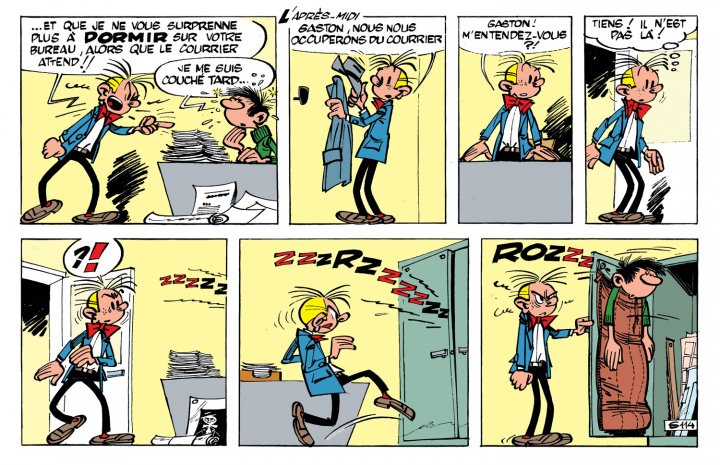
Yet we can also look into the other direction, for that we merely need to seek out André Franquin and his office boy Gaston, every company seemingly has one and therefor would bring instant joy, laughter and entertainment on a global scale, all mostly untapped ideas as American Netflix has been too localised in their searches (as well as the method of finding new stuff). Yet with Disney Plus on the horizon and other players like Stan making more and more waves, we might see a bidding war for the IP rights of these works soon enough.


Leave a comment

Filed under Media, movies

When a dream is too delusional

We all have those dreams we know will never pass into reality, they are too delusional for comfort, but they are dreams, so we go with the flow. One example is winning the €135,000,000 lottery, the other could be one including Wallis Day (main character in the DC series Krypton) to spend a weekend to remember at her place (with all the extra options). Yes, all options that are delusional and never ever a setting that could ever be true. So in all this we get to yesterday’s article in the Guardian where we (at https://www.theguardian.com/business/2019/apr/27/very-disappointing-ashford-laments-loss-of-debenhams-branch) are treated to ‘‘Very disappointing’: Ashford laments loss of Debenhams branch‘, yes it might be very disappointing, yet consider a few items. First there is the building that they are in, then consider that Ashford has a population of 62,787, so we need to look at another side of it all, or in this case the 2016 Annual report (at http://www.annualreports.com/HostedData/AnnualReportArchive/d/LSE_DEB_2016.pdf).

They had a staff count of around 28,000 supporting 182 stores in the UK and Europe as well as their domestic and international websites. Now consider their premise of Gross transaction value (52 weeks) of £2.9bn. In that regard, how does a shop in a village of 62K people add up to anything? When we look deeper and consider that Debenhams had a total of 165 stores in the UK alone and the amount of cities in the UK from 100,000 people up to 1 million added up to 96 locations, in the remaining places how did Ashford got to be one of those 69 positions? Now, we can see that in Kent, the average income is set to £29,095, which is above the UK average, still, when we do the numbers, the entire validation of having Debenhams in Ashford does not add up. Not in such a posh place, making me wonder why the building was placed there to begin with.

Now consider the additional information that the Kent Online gives us (at https://www.kentonline.co.uk/kent-business/county-news/debenhams-to-close-four-kent-stores-203461/). So, Ashford, Canterbury, Chatham and Folkestone are all shutting down, in all this, I wonder why Ashford, Canterbury and Folkestone were placed in the first place. Kent with its 1.5 million people (in the entire county) has a case for one Debenhams but not 4. The numbers do not make sense. Now we need to remember that Debenhams has been around for two centuries and as such they do not all have new places, but when I see Debenhams Ashford, I see a story that seems to think it is in a multi-millionaire district with 20,000 shoppers, whilst 2,000 active buying shoppers at best would be an achievement in Ashford, the entire article by the Guardian left me with way too many questions. The shop is clearly set out to call in the higher spender; the Dior setting dominating the floor gives that impression. Now, it is not merely about the prices, because Debenhams has always shown to have value for money and their stuff is affordable, yet that also creates the need for a much higher volume of purchases and let’s face it, Ashford is not a place where people buy clothes at a non-stop speed, the cost of living is not supporting that, and the optional coffee machine at £282.00 is not one that most people would buy, the one off perhaps, but most will resort to the luxury Russel Hobbs at £35.00. Now we get the image clearing up, you see as margins are lower, the units need to be sold at much higher frequency and there we see that Ashford never had the stage, moreover it is at least two Kent stores that could be seen as a drain on the Debenhams fortune and that took less than 2 minutes to figure out, so how the continued expansion (read: building upgrade) was seen by those in charge is beyond me.

So when I see: “For other young people, the department store had little to offer. “I just go in there to use the spray on the beauty counters,” said Faith Figaro, 17. “I think it’s expensive, to be fair.”” we see a 17 year old making the case for me and I wonder what possessed the Debenhams top to go in this direction in the first place. It gets to be even worse when the Guardian prints the pragmatic “It’s all hairdressers and coffee shops and nail bars. People won’t come here to shop – they’ll go to a bigger town like Canterbury instead“, which in itself is a truth, making me wonder what is getting into some of these delusional big brands. The entire setting of the larger players has been under fire for the longest of time and the essential need to revisit locations is becoming an essential need for all of them, as such the statement: “Conservative MP Damian Green described the news as “very disappointing”. On Twitter, he wrote: “We need to redouble efforts to strengthen the town centre.”” becomes one of worry. Even as a conservative I wonder how Damian got elected, merely as I saw the writing on the wall within three minutes, so he should have been on the ball for a much longer time, as such the Debenhams situation should have been to be expected, not ‘disappointing‘. For me the entire issue that is started by “Ashford borough council said they would work with the owners of the shopping centre to try to find new occupiers” becomes an issue soon enough. It is the duty of the owner to seek shops and to seek occupancy. When you put an expensive Rolls Royce in an old meadow, you cannot expect your return on investment, you do that by slashing rental prices and by seeking long term solutions that can afford to be long term solutions. Staging ‘elite placement’ in a place where ‘elite placement’ is not realistic is the stage where we see the Australian Westfield issue explode on several stages, places that are intent to fall over within a year, it attracts the wrong facilitator and that is where things go from bad to worse.

It is not the end, it is the Kent Online that also gives us the words from Executive chairman Terry Duddy: “Debenhams has a clear strategy and a bright future, but in order for the business to prosper, we need to restructure the group’s store portfolio and its balance sheet, which are not appropriate for today’s much changed retail environment“. The words sound nice in theory, yet from my point of view; the stage we see in the 2016 annual report contradicts the actions of having most Debenhams in Kent. And when we look at the annual report making the: Profit before tax* (52 weeks) £114.1m claim. I get to the stage thinking that their clear strategy was anything but clear.

In that version of a report we see the strategy: “To be a leading international, multi-channel brand by delivering a compelling customer proposition and increasing availability and choice through our flagship digital platform and well-invested, well-located stores around the world.” I honestly think that they got that wrong by a fair bit. You see, from my personal point of view the setting of ‘well-invested, well-located stores‘ we see the stage where it should have been ‘well-invested, and viable well-located stores‘ it is that part where viable needs to matter and in 50 of the 166 cases it was not to be and that is not something from the last year, the action should have started no later than 2015 as I see it.

It gets to be slightly entertaining when I look at their risk management in light of their e strategic and operational goals, but let’s not make too much fun of the situation, shall we? Even as there is a lot to be said on their KPI’s, the clear message of net debt reduction is important and a good thing, if that £40 million net debt reduction had not been met, the entire matter would have been critically fatal for Debenhams no later than 2018, so good steps had been made, yet larger were essential two years ago, that is as I personally see it and without the raw data my findings are open to critical debate (as my view might be wrong). Yet at page 29 we see the largest flaw. When we see: “New UK stores 12%” we see the largest mistake, in a place where there were 166 stores whilst the population did not support further growth that should have been staged for modernisation for now. I get it, some stores are too old and new stores replace the old ones, yet the 5 year option to rely on upgrades until the economy is much stronger was an essential step to make, even if some of the lucrative old shops would shut down, the long term growth in this economy is just not there. This is why I got the 2016 annual report (the 2017 would have been better, yet I could not find that puppy). Aspects of 2016 and 2017 are seen now, its impact is now direct, like a good ship you adjust course and wait for the numbers to be clear so any adjustment in 2018 would not be a valid impact until 2020 (unless it is immediate navigation) and there is where we see some of the flaws of Debenhams. Even now I noticed that internationally they are not in Germany, it might be because Hennes & Mauritz AB is too great a threat, it might be for another reason, but the one nations where the economy is still in a much better place, is the one place they do not show up. Can they honestly claim that Debenhams Bonn, Berlin and/or Munich would not make it? In the Netherlands they would have a cat fight with C&A and a few others, in Sweden there is Hennes & Mauritz AB, Åhléns and a few others, so that makes sense, France is a dimension all on itself, so no way to tell, yet Germany? If I had to bank on Debenhams Munich or Debenhams Ashford, Ashford would never have been a consideration, yet with no timeline on Ashford I have to make the blind choice and it would not be Ashford, due to no fault of anything Kent related.

It is on page 138 we get the final part. Here we see the minimum lease payments under non-cancellable operating leases. Now some have been there for a long time, it was a choice made and that is fair, yet in the entire matter we see that for up to 5 years we see £96.7 million in play and I have some serious questions on those marks, in light of certain facts seen now, I wonder which of those should never have been made, but that is merely my view on the matter and with up to 50 stores up for closure I personally reckon I might have a case on that.

LSE_DEB_2016


1 Comment

Filed under Finance, Media