Tag Archives: European Union

Rollback

That is the word of the day, I have always had that word in my vocabulary. The setting that any solution o programmed in Clipper had the setting for a rollback. This is how I grew up (growing up in the Clipper age was a little weird). You see, I had two settings. The first was the data didn’t change and as I was a ‘little’ verbose with my data creation there was the option of registering a data version, so that was the setting. We needed a rollback in several situations and that is where the setting ends. You see, today I got to see a few news lines. 

First there was Reuters (at https://www.reuters.com/business/aerospace-defense/boeing-jet-returns-us-china-victim-trumps-tariff-war-2025-04-20/) giving us ‘Boeing jet returns to US from China, a victim of Trump’s tariff war’, now that is a scrumptious hotdog to say the least. At almost $100 million, according to one source, that is a delicious snack to say the least and as we are told. China send it back. The tariff could cripple Xiamen Airlines as the tariff is 125%, and even as Reuters give us that the plane is a mere $55 million, we can say that the price difference is a little too much to be acceptable, the larger setting is that several players are trying to dam in the losses that are projected to become American losses. 

Most of us will have seen the trade agreements that China made with Mexico, so there is that. Then there is the setting we see at where Business Insider gives us the setting that ‘Some Canadian Stores Are Labeling US Imports With a T for ‘Tariffs’’ (business insider put it behind a paywall, so that’s all you get. And only three days ago I saw the headline ‘China’s Strategic Pivot from US to Canadian Oil Imports’ (at https://discoveryalert.com.au/news/chinas-pivot-canadian-oil-imports-2025/) I cannot vouch for this source, yet in that setting we are given “Data reveals Chinese refiners have slashed US crude purchases by approximately 90% between 2023 and 2025, redirecting roughly 1.2 million barrels per day (bpd) toward alternative suppliers, with Canada capturing a substantial portion of this market share.” So the first step to a change has been given and I foresaw these changes even as I never knew about the oil. So as I see it, these changes show billions upon billions in losses for America whilst we see damage to their export, their revenue making defense industry, their tourism and we can go on a little longer. Wouldn’t it have been great if America had a rollback setting for their elections? 

So as Goldman Sachs gives us “The decline in the world’s reserve asset during an episode of elevated volatility comes as investors are increasingly focused on the US’s growing debt burden and other countries are also increasing their borrowing. “Markets are dealing with a lot of competing factors right now — fairly significant drivers where it’s hard to trade all of them at once,” says William Marshall, head of US rates strategy in Goldman Sachs Research.” Really? Only now do we see “investors are increasingly focused on the US’s growing debt burden”, that’s about 4 years too late, but whatever. I saw (and reported on this danger for a few years at least). If the EU, Japan and China dump their bonds (that will be an expensive exercise) the value of the Dollar doesn’t just drop, it ends up having getting a CCC− grade (to give a mere view on the matter). At that point the imminent suicide risk will spike all over Wall Street (a clear but reliable speculation).

I reckon that the one dropping them first gets the best value for it, but after that it will be a quick fall to the luxury value of zero. But it is not just America, the bonds of the EU and Japan will face a similar risk, America is merely the highest as someone thought it was a great idea to introduce the tariff game to their economy. Global News told their Canadians ‘Avoid U.S. travel if possible, Canadian academics are being urged’ with others following in similar settings. The Detroit News gives us ‘Avoid U.S. or take burner phones, Canada executives tell staff’ and there are more sources that give us that, with the added “Arrivals of noncitizens to the United States by plane declined by nearly 900,000 people, almost 10%, in March from a year earlier, according to data from the U.S. International Trade Administration. Travelers are reacting to President Donald Trump’s trade war and to stories of harsh detentions at U.S. airports. Border figures show 4,970,360 came to the U.S. from Canada in March 2024. That number dropped to 4,105,516 travelers a year later. More visitors reportedly traveled from Canada to the U.S. in March 2022 under pandemic-related travel restrictions than they did last month.” I think that Canada is the most likely of number drops, but I reckon that it is not the only one. So as I see it, the danger is not only to Tourism, but business travel too and in that case, hotels in all the major cities in the United States will report on losses of 10% or more, so what does that mean for the value of Marriott International, who operates 9,361 hotels worldwide as of 2024. In addition there is Hilton who operates over 8,400 hotels worldwide. I have no idea how many they operate in the USA, but these are merely the two larger players, especially in the business travel setting. So how many businesses are under the hammer because of this situation? And now as Canada is growing closer to the Commonwealth and they will protect their bigger brother (Canada is 9.985 million km² and the UK a mere 243,610 km²) OK, Australia is 7.688 million km², away highly smaller brother than the United Kingdom. But that setting now gives us that these business meetings are likely to be held in the United Kingdom or Australia. Hilton and the Marriott will still get their coins, but the underlying issues will hurt America to a much larger degree. And as this escalates over the next month or so, the damage to America will increase. Additional damage as China and India rolls in as expecting ‘saviors’ to Saudi Arabia and the UAE will change global politics and global economics to a much larger degree. India will get new options to get additional Pharmaceutical products sold to Saudi Arabia and that is another slice of a billion dollars. Then we get the UK, Australia and Japan hammering on improving their slice of Optical, photo, technical, medical apparatus, as such the American slice of $1.39B will decrees a lot more. All this started with tariffs and basically this setting was staged by President Trump. I merely wonder what got into him to drive America to the edge of insanity (and bankruptcy). What a miss that politics don’t have rollbacks and I reckon that the lawmakers in America will push for a larger change of settings, because I am certain that the Republicans are desperate to see this damage undone and it is me personal believe that they will accept any other politician, even a democrat to undo the damage they are seeing right now.

A mere 21 hours ago we got (at https://jakartaglobe.id/business/indonesia-seeks-stronger-trade-ties-with-eu-australia-to-offset-potential-us-export-losses) that Indonesia Globe gives us ‘Indonesia Seeks Stronger Trade Ties with EU, Australia to Offset Potential US Export Losses’, which is fine by me as I love the Indonesian version of Bami Goreng with Saté Ajam with peanut sauce. The best dish I ever had, even now after a decade, the scent penetrates my nose, even as I haven’t had it in over a decade. So I am looking forward to stronger ties with Indonesia and I kinda miss the spices we had in Batavia (my weird sense of humor). But the stage is drawn as more countries seek replacement for America, their tariff becomes their setting for isolation and Australia will be happy to have ties with a country that has 281.2 million potential consumers. I already gave the premise to Saudi Arabia as they have access to something Indonesia desires. As such there are more players to take over the places that America is about to lose and lose more of them. Next in line are the international students who will seek safer places to be. In this Canada, the United Kingdom and Australia have good chances as they all have great places Oxford, and Cambridge might be the first you think of, but not everyone can afford these places. There is till the University College London, University of Melbourne, University of Sydney, University of New South Wales, University of Toronto, University of Manchester, University of Technology Sydney, University of Southampton. These are merely a Commonwealth grasp of those who are in the top 100 and I reckon that the losses for America start to add up now. And that was merely the Ivy League, America has more good universities and now that the international students will seek education elsewhere, the economic picture of America will deteriorate more and more. 

Wouldn’t it have been great to have some kind of political rollback in place? 
Have a great day and consider where you need to set your focus to next. 

Leave a comment

Filed under Finance, IT, Law, Media, Politics, Tourism

The loser iteration

Two days ago I wrote (at https://lawlordtobe.com/2024/08/04/the-judge-shouldnt/) with the headline ‘The judge shouldn’t’, it was part speculative and part what I see (again through my eyes it could be regarded as speculative). Today a mere 4 hours ago we get through the BBC (at https://www.bbc.com/news/articles/c0k44x6mge3o) ‘Google’s online search monopoly is illegal, US judge rules’. We are also given “Google was sued by the US Department of Justice in 2020 over its control of about 90% of the online search market.”, so lets take a look back. It started in 1995 and the ‘idea’ was completed in 1997. To turn about the setting in those days Microsoft was merely badgering their lack of knowledge and lam Netscape to get a browser dominance. Two youthful young sprouts namely Larry Page and Sergei Brin were ahead of the pack by a lot. They looked to a solution to search for text in publicly accessible documents offered by web servers, as opposed to other data. Microsoft was still trying to type words like HTTP and the clever people at Microsoft were able to type FTP. In the age of information the Google founders figured a few things out like ‘What are people trying to find’ this was against the grain for Microsoft who thought that corporations were the key and they went to ‘What are corporations willing to pay for’. The subtle difference is that Microsoft was working towards a slice of the $18,843,980,000,000 revenue that the fortune 500 represent. Google on the other hand decided to cater to its 31,000,000 employees. As such one could (oversimplified) cater to the simple fact that it would take Microsoft 9 million years to get as much data as Google. I do emphasis the oversimplification of this. I was not on the mindset of Google at first. You see I was a dedicated Yahoo user. It took 3 years until I saw that Google offered more and better result. As such in 3 years they gained a dominance. They surpassed Yahoo, Excite, Alta Vista and several other players. We can argue that it helped that Microsoft demolished Netscape. And in the decade that followed Google grew in strength and ability to cater to actual users not the CFO’s of 500 corporations. 

So when we see “It is one of several lawsuits that have been filed against the big tech companies as US antitrust authorities attempt to strengthen competition in the industry.” I believe that there is another ploy in play. The mediocrity losers (like Microsoft) want a slice of the cake they have no business being in. It isn’t just the ‘competition’ it is a reversal of technology that is in play. And in that setting the US is damaging the little benefit they have and leaving it all to China and true Chinese innovators like Huawei and Tencent. I reckon that by 2026 the mobile market will be overrun with Huawei in almost every non-americano place. They threw away the benefits when they forced Huawei to release HarmonyOS 5 years ago. 

Now we see that it is available in 77 languages and the turnover (as is) is getting stronger. Even now as EU nations are discarding the fear mongering of anti-China sentiment by American administration, and the strongest response that the EU nations give is ‘Show us evidence’, America has no answer to that other than debatable setting of ‘could’ and ‘expected’ whilst the evidence just isn’t there. And as we see an optional release this year of HarmonyOS NEXT, Android’s bough get broken on their sibling turning adult. So good luck with that.

Now we see a Judge giving us that there is a monopoly setting. I am not debating that (a lack of evidence I have), but the setting that we get from ““Google is a monopolist, and it has acted as one to maintain its monopoly,” Judge Mehta wrote in his 277-page opinion” as I see it, the maintenance of a unique field dominance is begotten by the lack of innovation by people like Microsoft who is spreading itself way too thin.  As evidence I ‘present’ Xbox, Solarwinds, CrowdStrike and the list goes on. You see ‘breaking up’ is merely a first step. They will then open the door and the abusive bully (Microsoft) will gleefully shout “Can I play here too?” With a debilitating browser called ‘Edge’. How is that progress? Don’t get me wrong if there is a decent player that can keep up with Google, even Google will applaud that. My worry is that the ideological setting of letting everyone in the sandbox play is all fine, but there is a reason that mothers do not allow toddlers in a sandbox until they reach a certain age. And bar them from playing when they get too old. The worry that I have is that this setting stops Google from evolving beyond the cookie (which is fine by the exploitative advertisers). The setting of other people’s greed who cannot evolve into newer territories. This could now allow Huawei and Tencent to gain even more innovative sides to push into markets where American stage are auto rejected. Tencent is on the cliffhanger to introduce their solution to 150,000,000 homes and they can get there by 2027. 

This will leave Microsoft in a stage where it has no options and no future. As these Fortune 500 will find ways to rise to new frontiers we will see them seeking IBM and Amazon solutions catering a larger downfall of Microsoft. In that stage there is certain a decent amount of space for Google. As they will hand a corporate solution to their ‘office’ suite Microsoft will lose more grounds. The only thing that keeps them up for some time is Excel. But the world is changing what was once a spreadsheet world now becomes an AWS environment and Google can cater there too. I do think that Googles forced push to breaking up is not a great solution, but Google has overcome harder challenges. 

This and my previous article ‘The judge shouldn’t’ gives us the premise that the Antitrust laws are possibly a little obsolete. Microsoft sees this as their ticket in and it is willing to cater to this as it hurts Apple and Google. Two parts the US desperately needs to work at optimum to stop themselves of being overrun by Chinese innovators. You see 7 years ago ByteDance introduced TikTok (not a Peter Pan crocodile). In 7 years it became a near equal of YouTube that was in play 12 years longer. Now I get that YouTube paved the was, but that is the usual tracks for New innovators, they go over the backs from those who went before. Now consider that and the fact that HarmonyOS is about to go toe to toe with Android in only 4 years. That is what I wrong. Not that we think about antitrust. I partially agree with antitrust sentiments. But we need to see that the greed driven use it to keep up, or not to lose their revenue. But that was never the concern of Google (or Apple for that matter). As I see it in the last decade the face of technology was set by Amazon (AWS), Apple (MacWares), Google (Android, G-wares) and IBM (large solutions and Quantum) they create the innovations, players like Microsoft should go under and seek revenue from the Fortune 500. They were the bees knees weren’t they? 

But as I see it, US District Judge Amit Mehta is allowed by law to hand it all over to Chinese innovators. When the EU, Commonwealth nations, Africa and Asia allow these innovator into their governments America becomes a party of one (with 330 million consumers). So consider that the other regions has over 7,500 million people. As I see it it is a hard lesson that America learns twice. Wasn’t the Google premise of 1997 not enough?

Enjoy your day and ponder what benefit was to be had from optionally breaking up Google and who were the actual beneficiaries (not the consumers clearly).

Leave a comment

Filed under Finance, IT, Law, Politics, Science

Ego versus tax dollars

Yes, that is the setting. It is not a new setting, we have seen it before and it comes with a surprise, just like the Ferrero kinder surprise.

It is a chocolate egg, but in the middle there is a toy, a surprise. And ego versus tax dollars also have a surprise for the people. Yet in this case it is a little less nice, in this case the people, the tax payers pay either way and optionally they get to pay both ends of the equation. This is seen in BBC article ‘Multi-billion EU bid to challenge Chinese influence’ (at https://www.bbc.com/news/world-europe-59473071). Here we are given “It’s regarded as part of the West’s efforts to counter Chinese influence in Africa and elsewhere. European Commission President Ursula von der Leyen will present the “Global Gateway” initiative on Wednesday. The EU is looking at how it can leverage billions of euros, drawn from member states, financial institutions and the private sector”, now consider the setting:

  • member states
  • financial institutions
  • the private sector

And here is the rub, here we see how the tax payer gets that bill twice. Or a speculated once for the duration of twice the timeline. The member states sounds nice, yet the credit cards of France, Germany, Belgium, the Netherlands, and Italy are severely overdrawn. So who will pay? Poland? Austria? Hungary? Estonia? Gimme a break please.

Then we get the second setting the ‘financial institutions’. Yet they will BORROW you the money for an interesting percentage, which means that a load with up to 15% interest is still payable by the tax payers. 

The private sector? Who has that kind of cash? I reckon that Webuild SpA (formerly Salini Impregilo SpA) will take the job, as long as they get the job with a few long term tax benefits, optionally at cost + 3% + tax benefits. And who do you think pays for it in the end? Yup you got it, the poor poor taxpayer (you). 

As such when I see “It has been criticised as a means of providing “predatory loans” in what is labelled “debt-trap diplomacy”” I am not opposing this (as I never looked at that data), yet the wording is almost exactly like the big tomato of MI6 (you say potato, I say tomato). Isn’t that a nice coincidence. Almost orchestrated. Now, I accept that it might be true, but in that same way Iran has been doing all over the Middle East and the same parties were eager to avoid shining the limelight there, and now that Huawei has a much stronger case (made in Saudi Arabia) and their 5G is 700% faster then anything the US has. The link here us that both Huawei and Saudi Arabia have a larger case for Egypt and that matters. With Neom city smack in the middle, they are likely have an operating 5G network long before the US figures out that marketed speed is not the same as real speed, but they will and they will see the cost involved. In that same light the BS approach to the arms deals with Saudi Arabia, China has a larger stage now, a stage that will cost the US well over 9 billion with a nominal maximum of $23,000,000,000 over the next 5 years, revenue handed to China and we see European Commission President Ursula von der Leyen getting ready for a presentation that is as I personally see a joke the EU cannot afford. Not with the US handing business over to China as they did over the last 12 months alone. 

So when we consider “Mrs von der Leyen said in her State of the Union speech in September: “We want investments in quality infrastructure, connecting goods, people and services around the world.”” We need to see the word ‘investments’, which is nice, but does that not imply that you have the funds? If not (which is the case) it ends up being a mere ego loan and that is not what is supposed to happen. I am not against it, as long as CORPORATIONS are properly taxed and that has been a horse no show for over two decades. I wonder what happens if Huawei and not Amazon decided to buy my 5G (and a few other matters). We then get a setting that shows that the European ego race was over before it even began, it was over when the ego driven tailored to stop the innovations because it did not give them a nice percentage, that is the larger stage we need to see and that is merely one of 4 elements stopping this ego driven presentation that is coming in hours. So even as we are given “Wednesday’s 14-page document isn’t likely to explicitly pitch itself as a rival to China’s strategy.” A setting that gives us the not explicit, it is relying on implied settings, a stage that can be revamped any given stage and there is the second rub, if you cannot go out and say what you mean, you can never mean what you say. That has been a truth for a lot longer than we had the internet. The EU relying on nudge-nudge-wink-wink settings (sorry Monty Python). When was the last time time you saw that going well? And now it involves multi billion euro plans that they cannot even afford. So in the end you the tax payer (if you are in the EU) get to pay that bill too. So hows that going against the rising prices of energy, Gas and petrol? Oh and how about the food prices, inflation of food which was 0.1% in April 2021, which is 2.3% in October 2021. Which is nothing to what I saw at the supermarket. I saw minced meat go up almost 20% in the last few months. So enjoy that extra tax bill with all the expenses you have in Europe. You elected what is there, so you get what is coming. 

Leave a comment

Filed under Finance, Politics

It’s fine that fine

I saw he news last week and it was one sentence that made me stop on the spot, but I needed some time to digest it all (and there was news from Iran to contemplate too). Facebook has been fined, the fine (the largest ever at $5,000,000,000) is not the sneer at, but for Facebook it will be business as usual soon thereafter. The amount is nothing more than an Apple building at the edge of the Mojave desert, so it seems little, but that would be the facade that we are offered. The article I initially saw (I forgot the source) stated: “paying fine to stop further investigations“, from my point of view that this would be worth a bundle, I believe that Facebook had been stupid to some degree and super clever in other ways. Let’s face it Mark Zuckerberg is on my level of data knowledge, so he is thinking several iterations ahead of all others and he needs the FTC of his back during the start-up of 5G, whoever is there first has a larger advantage to gain momentum. All my investigations into the dumb smart device shows that, all the data I see optionally coming requires unhindered acceleration and my device was meant to suppress data drag and emphasize on facilitation. Facebook needs this, Google needs this and Huawei has the advantage at present.

The new system when operational will give them (especially with Oak/OS) a 15%-24% advantage and in data terms when we consider that 5G is set to top out at 10 gigabits per second (Gbps), that difference is a lot, it is everything to enable a larger market advantage. Add to this the new devices that offer independence to SME and franchise markets, the stage would push towards smaller independent solution providers, if Google, Apple and Facebook even hesitate for one week the difference will be seen and short thereafter felt as well.

At that point every contract in the new setting will entice 3-5 others to follow as well. It is not word of mouth, it is companies watching their competitors gain advantage and that observed difference is almost exponential against mere word of mouth. And that part will also increase choices.

Yet it is not about what comes next (only partially) it is about what is now. There are two essential parts in the fine. The first is how it was a 3-2 split, with the Republicans all in favour to continue and the Democrats all eager to block. There is a polarising difference there. I am partial on the Republican side, Democrats clearly misrepresented this with the quote: “the dissent of the two Democrats on the commission because they sought stricter limits on the company” (source: NY Times). It is not about stricter limits one the company, it is the fact that the data has grown to dimensionality far beyond what governments have and it is available for purchase (to some degree). The element that we forget with the fine is what the Guardian gives us (at https://www.theguardian.com/technology/2019/jul/12/facebook-fine-ftc-privacy-violations) when we see: “Facebook will now re-examine the ways it handles user data, but the settlement will not restrict the company’s ability to share data with third parties, reports said“, it is to some degree about the ability to share data and how granular that data is set for the upcoming war that the Democrats want to wage. It has direct implications in insurance and healthcare and the Democrats have a system in mind that cannot function when all that data is available for health care scrutiny (one of many issues), yet healthcare is the most visible one. One short thought like on what drinks (alcoholic) you like and you might be seen as a higher risk and as such see your premium rise. Alcohol, tobacco and recreational pharmacy might be the most visible ones, but as the data net grows, we see a more comprehensive flag system that pushes close to 20% out of healthcare soon enough (as premiums go up and up on the risky groups) and it is not that this point is coming soon, this point has already been passed and the moment that data gets out, the ducks come home to roost on a coffin.

As the New York Times gives us the quote: “Last year, the European Union fined Google $5.1 billion for abusing its large market share in the mobile phone industry. More recently, numerous officials and lawmakers around the world have rushed to regulate Facebook” (at https://www.nytimes.com/2019/07/12/technology/facebook-ftc-fine.html), we seemingly all put it on one pile, yet that would be a massive problem and wrong too. In one side (source: the Verge) we get: “Google also made customers sign contracts forbidding them from including rival search engines on their sites alongside Google’s own. In 2009, Google allowed the inclusion of rival search engines as long as Google’s was more prominent. In 2016, around the time the EU announced its case, the company removed these terms altogether“, we can debate the correctness, but we can also accept that Google started this and took the advantage that they engineered, as in most places software cannot be patented, so it had to find another path to gain the advantage it created whilst followers re-engineered whatever Google published as soon as humanly possible. We can call it wrong (or not) but that stage is in place and it links to now and it also links to Facebook. The 5G wave is all about getting there first and at present the FTC was in a place to stop Facebook innovation and paying the fine will give larger gains to Facebook than to let investigative wave after wave continue to slow Facebook down, and when we realise that Facebook is no longer the only player on that level Facebook needed to make a tactical decision.

Still, there is a remaining issue with the Facebook data and how it becomes available and the lack of answers should remain to be a cause for concern. It comes down to the beginning when we got: “The F.T.C.’s investigation was set off by The New York Times and The Observer of London, which uncovered that the social network allowed Cambridge Analytica, a British consulting firm to the Trump campaign, to harvest personal information of its users. The firm used the data to build political profiles about individuals without the consent of Facebook users“, that was merely the tip of the iceberg and those who comprehend Facebook data know this to be true. The issue is not merely how the data is collected; it is what else becomes available and what else is collected. To see this we need to consider the added image.

At present there are some stages where larger contracts give people their advertising over different locations. Yet what happens when you have a complete mobile image on where what is shown? What happens when we see interactions of an advertising and where it actually works and how users react, that is the next stage and the data is ready and to some degree in that setting Facebook is more ready than others, that is the image that pushes us all and the innovation through handed data and as we can see Facebook people either do not care, or have no comprehension of all the data linked to their actions.

I took that data and more into another innovation and pushed it to a new stage, giving the collector even more data, more advertising options and optionally even more data opportunities on a larger scale. It is that shift that is all the difference between a 5% and a 9% market share for companies and now it is no longer local, the data allows for global exposure, so consider that exposure in New Delhi (India) could also expose those in Little Bombay (New Jersey) addressing a similar group at the same time, brand exposure that becomes global changing the entire setting for smaller enterprises at close to similar prices, driving advertisement bidding wars and pushing revenues for those in that area and that is merely the first part of the IP I created. Places like Facebook could get a much larger advantage and transform advantage into momentum pushing that advantage further and faster. It is only for the bigger puppies (Google, Facebook, Huawei) but they all want the largest juiciest bone to gnaw on and that is where the group of innovations push the difference, so in the end $5 billion is chicken feed under what is pushing towards the surface at this very moment, and they all want to nibble on that pie, they merely need to be the first in the game to gain advantage through momentum. As I see it IBM and Microsoft are already out of the game trying to facilitate the systems and the data and to be fair Microsoft Azure does have a larger advantage here, but IBM is not sitting still and we know that Facebook (to a lesser degree) and  Google have systems that work. The playing field is near level and the match is far from over, now with the Huawei push and Oak/OS they have opportunity to gain advantage and they can decide who to allow access to that new system, so even as Google seemingly had the advantage, the Trump trade war took that advantage away from them, so there is a second level war going on and whomever makes the larger deal with Huawei gets the gain, the issue is that Huawei hardware is more advanced and that is their advantage, the Trump trade war stopped innovation towards the US, so as such in a global setting now pushes the advantage to Europe, India and the Middle East. In this the US loses more than it comprehended in advance and it all depends on how they react to the change. It is the error in judgement on 4G and 5G is where the American disadvantage lies. In 4G is was ‘Wherever I am‘, now with 5G it becomes ‘Whenever I want it‘ and for that step the most advanced provider wins , it is not Ericsson, not Nokia, not Telstra, and not Sprint. It is Huawei that can facilitate towards ‘Whenever I want it‘ to a much larger degree at present and that wins the race, but the others are not done yet and there the Facebook data becomes a power player, an optional sledgehammer for those who know how to bash a wall and that is happening now, so when we see: “Facebook and other large tech companies are under an increasingly harsh spotlight in Washington, D.C., including at a “social media summit” at the White House on Thursday in which President Trump repeatedly bashed Silicon Valley as being unfair to conservatives. Facebook wasn’t invited to attend, nor were other tech companies. They have previously said they police their platforms without regard to political ideology“, we see a setting that we accept to some degree, yet those who are all about that “Social Media Summit” seemingly do not comprehend the application of data to the degree they need to and as such they as shooting themselves as well as their economic options in the foot, which is good news for Huawei, not that much for the other players.

I reckon that I will be proven correct within the next 12 months. When the dust settles we will see the first clear winners, I am certain that Tokyo 2020 Summer Olympics shows me to be correct and it will show the first larger winner, at present in this culture of short sighted decisions Google and Huawei will have the largest advantage, but 2 other players are not out of this race yet, so plenty can happen before we see the Olympic flame light the fires and start the Tokyo Summer Olympics.


Leave a comment

Filed under Finance, IT, Media, Politics, Science

War lines and Battle lines

We all know them, we all personally have them. Some are founded on the realism of professional life, In thee we see the person who works well with others, there is one that is off. You see, that person also wants the senior position you have been working towards and there are two paths trodden at the same time. Your opponent is working as hard as possible to be better and in that same stretch equally is working to make sure that you look worse. The acts are trivial, a little block here, a little delay there and it seems all friendly, it seems corporate, yet you know better, you know that this person is after your future goal. It is corporate politics. You both work towards pleasing the larger shark, you both work to get the amenities to gain favour and play whomever you can to end up being first. It is the corporate environment and we have accepted that for close to a quarter of a century, if not for longer.

It is seen everywhere and this same setting is now in a stage for the conservatives and Brexit as well. Here we see a growing list, a list that currently includes Suella Braverman, Shailesh Vara, Esther McVey, Dominic Raab, Jo Johnson (Boris Johnson cleverer brother), Guto Bebb and now Sam Gyimah. We could go on and point out on how the connections are with places like Goldman Sachs, but that is merely stupidity to the max, Brexit is much larger than that.

And the Guardian (at https://www.theguardian.com/politics/2018/nov/30/sam-gyimah-resigns-over-theresa-mays-brexit-deal) gives us oppositional goods we should not ignore. When we see the quote: “In these protracted negotiations, our interests will be repeatedly and permanently hammered by the EU27 for many years to come. Britain will end up worse off, transformed from rule makers into rule takers“. We see a partial and an absolute truth, we could argue that they are both partial, yet that is actually influenced by the economic powers like Goldman Sachs.

Britain will end up worse off‘, I never denied this. The issue is not the temporary ‘worse off’ part, because it is merely a temporary stage, the actual issue is the unaccountable acts by the ECB and people like Mario Draghi. Three trillion all pumped into a stage that was never going to work. That evidence has been clearly seen, yet the overspending goes on and on and on. Being a member of a group where simple book keeping and budgeting is lost again and again due to a two party political game (national party members versus EU party members) is costing the nations dearly and for the most they are all playing possum, it’s not a good thing believe me. The additional issue that all places (like Bloomberg) where we see: ‘Draghi Says ECB Still Expects Net Bond Buying to End in December‘, yet the operative word here is ‘Expects‘.

It is the larger problem in this. Even as the last month has set in we are not given that December is the end date, gives rise to the setting that they want to continue this bad plan. That and a few other parts give rise to walking away. I would personally add that unless nations get the right to targeted killing the heads of the ECB, both present and past (Mario Draghi is about to leave), we should not give any confirmation of talks in any direction. The taxpayers have been given the bills of the high, rich and mighty for too long. When this game collapses (and it will) Europe faces a civil war level of unrest and so they should. They key points in Bloomberg: “The end of new bond buying won’t mean the end of stimulus, Draghi said, in light of the reinvestment of maturing assets, guidance on interest rates and the 2.6 trillion euros ($3 trillion) of securities purchased by the ECB so far. Chief economist Peter Praet made the same point earlier on Monday” gives support to my view (as well as some consideration that we might have to resort to targeted killing at some point).

our interests will be repeatedly and permanently hammered by the EU27 for many years to come‘ the second part is the consequence of banks losing power and momentum, because 68 million consumers walking away will hit EVERY book there is and the banks and power players will become vindictive little children as their need and desire for Sex, Drugs and Rock & Roll can no longer be met. Salespeople in a growing economy walk around like the (Pea)cocks that they are, in a recession and shrinking economy the become blaming little bitches, just like every other corporation. I have seen it too often. Making deals they cannot hold and when the facts are laid out they go into the blame game throwing it on the others ability not to be able to communicate. Cash is king, bonus is sacred and the rest can get fucked. That is the world we created and the UK will get hit by it, yet there is also another part. You see, the quiet number two elements in that venue will see it as an opportunity to rise and people like Sam Gyimah know this, he was at Goldman Sachs long enough. For almost five years the UK and Scotland did not consider the power place they had to assist India to become much larger European players and as such get some of that cream. But some were too busy facilitating to Pfizer and not considering the position nearly every NHS in Europe has and the ability for India to become part of the solution here. I saw this opportunity as early as 2013, but the others were too busy looking into the mirror, considering which DJI logo would look better in their photo frame of a long term sustainable life of wealth. During those 5 years Wall Street has all been about setting the stage to build fortresses to protect IP to their wealth. It is the stage of Jonas Salk versus Pharmasset & Gilead Sciences. Jonas Silk walked away from a $34 trillion payout and saved the American people, as well as many millions all over the world. His action caused the eradication of polio, the other two have the solution to Hepetitis C and is set in value to well over $11 trillion, and these patents are still highly protected for another two decades. America only fights protectionism when it suits them, interesting, not?

There is a third part, a part we all (including me) seemingly ignored. The distinguishing of ‘rule makers to rule takers‘ is a path we need to consider, even as the EU gravy train is in full motion, we see that rule makers are only there in the stage of presentation, to keep asleep the masses. If that was not the case there would not have been an Italian Budget issue, but there is ad even as we see: “Rome could ultimately face a fine of up to 0.5 percent of economic output — or some €9 billion“, should we see it for what it is, a joke? The Italians will add the fine to the debt; they will do whatever they please and in that, Europeans are in a Europe where the rich and the ignoranusses do whatever they please. How is being part of that anything but a joke?

  • The unaccountable actions of the ECB
  • The unmanaged ability to keep budget within the EU
  • The lack of transparency in EU politicians (travel expenses anyone?)
  • The lack of long term thinking
  • The lack to innovate parts that need overhaul

The UK has failings there too, yet by themselves they can make amends over time, in this European Union there is no chance of that happening. So, as the UK pushes Brexit, there will be impact, there will be cost (it was never denied), yet as the UK improves its own standing, whilst the EU keeps on going spending trillion after trillion on ‘stimulus after stimulus‘, it is at that point where the flaccid economies (France and Italy) will impact the others and the ‘rise’ and bettered economies all over Europe to the smallest extend, will not undo the overspending to the much larger extend, we will see presented bettering, followed by managed bad news in that same fiscal year. The entire issue with Mario Draghi and the G30 bankers group is merely one visible example of many. If you think that there is no impact, guess again. How long until we learn what happened in the G20, only after it passed the consent of the G30? The Europeans are about to be diminished to empowered consumers versus disregarded collateral. Some went as far as the early 80’s to make statements in that direction, yet the 90’s was too enabling, only now, only as we see that the entire large corporation setting can no longer be maintained, now we see a much larger change and for all those players it is important to sink Brexit. A true independent monarchy is a danger, because whatever step forward the monarchy makes, the other path will have to take two steps back, and you tell me, when was the last time that banks were willing to do that? For that to succeed all European nations will have to be ‘reduced’ to rule takers, and who elected them exactly?

And right there, we see the final part that opposes the quote of Sam Gyimah. With: “It has become increasingly clear to me that the proposed deal is not in the British national interest, and that to vote for this deal is to set ourselves up for failure. We will be losing, not taking control of our national destiny“, you see, in this EU, the British National Interest is merely a presented one, a PowerPoint page in a stage where the EU parliamentarians and ECB dictate the stage without transparency. That part is seen in two headlines in the last month alone. The first is Bloomberg, giving us: ‘Draghi Defies EU Criticism in Attending Group of 30 Meeting‘, the second one is the Financial Times giving us: ‘EU bank stress tests should be redesigned, says watchdog head‘. The second one (at https://www.ft.com/content/868f2dfc-e842-11e8-8a85-04b8afea6ea3), also gives us: “The comments by Andrea Enria, who is set to become the eurozone’s top banking regulator, were made two weeks after the latest stress test results, which saw British lenders among the worst performers while Italian banks largely sailed through“. As we were treated to the Italian issues over the last month, with Reuters taking the Cheesecake with “Italy’s third-largest bank Banco BPM will discuss an up to 8.6 billion euro bad loan sale at a board meeting on Thursday, picking one or two bidders to continue talks with, three sources familiar with the matter said“, I would really like it if someone would have that conversation of applied logic with Andrea Enria in the near future, especially in light of certain facts openly available. When performance is weighted on the absence of bad loans, I reckon that we get numbers that make no sense at all, optionally making the European economy 0.2% better than it actually is. It could push Italy, France and optionally Spain form a positive to a negative economy, when two of the large four are negative, how much trouble is the EU actually in?

I have never trusted any group that demanded continued membership at any cost. If the EU was so great, people would not want to walk away and now we have two members one who is trying to leave and the second one (Italy) is seriously considering walking away. In all this the third player (France) is in a stage where a positive economy is not likely to come soon. Strike after strike is making that an almost dead certainty. I wonder what the numbers would have been if we had removed Greece (not withdrawing support from them though), as they had less adherence and more options to seek solutions, things might actually be less dire for the EU. The fact that once in never out is the standard gave (in my personal opinion) rise to politicians doing whatever they pleased no matter who got hit in the process.

There is one upside, those who have been placing battle lines are now out in the open, so we see a stage where we start identifying the opponents, the question becomes will there be actions, long winded speeches, or denial? Each has a separate disadvantage and none seemingly have advantages, that is also the impact of a ‘once in never out state called European Union’, for all the benefits are merely given in a memo, with bullet points and is redundant the moment that the next memo is released.

Did anyone realise that?


Leave a comment

Filed under Finance, Politics

Milestones

We all hope to make certain milestones, some through fantasy, some through luck and some through anticipation. Your first threesome, the moment you joined the mile high club and for governments they have their own achievements, for example when they join the 100% debt club. So when we realise that Japan has well over 200% of GDP in debt, the US has passed the 100% marker and it joins those they looked down on for the longest of times. Italy, Iceland, Granada, Eritrea, Greece, Jamaica and Lebanon, all members of that 100% debt club, so when we see the Arabian Business (at http://www.arabianbusiness.com/politics-economics/395741-100-debt-club-set-to-get-new-member-from-oil-rich-gulf), treat us to the facts that Bahrain will soon join Libya and the Sudan as their debt exceeds their 100% GDP. We see more and more messages at present and even the IMF is setting a different atmosphere. We see part of that in equities.com. There we see “IMF (Page 10): Against a backdrop of mounting vulnerabilities, risky asset valuations appear overstretched, albeit to varying degrees across markets, ranging from global equities and credit markets, including leveraged loans, to rapidly expanding crypto assets.
MY TRANSLATION: In the last two major bubbles, the problems were mostly contained to dot-com stocks and housing. That is 100% not the case now. Almost every single asset on the planet – from stocks to bonds to loans and more – is wildly overpriced. There is zero room for error with prices at such dizzying heights
“. This is merely one setting; the field is expanding on a larger field and in all this, the nations that are passing the debt bar. France is set at 99%, so if they cannot contain the debt growth they will pass it this following financial year, leaving only Germany as one of the four large economies that is in a containable situation and there is where we get a partial ‘I told you so!‘ You see I wrote on part of this 5 years ago. (at https://lawlordtobe.com/2013/05/15/a-noun-of-non-profit/), I made a reference in regards to Brexit, but the setting of it all was a lot larger than merely Brexit. So as you get to contemplate “Consider a large (really large) barge, that barge was kept in place by 4 strong anchors. UK, France, Germany and Italy. Yes, we to do know that most are in shabby state, yet, overall these nations are large, stable and democratic (that matters). They keep the Barge EU afloat in a stable place on the whimsy stormy sea called economy. If the UK walks away, then we have a new situation. None of the other nations have the size and strength of the anchor required and the EU now becomes a less stable place where the barge shifts. This will have consequences, but at present, the actual damage cannot be easily foreseen. Any claim that there is no consequence and they predict no issues, remember this moment! The Barge (as is), will lose stability and the smaller members thinking they are on a big boat are now thrown left to right then left again as the storm rages on. The smaller nations will get damaged and in addition, the weaker ones (Cyprus and Greece) could still collapse, especially if the UK takes a non EU gander“, this was predominantly regarding Brexit. Yet the implications are larger as I stated. The UK is taking on Brexit and now we see that the German anchor it the only anchor giving some stability, the UK is taken away, Italy has lost its footing as it surpassed the 100% debt and now France is pushing that boundary as well. All because it was easier to play the popular fool than taking a hard stance on their debts, France is not alone, Italy and the UK are all there, the smaller ones have no options to give strength to the large 4 and as the UK figured out that going it alone is much better for the economy, we see a dangerous setting.

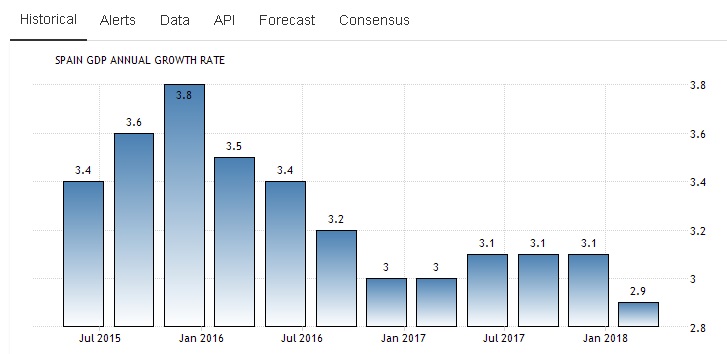
Even now, when we merely consider Spain in all this (not the smallest economy), we see (at https://www.southeusummit.com/europe/spain/spanish-economy-returns-grade/) that Standard & Poor’s is still playing (what I personally see) as ‘their little game’. Perhaps you remember ‘S&P reaches $1.5 billion deal with U.S., states over crisis-era ratings‘ (at https://www.reuters.com/article/us-s-p-settlement-idUSKBN0L71C120150203) the one quote (one of many) needs to be considered “S&P parent McGraw Hill Financial Inc MHFI.N said it will pay $687.5 million to the U.S. Department of Justice, and $687.5 million to 19 states and the District of Columbia, which had filed similar lawsuits over the ratings“. So when I see “S&P notes that Spain’s overall economic and budgetary performance has not been hampered by political tensions in Catalonia, as many had feared. The country’s GDP increased by 3.1% in 2017 and last week the Bank of Spain raised its economic forecast for this year to 2.7%, up from a December forecast of 2.4%“, you see, the numbers are not really in question, yet when we see the image below (source: Trading Economics).

When we realise that none of the EU nations has a grasp on their debts, in addition, the GDP for Spain went down whilst it is still below the numbers of 2016 and before, there is actually no reason to see the credit rating for Spain go up. I am personally speculating that the EU will be so much more hardship when France hits the 100% debt marker. It matters, because this will soon become the academic exercise that the question: ‘What is the difference between cooking the books and creating a false positive wave through inflated credit scores?‘ I actually do not have the answer here, but I guarantee you that the quality of life in Europe is not moving forward any day soon, not until some issues are seriously reconsidered. In addition, the US-China trade war isn’t helping anyone, not even the Europeans so that will also become a factor of debate soon enough. It partially relates to “We have revised upwards our GDP forecasts, with an intense rate of employment creation and an economic model based on the external competitiveness of our companies. With this scenario, we will achieve our objective for 20 million employed people by 2020“, the issue is that it is misrepresentation, you cannot rely on the unemployment figures and then state we will have 20 million employed, because on a population of 46 million, he might be implying that the unemployment numbers will skyrocket from 17.4% in 2017 to 56%, that would be crazy, yet that is what we are told, is it not? The best lies (read: miscommunications) are done through statistics, so that the feather matches the bird one would say. Still, back to my speculation, I believe that Spain is not the only nation in this setting; I think that some numbers in pretty much every EU nation are beefed, weighted and set to make Europe (or basically themselves in the European setting) look much better, so when the UK leaves they will not look as weak and feeble as they have actually become. It is a setting that is way too dangerous. There is no way that Mario Draghi is not part of this, so when we look at the Financial Times of last week we see ‘Mario Draghi acknowledges ‘moderation’ in Eurozone growth‘ (at https://www.ft.com/content/3e20b49e-4939-11e8-8ee8-cae73aab7ccb). So with “Analysts said that Mr Draghi’s guarded language suggested that the ECB may wait until July — a month later than previously expected — to provide the markets with updated “forward guidance” on its plans to phase out the crisis-era stimulus“. I am a little less optimistic in regards to the quotes, and when we see ““Better safe than sorry was the motto of the day,” said Dirk Schumacher, economist at Natixis“. I personally tend to see that as:

Better safe than sorry
It allows for another day without worry
As we pile the worries and woes
To a stack we can blame on crows
Those at the London Tower are best
Because when they leave the EU we can make them the jest
And when our barge is no longer secure
We move to Wall Street where we can endure

You might think that I am merely making light of all this. The issue is that people in Europe seem to ignore that over €2,000,000,000,000 was printed without the validation of treasuries or consent of the people whose funds got devaluated even further. Do you think that printing money has no cost? It is money that the EU never had, so why did you think it came without consequence?

This partially (and I mean partially) is seen in different ways when we look at an article from Reuters merely two weeks earlier (at https://uk.reuters.com/article/uk-ecb-policy-draghi/stock-volatility-no-big-factor-for-ecb-so-far-draghi-idUKKBN1HG1VR) ‘Stock volatility no big factor for ECB so far – Draghi‘, now I agree that volatility will come and go, so the ‘so far’ part is perfectly fine. When we see ““While we remain confident that inflation will converge towards our aim over the medium term, there are still uncertainties about the degree of slack in the economy,” Draghi said in the ECB’s annual report“, now I can agree with that. There will always be a certain amount of uncertainty, that is all good, no issues there, but it is set on a certain premise. When we see that Spain (the only visible one) suddenly in opposition of what I see as real has its credit score increased and as such we see the start of an optional bubble, when others do the same we see the forecast on unreal values, so we see the bubble is not set to the reality of the actuality, at that point, when a lot more start realising that some numbers do not make sense, the uncertainty grows and the closer the UK is to leaving the stronger that uncertainty becomes. At that point we see a run and a total collapse, when that happens, when the people realise that pensions before 78 is no longer optional, do you think that the people will remain calm? When they realise the impact of €2 trillion printed cash is impacting the 26 nations, how much value decline will they face? When that happens, how will people react in all this? Now we get to two elements, one is the mention in the Financial Times where we see: “But the weak economic data for the first quarter have triggered increasing speculation that the first interest rate rise will be delayed until later in 2019. A smaller number of analysts are expecting the bank to continue QE into the new year“, the second is that the entire stimulus was to set the economy right, which did not happen, now set that against inflated credit scores, inflated economies and the downturn that follows, that will happen, it can no longer be contained, merely delayed to some extent. When it does hit Europe would not have a penny left to balance against and it will leave the bulk of Europe destitute. There would be no defence against the next downturn and that is when disaster will truly strike. So as the story is pushing towards ‘protectionism’ and ‘patent values’, we should also consider that impact. Now, as a University graduated Master on Intellectual Property rights, I do comprehend some of the issues, yet I am not a patent attorney, so there are parts that I will ignore or not look at. Consider that a national economy is now more and more dependent on the national patents and the represented value that they hold. Now we get European Patents, the Unified Patent Court (UPC) allows for a simpler way to get it all registered and to some extent enforced. So it is a good thing overall, there was never too much fuss about that side, yet the one strong economy (Germany) is now setting the stage to oppose the UPC, we see this (at http://www.ippropatents.com/ippropatentsnews/europenewsarticle.php?article_id=5725), where we also see “Alternative für Deutschland (AFD) has called for the repeal of the convention on a Unified Patent Court (UPC). AFD “rejects the EU patent law reform”, according to the German Bundestag, which announced the motion on 7 March“, I believe that overall the UPC is a good thing, but there will always be small interests that are not perfect, no EU setting is 100% positive, yet overall, to get one filing for all EU nations, in light that even the UK agreed (and ratified) is a good thing. So when we see “It was based on three grounds, mainly how the UPC Agreement violates EU law, the majority requirements of basic law, and does not comply with the rule of law principle related to judicial impartiality. The complaint was scheduled to be heard in 2018 by the second Senate, appearing as the 11th item on its agenda. In Germany’s 2017 federal election, the AFD won 12.6 percent of the vote and received 94 seats, the first time it had won seats in the Bundestag“, there is an academic setting, yet with 12.6 of the council in hands of the AFD, a very Brexiting minded party, or is that Berlout or Deutchleave, we need to realise that the patent issue is a lot more biting in Germany and that cannot be ignored, as they give rise to uncertainties. So when we get back to the uncertainty there, as well as other uncertainties, and whilst we saw Mario Draghi accept that uncertainty results in stagnation, how much more stagnations are required for the next downturn, even a short term one, whilst the economic reserves have been already been drained.

Now we have a much larger setting, the EU was never about everyone agreeing on everything and the economic setting that requires that to happen at present is also making the dangers of waves that sinks the barge called EU. Now, that seems like an exaggeration, but when you realise that the German anchor is the only one giving stability, you can see the dangers the EU faces and more important, the dangers of no reserves and an utter lack to keep proper budgets in place, a setting now in more danger for the reasons that I gave supported by the economic views of many others. I believe some are downplaying the impact, yet when we realise that EVERY European Union government is downplaying the economic impact (as every nation always wants to look as good as possible, which is a PowerPoint setting of the human ago) we get a much more dangerous setting. We accept that the smaller nations have a negligible impact on the whole, but on a ship that can only remain truly stable with four anchors, losing three is a much bigger disaster than anyone realises, and that downplay will hurt all the players that are part of the EU, so when the downturn starts, we will see kneejerk movements from all the nations, all the big players and we can only speculate the fear mongering speculations that the IMF will treat the European audience to. I have no idea what form it will take, but when it happens I will take a deeper look. In a setting where every negative economic milestone could lay waste to whatever reserves its citizens wrongfully thought they had in the first place.


2 Comments

Filed under Finance, Media, Politics, Science

Patsy Ross and the curse of greed

Yes, we can do all kinds of things in Davos, Switzerland. We can enjoy cheese; we can enjoy the white slopes of Davos and not to mention learn about greed in the World Economic Forum. One article to start with Fortune, who gives us ‘Wilbur Ross Tells Davos: U.S. Is Done ‘Being a Patsy’ on Trade‘ (at http://fortune.com/2018/01/24/davos-2018-trump-wilbur-ross-trade-war-tariff/). The article brings up a few things and has a great ending (from a comedy point of view). With: “Ross also issued a warning against misinterpreting the Trump administration’s hardline approach to trade, in what could foretell what Trump himself will communicate to the Davos crowd on Friday. “We don’t intend to abrogate leadership,” Ross said. “Leadership is different from being a sucker and being a patsy.”“, you see if that was actually true than you would have had fairness in mind with the Trans Pacific Partnership. That document is a joke giving all the power to business and leave governments running for the hills as they get sued for diminished profits, in addition the TPP would not have given additional powers to patents leaving the option of generic medication in the basement. That cursed piece of parchment should never have been allowed to be completed to the degree it was, in secret and without proper open consultation. Now, we agree and accept that this was basically before the Trump administration and they rightfully opposed it, yet the dangers that the people of 12 nations are exposed to and exploited by is just too large. Consider the quote “Critics on the left also said the TPP would pave the way for companies to sue governments that change policy on, say, health and education to favour state-provided services“, since when is any corporation allowed to endanger the health of people by suing for damages? How greedy and stupid does a government need to get by endangering their citizens to such a setting? The full text (at https://www.mfat.govt.nz/en/about-us/who-we-are/treaties/trans-pacific-partnership-agreement-tpp/text-of-the-trans-pacific-partnership), also gives other dangers. Part of the deal was that, large pharmaceutical corporations (most of them American) want to extend the life of their patents, arguing that having spent billions to bring their research to fruition they should be entitled to a just reward so they can invest the profits into developing new medicines, the issue is that that timeframe had been given and they merely want to double that profit as much as possible. Yet in light of an aging population the effect is that generic medication becomes a long term inability driving cost up for the retired population by a lot, in some cases well over 100% more. So as we read that “Time Inc. chief content officer Alan Murray, agreed that pacts brokered decades ago “need a facelift,”“, the people are not given a fair shake in all this, it is all about the large corporations, whilst their tax accountability is off the table, making the forum a very imbalanced exercise. So as we saw the Patsy mention of Wilbur Ross, we are treated to no approach to keep the ‘jokers’ of Wall Street in check, there the political wings all fall silent and that is where the kneejerk dangers are. The law has failed the people, the Wall Street gains are beyond normal whilst those getting the cash seem to remains non-taxable, or taxable to merely the smallest possible degree. In this The Financial Times has an additional setting (at https://www.ft.com/content/cb18f700-011b-11e8-9650-9c0ad2d7c5b5). The emphasis on TTIP over TTP, as well as In this we see that he “repeated a willingness to revive negotiations on trade with the European Union“, yet left the United Kingdom unmentioned, which I see is merely a shot across the bow. In this Davos has been making jabs in that direction for 2 days now. In a place where every word and specific mentions are essential, it comes with clear setting on poses, stances and hand gestures, we see the total disregard and consideration regarding Brexit, or Brexit mentions in the same way that toilet paper advertises ‘softness’.

Finally, there is a continuation from yesterday’s blog as we see (at https://www.theguardian.com/business/live/2018/jan/24/davos-2018-merkel-macron-mnuchin-inequality-slavery-wef-day-2-live), the mention “Macron hails French recovery“, which sounds nice, but there is no evidence on that, only overly optimistic views for 2018. So as France still had 9.8% unemployment in July 2017, that against 4.2% in the UK and 3.6% in Germany, France is a long way away from hailing ‘recovery’. In addition, it was the view of Natixis Research that was used by Reuters to give us: “With growing optimism on the health of the Euro zone economy and its equity markets, it’s easy to forget that GDP growth in some countries such as France is somewhat below what one would expect at this stage in the cycle, with forecasts of under 2 percent for 2017 and 2018. According to Natixis’ research, structural unemployment and the rise in numbers of young people with no qualifications are a drag on the Gallic economy and will keep holding it back. “When the structural unemployment rate is as high as in France currently (more than 9%), recruitment difficulties will very prematurely stop growth,” Patrick Artus, who heads research at the French bank“, as such he uses a more academic stance, but our views partially align, France is not out of the woods yet and the Draghi Stimulus will still hit France as well because that money needs to come from somewhere in the end and France stands well over minus 2 trillion Euro. That is the part all the players are ignoring whilst the paths are made for large corporations, whilst the need to dam the flow through proper corporate taxation. None of that is properly in place in Europe (and the UK needs to fix a few things too). And as the people get to hear from Former UK Prime Minister Tony Blair on how Brexit is a mistake, the first part of my prediction comes out. I only need to see one of the five as mentioned last week to make a similar remark to make the prediction I made over a week ago come true. Yet in all this there is also a benefit to get soon enough. You see as the US is now hitting others with steep tariff increases, he is directly giving the danger that all the others (probably with the exception of Japan), will hit back by doing the same to video games, when that happens America will get a massive hit to that $130 billion market which is predominantly American, in this the tariffs would equally hit the digital sold titles. In light of the numbers, The US is making a dangerous move that could hit them harder than they bargained for.

The fact that Digital game revenue surpassed $10 billion in December 2017 alone gives rise to the awkwardly bad decision that the US set itself up for. We will see if the last day of Davos gives us a few more pointers on how large corporations will see more opportunities come your way that is if we can believe Breitbart. That is how we got the news from the Washington Post with ‘Breitbart called Davos a collective of ‘leftist elites’ and ‘corporate cronies.’ Then Trump said he was going’, the article is not really giving us anything besides the views that Breitbart has and therefore not really informative, but they seem to touch on the part that I found interesting, is Davos about upbeat presentations, or is it the one informal place where certain power players can align their presentations because there will be large shifts in 2018, France seems to be starting the events that will hit the people in Europe, in this Reuters also reported on Italy’s view with: “Italian Prime Minister Paolo Gentiloni sent a message to US President Donald Trump on Wednesday (Jan 24) that leaders can defend their countries’ interests but must respect existing international agreements”, which is a truth, yet as several sides are hitting the European Community, it is a view that raises other questions on current international agreements .

In the end, Fortune dot come gives us two additional parts. The love of blockchain and the need for smart data will be driving elements over the next few years. None of that was a real surprise, but the amount of push towards blockchain was a larger surprise that I thought it would be. Forbes (at https://www.forbes.com/sites/dantedisparte/2018/01/28/one-thing-is-clear-from-davos-blockchain-is-out-of-beta), the power is seen in “While Blockchain and digital assets were widely featured on the main stage at Davos, perhaps the most insightful conversations were taking place in standing room only events hosted by groups like the Global Blockchain Business Council, whose CEO, Jamie Smith, and chairman, Tomicah Tillemann, have emerged as global emissaries helping Blockchain go mainstream. Indeed, Jamie Smith has made it her personal mission to be the explainer-in-chief of this powerful technology so that more of the world can grasp its potential”. I am still not convinced! You see, the Blockchain is clever and it is one that has great potential, yet the push of a solution that is unregulated and in addition to that it is an option for others to skate around the laws, because the use of blockchain will raise legislation to another level. This was partially discussed in the Business Insider on October 20th (at http://www.businessinsider.com/blockchain-cryptocurrency-regulations-us-global-2017-10). With: “Blockchain is the technology of choice for many start-ups. As per research by Outlier Ventures Research Team in May to June of 2016, 200 new start-ups were added in six weeks. Businesses and start-ups popped up around the virtual technology and sprouted with lightning speed. While many countries are supporting the development of the digital currencies, thus encouraging new ways of transacting and new businesses to bud, there are some that have boycotted the new technology, deeming it as an illegal negative disruption that brings financial instability and global economic unrest”. There is no denying the view that Davos is spreading, yet the push (partially implied in the Business Insider) to get Blockchain approved and mainstream by 2025 is a larger issue than some realise. The banking industry that took close to two decades to accept ATM’s to the degree it did in the end is now setting a new digital path in less than 10. That worries me, not because of the digital leap forward, but because of WHY they are doing it and I feel certain that we will see more and more revelations in the next 2 years.

It is my personal feeling that it is a greed driven path and that never spells any good for the people at large around, because they end up paying for it all, one way or another.


Leave a comment

Filed under Finance, IT, Law, Media, Politics, Science

Want to bet on that?

The Guardian released a story last night, it released something a lot more important than you and I initially considered. You see, it intersects with articles I wrote in 2014, yet until today, and as we recently saw the issues that the Bank of England reported on, I now see a part I never considered, because, unless you are a banker it would not make sense. I admit that from the mere consumer point of view it seems like dodgy, even counterproductive to good business. So, I did not consider it, I did not inform you and for that I apologise. The writer of this story did not inform you either, but it was not the focus of her story so Mattha needs not apologise at all. Yet what is happening is a lot more important than you and I think and if I grasp back at what I found in 2014, there is every indication that GCHQ is actually aware of the situation, yet they decided to do nothing, endangering the sanity and social security of thousands of Britons, so should they apologise? Should Robert Hannigan, director of GCHQ apologise? I believe so, he should also get grilled in both houses (Lords and Commons), but that is not for me to decide (life would be so much fun if it was).

So as we are set in this path, let me explain what happened as per last night. Mattha gave us (at https://www.theguardian.com/society/2017/aug/31/gambling-industry-third-party-companies-online-casinos) the issue ‘how gambling industry targets poor people and ex-gamblers‘ the start is already an explosion of question by themselves. With: “The gambling industry is using third-party companies to harvest people’s data, helping bookmakers and online casinos target people on low incomes and those who have stopped gambling, the Guardian can reveal” we need to ask questions, but let me continue and give you a few more parts on these goods. the next items are “The revelations will add to calls for tighter regulation of the gambling industry more action to address problem gambling after the news on Thursday that online betting firm 888 had been penalised a record £7.8m because more than 7,000 people who had voluntarily banned themselves from gambling were still able to access their accounts“, as well as “The data is often gathered from raffle sites that offer cash prizes and gifts in weekly giveaways, he said. To apply for the prize draws, users must usually provide their name, date of birth, email and address. He claimed raffle companies would then sell the data, something customers have sometimes unwittingly consented to in lengthy terms and conditions agreements. One such site states: “The following sectors [including gambling] are the industry types you can expect to receive products, information, services or special offers from.”“. With these three quotes we have the first part of the equation filled. The article gives a lot more, but for now, here, that is what we need. So we see that people sign up for things they do not understand (we all do that), and for the most the initial thought was harmless enough. I have signed up for free premiere movie tickets, some of us for fashion items or even something as innocuous as a free bottle of perfume or after shave. It seems so harmless and when it comes to products it usually tends to be. Yet when it comes to free trips to certain destinations, for some of us, red flags go up, but at that point it is usually too late, we have already given out our details.

Now, we go back to January 2014. In my blog ‘Diary for a wimpy President‘ (at https://lawlordtobe.com/2014/01/18/diary-for-a-wimpy-president/) I set the stage that includes GCHQ. The setting was theft of IP on a massive scale, yet it was on equal terms the issue we see more common, the theft of personal data. The questions I posed were:

  • Have you identified your organisation’s key information assets and the impact it would have on your organisation if they were compromised or your online services were disrupted? [Alternative: what data is bankable?]
  • Have you clearly identified the key threats to your organisation’s information assets and set an appetite for the associated risks? [Alternative: what data is accessible?]
  • Are you confident that your organisation’s most important information is being properly managed and is safe from cyber threats? [Alternative: the value management of data you think you own]

it came with the footnote: “The alternative are not just views I opt for, consider that the data collection field goes into open commercial hands as it could be presented by March 31st, what are your options to purchase certain buckets of data?

We are now on par in the two sides, my blog three years ago and the new iteration that the Guardian shows. I admit, the Guardian shows a side I never considered before last night. You see, with the quotes we saw mentioned by me, we need to add the third side to what is not a pyramid, but optionally the specific view on a cube, or even more disturbing a buried dipyramid. Now, we cannot expect people to realise that this is happening, but GCHQ knew, there is no way it did not know, and missing that is a career breaker plain and simple. You see, to give you that part, we need to add the following items. The first was seen on August 21st with ‘UK credit and debit card spending ​growing​ at fastest rate since 2008‘. We need to keep a check on the quote “The number of card transactions increased by 12.3% over the year to the end of June, according to the banking trade body UK Finance, coming amid a boom in consumer debt that has been raising alarm bells at the Bank of England. The pace of growth in card payments was 10.6% in the 12 months to the end of December“, the second quote comes from two days ago in the Guardian. Here in the article ‘Credit card lenders ‘targeting people struggling with debt’‘ we see the two parts “Citizens Advice finds almost one in five people struggling with debts have had their card limit raised without request” as well as “Unsecured lending is returning to levels unseen since the 2008 financial crisis, raising alarm bells at the Bank of England that consumers may struggle to repay loans in another economic downturn, thus putting financial stability at risk“. I believed this to be a bad business practise, yet until last night I did not give it the merit it should have had. You see commercial bankers are for the most without a moral compass at best, what if they are joining hands with gambling places that do not care how they get the money? The banker gets the bonus because business was booming and his (or her) moral compass is limited to the cash leaving the door without the use of criminal activity, beyond that they will not care. Yet with hundreds of thousands getting into this scrap. How many gambled the gained credit? How many pushed a chance for instant wealth into a decade of depression without options? The weird part is that GCHQ had to be aware, they are our (mainly the UK) watchdogs and they let this just go on. The questions I asked three years ago show that GCHQ should have been aware and monitoring. If they did not do that, then we have a case of negligence that surpasses the age of MI5 and the Cambridge 5. the funny part in this is that those 5 “were contemporaries at Cambridge University in the 1930s, and were attracted to communism mainly because of the Wall Street crash” and now we see that the same thing is happening for merely the same bloody reason (but those tend to be on the other side of the exploitative equation nowadays), yet now every gambling capitalist gets to enjoy the fallout, or is that out falling?

The evidence?

Yes, some elements will demand the evidence. In my view we merely have to compare the two lists, one showing the unrequested credit rises and the second list are those on the gambling marketing list, with any surpass of 5% being enough to be seen as significant evidence. This now gives two issues, the one is speculative when we go with ‘Is this a shady move for banks to push Brexit out of the way?’ You might think this is conspiracy theory, but is it? How many setbacks can the UK deal with before the banks cry foul and beg for Brexit to be delayed because they are too big to fail? Is it that farfetched? I don’t believe so. The second part is on the location of the location of the gathered online betting location and how these ‘marketing lists‘ all made it out of the UK and in several cases out of the European Union, which now puts the actions (read: non actions) of GCHQ on the firing line of enquiries and inquisitive questions on how they are keeping the people of the UK safe. We might argue (and I would) that people who gamble only have themselves to blame, yet when we see ‘more than 7,000 people who had voluntarily banned themselves from gambling were still able to access their accounts‘, we see that the odds are intentionally stacked against them and I believe that ‘Gambling firm 888 penalised record £7.8m for failing vulnerable customers‘ is a joke, I consider that giving them a £78 million penalty would have been too soft for them, especially as their growth surpassed 63% in 2016. And that is merely ONE gambling holding. The issue is growing at an alarming rate, even as we see how in Australia councils are drawing lines on ‘out of bounds areas‘ whilst with such amazement that the new casino that is currently being built on the order of bad boy jimmy Packard is (with surprising amazement) to be exactly outside certain zoning issues, just like Star Casino, giving him all the freedom he needs and get to play without any level of limitation. Let’s just mark that one up to ‘coincidence‘ shall we?

That example shows a certain complacency between councils and certain playing players and we now see that such levels are apparently happening in the UK for online gambling and we see that there is no way that GCHQ was unaware, we merely need to wonder why there was no political intervention, because that question is becoming more and more important.

Issues, shown from 2014 onwards give rise to non-protectionism of an unacceptable shady character. The act that the Guardian now shows that certain players are given a wide berth of that gives them degrees of freedom that no company in the UK ever gets is also giving questions to the status of banks and lenders and whether we should allow them to operate in the UK. If you wonder about this statement you only have to consider the triggers of bankruptcy, personal insolvency and how it is that these lenders will get paid either way, through either collection or write offs. What happens when they are no longer allowed to write off these bad business actions? What happens when it needs to come from their own ‘profits’ and ‘bonus schemes’? How long until suddenly the online casino’s and lenders walk away and continue that in places where they can exploit all they like?

Can you now see that you are placed in an increasingly difficult place to grow the stability of your family? If not, consider that you might not be the gambler, but you are a member of that bank or lending corporation. If they cannot write off, they will charge you through the services you receive, either through administration fees or interest percentages. You would (and rightly so) complain about these fees, so you want no change, which is what they are banking on and that should not be allowed. The final statement in the article is also important. With “In a longer statement to its investors, the company said it had taken action to fix its self-exclusion systems, which it said arose when customers who self-excluded from some of its brands were able to gamble with others” we are confronted with the question that seeing ‘fix its self-exclusion systems‘. You see, I believe that they never properly worked in the first place; leaving us with the intent that they had too much to lose enforcing ‘self-exclusion‘ which in my book makes them guilty of intentional and reckless corporate negligence.

You see when we consider that courts are less willing to cut off liability due to intent, the scope of Liability in Intentional Torts is now a given. The plaintiff would be entitled to see the entire engineering part of the ‘self-exclusion system’ and with the failing it holds whoever goes after house 888 might have a legal setting to regain all their losses. Yet that is merely one online gambling house. The fact that none of them want to truly cooperate gives rise to the notion that too many players don’t want the broken system to be fixed, not until after they got out of it whatever they could and such a knowledge tends to give consideration that the burden on GCHQ will be higher and needs to be higher. Yet will the burden be unjustly set too high? Because that is the clear direction we seem to be going to and that is equally unjust. In the end it will turn out to be a counterproductive situation.

Are you willing to place a bet on any outcome here?


Leave a comment

Filed under Finance, Gaming, Law, Media, Politics

Explicitly exposed

There is an issue pushing to the forefront. In the upcoming elections, certain parties are playing a different game. The article ‘Facebook and YouTube face tough new laws on extremist and explicit video‘ (at https://www.theguardian.com/technology/2017/may/24/facebook-youtube-tough-new-laws-extremist-explicit-video-europe) is showing a story that is not just incomplete, it is not telling us about certain dangers we all face and it is not coming from extremists. You might have missed it all and that is fine, but you need to be aware of the mess that some parties are increasing. The quote: “European Union ministers approved proposals from the European Commission on Tuesday“, now the article gives us that the rules are not yet public, because they are still talking about it, which is fine. Let those people get their act together before presenting it, I have no issue with that. It is the ‘trialogue’ part in the article that beckons view. The negotiators from the EC, the European parliament and the Council of the European Union are in the midst of this and we will at some point hear what is agreed upon. What I find utterly boggling is how the people were left in the dark regarding Article 50 for years (during the Grexit era) and we now see an overreaction regarding “forcing them to remove hate speech and sexually explicit videos or face steep fines“, now, I have no issue (within legal limits) on fines for Facebook, Twitter and YouTube. Yet what those players are not realising and not considering is that THEY themselves wanted the smartphone era, they wanted connectivity, they USED those options to get new taxation, new revenues and new technological iterations, yet they are in denial of the opposite side of the scales and there has never been a balance in any place of used technology where it applied. Yet they knew better! I know for a fact (from mere history books), that porn was not part of the first photograph ever taken, it was definitely part of the first 50 photographs taken in history. With movie the same way. There is Etruscan erotic art 900 BC and the clock goes back a lot further, so we knew that it would happen. Now for the most, it gets stopped, yet at times the filters fail. This is because there is a global wave, you see, the statistics gives us that in the recent past there was a total upload of 60 hours of movies EVERY MINUTE. That is just YouTube, there is no way to see how much the other channels in different formats operate at present. What these overreacting individuals seen to be oblivious about is the stuff that they find ‘objectionable’. They will happily steer away from every bogus sales and scam video uploaded as those do not show breasts, penises, vagina’s or suicide bombers. Video’s on how to get wealth with so much certainty. On how the next hype whilst getting your neighbours involved is not a Ponzi scheme. The list goes on, but they will not act there. Or how the people are fooled by ‘YouTube Marketing Training Scams‘. No, they do not care about the thousands that get fooled by slick pitches that could have fooled many in the actual industry. No, the tits are out and we see how the outrage is in a state of overreaction. You see, when these ‘commissions’ start getting traction, the players will suddenly find that these large corporations will insist on other solutions, and the commission will not be able to do that. Because on that point, privacy will actually stop. Now, when it comes to stopping some of the video low lives that exploit the people for personal greed, I will be in full support. Yet these European nations will then learn that they were alas unable to prosecute those people. The mere levels of hypocrisy here is just too sickening for words.

Now, we have two issues. Yes, we do want to stop extremist video’s and I feel 100% certain that Google wants that too. Yet video is about content and identifying an extremist video is a lot harder than one thinks. censoring 60 hours of movies every minute is just nearly impossible. If it is set to priority it will just be another way to stop net neutrality, because the advertisers would want to get checked first. Meaning that an engine of free speech will be taken away from the people. The question that everyone is skating around is the number of explicit video’s produced and where from, as well as the original and numbers of extremist video’s. Now consider the element of Extremism. What if it is an imam giving a Muslim lecture? How could we see that it was extremist in nature? There are so many outlets and methods of communicating these dangers that the setting is (as I personally see it) not about fines, or about stopping any of this. It is about setting a stage to gain control of a media, where the some and the fat cats want control. And in this specific setting Google and Facebook are not the fat cats on the menu. So who are these ‘ménage-a-trialogue’ people facilitating to? You see, when you realise the 60 hours of video a minute, the three examples given in the article are less than 0.000,000,23% of all uploads and that is merely for one day of uploads. This is as useless as trying to get gun control in the US, guns do not kill people, people kill people. So as the criminal offenders film their events and as we can see that it is statistically impossible to prevent this from happening, why are the three parties having large lunches, uncanny levels of expenditure and levels of remunerations that go beyond most incomes, why is this happening?

I believe that this is merely to set levels of control, levels that do not benefit anyone at all, perhaps the church, which would start an entirely different debate. We are already moving towards a new technological setting of non-repudiation online, but the levels of settings, whilst we also know that hackers can get online ending up leaving the blame with some innocent granny who has internet is just not the way to go. The articles do show my side as partial evidence in the final paragraph. As we see: “The proposals, which fall under the digital single market legislation, also include a quota of 30% of European films and TV shows on streaming platforms such as Netflix and Amazon Video, up from the 20% originally proposed by the EC“, so if this is about bandwidth and streaming, we now see a different picture. One, why the hell do I get to pay for some Netflix need, one that I do not want in the first place. And with “Member states will also be able to require video-sharing platforms to contribute financially to the production of European works in the country where they are established and also where they target audiences” we see that video sharing now comes at a price of funding other matters? How will that work? 50,000 students (likely that times 500), all creating their video channel, in a field of their passion, hoping to get discovered and actually make their passion a reality on real life on TV for all their audience to see on the large TV. So as they do this, why is there a need of funding?

Also, when we realise that this is already in play, why would Google need to give 20 hours a minute of streaming time to European films? Will that be free of charge? I am going with ‘NO’ as the answer from the movie creators, so this will be about money, about surcharging that will push the non-viability of net neutrality because it is now about limiting bandwidth with a value to the mandatory availability of other materials.

So as these players are explicitly exposed, their ‘balls to the wall’ so to say, we should request the names of the members of this obscene ‘ménage-a-trialogue’, so that we can get some art going. Perhaps we can get Lars von Trier to make some new work called ‘Nymphomaniac Politicologica’, or perhaps ‘For a few Terabytes more‘ with music from Ennio Morricone. You see, in a few second I added hours of European promiscuous non-explicit art of a European nature. I am willing to bet the house that these people would prefer to remain in the shadows, because that is seen when we consider the quote “discussions between negotiators” in a time when all those imaginative attaining politicians, this is a setting between negotiators? Who missed that part of the article?

Yet it is not all gloom and doom. The quote ““We need to take into account new ways of watching videos, and find the right balance to encourage innovative services, promote European films, protect children and tackle hate speech in a better way,” said Andrus Ansip, EC vice-president for the digital single market” is not one of negativity. Yet as the watching video’s options is set on a shifting scale. New connection methods, new stream utilising options and new ways to offer other materials is in the corner of innovation, keeping that door open is the only way that innovation hits us. The one element in all this is the data provider, that was the simplest of issues to figure out. The issue is however seen, not in Google or Facebook et al, it is seen in the facilitation of the data stream itself, the ISP and they know they cannot get to the stream provider as that person is in it for the money and that provider has local government protection. KPN in the Netherlands, BT in the United Kingdom, Telia in Sweden, Mobile providers all over the European states and so on. The moment they go anywhere near this is when they get cut from everything and the censor marketing police will shout fire, rape, help, whatever they will shout to get the limelight. In all this Netflix might need more bandwidth and better deals, so they will happily facilitate this path. I am merely wondering why Andrus Ansip is happy to facilitate his voice for all this. You see it is not up to YouTube to promote European films, it is up to the film maker to creatively facilitate marketing for their movie. So, perhaps it is less about the DataStream, perhaps it is in equal measure getting proper television to look beyond the Marvel movies. When I was a lot less old than today, I would watch Simon van Collum (Netherlands), Jo Röpcke (Belgium) and Barry Norman (United Kingdom). I would dream of becoming like them, making a living talking about movies. Alas, I never had that option and I happily reviewed Video Games for a decade. These people were giants and they fell away whilst no one filled those shoes. So for the internet to pick that up is a little bit a stretch. And as YouTube is probably one of the most innovative services of this century, we could start asking a few more questions regarding the push that we see here. So as we see the one element in this that can be answered immediately, we see “tackle hate speech in a better way“, which can be solved on the spot. Because my response here is a non-diplomatic: “Clean up the Criminal Justice mess you currently have, and properly identify and prosecute those shits!“. You see? The issue is now solved, yet it is not, because European law is an utter mess and as Strasbourg will do too little to tackle the option as it is too restrictive on free speech, we see that the European Commission is stopping their own European commission to achieve anything ground breaking. In all this, as I personally see it, for those who need it there is a fictive solution in retrenching net neutrality that is no longer neutral and the European Commission Gravy train could run for years on this element alone. So as we see this level of facilitation, the term ménage-a-trialogue is a lot closer to the truth than some consider it to be. And as long as those balls to the wall don’t make it to YouTube, we will see no result that is a solution or fair, European would merely be receiving a lot more Netflix, but at what price?


Leave a comment

Filed under Finance, IT, Law, Media, Politics, Science

When a Newspaper gets it wrong

We’ve all had these moments. We have a preference in things we do, I look at the Guardian in the morning, and at times I check out the tabloids (front pages and in one case page 3 as well). Yet I keep the Guardian as my main source to work with. So I was slightly miffed when I spotted ‘EU fears influx of ‘British champagne’ once Brexit ends food naming rules‘, which is utter baloney (read: bullshit)! The United Kingdom is still bound in laws, in this case it means that Trade Marks are still protected and ‘British champagne’ is not ever going to be an option and any Trade Marks office in the UK initially passing such a request might get itself invited to a mandatory meeting with the Professional Standards Board. I now feel that at this point, that my concern becomes that the writer Daniel Boffey has no clue! So (at https://www.theguardian.com/business/2017/feb/15/eu-fears-influx-of-british-champagne-once-brexit-ends-food-naming-rules) we see “The European Union is concerned that British companies could violate protections given to the names of thousands of European products – such as Parma ham and Champagne“, these two examples Parma Ham as well a Champagne has been clearly settled, so that will not ever be allowed. This is something that can be set in stone as the United Kingdom joined WIPO in 1970. The UK uses Trade Marks Act 1994, where we see this part. The Trade Marks Act discusses in section 3 reasons that are an ‘Absolute grounds for refusal of registration‘, with in section 3(1)(c) we see: “Trade Marks which consist exclusively of signs or indications which may serve, in trade, to designate the kind, quality, quantity, intended purpose, value, geographical origin, the time of production of goods or of rendering of services, or other characteristics of goods or services“, as Parma (Ham) and Champagne are regarded as ‘geographical origin’ the examples are faulty. So what is Daniel Boffey? An editor who did not prepare his work? Or is he another anti Brexit fear mongerer with a need to rile the people for his own personal needs? I actually do not know, but it is clear that (as I personally see it), that Daniel did not talk to any Trade Marks Attorneys. Even a quick call to Intellectual Property Office (at https://www.gov.uk/government/organisations/intellectual-property-office), or just look at the website and lodge a question would have answered the part that is (again as I personal see it) a blight on the good frame of the Guardian. The articles linked to his name ‘Brexit transitional deal will lock UK into EU court, says Verhofstadt‘, ‘Northern Ireland peace at risk because of Brexit, says Bertie Ahern‘, as well as ‘Britons living in the EU face Brexit backlash, leaked paper warns‘ gives indication that he is very much against the Brexit. Now, I have no problem with those against Brexit, because that was a valid choice of the minority. In addition, they are not swayed yet and they might never be swayed, yet the issue I see here as an Attorney is that the UK has clearly accepted IP laws and leaving the EU will not change the accords that the UK agreed to as a signatory of WIPO. So when I see “The question of what will happen to EU GIs after the withdrawal of the UK is a difficult one” I get the clear indication that the Guardian editor is in cahoots with the European parliament’s agriculture committee on spreading misinformation. In addition, I think he is actually making a case for Brexit, as it now shows that those people in the European parliament’s agriculture committee might be regarded as overpaid incompetent individuals that should be fired immediately, because there is a clear IP setting in place and as such, just by reading the Trade Marks Act 1994, Contacting the UK Intellectual Property Office, or contacting WIPO, this mere fact could have been cleared up in 15 minutes. An alternative is the WTO (at https://www.wto.org/english/tratop_e/trips_e/gi_background_e.htm), which shows these issues clearly resolved as well. The WTO also gives us “The United Kingdom has been a WTO member since 1 January 1995 and a member of GATT since 1 January 1948. It is a member State of the European Union (more info). All EU member States are WTO members, as is the EU (until 30 November 2009 known officially in the WTO as the European Communities for legal reasons) in its own right”.

It seems to me that the EU gravy train on knowing as little as possible so that many meetings in 5 star locations could be held, which sounds like a massive waste of funds. Finding these facts took almost 10 minutes, so why are these EU members posturing on ignorance?

So the quote “If no arrangements to another effect are made, the protection afforded by the above-mentioned legislation would normally cease to apply in the UK, which means that over a thousand European registered names could be exposed to violation in this neighbouring country” is in equal measure a load of bollocks (for those unaware of the terms, they are the two elements positioned between the legs of a man), and if you are at this point still getting a blank, feel free to call Jim Davidson (the famous UK comedian) and ask him about a historical law enforcement agent (somewhere between 1068 until 1568), the name of that person was Big Dick Dangling, Sheriff of Nottingham Forest.

So there is a clarity that this is a non-issue, as the Trade Marks Act 1994 would remain in force after the UK becomes the Brexiteer, so as such I think that Katharine Viner (editor in Chief) needs to urgently call her Brussels office, especially as the non-issue is painted in such an obscure way that hiding behind “A document from the European parliament’s agriculture committee, which is advising the chamber’s leaders on the Brexit negotiations” is just too unacceptable, no matter how true that is, especially as the editor is now playing political suicide as he is stating “The document drawn up by MEPs warns: “In the hypothesis where the UK, as a third country, would enter into a new relationship with the EU27 based on a free trade agreement it would be important therefore to include a mutual recognition of GIs in such an agreement on the model.”“, which is  as I see it the hidden message. The ‘would enter into a new relationship with the EU27 based on a free trade agreement‘ is not for him to state, quote or comment on, especially as the bare minimum of the article is grossly misrepresented. Actually he could have quoted it, but I personally believe he fell short by a lot on elements like diligence in this article. In pursuit of the previous statement, we see the quote “The MEPs suggest the UK will need to maintain EU standards during any transitional period before a free trade agreement can be struck“, in that, can we get in writing that this includes equestrian beef burgers from Romania? There is light in the end of the tunnel as we see “the MEPs appear to take solace in the suggestion that the British government will be unable to take advantage of third countries seeking other options” with the supported follow up quote “One may wonder, in particular, whether the UK will have the sheer capacity to handle so many urgent trade negotiations in parallel with a national administration which has lost the experience and knowhow of such negotiations since the mid-1970s“, which sounds funny and in in fact hilarious, because in the first, the UK has been involved with trade negotiations on a global scale and in the end, it is the 27 nations that will be chomping at the bit to get a deal for their deliveries towards 68 million consumers. And if anyone thinks that 23 of these nations (who are smaller than the UK) will walk away from a customer base that represented 12% of the entire EU than those claiming that can apply for the function of Mad Hatter!

And as for the Chlorinated Chicken, that issue has been going on since 2014, which does not mean that the deal is null and void, or that it is not an issue, but at present, especially when we see the application of the word ‘if‘ we know that this is currently not the case and there is no clear indication that this will change, as such it remains a non-issue, because whatever the UK imports, if the EU does not allow for it, it stays within the UK, making it a non-issue for the export and the EU will not be affected as it has these limits in place. And in that regard, did these same MEP’s stop the issue of equestrian burgers yet?

Listen, there will be issues in the Brexit time, some will be complex and will require time to solve, anyone stating that this is not the case is lying to you, but to see articles that are a travesty of common sense, a case that could have been verified by any Guardian intern in Brussels with a few calls begs to consider what Daniel Boffey is doing. From my point of view he is not reporting, he is merely what some call a Reuters copy and paste user, which makes him very overpaid and replacing him with previous suggested intern might not be the worst thing to do.

The Guardian is not alone here, the amount of timewasting we see from the mirror, the Daily mail and the Daily online is far worse, but those places are not to be regarded as newspapers, so there is a difference. We see issues in the Independent as well, but one of a different kind. There Ben Chapman (at http://www.independent.co.uk/news/business/news/brexit-britain-must-be-made-worse-off-after-leaving-eu-says-austrian-chancellor-christian-kern-a7578206.html) writes on the Austrian Chancellor and his views. The subtitle gives an interesting and non-invalid view ‘A member of a club must have better conditions than somebody who isn’t a member of this club‘, which is actually a decent way to put it. Yet, what the chancellor is not stating is that this club has failed. Some of its members has not been able to keep up and in response to failed economic numbers the club decided to pump in cash, two rotations of well over a trillion each and the club members need to pay up, even as all members know that it was not a solution. This is regarded as irresponsible acting and this so called club has failed its members by not setting a proper charter for misbehaving members (Greece) as well as a failed system regarding the acts of its executive members (Mario Draghi). Part of that we saw in last weeks The Week (at http://theweek.com/articles/679060/european-central-bank-about-something-stupid), as we read “when it kicked off a quantitative easing (QE) program worth $60 billion a month. In plain English, that means the ECB started creating a bunch of euros out of thin air and using them to buy up various financial assets. In March 2016, it kicked things up a notch, to $80 billion in purchases a month“, which was one of the issues I had. In addition, how anyone can see ‘creating a bunch of euros out of thin air‘ and ‘buy up various financial assets‘ seems so odd as it is not money that is supported by any gold reserve or at lease set against something of value. This doesn’t just read like a Parker Brothers monopoly heist, basically Draghi is buying stuff that is then paid for and is given to? To whom exactly? It almost reads like a derivative nightmare, Mr Blotto buys a lemon and goes bust. He sells this lemon to Draghi for the initial value and he walks away smiling again, whilst Draghi is buying lemons in stacks of 80 billion a month. So who owns the lemon? And where is that 80 billion coming from? Some people forget that if we add (for example) 2 trillion to our 10 trillion, the value of our 10 trillion would now be 10/12 trillion, implying our value decreased by 17% (because against the pound and the dollar it did), but now we get the small complication, Sweden is still using the SEK, the UK has the Pound, so there is an impact there too. That is the part the Draghi elites (financial captain and his minions) seem to ignore. There is an impact on our values, and that decrease is actually increasing faster and faster, especially as there is no improvement in sight.

In this we saw the growth and the actual move towards Brexit, yet at present as the smaller nations are realising (Austria) that they are merely less than 2% of that group and the impact of the exiting nations is seen, Austria is now facing a very mental breakdown. Because it sees the dangers it faces. Austria has a 67% services industry and whilst that is not great, it is not the worst either. The changes that they are now facing might negatively impact their economic value, in addition, the speech the chancellor gave was nice on a European value, the fact that the top 6 of its main export partners does not include the UK, and neither does the top 5 import list, so his club speech sounds nice but is now laced with the emotion of ‘I am taking whatever the UK loses whenever possible‘ gives rise to his reasoning of the club mentality, in addition European Commission President Jean-Claude Juncker gives us “Do the Hungarians and the Poles want exactly the same thing as the Germans and the French? I have serious doubts“, which is fair enough, yet at the same time we see “and the endgame is that there is no united European front“, which is a realisation that is long overdue, that was a given for the longest of time and the economic posts have been somewhat clear on that. That part is also clear in France where Emmanuel Macron has joined Marine Le Pen by adding the Eurozone membership on the agenda. Which now means that out of the three most likely to win the French election, only François Fillon seems to voice a continuation of France within the Eurozone. As such there is no guarantee that the Eurozone loses France, but only if François Fillon beats both Macron and Le Pen, a feat that is not impossible, but for now decently unlikely. That will be known on 23rd April 2017, when the 1st round of the 2017 French presidential election will be held. Perhaps it would be nice that Daniel Boffey realises that the French will not walk away with a French version of the West Country Farmhouse Cheddar and in equal measure Champagne will still be French, also after both have left the Eurozone, it will not be possible for Either to claim ownership of the Trade Mark ‘Edam Cheese’ as it is a Dutch Trade Mark.

1 Comment

Filed under Law, Media, Politics