Tag Archives: IOS

An actual competitor?

It has taken years, it has taken close to 7 years yet the result is here. Finally there is a competitor to the iPad, it is not some Microsoft claim; no it is an actual tablet that is finally waking up to the fact that Apple has been alone at the top for too long. It is Google and their Pixel Slate that got the job done of getting there.

Will it remain?

That is indeed a good question. In my view they still need a smart keyboard to stand up to the iPad Pro, but when that arrives Apple will actually get a competitor. The main elements storage and battery have been addressed and that is a good thing. This is seen in the Guardian where we see: “Battery life was excellent for a work tablet, lasting close to 10 hours between charges when used like a laptop, with 10 or so Chrome tabs open alongside various chat, imaging and media apps” (at https://www.theguardian.com/technology/2018/nov/27/google-pixel-slate-review-chrome-os-android-tablets). It is a little better than the first iPad (which I still use today to a limited amount). As we see battery in the positive, we need to see the price in the negative. The two bigger models, essential for storage reasons are actually too expensive, with $1700 for 128Gb and $2730 for 256Gb this solution is expensive, no way around it, the iPad pro with 512Gb is still way cheaper, almost $500 cheaper and it is an iPad Pro. I am not dismissing that the two bigger models come with an i5 and i7, the Apple processor defeats the stronger of the 2 (i7) by well over 10% which starts to add up. Still, it is the first time that a tablet is actually competitive against the latest Apple has.

Google still has a few other parts to clean and grow apps and iBook elements to name merely two of them, yet the hardware is now here. I reckon with larger development kits for Chrome and a massive discount for students it would be the option for Google to create traction that gives rise to larger acceleration catching up to Apple in this case. Even as Huawei is also giving rise with their new media pads, it was not getting too close to the iPad Pro, Google is getting there a lot better and for those with a personal ‘discomfort’ for Apple, the Google tablet is an optional solution.

I mentioned keyboards and the Google Pixel Slate does have one, but it has a few design flaws. Even as they had the option to close that gap, I see that there is an issue in the reported parts. The quote: “Unfortunately when closed the keyboard side slides around against the screen, which might end up scratching the display and feels less than reassuring when carried” seems to hit the nail on the head, even as I came up with the Google Tome design almost two years ago, that and a few other issues would have been solved, yet it seems that Sundar decided not to be too adventurous in that regard (perhaps in other regards as well).

Still, in the end the Pixel slate is a lovely surprise to look at. Not only is it a competitive device (all being way too expensive), the push for Chrome OS is showing to be an IOS alternative that many can embrace. Once the indie developers start rebuilding their well selling apps, we will see a much larger growth for the Google stores. When it comes to apps, Google has nowhere near the option that Apple has, yet I have not found any functionality in an app (besides games) that Android could not supply when IOS had it (the ones I needed anyway). This now leaves the iBook part to be dealt with, once we see Google offering that to an Apple level, at that point we will see close to a level playing field and Apple has never faced that situation before in tablet land, so the next two years could end up being interesting for us and challenging for Apple.


Leave a comment

Filed under IT, Science

Annual medical bill $864,685

Yes, that is the price for keeping the doctor away. An Apple a day keeps the doctor away, yet at $2,369 per iPhone it will be a hefty bill, let me tell you that. And the news gets to be worse after that. Apple has been in the news and not in a good way. We all remember the big news earlier this year, when Apple announced that they had become the first trillion dollar company. It was just as the new Apple models had come to town and the impact has been seen. First we get the Financial Times 2 days ago with: ‘Apple falls into bear market territory‘ (at https://www.ft.com/content/c9dd38f0-e839-11e8-8a85-04b8afea6ea3). I thought it was merely metaphorically, yet it is not. You see, bear territory is when a company got into the state of: “The drop takes the stock’s decline from its intraday high of $233.47 on October 3 to 20.3 per cent, meeting the definition of a bear market“, the first corporation to surpass 1 trillion and lose 20% value soon thereafter. Apple did this t themselves in a few ways. It takes me to my dark Apple moment. Now do not get me wrong, I do not hate Apple, I still have the very first iPad and I will get the iPad Pro if my budget would ever allow for it, hopefully before my iPad passes away.

I bought an Mac Book Pro in 2005, I loved it and it set me back $5099, it was all I had and it after 11 months I had one line in my screen, then 3 then I went to the Apple store and I realised that my warranty had past. Two weeks later the screen was no longer usable, $5099 and nothing to show for it. When it ran it ran great, so for 11 months I never regretted buying it, and then the onslaught came. I was not happy, the $5099 was all I had, so there was nothing left for the Apple care and after 6 months I had forgotten to get it, it is my own fault, yet the longevity of Apple (lack thereof) will never be forgotten. The opposite is also true, my G5 and first iPad as well as an iPod Classic are still doing their stuff. So overall there is more good than bad. The previous parts I mentioned matter, as you are about to find out. Forbes, who also on last Thursday gives us (at https://www.forbes.com/sites/gordonkelly/2018/11/15/apple-new-iphone-xs-max-xr-upgrade-price-cost-camera-sales-face-id/#78e1e0302932): ‘Apple’s new iPhones have a Serious Problem‘. Here we see: “AMS revised its Q4 2018 revenue estimates down from highs of $610M to new lows of $480 citing “recent demand changes from a major consumer customer.” AMS is the latest in a string of iPhone suppliers to announce revenue cutbacks“. The setting here is not merely the suppliers; we see ““Many suppliers have lowered numbers because of their unnamed ‘largest customer,’ which is Apple,” Elazar Capital analyst Chaim Siegel told Reuters“. This shows that the shareholders could optionally panic before the end of the year and it will be an additional downturn for Apple, who is currently worth a mere $US886 billion, in addition the second wave might lower it to somewhere between $794-$811 billion, making Q4 2018 one of the worst moments in Apple history, lowering its value by almost 30%. So if 20% is bear territory, will passing the 30% make it the Groundhog tree stump area? #JustAsking

Yet all is not lost, there is still last moment Black Friday, Thanksgiving, Saint Nicholas (Belgium and Netherlands), and Christmas. It will mean a massive level of facilitation (by Apple mind you), but there is space for a partial turnaround and it was their own doing, this economy is not ready for upper class latest techno prices. Consider the $2365, whilst their opponent is offering a decently close solution for $1499 (Google) and $1599 (Huawei) all top end phones and the next model is 33% cheaper, in an economy where most people are turning around pennies (just look at Debenhams). It was a really bad market moment; one could argue that Apple believed their marketing whilst it was nowhere near realistic. In addition we see (at https://www.macrumors.com/2018/11/16/new-ipad-pro-bend-test/) ‘New iPad Pro Models May Be Prone to Bending‘, the image is very expressive on the curve, which might be moving towards boomerang shape over time (just guessing here). The quote “both forum complaints and a new bend test video suggest the two devices have the potential to bend without a huge amount of force“, gives us that the news is already out there, which gets us the Achilles heel of any corporation that is ruled by marketing deadlines. It is the proper testing of last minute changes. You see, if that was not done it implies that proper testing was never done and that is a lot worse at present for Apple. As the new iPad Pro could set you back $2689 that issue is a lot more important than you think. MacRumors also gives us: “Despite the video and the forum complaint, this does not appear to be a widespread issue. There are a couple of other complaints from MacRumors readers who were seeing slight curves in their devices and received replacements or sent the tablet back, but there aren’t complaints that match the complaints we saw back in 2014 with the original iPhone 6 Plus bendgate“, which should be noted too, just be certain (as it counts for me too) to keep an eye on it, and even as a prospective Apple marketeer gives us: ‘Apple released their folding display before Samsung 😉‘, we need to be certain that any gospel truth involving Apple, just in case it is still partially owned by Microsoft.

For Apple things are escalating in a few ways. First there is ‘Apple admits iPhone X ‘ghost touch’ screen issue, offers free repair‘, which we got form the Sydney Morning Herald last week (at https://www.smh.com.au/technology/apple-admits-iphone-x-ghost-touch-screen-issue-offers-free-repair-20181112-p50ffl.html), yet Apple did respond with: “Apple has announced that it has found issues affecting some of its iPhone X and 13-inch MacBook Pro products, and said the company would fix them free of charge“, which is good, but it is water under the bridge, the damage is optionally already done. The question rotates around the core of properly testing issues before the audience gets them.The issue gets worse when we see: “For the 13-inch MacBook Pro, it said an issue may result in data loss and failure of the storage drive“, no matter how repairs go, the entire matter of data loss is a nightmare for many people, the idea that a days work is lost for whatever reason is a massive push to look elsewhere for a solution and that will hurt Apple down the track as well. The battery issue has put a dent in faith in Apple with many people and the keyboard issue in the Macbook and Macbook Pro models only make matters worse, so as the list is added to the media and as the media gives more and more light to it all, Apple might be in extremely rough seas this coming January. A setting that proper testing might have avoided to a greater extent. If this was not enough, CNBC adds fuel to the fire two days ago with ‘I tested the new iPad Pro and it still can’t replace my laptop like Apple says it can‘. The article (at https://www.cnbc.com/2018/11/15/apple-ipad-pro-review.html) also gives us: “I’ve been testing the iPad for the past several days, and while it’s a very nice tablet, it’s still not capable of replacing my regular laptop. In fact, most people should probably just buy a Mac, or Apple’s cheaper $329 regular iPad“. I saw it in the store myself and the new Apple Smart Keyboard is a game changer, which is not available for the normal iPad. He might have a point to some degree, especially when we have to shell out a difference of $1200 at least. The only core issue is that the graphic part of the Pro is close to 300% faster than the not pro, so that is still a consideration to take in a graphic tablet life, but beyond that his view is harsh and optionally not wrong. I found the review of Todd Haselton extremely genuine, especially when he gives us: “The iPad Pro is great, but it isn’t for most people. Let me explain why“, he gives it the proper support, so it is a good part, yet it is also bad for Apple in another way, let’s go there together.

You see, the competition is never far behind and the device already available and several sources give it to us. In this case I selected ‘Huawei’s Matebook X Pro Is The MacBook Rival People Have Been Asking For‘ (at https://www.gizmodo.com.au/2018/11/huawei-matebook-x-pro-review/). Whilst we can look at Like Apple, Huawei starts with a solid aluminium body and then adds surprisingly powerful speakers to the sides, a big one-piece trackpad down below, and clever power button/fingerprint reader combo in the top left – and all of it is top notch. Then there’s Matebook X Pro’s backlit keyboard. While it is a bit on the shallow side, the keyboard’s relatively high actuation weight and deeper key travel feels vastly superior to the garbage you get on modern MacBooks” from more than one direction, it is the setting that gives is weight (as well as the keys I reckon). We also get two more interesting parts. The first is “the X Pro’s chin is equally thin too, resulting in a screen-to-body ratio of 91 per cent. That’s better than devices like the new XPS 13 (80.7 per cent) and the Galaxy S9 (83.6 per cent) by a fair margin“, as well as “Regardless of how shamelessly you think Huawei has copied Apple’s formula, it has absolutely improved on that template in a number of very important ways“. The second part is the most damning one. Apple had a good thing going and was willing to let marketing rule the ways, whilst improvements have been lacking (many users have made similar statements). When we see that the original has been improved upon and we see an equal in a field where they optionally did not belong, that is when the goose of Apple remains to be cooked (optionally for Christmas). With the final part “As of today we finally have Australian pricing and a release date for the Matebook X Pro, which is November 22, 2018. They start at $1,899 for the i5/8GB/256GB model and at $$2,599 for the i7/16GB/512GB model” we see the nightmare of Apple become a reality, not only is there an alternative available, as CNBC reflects on, we see that this alternative is out and it is with Huawei, which should upset Americans to no end. In addition that model comes with Windows 10 Pro Signature Edition, so you get the good stuff. Even as it is not a gaming PC, the optional Nvidia GeForce MX150 would enable you to truly enjoy places like Facebook in several ways and that is definitely an additional plus point all over the board. The battery was stated as good, not much beyond that, yet in light of the bank hey are bringing, we see that Huawei is optionally pushing into Apple territory and even as that is a really large field, the fact that Huawei moved into laptop space is something no one had really prepared for and that might be an issue over the next two months depending on how the Huawei Matebook X Pro is embraced by the audience, the fact that they are clearly on the radar should be regarded as an optional threat for Apple, they quite literally have a lot to lose at present.

There is also an IOS issue (and it goes way beyond IOS. hackers were able to exploit the JIT compiler flaw with a malicious access point, which Apple is expected to have patched in an upcoming iOS 12 update. This is always going to happen, we get that as an issue by itself it is not a biggie (or at least it is optionally not a biggie). When we see “An iOS 12 Security Flaw Allows Access to Deleted Photos on iPhone“, so OK, it is an issue and it will be fixed, in the worst case if you take photos of your wife/girlfriend you will just have to refrain from deleting them until the patch is out. It becomes a little more of an issue as the Mirror reported (at https://www.mirror.co.uk/tech/iphone-x-explodes-during-ios-13593046). The article ‘iPhone X EXPLODES during iOS 12.1 update – and Apple’s response is laughable‘. The article itself gives us: “@Apple iPhone X just got hot and exploded in the process of upgrading to 12.1 IOS. What’s going on here???“, yes it was done over twitter and the response: “That’s definitely not expected behaviour. DM us, so we can look into this with you” was indeed funny, yet not incorrect. Twitter is limited in the response usage, so it was an acceptable answer in all this. The article was not that great, but there is optionally another issue and whether this is a mere IOS 12.1 flaw, or a larger issue is unknown, leave it to the Mirror to not properly look into this and let emotions rise via responses on a mere Twitter setting and few words. The responses were exactly the ones we should expect to see and not worthy of repeating other than ‘And this deserved an article devoted to it?‘ This is acceptable and fair enough, yet the issue behind it is larger. You see if this is the update that is supposed to deal with the JIT compiler flaw; the update could optionally merely be making matters worse. The grand total is negative for Apple as a multitude of issues on devices and drop of value, as well as intensely lowered sales at present shows that Apple is in a not so good place. We cannot tell for certain because the end of year is 6 weeks away and a lot could optionally be repaired by then, yet the fact that there is a list of issues spanning the range of Apple models is not the greatest place to be in at present and proper testing could have prevented a lot of the issues involved before they happened, which leaves us to the setting: ‘Has Apple become too complacent in all this?

It is important because it only means that whatever comes out in the next 6 months could be as messy as anything they have released in the last year and it has not been a great year for Apple technologically speaking, and now that they have both Google and Huawei nipping at their heels on several fields could be a decent sign that there are more issues on the horizon making their shareholders even more nervous than in the previous 4 years altogether, so that too is likely to impact the total value of Apple over the coming quarter, they will survive, no doubt about that, yet it might be a while until they get to that 1 trillion mark again.


1 Comment

Filed under Finance, IT, Media, Science

Game of Pawns

Most people have heard of the Game of Thrones, George R.R. Martin’s masterpiece filmed and shown by HBO. Its final season will come in 2019 and the air is filled with teasers, speculated spoilers and optional fan made false trailers. Yet have you heard of the game of pawns? This goes directly towards the entire Australian Encryption Bill. I spoke about it 2 days ago in ‘Clueless to the end‘, where we are introduced to the misrepresented views of Peter Dutton. On how he plays the system on getting the FAANG group to help him a little, which is exactly what the FAANG group is unwilling to do. In addition to what I wrote there is the voice of Paul Brookes, chair of Internet Australia. He gave us: “it is important for law enforcement to find ways to improve their capabilities for intercepting criminal activities through the communications sectors, “they must not do so via hastily enacted legislation which fails to consider the legitimate concerns and advice of global technology experts, and carries the very clear risk of creating more problems than it solves”“, in this Paul is right and the issue is growing on other settings too. In the last three days we have been made privy to: ‘Hackers stole millions of Facebook users’ highly sensitive data — and the FBI has asked it not to say who might be behind it‘. Optionally because they cannot unsubstantiated blame Russia again, yet in the much larger setting it seems that they do not have a clue. In addition, we see evolving today: ‘PS4 Users Are Claiming That Malicious Messages Are Breaking Their Consoles‘. The last one seemingly has a solution as reported by Kotaku: “It does seem that the exploit is purely text-based, so changing your PlayStation messenger privacy settings should prevent it from happening. You can do that by going to Account Management in your console Settings, heading to the Privacy Settings submenu, and changing Messaging settings to “Friends Only” or “No One,” meaning that only your pre-selected friends or no one at all can message you“. Two attacks, the second one without knowing the extent of the attack in a setting that could not have been prevented by the encryption bill, the fact that the authorities have been grasping in the dark gives a very clear view on how short the authorities are on the ability to stop these events. All the BS short-sighted attempts to access data whilst the entire communication system is flawed beyond belief shows just how clueless the governmental players have become.

So as this week is likely to be about: “It appears to be the worst hack in Facebook’s 14-year history“, many will all go into the blame game against Cambridge Analytical, ye the foundation is that the internet was always flawed, and again we see a setting where the failing of non-repudiation is at the core of certain events. A setting where ““access tokens” – essentially digital keys that give them full access to compromised users’ accounts“, done through hacks into vulnerabilities into a setting of ‘authentication’, where the optional ‘non-repudiation’ might have optionally prevented it. That basic flaw has been around for over a decade and the tech companies are unwilling to fix it, because it makes them accountable in several additional ways.

Non-Repudiation

In a setting where you and you alone could have done certain things, is stage against the setting of someone with the claimed authority has staged the deletion of all you created. That is the stage we are in and the damage is increasing. As more and more vulnerabilities are brought to light, the lack of actions are beyond belief.

The NPR reported something interesting that the initial sources did not give me. They give us: “the hack exploited three separate bugs in Facebook’s code. No passwords were compromised, but the hackers were able to gain “access tokens” that let them use accounts as though they were logged in as another person“, as far as I can speculate, non-Repudiation might not have allowed that, making non-repudiation a much larger priority for social media than ever before. The fact that the data captures are getting larger makes the change also a lot more important. If the value of Facebook is data, keeping that secure should be their first priority, the Encryption bill would also be a void part if non-repudiation becomes an actual part of our lives. The dire need of Common Cyber Sense is seen everywhere and we need to give less consideration to people who cannot keep their Common Cyber Sense.

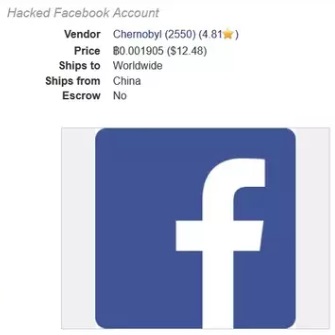
You see, the issue is becoming a lot more important. The fact that these accounts are now sold on the dark web, with the by-line: “If sold individually at these prices, the value of the stolen data on the black market would be somewhere between $150m and $600m“, we are certain that this will get a lot worse before there is any improvement. It is my personal view that actively seeking a non-repudiation setting will hasten that process of making your data more secure.

It is in addition the setting that the Dream Market offers, which by the way is useless. The Chinese vendor offering the data, could in the end merely be an expelled student from any US university living in Dublin, there is at present no way to tell who Chernobyl 2550 actually is.

Finding and exploiting three bugs in Facebook gets you optionally half a billion, the governments are that far behind and there is no indication that they will catch up any day soon. When going back to the Facebook setting, we also saw “Facebook said third-party apps and Facebook apps like WhatsApp and Instagram were unaffected by the breach“, yet another source gives us: ‘WhatsApp Bug Allowed Hackers To Hack Your Account With Just A Video Call’ (at https://www.valuewalk.com/2018/10/whatsapp-bug-video-call-fixed/) implying that Facebook users are in a lot more peril then shown from the different media. We are given: “A security researcher at Google’s Project Zero discovered a strange bug in WhatsApp that allowed hackers to take control of the app if they just knew your phone number. All they had to do was placing you a video call and getting you to answer it. Though the WhatsApp bug was disclosed only on Tuesday, Google researcher Natalie Silvanovich had discovered and reported it to the Facebook-owned company back in August“. So even as it seems that Facebook is not giving us ‘faulty’ information; the mere fact on the existence of the flaw as seen with: “She disclosed the WhatsApp bug to the public only after the company fixed it via a software update. Silvanovich wrote in a bug report that heap corruption could occur when the WhatsApp app “receives a malformed RTP packet.” The bug affects only the Android and iOS versions of WhatsApp because they use the Real-time Transport Protocol (RTP) for video calling” is showing a dangerous setting where a number of failings within this year alone gives rise to the flaws in security and proper testing of apps and the stage of security is failing faster than we should be comfortable with.

So even as CBS News was all about hacking elections last week, giving us: “These cyber-attackers are driven by a variety of motivations, says Andrea Little Limbago, the chief social scientist at data security firm Endgame. “As long as attackers find it in their best interests or find the motivation to want to have some sort of effect … they’re going to think about what they could do with that access,” she says. “Especially China, Russia, and Iran.”“, the failing we see that there is a flaw in the system, it is not merely on pointing at the wrong players, it is about the flawed setting that some systems were breached in the first place. The larger setting is not the hack, it is access and the need for non-repudiation is growing at an alarming rate, in a setting where none of the players are ready to accept non-repudiation, we see a faulty authentication approach and that is the cost of doing business. So when you consider it a sign of the times, consider that I personally witnessed a bug that Whatsapp showed over 27 years ago, when a financial package on DEC VAX/VMS has something called Ross Systems. An intentional illegal action would crash your terminal program and leave any user in the VAX/VMS system with supervisor rights, with total access to every file on the server and every drive. Would it be nice if certain lessons were learned over a quarter of a century?

That is the issue sand the opposition of those who want to push out new features as soon as possible and that danger will only increase in a 5G setting, so when your mobile becomes your personal data server and someone does get access to all your credit card and health data, you only have yourself to blame, good luck trying to sue the technology companies on that. Actually that is exactly what Google is facing with class actions against both the Pixel and Pixel 2 at present. Should they lose these, then the ante goes up, because any case involving flawed data security, when flagged as inappropriately dealt with could cost Google a lot more than they are bargaining for, and it is not just Google, Apple, and Facebook will be in equal settings of discomfort.

If only they had properly looked at the issues, instead of seeking the limelight with a new fab. In the end, are we mere pawns to them, to be exploited and under secured for their short terms needs of clicks and sales pitches? What happens when it falls? They will still get their golden handshakes and a life without complications for decades, what are we left with when our value in data is sold on?

We are merely pawns in a game and no one wants the throne, they merely want to be the second fiddle and walk away overly rich (or own the Iron Bank), we enabled this, and we get to live with the fallout that comes next, all because non-repudiation was too hard for these players.


Leave a comment

Filed under IT, Media, Politics, Science

The politics of 5G technology

I was watching the news and all the announcements of the new iPhone series and it dawned on me that even as they are not just the most expensive phone, they are close to 400% the price of the top Huawei P20. So why is this now a massive price jump? It is not merely that it is a 512 GB Phone, or that is has 4GB RAM, or that it is IP68 dust and water resistance (maximum depth of 2 metres for up to 30 minutes). I think that Apple is changing the game. It is realising something different, It is also why I designed the ‘dumb’ smart devices for 5G.

You see, for better or for worse, I ask you the question: ‘What is this?’ You swill respond with it is a phone (or variant of it), it is a connection to everything, it is your personal assistant. No, it is none of those. It is important that you realise that this is now becoming your personal data server. When 5G enters your life it will be the foundation of you. You must realise it now, or lose your personal value very very fast; even as we are shown the political ‘BS’ on Telstra regarding Huawei, US telecom companies and other players. This is the vault all the players want. This is the setting of the next generation. Apple is cashing in on mere then just the price of a product. They are setting a stage that Huawei is already walking (slower in some regards, faster in others). This is the future and the Apple version of that future arrives within the next 7 days.

Google is on that path too. Its mint flavoured (or is that coloured?) is arriving in 4 weeks, they too are on the path of the future. That path is you and your personal data server. You better get used to that very quickly, you better realise that you, you yourself enabled all this. So even as we will not know the specifics of the new Pixel 3 XL, we all know that this too will be the personal data server, just like the Huawei P20 series, the Apple Xs series, the Samsung Galaxy and the Google Pixel 3. No longer merely phones, no longer merely the Spotify point. You see, the steps we have had with 4G are closing down, and the marketing changes. It is no longer ‘Fastest Mobile Broadband Network‘, it is no longer ‘Live More Internet‘ (which might be Ogilvy’s worst slogan), and it was never ‘Rethink Possible‘. It will be ‘Whatever you need, anywhere you need it‘. That is the foundation of 5G, anywhere you need it is going to be your cornerstone. It is in that part, when you have transplanted yourself in that new dimension you will get exposed to the change and the need to protect your personal data server wherever you are, because your personal data server (the next mobile phone) will become to some extent: “Your Identity”. Now you will need to consider getting it properly protected, because your data value is you and you need to realise that your mobile phone will have more processing and collection power than any server that was out 10 years ago, facilitating for you and 49 other employees. This personal data server will work for you, on your behalf and to your needs. This was why I came up with the protection layer of ‘dumb’ smart devices. No matter whether you go for IOS or Android, you will be your own cornerstone to social life, to entertainment, to business ventures and to your financial pathway. Consider what you are doing now on your phone. Your banking needs, your radio, your TV, your games, your appointments, your insurances and your investment and retirement portfolio. You do it all from your mobile phone and soon with block chain added to the data stream we are now moving towards a point of non-repudiation. In non-repudiation it means that you and only you could have done this. It is the one step above authentication; it is your future of accountability. At that point you cannot go to the judge stating you lost everything, because your phone got stolen. The easy path is getting removed; that is the future of whatever you want, anywhere you need it. Because only you could have wanted it and the new phones are about setting the stage enabling you and protecting you and foremost keeping your data safe, as long as you realise what you are doing.

So that got me thinking of the old Re-Flex hit: ‘The Politics of Dancing

We got the message, I heard it on the airwaves
the politicians are now DJ’s
the broadcast was spreading, Station to station
like an infection, across the nation

We see and hear it all as these settings evolve; politicians are becoming evangelists for places like Telstra, Vodafone and T-Mobile (to coin an example). The speed and radius of influence increased with every technology jump, three times in the last 10 years alone. Forever growing, ignoring borders and natural obstacles.

When we look at the refrain we see:

The politics of dancing, the politics of ooh feeling good
the politics of moving, aha, If this message’s understood

The setting of movement, dance and self-gratification, the fastest way to move the population in the direction they needed you to go in. You better realise this now and not too late.

You see, In Australia Telstra is the best example to look at. In 2016 they themselves set the stage with: “The Connected Government Program is Telstra’s premier thought leadership program for the public sector“. You did not think this was some philanthropic society, did you? This was the initial culling of those good for the in-crowd and those who are not. And I will also include “Dramatic economic, political, cultural and technology changes are creating opportunities and risks for growth, inclusion and sustainability that are making new demands on government and the public sector which require the ability to lead for innovation in conditions of volatile change, ambiguity and fragile trust“. This is all about growing the status quo for Telstra against whatever threatens it (Huawei is a nice example). Whatever they consider to be ‘innovative‘, I personally view it to be, ‘innovative at whatever speed Telstra can manage in an optimised setting of ROI and profit from whatever was deployed before‘. That is not the same is it?

So here we see the setting of 5G, you all want it and your personal data server will be the first choice that either enables of limits you. This is why Apple has upped the ante by a lot and until the answer of Google is ready, I am unwilling to make any choice other than Huawei, especially as it is at merely 25% the price of the new iPhone. 5G is optionally 2 years away for consumers at the facilitated speed of the new apps and protections; we see that this system needs to be at full force when the City Gates of Neom opens, because that will be the first fully fledged setting of a 5G environment giving you whatever you need anywhere you need it. Interactive information posts, shops that inform you 24:7, giving you the data you needed and showing you the products and offer sales and interactivity even when the shop keeper is asleep. All setting the stage for the explosive data growth you will be faced with and your personal data server is your link to all that. In this Google has the advantage as they solved three elemental parts in that essential need, added to that the marketing agents who specialised and focused on actual engagement. That is where you see the benefit of the next generation of data and visibility at the speed it needed to be at. This is not marketing through the eyes of their clients, this is marketing through the eyes of the respondents and how they envisioned it to be. A flexible setting set to the owner of the owner of the personal data server, not the approach towards that server as players like Telstra thought it needed to be, based on their metrics and their perception. Two distinct different ways and many marketeers and self-professed evangelists never understood that part, or learned it too late.

So yes, Re-flex was partially correct when they stated: ‘The politicians are now DJ’s‘, yet they did not forgot it, it was merely in a time when that option did not yet exist. Now there is no lack of choice and the owner of that personal data server can switch channels in the blink of an eye, an engagement opportunity lost as the focus of the evangelist (read: marketeer) was set to the wrong party. The owner who gets whatever they want, whenever they want it also gains the power to decide on what they want, any time they need or desire something, so making sure that there is engagement also gives the strength of retaining that person for a much longer time and in this game in 5G time is close to absolutely everything. It is the one where we start to realise that time is the essential unit of measure. It was there in the old days. CPU time set the stage of costing; it was there in the old phones, where the duration of a call was the unit of costing. Down the road it was trivialised in most places and set to zero, but it was never zero. Now we get to the next stage, yet now it is in the hands of the consumer, because the time of engagement is the sales funnel, so engagement becomes the stage for success. It is close to the end of mass marketing. It will be the stage of smart marketing. In that setting phishing becomes the new skeleton key and there is the first clear need to protect your personal data server and to protect the data it holds. A setting of consideration in 3G and 4G becomes a setting that is essential for anyone that wants to remain in the game in the next generation with a setting of continued value.

#40800SecondsTillMondayMorning


Leave a comment

Filed under Finance, IT, Media, Politics, Science

Trusting Anti-trust cases?

Today will be about Jennifer Rankin and her article ‘Google fined £3.8bn by EU over Android antitrust violations’. First off, it is a good article, she did absolutely nothing wrong (at https://www.theguardian.com/business/2018/jul/18/google-faces-record-multibillion-fine-from-eu-over-android). We get the goods (not all mind you) but a clear picture and that is what I like, a clear picture to work with.

Right off the bat we start with “Google has been hit with a landmark €4.34bn (£3.8bn) fine by the European Union over “serious illegal behaviour” to secure the dominance of its search engine on mobile phones“. Interesting setting as there are Android based phones and IOS (Apple brand X phones). The android systems ALL have full access to Google. As for the search engine, there are two elements. The first the engine for searching itself, which is in android, giving us an open source setting and (at https://searchcode.com/), you can take a look yourself, now you will still need the skills to program, but that is a discussion for another day. The second part is to find stuff, which requires the PageRank. Now we have an issue, because (as the Americans say): ‘that shit is patented!‘ plain and simple. Whilst Microsoft and IBM were belittling Google in 1999 (heard it myself in the UK) Google was working and growing in what is now defined as ‘the development of the Android mobile operating system, the Google Chrome web browser, and Chrome OS, a lightweight operating system based on the Chrome browser‘, it took 5 years for them to get serious traction and whilst they grew, the other two were marketing their BS on every level whilst trusting in VP and players who actually did not know any of their shit, people relying on PowerPoint presentations, bullet points and hype expressions. Now we get the first part that matters: “The European commission imposed the record penalty after finding that the US tech firm required smartphone manufacturers to pre-install Google’s search and browser apps on devices using its Android operating system, which is used on 80% of all phones“. This is the first part. You see, there is a merely a partial truth and it is largely incomplete. Any mobile smartphone needs an OS. So we have Apple with IOS, there is or was) Blackberry, Microsoft and Google with Android. The rest was either not willing or eager to play on any serious level. They all had this: ‘it is much better going for larger systems‘. Even the larger players ignored the power of Mobile and Smartphones for too long. That evidence is seen with NBC where we see “In a farewell post on LinkedIn, Microsoft’s former head of Windows, Terry Myerson, explained why Microsoft failed in the smartphone business“, (at https://www.cnbc.com/2018/03/29/why-microsoft-failed-in-phones.html). The quote: “It comes down to two problems: Underestimating Android’s business model, and building on an older technical platform that wasn’t quite ready for the job“. So in two mere dimensions we see the acknowledgment of large corporations set in a place of short sighted expectations whilst using a narrow minded business model. That is apart from the issues that Windows Mobile had, I wanted to add that list of issues, but I calculated that this section would be no less than 6000 words, with the additional issues on Windows 10 mobile adding a serious amount of words to the 6000 words required. Blackberry did not survive the times either. It had a good platform, but ultimately too expensive for most businesses. It is still going on, but not in the same way it was. Blackberry was not flawed, it focused on specific groups and those groups, those who choose Blackberry will love it forever, it merely could not hold up the settings there were, I reckon that the 2008 crash wiped well over 35% of their customer base instantly, a setting that many corporations tend to see as a fatal blow, Blackberry was no exception. So 50% of the ‘larger’ players are already gone, none of it had anything to do with Google, or with the patented parts. So I would love to scrutinise the Danish Margrethe Vestager (without resorting to Denmark and Hamlet). It starts with: “Google has used its Android mobile phone operating system “to cement its dominance as a search engine”, preventing rivals from innovating and competing “and this is illegal under EU antitrust rules”” No! They did not! We see the clear admission from Terry Myerson giving us ‘building on an older technical platform that wasn’t quite ready for the job‘, knowing that already sets one of the two outside of the consideration. I have given the audience evidence again and again on how stupidity rules at Microsoft. The Surface and Xbox platforms are two distinctive places where this is visible. Both have a narrow minded setting, both are short sighted and even the business approach to grow the customer base failed to do its job. Reuters gave us that last year with ‘Microsoft Surface devices fail on reliability: Consumer Reports‘, an overpriced system that cannot even get close to 80% of what Apple could do with its very first iPad in 2011. In addition Reuters gives us: “The non-profit publication surveyed 90,000 tablet and laptop owners and found that an estimated 25 percent of those with Microsoft Surface devices would be presented with “problems by the end of the second year of ownership,” according to a study published on Thursday“, how can any device with a 25% failure issue be in the market in the first place, and it is very connected, as this is the mobile industry, the mobile industry is more than merely a mobile phone, all connected devices that rely on mobile technology (Wi-Fi or cellular) are part of that failure. The Reuters article (at https://www.reuters.com/article/us-microsoft-surface-idUSKBN1AQ1EP) we also get “According to the Consumer Reports survey responses, the Microsoft devices were found to freeze, unexpectedly shut down or have issues with their touchscreens, Beilinson said. Altogether, the reliability issues made Microsoft a statistical outlier compared with other brands. Apple Inc. had the most reliable devices, Beilinson said“, so how many corporations should be considered when they are the outlier in a negative way? #JustAsking

It is time to look at article 101 (antitrust) (at https://eur-lex.europa.eu/legal-content/EN/TXT/HTML/?uri=CELEX:12008E101&from=EN). Here we see:

  1. The following shall be prohibited as incompatible with the internal market: all agreements between undertakings, decisions by associations of undertakings and concerted practices which may affect trade between Member States and which have as their object or effect the prevention, restriction or distortion of competition within the internal market, and in particular those which:
    (a) directly or indirectly fix purchase or selling prices or any other trading conditions; (not charging for a service is a right anyone has)
    (b) limit or control production, markets, technical development, or investment; (impeding your own technical development, intentional or not is merely your own visionary stupidity)
    (c) share markets or sources of supply;
    (d) apply dissimilar conditions to equivalent transactions with other trading parties, thereby placing them at a competitive disadvantage; (nope, the non-patented part of android is open to anyone)
    (e) make the conclusion of contracts subject to acceptance by the other parties of supplementary obligations which, by their nature or according to commercial usage, have no connection with the subject of such contracts.

The first issue is that the Page rank which is part of this is patented, so there is already a setting of exclusion. The fact that the others are 10 year late to the party is equally evidence that there is a wrongful conviction here. The setting that they are all scared with the coming of 5G, whilst Apple and Google are the ONLY ONES who will be decently ready, both ending up with a massive market share. We see at this point the third failure of Microsoft. You see, it was not merely the two that Terry Myerson stated at CNBC, the ‘Underestimating Android’s business model‘, as well as the ‘an older technical platform that wasn’t ready for the job‘, it is to some extent the ‘25 percent of those with Microsoft Surface devices‘ failing, they are all connected to overlapping user groups making the damage even larger. The Xbox debacle that showed a bullying setting of ‘always online’ as well as storage shortage issues (a killer in the mobile devices), their bullying setting of pushing people online is equally part of the failure. It was the fourth part that truly took Microsoft out of the race. Google (as I personally see it) looked at roughly 1.7 million university students and looked at where the future was pointing. They saw where the future was heading and they build on that long term view. Just look at the Gmail storage, the YouTube facilitation, and to openness of their business suite apps, just a few examples. Over 3 years I have only two parts where I missed Microsoft Office a little, over 3 years that is nothing. That in a setting where Microsoft went into the ‘greed’ setting it becomes a lot more funny, especially when we see students having to get by a few dollars a day, yet Microsoft has a $199 version for these students, yes it will be cloud, secure (so they say) and update cost free, a subscription service. Google merely states $0, on the cloud. You tell me what students want! The issues are linked, because Microsoft had been actively growing the anti-Microsoft feelings for almost a decade. I understand that Microsoft has a business model and ‘free software’ is an issue for them, they have a right to be like hat. Google understood that the poor students who hardly can keep a budget now, are going to be the executives of tomorrow, those people then are executives now and they all embrace Google (well, most of them anyway). There was no force, there was no (how did that Danish lady put it?) ‘Restriction or distortion of competition within the internal market‘, many went to iPhone and IOS and Google is fine with that. No, the issue is that the other players are confronted with the stupidity of the previous post holders and that is an issue now, it links together.

By not realising the future 15 years ago, the present is close to unobtainable for them. I watched how I saw again and again how some of them went by ‘We are now working on the new technology surpassing the others‘ again and again (and not delivering). You merely need to find the history of ‘SPSS Data entry for Windows‘ and realise that this was an excellent way to lose 6000 businesses, and close to 35,000 users (relabeling it ‘form design software’ was never a solution). Microsoft went in that same direction and now they are close to side lined from the next technology by their own stupidity. No resources, no ‘know-how’ and no vision, yet Google is the big bad wolf here!

This is the underlying story that links it all and some companies are merely indicative, but they overall went the same direction. So where we see ‘preventing rivals from innovating and competing‘, I see that this was not the case, they merely went a greed driven path (OK, I admit, I should say ‘revenue driven path’), whilst actual new technology is all about innovation and never about iteration. Microsoft, after IBM the larger player feeling left out has shown us on several fields that innovation is merely marketing, not actively pursuing issues and with a ‘25% failure issue’ setting in the Surface department, I believe that their flaws are clearly shown. It becomes more of a farce when we see “Vestager added: “The vast majority of users simply take what comes with their device and don’t download competing apps.”“, users want what works; we are not interesting in a $199 fee for apps that they we get for free, ask any student. There are apparently 207 million higher education students globally, ask them! In addition, that mere setting where we see the onus of the user, to not look for more is punishing a company because the users are lazy? Since when can we convict Google for not installing in the second degree, because the user was lazy?

In many situations there are no competing apps, not of any quality that is and when you look in the Google play, we see that the users are allowed to set the tone. I will be the first to agree, that there are issues and that there might have been a case to some extent. Microsoft faced that years ago when it was still in the delusional setting that they had the better browser. Now we see a different picture. Now we are faced with IBM that put everything on Watson (not sure if that was a good idea), but it can facilitate to the larger degree in every direction, including the third parties banking on 5G, IBM is eager to oblige. Microsoft has nowhere to go, they burned down their options and as they screwed up again and again, it has nothing left but to sulk like a little child. Just consider the upcoming Microsoft Surface Go, for people with budgets. Now consider the News we are given: “With a starting price of $469, the Apple iPad (with Wi-Fi connectivity only) is the winner on affordability”, “The consumer/education version is priced at $599 and will run Windows 10 Home in S mode – which only allows apps that are available in the Windows store”, all this, for a system not out yet, and the Australian Financial Review (at https://www.afr.com/technology/mobiles-and-tablets/will-the-surface-go-boldly-where-other-tablets-cannot-20180713-h12n71) gives us: “Why has Microsoft just released a tablet at a time when almost everyone is buying smartphones and almost no one is buying tablets? Sales of tablets such as Apple’s iPad have been in steep decline since 2015, a decline that shows no signs of reversing in the next four or five years, analysts say”, so in that setting another optional failure is introduced. That whilst I saw it coming, just as the short sighted failures that are part what now with giggles is called the ‘most powerful console on the market’ (The Xbox One X), that is the company that is connected to all this.

That part can be found in a few places. In this case I give you the New York Post where (at https://nypost.com/2015/04/15/microsoft-the-big-winner-in-google-antitrust-lawsuit/) we see “While Google CEO Larry Page took his lumps with the suit, Microsoft, very quietly, came out the big winner, sources said. “Microsoft complained a lot,” said a source with direct knowledge of the situation. “Microsoft definitely counselled the [EC], suggesting it made sense to send Google a statement of objections so Google would be forced to produce documents” showing its search-result recipe, another source said”, this was a joke 3 years in the making. I hope that I can turn that joke on these losers as they have diminished consumer trust in their narrow minded way (not to mention short sighted ways).

Even when we turn this in another direction through the Register two month ago (at https://www.theregister.co.uk/2018/05/21/antitrust_google_us_government/), where we see ‘On 20th anniversary of Microsoft antitrust, US Treasury Sec calls for Google monopoly probe‘, I am not arguing how right or wrong it is. I am merely pointing out that Google went in a direction that was long term, whilst all the others went into the short term path that was demanded from their board of directors, who for the most could not read a spreadsheet properly because the bullet points were missing (their optional opposition to the NRA perhaps?). That was the setting and those with vision are dumbfounded and they got hurt through the inadequacy of stupid people.

So the Danish party was already active then. What is an issue is Jeremy Stoppelman, he had vision with Yelp, even as he did not understand certain markets (miscalculated is a better word), he had faith in his product, which I applaud. it worked for a while, yet I see that bad choices (unfortunate choices is a better setting) impacted it all, so even as Yelp failed to meet expectations, if it survives and gets 5G traction, it will be ahead of others a decent amount, it turned down Google who wanted them when the going was good and he would have had a strong place if he had taken that part, but it was his decision and I applaud him for it. Yelp and Turnstyle Analytics would have an optional strong 5G setting if it had kept international operations and grow the data the way they had, it will not be easy now for them, but I digress. With: “Mnuchin’s comments on Google came after a special 60 Minutes episode that focused in part on the company and its effective search monopoly. That segment was notable for the inclusion of two people: EU competition commissioner Margrethe Vestager and Yelp founder Jeremy Stoppelman“, yet all parties have their ‘its effective search monopoly‘, what they are not telling us is that they had a vision that everyone would come with a future need and they got Stanford University to create the algorithm that got patented. All the other players remained dumb to the future. And then we get the one gem I expected: “Also, the EU announced it was launching a probe of Google’s Android operating system to see if its agreements with cellular phone makers was hurting rivals. While Microsoft likely does not care much about search preference, “the investigation throws sand in the gears of Google’s innovation,” the former FTC official said“, so there it is ‘agreements with cellular phone makers was hurting rivals‘, phone makers had options, Apple had its own system and there are NO non-Apple IOS phones. Interesting that this does not make that cut is it? An open system was offered and the alternative Microsoft (rejected because it was not up to the job), Blackberry (is only after the collapse that it became an option to others), we see that Google has an open option, yet they are the boogeymen. So we get two elements, a partially failed entrepreneur (only in part) and a limelight seeking politician. The power of the google Appeal is found in a simple statement: “Her staff ran through over a billion Google searches and found that Google was knowingly manipulating its search algorithms to promote its own products and push competitors far down the ranking“, that evidence must be shown in court and get scrutinised! You see, the timeline for a billion searches can only partially be automated and those results can be used by Google as evidence against Margrethe Vestager as well. The evidence of ‘manipulating its search algorithms‘ will be equally a discussion point putting EVERY intern and assistant of Margrethe Vestager in the witness box, no exception. A setting that I personally see as the EC has close to no chance of winning. Even as I saw the algorithm in my University classes for an assignment, I am decently certain that I did not see the whole 100% of all elements of the algorithm, one element out of place and that is as I (again: personally) see it the crushing of the EC case, the appeal will be won by Google.

The fact that Microsoft was part of this in several ways from 2015 onwards and likely before that is more than enough for me to consider the premise that trusting antitrust is not always a good thing. I do agree that antitrust should exist, yet it should be clear that this is not a handle for the narrow minded, the short sighted, the greedy and the stupid to use because they could not get their shit together. They should reread Chapter 11 of their favourite pornographic work, whether that text comes in 50 shades of mixing several combinations of white and black. A colourless equation in a setting where colour was the only part that the global users demanded, listening to them would have been a first requirement. It is the setting, which gets me to the final image.

An interesting to set the stage, because if Microsoft was a marketing firm, they would be reduced to merely being a spammer, look at the first screen of your Xbox One (X optional) for that part, also all the parts people have to go through in Windows 10 (https://www.windowscentral.com/how-remove-advertising-windows-10), so in the end, the advisors have their own games to play (quite literally at some point). The Independent was kind enough to give us this with: “In the meantime, we probably ought to do our bit to help her by making a little more use of Google’s rivals, such as Microsoft’s Bing, which is a perfectly serviceable search engine“, it is seen at (https://www.independent.co.uk/news/business/comment/google-eu-fine-margrethe-vestager-android-search-microsoft-bing-silicon-valley-mobile-phones-a8453486.html)

Just ‘Bing’ “UK Law firms”, to get a UK law firm and immediately I see 10 law firms (page top view), 50% Australian ones (3 of those advertised), so if Bing cannot give me what I am looking for, why should I even consider them? With the term “Dutch Lawyers” I get 25% fulfilling the search. I can go on for a while, but I think the case of the doubt regarding ‘a perfectly serviceable search engine’ and the case on how it isn’t one has been made. I did not need to go far. Oh, and if you do have a sense of humour, try “Microsoft guilty” (with brackets), to see Bing give you “We didn’t find any results for “Microsoft guilty””, whilst Chrome giving us an immediate 8 results, with the quotes on these links. So when it comes to censoring (or is that just their flawed algorithm), we can soon see that there is an optional setting where Margrethe Vestager could be seen as a tool for Microsoft (as they might have been ‘searching’ for optional solutions), it might not be a fair setting, yet the entirety of the Antitrust case is seen by me in that way. Microsoft and a few others need time to catch up, being stupid merely gets you at the back of the line (which is where all future opportunities are lost), they need time and they are using the EC to try to catch up. My sense of giggling will be found the moment the appeal is won by Google; we are likely to see a tsunami of ‘carefully phrased denials from European political players trying to avoid the limelight’.

Oh, and whilst we are at it, when we see ‘placing them at a competitive disadvantage‘, that in light of Huawei surpassing Apple (source: the Verge). With: “Huawei has surpassed Apple as the world’s second largest smartphone brand. Sales have overtaken Apple for the first time”, Margrethe Vestager will call it ‘proving her point’, yet the truth is that Huawei went for the affordable option, a side Apple has not considered in decades, whilst in addition, the decline of Samsung and the growth of Huawei reinforces that it was about affordability for the longest of times, those losing market shares are their own worst enemy, because the wrong people are setting the price, I added enough evidence of that for the longest of times. This all in a setting where we see that even as Huawei realises that Europe is the key, the others are isolating themselves even more. Soon enough it will no longer be about Google and Android, it will become on non-American mobile players gaining the upper hand  over all the others, I wonder what anti-trust case will be filed at that point.

#PriceDiscriminationAnyone?


Leave a comment

Filed under Finance, IT, Law, Media, Politics, Science

Business will be booming

There are all kinds of settings in the tech industry, some we like and some we like a lot less. It is the most visible in the mobile industry, the clear discriminatory setting there is almost unheard of. No matter what the reason is, a person for the most is iOS (Apple) minded, or they tend to go the way of the Android (Google, Huawei et al). There is for the most no in-between there. The reasons are as wide as the drops of water in a lake on a rainy day and for some these reasons make sense, or they do not. Yet we all tend to have them. I have been and remain an Android follower. I have nothing against apple. The initial setting was done by their marketing departments. Where Apple gave us: ‘You can do all these things and it is a phone too‘ and Android gave us: ‘This phone can do all kinds of things, some you will not have believed was even possible‘. I went the way of Android. You see, they are stating the same thing, yet Android focussed on a phone that can do other things. Apple went towards the things they could do, including being a phone. So from my point of view, I needed a phone, so I went the non-iOS way.

I know that in the end the difference is negligible, but it did matter. So it is a little over three years when I got myself (because it was a bargain) the Huawei P7. The difference from the previous phone (Motorola) was so distinct I became a Huawei fan overnight. Now that it is time to put that phone to bed and switch it off for the last time, I find myself clinging onto the idea that I need a new Huawei. Let me be clear, apart from my distinct non liking Samsung (a past issue I had with them), I do think that the other brands are decent too. Yet, when you have the option for a Google Pixel 2 XL, or a Huawei P20 close to $500 cheaper, what will you choose? Let’s also consider that the difference is almost nil, well it is not nil but the real differences do not stand out too much, not worth $500 as I see it. For me, if I get that phone, it will be a 300% improvement of what I have now and I am not dissatisfied with what I have, it merely has been acting up and after 3 years of working 24:7, that makes perfect sense. The little workhorse has earned its retirement. So when I started to look around, and I took a new look at the P20 and P20 pro, which is a $300 difference, I wondered why I would want the P20 pro for the usage I have. I have been able to do everything I needed with 2 GB RAM, so the 4 GB and  6GB RAM issue is not one I need to worry about. Both come with 128 GB storage, which is 800% more than I have now and even as I ran out of storage merely once, it did not worry me to any degree. The camera options are not the same, yet the PRO has an additional 40 MP camera option, which is slightly over the top need for someone who uses an EOS 1 Camera. The only issue is the battery, it is 3400 mAh versus 4000 mAh and I am not sure that this constitutes the value of $300 difference, not on my budget. More important, the P20 holds its own against the $1500 phones out there and when you consider the fact that it is 30% cheaper, what would you choose? This constitutes a difference that is well over a week’s rent for some people, so there is that to consider as well.

Yet, it is not about that part, it is that Huawei has seen the light of opportunity in both Saudi Arabia and Egypt, so when we see (at https://www.albawaba.com/business/pr/huawei-announces-%E2%80%98vip%E2%80%99-service-p20-pro-saudi-arabia-1135384), the fact that branding is getting momentum in the Middle East with their Huawei Consumer Business Group and their “a ‘VIP’ service for its customers in Saudi Arabia through its authorized service centres for any customer buys Huawei P20 Pro with Huawei KSA warranty”. Some call it marketing, which in all fairness it actually is, yet with 95 million people in Egypt and 33 million in the KSA, the market could be booming for Huawei, even as an Apple store is coming in 2019, the Apple SA store is pointing towards “Apple-designed outlets located within selected Apple resellers and other retail shops. Many are staffed with Apple-trained experts who can help you to find the right solution for you“, which is a perfectly valid and acceptable text. Yet, when you can consider an ‘outlet’ versus “Huawei has announced “Huawei Flex” which is a free drop off service in which customer can drop his device for service in more than 300 locations across kingdom for Huawei device under Saudi Arabia warranty to be send for Huawei Authorized service centre for warranty repair and return“, we see that Huawei is on the ball (I am not saying that Apple is not), but the service minded sales pitch is clearly there and as we see: “Pablo Ning, President of Huawei Consumer Business Group Saudi Arabia said: “The Kingdom is a strategic market for us, and this announcement reflects our commitment to doing business in the region. It is our effort to always cater to the specific needs of the markets we operate in. Recognising the needs of our loyal customers in the Kingdom, we are very pleased to announce these services and we are looking forward to announcing many more unique offers for them in the future”“, we see that even as we realise that too is a marketing setting, it also states that Huawei means business. With a chunk of a 125 million customer base, these two alone could drive sales even further in the Middle Eastern nations; in addition, the Huawei centre is rumoured to be coming to Neom, which could drive the brand even further. Even Forbes was recognising the growth Huawei had in 2017, even though we do take notice of the fact that anti-Chinese sentiments in the US barred the phone from the US markets, we need to realise that the planet is a lot bigger than the 325 million in the US. Also consider the fact that Huawei does a lot more than merely smartphones and the opening of the market that is a third of the US population matters, in addition the 740 million Europeans are now more than ever looking for a good deal. So the group of people who have the cash to go all out and get a phone $500 more expensive is shrinking fast. Yet Huawei is not out of the woods there either. It is up against Samsung and Samsung is doing a good job of gaining ground. In there we see that Apple is losing their footing, losing sales share in the UK, France and Spain. So even as some had growth, iOS was merely growing at 0.1%, against Android 2.8%, that is a massive difference, and Huawei is tinkering very effectively on these two markets. Although, I have to admit (speculatively) that the largest growth was due to the release of the Google Pixel family. Still Huawei remains in the fight of growth and its setting in the Middle East is as assertive as it gets. I reckon that if Pablo Ning pulls it off, he might be looking forward to his new apartment overlooking Chaoyang Park in Beijing. It is that extreme because the market share that Huawei has to grow is pretty astounding. You see, not everyone is looking towards the coolest marketed phone that most cannot normally afford, in the Middle East revenue is often set towards pragmatism and that is a setting that Marketing on a global basis tends to be unfocussed on. It is in this setting that mobile phones will gain traction in sales. So when we consider the progress that Huawei is making towards growth by going via the support and customer care path, or as Pablo Ning phrases it “the needs of our loyal customers in the Kingdom“, we see not some message on selling a phone like ‘iPhone X, Say hello to the future‘ with after that ‘Sales, Apple Authorized Resellers‘ or ‘Sales, Apple Authorized Resellers‘ but with ““Huawei Flex” which is a free drop off service in which customer can drop his device for service in more than 300 locations across kingdom for Huawei device under Saudi Arabia warranty to be send for Huawei Authorized service centre for warranty repair and return“, we see that Huawei means business. It is not about the initial sale, it is putting to bed any worry the consumer has afterwards and the Huawei version sells much stronger than the other messages and that is how commercial traction leaps forward making it market share gain. The lower sales threshold only speeds it up. In that we see that “aiming of strengthening its business base, its operations and customer service in the Kingdom“, is not just vital for growth of Huawei, the commitment of 5G in Saudi Arabia as it is at present, will only fuel the need for the Huawei smartphone (and smart phones in general); with its upcoming Huawei Mate 30 (Q3 2019) Huawei could give a further boost, as those buying today would be ready for a new phone just as the Mate 30 will be released and it will drive it a lot faster if it is both 4G and 5G enabled (which is not officially confirmed), so as Apple and others are looking to open a shop at that point, we will see that if (consider that it is an ‘if) Huawei kept its services and exceeded the expectations of the consumer, they will have a much larger advantage and as such Google might profit with their own Android phones on the coattails of Huawei. This is shown in another way too. Statista (at https://www.statista.com/statistics/271774/share-of-android-platforms-on-mobile-devices-with-android-os/) gives a view that takes some mulling. When we consider the Android market share, we see that the largest part is owned by Marshmallow (v6) and Nougat (v7), so that means that those who update now to Oreo (v8) will be most likely to update the moment 5G is out, those who delay more than 6 months are not likely, or better stated less likely to update more than once, so either they miss out on 5G or are in a much smaller segment (not serious smartphone users). So they use it as a phone and that is it, which is fair enough, because a phone is a phone and for that 5G is not essential. Yet when we consider that this group is almost 37%, there is an option for smartphone sales everywhere to evolve those users towards a more smartphone driven use of apps and data, yet what are these consumers made of? There is no data that I had at my disposal, yet finding out is actually a lot more important here. If we know what the consumer needs, we can see if there is a better solution in new hardware, not merely because of the security risk that older phones hold, the fact that smartphone functionality is optionally missed out on is basically a sales opportunity missed and when it affects an optional 37% slice of smartphones it starts to matter as that involves a serious amount of cash. Now we need to accept that it is not merely the phone, for the larger places like the island of Australia mobile data was until last year pretty expensive, so why upgrade when the data used will monthly kill your budget? to go from 15GB a month for $65 in 2016 to 200Gb for $70 in 2018 is actually a massive leap and not all places have made such changes, so not everyone is on board yet, but with 5G that will change by a lot, not only will they drive down the 4G data prices, but the mobile setting in places like Egypt and Saudi Arabia (outside of Cairo and Riyadh) will drive the need of people much larger. The fact that Egyptian TV outside of the large cities is not fabulous, for these people to suddenly get a clear reception of matches of Al Ahly SC or Zamalek SC could drive sales, so the larger the part of that 37% slice is actually found in the Middle East, the easier the upgrade sales will get; when we consider the joke (that is how I personally see the Vodafone Egypt site), as well as the clarity of http://www.egyptsim.com/, we see that there is still space to improve it all and Huawei is in an interesting place to make that happen. In addition, the Egyptsim site shows a setting that was almost the 2016 setting in Australia, so they are not that far behind, so when we see the evolution where the prices reflect 500% if what they offer now (which is what we can get in places like Australia nowadays), we see a more competitive setting where upgrading any smartphone will become the essential need of anyone wanting to use such amounts of bandwidth. Even a mere 50 GB at €15 could change the game, it will drive app use, phone use and more important, the need for phone upgrades and competitive phones will become more and more desired. This is shown in direct opposition to the anti-Huawei feelings that we see from America (at https://www.politico.eu/article/huawei-china-ghost-in-europe-telecom-machine/), a story from last January. So in all this when we see “The Chinese tech giant is banned from bidding for government contracts in the U.S. over concerns that its telecommunication equipment could be used for spying by Beijing“, that whilst it refers right next to it a story regarding ‘Mark Zuckerberg hearing: As it happened‘, in all this Huawei is a concern? As the US has not even got clear legislation on data and as we see the Facebook events, I can state that some people have their mindset in the wrong place. In addition, if we can believe the Daily Mail who gave us “Google caught using $580 million worth of Australians’ phone data to spy on them by monitoring their movements“, so in that, is Google getting government contracts? And if the second is true, why is there no outcry in that setting? Is it about the company, or where the revenue is going to? It is a multiple facetted setting of greed, technology and whose ego is the largest to present. How does that help the consumer who wants a good affordable phone, if the Google Pixel and Huawei phones offer the same thing, yet Huawei can do it 30% cheaper, why would we want the more expensive one, our privacy? Facebook gave that away and there is no actual act in place to thwart that, in addition, the US senate hearing gave more and more reluctance as we seem to get the impression that these senators do not even comprehend technology in its basic foundation. We merely have to look back at the moment with Senator Orrin Hatch (R-UT), who asks on: ‘how do you sustain a business model where users don’t pay for your services‘, the answer by Mark Zuckerberg was priceless: ‘Senator, we run ads!“. When we are confronted with such a level of what I regard to be ignorance towards business reality, that is the not party we should rely on when they state to us: “its telecommunication equipment could be used for spying by Beijing“, yet in that foundation, not one piece of evidence has been presented that this is actually the case. The “potential for secret ‘backdoors’” is astounding. Not one piece of evidence, not one setting that gives any level of reliability on ‘potential‘. I wonder how many of these gentlemen have been receiving calls from Cisco, Apple, IBM and other parties on their fear of China getting a slice of American business, or perhaps it is even more simple. With American firms the government of the USA can make tax deals, because the inability of paying invoices can always get bartered on a national level, not international. And there is where Huawei has its opportunity. As it grows its segments in both Europe and the Middle East it can potentially grow the services they offer as the reach of those services and in that light and the next level of growth towards 5G, we see that Huawei has a growing distinction against all competitors. It can offer a new price range, one that consumers have not had for the longest of times and it can place a setting where customer loyalty can grow towards Huawei as it offers something affordable, now when the providers think it is time, but when the consumers need them, which is always a war that works in favour of the consumer. It is a war of settings between optionally, actually, and eventually. The first one offering it has the benefit. Yet is Huawei ready to make that commitment? I do not know, yet should Huawei grace the settings and be announced as a participant of the new high tech city Neom, at that point you can be decently certain that Huawei will become a much larger player in the Middle East and from that, growth in Europe will be a near certainty. Business for Huawei will be booming and it all started by making high end mobiles an affordable item for those not in high paying jobs, or forced to get themselves chained to a two year contract with a telecom provider.


Leave a comment

Filed under Finance, IT, Media, Politics, Science

The sting of history

There was an interesting article on the BBC (at http://www.bbc.com/news/business-43656378) a few days ago. I missed it initially as I tend to not dig too deep into the BBC past the breaking news points at times. Yet there it was, staring at me and I thought it was rather funny. You see ‘Google should not be in business of war, say employees‘, which is fair enough. Apart from the issue of them not being too great at waging war and roughing it out, it makes perfect sense to stay away from war. Yet is that possible? You see, the quote is funny when you see ‘No military projects‘, whilst we are all aware that the internet itself is an invention of DARPA, who came up with it as a solution that addressed “A network of such [computers], connected to one another by wide-band communication lines [which provided] the functions of present-day libraries together with anticipated advances in information storage and retrieval and [other] symbiotic functions“, which let to ARPANET and became the Internet. So now that the cat is out of the bag, we can continue. The objection they give is fair enough. When you are an engineer who is destined to create a world where everyone communicates to one another, the last thing you want to see is “Project Maven involves using artificial intelligence to improve the precision of military drone strikes“. I am not sure if Google could achieve it, but the goal is clear and so is the objection. The BBC article show merely one side, when we go to the source itself (at https://www.defense.gov/News/Article/Article/1254719/project-maven-to-deploy-computer-algorithms-to-war-zone-by-years-end/), in this I saw the words from Marine Corps Colonel Drew Cukor: “Cukor described an algorithm as about 75 lines of Python code “placed inside a larger software-hardware container.” He said the immediate focus is 38 classes of objects that represent the kinds of things the department needs to detect, especially in the fight against the Islamic State of Iraq and Syria“. You see, I think he has been talking to the wrong people. Perhaps you remember the project SETI screensaver. “In May 1999 the University of California launched SETI@Home. SETI stands for the” Search for Extraterrestrial Intelligence,” Originally thought that it could at best recruit only a thousand or so participants, more than a million people actually signed up on the day and in the process overwhelmed the meager desktop PC that was set aside for this project“, I remember it because I was one of them. It is in that trend that “SETI@Home was built around the idea that people with personal computers who often leave them to do something else and then just let the screensaver run are actually wasting good computing resources. This was a good thing, as these ‘idle’ moments can actually be used to process the large amount of data that SETI collects from the galaxy” (source: Manilla Times), they were right. The design was brilliant and simple and it worked better than even the SETI people thought it would, but here we now see the application, where any android (OK, IOS too) device created after 2016 is pretty much a supercomputer at rest. You see, Drew Cukor is trying to look where he needs to look, it is a ‘flaw’ he has as well as the bulk of all the military. You see, when you look for a target that is 1 in 10,000, so he needs to hit the 0.01% mark. This is his choice and that is what he needs to do, I am merely stating that by figuring out where NOT to look, I am upping his chances. If I can set the premise of illuminating 7,500 false potential in a few seconds, his job went from a 0.01% chance to 0.04%, making his work 25 times easier and optionally faster. Perhaps the change could eliminate 8,500 or even 9,000 flags. Now we are talking the chances and the time frame we need. You see, it is the memo of Bob Work that does remain an issue. I disagree with “As numerous studies have made clear, the department of defense must integrate artificial intelligence and machine learning more effectively across operations to maintain advantages over increasingly capable adversaries and competitors,“. The clear distinction is that those people tend to not rely on a smartphone, they rely on a simple Nokia 2100 burner phone and as such, there will be a complete absence of data, or will there be? As I see it, to tackle that, you need to be able to engage is what might be regarded as a ‘Snippet War‘, a war based on (a lot of) ‘small pieces of data or brief extracts‘. It is in one part cell tower connection patterns, it is in one part tracking IMEI (International Mobile Equipment Identity) codes and a part of sim switching. It is a jumble of patterns and normally getting anything done will be insane. Now what happens when we connect 100 supercomputers to one cell tower and mine all available tags? What happens when we can disseminate these packages and let all those supercomputers do the job? Merely 100 smart phones or even 1,000 smart phones per cell tower. At that point the war changes, because now we have an optional setting where on the spot data is offered in real time. Some might call it ‘the wet dream’ of Marine Corps Col. Drew Cukor and he was not ever aware that he was allowed to adult dream to that degree on the job, was he?

Even as these people are throwing AI around like it is Steven Spielberg’s chance to make a Kubrick movie, in the end it is a new scale and new level of machine learning, a combination of clustered flags and decentralised processing on a level that is not linked to any synchronicity. Part of this solution is not in the future, it was in the past. For that we need to read the original papers by Paul Baran in the early 60’s. I think we pushed forward to fast (a likely involuntary reaction). His concept of packet switching was not taken far enough, because the issues of then are nowhere near the issues of now. Consider raw data as a package and the transmission itself set the foundation of the data path that is to be created. So basically the package becomes the data entry point of raw data and the mobile phone processes this data on the fly, resetting the data parameters on the fly, giving instant rise to what is unlikely to be a threat and optionally what is), a setting where 90% could be parsed by the time it gets to the mining point. The interesting side is that the container for processing this could be set in the memory of most mobile phones without installing stuff as it is merely processing parsed data, not a nice, but essentially an optional solution to get a few hundred thousand mobiles to do in mere minutes what takes a day by most data centres, they merely receive the first level processed data, now it is a lot more interesting, as thousands are near a cell tower, that data keeps on being processed on the fly by supercomputers at rest all over the place.

So, we are not as Drew states ‘in an AI arms race‘, we are merely in a race to be clever on how we process data and we need to be clever on how to get these things done a lot faster. The fact that the foundation of that solution is 50 years old and still counts as an optional way in getting things done merely shows the brilliance of those who came before us. You see, that is where the military forgot the lessons of limitations. As we shun the old games like the CBM 64, and applaud the now of Ubisoft. We forget that Ubisoft shows to be graphically brilliant, having the resources of 4K camera’s, whilst those on the CBM-64 (Like Sid Meier) were actually brilliant for getting a workable interface that looked decent as they had the mere resources that were 0.000076293% of the resources that Ubisoft gets to work with me now. I am not here to attack Ubisoft, they are working with the resources available, I am addressing the utter brilliance of people like Sid Meier, David Braben, Richard Garriott, Peter Molyneux and a few others for being able to do what they did with the little they had. It is that simplicity and the added SETI@Home where we see the solutions that separates the children from the clever Machine learning programmers. It is not about “an algorithm of about 75 lines of Python code “placed inside a larger software-hardware container.”“, it is about where to set the slicer and how to do it whilst no one is able to say it is happening whilst remaining reliable in what it reports. It is not about a room or a shopping mall with 150 servers walking around the place, it is about the desktop no one notices who is able to keep tabs on those servers merely to keep the shops safe that is the part that matters. The need for brilliance is shown again in limitations when we realise why SETI@Home was designed. It opposes in directness the quote “The colonel described the technology available commercially, the state-of-the-art in computer vision, as “frankly … stunning,” thanks to work in the area by researchers and engineers at Stanford University, the University of California-Berkeley, Carnegie Mellon University and Massachusetts Institute of Technology, and a $36 billion investment last year across commercial industry“, the people at SETI had to get clever fast because they did not get access to $36 billion. How many of these players would have remained around if it was 0.36 billion, or even 0.036 billion? Not too many I reckon, the entire ‘the technology available commercially‘ would instantly fall away the moment the optional payoff remains null, void and unavailable. $36 billion investment implies that those ‘philanthropists’ are expecting a $360 billion payout at some point, call me a sceptic, but that is how I expect those people to roll.

The final ‘mistake’ that Marine Corps Col. Drew Cukor makes is one that he cannot be blamed for. He forgot that computers should again be taught to rough it out, just like the old computers did. The mistake I am referring to is not an actual mistake, it is more accurately the view, the missed perception he unintentionally has. The quote I am referring to is “Before deploying algorithms to combat zones, Cukor said, “you’ve got to have your data ready and you’ve got to prepare and you need the computational infrastructure for training.”“. He is not stating anything incorrect or illogical, he is merely wrong. You see, we need to realise the old days, the days of the mainframe. I got treated in the early 80’s to an ‘event’. You see a ‘box’ was delivered. It was the size of an A3 flatbed scanner, it had the weight of a small office safe (rather weighty that fucker was) and it looked like a print board on a metal box with a starter engine on top. It was pricey like a middle class car. It was a 100Mb Winchester Drive. Yes, 100Mb, the mere size of 4 iPhone X photographs. In those days data was super expensive, so the users and designers had to be really clever about data. This time is needed again, not because we have no storage, we have loads of it. We have to get clever again because there is too much data and we have to filter through too much of it, we need to get better fast because 5G is less than 2 years away and we will drown by that time in all that raw untested data, we need to reset our views and comprehend how the old ways of data worked and prevent Exabyte’s of junk per hour slowing us down, we need to redefine how tags can be used to set different markers, different levels of records. The old ways of hierarchical data was too cumbersome, but it was fast. The same is seen with BTree data (a really antiquated database approach), instantly passing through 50% data in every iteration. In this machine learning could be the key and the next person that comes up with that data solution would surpass the wealth of Mark Zuckerberg pretty much overnight. Data systems need to stop being ‘static’, it needs to be a fluidic and dynamic system, that evolves as data is added. Not because it is cleverer, but because of the amounts of data we need to get through is growing near exponentially per hour. It is there that we see that Google has a very good reason to be involved, not because of the song ‘Here come the drones‘, but because this level of data evolution is pushed upon nearly all and getting in the thick of things is when one remains the top dog and Google is very much about being top dog in that race, as it is servicing the ‘needs’ of billions and as such their own data centres will require loads of evolution, the old ways are getting closer and closer to becoming obsolete, Google needs to be ahead before that happens, and of course when that happens IBM will give a clear memo that they have been on top of it for years whilst trying to figure out how to best present the delays they are currently facing.
 

Leave a comment

Filed under IT, Media, Military, Science

Songs in the key of Technology

Yesterday saw an article in the Guardian (at https://www.theguardian.com/technology/2017/oct/03/pixel-2-google-apple-iphone-htc-pixel-2-xl), with ‘what does Google need to do if it wants to beat Apple’s iPhone?‘ which is one way of looking away from what is actually happening. You see, with the opening part on how Google ‘could become big player in smartphone-making with acquisition of part of HTC and forthcoming Pixel 2 launch’ is merely the front for something a lot bigger. You see, for a year Huawei had an optional advantage towards Google whilst the one advantageous player (read: Apple) wasted their time on iteration and presentation, perhaps only partially on innovation and marketing the hell out of an event that will happen in December (read: the iMac pro). Now the gap is closing and with the HTC part Google has stepped into the space where it can compete with Huawei on an upcoming £30-45 billion market. A new market that is about to happen. Whilst everyone is playing with themselves on how some of these people are ‘rulers of the universe‘, or so they think, Google now is moving on the inside track to take that market and at least three niche markets, which will give them a long term advantage. You see, Apple might be number one, the largest and the richest, but the danger of the number one is that you need to make sure you comprehend what numbers 2, 3 and optionally the player in position 4 is doing and Apple seems to have lost track of that part. Now they are in a place where they lose one edge and as such they might remain number one, but the players in position 2 and optionally the one in the third position will be closing the advantage gap that Apple had and had been making them complacent in their actions. Now, we will wait, living on conjecture and gossip as we will get to live with 15 months of movement below the surface of the waters. For those on the sidelines, it will be like watching a submarine race, a real spectator sport (read: not really). Now we get to the accusation in regards to what Samuel Gibbs is writing about. With: “it can pull off the one thing other Android smartphone manufacturers have struggled with: differentiation” it is staging that Google is not differentiated, which might be true to some respect, but in another regard he fails to see what truly matters to the millions of users. It is actually very simple: “To give the people, the users what they desire”, so basically something pretty amazing at an affordable price. We see his claim of ‘homogenous sea of sameness‘ (it does sound cool though) whilst these same styled writers seemed to price Apple for consistency for the longest of times. What he fails to see is that this homogenous ocean creates users, users that know what they are getting and they know the value of Android (well many seem to do that). So after the age of VHS, MSDOS and MP3, where it was to get as many people as possible to adapt a standard, it suddenly becomes about ‘being different‘? No, that is not the way it is played! You see, the market Tata lost, the market Apple ignored and that same market that Huawei is waking up to, is the one that is now almost within the grasp of Google and it can potentially grow the value of Google not overnight mind you) up towards a growth of 40%-70%, that is almost unheard of and we have not seen such spectacular growth since Windows 95 was introduced. That is the key of technology that we are about to face and ballads will be composed to those creators when it hits us all.

In this I equally oppose Ben Wood, chief of research at CCS Insight. With “The Achilles heel of Android at the moment is that software updates take forever. Unlike Apple where it controls everything, you’ve got to go through the device manufacturer, and be approved by the network operator, which means it takes ages to get services and experiences out there.” He knows that he is (as I personally see it) misinforming you. All the Android hardware makers have used Android and then tweaked it for their optimisation. So when the new versions came, we all had to wait, because these makers preferred to sell new phones, not update old ones. In addition the workforce needed to truly test new android versions and test and update all the elements were not in place either. As I see it, Samsung, Motorola, Huawei and other Android facilitators should all be regarded the same and as I see it, people like Ben Wood know that, they literally can’t ‘not know’ it. So as we see the hidden Apple tweet in their story, they are missing on the fact that Android, or perhaps we would soon call it Cyborg (or Android plus) will potentially crush Apple as it goes past the stratosphere. In this, how do I know it? Well, to be honest I cannot say that for certain, yet the lull in the patent registration department is a little less loud. So it might still come, but with the time lap we see under those conditions, I would speculate that Apple is already slow, too slow to that punch, which gives the larger players (Google and Huawei) now an edge they have not had before.

So as I see the end of the article with “In doing so the Pixel could also be Google’s stake in the ground. A demonstration of what the best of Google can really do that is as much a statement as a product”, it seem like a filtered version of what we might be seeing after the Pixel 2 comes. The grounds are already starting to shift, the question becomes who will attend the changed surface and which of these players are ready to show what the other players were too slow or even worse nowhere near to address. There will not be any ‘defection’ or people dropping there IOS device, yet the growth that comes is almost a certainty, which will vocally set another motion. That changed motion would be: “Every IOS user has an Android device, but not every Android user has an IOS device”. The moment that happens, and it is a realistic shift, it is at that point that the people in the higher echelons start realising that believing ones marketing and moving the borders of true innovation are not the same thing. Going for a market with a Pro device priced at 40% more whilst not giving the people that much more power is not innovation, it is iteration, an expensive lesson that Apple might end up learning the hard way. I wonder if I end up being proven wrong. We are less than 18 months away from that moment.

Leave a comment

Filed under IT, Media, Science

Challenging fruit

There is an old saying: ‘An Apple a day, keeps the doctor away‘, which could be regarded as correct, or at least as something that is not wrong. These are essentially two statements that depending on your way of life is either more or less correct. Yet, in technology it is a lot less correct, mainly because our health does not have a chance to survive if it comes with the daily cost of $679 a day.

You see, the fruity side of mobile phones is not really an issue when we look at the IOS side of things (aka: the iPhone world), it is quite another when we look at the Android side of things. Even though this was last Wednesday’s news. There have been a few things that required digging and it has been a little bit of a chase. The article was not the first one I saw as I was watching the Google event at 04:00 (as stated in a previous blog). The article ‘Pixel is a direct challenge to Apple – and a referendum on Google‘ (at https://www.theguardian.com/technology/2016/oct/05/google-pixel-phone-market-apple-iphone), was on my mind, but so were a few other items.

The article raises a few issues, some of them are not entirely agreeable from my point of view, so let’s deal with them.

Some do get monthly security updates, but others get Android version updates sometimes years after Google releases new versions, creating so-called fragmentation that makes it harder to develop apps and services” is the first quote I have an issue with. For this I need to step back to one of my earlier smartphones. The Motorola Razr-V. Now, when I bought it I though it was an amazing phone. I still have it, it still works and it is in a drawer somewhere. When I bought it 4 years ago 1GB was ‘da bomb’. I had 4GB storage, so I was happy as can be. I had one update, which was from Ice Cream Sandwich (4.0) to Jelly Bean (4.1) at some point and still, all was fine, just a little nagging need for RAM. What happened was what always happens, we need more storage and we need more RAM. Yet it was not the only thing that was an issue. You see, this model would not support Kit Kat (4.4) and now we had ourselves a horse race because we saw more and more news regarding security flaws and the essential need to have android as updated as possible. Now we get to the issue with the quote: “sometimes years after Google releases new versions“, which is not that correct. You see, the makers of phones did not consider upgrades to the OS, for the mere reason that they prefer to sell a new phone instead of upgrading your old phone, when the phone is deep within warranty it is one thing, however after that passes, the seller tends to not care and getting the new system vetted and fitted requires resources and a serious amount of them. So Motorola came with a notice that it would not be possible to update this model beyond KitKat. Now, because it was a cheap deal and I had actually not considered that updating the Android OS would be a biggie, I ignored it, and it was just one of those few lessons you tend to learn the hard way the first time around. You see, I am an Android user for a reason. As Apple advocated a device that can do a million things, and it can call people, the Android was the opposite. It was a phone that could do a lot of additional things. With Android the phone remained the centre, not the apps (as I personally saw it). The issue is more than semantics, I felt it was a state of mind, which is why I prefer Android (whilst not hating the iPhone).

Now with my feelings regarding safety and security, I believe that it is very important never to be more than 2 versions old, so as I am on Lollipop, it is essential for me to get a new phone capable of Nougat. Those on Marshmallow should decide for themselves if they want to wait another version before getting a new phone. In light that the average functional phone is over $600, that rule becomes a lot more important, also knowing that you are buying something that will need essential replacement after 2 years makes it even more important to find the right device and especially at the right price. This is why I have been hammering on systems with 64GB storage and at least 2GB RAM (3GB preferred). The fact that the makers are withholding these devices, whilst they are available, angers me. This is because the Telecom companies love a consumer forced to upgrade on an annual basis. What they fail to realise that our budgets are not as wide as their need for coke and hookers (if we believe the NY marketing needs, so the entire greed philosophy falls away. So when I go to the shops now, I expect a Nougat device, or a Marshmallow version at high discount. When a shop offers a Sony with a 2 year old operating system at $900 (Lollipop, aka Android v5), they have obviously lost their minds! Now this is the part that matters in the case of Sony. They call it ‘The pioneering 4K smartphone‘, as well as ‘Sony’s next-generation camera technologies in collaboration with Sony’s Alpha engineers‘ and then they promote it, whilst not updating the phone with an operating system that is less than a year old? And only this month, will they come with a previous version of Android (Marshmallow, aka Android v6). Now, this falls in line with the quote from the Guardian, the issue I have is that if they had their ducks in a row, the phone would have been in the shops with Marshmallow (v6), with the option to update to Nougat (v7).

It is my suspicion that the service oriented devices have not caught onto the need to have a more generic framework oriented approach. I touched on it in my article ‘Chicks for free‘ (at https://lawlordtobe.com/2015/03/31/chicks-for-free/), where I touches on SaaS in March 2015, as well as the advantage Huawei gave to its customers by being competitive in price and hardware. They had cornered a nice chunk of market in just one year. Parts of all this were also discussed in January 2015 (https://lawlordtobe.com/2015/01/15/exploiting-mobile-users/). So the issue has been around long enough for the market to adjust, they just decided not to do that. So for Google to come with the Google Pixel (XL) makes perfect sense. Although, from my point of view, $1400 for a device that might initially not last beyond 2 years is still a hard pill to swallow. Apart from the retired groups who are out of cash and comprehension of the technology, we are now facing a growing group of people where the risk of malware exposure goes up tenfold. So the precedence to slam the mobile market is very appealing.

I do not believe that Google is the bad guy here, I believe that our comprehension of accepted support is changing. Let’s take the new Pixel. For one, the marketing was perfectly done and so far from cheap Telco page to Forbes, they are all wildly enthusiastic. A fair point of view, especially as I (from my needy point of view) found just one flaw. Now, there is a side that is not yet known, however, if Google delivers on the statement ‘Two years of OS upgrade from launch‘ as stated, meaning that your Google Pixel will support the installation of Android v9 (whatever that candy name will be, I vote for ‘Liquorice’), then the Pixel will be a steal at twice the price. Meaning that your $1400 should last you 3-4 years, twice the current expected lifespan, easily making it the only choice as an Android phone.

I have an even bigger issue with the quote “Francisco Jeronimo, market research firm IDC’s research director for European mobile devices, says: “Many people care about updates. They recognise that getting the latest update is about getting something better, unless they’ve got an old phone. But it’s about how easy it is to do. Going online and finding an update is something most will not do. If you present it as a notification, as Apple does, then most will jump on board.”“, in this I state that it is my personal believe that Francisco Jeronimo didn’t give the right ambiance to this spin. I have presented evidence that this issue has been known and was visible for the better part of 3 years. Old phone or not, the issue has been limitation of hardware and now that the players realise that the gig is up, they are likely to go into some form of blame mode, whilst their own approach should have changed years ago. The fact that brands like Oppo and Sony are selling what they call state of the art today with a 2 year old OS is just as big a joke, especially if it doesn’t come with the clear notice that an upgrade is available. If I need to give it a name, I would call it the annual update Telco requirement is pushing back and most people are willing to switch providers on a moment’s notice if needed. So Google went Fruity, looked at Apple (it has its own model of OS) and from that point of view, the power of a dedicated mobile became apparent. So now we see that for a mere $150 extra, we get a phone that is not 32GB, but 128GB. So only the dedicated silly would not get that, mainly because logic suggests that Android v8 and Android v9 will all be larger than the previous versions, as could logically be deduced. So not getting storage constraints over the next 3 years makes perfect sense, even if you have a minimal amount of apps. In this case it is not the 10 apps I have now, it is the notion that over the next 3 years I might get another 10-20 apps, as well as a few thousand pictures and knowing that storage will not be an issue, that peace of mind is very important, the moment you get hit by the limitation, it will make sense.

So as Google is challenging that fruity named competitor Apple, it needs to adjust its own model a little bit too. You see, there is a reason why corporate clients still rely on Blackberry. It is the one market Apple has not been able to penetrate, once Android does that, if will be able to shift its interests to another field of data gathering (I mean client instigated data gathering) and data encryption interactions, fields that Apple was not able to surpass Blackberry in, Google has a fair chance at changing that field, with Google now entering layer 1, they have a complete layer coverage allowing to take on the industrial strength enterprise security that Blackberry is famous for, which would give Android the push into the areas where critical security issues are the number one need.

The reality is that this would take at least one additional android upgrade before they enter that field, which have giving Apple the time, but not the engineering skills or the architecture to compete with Blackberry on that level. With this I imply that Apple by keeping to its consumer market views, it ignored a corporate side, or so has create the potential to rule the market, whether it will depends on what they do next, but they have been off to a great start.

The final quote is one that the article has dealt with already “Jeronimo says: “With the Nexus, Google attempted to bring the best device running the latest version of Android, but couldn’t give priority to one of the tier two manufacturers that were interested in making it when you have companies like Samsung and Huawei leading the market. It meant Google struggled to differentiate with its own device when its partners were already making very good devices that were good value.”“, it still requires a little extra and the element that is kept silent is the one I dealt with in ‘The smokescreen of a Smartphone War‘ (at https://lawlordtobe.com/2016/09/30/the-smokescreen-of-a-smartphone-war/), you see, making a version and then making it not an option in Australia reeks. It reeks of Telco managed collaboration, the article stipulates why I feel that way. Now that Google blows storage apart with 128GB for $150 should show those two brands and a few others too, the stupidity of their actions. Huawei had an advantage by offering the 64GB, now that is a no no, it seems that Google can make a massive change, what was once a 0.2% market has the potential to become a 10% market in the next 12 months, which would be a growth that is unheard of. A market Huawei decided not to engage and now Google has voiced it will offer options that I would have considered overkill and not essential. Google seems realise that it does not matter whether the person prefers 64GB or 128GB, by offering them 128GB at a 64GB price is a winner in everyone’s books and it shows the consumer that 32GB might be good for nana and grandpa, the rest should just go big at the additional requested fraction more. In that regard the entire model race with two price additions, one for size of screen and one for size of storage is in my view brilliant (I will give credit that Apple had this approach already).

Which leaves us with the last speculation, no matter how we see 2016, with the changes of 2017 we see that Google is entering a new innovative phase of connectivity. Android devices like Google Home, might seem like a party trick, but the reality of Android devices and the option to connect them is more than a fab, the world presentation blew me away and where it matters, your Pixel could become the hub in all this, music on that little boom box, whilst streaming the pics to your TV. For the mere giggles in me, the device (an entertainment unit), which Microsoft promised the Xbox One to be and not delivered. Google now presents and delivers an actual entertainment system whilst not promising it. It is just too funny for words.

So whatever path you take, whether IOS or Android, just make sure it delivers long term what you need, if you do that, you will remain happy with whatever choice you make and that is what truly matters in my humble opinion.


Leave a comment

Filed under IT, Media

Dangers of Android?

Today I got confronted with a danger that Android poses. Yet, is this truly an Android issue? An Apple user will of course nod yes in a very rapid way. My Huawei is not the only one hindered by this. At Android central the following was found: “Are the apps definitely being removed from the App Drawer, or is it just that the shortcut is disappearing from your home screen?

This is of course a fair question, it still is not OK, but the difference between an app and a shortcut is quite the difference.

It turns out that the apps are on my phone, but they no longer run, they are now called ‘com.spyfox.tripletown‘. The apps seem to have gotten themselves damaged. The question no becomes why. At this point I also notice a program called ‘Li emotion’. The kanji next to it gives it away. My question now becomes ‘what is this and what does it do? This is because it is a separate app, I never installed it (as far as I can tell) and the rights it does have are massive. Yet there is no indication what it is, why it is on my phone and why it is allowed to do many things without my permission. It does not take too long that this is part of the Huawei Emui, so there is no real issue as the operating system needs to be able to do all this. Comprehension was the mere element that resolved everything.

This does not solve my app issue (which actually fixed itself) and gets us to the Guardian video (at http://www.theguardian.com/silent-circle-partner-zone/video/2015/aug/17/smartphone-users-read-their-app-permissions-out-loud-video). So yes, when we see the rights and speak them out loud, they sound very disconcerting. But why is it such an issue? ‘Modify calendar events and send e-mails without my knowledge‘ sounds extremely offensive, but now realise that you set up a meeting, you change the meeting and all parties are automatically updated through messages. Did you know that they got another mail stating that the meeting had changed? There you go, mystery solved. Apps ‘reading your text message‘ sounds like a worry, but is that program actually comprehending the information, or does ‘reading’ mean ‘parsing’, processing the text in all this? Computer lingo for the layman is not the easiest task.

In all this the one that stood out for me was ‘I give this app permission to automatically turn of airplane mode‘ if airplane mode was there for safety reasons (the airplane message no one ever believed that mobile phones interfered with airplane instruments), than the option to turn that off should not be allowed, but in all that, this could be as simple as the dialogue box ‘Would you like to deactivate airplane mode?‘ The video ends with ‘the biggest risk to you and your privacy is your smartphone‘, this is a decent claim to make. In all this, it is actually about users and consumers who do not understand (read comprehend) what they are agreeing to. They do not understand what they have consented to. That is always dangerous, because the things you do not realise are the issues that turn you into the greater fool. Here we can paraphrase the greater fool theory which states that “the price of an object is determined not by its intrinsic value, but rather by irrational beliefs and expectations of market participants” into “the security of your environment is determined not by the borders you mentally erect, but rather by naive believe that the applications on your smartphone will respect them“.

You see, I believe that people should be worried about privacy, and #Privacynow is a valid need, but what is your actual privacy? The way that they are getting there is a little bit of a worry, yet the path is not without valid reason. Consider the quote “It’s common for users to employ the same username and password across systems, so if someone compromises that particular password, the potential also exists for them to compromise additional user accounts“, this is a worry in one way, because is this about the safety of the phone and its apps or is this about Common Cyber Sense? Something I have been advocating for about 2 decades. So how is this a danger for Android? That is part of the issue. In my view the danger to IOS is not smaller and the danger is nor subsiding any day soon. One of the earliest sources is around 2008, in 2010 Computer world, CNet and other sources stated “About 20 percent of the 48,000 apps in the Android marketplace allow a third-party application access to sensitive or private information, according to a report released on Tuesday“, there are two sides here. In the first, is this like the earlier issues in the video and stated, ‘a form of feigned transgression?’ Or is this in the second ‘leaky security that leads to open access of information?’ There is however a third option, apps that were created that are intent on creating a backdoor that allows access to all data. It is the third that is a true danger, yet how realistic is this danger?

Computerworld stated this from a Google representative: “This report falsely suggests that Android users don’t have control over which apps access their data.  Not only must each Android app gets users’ Permission to access sensitive information, but developers must also go through billing background checks to confirm their real identities, and we will disable any apps that are found to be malicious“, this is not just clearly the case, there is supporting evidence on several levels that this is true. In addition, these parts are quotes from 2010 and since then both Apple and Google have upped the security game by a lot. Still, it is the news from last week (at http://www.wired.com/2015/10/iphone-malware-hitting-china-lets-not-next/) ‘iPhone Malware Is Hitting China. Let’s Not Be Next‘ is the issue today. The quote “Unlike previous spates of iOS-targeted malware, many of those victims hadn’t jailbroken their phones to install unauthorized apps. The two back-to-back attacks—one far more sophisticated than the other but both unprecedented in iOS’s history—suggest that complacent iPhone users around the world could be in for the same nasty shock“, the issue has now become the fact regarding ‘non jailbroken systems’, which implies that either a flaw has popped up in the Apple device, or overall a new level of access has become a worry. It is the quote that follows which now is centre in all this “Apple has said that only iOS 8.3 and earlier were left open to the attack. Later versions limited access to the APIs it exploited to plant its ads“, so we can accept that we all install the latest versions, yet what happens to those who have an older device (like the iPhone 4)? There are plenty of things people can do that prevent these issues, and in all this ‘Common Cyber Sense’ remains the big issue. So is China hindered by a massive lack of Common Cyber Sense?

Here we now see the evolution that is the danger. It is the assumption of the user. The laziness of their usage and the ignorance of the effects that they easily embrace. The quote “Don’t install strange apps that appear in pop-ups online and aren’t found in Apple’s App Store” is the big part we must adhere too (well Apple users anyway), for most people like you and me, we use the Google Play Store sources only! Both Google and Apple have their methods in place. Would a three pronged app remain the issue as implied in the article? That is hard to state, but what is clear is that 99% of the dangers can be averted by using the reliable source and that reliable source only. The application of ‘Common Cyber Sense’ can aid you in averting another 0.9999%, which means that if you install 10,000 apps, there is a one in 10,000 chance of you ending up having a chance of being in danger.

Yet in all this, we should never relax about the technology we use and the danger it could bring. It is that fear that is driving people in all kinds of corners they never need to be in. When you have sex, not the committed relationship one, but the quickie with that girl next door for some slap and tickle. In that case do you practice safe sex? When you live in the city, do you go to work leaving the front door to your apartment wide open? In that same sense, when you use any technology that has your personal information, you use more than the minimum safety. That last part requires Common Cyber Sense. To the previous generation it is a harder thing to do, but it can still be done, to my generation it is an additional side to my workflow. It is the next generation that is now the part that matters. Many are taking the casual approach their parents (or bigger siblings) have, whilst not realising that Common Cyber Sense will be at the foundation of their lives. So, any OS will come with its own perils. Be it Windows, LINUX, Android, IOS or any other OS. They will face a new area that is on the move with such high speed that there is no way to predict where they will be in 7 years’ time. The dangers of a complete rewrite in an iterative world. You see until 2000, both hardware and software remained highly innovative, it was after 2003 that the iterative world was set in high gear. First Hardware and now to a larger extent Software has been in iterative mode. Yet the world behind all this, the security part has made leaps and bounds and to some extent not in a good way. Here we can make a connection to an article by Tarleton Gillespie from 2014 called ‘Facebook’s algorithm — why our assumptions are wrong, and our concerns are right‘. The quote “I will say that social science has moved into uncharted waters in the last decade, from the embrace of computational social scientific techniques, to the use of social media as experimental data stations, to new kinds of collaborations between university researchers and the information technology industry“. In addition there is “Those who are upset about this research are, according to its defenders, just ignorant of the realities of Facebook and its algorithm. More and more of our culture is curated algorithmically“. This is not upsetting or ground breaking, but it is the next part that links to all this. It is a blog article called ‘Analytic Suspicions‘ (at https://analyticsuspicions.wordpress.com/2013/02/25/metric-failures-and-data-assumptions-4-myths-of-social-analytics/), he is looking at a few myths in social media, in all this (it is a nice read and well written), I personally see one point that is not a myth, it is a worry and it seems to me that many remain ignorant on that danger. You see, the myths whether all Social Media is analysed, that Social Media data is clean enough to Analyse, Influencers should be targeted and sentiments analyses works. In all this we forget the 5th issue (this being the non-myth). The interaction of apps and data. The dangers that we interact our apps and the data that is linked to all this that is now becoming the true issue. You see, even with all the common cyber sense no matter how safe our mobile is, the data is still somewhere and that data becomes available, more data than we agreed on. Yet in all this is the mobile OS Android/IOS the weak link?

That is the part that is not addressed by many speakers in this realm. Some get scared by places like ‘life hacker’ and some are ignoring the woeful text that passes us by, yet when places like Forbes report that ‘Report: 97% Of Mobile Malware Is On Android‘ (at http://www.forbes.com/sites/gordonkelly/2014/03/24/report-97-of-mobile-malware-is-on-android-this-is-the-easy-way-you-stay-safe/) people get worried (even though the article is more than a year old). Yet the article enlightens us in many ways. The most important quote here is “here’s the part Google’s rivals don’t want you to know: the figures are misleading“, which is one side of the foundation. The second on is the part I already discussed “stick to buying apps on the Play Store and every one in 1000 apps you buy may have had malware for a brief period“, the word ‘may’ is essential and ‘brief period’ is also essential, in the end, the chance of you getting the winning lottery ticket could be slightly higher, odds I’ll take any day.

Yet in all this, with all the protection these providers offer, the number one danger is you!

Common Cyber Sense is the essential step of reducing that danger to almost zero (like 0.0001% chance).

In the end the danger of Android is almost the same as the danger to IOS, both large players presenting into the margins, which is where the mobile phone user (you know that pesky consumer) does not tend to be. Which takes us to the final part in all this. It was my blog article from the 4th of October (at https://lawlordtobe.com/2015/10/04/cisa-and-privacy-are-not-opposites/) ‘CISA and Privacy are not opposites‘, we get confronted with Silent Circle and their Blackphone 2. I have no doubt that Phil Zimmermann and Mike Janke are men of knowledge, determination and possibly even innovation. Yet, these skills do in my humble opinion not match up to the killer skills of the Google engineers with their keyboards. So when we see the quote in the Guardian (see previous blog link) “Google didn’t support the initial software build, something that probably helped make the phone more popular, rather than less“, do you think that this was done in envy by Google, or because their build did not hold up to scrutiny? That last part is speculation because I have no data or any evidence going one way or another. The Blackphone is marketed by intelligent people with skills, no one will doubt that, and it is also clear that Silent Circle is now tapping into a direction that is gaining traction, which means the market will most definitely grow in this direction. Yet in all this, considering all the facts, in how much danger is your data?

Sit in a quiet corner and let that questions sink in for a minute. I have been in the data field since 1989, in all that time the biggest threat was ‘data at rest’ (data saved on a device), meaning that this implies that you have strong passwords on your hotspot and Bluetooth capabilities, or just switch these options to ‘off’, not data that is moving from point A to Point B. Today both areas are a ‘threat’ and the second one only since very recent.

Since November 2012 I have had 2 phones, the second one I got this year because only now, my Android needs had grown beyond a 1 GB RAM phone. As far as I can tell I have only faced one issue and that was due to an ignorant third party developer and their dim witted approach to synchronisation. The simple use of Common Cyber Sense is all I needed. Basic steps that nearly anyone can adhere to. The threat of criminals and organised crime will not go away. Common Cyber Sense will keep them at bay and common sense should do the rest.

Which now takes us back to the title, you see, the dangers of Android are largely between your ears. The only dangers you face are the ones you open yourself up to! You should never stop asking questions on where things are and what you sign up to, that is common sense, but also feel free to question what certain things mean, it is in the comprehension that you find the answer. If there is one conundrum to leave you with then it is not android or IOS, consider the idea that a Facebook game wants you to give them access to your religious views, whatever for?

To pray for ammunition?

Well, so be it: ‘halleluiah’, now die you zombie master and give me my 10 points towards a high score!


Leave a comment

Filed under IT, Media, Science