Tag Archives: IBM

And so it begins

To be honest, yesterday was a little whack. I came up with the foundation of a new Star Trek movie (a story covering two movies), but I will not set it here as it is founded on Star Trek materials already in existence and as such, it is not mine, that and the fact that the people at Paramount should be ahead of me, if I can come up with the goods and they cannot, you can draw your own conclusions on that. The second part was a new idea on something that might be seen as either a sequel or a prequel. I am not much of a horror fan, never was but I sometimes go see one. There was Poltergeist, the Relic, Grave Encounters (one and two), and then it happened. The idea got into me and these movies gave way to the paving of the idea, they are important (somehow). I remembered a ride in a Dutch theme park named ‘the Efteling’, the ride is called ‘Villa Volta’ and it refers to a legend called ‘de Bokkenrijders’ (the Goat riders). The story goes back to a book written in 1779, the book and the gang actually referred back to 

  • Gabriël Brühl – sentenced to death by hanging, 10 September 1743.
  • Geerling Daniels – died of two self-inflicted stab wounds, 28 January 1751.
  • Joseph Kirchhoffs – sentenced to death by hanging, 11 May 1772.
  • Joannes Arnold van de Wal (“Nolleke van Geleen”) – sentenced to death by hanging, 21 September 1789.

When we consider these parts, we see the foundation of an excellent horror movie, one with references to the past, consider that the area ‘the Kempen’ was not the most illuminated one and also largely absent of lighting, we see a larger stage, with the robbing of churches, people and devil worship that the stage for something nicely haunting can be made. A stage that includes parochial corruption, envy based corruption and superstition all whilst there was an actual danger of cutthroat robbers does tend to lend a hand in setting nerves on fire as we contemplate what is behind the three doors, it might help to realise that it is not the doors leading to the living room, the street or the cupboard door to the bed (people slept in cupboards in those days). A stage that was determined not by law (even as they claimed it) but by fear and by the hands of the church, yes, those were the days.

So as I was setting the field to all kinds of creativity, the US government changes the timeline I had in mind initially (at https://lawlordtobe.com/2020/12/03/trillion-dollar-musk/  where I wrote ‘Trillion dollar Musk’, the stage where I predicted “I stated before that in the next 3-4 years his value will increase to roughly $1.2 trillion dollars, or in a less shorthand version $1,200,000,000,000, yes that is where he is heading and he already has most of the IP in his possession to do so”, now we see that Reuter gives us ‘Biden proposal: $174 billion for EVs, new funds for renewable power’, a stage where we are told “The White House said the new EV funds will result in more U.S. production of EV components and batteries and fund new consumer rebates and tax incentives “to buy American-made EVs, while ensuring that these vehicles are affordable for all families and manufactured by workers with good jobs” and that is the beginning for Elon Musk to chisel in stone the setting that gets him a trillion dollar plus member and he already has most of the IP to do so, the little he is missing was in one of my articles and likely his team already has the stage in place to get started, I reckon (speculatively) that Elon Musk and his Musk-wares will optionally be a household name within the decade, equalling, optionally surpassing Google, Apple and Microsoft in the process. It is the power of innovation and the sooner the iterative flaccid minds take notice, the better the world becomes. 

And so it begins, the stage for a new technology driven economy comes into play and when 5G deploys all over the world, the old people (Arvind Krishna, Satya Nadella, Larry Ellison et al) see what happens next, they will race, they will cry needs and they will object to all kinds of things, but the world is changing and unfortunately for them, Elon Musk seemingly has the goods.

It will not make changes overnight but it will make larger changes. He will not do it alone, there are larger players who will be part of all this, but not the three mentioned and if they do not adjust the need of their shareholders to actual innovative jumps they will become obsolete. Yes and it includes Microsoft, who has the good fortune to be reduced to a user facilitator. The innovative will also push us into directions we are not completely ready for, but that is the foundation of innovation. You see Ren Zhengfei was initially part of that, but the Wall Street players saw what they were missing out on and their anti-Huawei rhetoric is playing against them, now the US will miss out on a lot more, the question is will the change of direction go towards the EU, or will there be another direction? I actually do not know, but to cater to these changes proper 5G was required and in the speed section, we see (according to statista.com) that Saudi Arabia is at the head of that speed setting, yet both Canada and Australia have more than the minimum speed requirement (America does not), as such they do have a larger advantage at present and that matter, because the developer that fits the bill will have an easy mark raking in revenue in whatever direction innovation pushes. I cannot tell what direction it is in, because I simply do not know, but the earlier step (the Elon Musk deal) will also push domotics and smart devices and they are optionally now all driven by Musk technology. 

So here in the beginning of new technology, we see players, but not the players that hoped to be in charge and that drives them to all kind of directions, it is THEIR personal horror story, and they fear to be non-essential, the rich fear that as much as a direct loss of wealth, because when their status as essential captain of industry goes, so do their automatic revenue renewal programs, and it seems like we get to see the impact of those changes earlier than I expected.

Leave a comment

Filed under Finance, IT, Politics, Science

The danger of being wrong

It happens, to you and me, sometimes we are wrong. It can be because of belief, it can be because of presented facts, or it is linked to the faith you hold. Faith, not religion! In this I have a surprising large foundation of preference towards being incorrect, not being wrong. They are not the same. When you are incorrect, it tends to be towards a specific part of the equation, when you are wrong, you are looking at another equation. That tends to set you on the wrong foot, the one that cannot kick the ball.

For me it started roughly 780 seconds ago when the BBC gives us ‘Facebook Australia: PM Scott Morrison ‘will not be intimidated‘ by tech giant’ (at https://www.bbc.com/news/world-australia-56109036). To be honest this mess started a few weeks ago when politicians were starting to suck up to a desperate media setting. The larger fear is not merely the new linking and cookie solution that Google is working on, and that is before they realise that my new IP takes the newspapers out of ALL equations. It was not intentional, but the fact that my solution gets rid of ‘filtered information’ carriers is just icing on the cake. So the article gives us “Australians on Thursday woke up to find that Facebook pages of all local and global news sites were unavailable. People outside the country are also unable to read or access any Australian news publications on the platform”, which suit me just fine, it is not my use of social media, as such I do not care of seeing news (read: filtered information) there. So when we consider the information from the same source giving us “The world-first law aims to address the media’s loss of advertising revenue to US tech firms” my initial somewhat less diplomatic view tends to lean towards “Who the fuck are you legalising advertisement revenue and who gets it?” From my seat it looks like that everyone is all about free trade until the friends of politicians lose their trade, then it becomes a political setting towards protecting those moneybags, that is how I see it. The fact that the media did not comprehend what digital media and digital advertisement was until it was much too late, why do we cater to them? In that same setting how much protection will the Yellow Pages receive against that same media outlet trying to rip dollars from tech companies? The world evolves and those who cannot adjust die, or go under. This is how capitalism works. The stage is even less acceptable when we consider the Guardian (at https://www.theguardian.com/media/2019/oct/11/the-press-were-never-in-a-post-leveson-straitjacket) giving us “It has always suited journalists to suggest it is unwise for victims of illegality to pursue justice against newspaper publishers”, so not only is it unwise for victims to get against their media harassers, we see a larger stage where politicians and laws are devised to protect them from acts of technological evolution. In this at what point are they held to account for their actions?

So when we consider the part where we see “Under the code, news outlets will be required to negotiate commercial deals individually or collectively with Facebook and Google. If they cannot reach an agreement, an arbitrator will decide whose offer is more reasonable. If Facebook or Google break any resulting agreements, they can be fined up to A$10 million ($7.4 million) in civil penalties”, we see discrimination. Microsoft Bing is not in that equation, why not? In addition, why would we want to see any Australian news in our social media? Come think of it, the setting that Facebook has with advertisements goes back to 2007, so over almost 14 years, the media was incomprehensibly incompetent toward advertisements and the impact. 

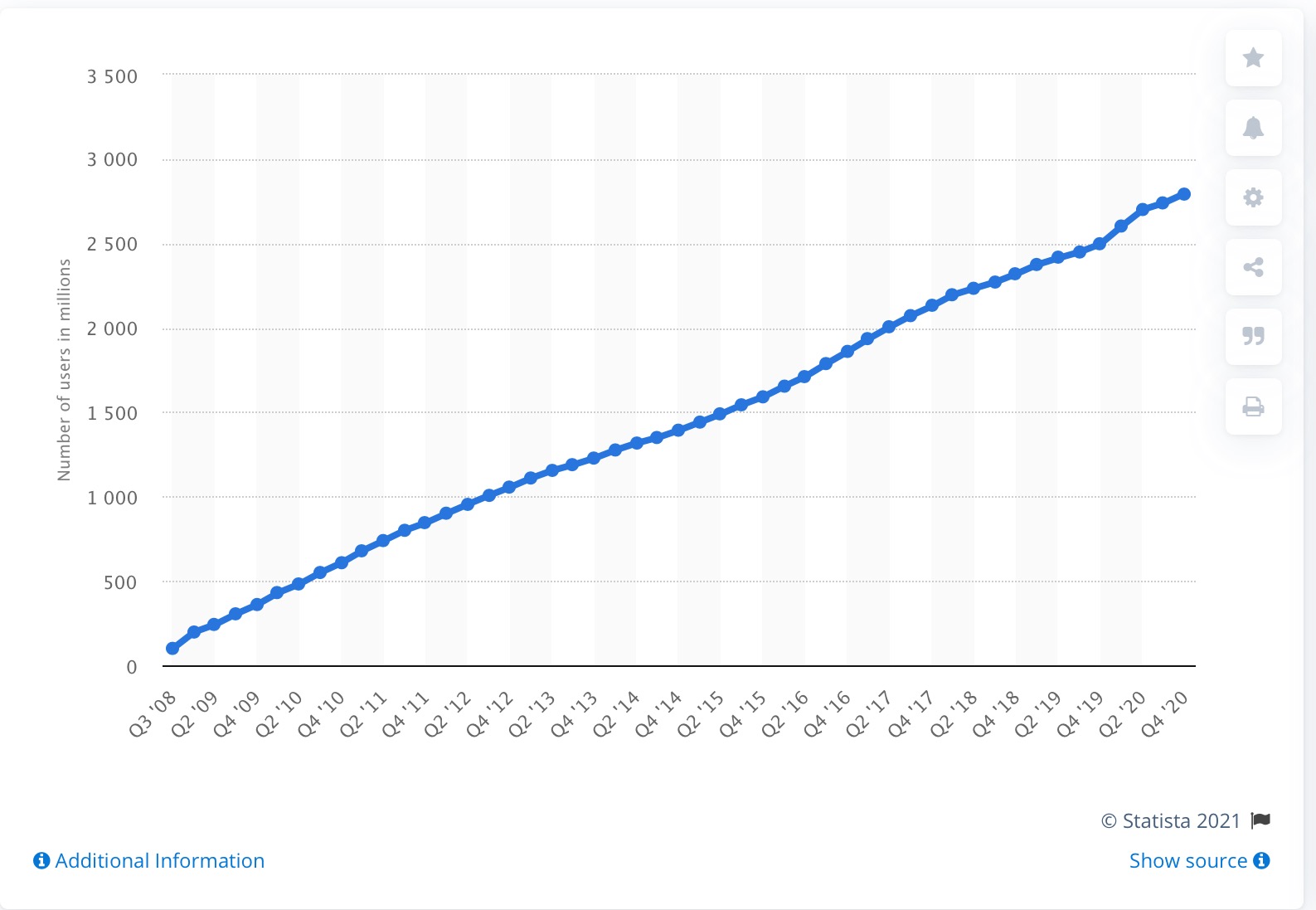
In 14 years they did almost nothing to counter it with their own version, by the end of 2012 they had passed 1 billion users, 5 years later they doubled that. (at https://www.statista.com/statistics/264810/number-of-monthly-active-facebook-users-worldwide/)
And the media sat on their hands, they sat on their hands to such a degree that now politicians are aiding the filtered information bringers to get some more undeserved revenue, in addition these same politicians did nothing to overhaul the tax laws, so how does that play?

As such why do they deserve that leg up? Oh and in this stage if the population is a solar system, planet earth becomes a system with planet Bing, planet IBM, planet Google, planet Facebook and planet media. In this planet media is mercury, scorched from being too close to the sun, Saturn and Jupiter are Google and Facebook, each with their own asteroids and moons, al having their own function, Mercury, like the media has no moons, no services to offer, merely a printed media solution, as such, how much protection did the parchment guild get when the news went to the pulp business? What was left for the paper mills?

The paper mill is a nice touch, I actually went to one, I saw how paper is made and we all go towards: ‘Yes, but that is now obsolete’, this is true, but in that same light, the media we see today made THEMSELVES obsolete. They did not apply the brakes when they had the option and the Leveson inquiry is merely one of a few examples. When one side of media becomes too populistic, people can no longer tell or differentiate, that made them obsolete and now that this is the stage they want to hang to any solution they can, even the ones that require legality, all whilst they hang freedom of speech and freedom of expression somewhere else so they can accuse others of negating their right to show that freedom of filtered information.

Another voice is journalism professor at City University New York Jeff Jarvis, he gives us (at https://pressgazette.co.uk/media-bargaining-code/) ““The Code is built on a series of fallacies. First is the idea that Google and Facebook should owe publishers so much as a farthing for linking to their content, sending them audience, giving them marketing. In any rational market, publishers would owe platforms for this free marketing, except that Google at its founding decided not to sell links outside of advertisements. The headlines and snippets the platforms quote are necessary to link to them, and if the publishers don’t want to be included, it is easy for them to opt out…”, he gave this yesterday, I was on that train a week ago. And as I see “if the publishers don’t want to be included, it is easy for them to opt out”, the ACCC was eager not to include that little snippet of the equation making them a tool and optionally a joke too. As such we might wonder what politicians are dong (apart from helping their media friends remaining a non-poor entity), I could be wrong, I could be incorrect. I believe I am neither and that is the stage we see, all whilst the bringers of filtered information continue their revenue round one more lap, that is until the race is called. I believe it was called some time ago, but that is merely me. I could be wrong.

Leave a comment

Filed under Law, Media, Politics

From drain to sewer

To be honest, I am not surprised. In this day and age of overruling greed and the lack of care I see a change and this change will set woe to Australia and its local brands. It all started with overly stupid shareholders and stake holders, who engaged greed driven politicians on prolonging the lifestyle that some would and should never have been allowed to continue. I am of course talking on those relying on journalism. This is not about the journalists, although they are not entirely without blame. The news was happy to side with a player who has less than 5% of the market. So they were happy to go towards a player who has a mere 1/20 slice of the advertisement cake, this was never about fair, or about realism. 

In the first when we see “Under the proposed bill digital platforms would be required to pay media companies for content” EVERYONE is ignoring the part where the media can decide not to be on the digital format, they can decide not to post their messages on Google Search or place them on Facebook. So why is it an option. It is like advertising on the Yellow Pages and demanding the Yellow Pages for payment for the privilege of showing these articles. The ACCC and a few other players were happy to ignore that part, in addition we see them ignoring the fact that some of these papers have articles that ALWAYS push the link to a payment portal. There is more, these greed driven silly people relied on Microsoft and their Bing flaw to take the forefront into staging the response of “both would have to better compensate news publications for displaying their content, as well as give outlets more information about their search and newsfeed algorithms”, in this, the stage of ‘better compensate news publications’ as well as ‘give outlets more information about their search and newsfeed algorithms’, in this Microsoft who only has at best 5% is eager to increase its market share, yet there is a reason that they only have 5% and the news is only getting worse. As Australia moves away from Google search, they are cutting their fingers in a few more places as well. As silly people are all about their personal gains and personal wealth, the idiots owning the media that they are demanding payment for are all in a stage that they never understood in the first place. The Conversation gives us ‘The old news business model is broken: making Google and Facebook pay won’t save journalism’ (at https://theconversation.com/the-old-news-business-model-is-broken-making-google-and-facebook-pay-wont-save-journalism-150357). There we see “The code is meant to help alleviate the revenue crisis facing news publishers. Over the past two decades they have made deep cuts to newsrooms. Scores of local print papers have become “digital only” or been shut down completely”, as such, we seem to overlook that the elderly owning news media (example the Murdoch wannabe’s) never understood the digital part. We optionally see this in “To understand why the commercial news model is so broken, we first need to recognise what the primary business of commercial news media has been: attracting an audience that can be sold to advertisers”, Google already has the audience and Microsoft wants them too, so silly people (optionally including the politicians) are setting a slippery slope and Australia is about to lose whatever global foothold they have. In this the silly people are clueless on the damage that will hit. 

This is seen in two parts, the first is “2021 Cloud Report from Cockroach Labs ranked Google Cloud Platform as the best-performing of the three major public cloud platforms, offering an impressive threefold advantage in throughput capability”, so not only is Microsoft out of options, they are severely outclassed by Google (and optionally IBM as well), a stage that is influencing a global stage that we see (at https://www2.deloitte.com/au/en/pages/consumer-industrial-products/articles/global-powers-of-retailing.html#), so consider the players that have some global visibility. Players like Wesfarmers, Woolworths and JB HiFi. All players that were until 2020 in the top 250, now consider that they are removed from that field. This is because Microsoft does not count on the global field, not with a mere 5%, 7% on the global stage, we get it that Microsoft wants it desperately, but the silly people never realised that the media is now influencing a stage where others will no longer count as well. It is the purest form of ‘Think local, act global’ it would sound nice, but it merely makes Australian brands no longer a global player, a stage that will make New Zealand the number one consumer target for Australian brands and wherever they are second place, they become obsolete. The ACCC should be proud of not comprehending the larger stage. And in all this as the Conversation informs us of “before 2000 print media attracted nearly 60% of Australian advertiser dollars, according to an analysis for the Australian Competition and Consumer Commission’s Digital Platforms Inquiry. By 2017 it was just 12%”, we see the initial folly, it almost reads like the setting of Alexandre Auguste Ledru-Rollin where we see ‘There go the people. I must follow them, for I am their leader’, but the media was never a leader in the digital media (or media for that matter), they were merely facilitators to shareholders and stake holders, as such ‘their’ people are already the population of planet Google and Microsoft wants to annex that population in any way they can. So whilst the ACCC is setting a Microsoft stage, the media is still clueless on what is required. As we see “the core of the problem is that funding such journalism through advertising is no longer viable. Other solutions are needed – locally and nationally – to ensure its survival”, it is the larger setting they all relied on advertisers, advertiser whores for a better reference, yet in all this the newspapers are all drowning most pages in advertisements, it is partial evidence of remaining clueless. The owners needed to act over a decade ago, that is seen in the decrease from 60% to 12%, a decade of decrease and nothing was done and now that they are desperate Microsoft steps in, they will save the day, or so they say but will they? They only have a 7% global penetration, they did this to themselves by forgetting that the consumer had become in charge to some degree, it is what Google wanted all along, they merely became the facilitator of whatever the consumer required and requested, the media does not understand as they think that they are the centre of the universe, but in a global setting with thousands of voices they are merely a discord in a choir at best. 

So as the small players listening to the media are throwing away whatever options they have to the media, the media is locally acting to fill its pockets, although they will not see it that way and Microsoft is in a stage where they gain 25,000,000 bing users. And in that stage where 5G passes Microsoft by, the Australians will see a decade of hardship with no future options at all. Well some players will proclaim in their presentations that this is not the case, but when their presentations run dry and when we get to 2023 and players like Wesfarmers, Woolworths and JB HiFi will no longer be on a top 500 list, at that point some people will wonder why they listened to the silly people. I can only hope that my IP is sold before that because the hardship Australia faces with no global audience is not one I hope to rely on, and when you realise just how dangerous this setting is, you will not want that either.

In this when you realise that the media pushed you to a room in the sewer with that view, will you finally realise that the media, their shareholders, stakeholders and advertisers have sold you a bag of goods whilst calling it ‘life on quality street’? Who will you hold accountable the moment you realise that?

Leave a comment

Filed under Finance, Law, Media, Politics

A political stage of nowhere

Less than an hour ago the BBC gave us ‘EU reveals plan to regulate Big Tech’, apart from the discriminatory nature of the stage, are they doing anything else than merely fuelling their own gravy train? Consider the news from last July, there we were given ‘Apple has €13bn Irish tax bill overturned’, a case that started in 2016, had Apple and the government of Ireland in a twist, when you consider “The Irish government – which had also appealed against the ruling – said it had “always been clear” Apple received no special treatment”, I am on the fence, and in this the European Commission wasted 4 years in going nowhere, in the light of that revelation, can we even trust the approach the EU has? When we look at the first option, we see ‘Online harms law to let regulator block apps in UK’, this means an almost immediate blocking of Twitter, Facebook, WhatsApp and a few more. Local laws have been ‘accomodating’ to large corporations for such a long time, that social media is caught in the middle (and yes they benefitted too), so they re now pushing for changes that end privacy, because that is a conclusion. If we hunt down the perpetrators, we need to coat the materials in identity revealing codes, in addition, the EU government will have to adjust laws to make the poster responsible for what they post and that will lead to all kinds of privacy adjustments (that does not worry me), yet when insurance companies will use that setting to see transgressions on social media and they demand adjustment by handing over the posted evidence, how long until people like Margrethe Vestager start realising that they were clueless from the start? The BBC article gives us “The law would give local officials a way to ask Airbnb and other apps to hand over information or remove listings”, which now puts some players on the dark-web and the chaos (and organised crime involvement) merely increases. For example, when we see “not use data gathered via their main service to launch a product that will compete with other established businesses”, how will that be proven and tested? By handing all data over to the government? How many frivolous cases will that grave train launch? How is it impossible to stop advantage seekers a stage where they use Margrethe Vestager and her gang of idiots to do the bidding of (optionally) organised crime?

Even though I spoke of the Accountability Act, a legal direction that could thwart a few issues from the start in June 2012, 8 years later and this group is hardly even on the track of resolving anything, only to get their grubby greedy fingers on data, the new currency. And in this, the tech companies have their own games to play as Facebook shows with “Apple controls an entire ecosystem from device to app store and apps, and uses this power to harm developers and consumers, as well as large platforms like Facebook”, what Apple does, IBM did for decades, what Apple does Microsoft did for decades, so where is that train station? So even as we see “And they may influence other regulators – in the US and elsewhere – which are also planning to introduce new restrictions of their own” we also need to realise that after a decade, the local and EU laws have done little to nothing to hold the poster of information to criminal account, it seems to me a massive oversight. And in all this there is no view that the EU will wisen up any day soon. 

So as I see it, this will soon become a political stage that goes nowhere and in all this these layers merely want their fingers on the data, the currency that they do not have. How is that in any way acceptable?

Oh and when we see the blocking of apps and localisation, how long until people find an alternative? An alternative that the EU, the UK and the US have no insight over? Will they block apps that interact with data centres in China, Saudi Arabia and optionally other locations too? I raised it in other ways in ‘There is more beneath the sand’ in 2019 as well as some issues in 2018, a setting that was almost two years ago, as such is it not amazing that we see a shortsighted approach to this issue, whilst I gave the option EIGHT YEARS AGO and the laws are still not ready? They are ready to get the data from Google, Facebook, Apple, Amazon and Microsoft, as such when the trial goes wrong, hw will these people be compensated for the loss of uniquely owned data, data that they collected over the decades? Will the stupid people (Margrethe Vestager et al) compensate per kilobyte? How about $25,000,000 per kilobyte? Perhaps we should double that? What will be the price and in this, we should demand that Margrethe Vestager and her teams will be criminally liable for those losses, or will the gravy train decide that it is a little too complex to hold one station to order, and let face it, that gravy train has 27 stops to make, all with their own local needs, their local incomes and their local digital wannabe’s.

When a setting like that goes nowhere, you better believe that there is someone behind the curtain pulling strings for their own enriching needs, that is how it always has been, as such, let me give you the smallest example from January 2020, there we see “‘DIGITAL CROSS-BORDER COOPERATION IN CRIMINAL JUSTICE’ CONFERENCE”, with the nice quote “The e-Evidence Project led by the European Commission, DG Justice and Consumers, provides for the e-Evidence Digital Exchange System that manages the European Investigation Order/Mutual Legal Assistance procedures/instruments (e-Forms, business logic, statistics, log, etc.) on European level. The Reference Implementation Portal is the front-end portal of the e-Evidence Digital Exchange System and is also provided by the EC”, yet this is only step one. In all this we can also include the EC (at https://ec.europa.eu/home-affairs/what-we-do/policies/cybercrime/e-evidence_en), where we see: “However, present-day solutions too often prove unsatisfactory, bringing investigations to a halt”, I get it, you will say, will this not resolve it? Well, consider “provide legal certainty for businesses and service providers: whereas today law enforcement authorities often depend on the good will of service providers to hand them the evidence they need, in the future, applying the same rules for access to all service providers will improve legal certainty and clarity”, in this we need to look in detail at ‘provide legal certainty’, which at present under privacy laws is a no-no, and the poster cannot be identified and cannot (and will not) be held to account. As well as ‘applying the same rules for access to all service providers’, still the poster remains out of reach and the local and EU laws have done NOTHING for over a decade to change that, as such, when we consider this, why should Google, Facebook, Apple, Amazon and Microsoft suffer the consequences, in addition we see the absence of IBM, why is that? Does it not have data collection software, it has data centres, it has cloud solutions, so why are they absent?

And in light of earlier this year, as we were told ‘Google starts appeal against £2bn shopping fine’, how will that end? The law remains untested in too many aspects, in this the entire data stage is way too soon and in that the blowback will be enormous, all whilst the EU (UK too) is unable to do anything about data driven organised crime, other than blame state operators Russia and China, consider the Sony Hack of 2011, I was with the point of view by Kurt Stammberger (before I even knew about Kurt Stammberger), North Korea lacks infrastructure and a whole deed of other parts. I also questioned the data, like “former hacker Hector Monsegur, who once hacked into Sony, explained to CBS News that exfiltrating one or one hundred terabytes of data “without anyone noticing” would have taken months or years, not weeks”, I even considered an applied use of the Cisco routers at Sony to do just that, all issues that North Korea just could not do and in that environment, when we see these levels of doubt and when we get “After a private briefing lasting three hours, the FBI formally rejected Norse’s alternative assessment”, which might be valid, but when we see a setting where it takes three hours to get the FBI up to speed, can we even trust the EU to have a clue? Even their own former director of German Intelligence, gave us recently that they did not fully comprehend Huawei 5G equipment, and they will investigate the data owners, al before the posters of the messages are properly dealt with? I think not!

Leave a comment

Filed under IT, Politics, Science

The speed of rumours

Yes, we have all heard of the speed of sound and the speed of light, yet have you heard of the speed of rumours? In this, I was amazed at how quick it actually is. On the 14th of November, I wrote ‘Outdated?’ (At https://lawlordtobe.com/2020/11/14/outdated/), and now, less than 9 days later we see the Guardian give us “State-sponsored hackers from China, Russia, Iran and North Korea are engaged in concerted attempts to steal coronavirus vaccine secrets in what security experts describe as “an intellectual property war”” and those are merely the ones they are willing to name, yet the larger stage is that ANY and ALL IP is under duress, if ownership can be reregistered, as such I see the need for a clear data vault, without it I am keeping my IP on the one system that never connects to the internet, is never networking and is never handed out of hands. It is (for now) safe. And all these so called data vaults in the Apple app store can reconsider what they are, because as I see it they are many vaults, but not really a data vault, what a surprise. 

So as we take notice of “The cyber struggle involves western intelligence agencies, including Britain’s National Cyber Security Centre, who say they are committed to protecting “our most critical assets”. But they discuss only a fraction of their work in public”, I merely wonder what our side is up to, with the US as broke as it is, with the media filtering what people are allowed to know, the issue is not who can we trust, but is there anyone left to trust? I know that this is not the way we tend to feel on Monday morning, but when will we feel ready? Even as the news is limiting the scope through “Adam Meyers, senior vice-president at the IT security specialists Crowdstrike, said countries including Russia and China had been engaged in hacking western companies and agencies “for the past 20 years””, I tried to bring you up to speed with with Hollywood and how easy they find it to reassign ownership, there are a few cases out there, and how protected were the original creators, Do you think that 5G IP is any safer? Do you think that given a chance, corporations are even hesitating to claim millions, of not billions? I cannot guarantee that Huawei would keep its word, yet would Amazon or IBM? Google has a larger disadvantage, this gets out and as such they would get a brain drain the size that could snowball into the greatest loss they ever faced. But the settings out there are not in favour of the average inventor and for some of us time is running out, making it public domain is all we might have, in that field the cheapest maker gets the largest slice and when that is out, they get hired for a nice fee and it is what comes next that gets the money rolling. It might be the only option for some. So when we are told “western governments remain reluctant to point the finger of blame in all cases of hacking attacks for fear of diplomatic repercussions, with the UK, for example, particularly cautious about accusing China”, I am wondering what the reluctance is, I am speculating that it is not merely governments, it is the large corporations directing some key people in those governments. The Financial Times gives us (at https://www.ft.com/content/26903a94-3617-11ea-ac3c-f68c10993b04) ‘Americans are wrong to paint China as an intellectual property thief’, as well as “Now that the US has reached the top of the ladder of tech supremacy, it wants to kick it away”. In all this, we take notice of “the US made the claim that China’s IP theft violated “public morals” prevailing in US society, while noting that such behaviour “may not offend China’s sense of public morals”. That allegation is both wrong and offensive. IP violations bring about civil, administrative and even criminal penalties in China, as well as in the US. China cherishes a culture of fair competition and respect for innovation. “To steal a book is an elegant offence,” has long been misread as a permissive aphorism peculiar to Chinese culture”, yet the setting is larger, when you do the Google searches on IP theft by the US you find none, only mentions of China stealing from the US and they tend to be opinion pieces and allegations, a lot of them absent of any level of evidence. It does not add up, there is no mention of the scripts that were ‘reacquired’ other events that I know happened do not get a mention, the setting is too unbalanced, and I do not trust any equation that unbalanced. Yet the article is failing in one respect, it does not show the imbalance that iterators versus innovator bring and that is important, Huawei is only the first of I reckon a dozen that can conquer others a dozen times over. It is the larger setting we face, because we face it now as the underdog, 30 years ago the lines were blurry, now we see that China has telecom, cars, motorcycles, an d many more, it is now the world’s leading manufacturer of chemical fertilisers, cement, and steel. A stage that remains growing in a time when the US and the EU are in a stage of mounting debts, a system of deranged stupidity and we are all idly sitting by, whilst the captains of balance sheets are setting another tone and in this we all get slammed, Some might say we are getting hammered, yet in the UK they will think we are merely getting drunk. Yet the Wirecard issues which is costing some $2,200,000,000 is merely the beginning of a larger stage and soon the players need whatever IP they can get, just to keep their heads above the water. And in all this thousands of inventors are trying to keep whatever they had secure, all whilst app stores are looking at data vaults and think it is to keep pictures safe by transferring them via a camera roll, yes really inventive move!

So what is being done (nation by nation) to keep IP safe? With 70% of the cloud getting hacked, I do not think that will be the place to keep them, but that is merely my idea.

Have a fun Monday!

Leave a comment

Filed under IT, Law, Media, Politics, Science

News, fake news, or else?

Yup that is the statement that I am going for today. You see, at times we cannot tell one form the other, and the news is making it happen. OK, that seems rough but it is not, and in this particular case it is not an attack on the news or the media, as I see it they are suckered into this false sense of security, mainly because the tech hype creators are prat of the problem. As I personally see it, this came to light when I saw the BBC article ‘Facebook’s Instagram ‘failed self-harm responsibilities’’, the article (at https://www.bbc.com/news/technology-55004693) was released 9 hours ago and my blinkers went red when I noticed “This warning preceded distressing images that Facebook’s AI tools did not catch”, you see, there is no AI, it is a hype, a ruse a figment of greedy industrialists and to give you more than merely my point of view, let me introduce you to ‘AI Doesn’t Actually Exist Yet’ (at https://blogs.scientificamerican.com/observations/ai-doesnt-actually-exist-yet/). Here we see some parts written by Max Simkoff and Andy Mahdavi. Here we see “They highlight a problem facing any discussion about AI: Few people agree on what it is. Working in this space, we believe all such discussions are premature. In fact, artificial intelligence for business doesn’t really exist yet”, they also go with a paraphrased version of Mark Twain “reports of AI’s birth have been greatly exaggerated, I gave my version in a few blogs before, the need for shallow circuits, the need for a powerful quantum computer, IBM have a few in development and they are far, but they are not there yet and that is merely the top of the cream, the icing on the cake. Yet these two give the goods in a more eloquent way than I ever did “Organisations are using processes that have existed for decades but have been carried out by people in longhand (such as entering information into books) or in spreadsheets. Now these same processes are being translated into code for machines to do. The machines are like player pianos, mindlessly executing actions they don’t understand”, and that is the crux, understanding and comprehension, it is required in an AI, that level of computing will not now exist, not for at least a decade. Then they give us “Some businesses today are using machine learning, though just a few. It involves a set of computational techniques that have come of age since the 2000s. With these tools, machines figure out how to improve their own results over time”, it is part of the AI, but merely part, and it seems that the wielders of the AI term are unwilling to learn, possibly because they can charge more, a setting we have never seen before, right? And after that we get “AI determines an optimal solution to a problem by using intelligence similar to that of a human being. In addition to looking for trends in data, it also takes in and combines information from other sources to come up with a logical answer”, which as I see is not wrong, but not entirely correct either (from my personal point of view), I see “an AI has the ability to correctly analyse, combine and weigh information, coming up with a logical or pragmatic solution towards the question asked”, this is important, the question asked is the larger problem, the human mind has this auto assumption mode, a computer does not, there is the old joke that an AI cannot weigh data as he does not own a scale. You think it is funny and it is, but it is the foundation of the issue. The fun part is that we saw this application by Stanley Kubrick in his version of Arthur C Clarke’s 2001: A Space Odyssey. It is the conflicting part that HAL-9000 had received, the crew was unaware of a larger stage of the process and when the stage of “resolve a conflict between his general mission to relay information accurately and orders specific to the mission requiring that he withhold from Bowman and Poole the true purpose of the mission”, which has the unfortunate part that Astronaut Poole goes the way of the Dodo. It matters because there are levels of data that we have yet to categorise and in this the AI becomes as useful as a shovel at sea. This coincides with my hero the Cheshire Cat ‘When is a billy club like a mallet?’, the AI cannot fathom it because he does not know the Cheshire Cat, the thoughts of Lewis Carrol and the less said to the AI about Alice Kingsleigh the better, yet that also gives us the part we need to see, dimensionality, weighing data from different sources and knowing the multi usage of a specific tool.

You see a tradie knows that a monkey wrench is optionally also useful as a hammer, an AI will not comprehend this, because the data is unlikely to be there, the AI programmer is lacking knowledge and skills and the optional metrics and size of the monkey wrench are missing. All elements that a true AI can adapt to, it can weight data, it can surmise additional data and it can aggregate and dimensionalise data, automation cannot and when you see this little side quest you start to consider “I don’t think the social media companies set up their platforms to be purveyors of dangerous, harmful content but we know that they are and so there’s a responsibility at that level for the tech companies to do what they can to make sure their platforms are as safe as is possible”, as I see it, this is only part of the problem, the larger issue is that there are no actions against the poster of the materials, that is where politics fall short. This is not about freedom of speech and freedom of expression. This is a stage where (optionally with intent) people are placed in danger and the law is falling short (and has been falling short for well over a decade), until that is resolved people like Molly Russell will just have to die. If that offends you? Good! Perhaps that makes you ready to start holding the right transgressors to account. Places like Facebook might not be innocent, yet they are not the real guilty parties here, are they? Tech companies can only do so such and that failing has been seen by plenty for a long time, so why is Molly Russel dead? Yet finding the posters of this material and making sure that they are publicly put to shame is a larger need, their mommy and daddy can cry ‘foul play’ all they like, but the other parents are still left with the grief of losing Molly. I think it is time we do something actual about it and stop wasting time blaming automation for something it is not. It is not an AI, automation is a useful tool, no one denies this, but it is not some life altering reality, it really is not.

Leave a comment

Filed under IT, Law, Media, Politics, Science

Warrior Women Librarians

Yup, it is about the Amazon tribe, the one that is managed by no one less than Jeff Bezos. They caught my eyes twice today (well once was at 01:34 roughly), so I decided to take another look. First the second story, it was an opinion piece in the New York Times called ‘Don’t Let Amazon Get Any Bigger’. The article (at https://www.nytimes.com/2020/10/08/opinion/amazon-antitrust.html) gives us “the evidence presented this week in a long report by the House Judiciary Committee, following a bipartisan investigation of the tech giants, tells a very different story. Amazon’s website forms a choke point through which other companies must pass to reach the market. It has exploited this commanding position to strong-arm other companies, control their means of distribution and drive them out of business”, I am on the fence here. In the first no one was interested in Amazon, now that they have traction everyone is crying foul. It’s like watching gangs cry like little bitches because they aren’t getting scraps, all whilst they forgot that in a library a 9mm is not of much use, a book on the Dewey Decimal Classification is. If I have a firm, I do not give wannabe’s access to my IP, if they do not have their own, they miss out, it is that simple, no matter what size I have. And for the longest time, we see certain firms getting called out, all whilst the grandfathers of this approach (Microsoft and IBM) are given leeways and passes on a non-stop foundation, or perhaps the whinging members of the House Judiciary Committee would like to have a deep conversation in the IBM dealing with NATO, its members and their system 36 (or was that their system 38) approach on ‘distribution’ in 1978-1980, I feel certain that former members of the Digital Equipment Corporation, as well as those of Hewlett Packard would like their day in Congress asking direct questions on certain non-outspoken choices. 

A small sidestep that has little (not nothing) bearing on Amazon. Amazon has grown, it has grown dramatically, but it was founded on the stage of an online bookshop. A dream the became a behemoth and Jeff Bezos does have some reason of pride. To be honest, I am not much of an Amazon fan, I have nothing against them and I see that there are places that benefit greatly of their presence, yet just like I prefer my local hooker, I am determined to support my local bookshop and local retail outlets, that is how I roll. It is the first article that I saved for last that has the larger frame of becoming an issue.

It is not the article I initially saw, yet ‘Yes, Amazon Luna dodges Apple’s cloud gaming rules — when will Nvidia and Google?’ (At https://www.theverge.com/2020/9/25/21455343/amazon-luna-apple-app-store-rules-cloud-gaming-streaming-google-nvidia) that is the larger issue. You see, it is not bout being naughty or about going rule dodging. It is seen in “Amazon Luna on iOS is not a traditional app. It’ll never appear in the App Store, and it doesn’t need to”, did you catch on yet? No? OK, let add “it’s a progressive web app (PWA), which is mostly a fancy name for a website that you can launch and run separately from the rest of your web browser. Engadget says it can even appear as an icon on your home screen, making it look like a normal app before you tap it”, I get it if you are still in the dark, so let continue the tory, The verge also had something I did not know before, they give us “Streaming games are permitted so long as they adhere to all guidelines — for example, each game update must be submitted for review, developers must provide appropriate metadata for search, games must use in-app purchase to unlock features or functionality, etc. Of course, there is always the open Internet and web browser apps to reach all users outside of the App Store”, so even as the Verge is wondering when Google and Microsoft will catch on, the larger danger remains. 

This for organised crime is a dream come true, and anyone denying or countering it is a blatant fool. A system the can reside in RAM and sets a stage of multiple systems is the holy grail. For the most as it was all system based, there was no real issue, if things did get wrong, one player is held accountable and it tends to end there, now there is a new stage where one system could open a gateway to basically rob you. Now, you are unlikely to lose a lot $1 at the most, so you might not wake up, but when this happens to well over a million players the amount tends to add up and organised crime (as well as entrepreneurial criminals) love that part, becoming wealthy as they sleep and when the system resets, the evidence is gone. No indications of long doing and the justice systems tend to not engage when the stolen amount is less than $5, so there is that, the interested parties could double their income overnight. But in the long term a person could lose $12-$50 over a year and they might not care or even realise this, but when this is done to 20-50 million people it all ends up being a serious amount of money.

A stage where we all watch things happen all whilst nothing will be done, the ego driven will Tate that it is under investigation, and deny wrongdoings, the secondary stage where some careful phrased denial in the some shape that gives us “We have seen no wrong by we are adding safeties just in case” and the jurisprudential parts that give us, it seemingly is a small crime and involved events of less than $5 the we do not investigate and the clever entrepreneur will walk away with millions upon millions of dollars, the is the stage and greed driven technologists thought they were allegedly clever by allowing a stage where a speculated stage of mis acquisition was an optional reality.

A stage the is increasingly dangerous because it is not merely Google, it I a sage where Epic Games, as well as any other set the stage of avoiding fees from whatever source they owe it to, only to set a much more dangerous stage, one the the cyber crime finals love and one the will all cost us, seemingly not a lot, but enough to make others wealthy beyond their dreams.

Leave a comment

Filed under Gaming, IT, Law, Science

A coin with 2 sides of greed

This morning started out alright, I was still pondering on what I had wrote yesterday and I still stand by it. Any voices on complexity are not dimmed, the issue is larger than I wrote about it, but to take the full scope makes the matter too complex, I was all about oversimplification, as that tends to show things, but it also polarises any view (including mine). This is what was in my mind when the news on Proton-mail and Andy Yen hit me. You see the moment any firm goes into some preaching stage of ‘App Fairness’ mode, the hairs in my neck tend to rise to the occasion. Now, those who read my blog regularly will have seen that I have no issue slapping the big boys silly whenever I can. So like the proverbial pitbull, I have had a mouthful of pants with Apple, Google, IBM and Microsoft logo’s and a chunk of their asses. No matter how big they are, I do not pull my punches (much more fun the way), so let’s have a look at Andy Yen, actually, let’s do something else first, it helps you to understand the station where I am at.

In 2008 Apple launched the App store, initially with around 500 apps. Apple saw in the early days the third party developers would bring home the bacon, but in those years it was not easy being a developer. Those developing for windows had well over a decade of experience and in those days the Software Development Kit would cost a developer $1500, with the additional programming packages and consultancy lessons. So ANY developer would be out of pocket between $3,000 and $5,000 and they would not have anything to show for it. The cost would drastically increase when the program was ready, but the was for another time. So in those days Apple got clever about it and gave us “To publish apps on App Store, developers must pay a $99 yearly fee for access to Apple’s Developer Program”, now consider the first setting of $99 versus $3,000, a new stage that allowed the dreamers and the wickedly clever to publish without a setting of some bulk investment and there was another part, “The income app stores take is 30%. Apple started setting that as a standard – they weren’t the first, but the iOS app ecosystem has been used as a model by many other players in the mobile app space”, now consider the you are a small developer, selling your software will need servers, protection software, shopping kart software, income checkers and go on from that. Apple delivered a system that does it all, so the developer will only need to upload their readied product. Thousands of dollars saved and the small developers get an almost free ride and they pay later through every sale. 

This is beyond fair, because the one million programs that came in the first decade would evolve, these people had a second option. They would sell their program for $0.99-$5 and Apple merely takes 30% of the sale, 70% remains with the makers and that contribution setting was already in play with software houses from the 90’s, yet those programs were often $299-$999. A mobile with the option of programs costing less than $5 are more easily sold and these makers suddenly made thousands of dollars, most of them massively happy. In that same light under Microsoft these developers would never exist. The cost of being up and running would strip all revenue away. As such Apple (and Google too) would create a wave of people creating the thousands of dollars to fuel the system would basically be paid for by the more successful players in this field.

So when I see the headline ‘Why we joined the Coalition for App Fairness’, I merely see a greed driven non-truth that is (as I personally see it) fuelled by greed.

So now the you have some of the background, we see the real deal, people like Epic Games and Proton-mail, they had an idea and they used that system to get ahead, which is nice for them, yet now, now that they made it, they want to avoid fees, they want the 30% that they initially signed up for as well. It is basically the same with Epic Games, once they made the numbers, their success went to their heads and they are now fishing (or is that phishing) for the 30% they signed up for? They want to avoid the apple fee and for one player it makes sense, yet this system was designed so that the small players would get a chance to become big, a stage that many faced. So when I see these ‘displays of fairness’ I merely see greed driven players merely wanting more.

The setting is however larger. The quote “First, to be clear, our mission at Proton is to foster an open, free, private, and secure internet. We exist today because a large community of people agree with these goals and support our work. Helping to found CAF does not in any way signal a deviation from these core values. Proton will always remain fiercely protective of our independence in order to put user interests first” gets to be ripped to shreds when we see “to foster an open, free, private, and secure internet”, yes they do have a free option, but it is limited, which might be fair enough, their goal is to be ready for the 4.00 € and 24.00 € a month users, whilst their free accounts are limited, the paying ones are driving this and so far they got 10 million people in their accounts, I am not aware how many constitutes free accounts.

Another point was “Our purpose for joining CAF is not about advancing the goals of Spotify and Epic, but about making sure that you, our community, have a voice in this important debate”, is the so? I find it debatable, for the simple reason that we are also handed “ProtonMail is run by Proton Technologies AG, a company based in the Canton of Geneva, and its servers are located at two locations in Switzerland, outside of US and EU jurisdiction”, whilst this sounds nice, outside of jurisdictions comes at a price and one could argue the organised crime finds the approach appealing, as do some people the want to avoid data accountability, but for the most, I am on the fence of how reliable data safety outside of jurisdictions tend to be (I am not making any statement on the security they run). So the app store has them as a free app, which implies that they are free, but they offer ‘Offers In-App Purchases’, and their own Twitter account gives us “We actually don’t understand the significance of paid account here? ProtonMail doesn’t offer in app purchases on Android, so purchases need to be made through our Swiss website”, and there is the kicker, they want it via their own website to avoid the 30%, exactly how Epic Games set it up, once they have the foundation of users, they want to avoid Apple (and/or Google) fees. 

I need to admit that Andy Yen is in a slightly different setting (as is Epic Games). You see, he started with the backing through kick-starters and ended up with a beginning capital of $500K, 5 times of what they needed to get started, a lot do not have that option, which I admit is not the stage that Andy Yen cares about (yet he claims the opposite), we get it, but when we see ‘a better internet that puts people first’, we need to realise the this was exactly what Apple did (Google too), by setting the contribution cycle almost EVERY developer had their chance at stardom, and whilst we see ‘free app’, how many people would have taken it up when the app had to be bought at $9.99, or $19.99? You forget that if we avoid the contribution cycle, we see the the funds need to be found somewhere, do they not? You really cannot get it both ways and for the most the contribution cycle is the most fair, because it is only taken from actual sales, so the newbies get to be there for free or for nothing (or both), and the big players basically pay for the little people.

Consider that and the fact that there is a price for being able to chose from 1.75 million app on a store. If that setting did not exist these store would end up having well over a million apps less. And this year, in the covid year, there is suddenly the need to avoid paying because the investors need to be appeased. As I personally see it greed is the final equaliser against choice, because these players want to be the only provider and the current stage allows new developers deploy their system, optionally a real innovative one, but they get a to because the costs of starting are not there, not like it was anyway.

Happy now?

Leave a comment

Filed under Finance, IT

EU fart bit, Google Fit Bit

Yes, we leap left, we leap right and as we see options for choice, we also see options for neglect. In Reuters we see “Google’s parent company Alphabet agreed a $2.1bn (£1.6bn) takeover of the wearable tech firm last year. However, the deal has yet to be completed”, we see that at https://www.bbc.com/news/technology-53647570, and as we see the BBC article, we wonder about a lot more. Yes we acknowledge “While the European Commission has said its main concern is the “data advantage” Google will gain to serve increasingly personalised ads via its search page”, and in the matter of investigations we see:

  • The effects of the merger on Europe’s nascent digital healthcare sector
  • Whether Google would have the means and ability to make it more difficult for rival wearables to work with its Android operating system.

From there there are two paths, for me personally the first one is Competition Commissioner Margrethe Vestager, to be honest, I do not trust her. I will admit right off the bat that this is personal, but her deal relying on what was requires her to get a win, any win. The setting is founded on “officials acknowledge that the EU’s competition enforcer faces hard choices after judges moved to quash her order for the US tech company to pay back €14.3bn in taxes to Ireland”, which was a juridical choice, but in all this she needs a win and I reckon she will do whatever er she can to get any of the FAANG group. For the most I would be on her side in the tax case, but on the other side the entire sweep of the Google Fitbit leaves me with questions.

The first point is on ‘effects of the merger’, so how is this in regards to the Apple Smart Watch, the Huawei smart watch (android), and a few other versions, how much investigation did Apple get? How much concern is there for Huawei? Then we see the second part ‘Whether Google would have the means and ability’, it is not a wrong position for Margrethe Vestager to take, but as he does it upfront, in light of the EU inactions regarding IBM and Microsoft, it seems weird that this happens upfront now (well to me it does). And as we see ‘difficult for rival wearables to work with its Android operating system’ I see Huawei and the solutions they have, Android solutions no less, so why is Google the problem? 

Then there are two other parts. The first one is “Analysts suggested part of the attraction for Google was the fact that Fitbit had formed partnerships with several insurers in addition to a government health programme in Singapore”, the second one is “Google has explicitly denied its motivation is to control more data”, in all this there is less investigation in regards to what data goes to Singapore, or better stated the article makes no mention towards it, and as I see it, there is no mention on it from the office of Margrethe Vestager either. The second part is how Google explicitly denies its part, yet that denial does not give us anything towards the speculated “its motivation is to have access to more data”, and when you decide on a smart watch, data will end up somewhere and the statements are precise (something that worries me), I have no issue with Google having access, but the larger issue is not Google, it is ‘partnerships with several insurers’, the idea of privacy is not seen remarked upon by Margrethe Vestager and her posse of goose feather and ink-jar wielders, the focus is Google and is seemingly absent from investigations into Fitbit pre-Google in an age where the GDPR is set to be gospel, so who are the insurers and where are they based? Issues we are unlikely to get answers on. Yet when we consider “John Hancock, the U.S. division of Canadian insurance giant Manulife, requires customers to use activity trackers for life insurance policies in their Vitality program if they want to get discounts on their premiums and other perks”, so what happens when that data can be accessed? Is the larger stage not merely ‘What we consent to’, but a stage where the insurer has a lessened risk, but we see that our insurance is not becoming cheaper, there is the second stage that those not taking that path get insurance surcharge. So what has the EU done about that? We can accept that this is not on the plate of Margrethe Vestager, but it is on someones plate and only now, when Google steps in do we see action? 

So whilst the old farts at the EU are taking a gander at what they can get, I wonder what happens to all the other parts they are not looking at. Should Google acquire my IP, with access to 440,000,000 retailers and well over 1,500,000,000 consumers, will they cry murder? Will they shout unfair? Perhaps thinking out of the box was an essential first requirement and Fitbit is merely a stage to a much larger pool that 5G gives, but as they listened to the US, they can’t tell, not until 2022, at that point it is too late for the EU, I reckon that they get to catch on in 2021 when they realise that they are losing ground to all the others, all whilst they could have been ahead of the game, lets say a Hail Mary to those too smitten by ego. 


Leave a comment

Filed under Finance, IT, Law, Media, Politics

What light is the limelight

We all wonder at times why certain matters are brought to attention, we now automatically assume that issues are revealed to seat the limelight, not merely TV and other media, the press is seen in that same way. It is not that we are bombarded with fake news, there is now the assumed feeling by many that the media is giving us fake news (they tend to call it direct and speculated views from experts). 

This view is supported (to a degree) by Al Jazeera who gave us “Long before “fake news” had a name, the BBC was a master of fake news, in fact fake news of the most dangerous, the most vicious consequences, casting nations, not just individuals, into direct calamities”, they did so in November 2018, they also give us “The role of BBC in the overthrow of Mosaddeq was not out of character or unusual. In a piece titled Why the taboo tale of the BBC’s wartime propaganda battle must be told published by The Guardian, David Boyle writes about characters like Noel Francis Newsome (1906-1976), who “as director of European broadcasts … led what is still the biggest broadcasting operation ever mounted, in 25 different languages for a total of just over 25 hours a day, across three wavelengths.””, in this the BBC does not stand alone, there are scores of producers that have had the ear of their governments. 

The problem now is that the media is flaunting the #Fakenews items and procrastinate on what they regard on what is fake news, yet they themselves have been heralding tweaked news and scores of misinformation through either omission or ‘non disclosed sources’ and the people have caught on, they have caught on for a while, so whilst they disregard newspapers, they embrace another level of debatable news that others publish on social media. 

And everyone is seeking the limelight, yet the most obvious question becomes slowly apparent to some, what sort of light is the limelight? And what sort of light was it supposed to be?

That is the question, in people like Freddy Mercury and David Bowie got to be exposed to the purest form that was discovered in 1837, at that point we had: “limelight was used for the first time to illuminate a stage, at London’s Covent Garden. During the second half of the 19th century, theaters regularly utilized this powerful form of light, which could be focused into a beam to spotlight specific actors or an area of the stage”, the stage was set to illuminate and give visibility to, in this case titans of music. In other forms we see the pink limelight, which in this case is not a version of ‘La vie en rose’, it is a version to make softer the harsh reality of a situation that we face, we see it whenever the limelight needs to be on Iran, we see it when bad news must be tempered for the good of that government or for the good of the political needs of THAT moment. In this stage we also need to see the omissions of news and I am not buying the usual ‘we ran out of space’ BS all whilst digital space costs nothing and any additional space implies more advertisement space too. Some might have noticed on the massive lack of reporting whilst Houthi forces (via Iran) were firing missiles on the Saudi government. To merely quote one of the (many) sources “When important news is omitted, we get a skewed or biased perspective”, as I see it, the Saudi example shows a few issues, as the larger lack of reporting was shown, right around the time several governments were setting the stage of no weapons to Saudi Arabia. And in all that mess, the lack of reporting on the actions of Iran take a larger view and we need to do that. We see a global stage that is changing, whilst a group of politic Ians are setting the stage based on their egotistical needs, and that group is getting too large, all whilst the political field of the US is dwindling down and European politics is getting a dangerous overhaul. In this stage of changes, some have figured out that a new way of setting the tone of news is not changing the story, it is adjusting the limelight. As I see it it will open differently across forms of media, but the readers will have a lot more issues to distinguish between news and fake news, you see, there will be news, adjusted news and fake news. The problem is that all have a professional looking character, yet the impact differs. It gets us back to the 90’s when the 256 greyscale solutions came, but the setting is an important distinguishing one. We cannot distinguish these 256 grey scales. Our eyes are not that good, and our brains are even less distinguishing, as the overlap between real, adjusted and fake messages increases, our ability to distinguish becomes a larger issue. In this a personal view is that there is a correlation between phishing and adjusted news. It becomes harder, if not close to impossible to see the difference. I almost fell for two phishing attacks, even as I knew what to look for, the message was indistinguishable from the real deal and news is going the same way, the media relying on ‘adjusted news’ is not helping any. The one clear part (from factcheck.org) is “Not all of the misinformation being passed along online is complete fiction”, the question is when does it become too hard to see the difference between a story that is not ‘all fiction’ and a story that is not ‘all true’. When can we no longer tell the difference? And as some come with the treated excuse ‘Is there not an AI solution?’, the stage becomes rather large, because AI does not exist, not yet at least. You see, the salespeople are selling AI, because it is marketed at all, just like the 80’s when printers had to be sold, they came up with Near Letter Quality. Wit AI we now have True AI: “True artificial intelligence is autonomous — it does not require human maintenance and works for you silently in the background” and there we see the problem, the identification is still done with human intervention, and the part in this that I did not report on is that AI, or perhaps more clearly stated True AI requires to be learning. That is not yet possible as it requires quantum computing with shallow circuits. IBM is close to getting it, but not completely there yet, only when that is ready, complete and true AI becomes achievable. So whilst that stage is still evading us, the issues of adjusted and fake news keep on going. Yet I am concerned with the question “What is the light they use as limelight?”, in this we consider it as we need to contemplate that news should not change when WE change the light, so real news will remain  the same whether it is rose or lime light, adjusted news will change slightly, but perhaps just enough for us to see the difference. It is speculative, but I believe that it is a future option.


Leave a comment

Filed under IT, Media, Science