Tag Archives: Wall Street

Clueless to the end

That is quite the statement is it not? The question that follows is is the writer clueless (aka me) or the presenter of certain statements (aka Peter Dutton, current Home Affairs Minister). I will leave that to you as I am merely presenting the facts as I see them.

It all started on a simple Wednesday (2 days ago) when I was confronted with the statement ‘Coalition calls on Google and Facebook to get on side with encryption bill‘, just another political yada yada moment and I was about to ignore it and more to the next page when I noticed ‘the internet giants have a responsibility to help combat organised crime‘, which woke me up nice and widely. So the article (at https://www.theguardian.com/technology/2018/oct/10/coalition-calls-on-google-and-facebook-to-get-on-side-with-encryption-bill) gives us: “Australia’s law enforcement agencies have been prevented from infiltrating paedophile networks and other organised crime groups because the messages they send over encrypted electronic messaging services, such as Wickr and Whatsapp, cannot be intercepted by authorities“, in light of Australia being America’s minion in the anti-Huawei activities is admitting that mere app decryption is beyond their ability? And they have the loudly shouted notion that Huawei is a 5G risk whilst ‘basic’ skills are not in their arsenal? Apart from making a case that Huawei is now basically a political fuelled exploitation game and a setting of bias (and optionally nepotism), we are interested in learning that certain skills are beyond Australian Intelligence. I am certain that Paul Symon, Mike Burgess and Duncan Lewis would have been delighted to learn of this revelation via the Guardian, but that was merely comical relief anecdote, let’s get down to the brass of it all.

We get to see the first part in “He said a new report from the Australian Institute of Criminology, released on Wednesday, estimated the cost of serious and organised crime in Australia in 2016–17 was between $23.8bn and $47.4bn, and showed how sophisticated internet-based crimes can be“. So as we take a look at that report (attached), we take a first look at the end (just like any detective story, starting at the end we see the revelations we needed to see if the story adds up). So there we see: “This paper sought to estimate the cost of serious and organised crime in Australia for the 2016–17 financial year. It was not possible to undertake new empirical research to provide more accurate baseline data to support the estimated costs, so in most cases uprating using the RBA (2018) inflation calculator was used in conjunction with the most recent reported crime statistics to assess the prevalence of the various crime types examined“, which gives us another part. The first is on page 3 where we clearly see (in bold) ‘$31.5 BILLION for the cost of serious and organised criminal activity as well as the serious and organised component of conventional crimes‘, so now we see in opposition an amount against ‘between $23.8bn and $47.4bn‘, which I admit remains a truth, yet when we do the math, we see $15.9B for prevention and $31.5B for the so called organised and serious criminal activity, which gets us to $47.4B. At this point we could surmise that Peter Dutton passed his basic math test, was it not that the same page 3 (just like in the Sun, for the longest of times) gives us an additional $8.6 on organised Fraud (debatable), and $6.5B, $9.6B, $4.1B and others adding up to almost $2.7B, so in total we have the $31.7B, yet here is the problem, the individuals cannot clearly represent 100% of organised crime. We are now getting to the miscategorised and the miss set properties of certain players, which also deflates the issue. It becomes a larger setting when we consider the ABC, who reported in May 2017: “the Australian Cybercrime Online Reporting Network, and the reported losses from online scams across the nation come in at around $300 million“. So here we get the second part. We see ‘online scams‘ and I am willing to accept that, yet against ‘PURE CYBER CRIME‘ the question becomes what is what and where are the definitions and this gets us to page 18 where we see: “It extends the conventional understanding of organised crime groups by adding all serious crime of an entrepreneurial nature or committed to support a criminal enterprise, whether by a group or an individual“, now the entire setting changes. It optionally includes all the entrepreneurial naughty people in places like Wall Street does it not? Good luck getting anything done at that point!

Then we get to the illicit drug activity. Now, I am not debating the number overall. I do not have the data to do so, yet consider the part on page 10 where the three costs are included namely Medical costs, Lost Output and Expenditure on drugs. The items are fine, it is how you set your filter, I get that, yet in all this when we consider the numbers and the setting whilst we also have been treated to the longest time to those individuals in caravans in the middle of nowhere making their acid/ecstasy junk. So when we look at Methyl​enedioxy​methamphetamine (MDMA), we can see that it is a serious crime and that we are given a dangerous setting, no one denies that, yet in all this, those singular people who do something with gallons of cough syrup (as It was presented at one point) we should also see that at this point that Peter Dutton had all the elements added together and presents it like a Ponzi scheme, or should I say that it looks like an Amway sales presentation (the one I saw at least)? You know, the one where someone states ‘replicate, don’t reinvent‘ it is a good sales pitch, no one denies that, and it is here that we see the flaw and failing of Peter Dutton.
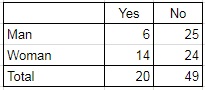
You see his presentation adds up ‘perfect’, these numbers add up, whilst a millennia of history shows us that numbers never add up, not in any criminal enterprise; to do that I have to teach you a little data basic. The best comparison is the use of a cross tabulation. Let’s take gender and shoes. For example we see 6 men and 14 women bought shoes. We also see that 24 women and 25 men did not buy shoes. So far we get the table on the left, yet now we also get the setting that a cross tabulation will not deal with.

For example the fact where we know that shoes were bought, yet the gender is unknown or we see a gender reference and that something was bought, but we cannot see if they were shoes. These are called missing values and they will not show up in that cross tabulation and there we see the first part. It gives us the setting of crimes but not by whom, they are serious in setting but that is not enough is it? You see Peter Dutton gave us ‘help combat organised crime‘, yet not all serious crime is done by organised crime and now we have a $47 billion dollar question and in addition the failing that we are now introduced to is a much larger failing. In this we now see that we saw in the beginning when we went to the end of the story. It is seen with: ‘estimated the cost of serious and organised crime‘ and that is not enough. We could argue that it should be, we can argue that (the amount involved) is way too big, but the setting is not merely that Tech companies should ‘help’, it is the prosecution setting. The setting that there is too much junk attached and the prosecution will fail in the bulk of all those cases because the evidence relies on loaded and unproven data. It is the part that we have faced for well over 7 years. The court barristers will give every jury the speech of authentication versus non-repudiation and the second one cannot be proven (in most cases), so we end up not merely not having ‘beyond all reasonable doubt‘, there will be a high and likely chance that the courts will not even be able to prove ‘on the balance of probabilities‘ or ‘is it more likely than not‘ and it is here where we see that Peter Dutton could be optionally wasting millions upon millions of costs to set the stage of presentation that will have little to no results and that is a much larger problem. The additional play is that any smudging of any presented evidence will give us the stage that a case will be thrown out of court, how is that helping anyone?

So whilst we ponder this, we need to review the statement “And it should be noted the same companies who protest about having to help police with the encryption problem, operate their business in less democratic countries and accept a compromise on privacy to allow their presence in those growth markets“. We are not those countries are we? so at this point, we get the impression that Peter Dutton is merely a minion for the intelligence services who according to him were unable to ge to places in the first place, which implies that certain players have much larger problems and the serious cirme part, which is not on their plate is already beyond them, so there!

At this point we get to the final part where we see: “It is important that tech firms understand and embrace their responsibilities to the community that has helped enrich them“, I actually do agree with that part, yet that should be set in taxation law. A flaw that I reported on yesterday (at https://lawlordtobe.com/2018/10/11/taxation-solved-the-old-way/) which I charmingly called ‘Taxation solved the old way‘ (pun intended). So when we now consider the biggest organised crime master in Common Law (Al Capone), who funny enough got scuttled not by crime fighters but by tax laws. How we get to relearn the lessons of old, do we not?

It gets us to the quote: “Currently our police and intelligence officers who have a warrant may be able to covertly recover an email or a photo or other evidence of a crime from someone’s computer, but they can’t crack encryption, which is why it is now being exploited by criminals“, so these are criminals and not organised crime. Or in a simplistic setting that every square is a rectangle, but not every rectangle is a square. It is at that point that I will teach Peter Dutton the one lesson he never learned (optionally he merely forgot the lesson).

Consider: “When sarcasm bounces it is merely irony“, a lesson that has a much wider application that the honourable youthful young Dutton might not have contemplated yet. However, we have to consider he was only reappointed his seat on August 24th, so he has time to settle in. And the lesson does not end, the second part of the lesson is not from me, it comes from Lizzie O’Shea who gives us: “they were united for the first time in their opposition to the government’s encryption bill“, when we see united tech giants, how short sighted was this encryption bill in the first place? It gets to be a larger issue when we add the setting from World Animal Day (pun intended) when we see the two parts “Telstra has won a $8.2 million contract with the Department of Foreign Affairs and Trade (DFAT) for the landing of the Coral Sea Cable System” and “Chinese technology giant Huawei was originally set to build the 2.5TB-cable linking Australia to the Pacific island nation back in July 2017. However, following concerns that Huawei’s involvement posed a security risk, the Australian government stepped in to fund the multi-million-dollar project from its foreign aid budget“, whilst clear evidence has never been presented and in that stage we see optional nepotism and ego and not fact and science based solutions. We are supposed to trust any of the reporting parties on any of this? The articles are different on different settings, yet the entire mess as it is now shows a much larger failing and a setting of doubt, not one of justified confidence and in that we see the second part of the reason why the tech giants are uniting. A certain play performed by adjusting to the notion of stupid and short sighted whilst the captains of industry have been getting their A-game in gear and others never did. It is merely another stage of the impact of iterative exploitation and profit founding, that whilst Huawei, Google, Apple and Samsung are no longer going iterative, they are now making larger leaps over the next 5 years as they want the largest slice of 5G pie possible and in an iterative setting the others can catch up and that is where we see the clash, because these hardware jumps will also prevail in software and data jumps and some players are in no way ready to play that game. That is where this so called balanced report strikes out as well. this is seen on page 21, where we see: “Because information and communications technologies are used widely throughout society and are instrumental to government, business and consumer activities, there is considerable overlap between the estimated costs of cybercrime and the costs of other crime types— particularly economic crimes, banking and financial crimes, transnational crime, online commerce and internet-facilitated crime such as consumer fraud, online dissemination of child exploitation material and intellectual property infringement“. You see in that stage we see the mention of ‘economic crimes, banking and financial crimes‘. Here we see that Financial institutions and Wall Street come into play (perhaps ‘entrepreneurial bankers’ is a much better term). This is not organised crime because Wall Street never committed any crimes did they, yet they are at the centre of a group of people in that classification are they not? And there we see not merely the adaptations of block chains, we see that organised crime will go there (as soon as they possibly can) whilst the bulk of all the players will not be ready and any encryption bill will hinder the progress of new technology as other players are not anchors of stability, they are concrete blocks of deceleration, another part not considered in any of this.

So yet, the tech companies are uniting and there is a second part in all that. When they strike a deal with Saudi Arabia and set a large part in the city of Neom; when Saudi Arabia accepts certain concessions towards the FAANG group? I personally believe that as soon as the benefit is clearly shown to the rulers of Saudi Arabia and the headway that they could make, they will adjust whatever they can according to Islamic Law, and at what point will governments realise that their only option of control will be isolation and a loss of economy? We are not that far away from that point. Even as we were told yesterday “A senior executive who works for Google’s parent company and a former US secretary of energy have dropped out of a Saudi Arabia tech and business advisory board following international outcry over the disappearance and alleged murder of a dissident Saudi journalist“, yet as Google cloud picks up more and more banks, how long until they reverse the setting? In this the Financial Times also gave us (a day earlier): “A radical blueprint to transform Saudi Arabia through socio-economic reform and ambitious development projects is persuading banks to return to Riyadh“, so at what point will we realise that Saudi Banking is growing and that all players want them as customers? It all boils to dollars and crime is merely a cost of doing business. It is that side that shows the missing data part (going back to the cross tabulation comparison). Corporations have always been about the privileges that come with a certain network and the most facilitating one is the one they will choose, that is in the heart of the flaw that I saw regarding Peter Dutton’s claims here. A bill that stops facilitation and stops optional business on much more levels, as banks need to show more and more profit. The greed driven business model will always be destructive in nature, learning that lesson 10 years ago would have made a difference, now it no longer will.

That is part of the heart of the “$40bn of foreign money is expected to flow into the stock market as a result of Saudi Arabia gaining MSCI emerging markets index status next year“, that against a flawed encryption bill, it was a bad play, played even worse on the surface of all the facts shown and I did not even bother going all the way when it comes to the initial ‘sought to estimate the cost‘, it almost reads like ‘the lady gains weight and we are trying to determine whether she is pregnant, or if she really likes pizza‘, how was that ever going to go? Perhaps asking her: ‘Have you been screwed (over) lately?‘ It could give you a truth and a lot more non-truths. That is the problem with data, whilst moulding data in one direction, you tend to open a door in another direction too, I learned to see and seek those doors, oh and that is before we consider the estimates and the application of weights to a data file, which I do not know whether it happened. this we should have consider with the statement on page 2 ‘Where data were not available for this period, the Reserve Bank of Australia (RBA) (2018) inflation calculator was used to uprate estimated costs from earlier periods‘, the part ‘uprate estimated costs‘ would have gotten us that part, also the fact that it is not data merely a ballpark idea on what the data could be, it is not the same, is it?

 

Leave a comment

Filed under Finance, IT, Law, Media, Military, Politics, Science

A haircut before the guillotine

That is how we sometimes see life. We are all dressed up, all ready, smooth shave and a decent look, all on route to the main event where we are the guest of honour at a dinner party hosted by Joseph-Ignace Guillotin. Yes, we are the person on the chopping block. When death is all you look forward to, the way getting there will mean the most to anyone.

So out comes the master of coiffure, to make sure that the shave and the haircut were done to levels of excellence that you never considered before. Master tailor Marc de Luca will come and see you to make sure that the suit is one that Versace will look at with utter envy, the people on Saville Row will look with utter amazement on just how perfect a suit can be, because you must look your best on route to that once in a life time dinner party with Joseph-Ignace Guillotin, all the elements mattered the most on this one day.

So there is the setting you see when we consider ‘EU says Greece can ‘finally turn the page’ as bailout ends‘. The article (at https://www.theguardian.com/world/2018/aug/20/eu-greece-bailout-ends-pierre-moscovici) gives us “Greece has turned the page to become “a normal” member of the single currency“. Yes in that regard it is nice to know that a mental health setting of ignorance when it comes to the economy, is still riding high with too many individuals. I mentioned it over 3 years ago in the article ‘Dress rehearsal (part 1)‘ (at https://lawlordtobe.com/2015/07/01/dress-rehearsal-part-1/), where I stated ““Greece would face an unsustainable level of debt by 2030 even if it signs up to the full package of tax and spending reforms demanded of it, according to unpublished documents compiled by its three main creditors“, the reason that I call it questionable, is because Greece is what I call a 3G nation, which means it will take three generations for this debt to become close to manageable. So, with that I imply that the debt is still a massive form of pressure in 2061, there is no escaping it“. That part we now see with “Greece has the highest government debt in the EU, 177% of gross domestic product, and is forecast to be repaying loans until 2060“. WOW! I was off by one year and that was me using my fingers and an abacus over three years ago. Now we see that it will be all done by 2060, which is actually not a certainty. I took a few setbacks in consideration that are likely to be missing here, so considering that this started 8 years ago, we see that in the end it will take another 42 years, making my ‘three generation‘ prediction spot on. Yet the good news is not yet done. When we consider that the debt is 177% of gross domestic product, the fact that youth unemployment remains at 43.6%, as well as a few setbacks, there is merely one stupid act of starting another bonds plan and it all goes south really really fast.

The first is that with “Athens will face more exacting checks than any other Eurozone member, so Brussels can monitor whether the government’s budgets are in line with EU stability and growth targets” Greece will still be bound by some factors. The setting is a given if Greece decided to try the Goldman Sachs strategy again, the future will start to look extremely dim again at that point, with little to no hope on resolving it ever. There will always be politicians that play the fast and loose card whenever they are in a pickle, which will soon thereafter become the ‘fast and lose‘ scenario, especially for the Greek population.

Even now we see the quote: “Many analysts believe it will take a decade before Greece returns to pre-crisis living standards following a slump in which its economy contracted by 25% and unemployment peaked at 28%“, I am not convinced that it will be that quick. It might be if serious investors can be found to pump up the Greek economy like a Google space, an Apple hub and an IBM data centre. Those steps will be a turn for the good for Greece, but without a really large player opening the field, Greece keeps on lagging behind and a decade will not be enough to set the economy back on track to the pre-crises degree stated. Furthermore, there is the consideration of “levels of extreme poverty jumped. The population has fallen by 3% because of emigration and a lower birth rate“, you see, the levels of extreme poverty also slows the recovery setting and the loss of population will not merely mean that there are less jobs required, it also means that a continuation of certain aspects can no longer happen. So the setting of parent to child implies that more and more businesses die over time lowering the GDP further, which in turn shoves the debt up by 5%-10% more than previous. So it is not the percentage, it is the €336,900,000,000 that is due its interest and that amount is not shifting merely due to the shifting GDP percentage. It is rising because 336 billion implies 6-9 billion euro of interest a year and with a population of less than 11 million, whilst we get the slightly over enthusiastic “By 2023 unemployment is forecast to fall to 14%“, yes, I’ll accept that when I see it. You see, last October it was 20.7 percent. This now give us that close to 2.5 million Greeks are not paying tax. So exactly how are they not merely getting the infrastructure paid for, but in addition to that pay for the 6-9 billion in annual interest? From my point of view the picture we are given is a rosy coloured setting of ‘Bull dung and grapes’, at which point the grapes are not that appetising anymore.

The final part is seen with “As a condition of getting debt relief, Athens agreed to the EU’s demand to run a budget surplus of 3.5% of GDP until 2022 and thereafter 2%. However, the International Monetary Fund, a co-funder of the bailouts, has long argued this goal is too onerous for a country that has endured years of belt-tightening“. That shows part of the imbalance, or merely the gross injustice to the Greek population. There is close to no way to live with the ‘a budget surplus of 3.5% of GDP until 2022‘, unless you cook the books that is, which is a purely personal speculated option. It merely seems more than an impossible task and agreeing towards demands that are unrealistic is just not acceptable and utterly inhumane.

Forbes is on my side in this. The article (at https://www.forbes.com/sites/francescoppola/2018/08/20/lessons-for-the-eurozone-from-the-greek-debt-crisis) gives us: “Fiscal austerity is on the menu for generations to come. Furthermore, if GDP takes a nosedive – as both business cycle theory and economic history tell us is almost certain to happen at some point during that time – further cuts will be necessary to meet primary surplus targets. In the light of this, the IMF has expressed serious reservation about the sustainability of Greek finances. If it is right, then the Greek crisis is not ended. It will be back with a vengeance in a decade or so“, I actually believe that ‘a decade or so‘, is a little optimistic. When we correct for Murphy (anything that can go wrong will go wrong), the tie line will shove the entire situation to the foreground by the year 2025.

The article is a really good read, mainly because it gives us in short the history on how it happened, which was essential in all this, because the danger of “in 2009 the Greek government lied about the true state of its finances, and that the pre-crisis boom had resulted in a fiscal deficit of 15% of GDP and debt/GDP of well over 100%” is a setting that is not unlikely to return in the 2023-2025 years, for a few reasons, especially when the Greeks are set in a stage of what is humanly called to be in a stage ‘without a pot to piss in‘. there will be overreactions and that is when things go from bad to worse and in that time, when there is still 35 years to go, a lot of people will re-enter new (read: even more harsh) levels of austerity.

So even when we think that the bailouts have ended, we also need to consider that this is academically correct, yet the truth is that we need to realise that in a little less than 16 months “the expensive debt to the International Monetary Fund, some 2.6 billion euros of which is due by the end of 2019” (source: Bloomberg), apart from the interest, posts like the maturing bonds come out to play and that is in this case well over 2.6 billion, also we need to consider ‘the interest Greece has to pay on bonds is still too high at about 4.2 percent‘, there we see that the additional pressures that Greece gets from refinancing all those bonds come at a huge cost. In addition to that part, we also need to notice ‘National Bank of Greece issued international bonds (XS1698932925) with a 2.75% coupon for EUR 750.0m maturing in 2020‘, so where will that money be coming from? We accept that seven hundred and fifty million Euros is not a lot when you say it fast, but in lieu of the outstanding debts, the budget surplus as well as bond maturities, all that whilst the economy is not on track and will not be anywhere near that in 2020, my prediction of a new stage of defaulting by 2025 might have been slightly too optimistic.

Personally I really hope that we can find a decent solution for Greece, a solution that allows for a growing economy because Greece is an awesome place and for the most Greeks are awesome (unless you’re German at that point you’re on your own). The good news is not there yet and I personally believe that some players are still stacking the cards in a way that suits them and not Greece. I am referring to the message: ‘S&P Global Ratings upgrades Foreign Currency LT credit rating of National Bank of Greece to “B-” from “CCC+”; outlook stable‘. It was given to the people on June 6th 2018. I personally do not believe it to be correct or better stated ‘justified’. Bloomberg gave us those goods an hour ago with: ‘Greek Bad Loans Are a Drag Even after Crisis Shrank Bank Sector‘. Basically an hour ago we were treated to “the problem she saw 12 years ago lingers on — Greece’s banks are still weighed down by bad loans. That’s making them cautious about new lending, which the country’s cratered economy needs to grow again after its European bailout ended on August 20th“. Basically hidden ghosts still rock the financial cadaver of Greece and there is more to come. Do you really think that ‘stable’ is the correct word? When we consider the S&P definitions we end up getting “An obligation rated ‘B’ is more vulnerable to non-payment than obligations rated ‘BB’, but the obligor currently has the capacity to meet its financial commitments on the obligation. Adverse business, financial, or economic conditions will likely impair the obligor’s capacity or willingness to meet its financial commitments on the obligation“, if the entire setting relies on ‘currently‘ I end up with the consideration that this could revert to a more negative stage by years end and then we see that the costs will increase whilst the maintenance of a budget surplus is close to a nil percent possibility at that point.

If we see that this is going on and the stage is set in several ways against Greece, who was the message ‘Greece can ‘finally turn the page’‘ for? Was it for the EU and European, was it for Greece (as an optional setting of false hope) or was this as the starting signal for Wall Street? In my mind the question becomes, who exactly was The European commissioner for economic and financial affairs, Pierre Moscovici catering for? Perhaps it is less complicated, perhaps he was merely acting as the maître des cérémonies for Joseph-Ignace Guillotin. To set the stage, where in the old days, executions by guillotine were a popular form of entertainment that attracted great crowds of spectators (their version of the Roman bread and games). Perhaps that is what is needed in Europe and for now the Greek government is unaware that their status has been elevated from underdog to the proverbial ‘guest of honour’.

Yet in all this, we need to be more then sceptical, there is much doubt and most of it based on common sense. We need to realise that the setting of Greece remains close to unacceptable, these levels of austerity will have to continue not for a decade, but for several decades, mainly because until the economy gets an actual boost, the options of budget surplus seem to be so unrealistic that whatever was signed was basically signed under duress. If the CIA and others stopped torturing a terrorist because the issue was too inhumane and the intelligence was never reliable, why would you transfer such levels of inhumane economic pressure to a European ally?

In the entire Greek economic setting that one part never ever made any sense to me.


1 Comment

Filed under Finance, Media, Politics, Science

Chivalry vs Rivalry

The news is still hanging onto several things that are playing. This is not a bad thing; this is the setting as news moves forward and remains news. Even when we consider the events in Saudi Arabia, where we get the Guardian quote: “Saudi Arabia has rushed to boost oil production under pressure from US President Donald Trump – only to discover that global markets might not need it yet, according to some financial experts“, we see that certain players do not tend to use a presidency as a tool, so the quote might be correct, but there is a game in play, played between Donald Trump and Wall Street. So far it works, because everyone thinks he is an idiot, that is the popular story, but I am not convinced. This is direct and it is with purpose, so something else will rear its ugly head soon enough. Yet this is not about that. You see, when it comes down to chivalry versus rivalry, we see that chivalry is dead, it has no place anymore. Even as Saudi Arabia wanted to come to the aid of America, we see the news that “the Saudis are struggling to sell as much extra oil as they’d hoped and are privately fretting that they may have opened the taps too quickly, according to people briefed by Riyadh in the last few days“, it this merely an American ply to keep the reserves maxed so the President can haul away a cheap political victory as heating prices remain low this coming winter?

Even as the Independent offers: “Societe Generale’s Mr Wittner, said: “We have hardly started to see a reduction in flows from Iran. Though there’s a lot of crude coming out from Saudi Arabia now, spare capacity is really going to be the big issue going forward. And spare capacity is getting very tight very quickly.”“, I am not convinced that this is about Iran; this is about keeping prices down over the next 8 months. The flow fall of Iran is merely a nice bonus. Even as we start on oil, we now see that a similar fight is going on in entertainment, the actual issue. In the light of Netflix against the world, we see a few changes that are now more adamant and also impacting us all. The Guardian starts the event with: “Below-par subscriber numbers last week were bad news for a service that must keep growing to survive. How will it respond?“, yet the story is not there. You see, from my point of view, 100 million subscribers is nothing to sneer at and the saturation makes new members a much harder setting, it is by no means the setting for a down draft. Even last week, when I wrote ‘Pushers of media value‘ (at https://lawlordtobe.com/2018/07/17/pushers-of-media-value/), I was confronted with several responses, that I was crazy, that there was no saturation. Yet now we see in the Guardian: ““Netflix’s big challenge is maintaining growth worldwide while its customer base saturates in core western markets,” says Richard Broughton, analyst at Ampere. “Netflix is having to work ever harder to gain new subscribers.” The low-cost nature of the streaming service – a premium subscription costs £9.99 per month in the UK and $13.99 in the US – means that it needs inexorable growth to pay for its content“, so apparently with ‘while its customer base saturates in core western markets‘ my setting shows to be the correct one. Now that we have that out of the way, and for now I ignore the one market that Netflix ignored in the UK and a few other places, worth close to an additional £15 million a month, we see that Netflix is for now all about the “it costs a lot of money to attract a Hollywood star such as Will Smith to a sci-fi film like Bright – and in recent years it has been raised by about $1bn annually. Netflix is stuck in a costly and precarious cycle“, Netflix has chosen a short term solution that will go nowhere in about 3 years.

It is the setting of the man who makes a deal with the devil, to bring 10 souls a day to stay out of hell, and accepting a 20% annual increase, as a sales director he accepts it, because he knows it can be done, yet souls are not revenue and in 3 years he needs to have accumulated 12,230 souls. After 6 years it is up to 34,200. A setting that started with 10 souls has now been increased to 25 a day, no option to fail. Greed is like that, it has no problems, because in the end the house wins or collapses, until the second happens, all serving the house are in a spiral of servitude with sliding morals. You see, the first 10 years seems fine, but after 10 years the daily soul quota has gone up to 51 a day and after that it gets interesting with decennial party where 319 souls a day will be required. That is the game everyone forgets about, steps absent of long term vision with in the end the executive having to hand over his soul, no matter what. The house of greed always wins!

Netflix is now in that downward spiral, not when it comes to members, but the setting to gain followers, set against the tides of resources, that is the war they cannot win, not until they resist temptation and take it to a very different level. They have the option and the means, but will they be willing to take the plunge?

Rivalry

This is the setting of greed, rivalry is everything, because now that Netflix has shown the value, now that the others are seeing that the setting is not merely revenue, it is massive profit for the one holding the data, that is the setting that we now get with: “Netflix was able to get hold of the rights to TV shows and films on the cheap. Rights owners and future rivals had not identified the global potential of subscription video-on-demand rights, and Netflix prospered. The value of those rights has now spiralled, which has pushed up Netflix’s content budgets and fuelled its drive to produce its own content“, there are solutions and the nice part is that both the UK and Australia have a leg up in all this, they have an advantage if the proper person gets the parties working together, but can they realise the potential that is still out in the open for the next person to grab?

I am certain that the issue is there, but sees it? I am not giving away the plot here, because there are three aces up for grabs, the question is whoever holds the fourth ace is in the running to get the clean sweep. Yet, the second party is Netflix, are they up to the task to get set up for the chop? That is the game, it is not merely winner takes all, failure is at this stage slightly too dangerous. It took me a day to realise the opportunity, because even as an IP master, I had to wonder how far it could be stretched, yet it can in the Commonwealth and as far as I can tell in the US as well, so this gives Netflix the option, however, to get this up and running, they need to truly focus. It cannot be half baked!

The next pitfall

With “Youth-targeted shows such as Stranger Things and Thirteen Reasons Why have been major hits, but Netflix faces some of the same pressures caused by the rapid generational shift in viewing habits“, that is true, but in that same setting, we see that in some cases everything old is new again, so there is space and place to grow and to do that, a first step is needed, but are the shareholders willing to play the longer game, a game that could potentially grow value by 400%? The long game is not something that shareholders are good at. They believe in short term gratification (not just on 42nd street mind you), so the game is optionally out of the hands of the Americans, giving the UK and Australia now a partial advantage over America on the entertainment business and there is plenty of famous entertainers here, beyond the Australian King and Queen (Geoffrey Rush & Cate Blanchett). This gets us to the final part in all this. The quote “Netflix’s long-term strategy is that it has to increase its revenue from subscribers; it needs to move into those content genres to replicate the journey of traditional pay-TV companies,” says Mulligan. “You need a full suite of content if you want to be a real substitute, not just an additive service.”” we see here is a dangerous one. I do not completely agree with Tim Mulligan, analyst at MIDiA Research. You see, he relates Netflix back to TV, yet we all forget that Netflix is not merely new, it is in a position to become more than: ‘the large new kid on the block‘, yet what Tim fails to see is that Netflix is optionally the new cornerstone of entirely different block, Netflix has been setting new grounds, but the inconceivable still exists, Netflix and rivals have the option to become the rulers of Tinsel town II, a setting that scares Hollywood and the large players in cinematography. They know that this is still a reality that they face and it makes every analyst take a 90 degree turn, but the reality is that short sighted on what makes for any Tinsel town is the opportunity that hands Netflix the goods. Whilst the realisation of avoiding ‘value of those rights has now spiralled, which has pushed up Netflix’s content budgets and fuelled its drive to produce its own content‘ is clearly there, the fact that no one sees the options available is equally disturbing, are they not seeing it, or are they too scared and pushing away FROM it, two very different realities. and one is a steal to own if you see beyond the 4 lines that makes the square that some analysts put you in, realising that lines on a map mean nothing to the map itself, only then can you embrace the new course where those talking the leap have an option (if ALL the conditions are right) to become the new rulers of a market no one saw coming in the first place.

That is what separates the visionaries from the second rate followers.


1 Comment

Filed under Finance, IT, Law, Media, Politics, Science

Pushers of media value

We all heard of the name ‘pusher’, usually it is seen in the drugs community. People who prey on children and weak students with: ‘try this, makes you feel good‘. Knowing that as their customer base increases, he can continue his lifestyle of booze and bitches, because that is his only priority, to feel good and to live like a rock star at the expense of everyone and anyone else. So when I saw ‘Alarm for Netflix as shares plummet on worse-than-expected subscriber growth‘ (at https://www.theguardian.com/media/2018/jul/16/netflix-subscribers-numbers-forecasts-wall-street) and was confronted with both “But it also warned that subscriber growth in the current third quarter would likely be around 5 million, again below analysts’ expectations of 6.3 million“, as well as “spooked investors and suggested the company’s explosive subscriber growth may now be slowing. Netflix shares fell 14% to $346.05 in after-hours trading in New York. For the second quarter, Netflix reported a profit of $384.3m, or 85 cents a share, up from $65.6m, or 15 cents a share, a year earlier“, I wondered what the analyst had to offer that gave rise to the situation.

In a world where we see that the quality of life is down, where we are struggling to merely pay the rent in some places, in that world where we learn that “Netflix has almost reached the 100 million mark for streaming subscribers, thereby more than doubling its subscriber numbers from the start of 2014“, so the numbers are showing us an almost 25% year on year growth, that is pretty amazing in many settings.

In this day and age, getting over 10% growth is pretty well done. We all recognise that 100 million users might not be that much on one side, yet the entire business is set against a facade where there is more to the picture. Still, in this the entire setting a 14% drop seems a little extreme. It is set against what I regard to be the pushers of the world (also known as analysts). I have had issues with these analysts before; they are like the drug pushers of Wall Street. They might not see it in this way, but I do. In this setting when we see “that subscriber growth in the current third quarter would likely be around 5 million, again below analysts’ expectations of 6.3 million“, so explain to me where they got that 6.3 million new subscriber issue? Where is the evidence that expected 15 people from Hoboken New Jersey decided not to become a member? Sickness, getting laid off, hospital cost, daughter getting married, all optional reasons where 15 people decided on not becoming a member, now set that number in EVERY zip code in the United States. We can go on with the thousands of additional cases in the US alone, yet the wisdom of some person telling us that a mathematical model should have produced another 1.3 million uses cannot be vetted is merely the setting of a person giving a speculative result and that speculator is the cause of a 14% drop in value?

Now, we do understand that Netflix has responsibilities and with their expected growth is of course linked to the content they can afford to buy. So when I see “Netflix is expected to invest as much as $12bn on content this year, but could face growing competition in the streaming market. Apple is upping its spending on original content in video, music and publishing to $4.2bn by 2022 from $1bn this year. Amazon is expected to almost double its spending on original content from $4.5bn to $8.3bn“, there are two issues. The first is that if we quadruple the quarter and consider the 1.53 billion in profits (or expected profits) for 2018, how come that this year the acquired spending is $12 billion? We get that content is a long term pay off and all the movies acquired now will fuel the customer base for a long time, yet the fact that the profits merely represent 7.5% of the annual content spend is very unbalanced. It also gives us the additional setting that the 1.3 million additional members would not have made a dent there. The setting is fishy and it does not add up. Now, we can all agree that such services are perhaps a lot more complex, but the value long term is also setting the pace that something does not seem to add up. To see that picture we need to realise that Netflix realised well over $11.5 billion in revenue last year alone, so by giving you this, the $20 billion is not only no longer a stretch, it implies that Netflix still ends with $1.5 billion of pure profits, that is nothing to be sneered at, and in that light the spooking of the shareholders make less and less sense and in this, the entire analyst setting comes to the foreground once more, especially when we also add the one small fact that Netflix has $19 billion in assets. It is even more puzzling when we add the NY Times findings with “The company also saw its net income rise to $130 million, well over last year’s third quarter total of $52 million but short of the $143 million that Wall Street expected“, again the analysts now imploding, or is that setting back the market, whilst the records are still showing enormous growth, we see that dark cloud called Wall Street stating that it should have been better. There is nothing that shows evidence of the numbers that Wall Street holds others accountable to. In a system that is unrealistic, punishing realistic growth is not merely dangerous, it tends to be counterproductive in the end.

An additional part seen in the NY Times is now giving another light. They gave “Netflix already outspends its rivals, including HBO, FX and CBS, while Apple has recently signalled to Hollywood it would spend more than $1 billion on original content“, whilst the Guardian treats us to “Apple is upping its spending on original content in video, music and publishing to $4.2bn by 2022 from $1bn this year. Amazon is expected to almost double its spending on original content from $4.5bn to $8.3bn“, so the other two players are also spending billions in a market that is short of resources creating a bubble and bubbles are never good, so then the question becomes, is Wall Street intentionally creating bubbles to overinflate the mess and then short sell the cycle to make it implode in the future?

The fact that three players will represent close to $4 billion a year, each year is already a signal that the big screen, through internet or big screen itself is still flourishing, as the IP is brought through different ways, the only way will be up. So when we consider Australia who gives us “Netflix Australia starts from $9.99 per month for the entry-level, single-stream standard definition package, all the way up to $17.99 for the deluxe, 4K quality, four-stream package“, we see the simple selling point that a month of maximised streaming is close to a mere cinema ticket. That is the simplest of selling points and when we consider that, when we consider that this is not merely on that level, but that the setting also needs to fit the bandwidth that people sign on for, some will not charge Netflix, some do. That is also an influence. So there is more than one player that impacts the Netflix subscriber, all elements in that equation and some we can predict to some extent, but we remains in a setting where the analysts all claim that predictions were outclassing achievement in a place where growth is pretty sweet, it does not add up and that might just be me.

Yet this is where we get the Washington Post with ‘Netflix’s subscriber growth slows, panicking Wall Street‘, this is where we get to the golden egg, the part that Americans never understood, not in 1994 when some made claims on ‘saturation is a myth’, giving us an example with an elastic band, showing that 20% stretch again and again is possible and not today when we see that especially in Australia where housing prices in the big cities are through the roof, where we see that making a budget work is to cut out all extra excesses. In that setting many people can’t merely afford the $18 a month extra. That is supported with: “Professor Muir said it was important to realise that not all of those who live in poverty were unemployed. “One in three people who are living in poverty actually have wages, so we have challenges not just about how we make sure people have jobs, but we also want people to have stable jobs,” she said“. So we have an Australian setting where 1/3 is in poverty and a chunk of that has an actual income. So at that point, who of those people will have Netflix? Will they be willing to sacrifice two meals just to have Netflix? This is not a setting that is only seen in Australia. In America the UC Davis center for Poverty treats us to the setting of a few important characteristics of the 50% percent of minimum-wage earners with an age that is 25 or higher, 50% has a part time job. They have an average family income of $42,500 per year. At this stage it comes down to 20%-25% that live in poverty, when you consider that in 2016  around 43 million Americans were living in poverty, how much of an influence does that stop others from spending sprees outside of the Christmas season? When you see the hardship of anyone in your street, a person who works, fights and does whatever he can to feed his family, often both working, still not making the bills go away. How long until others start to save for the rainy day? I believe that these people are set to the economy as missing values. They do not matter, but they are still part of the total count. I personally believe that there is intent.

When we look at Wiki for a quick explanation, we get the optional view of an economic bubble with the text: “One possible cause of bubbles is excessive monetary liquidity in the financial system, inducing lax or inappropriate lending standards by the banks, which make markets vulnerable to volatile asset price inflation caused by short-term, leveraged speculation“. Yet what happens when it is not the ‘financial system‘? What happens when a bubble is pushed through analysts on the places like Netflix, creating friction with investors that apparently get spooked when a company still reports an optional 1.5 billion annual profit? So what happens when we see ‘volatile asset price inflation caused by short-term, leveraged speculation‘? Now take the leveraged speculation, asset price inflation (due to Apple and Amazon in the market) and it all suddenly implodes as all the analysts stated that Netflix could have easily gotten a million more subscribers that quarter. I hope that you get the drift now!

I am no Netflix fan (I have nothing against Netflix either). I always preferred to watch the big screen whenever I could afford it. I prefer to buy the season DVD/Blu-ray of a TV series I enjoy, that’s how I roll. Some prefer Netflix and that is fine by me too, whatever loads their canon, I say.

So when we see the Washington Post treating us to “they could validate investors’ fears of a company in slowdown mode for the first time in years. Wall Street has already been watching closely as Disney ramps up its subscription-content efforts and HBO, under incoming owner AT&T, is adopting a new strategy to compete“, we are treated to the setting of Pluto and two other dogs competing for the same bone, it is called market saturation and I have had the impression for the longest of times (around two and a half decades) that Americans either do not comprehend that part of business, or they merely do not care and ignore it. Now, we understand that at such points, the stock value of Netflix slows or even halts, yet to see a 14% drop is equally weird, which leaves me to think that Wall Street and all their analysts are in a bubble creating setting, which I believe has been going on for the longest of times. Do I need to remind you of Moody’s and S&P regarding the 2008 events? In the end they paid a fine, but compared to the damage done, it was miniscule. So when we take a step towards FLETC and the ‘Economic Crimes Investigation and Analysis‘ parts. They seem to be all up in arms for investigators, auditors, analysts and individuals serving as direct law enforcement support personnel who provide a foundation for fraud and financial investigations. Yet, when we look closely, how much effort has been done to investigate the Wall Street Analysts and other analysts who seem to be tweaking the expectations?

So when we look at the FLETC syllabus and see: “Successful completion of the ECIA will enable students to:
(1) identify various investigative techniques that may be used to investigate economic crimes;
(2) identify evidentiary documents that may be used to prove the source and disposition of monies;
(3) demonstrate how computer software may be used to organize, analyze, and present information;
(4) identify various ways that an accounting system may be used to conceal the true nature of fraudulent transactions;
(5) demonstrate how indirect methods may be used to identify illegal income; and
(6) demonstrate how effectively present investigative findings
”

Yet as I see it, in all this the global analysts who are spiking the expectations are all considered not a factor and have the privilege of remaining outside of the scope of all this. That also gives us that unless a 2008 version disaster happens; they and their overpaid asses quite literally get to walk away.

So how does that make sense in any universe, especially when we see the damage others faced over a decade?

Which gets us to the last quote in the Post with “Hastings did acknowledge the second quarter has historically been rough for Netflix, noting another under performance in 2016. “We never did find the explanation [for that],” he said“. In this we need to ask, was this merely a real under performance, or was it all based on a flawed algorithm, one that all the analysts using them will happily silence away?

A group of people never scrutinised, whilst a company making a clean billion plus a year is axed by 14%. Some will say it is all logical and that my lack of an economic degree makes it all my ignorance issue. Yet the Margin Call quote “2 and 2 no longer makes 4” gives the indication that it was not math and according to the math involved the 14% cut is optionally wrong, yet the reality of bubbles and the intentional creation of them is set on greed and that is the one thing that Wall Street thrives on and I wonder how closely some of its players are actually watched, more importantly, once proven, will the events actually be acted on, or will they merely receive a $401K fine in the mail?


1 Comment

Filed under Finance, IT, Media, Politics, Science

The academic colour

This goes back to me having a very young age and in those days we had a saying in chess: ‘white begins and black wins‘. It had nothing to do with race, it was that those in reaction have a benefit; we can play whilst considering in response what the opponent is doing. It is a mere tactic, some you win, some you lose, yet overall, I still believe that the one moving first is out on a limb until the game unfolds and as long as the player using black comprehends the moves that are set, that player has an advantage, the size of that advantage is how quickly white picks up on the countermoves by black.

Yet, I made the race connection and here it is: ‘Trump administration moves to rescind Obama-era guidance on race in admissions‘, the Washington Post headline (at https://www.washingtonpost.com/local/education/trump-administration-moves-to-rescind-obama-era-guidance-on-race-in-admissions/2018/07/03/78210e9e-7ed8-11e8-bb6b-c1cb691f1402_story.html) gives us a dangerous setting. The issue is the reasoning behind it is what matters. The quote starts us with: “rescind Obama-era guidance to colleges and universities on how they can use race in admissions decisions to promote diversity, according to an administration official“, yet I am not certain whether that is a good setting. You see I have had my share of tertiary education. I was lucky to some extent and I finished with three post graduate degrees, one a Master. I have lived in many places where diversity was the cornerstone of education and I expected that to be the norm, yet we all know that it is not.

If we look at the Pre-Obama era and take the sport players out of the consideration (Football and Basketball), the racial diversity is pretty much non-existent as I see it. Even now, if we look at American education and we take the top 30% we get a really skewed view of ‘educated Americans‘ it is seen even better when we look at the census. We see (at https://www.census.gov/prod/99pubs/99statab/sec04.pdf), the fact of educated people, and even if we realise that the percentages are all going up, the setting that in 1998 that 80% of those with high school were white and merely 50% was black, that is a number that matters, in a diversity given setting, they should be a lot closer together, not 30% apart. The Hispanic community is much closer to the white one, yet still trailing. When we look at the next step, those with 4 years (or more) of college, we see that Caucasians lead with 25%, that against Hispanics at roughly 12% and blacks at 10%, that is a problem, there is no level of equality. Any civilisation that truly embraces diversity and equality can see that these numbers are just wrong, and as such changes, many large changes are essential. Now, we can argue with the Obama setting, or find a way to improve it, not rescind it.

There is another setting that we see (at https://www.census.gov/content/dam/Census/library/publications/2016/demo/p20-578.pdf). It makes no sense to completely chew the report and mull over the entire spectre of data, yet the one that lighted up were those with advanced degrees. 8.2% Black and 12.1 were Caucasian, what was interesting that the Asian group is 21.4% surpassing all others. There is a change and we need to earn what that is, because here we have a shift in success. The numbers seem to add up more evenly (after 20 years) between black and white, yet the shift starts from Associate degree and later, that is where we see the numbers drop. Yet in all, how was this weighted? You see, the counts give us White with 168,420, Black with 25,420, and Asian with 12,331, so a setting so uneven is unsettling, because this implies that if there is weighting that it is too unbalanced. That issues grows even further when we see (at https://www.census.gov/prod/cen2010/briefs/c2010br-02.pdf), the setting “This report looks at our nation’s changing racial and ethnic diversity. It is part of a series that analyses population and housing data collected from the 2010 Census, and it provides a snapshot of race and Hispanic origin in the United States. Racial and ethnic population group distributions and growth at the national level and at lower levels of geography are presented” is one that I cannot agree with. We see in 2010 223,553,265 (72.4%) white, 38,929,319 (12.6%) black or African American and 14,674,252 (4.8%) is Asian. If we go from the (I admit a wrongful set assumption) that there is equality to some degree, that if we take the black population as part of the white population as comparison, there should be some equality between the educated and the ‘actual’ population (yes, it is shallow, I know), they should be close together, yet they are not, they are 2% apart and when you consider it reflects a total of 200,000 students (roughly rounded), the African Americans lose out on a few thousand completed education seats and that is actually a much larger issues than anyone realises.

I will not tell you what the reason is for the difference, because it takes someone a lot more clever than me to do that, but the data (even when not optimally used) should not add up to this. In equal measure I feel that I need to disagree with Roger Clegg, president of the Center for Equal Opportunity. We see: “He said it was appropriate for the administration to ditch policies that had encouraged schools to weigh race and ethnicity in deciding where students would be assigned or admitted. “Students should be able to go to a school without regard to their skin color or what country their ancestors came from,”“, I agree with the premise he states, yet we already see that the African American population are getting short changed for a few thousand higher education seats and we need to find out why that is happening, because if diversity can lead to academic salvation of a nation, we need to change the books and values most held for granted. This is seen in the Teacher Education Quarterly, Fall 2008 in the article by Rita Kohli called: ‘Breaking the Cycle of Racism in the Classroom: Critical Race Reflections from Future Teachers of Color‘, we see on page 178: “Eddie came up to us and asked, “Ms. Wright, I don’t got no lunch money, can I sit in your room and use the computer?” Ms. Wright was a seventh year White teacher who received a lot of respect for the high academic standards that she held students to at this underperforming school. Ms. Wright immediately responded, “I am not going to answer that question until you speak correctly. How can we say that in proper English?” We both looked at Eddie, waiting for him to rephrase his words, but instead he calmly replied, “Maybe not in your house, but in my house that is how we speak correctly.” Ms. Wright and I were both caught off guard and a little speechless, and Eddie just stood there un-phased, waiting for us to let him use the computer“, it is there that we see the reflection on “what I was not conscious of, until Eddie so confidently pointed it out, was that although differences exist in the structure of African American Language (AAL) and Standard American English (SAE), at this school, we were actually teaching a hierarchy of those differences (FairesConklin& Lourie, 1983)“. The article goes on regarding racial issues that are beyond my comprehension, as my life has been very different, yet this one setting where we see that the cards are already set against the African American population in a mere AAL versus SAE setting, these kids have not even made it to high school and they are already at an advantage, I cannot even perceive the disadvantages that the Native Americans face in such a setting. But that small setting can already impact thousands, thousands of students who could be the prospering African American minds that America desperately needs. Let me state it in a simplified way, the mere setting of AAL versus SAE would not prevent any African American becoming the next Mary Frances Berry, Stephen L. Carter, Patricia Hill Collins, Roland G. Fryer, Jr., or Rhonda Vonshay Sharpe. Hell, I’d be happy just to get another James Earl Jones so we get to enjoy a really good movie that is relying on zero special effects.

The issue is that in a true society, race is not the deciding factor. Or as I see it, when we look at the average year of a university we should get a racial setting that approaches the national population. That will never be true, because some are more driven to be successful than others. You merely need to see the Asian graduation numbers to see that some drives are inherent to family values and history. Yet, they should not be as unequal as we currently see them and that is why I am not on the side of Roger Clegg, even as he might be completely correct.

I also need to raise the issue that we see with: “Harvard University’s use of race in admissions has come under scrutiny in a federal lawsuit that alleges the school has discriminated against Asian Americans. Separately, the Justice Department is conducting its own civil rights investigation of Harvard admissions. The university denies wrongdoing and says its methods — weighing race and ethnicity as one factor among many in a review of an applicant’s background and credentials — conform to decades of settled law“. I do not think that there is anything that Harvard is likely to have done wrong, I merely think that the system has stopped working correctly and we need to see if another mould might do the trick in getting it right, yet the setting of ‘weighing race and ethnicity ‘ might be the wrong path. You see, weighing is dangerous, even if we use it to set towards a path of minimum inclusion, which is a good thing, most tend to see it as a reference line to exclusion, which is a lot more dangerous. The old setting that has been going around for the longest time is ‘will that person succeed’, ‘will that person contribute’, ‘will this not be a failure’. The third is important, as it highlights my issue with a place like Ubisoft for the longest of time. To set the stage of something not being a failure is also the stage of creating mediocrity, for those who are not willing to put it all out, they will never create something truly exceptional. In gaming those are the games that are that are scoring 97% or higher. You merely have to look at the track record of Ubisoft to see that I am correct. The next group of upcoming billionaires are not created in Wall Street, they come from the streets and high schools; they figured out on how the next generation of technology (5G) can be harnessed in productive ways, the will start something new, whilst those around them will try to copy and mimic that creativity. We forgot all about the creative arts, the one side that does not rely on AAL versus SAE, it relies on vision and that matters, because vision allows to create that what does not yet exist and growing that group with academic skills is all that matters, giving them the comprehension of tools and concepts is what allows them to link one to the other and that is where trillions are created. I came up with three systems not by pushing the boundaries further, but by inverting the process. We do not need someone who solves the next small clever iteration, we have thousands of that, we optionally need the one solving the puzzle of CELL(150) (or is that CELL(182)?), it cannot be created here, but when you figure out where it could be found, you solve two other puzzles and that is where we need to look.

We don’t need another John Paulson; we need another James Edward Allchin. As data speeds go up, the systems that need to store are becoming the bottle neck in all this, and whilst everyone smiles and points at the cloud, we will see some people losing the plot, and some sales figures will point at the Cisco QoS: Congestion Management Configuration Guide. We will see clever articles on “control congestion by determining the order in which packets are sent out an interface based on priorities assigned to those packets. Congestion management entails the creation of queues“, it all sounds so easy and so logical. Yet the truth is that most have no clue. You see, 3 billion people using the peak of 5G (2024-2027) will impose  levies of congestion on nearly all systems; some cannot even keep up now (a jab at Australia’s NBN). It is very serious matter and even as all the players are in the dark. So, someone, who was into painting night skies would optionally get into astrology and whilst that person decided to paint a starry night outside Lambert Montana, the thought: ‘What if I stored it that way?‘ came to that persons mind and then considered the storage that mother had in the kitchen and things start falling together. It would never have worked in any other way, sometimes the biggest fluke is actually the brainwave that solves a lot more than we ever considered.

Exceptional solutions are not grown or trained, they come from people with vision and growing those people into levels of comprehension towards analytical and critical thinking is what gets the golden eggs that change everything. True wealth is not following or being better, true wealth is being first and pushing the boundaries for everyone else. Mark Zuckerberg might be the clearest example, but he is not the only one. And when we consider that some of the solutions were seen as early as the 70’s with the benefits of VAX/VMS whilst the connection of one with the setting 5D optical data storage and now replace that ‘contact lens’ for a hollow cylinder where the inside writes and the outside reads and you’ll end up with a storage system that offers no less than 250 Petabyte, has a half-life of well over  an eon and is 75,000 times faster than anything found in the Pentagon (at present or in the next decade). You merely need to reset the mind to not adhere to the current rules of any proclaimed captain of industry (especially the self-proclaimed ones). And whilst you laugh on the CP/M part, consider that it was equal to anything else and was merely surpassed by IBM because they relied on business sense and marketing, not on technological advantage. Oh, and whilst you giggle on VAX/VMS, it had full 64-bit addressing around 21 years before Microsoft, it also had version control and decent security at least a decade before Microsoft or their Windows 95 version had a decent setting towards security, so looking back at what the ‘old guys’ offered is never the worst idea.

So when we change the given and make 5G the weakest link in speed, we will finally get to the hardware that will give us a true advantage, although I merely want it so that I can call Sundar Pichai, telling him that the Bristlecone processor is the slowest link in my computer system and I need a quicker chip so that I can enjoy a nice game of Pong, because that is how weirdly warped my sense of humour is at times.

#RealtimeIsJustTooSlow


Leave a comment

Filed under IT, Military, Science

Chaos, benefit or danger?

As an aspiring agent of chaos, I have always been in favour of chaos. There are two quotes from the movie The Dark knight (2008) that are important here. They seem meaningless, but they are not. Consider the events surrounding Brexit. The IMF, Wall Street, the ECB all desperate to scheme through fear mongering, and they are even at it today, all so eager to keep their status quo in place. So, the first quote is: “Y’know they’re schemers. Schemers trying to control their little worlds. I try to show the schemers how pathetic their attempts to control things really are“, that is only partially true. The evidence is all around us on how Wall Street is still largely in control. I am not giving you some conspiracy theory on how they did one or the other. The news as we read it in nearly every decent newspaper gives you that evidence and they call it ‘policy’. It is fun to make a second movie reference, especially as it also included Christian Bale. The movie the Big Short (2015) shows clearly the facts of the subprime mortgage issues that unfolded and became a reality. It was based on the book by Michael Lewis called The Big Short: Inside the Doomsday Machine. I was sceptic at first, not because of the actors involved. Yet the notion that it involved Steve Carell and Ryan Gosling made me a little wary. In the end, I saw a movie that showed a Steve Carell who shows us how brilliant he actually is, more than merely a really good comedian. Even as he had already worked together with his prospective son in law (a Crazy, Stupid, Love pun), as the narrator in part of the movie Ryan Gosling gives it that extra, that part that will make you remember the movie long after you have seen it. The movie ends up being not merely an entertainer, the movie becomes an educator almost to the degree that the book was. Together with Margin Call and Inside Job you get a real grasp of the economic wasteland that 2008 created.

This part is truly important, because when you consider those facts and the mere realisation that the US, EU and many other places still have no proper protective laws in place is just scary.

Part of this is seen in the McKinsey report on June 5th 2018 where we see: “That the effects of Pillar 2 add-ons and capital buffers should result in two widely different assessments, of €56 billion and €2.2 billion, is notable, highlighting the room for national discretion during implementation. In Sweden and Norway, for example, supervisors are reflecting higher risk weights for mortgage loans in Pillar 2 capital requirements. Some analysts are therefore expecting that these add-ons will be removed, given that they are already captured by an internal model floor for mortgages under Pillar 1“, the part ‘expecting that these add-ons will be removed‘ is the danger here. You see, Bloomberg reported in January 2018 (at https://www.bloomberg.com/news/articles/2018-01-25/banks-prepare-for-battle-as-europe-readies-rules-to-cut-risk), “banks are uncertain about how Pillar 2 capital requirements — demands set over and above legal minimums — will be imposed“, the statement is odd as they were already there in Basel 2, so why is there now ‘miscommunication’? (Perhaps ‘ignorance through intentional non-comprehension‘ might be a better term).

When we look at those two pillars we see:

First Pillar: Minimum Capital Requirement
The first pillar Minimum Capital Requirement is mainly for total risk including the credit risk, market risk as well as Operational Risk.

Second Pillar: Supervisory Review Process
The second pillar i.e. Supervisory Review Process is basically intended to ensure that the banks have adequate capital to support all the risks associated in their businesses.

You see, we have seen the game of CDO’s, derivatives in many forms, sometimes being ‘diplomatically’ called Bespoke Tranche Opportunities nowadays, the Big Short mentions it at the very end. Consider that this was a 2015 movie, and Bloomberg gives us last August: “Pacific Investment Management Co., Goldman Sachs Asset Management, Columbia Threadneedle and others are snatching up bonds tied to subprime mortgages and other home loans made before the housing crisis, while selling speculative-grade company debt. They say junk yields are too low for the risk investors are taking, and securities backed by mortgages — which have already gained as much as 6.9 percent this year according to Bank of America Corp. data — offer higher potential returns given the risk“, it implies that some could get rich by taking risk on junk. So when that collapses, considering Basel 3 pillar one and two, what are the chances that pillar one, the operational side does not include such events as it is not ‘operational‘ but based on non-operational settings? Where is the risk then? In addition, when we see that now, the banks are expected to ‘expecting that these add-ons will be removed‘ from consideration, how dangerous is the balance at that point? Did we not learn enough in the years 2008-2011? Why are we allowing these gambles leaving us with nothing twice over? Why are there no clear laws banning credit swaps and BTO’s? It might sound nice and soundbyte nice when the pope makes such a claim, yet it is still legally an option, so why was this not halted? The fact that the book and movie mention this gives rise to the fact that Wall Street knew for many years, yet they let it slide. So what happens when the people DEMAND from their president that the banks will no longer bailout banks involved in that? What happens when Wall Street faces the rage of the people and there is no continuance or replay of the Emergency Economic Stabilization Act of 2008? What happens when the people have had enough and in honour of the American Civil War (1861 to 1865) decide on the American Wall Street Clambake of (20xx) where 150 million Americans decide to lynch the 63,779 bankers on Wall Street in public, would that change a few noses to be more morally inclined (of those still alive that is)?

Agustin Carstens gives us a more diplomatic view in the Financial Times (at https://www.ft.com/content/720efbe2-75fa-11e8-a8c4-408cfba4327c) where we see “the future is not pre-ordained. The right policies can help. While the path ahead is a narrow one, it can be taken. We should seize the day to rebalance the policy mix and sustain the current expansion. That means regaining room for policy manoeuvre and reviving the flagging efforts to implement structural policies. Let’s use macroprudential tools to strengthen resilience where financial vulnerabilities are building up. Let’s ensure that public finances are on a sound footing“, yet he phrases it better, but as I stated in the beginning, I am an aspiring agent of chaos after all. This gets me to the second quote in the Dark Knight. It is applicable in two settings, the one we saw and the one we are about to see. The quote: “You know what I noticed? Nobody panics when things go according to plan. Even when the plan is horrifying. If tomorrow I told the press that, like, a gang-banger would get shot, or a truckload of soldiers will be blown up, nobody panics. Because it’s all part of the plan. But when I say that one little old mayor will die, well then everybody loses their minds!”

This gets me to the situation where Israel made a choice to speak, but from where I am sitting, it seems like the wrong voice to raise and it is the setting of a dangerous strategy that could backfire in ways that we cannot perceive as yet.

You see, on Wednesday afternoon Netanyahu tweeted out a video praising the Iranian soccer team for its performance in the World Cup against Portugal with “The Iranian team just did the impossible. To the Iranian people I say: You showed courage on the playing field, and today you showed the same courage in the streets of Iran.”

For soccer fans it was a remarkable day, most of them did not give Iran any chance of winning, not against Morocco, who has a team that can stand up to the likes of Spain, a nation devoted to soccer, so for Iran to win, that was a really big thing. Now consider the words ‘today you showed the same courage in the streets of Iran‘. This is a reference to the Iranian currency plunging to the depths of the Mariana trench, having a massive impact on the Iranian people. ABC gave us (at http://www.abc.net.au/news/2018-06-26/thousands-protest-in-iran-over-failing-economy/9909184) ‘Thousands protest in Iran over failing economy, forcing closure of Tehran’s Grand Bazaar‘, now we can acknowledge the event, yet from the lips of PM Benjamin Netanyahu, or in this one particular case ‘PM Be not a Yahoo‘ it seems to give notification that revolution needs to be on their mind. The problems is even as they currently have a lame duck in place (President Hassan Rouhani), who is merely accepted as the temporary voice of the Clerical and Military power in Iran. Such a revolution would merely empower the military and give rise to the Clerical side to end up supporting the military

Yet the setting in the frame whilst the nuclear negotiations are still going on, Iran is under pressure. The danger we are now exposed to is that the Iranian clerics and military will not place another ‘liberal’ minded person for another 4 years, so the danger of having some short minded version of former president Ahmadinejad on steroids as the next president of Iran is not out of the question. No one can tell whether the clerics and military have prepared the next one, but to get one in their years early tends to push chaos to a level of devastation and this is not the time to make this happen. So basically we see the feeding towards ‘then everybody loses their minds!‘ Could I be wrong?

Off course I can, yet the data and events seeping towards a more extreme new president was always coming, the acceleration in Saudi Arabia and the Iranian acts in Yemen clearly point that way. We see in some sources phrases like “Iranian Foreign Ministry spokesman Bahram Qasemi told a news conference that the ongoing offensive on Hodeidah has put the country on the brink of famine“, from my point of view, the Iranians achieved that last year with the aid of a tool like Hezbollah and pointing the Houthi rebels to cause maximum damage to the people of Yemen. So when we see: “The international organizations and the UN should make an effort to end the aggression against the oppressed Yemeni people“, the UN knows perfectly well that delivered missiles firing from Houthi positions into civilian targets in Saudi Arabia made that a non-option right of the bat. Yet, we must not forget that Foreign Ministry Spokesman Bahram Qassemi played his part very well, the main players are not new to this game and merely waiving their options away is not something the UN is willing to do, in that regard we all need time to get anything proper in place and Israel just changed that instance to some degree. Chaos in Tehran can unfold in ways that cannot be predicted because several players behind the scenes cannot be identified. Yes, the top two (Ali Khamenei and Qasem Soleimani) are known, yet their inner circle is not completely known and now we are in an upcoming impasse where we could be forced to wait until their moves are done, that whilst Iran is nowhere near on the ropes, so they have what might be seen as the field advantage for a little while and that is where chaos can go unbridled and cause actual long term damage.

There is enough evidence of that in Syria, Libya, Egypt and Yemen, none coming with short term solutions to get some actual productive. the Egyptian $500 million education reform bill is only two months old and took some time to get it all in the right shape. This is long term thinking, a true working strategy where the next generation will be more educated giving additional options for long term dialogues and giving a nation options to grow economically. Now consider that any prospective improvement is now optionally off the table for Iran until 2027. This gives a long term danger to sparks evolving in a very different form of chaos, one that no one can predict how it will unfold in the end. That is the game at present. Now consider such an event happening whilst Europe and the US go through another 2008 event, something that several predict and most seem to agree that it is pretty much unavoidable.

Almost like some used to say that the Great War (1914-1918) was the war to end all wars and we were treated to a very different reality in 1938. In that year we got the very first issue of Superman and Time magazine elected Adolf Hitler as ‘Man of the Year‘, do you remember how that ended, apparently all remaining 9 million Israeli’s definitely do!

Chaos can be good, it allows for true change. In this the quote: “It’s like knocking over an ant-hill. Every new generation gets stronger, the ant-hill gets redesigned, made better” is appropriate, yet the danger is that those ants have access to an arsenal of ‘solutions’ that can make a real dent ensuring long term chaos, that is why the Israeli push is not the beneficial push that the PM thought it could be, so tweeting that video was slightly too rash (for more than one reason). In that the earlier setting where we let the banks completely collapse might be the better options (if we had to choose between the two). In the second part, the Iranian debacle is also set on how China will react. Some are speculating that Iran wants to offer an oil solution if China is the saviour that they hope it will be. I cannot tell, I never looked at any data or papers giving real light to one path towards the other path. For china it might be an option, especially after the vitriolic actions against Huawei and ZTE, yet in the end that market is for now not large enough to cause truest concern, not whilst they have plenty of options to grow 5G in Europe with a population twice the size of the US and an overwhelming desire of the local populations in western Europe and Scandinavia to adopt it, there is enough for China to focus on, they might love to help out Iran, just to spite the US and to get under-priced oil, yet that is a separate play from what is on offer.

Scandinavia is also interesting as it allows Huawei to reach the bulk of Swedes through their three cities (Stockholm, Goteborg and Malmo). As Malmo is merely a bridge crossing away from Denmark’s capital Copenhagen a growth path for Huawei could show others soon thereafter what the rest is missing out on and with Swedish Telia on board, the setting for both Denmark and Norway becomes a reality. Even as the US is all up in arms, Reuters gave us merely 4 months ago on Huawei being “the company in prime position to lead the global race for next-generation 5G networks despite U.S. allegations it poses a security threat“. So even as we see newscasts like ‘Sprint, T-Mobile merger will generate 5G powerhouse, cut costs for users‘, that setting is definitely not a given. You see the chaos is not in getting the 5G, the chaos comes from 5G as governments and large telecom companies are nowhere near dealing with the setting that cyber threats can become. this is not merely phishing, scamming or abducting accounts, this is the realistic danger that for the first two years 5G facilitators become start points of all kinds of chaos though the facilitation of non-calibrated systems, architecture lacking equilibrium. the difference between ‘a holistic approach towards DDoS attacks and 5G networks, rather than relying on outdated defence tactics‘ (source: Wireless Week). Non-repudiation would have been a quality first step in that, in a time when too many are relying on authentication, we seem to forget that it remains relatively easy to get a ‘false positive’. Please do not take my word for that, merely visit 675 N Randolph St, Arlington, VA USA (address of DARPA) and ask Dr. Steven H. Walker if you can take a look at a massive archive of false positives that their previous research gave in all kinds of fields, it is an impressive read to get your fingers on and you’ll die of old age before you even get through 30% of the materials, even if you start as a teenager.

That was the ball game from the start. A mere setting of order versus chaos; a simple setting where order could have prevailed, if not for the economic setting of greed and speed over quality. In that 5G does not open up the super highway of data, it merely opened `15 highways next to the one we cannot even properly control now and we end getting 16 highways flooding us with false positives, chaos on a new level and not chaos of the good kind. It will be the wet dream of organised crime for close to a decade to come and the larger players remain is presented denial.

For that you merely have to search Google and use the search term “Telstra non-repudiation“, you get ‘Mobile Authenticator’, which states to be ‘Enhanced non-repudiation’. These two are not the same! Now, important that this is not anti-Telstra, the bulk of all systems on a global level have these issues. My issue in this particular case is “reduce the costs associated with robust user authentication for large populations of staff or customers accessing your online service” Non-repudiation is never cheaper (for now) and in the end the flaws are not obvious, yet they are there and it takes one sloppy moment to give access. Computer world gave us last year the article by Evan Schuman involved here is Steven Sprague is the CEO of Rivetz, this project that comes the from National Institute of Standards and Technology’s National Cybersecurity Center of Excellence (yes, it’s a mouth full) is giving us: ““Software code is easily altered, and memory can be copied,” he said. “The [whole] software process can be observed. You simply cannot hide a secret in the operating system. It’s time to finally do it correctly, with hardened keys within the device.”“. It is one step stronger, yet this is still not non-repudiation, where the setting is that you and only you could have done the deed. Some go for the ‘Dual biometrics may just be the authentication answer we need‘, yet that is still ways away and in the end on the mobile path not really a good solution. One player called Sensory is making positive headway, yet they are not there yet and time ran out close to two years ago to get something really good on the roadmap. So even as we see that authentication solutions are there, in the immediate setting where mobiles can now move billions, the game is now and has always been non-repudiation. At present we move over a billion dollars a day via mobiles and ecommerce, when we consider that this push is going to fivefold in the next decade, do you really think that authentication is going to get the job done securely and on time before the big bank download begins?

Is there a connection?

Consider Bank Melli Iran: $45.5 billion, Bank Mellat: $39.7 billion and Bank Saderat Iran: $39.3 billion. Merely three banks with a few billions. Now consider the following settings. In the first we get “While the standards of the Bahrain-based Accounting and Auditing Organization for Islamic Financial Institutions (AAOIFI) are widely followed around the world, they are not enforced in Iran“, a mere setting of rules. Now we consider the resetting of Basel 3 pillars one and two, with the support from several financial sources giving us “The Central Bank of Iran has played a significant and effective role in implementing Basel II and III standards in the banking system“. Now we take those elements and add 5G, whilst non-repudiation is non-existent and some devious entrepreneurs help themselves to the $125 billion of cream. This fat cat, can we call them ‘organised cats’, could potentially use the 5G debacle to remain anonymous and sail away on their new yacht (by the way, if you guys pull that off, please remember my AU$20,000,000 consultancy fee through Riyadh, so I can use the legally available tax avoidance rules).

Do you still think I am joking?

We have heard all kinds of noise concerning security, so in addition to that, one source (Internet of business dot com) gives us “5G will enable IoT applications such as autonomous vehicles, healthcare solutions, and robotics. But the technology also poses a much larger security risk than the 2G, 3G, and 4G networks that came before it. Why is this?
Significantly, 5G represents an overhaul in the way that networks are run and managed. In contrast to the hardware-based networks of the past, the technology takes advantage of virtualisation and cloud systems, leaving it more vulnerable to breaches if not properly secured.
” There we see the connection, proclamation of proper security are at the foundation of it, whilst the systems are all about Authentication and not about clear non-repudiation, in an age where mobile hi-jacking is a reality of life, the authentications in place are often too easily avoided. In the time a person walks to the bathroom a highly jacked phone can now set up the vibe of 25 million transactions, all completed in 52 seconds, most likely at that point, the person going to the toilet barely sat down for the event to release, that’s what it took to set the Iranian coffers to ’empty’. Now, many will not react that it happens to Iran, yet the newly elected extremist will not let that slide; and what happens when it is not Iran, but another nation? What happens when we realise too late that our own banks are not up to scrap?

Only this month did we see: “Security breaches continue to be an ever-present threat for financial institutions. Defending against attacks and authenticating customers without creating undue friction is something financial institutions have not yet completely solved. Consumers seem to be willing to use more secure methods to access their accounts, but not necessarily give up on ease and speed of transacting“, and in addition ““Attacks haven’t died down,” said Will Lasala, director of security solutions at OneSpan, a cybersecurity firm. “The amount of loss is through the roof. Stopping losses and the need to analyze what’s happening in those transactions is important.”“. That was this month, whilst the FDIC (Federal Deposit Insurance Corporation) treated all willing to learn to “Internet connections establish a pathway for hackers and thieves to access and steal sensitive personal information, including the banking records that many customers store on their home computers. Phishing, pharming, spyware, malware, worms, nimdas, viruses, buffer overflows, and spam—all relatively recent entries to our vocabulary—have raised electronic/Internet banking risk levels to new highs, and financial institutions have had to increase security measures to address those risks“, that was in 2005, thirteen years ago. Welcome to the age of ‘if it costs too much, sit on the solution for now‘, you see, not much headway was made (clearly nowhere near enough) and in that result we are now on the edge of 5G where the speed and issues are driven upwards at least tenfold, so that is where non-repudiation was a solution, if only someone had gotten us there. It was a risk covered in my University IT classes in 2010, so it is not like there was no awareness, merely a path that was seen by too many decision makers as too unprofitable to consider.

Now we see chaos in its proper light. Chaos could have set the stage properly, if they only allowed the banks to collapse in 2008, yet that did not happen and some players are up to their ‘old’ tricks in a new jacket whilst the people are more likely than not having to pay for it all again.


Leave a comment

Filed under Finance, IT, Law, Military, Politics, Science

They are still lying to us

There is a piece that the Guardian gave us less than 12 hours ago. The title ‘Greece ‘turning a page’ as Eurozone agrees deal to end financial crisis‘ should worry you. You are getting played! The article (at https://www.theguardian.com/world/2018/jun/22/eurozone-greece-financial-crisis-deal) is giving a dangerous situation as it is downplayed on nearly every level. Now, to set the stage, we need to understand that government budgets are complex. No one is denying it. Yet, what is complex about: “Eurozone member states reached an agreement on the final elements of a plan to make its massive debt pile more manageable, ending an eight-year bailout programme“, can you tell me that? You see in the heart of this is ‘its massive debt pile more manageable‘, we all see that. Yet do we understand it?  €328 billion, the interest on that small sucker is well over €500 a second! The debt is around 180% of GDP, it was 178% last year. These are issues that matter, because it gives Greece no options. Then the Guardian gives us the bit that matters a lot more. You see, in part one we consider “The plan allows Greece to extend and defer repayments on part of its debt for another 10 years and gives Athens another €15bn (£13.2bn) in new credit. Tsakalotos said it marked “the end of the Greek crisis … I think Greece is turning a page.”“, so an option to get even MORE DEBT. When was that a good idea? Now consider that the interest on the current loan is €640 million a year, so how does raising the debt by 5% help? You see, we see the game played, because the next elections are 20 October 2019. This is the beginning of an election stunt and the Eurozone is happy to help only if the current government does what the Eurozone tells them to. How is that for an option?

The next pack of non-truths is given by PM Alexis Tsipras with “The prime minister, Alexis Tsipras, told a meeting of MPs: “Greece is once again becoming a normal country, regaining its political and financial independence.”” I hope you understand that financial independence will not happen until 2045. The debt is that severe. The banks are not willing to be soft any longer, when the access to the markets are given it will merely take one screw up, one act of short sighted stupidity and people all over Europe will rally to demand the barring of Greece from the markets for decades. So when we are presented within: “The plan allows Greece to extend and defer repayments on part of its debt for another 10 years and gives Athens another €15bn (£13.2bn) in new credit“, you see this is what the beginning of slave labour looks like, a debt that cannot be repaid, a setting where €15 billion is merely a smoke screen and the coming years when you think your life is getting better, the truth is merely that your options are taken away. That is how you enter into slave labour. And the Eurozone will be nice and humane about it, they will not call it slave labour, they will call it new zero hour contracts and with the definition “Any individual on a zero hours contract who is a ‘worker’ will be entitled to at least the National Minimum Wage, paid annual leave, rest breaks and protection from discrimination” and the Greeks will realise too late that this government AFTER its election will set the stage where because of the high debts the National Minimum Wage would optionally have to be lowered by 20%, until the debts are better dealt with. So there you are sitting on a terrace having your last pita gyros with an Ouzo realising that you can no longer afford to do that, your income got cut by 20%. The opposing party reacted to the credit buffer with ‘Kostis Hatzidakis said it reflected the lack of faith international creditors had in Athens’ ability to successfully return to capital markets.‘ And in this Kostis is right, the international markets have zero faith in their return, they rely on a small thing called mathematics and the clarity there is that the scales are not in the favour of the Greeks. The financial market is hailing the success, especially those making money of every trade, and until the money is gone, some parties on Wall Street will love the Greek, give parties in their honour. The parties behind this were shown in the NY Times last week (at https://www.nytimes.com/2018/06/19/business/economy/greece-europe-bailout.html). Here we see “To play it safe, Greece won’t start selling bonds until well after it exits the bailout. Instead, the government, which is being advised by Paris-based Rothschild & Company, will pick a moment in the next two years when market conditions seem favourable. A cash buffer of up to €18 billion, funded by creditors, may help Greece secure the liquidity it needs in the meantime“, so now the credit makes a lot more sense, does it not? A credit to pay the bills until there is one more fish to cook for Wall Street ending the existence of Greece. Well, actually the Greek elected officials will do that all by themselves. Because it will be there choice (through whispers) that benefits could be gained through 10 year bonds giving 10 more years of relief. Yet those billions come at a cost, a 2% cost which goes to the traders, they will cash in millions at the expense of a few parties costing them mere thousands, after which they switch off their phones, walk away and it is no longer their problem. For them it was merely good business, the direct application of a mere fool and his money getting parted.

Yet, this is not the only part. In what I would regard to be a direct outright lie, we see the actions from Pierre Moscovici as we are treated to: “Greece had received €275bn in financial support from its international creditors over the past eight years and twice came perilously close to being kicked out of the Eurozone group, the EU commissioner, Pierre Moscovici, said, adding: “There have been enormous sacrifices. But at last Greece will be capable of moving on its own two feet.”“. This is what I personally see an outright lie! Let me explain why I think that this is as bad as such. The documentation gave us (I already published it before). It is a paper from 2009 from the ECB and I gave light to it in my article on July 1st 2015, yes, almost 3 years ago. The article was ‘Dress rehearsal (part 1)‘ (at https://lawlordtobe.com/2015/07/01/dress-rehearsal-part-1/), the original paper is there at the end. It is called ‘Withdrawal and expulsion from the EU and EMU some reflections‘, a paper written by Phoebus Athanassiou. Here we see “The idea that the treaties should explicitly provide for a possibility of expulsion was discussed in the 2001-2003 Intergovernmental Conference responsible for drafting the ill-fated Constitutional Treaty, but was abandoned“, on page 32 it gives the premise that greed driven politicians did not consider that expulsion should be an option. In addition, the EU observer gives us in 2011 ““Neither exit nor expulsion from the euro area is possible, according to the Lisbon treaty under which participation in the euro area is irrevocable,” he added, referring to the European Union’s rule-book.” and there is May 2012, where we get “The Mechanics of Eurozone Withdrawal, It has frequently been stated that the EU Treaties contain no legal framework for a withdrawal from the Eurozone.  This is true and, indeed, the Treaties make it clear that the process of monetary union was intended to be “irreversible” and “irrevocable”“. The last we got from Locke Lord LLP, a Texas Lawfirm. So I now need to revert to my original Dutch Diplomatic self stating: ‘Moscovici, you stupid fuck! There is 9 years of documentation from people better educated than me stating that kicking out of the Eurozone was not an option in any way. So get a fucking grip on your stupidity and amend it or resign your post, your choice!‘ (Sorry, I needed to get that off my chest, I feel a little better now).

The final straw for my ego is found in the Guardian quote “But it means the left-led government in Athens will have to stick to austerity measures and reforms, including high budget surpluses, for more than 40 years. Adherence will be monitored quarterly“, when we consider that my setting was without the ‘discount’, the proven setting that the debt will be a 3G debt, it will push hardship on three generations. A setting I was able to prove with an abacus is now finally recognised by those less fortunate as they were not able to get basic calculus done. I am happy for me being correct, but not for the hardship that the next generation of Greeks face, they never had any choice in the matter, merely have to clean up after grandpa’s bad political choices, to them it is massively unfair.

The final part if given with: “At almost 180% of GDP, Greece is burdened with the highest debt load in Europe. The €320bn debt mountain is widely recognised as the single biggest obstacle to economic recovery. The International Monetary Fund had resolutely refused to sign up to the country’s latest bailout unless Eurozone creditors agreed to a restructuring that would ultimately make the debt sustainable“, most will not recognise the miswording that is used here. With ‘widely recognised as the single biggest obstacle to economic recovery‘, which is actually ‘Greece has no options to recover from a debt that high, not ever‘. Which leads to ‘International Monetary Fund had resolutely refused to sign up to the country’s latest bailout‘ and ‘make the debt sustainable‘, which needs to be read as: ‘the IMF cannot allow the support of a debt that cannot be paid off, lower it!‘, yet when is the setting for sustainable made? Making it longer by setting the €328 billion in three stages of 26 years each? Who will sign up for that? How many forward pushing bond programs will it require and we understand that among the banks (read: financial institutions), they are willing to do that as long as it is set in 25% profit stages, giving light to the fact that the additional pressure beyond the debt is the Greek population paying an additional €78 billion in sustainable bonus. If you’re Greek, would you want your child to inherit a €75 billion invoice at birth? That was what I predicted three years ago and I have been proven correctly and I have been conservative, when you consider the cost of the bonds, the interest paid to the people buying the bonds as well as the impact of devaluation of a nation that cannot fund its infrastructure. It is a mess and when you consider Forbes on 28th Jan 2017, where we see: “The IMF projects Greek debt will reach 170 percent of GDP by 2020 and 164 percent of GDP by 2022 but will rise thereafter, reaching around 275 percent of GDP by 2060” (at https://www.forbes.com/sites/timworstall/2017/01/28/amazingly-yes-the-imf-is-still-saying-that-the-greek-debt-problem-is-not-yet-solved), we see that they were off last year by close to 10%, so the prospect for Greece is even worse than the IMF predicted (I admit a slight overbearing assumption at present).

To illustrate that, I will revert to a source that I cannot vouch for, yet they give (at https://www.thenation.com/article/goldmans-greek-gambit/) “As a result, about 2 percent of Greece’s debt magically disappeared from its national accounts. Christoforos Sardelis, then head of Greece’s Public Debt Management Agency, later described the deal to Bloomberg Business as “a very sexy story between two sinners.” For its services, Goldman received a whopping 600 million euros ($793 million), according to Spyros Papanicolaou, who took over from Sardelis in 2005“, a fee closing that surpassed half a billion euros.

So in the end, the news, the papers the quotes, it will be up to you to decide how Greece is given a fair go, yet they themselves have mostly only themselves to blame. You see, in all this, how many Greek politicians went to prison? How many got their assets taken from them? Or are we all agreeing that there was no legal option? Now wonder if the legal options exist at present, if not. Then this is the bed of hardship that the Greeks made for Greece.

So, are the Greeks still being lied to? If that is so who exactly is presenting their version of the ‘facts’ to the Greeks?


2 Comments

Filed under Uncategorized

Waking up 5 years late

I have had something like this, I swear it’s true. It was after I came back from the Middle East, I was more of a ‘party person’ in those days and I would party all weekend non-stop. It would start on Friday evening and I would get home Sunday afternoon. So one weekend, I had gone through the nightclub, day club, bars and Shoarma pit stops after which I went home. I went to bed and I get woken up by the telephone. It is my boss, asking me whether I would be coming to work that day. I noticed it was 09:30, I had overslept. I apologised and rushed to the office. I told him I was sorry that I had overslept and I did not expect too much nose as it was the first time that I had overslept. So the follow up question became “and where were you yesterday?” My puzzled look from my eyes told him something was wrong. It was Tuesday! I had actually slept from Sunday afternoon until Tuesday morning. It would be the weirdest week in a lifetime. I had lost an entire day and I had no idea how I lost a day. I still think back to that moment every now and then, the sensation of the perception of a week being different, I never got over it, now 31 years ago, and it still gets to me every now and then.

A similar sensation is optionally hitting Christine Lagarde I reckon, although if she is still hitting the party scene, my initial response will be “You go girl!”

You see with “Market power wielded by US tech giants concerns IMF chief” (at https://www.theguardian.com/business/2018/apr/19/market-power-wielded-by-us-tech-giants-concerns-imf-chief-christine-lagarde) we see the issues on a very different level. So even as we all accept “Christine Lagarde, has expressed concern about the market power wielded by the US technology giants and called for more competition to protect economies and individuals”, we see not the message, but the exclusion. So as we consider “Pressure has been building in the US for antitrust laws to be used to break up some of the biggest companies, with Google, Facebook and Amazon all targeted by critics“, I see a very different landscape. You see as we see Microsoft, IBM and Apple missing in that group, it is my personal consideration that this is about something else. You see Microsoft, IBM and Apple have one thing in common. They are Patent Powerhouses and no one messes with those. This is about power consolidation and the fact that Christine Lagarde is speaking out in such a way is an absolute hypocrite setting for the IMF to have.

You see, to get that you need to be aware of two elements. The first is the American economy. Now in my personal (highly opposed) vision, the US has been bankrupt; it has been for some time and just like the entire Moody debacle in 2008. People might have seen in in ‘the Big Short‘, a movie that showed part of it and whilst the Guardian reported ““Moody’s failed to adhere to its own credit-rating standards and fell short on its pledge of transparency in the run-up to the ‘great recession’,” principal deputy associate attorney general Bill Baer said in the statement“, it is merely one version of betrayal to the people of the US by giving protection to special people in excess of billions and they merely had to pay a $864m penalty. I am certain that those billionaires have split that penalty amongst them. So, as I stated, the US should be seen as bankrupt. It is not the only part in this. The Sydney Morning Herald (at https://www.smh.com.au/business/the-economy/how-trump-s-hair-raising-level-of-debt-could-bring-us-all-crashing-down-20180420-p4zank.html) gives us “Twin reports by the International Monetary Fund sketch a chain reaction of dangerous consequences for world finance. The policy – if you can call it that – puts the US on an untenable debt trajectory. It smacks of Latin American caudillo populism, a Peronist contagion that threatens to destroy the moral foundations of the Great Republic. The IMF’s Fiscal Monitor estimates that the US budget deficit will spike to 5.3 per cent of GDP this year and 5.9 per cent in 2019. This is happening at a stage of the economic cycle when swelling tax revenues should be reducing net borrowing to zero“. I am actually decently certain that this will happen. Now we need to look back to my earlier statement.

You see, if the US borrowing power is nullified, the US is left without any options, unless (you saw that coming didn’t you). The underwriting power of debt becomes patent power. Patents have been set to IP support. I attended a few of those events (being a Master of Intellectual Property Law) and even as my heart is in Trademarks, I do have a fine appreciation of Patents. In this the econometrics of the world are seeing the national values and the value of any GDP supported by the economic value of patents.

In this, in 2016 we got “Innovation and creative endeavors are indispensable elements that drive economic growth and sustain the competitive edge of the U.S. economy. The last century recorded unprecedented improvements in the health, economic well-being, and overall quality of life for the entire U.S. population. As the world leader in innovation, U.S. companies have relied on intellectual property (IP) as one of the leading tools with which such advances were promoted and realized. Patents, trademarks, and copyrights are the principal means for establishing ownership rights to the creations, inventions, and brands that can be used to generate tangible economic benefits to their owner“, as such the cookie has crumbled into where the value is set (see attached), one of the key findings is “IP-intensive industries continue to be a major, integral and growing part of the U.S. economy“, as such we see the tech giants that I mentioned as missing and not being mentioned by Christine Lagarde. It is merely one setting and there are optionally a lot more, but in light of certain elements I believe that patents are a driving force and those three have a bundle, Apple has so many that it can use those patents too buy several European nations. IBM with their (what I personally believe to be) an overvalued Watson, we have seen the entire mess moving forward, presenting itself and pushing ‘boundaries’ as we are set into a stage of ‘look what’s coming’! It is all about research, MIT and Think 2018. It is almost like Think 2018 is about the point of concept, the moment of awareness and the professional use of AI. In that IBM, in its own blog accidently gave away the goods as I see it with: “As we get closer to Think, we’re looking forward to unveiling more sessions, speakers and demos“, I think they are close, they are getting to certain levels, but they are not there yet. In my personal view they need to keep the momentum going, even if they need to throw in three more high exposed events, free plane tickets and all kinds of swag to flim flam the audience. I think that they are prepping for the events that will not be complete in an alpha stage until 2020. Yet that momentum is growing, and it needs to remain growing. Two quotes give us that essential ‘need’.

  1. The US Army signed a 33-month, $135 million contract with IBM for cloud services including Watson IoT, predictive analytics and AI for better visibility into equipment readiness.
  2. In 2017, IBM inventors received more than 1,900 patents for new cloud technologies to help solve critical business challenges.

The second is the money shot. An early estimate is outside of the realm of most, you see the IP Watchdog gave us: “IBM Inventors received a record 9043 US patents in 2017, patenting in such areas as AI, Cloud, Blockchain, Cybersecurity and Quantum Computing technology“, the low estimate is a value of $11.8 trillion dollars. That is what IBM is sitting on. That is the power of just ONE tech giant, and how come that Christine Lagarde missed out on mentioning IBM? I’ll let you decide, or perhaps it was Larry Elliott from the Guardian who missed out? I doubt it, because Larry Elliott is many things, stupid ain’t one. I might not agree with him, or at times with his point of view, but he is the clever one and his views are valid ones.

So in all this we see that there is a push, but is it the one the IMF is giving or is there another play? The fact that banks have a much larger influence in what happens is not mentioned, yet that is not the play and I accept that, it is not what is at stake. There is a push on many levels and even as we agree that some tech giants have a larger piece of the cake (Facebook, Google and Amazon), a lot could have been prevented by proper corporate taxation, but that gets to most of the EU and the American Donald Duck, or was that Trump are all about not walking that road? The fact that Christine has failed (one amongst many) to introduce proper tax accountability on tech giants is a much larger issue and it is not all on her plate in all honesty, so there are a few issues with all this and the supporting views on all this is not given with “Lagarde expressed concern at the growing threat of a trade war between the US and China, saying that protectionism posed a threat to the upswing in the global economy and to an international system that had served countries well“, it is seen in several fields, one field, was given by The Hill, in an opinion piece. The information is accurate it is merely important to see that it has the views of the writer (just like any blog).

So with “Last December, the United States and 76 other WTO members agreed at the Buenos Aires WTO Ministerial to start exploring WTO negotiations on trade-related aspects of e-commerce. Those WTO members are now beginning their work by identifying the objectives of such an agreement. The U.S. paper is an important contribution because it comprehensively addresses the digital trade barriers faced by many companies“, which now underlines “A recent United States paper submitted to the World Trade Organization (WTO) is a notable step toward establishing rules to remove digital trade barriers. The paper is significant for identifying the objectives of an international agreement on digital trade“. This now directly gives rise to “the American Bar Association Section of Intellectual Property Law also requested that the new NAFTA require increased protections in trade secrets, trademarks, copyrights, and patents“, which we get from ‘Ambassador Lighthizer Urged to Include Intellectual Property Protections in New NAFTA‘ (at https://www.jdsupra.com/legalnews/ambassador-lighthizer-urged-to-include-52674/) less than 10 hours ago. So when we link that to the quote “The proposals included: that Canada and Mexico establish criminal penalties for trade secrets violations similar to those in the U.S. Economic Espionage Act, an agreement that Mexico eliminate its requirement that trademarks be visible, a prohibition on the lowering of minimum standards of patent protection“. So when we now look back towards the statement of Christine Lagarde and her exclusion of IBM, Microsoft and Apple, how is she not directly being a protectionist of some tech giants?

I think that the IMF is also feeling the waters what happens when the US economy takes a dip, because at the current debt levels that impact is a hell of a lot more intense and the games like Moody’s have been played and cannot be played again. Getting caught on that level means that the US would have to be removed from several world economic executive decisions, not a place anyone in Wall Street is willing to accept, so that that point Pandora’s Box gets opened and no one will be able to close it at that point. So after waking up 5 years late we see that the plays have been again and again about keeping the status quo and as such the digital rights is the one card left to play, which gives the three tech giants an amount of power they have never had before, so as everyone’s favourite slapping donkey (Facebook) is mentioned next to a few others, it is the issue of those not mentioned that will be having the cake and quality venison that we all desire. In this we are in a dangerous place, even more the small developers who come up with the interesting IP’s they envisioned. As their value becomes overstated from day one, they will be pushed to sell their IP way too early, more important, that point comes before their value comes to fruition and as such those tech giants (Apple, IBM, and Microsoft) will get an even more overbearing value. Let’s be clear they are not alone, the larger players like Samsung, Canon, Qualcomm, LG Electronics, Sony and Fujitsu are also on that list. The list of top players has around 300 members, including 6 universities (all American). So that part of the entire economy is massively in American hands and we see no clear second place, not for a long time. Even as the singled out tech giants are on that list, it is the value that they have that sets them a little more apart. Perhaps when you consider having a go at three of them, whilst one is already under heavy emotional scrutiny is perhaps a small price to pay.

How nice for them to wake up, I merely lost one day once, they have been playing the sleeping game for years and we will get that invoice at the expense of the futures we were not allowed to have, if you wonder how weird that statement is, then take a look at the current retirees, the devaluation they face, the amount they are still about to lose and wonder what you will be left with when you consider that the social jar will be empty long before you retire. The one part we hoped to have at the very least is the one we will never have because governments decided that budgeting was just too hard a task, so they preferred to squander it all away. The gap of those who have and those who have not will become a lot wider over the next 5 years, so those who retire before 2028 will see hardships they never bargained for. So how exactly are you served with addressing “‘too much concentration in hands of the few’ does not help economy“, they aren’t and you weren’t. It is merely the setting for what comes next, because in all this it was never about that. It is the first fear of America that counts. With ‘US ponders how it can stem China’s technology march‘ (at http://www.afr.com/news/world/us-ponders-how-it-can-stem-chinas-technology-march-20180418-h0yyaw), we start seeing that shift, so as we see “The New York Times reported on April 7 that “at the heart” of the trade dispute is a contest over which country plays “a leading role in high-tech industries”. The Wall Street Journal reported on April 12 that the US was preparing rules to block Chinese technology investment in the US, while continuing to negotiate over trade penalties“, we see the shifted theatre of trade war. It will be about the national economic value with the weight of patents smack in the middle. In that regard, the more you depreciate other parts, the more important the value of patents becomes. It is not a simple or easy picture, but we will see loads of econometrics giving their view on all that within the next 2-3 weeks.

Have a great weekend and please do not bother to wake up, it seems that Christine Lagarde didn’t bother waking up for years.


Leave a comment

Filed under Finance, IT, Law, Media, Politics, Science

The Global Economic Switch

There is a shift going on, now this shift is still in the planning stages, but the switch is very real and as we see the crumbling switch from enabler and entrepreneur, the US is moving towards becoming a mere consumer and dependent user. That is a switch some might have seen coming, others have not seen it at all and some are still in denial, claiming it is a short term inconvenient stage. I have no idea which is true, but the events that are a given are showing to be more than a mere short term event and the diplomatic impact will equally show to be a long term impact on what the US had and what it will become. Now there are indicators, but the image is not seen in a single view, so let’s paint this picture for you whilst adding the sources.

Saudi Arabia

The Saudi Arabian announced investment (at https://www.cnbc.com/2018/03/05/saudi-arabia-and-egypt-agree-to-a-10-billion-deal-to-build-a-new-mega-city.html), is actually a lot more than the $10 billion forecasted, because the value as I showed in over the last year is more than becoming a reality, it is now in a planned stage, and planned much larger than I foresaw it going. It starts with “Saudi Arabia and Egypt have agreed to create a $10 billion joint fund to develop a mega-city in Egypt’s southern Sinai Peninsula, with both countries committing more than 1,000 square kilometres (386 square miles) of land to the new project“, you see, depending on the distance from Sharm-El-Sheikh the infrastructure will grow much faster and even as they will rely on what Sharm-El-Sheikh has, the growth of this new Mega-city could be the start of the tech-hub that benefits both Egypt and Saudi Arabia. As the technology hubs grow, so will the economy. It is also the first part to start getting combined 4G/5G preparation in place, because as this technology becomes available Saudi Arabia now has a first advantage in both upgrading its services and that gives optional access to 23-32 million out of a 95 million population. With the tech hubs, both the Sinai one as the half a trillion dollar NEOM, there will be a massive growth in dependency and requirements for technology. There is in addition, the Barcelona World Mobile Congress where on February 26th Huawei announced its full range of end-to-end (E2E) 3GPP-compliant 5G product solutions, now the other players will be following, yet Huawei has an advantage for now. With “The featured products are also the only available options within the industry to provide 5G E2E capabilities” we see that Huawei has chosen a path that allows them to grow and they will not be alone, but for now they are ahead of the crowds, so even as we see now “Huawei partnered with Zain Saudi Arabia, signing a Memorandum of Understanding promising to develop a new network strategy in the Kingdom. The aim of the MoU is to accelerate the realization of 5G networks and assist Zain in building the most advanced end-to-end networks in the region. The two companies will work together to accelerate the deployment of 4.5 to 5G networks, make further advances towards full cloudification, and produce additional strategy and planning in the field of ICT Synergy Cloud” (at https://www.arabtimesonline.com/news/huawei-outlines-vision-5g-future-co-unveils-latest-innovative-products-solutions-mwc/) merely a day ago. I gave that indication almost two weeks earlier, so how is that for a prediction. So even as the US is setting the bar at “Chicago, Los Angeles, Dallas, Atlanta, Washington, DC and Houston” to be the first with 5G at the end of the year, what happens when you need to reach out to Wall Street and Manhattan? Will that be merely 4G, or will you suddenly experience other issues (between providers, reception issues and so on; oh, and as you go from protocol to protocol switching per cell tower on the move, watch that battery power drain as the battery percentage goes down like a timer in seconds 75, 74, 73, 72, 71 and so on. Please do not take my word on this, it is much better when your own eyes see the battery counter go down, it adds to the dramatic effect when you hear me howl with laughter (stating: ‘I told you so’). So even as the article ended with “Ken Hu, Huawei Rotating CEO, said: “The intelligent world is drawing near, filled with potential and possibilities. Ground-breaking technologies like 5G and IoT promise to solve complex business challenges and improve the lives of the population. Yet challenges remain on our path before these dreams are realized. MWC 2018 was an excellent opportunity for us to meet with other leading companies and discuss how together we can overcome these obstacles, achieve sustainable business growth, and Build a Better Connected World.”“, I will admit that I have an issue with that part, you see with ‘IoT promise to solve complex business challenges‘, we see the implied solution, but the IoT (Internet of Things) is merely the applied hype word in a solution that has not been designed yet. It is true that the application of IoT is a solution in itself towards a whole shoal of options and challenges, but as we consider that the 4G smartphone brings solutions, it requires the apps to be there and solve actual settings and that takes time, like all other needs. In that regard I see the IoT as the old sales technique of selling a concept before the product exists and I always thought that to be a broken non resolving approach to the greedy salespeople coming with a ‘pay it forward’ solution that is paid for before the product has been completed. It is a dodgy need, because in the end the (business) consumer needs and actual product to work with. Yet that might just be me imagining things.

United States of America

The view here starts with the Financial Times, who brought us ‘Currency markets send a warning on the US economy‘ (at https://www.ft.com/content/de57a6a2-1e32-11e8-a748-5da7d696ccab). So even as this is about the financial markets, there are a few points to take away from that. First there is “The pattern of higher interest rates and a weakening currency suggests that on multiple dimensions US assets now have to be put on sale to convince foreigners to hold them or induce Americans not to diversify into overseas assets. This pattern is relatively uncommon in the US though it happened in the Carter administration before Paul Volcker’s appointment as chair of the Federal Reserve and in the Clinton administration before Treasury secretary Robert Rubin’s invocation of the “strong dollar” policy. It is fairly ubiquitous in emerging markets where it reflects anxiety over a country’s policy framework“. The dangerous part here is ‘convince foreigners to hold them or induce Americans not to diversify into overseas assets’; you see it is a move of limitation, either the non-American buyer holds onto the for a much longer time, which needs convincing (usually with higher yields), as well as stopping Americans to go overseas into other markets, so it is not actually an ‘or’ situation, it is actually an ‘and’ setting where the inclusion needs to be both to remove doubt and volatility. The article ends with “The confidence of global markets is much easier to maintain than to regain. Currency markets are sending a signal that the US is not on a healthy path. Its time for the US to strengthen the strong fundamentals on which a strong dollar and healthy economy depends“, you see that view is set not merely in the war of tariffs, it is set where the global markets have been seeing a decline in US activity and more important acts that show that the US economy is feeble and the US infrastructure is not in strength, it is merely getting by and that is a dangerous place to be in. Even as I predicted that the inactions and the inability to act against Russia will be felt when Russia calls the bluff of America, it is now showing that the US on a larger scale is showing to be set towards a series of hurdles that will stagnate its economy and over the long haul (within two years) will show the danger of another recession, so when that happens and projects get halted, how will Sprint and other players pay for 5G? Entrepreneurial innovation tends to demand buckets of cash, cash that is not available, certainly not readily. Protectionism is merely the first hurdle and one of at least three in the setting of the tariff war. The Financial times gave the people the biggest fear and doubt on February 21st with “US ‘too big to fail’ regime set for Trump overhaul“, that ‘too big to fail‘ has been used before and a whole bunch of billionaire grapes got bitten rather badly in Europe. It is not merely the Chapter 14 implementation with the by-line ‘to shield the tax payers’, it is the text “Both Wall Street and overseas regulators have warned the administration over the dangers of dismantling the system but the Treasury said it wanted to narrow its use so it could serve only as a last resort“, the fact that ‘narrow’ and ‘Wall Street’ imply that the Chapter 14 will lack the teeth it needs and as such it is another parachute for the 1% bankers, banks and those making upwards of $253 million a year. So how much will this marker cost the tax payers in the end? Even as there is an abundance of recession fear articles and announcements by the media at large, that part even as it is likely to happen, it is not certain to happen and that fear needs to be removed (by other means than the Chapter 14 messages). You see, the problem is that the 1% has enough wealth to survive the next two recessions, whilst the quality of life of the other 99% has not been pushing forward towards the level it needed to be. So they will get hurt really bad if another recession happens within the next 16 months, which is close to all speculated views by the media at large. Whilst that is not much of an indication, the events in Saudi Arabia is only one element, the other elements is the one we will see next

Other players

There is more than one player in all this. The first is seen by CNBC (at https://www.cnbc.com/2018/03/05/saudi-russia-oil-deal-leads-to-bigger-russia-role-in-middle-east.html), where we are treated to “The partnership with OPEC, led by Saudi Arabia, allows Russia to strengthen its hand in the Middle East at the same time the U.S. role has been diminished“, the diminishing of the US as stated by other sources closes doors to the US on several shores, a dangerous change that comes at one of the least fortunate times. The quote “it is now the foundation for a broader relationship that has the potential to reduce already waning U.S. influence in the Middle East” is foremost set to the chilling friendships with Syria and Iran, it is not merely there. Turkey has been out of control for the longest of times and now that Turkey is smelling blood, it is trying to get much more out of the US, making them a very expensive ‘friend’, more so, the question becomes was Turkey ever a friend? In that whatever bites there could hinder the US with its access to the Middle East at large. Should Incirlik and Izmir become an issue, the economic print of the US would drastically change, because that would require the US to find a way to grow the option to get a base in Saudi Arabia and optionally in Israel. Whilst neither is a given, the costs of that will be staggering and the economic footprint of the US will equally become an issue down the road. Even if there would be an option to get one in Western India (who would like that economic windfall in their region), it would be a drastic fund pressuring move for the US.
Another option would be in Egypt and if that becomes an option it would in the longer term benefit both Egypt and Saudi Arabia, whilst Egypt gets to grow its stability in the Sinai, the US would become a much larger target in Egypt, wherever its base would be placed. So that too would come at a cost for the US in a time it needs to turn over every dollar it spends. Another is Jordan, but there is no way to tell the impact, the costs and the options in that regard as I have no clear information or sources to give at this time. You see, the memorandum of understanding was signed with Jordan with Rex Tillerson a mere 3 weeks ago, so adding a conversation of adding a US base there might not be the one that would work (pure speculation from my side). In addition, the EU News (and others) who gave us “Commissioner for Trade Cecilia Malmström added: “These US measures will have a negative impact on transatlantic relations and on global markets. In addition, they will raise costs and reduce choice for US consumers of steel and aluminium, including industries that import these commodities”” gives rise that there is a cooling of ‘friendliness’ between the EU nations and the US to some degree, so there is that impact as well. I am not talking about the tariff, I am talking to the diplomatic language where Dutch Prime Minister Mark Rutte gave us “Relations with the United States can no longer be taken for granted“, which is not a good thing as the Dutch port of Rotterdam is the gateway to Germany and its industrial heart, in addition the US pressures on France regarding the Iran nuclear deal could impact the two, but that is not a given, even better, it is unlikely to be an issue, which is a plus point, for the US for now as the Italian elections are over and the anti-EU parties made a massive gain (from 4% to 18%, whilst they surpassed the Berlusconi party) is still an issue in play. I agree with the Guardian that stated that the EU-issue is not in play, but as we see (at https://www.theguardian.com/commentisfree/2018/mar/03/italian-elections-european-union-populism), the need for Berlusconi was the man to save them from populism has now become a non-reality, the impact will grow and in that matter the US would need to play nice, very nice with Italy. You see there was always going to be an issue with Matteo Salvini, yet the fact that they became the largest party with 37% was unforeseen. There is no issue with iExit as the Italian version of Brexit is called, but its anti-immigration policies will give headaches for many EU nations and as the impact of US-EU nations is cooling, becoming an enabler for Italy might be the wiser of solution for the US. The BBC (at http://www.bbc.com/news/world-europe-43294041) gives much more, but the power is at the end with “Voter frustration here in Italy but evident and ongoing in Germany too surely shows it’s time for Brussels to sit up and really pay attention“, the shown fact that Brussels have not been doing that is the anchor around the neck for the EU and that will impact the US numbers as well. Even as Germany was the biggest friend of the US in the EU, the tariff and, the EU army and the need by America for Germany to play a larger role in the EU borders (taking some pressures from the US) are all elements that put more and more pressures on the US, even as some of the needs by the US are very valid, we need to realise that Newsweek gave us “Germany’s top diplomat has told foreign policy experts that his country’s relationship with the U.S. has suffered irreparable damage under the administration of President Donald Trump“, even as the damage began in the previous administration (to a small extent), the chosen path by the Trump administration has been adding negativity to it all. Syria must be seen as the largest of catalysts in that regard, it is merely my sense of humour that the Germans see the forced ‘friendship‘ with the French as a larger issue than the actual absence of the US in all that, but that is just my take on humour.

All these elements are part of the economic switch in all this, in support of this, there are sources that show that Saudi Arabia wants to grow its arms industry and as SAMI (Saudi Arabian Military Industries) is sitting down with the Russian who are eager to accommodate, I need to wonder why the hell Raytheon and Northrop Grumman were asleep at the wheel, or decided to remain vacant from that setting. So even as Remington (American outdoor Brands) has a product of sheer excellence, they are now not at the middle Eastern table, but in a novel mentioned in Chapter 11 and seeking a quick sale, perhaps someone can tell me how much could have been gained at the Riyadh SAMI conference table? So even as we read (at http://www.business-standard.com/article/international/saudi-arabia-wants-to-make-their-own-weapons-russia-eager-to-help-118030300622_1.html) that “likely to alarm American policy makers, who worry about losing ground to Russia and China in the Middle East“, where we see that this is understated to the largest degree. With “They’re already planning to buy the Russian S-400 air-defense system, under a deal that would let them manufacture related products at home” as well as “Half of Saudi procurement is supposed to be done locally by 2030, from about 2 per cent today” we see the extent of the market lost for both Raytheon and Northrop Grumman as two of the largest players in that field. Someone (more than one player) was asleep at the helm and by playing the card of exclusivity the ended up playing the card of exclusion, which takes them out of the game as such and that is the issue in this, because as far as I see it we have not seen such a large shift of plays optionally towards Russia and away from the US since before WW2, perhaps it might be more correct that this has never happened to this degree in history, that too is a factor that must be considered; so, suddenly the extended play changes. I mentioned part of this on Feb 24th (at https://lawlordtobe.com/2018/02/24/losing-values-towards-insanity/) in ‘Losing values towards insanity‘, yet I only had some unconfirmed parts and no idea why I had some parts, I had these parts a week ago, yet all these parts came to me over the last 24 hours with 1-2 exceptions, now we see a shifted picture. When we consider LLC Megaline (as well as Concord Management and Consulting) where Yevgeniy Prigozhin and Dmitry Utkin allegedly have been preparing to grow an ICT/Mobile infrastructure in Syria, that whilst construction fortunes would be coming their way too, the entire growth with Saudi Arabia as an optional side allows those two to split a few billions between the two of them, whilst at the same time growing the other fields they have access to and get a seat at the Saudi Arabian table at the same time. A side I never saw as I did not have the information I have read over the last 24 hours. To get any additional part in that play could set me up for life within 3 years, to get a 400% better lifestyle in 36 months than the 36 years of hard work allowed me to get is what would get any person to change their pupils to dollar signs and that is merely in their need for ICT, Data farms, Mobile facilitation, Data systems, forecasting, reporting and logistical infrastructures. In all this we see the clear evidence as given by several players that is now on route in a place where the US has a setting that is diminishing, so as those currencies go elsewhere, do you think it will not impact the US economy. That is apart from the greedy pharmaceuticals that are now pushing on India for the longest time. It is an additional place where non-US players will have options to gain market share. All that because certain players in the patent field were enablers towards the few greedy US pharmaceuticals as they increasingly ‘demanded‘ more and more outside of the patent scope that was once given (the attempted Trans Pacific Partnership was clear evidence of that), now we see hat impact and the US is at the axis of an economic switch where someone else will soon decide whether that switch will be switched on or off, no longer as the setting where the US sets the status, which is something the US has not faced before ever as far as I can tell, even the 2004 and 2008 events did not remove that option from them, but that is now a reality from sources like Bloomberg, Reuters, the Financial Times, CNBC, BBC and other players are setting the view that we are getting now. Even as none as saying it outright, the news as given provides a speculated picture where that may become a reality. I do believe that it could be prevented to some extent, but at the current course of the US ‘Kingmakers’ and ‘Wall Street regents’, that reality is slowly being removed from the US table of decision makers and once that reality hits, when they have to report that the Switch is set to ‘OFF‘, the impact will hit pretty much every market where the US is policy maker.

A world where the US player involved goes from being exclusive to excluded!

I wonder how the media will then cover it and who will they blame, because they will always be about laying the blame.


3 Comments

Filed under Finance, IT, Media, Military, Politics, Science

Pussy in the White House?

Yes, the Washington Post is bringing us another White House, not the one that we see in some Debbie does Dallas version, the original movie, not the Broadway event. Yet in that version Bambi Woods shows to have more balls than the White House officials seem to have nowadays.

So the issue as shown (at https://www.washingtonpost.com/world/national-security/trump-administration-divided-over-how-to-handle-two-isis-militants/2018/02/09/17c2fafe-0dc6-11e8-8890-372e2047c935_story.html) whost the two parts, the first is the one I agree with. That view is: “top counterterrorism adviser, Thomas P. Bossert, favors sending the pair to the military prison at Guantanamo Bay in Cuba“. The other one is “families of American hostages killed by the group want the men brought to the United States for a criminal trial“, the fact that this view was given any consideration was fair enough. Yet the dangers that wherever the trial will be, will have increasing dangers of Lone Wolf activities as well as the emotional ball that the media will play in every direction they can. It is nice for those families to have their day in court, but it is a view that is in every direction short sighted. Yes, I do feel for these families, yet in the end they will never get any justice, at best they end up having some peace of mind. Yet the price tag of that peace of mind, with the added dangers that they are inviting is just not worth it. The GB (Guantanamo Bay) solution by draining them of all intelligence and in the end when there is nothing more to get, a mere 9mm through the back of the skull is basically the best solution all around. So as we see the quote “The men, who grew up in Britain, had travelled to Syria to fight with the Islamic State and were part of a four-person cell known as the “Beatles” because of their British accents“, giving them a John Lennon end is not entirely out of bounds. So is that to be the fate of El Shafee Elsheikh and Alexanda Kotey? Let’s not forget that they were seen in gruesome videos beheading American journalists James Foley and Steven Sotloff and other hostages. So why should that fate not be theirs? Because we are so much better than they are? You only have to watch the cut throat activities in Wall Street to know that that part is not entirely true!

The Mother of beheaded victim James Foley stated: “I certainly don’t want them to go to Guantanamo or any place like that, because something like that would just bury the truth. I think there needs to be a public, open and fair trial” is fair enough. She has a right to speak and I will not invalidate her view. I would state that the truth was not buried, that decapitation was tweeted and social media channeled as much as those ‘terror Beatles’ could, as for fair trial? When you become a terrorist you throw away your rights, you decided to invalidate the right to life of others beyond any reasonable view, as such, why should they be given any. The only reason why I want them in GB is because they might still have info. Even as we see: “The two men have been undergoing questioning by U.S. officials, including Special Operations forces, for “operational intelligence,” said two national security officials“, there is a chance that they missed something, not intentionally, but because the data files have too many interactions and we want to make sure we know everything we can. If that was inaccurate these Special Forces could draw straws as to who gets to execute them, if they so desire.

I can understand that the UK has a few issues with this and when we see “Any effort to transfer Kotey and Elsheikh to Guantanamo will run into stiff head winds“, we see a view that is not really surprising, yet in opposition we see: “The citizenship status of the men, who both grew up in west London, is unclear. Elsheikh’s family emigrated from Sudan. Kotey has a Ghanaian and Greek Cypriot background“. This is interesting, because if the UK cannot provide actual evidence of their British citizenship, it would indicate that the UK has no opposition to offer. If there is no clarity, it implies that these two were either illegal immigrants who left the country, making it a non-issue for the UK, or they are British citizens removing the uncertainty of a citizenship status. You can’t have it both ways in this case.

I believe that it is Rita Siemion, international legal counsel at Human Rights First who gives the quality opposition that counts. As she gives us: “Sending them to Guantanamo to be prosecuted in the military commission or detained there would be a serious mistake, the federal courts have a proven track record for handling international terrorism prosecutions quickly and effectively, while military commissions are just the opposite” is a valuable view, yet how many of these federal court cases have there been and what has been the time span of those cases? That part is equally important as it puts a large target to any court facilitating to that trial and there had been Lone Wolf activities in the US. In that regard, any wannabe terrorist or upcoming ‘martyr for Allah‘ would want to hit that place for their limelight and the limelight support that their family could get. That risk is actually larger than it was a few years ago and that risk is only going to get larger and not just in the US. Jennifer Daskal, a former senior official in the Justice Department’s national security division gives an additional view that is legally important. With: “Most importantly they are connected to ISIS, as opposed to al-Qaeda, and the Supreme Court has never authorized the detention of ISIS fighters,” she said using an acronym for the Islamic State. “Bringing these men to Guantanamo would put their detention and possible prosecution on shaky legal grounds and set up a good legal basis for them to challenge their detention“. This is an important distinction. Yet I myself and many like me are in opposition with “Why are terrorists given any consideration or rights?” Let’s face it, their victims weren’t given any. Merely watching two beheadings will get you that evidence driven views, so why give them any? Because we are better? Because we believe in the rule of law?

I actually do, but there is a pragmatic difference. You see 99.9999% can fall under the law. This includes any first time offender, any repeat offender and almost every serial killing monster. Yet there is 0.0001% that is so driven to kill everyone, so driven to denounce the rights of others and so determined to blow up whomever they can that pushing them into that same jurisprudence setting whilst we know that dozens upon dozens would knowingly face death whilst the law remains idle is wrong. You see that degrades those victims to human sacrifices for the benefit of that Golden Cow names Jurisprudence and that is just a little too hypocrite for my blood.

The additional fact that the law would require to pass legislation for every splinter group, which we get to consider when we see: “a legal battle could undermine the U.S. government’s overseas military operations if a court rules that the government has no authority to detain ISIS militants under a 2001 Authorization for Use of Military Force passed by Congress to be used when going after al-Qaeda and its affiliates” is also scary. It could mean that every extremist Muslim splinter commander would seek another name, getting the limelight as he is given consideration under US Congress, his acknowledgement and as such the US military could face additional complications. All this whilst the defined term ‘Terrorist’ could have settled it all.

In all this revisiting the discussions on Proportionality in targeted killing as discussed in the 2015 publication of ‘Global Alert’, a work by Professor Boaz Ganor might be a better path to take. In that keeping in touch with Professor Ganor might be more important than you think, because if there is a trial in for example New York, the fact that these Lone Wolves might be seeking ‘assistance’ or we see the internet growing call for martyrs is a view he discussed in his 2007 publication ‘Hypermedia Seduction for Terrorist Recruiting‘. Wherever that trial gets to be better prepared for a long hot summer and that hot summer can be viewed in the most negative narration possible.

So even as we understand that the White House is seeking a legally acceptable solution, yet as the events in the Middle East are still heating up, is that a path that they can afford? With ISIS all over the Sinai, Libya, Syria and still being a presence in Iraq, the lack of stability is working for ISIS, not against them. So it is in that setting that we need to contemplate, not merely the values we have, but also the pragmatism of them. You see it is great to have values and to keep them, but at what point in this changing world can we hold on to those values?

It would be great if that was an actual fact, but in this day and age you only need to look at the ever growing problems that the ‘pension crises’ represents, showing that governments at large (on a near global scale) do not have any solution, pushing forward actions on assuring pensions. The US and UK are the more visible ones, but they are not the only ones, not by a long shot. In this day and age where they all misrepresent the collapsing pension systems, at this point do those people want to be the bringers of ‘legally acceptable’ solutions to terrorists?

There is nothing more dangerous than relying on jurisprudential handholding whilst the politicians are largely in denial of the actual problems we face, because they all want to leave it for the next person as it is not an immediate concern. You only need to consider the fact that one firm alone (General Electric) is currently facing a $31 billion deficit, which they are trying to plug using a $6 billion loan. So in this face, whilst the US has currently a deficit of a number exceeding $200 billion, so as we are all so concerned for a decapitating population of 2, we see the White House in a light that it cannot make decisions, hiding behind the law in one side and refusing to enforce or strengthening laws to protect those who have worked a life time to making the US big, so how good is the US economy?

In my view not wasting the courts time on Terrorists and going after these companies who have basically betrayed their employees, who have given their life being faithful employees seems to rate higher on my ladder for a few reasons.

Yet that is merely my likely to be regarded as a ‘short-sighted point of view‘.


Leave a comment

Filed under Finance, Law, Media, Military, Politics