I saw an article that the BBC put out last week. I must have missed it, because I tend to look at BBC news each day. So the article (at https://www.bbc.com/news/articles/cqj9kgxqjwjo) is giving us ‘Meta and TikTok let harmful content rise after evidence outrage drove engagement, say whistleblowers’ and here I am not really that clear why needed whistleblowers. The media has been doing this for the better part of a decade. These morning shows (what they call entertainment) are driven to push the boundaries of engagement. A carefully placed half witted word is all it takes to drive up engagement. And driven to all this is the digital dollar, because these pages also drive advertisement money for all concerned. As such it is to be expected that Meta and others (in this case TikTok) would be on that same horse. So whilst we are given “Social media giants made decisions which allowed more harmful content on people’s feeds, after internal research into their algorithms showed how outrage fuelled engagement, whistleblowers told the BBC. More than a dozen whistleblowers and insiders have laid bare how the companies took risks with safety on issues including violence, sexual blackmail and terrorism as they battled for users’ attention.” And this comes with the added “The whistleblowers who spoke to the BBC documentary, Inside the Rage Machine, offer a close-up view of how the industry responded following the explosive growth of TikTok, whose highly engaging algorithm for recommending short videos upended social media, leaving rivals scrambling to catch up. A senior Meta researcher, Matt Motyl, said the company’s competitor to TikTok, Instagram Reels, was launched in 2020 without sufficient safeguards. Internal research shared with the BBC showed comments on Reels had significantly higher prevalence of bullying and harassment, hate speech, and violence or incitement than elsewhere on Instagram.” I am not surprised and it comes with the added concerns that we aren’t being given here. You see, the word “Advertisement” isn’t given once in this article. And advertisement is driving this. Simply because advertisement is money, it is printed money that can be handed over anywhere and the second stage that the advertisement lobby is now quietly becoming a lot bigger than the NRA or the National Association of Realtors (NAR), which spent approximately $63.5 million in the USA, followed closely by the U.S. Chamber of Commerce at over $53 million. The advertisement lobby knows that they need to stand in the shadows (for now), so whilst we might think that the Association of National Advertisers (ANA), which represents over 1,000 companies and 15,000 brands, focusing on marketing strategies and lobbying against restrictions on advertising, or the American Association of Advertising Agencies (4A’s), they represent advertising agencies, focusing on industry standards and advocacy. And there are a few more. None of them is making any sounds to the setting of these settings, because their pennies are depending on all this and these pennies when multiplied by a few billion become a serious amount of money and that money is coming in every day through engagement and flames. So at what point will we see the deeper story behind all of this?
Because at some point this lobby becomes too large to be unseated and whilst the NRA is in the United States, the advertisement lobby is working on a global setting and no-one is taking that serious. So, whilst some agencies (locally) are vetting for legality, decency, and truthfulness. The moment it crosses borders they become pretty silent.
In this I wonder when the BBC takes up that baton and takes a much harder look at what they are leaving in the dirt. What parts of all this is not being picked up by anyone?
These are simple question, but the answers might show that there is more to all this and that is seemingly not seen.
That is at times the setting, but it is not always clear. As I personally see it, it has nearly always been clear as glass, but the ‘powered that could be’ doesn’t want to hand over any of the greed it can get, and as a result people get scammed. So I have a few issues with the Reuters article (at https://www.reuters.com/investigations/meta-created-playbook-fend-off-pressure-crack-down-scammers-documents-show-2025-12-31/) and as we read its headline ‘Meta created ‘playbook’ to fend off pressure to crack down on scammers, documents show’ we might think that this giant (aka Meta) is the cause of it all, but that isn’t exactly true. To see this we need to look back the last half century, slightly before Meta (then known as Facebook) was born. So as we are given “As regulators press Meta to crack down on rogue advertisers on Facebook and Instagram, the social media giant has drafted a “playbook” to stall them. Internal documents seen by Reuters reveal its tactics, including efforts to make scam ads “not findable” when authorities search for them.” We are shown a half truth that I see as a near blatant lie. You see, in 1961 a man named Luther Simjian came up with the father and mother of the ATM. An experimental Bankograph (as they named it then) was installed in New York City in 1961 by the City Bank of New York, but removed after six months due to the lack of customer acceptance. But on 27 June 1967 it was reintroduced by the actor Reg Varney as a push to control people pressure at Barclay in London. Think of this as the starting point. As security was upgraded, most security was still set to older concepts, they were not bad, but it all comes from this point. And as the law was set to this setting, it fell behind fast. As such things like Two-Factor Authentication are still concepts to be implemented in banking and auto banking and beyond. So as Meta and others are trying to make the sale of advertising ‘easier’ scammers are really happy to bank in on such opportunity.
Consider three points, the advertiser, its payment and its location are three separate issues, whilst the initial setting is almost never confirmed as these players are set to ease of business and commerce instead of security of business and commerce.
And we see this in the article as “Meta, owner of the two social media platforms, feared Japan would soon force it to verify the identity of all its advertisers, internal documents reviewed by Reuters show. The step would likely reduce fraud but also cost the company revenue.” This is true, but the setting goes far beyond Meta and that is as far as I can tell not set either. So as Reuters gives us “Meta launched an enforcement blitz to reduce the volume of offending ads. But it also sought to make problematic ads less “discoverable” for Japanese regulators, the documents show.” Which bus likely true, but it is a larger field. If the EU, the Commonwealth and America keep shoulder to shoulder to “verify the identity of all its advertisers” we could actually get somewhere, but then the conversation goes into the direction of complication and such, the greed driven are ready to hand victory to the scammers. And as we are given “The documents are part of an internal cache of materials from the past four years in which Meta employees assessed the fast-growing level of fraudulent advertising across its platforms worldwide. Drawn from multiple sources and authored by employees in departments including finance, legal, public policy and safety, the documents also reveal ways that Meta, to protect billions of dollars in ad revenue, has resisted efforts by governments to crack down.” The setting that Japan is trying to overcome, the establishment of identity of advertisers become frightfully clear. And that costs Meta revenue, but it goes far beyond Meta, Amazon is likely to have similar settings and they accept that as the cost of doing business, but the people caught in-between are settled with the bill of BigTech doing business. So as Sandeep Abraham, a former fraud investigator at Meta gives us “Instead of telling me an accurate story about ads on Meta’s platforms, it now just tells me a story about Meta trying to give itself a good grade for regulators.” We are being told the picture that regulators are part of the problem. In stead of the cold hard question “How is the identity of the advertiser established” the people are told a different picture. It would be regarded as Artsy, but not the truth. So whilst the world is ready to accept “The tactic successfully removed some fraudulent advertising of the sort that regulators would want to weed out. But it also served to make the search results that Meta believed regulators were viewing appear cleaner than they otherwise would have. The scrubbing, Meta teams explained in documents regarding their efforts to reduce scam discoverability, sought to make problematic content “not findable” for “regulators, investigators and journalists.”” The larger question on what happens when these fraudulent go getters get access to more finely trained DML/LLM solutions, to capture the wallets of millions more? That question remains in the background and soon it will be too late, because soon places like America will try nearly anything to keep their shareholders happy and that comes with additional cost of doing business. And that setting is given with “The playbook, as it’s referred to in some of the documents, lays out Meta’s strategy to stall regulators and put off advertiser verification unless new laws leave them no choice.” And again, the lawmakers are shunning their duty, not merely in America, but in Europe and partially the Commonwealth as well. And that is, as I see it, the gist of the setting and whilst we might want to blame Meta, the direct setting is that places like Apple, Google, Microsoft are at least equally guilty. So, as I see it, Microsoft could have done something years ago, but they were chasing Google, instead of becoming real innovators. They might have trailed, but at this point they could have taken a lead and as I see it, they did not.
So as we see Meta, no one is asking where Amazon and Apple were at that time. So how many scammy advertisements did they make way for? I don’t know the number and it will be less than Meta, but is it small enough? I fear not (a speculation on my side).
Oh, and before you think this was all new stuff, consider that I raised this issue in ‘Enabling Crime’ and article I wrote in 2017 (at https://lawlordtobe.com/2017/12/02/enabling-crime/) so this has been over 8 years in rotation, 8 years that BigTech and lawmakers did close to nothing and I was taught an issue like “Two-Factor Authentication” in University (aka UTS) in 2012. So it is over a decade where legal Impotency is shown. It was in the trend of non-repudiation where you and you alone could have set this in motion. The law seems uneasier to bind itself and tech doesn’t want to be bound by this. So as I showed close to 13 years of inability to do something about that setting we are given a slightly different setting, not an incorrect one, but one that is slightly larger than anticipated.
So I wish you all a good day and a lovely time enjoying coffee (I just had mine). Those lazy bastards in Vancouver are likely snoring the night away, it’s half past midnight this morning there.
That is the setting and it remains to be seen as to where the crush will end up being. This morning I was surprised by a story in CDOTrends (at https://www.cdotrends.com/story/4729/how-agentic-analytics-replacing-bi-we-know-it) where Artyom Keydunov gives us ‘How Agentic Analytics Is Replacing BI as We Know It’ this is his view and as the co-founder and CEO of cube he is talking in his own street and that is his right. The issue with the article that it is really good, but there are some issues (from my point of view). The start is (optionally) great and with “For over two decades, the business intelligence (BI) dashboard has been the primary interface between data teams and decision-makers. These visualizations, charts, and KPIs have been invaluable tools for understanding what is happening inside a business. But in 2025, the dashboard model is showing its age. In a world where data moves at the speed of cloud transactions, connected devices, and global markets, static dashboards can no longer keep up. By the time a decision-maker logs in, refreshes a dashboard, and sifts through its filters, the critical moment for action may have already passed. Business leaders want answers, not just visualizations, and they want those answers as events unfold. A new approach, driven by AI and automation, is emerging to fill this gap.” There is merely spoken truth here and he is correct, but the Dashboard was ‘thought’ of by a Business Intelligence analyst and that tends to have hidden settings as that tends to be the case and the more it is set to the BI industry it was designed for, the better that tool tends to be. So when we see “By the time a decision-maker logs in, refreshes a dashboard, and sifts through its filters, the critical moment for action may have already passed” is not incorrect, but there is a time gap, we get that and the better the tool, the smaller the gap and as the designing analyst is better the more precise the tool becomes regardless of gap. So now we get to the ‘Agentic Analytics’ of the matter. It is programmed and based on the data it is trained on. Now, if this is all in-house data, that tends to be OK, but there is still the programmer and that is the culprit of the story. You see a programer is as good as the explainer hands him his data (tends to be a sales person) and that is already the issue. Sales persons are set to the blinkers then have (like pupils shaped as dollar signs) not the most eloquent setting to begin with.
So then we get to “The static nature of dashboards has made them a bottleneck in modern analytics. They rely on the user to know what question to ask, when to ask it, and how to interpret the results. When organizations scale, the proliferation of dashboards often leads to confusion rather than clarity. A company may have hundreds of dashboards, each presenting a slightly different view of the truth, leaving teams overwhelmed and second-guessing their decisions.” This is a truth and a half no matter how you tweak it. And the stage of “proliferation of dashboards often leads to confusion rather than clarity” is set to the organiser behind this and that tends to be a salesperson, CEO or CFO, as such money is the operative word and Agentic Analytics (AA) is set to data and clarity of collected data and upgrading this won’t make the data more clear, it merely showed how the dashboard fell short of what’s needed. So when we get to the ‘good’ part with “A company may have hundreds of dashboards, each presenting a slightly different view of the truth, leaving teams overwhelmed and second-guessing their decisions” we see the gap in the entire AA setting. It isn’t less confusing, the tweaked set of data is likely misrepresenting what was needed in the first place and I will grant you that this is my view on the data. I have seen dozens of cases where that was the case and in some cases it was with people managing data the size of a Fortune 500 company. So as we get to the really good part, Artyom Keydunov tells us “The promise of agentic analytics depends on trust. Without robust data governance, AI-powered systems risk surfacing misleading or inconsistent insights — and worse, they might automate actions based on flawed assumptions.” This is a powerful statement, it is not the trust part, this is inherently drawn from the loyalty a firm instills, it is “they might automate actions based on flawed assumptions” you see, ‘flawed assumptions’ is the key here and it is with many dashboards and as such with AA solutions as well. That just gave me an idea (perhaps cube has this) there is a between setting where the app could have documentation in the ‘second tier’ a setting where a document cog could be embedded in the software solution that is merely accessible at the core company that made this setting. So where some see “growth margin per quarter” the hidden blockchain will refer to that setting and the documentation will set the parameters for inspection. It could be any kind of blockchain with the setting of corporation – application – sequential counter and that is documented. You see, it is not what is now that matter, but in 5 years the reality of any solution (or AA) will require revision and wouldn’t it be great that you are able to vet what was (correct or not). So, now go back to any dashboard that was designed over 10 years ago and still in use. How many will not be able to tell you what was?
A simple setting merely shown to you and perhaps in your own firm there are several others. So make of this what you want. The article is quite good and even as it is talking in the street of Cube, it shows some common grounds we all need to have before we all go the way of the Dodo because AI told us to do just that and we end up at the edge of a cliff like darling little lemmings and when we realise we are at a cliff, the lemming behind us its pushing us in the back making us fall over. Nice ride, don’t you agree?
So have a great day and for me a new coffeeshop open tomorrow, so another option to try pointing myself for the simple reason that only the once trusted coffeemaker knew how we wanted our coffee, just like the users of a dashboard now relying on some AA that we are supposed to do it their way (which might not be wrong).
Yes, I promised you a story full of intrigue, filled with bad Jedi and happy Sith only 20 hours ago. And here it comes (I’m watching Star Wars episode 2 at the moment). You see, there is a setting where we can watch the unfolding of what some laughingly call ‘Artificial Intelligence’ (it would be if it was designed by the CIA, but the American Administration is now in shutdown). To get there there are three parts.
In part 1 we look at the ‘disinformation’ and here we see the parts that do not match. You see, Dab Mashed potatoes with unions were discontinued in both Coles and Woolworths. The IGA still has it as I was able to verify in person (I had to travel to Summer Hill for that). So this is part 1.
Now we get to the slightly better stuff. You see, some might think that combining DML with Predictive Analytics (some think it is AI) is a solution. You merely set this in a massive database and voila (a theatrical of ‘here it is’) and that was that. This is merely my version of what I think it is happening.
You merely set the model on all the articles you have and you take settings of ‘minimum order size’ ‘estimated margin per item’ and a few other things and there you have a matrix showing the items that just don’t make the cut for your ‘predicted margin of profit’ model and they are ‘discontinued’. And it goes on for nearly all retail models, and it might be a consideration that this is a speculated idea of why PM Albanese invited Lulu into the mix against Coles, Woolworths, IGA and Aldi. I have no data on this, but I reckon it might be a reason that it stops the DML/Predictive Analytics madness. You see, there is a setting that it is folly to get any customer 100% happy (it really is), so these giants are heading for a mere 90% and they throw out the least margin articles out of their consideration, but there is a flaw, thrown out 10 articles is a start, but that leaves one less at 90% and 9 less at 1%, as such you have a base of 81%, so now we are off to the races. And as there is no substitute for added pressures, Lulu gets invited to Australia (in case the others went the way of the dodo, I meant Coles and Woolworths). There is no supporting evidence, so this is (highly) speculative. But there is another setting. You see, this solution requires programming skills and that is where ‘Accenture plans to boot staff it can’t train to use AI, 12,000 already culled’ comes in. This solution will require hundreds, if not thousands of people being reskilled and places like Accenture cannot do that, unless they trim the staff they have in several places. And 12,000 were ‘culled’ because it hinders their bottom line. To support this I give the following thoughts ‘What time was taken to assess a person whether he/she could be re-skilled?’ Who had the knowledge to assess this and what time frame was developed here? If this goes through it will mean a lot of engineers will be required in a short term setting.
And I merely used the Deb potato mash as an example, but what happens when it this pattern is released on pharmacy or other items? So whilst we might think that Accenture is dabbling in greed, the plain setting is that this is the direction that commerce is driving itself into.
And this setting is about to be set on unverified data. Consider that Gemini AI had it wrong on Coles and Woolworths (see image), so what else did they get wrong and when that data is unverified how will the Predictive Analytics work with any level of accuracy? Mere simple questions at the top of my mind. And that was the setting of that ‘so called’ AI.
Now, the setting is that parts of this are speculation, but does this make it wrong? It might be unverified, but the setting of the 12,000 culled into joblessness is recorded all over the media, and it is for the reason of ‘reskilling’ but what makes it impossible to reskill a person? As I see it, it is merely time and that is as I see it, time Accenture seemingly doesn’t have. And the setting of DML and Predictive Analytics? I see that as a limit towards viable data and that is the setting that plenty are ignoring. Some will ‘embrace’ the customer telling them that their data is awesome, but that is the second folly in this. Most of them are merely at the tally stage and their systems tend to come from legacy data, implying it is filled with holes and holes of non-data.
So think of this what you want, but the larger setting is about limiting YOUR ability to choose because it affects THEIR profit margins. Come to think of it, when was the last time you saw Sarsaparilla on the shelves of your supermarket? I remember a few years back there was Black knight licorice, where did that go? So think of all the things you liked and it is no longer there, why is that? Some are unviable as they cater to hundred of thousands of customers and they need to ‘adjust’ their stock accordingly. But what was denied to you? And the setting of adding predictive analytics to their profit mix is only making that worse for you. So what about part 3? Well that is where you the consumer comes in, it is what defines you, not what ‘their’ unverified data says you are.
So have a think about what you are about to lose and have a great day and enjoy your next coffee, if only to force you to their brand of Nescafe.
That is all on me. Or basically better stated, there were other factors in place. First there was the Amazon Luna, the setting was open to them, but like Google, Amazon left billions on the floor. So I moved on, hoping that Kingdom Holding would buy the Google Stadia to further their own capital and throughput to their community. But that didn’t happen either. To see this setting we need to take a step back and look why the Google Stadia ‘failed’. The published ‘works’ give us:
Google Stadia failed due to a combination of a flawed business model, insufficient exclusive games, and poor marketing. Gamers were hesitant to purchase games on a new platform with an uncertain future, especially when compared to established alternatives like Xbox Game Pass. The inconsistent technical performance and the closure of Google’s own game development studios further eroded user confidence, leading to the platform’s shutdown in January 2023.
In addition we are given:
1. Business Model & Pricing: Confusing Model: Stadia was both a subscription service and a game store, which confused potential users about what they were getting and how to pay. This could be easily fixed. In my ‘oversimplified model’ I set the idea to an annual setting of $90 dollars, or $9.99 a month, first two months free to counter the purchase of the Stadia. In this setting I am foreseeing an initial annual revenue of $2-$3 billion, after that (during phase 1) the revenue would top up to about $6 billion. High Purchase Prices: Unlike competitors, Stadia required users to purchase games outright, which was a hard sell for a platform that didn’t have a console. This item falls away at present.
2. Lack of Exclusive Content: Few “Killer” Games: Stadia failed to attract users with a strong lineup of exclusive, must-have games that would justify switching from competing platforms. The stadia will not be competing, it goes in another direction. It still have games, but is part of a tripod of services, as such it has another direction.
3. Marketing & User Adoption: Poor Marketing: Many people, even within Google, were unaware of Stadia. The marketing efforts were misdirected and did not resonate with potential users. This is easily fixed, the setup allows for a population of 50,000,000 users and there is a business part that will show to be transparent. Unclear Target Audience: The platform’s target audience was not well-defined, leading to confusion about its purpose and value proposition. I solved that from basically day one.
4. Technical Issues: Connection & Latency Problems: While cloud gaming is dependent on internet speeds, some users experienced technical issues, including frustrating delays and sudden crashes, even with good connections. This might be a problem, But if Amazon could fix it, so could Google, were the right settings set in motion? Also, the premise of the Stadia changes, as such some games will not have latencies, only games like Epic Games depend on this.
5. Google’s Priorities & Image: Lack of Long-Term Commitment: Google’s history of abandoning projects further damaged trust in Stadia, especially after its closure was announced. Optionally no longer a problem.
Unrealistic Expectations: Google reportedly had very high expectations for Stadia from the outset, expecting a scale similar to the Play Store, which may have been unrealistic for the nascent cloud gaming market. This is on Google, the setting changes and as such so does the expectation of things. I expected up to $6,000,000,000 in annual revenue in phase one, after that it could go up to $15,000,000,000 annually, that is a lot better that Microsoft EVER achieved.
Some call me stupid, some call me a dreamer (I might be the latter) but as I see all the tech firms rely on their AI, all whilst Huawei is about to make a move with cheaper options. They are likely to get billions of consumers (1.4 billion in China alone) and as Huawei is pushing through several ides that make Apple and others nervous, they could end up with a massive chunk of it. In the meantime I looked elsewhere and I see the stadia hiding for its own population and there is a chance that China might become one of them, although partnership with Tencent is much more likely. And my idea opens up the Ubisoft schooling setting (I wrote about it a few times) on the stadia as well.
A setting of $6,000,000,000 is there for Google to activate, they already have the hardware and one of the tripod elements in place. One required Unreal Engine 5 (I don’t know if the stadia can cater to that app need) but that is the setting several left on the floor (and I am not in favor of Microsoft picking up this idea).
So am I a dreamer or are the Tech giants running like Greyhounds after the AI bunny in a spinning retrace? I leave it up to you to decide. But as I see it Google overlooked a massive optional population and now as the game is about to change, Tencent might actually become the winner of that tally. Have a great day and enjoy the coffee this morning.
Yes, nice and confusing. But that is the meaning of this exercise. You see, I don’t agree on the point of view the law makes in this case. They have altered their point of view on the law in motion. In a setting that ran for over a decade. I don’t think they are to blame, there is no real guilt here (apparently), but the setting stands. In this I call to attention the BBC article (at https://www.bbc.com/news/articles/c3674nl7g74o) stating ‘Google has illegal advertising monopoly, judge rules’ I do not agree and for this I call to attention two ‘pieces’ of evidence. The first is the actor Ryan Reynolds, a person I have called more than once the craziest marketeer on the planet. The second piece of evidence is a firm named CAASIE.co, an advertisement services firm apparently in Brisbane (I thought they were in New York). These two stand out, in a pool of millions. Set in a presence of “The US alone spent almost $481 billion on marketing in 2022, with digital marketing seeing significant growth. Australia’s marketing industry is also substantial, valued at over $20 billion.” With the added “While a precise count isn’t available, the scale of the industry suggests a large number of professionals are involved in marketing roles worldwide. The demand for marketing expertise is strong, and the industry is continuously evolving, particularly with the rise of digital marketing”. Don’t get me wrong, there are good marketing teams. The bigger brands have decent teams and at times places like Coca Cola and Heineken stand out. Yet in that setting of millions of people these two stand out. Why? Perhaps marketing is seen by some as the path you take when you can’t do anything else? Perhaps these men (women too) can talk their way into the panties of the youthful ladies and they thought, perhaps I can make money out of this venturous situation. And they went into marketing, mainly because ‘sex sells’. The truth couldn’t be farther (or is that further) removed from the truth.
And there the problem starts. You see, Google isn’t monopolising things, they merely had the proper handle on things. The marketing bulk doesn’t know what it its doing and as ‘they’ see it Google is in the way. In the early days Google (read: Larry Page and Sergei Brin) figured out a few things. As Microsoft was talking dirty to the CFO’s in the land (in the late 80’s and beyond) these two youthful young sprouts figured out that the work was done by the m inions of these CFO’s, so as they catered to the bulk of the worker ants, Microsoft was wasting its time on expensive dinners and drink parties and they got all the CFO’s and CTO’s of the Fortune 500. But these people needed their worker ants and Google had created a search system that catered to THEIR needs. So whilst these youthful young sprouts were at Stanford University, their buddies all went for the knickers of the ladies. They created a page rank system, because they saw ahead that the web was going to be a mess, millions of voices create cacophony and they cut through the mess.
So ahead we go 20 years (take or leave a year) and Google figured out that their system is gold. So they venture forward and they create Google Ads (formerly Google Adwords) and that was in 2000. Again they hit gold, although it was a natural continuation from page rank and again Microsoft wants ink on the game, but wannabe’s and spin creators can merely make shallow creation and it is seen in their product. At present known as Microsoft Advertising, holds a market share of around 3-4% of the global search engine market. This is bad news for the marketing wannabe’s as they bought the shite that Microsoft is seemingly selling. Even I saw the bing hijacking of people seeking and as Microsoft is all playing innocent, they did (as I personally see it) enable the system to be abused. It matter not, Google created a firm product and now the marketing bitches (both male and female) decided to cry fowl (intended typo) So that I the setting.
Marketing today is people who talk a lot present a lot, but as I see it, they do not know what they are doing. Merely hoping that their revenue cup runneth over and it is based on decade old settings (which is what schools rely on). At UTS (University of Technology Sydney) we had one lecture on page rank and that opened my eyes (unlikely as much as it hit Sergei and Larry), but the setting was clear. Google created the largest setting by thinking of what to do, not to wine and dine the people with money and they followed Microsoft as they didn’t realise what they were up against. The internet of things is a massive beast with plenty of horns and these are the horns of plenty.
So now we get to the ‘court case’ that the BBC gives us. So as we are given “The US Department of Justice, along with 17 US states, sued Google, arguing the tech giant was illegally dominating the technology which determines which adverts should be placed online and where” and as I personally see it, they are catering to millions of people who do not know what they are doing and they think it is unfair that these people should miss out on a business they are unlikely to understand. You see, I name these two at the start as they have figured out a few things. Ryan Reynolds created billions from understanding the world and its business (Mint Mobile, Aviation Gin, and Wrexham AFC. He also co-founded Maximum Effort, a marketing agency and production company) he figured out a few things and that sprout is a mere 48 springs old. He saw the options and turned several products in a multi billion dollar empire by engaging with an audience and telling a story in a way they remembered. The other (the wannabe’s) can scoop up a mere $100,000 dollars at a time as I see it. Let’s not forget that this man started as an extra on the X-Files, now he surpassed the main cast of that series (including the director) in several ways.
Second we get CAASIE.co, they come with “buy outdoor ads globally – from your browser”, with the byline “Self-service. No contracts. No commitments” and consider this quote “In 2007, São Paulo, Brazil instituted a billboard ban because there were no viable regulations of the billboard industry.” For decades these billboards were out there and in 2020 (a mere 5 years ago) they decided to change the premise. So as we get “They are an advertising company specializing in Digital Out of Home (dOOH) advertising, programmatic advertising, and digital signage. Their headquarters are in Brisbane, Australia”, a setting that was clear for decades but no one considered what there was and these people did, so as they gain favor and altitude by being innovative the wannabe marketeers can (for all I care) go duck themselves.
These two examples are a clear sign that the crying marketeers need to grow up, or as the Americans say “Go big or go home” and that is noticeable on the future of marketing as I see it. Now they are all about AI and creating hypes, but that doesn’t pay for the yacht (or for diner as I see it).
So as I see “US district judge Leonie Brinkema said in the ruling Google had “willfully engaged in a series of anticompetitive acts” which enabled it to “acquire and maintain monopoly power” in the market.” Is wrong by at least half a continent (a mile seems so shallow), so as I see it, when did the law start catering to village idiots? The fact that there are thousands of voices doesn’t make this clever. Reynolds and CAASIE were clever, they were very clever and that is a setting that CAASIE can enjoy, you see when they get access to the stage where the Google Ads people use CAASIE as the global interface to get global visibility, CAASIE will grow a lot more and what will the marketeers do to get their slices of pie? Cry a little more? Since when did we cater to the stupid to give value to this world?
The is the setting I see and as I see it the larger folly of US district judge Leonie Brinkema, so their goes her “willfully engaged”, Google walked a path for decades and that thought paid off and as I see it, Google was not catering to CAASIE, CAASIE found its own niche of global needed marketing. These two settings (Reynolds and CAASIE) show that there was space and these are raking in the billions (CAASIE not yet) but they can get a lot more by expanding into the UAE and Saudi Arabia, optionally Bangladesh and Indonesia as well. A setting that will iterate in new areas and that was something that a player like Microsoft never understood. My evidence in that statement is the fact that they lost marketshare 6 times over.
So the viewpoints of Google, Ryan Reynolds and CAASIE are not points of view, they are intentional strides in the Internet of Things and their views of how to make money. A lesson a lot of marketeers never learned in the first place. Although they got their collection of panties n their trophy cabinet, something I never ever had, but I decided to remain innovatively engaged. So as I had the ball several times from DARPA, Ubisoft and Microsoft (optionally Amazon and Apple as well) I can relax to see these departments of Justice (globally) fumble their balls and as things go from bad to worse I can giggle (not Google) from the sidelines. How the stage is the play of things, something Shakespeare figured out in 1623.
Have a great day whilst you ponder the wisdoms I left here with two hidden snags, the clever people out there can work out what I left for others to find. Have a great one.
That is at times the question and the BBC is introducing us to a hell of a tradeoff. The story (at https://www.bbc.com/news/articles/c0kglle0p3vo) is giving us ‘Meta considers charging for ad-free Facebook and Instagram in the UK’, the setting is not really a surprise. On April 10th 2018 we were clearly given “Senator, we run ads” and we all laughed. Congress is trying to be smart over and over again and Mark Zuckerberg was showing them the ropes. Every single time. There was little or no question on this on how they were making money. Yet now the game changes. You see, in the past Facebook (say META) was the captain of their data vessel. A system where they had the power and the collective security of our data in hands. There was no question on any setting and even I was in the assumption that they had firm hands on a data repository a lot larger than the vault if the Bank of England. That was until Cambridge Analytica and in March 2018 their business practices were shown the limelight and it also meant that Facebook no longer had control of their ship of data, which meant that their ‘treasure’ was fading.
So now we get “Facebook and Instagram owner Meta is considering a paid subscription in the UK which would remove adverts from its platforms. Under the plans, people using the social media sites could be asked to pay for an ad-free experience if they do not want their data to be tracked.” It makes perfect sense that under the guise of no advertising, the mention of paid services make perfect sense. This is given to us via the setting of “It comes as the company agreed to stop targeting ads at a British woman last week following a protracted legal battle.” I don’t get it, the protracted legal battle seems odd as this was the tradeoff for a free service. Is this a woke thing? You get a free service and the advertising is the process for this. As such I do not get the issue of “Guidance issued by the regulator in January states that users must be presented with a genuine free choice.” This makes some kind of sense, so it is either pay for the service or suffer the consequences of advertising. And lets be clear the value of META relies on targeted advertising. What is the use of targeting everyone for a car ad when it includes the 26% of the people who do not have a drivers license. There is the addition that these people need to have an income of over $45,000 to afford the 2025 Lexus RX $90,350 which is about 30%. We can (presumptively) assume that this get us a population of about 20%-25%, so does it make any sense for Lexus to address the 100% whilst only one in four or one in five is optionally in the market? Makes no sense does it? As such META needs to rely on as much targeted advertising as it can. And as you can see, The advertising model, known as “consent or pay”, has become increasingly popular. And at some point they were giving the people “But it reduced its prices and said it would provide a way for users not willing to pay to opt to see adverts which are “less personalised”, in response to regulatory concerns.” That is partially acceptable, but I have a different issue. You see, I foresee issues with “less personalised”, apart from gambling sites, there is a larger concern that even as Facebook (or META) isn’t capturing some data. There is the larger fear that some will offer some services and now care about capturing collected data. For example sites outside the EU (or UK). Sites in China and Russia like their social sites that collect this data and optionally sell it to META. You see, there is as I currently see it no defense on this. Like in the 90’s when American providers made some agreement, but some of them did not qualify the stage of what happened to the data backups and those were not considered, when they were addressed it was years later and the data had left the barn (almost everywhere).
There is a fear (a personal fear) that the so called captains of industry have not considered (I reckon intentionally) the need of replacing and protecting aggregated data and aggregated results. Which allows for a whole battery of additional statistics. Another personal fear is the approach to data and what they laughingly call AI. It is hard to set a stage, but I will try.
To get this I will refer to a program called SPSS (now IBM Statistics) so called {In SPSS, cluster analysis groups similar data points into clusters, while discriminant analysis classifies data points into pre-defined groups based on predictor variables.}
So to get data points into a grouping like income to household types, this is a cluster analyses.
And to get household types onto data points like income to household types, is called a discriminant analyses. Now as I personally see it (I am definitely not a statistician) If one direction is determined, the other one should always fail. It is a one direction solution. So a cluster analyses is proven, a discriminant analyses to income ill always fail and vice versa. Now with NIP (Near Intelligent Parsing, which is what these AI firms do) They will try to set a stage to make this work. And that is how the wheels come of the wagon and we get a whole range of weird results. But now as people set the stage for contributing to third party parsing and resource aggregation, I feel that a dangerous setting could evolve and there is no defense against that. As I see it, the ‘data boys’ need to isolate the chance of us being aggregated through third parties and as I see it META needs to be isolated from that level of data ‘intrusion’. A dangerous level of data to say the least.
There is always a downside to a tradeoff and too many aren’t aware of the downside of that tradeoff. So have a great day and try to have a half cup of good coffee (data boys get that old premise)
Well, the answer is simple. It is +1 202-346-1100 (aka Google DC – Massachusetts Ave). As such the Pentagon has a few more techies in service. Yes, we all know that according to the BBC (at https://www.bbc.com/news/articles/cy081nqx2zjo) that they are there for the AI concerns and the setting ‘given’ is “Alphabet has rewritten its guidelines on how it will use AI, dropping a section which previously ruled out applications that were “likely to cause harm”.” And we also heard the ‘other’ side with “Human Rights Watch has criticised the decision, telling the BBC that AI can “complicate accountability” for battlefield decisions that “may have life or death consequences.”” So here comes my question “What will you do about that?” You have done extremely little to the Hamas setting, to the Syrian setting and to the Houthi setting, not to mention acts against Iran, its IRGC, Hamas, PLO, Houthi terrorists, Hezbollah and a few other parties.
I think it is time for the Human Right Watch to set next to a set of tea grannies and debate ‘normalcies’ with these grannies over tea with a bicky.
In the mean time people within or outside of Google will face the challenges of the world and as I see it the Pentagon is short on people. So until that gets resolved Google does what it needs to de and create a work sphere that can service its people. Let’s not forget that Amazon, IBM, Meta, Microsoft and a few others are ‘departing’ with thousands of people and placing them outside the workforce. Google adjusted its view to include a set of duties that are extremely unlikely to do harm (there is a 0.0001% chance a person gets executed by messing with the back of a server rack). As such I think that Google has the better mindset. Oh, and before you complain. With all these firms dumping staff on the ‘reduction’ line, they will most likely be out of a job for several years. So good luck with that setting, especially if you are in California.
And as we are given “In a blog post Google defended the change, arguing that businesses and democratic governments needed to work together on AI that “supports national security”.” We could surmise that there is a small chance that Google will be the go-to guy for Palantir settings, upping the value of Google by a fair bit (and giving Palantir the people the desperately require). There is another side, but that is pure speculation on my side. Google will enable the US Administration to make bigger inroads into exporting this knowhow to Saudi Arabia, UAE, NATO (all over Europe) and a few other places. As such Google will enable American growth. So what have these naggers (HRG’s) achieved?
So whilst they (via BBC) give us “Experts say AI could be widely deployed on the battlefield – though there are fears about its use too, particularly with regard to autonomous weapons systems. “For a global industry leader to abandon red lines it set for itself signals a concerning shift, at a time when we need responsible leadership in AI more than ever,” said Anna Bacciarelli, senior AI researcher at Human Rights Watch.” Consider what ‘red lines’ are. You didn’t hold Apple account for pushing advertisements of gambling to children, You never held parties that are a clear and present danger to any level of account. So it is time to consider the Human Rights Groups for the windbags they actually are. Spreading unease and flaming what they can (which never did them any good) as such Anna Bacciarelli, got here name mentioned one more time and people (specifically Googlers) need to get back to the business at hand before China gets too much of the world in its grasp. I personally don’t care about AI (as it doesn’t exist) but the world is now revolving around Deeper Machine Learning, Advanced Deeper Machine Learning and LLM’s and here Google can impact all kind of business and it is clear that The Pentagon needs that knowledge if it is to keep on standing. And before these grannies start crying foul bicky, consider the line ‘California Wildfires: How exci’s AI Technology is Revolutionising the Fight’ Do you think that this was possible with just public spendings? Do you think that “An estimated 12,000 houses, businesses, schools and other structures have been damaged or destroyed, at least 24 people have died and about 150,000 people were ordered or warned to evacuate.” This will continue? The next setting, which is optionally a year away will remain, he next time the casualties will run into the hundreds. And ‘AI’ will diminish these casualties to approaching zero. That is the other side and only larger settings (like the military) have the processing power to do something about it. So, the social news setting was ‘Amazon, Google, Meta, Microsoft, Apple and Uber haven’t donated anything toward LA fire relief, but Taylor Swift donated $10 million.’ (Source: Politifact) Which could be true (it was not, as stated by themselves as “Swift’s donations to 10 organizations for wildfire relief efforts.”), but Meta set up systems so that people could stay in touch, set up the markers for people to warn families and friends. I am not sure what they others did, but they did something. Even Microsoft (as I saw a notice) gave ‘Wildfire Risk Predictive Modeling via Historical Climate Data’ You don’t think this was an intern with HWG sympathy did this. This was at least a team busy crunching data and verifying number for days effort. California was the first hit and this will not be enough. Google might become a power for good on several fields. We can’t steal the thunder from Exci who have their abilities, but one player is not enough and this military needs to become multitasking. The Dutch clearly saw this need in the 80’s and 90’s and they reacted. Now Google is setting a new frame pushing new boundaries. Two little fields that Anna Bacciarelli overlooked. How Human Rights was that. Oh, I forgot fires are natural and people have a right to be baked to a crisps BBQ style.
And in other news, consider the stage that they gave with “battlefield decisions that “may have life or death consequences.”” The Pentagon doesn’t need Google for that, they can do that all by themselves. I reckon that a few more ethical hurdles are added when Google gets entered into that frame. I might be wrong but that is how I see it.
Have a great day and enjoy tea with a bicky as tea grannies and HRG members tend to do.
You know the setting that came (if I remember correctly) from the original TV-series ‘The Untouchables. The start was always “the names have been changed to protect the innocent”, what if it becomes “The names have been changed for the progression of greed”? As such we get:
It was a dark and gloomy night (a lousy start to be sure). There was a table. At that table were 5 man. His name was M Rerolls, he was heading a meeting with the others. The setting was the progression of advertising. As he saw it, every person should be able to be advertised to. But one organisation was impeding this progress. The makers of this console solution had bounced Microsoft and others and now that the Amazon Crescent was gaining more than 200 million gamers, the essential revenue from that medium was expected to be massive, more so then any other console. As such mr. Rerolls had another stage, the stage of pressure and social media pressures through fake accounts and hyping. Within 2 months the console went overboard and advertisings were introduced. Mr. Rerolls was pleased. Millions more in the bank thins month alone. Life was good.
On the other setting, the people in charge of the console decided that this pressure was more then undesirable and they made plans. But there was no easy way to do this. As such they went back to the maker of the solution and decided to leave it with him.
The man brooded and brooded for a week to see how this setting could be disabled and then on the 8th day, when eating a sandwich on his balcony a thought emerged. The man considered a few items and decided to get to work.
He started simple, he looked into the cookie system. It was the building block of advertising and as such it would be their undoing. And as he set it out, it would be near impossible to track, the better setting was that consoles were near impervious and he dud everything to give Nintendo and Sony a pass on that system. Crescent would be the infectors of others and when the system was shutdown it would all be purged from the machine. A near perfect solution.
It was inefficient to transport the worm, virus or hotkeys. But building them with advertising would be simple and the larger goal would be served. As such he took a page from the books of the series of Bones and set it all in motion.
As he saw it the ‘simplicity’ of the data-cbid was that it was a counter (a Cookiebot Domain Group ID), but it could be more, much more and it would take the people a long time to figure out what was going on. He had a similar old fashioned idea in the 80’s. It was a different idea, but the same principle.
He started the design of several data viruses and cut them into small pieces he needed 56 bytes to set the story in motion and another 128 bytes to give it direction. The 128 bytes could be embedded into the system cash, the 56 bytes in 3 data-cbid’s and that set the advertisement system into a new creator of malware victims.
The idea was set into another approach towards direction and segments. The cbid parts were the location, the the direction was part of the algorithm and the third part was the conundrum, as he was contemplating this, he thought of a advertisement demo. It was clear that the advertisement was intelligent, measuring and responding to the advertised party. It gave him the parts he needed. As such the three parts were independent and they did not connect to each other and the advertisement used it all, but there were no connections and no connections were made.
As he saw it, it would take a setting that is larger then the simple code. He created three parts, the first part will attach the codes if a certain advertisement was shown. He had a few friends and to add an advertisement was easy, the setting was to add a dozen campaigns all working kinda the same, but all handing different cbid’s there were three code parts, in the id number, the second sequence had the part number. 0000 became sequence with an added 01, 02 or 03. As such there were 150 cbid’s spread over difference advertisers and in part the idea was that until the three sequences align, nothing happens. When they align because the three are shown in one sitting and the code is completed. The randomness of it all will not allow it to be found easily and it will set the difficulty of finding the problem to almost impossible. The advertisements will connect the work, virus or malbot to anyone that computer, tablet or mobile cold connect to and when the device reboots, the stage resets and it all starts over again. As defined, the right to be advertised to will result in the world of Mr. Rerolls to be deleted, how nice. Killed by his own advertisement system and the solution will be outstanding for the longest of time.
This was a simple story, I am all about the stories and about the settings of an RPG. In that setting you cannot have a one track mind and as I see it the people forcing us into advertisements for the need of greed, need to be stopped. I am not against advertisements, I am against forcing it down our throats, which is why some of the IP I created will not allow advertisements and that is how I see it. Some will be fine with it, others are not (the greedy people). And I created this setting to fight the overwhelming setting of greed.
And I needed a hobby for this Sunday. What is more lovely than to create an offset to ‘Microsoft’s ad revenues surge 19% in latest quarter’ with this? So do I mind that they recorded Revenues were $64.7 billion, Net income was $22 billion. No, I do not. It is wrong to okay Google and say it is wrong for Microsoft to make that penny. I believe that it is wrong to force it down out throats. That where marketeers come into play. And they must be stopped, their hinger for advertising is insatiable and my idea stops it to some extent. When the world does something to stop insatiable greed we will have a chance, but I won’t hold my breath. So my creative mind selected an idea to stop them. Creativity yay.
I just had another idea hit me square in the face. I cannot tell if it is a good idea, but as the evolution of eCommerce is going, there is space for this idea. In this case it is fledged to the conscription of Al C. O’Holloway (aka alcohol) and I just had an idea. To see the idea, you need to consider the elements. There are 3.2 billion video gamers in the world, and 1.17 billion play online. Now the idea is not set to online gamers, merely gamers. You see, when you are gaming you get hit by hunger and thirst. I for one rely on coffee and fruit juices. But not all are like me (I do like a drink every now and then). As such I was considering the online options of getting what you need and I tend to not like this. Going through the lists, or offerings tend to make me not like the order. I like to be in a store seeing what gives and that applies to food and drink. Now consider a gamer where he can walk into a store. Any store that offers the option like Dan Murphy (Australia) or LCBO (Canada). Now the store could be specific (like a location) or generic. You walk the isle and you see the bottles (an in per Unreal Engine 5 created). No list, just you strolling the lanes for what you feel like is a good choice. And the mind (read: brain) will link this to your actual visit to these places. The brain has that ability, more so then going over a list in catalogue.
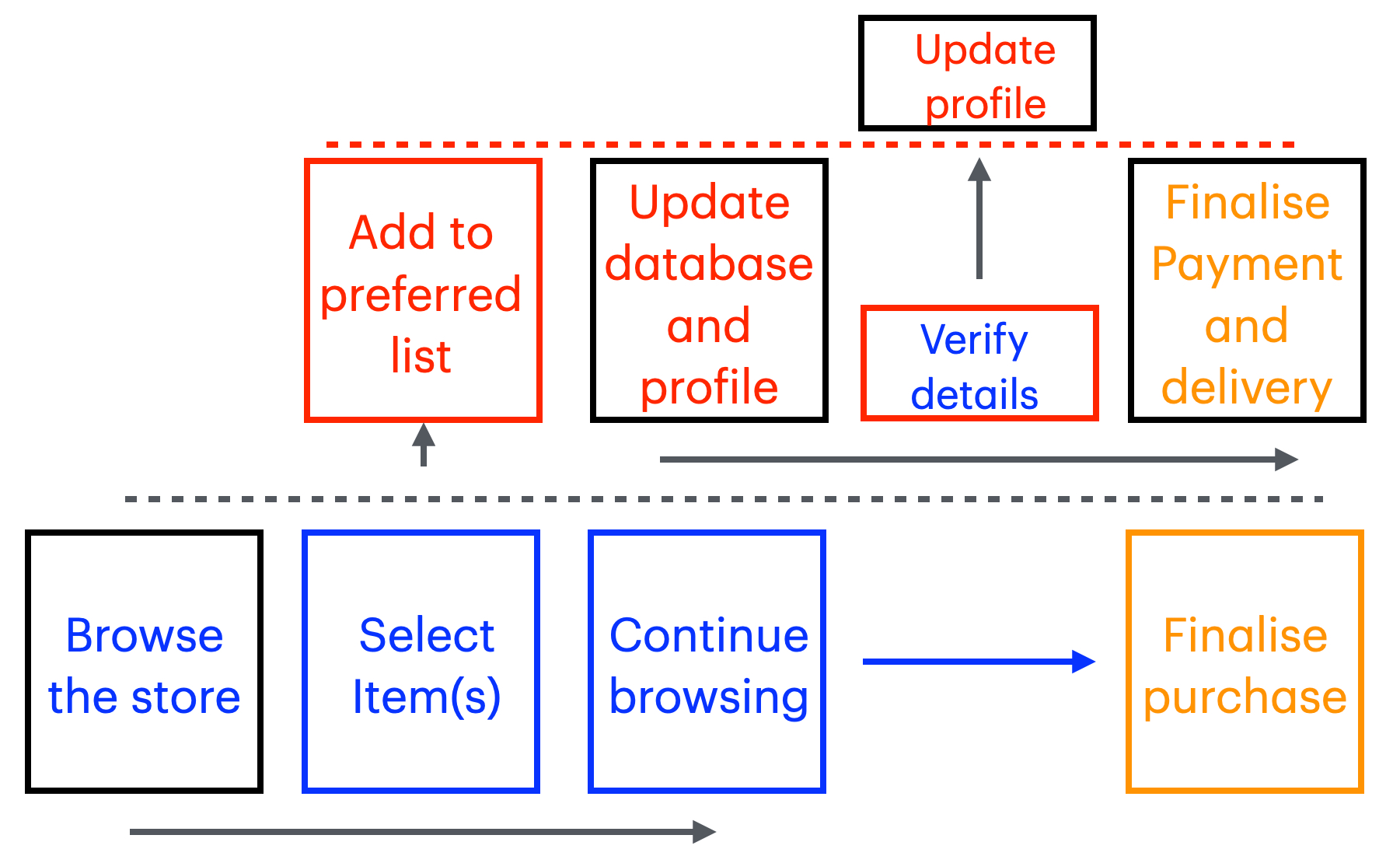
As we linger on the options, we get to add a certain bottle or brand to our Wishlist. I got this basic idea of the system (see below)
We have a walk through the booze browse place. We select items and we can then decide if it is an order, a consideration or a mere preferred drink (Wishlist). And as we walk and profile our drinking needs, we also get above the red line an update to our profile, more exact, it considers what you have placed in your profile any hidden traps. Perhaps you dislike beers, or wines and someone adding beer or wine will get red flagged and the fraud detection goes into high gear. This is not the final trigger, because you might order it for a guest. There is however a larger need to engage fraud detection in this day and age. As we keep on browsing we get to the end where the list is given and we decide making any item a Wishlist item, a preferred item or an actual purchase. The purchase is finalised and the delivery address is recorded (you might be gaming at a friends place) and the purchase is received and delivery is made through whatever option you like, possibly just an in-store pickup. Now you might want to think that there are other ways and you would be right. But eCommerce has its own grips on the matter and whatever the customer wants he or she can get. This way you are appealing to 3 billion gamers. That is not a simple Direct Marketing fling, that is a long term option and this market has been overlooked for too long. Optionally we see “They can get it in another way” vibe and that is not incorrect, but the sentiment in this day and age is just plain wrong. How long until this method is used for super markets? Consider that Dubai has a temperature of 33 degrees. Some like to go out and endure it, but as streaming systems evolve they want to walk around in their homes and see what gives at Carrefour they have foods and fashion. And there is a larger need. It is obvious that the larger places will adapt to this first. But as this system evolves more will crowd the place. The idea that was started (to some extent) by Sony Home is now in a stage where a lot can opt to move in and it will go to a much larger place. You see 3 billion gamers are about 40% of the planet. I merely wonder why it has taken so long for others to adopt the idea.
And there is a secondary option. This might be easier way to stop fraud, because gamers will have profiles that have been around for years and these places will be able to find a lot more data on the transgressors of fraud as well as the stores trying a fast one on the customer, they are likely a lot easier to find, but that is merely a gut feeling of mine.





 Lawrence van Rijn - Law Lord to be