Tag Archives: Huawei

From trade war to losses

Huawei remains in the news on an international level. Australia gives us ‘Huawei sheds 100 Australian jobs in the face of 5G ban‘ (ZDNet), ‘Huawei Australia says over half of jobs at threat due to 5G ban‘ (ITnews), and ‘Greece opens up to Huawei’s 5G ambitions‘ (ZDNet). For the most there is some level of balance that is going on. We see messages of reprieve given to the US on Huawei, yet the clear part is that there is no way around Huawei. Just like the 80’s when there was no way around IBM. I still remember those arrogant sales people. Whenever they could not answer a question with any clarity (which was more often than I was ever comfortable with), the response became: ‘Sir, we are IBM‘.

It is not limited to one company, CNN reports (at https://edition.cnn.com/2019/08/23/business/china-tariffs-trade-war/index.html) “The US-China trade war ratcheted up yet again on Friday, with Beijing unveiling a new round of retaliatory tariffs on about $75 billion worth of US goods“, this round will hit “25% for vehicles or 5% on parts, and would take effect on December 15th. The new tariffs will target 5,078 products, including soybeans, coffee, whiskey, seafood and crude oil“, this war was a bad idea for America the moment they started it. Yes, there is an impact on China and there is an impact on Huawei. Yet the world cannot go around Huawei. The non-Chinese players were complacent for well over half a decade and the invoice is due, it is an invoice that a bankrupt America cannot afford at present. Moreover, the stage is now sliding away from the American market more and more. As Europe is seeking Huawei to instigate growth, America grows lag time losing momentum more and more. In Europe the issue is larger because it is not one EU; we are looking at 27 member states. The UK with BT gives us: “The investment bank also noted that the Conservatives have outlined an ambition for the roll out of super-fast fibre broadband across the whole of the UK by 2025 but it is not clear how it will be funded or what the returns will be for BT“, a technology years out of date, too much delays, politicising and now BT, a company that was once regarded as a company at the height of technology (some might remember the 80’s advertisement with Tom Baker, the 4th Doctor Who showing us a piece of fibre optics, transmitting the entire bible in one second), the message of advanced progress was clear. Yet in 2018 we see other messages ‘Why most of the UK doesn’t have True Fibre Optic Broadband‘, the setting is a disappointing one and there is a really nice explanation (at https://www.youtube.com/watch?v=DDp9-tSYpU0). The Dutch have KPN, an advantage here is that they managed to put 30% of the British population on 14% of the UK, so they have less distance issues. So even as Reuters gave us last April “Dutch telecom firm Royal KPN NV said on Friday it would select a Western supplier to build its core 5G mobile“, they will be digging a large hole for themselves. No matter who gets chosen, they all lag to a much larger degree the abilities that Huawei offers and that impact will only increase over time.

To see this we need to take you to a little math equation. An innovative technology gives you 10 years. Huawei has at present two innovations and three iterations lined up, which gives them 26 years (iterations gives one a mere 2 year advantage), which almost aligns as reengineering catches up three years annually. This gives us the number that others need to catch up to Huawei, who could in 2020 be technologically already at 2047. At present none of them have any TRUE innovations. As such the iterators will truly catch up in 2028 whilst that stage will be met in 2020 by Huawei. This is the largest danger for all the other players. In 2028 the 5G market will settle and they are all still catching up whilst Huawei rules the 5G on a global scale.

The math was important, because it also meant that I have until 2023 to sell my IP, at that point iterators will have found part of my IP and they can equal it to me by 2025. The math was everything and the math is not looking good for America or Europe. Those who embrace Huawei to some degree will get a much larger advantage. My IP was about pushing momentum and if that goes as I hope, the others will face a much larger setback, in all this a much larger part of cybersecurity will not work, or will merely delay the commerce. When was the last time you saw commerce seeking safety over revenue?

The fact that the Guardian gives us: ‘Apple warns new credit card users over risks of it touching wallets and pockets‘ (at https://www.theguardian.com/technology/2019/aug/22/apple-card-wallet-pocket-warning) gives a much larger issue. Even as we laugh on: ““Apple Card completely rethinks everything about the credit card. It represents all the things Apple stands for. Like simplicity, transparency, and privacy,” as the company said when the card was launched. Just don’t put it in your pocket.

So when was the last time you went on vacation and you had to take care of all that for a mere Credit Card? What happens when there is damage to the card whilst on a business trip? Oh, and more interesting, what Forbes told us (at https://www.forbes.com/sites/daveywinder/2019/08/10/apples-iphone-faceid-hacked-in-less-than-120-seconds/#1c136a2421bc) with the title ‘Apple’s iPhone FaceID Hacked In Less Than 120 Seconds‘, it is the issue of greed versus Common Cyber Sense and CCS never gets to win, greed dies!

That will show in 5G within the first year and as such there is a lot less taken care of, and it was exactly why I am rubbing my hands, the more desperate they become, the more valued my IP becomes and in the end, my IP pushes commerce and safety in the same IP line. As an android solution I get to thumb my nose against Apple and iOS, it is too iterative to consider. I hope that Google wakes up, so far Huawei might be the only tender and that is just fine by me.

How do these relate?

The pressures that we saw when thatcher decided to stop Fibre, as she saw that BT got an unfair advantage (which is fair enough) too many players try to get part of the cookie for their minimalist services and it directly relates to the US. Their stage of Status Quo as dictated by Wall Street has stopped innovation. The boat that was not rocked was giving Wall Street the managed expected returns they vowed to get. Yet the other side is also a given. We see this as the senior people stayed where they were, stopping innovation too often because they were scared to make the jump, it is the principle that gave Google the growth they had, yet the linked headline (to the smallest degree mind you) ‘Americans Owe $1.6 Trillion In Student Debt – What Will It Take To Solve This Crisis?‘ close to an entire generation was topped to innovate, I grant you that not all are innovators, but the entire innovation cycle was missed. As such highly educated people got menial jobs and went in other directions, a decent amount of them disillusioned. There is a part that gives the concern of affordable higher education, yet there is also the path that those educated and ready were stopped their innovation; each of them stopping 3-7 fellow students to tag along in that innovation path. It is what I call, a non-proven given. It is hard to set a number to this and there are of course other elements (like the economic crash) all set through and connected to the actions of a few on Wall Street, that much we all agree on and whilst that path was set to non-motion, innovation was lost in almost a dozen industries, IT and telecommunication being the most visible ones. Patents are the most visible marker here, but not the only one. That part is making the US scared, not nervous but scared. Over the next 5 years 43 drugs will become generic, the patents expire, 28 of them this year. the world looks at the pharmaceutical patents because of the aging population, yet technology patents expire too and all of those not linked to renewed innovation patents will be collapsing, consider all that was patented from 1985 and 1999, all coming to a close some were just forgotten and not renewed because the technology was surpassed, yet there we forget that original ideas can be reengineered solutions, all up for patenting and that market is well over $100 billion. One consideration is shown (at https://www.dnj.com/story/news/2019/08/22/rutherford-county-jail-hit-lawsuit-over-patent-infringement-stealing-technology-smart-communications/2064500001/) where we get: “Smart Communications accused them infringing upon their patented technology that transformed written mail into an electronic version sent directly to inmates“, I merely wonder how we see that setting when we look at players like Perceptive software, Readsoft and a few other players. Readsoft became part of Lexmark and then Lexmark, the printing and Software Company, agreed Wednesday to be sold to a consortium led by Apex Technology of China and PAG Asia Capital, a private equity firm. Consider the placement of digital transfer, on an international level in the hands of a Chinese consortium. The NY Times took notice (at https://www.nytimes.com/2016/04/21/business/dealbook/lexmark-apex-pag-asia.html), for the most no one else did. They had no grasp of the power that the innovations were that Readsoft had. I worked with the materials; it was next gen software in 2003. Now consider that we think digital almost every moment nowadays, but there are decades of legacy materials out there and not everyone has the budget of the America alphabet group. In 5G that material needs to be digital or it will be lost. All these patents give advantage to the owner and stop others, having to re-engineer their idea again and again, that is direct currency and China has a much larger truckload of them with a later end date, even as Huawei is all innovation, they still need their patents and whatever innovation they launch next, they will need to have the patent in place. It stops all the other making the case that their advantage grows as the others forgot to get a workforce that is innovative in nature (Google is excluded from those losers). The innovator drivers are gaining momentum and over the next three years their advantage gets to grow.

That was always the advantage the innovators have and the iterators are starting to feel the pain. IBM, Microsoft and Apple might market their ‘innovation’ yet marketing it doesn’t make it actual innovation. Perhaps you remember the Verge last March giving us ‘Study confirms AT&T’s fake 5G E network is no faster than Verizon, T-Mobile or Sprint 4G‘, marketing versus reality is often disappointing and the iterative technology firms are finding out the hard way that there is no such thing as marketing the reality of shareholders expectations.

We see that part ibn another field as Microsoft Phil Spencer gets to be quoted: “There’s only one new Xbox coming in 2020: ‘We are not working on a streaming-only console,’ says Xbox chief“, yet the end of the article gives us: “given the iterative nature of game consoles and the history of the business, we wouldn’t be surprised to see new versions of Project Scarlett in the coming years – it just sounds like we’ll only see one in 2020“, that is where Business Insider made the massive flaw one week ago. It is a flaw because if that was actually true the Nintendo Switch would exist, iteration would never have led to the Nintendo Switch, and not only is it beating all the records, it is also reducing the Microsoft Xbox One to the number three console. Projections are that Nintendo Switch will get to 50 million consoles sold before the end of the tax year, a lofty promise, yet that too shows the impact of innovation. In 2 years it equaled what Microsoft calls the most powerful console in the world and it took Microsoft 6 years to get there. Clearly power is not all it is cracked up to be. In addition, for the first time in history Sony is worried about how far Nintendo can get. Nintendo never wavered, they never lost their core groups, they merely added to them.

Innovation does that and innovation will push 5G in the same way, it seems that Huawei with its innovation has support all over the world on the impact of innovation and the funny part is that IBM and Microsoft used to be actually innovative, they merely forgot the sweetness of innovation victory, which is sad really. I gave mention to the Wall Street part in the Status Quo, yet they are not the only ones in that game and those who embraced that game held technology and innovation back to a much larger degree than you realise and that loss of momentum is a much larger issue in this trade war than anyone has considered.


Leave a comment

Filed under Finance, IT, Media, Politics, Science

Another Brick in the growing Wall

The wall of profit is going nicely in France, even as I would like to take another gander on how the western media is all about ignoring the Houthi attacks with drones on Saudi Arabia, it seems that we will get more on that soon enough. As I see it, we have a situation where at present 5 attacks have been ignored by the western media, like they are all about calling Saudi Arabia the big nasty, even though there is no factual evidence, merely biased opinion on several fronts. Today is not about that. Today is about France (the land of Wine, Cheese and Citroen). This place is pushing a few boundaries and even as we think that things are still open to discussion, it seems that the mighty bosses of banks (one particularly) have made their choice, I mentioned it a little over a week ago, yet all were easily persuaded to ignore it. Now that we are given: ‘French parliament passes “Huawei Law” to govern 5G security‘ (at http://telecoms.com/498728/french-parliament-passes-Huawei-law-to-govern-5g-security/), we see an optionally much larger change. This might be the first step in changing the landscape on a much larger scale and as far as I can tell it is just the beginning. There is an important notice to all this and it opposes the UK point of view to almost 180 degrees. In the UK, Alex Younger (big boss of MI-6), aka El Capitano de observadores furtivos is off the mind that important infrastructure should never be in foreign hands. This is a policy issue and I do not oppose this choice. It is the short minded and stupid American view of being shouting anti-Huawei accusations without proof that I object to. Now we see on the other side (France) where Mathieu Duchatel gives us “the French government is creating a regulatory environment that helps reduce its vulnerability to foreign intelligence collection“, which is another policy approach. I tend to like this more than the one Alex Younger gives, but both are valid points. Yet the one Duchatel gives us leaves the players with more options.

To see this, we need to go back to 1993, when Sybase and Microsoft dissolve the partnership they had and Microsoft receives a copy of the SQL Server code base, this was the best approach and after this we see that Microsoft sets their own designers to make evolve their SQL servers, a choice that ends up making them a direct competitor of the code Larry Ellison pushed for (the solution we know as Oracle), and whilst he went sailing across the oceans, MS SQL Server got the be lean and mean. Even as we see flaws, we see that Microsoft created a much larger market than we thought possible. It is that path Europe and America needed for 5G. So as the Yanks decided to screw themselves 6 ways from Sunday, Europe has a much better approach and now we see the path where France has opened up a dialogue to enable that solution down the track. It is a solution that would assist Huawei as well, as we see a solution that uses the Huawei 5G path as a benchmark, France et al could deploy a non-Chinese 5G solution that is set to the Chinese standards and that would suit China (read: Huawei) in a few ways. It all goes from bad to worse for America. What everyone seems to forget is that Azure in China is Shanghai Blue Cloud Technology Co., Ltd., a wholly (or is that holy) owned subsidiary of Beijing 21Vianet Broadband Data Center Co., Ltd. and it now implies that the accelerated evolution of 5G via Huawei has the stage where the best upgrades to implementation and facilitation to 5G will come from 21Vianet and not from Microsoft. Just as Sybase gave the keys to Microsoft in the 90’s, we now see the opposite where the business advantage will be with the Blue Cloud bosses, together with Huawei they now have a much larger advantage than anyone realises. Even as there is a shift in china through the players like BitTitan, I believe that Huawei is still preparing for a much larger innovation giving 21Vianet when that kicks off an overnight advantage that Microsoft cannot equal, not for a much longer time, leaving Microsoft losing momentum to a much larger.

If you want proof, then I have to admit that I cannot give it, the market seems to facilitate to a larger shift and it is not some hidden gem that no one else found. I believe that the Sybase example is what we face today, as Mathieu Duchatel is setting the new policy, we see policy that is accepted over most of the EU, so as Germany, Spain and Italy accept this push, most of the EU nations will follow, they are willing to drop America like a bad habit ion all this. The US overplayed its hand and now they will face the consequences of choice. In this the UK must soon make up its own mind. The path Alex Younger opted for was not wrong, but it is a larger choice that could impede economic growth to a much longer degree for a much longer time, two elements the UK does not really have at present.

The SCMP article (at https://www.scmp.com/news/china/diplomacy/article/3020354/while-weighing-5g-security-risks-france-predicts-it-can-manage) we see another solution for France and somehow I believe Credit Agricole had been preparing for this step a little longer than most others. France needs to be on top of this as 2024 Paris is coming near soon enough, implying that a multi-billion euro scheme for 5G will be announced before years end to get anywhere near ready and it seems that the Credit Agricole dividend is about to push upwards to a much larger degree. And when we get to the end of the article where we see: “5G infrastructure poses more complex problems. The distinction between core and edge is no longer as relevant, as many software operations will operate in the cloud“, we get to be introduced to the benefit and advantage that Beijing 21Vianet Broadband Data Center Co. now gets to have; Microsoft forgot that most cannot get to China (for simple linguistic considerations) that limitation does not exist in the other direction. And now as the cogs connect we see how the market takes a shift. Remember when I made the joke (and connection) to the cloud; it is merely someone else’s computer. Everyone so needy to muddy the water claiming it is so much more complex. OK, to the smallest degree it is.

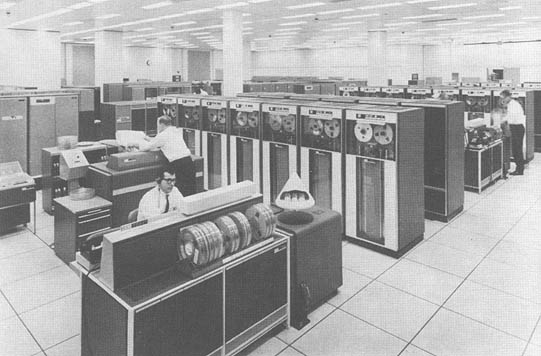
To see my point of view consider the NASA Mainframe that was there for the moon landing (and perhaps a little more), now consider my old Mobile, this 2011 mobile needs 5% of available processing power to do what that entire NASA room did. The mobile that followed 4 years later was 400% more powerful with 1600% more storage and the one that followed was close to 300% more powerful than the previous one with an additional 1600% more storage, the market shifted THAT fast.

So when we see a data center now, and consider that a dozen racks with terabyte storage can be replaced by ONE drive, yes there is an Exabyte drive now, one drive with well over 1,000,000 terabytes. We are nowhere near replacing the entire data center, yet in 10 years, that center could be replaced by one large tower in that time, it might look a little different (I always loved the Cray systems, it comes with a place to sit and heating, but that so called ‘cloud’ will be in one clear specific location (just as it is now) and that is the issue;

it is the location of someone else’s computer that is the issue, soon it will no longer be in America, China is now in a position to offer the same, optionally cheaper and when the America BS starts with ‘It needs some vague quality seal of approval‘ (a SAS marketing trick we saw 20 years ago).

It will be at that point that the entire mess becomes ugly real fast and we are already pushing in that direction. The problem is not China, or America. It will be the policy considerations on where data is allowed to be; a lot of cloud issues on data locations are still open to discussion. The problem is not the hardware, it will be the place with the most logical policy in place, that will be the main player for the next stage and it seems that France has been keeping busy on becoming that European location. I reckon that China does not care, as long as they get the business and that is when we see the American failure on getting the business. They planned on greed when pragmatism was the only solution to push the market forward. Now as most nations start waking up on the loss of pragmatism, we see the consideration, to be a player or a tool and some are realising that they banked on the wrong horse and the American horse is about to become a ‘horse no show!

Whether it was merely some bank, some policy, or a larger linked consideration, this time the French have played a good long term game and they have every chance to reap the benefits of that game. We have yet to see how it all plays out and Paris 2024 will be the big test, but as the issue stands, the French are pushing forward, it is there that I found some references to Credit Agricole, DGSE, and a very large billion dollar option. Even as 21Vianet and its subsidiaries are not mentions, neither is Azure in any way, it all falls to the one mention of ‘Microsoft Corporation‘. This might all be true, but I still seek confirmation, on a stage this large 21Vianet could not have been unmentioned, the same for the entire Azure part. the line “the proliferation of real-time data from sources such as mobile devices, web, social media, sensors, log files, and transactional applications, Big Data has found a host of vertical market applications, ranging from fraud detection to scientific R&D“, makes its absence of certain players either short sighted or the elements of that article were unreliable. I believe it to be a little of both.

I wonder how the game unfolds; I reckon we will know a lot more by the end of the year.


Leave a comment

Filed under Finance, IT, Law, Media, Politics, Science

Marketing Deceptive Concepts

We are all in the lane of what is coming; the problem is that what is coming is set on the E40, the longest European highway going from Calais all the way to Kazakhstan (Ridder). So as we depart from Ridder, trying to get to Calais on this AI highway, we need to consider that at present we only got past the first 100 kilometres of a trip that will be 8,000 kilometres long and we are not driving a Aston Martin, not even a Lada, we are traversing this in a 1908 Model T, giving a much clearer indication that this trip will take years (read: a decade at the very least) at best. To be quite honest, as technology goes, we are nowhere near AI, true AI. It will take the largest players (Google & IBM) decades to get to the real AI part, and only when computers become more technically savvy and a lot faster. As such I do not see the reason for people and companies like RACGP to give us: ‘AI is coming to healthcare – and it’s here to help‘, with the quote: “real promise – of artificial intelligence in healthcare“, yet we remain fair. Dr Martin Seneviratne stays faithful when he gives us: “we’re far away from that, to be honest” and he is correct. Yet the stage is there where we see: “In this article we are listing top 15 artificial intelligence apps for android and iOS users“, as well as “an Indian start-up claiming to have built an artificial intelligence-assisted app development platform, is not in fact using AI“. It is all BS (read: Hogwash), there is no such thing as AI, it is theoretical, conceptual at best, the real deal is at least a decade away. It reminds me of some Sales Dumbo I had to deal with on how cloud computing was it bees knees. When I mentioned that there is no thing like a cloud, it is merely someone else’s computer, I was the one who did not comprehend it (in the end I was right, and he (read: it) was not). Yes, I am aware of the ZDNet article (at https://www.zdnet.com/article/stop-saying-the-cloud-is-just-someone-elses-computer-because-its-not/). We get it, it is about scalability and the scale of the cloud is huge, but still, it is a server center that is owned by someone else, and the location of that server is equally important in the data laws we see today. Because the moment China launches its own commercial cloud system, the Americans will ‘suddenly’ come with issues like cloud locations and how the Chinese government can look into every cloud account. I was not belittling anything, merely making sure that we keep focus on terms used (and awareness is often larger than anyone considers). It is the monitoring, hacked data and more important lost data. The cloud comes with all kinds of marketing hypes, but informing on the scope and warning of the dangers that poor passwords bring is often not seen.

So when we get to the Verge where we see: “The company was sued earlier this year by its chief business officer, Robert Holdheim, who claims the company is exaggerating its AI abilities to get the funding it needed to actually work on the technology. According to Holdheim, Duggal “was telling investors that Engineer.ai was 80% done with developing a product that, in truth, he had barely even begun to develop“, we see the larger deception and we also see a lack of actions by governments to a much larger degree, apparently white collar deception is OK in their books.

So when we get back to the RACG (at https://www1.racgp.org.au/newsgp/professional/ai-is-coming-to-healthcare-and-it-s-here-to-help) where we see: “‘Documentation is a constant issue, and so is having a computer separating you and the patient,’ Dr Seneviratne said. ‘The dream of this AI revolution is that it helps with the parts of medicine doctors and patients don’t like, creates a safety net for ensuring quality across the board, and gives clinicians more time to be with their patients.’“, my mind goes back 47 months, 12 days and 14.1 hours (roughly) when I designed the concept of what could be the Google Tome (I concluded that the iTome could never become a reality in an technological iterative pushed corporation), a device that would take case of part of it and help the UK NHS to get a handle on their paper mess and red tape. The device would also be a great solution for places like Scandinavia where the rural population is all over the place. There was one tiny setback, it required 5G, it was the only way to get it to work to the degree it did and 5G was nowhere near ready to the stage that places like the NHS, GP’s and clinics could be upgraded. We are still 1-2 years away, but the Google Tome would be a game changer as it worked on a very different IP. Apple would take a decently large hit as I remembered some original parts from before the PowerMac and Apple actually had the inside track, with today’s iPad they could have ruled, but in the last two years they became a mere iterative needy toddler, taking them out of the game. both IBM and Huawei are not ready for this leap giving Google an actual first position with no chance of any number two catching up for close to half a decade. My solution was not AI based, it was based on the realistic foundation of NHS administrations and to see where the obstructions were. Instead of making some political never working one system (UK Parliament spend £11.2 billion learning that it did not work), my path was to upgrade all the elements and give a new definition to speed, not the one that is founded, for downloading, but a new on access protocol that emphasises on security and data safety. In fact, the results would in theory get to the right physician 30%-60% faster. Anyone who waited for results in an NHS location can tell you what a game changer that is.

And none of this touches the 5G IP I created three years later.

But that is not what it is about, it is about the marketing ploys we are confronted with and for the most, the media greedily uses that hyped term to get traction with people, clicks and awareness, the information is less and less a concern to the larger group of media (or so it seems). The one that I got confronted with yesterday is the one that set it off. A friend (Tom Breur) wrote an excellent piece regarding Data Democracy (at https://tombreur.wordpress.com/2019/08/13/what-does-data-democracy-stand-for/). Yet in data, as I personally see it, there is no real democracy, it can be dictatorial, it can be feudal, it can even be tyrannical, but it is never democratic, you do not get a vote in that hierarchy, that is the way with data and it is the researcher who can redefine you through giving you a weight of 1 (or lower) or disregard you as inconsequential as grouping you with other user missing points of non interest. The respondent never had a voice in the matter negating the entire democracy part.

This setting was most likely started by media with their claims of “Big data’s threat to democracy becoming global problem“, and there the delusion started. Big data is never about democracy and democracy is not about data, it is about applied wisdom, they do not correlate and are even less likely one and the same. It becomes even more entertaining when we (at https://morningstaronline.co.uk/article/labour-will-ban-big-money-buying-democracy) see: “Labour will ban big money from ‘buying up democracy’“, it is entertaining and hilarious as this has been happening well over a century, long before there was a silicon based economy (not talking about boobies here). When we get: “Last November Mr Johnson was flown to New York and was paid £94,507.85 for a two-hour speech at the multibillion-dollar hedge fund company Golden Tree Asset Management“, we can argue that he was merely doing a job he was allowed to do, and that is not impeding democracy, is it? And when we see: “We are funded by workers through their trade unions and small donations, averaging just £22 in the last general election“, how much support did you give the people who voted for UK Labour without a donation? And when we see the Washington Post give us: “Data shows that an overwhelming majority of Africans believe that democracy remains the best form of government“, I might not disagree with that, yet the issue is not agreeing and disagreeing, it is the deceptive model of awareness creation that big business allows for when they buy the identities on Facebook by millions and target them with political advertisement. Even as Senators like Ron Wyden are calling to ban that, he knows he is fighting a lost war. Also, as a member of the Senate Intelligence Committee, he is watching proven CIA tactics being deployed via Facebook and he knows how efficient those can be, it is a game only the rich can play. He even hides behind “I’d rather have them do it voluntarily than requiring a law“, because there is no way that they can pass that law in time and even then there will be a dozen loopholes to circumvent the law passed via the first amendment.

It is all due to the marketing we allowed from the very beginning. there was no stop to the media, the hold on awareness versus deceptive is sketchy at best and now that there is a whole slew of iterations coming forward we see more and more deceptive conduct, yet nothing is done, there are attempts, but they are feeble at best. That evidence is seen when we consider Engineer.ai and its founder & CEO, Sachin Dev Duggal. We see the news in the Wall Street Journal as well as the Verge, yet less than 3 days ago that person won the Serial Entrepreneur award, so it seems that the players are all OK with deceptive conduct. Yet I remain optimistic, I merely have to wait to see this blow up in the faces of those sales driven CEO’s and VP’s to see that their failure gave them months of reprieve and every documented event merely sets the stage for my IP in a much more powerful way.

We need to consider that when it comes to creating awareness, the media is still accountable to shareholders, stake holders and advertisers, as such there are a lot of issues in the IT field, personally in light of recent events the do’s and don’ts of Sachin Dev Duggal take the cake. Don’t take my word for it, merely look at the Wall Street Journal (at https://www.wsj.com/articles/ai-startup-boom-raises-questions-of-exaggerated-tech-savvy-11565775004) and consider how the award two days later was still handed to Sachin Dev Duggal. Even as the man ‘hides’ behind ‘human-assisted AI‘, and when we look at the quote: “it uses artificial-intelligence technology to largely automate the development of mobile apps, but several current and former employees say the company exaggerates its AI capabilities to attract customers and investors“, we need to ask a whole range of questions, none of those are found anywhere. I am not raining on the man’s parade, but clearly no one else is either. I wonder how many righteous participators at that entrepreneurial award feel left out in the cold, a fair question if I say so.

I merely look at the marketing part of it all, when I look into the direct impact, that some marketing hypes are giving us, I tend to wonder if the need was really awareness, or confusion that was behind the creation of the hype. It is sad but that is more and more often the need to wonder when any form of media gets involved.

It is a sad evolution in the age of information as it has been for some time now.


Leave a comment

Filed under Finance, IT, Media, Politics, Science

The slammer got slammed

There is nothing so rewarding as the moment you realise that you get to slam the door on those slamming the door on you. It is an innate feeling that is in the core of all of us. It is more powerful than getting the drop on your boss or CEO with an overwhelming amount of narcissism and the overbearing feeling towards the need of being some dominant / dominatrix figure (at that point they become merely a figurine).

I made several references over the course of 2018 that this was coming, the stronger one in May 2018 (at https://lawlordtobe.com/2018/05/05/milestones/) where I made the reference: “the EU was never about everyone agreeing on everything and the economic setting that requires that to happen at present is also making the dangers of waves that sinks the barge called EU. Now, that seems like an exaggeration, but when you realise that the German anchor is the only one giving stability, you can see the dangers the EU faces and more important, the dangers of no reserves and an utter lack to keep proper budgets in place, a setting now in more danger for the reasons that I gave supported by the economic views of many others. I believe some are downplaying the impact, yet when we realise that EVERY European Union government is downplaying the economic impact (as every nation always wants to look as good as possible, which is a PowerPoint setting of the human ago) we get a much more dangerous setting“. The article ‘Milestones‘ has more, it also has references to the AfD (Alternative for Germany), and even as we see in the Financial Times (at https://www.ft.com/content/d695fff8-b838-11e9-96bd-8e884d3ea203) “It is a happy hunting-ground for the AfD: if polls are accurate, it could emerge as the most popular party in regional elections on September 1, even beating the left-of-centre Social Democrats which have governed this corner of East Germany since reunification in 1990. Two other eastern regions, Saxony and Thuringia, are also choosing new parliaments this autumn and, as in Brandenburg, the AfD is set to make big gains. That is a major problem for the eastern political elite“, I believe that this powerful eastern political elite is part of causing the headline ‘Germany: AfD surge threatened by party disunity‘, they are that scared at present. The gains cannot be stopped not to the degree some elitists are vouching for; the best that they can hope for is derailing them from becoming the majority, which is actually a political war that is allowed. The question becomes will it work?

We are 2-3 weeks away from finding out.

CNN gave us less than 2 days ago: ‘5 of the world’s biggest economies are at risk of recession‘ (at https://edition.cnn.com/2019/08/14/economy/recession-risk-economies/index.html), it is a huge part because the impact matters. Under Mario Draghi and his bond buying program, there are no reserves left, so the impact towards recession is about to get real. The shift in quality of life makes the consumer spending tactic an instant non option.

Yet, it all comes down to the Washington Post who (at https://www.washingtonpost.com/business/2019/08/14/stocks-tank-another-recession-warning-surfaces) gives us: ‘Stocks losses deepen as a key recession warning surfaces‘. It is here that we get: “after a reliable predictor of looming recessions flashed for the first time since the run-up to the 2008 financial crisis. The Dow Jones industrial average fell 800 points, or about 3 percent, and has lost close to 7 percent over the past three weeks. Two of the world’s largest economies, Germany and the United Kingdom, appear to be contracting even as the latter forges ahead with plans to leave the European Union. Growth also has slowed in China, which is in a bitter trade feud with the United States. Meanwhile, Argentina’s stock market fell nearly 50 percent earlier this week after its incumbent president was defeated by a left-wing opponent“. First of all, ‘reliable predictor‘ is not the term I would use, the dangers were clear for well over a year, it was the wrong stage of a trade war, with the Huawei 5G setting that pushed the inevitable date forward by a lot. The entire Huawei stage was a stage of stupidity, and a more dangerous post-recession part than anyone was willing to consider. We might find clarity in the footnote: “But with so many losing confidence in the near-term prospects of the economy and rushing to buy longer-term bonds, the U.S. government now is paying more to attract buyers to its 2-year bond than its 10-year note“, is looking in the wrong direction. It is merely a small symptom at present and direct consequence on risk and not the one that bites. The US is losing its footing on the global mobile market faster and faster. And even as we accept the ‘marketing’ that Huawei gives via Cnet towards 6G, the direct truth is outstanding for a longer time. It links to my own IP that is currently available to Huawei and I want my share of that market, I believe that my part after the fact will be enough to truly make me independent on several fronts. One party found my claim a $ billion market through the investment on $25m post taxation too good to be true, but it is the second wave that takes care of my needs and you gotta give a little to get a little. It is was the ‘denied’ parts of Credit Agricole and the Paris games of 2024 that gave me the final straw I needed to see that I was right all along. In all this verification that I was correct was always the biggest issue for me to deal with, and the recession is making those big business daddies of greed close to desperate, giving me a small push forward. Those people are not willing to walk away from a one billion market at the investment of 2.5%, no bank has ever offered those margins and with the Credit Agricole parts exposed to the smallest extent, I know it will work. It is there that I saw that the IP I designed was never considered by either Google or Huawei, all set to iterative paths to innovation, and the economy shows that nearly all of the other players were looking at the next quarter, whilst the quarter+3 was the game changer. The Olympics gave the option to look at inverted innovation and make it a new innovation, Paris was not the first, but certainly the clearest indicator and whilst we see through Channel News “Huawei Technologies has joined 564 other entities in the Paris Call“, the message is not that there are 565 players, it is that they are all looking in a similar direction whilst the none excavated the gold mine that was right behind them, a first lesson that the classics can inspire towards a new direction. Now that I see their direction I found two other fields that had not been considered to the degree it needed. Saudi Arabia is giving us Neom City, but there is a lack in one direction and now that this can be exploited we see even more options. You only had to be willing to get your hands dirty in the most literal of ways. And all this is pushed even more through the impact of the European economy. A French invention gets a new life after almost 2 centuries and we can see that there is more to be found.

Sergey Brin on Sat. morning

It is what else Harmony OS can do that will push the benefits away from the US and it will hurt Google to the smallest degree (almost inevitable), Google is just too big, but now that the equation changes, it is Google who will be chasing Huawei, so well done Trump dude, you merely made everything worse for America and I will sell to the quickest bidder and the 2.5% approach gives me the edge; the two known entities Ren Zhengfei and Papa Smurf Sergey Brin can make the investment from the small change they have in their pockets and the bait would be just too appealing for them.

Al this was confirmed and accentuated through the US Senate with: “In February, the US Senate Commerce Committee held a hearing titled “Winning the Race to 5G and the Era of Technology Innovation in the United States”, to discuss what policies are required to accelerate the deployment of 5G to keep America “competitive on the international stage”” and whilst we accept the American point of view, they forgot about two elements in the 5G field and the upper echelons of decision makers showed at that point that they were working in a dimmed room without lights, giving additional evidence that they never saw the writing on the wall and now I get to make a new voice and whilst I only am willing to trust Google or Huawei in all this, there can only be one winner and the others are merely a chaser at best, it is the price of iteration over innovation. Even as Microsoft and IBM are in denial of what they are about to lose, they do know and accept their choice. Microsoft is banking on Azure and there the hindrance of Harmony will cause a void, they were ready for Android, yet HarmonyOS is another matter and China is seeing that as another opportunity. It is there where we see the talks of Huawei with the Shanghai Blue Cloud Technology taking an additional turn, and how many players in the Paris games are banking on Azure? How many lose out when they are not ready for the 5G version 2 under HarmonyOS, it will work with Android and Azure, but suddenly we will see some accidental 10% gap (latency) and that is how the game was played and all this before my elements come into play, and they will!

The big business slammers all relying on PowerPoint presentation they are given the elements and when we see the 2023 acceleration and people cannot answer the differences because they never considered looking behind them as well as looking at the corners of their eyes, the blind corners they ignored; now they no longer have one blind spot, they suddenly have three and we get all kinds of concept promises in presentation form, all whilst the data was never that unclear from the very beginning. An issue they claimed that it was being looked at.

So here I am, having to take their shit with the option to sit at the sidelines watching them fight over options because they anticipated without comprehension, sometimes the universe gets to be nice and smile at those having to take their shit. A direct zero day exploit of the applied intent of narcissism on how good a presentation looks, whilst their data never clearly supported it.

My case of exceeding expectations towards customer satisfaction trumped some short sighted ‘Ca$h is king‘ setting, because it works at the grocer, but that part has no bearing when their minimum needs exceed he budget of 80%, it was a simple equation from the very beginning. So when we are now considering the new ‘truth’ where the Washington Post gives us less than an hour ago: ‘Weak global growth likely to mean US slowdown, not recession‘, we merely see wishful thinking in the quote “Yet most analysts expect the U.S. economy to power through the rough patch, at least in the coming months, on the strength of solid consumer spending and a resilient job market. The U.S. stock market plummeted earlier this week when the bond market, spooked by the global turmoil, sent a possible early warning sign of a recession ahead: The yield on the benchmark 10-year Treasury note slipped briefly below 2-year Treasury yields“, the article (at https://www.washingtonpost.com/business/weak-global-growth-likely-to-mean-us-slowdown-not-recession/2019/08/15/1cb8d81a-bfba-11e9-a8b0-7ed8a0d5dc5d_story.html),all whilst we see the clarity of next quarter believes linked to the next Thanksgiving and Christmas, all whilst it is Q2 2020 that makes the tequila slammer which gives the drinker the sledgehammer headache stated it was one that they never saw coming. The entire trade war is taking a new turn and when the people realise on all that the US is missing out on and therefor anyone taking that path will also learn that there is a long term price to pay and it is the markets that Google and Huawei are now staging for that brings the next stage. China has too much to gain, whilst Google will try to retain losses that they will optionally get (reduced growth is clearly a loss). Even as the impact for Google is small, losing one percent is still big news and there one percent adds to a billion plus, whilst their risk to hedge will cost them a mere 1.8% of the optional loss, it is a non-issue.

Guarantee?

There is none, but the option of a new 2% market is worth so much more than that, and it is not open to the iterative industries, innovators only, because it will be about the momentum and there is too much to gain. Consider what the 565 are looking at, whilst I focused on the group that represents up to 445,000,000 SME companies in a new 5G setting. The Olympics are merely the icing on the cake. 2020 Tokyo opens the doors more clearly but the impact is abundantly seen in Qatar 20222 and Paris 2024. And at present I see that they never looked in the places where they could be, merely where they want to be.

In the end it is one of Warren Buffett’s quotes that got me there: “the great moves are usually greeted by yawns“, thanks Warren; you were absolutely right on that part!


1 Comment

Filed under Finance, Media, Politics, Science

The drowning swimmer

We all have the moments when we make an error, an error that requires us to re adjust views. The problem is that some people tend to be overconfident when they make that critical error. Sometimes it comes with ‘Watch this’, all whilst the public watches the person dive to death. At times it is less visible, in Australia 249 people drowned during the 2017-2018 season. The Guardian gave us in the beginning of the year: ‘Drownings in Australia up 51% on last summer after five men die on New Year’s Day‘, all because these people overestimated their abilities regarding knowledge on how the ocean reacts and overestimated their fitness and there we see that nature has no regard for stupidity, it merely takes lives, unyielding and not caring.

Sports

The earlier stage is at present important, mainly because we are about to face it in different ways as well. The Japan Times (at https://www.japantimes.co.jp/opinion/2019/08/06/commentary/japan-commentary/2020-tokyo-olympic-games-cant-rescue-japan) gives us in an opinion piece: ‘2020 Tokyo Olympic Games can’t rescue Japan‘, the writer gives us a view where the impact against the 1964 Tokyo Olympics are set. The writer is correct, the entire commerce engine, the murder truck called Olympic exposure benefit is a much larger issue and Japan cannot rely on the Olympics to give them the economic needs that they have. We accept that there will be an influx for Japan. There will be people who will attend in person that year, because it was always on their bucket list. I would be in that group if I could afford it, but that is not a realistic option for the bulk of all of us, the quality of life has regressed to the lower end of the scale for too long and for many the trip is not an option. In addition with 5G we will be able to see more, enjoy more than ever before and even if that impression is not for all, it will be for the larger group who cannot afford to make the trip. So as the writer (Fumika Mizuno) gives us: “True transformation requires confrontation with the sticky problems holding back Japan’s society, like gender inequality, lack of diversity and rigid notions of ethnic identity. No sports event can grapple with such a task“, we see partial the correctness of it all, yet we also need to consider that this is happening in a stage where digital visibility will be in the midst of an overhaul, so the Tokyo Olympics is happening just when the digital providers are shouting and screaming towards the consumer acceptance of a changed digital footprint. It also intersects with the offered “With plans for AI-powered surveillance robots and real-time 8K broadcasts delivered over 5G networks, the games are set to be a celebration of Japanese prowess in sectors the country is desperate to dominate“, in a stage where AI is nowhere near ready to the degree it needs to be by 2022, two years early whilst the entire 8K matter will be unaffordable to well over 70%, so how will that help matters? So when we see: “Addressing the labor shortage and the aging crisis in a meaningful way requires profound cultural and political shifts. Blind optimism in the power of technology even reduces the urgency of social change“, we see a stage where labour shortage is optionally replaced by technological scripted events where the high tech enablers like news casts, streaming players and awareness seekers are jumping the digital shark to capture what is needed to enable the visibility of the people in the below 70% who are missing out and none of that will be captured by Japanese firms and/or Japanese enablers, it will be up to the FAANG group to maximise that capture taking the bulk away from Japanese economy players. So not only will they miss out on the sporting parts, the stage is then set to a larger community, one that never existed in 1968 giving Japan a much larger concern and that is where the expectation of Tokyo 2020 fall short for Japan to a much larger degree. Optionally the players like Samsung and Huawei (South Korea and China) who truly will enjoy the boost that Japan (NTT Docomo) was hoping for. That part is shown in several sources when we are introduced to: “Japanese mobile operators are preparing for commercial 5G launches between March and June 2020“, Japan is nowhere near ready and that is largely because Japan started almost a year to late in all this and they are nowhere near what Huawei can offer. In that stage there is every chance that players like NTT Docomo will face almost public humiliation when they have to explain congestion and latency on a network that needed proper testing an adjustment no later than November 2019 to make it ready for the larger consumer groups, in this stage Japan could lose revenue four times over, on the loss of preparedness, on the loss of deployment, on the loss of consumer traction and on the loss of network reliability and that is not merely the workforce, it is the loss of not having a 125% workforce readiness at the time that the initial presentations of the 2020 locations and press readiness is offered. There is no way that this will be ready at present and such we see a dampened visibility as well as larger digital losses, digital losses not because it is not there, but because it will be in the hands of non-Japanese corporations. In this there is one benefit, Japan gets to show the US what happens when you enter the field not being prepared for what comes, the US will surely panic at that point (to some degree), all this could have been prevented by driving innovation over iteration and it will be shown to a global community in full view and full exploitation by others.

For centuries we have seen the slogan: “Si vis pacem, para bellum“, If you want peace, prepare for war, a known rule ignored by the technology firms who relied on iteration for too long, now we see that this is impacting a larger group. The entire global economy is set to a war theater (and has been for some time), we see it almost everywhere and now we see that a nation regarded as a front-runner in applied innovation for the longest of time is not ready. All this directly related to ‘Fortuna Eruditis Favet, fortune favours the prepared mind and we are shown that Japan is far from ready, all whilst their own stage was set 3 years ago. They all waited for things to fall in their laps and this was shown a few months ago in the US (thanks to Forbes magazine) with “In recent weeks several major developments affecting the roll out of 5G systems in the United States highlight the promise and the difficulties for near-term deployment of this transformative technology“, as well as “A major issue in the next few years will be the capital costs of installing the needed 5G infrastructure and software upgrades in the U.S. Effective deployment will require hundreds of thousands of new cell sites, new or upgraded connective nodes and central switches, new software and redesigned mobile devices“, the operative part being ‘in the next few years‘ (at https://www.forbes.com/sites/thomasduesterberg/2019/04/30/problems-and-prospects-for-5g-deployment-in-the-united-states) and that is just one player, Japan is seemingly in a less positive place and that is also where Huawei and Google could make additional wins if they merely look outside the box and realise that they are not in a box, but in an terrarium. It makes for all the difference and their time to act is running short. For Japan the issue is larger and more dangerous. Japan has a population of 126 million, with only 10 million in Tokyo, so even if they adjust to get Tokyo covered, they will give 7% and set a stage where 78%-93% gets to miss out on the 5G fun, how would that sell to an economic event that should have been a boost? It is there where we see just how correct Fumika Mizuno is, Japan is facing a larger issue and it is about to cost them more than they realise.

It is at this point where we see the one part that is at present not very likely to happen: “Abe will bask in praise and the people of Japan will revel in politically correct bouts of national pride. But Japanese society will be no less rigid than it was before“, I believe that within the first week of the 2020 Olympics, there will be enough 5G issues for Shinzō Abe, Prime Minister of Japan to take a backseat and make the larger people of NTT Docomo and alike to take the stage and explain the failures to the people of Japan. It is my personal beliefs that at present people like Kazuhiro Yoshizawa (CEO NTT Docomo) are trying to safe or set the stage to make a quick exit by the end of this year to avoid the consequence of having to publicly face not being a prepared mind.

For the US Tokyo 2020 is more likely than not to be a rude awakening of public technological failure. LA (Olympics 2028) will have enough time to adjust to it all and it gives a much larger rise to technological spending for the US, and it is Beijing 2022 that gives the larger rise for the US and at present China is already prepared for that, they have Huawei in their corner, yet how it all plays out is depending on a few elements, so there is momentum in several direction, yet with the underlying lack, Tokyo has a much larger issue to face and at present there is enough indication that they will not be ready in time, they overestimated what they were able to achieve and how fast their stamina could adjust to what needed to be ready, just like all those swimmers that drowned in the Pacific river, which in the end was an ocean to endure, not a river to cross.


Leave a comment

Filed under Finance, IT, Media, Politics, Science

Exposing lies?

We are confronted with lies all the time, the CIA (who is truly gifted in the act) uses it to spread all kinds of discourse, but that is their operandus mondi, so we are not surprised. Yet now we are confronted that these tactics have been embraced by both the FBI and the Pentagon. And it is not my source; it is an American source that gives us this part.

To get to the heart of the matter, we will have to borrow a TARDIS and do some time-travel (a valid Dr Who reference). During this trip we will not be looking at apples and oranges, but we will be investigating fruit, and this has all the bearings on the case.

Trip one

Let’s travel back to November 24th, 2014. It is a sunny day at Sony Square New York, 21 degrees, nice and relaxing weather. It had all the marks of it being a lovely day, were it not that someone decided to hack Sony and they did it, not only did they do it, they left all the markers blaming North Korea. The FBI send their cyber experts and behold, they too agreed that it was North Korea. Even as we were extremely aware that they had no way of doing it, the FBI stood firm on their findings.

Trip two

We are pushing the envelope and stopping at 2015, 2016, 2017 and 2018. We are given “North Korea’s offensive cyber capabilities” and we see Randall Schriver, a top Pentagon official and all the ‘so called’ expressionistic ideas on how North Korea is the big nasty, the large danger and the big hacker. In addition to this the Financial times gives us (at https://www.ft.com/content/cbb28ab8-8ce9-11e9-a24d-b42f641eca37) “Pyongyang controls an army of thousands of hackers who bring in hundreds of millions of dollars annually, according to experts’ estimates“, which was given to us in June 2019.

Into the Heart of Darkness

It was only hours ago that we were given the first light of truth by the Washington Post. To give you that we need to change the topic to fruit and not apples or oranges. You might realise that to get ahead, you need to be ahead. Unless you build a system yourself, you need access to a system of equal quality to hack into a place. Unless you have the passcodes (current password = Inc0rrect%) and inner workings, you cannot hack past the Pentagon Cray, it is close to impossible to do with even the most updated equipment and North Korea is well over a decade behind. It is defended by firewalls and other encrypted matters. Sony is not that advanced, yet still has a lovely set of firewalls and other means to limit access. Yet North Korea, with technology that was considered advanced in 1990, was nothing of the sort a decade before they hacked Sony. In addition, certain access methods or planting of other abilities would have required 4G mastery, a mastery that they do not have. The digital footprint does not match up and it is there that the Washington Post (at https://www.washingtonpost.com/world/national-security/leaked-documents-reveal-huaweis-secret-operations-to-build-north-koreas-wireless-network/2019/07/22/583430fe-8d12-11e9-adf3-f70f78c156e8_story.html) is giving us the goods.

So as we are given: “Before 2008, North Korea struggled to find multinational companies willing to build a 3G network in such a risky business environment. That ended with the creation of the wireless provider Koryolink, which emerged from a discreet visit in 2006 by Kim’s father, Kim Jong Il, to Huawei’s headquarters in Shenzhen, China” this is the first piece of evidence, 6 years before the hack North Korea did not have access to 3G, it was not there, as such the knowhow of hacking would have been severely limited. In addition to this we need to consider “Alexandre Mansourov, an adjunct professor at Georgetown University’s School of Foreign Service, who in 2011 wrote about North Korea’s digital transformation. “They decided to work with Huawei from that time on.”” gives us that in 3 years that stage was not surpassed, or even achieved. The paper by Mansourov also gives: “less than 3 percent of the population currently use modern telecommunication services, it has adequately trained human capital, a rather developed industrial and technological base, and sufficient financial resources to pursue the digital revolution to the benefit of the majority“, which now implies that the fall back is actually a lot larger. If they truly had a ‘rather developed industrial and technological base‘, then they would be the oranges that need not rely on Huawei, yet they are technologically speaking merely apples, they are both fruit, but on a different shelf, a lower shelf and that is where we see the technology fail (especially in North Korea). In his paper we also see: “Because the cell phones connect to Chinese cell phone towers it is difficult for the North Korean government to eavesdrop on the calls, but it does mean use is restricted to the border area“, this implies that the limitations in North Korea are actually larger and as such knowledge is more limited. that last part came from ““How Chinese Cell Phones Help Information Flow,” Martyn Williams, 1 April 2010” which was 4 years before the hack, there is no way for any nation to evolve their technology level in that amount of time without having billions, as well as all the technology available for installation and implementation. Which was never the case, North Korea is hardly on the 3G path keeping them a decade behind everyone else.

Fruit, Apples and Oranges

So even if I am looking at fruit, looking at mobile technology versus hackers is like setting apples against oranges, yet the larger truth remains, a hacker cannot surpass certain levels of access if they lack access to the current generation of technology and that is where we see the flaw in all this. To have antiquated equipment access the Sony mainframe calls for all kind of issues as the access requires speed, and if you rely on old technology there is a limit to what you can get. For example getting a 4TB drive for a PlayStation 3 is bogus as it cannot address the complete drive, so when you look at it from that path, you lack the ability to store all that data and Sony was all about data. More important, if the skill to get behind a 4G system is not there, there was not even 3G, how can you get into the hack? Now we might rely on normal lines, but the flaw is already shown, you need a larger comprehension of technology and telecommunication to proceed and North Korea is stated that it could not get 3G without Huawei; at that point we should recognise that it could not get into Sony. If they actually had done that, then they would have been able to design and build their own 4G (which would still be half a decade too late), but that would be the premise. That absence gives us that the Washington Post, who also gives us: “According to a 2008 contract, Panda would transport Huawei equipment to Dandong, a town in northeastern China known for cross-border trade. From there, it would be taken by rail into Pyongyang“, as well as “In spring 2008, Orascom and Korea Post tasked Huawei with developing an encryption protocol for the network, noting that the government would create its own encryption algorithm, according to the documents” this much larger stage does not absolve Huawei (it is not about that), but the fact that encryption protocols were not in existence implies a delay of at least 2-3 years to get their 3G up and running, the entire matter would have given North Korea less than 2 years to get trained to the levels required to visit the Sony Server and become an actual cyber threat. There is no realistic chance that this would be the case and again, when we consider the press visit to North Korea (somewhere in 2012) where the Dutch press learned that their high ranking escorts had no idea of what a smartphone was, that alone gives a lot more insight in the technological limitations of North Korea and its army.

There is no doubt that North Korea would love to be an actual threat, but when it cannot comprehend 3G to the degree it needs and it has no 4G, how is North Korea an actual threat? I believe that Sony was hacked by someone else, there is also enough valid intelligence to see that those people would love to do business with North Korea, yet the entire matter connected to Huawei implies that North Korea is missing several links on the chain of telecom cleverness, the reigns of the horse of innovation and the armour of progress is all rusty, heavy and useless. In this stage the North Korean cavalry might be the most advanced they had but it still does not match up what other nations have had access to from the late 1800 onwards, when you realise the difference to that degree, do you still believe that North Korea could have been the hackers?

That is seen when we look at ‘The Hill’ in 2017. There we get North Korea and the quote: “Today, when warfare can include the operational use of nuclear weapons, the cumulative consequences of underestimating “friction” could be exponentially more serious. This conclusion is true by definition and thus, thoroughly incontestable” yet when we see in a 4G world that North Korea has not even mastered 3G to the degree it needs, we see a shift of needs, needs that are all about the consultants charging their overexposed ego’s by the hour, whilst we see a lack of evidence on the abilities towards the dangers that we are seemingly exposed to. In that regard the FBI and the pentagon has played into the hands towards consultants like Randall Schriver, yet the actual evidence (implied to be) as we now see in the Washington Post gives us another picture, one that bounces against earlier accusations and speculations. March 27th, 2019 C-Span gives us the premise that China and North Korea are set together as a threat, yet the overbearing accepted evidence shows that the division sets the stage where China is 99% the threat and North Korea a mere 1%, yet together is nice to bump the budget. So far no actual or factual evidence has been shown where North Korea is an actual cyber power. As I personally see it, even the NY Times is in on it.

When we are given: Their track record is mixed, but North Korea’s army of more than 6,000 hackers is undeniably persistent, and undeniably improving, according to American and British security officials who have traced these attacks and others back to the North“, as well as “North Korean hackers tried to steal $1 billion from the New York Federal Reserve last year, only a spelling error stopped them“, and “only sheer luck enabled a 22-year-old British hacker to defuse the biggest North Korean cyber-attack to date“. when we are confronted with ‘spelling error‘ and ‘sheer luck‘ we are sold a bag of goods, the fact that North Korea is at the most about 3G, we see the lack of certain abilities. If these hackers were that good, than their abilities would have been to acquire all the technology that we have full access to and that has seemingly not happened. In any war we acquire the weapons to be an equal footing, or more advanced footing, von Clausewitz and Sun Tzu taught us that. You do not rely on the flintlock when the opposition is walking with a 7.62mm MAG. The accusation (also from the NY Times) “the country is suspected of having thousands of hackers capable of carrying out global cyber-attacks, like the recent ransomware attack in more than 150 countries” gives us that they are a large threat and this is only possible with a large established infrastructure. That is seemingly not the case so as we ponder ‘suspected‘ we see the speculated inflated danger that North Korea is, and until today, until the Washington Post gave us the article, that part was too eagerly accepted.

There is no doubt that there are hackers in North Korea, but as the technology shows, they are fighting with one hand on the back wearing a blindfold. It does not make them less dangerous, but it also implies that the events that have taken place were done by others and as such the cyber operatives trying to stop it are not merely failing, they are at present completely unaware who they are actually up against and that is the sad part of this story. after all the billions they got they are still clueless in the dark, a sad story that only came to light as the Washington Post gave us: ‘Leaked documents reveal Huawei’s secret operations to build North Korea’s wireless network‘, seemingly a 3G network no less. And even there we have no evidence at present. That part is given through: “Since then, any company to provide Panda with telecom items intended for North Korea and containing at least 10 percent U.S.-origin content without a license would be in violation of the export ban”, so not only is there a question on one side, the lack of evidence at present gives rise to a lot more issues and that makes for such a sad situation at present.


Leave a comment

Filed under Uncategorized

It’s fine that fine

I saw he news last week and it was one sentence that made me stop on the spot, but I needed some time to digest it all (and there was news from Iran to contemplate too). Facebook has been fined, the fine (the largest ever at $5,000,000,000) is not the sneer at, but for Facebook it will be business as usual soon thereafter. The amount is nothing more than an Apple building at the edge of the Mojave desert, so it seems little, but that would be the facade that we are offered. The article I initially saw (I forgot the source) stated: “paying fine to stop further investigations“, from my point of view that this would be worth a bundle, I believe that Facebook had been stupid to some degree and super clever in other ways. Let’s face it Mark Zuckerberg is on my level of data knowledge, so he is thinking several iterations ahead of all others and he needs the FTC of his back during the start-up of 5G, whoever is there first has a larger advantage to gain momentum. All my investigations into the dumb smart device shows that, all the data I see optionally coming requires unhindered acceleration and my device was meant to suppress data drag and emphasize on facilitation. Facebook needs this, Google needs this and Huawei has the advantage at present.

The new system when operational will give them (especially with Oak/OS) a 15%-24% advantage and in data terms when we consider that 5G is set to top out at 10 gigabits per second (Gbps), that difference is a lot, it is everything to enable a larger market advantage. Add to this the new devices that offer independence to SME and franchise markets, the stage would push towards smaller independent solution providers, if Google, Apple and Facebook even hesitate for one week the difference will be seen and short thereafter felt as well.

At that point every contract in the new setting will entice 3-5 others to follow as well. It is not word of mouth, it is companies watching their competitors gain advantage and that observed difference is almost exponential against mere word of mouth. And that part will also increase choices.

Yet it is not about what comes next (only partially) it is about what is now. There are two essential parts in the fine. The first is how it was a 3-2 split, with the Republicans all in favour to continue and the Democrats all eager to block. There is a polarising difference there. I am partial on the Republican side, Democrats clearly misrepresented this with the quote: “the dissent of the two Democrats on the commission because they sought stricter limits on the company” (source: NY Times). It is not about stricter limits one the company, it is the fact that the data has grown to dimensionality far beyond what governments have and it is available for purchase (to some degree). The element that we forget with the fine is what the Guardian gives us (at https://www.theguardian.com/technology/2019/jul/12/facebook-fine-ftc-privacy-violations) when we see: “Facebook will now re-examine the ways it handles user data, but the settlement will not restrict the company’s ability to share data with third parties, reports said“, it is to some degree about the ability to share data and how granular that data is set for the upcoming war that the Democrats want to wage. It has direct implications in insurance and healthcare and the Democrats have a system in mind that cannot function when all that data is available for health care scrutiny (one of many issues), yet healthcare is the most visible one. One short thought like on what drinks (alcoholic) you like and you might be seen as a higher risk and as such see your premium rise. Alcohol, tobacco and recreational pharmacy might be the most visible ones, but as the data net grows, we see a more comprehensive flag system that pushes close to 20% out of healthcare soon enough (as premiums go up and up on the risky groups) and it is not that this point is coming soon, this point has already been passed and the moment that data gets out, the ducks come home to roost on a coffin.

As the New York Times gives us the quote: “Last year, the European Union fined Google $5.1 billion for abusing its large market share in the mobile phone industry. More recently, numerous officials and lawmakers around the world have rushed to regulate Facebook” (at https://www.nytimes.com/2019/07/12/technology/facebook-ftc-fine.html), we seemingly all put it on one pile, yet that would be a massive problem and wrong too. In one side (source: the Verge) we get: “Google also made customers sign contracts forbidding them from including rival search engines on their sites alongside Google’s own. In 2009, Google allowed the inclusion of rival search engines as long as Google’s was more prominent. In 2016, around the time the EU announced its case, the company removed these terms altogether“, we can debate the correctness, but we can also accept that Google started this and took the advantage that they engineered, as in most places software cannot be patented, so it had to find another path to gain the advantage it created whilst followers re-engineered whatever Google published as soon as humanly possible. We can call it wrong (or not) but that stage is in place and it links to now and it also links to Facebook. The 5G wave is all about getting there first and at present the FTC was in a place to stop Facebook innovation and paying the fine will give larger gains to Facebook than to let investigative wave after wave continue to slow Facebook down, and when we realise that Facebook is no longer the only player on that level Facebook needed to make a tactical decision.

Still, there is a remaining issue with the Facebook data and how it becomes available and the lack of answers should remain to be a cause for concern. It comes down to the beginning when we got: “The F.T.C.’s investigation was set off by The New York Times and The Observer of London, which uncovered that the social network allowed Cambridge Analytica, a British consulting firm to the Trump campaign, to harvest personal information of its users. The firm used the data to build political profiles about individuals without the consent of Facebook users“, that was merely the tip of the iceberg and those who comprehend Facebook data know this to be true. The issue is not merely how the data is collected; it is what else becomes available and what else is collected. To see this we need to consider the added image.

At present there are some stages where larger contracts give people their advertising over different locations. Yet what happens when you have a complete mobile image on where what is shown? What happens when we see interactions of an advertising and where it actually works and how users react, that is the next stage and the data is ready and to some degree in that setting Facebook is more ready than others, that is the image that pushes us all and the innovation through handed data and as we can see Facebook people either do not care, or have no comprehension of all the data linked to their actions.

I took that data and more into another innovation and pushed it to a new stage, giving the collector even more data, more advertising options and optionally even more data opportunities on a larger scale. It is that shift that is all the difference between a 5% and a 9% market share for companies and now it is no longer local, the data allows for global exposure, so consider that exposure in New Delhi (India) could also expose those in Little Bombay (New Jersey) addressing a similar group at the same time, brand exposure that becomes global changing the entire setting for smaller enterprises at close to similar prices, driving advertisement bidding wars and pushing revenues for those in that area and that is merely the first part of the IP I created. Places like Facebook could get a much larger advantage and transform advantage into momentum pushing that advantage further and faster. It is only for the bigger puppies (Google, Facebook, Huawei) but they all want the largest juiciest bone to gnaw on and that is where the group of innovations push the difference, so in the end $5 billion is chicken feed under what is pushing towards the surface at this very moment, and they all want to nibble on that pie, they merely need to be the first in the game to gain advantage through momentum. As I see it IBM and Microsoft are already out of the game trying to facilitate the systems and the data and to be fair Microsoft Azure does have a larger advantage here, but IBM is not sitting still and we know that Facebook (to a lesser degree) and  Google have systems that work. The playing field is near level and the match is far from over, now with the Huawei push and Oak/OS they have opportunity to gain advantage and they can decide who to allow access to that new system, so even as Google seemingly had the advantage, the Trump trade war took that advantage away from them, so there is a second level war going on and whomever makes the larger deal with Huawei gets the gain, the issue is that Huawei hardware is more advanced and that is their advantage, the Trump trade war stopped innovation towards the US, so as such in a global setting now pushes the advantage to Europe, India and the Middle East. In this the US loses more than it comprehended in advance and it all depends on how they react to the change. It is the error in judgement on 4G and 5G is where the American disadvantage lies. In 4G is was ‘Wherever I am‘, now with 5G it becomes ‘Whenever I want it‘ and for that step the most advanced provider wins , it is not Ericsson, not Nokia, not Telstra, and not Sprint. It is Huawei that can facilitate towards ‘Whenever I want it‘ to a much larger degree at present and that wins the race, but the others are not done yet and there the Facebook data becomes a power player, an optional sledgehammer for those who know how to bash a wall and that is happening now, so when we see: “Facebook and other large tech companies are under an increasingly harsh spotlight in Washington, D.C., including at a “social media summit” at the White House on Thursday in which President Trump repeatedly bashed Silicon Valley as being unfair to conservatives. Facebook wasn’t invited to attend, nor were other tech companies. They have previously said they police their platforms without regard to political ideology“, we see a setting that we accept to some degree, yet those who are all about that “Social Media Summit” seemingly do not comprehend the application of data to the degree they need to and as such they as shooting themselves as well as their economic options in the foot, which is good news for Huawei, not that much for the other players.

I reckon that I will be proven correct within the next 12 months. When the dust settles we will see the first clear winners, I am certain that Tokyo 2020 Summer Olympics shows me to be correct and it will show the first larger winner, at present in this culture of short sighted decisions Google and Huawei will have the largest advantage, but 2 other players are not out of this race yet, so plenty can happen before we see the Olympic flame light the fires and start the Tokyo Summer Olympics.


Leave a comment

Filed under Finance, IT, Media, Politics, Science

The wider field

There is a wider field, the field is ignored by many because it overlaps in several ways and most people (read: media) tend to stare at one element. We can argue whether it is bad or good, but it does mean that the bulk of the information is not there. To get this view we need to look at several sources. First we get the International Business Times, they give us two headlines. The first is ‘Samsung Expecting Profits Slump For Q2‘ as well as ‘Huawei Ban Helps Company Earn More‘, in one way we get an increase of revenue due to the Huawei events in the US, yet there is still a Q2 slump. There are several plays that apply, but it is not about the play as such. The firs realisation is that 5G is currently being ‘advertised as here‘ by several players and at present there is an increased question on which phone is 4G and/or 5G and most people are holding off on phones this year until that field has a better view on what is available. Most people cannot afford to buy a new phone when some new models are $1800, most people cannot afford a step like that and being tied to any provider at present is an increasingly bad step to make. Even as Huawei is 20% cheaper, it remains a lot of money, and the Google (Android) issues are still there, so people are hesitant. I might have committed myself to Huawei, but that is in part because I renewed my phone in the beginning of the year, so it has to last me 2-3 more years (I have principles towards blatantly buying new phones) and I am happy with my phone.

then there is the new stage hat is now evolving when we see CNN Business give us (at https://edition.cnn.com/2019/07/04/tech/huawei-us-ban/index.html) ‘US government asks judge to dismiss Huawei lawsuit‘, they are rightfully scared because the claim: “Huawei had filed the lawsuit in March, arguing that a law preventing US federal agencies from buying its products violates the US constitution by singling out an individual or group for punishment without trial” is almost a given, the US government made sure that every media outlet on the planet took great painstaking effort in illuminating that and now it becomes the anchor attached to their legs as they have to swim across the Pacific river (or Atlantic river). If the case goes through and discrimination is proven, the impact will be monumental, especially as no evidence was ever brought forward and if we are a nation of laws, the impact will be large, moreover, at present Huawei is still growing its pool of 5G contracts and should the Case fall on the side of Huawei, the impact on Europe will be much larger, it could signal a much larger run on trying to get a quick deal with Huawei, not because they are nice people (they optionally are), but because Huawei 5G equipment is more advanced and all the telecom players know this. Ericsson and Nokia fear that side, they had a good run due to the escalations, but Huawei is still on par to have well over 50% of 5G by themselves and that is what the US fears, that large a disadvantage because its pool of CEO’s and CTO’s were increasingly stupid, flaccid and complacent in an age where pushing innovation was essential.

The issue is not out of the room yet because there is the larger issue that everyone has not been looking at. There is still the Google issue around Android. Consider that Huawei’s Oak OS is now 60 days away from release, it is the start where people who were initially ‘forced’ to dump Android, they now will be part of the Oak OS group, a data core that involves millions from adding data to the Oak servers and no more to the Google servers. The impact seems small, but it impacts the US to a much larger degree, this stance has given China a much larger boost than ever possible. For the users it will only be a temporary setback, as apps will be supported through Oak/OS, these players will continue, yet the overhaul as people push away from android is much larger than the interaction of IOS versus Android. Consider what you need. The bulk of all android apps we use will almost immediately be available, leaving us with optionally some issues regarding LinkedIn, Facebook, WhatsApp and Instagram. Now there is a new stage where Chinese options could be considered and for the most when we can address who we need, we might not care on where we are. The idea that advertisements might initially fall away will be a massive reason to do that. I am certain that there will be a Facebook Oak and LinkedIn Oak, the rest remains open, the usage is huge but that too might be a reason to try something new, people love new things, especially if it comes with cool additions and new we see a different stage, it is not the US that matters, it is whether China has options that appeal to India and Europe, these three represent 3 billion people and there is the data crunch, they will not all go the Chinese solution, but even 10% would be massive, it would be a an intense gut punch to Google, more important over time as word of mouth make more people switch, the damage will increase for Google. Make no mistake, it will merely impact the total, it will not sink Google, it is too large, but in light of their predictions when they have 20% less data points to make predictions with, granularity becomes an issue for the professional side and there too there will be an impact, Chinese app owners will have their own digital advertisement agenda and business dictates that you cannot ignore that population, so budgets will be shortened to cover an audience as large as possible.

All that because of the Huawei ban, which was shown to be short-sighted from the very beginning. Consider that we were given in June: “Huawei can no longer pre-install Facebook apps on its smartphones after Facebook fell into line with a US ban on exporting software“, now consider that suddenly millions are offered a pre-installed WeChat and they are willing to try it, the impact on Facebook will be seen in less than 60 days, the fact that Facebook had been playing games with its mobile users for a much longer time will also entice users to give it a try. Not all will stay, but some will and the dimension of ‘some’ will imply a drop of Facebook of several million user. In addition we see “Chinese users spend an average of over 70 minutes a day within the app. All this makes it one of the most popular choices for businesses looking to get started with social media marketing in China“, yes it was overwhelmingly Chinese, yet in the shift it will now have optional access to a large Indian and European following. In addition the shift we optionally see when we realise: “WeChat allows for one-to-one personalized interaction between brands and users. This allows brands to communicate directly with their followers through the messaging functions on their account. This also allows brands to provide customer service directly through their WeChat account. It’s due to this reason that many companies in China don’t even operate traditional websites instead of focusing their efforts on constantly improving their WeChat official accounts” direct granularity towards the user, not mass marketing, but adjusted marketing for the individual, and then consider players like Tableau, Salesforce (now one and the same), SAP, Sony and Microsoft all wanting to address the person, not the masses, do you think that they will ignore this group of users? These people invest hundreds, if not thousands of dollars a day towards addressing their growing need of users, all revenue that is soon lost to Apple and Google. It goes beyond merely Facebook; Twitter and Snapchat, all have a Chinese version that now has the option to surpass (read: close the gap) towards their competitors. Surpass is perhaps the wrong word, the fact that people will consider the alternative in the immediate is a risk for these players, it sets the dangers of schools of users to switch to another pond, so those fishing for ads, visibility and awareness, they will all have to adjust the way they operate. There now are now only two parts where I have no idea how it will play out. Youku Tudou is the Chinese version of YouTube, but YouTube is so strongly placed that I have no idea how that will go, the same for LinkedIn. these are the two we cannot predict, no one can, but if they remain absent from Oak/OS something will have to budge, the question becomes how much do you need LinkedIn to be on your smartphone when you can just catch up daily at home, or in the office. I personally do not believe that its equivalent Maimai will be embraced as strongly as Maimai would hope, but that is my speculation on the matter.

Only YouTube as it is and remains the behemoth of Google, is too strong an app to ignore, it is too strongly desired, especially on smartphones, some might give Youku Tudou a try, but the library of YouTube increases with 300 hours of material every minute, there is no real competing with that, no matter how you slice that. There is no denial that their Chinese competitor will grow, but there the impact is less than a mosquito bite for YouTube, it is perhaps the one part of Google that no one seemingly can be without.

Is there another side?

Well there is always the option that everything in Google will be accessible on Huawei phones and that is for Google the best solution, but at present that part is just not a given, and when many Huawei smartphones are between 20%-40% cheaper, they will have an advantage and only because of US stupidity that impact is now optionally becoming much larger. And now the shift is changing faster, the Observer gave us on Saturday ‘UK mobile operators ignore security fears over Huawei 5G‘, when we consider the quote “The Observer understands that Huawei is already involved in building 5G networks in six of the seven cities in the UK where Vodafone has gone live. It is also helping build hundreds of 5G sites for EE, and has won 5G contracts to build networks for Three and O2 when they go live“, we see how things are escalating away from the US. the massive part in all this is “a firm line against the company amid claims, strongly denied, that it is controlled by the Chinese government and that its equipment could be used to spy on other countries and companies” all from the point of view that clear evidence was never provided and the commercial corporations need to remain on top or drown and that was the larger flaw the US never seemingly understood (or blatantly ignored). Yet the other side also matter, as the numbers are given: “The consultancy Assembly suggests a partial to full restriction on Huawei could result in an 18-to-24-month delay to the widespread availability of 5G in the UK. The UK would then fail to become a world leader in 5G – a key government target – costing the economy between £4.5bn and £6.8bn” (source: the Guardian). People tend to get nervous at a loss of millions, so the loss of £4,000,000,000 plus is something that can start cardiac arrests all over the telecom boardrooms. More important as Huawei is still ’embraced’ in Germany, the German players will get the upper hand over other European players giving a larger technological shift. The final straw was the consideration of “They have taken note of what happened last December when the O2 4G network went down for 24 hours due to problems with technology provided by the Swedish telecoms firm Ericsson“, a danger as this was 4G technology that should have been clear and non-problematic, now consider that this happened to established technology, so what optional risks are Ericsson users exposed to when in involves 5G, a technology that Nokia and Ericsson is still trying to figure out?

In all this, Huawei has not stopped adding pressure. Now that we see that less than 24 hours ago we were notified that Huawei has completed the contracts with Msheireb Properties. It seems small and insignificant, but it is not. With a smart experience centre in Qatar, it is my expectations that they are ready to approach and upgrade Al Jazeera to 5G, it is speculative but it will be the first time that Al Jazeera surpasses CNN technology (as well a Fox News), It might not matter to most of us, but to people like Nasser Al-Khelaifi (beIN Media Group) it matters a lot, so when we are informed that Al Jazeera getting ready to offer 5G streaming during the Tokyo 2020 Summer Olympics and Huawei as a Chinese company is mentioned everywhere in Tokyo, you better believe that these two are on top of making this work as fast and as quickly as possible, so when I created my base station IP, I never considered this, but it fits and that is another notch that some miss out on. Half the planet goes nuts for sports on a regular day, how nuts do you think the planet goes when ‘their nation‘ is fighting its fight (against up to 205 other nations) to be the best at the Olympics? When you get to watch that live, streaming it all at 5G, do you really think that people will care who brings it as long as it is true 5G? In several nations the brand jump was huge when 4G became real and some were not up to scrap, I believe that this time around the jump will be close to 300% larger than before, and the Tokyo Olympics will be a clear driver on that part. When 206 nations fight for the laurels (gold medals) every nationally driven sports fan tends to get a little (read: abundantly) nuts, and at present that group of people is well over 3 billion people, all factors some players did not consider when they were playing the short game, Huawei never played the short game, it gives them an advantage in several ways.

That is merely my view on the situation at present.


Leave a comment

Filed under Finance, IT, Media, Science

The next economic identity

Today is about an opinion piece by Shoshana Zuboff, Zuboff graces us (at https://www.theguardian.com/commentisfree/2019/jul/02/facebook-google-data-change-our-behaviour-democracy) with: ‘It’s not that we’ve failed to rein in Facebook and Google. We’ve not even tried‘. It’s a good piece, I do not completely agree, but it is a good piece and you should read it. The start is actually full on when we see: “tech giants use our data not only to predict our behaviour but to change it“, it is not actually an attack on democracy, but the applied pressure on our way of thinking, consumer adjusting if you will. Then we get to the part that has an issue, with “In 2011, the former Google CEO Eric Schmidt warned that government overreach would foolishly constrain innovation“, it is not that, it is actually a lot worse than that. It is the stage where big business goes its own way, regardless of what any government dictates and governments are all about facilitating. when we see all governments drop down on so called individuals committing fraud (which is fair enough) staging thousands of man hours finding these dozen or so people, all whilst places like Apple, Amazon, Google and Facebook pay a mere 1% of 3 billion plus, do you think that there might be a pattern? A solution offered by me 20 years ago, ignored, shunned and ridiculed could have made things a lot better, but these people ignore it. They did not fail calculus, did they? When you realise these two simple parts, you see that government officials and big business fat cats go like hand in glove, but which of the two is the glove?

Now we get to the good part. We now see: “Facebook giving private information to developers, and more. Each of these was an expression of a larger breakthrough: the invention of what I call surveillance capitalism“, the writer is not wrong, but as I personally see it the writer is incomplete. It is only in part surveillance capitalism, you see capitalism is merely the consumer item; the actual currency in this capitalism is data. Data is everything and Google figured that out from the very very beginning. It took a decade to get where they are now, but that long play changed everything for Larry Page and Sergey Brin, they had been right from the very beginning and it is one of the reasons why I contain my IP for them or Ren Zhengfei, as I personally see it they are the only ones who can take my billion dollar IP (a mere slight exaggeration) and turn it into some serious cash, but I digress.

You see, the realisation that they saw it correctly from the beginning is essential, data is like the application of greed, it value is contained by always getting more. A billionaire becomes stagnant as he/she lives of the interest, stagnancy kills in the end and in data it becomes certain death, so data must always grow, which is exactly why the entire Huawei mess is not a good thing, not for Apple Iovesa and not for Google Androidian.

So far I merely create a side-track and it is all still on the Zuboff train to eternity. It is when we see: A leaked Facebook document in 2018 describes its machine-learning system that “ingests trillions of data points every day” and produces “more than 6m predictions per second”. Finally, these prediction products are sold to business customers in markets that trade in human futures” this is where we see the first part that should wake us up. It is connected to “our societies successfully confronted destructive forms of capitalism in the past, asserting new laws that tethered capitalism to the real needs of people. Democracy ended the Gilded Age. We have every reason to believe that we can be successful again“, it is a nice premise but it is where the plan falls apart and it all fails. You see the biggest flaw is not them; it is us, the people. We expect all digital media be for free. We want it all and we do not want to pay for it, in addition that this economy implies that we cannot buy too many items before the budget hits our food needs, at that point we see that we are limiting ourselves. There is no free ride, there never was! As people refuse to learn this lesson they are confronted with the notion that they surrender their data as it is currency, it is not taxed and the people are happy, the merely had to hand over their soul if you will be, their personal data to well over a million people with a Faustian agreement and many were happy to do so because they do not comprehend what they signed up for. They are in denial through: “it is supposed to be free, yes?” Nothing is free and nothing is for free. These developers have to pay rent, they want either a gorgeous girlfriend, or they need enough for hookers. It seems plain and bland, but there you have it. Sex sells and sex is never free, not even when they marry the option. It is the simplest of evolutionary points. Be in denial as much as you care to be, but that notion should make it clear that nothing is free. You see, if you bought a program, you get to have rights. They get to be liable and when they consider that 95% of their user base would not be their customer base their income would be exceedingly limited, so as we realise that data is all, data is cash we see the path that is a problem. True democracy is not free either, as such the problem merely becomes bigger. Consider the people using Microsoft Word and those paying for Microsoft Word; we see a difference is a much larger part of several nations. If one does not pay in one way, one pays in another form and data is often that form. So as we get all these Google apps (or Apple apps) to aid us, we are all happy but that reliance on Google/Apple gives them the data they need to make predictive analytics and evolve it at some point into Artificial Intelligence.

At that point the writer becomes absolutely brilliant and gives us: “Data ownership is an individual solution when collective solutions are required. We will never own those 6m predictions produced each second. Surveillance capitalists know this. Clegg knows this. That is why they can tolerate discussions of “data ownership” and publicly invite privacy regulation“, Shoshana Zuboff has figured it out. It is the predictions that move forward and give these firms the additional capital they need, in addition it is almost like answers versus responses. they are two different things, a person can answer you whilst never responding to the question, they can also respond to the question and never give you an answer and whilst you ponder this consider that people are 97% sheep, so the 6 million predictions go a long way. Now consider that 6 million predictions needs a lot of data and when the US trade war comes to blow, Huawei will get a share of users, a large share of users that will then become unavailable to Google when the isolation increases, optionally unavailable to Apple too and so on, a new data currency will be created and when that data is 5G based Huawei data will grow faster and faster whilst Google data will end up coming to a standstill, 6 million predictions become 2 million, become 666,666 (I had to go there), in two hardware revolutions (less than two years) the system has to deal with collapse. OK, it is only partial exaggerated, but that is what happens when everything goes positive for Huawei, when they deliver 5G, when the others falter to a larger degree, when their infrastructure is not ready for latency and congestion this is what we will face, the Trump administration was actually that stupid.

And then we get to the final part where the ball is struck out, not out of the field, but merely the ball is out. When we see: “Surveillance capitalists are rich and powerful, but they are not invulnerable. They fear law. They fear lawmakers. They fear citizens who insist on a different path“, I can tell you right now that they do not. The largest issue with tax laws is that they catered to big business for two decades, and that will not stop, if you think that there is no one willing to compromise to the largest extend, I will introduce you to a politician and they will compromise to the largest extent, it is merely towards big business and we have decades of examples in a whole league on nations, so do you really think we have nothing to fear? We do and until proper taxation is in place and until the large corporations are given a proper tax invoice we will see more and more. So when you get another headline like: ‘Australia targets cryptocurrencies in international tax crackdown‘, you better believe that it is a joke, it will be high visibility with claims like “J5 was formed a year ago because of growing concern that tax avoidance, cybercrime and crypto currency abuse were escalating as criminals exploited differences between national tax laws“, you better believe that you are sold some bag of goods. ‘growing concern‘ and ‘exploited differences between national tax laws‘ and consider that the first is not proven and the second is stated in such a way that it is optionally not even a crime, the laws are not properly in place, so consider these empty efforts and the facts below

Apple

  • Apple’s statutory 30 percent tax bill of $76.6 million was compounded by a number of additional tax expenses, adding up to a total income tax expense of $183 million for 2017
  • Apple has paid its largest Australian tax bill in years as it reached $8 billion in local revenue for the first time.

Google

  • Australians paid Google $4.3 billion for consumer items/software.
  • Google had a corporate tax bill of only $26.5 million.

Facebook

  • Facebook scored more than $500,000,000 for services in 2018.
  • Facebook paid a mere $11.8 million in corporate tax.

These are merely three of the larger players and we haven’t even considered Amazon and Netflix yet. Is it really about crypto currency whilst there is an optional one billion ($1,000,000,000) up for the taking once we get politicians that actually fix taxation laws. You really thing that these people fear laws when they can make a deal (read: national economic agreement) with whichever politician is elected? Go cry me a river please.

Oh and let’s not forget that this is merely Australian number for merely three firms, so let’s get real about data currency and the value it has, because as I see it the law will still not be up to scrap and ready in another 10 years, we will at that point be optionally in (or towards) a 6G stage and most cannot even comprehend the impact of that much data per minute on a national economy at present, there is really no way to tell.

In the end there is part that is an attack on democracy, yet not in the way that we see it. You see, we see that numbers, statistics and dashboards help us make our place more efficient, you see it in shops and in offered services, but when the streamlining begins and the shop becomes more efficient we see the impact, it is not that we cannot have a democratic voice, we see
(yet not realise) that the choices are no longer there. It is the most dangerous of democratic impacts as it tends to be subtly. A clever question was asked of me once, a consideration: ‘What if we only please 80% of our customer base, not 93%? It is the immediate and direct impact of the cost of doing business. The question makes perfect sense, but what happens when one of the lost 13% has a direct link to a large player like Johnson & Johnson, McKesson or Marathon Petroleum? What happens when we cannot get their business because we limited ourselves through the cost of doing business? You cannot answer that can you? That is fine, it was not a test, it is to show that there is always a price to limiting choice and or those chosen it works out fine, but real innovation comes from inclusion, not limitation and that is where we are, we are so streamlines, all the same people living in San Francisco (I wrote about this in an earlier blog), it is all the same, we all become the same, we all become a limited version of ourselves and the people in charge cannot learn that lesson because they do not care, their pocket were filled, which was their priority. It was the only goal they had and that is why my IP is not available (merely to a chosen few), that is why I wait, in the end it is either lost or I win, perhaps someone else will have the same idea in 5-10 years, but at that stage I will no longer care, I will already have moved on to different and better challenges as well as new puzzles.

My creative mind allows me to redesign almost anything and create based on what I see, the creative mind only stops at death and that is not even proven at present, I remain hopeful that the people figure it all out before it is too late for them.


Leave a comment

Filed under Finance, IT, Media, Science

Wrong way intersection?

We all look at times, we look in the direction that we are going we look at where we want to be, in this we are all alike and for the most, we stop to look where we were, what we passed and where we came from. These are natural moments. So what is natural on focussing on Huawei, especially the accusations by Finite State, a Matt Wyckhouse undertaking. I have a few issues here. You see, when a person hides behind statements like: “‘The Finite State report was highly critical of Huawei, claiming that the Chinese company’s “devices quantitatively pose a high risk to their users. In virtually all categories we examined, Huawei devices were found to be less secure than those from other vendors making similar devices.” According to Finite State, this included potential backdoors. “Out of all the firmware images analyzed, 55% had at least one potential backdoor,” Finite State reported. “These backdoor access vulnerabilities allow an attacker with knowledge of the firmware and/or with a corresponding cryptographic key to log into the device.”“, when the bla bla is surrounding “Out of all the firmware images analyzed, 55% had at least one potential backdoor“, a percentage with ‘potential backdoor‘, you should optionally be regarded as a hack giving a hatchet job, plain and simple. A real cyber security firm will give us: “These are the clear backdoors found“, there is no percentage, and it will be presented as evidence plain and simple. That is how this works; let’s face it, Columbus Ohio is not really Silicon Valley, is it? (there is a plot twist, read on please)

And when TechRadar gives us: ‘Huawei’s telecom equipment is more likely to have flaws than rivals’ claims report‘, my question becomes based on what evidence? When it is linked to: “when compared to similar equipment manufactured by its rivals Juniper and Arista“, why are they dependable? Or perhaps only the NSA has those backdoors? There is a disgusting amount of bias coming out of the mouths from those who should stay absolutely neutral, and it gets to be worse.

Twenty four

It is like a real time drama with Kiefer Sutherland, less than 24 hours ago, Cisco gave us: “Cisco issued three “critical” security warnings for its DNA Center users – two having a Common Vulnerability Scoring System rating of 9.8 out of 10“, which is really really bad and the rest of the media ignores it completely. So when we get: “In one advisory Cisco said a vulnerability in the web-based management interface of DCNM could let an attacker obtain a valid session cookie without knowing the administrative user password by sending a specially crafted HTTP request to a specific web servlet that is available on affected devices. The vulnerability is due to improper session management on affected DCNM software” there is a much larger story, especially as Cisco is working to remove a few severe failings in its own system, which are unlikely to be removed for a few more months, all leading to larger issues, but the media is seemingly more interested in spouting anti-Huawei materials and not interested in warning optional victims, how does that go over to you?

TechRadar also gives us: “Finite State makes big claims in its report but until it is publicly released, we won’t know for sure if its findings are accurate. However, now that the news is out, further investigation into its legitimacy will likely be carried out by the media, world governments and of course by Huawei itself“, a relatively unknown company in the middle of nowhere; that is how it reads to me and I will happily have my serve of humble pie when they are proven to be correct, yet that public release is likely to find delays to maximise on fear, all whilst Cisco is evading the limelight by media friends. This is not entirely correct from my side, Cisco has been warning all kinds of parties since they were found and that is a noble thing, yet the media does not hand out that reality to the larger media does it? (They had not responsibility to do so)

I have a second issue, this is supposed to be a ‘for profit‘ venture and that is fine, they have been around for 2 years, yet we now see: “the security report was done pro-bono as the company believed making this information public was the best way to inform policy makers of the security issues in Huawei’s equipment“, so this report requiring a massive amount of hours and testing if we go by: ‘all the firmware images analysed‘, the (initial) absence of numbers is also debatable here, so in all this time and resources required, this report was done pro-bono? Is (like it goes in deceptive conduct) merely a pro-bono report, or are they servicing Juniper and/or Arista? Is that not a valid question?

I find the setting debatable from the mere TechRadar point of view. From my point of view, well known cyber experts have looked at Huawei and none of them have given any clear indication that there was a clear and present danger with anything that Huawei has, they had shown previous issues and they had been dealt with, so unless Finite State gives the golden bullet with clear evidence, than the future of Finite State might not be that bright. Can we expect anything form a cyber-firm that facilitates for others? Well, yes but those are not known as Cyber Experts, they are merely digital marketing firms and the method used implies that they are not very good at what they do.

So I can jump in there and show them how to do it, as long as it comes with 300 W Spring St #1904 as a stating bonus (we all have our price), it is 2 blocks from the Ohio FBI office, as well as a nice view of the Scioto River (good for enjoying coffee in the morning). Would I compromise? Optionally, but do you want to have faith in someone who compromises, or someone telling you how it is at a price? I get it, at times there is a tactical reason to do things pro-bono, sometimes it brings in the larger fish, yet in this case, when the floor falls from under them, in the way it was presented, do you have faith in them looking towards keeping you safe? Is that really the security you want to bank on?

Cisco has issue, yet they came forward (almost) immediately telling us how it is, the fact that the media is treating them darling and keeping them out of the media to the largest degree is not a crime, it places merely question marks on the integrity of the media, and how much credibility do they really have?

There is a larger concern and it is a serious one, the media has set the stage that less and less information is trusted, especially in fields where trust is essential. It changes the game, but how is not to be told, we cannot tell, yet there is every concern that Europe, Asia and India are less and less likely willing to trust US equipment. There has been clear indicators that 5G evolution did not give rise to trust, the fact that so called pro-bono work is working out is also not a given, until there are clear trustworthy sources showing all that Finite State had indeed the silver bullet, things can only go worse for many over the long term and that has been proven in several ways offer the last decade. It is not that I want.

Let’s not start kidding around here, the report is damning, there is no doubt. When we look past the TechRadar hype created and take a serious look at the paper (at the end), we get 55 pages of tech heaven, all jetlagged turbo text, with all the hypes that any techie get off on.

When a firm gives us: “Across the firmware tested, there were 8,826 observations of vulnerabilities with a CVSS score of 10.0, the maximum severity level, indicating serious flaws in the systems“, it better come with backing, and the source of the data, as well as the firmware better be verifiable, from my point of view, any discrepancy shown and Finite State becomes liable. Even when we see: “Our automated system analyzed more than 1.5 million files embedded within 9,936 firmware images supporting 558 different products within Huawei’s enterprise networking product lines“, the sources are not given to us (as far as I saw). The appendix does give us the hardware list and it is a huge list, so now that the die is cast we will have to see what happens next, not merely to Huawei and Finite State, large names have stated on the record that no issues had been found, they will be in equal measure get judged if the scrutiny on the Final State paper holds up, no matter how this goes, there is a shit storm coming and it will impact at least one party, yet how large it will be cannot be stated at present, the claims are too loud and if the scrutiny breaks the paper it might be the end of Finite State and its board of directors before they got decently started, should they make it, the opposition is a lot larger and it gets to be a lot uglier for many players involved.

The paper also gives clear premises, for one there is: “It is common for embedded devices to ship with a default password enabled for the primary account, “root” in this case, as long as the password can be changed and is documented as part of the standard operating procedure of the device.” OK, that is fair enough, but there is a second part, how many consumer get told on how to change that? And how does that compare to issues found with Sprint, T-Mobile and Verizon as documented parts that show users how to do that. Is that not equally important? In the end I can debate all the parts until I look like a failed auto asphyxiation attempt, yet the scrutiny from me has little to no value, it is the response of Huawei and the other players that now becomes the part, because these expert making 1000% or more of what I make will not be allowed the ‘Oops!’ or ‘That was not part of our investigation’ excuse, in that way whatever comes next will get ugly fast and in light of my initial exposure of anti-Huawei goons, I have an equal responsibility to take this to the next level, no matter how it goes, because that too is part of accountability. No matter how we slice it, Finite State has given us something serious to look at (one of the very first to do so), so now we look at the boffins at MiT and Stanford on what they make of it, and if the technical dudes at DARPA decide to wake up for this one, that would be nice too.

I look forward to round two, because it will be a beauty to watch on hundreds of channels all over the planet, this would make for great TV (and optionally ten times better than anything the Kardashians can show) so I’ll get the popcorn for this one.

https://finitestate.io/wp-content/uploads/2019/06/Finite-State-SCA1-Final.pdf

Finite-State-SCA1-Final


Leave a comment

Filed under Finance, IT, Law, Military, Politics, Science