Category Archives: Finance

Smite the analysts

It is time to change the game. It is time to do a lot more than merely claiming to do something about fake news. I never claimed to bring the news, I have merely been in the process of nitpicking it as much as possible and the Guardian got my feathers plenty ruffled this morning, so it is time for me to be a little speculative of the matter.

We love our idiot products at time; it is something to laugh at or something to make a joke about; for the most harmless fun. Yet today something snapped. It might have been the abuse that Theresa May has been receiving, it might have been watching some poor sod holding a ‘We’re poorer without EU‘ sign, whilst like me that person is unlikely to have any economic degrees.

So when I see: ‘Theresa May’s Brexit deal could cost UK £100bn over a decade‘ by Richard Partington (at https://www.theguardian.com/politics/2018/nov/26/theresa-mays-brexit-deal-could-cost-uk-100bn-over-a-decade).

I hereby make my first demand (do not worry, no one will listen anyway).

In regards to: ‘People’s Vote-commissioned study says loss is equivalent to annual output of Wales‘, I DEMAND a full disclosure of the names of the people involved as well as a clear documentation of all sources used. this includes the names of those in the ‘People’s vote’ those who commissioned the study, the price paid for the study, as well as the names of those who made that report (not just the three who wrote it), the data sources used as well as how the report was set to the data and its results. I expect to find a dozen flaws in the very least. In this case any arbitrary choice (which at times is perfectly valid), should be seen as a flaw, unless clearly stated as such.

It is time to hold these people up to the limelight exposing what the Guardian (and many other newspapers) are giving voice to as being ‘the facts’. I would like to go as far as prosecuting (to some extent) the makers of these loaded and dubious reports by banning those names from any governmental research for life! When that happens, we will get all kinds of excuses and well phrased words or denial. Yet, I feel that we have come to a point where these activities can no longer be tolerated. Not by any government and not by any organisation with political aspirations, or connections.

The reality here is that the UK will lose income, lost funds and lose options for the short term. This has always been known. We always knew that things would get a little worse. Yet NOONE is making any call on the waste of three trillion euro’s by the ECB on their Quantative Easing and the waste of now close to three trillion that the taxpayer has to pay back, whilst people like Mario Draghi walk away with a ton of money, a member of an elite banking group of 20 and no accountability to anyone. The media refused to hammer on the ECB on any of it and the lack of clarity and transparency that the ECB has. This happened in full view whilst they all had 50+ articles on the death of a journalist no one really cared about (aka Jamal Khashoggi).

My larger concern is seen in: “Garry Young, the director of macroeconomic modelling and forecasting at NIESR, said: “Leaving the EU will make it more costly for the UK to trade with a large market on our doorstep and inevitably will have economic costs.” The NIESR report found May’s deal would not be as damaging for the economy as Britain leaving the EU without an agreement, which would cost the economy about £140bn over the next 10 years.” From my personal point of view, these people are in it for themselves, most of them are. Even as I will immediately admit that this report looks actually valid and good, issues come forward to a degree that might not have been seen at the beginning of it all, yet the scrutiny after the report is also lacking making the issue larger. What some call ‘lucrative European contracts’, we see a lack of investigation on both sides of the isle in all this, because as a Brexiteer, I will never deny a Bremainer to voice their opinion, or their opposition to it all. It is the acceptance of democracy that demands it from within me. The UK has not really profited from the EU, merely large corporations have and that is actually the biggest issue with the entire EU at present. When we look at the 68 million consumers, many of them have not been able to afford any of it. The bulk of all of us are dependent on moments like Black Friday to get the hardware we normally cannot get. It is a known issue that the quality of life is still low all over the UK and in many other places. The only true beneficiaries of the entire EU setting are the large corporations. The local grocer sees no real benefit, whilst the large supermarkets have all these deductibles that for the larger extent benefit its board members, not the customers. People like Gary Young are eager to make mention of ”inevitably will have economic costs“, which is a truth; I and many realistic others do not deny it. Yet in equal measure we can move away from a multi trillion bond buying scheme that has done nothing for the people whilst making the banks fat and rich. Never before in the history of mankind did the banks and Wall Street have such a large hold on governments and its citizens and we sat down and let it happen. Brexit is for the UK the first step to undo that damage and it will take time, we all get that. So as we realise that the ECB failure, in part to unmanaged ‘freedoms’, lack of transparency and accountability has greatly impacted the UK, at that point will we realise that there is a weighted and loaded stage against all of us, in every EU nation. The second part in all this is what some call: ‘the EU gravy train’, I have made mention of it on a few occasions and the lack of actions in that regard is close to sickening. Even The Times gave us some time ago: “MEPs are clinging on to lavish, tax-free handouts for travel despite publicly pledging to repay them, according to an internal report by the European Parliament. They have kept an estimated €6million (£4 million) after promising before the 2004 elections not to claim the money. “They get exposed, promise to be modest and then keep riding the gravy train. It is appalling,” said Hans-Peter Martin, an Austrian MEP, who has led a campaign against abuse of expenses. The €60 million-a-year travel allowance system is so generous that many MEPs admit it amounts to legalised embezzlement of taxpayers’ money. MEPs are paid a first-class air fare for travel to the parliament, even if they use budget airlines. They make an average of £20,000 a year tax free“. We can agree that in that meantime something was done, yet how much was done? The taxpayers have to come up with 751 times £20,000, giving us a total of fifteen million pounds and that is only the travel item every year, one of a lot more items, so how much extra are these people getting? The simple fact that many of these issues have not been adjusted for over 12 years is a clear stage that the EU is the goose for exploiting extra income and benefits, something taxpayers never signed up for in the first place. Even now (8 weeks ago) we see: ‘Details of MEPs’ €4,416-a-month expenses to remain secret, court rules‘ (at https://www.theguardian.com/world/2018/sep/25/mep-expenses-eu-court-ruling) with in addition: “MEPs are also refunded first-class travel expenses and get a €313 daily allowance for hotel and living costs when working in Brussels and Strasbourg“, which in the most optional stage grants them an additional £60K each, adding fuel amounting to £46,562,000 to the tax payers fire. I think I have made my point, did I not?

When Brexit is done and we start seeing the impact, I predict it will be less than 2 years before the complaining starts, not from the UK, but from the other nations that now have to pay for the part that the UK will no longer be paying for and that is the ballgame here. When that happens, and it will we will see a rejuvenation by both France and Italy wanting to get out as fast as possible leaving merely Germany as the large economy to carry the weight of the EU and they will not be able to do this and it will all collapse. That is not a speculation; it is a certainty as I see it. It will only need one of those three to join the leave team and it will already fail. In light of all that is happening it seems to me that Italy is now the frontrunner before France, yet that might be what the horse lover calls a nose length photo finish. It was almost two weeks ago when French Marine Le Pen gives us almost the same view in the Daily Herald with: “French far-right leader Marine Le Pen is blaming the policies of the European Union for Britain’s exit from the bloc. “If the EU wasn’t what it is now, the United Kingdom would still have been a member of a structure that respects the nations, the people, that doesn’t impose migration polices and deals that have very heavy consequences on our industries and agriculture,” Le Pen said Friday at a news conference in the Bulgarian capital, Sofia.” It was for the most what pushed me into the Brexit field a few years ago; even as Mark Carney, Governor of the British Bank and his presentation in the House of Lords gave me reason to doubt that, the acts of stupidity by Mario Draghi and the ECB pushed me straight into the Brexit field, supporting Brexit. A situation that had been known for years, yet in light of 751 beneficiaries nothing was done to keep tabs on it and Brexit become a fact.

So as we accept the setting (via many sources) that Marine Le Pen is giving through “the EU wants to punish Britain by imposing “conditions that are unacceptable to a large majority of the people in the U.K. and to members of the British government.”“, we have seen several parts of that in the media. Is it not interesting how infantile the EU gets when you do not want to be a member? They threatened Greece to throw them out, whilst there was no legal option for the EU, and they demand the impossible from those wanting to leave. In that setting, who wants to remain a member? I would go with the speculation that the EU is for: ‘those who needs the power of exploitation‘.

It is getting worse

In this we look back at Greece. Some might remember the big boast that Greece made. I mentioned it in my blog: ‘They are still lying to us‘ (at https://lawlordtobe.com/2018/06/23/they-are-still-lying-to-us/), so when we were treated on June 23rd to ‘Greece ‘turning a page’ as Eurozone agrees deal to end financial crisis‘. Here Alexis Tsipras was happy to be quoted with: “Greece is once again becoming a normal country, regaining its political and financial independence”, we saw none of the EU reservations in a claim that was off by decades. I also commented in favour of the Greek opposition shown by Kostis Hatzidakis with: “The opposing party reacted to the credit buffer with ‘Kostis Hatzidakis said it reflected the lack of faith international creditors had in Athens’ ability to successfully return to capital markets.‘ And in this Kostis is right, the international markets have zero faith in their return, they rely on a small thing called mathematics and the clarity there is that the scales are not in the favour of the Greeks.” Now we see a mere four days ago ‘How Greece Is Scrambling to Save Its Banks — Again‘, the EU has become this short sighted, this convoluted in misrepresenting the facts to the people. So as we see: “Greece is scrambling to figure out how to save its banks — again. Burdened by bad loans that make up almost half of total lending, crippled banks remain one of the biggest hurdles to Greece’s economic recovery. There are even worries that the country may face yet another financial crisis if it can’t dislodge its lenders from their downward spiral. With bank shares tumbling, the government and the Bank of Greece are working on plans to help banks speed up efforts to shed soured loans” and this comes one day after: ‘EU: Greece has Not Implemented 16 Bailout Program Prerequisites‘, which we get from the Greek Reporter. We see: “The European Commission is urging Greece to proceed with 16 prerequisites that have to be completed by the end of the year, as agreed with creditors. The first report after the end of the bailout program in August that was released on Wednesday says that Greece is delaying to implement 16 important measures and reforms. Among them are the staffing of the independent public revenue authority, the repayment of overdue debts, the legislative framework for resolving the problem of non-performing loans and the development of the new primary health care system“, the article by Philip Chrysopoulos also gives us “Despite the fact that Greece’s 2019 budget meets the target of a primary surplus of 3.5 percent of GDP” will see a speculative setback (speculated by me) by close to 2% at the very least, in what will likely be a wave of managed bad news. The EU is now that useless and pushing down all the other European players. If only the EU legal setting had allowed for removing Greece from the Euro setting and EU economy settings in 2014, a lot of the issues (like Brexit) would never have been an issue. It is in my personal view greed driven EU stupidity that allowed for this. A blind faith in Status Quo that pushed the need of large corporations and that might become the downfall of the EU as a whole.

Do you still think that the EU is better for the EU economy? First Greece and now Italy are becoming the weights drowning the EU. Merely one hour ago, the BBC reported that: “Italy’s government says it will stick to its high-spending budget plans, setting up a potential stand-off with the European Union over its deficit.“, are you actually believing in fairy tales when you think that this will not hit back on the rest of the EU? Even as the Independent reported 13 hours ago: “The pound fell 0.19 per cent to €1.1284 off the back of reports that Italy is headed for a breakthrough with its budget, which would bring to an end weeks of wrangling between the EU and the Italian government.” we now get the reality that there was no breakthrough, we merely see more of the same and the impact of Italy is not immediately reversing and upping the pound against the Euro is it? In light of the revelation, the pound should be up by no less than 0.27 percent against the Euro (the gain and the 0.19 percent loss), we will not see that will we (or we will see it as late as possible so that the 0.27 percent can be largely minimalized. When you realise that the UK is getting unfairly hammered to this extent, would you want to be part of that group? And when (not if) the UK shows the improvements making the UK economy better, what excuses will the EU, ECB, IMF and Wall Street give the people of Britain?

To be part of any exploitative regime as the EU is starting to show it in a few ways. The evidence of this statement was shown by the Clean Clothes Campaign last June when we see (at https://cleanclothes.org/news/2018/06/11/complaint-lodged-against-the-european-commission-for-failing-to-uphold-fundamental-human-rights-in-trade-policy) ‘Complaint lodged against the European Commission for failing to uphold fundamental human rights in trade policy‘. Here we see: “Bangladesh has committed serious and systematic violations of fundamental workers’ rights. Conditions are unsafe for millions of workers in Bangladesh. Additionally, the labour laws of Bangladesh create significant obstacles to the exercise of the right to freedom of association, to organise and to bargain collectively. Further, the government has not effectively enforced even these flawed laws, and workers complaints to authorities are routinely ignored. Without bargaining power or legal recourse, workers have been forced to live in extreme poverty.” and when we realise that the lack of activities, naming and shaming those who are part of it all, whilst the EU remains inactive to a much larger extent, my case of large corporations being in charge of those acting in the EU parliament is close to well made, tailor made one could state. The lack of visibility given in the EU and the oversight on what is imported into the EU from Bangladesh is frightening. The Dutch CBS reported 3 weeks ago: “The average import price per vest exceeds 3 euros in 2018. With an import price of around 2 euros, vests manufactured in Bangladesh are considerably cheaper. Prices of vests from China (approx. 2.50 euros) are also lower than average, while vests from India were average-priced (around 5 euros) and those from Turkey more expensive than average (around 5 euros).” good luck trying to convince me that this is not about money and that there is a proper investigation into the Bangladesh situation. The fact that even China cannot match these prices is partially evidence enough. The fact that manufacture owners in Bangladesh are part of the 250% plus stage that we see with: “This is the largest quantity ever recorded and approximately 2.5 times more than in 1998“, the lack of questions by those gravy train people is just a little too weird and more questions are not coming forward. That is the European Union that its members seem to like and letting the UK out is also not an option. The analysts are merely the first circle we should go after (the first of several mind you). Any report that is not clearly documented with the names of all the people involved in this should immediately be disregarded and kept on record for prosecution and smiting afterwards (when those reports are proven to be incorrect) at that point I wonder how many studies we will get that are so overwhelmingly negative. And it is not merely the analysts. The names of the people commissioning for the report and the clear definition of the question that was asked will also be set to scrutiny. I wonder how many politicians and corporate figures will suddenly run for cover and darkness like a group of cockroaches.

Feel free to disagree or even oppose my view. Yet also remember, I merely want to see the names and all data on those so called ‘commissioned studies’. Is that such a bad question? When we are given the results, should we not wonder HOW they got there? Is that not a duty we all should have?

When we look at The National Institute of Economic and Social Research, we see a clear stage of names, Arno Hantzsche, Amit Kara and Garry Young (which is a proper thing, mindyou). We also see on page 7 and 8: “The Governor of the Bank of England estimated that by May 2018, UK household income was 4 per cent lower than it would otherwise have been as a consequence of the referendum (Carney, 2018): “one third of the 4 per cent shortfall in real wages reflects stronger-than-projected inflation, which is almost entirely accounted for by the referendum-related fall in sterling. The remainder reflects weaker-than-expected nominal wages, the majority of which can be accounted for by weaker-than-anticipated productivity growth“, which should not be disregarded.

Am I opposing my own view?

No, when you see the charts in that page, we see the UK not being in a good place. Yet considering ‘UK economic growth relative to other G7‘ and ‘UK inflation relative to other G7‘, the UK situation would not look great whilst this is staged up to 2018, and now we get the good part. The G7 are Canada, France, U.S, U.K, Germany, Japan and Italy. Now consider the Italian part dragging down due to the stupidity of their budget decision (which might be seen as their right). In addition the Greek issue will drag down the EU as a whole and the USA is in a trade war that will also impact the USA, all parts seemingly not taken into account and suddenly the UK already looks a lot better in all this. Now, we cannot completely fault the report called ‘The economic effects of the government’s proposed Brexit deal‘, yet there is already a non-negative impact for the UK (it is a stretch calling it a positive effect). In addition we see properly placed “We have assumed” in the proper places and only thrice, which is also a good thing and for the most utterly unavoidable. We also see in one place: ‘Sterling effective exchange rate (January 2005=100)‘, which is possibly merely arbitrary, from my personal view the fact that 2008 and 2016 have impacted it all might also be a stage where the UK had more hardship than before and as such the three stages should have been included. My final issue is on page 15; I do not doubt the numbers or the statement perse. Yet when we consider “Ramasamy and Yeung (2010) find that openness to trade benefits in particular FDI inflows to services sectors, much more than to manufacturing. Ebell and Warren (2016) survey the empirical literature and calculate that reverting to trade under trade arrangements similar to those between the EU and Norway would reduce FDI into the UK by 8–11 per cent, and by 11–23 per cent under a Switzerland-type relationship” that openness of trade also implies the open acceptance of the unacceptable ethical stage that Bangladesh is showing to be, we need to ask the tougher questions on EU inactions to the degrees currently seen. You see, when we accept one part, we need to accept that all these sweatshop articles are out of bounds. They are merely emotional banter pressed on those trying to meet budgets, there is no humanity left, we should not allow for that. In this way my statement is harsh, yet that is what the EU has become, a harsh proposer of status quo at the expense of whatever is coming next. If you do not agree, feel free to ban all Bangladesh T-shirts, leaving others with 215 million T-shirts to sell; was that example too direct?

Even when we accept the part of ‘how the deal affects uncertainty and confidence‘, which is a topic that will remain as there will always be uncertainty, the entire report is seemingly staged towards the bad side, whilst any improves economic marker from the second year onwards are basically ignored. We can argue that year one will have no upsides, yet the stage of no upsides in year two is lose to unimaginable. Apart from the ‘EU donation‘, which has been significant, the downturn of Italy and Greece that will no longer impact the UK is clearly escalating and France is basically scared shitless of that part. France is so scared as it is in a much worse position than Germany currently is, who will also feel that impact to some extent.

No matter how this plays, it is a mess that will test the reality of a lot of people. My largest concern is not how good or how bad things get, it is the fake revelations by speculative analysts that are the impact of a lot of things and the moment when we see the managed bad news after the fact, we will also see the weakness that has become the EU, in light of an already weak USA, this merely strengthens the need for a segretative community (read: nationalistic approach to national issues). It is the one part where I see eye to eye with Marine le Pen: “the policies of the European Union as well as the lack of transparency and non-accountability” are the biggest drivers in this entire sordid affair.

I wonder how draconian the changes will become when others realise how correct my view of the matter was. I am less likely to facing the fact that I was wrong, there is too much documentation pleading for my view, especially as the Wall Street Journal reported “Greece’s Eurobank Ergasias SA said it will acquire real-estate company Grivalia Properties REIC, boosting its capital and paving the way for the creation of a “bad bank” to help deplete its pile of nonperforming loans” a mere 5 hours ago. So when exactly did the people ever benefit from a bad bank solution? We saw that in 2013 with the Dutch SNS and Reaal setting. So as Brussels treated us to: “The costs to the Dutch taxpayer were still substantial, resulting in a deterioration of the budget balance (excessive deficit procedure definition) for 2013 with 0.6% and an increase in EMU debt of 1.6%“, we see Greece doing the same 5 years later. As we look at the quote: “In fact, since the nationalization the Dutch press has regularly published pieces that show how the commercial real estate has been mismanaged for a substantial time period. Did this go unnoticed by the regulator? Why did it not intervene?” We now get to unite that part with the overwhelming inaction of the EU and the unacceptable actions of the ECB, so this will be a much larger thing that Greece is printing on the rest of the EU then the people are currently aware of and the impact will be felt much larger, the fact that the bulk of the EU states cannot keep a proper budget merely makes mathers worse (not a typo, it means ‘reaper of hay’), and now I am in a state of moments uncontrollable deriving laughter.

The lack of visibility to several parts (an issue I cannot blame the media for in this case) is just incomprehensible. In part this is due because there are so many elements interacting, yet the fact that the issues are not visible is still a matter of great concern, and also an additional reason to push for Brexit.
 

Leave a comment

Filed under Finance, Media, Politics, Science

Dark Friday

There was an article last Friday. I knew it was bogus from my point of view, so I waited until the end of that event (actually this is the last day). It starts with the sub line, which gives us ‘Brands, activists and charities are questioning the annual consumer feeding frenzy‘ (at https://www.theguardian.com/business/2018/nov/23/has-the-backlash-to-black-friday-already-started), it was the undertone that made me wonder and even as I knew it was from my point of view a bogus article, I waited to see how it unfurled. And behold, hallelujah, someone states the stupid part and my case is won. It is seen with: “The whole Black Friday thing is fake and customers are getting wise to it,” said FatFace boss Anthony Thompson. “Bigger brands and retailers should look very hard at what they are doing. They are damaging the high streets and local independent traders who can’t compete with these fake promotions and customers are getting ripped off.”” I am certain that Anthony is a driven ideologist towards his own brand and we cannot fault him for that. You see clothing, shoes and other temporary items dread these sales moments as it undermines their bottom dollar, they need their margins and for them Black Friday is a problem, yet it is not something fake. It has become something real, it always was real, yet now it impacts people to a much larger degree. I remember last year, I got Assassins Creed Origin with statue for well over 55% off. What was $199 was offered at that point for a mere $85, so that was a real saving. There was more at that point, and I got one or two additional things. I believe it was Nioh, with season pass and all extra’s for $24, a bargain if ever there was one. this year my budget is strapped, so I have to forego Black Sunday this year around, which is a shame, because getting yourself a nice Christmas present 4 weeks early with 50% or more off is a huge deal. That is also the impact of Black Friday; it is close to Christmas for all those people doing their Christmas shopping early. A Xbox One S for $299 (+ games) is a real deal and those who have the old Xbox, it is also a nice step up and that is beside the point that the slimline Colgate white One S is actually really pretty to see, there is no denying that. Loads of places give 20% of TV’s, Camera’s and laptops, so at that point getting the device that is on its last legs a quick replacement is a good option to have.

Nothing fake about this moment and we all need it, even as some people are in denial (especially Anthony Thompson), most of us have too small a budget, we cannot afford to get the nice things as the cost of living all over the world keeps on going up and there is less cash to go around for other things. At that point the Black Friday is a blessing. Especially for parents, most kids desire a console, or perhaps a new mobile. At that point 20% makes a dent in that bill and even as some parents give the present early stating no bog presents at Christmas, for these kids Christmas came early and they are all so happy. It also applies to adults, especially when we take a look at Applewear and Fitbit deals, there were plenty.

Yet there is nothing fake about other venues either. When I see: “The Charities Aid Foundation is backing the UK’s efforts for global charity event Giving Tuesday on 27 November, which encourages people to do something for – or give something to – a charity they care about. Celebrities including blogger and Strictly Come Dancing participant Joe Sugg, Ricky Gervais and Martin Lewis are supporting the day which last year raised £213m online alone around the world” I see that there is reason to look in other directions too. I am a little amazed that there was no union. How would it be if a store on the Black Friday announces that any sale under $109 adds 50 cents to that charity and over $109 the send $1 that way. It could effectively add millions to such causes and that would be a reason to embrace Black Friday even more. Knowing that I was looking forward to this black Friday hoping that there was some cash left, I would not have whinged at the extra $1, even with a purchase of $85, the saving was already awesome and the extra dollar would not have dented it. So when I see this article, is it really about a missed opportunity for charities, or were some of the people at Charities Aid Foundation negligent to see if a deal could have been made with the thousands of retailers for those few extra coins for every visitor? There was even the chance that some of them would have been willing to add it that little extra to every deal they had, even more money lost out on.

There is a similar issue with the opinion piece by Stuart Jeffries where we see: ‘I’ve discovered the Joy of Missing Out. Black Friday isn’t for me‘. The article (at https://www.theguardian.com/commentisfree/2018/nov/23/black-friday-joy-of-missing-out) an be seen in more than one way. Apart from the sensation of ‘Missing Out’ which tends to be a negative one. Like many other men, I do not really warm up to 50% fashion sales, unless I am in dire need of Jeans, Cargo Pants, Polo shirts or something like that. He takes us to an advertisement with: “Take the ad starring Martin Freeman for a mobile phone company. His train carriage is filled with boneheads staring into their handsets; even in the loo he finds the guard furtively watching something on his phone when he should be checking tickets. “What is wrong with you!” Freeman yells. And then a beat, before he realises that what’s wrong is him. He doesn’t have a two-year data deal to get unmissable TV, music, movies and sport promised in the voiceover. Freeman winces – and there it is, Fomo in the face“. I personally believe that contracts are for the most not a spur of the moment thing. They are long lasting and even as I had a great deal 2 years ago where I got an additional 200GB for $50 (considering that any gig over quota gets rewarded with $10 to the bill, $50 is a steal any given day. We need to think long term when we sign up to those deals. It will impact long term, yet getting a console, a game, movies or perhaps even a TV is a short term impact and 30% of a 65” 4K TV is actual money for savings. These are things you do not normally buy, so getting them in January or February when all the sales are on is the time to get them, now Black Friday changed that by offering a similar deal just before Christmas and people are getting in line a year ahead to see what else is getting the large write-off. We have to as it is almost the only moment when we have the option to spend cash on something we normally cannot afford. It is at that point that we see that the article was stupid, hollow and misguided, especially when we realise the ‘customers are getting ripped off‘, how is 20%-30% discount ripping of customers?

As for the entire Charities Aid Foundation, we see another path, perhaps it was taken; I do not know that part. Yet the entire setting where I give the option of $1 (or £1) per sale and 50% of that if the amount was small would have made an extra mountain of cash for Charities Aid Foundation. Was that path taken? I guess not, but that would be speculation. From my point of view, even cash strapped when you gain (in my personal example) 114 coins of profit, handing one over to charity seems perfectly normal and it would be given when the savings were really nice, the impact would have been marginalised to zero. Not everyone can do this, but the bulk can and in that I do not see a ‘backlash to Black Friday‘, I merely see a ‘missed opportunity for the Charities Aid Foundation‘ and of course all other charities trying to get a few extra coins on November 27th. As I see it, giving Tuesday could have started early, optionally giving the premise for people to give one more coin on Tuesday too, so how much will be missed out on as we whinge in one direction whilst we all know that there are more and more people depending on this point in time to get something essential, something the budget does not allow for?

It is in that trend that I always look forward to Christmas dinner on December 27th when all the supermarkets are pricing their Turkeys and hams down by 60% or more, December 25th is merely 0.273% of a year. When you can do that (most atheists and agnostics can) does it really matter when you have an abundance of food as a meal? whether I do or do not does not matter, when our lives are set to strapping for a budget we look towards what the opportunities give us and it seems to me that for several players Black Friday ended up being a missed opportunity. I wonder if that book ‘The Joy of Missing Out: The Art of Self-Restraint in an Age of Excess‘ by professor Svend Brinkmann takes into consideration the timing of maximising one’s budget, and as it goes on sale in March 2019, at a time when there might still be book sales going on, so we can find out then.

I am curious, merely because the list of people getting to live a life of excess is actually dwindling down. Even as incomes are not the worst, some groceries (especially meat) went up by 12% last month, and when you consider that budgets are tight, 12% has an actual impact on people, especially in places like meat & milk, items most of us need on a daily basis.

Budgeting is becoming an art for many families and for them Black Friday is becoming an opportunity to put a dent in what is needed versus available funds, nothing to miss out on. So if we see the Charities Aid Foundation using next Black Friday to give a ramp towards Giving Tuesday, I would happily hand over those extra coins if I am able to participate in the Black Friday deal, we will see what happens on Black Friday 2019.

This is merely my view on the matter, feel free to oppose it.


Leave a comment

Filed under Finance, Gaming, Media

The promised example

In light of all the outsourcing we saw yesterday, it is time to show you just how lucrative it can be to set the outsourcing stage. In this example I will go with a software example, as I have seen this myself. You see, sometimes a place is profitable for the mother company no matter how you slice it and with this example we see this in action.

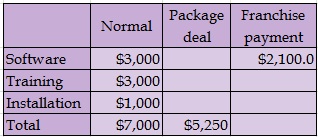
Let’s take a software vendor, selling some software solution. Normally that entire path will set you back $7,000. The software, training, installation and personalising the solution. At this point you might think, well, it is all tax deductible for the company, so what gives?

Well, some of these players still have budgets to adhere to (unless you are in Italy), and when we look at that the procurement department will state that it is too expensive. So, the sales team has an idea. They say: ‘You know what! We can (if you take all three) the entire as a package for $5250, and that is a nice discount‘. So the company takes all this and accepts the deal. So the software is bought, there was a trainer on the spot educating the staff for 2 days and they set up whatever needed to be set up and the entire delivery is complete.

It all seems straight forward. Yet, it is not to be. You see that outsourcers often have a main office outside of that country and they want their franchise fee, which could be 70% of the software, yet they will always get FULL PRICE. So they will get 70% of $3,000, no matter what the discounted invoice was. Now that company has to make due with $3,150 for training, training materials, travel expenses, training hardware and staff. And for every deal they make the cost remain high, yet the revenue has been siphoned off and the cream went somewhere else. Now we get the stage where there was still a profit, yet the staff members are still costing thousands of dollars, as is the office and all other goods. There is not taxation as the revenue was too low and this is where we see the problems for a lot of these companies. They are now in debt, governments having to make deals and I cannot vouch for Interserve, Carillion, Serco Group Plc and Capita Plc, because where I know it was happening was not one of these. Yet I feel certain that others have been playing similar games and it has been going on for over 20 years that I am aware of that tactic.

So does the entire Interserve part now make sense? A debt of well over half a billion and its board members are still up for millions in bonus? I cannot tell what the reason is for the entire Interserve issue, yet what I have seen in the past, we should take a long hard look at what some consider to be debt and what some consider to be an optional approach to deferred invoicing.

We might see partial support when we see the article in the Morningstar (at http://www.morningstar.co.uk/uk/news/AN_1542962437936788100/interserve-expects-higher-operating-profit-despite-construction-loss.aspx). Here we see: “Interserve posted a pre-tax loss of GBP244.4 million on revenue of GBP3.25 billion in 2017. It then recorded a pre-tax loss of GBP6.0 million on GBP1.67 billion in revenue in the first half of 2018“, others sources had a similar setting, yet here we also see the headline ‘News Interserve Expects Higher Operating Profit Despite Construction Loss‘, now we see operating profits versus construction loss? Does it now seem more and more that we are given a half a billion birdie, whilst some are showing to be receiving massive bonus payments? How is this not tackled? How come that for 20 years we have seen the impact of creative bookkeeping, whilst the European governments have been unable to fix anything?

When we see the Financial Times (at https://www.ft.com/content/b2c9fdd2-eeed-11e8-8180-9cf212677a57) giving us: “Interserve employs 80,000 people worldwide — 25,000 in the UK — in jobs that range from cleaning the London Underground to maintaining army bases and building a shopping centre in Dubai.” Giving me the speculative thought ‘How long until we see the Dubai part sold off (including equipment) at roughly 5 pennies to the pound? How would that screw over the 25,000 staff in the UK when Interserve folds? We will not know until the Interserve lawyers and accountants finalise they optimised plan in 2019, but I fear that the impact of outsourcing is going to be felt on a very large area. You see, outsourcing growth is through the roof and it is growing in a sphere of influence that has not been seen before. Fintech, Meditech, Pharmaceutics. It seems like the golden calf, yet it is a treacherous field. It might be a temporary field at best. I think that the construction companies have good weather now, yet the crash of the 80’s is still with them, Communications is all about outsourcing, yet when those outsourcers do not finance the training of staff, their usefulness will decline in 3-4 years as the companies are focussing on 5G. In that same light, we see a pharmaceutical growth, yet the setting is that many patents will fall over in the next 5 years. At that point these companies outsourcing can discontinue the renewal of contracts and the staff issue will not be their problem, it will be the problem of the outsourced company and that is starting to push a wave to a much larger degree than we have seen before.

So as we return to the Financial Times article we get “Interserve said profit growth for the year so far had been as expected, and it anticipated “a significant operating profit improvement” for the full year. The group, which swung to a loss in the half-year, did not provide figures“, we knew that, many sources had it. Yet we also get “It has revenues of £3.25bn but is valued by the stock market at just £75m and is already under close watch by the British government in case of collapse“, when a 3 billion revenue company is merely valued at merely 2% of that, there is a lot more going on than mere sneaky keeping of books and that needs to be seen as well. So when we consider: “Interserve’s update attempted to “sugar coat” the increase in net debt and “to deflect from the news” that the Cabinet Office is making sure it has alternative suppliers to take the place of Interserve should it fail. “The operational developments are not good reading either,” he added“, a part given to us by the independent analyst Stephen Rawlinson, we need to look deeper. You see, if the UK does get confronted with: “alternative suppliers“, we need to accept that for a chunk of those 25,000 British workers it will not spell good news, even more so, there is every chance that it gives a larger level of turmoil to those people whilst some board members end up going home with a payout that is between £380K and £2.25M, making sure that they can live in a sea of porn and Netflix for the longest of times, possibly even until the day they die.

Is it that bad?

Well, that is not certain, yet the issue that the UK accounting watchdog had to quit over criticism regarding Carillion (source: the Guardian), they give us the quote: “Stephen Haddrill will depart after nine years in charge of the Financial Reporting Council, which is subject to multiple inquiries into its effectiveness and independence” we get one thought, yet in light of “a committee of MPs described the FRC as “chronically passive” in an excoriating report into the construction group’s failure, condemning the regulator as “too timid to make effective use of the powers they have”” we should consider that there is every chance that Interserve might have been on that same side of the page making the issue larger and more critical. Is it not interesting that too often we see terms like ‘too timid‘ when it comes to dealing with the rich? The entire Sir Philip Green’s £1 sale of BHS is a nice example to keep in mind. The setting where the people behind BHS are apparently not in prison in a stage where “the settlement will not fully restore the retirement income they had been promised by BHS” (source: Financial Times). One of many failings where we see the creativity of applied accountancy and the improper use of non-committal prison sentences to those employing these fast and loose solutions. At present there is a speculative chance that Interserve might be on a similar track, but that is pure speculation, we will not know until the solution is offered, which according to the papers will not happen until somewhere in 2019, until that point arrives thousands of employees at Interserve will likely be in a state of stress. It is one hell of a way to approach Christmas.

Humbug!


Leave a comment

Filed under Finance, Law, Media, Politics

The economic insanity

We all have our limits, we all have parts we look at it and it just does not make sense. I am no different in that regard. I cannot fathom how a business survives at times. We all get that. I grew up having to walk to the grocer, the butcher and the general goods store when I was young. I got beef from one, I got cabbage from the other, we even had a potato vendor on a street called Vierambachtstraat (Rotterdam); this potato man had half a dozen of different kind of potatoes, sweet, non-sweet, large and small. We would pick up a bag 3-4 KG and it would be more than enough for a week (household of 5). At some point he left us, he stopped, the grocer remained for a while, yet I was still around when he left and it was replaced for a record store. The general goods store had already left. You see, a Supermarket called Albert Heijn had taken over and the other stores could no longer remain there. The butcher remained, yet over time he too would fall away it is now a furniture store I believe. My house is still there, yet none of the shops remained, over time they were replaced by other shops, a mere sign of the times.

So when I was confronted with ‘Interserve shares fall as growing debt sparks fears over its finances‘, I initially merely glanced. An outsourcer called Interserve; it seems to be something trivial. That is, until you realise the part “The Company, which carries out building work and provides services such as cleaning, said debts would be between £625m and £650m by the end of the year, having earlier said debts would be £575m to £600m“. So even if we would trivialise all this, in which universe would a company have any chance to survive with an initial debts of ‘£575m to £600m‘? The fact that it will be fifty million pounds more should be the fuel to the fire. A company will be in debt for well over half a billion pounds and people are worried? Why on earth were the members of that board of directors and their children (and grandchildren) not sold into white slavery on a market in Marrakech? You see, I get it, any company will have downturns and we should allow for repairs on that, yet when a company is the pressure on the existence of small companies, whilst it act as a behemoth with a workforce of an estimated 75,000 people worldwide, we need to up the ante. These people are pushing the envelope hoping that they would be like any bank ‘too big to fail‘ leaving it up to politics and wheeling and dealing to get them out of the hot waters, to save and saviour their hot potatoes some might say.

Even as we see: “It comes a week after Interserve was forced to comment on the state of its finances, after shares tumbled to a 30-year low over fears it was heading the same way as Carillion, the rival outsourcing firm that collapsed in January“, was that not a wakeup call to set the stage to push for oversight much faster?

We are also introduced by Russ Mould, investment director at AJ Bell to: “Chief executive Debbie White and her team are clearly doing their best to steady the ship at Interserve but the admission that net debt will end the year higher than expected, not helped by how the cash inflow from the troubled energy-from-waste business will be lower than hoped, means the company has yet to reassure shareholders and potential investors about the key issues that face it.” I am not sure how we should see this, in view of: ‘how the cash inflow from the troubled energy-from-waste business will be lower than hoped‘. When should we accept ‘lower than hoped‘? That implies speculative investment with funds that they never had and playing the gamble card in corporate expectations. So when these debts hit full on, who gets to pay for that, the taxpayer? It is my personal believe that until the debt is gone, none of the board of directors should be allowed any income above £100,000 with in addition all bonuses scrapped until the company goes out of the red. In addition, there should be no weight to the claim: “Interserve, which provides a range of services for schools, hospitals and government departments across the UK, agreed a £300m rescue plan in March, at a time of heightened pressure on the outsourcing sector and in the wake of Carillion’s collapse under a mountain of debt.” From my personal point of view, they took jobs and under-priced them forcing the small fish out of the water of revenue, and then they use that shortfall to push taxation to zero whilst walking that path too often in too many divisions. That is how I personally see this and I might be wrong. Yet in all this, that is seemingly the path too many large players play it, undermining services for the longer time whilst the others have no option to get into the business. The government might like the short sold services as it looks good on their costing spreadsheet, yet when group of 75,000 people end up to the larger extent being unemployed, the damage will merely increase for all the parties involved. Russ Mould also gives us: “some investors would wonder why Interserve was waiting until 2019 to unveil a new plan designed to reduce debt, whilst the share price slide suggests the company’s situation remains acute“. In light of that we see the urgent need for players like that to suffer a lot more oversight, the withdrawal of all bonuses and capping of income. In a state where we see an escalating stage of danger to staff members on almost every level (I did say almost), we see (at https://www.interserve.com/docs/default-source/investors/financial-reports/integrated-reporting/2017/2017-full-year-pdf’s/governance-report.pdf) the mention of something I will address shortly, whilst we see (at https://www.constructionnews.co.uk/companies/contractors/interserve/interserve-ceo-set-for-125-bonus-for-2017/10030955.article). Can anyone explain to me how well over half a billion shortfall gives rise to: ‘Interserve CEO set for 125% bonus for 2017‘, you might think that this was merely last year, yet consider that one company has a shortfall of well over half a billion in one year. That does not happen, this has been going on for a much longer time and whilst we accept that any company gets to have a hard time, it seems utterly unacceptable that its board of failures in managing that get to go home with £525,897 (the bonus of Chief executive Debbie White) for 4 months of work and if things go really south, to sit at home on the sofa optionally watching Netflix and porn for 5 years whilst the market ‘restores’ itself. It gets to be even less tasteful when we also see: “This includes an annual variable pay (AVP) bonus of £270,089, which is 125 per cent of her pro-rata base salary of £216,667 since she joined in September 2017 – the maximum available under the AVP scheme” are you feeling betrayed yet? She should be regarded as HMRC positive and kept in isolation, removed from income until the company is again in the non-red numbers zone.

Was that over the top?

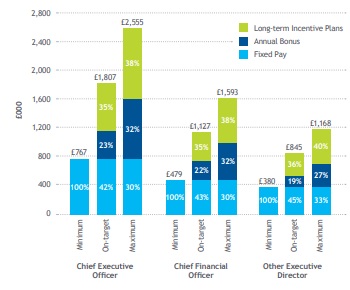
When we consider the first report which is 62 pages, we see that plenty of space was used to give rise to bonuses where three people get to go home (in a best case scenario) with £2.555, £1.593 and £1.168 million. In a setting where we see that a company minus zero setting, towards the one billion mark in the red, how is there even a case for a best case scenario? How is it that we see all kinds of share and cash deals whilst there is a real issue with this type of company? Should we not see a whole range of other questions holding the HMRC responsible for allowing this situation in the first place? Whilst the cheapest of the three (other executive director), optionally being a figure of speech for a lot more than one person the issue merely intensifies. Their minimum pay is £380K, which is close to 1,800% of the average annual UK income; giving rise that one year would enable a person to afford a person to go on a holiday for close to 10 years. I never had that option, not in two decades of loyal service, interesting how some people are just not held accountable for bad turns is it?

So whilst these high and mighty desk jockeys get to relax over Christmas, considering on how to tackle it all in 2019, as per ‘Interserve to roll-out £650m debt reduction plan‘, they will leave staff in pressure and under threat of being laid off. It gets to be even worse when they ‘hide’ behind “This deepened due to additional cash outflows on Energy from Waste as well slow payments in certain Middle Eastern markets“. If they have been there they know what the cycles of payments are. They know on what is to be expected. So if there is plenty coming in, there should not be an issue. When jobs fall through, it is known as well, so even as there is a slack from the energy from waste, it seems that merely lose statements are given and they might not hold water under accountancy scrutiny here.

As for the books

There we see that PwC are to be the financial advisors, some sources give rise to other parts. The independent report (at https://www.interserve.com/docs/default-source/investors/financial-reports/integrated-reporting/2017/2017-full-year-pdf’s/financial-reports.pdf) talks about ‘we’, but who is ‘we’? The report is 100 pages and it was set for the December 2017 point, yet there too we see a few things. If we are to accept certain previous statements, we see “We performed targeted procedures over component entities in Guernsey, Oman, Qatar, the United Arab Emirates, Saudi Arabia, Australia, Hong Kong, the Philippines and the United States of America. We performed analytical procedures over component entities in all other geographical locations“, so when we see the larger picture, how does the ‘Middle East’ reference hold water? This would imply they’re UAE, Qatar, Oman and Saudi Arabia customers. There are still plenty of other locations, even if it is largely weighted to those 4, the mention “as well slow payments in certain Middle Eastern markets” seems less valid. The shortfall of well over half a billion does not hold up, because if it was all due to investment, there would not be a shortfall to report, those debts are different. That is where the report on page 114 seems to give a little light. We see: “A further update was given to the market on 21 March 2018, indicating that short-term facilities had been extended for a further month to 30 April 2018. The Group announced that it had concluded refinancing negotiations and had arranged access to committed borrowing facilities of £834 million on 27 April 2018.“, on the other side of that page, we see: “assessing the appropriateness of sensitivities applied to the Adjusted Cash Flow Forecast to evaluate whether liquidity headroom and covenant compliance had been subjected to appropriate stress tests;” when they come up short by another £50 million, one might argue that either the stress test was wrong, or elements were unknown or merely ignored. I cannot tell what, why, who or which, yet it does not seem to add up.

So as that page ends with: “As a result of our work, we concluded that there were no matters in relation to going concern to which the ISAs (UK) require us to report to you“, I will offer that the news is giving us a £50 million reason proving that statement to be wrong (or at least partially). There is also increasing consideration that the auditing firms needs additional scrutiny, as jobs are handed over from one firm to another, there is the option that it speculatively gives rise to nepotism, as well as the danger that they all play the same game in what should not be required to be reported. The last is also highly speculative, yet the shortfall over 50 million as well as the debt surpassing half a billion proves me at least partially correct.

The question is how to move forward. There is a point of view that gives rise to a lot more than merely changing the laws towards outsourcing. There should be a long term accountability system in place, as it might all seem to be nice and correct on the balance sheet, the mere worry is that there is a long term impact. Should we see additional pressures where Interserve goes the way of Carillion, there might be a pressing point to start considering making that change. In an age of global accountancy where the costs are stored local, whilst indirectly the booked profits are staged to go to the land of the shareholder (wherever that is) we see an imbalance of accountancy that is seemingly all fine, yet makes no logical sense altogether. That might be one of the biggest settings that governments are facing in Europe and on a global stage.

Perhaps I will take tomorrow to give you a clear picture on what I mentioned here in examples. At that point I will be bringing graphics to the table as well.


Leave a comment

Filed under Finance, Media, Politics

Two Issues in play

There is a larger issue in all this, part of it is Wall Street, the gig is up (to some extent) yet no calls are being made to investigate the Analyst game by aspiring new Wall Street kings, and moreover no one is asking questions.

We start with the impact that Apple has had and the Financial Post is giving us (at https://business.financialpost.com/investing/us-stocks-wall-st-pulled-lower-by-apple-trade-worries) “Shares of Apple Inc fell 3.5 per cent after the Wall Street Journal reported the company had cut production orders in recent weeks for all three iPhone models launched in September“, as well as “Other market leaders — including the ‘FANG’ stocks — also fell sharply, underscoring the view that their leadership was on shaky ground. Shares of Facebook were down 5.1 per cent, Amazon.com was down 4.3 per cent, Netflix was down 4.9 per cent and Alphabet (Google) fell 3.4 per cent“. Now, we can go two ways in this, yet I am concentrating on the mere logical view. It is not the part of loss that is concerning me, it is as I said in ‘Annual medical bill $864,685‘ (at https://lawlordtobe.com/2018/11/17/annual-medical-bill-864685/) “Consider the $2365, whilst their opponent is offering a decently close solution for $1499 (Google) and $1599 (Huawei) all top end phones and the next model is 33% cheaper, in an economy where most people are turning around pennies (just look at Debenhams). It was a really bad market moment; one could argue that Apple believed their marketing whilst it was nowhere near realistic“, when we consider this part, which is the basis application of common sense in a day and age of hardly being able to get by and we see such drops in stock levels, is that because there is underperformance, or a more clear image of overestimation by certain analysts clearing an optional path of short selling? When we consider the definition of short selling as: “The trader sells to open the position and expects to buy it back later at a lower price and will keep the difference as a gain“, is my speculation on a market set to implode that far from the actual truth? Has the entire FAANG group resorted to hiring mentally challenged Business Intelligence enabled accountants, or is someone spiking the Wall Street environment?  Is my thought on this that far out or synch with reality? When we see SBS reporting with ‘Nissan chairman arrested in Japan for financial misconduct‘, and we are given: “Besides being chairman of Nissan, the 64-year-old is also CEO of Renault and leads the Nissan-Renault-Mitsubishi alliance“, “Nissan CEO Hiroto Saikawa expressed “despair,” but also suggested that Ghosn had accrued too much power and eluded proper oversight“, as well as “Saikawa gave few details about the nature of the improprieties, including refusing to confirm reports that Ghosn under-reported his income by 5 billion yen, or around $60 million (AUD), over five years from 2011. He said an ongoing investigation limited what details could be shared, and refused to be drawn on whether other people were involved, saying only: “These two gentlemen are the masterminds, that is definite.”“. As we consider the impact of Representative Director Greg Kelly and Carlos Ghosn, we might think that the entire matter is contained, yet is it? The fact that Automotive is a clear element on Wall Street, when we see this and we do not see another part, how wrong have the analysts been getting it? The fact that numbers on Wall Street would not fluctuate to the degree needed as the numbers were spiked by a major players is interesting to consider yesterday’s news (at https://www.zdnet.com/article/nuance-spins-off-automotive-segment-into-new-publicly-traded-company/). You see, just like I found the issue in the Harbour or Rotterdam two decades ago, I looked into another direction. When we consider “Other automotive brands such as Honda, Volkswagen, Ford, Hyundai, Audi, Porsche, Nissan, Kia, Chevrolet, Harley Davidson, Ferrari are ranked by their brand value among the top 100 brands in the world!“, so if we see the SBS part with: “years of financial misconduct including under-reporting of income and inappropriate personal use of company assets“, which looks weird as this is merely an internal part (criminal or not), is there a decent chance that the entire matter is larger and as such, would a provider like Nuance not be hit as they are a component in the Nissan (and Renault, and Mitsubishi)?

In all this, when we consider The actions of one, and the impact on another, yet we see that expectations were ‘firmly’ in the wrong place, at what point will we start asking the damaging questions to analysts who were ‘overly’ positive? So when we see: “Wall Street was looking for earnings of 32 cents a share on revenue of $525 million. Shares of Nuance were down slightly after hours“, were we shown a realistic stage? This gets us to the Sydney Morning Herald, where we see: “Since the FANG outperformance run peaked on August 30, the group has underperformed the S&P 500 by 16.25 per cent. That is their worst underperformance since the first half of 2014 when they underperformed by around 20 per cent“, is it truly an underperformance, or is it set towards unrealistic overestimation and as such, is the foundation of short selling not done on the word of analyts? So in that light, would it not become more and more prudent to ask the analysts certain questions? The fact that certain Nissan events were not on their radar, what else did they not see and as such, would that not have impacted the numbers at Nuance in a similar, yet there unfairly?

What else is there?

Well, that can be seen in one way as these players all need power to be available and energy is becoming an issue in the US. What happens when we put the (big) mouth of Senator Lindsey Graham (R-SC) to the test? As he was ‘kind’ enough to use Bloomberg to state that the current crown prince of the Kingdom of Saudi Arabia Crown Prince Mohammed bin Salman was “unstable and unreliable”, would it be an idea to ask his royal highness to kindly consider that Oil is a sellers’ market and that it is important to consider the long term future of the kingdom of Saudi Arabia, as such, it is important to consider the value of oil and I personally believe that it should be raised to $73 per barrel, in light of this cutting oil production by 12% would be essential.

So when Lindsey gets the news that his lack of diplomacy is cutting oil and raising prices, at what point will he ever feel safe again as the American people will react to the mere stage of commerce, it is a sellers’ market plain and simple. It is a sellers’ market because the buyer is always open to get it somewhere else, and in all that there is merely Iran left. How does it all flow now? Let’s not forget that these are not my rules, they are the consequences of Wall Street. At what point will people wake up?

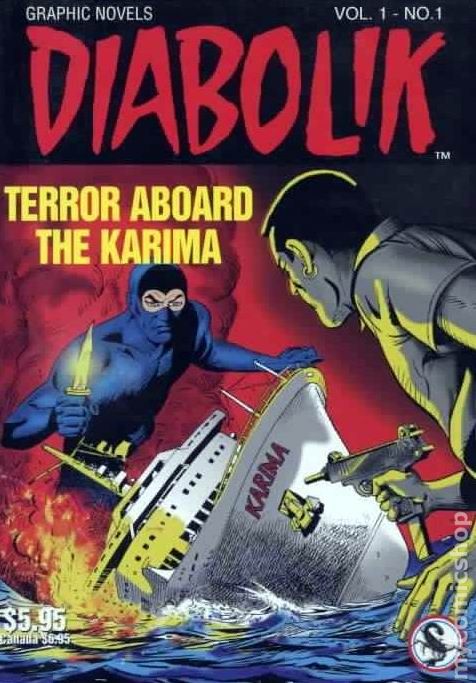
The Kingdom of Saudi Arabia is a monarchy, it is one where the monarch of that nation makes decisions that decide what would be the best track for the people of THEIR nation (which is Saudi Arabia). In a time where the life of a journalist does not matter, Turkey showed that and both the EU and America remained largely quiet, so let’s face it, we do not care about Jamal Khashoggi, yet that person has received more pushed and powered visibility than for example Matteo Messina Denaro (I chose him as I grew up being a huge Diabolik comic fan), so when we see his actions and his absence from the press for the longest time, why would we care about Jamal Khashoggi? Because a knave speaking for Iran direted others to do so? We keep on getting the news, the media, the mention of tapes, yet how clearly has the evidence been investigated? The media stays silent, mostly playing on innuendo as much as possible.

You see, it the Crown Prince succeeds in getting the stage of Neom Started, Saudi Arabia will have started and aspired to something never seen before in the history of this world, all the things that America claimed to have done will be seen active in Saudi Arabia, it is optionally the biggest blow to American ego and optionally their economy too and they are finally scared, like the UK was when the 70’s peace accords had a chance, they pushed Egypt in another direction. Now we see the stage where there is so much anti-Saudi news, that it is sickening to me, especially as the acts of Turkey and Iran are smothered. How much news have you see on the 214 journalist jailed in Turkey? most of them all convicted, the last one a week ago, we were given “A court sentenced Turkish journalist Ali Unal to 19 years in jail on Wednesday on a charge of being a leader in the network accused of carrying out a failed coup in July 2016“, Jamal Khashoggi got 60 million hits in Google Search this morning, it is that far whacked out of balance and the industrial next generation all technological marvel that could be Neom, including the Bridge that links the Sinai (Sharm-El-Sheik) to Saudi Arabia, opening even more options to commerce and growth for Egypt and the Sudan? A mere 2.8 million, a project that is well over $500 billion in investments for technological and financial opportunities; that got less than 3 million hits. I reckon that Saudi Arabia also needs additional PR and digital PR on a much larger scale.

I think that America (as well as the European Union) needs to wake up and smell the coffee and they need to do it fast. As they whinge like little children, they are optionally giving additional fields of economy to India, China and Russia to move into a market where the oil revenues will be pressed for a different directions, so as these people are merely trying to bait infighting within the Saudi Royal family, they should start to realise that one of them wakes up and decides to close the tap by 20% and merely adjust the vision towards 2035, at that point whatever comes next will no longer have any America and even less Wall Street, at what point will the American administration have to forfeit on 21 trillion of debts they can no longer pay? Let’s not forget that the entire FAANG group can vacate and move anywhere globally, at what point will we see the news: ‘NASDAQ shuts down!‘  leaves us with the question: ‘is my speculation so outlandish?’ You see, the needs for the next technology is no longer in America and the difference between global and global minus America is not that big, at that point the politicians of the European Union will fold like little bitches and accept whatever deal will keep them employed and on their gravy train; they are that predictable.

The nice part is that there is every chance that I will be around when that happens, getting to tell the economic and financial editors of all the major newspapers: ‘I told you so!‘ and the blatant attacks, the media toolkit against the current crown prince of Saudi Arabia makes my speculation more and more likely. You see, it was merely a week ago, when CNBC gave us (at https://www.cnbc.com/2018/11/15/trump-duped-saudis-into-tanking-oil-prices-analysts-say.html) ‘Oil analysts say Trump fooled Saudis into tanking crude prices‘, with the quote: “Oil market analysts say it now appears that Trump hoodwinked Saudi Arabia, fooling the U.S. ally into pushing the oil market into oversupply and sparking a roughly 25 percent drop in crude prices. That accomplished Trump’s goal of driving down energy costs for Americans“, it is optionally a decent tactic, but at present it can backfire, the KSA can take a step back and let it all fall to pieces as the Saudi government can survive a few years in the up scaled oil prices, yet the US and European economies will start to collapse as they have no infrastructure left, so when we see Bloomberg giving us ‘The Oil Price Is Now Controlled By Just Three Men‘, whilst we know that America has pissed of the other two to the largest degree; if truly three man control the price, the names are given to us as Presidents Donald Trump, President Vladimir Putin and Crown Prince Mohammed Bin Salman. That whilst America needs to import to survive making them actually pretty weak. So at what point do the people in Wall Street wake up and realise that the oil morning special is served at $91+, whilst there are 3-4 months of extreme cold ahead? At what point will they realise that oil is a sellers’ market, not a buyers one and the oil companies can wait, they can watch it all collapse and pick up cheap labour for a mere apple and an egg (quite literally so).

In the end, America can start making a deal with Iran and Russia for oil, yet at what cost will that come? Which concession will the American people have to agree to? I am pretty sure that this moment will become the nightmare scenario for Israel as well as the others get to cater to Iran, and the oil setting makes that an optional reality; the amount of concessions Turkey will get will give the EU something to cry about to a much larger extent; apart from the nightmare that the Italian budget is becoming at present.

There were a few games on everyone’s desk and at least three of them have been handled so badly that the impact needs to be felt in the US, even if it was for the mere reason to get them to wake up and smell the coffee that they spilled and the cost of living that they helped raise soon enough.

Oh, and when the Italian economy stops stagnating and turns to recession again, the mere impact of a 5% oil price rise would be enough to stop Italian traffic in its track, how much will be possible there when that happens? Consider that Italy has the highest fuel prices costing €1.65 per litre. When that goes up by 10%, how many people would be able to afford a car? More importantly, the Italian economy has misjudged this super high price for taxation, so when that falls away, how much of the Italian infrastructure is also likely to collapse?

It is a mere side thought, because France and Spain will be in similar distress on a few stages there too, not to mention the impact in Greece. It would decimate the Mediterranean economy to a much larger degree, yet Wall Street will trivialise it and when there is no more trivialisation left, who will they blame?

Saudi Arabia, President Trump or themselves?

I will let you figure that part out.


3 Comments

Filed under Finance, Law, Media, Military, Politics

Hezbollah, an ignored danger

It has been around for a while. There has been a clear view on how we perceive things, it is in part fuelled by the media and in part through governments that use the flim flam artist approach of ‘watch here‘ whilst the action has been ‘there‘. We have seen a larger growth of anti-Semitic and even anti-Saudi ‘presentations’ and articles. Even though there has been a clear issue with several sides towards the ‘unnatural ending’ of Jamal Khashoggi, the media was way too eager to merely use Turkish innuendo, whilst to a larger extent no verifiable evidence has been produces, even some of the claims have been contradictive. This does not mean that Saudi Arabia is innocent in this, but the critical questions had remained absent to a much larger degree and that too is being swept under the carpet. Yet there is a lot more in all this and it’s important to look at one of the larger puppets Hezbollah. You see, they are very much connected in all this.

Historical

For me personally there is history, I was never part of UNIFIL, yet I was part of the United Nations Security Council and I knew people who were part of UNIFIL, so when I was exposed to ”One year later, following a comprehensive operation by the institute and due to growing international attention to UNIFIL’s failures – and despite EU pressure to prolong the UNIFIL commander’s term – his term was discontinued“, as well as ““The European continent has turned into the lifeline – the oxygen line – for Hezbollah’s terrorist activities,” said Prosor. “If Germany, and then the European Union, would designate all of Hezbollah as a terrorist entity, it would suffocate part of the organization’s ability to function.” For more than a year, the institute researched and produced an investigative documentary on Hezbollah activity in Germany. The film was produced entirely in the German language and with German and international experts“, I was decently shocked. The Jerusalem Post gave us in addition: “the lack of professional background of the commander who was leading the force and his blind eye toward Hezbollah’s violations on the Israel-Lebanon border, deeming them as activities of “shepherds and hunters.”“, the fact that there was this level of complacency was just unheard of. The fact that the other media is seemingly ignoring parts of this is just way too weird. Now, we can consider that the Jerusalem Post is biased, yet when we consider both The documentary was first shown at the 2018 International Conference on Counter-Terrorism and at the presentation to the German Parliament at the end of this month, we should realise that this is a much bigger issue, in addition UN Nikki Haley publicly criticized UNIFIL at the UN, one would think that this is due more visibility then we have so far seen, and when we also see: “while it seems obvious in Israel and America that Hezbollah’s military and political arms are both sponsors of terrorism, in Europe this is not so obvious. There, they make an artificial differentiation between the military arm – a designated terrorist group – and the political arm“, It is almost like the entire IRA issues we saw in Europe in the 80’s and 90’s and whilst Europe remained cautious in regards to the IRA, it is seemingly willing to embrace the political arm of Hezbollah that is every bit as dangerous as its military counterpart.

A facilitating gravy train

There are two additional parts here. The first is less than a day old when we are ‘treated’ to: ‘Hezbollah money laundering has a ‘safe home in Germany”, again from the Jerusalem Post, that even whilst we are given “Lax German illicit terror finance policies permitted Hezbollah to run a vast enterprise to raise funds through a money laundering operation in Europe and South America. French prosecutors put 15 members of the criminal organization on trial last week in Paris. According to three German media outlets – NDR, WDR and the Süddeutsche Zeitung – two of the accused men lived in the German state of North Rhine-Westphalia and an additional two men who were charged lived near the city-state of Bremen in northern Germany“, I could not find any references in other large media (outside of Germany and France). If they have it, it was hidden pretty efficiently. It seems to me (very speculative) is that there is optionally a growing link between the political branch of Hezbollah and the secular press as the Americans call it and that is pretty dangerous. When we consider that Hezbollah is directly engaged in Yemen, the ignoring of such events is a lot more damaging than you could imagine.

There are additional sides in this, yet most of this is given in opinion pieces, which is a factor that we must take into consideration. The first comes from the Khashoggi family (aka The Washington Post), who (at https://www.washingtonpost.com/opinions/global-opinions/to-rescue-yemen-the-us-must-end-all-military-support-of-the-saudi-coalition/2018/11/12/aca29358-e6ad-11e8-b8dc-66cca409c180_story.html) gives us ‘To rescue Yemen, the U.S. must end all military support of the Saudi coalition‘, now, it is a viewpoint that a person should be allowed to have. I do not think it is a realistic one, apart from the fact that ‘Houthi’ is mentioned twice and Hezbollah does not get any mention and they are both firing missiles into civilian areas of Saudi Arabia (and that is all besides the absence of Iranian activity fuelling it all). Yet the passing of a ‘blogger aficionada‘ (aka Journalist) takes front seat to a setting where that person should not really be an issue to the degree he is shown. The stage gives us “in which more than 16,000 civilians have been killed or injured“, yet the mention of 50,000+ deaths from disease, famine and other means where Houthi’s are allegedly using Hezbollah tactics does not get any mention either.

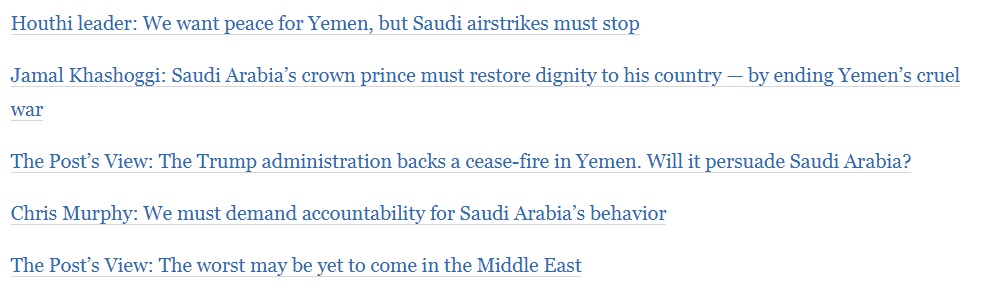
It is that filtered view that is giving light to a behind the curtains support setting to Palestine and Hezbollah. Now, to be fair, a person should be allowed to be pro-Palestinian, if people are Pro-Israel, the other should not be denied, yet Pro-Hezbollah, to be in support of a terrorist organisation is a much bigger issue and that hidden part is becoming a lot more visible, especially when the news is shown to be so unbalanced, even when it is ‘fronted’ as an opinion piece. so when we see the links (as an image), whilst it is almost all openly ‘anti-Saudi’, yet the fact that the atrocities that Houthi and Hezbollah have been largely the cause of, that absence is making the news not democratic, but a shadowy version of niche events presented as factual truth, whilst the given view on the larger scale shows this absence to be close to utterly unethical, especially for a paper like the Washington Post, whether they are now staff-1 or not.

1982 kilometres from Beirut

So how should we react to: “Even U.N. Secretary General Antonio Guterres submitted evidence to the Security Council that Iran was supplying ballistic missiles to Houthi rebels in defiance of U.N. resolution 2231“, which links to a 2014 article, yet the truth is that this has been ongoing and even as Western Europe is puckering up towards Iran to a much larger degree, leaving the political response against Hezbollah unanswered and more important Mohammed Ali al-Houthi is not seen as the guilty party he should be seen as. It is often stated that any aspiring tyrant will consider peace on the eve of defeat and that is what we see now. Even as we are treated to ‘Arab coalition to allow Al Houthi medical evacuations from Yemen: UK‘, we also see ‘Wounded Al Houthi rebels to be evacuated‘, yet what about the 80,000 children on the brink of death due to famine? Even as some might applaud the Saudi Coalition victory, seen though: “Recent high-ranking defections among erstwhile allies of Al Houthis signal further such splits as the Iran-aligned militia suffers setbacks at the hands of the Saudi-led coalition, experts said. This week, Abdul Salam Jaber, who had served as the information minister for Al Houthis, defected from the militia and fled the Al Houthi-controlled capital Sana’a for Riyadh. He said the rebels were “breathing their last”“, the biggest responsibility should be to the Yemeni civilian population in such distress through famine and disease alone. Even Deutsche Welle reported ‘Yemen Houthis seek truce with Saudi coalition‘, yet nothing on those starving to death and even as the Deutsche Welle gives us “The three-and-a-half-year-war has pitted forces loyal to President President Abed Rabbo Mansour Hadi, backed by the Saudi-led bombing, against Houthi rebels associated with Tehran. Saudi-led coalition has recently intensified the bombing in the key strategic area of Hodeida. A blockade of the port city could trigger unprecedented famine“. Even as the blockade might be tactical, the fact that food has been withheld from the civilian population to a much larger degree through the Houthi whether or not employing Hezbollah tactics is also absent here.

For me the problem is a lot larger, as we clearly see the impact of Hezbollah and the absence in the media, the media is becoming less and less reliable, especially as the stories remain one sided. There is a larger part in all this. Personally I am not convinced that this is the complete picture, and I need to make it clear that this is speculative. It is my personal belief that when we consider The National (at http://www.thenational.ae) and some of its unconfirmed articles, some might have seen: ““This was no rogue operation but, rather, a function of Hezbollah’s “financial apparatus,” which “maintained direct ties” to both Hezbollah commercial and terrorist elements,” he wrote in a report published by the Washington Institute of the US Treasury designation of Nourheddine, which preceded the arrests. “Within days of this designation, Noureddine was arrested in France along with several other accused Hezbollah operatives“, as well as ‘Operation Cedar—of which the Treasury designation was just one part‘. I am amazed that the Netherlands were not more visibly mentioned in all this. It seems weird, almost unfathomable that this was all achieved without the use of Rotterdam as a point of transit. Even as transitional cargo is not really looked as, as the Netherlands was not the end destination, it is the biggest world hub in getting containers and bulk cargo from anywhere in Europe towards Asia and the US (and vice versa). This implies that Hezbollah political players are seemingly active there too. The article does mention the Netherlands, yet in a much more ‘timid’ capacity. We see: “Cash was dropped off at hairdressers in Antwerp in Belgium, a large hotel in Paris, a restaurant in Montreuil or a café in Enschede in the Netherlands. Transcripts showed that Mr Noureddine would hand out orders for the collection of as much as 500,000 euros at a time. Six figure sums were often delivered in small note denominations” and that makes sense for the German part (Enschede – Germany) is a distance you can walk (4.5 km) with a highway to Gronau, so that is a place to easily get into Germany (and the opposite direction), hundreds of containers a day take that route. when we consider the news a month ago, when the Dutch were confronted with: ‘Dutch politician praises pro-Palestinian kite show featuring Nazi symbols‘, my assumptions and speculations might be shown as correct, yet is that the actual part in that? So when the Dutch were treated to: “Rens Reijnierse, a lawmaker from the southern city of Vlissingen” and his Pro-Palestinian view “Kites at Pool Beach. Beautiful autumn day in Vlissingen. No wind so the kites won’t fly but the project for Palestine still succeeded,” he wrote” as it was tweeted gives light to not merely a Pro-Palestinian view (which should be allowed) to an optional facilitating Pro-Hezbollah view (a speculative view by me), which is another matter entirely, if that would prove to be true, and even as I mention one person, I am convinced that the anti-Semitic vandalism as shown 6 months ago in Amsterdam was recorded to have risen by 40%. From my speculative mind, there is no way that this does not include a wave of Pro Hezbollah people giving light to a much larger danger on a global scale.

The size does not matter here, the fact that the media is allegedly shuffling this part to the bottom of the news pile is an issue and the few parts I have shown here, should also give rise that the media to a much larger extent is seemingly doing this. Merely Google ‘Hezbollah‘ for the last 24 hours and I see an absence of The Guardian, The Independent, the Times, and several other large newspapers in Europe. Do you really think I was making that up? It is not merely what we see; it is what we do not get to see that shows us that there is a much larger problem. Optionally there is a hidden danger, which is nothing to speculate or allege to. Those who are not in the news are often quickly forgotten and that is the true danger that Hezbollah is representing on a global stage. You merely have to view the thousands of images that show the nightmare that Hezbollah has been part of to see the danger that they pose, the fact that Iran is willing and has been shown to fund this is the icing on the cakes of Iran and Hezbollah, the fact that the media skates around it makes the cake more delicious for both these players as they are not given the limelight of their actions.


Leave a comment

Filed under Finance, Law, Media, Military, Politics

Annual medical bill $864,685

Yes, that is the price for keeping the doctor away. An Apple a day keeps the doctor away, yet at $2,369 per iPhone it will be a hefty bill, let me tell you that. And the news gets to be worse after that. Apple has been in the news and not in a good way. We all remember the big news earlier this year, when Apple announced that they had become the first trillion dollar company. It was just as the new Apple models had come to town and the impact has been seen. First we get the Financial Times 2 days ago with: ‘Apple falls into bear market territory‘ (at https://www.ft.com/content/c9dd38f0-e839-11e8-8a85-04b8afea6ea3). I thought it was merely metaphorically, yet it is not. You see, bear territory is when a company got into the state of: “The drop takes the stock’s decline from its intraday high of $233.47 on October 3 to 20.3 per cent, meeting the definition of a bear market“, the first corporation to surpass 1 trillion and lose 20% value soon thereafter. Apple did this t themselves in a few ways. It takes me to my dark Apple moment. Now do not get me wrong, I do not hate Apple, I still have the very first iPad and I will get the iPad Pro if my budget would ever allow for it, hopefully before my iPad passes away.

I bought an Mac Book Pro in 2005, I loved it and it set me back $5099, it was all I had and it after 11 months I had one line in my screen, then 3 then I went to the Apple store and I realised that my warranty had past. Two weeks later the screen was no longer usable, $5099 and nothing to show for it. When it ran it ran great, so for 11 months I never regretted buying it, and then the onslaught came. I was not happy, the $5099 was all I had, so there was nothing left for the Apple care and after 6 months I had forgotten to get it, it is my own fault, yet the longevity of Apple (lack thereof) will never be forgotten. The opposite is also true, my G5 and first iPad as well as an iPod Classic are still doing their stuff. So overall there is more good than bad. The previous parts I mentioned matter, as you are about to find out. Forbes, who also on last Thursday gives us (at https://www.forbes.com/sites/gordonkelly/2018/11/15/apple-new-iphone-xs-max-xr-upgrade-price-cost-camera-sales-face-id/#78e1e0302932): ‘Apple’s new iPhones have a Serious Problem‘. Here we see: “AMS revised its Q4 2018 revenue estimates down from highs of $610M to new lows of $480 citing “recent demand changes from a major consumer customer.” AMS is the latest in a string of iPhone suppliers to announce revenue cutbacks“. The setting here is not merely the suppliers; we see ““Many suppliers have lowered numbers because of their unnamed ‘largest customer,’ which is Apple,” Elazar Capital analyst Chaim Siegel told Reuters“. This shows that the shareholders could optionally panic before the end of the year and it will be an additional downturn for Apple, who is currently worth a mere $US886 billion, in addition the second wave might lower it to somewhere between $794-$811 billion, making Q4 2018 one of the worst moments in Apple history, lowering its value by almost 30%. So if 20% is bear territory, will passing the 30% make it the Groundhog tree stump area? #JustAsking

Yet all is not lost, there is still last moment Black Friday, Thanksgiving, Saint Nicholas (Belgium and Netherlands), and Christmas. It will mean a massive level of facilitation (by Apple mind you), but there is space for a partial turnaround and it was their own doing, this economy is not ready for upper class latest techno prices. Consider the $2365, whilst their opponent is offering a decently close solution for $1499 (Google) and $1599 (Huawei) all top end phones and the next model is 33% cheaper, in an economy where most people are turning around pennies (just look at Debenhams). It was a really bad market moment; one could argue that Apple believed their marketing whilst it was nowhere near realistic. In addition we see (at https://www.macrumors.com/2018/11/16/new-ipad-pro-bend-test/) ‘New iPad Pro Models May Be Prone to Bending‘, the image is very expressive on the curve, which might be moving towards boomerang shape over time (just guessing here). The quote “both forum complaints and a new bend test video suggest the two devices have the potential to bend without a huge amount of force“, gives us that the news is already out there, which gets us the Achilles heel of any corporation that is ruled by marketing deadlines. It is the proper testing of last minute changes. You see, if that was not done it implies that proper testing was never done and that is a lot worse at present for Apple. As the new iPad Pro could set you back $2689 that issue is a lot more important than you think. MacRumors also gives us: “Despite the video and the forum complaint, this does not appear to be a widespread issue. There are a couple of other complaints from MacRumors readers who were seeing slight curves in their devices and received replacements or sent the tablet back, but there aren’t complaints that match the complaints we saw back in 2014 with the original iPhone 6 Plus bendgate“, which should be noted too, just be certain (as it counts for me too) to keep an eye on it, and even as a prospective Apple marketeer gives us: ‘Apple released their folding display before Samsung 😉‘, we need to be certain that any gospel truth involving Apple, just in case it is still partially owned by Microsoft.

For Apple things are escalating in a few ways. First there is ‘Apple admits iPhone X ‘ghost touch’ screen issue, offers free repair‘, which we got form the Sydney Morning Herald last week (at https://www.smh.com.au/technology/apple-admits-iphone-x-ghost-touch-screen-issue-offers-free-repair-20181112-p50ffl.html), yet Apple did respond with: “Apple has announced that it has found issues affecting some of its iPhone X and 13-inch MacBook Pro products, and said the company would fix them free of charge“, which is good, but it is water under the bridge, the damage is optionally already done. The question rotates around the core of properly testing issues before the audience gets them.The issue gets worse when we see: “For the 13-inch MacBook Pro, it said an issue may result in data loss and failure of the storage drive“, no matter how repairs go, the entire matter of data loss is a nightmare for many people, the idea that a days work is lost for whatever reason is a massive push to look elsewhere for a solution and that will hurt Apple down the track as well. The battery issue has put a dent in faith in Apple with many people and the keyboard issue in the Macbook and Macbook Pro models only make matters worse, so as the list is added to the media and as the media gives more and more light to it all, Apple might be in extremely rough seas this coming January. A setting that proper testing might have avoided to a greater extent. If this was not enough, CNBC adds fuel to the fire two days ago with ‘I tested the new iPad Pro and it still can’t replace my laptop like Apple says it can‘. The article (at https://www.cnbc.com/2018/11/15/apple-ipad-pro-review.html) also gives us: “I’ve been testing the iPad for the past several days, and while it’s a very nice tablet, it’s still not capable of replacing my regular laptop. In fact, most people should probably just buy a Mac, or Apple’s cheaper $329 regular iPad“. I saw it in the store myself and the new Apple Smart Keyboard is a game changer, which is not available for the normal iPad. He might have a point to some degree, especially when we have to shell out a difference of $1200 at least. The only core issue is that the graphic part of the Pro is close to 300% faster than the not pro, so that is still a consideration to take in a graphic tablet life, but beyond that his view is harsh and optionally not wrong. I found the review of Todd Haselton extremely genuine, especially when he gives us: “The iPad Pro is great, but it isn’t for most people. Let me explain why“, he gives it the proper support, so it is a good part, yet it is also bad for Apple in another way, let’s go there together.

You see, the competition is never far behind and the device already available and several sources give it to us. In this case I selected ‘Huawei’s Matebook X Pro Is The MacBook Rival People Have Been Asking For‘ (at https://www.gizmodo.com.au/2018/11/huawei-matebook-x-pro-review/). Whilst we can look at Like Apple, Huawei starts with a solid aluminium body and then adds surprisingly powerful speakers to the sides, a big one-piece trackpad down below, and clever power button/fingerprint reader combo in the top left – and all of it is top notch. Then there’s Matebook X Pro’s backlit keyboard. While it is a bit on the shallow side, the keyboard’s relatively high actuation weight and deeper key travel feels vastly superior to the garbage you get on modern MacBooks” from more than one direction, it is the setting that gives is weight (as well as the keys I reckon). We also get two more interesting parts. The first is “the X Pro’s chin is equally thin too, resulting in a screen-to-body ratio of 91 per cent. That’s better than devices like the new XPS 13 (80.7 per cent) and the Galaxy S9 (83.6 per cent) by a fair margin“, as well as “Regardless of how shamelessly you think Huawei has copied Apple’s formula, it has absolutely improved on that template in a number of very important ways“. The second part is the most damning one. Apple had a good thing going and was willing to let marketing rule the ways, whilst improvements have been lacking (many users have made similar statements). When we see that the original has been improved upon and we see an equal in a field where they optionally did not belong, that is when the goose of Apple remains to be cooked (optionally for Christmas). With the final part “As of today we finally have Australian pricing and a release date for the Matebook X Pro, which is November 22, 2018. They start at $1,899 for the i5/8GB/256GB model and at $$2,599 for the i7/16GB/512GB model” we see the nightmare of Apple become a reality, not only is there an alternative available, as CNBC reflects on, we see that this alternative is out and it is with Huawei, which should upset Americans to no end. In addition that model comes with Windows 10 Pro Signature Edition, so you get the good stuff. Even as it is not a gaming PC, the optional Nvidia GeForce MX150 would enable you to truly enjoy places like Facebook in several ways and that is definitely an additional plus point all over the board. The battery was stated as good, not much beyond that, yet in light of the bank hey are bringing, we see that Huawei is optionally pushing into Apple territory and even as that is a really large field, the fact that Huawei moved into laptop space is something no one had really prepared for and that might be an issue over the next two months depending on how the Huawei Matebook X Pro is embraced by the audience, the fact that they are clearly on the radar should be regarded as an optional threat for Apple, they quite literally have a lot to lose at present.

There is also an IOS issue (and it goes way beyond IOS. hackers were able to exploit the JIT compiler flaw with a malicious access point, which Apple is expected to have patched in an upcoming iOS 12 update. This is always going to happen, we get that as an issue by itself it is not a biggie (or at least it is optionally not a biggie). When we see “An iOS 12 Security Flaw Allows Access to Deleted Photos on iPhone“, so OK, it is an issue and it will be fixed, in the worst case if you take photos of your wife/girlfriend you will just have to refrain from deleting them until the patch is out. It becomes a little more of an issue as the Mirror reported (at https://www.mirror.co.uk/tech/iphone-x-explodes-during-ios-13593046). The article ‘iPhone X EXPLODES during iOS 12.1 update – and Apple’s response is laughable‘. The article itself gives us: “@Apple iPhone X just got hot and exploded in the process of upgrading to 12.1 IOS. What’s going on here???“, yes it was done over twitter and the response: “That’s definitely not expected behaviour. DM us, so we can look into this with you” was indeed funny, yet not incorrect. Twitter is limited in the response usage, so it was an acceptable answer in all this. The article was not that great, but there is optionally another issue and whether this is a mere IOS 12.1 flaw, or a larger issue is unknown, leave it to the Mirror to not properly look into this and let emotions rise via responses on a mere Twitter setting and few words. The responses were exactly the ones we should expect to see and not worthy of repeating other than ‘And this deserved an article devoted to it?‘ This is acceptable and fair enough, yet the issue behind it is larger. You see if this is the update that is supposed to deal with the JIT compiler flaw; the update could optionally merely be making matters worse. The grand total is negative for Apple as a multitude of issues on devices and drop of value, as well as intensely lowered sales at present shows that Apple is in a not so good place. We cannot tell for certain because the end of year is 6 weeks away and a lot could optionally be repaired by then, yet the fact that there is a list of issues spanning the range of Apple models is not the greatest place to be in at present and proper testing could have prevented a lot of the issues involved before they happened, which leaves us to the setting: ‘Has Apple become too complacent in all this?

It is important because it only means that whatever comes out in the next 6 months could be as messy as anything they have released in the last year and it has not been a great year for Apple technologically speaking, and now that they have both Google and Huawei nipping at their heels on several fields could be a decent sign that there are more issues on the horizon making their shareholders even more nervous than in the previous 4 years altogether, so that too is likely to impact the total value of Apple over the coming quarter, they will survive, no doubt about that, yet it might be a while until they get to that 1 trillion mark again.


1 Comment

Filed under Finance, IT, Media, Science

Terrorism is OK

How is that for a title? Is it nice, cool, rad or merely scary? One would think that people wake up at some point, especially when we see the condoning of terrorism because of the ‘signs’. It is in that light that we need to see the New Yorker and what it brought to the people (at https://www.newyorker.com/news/daily-comment/the-ceasefire-in-gaza-a-turning-point-for-hamas-and-netanyahu). Here we see the writing of Bernard Avishai, a man who teaches political economy at Dartmouth, Dartmouth being a private university in Hanover, New Hampshire. It does not matter where he is teaching, from my personal point of view; the man has been in a stage of historic denial. You see, over the ages Hamas has only ever agreed to a cease fire when the ammunition was lot and they would only keep it until the stocks were back up. In this stage we need to consider what the impact is. You see, the issue is not that missiles were fired on Israel; it is the fact that 400 were fired. The storage for this would have been pretty enormous. This also implies that for the most, the rocket fire is done with the ‘blessing’ from the Palestinians to a much larger extent than we ever considered before. The even more hilarious view is given by the Washington Post with: “Why did Israel carry out this military operation at a time when many were heralding novel progress in diplomatic steps toward alleviating tensions between Israel and Hamas?” My response would be: ‘Didn’t you guys lose a temporary reporter recently? How much of a stink did you kick up over that one? So when 400+ missiles get fired at civilian targets in Israel, we see clear cause and even the consideration that the response was disproportionate (too light), in this that for every 10 missiles one building van get flattened, Israel can still lower the maximum altitude towards zero for at last 35 buildings at present‘.

From my point of view is that we need to hunt the money. These were not some 400 garage band projects, they were ‘commercial’ products (and not cheap) and there should be a trace on where they are from. 400 missiles, even over 10 months is just too much of an amount. There will be a trace and that stuff needed storage, even if it is after the fact, we need to look at the options at what could be backtracked. There is also debate over ‘Israel risks igniting a war that no one can win‘. I agree that there is a partial truth in all this, yet the risk is already ignited as the premise of premeditation that it takes to launch a 400+ missile attack, yet the Washington Post is not really that interested in giving us that light, merely keeping the darkness alive in hindering the light to shine on the truth of attacks against Israel. We can argue that Boaz Atzili has a point or two and he does have them, yet the lack of illumination on the actions of Hamas is also leaving me with a question mark in all this. In addition, the news (very generic) giving us Likud Minister Tzachi Hanegbi downplaying the rockets is also an issue, let’s be clear that it is a valid political play, but the stage with 400+ missiles is a changed stage and the denial over that is a little too weird for me. You see as a national security expert he knows better, the storage, the preparation to get this done was decently impressive. The timeline before this will be equally important. No matter how many rat tunnels are drowned. There is a direct need to look into the trace these missiles back as this will happen again and again and the next time it could optionally hit the wrong place (what Hamas calls the bullseye) and at that point the fence comes of and we do get a full scale war. We could consider that the pressure is removed as Gaza becomes part of Israel, yet another option would be preferred by pretty much every party (including Israel). It is there where we see the agreeing light to the statements by Dr. Mordechai Kedar. He gave us (more than once): “What would the UK have done to anyone who launched 400 rockets at its civilians? How about just one rocket? What would France do to anyone who dared launch one single rocket at its territory? What would any US president do to Mexico if it dared launch one mortar shell at America?” The bulk of the world has had enough of the mind games that Hamas and Hezbollah plays (as well as Iran and to some degree Turkey too) and the people are getting angry, they want it resolved it in any way that takes Hamas and Hezbollah out of the equation permanently. If anything that feeling is mostly fuelled by the images from Yemen, a situation that Hezbollah was a much larger part of than the news is letting on and the people are realising that too, hence the increased anger and frustration from the civilians in nations all over the globe.

Then we get one accusation that is a much larger issue. When we see: “Qatari money is being transferred at Iran’s behest. Iran’s rulers, under severe economic sanctions at present, do not want peace and tranquillity between Israel and Gaza. On the contrary, they want the smoke rising from a war between Israel and Gaza to divert media attention from Iran and the “deal” which granted the Ayatollahs 150 billion dollars in cash with which to destroy the Middle East. Qatar, a long-time supporter of the terror espoused by organizations whose ideology originated in the Muslim Brotherhood, backs Hamas publicly. It has, for the most part, built the infrastructure, including the military one, for a Hamas state in Gaza.” It is an issue as the evidence is required. It will not only end any nuclear deal, there would be enough public outrage that any politicians who was connected into diminishing this part in the equation, that person will be an outcast, the people will demand that person to be removed from office for life and the media is actually aiding some of these connected politicians. Certain people in the EU will see another light if we can ever clearly show evidence of their ‘assistance’ in feigned opposition to Hezbollah and Hamas, as it comes with a large consequence. One that needs to be put in legislation, yet the calls for an adjustment that a political voice is set to zero if any terrorist assistance could be clearly proven. To get there it is more and more important to trace the missile attacks not merely before the attack, but collect the evidence after the attack so that a much better case could be made against those supporting Hamas and Hezbollah through military hardware. I make it sound easy, but it is not, the water is deeply dark and there will be no clarity, not for a long time. Yet identifying the players in all this is becoming increasingly important., and there is a call to expose those who seemingly hide behind a humanitarian political cloak, and let’s face it the people have a right to know, do they not?

Yet the issue remains clouded and it will do so for some time. So as we see innuendo, gossip and covered information take the central road in all this, we need to consider the impact that inactions have. Even as we see US actions with: “The U.S. Department of State announced on Tuesday rewards of up to $5 million each for information or identification leading to the capture of the following terrorist figures: Hamas leader Saleh al-Aruri, and Hezbollah leaders Khalil Yusif Mahmoud Harb and Haytham ‘Ali Tabataba’i” we need to wonder if it has any impact at all. A Dark web ‘source’ made mention that one of them (Hezbollah) is supposed to be at a place called ‘مسجد الإمام الهادي يحيى بن الحسين’ either within the next 72 hours, of was there in the last 36 hours (the text was ambiguous and the translation by Google did not make any sense at all). Parts of the other text translated to a mosque supposedly in Sadat, which is in Egypt and that made even less sense to me. So relying on Google translate does not seem the best idea in any of this (as well as the fact that I cannot decipher the native Arabian alphabet), yet the exercise was important. Knowing the elements you cannot fathom in the first place is a first step in finding the limitations of a thought process. Data is the foundation of creating the timelines we need down the track and the lack of effort that are seemingly in place is impressive.

Even when we accept: “Qatar played a bad role in supporting the Houthis, especially after having already fought them as a former member state of the Arab Coalition, is self-destructive behavior, “ Al Adini said while explaining that Qatari leadership fully understands that Iran’s agenda in Yemen threatens both Arab and Gulf security“, we are seemingly missing a larger element in all this. You see, Hamas, Hezbollah, Houthi forces, Qatar and Iran are all elements in all this. They are all elements in a progressing destabilisation and money is the central key here. The issue has been going on for a year when we were first treated to “Saudi Arabia, the United Arab Emirates, Egypt and Bahrain have imposed a near-total embargo on Qatar since June 2017 over allegations of Doha supporting radical groups and seeking closer ties with Tehran“, I always have doubts, but the given links are becoming overwhelming. It is not merely ‘where there is smoke, there is fire‘, it has evolved into: ‘There is so much smoke in this room, I can no longer see the walls‘, ignoring this and ignoring the games that Iran is playing in all this is becoming a very dangerous stance to maintain.

I did do some (highly speculative and debatable) research in this and there is more and more alleged links towards bitcoin exchange on the dark web. This leaves me with the worry that there are even more Qatari links active as there would be an easy method for Saudi’s to use their banks as they do not reveal anything to anyone ever, so whoever is using this path is requiring an almost total level of isolation. I am not stating that Saudi Arabia is innocent, but the implied facts give more and more rise that other players are using the dark web to launder money and make payments as well as supportive accounts. This is a stage that cannot be proven as any link will never go towards any source that has any value, yet I searched as 400+ missiles represent value and deployment of such resources will cost a fair bit too. So I looked into whatever dark web search I could. Now, there is no way to get anything remotely reliable and my method was as plain as it was useless. I merely looked at the haystack hoping I would see anything metallic (optionally the needle we all seek). That is as good as it gets and even as I got more and more details on optional events, finding the wheat from the chaff is unlikely to happen. I reckon me winning the lottery has better odds. Yet the idea that this path has been taken makes more and more sense so even as we cannot find the relative data, finding the relative data becomes increasingly important because there is every chance that places like Iran would use it to fund events for Hezbollah optionally all over Europe and finding the money is a top priority. Just on the side of all this, the fact that I (as a mere exercise) would have been able to get a Glock 17 & silencer for $1149 (and an additional $49 for two extra clips with a box of 50 rounds delivered to a drop place in the UK, and you still think the entire Novichok issue in Salisbury was as clear cut as everyone thinks? If I was able to find this, then the GRU would have known about it, that entire situation never did make any sense.

There were links that offered something more exotic, but I was unable to get there (reason unknown), so in all this there is a reason to check the links and there was even more reason to pursue or is that peruse the information? I believe that the dark web is the Chinese wall that both Iran and Qatar are allegedly using (extremely speculated by me at this point) to keep insulated from any accusations and therefor that data will become increasingly important. There was more, a Dutch Freelance (detective or Journalist) found an extremist with: “an .onion link in their bio. I thought, Wow, this is the first time I’ve ever seen a jihadist group using an onion link. So I opened it, and I was blown away. I sent the link around to a few different friends with similar interests, and they were also blown away. We wanted to think it was a scam, but there were just too many factors ruling against it being a scam“, I personally believe that the issue is larger and even as some can be stumbled upon, there is a growing trend to use .onion links like burner phones. To be merely there for a short time (a speculated 96 hours) and then abandoned. Yet in those 96 hours, traffic of goods and finances could have been completed. It would be the operations equivalent of an entire lone wolf operation with no chance to find it in time. That too gives rise to the need to start tracking with a long term need after the fact. Even as prevention should remain the initial need, the data could down the track be enough for conviction and that too is important. Yet, for the most I cannot prove any of this. There is a lot of implied and even more speculation linked in all this (as I stated earlier) yet the connections are too realistic and probable to ignore. If people like Ben Strick are correct and there is an actual setting of: ‘jihadi crowdsourcing‘ then the impact of escalations in Europe will only escalate with all the issues that follow, which is an additional reason to stat mapping all this. So unless we want to start living with the slogan: ‘Terrorism is OK‘ we need to start to think about creating solutions that can deal with inverted data funnels with an optional stage that an inverted funnel leads to 3-4 other inverted funnels. This is not an easy path and there is no real direct answer, because it is not merely which inverted funnel it goes into, it could be that the third tier is a funnel where the path is not where it leads to but where it went when the data bounced, that too is a destination and that path that skill will become increasingly important. To illustrate this is a lot harder, but I will try though market research. Consider an interview; it is a mere one on one event. Now we assume that the interviewee was the jihadi crowdsourcer’s data point. So we begin with a few simple narrow, closed-ended questions. From there on we move to broader, open-ended questions. This gives an optional pattern and we move from both specific and general questions. When we have asked enough questions (collected enough data), we enter a stage with Diamond questions, which is a combination of Funnel and Inverted Funnel questions.

Consider the image, we see inverted funnels (yes, go with it), so as we go from A, will B be the exclusion, or did it enter the funnel? If it entered, C is out of the question, so if F, yet E remains a player. This is near impossible and it is not in one transaction, it is over hundreds of connected transactions that certain players will be excluded, even more events are needed to find a group, yet there will be a pattern over time and that is what is needed. Yet if C is not an inverted funnel, but a funnel, or it as an inverted funnel and the traffic went through C, we now see that F remains an option and B, D and E were excluded. It will be a data collection over a much larger time frame that will prove this and time is what is needed. Most Jihadists will not care to live, yet the people behind it will always prefer to outlive events and it is the only way to get to them. You see, when we look at history, we all know Ghandi, many, especially Hindu will know that he was murdered by Nathuram Vinayak Godse. Yet the movie (by Sir Richard Attenborough) implies someone behind the screen and those are the people we need to find. It starts by proving that there was a person behind the screen. In case of Hezbollah that is actually decently simple as the amount of Yemeni missiles required is impossible Hezbollah to afford (or produce) in any way shape or form and it is easy to state that it was Iran, but we need the individuals to connect to it all and that takes time. ‘Follow the money’ is the most realistic path to take in this case. It is more realistic as Mossad has been unable to find actual missile traffic for the longest of times, and even if they did, it would be for one shipment. That too is still important as it links goods and money, so that path must not ever be abandoned, yet conviction without the money path proof is pretty much impossible and the time is now as we see more and more events leading to Europe and to a larger stage, so this path is becoming essential. If we translate the events to marketing (or market research) the same paths can be used. Whether we go via vendor, via drop point or via the path of the funds and buyer, we have the elements of awareness of what to get where, interest to get what is needed, choice of goods and purchase to go through and unless every stage was another person (not enough people) there is still a path. The unaware cannot purchase, the unaware cannot choose, the interested part is aware, a choice was made, it does not matter whether online or offline, it is not virtual, so there was traffic in some form. Even if the first two stages are negated a specific person has made the choice of goods to purchase, so now we have inverted or not a much smaller funnel to work with. In the end at the bottom we have the point of purchase (or point of sale) and there is a connection there. Something was bought/sold and funds are linked to that, so that part is optionally set in cement, the rest is not, yet the deployment path is still ‘riddled’ with actual people as well making the picture more complete. Now we need to find their optional connections to the dark web, if it is web and not dark it becomes increasingly easy, yet this is not a path where we bank on too much good news and there is in the end the question if convictions will be possible. Even if the path is an inverted funnel (showing what some call a Customer Experience Funnel view), we can see that the jihadists unite in certain views and if they were the advocates in this, it stands to reason that they try to engage to increase their footprint (and attempted funding). Finding that point will give optional identification of channels with an optional overlap to people linked to the buyer and/or shipper. It is a slow path, yet as time progresses an essential one. It achieves two parts, the first the optionally linked people, yet it also shows that those not linked to anything can optionally be excluded freeing up resources to refocus in this path, because this path drains resources and whatever resources there are available will be stretched. It is precisely the view we need to have as more data means more efficiency. One could argue that it could make it an optional track to find links to servers that have remained invisible for the longest of times, because if two people are found, there is the optional chance that they have gone to a .onion link that we have never noticed before and that would be a first true victory, yet in a short term span, if temporary is the name of the game, it becomes a near impossible task, should we therefore not do it? Are we ready to admit defeat by stating: ‘Terrorism is OK‘, or will we get the notion to get clever about it and limit the dangers we are exposed to. For this we can actually quote Tom Cruise (the Firm): ‘If you want the criminals, go after their lawyers‘, in the case of Hamas and Hezbollah, we need to go after their accountants and contributors, and optionally their military goods distributor as well.

If you truly want to decrease pressures in the Middle East, this will be the only path that really works. If you are delusional enough to consider peace talks, consider how many there have been since 1982 and how often it worked (as well as the cost involved). It is a discouraging picture that makes depression look like a healthy positive look on life.

Oh, and should you consider Europe to be completely innocent in all this, consider that Bloomberg gave us: ‘U.S. Warns Europe against Iran Payments after Austria Bows Out‘ (at https://www.bloomberg.com/news/articles/2018-11-15/u-s-warns-europe-against-iran-payments-after-austria-bows-out). The quote: “Austrian officials rebuffed entreaties from France, Germany and the U.K. to host the so-called special purpose vehicle, a system that the European Union sought to handle payments to Iran in defiance of U.S. sanctions” has absolutely no bearing on terrorism or fuelling terrorism. Yet it does show a desperate need to keep a level of facilitation to keep some Joint Comprehensive Plan of Action in play, a situation that has not been realistic for several months now. The issue optionally becomes a much larger vessel. Even as we see: “EU nations have identified Austria as the best candidate to host a special purpose vehicle that could handle payments to Iran, according to three people familiar with the negotiations. Austria itself is not so keen. Belgium, Luxembourg and France have also been identified as potential venues but Belgium and Luxembourg have declined while France is looking to Austria“, we see a nation not interested and an EU ready to take a desperate step, in all this, when we see the earlier quote ‘France, Germany and the UK‘. Why isn’t France, Germany or the UK doing this? It is that setting that shows a political game of facilitation on too large a field. From my limited knowledge, I feel that the EU is all about non-accountability yet the impact will be felt in Europe. Unless direct evidence can be produced by all EU signatory nations that this Joint Comprehensive Plan of Action could prove to be an actual solution. And in this I mean that politicians have to put their name under it and live with the consequences of being cast out of politics (for life) when it backfires, at that point we will end up seeing that no one would have been willing to put their name under any of this and you still think that Iran is merely sitting on the sidelines?

We need to figure this out before the Middle East destabilises close to completely and we are running out of time, if we have to choose, I personally see no other option but to openly side with Saudi Arabia in all of this, they might not be perfect, but with Iran as an alternative, we are basically ending up not having any options for any stable future at all. That part of the equation was given to us by the SMH merely a few hours ago (at https://www.smh.com.au/world/middle-east/us-eyes-ways-to-remove-erdogan-foe-to-appease-turkey-nbc-20181116-p50gew.html). when we see that the US allegedly accused through: “The Trump administration is exploring possible ways to remove US-based Muslim cleric Fethullah Gulen, a foe of Turkish President Tayyip Erdogan, NBC News reported on Thursday“, Turkey an open ally of Iran, as they are openly strengthening trade relations, giving even more pressure to the European union in all this, when the US ends up handing over the ‘enemies’ of President Erdogan to Turkey, so that they can be lost forever, at what point was Iran even a choice?

How much longer must we wait until we make hard and essential choices in setting a path that actually stops terrorist actions, because 400+ missiles can be considered as actual evidence that there is clearly a lack of actions on that front by way too many political players and governments as a whole.


Leave a comment

Filed under Finance, Law, Media, Military, Politics, Science

What’s in the room?

It is merely a reference to a modernised joke by the Groucho brothers. ‘Wow, is that a really large penis, or is there an elephant in the room?‘ This is the situation we face (and yes it was an elephant). The stage we see when we are confronted with: “The 240-year-old department store chain was valued at just £65m by the end of the day, after its shares fell by 21% amid reports that it was now being shunned by suppliers. It was the biggest one-day fall recorded by the retailer for more than a decade” (at https://www.theguardian.com/business/2018/nov/14/debenhams-shares-fall-by-21). There is a question forming in my mind, but I will refrain from voicing it for now. You see, we also see: “The sharp decline also came after very poor weekly sales figures released by John Lewis on Tuesday. The rival department store chain said fashion and home sales collapsed by more than 11% on 2017 levels last week“. This now leads us to the question ‘Hold on, Debenhams is impacted by the bad sales of a competitor?‘ and that is not the worst. John Lewis is doing the British thing and blaming the weather though ‘John Lewis blames weather for clothing and homeware slump‘ they are all in an ‘I am so upset mode‘ due to: “The poor clothing figures came despite the employee-owned chain’s recent investment in its womenswear ranges, including the 300-piece John Lewis & Partners collection“. Debenhams reported more bad news in the recent past and they are all signals and symptoms of another problem. Yet the issue of that problem is not the actual problem, it is actually seen through “The move comes just weeks after credit ratings agency Moody’s downgraded its long-term outlook for Debenhams and increased its “probability of default” rating, which assesses how likely it is that the company will be unable to pay some or all of its debts“. It is not Debenhams, it is Moody’s that is part of the problem and there should be some consideration whether we should look at orchestration here. From my personal view there are two elements. One is actually Debenhams; the other is Moody’s as well as the analysts that they have.

Painting the frame of an empty picture

To get that, we need to look at the larger picture and therefor look at the frame of it all. There are plenty of people who have a job, yet their living expenses are high, and in winter even higher. Now we get the more important part in all this, which is: ‘This is not news!’ And that revelation puts Moody’s in part of the frame. In this day and age, laces like Sydney and London, the cost of living is through the roof and people can only barely get by. In Sydney we also have Christmas coming and it is going to be summer here soon, so the Australian population is going with the Australian bikini (hat and panties), so women look even more amazing than ever before and the weather ensues that they are not cold, so no heating bill (optionally some air-conditioning expenses). In the UK it is the reversed and under these conditions KMart, Target and places alike are doing really nice, whilst places like John Lewis with their “300-piece John Lewis & Partners collection” will not get much traction until the boxing day sales when prices go down 30% or more, so any increased revenue expectations is close to insane in November (besides black Friday that is). Optionally December will be on par (at best), so there we see my reason for the suspicion of orchestration. More so when we see information like “Debenhams did not deny the reports, but a spokesman said: “Many suppliers don’t use credit insurance. Those that have used it historically are well aware of the current situation and work with retailers to manage things accordingly“. This now gives us two parts. The first is seen with: ‘Those that have used it historically are well aware of the current situation‘, so not only is it a known situation, it is known historically so making the 21% down an even larger no-no, because a predicted event is either calculated in, or it is a stage of orchestration as I personally see it. This implies that some players are overly confident in the previous cycle, whilst the known elements were already in place that this was highly unlikely to ever happen. This is an additional part in my personal suspicion of orchestration of the numbers and optionally by the numbers.

The other article on John Lewis (at https://www.theguardian.com/business/2018/nov/13/john-lewis-says-mild-weather-to-blame-for-clothing-sales-slump) gives us: “It was also a challenging week for homeware, which fell 11.2.% after a sluggish housing market hit demand for curtains and cushions. Technology fared better and, though sales were down by 2.8%, the department was bolstered by gadget launches such as the iPhone XR“, and at this point we see even more.

You see, when we see the household spend being down, why would anyone get curtains and cushions at their homeware, whilst they get a decent and much better deal at places like IKEA? That would have been my forecast and knowing that is also adamant to the stage where the previous estimation of certain vendors would have been too positive in advance, in addition, technology sales would have been overestimated if it was down, yet not as much by the iPhone XR, so that implies (from my point of view) that there was a clear overestimation in the first place, as well as an optional overestimation of the new iPhone which by the way is at least 17% too expensive from the get go. Knowing these elements and you can see them in your own personal environment the best, you know that most of you are a little more cautious because of upcoming Christmas, all that implies that the organisations like Moody’s have been loading their cannons for another reason, because the entire cost of living is out of whack and it seems that it can now be used for optional economic orchestration, which is a huge no-no in my books. In addition, we see this downfall whilst the Black Friday has not started yet, a black Friday that could impact sales extremely positive as some see Debenhams (optionally John Lewis too) as the place to be on such a day. Consider that last year (according to the Express) ‘Debenhams offered up to 70 percent off on certain goods. Calvin Klein clothes were discounted by 50 percent‘, so when we see that, can we expect that these places were shunned last month so that the people could buy a lot more bargains? When you know that there is a chance that articles will be priced sown by 70%, would you shop now, or wait for an optional 70% cheaper pair of jeans (and if the man is lucky, his girlfriend will stock up on lingerie on that day too). All elements that are close to given, so when we see a 21% downfall on given expectations, whilst we see that certain elements are not considered in the first place, it is my believe that there is a setting of orchestration, which can have far reaching effects, especially as certain players with openly pressuring anti-Brexit feelings should no longer be ever trusted, not as they are trying to sway people through fear mongering. That is a personal believe of mine and so far I have been proven correct in more than one way ad on more than one occasion.

Let’s be clear, we need places like Fitch and Moody’s, yet when we see that certain known factors are downplayed by  analysts and when we see that they are not held accountable in any way, we see a power vacuum, where people unelected and optionally non-qualified are setting a dangerous stage for corporations to be scrutinised on a few counts where there was a seemingly level of neglect on applied business intelligence, at what point will we see the open questions on how the curve was overly downgraded at a prearranged point? If Debenhams and John Lewis get to hit the ball out of the part on the coming weekend and we see overly good news on the week after, will we start asking the questions on how analysts are optionally intentionally fear mongering companies into some level of administration? My views are supported by Springboard. The Guardian gives us: “The most recent data from Springboard, which counts shopper numbers, showed high street footfall down 2% in October – the 11th consecutive month of decline. Its analysts suggested shoppers were waiting for Black Friday and other seasonal promotions“. When we see that view and we do see that there has been a drop and the drop can be explained in simple and logical ways, at that point we see that there is an urgent need for Moody’s to explain their actions and give us jerk-knee actions like lowering the forecast for well over a fifth of the value, whilst the known status for the UK has been that Christmas tends to be a decent time, especially as there is no Thanksgiving outside of the US (for the most).

It seems to me that analysts and credit agencies like Fitch and Moody’s are becoming the elephant in the room and their actions should be the beginning of a lot of questions, especially as there are still too much questions on how they were in denial for too long in the 2008 bank and housing issues. It seems that they have been given a pass for too long and it is time to address that, especially as the US has been deploying whatever they can to avert Brexit into a remain status, they do not like to lose their upgraded revenue at the exploitation of Europe any day soon and that has come under fire to a much larger degree, and it should be receiving a lot more scrutiny by all levels of media soon enough (actually,  they are already a year late on that too).

At some point serious people should address the elephant in the room. I am hereby voicing clearly that I might be completely wrong, yet I am asking questions, ready to be corrected. The facts are clearly shown that some actions are overly excessive, especially in light of certain parts shown out there, the Debenhams situation is not new, there are pressures and no one denies that, yet they are not new. There are clear indicators that this has been a longstanding issue, a longstanding status of consumers not having enough available to splurge in any real sense of the way, making the entire 21% drop questionable on many levels and we do not see the questions asked, more so the drop is just accepted as is, which is another issue as well. We can clearly ask John Lewis a certain amount of questions that link the words ‘sanity’ and ‘reasoning’ on their ‘300-piece John Lewis & Partners collection‘. When was that done? Was it ever done? When we see the mention of ‘The line, which will be available in sizes 8-20 and available at prices ranging from £10 for a cotton jersey tank to £250 for a cashmere coat‘, yet I see no information on where the mean, the median is and how many pieces are at the outliers of that 300 piece range, is that not an important part as well? You see if 45%-65% is between the lowest and the -1 median John Lewis really arranged for a good time for themselves, if more than 40% is higher than the mean, we see that their insight was poor, with the optional ‘utterly stupid’ label if 30% is between Median +1 and highest priced articles, especially in this economic climate. Did anyone look at that? I am asking, because I searched, but I did not find that information. I am willing to accept that I did not look everywhere and in the wrong places, but Google search is pretty good that way. So as that part is optionally missing, the question I had on analysts, forecasters and prognosticators is setting them in a not so good light, especially as this data would have been available pre-launch (consider that these catalogues needed months to be created and printed).

These are all elements that were available way ahead of a sudden drop in values. Now, in the case of John Lewis, there is a chance that the fashion was initially rejected (until Black Friday) but that too could have been accounted for ahead of time. This all gives additional value to the question: ‘What is in the room?‘ So what if it was not an elephant, but merely an overextended ego? How would we see the status that Moody’s, Fitch and others are giving certain UK retail downgrades ahead of the curve?

I wonder if we will see the questions come after Black Friday and in January 2019, but I am not getting my hopes up, not any day soon at present.


Leave a comment

Filed under Finance, IT, Media, Politics, Science

The beat goes on

Perhaps you remember the stage. It was around the time that Sony started giving the audience both God of War 4 and Spiderman, breaking all kinds of records in the process. It is gaming at a new level and both groups of players (and many who play both games) have been satisfied well beyond amazement. Now we see that Microsoft is trying to bring the pain to Sony and they are doing it the right way (and only 5 years too late).

With the acquisition of Obsidian (Fallout New Vegas) and InXile (Wasteland 1+2) we see that they are starting to wake up, yet will it be enough? Having exclusive RPG games is the right way to go about it. You see, dedicated RPG fans tend to be long term fans. If you get the game right, there will be no chance that these players will switch consoles or PC Gaming platform. Bethesda proved that point and it gets to be better, there are people (including me) who have the game on all their consoles. There is value in doing that, but it tends to be reserved to the dedicated few and if you are not that person and you merely like it on one system, that is good too.

But it is not all roses and honey in this arranged marriage. Former Obsidian Owner Chris Avellone gave us (via Screenrant) “Chris Avellone didn’t hold back after discovering that Microsoft had just acquired Obsidian Entertainment in a blockbuster deal, beseeching the powerful tech company to gut the leadership that still worked there” that might be the case, it might not. I do not know. Yet what is a given is that the value of such a company is its IP, plain and simple and no matter how amazing Fallout New Vegas was for the Xbox360, that is still Bethesda IP, so is the Elder Scrolls. If they cannot match my ability to create the foundation of new IP within 168 hours, what value, or perhaps what costs is Microsoft looking forward to and will it even have a chance? Let’s take a leap in another direction. In 2017 Guerrilla Games released Horizon Zero Dawn, a game that when looked in depth has an amazing story behind it. It’s a little Matrix perhaps, but the intention towards greatness was there and with reviews ranging from 89%-95% shows that they had the good stuff, the right stuff and the parts that Ubisoft keeps missing out on. Now they are in not merely in the right pace, they are literally sitting on the next goldmine. How it will turn out? No way to tell. I am not in their in-crowd, but the potential is there. Can Obsidian bring that level of pain to their competitors in this field, because that will be the need? I know a lot less about InXile, yet so far they have been largely dependent on the Bards Tale and Wasteland franchise and that could be enough if they take it to new levels, because that is what the players look for. For me the Bards Tale looked awesome as I had not touched the Bards Tale Franchise since the CBM-64. I never really got into that game. Not every game is everyone’s cup of tea and that is not a bad thing; only Ubisoft has been delusional enough to think that they can make a game for everyone and they keep on making games that pleases no one (OK that was a bit of an exaggeration).

You might think that gaming is not interesting, yet it is the most interesting part in all this, merely because gaming has remained on the edges of technology for the longest of times. Its push is also a push for hardware. It is my personal belief that the new I9 processor (an Intel fabrication) would not exist without gamers. Mark Seconi (Intel) gave us in Forbes last month “Gaming has traditionally been the more lightly-threaded of applications your PC will face, but over the last couple of years we’ve seen games and gaming engines become more threaded. Nonetheless, they do still remain lightly-threaded, but we also recognize that a lot of the gaming community also do content creation to some extent. That’s both casual creation or something more demanding and a lot of those applications are beginning to use more and more threads“, you merely have to consider how this skill could propel blockchain software solutions over time and we see that partially at Digital trends with two quotes. The first one “Rather than compete directly with either the Threadripper 1900X or the Ryzen 7 1800X, the Core i9-9900K promises the best of both worlds. It has a base clock speed of 3.6GHz, matching the Ryzen 7, but boosts up to an audacious 5GHz Turbo frequency. Not even the 2nd-gen Threadripper has cracked that milestone. Its core count might be far behind, but the Core i9-9900K can hit higher per-core clock speeds at default settings“, as well as “the Core i9 is the clear winner in every benchmark and test we could put it through. Against the previous generation Core i7-8700K, the Core i9 matched its single-core performance, but flexed its eight-core muscles by upping its multi-core score by around 25 percent. That’s the kind of improvement two extra cores provides“, something that is 25% more powerful than anything else. This implies that your data mining scripts can clear up more data, aggregate as well as set the stage for more predictive analytics in a single day, well over 25% more because the solid state drive fixed a lot before, the processor had become the bottleneck and that is now changing. Consider another paraphrased quote: “It takes millennia to break the cryptographic algorithm. This cannot be done faster because of the computational limits we have (now that takes 25% faster). Quantum computers in the future might be the answer, yet we merely upgrade the algorithm. Satoshi Nakamoto, the bitcoin creator added cryptography in his system to help people authorise bitcoin transactions from their wallets“, yet it is not the hacking, it is the creation of all this that also takes time and if it is about speed, creating the cryptographic 25% faster will be everything in banking and FinTech solutions for decades to come, that is where the i9 will find itself get embraced by banks at the speed of light, and that is even before we see new solutions that will allow people to now create live video-edited streams on the air. A system that optionally censors ‘live news action’ within 7 seconds, from the battlefield straight to the TV recipient, a stage that allows almost instant filtering. Places like CBS, Fox News, SBS, BBC and many others will fly to the shops getting that solution taking away time constraints. When you consider ‘There are nine factors associated with newsworthiness: generally recognized significance, possible future impact, conflict, human interest, proximity, the number of people affected, timeliness, exceptional quality, and shock value‘, now consider that this so called ‘gaming chip’ optionally removes the time constraint for the creation of 3-4 of them, do you still think it is merely about gaming?

Is this about gaming?

It still is to some degree; it is about pushing corporate creativity, this is not merely set in a more expensive computer, it is seen in the creation of material and the creation of a video game is one of the most visible digital creation fields there is.

We can all admire the creativity of an advertisement, the clever use of innuendo and graphics. Yet this is all staged in a time frame. What happens when we remove that element? What happens when we see (as this is happening at this very moment) that data mining is done on the fly, the need of ‘on to go’ editing for dashboards and presentations are set to zero time? Don’t laugh because this is happening at this very moment all over the world. The systems are fast enough to no longer be the bottleneck. Now we see the need of a new kind of data miner. One that can see through data and who can creatively look at other ways to present the lack of 2.75% growth, or perhaps a long term impact that has to be explained to the shareholders in an acceptable way. It is a new age in Data Visualization, where the story is everything and now we see the intersection with gaming development. Adjusting the storyline of the dashboard is becoming the mainstream player here. Don’t take my word for that, Forbes gave us two weeks ago: “Any great story means visualization and detail. It takes the small additions of those details to build a picture in someone’s mind to truly make the story complete. The same goes for analytics and data“, it is a new style of adherence. a person needs to be able to focus the listener and create attachment of the shareholders to a cause, a trust and a commitment to that corporation, in this creativity is become everything and that is directly seen in the ability to create any Role Playing Game.

It is digital theater in a new way, the hardware is now ready to do it on the fly, but with the wrong presenter that view collapses as soon as it is presented and the gap between projection of data, capture of results and presentation to the shareholders is now diminishing and we see that solutions like Tableau are ready for that, if they can only find the right people to get the data from Point A to PowerPoint presentation. The corporations still have their marketeers to tell the story, yet the shareholders will no longer accept the delay of the presentation pushing a new need to a group of people that we have not seen before.

Uniting Business Intelligence and Gaming

In the first stage we see (a random choice) presentation (at https://www.youtube.com/watch?v=LntX_5qA_Aw), this two minute presentation gives what BI was, frozen moments in time presented on the screen to a group of people. Now we go to the extreme other end, it comes from a game called Counterstrike. It is 90 seconds and shows how the display dashboard is adjusted (at https://www.youtube.com/watch?v=JQO8dR8NHM4). In the second stage we need to unite the views, the issue is that no one is ready at present. A company named Profitsword is making waves in the right direction, yet they have not arrived at this destination yet (at https://www.youtube.com/watch?v=UhE6RMZYF3M), it is merely on theme and it is the themes that drive the solutions. Should you doubt me, ask yourself, have you ever gone to a car site and configured a car to your liking even though you will never be able to afford the wheel caps? Jaguar, Dodge, Maserati and there are plenty more. You see, it is actually quite simple. A thematic approach gives us identity and the identity of a company translates into value, interaction gives engagement and these two elements are becoming more crucial in keeping the shareholders (and the general audience) interest. The question is problem is how to avoid a mere ‘sprinkle’ of interest and keep it business oriented. The gaming industry had that solved close to a decade ago, people ignored it too long and those in the trenches of that world are now reaping the benefits. The game has 11 million players, in May 450,000 people were actively playing the game. In a business of 100 billion, those numbers matter and the fact that this game has been around for 18 years is even more amazing. We are halfway in the month and this morning 178,000 gamers were playing that game. These numbers matter, because if engagement and interaction is everything in this field, how long until BI graphics require a lot more than we currently see?

What happens when Hawaiian Tropics changes the game and this poster is not merely advertisement, but the Shark, and the swimmer in the water becomes elements of profit, loss, ability and availability shown in its own way? What happens, when the presentation is not merely graphics, but the water itself shown brand visibility against others? That is not a fab, that is the direction that we are going in and people will stop, they will take additional looks at that presentation and when they can choose elements like placement, and product type to see how the brand shows up against others, how much better in protection, where to get it, where the best deal is and we are there now 5G will allows that to be done on the fly, to see the ads, interact and the people will engage, and as has been shown for a few years now, engagement is quality marketing. It is not views on Facebook, it is not a display advertisement, it is the engagement with the presented product that draws people in, every single time and the quality programmers for that solution have been doing it in gaming for over a decade. As I started, the beat goes on, but the tune is shifting as are the beats per minute in that showstopper. The push for engagement will be everything over the next 5 years and that will be seen even more clearly in the boardroom and shareholder presentations. Having the ability to mainstream such levels of interaction is going to be the next gold rush and at present the amount of players on that level is disturbingly low. The moment they catch up too late we will see all these golden fires that promise a lot, yet in the end you merely see a file with scorched data results.

Whatever we will see, it is not an easy path and there will not be too many good players, ready to go that distance, yet those who do will corner that market for close to the next generation. That path is actually a different one and the golden programmers will be needed, but not high on this corporate ladder. that place will be limited to the with the creative vision to see what needs to be programmed and those programmers who see the image and comprehend how to program that will end up being the people with a job and career until their retirement.

It has been a long time from the models we had to the model where creativity was the slowest element in the digital framework, however we are there now and knowing how to deal with it will be the crux. Or to frame it in another view, the time for the cold accountant is over in the Annual stockholders meeting, now it is not merely that knowledge, it is the one who finds the novelist that gives the correct engaging story that weaves it all together in a way all shareholders can relate to, that will be the golden placement to have.

This now gets us back to Microsoft. No matter what software house they buy, yes they will always have a Minecraft audience need, yet the bulk of all the gamers require a new a most original IP to get them through the next season of gaming. Guerrilla Wars figured it out and gave the people Horizon Zero Dawn. A new IP, now Microsoft needs to do the same with two houses that have relied on the same IP for an awful long time; are they ready for what comes next? Microsoft Studios has the right stage when the connected with Bioware and unleashed Mass Effect on the people in 2007, it seems to be a lesson they have forgotten too easily, so I hope that they catch on quick as this is a stage where you are merely allowed to get it wrong only once. Mass Effect Andromeda taught them this lesson the hard way, a C$100 million dollars development failure that merely gave them a 71% rating (in gaming rating translates directly to revenue), Guerrilla Wars needed a mere 50% to get a much better result, creativity and the story were everything, pretty much quite literally and we will see that same push in Business Intelligence. Data Visualisation is getting us there, whether we want it or not. When we realise to all the ways we can engage with an audience, we will learn that a few buttons will not do the trick, it will be about the backdrop, the interaction and the choice of what we see. It is a path gaming has been on since 1993. You cannot ignore 25 years of technology evolution that would actually be really stupid.


Leave a comment

Filed under Finance, Gaming, IT, Media, Science