Category Archives: Finance

It’s a bulletpoint

We all have these days. We have moments where we are confronted with superiors (or bosses) who seem to be able to do anything based on a one page memo that is drenched in bullet-points. It was an almost Neanderthal moment in management when those (getting tertiary education) were all brought up with the belief system that a memo is one page (which I can partially agree with), yet that memo should merely consist bullet-points that bring the goods.

I always thought of that part as an absolute load of bollocks. I can agree that sometimes luck works in our favour and that is exactly what happens, they are however rare. You see, the bullet-point might be correct to some extent, but you can only see part of the view with bullet-points. An actual tactical or strategic business setting is properly set in a SWOT analyses. If it is a serious action, that is what you need, because the boss requires the opportunity, yet he must also know the threat and the weakness. Some decisions are merely based on the balance of merits; do the strengths and opportunity outweigh the weakness and threat? That is the game we face in most business ventures and as they move forward. The Netflix balance, the ‘Nine+Fairfax=NEC’ setting, the setting that we saw in Natixis, Ubisoft and Verizon. The last one is apparently not focussing on big Mergers, that is, until we get the allegedly implied news in upcoming October, when in the black out period of Verizon Hans Vestberg will make an interesting announcement. This is not merely about the ‘fast-growing global market‘, this will be about the upper hand and those with the data will have the upper hand, plain and simple.

So when we go back to 2018, where the state of the union treated us to ‘President Trump claiming the military defeat of ISIS‘, yes, also I have a bridge to sell you, nice view of the Tower of London, going cheap! In that same setting we see the New Yorker giving us: “Trump was holding a press conference, a few blocks away, with the Presidents of the three Baltic states. He was visibly angry when asked about Syria. “I want to get out,” he said, his voice rising. “I want to bring our troops back home. I want to start rebuilding our nation. We will have, as of three months ago, spent seven trillion dollars in the Middle East over the last seventeen years. We get nothing—nothing out of it, nothing.” He called it “a horrible thing.”“, here I have to say that he was not entirely incorrect. There is no return on investment. In a war against terrorists, unless you are willing to become, or unleash the monsters, any fight against monsters is a cost, and will remain a cost; there will be no return on investment.

Unless you are willing to properly strike back, this fight will go on and on. The events in the New Yorker were in April 2018, three months after the so proclaimed not really existing victory. The New Yorker brought the news one day after Haaretz gave us: ‘Trump’s White House Says Military Mission to Eradicate ISIS in Syria ‘Coming to Rapid End’‘, a rapid end and not in a good way. Haaretz also emphasises on “Trump said Tuesday that he expects to decide “very quickly” whether to remove U.S. troops from war-torn Syria, saying their primary mission was to defeat the Islamic State group and “we’ve almost completed that task.” Trump’s national security team is advising against a hasty withdrawal even as he makes his preference clear: “I want to get out.”“. that was the setting in April, now a mere 84 days later we are treated (at https://www.theguardian.com/world/2018/jul/25/dozens-dead-suicide-attack-syria-sweida-isis) to ‘Surprise Isis attacks leave more than 200 dead in south-west Syria‘, several credit cards will not charge interest the first 90 days, not ISIS, the interest was served quick, to the point and basically deadly precise. The by-line giving us ‘Suicide bombers strike targets in Sweida city and launch simultaneous raids on nearby villages‘. That is the setting less than 24 hours ago and the directness of the attacks imply that we will see more over the next 4 days. This is not a quick hit and run, this is a message to President Trump that his Trumpet is false and full of lies.

As we are confronted with “The militants are also believed to have kidnapped dozens of people and taken them back to their hideouts. Local sources said the attacks began almost simultaneously in the early hours of Wednesday, between 3.50am and 4.30am“, we see a setting of coordination, creativity and direct action. Not merely proving that the State of the Union setting was wrong, it is a setting that implies that a lot more resources are required. In addition, it also proves that we need to shift gears and reactivate the monsters that can take care of business. This is not the theater of Chicago windy city makers; this is the battleground of people like Academi and the Wagner group. Yes, there is a case where it might be better that the actual governmental military organisations do the work, but it seems that America did not have the stomach for it, the Europeans and NATO are locked in everlasting debates and Israel is eager to stop it all, but that means a direct was with Syria, which it prefers not to be in. So there are not too many options at present. Even as the media at large is setting the stage on a Putin-Trump option, we see in equal measure on how Assad won and Trump is fine with that. We get loads of writing, but none of it reflects a solution and with all the papers all printing the same photo, all claiming a death count that is somewhere between 200-220 we are told that the count is high, yet they do not give us that this happened 35 Km from Jordan, 90 Km from Damascus and 90 Km from Israel. I think that the message from ISIS is clear. There is an issue; ISIS is still a player in the region and yes, from all we can tell ISIS with this one act melvined President Trump pretty much on the spot.

Yet everyone’s question will be how to counter this and deal with ISIS. From my point of view we see a setting that cannot be resolved the way it has been, it requires a different scope of activities and a very different level of investigation and intelligence analyses. That evidence is seen in the way the surprise attack went through and pretty much every part of it was a success (form the ISIS point of view), giving is to wonder how incomplete the current level of intelligence data is to begin with. We were aware that there is too much intelligence ego in Syria (or Iraq for that matter). Even now, in the last few months as sources go out and admit (or proclaim) intelligence failures in Israel, the US, NATO et al. Even as the Syrian nuclear reactor is the most visible one, the quality of the workers gathering the data, often in am allegedly precarious double agent setting tend to be not the greatest sources of intelligence. A less reliable source is seen in open source intelligence where we can get a taste of some things happening, but for the most the reliability is too low to be of operational use, even after the facts deeper digging tends to show issues that after the fact seemingly it could only have contributed towards failure, not towards success.

Iran is the second setting where some go from the balance of probability in a algorithm setting that dictates the tactical push forward, yet the people involved tend to forget the oldest IT setting in any data analytical collective where the protocols of GIGO are in effect, a given law that dates back to 1982 when I was in the Middle East for my own adventure. I always see (or better stated I have seen too often) that the officer’s response of GIGO would be: ‘some of it can be used‘, yet the setting Garbage In Garbage Out is merely the setting that as Garbage was accepted, all data involved becomes tainted, or is tainted. Those who bring you ‘some of it can be used‘, tend to rely on the creation of truths by aggregating false flags. So the setting where: ‘he never relies on computers’, we get ‘must create notes on their intelligence’. The one setting where he does not use computers because the person was dyslexic was overlooked. Aggregated data can be useful against the singular observation in a timeline, it gives the unit against the volume, but if one false flag was false, the others lose value and the column setting is no longer reliable. GIGO is devastatingly simple and pretty much always a given truth (or is that a confirmed non-false?), yes, I am at times that funny.

this now takes us to a setting almost three weeks ago in the Washington Post (at https://www.washingtonpost.com/news/made-by-history/wp/2018/07/09/russia-and-the-u-s-have-common-interests-in-syria-but-it-may-not-matter), where we see: “Last week, national security adviser John Bolton said that the meeting could offer a “larger negotiation on helping to get Iranian forces out of Syria” and that an agreement could be “a significant step forward” for U.S. interests in the Middle East“, it is a statement that I cannot agree with. You see, even as Iran in Syria is an issue for Russia, it is not the same where Iran is an American problem, pure and simple. Russia has a setting where it wants to waste as much of the resources that NATO and America have, plain and simple. There is plenty of data proving that. I have nothing against John Bolton, I do not know the man, but I know he has been out of ‘circulation’ for almost 12 years. He is however not that devious. He sails a straight course (a commendable setting), in this he was always against the Iranian deal, he has been advocating regime change for both Iran and North Korea. It does not matter whether he is neoconservative, pro-American, or a nationalist. The settings that are clearly out and visible is that he has placed his country before his personal interests again and again and that is always a good thing (a lesson Democrats should learn at some point), yet when we look at Politico (at https://www.politico.com/story/2018/07/25/bolton-cabinet-meetings-mattis-pompeo-trump-740429), he is also doing something dangerous. It is seen in part with: ‘Cabinet chiefs feel shut out of Bolton’s ‘efficient’ policy process‘, followed by “Defense Secretary James Mattis has gone so far as to draft a letter requesting the national security adviser hold more gatherings of agency and department chiefs“, this is followed by ““He doesn’t want to ‘meeting’ an issue to death,” said one White House official. “He wants to make the bureaucratic process more efficient so that decisions can be made at the principals level.” But across the U.S. national security establishment, there’s a growing sense of a breakdown in the policy process since Bolton took over the National Security Council on April 9“. From where I am sitting, it creates a different friction. The different stations always had their own way of registering intelligence and it is in the misinterpretation of each of the used Thesaurus, that is where the data gap is starting to form, an international data point is not seen the same by the NSA, DIA and CIA. This gets me to my party favourite, what is another word for ‘Thesaurus‘? It is funny when you think of it, because as there is no synchronicity between Defense Secretary James Mattis, Secretary of State Mike Pompeo, Director of the CIA Gina Cheri Haspel and National Security Advisor John Bolton, they only think there is synchronised thinking (they nearly always do). So now we have the hats of the big cheeses in a similar direction, but not in the same direction, it gives us the issue that there are losses, losses in intelligence, losses in data and losses in translations, and lets not forget an overall loss of quality. That tends to be a much larger problem, and that problem will hit the desk of Director of the FBI Christopher Wray a little sooner than he bargained for. It also sets a very dangerous precedent. You see, it is mishaps like this that caused the deaths of Ambassador J. Christopher Stevens, Sean Smith, Glen Doherty and Tyrone Woods. I see it as a setting where people that need to act are getting more than one version because of the lacking intelligence cohesion, which was never great to begin with is now in a setting of decay. I get where John Bolton is at, but the red tape has one setting which is intelligence quality, that is now too in a stage where the Dodo went. You see, the politico quote ‘cutting unnecessary bureaucratic red tape, pushing the nitty-gritty discussions to lower levels‘ shows the foundation of a good thing, but pushing certain issues to a lower level also means that the accountability and responsibility is brought down, whilst at the same stage, the essential lack of security clearance at that level also stops optional security leaks and as such some information will not be available at lower levels. So if ISIS decides to become surprisingly creative again and we see in a future news setting that they decided to visit Al-Umawyeen St, Amman, Jordan, We will see an entirely new escalation, one that President Trump cannot walk away from, in equal measure, if the changes by John Bolton enabled that scenario, we will see another setting where a National Security Advisor will immediately go into retirement and focus on his family life (the present assigned young-ling is 69 after all, so that excuse will be readily accepted).

So the shorting of the memo’s relying on bullet points, whilst setting the strategic placement of people to be placed at the point of a bullet is not so far-fetched, is it? Even as we will soon see that this gets paraded as a once off event, a rare option where ISIS got lucky. Remember that this was not merely an explosion. It was that, in addition the abduction of people and activities in other places as well that it all went down at the SAME TIME. It was not merely coordination; it required funds, facilitation of events and goods that were available at the right time. Should you consider my folly (never a bad thing to do), consider the one setting that we did not get to see in the news. The distance from the Zaatari Refugee camp to Al-Umawyeen St, Amman, Jordan is a mere 60,224 metres; I have actually walked that distance, so when we consider the dangers in place and we accept that there are ISIS sympathisers in Zaatari (we do not know how many), the one issue that the US cannot allow for is any more miscommunication between intelligence operations. On the plus side, if it does happen, Hollywood can do another movie, John Krasinsky was awesome in the Benghazi story, and he could prepare his Jordanian language skills if he reprises his role at: The Markaz, Arts Center for the Greater Middle East 1626 N. Wilcox Ave, Suite 702 Los Angeles, CA 90028.

You see there is something in this setting for everyone, whilst me successfully avoiding bullet points until the very end, how crazy was that?

#BulletPointsAreAlwaysInaccurate
Leave a comment

Filed under Finance, IT, Media, Military, Politics

The wrong side of news

We all have those moments where we get stopped by news. Not because it was shocking, or because it was some breaking event, we all have those moments. Yet, how often did news stop you because it raised a few too many red flags?

That was the case with me this morning when I saw ‘News Corp wants limits on ABC to prevent ‘advantaged’ competition‘. The article (at https://www.theguardian.com/media/2018/jul/23/news-corp-wants-limits-on-abc-to-prevent-advantaged-competition) might be fair enough. Yet when we get treated to the story that is (at https://www.theguardian.com/australia-news/commentisfree/2018/jul/16/news-corps-promotion-of-lauren-southern-is-disturbing), merely a week ago, giving us ‘News Corp Australia’s promotion of Lauren Southern is disturbing‘ with the quote: “Her speaking engagements with rightwing YouTuber Stefan Molyneux will go ahead, as will the top-dollar dinner engagements with those willing to shell out $750. But if the notion that she might be prevented from entering Australia was credible, it’s because Southern has been banned from entering a country before“, what is an issue is that News Corp seems to be about creating visibility, but what part of all this was the news? It might be relevant, it might even fit, but all these resource draining tantrums that we get with “A temporary setback was re-purposed as precious publicity, and News Corp papers continued to unfurl the red carpet ahead of her visit“, seems to indicate that as a ‘commercial provider‘ they seem to be wasting loads of energy and resources. All these events are on their turf, so when I see “Rupert Murdoch’s Australian arm has told a government inquiry the internet has transformed the ABC and SBS into “news publishers” who have the advantage of being taxpayer-funded, while denying commercial competitors revenue” as ABC (and SBS), whilst the question on News Corp, whether it should exist at all is on the mind of many people. It’s like watching a butter salesman stating that a Brioche with margarine just tastes better. I am asking whether the limelight seeking News Corp, by their own actions (against ABC, SBS and Facebook) made their own existence debatable. As that comes into focus and people are more and more shying away from anything News Corp brings, they are now in a silly position. They painted themselves into a corner and now that they are in that corner being immobile for the time being, they are telling all the painters to stop, so that those painters will not get an actual lead on the amount of painting done.

One source gave me a partial interesting view. It is the setting of Sinclair broadcasting next to News Corp. This is seen in the Washington Post, where we get: “The Company is the largest owner of local television stations in the country, with 173 stations in 81 broadcast markets that stretch from coast to coast and just about everywhere in between, at a time when local news outpaces national news outlets both in overall viewership and trust. About 85 percent of Americans trust local news outlets, more than the 77 percent for family or friends, according to the Pew Research Center“. The article (at https://www.washingtonpost.com/news/style/wp/2018/04/02/get-to-know-sinclair-broadcast-group-the-conservative-local-news-giant-with-a-growing-reach) shows a very different setting. You see, when we see those two, we get the setting: “using local voices and optionally celebrities to push a national and even an international agenda, in this pushing any other media as an enemy creating market penetration that is set on the foundations of a political required brand or view“. When we see that places like the Sinclair Broadcast Group (headquartered in Hunt Valley, MD), we start seeing that there is a larger play, in this light we do not see ABC or SBS in an advantaged playing field, we see two players bringing newsworthy events that oppose the playing field that News Corp relies on. We see a setting of opposition in a place where News Corp can’t stomach any. Now we get a very different light and in all this we need to wonder what the hell anyone is doing allowing and paving the way for News Corp.

In addition we see the Washington Post also give us: “Interest in Sinclair picked up recently after reports exposed a seemingly Trump-friendly script the company ordered its anchors nationwide to read, lambasting “irresponsible, one-sided” and “fake” news stories. The one-minute-long script, which appeared to echo Trump’s efforts to attack the reporting he has disagreed with as “fake news,” brought to the fore long-standing critiques about what many view as the company’s rightward tilt. The fake stories promo, which was first reported by CNN in March, drew wide attention after Deadspin published a video Saturday that layered dozens of the company’s anchors around the country reading the script over one another, creating a visceral portrait of corporate message control“, now we have ourselves a party, because if that is the future of News that News Corp is bringing us, then we are a lot better off keeping ABC and SBS enshrined in the places they are now.

One source gave us regarding a similar setting: “It should feel familiar; our very own News Corp has employed these strategies“, from that point of view we need to become extra careful.

It was the Sydney Moring Herald that gave us (at https://www.smh.com.au/business/companies/news-corp-s-war-on-facebook-is-a-decade-in-the-making-20180511-p4zet3.html) the article ‘News Corp’s war on Facebook is a decade in the making‘, yet it is the quote “The company has made it very clear it thinks Facebook and Google should pay publishers “carriage fees” for running their stories. This would be a similar economic construct to the American cable television industry, where distributors such as Comcast and Time Warner Cable pay programming suppliers such as Murdoch’s Fox and Disney to carry their channels” gives a different light. You see, Murdoch took a path (one that he is allowed to. Whenever you share a story (like a link) you get transferred. In this example Google search gave me: ‘Daily Telegraph editorial: It’s time to embrace our freedoms and fight …’, which comes with the quote: “DURING the 1960s and into the 1970s, when waves of post-war Baby Boomers came of age and began to exert their demographic influence”, it might have been an interesting read, yet when we go there, we get pushed to ‘myaccount.news.com.au’, asking to log in, or take a subscription, which is fair enough. But now, all those papers like the Daily Telegraph, the Courier Mail and others are no longer used. People link others to the Sydney Morning Herald, the Guardian, the Independent, and the Financial Times. Social media is about sharing and an interesting article remains interesting when you share it with a like-minded person. So now News Corp is getting less and less traction, as others get the limelight. That is the effect on users trying to keep friends alerted. that is very much also the path and the entire ‘the foundations of a political required brand or view‘ is all about emotion (well mostly), so now as people regard News Corp to be less and less relevant, as people are relying on ‘any other source‘, we see that the long game as spoken about in the SMH, as well as the setting that the Guardian gives us is becoming more and more unacceptable to the people. for a lack of a better view, Murdoch dug his own grave and even as the coffin he has for the plot will be massively comfortable, once we cover it with dirt at roughly 6 feet deep, he starts becoming a ‘forgotten item’ from the era of the Jurassic age where the loud voice carries weight. At 6 feet deep no one can hear you scream (I just had to add some Alien factor).

So as SBS and ABC are all about sharing news, it opposes the agenda and revenue of News Corp, so now they cry like (for a lack of a better term) ‘prissy little bitches’. When we look at the Parliament page (at https://www.aph.gov.au/About_Parliament/Parliamentary_Departments/Parliamentary_Library/pubs/rp/BudgetReview201617/Publicbroadcasting), we see: “The ABC is to receive revenue of $3.1 billion in base operating funding over the three years to 2018–19“, as well as “Base funding for Special Broadcasting Service (SBS) is also included in the Portfolio Budget Statements. The broadcaster will receive $271.9 million in 2016–17, $269.8 million in 2017–18 and $272.4 million in 2018–19“, when we realise some sources giving us: “The company reported total revenue of US$8.14 billion (AU$10.35 billion) last year“, which seems to be in line of previous reporting, although there is a shift and that hurts News Corp, I think considering the waste of resources when we look at events like Lauren Southern, how much was the entire bill for News Corp?

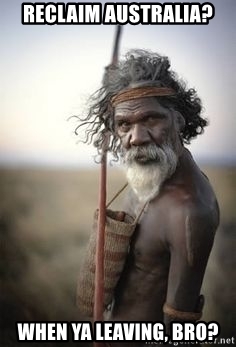
I am not saying that they should not have done that, but this is about creating emotion, not about reporting news. News Corps creating news (through their promotions) and that makes it another matter entirely. In all this, when I see: “She believes Australia should close its borders and that there “are only two sexes — male and female”“, it is my personal view that there is one poster that does give us the actual goods. So, what do you think? Should we all revert to Aboriginalism? At that point I do wonder who would embrace Pauline Hanson as a sister (but that is merely my evil sense of humour). I would never attack freedom of speech and freedom of expression, she is allowed her views, yet from my point of view, she’s a Canadian, a British Columbian. Her views are extreme right (or is that extremely incorrect), but pushed through the internet, a libertarian with a populist focus. A 23 year old not hit with the ugly stick and those factors make her an internet personality. The issue I also see is that she is seen as a Journalist, yet she never graduated University (University of the Fraser Valley). I am a blogger and I refuse to call myself a Journalist, even as I have a Masters in IP Law as well as two other postgraduate degrees from the University of Technology Sydney, I never graduated in Journalism, so I refuse to call myself a Journalist, even as I have publications going back to 1988 in several magazines, being a reviewer of multimedia products does not make me a journalist, plain and simple.

In this case Lauren Southern matters. You see, when you consider her education, the fact that we see that in March 2017, Lauren Southern left Rebel Media to become an independent journalist (without a degree in journalism I might add), this whilst she still additionally gained access to White House press briefings, so how is that even possible? In addition, News Corp is promoting her events making the entire matter even more debatable. So in that setting, when I see the Guardian giving us: “The publisher of the Australian and Daily Telegraph wants the ABC to be barred from promoting its news stories online using Google ads“, I am of the mind that someone stupid enough to promote a non-Journalist and giving the limelight to “News Corp papers continued to unfurl the red carpet ahead of her visit“, they should realise that there are places where people (and actual Journalists) actually focus on the news, reporting on events not creating hypes through: she chose Luton because it is the home of Tommy Robinson, the currently imprisoned founder of the English Defence League. In May, Robinson was sentenced to 13 months in prison for contempt of court after broadcasting details of a trial from outside Leeds crown court that risked causing it to collapse“.

News Corp is showing to be on the wrong side of the News, their approach on spreading news, I apologise! I meant spreading the subscription page is valid. They are allowed to do that and their tactic that they should be paid by places like Facebook is a fair choice to make, but they forget that actual reliable sources (BBC, the Guardian, SBS, ABC) are allowing such a path (without subscription), and when it comes to results, the people sharing stories want to share the story, not the subscription page. Add the entire Lauren Southern promotion and we don’t get news, we get the acceleration of emotional hype’s and we have had quite enough of that.

The question becomes, will political need buckle to their needs via News Corp, and once that is out and in the open, when we investigate those politicians who allowed for this, will we tolerate answers like ‘It was a complex setting‘ and ‘there appeared to have been a level of miscommunication‘, when those quotes are given, will we be able to demand their eviction from any political seat? I am asking these questions because all those shouting on how our privacy is gone and how we are all monitored whilst the political setting is in a stage where smothering real news is a reality that we are optionally allowing for. In that part we are actively allowing for media outlets to create fake news. When we are not allowed to see the whole story, when we merely see a carefully scripted partial side, are we not in the foundation where we are being fed fake news?


Leave a comment

Filed under Finance, Media, Politics

Circling the wagons

I had not expected a follow through on yesterday’s thoughts, but here we are. It seems that there is a business dispute between UKTV and Virgin Media. The Guardian (at https://www.theguardian.com/media/2018/jul/22/four-million-virgin-media-customers-lose-uktv-channels-dave) gives us: “after Virgin sought what UKTV called a multimillion pound cut in fees, leaves fans of shows including Judge Romesh, Harrow and Red Dwarf unable to watch some of their favourite programmes“. Let’s be clear, this is a business decision, so when Virgin wants a 7 figure fee cut, there must be something behind it, should there not? In addition, we need to offer in opposition, that reporting on (as quoted) “According to UKTV, “around 4 million households” were no longer able to access the channels after the midnight deadline passed” should also have an impact on advertising, as you are broadcasting to 4 million less viewers, so there is that in the mix too. Is it merely pricing?

The quotes: “Virgin Media has accused the broadcaster of seeking “inflated sums” to provide its paid channels and linking those to provision of free channels such as Dave and Home“, as well as “Steve North, the head of comedy and entertainment for UKTV, said the company provided thousands of hours of on-demand content to Virgin, with viewings of its programmes, such as Taskmaster, via the service up by a third over the year“, finally we need to add the part mentioned much earlier in the story. With: “The BBC holds back the video-on-demand rights to its programming, instead selling them to players such as Netflix. Virgin Media said this strategy was no longer acceptable as viewers expect to be able to watch shows on demand” we see a linked part in all this, and perhaps also the part where Virgin Media dropped the ball. You see when we see ‘viewers expect to be able to watch shows on demand‘, which I thought was a silly thing to mention, because of the mere fact that Virgin Media was unable to manage the expectations of their customers is a much larger fail. It is a first duty in support and customer care to manage expectations, some use SLA’s, some use other methods (like pricing), but managing expectations was never on the plate of UKTV. We can argue in addition that as viewing was up by 34%, fees would go up, but in addition, so would advertisement revenue. When you report that programmes are watched be an additional 34%, you have an advertising selling point. The question becomes was this merely about fees?

The BBC mentions the Netflix challenge, as well as a picture of a relaxed Greg Davies sitting in a chair (who is apparently no longer trying to destroy the city of Tokyo). Yet the article gives us two points, the first is: “On Twitter, Darren Woodward said he was “gutted” not to be able to see Taskmaster, while Tom Langdon was one of a number of subscribers to wonder whether his monthly bill would be reduced because they could no longer watch the show“, and the second is: “Richard Blunt from Birmingham told the BBC: “Practically all the stations we watch on Virgin have now been withdrawn. I think we will give it a couple of weeks, hoping that the decision is reversed, before deciding whether to stay or to go.”” The entire setting could now escalate in very different manners, not all good for Virgin, actually none of them good for virgin. Even as the Guardian article ends with: “The 10 channels are still available on other TV platforms including Sky, BT, Talk Talk, as well as Freeview and Freesat. Viewers can also watch them online via UKTV Play“, we need to see that this is merely a first step. I personally believe that UKTV has figured out a few things and in this, it has options that go further than merely a fee. The fact that 4 million users are in a setting where there is 34% growth, that is a section that Netflix (and others need), so this is not merely about money, I believe that there is a shift happening. I knew that this would happen, that part is clearly seen in the Netflix pressures. That we would see it shown the very next day was not on my calendar.

So when I decided to dig a little deeper, I found an article (at http://www.gizmodo.co.uk/2018/07/uk-tv-networks-are-looking-at-creating-a-british-netflix-to-combat-falling-viewing-figures/), which gave us 5 days ago: ‘UK TV Networks Are Looking at Creating a ‘British Netflix’ to Combat Falling Viewing Figures‘, so was that a self-fulfilling prophecy or not? So as the article ends with “BBC News reports that the BBC, ITV and Channel 4 have already had early conversations about the possibility of working together to create a combined streaming service with the potential to compete with the likes of Netflix and Amazon Prime TV. Whether such a thing will come to fruition currently remains a mystery, but considering the shifting trend to online media, it seems a likely step that broadcasters will eventually have to take to remain relevant“, we see exactly the play that seems to be unfolding now, and from the pressures shown, there is every chance that through pressures applied, this new venture starts with a rather delicious slice of 4 million viewers leaving Virgin. Even as some stated that they will see in a couple of weeks, the sooner this shift happens, the more power Virgin loses, implying that Netflix will not merely grow business, it has the option to grow an advertisement branch much larger overnight as well giving them more options.

Even as we agree that some changes are about to happen, we need to realise that the UK will have a new venture in ‘package deals‘. The quicker that Sky TV and other shops include the UKFlix side of things, the quicker momentum can be gained. It is in this setting that it can grow in the UK as well as gain momentum in Western Europe, where UKTV has always found happy recipients of the series that UKTV fathered and promoted.

It does set a new tone on where places like Virgin Media are going. The UK always had a little saturated niche in all this, the fact that the Netflix equation unsettled the walls in place making it a dog-eat-dog battle field, is both good and bad, the good is that overall the pricing will become interesting to households, the bad is that those with the larger budgets can overturn whatever independence remains. It will be a fight where those with the biggest wallets will be able to out buy whatever is in play and that is not always the positive outcome for households on a budget. The issues that follow soon after that is as one is diminished, how far can it go abroad? The direct setting for the Netherlands, Belgium, France and Scandinavia is also added to the board, because a shift like that tends to move outside of the borders. for example in Sweden where 50% is set by SVT1, SVT2 and TV4 gives options for growth, especially when you consider that Disney and Fox each have less than 1%. The same we see in Norway where 50% is with NRK1 and TV2. They are all markets with options for growth; from an advertising view Norway is more of a nightmare. The two large cities merely represent 14%, whilst the villages 11th in size and smaller are less than 50,000. This is different in Sweden where the four largest cities are 25% of the population and a chunk of the smaller places are still a lot larger than most places in Norway, Sweden has twice the population, but they also have that population in larger communities. These are all elements that have an impact on growth, so that is one side and merely one side. You see Netflix and their methods are rubbing off on the other players and that is where Scandinavia becomes a much more interesting market. The land that gave us Maj Sjöwall and Per Wahlöö and their fiction in the 60’s and 70’s; the land that had Pippi Longstocking and the White Stone for the kids, whilst giving the adults Beck and Swedish Dicks is a treasure trove of IP and that is very much on the mind of the decision makers behind the screens. You see, getting the right IP is half the distance towards profitable series, and there is plenty to find in places like Scandinavia and Australia. They have built quite the score list. That setting needs to be on the forefront of all the board member minds. Getting decent writers for new series is one thing, resettling an existing gem comes at 40% less cost, whilst upgrading a series to today can score places like Netflix millions of viewers with minimum expenditure, when we consider the 8 billion that they are setting in now, delaying one series and replacing that with 10 retrenches that are unknown in the bulk of their places is a way to quickly fill needs, to up the amount of IP and the value it represents as well as open up new doors to other ventures. You merely have to see the impact of the TV series Humans, which got the makers the British Academy Television Craft Award for Best Digital Creativity, as well as a 94% rating is what matters to those in the boardrooms and even as they missed out on Humans, there is plenty to find in some of these places. The relaunch in Sweden of Beck is one part, getting that to the Netflix audience is potentially an additional market to tap in to. In the end, merely buying IP is an option and I personally see is again as short sighted, it is the interaction and engagement of these markets where new innovative IP becomes an option. You merely have to look at the past on the history of the 70’s series Kung Fu to see that the creation of IP that shines for decades is seen. And they are not alone, especially when it comes to TV series for the younger viewers. Sweden had several series like the ones mentioned earlier, the Dutch had the still immortal ‘Kunt U mij de weg naar Hamelen vertellen meneer?’ loosely based upon the ‘Pied Piper of Hamelin’, even as the materials were lost over time, that TV Series is still remembered 48 years later, that’s IP that sets a provider apart from all the other players! As such growing interactive markets, not merely acquiring IP, whilst at the same time investigating what IP is close to readily available is what pushes the Netflix investment invoice of $8 billion a year down, whilst creating content that will be around for a long time. As I mentioned in yesterday’s blog ‘Chivalry vs Rivalry‘ (at https://lawlordtobe.com/2018/07/22/chivalry-vs-rivalry/), we need to consider “The value of those rights has now spiralled, which has pushed up Netflix’s content budgets and fuelled its drive to produce its own content“, that is still going on, so the one moving fast into areas and setting the stage to acquire the IP, that is where it will be at in 3-4 years, so whomever moves now ends up having the home field advantage, giving additional rise to production settings that are currently a steal at twice the price, yet as the impact of digital content and growth becomes more and more visible, the other players will circle their wagons faster and more determined to get either much better prices, or become players in this field themselves. the moment that all this IP hits 5G and goes global, at that point the entire game changes for all the players involved, so getting there sooner is what it will be about and from what I personally expect that visible push will be all over the news with some frequency no later than 2019.


Leave a comment

Filed under Finance, IT, Media, movies, Politics, Science

Chivalry vs Rivalry

The news is still hanging onto several things that are playing. This is not a bad thing; this is the setting as news moves forward and remains news. Even when we consider the events in Saudi Arabia, where we get the Guardian quote: “Saudi Arabia has rushed to boost oil production under pressure from US President Donald Trump – only to discover that global markets might not need it yet, according to some financial experts“, we see that certain players do not tend to use a presidency as a tool, so the quote might be correct, but there is a game in play, played between Donald Trump and Wall Street. So far it works, because everyone thinks he is an idiot, that is the popular story, but I am not convinced. This is direct and it is with purpose, so something else will rear its ugly head soon enough. Yet this is not about that. You see, when it comes down to chivalry versus rivalry, we see that chivalry is dead, it has no place anymore. Even as Saudi Arabia wanted to come to the aid of America, we see the news that “the Saudis are struggling to sell as much extra oil as they’d hoped and are privately fretting that they may have opened the taps too quickly, according to people briefed by Riyadh in the last few days“, it this merely an American ply to keep the reserves maxed so the President can haul away a cheap political victory as heating prices remain low this coming winter?

Even as the Independent offers: “Societe Generale’s Mr Wittner, said: “We have hardly started to see a reduction in flows from Iran. Though there’s a lot of crude coming out from Saudi Arabia now, spare capacity is really going to be the big issue going forward. And spare capacity is getting very tight very quickly.”“, I am not convinced that this is about Iran; this is about keeping prices down over the next 8 months. The flow fall of Iran is merely a nice bonus. Even as we start on oil, we now see that a similar fight is going on in entertainment, the actual issue. In the light of Netflix against the world, we see a few changes that are now more adamant and also impacting us all. The Guardian starts the event with: “Below-par subscriber numbers last week were bad news for a service that must keep growing to survive. How will it respond?“, yet the story is not there. You see, from my point of view, 100 million subscribers is nothing to sneer at and the saturation makes new members a much harder setting, it is by no means the setting for a down draft. Even last week, when I wrote ‘Pushers of media value‘ (at https://lawlordtobe.com/2018/07/17/pushers-of-media-value/), I was confronted with several responses, that I was crazy, that there was no saturation. Yet now we see in the Guardian: ““Netflix’s big challenge is maintaining growth worldwide while its customer base saturates in core western markets,” says Richard Broughton, analyst at Ampere. “Netflix is having to work ever harder to gain new subscribers.” The low-cost nature of the streaming service – a premium subscription costs £9.99 per month in the UK and $13.99 in the US – means that it needs inexorable growth to pay for its content“, so apparently with ‘while its customer base saturates in core western markets‘ my setting shows to be the correct one. Now that we have that out of the way, and for now I ignore the one market that Netflix ignored in the UK and a few other places, worth close to an additional £15 million a month, we see that Netflix is for now all about the “it costs a lot of money to attract a Hollywood star such as Will Smith to a sci-fi film like Bright – and in recent years it has been raised by about $1bn annually. Netflix is stuck in a costly and precarious cycle“, Netflix has chosen a short term solution that will go nowhere in about 3 years.

It is the setting of the man who makes a deal with the devil, to bring 10 souls a day to stay out of hell, and accepting a 20% annual increase, as a sales director he accepts it, because he knows it can be done, yet souls are not revenue and in 3 years he needs to have accumulated 12,230 souls. After 6 years it is up to 34,200. A setting that started with 10 souls has now been increased to 25 a day, no option to fail. Greed is like that, it has no problems, because in the end the house wins or collapses, until the second happens, all serving the house are in a spiral of servitude with sliding morals. You see, the first 10 years seems fine, but after 10 years the daily soul quota has gone up to 51 a day and after that it gets interesting with decennial party where 319 souls a day will be required. That is the game everyone forgets about, steps absent of long term vision with in the end the executive having to hand over his soul, no matter what. The house of greed always wins!

Netflix is now in that downward spiral, not when it comes to members, but the setting to gain followers, set against the tides of resources, that is the war they cannot win, not until they resist temptation and take it to a very different level. They have the option and the means, but will they be willing to take the plunge?

Rivalry

This is the setting of greed, rivalry is everything, because now that Netflix has shown the value, now that the others are seeing that the setting is not merely revenue, it is massive profit for the one holding the data, that is the setting that we now get with: “Netflix was able to get hold of the rights to TV shows and films on the cheap. Rights owners and future rivals had not identified the global potential of subscription video-on-demand rights, and Netflix prospered. The value of those rights has now spiralled, which has pushed up Netflix’s content budgets and fuelled its drive to produce its own content“, there are solutions and the nice part is that both the UK and Australia have a leg up in all this, they have an advantage if the proper person gets the parties working together, but can they realise the potential that is still out in the open for the next person to grab?

I am certain that the issue is there, but sees it? I am not giving away the plot here, because there are three aces up for grabs, the question is whoever holds the fourth ace is in the running to get the clean sweep. Yet, the second party is Netflix, are they up to the task to get set up for the chop? That is the game, it is not merely winner takes all, failure is at this stage slightly too dangerous. It took me a day to realise the opportunity, because even as an IP master, I had to wonder how far it could be stretched, yet it can in the Commonwealth and as far as I can tell in the US as well, so this gives Netflix the option, however, to get this up and running, they need to truly focus. It cannot be half baked!

The next pitfall

With “Youth-targeted shows such as Stranger Things and Thirteen Reasons Why have been major hits, but Netflix faces some of the same pressures caused by the rapid generational shift in viewing habits“, that is true, but in that same setting, we see that in some cases everything old is new again, so there is space and place to grow and to do that, a first step is needed, but are the shareholders willing to play the longer game, a game that could potentially grow value by 400%? The long game is not something that shareholders are good at. They believe in short term gratification (not just on 42nd street mind you), so the game is optionally out of the hands of the Americans, giving the UK and Australia now a partial advantage over America on the entertainment business and there is plenty of famous entertainers here, beyond the Australian King and Queen (Geoffrey Rush & Cate Blanchett). This gets us to the final part in all this. The quote “Netflix’s long-term strategy is that it has to increase its revenue from subscribers; it needs to move into those content genres to replicate the journey of traditional pay-TV companies,” says Mulligan. “You need a full suite of content if you want to be a real substitute, not just an additive service.”” we see here is a dangerous one. I do not completely agree with Tim Mulligan, analyst at MIDiA Research. You see, he relates Netflix back to TV, yet we all forget that Netflix is not merely new, it is in a position to become more than: ‘the large new kid on the block‘, yet what Tim fails to see is that Netflix is optionally the new cornerstone of entirely different block, Netflix has been setting new grounds, but the inconceivable still exists, Netflix and rivals have the option to become the rulers of Tinsel town II, a setting that scares Hollywood and the large players in cinematography. They know that this is still a reality that they face and it makes every analyst take a 90 degree turn, but the reality is that short sighted on what makes for any Tinsel town is the opportunity that hands Netflix the goods. Whilst the realisation of avoiding ‘value of those rights has now spiralled, which has pushed up Netflix’s content budgets and fuelled its drive to produce its own content‘ is clearly there, the fact that no one sees the options available is equally disturbing, are they not seeing it, or are they too scared and pushing away FROM it, two very different realities. and one is a steal to own if you see beyond the 4 lines that makes the square that some analysts put you in, realising that lines on a map mean nothing to the map itself, only then can you embrace the new course where those talking the leap have an option (if ALL the conditions are right) to become the new rulers of a market no one saw coming in the first place.

That is what separates the visionaries from the second rate followers.


1 Comment

Filed under Finance, IT, Law, Media, Politics, Science

Trusting Anti-trust cases?

Today will be about Jennifer Rankin and her article ‘Google fined £3.8bn by EU over Android antitrust violations’. First off, it is a good article, she did absolutely nothing wrong (at https://www.theguardian.com/business/2018/jul/18/google-faces-record-multibillion-fine-from-eu-over-android). We get the goods (not all mind you) but a clear picture and that is what I like, a clear picture to work with.

Right off the bat we start with “Google has been hit with a landmark €4.34bn (£3.8bn) fine by the European Union over “serious illegal behaviour” to secure the dominance of its search engine on mobile phones“. Interesting setting as there are Android based phones and IOS (Apple brand X phones). The android systems ALL have full access to Google. As for the search engine, there are two elements. The first the engine for searching itself, which is in android, giving us an open source setting and (at https://searchcode.com/), you can take a look yourself, now you will still need the skills to program, but that is a discussion for another day. The second part is to find stuff, which requires the PageRank. Now we have an issue, because (as the Americans say): ‘that shit is patented!‘ plain and simple. Whilst Microsoft and IBM were belittling Google in 1999 (heard it myself in the UK) Google was working and growing in what is now defined as ‘the development of the Android mobile operating system, the Google Chrome web browser, and Chrome OS, a lightweight operating system based on the Chrome browser‘, it took 5 years for them to get serious traction and whilst they grew, the other two were marketing their BS on every level whilst trusting in VP and players who actually did not know any of their shit, people relying on PowerPoint presentations, bullet points and hype expressions. Now we get the first part that matters: “The European commission imposed the record penalty after finding that the US tech firm required smartphone manufacturers to pre-install Google’s search and browser apps on devices using its Android operating system, which is used on 80% of all phones“. This is the first part. You see, there is a merely a partial truth and it is largely incomplete. Any mobile smartphone needs an OS. So we have Apple with IOS, there is or was) Blackberry, Microsoft and Google with Android. The rest was either not willing or eager to play on any serious level. They all had this: ‘it is much better going for larger systems‘. Even the larger players ignored the power of Mobile and Smartphones for too long. That evidence is seen with NBC where we see “In a farewell post on LinkedIn, Microsoft’s former head of Windows, Terry Myerson, explained why Microsoft failed in the smartphone business“, (at https://www.cnbc.com/2018/03/29/why-microsoft-failed-in-phones.html). The quote: “It comes down to two problems: Underestimating Android’s business model, and building on an older technical platform that wasn’t quite ready for the job“. So in two mere dimensions we see the acknowledgment of large corporations set in a place of short sighted expectations whilst using a narrow minded business model. That is apart from the issues that Windows Mobile had, I wanted to add that list of issues, but I calculated that this section would be no less than 6000 words, with the additional issues on Windows 10 mobile adding a serious amount of words to the 6000 words required. Blackberry did not survive the times either. It had a good platform, but ultimately too expensive for most businesses. It is still going on, but not in the same way it was. Blackberry was not flawed, it focused on specific groups and those groups, those who choose Blackberry will love it forever, it merely could not hold up the settings there were, I reckon that the 2008 crash wiped well over 35% of their customer base instantly, a setting that many corporations tend to see as a fatal blow, Blackberry was no exception. So 50% of the ‘larger’ players are already gone, none of it had anything to do with Google, or with the patented parts. So I would love to scrutinise the Danish Margrethe Vestager (without resorting to Denmark and Hamlet). It starts with: “Google has used its Android mobile phone operating system “to cement its dominance as a search engine”, preventing rivals from innovating and competing “and this is illegal under EU antitrust rules”” No! They did not! We see the clear admission from Terry Myerson giving us ‘building on an older technical platform that wasn’t quite ready for the job‘, knowing that already sets one of the two outside of the consideration. I have given the audience evidence again and again on how stupidity rules at Microsoft. The Surface and Xbox platforms are two distinctive places where this is visible. Both have a narrow minded setting, both are short sighted and even the business approach to grow the customer base failed to do its job. Reuters gave us that last year with ‘Microsoft Surface devices fail on reliability: Consumer Reports‘, an overpriced system that cannot even get close to 80% of what Apple could do with its very first iPad in 2011. In addition Reuters gives us: “The non-profit publication surveyed 90,000 tablet and laptop owners and found that an estimated 25 percent of those with Microsoft Surface devices would be presented with “problems by the end of the second year of ownership,” according to a study published on Thursday“, how can any device with a 25% failure issue be in the market in the first place, and it is very connected, as this is the mobile industry, the mobile industry is more than merely a mobile phone, all connected devices that rely on mobile technology (Wi-Fi or cellular) are part of that failure. The Reuters article (at https://www.reuters.com/article/us-microsoft-surface-idUSKBN1AQ1EP) we also get “According to the Consumer Reports survey responses, the Microsoft devices were found to freeze, unexpectedly shut down or have issues with their touchscreens, Beilinson said. Altogether, the reliability issues made Microsoft a statistical outlier compared with other brands. Apple Inc. had the most reliable devices, Beilinson said“, so how many corporations should be considered when they are the outlier in a negative way? #JustAsking

It is time to look at article 101 (antitrust) (at https://eur-lex.europa.eu/legal-content/EN/TXT/HTML/?uri=CELEX:12008E101&from=EN). Here we see:

  1. The following shall be prohibited as incompatible with the internal market: all agreements between undertakings, decisions by associations of undertakings and concerted practices which may affect trade between Member States and which have as their object or effect the prevention, restriction or distortion of competition within the internal market, and in particular those which:
    (a) directly or indirectly fix purchase or selling prices or any other trading conditions; (not charging for a service is a right anyone has)
    (b) limit or control production, markets, technical development, or investment; (impeding your own technical development, intentional or not is merely your own visionary stupidity)
    (c) share markets or sources of supply;
    (d) apply dissimilar conditions to equivalent transactions with other trading parties, thereby placing them at a competitive disadvantage; (nope, the non-patented part of android is open to anyone)
    (e) make the conclusion of contracts subject to acceptance by the other parties of supplementary obligations which, by their nature or according to commercial usage, have no connection with the subject of such contracts.

The first issue is that the Page rank which is part of this is patented, so there is already a setting of exclusion. The fact that the others are 10 year late to the party is equally evidence that there is a wrongful conviction here. The setting that they are all scared with the coming of 5G, whilst Apple and Google are the ONLY ONES who will be decently ready, both ending up with a massive market share. We see at this point the third failure of Microsoft. You see, it was not merely the two that Terry Myerson stated at CNBC, the ‘Underestimating Android’s business model‘, as well as the ‘an older technical platform that wasn’t ready for the job‘, it is to some extent the ‘25 percent of those with Microsoft Surface devices‘ failing, they are all connected to overlapping user groups making the damage even larger. The Xbox debacle that showed a bullying setting of ‘always online’ as well as storage shortage issues (a killer in the mobile devices), their bullying setting of pushing people online is equally part of the failure. It was the fourth part that truly took Microsoft out of the race. Google (as I personally see it) looked at roughly 1.7 million university students and looked at where the future was pointing. They saw where the future was heading and they build on that long term view. Just look at the Gmail storage, the YouTube facilitation, and to openness of their business suite apps, just a few examples. Over 3 years I have only two parts where I missed Microsoft Office a little, over 3 years that is nothing. That in a setting where Microsoft went into the ‘greed’ setting it becomes a lot more funny, especially when we see students having to get by a few dollars a day, yet Microsoft has a $199 version for these students, yes it will be cloud, secure (so they say) and update cost free, a subscription service. Google merely states $0, on the cloud. You tell me what students want! The issues are linked, because Microsoft had been actively growing the anti-Microsoft feelings for almost a decade. I understand that Microsoft has a business model and ‘free software’ is an issue for them, they have a right to be like hat. Google understood that the poor students who hardly can keep a budget now, are going to be the executives of tomorrow, those people then are executives now and they all embrace Google (well, most of them anyway). There was no force, there was no (how did that Danish lady put it?) ‘Restriction or distortion of competition within the internal market‘, many went to iPhone and IOS and Google is fine with that. No, the issue is that the other players are confronted with the stupidity of the previous post holders and that is an issue now, it links together.

By not realising the future 15 years ago, the present is close to unobtainable for them. I watched how I saw again and again how some of them went by ‘We are now working on the new technology surpassing the others‘ again and again (and not delivering). You merely need to find the history of ‘SPSS Data entry for Windows‘ and realise that this was an excellent way to lose 6000 businesses, and close to 35,000 users (relabeling it ‘form design software’ was never a solution). Microsoft went in that same direction and now they are close to side lined from the next technology by their own stupidity. No resources, no ‘know-how’ and no vision, yet Google is the big bad wolf here!

This is the underlying story that links it all and some companies are merely indicative, but they overall went the same direction. So where we see ‘preventing rivals from innovating and competing‘, I see that this was not the case, they merely went a greed driven path (OK, I admit, I should say ‘revenue driven path’), whilst actual new technology is all about innovation and never about iteration. Microsoft, after IBM the larger player feeling left out has shown us on several fields that innovation is merely marketing, not actively pursuing issues and with a ‘25% failure issue’ setting in the Surface department, I believe that their flaws are clearly shown. It becomes more of a farce when we see “Vestager added: “The vast majority of users simply take what comes with their device and don’t download competing apps.”“, users want what works; we are not interesting in a $199 fee for apps that they we get for free, ask any student. There are apparently 207 million higher education students globally, ask them! In addition, that mere setting where we see the onus of the user, to not look for more is punishing a company because the users are lazy? Since when can we convict Google for not installing in the second degree, because the user was lazy?

In many situations there are no competing apps, not of any quality that is and when you look in the Google play, we see that the users are allowed to set the tone. I will be the first to agree, that there are issues and that there might have been a case to some extent. Microsoft faced that years ago when it was still in the delusional setting that they had the better browser. Now we see a different picture. Now we are faced with IBM that put everything on Watson (not sure if that was a good idea), but it can facilitate to the larger degree in every direction, including the third parties banking on 5G, IBM is eager to oblige. Microsoft has nowhere to go, they burned down their options and as they screwed up again and again, it has nothing left but to sulk like a little child. Just consider the upcoming Microsoft Surface Go, for people with budgets. Now consider the News we are given: “With a starting price of $469, the Apple iPad (with Wi-Fi connectivity only) is the winner on affordability”, “The consumer/education version is priced at $599 and will run Windows 10 Home in S mode – which only allows apps that are available in the Windows store”, all this, for a system not out yet, and the Australian Financial Review (at https://www.afr.com/technology/mobiles-and-tablets/will-the-surface-go-boldly-where-other-tablets-cannot-20180713-h12n71) gives us: “Why has Microsoft just released a tablet at a time when almost everyone is buying smartphones and almost no one is buying tablets? Sales of tablets such as Apple’s iPad have been in steep decline since 2015, a decline that shows no signs of reversing in the next four or five years, analysts say”, so in that setting another optional failure is introduced. That whilst I saw it coming, just as the short sighted failures that are part what now with giggles is called the ‘most powerful console on the market’ (The Xbox One X), that is the company that is connected to all this.

That part can be found in a few places. In this case I give you the New York Post where (at https://nypost.com/2015/04/15/microsoft-the-big-winner-in-google-antitrust-lawsuit/) we see “While Google CEO Larry Page took his lumps with the suit, Microsoft, very quietly, came out the big winner, sources said. “Microsoft complained a lot,” said a source with direct knowledge of the situation. “Microsoft definitely counselled the [EC], suggesting it made sense to send Google a statement of objections so Google would be forced to produce documents” showing its search-result recipe, another source said”, this was a joke 3 years in the making. I hope that I can turn that joke on these losers as they have diminished consumer trust in their narrow minded way (not to mention short sighted ways).

Even when we turn this in another direction through the Register two month ago (at https://www.theregister.co.uk/2018/05/21/antitrust_google_us_government/), where we see ‘On 20th anniversary of Microsoft antitrust, US Treasury Sec calls for Google monopoly probe‘, I am not arguing how right or wrong it is. I am merely pointing out that Google went in a direction that was long term, whilst all the others went into the short term path that was demanded from their board of directors, who for the most could not read a spreadsheet properly because the bullet points were missing (their optional opposition to the NRA perhaps?). That was the setting and those with vision are dumbfounded and they got hurt through the inadequacy of stupid people.

So the Danish party was already active then. What is an issue is Jeremy Stoppelman, he had vision with Yelp, even as he did not understand certain markets (miscalculated is a better word), he had faith in his product, which I applaud. it worked for a while, yet I see that bad choices (unfortunate choices is a better setting) impacted it all, so even as Yelp failed to meet expectations, if it survives and gets 5G traction, it will be ahead of others a decent amount, it turned down Google who wanted them when the going was good and he would have had a strong place if he had taken that part, but it was his decision and I applaud him for it. Yelp and Turnstyle Analytics would have an optional strong 5G setting if it had kept international operations and grow the data the way they had, it will not be easy now for them, but I digress. With: “Mnuchin’s comments on Google came after a special 60 Minutes episode that focused in part on the company and its effective search monopoly. That segment was notable for the inclusion of two people: EU competition commissioner Margrethe Vestager and Yelp founder Jeremy Stoppelman“, yet all parties have their ‘its effective search monopoly‘, what they are not telling us is that they had a vision that everyone would come with a future need and they got Stanford University to create the algorithm that got patented. All the other players remained dumb to the future. And then we get the one gem I expected: “Also, the EU announced it was launching a probe of Google’s Android operating system to see if its agreements with cellular phone makers was hurting rivals. While Microsoft likely does not care much about search preference, “the investigation throws sand in the gears of Google’s innovation,” the former FTC official said“, so there it is ‘agreements with cellular phone makers was hurting rivals‘, phone makers had options, Apple had its own system and there are NO non-Apple IOS phones. Interesting that this does not make that cut is it? An open system was offered and the alternative Microsoft (rejected because it was not up to the job), Blackberry (is only after the collapse that it became an option to others), we see that Google has an open option, yet they are the boogeymen. So we get two elements, a partially failed entrepreneur (only in part) and a limelight seeking politician. The power of the google Appeal is found in a simple statement: “Her staff ran through over a billion Google searches and found that Google was knowingly manipulating its search algorithms to promote its own products and push competitors far down the ranking“, that evidence must be shown in court and get scrutinised! You see, the timeline for a billion searches can only partially be automated and those results can be used by Google as evidence against Margrethe Vestager as well. The evidence of ‘manipulating its search algorithms‘ will be equally a discussion point putting EVERY intern and assistant of Margrethe Vestager in the witness box, no exception. A setting that I personally see as the EC has close to no chance of winning. Even as I saw the algorithm in my University classes for an assignment, I am decently certain that I did not see the whole 100% of all elements of the algorithm, one element out of place and that is as I (again: personally) see it the crushing of the EC case, the appeal will be won by Google.

The fact that Microsoft was part of this in several ways from 2015 onwards and likely before that is more than enough for me to consider the premise that trusting antitrust is not always a good thing. I do agree that antitrust should exist, yet it should be clear that this is not a handle for the narrow minded, the short sighted, the greedy and the stupid to use because they could not get their shit together. They should reread Chapter 11 of their favourite pornographic work, whether that text comes in 50 shades of mixing several combinations of white and black. A colourless equation in a setting where colour was the only part that the global users demanded, listening to them would have been a first requirement. It is the setting, which gets me to the final image.

An interesting to set the stage, because if Microsoft was a marketing firm, they would be reduced to merely being a spammer, look at the first screen of your Xbox One (X optional) for that part, also all the parts people have to go through in Windows 10 (https://www.windowscentral.com/how-remove-advertising-windows-10), so in the end, the advisors have their own games to play (quite literally at some point). The Independent was kind enough to give us this with: “In the meantime, we probably ought to do our bit to help her by making a little more use of Google’s rivals, such as Microsoft’s Bing, which is a perfectly serviceable search engine“, it is seen at (https://www.independent.co.uk/news/business/comment/google-eu-fine-margrethe-vestager-android-search-microsoft-bing-silicon-valley-mobile-phones-a8453486.html)

Just ‘Bing’ “UK Law firms”, to get a UK law firm and immediately I see 10 law firms (page top view), 50% Australian ones (3 of those advertised), so if Bing cannot give me what I am looking for, why should I even consider them? With the term “Dutch Lawyers” I get 25% fulfilling the search. I can go on for a while, but I think the case of the doubt regarding ‘a perfectly serviceable search engine’ and the case on how it isn’t one has been made. I did not need to go far. Oh, and if you do have a sense of humour, try “Microsoft guilty” (with brackets), to see Bing give you “We didn’t find any results for “Microsoft guilty””, whilst Chrome giving us an immediate 8 results, with the quotes on these links. So when it comes to censoring (or is that just their flawed algorithm), we can soon see that there is an optional setting where Margrethe Vestager could be seen as a tool for Microsoft (as they might have been ‘searching’ for optional solutions), it might not be a fair setting, yet the entirety of the Antitrust case is seen by me in that way. Microsoft and a few others need time to catch up, being stupid merely gets you at the back of the line (which is where all future opportunities are lost), they need time and they are using the EC to try to catch up. My sense of giggling will be found the moment the appeal is won by Google; we are likely to see a tsunami of ‘carefully phrased denials from European political players trying to avoid the limelight’.

Oh, and whilst we are at it, when we see ‘placing them at a competitive disadvantage‘, that in light of Huawei surpassing Apple (source: the Verge). With: “Huawei has surpassed Apple as the world’s second largest smartphone brand. Sales have overtaken Apple for the first time”, Margrethe Vestager will call it ‘proving her point’, yet the truth is that Huawei went for the affordable option, a side Apple has not considered in decades, whilst in addition, the decline of Samsung and the growth of Huawei reinforces that it was about affordability for the longest of times, those losing market shares are their own worst enemy, because the wrong people are setting the price, I added enough evidence of that for the longest of times. This all in a setting where we see that even as Huawei realises that Europe is the key, the others are isolating themselves even more. Soon enough it will no longer be about Google and Android, it will become on non-American mobile players gaining the upper hand  over all the others, I wonder what anti-trust case will be filed at that point.

#PriceDiscriminationAnyone?


Leave a comment

Filed under Finance, IT, Law, Media, Politics, Science

Pushers of media value

We all heard of the name ‘pusher’, usually it is seen in the drugs community. People who prey on children and weak students with: ‘try this, makes you feel good‘. Knowing that as their customer base increases, he can continue his lifestyle of booze and bitches, because that is his only priority, to feel good and to live like a rock star at the expense of everyone and anyone else. So when I saw ‘Alarm for Netflix as shares plummet on worse-than-expected subscriber growth‘ (at https://www.theguardian.com/media/2018/jul/16/netflix-subscribers-numbers-forecasts-wall-street) and was confronted with both “But it also warned that subscriber growth in the current third quarter would likely be around 5 million, again below analysts’ expectations of 6.3 million“, as well as “spooked investors and suggested the company’s explosive subscriber growth may now be slowing. Netflix shares fell 14% to $346.05 in after-hours trading in New York. For the second quarter, Netflix reported a profit of $384.3m, or 85 cents a share, up from $65.6m, or 15 cents a share, a year earlier“, I wondered what the analyst had to offer that gave rise to the situation.

In a world where we see that the quality of life is down, where we are struggling to merely pay the rent in some places, in that world where we learn that “Netflix has almost reached the 100 million mark for streaming subscribers, thereby more than doubling its subscriber numbers from the start of 2014“, so the numbers are showing us an almost 25% year on year growth, that is pretty amazing in many settings.

In this day and age, getting over 10% growth is pretty well done. We all recognise that 100 million users might not be that much on one side, yet the entire business is set against a facade where there is more to the picture. Still, in this the entire setting a 14% drop seems a little extreme. It is set against what I regard to be the pushers of the world (also known as analysts). I have had issues with these analysts before; they are like the drug pushers of Wall Street. They might not see it in this way, but I do. In this setting when we see “that subscriber growth in the current third quarter would likely be around 5 million, again below analysts’ expectations of 6.3 million“, so explain to me where they got that 6.3 million new subscriber issue? Where is the evidence that expected 15 people from Hoboken New Jersey decided not to become a member? Sickness, getting laid off, hospital cost, daughter getting married, all optional reasons where 15 people decided on not becoming a member, now set that number in EVERY zip code in the United States. We can go on with the thousands of additional cases in the US alone, yet the wisdom of some person telling us that a mathematical model should have produced another 1.3 million uses cannot be vetted is merely the setting of a person giving a speculative result and that speculator is the cause of a 14% drop in value?

Now, we do understand that Netflix has responsibilities and with their expected growth is of course linked to the content they can afford to buy. So when I see “Netflix is expected to invest as much as $12bn on content this year, but could face growing competition in the streaming market. Apple is upping its spending on original content in video, music and publishing to $4.2bn by 2022 from $1bn this year. Amazon is expected to almost double its spending on original content from $4.5bn to $8.3bn“, there are two issues. The first is that if we quadruple the quarter and consider the 1.53 billion in profits (or expected profits) for 2018, how come that this year the acquired spending is $12 billion? We get that content is a long term pay off and all the movies acquired now will fuel the customer base for a long time, yet the fact that the profits merely represent 7.5% of the annual content spend is very unbalanced. It also gives us the additional setting that the 1.3 million additional members would not have made a dent there. The setting is fishy and it does not add up. Now, we can all agree that such services are perhaps a lot more complex, but the value long term is also setting the pace that something does not seem to add up. To see that picture we need to realise that Netflix realised well over $11.5 billion in revenue last year alone, so by giving you this, the $20 billion is not only no longer a stretch, it implies that Netflix still ends with $1.5 billion of pure profits, that is nothing to be sneered at, and in that light the spooking of the shareholders make less and less sense and in this, the entire analyst setting comes to the foreground once more, especially when we also add the one small fact that Netflix has $19 billion in assets. It is even more puzzling when we add the NY Times findings with “The company also saw its net income rise to $130 million, well over last year’s third quarter total of $52 million but short of the $143 million that Wall Street expected“, again the analysts now imploding, or is that setting back the market, whilst the records are still showing enormous growth, we see that dark cloud called Wall Street stating that it should have been better. There is nothing that shows evidence of the numbers that Wall Street holds others accountable to. In a system that is unrealistic, punishing realistic growth is not merely dangerous, it tends to be counterproductive in the end.

An additional part seen in the NY Times is now giving another light. They gave “Netflix already outspends its rivals, including HBO, FX and CBS, while Apple has recently signalled to Hollywood it would spend more than $1 billion on original content“, whilst the Guardian treats us to “Apple is upping its spending on original content in video, music and publishing to $4.2bn by 2022 from $1bn this year. Amazon is expected to almost double its spending on original content from $4.5bn to $8.3bn“, so the other two players are also spending billions in a market that is short of resources creating a bubble and bubbles are never good, so then the question becomes, is Wall Street intentionally creating bubbles to overinflate the mess and then short sell the cycle to make it implode in the future?

The fact that three players will represent close to $4 billion a year, each year is already a signal that the big screen, through internet or big screen itself is still flourishing, as the IP is brought through different ways, the only way will be up. So when we consider Australia who gives us “Netflix Australia starts from $9.99 per month for the entry-level, single-stream standard definition package, all the way up to $17.99 for the deluxe, 4K quality, four-stream package“, we see the simple selling point that a month of maximised streaming is close to a mere cinema ticket. That is the simplest of selling points and when we consider that, when we consider that this is not merely on that level, but that the setting also needs to fit the bandwidth that people sign on for, some will not charge Netflix, some do. That is also an influence. So there is more than one player that impacts the Netflix subscriber, all elements in that equation and some we can predict to some extent, but we remains in a setting where the analysts all claim that predictions were outclassing achievement in a place where growth is pretty sweet, it does not add up and that might just be me.

Yet this is where we get the Washington Post with ‘Netflix’s subscriber growth slows, panicking Wall Street‘, this is where we get to the golden egg, the part that Americans never understood, not in 1994 when some made claims on ‘saturation is a myth’, giving us an example with an elastic band, showing that 20% stretch again and again is possible and not today when we see that especially in Australia where housing prices in the big cities are through the roof, where we see that making a budget work is to cut out all extra excesses. In that setting many people can’t merely afford the $18 a month extra. That is supported with: “Professor Muir said it was important to realise that not all of those who live in poverty were unemployed. “One in three people who are living in poverty actually have wages, so we have challenges not just about how we make sure people have jobs, but we also want people to have stable jobs,” she said“. So we have an Australian setting where 1/3 is in poverty and a chunk of that has an actual income. So at that point, who of those people will have Netflix? Will they be willing to sacrifice two meals just to have Netflix? This is not a setting that is only seen in Australia. In America the UC Davis center for Poverty treats us to the setting of a few important characteristics of the 50% percent of minimum-wage earners with an age that is 25 or higher, 50% has a part time job. They have an average family income of $42,500 per year. At this stage it comes down to 20%-25% that live in poverty, when you consider that in 2016  around 43 million Americans were living in poverty, how much of an influence does that stop others from spending sprees outside of the Christmas season? When you see the hardship of anyone in your street, a person who works, fights and does whatever he can to feed his family, often both working, still not making the bills go away. How long until others start to save for the rainy day? I believe that these people are set to the economy as missing values. They do not matter, but they are still part of the total count. I personally believe that there is intent.

When we look at Wiki for a quick explanation, we get the optional view of an economic bubble with the text: “One possible cause of bubbles is excessive monetary liquidity in the financial system, inducing lax or inappropriate lending standards by the banks, which make markets vulnerable to volatile asset price inflation caused by short-term, leveraged speculation“. Yet what happens when it is not the ‘financial system‘? What happens when a bubble is pushed through analysts on the places like Netflix, creating friction with investors that apparently get spooked when a company still reports an optional 1.5 billion annual profit? So what happens when we see ‘volatile asset price inflation caused by short-term, leveraged speculation‘? Now take the leveraged speculation, asset price inflation (due to Apple and Amazon in the market) and it all suddenly implodes as all the analysts stated that Netflix could have easily gotten a million more subscribers that quarter. I hope that you get the drift now!

I am no Netflix fan (I have nothing against Netflix either). I always preferred to watch the big screen whenever I could afford it. I prefer to buy the season DVD/Blu-ray of a TV series I enjoy, that’s how I roll. Some prefer Netflix and that is fine by me too, whatever loads their canon, I say.

So when we see the Washington Post treating us to “they could validate investors’ fears of a company in slowdown mode for the first time in years. Wall Street has already been watching closely as Disney ramps up its subscription-content efforts and HBO, under incoming owner AT&T, is adopting a new strategy to compete“, we are treated to the setting of Pluto and two other dogs competing for the same bone, it is called market saturation and I have had the impression for the longest of times (around two and a half decades) that Americans either do not comprehend that part of business, or they merely do not care and ignore it. Now, we understand that at such points, the stock value of Netflix slows or even halts, yet to see a 14% drop is equally weird, which leaves me to think that Wall Street and all their analysts are in a bubble creating setting, which I believe has been going on for the longest of times. Do I need to remind you of Moody’s and S&P regarding the 2008 events? In the end they paid a fine, but compared to the damage done, it was miniscule. So when we take a step towards FLETC and the ‘Economic Crimes Investigation and Analysis‘ parts. They seem to be all up in arms for investigators, auditors, analysts and individuals serving as direct law enforcement support personnel who provide a foundation for fraud and financial investigations. Yet, when we look closely, how much effort has been done to investigate the Wall Street Analysts and other analysts who seem to be tweaking the expectations?

So when we look at the FLETC syllabus and see: “Successful completion of the ECIA will enable students to:
(1) identify various investigative techniques that may be used to investigate economic crimes;
(2) identify evidentiary documents that may be used to prove the source and disposition of monies;
(3) demonstrate how computer software may be used to organize, analyze, and present information;
(4) identify various ways that an accounting system may be used to conceal the true nature of fraudulent transactions;
(5) demonstrate how indirect methods may be used to identify illegal income; and
(6) demonstrate how effectively present investigative findings

Yet as I see it, in all this the global analysts who are spiking the expectations are all considered not a factor and have the privilege of remaining outside of the scope of all this. That also gives us that unless a 2008 version disaster happens; they and their overpaid asses quite literally get to walk away.

So how does that make sense in any universe, especially when we see the damage others faced over a decade?

Which gets us to the last quote in the Post with “Hastings did acknowledge the second quarter has historically been rough for Netflix, noting another under performance in 2016. “We never did find the explanation [for that],” he said“. In this we need to ask, was this merely a real under performance, or was it all based on a flawed algorithm, one that all the analysts using them will happily silence away?

A group of people never scrutinised, whilst a company making a clean billion plus a year is axed by 14%. Some will say it is all logical and that my lack of an economic degree makes it all my ignorance issue. Yet the Margin Call quote “2 and 2 no longer makes 4” gives the indication that it was not math and according to the math involved the 14% cut is optionally wrong, yet the reality of bubbles and the intentional creation of them is set on greed and that is the one thing that Wall Street thrives on and I wonder how closely some of its players are actually watched, more importantly, once proven, will the events actually be acted on, or will they merely receive a $401K fine in the mail?


1 Comment

Filed under Finance, IT, Media, Politics, Science

It’s called an alarm clock

This all started with the Guardian, they put an article there that connects directly with the last two articles and that is why I decided to take a look. It also directly connects to me with my Data skills and as such I thought it was a good idea to look at it. So the article ‘You aren’t as anonymous as you think‘ (at https://www.theguardian.com/world/2018/jul/13/anonymous-browsing-data-medical-records-identity-privacy) is not a consideration, it is an absolute truth that goes back to the ages of Windows 3.1. All these users thinking that you cannot be found, and that you are invisible online. That was never a truth. Yes, you can hide, you can deceive people on location, but in the end you leave data behind. So when the article treats me to “Names and other identifying features were removed from the records in an effort to protect individuals’ privacy, but a research team from the University of Melbourne soon discovered that it was simple to re-identify people, and learn about their entire medical history without their consent, by comparing the dataset to other publicly available information, such as reports of celebrities having babies or athletes having surgeries“, I was not at all surprised. If data can be aggregated, to some extent that data can also be reversed. The mere consideration of ‘comparing the dataset to other publicly available information‘ makes it happen. It goes even further when you consider not publicly available data. For example data on those watching a YouTube video, data from supermarkets (loyalty programs) and there are dozens of them. The amount of people who are connected to no less than half a dozen of them is staggering. Now consider the data in places like Facebook and you have a setting to create wires, each wire a person and a system fast enough to extrapolate dozens of wires a second, 85,000 people identified a day. You might think that this is nothing, but this new database is only growing adding more and more public data to it every second. Even if we start now, within a year 31 million people would be identified, categorised and classified. It will grow faster after that, actually the growing of that dataset is only a dozen a second in the first day, it already accelerates soon thereafter and this has been going on for close to a decade at the very least.

The text that follows: “This privacy nightmare is one of many examples of seemingly innocuous, “de-identified” pieces of information being reverse-engineered to expose people’s identities. And it’s only getting worse as people spend more of their lives online, sprinkling digital breadcrumbs that can be traced back to them to violate their privacy in ways they never expected” is true but a little fear mongering in nature. You see, it only matters when you put your life online. I saw this danger and the reality of it well before 2003, so I never allowed for internet banking, EVER!

There were issues with the X.25 protocol for a long time, my bosses then called me crazy, the flaw in the defence computer found in 1981 was ignored, people told me that I had no clue because I was not educated (with two graduates and a master I would oppose that nowadays, but then I could not). So when I saw the presentation recently by Raoul Chiesa (Telecom Security Task Force) I found the pieces that I never had in those days. His quote “We encountered a huge number of breaches on tested infrastructures, usually getting access via the main X.25 link. More than 90% was insecure“, that is the smallest part (here), so today I take my anger out on two Lt’s and a Major then were eager to belittle me and call me dumb whilst removing me from access from a system that I tried to warn them about (I held thus grudge since 1981). At the Dutch Defence Ministry, the payment systems were used to keep track of it all, it was a mere customer support function. It was fun for a month, and then I considered (and tested) the flaw. Even as there was a boss and he had a keyboard with actual keys to unlock certain options (like the keys of a lunchbox), but it was merely a charade. I learned that the system had a flaw. It was possible to get the down and out of every officer in no time, especially if they had loans. There was the flaw, and when I tried to warn someone I was muzzled and send to the basement to clean out the archives (which gave me access to a lot more). So when we see the data setting, there is a lot more going on because if someone figured out the how to get into one system, they can get into a lot more systems.

In this specific case I learned that the system was only for those following the menu rules. Yet when you press ‘SYS REQ‘ you get a blank screen, even as this was not new, knowing that one program gets you into the main screen, the people were able to get into ANY part because security was not monitored to the extent it needed to be (good old IBM), so even as you get into the system, by entering “MDET 2710” I got a new blank screen, but now with the cursor almost in the middle, I have found the loans system. So by entering the registration numbers of soldiers, when there was a loan, there would be numbers and now there is an issue, because when you know there are debts, there are issues and weaknesses. I always suspected that this was how some officers had been gotten to, but I was the idiot and quickly send away.

Now consider the fact that X.25 is still in use, that there is still a use for it (attached document) and now consider that page 19 gives the Australian defence prefixes. Now also consider that prefixes are not that secret. Now switch to page 40, where we see the assessment of Raoul telling us (unverified) that 1% of the top 1000 companies are ‘not penetrable‘, this now gives us that the top 990 companies that still have X.25 links are indeed optional data sifts.

It is that bad!

Getting back to the article we see the setting where we are confronted with “In later work, Sweeney showed that 87% of the population of the United States could be uniquely identified by their date of birth, gender and five-digit zip codes“, depending on the country it can get a lot worse sooner. You see, the Netherlands has a well-designed postcode (very postman friendly) so the 4 letter code gets you to the near location, the two letters that follows can get you to within a 10 house distance; that alone could offer the setting of identification sooner. But the clarity should be there, a zip code and a birthdate is all you need. Now, tell me how often have you filled in some voucher for a great deal and you got a massive discount? Did it include your zip code? Well, the credit card will most likely have sealed the deal uniquely identifying you to an amazing offer and from there you are now the direct target for targeted marketing and other offers. This does not need to be a bad thing, because the more 40% discounts you get, the better your quality of life looks, yet now that it is linked to a bank card or credit card also means that optionally EVRYTHING purchased after that can be linked to you too, now we get a spending pattern, we get products and services you need and want, giving those offering it a setting where they can optimise how much you get to spend (by varying services and costs). This also links to “Yves-Alexandre de Montjoye, a computational privacy researcher, showed how the vast majority of the population can be identified from the behavioural patterns revealed by location data from mobile phones. By analysing a mobile phone database of the approximate locations (based on the nearest cell tower) of 1.5 million people over 15 months (with no other identifying information) it was possible to uniquely identify 95% of the people with just four data points of places and times. About 50% could be identified from just two points“, there we get the next tier, because any additional tier gets the owner more clarity on you as a person and what you aim for (what you desire). Where you are, when you were there and why you went there. Now, a lot of this is still a stretch, because you go to work and you lunch and shop around the office to spare time. Yet that is not a given in the weekend is it and that data set grows and grows.

You might wonder why this matters.

It might not for you, you might not notice but having the needs of 3 million people in London mapped also implies where the good deals are and where true profit can be found. London is perhaps the best evidence as it is so choc-a-block full. So when you are interested in setting up a building anywhere in London is a good place, yet when you know where the spending sprees happen, you can also tell where they are much lower and the latter is the place you do not want to build. It could set the profit margin up by close to 10%, not merely in value, but by starting somewhere and the plots are sold before the building is finished, that is a hell of a lot o margin to play with. The other side is equally happening. Consider that all your activities are known, how much is a health insurer willing to pay for access? Evidence that shows a person to be a 15% larger risk factor, what will his or her premium be like in the end? Consider: ‘Insurers have to tell you why they’ve ended your coverage‘, so we accept that, but what are the chances that we get to hear the truth? They might have told you that you falsely claimed that you were a non-smoker, but is that actually the real reason?

The next quote is a little silly, but it was Apples finest hour, so I cannot deprive you of it: “Even if location data doesn’t reveal an individual’s identity, it can still put groups of people at risk, she explained. A public map released by the fitness app Strava, for example, inadvertently became a national security risk as it revealed the location and movements of people in secretive military bases“. Yes that is one option, it was a certain lack of common cyber sense from the military side of things, but not the worst, when you combine the X.25 issue, sniffers and military locations, it becomes easier to identify logistical targets, yet that is not the issue, it is the data that matters. When you figure out what goes where, you get the setting that data in transit is no longer as secure as we once thought it was, so as data is cloned in transit we lose even more. Oracle stated in one of their papers “Enterprises are concerned about the lack of control on the data in the cloud due to on-going data breaches, lawsuits, government/regulatory agencies involvement, the volume of the data being generated by hundreds of applications and the related components“, it is not merely that, it is the factual setting where data is trusted, and too often to what we might consider is the wrong party.

Wired gave us that with: “Like any industry, there are many newcomers that give the reputable cloud solution providers a bad name. These companies are poorly financed, staffed, and resourced. They are traditionally an IT solution provider who has installed some server in a data center and called it a cloud. They are not security experts, and have poor security measures in place“, that is part of the problem, we cannot tell one apart from the other and they are all on LinkedIn trying to grow their business. A valid step to take, but how can we differentiate the wheat from the chaff? That is the first issue already and we haven’t even started to keep data safe. You think that people would employ common cyber sense in keeping safe, but no, the bosses tend to go for the good deals, the ones that are on special and when they get one they let you sort it out after data was transferred, that is the cold reality of corporations.

And when it is set up, there is always one employee stupid enough to think that some mails were specifically for them and when they look at the present it is a mere cool meme, after which they have given access to the outsider, including their cloud account. That is the cold light of day in this. So the alarm clock is not there to wake you up, but to tell you that you have been asleep and things are already moving from bad to worse.

And it is not over; the large companies are still at it. Consider the headline ‘Apple Rebuilding Maps App, Hopes to Outperform Google‘, you would think that they would give up and merely use Google Maps, but the reality is that the data coming from 800 million iPhone users is just too much not to get. The business intelligence value alone goes deep into the billions and there we see it, we will connect to one or the other, but we will connect and let others collect data on activities and events, completing the picture of every unique user that is online. The fact is that if it all was secure it would not be a big thing, but there are two flaws in that thinking. The first is that free services are never free, Apple is not wasting a billion dollars on a solution that is merely a free service, for every million invested, they expect between 3 and 4 million in return. The second flaw is that whilst you think that apps are secure, they are not. Let’s be fair, most merely want to write a cool app that has fans and makes them some coins, 99% of these developers are all like that and that is a good thing, but when the system is flawed, issues happen and we are caught in the middle, whilst all our details go everywhere. Some do it intentionally through Facebook, some do it without knowing what they are doing, they are introduced to the impact down the line.

That is how it crumbles and the people need to become Data Aware and have a better Common Cyber Sense more and more, because the response ‘It was just on my own computer‘ no longer holds any water when it comes to defending your online actions.

In opposition

There is one part in the article that I do not agree with. It is the part: “One of the failings of privacy law is it pushes too much responsibility on to the consumer in an environment where they are not well-equipped to understand the risks,” said Johnston. “Much more legal responsibility should be pushed on to the custodians [of data, such as governments, researchers and companies].”” I only agree in part, the fact that data is collected needs to be revealed from the start and it is ‘opt in’ only! That means that if the customer disagrees, no data is to be collected ever. Yet many will not like it because the unwary user is the treasure trove they all want. I do not believe that we can allow for the ‘not well-equipped to understand the risks‘, like a car, a plane and a shotgun, usage can be socially fatal and have long lasting considerations.

If you did not want to learn, then do not use it. Additional responsibility is to be placed on the custodians regardless, but leaving the consumer in the country of ‘no man’s land’, in the city of ‘never accountable’ is also no longer acceptable form my point of view. The ‘figuring it out‘ time has gone. The impact is too large to remain on that route and there is enough evidence to show it.

My last ‘disagreement’ is with the end quote: “Privacy is not dead. We need it and we’re going to get there”, it is optimistic and I love it, but it is not very realistic.

In the online world: “Privacy is optionally public domain. Getting somewhere eager is to become a member of the public domain charter and that population already surpassed a billion and still growing every minute“.


Leave a comment

Filed under Finance, IT, Law, Media, Military, Politics, Science

Iterative diversity never goes anywhere

Facebook has been on the minds of many people, so merely on how to procrastinate (a student thing), some on the value of the company and some are investigating on how data issues were reported. CNet reported merely a few hours ago ‘SEC asking if Facebook properly warned investors of data issue‘ (at https://www.cnet.com/news/sec-investigating-if-facebook-gave-investors-enough-warning-about-data-issue-wsj-says/), the origin is the Wall Street Journal. My issue is at the top when we consider the quote “The agency is looking into how much Facebook knew about Cambridge Analytica’s misuse of data, says a report in The Wall Street Journal“, do you think that any evidence is still there to be found? Even if the brightest minds unite to finding anything, by the time all the proper access is granted, the decisionmakers will be facing a new government resetting priorities.

Now, I get it. That is the job of the SEC. With “The SEC has requested information from Facebook to learn how much the social-networking company knew about Cambridge Analytica’s data use, according to the Journal. In addition, the SEC reportedly wants to learn how Facebook analyzed its risk as developers shared data with others against Facebook’s policies“, we see that the SEC is merely doing its job and even if we believe the meida and some of the revelations that passed our screens, the SEC has a clear directive, merely set in factual evidence. Yet the can of goods is seen with “The SEC is also looking into whether the company should’ve told shareholders about Cambridge Analytica’s policy violation when Facebook found out about it, in 2015“, it is not the game, but it is a setting of the stage. In my view there is doubt that this was properly done. The issue is not whether it happened, it is the setting that we must speculate on what would have happened next, and that whilst there is no evidence that something was done. Not the acts of Cambridge Analytica their part is a foregone conclusion. The issue is as long as there is no evidence showing that the data was sold on to other parties. The value of the company would not have been impacted, which would have negatively impacted shareholders. That is the game the SEC is set with that is their duty and they are doing that just fine.

The question becomes on what stage is speculation of something that might have happened set in actionable consideration two years after the fact, that is the setting and that will be a dry bone as far as I can tell. Still the SEC has a duty to perform and they are doing that. Even as Endgadget goes with “the agency might disagree with Facebook’s perspective and find the company at fault for not properly informing shareholders“, the setting is not a given. You see, the impact of value was after the revelation and after the shareholders were spooked by the fear mongering media. As long as there is no evidence that a third party has all the raw data, the value impact is close to nil. The only impact that the SEC should be allowed to consider is the negative impact of value, if proven that data left control of Facebook and only when that evidence is proven to have impacted Facebook before Jan 2018, only at that point is there an optional issue and there is a second tier in all this. If any shareholder is in both companies, it becomes a little murky, because at that point the shareholders themselves will be up for investigation. Whether this is true cannot be said because the first part for the SEC is proving that the second player actually has the raw Facebook data, in all this aggregated data lacks value and interactions on aggregates data is just too shallow for consideration.

And this is just one of the settings. The second and main setting is the Diversity report that Facebook has presented. The Verge is all about the focus on ‘Change is coming slowly, if it comes at all‘, which is a given in most companies (Apple and Google are optionally the exception). The setting is however no longer just about optional diversity, it is about bankable value and the national patent value that these places have in that setting diversity be damned and Endgadget knows this the fact that they took a page to focus on ‘diversity’ whilst there are much larger fish swimming in the Facebook pond is to some a total mystery. The IP Watchdog gives us another side and a side that in this day and age are actually really important. There we see (as a small grasp):

  • U.S. Patent No. 8732802, titled: ‘Receiving Information About a User From a Third Party Application Based on Action Types’. Issued to Facebook in May 2014.
  • U.S. Patent No. 8938411, titled: ‘Inferring User Family Connections From Social Interactions’. Issued to Facebook in January 2015.
  • U.S. Patent No. 9740752, titled: ‘Determining User Personality Characteristics From Social Networking System Communications and Characteristics’. Issued to Facebook August 2017.
  • U.S. Patent No. 9798382, titled: ‘Systems and Methods of Eye Tracking Data Analysis’. Issued to Facebook October 2017.
  • U.S. Patent No. 9923981, titled: ‘Capturing Structured Data About Previous Events From Users of a Social Networking System’. Issued to Facebook March 2018.

These are only 5 out of a large basket of patents and the issue is not about diversity of staff, it is about the diversity of the population. The setting does not change that much, because changes might be small, but consider that in this case we have an additional 1 TB a day that can now be used very effectively. So even as the Verge reminds us with “Rep. G.K. Butterfield (D-NC) took some time out of a congressional hearing in the wake of the Cambridge Analytica scandal to grill CEO Mark Zuckerberg about increasing diversity at the company, something that Zuckerberg said that Facebook was “focused on.”“, we can take diversity as stated with ‘increasing diversity at the company‘ as either staff diversity or data diversity, I guess that I am going with number two on that one. You see, even as I tipped on ‘diversity’ we all recollect places like Forbes and the Financial Times on how it leads to better profits. It is the reason it reflects on the shareholders on how that notion gives them an on the spot hard on, male and female shareholders alike. Yet, the much larger revenue boost is seen when we combine the setting of the patents, the data that Facebook has and now we get to yesterday’s story, In yesterday’s article (at https://lawlordtobe.com/2018/07/12/seeking-security-whilst-growing-anarchy/), I left a few screws fall all over the place. With ‘Seeking security whilst growing anarchy‘, I gave a title that could be read in more than one way. The part I just skipped yesterday (as the story would have been too large) was seen with “So now we get the setting of ‘who is exactly waging war on who’, or is that whom?“, as well as “the defense ‘laws governing wars were devised with conflicts between states in mind‘ can no longer be upheld“. These were true settings, yet the setting of the data was partially set in “how many flags were raised by that one person, yet now not on 5 tests, but on dozens of tests, against people, places, actions and locations at specific times“, there we see the issue, but there is a complication, the bulk of the people actively sought all use burner phones, they tend to be nervous and do not call, yet they are closely grouped together and that is a first setting. Now consider that for the most burner phones are useless, now consider these people taking hours to keep busy and some will go for the silliest diversion. A diversion like a simple Candy Crush, now take another look at the 5 patents, consider that the burner phone is useless for intelligence, but now reconsider that value when these patents are used, not merely for tracking needs, but reconsider the ‘Eye Tracking Data Analysis‘ add the camera to take a silent image of the iris, it is almost as good as a fingerprint. Now add ‘Structured Data About Previous Events From Users‘. Two of the five added to the billions of users on Facebook and now we have a system that does a lot more, it is the 32% that Palantir inc. does not have, the patents that Facebook has allows not merely for a diversity growth factor, it will be one of the few times that any company had two massive niches in data, when Combined it allows the US to have a grasp of a system that allows near real time tracking of anyone they seek, this system can void well over 80% of the false flags making the data system well over 10 times as efficient than ever before. So yes, we can argue the truth of “Not to worry, says Facebook VP Allen Lo, head of intellectual property. “Most of the technology outlined in these patents has not been included in any of our products, and never will be,” he told the Times in an email” as a master of IP I do know the length that Facebook has been through with patents and he is telling the truth, the product of Facebook is Facebook, that system will not go there, but will be in all kinds of different technical solutions that allows for new methods of data gathering. Even as it is a burner phone, when they take it for a mere leap into betting solutions and gaming procrastination, they will hit some top 10 app of the month and that is when one element of data is connected to the ones that matter for those seeking these really welcome people for personal one on one interviews. And there we see the link between places like Palantir and Zuckerberg (not Facebook). Sen. Maria Cantwell was asking around the edges for a reason, the April interview had another reason, one that I was never aware off (or considered). It seems that she heard water cooler chats on settings of Palantir, this was about a larger issue and the Patents had clearly indicated options for Facebook, it was not about the setting (as she put it) ‘the talent and the will to solve this problem‘ it is given that Palantir knows that Facebook Inc. can become a contender and with the data that could be available, we see a setting where Palantir would be going up against a new player having 500% of the data that the Palantir customer has and more important, Facebook has the patents to partially solve the burner phone issues much better then Palantir ever had the option for and that is a real new path in this field. So as I personally read it, Sen. Maria Cantwell was asking whether Mark Zuckerberg was ready to become a player in this field.

So yes, even as we see that some steps are small (like diversity and torts law), Facebook has an optional setting to take a leap forward, not by a mere length, but by an entire class of data options, which is new and that is where those investigating Cambridge Analytica never looked at, or so we were meant to believe, Sen. Maria Cantwell might be the first through orders or insight to do just that.

That setting is now still under debate, not because of the tech, but because of a case of OIL STATES ENERGY SERVICES, LLC v. GREENE’S ENERGY GROUP, LLC, ET AL. No. 16–712 (decided April 24th, 2018), this case changes the game all over, because until overruled by the US Congress, we now have a setting where we see that the possibility that patents are no longer property rights is close to an absolute. Patents are not property rights and will not be property rights until Congress overrules the case, so in this the entire patents side is now a new setting that it is set as a government franchise, so in all this Facebook has the one play to set themselves apart from the rest of the data players, and some might state that the setting of the decision of the Supreme Court was a forgone conclusion close to two weeks earlier, so Sen. Maria Cantwell was either on the ball or asked the perfect questions two weeks in advance, I wonder who ended up with a boatload of speculated wealth, because someone definitely got rich in that process (happy speculation with a smile from the writer).

In all this it was not merely the setting of diversity and how to see it, but the fact that a place like Facebook might think iterative within its Facebook app, it has options and therefor opportunities in a much larger field than merely the Facebook app. So if Palantir is not worried on what comes next, they are more asleep at the wheel than you imagine; a small spoiler alert here: the people at Palantir are a lot of things, they have never ever been asleep so they know what is coming and as the path of Facebook is allegedly on now is regarded as government Franchise terrain, we need to wonder where this goes next as they are still all about finding those illusive extremists, all depending on burner smart phones.

I wonder when the rest realises what the patent holders have been able to achieve in mobile communications, now consider 350% of speed increase and 700% of data markers with the release of 5G, now revaluate the Patents that the Facebook corporation has and consider how much larger they could optionally become by 2021. Now reconsider the Forbes list of ‘The World’s Most Valuable Brands‘ and consider its position in 2021. I doubt that it will be #1 at that time, but it will be equal if not bigger then Google by then taking its #2 position away from them, and leaving Microsoft a distant #4. Although Microsoft is doing plenty to diminish its value all by themselves, they do not need to rely on Google and Facebook to reduce their position for them.

Iterative act never go anywhere, it is the setting of new stages where true fortunes are gathered.

Happy Friday 13th everyone! (Please don’t meet a guy named Jason today)


Leave a comment

Filed under Finance, IT, Law, Military, Politics, Science

On the ropes again

It isn’t often that I see a corporation setting themselves up for a fall, to do so twice in a short time span is almost staggering, but would you know it, Microsoft pulled it off!

Now, we need to consider the setting in the right light. They want to capture part of the Apple market and that is a valid jump, yet they are doing it whilst the Apple is sitting there with hundreds of thousands of apps, a setting that almost smoothly sets you up for your music, your photos, your face time and your data. I still have the very first 64GB iPad. It has been running 24:7 for close to 7 years. Only now, only this year did I get the first issue with my 1st generation iPad. This is the situation that Microsoft is facing up and guess what! They still fumble the ball. So the equivalent of the 128GB iPad (the new one) is $100 more expensive than the Apple edition. In addition, the Surface Go does not offer Cell next to the WiFi, which Apple does, making it more ‘on-the-go’ than the Microsoft version is.

The fact that they still screw around with 64 Gb in this day and age, whilst most consider 128 GB now a minimum for anything larger than a mobile phone was the first fumble. It goes beyond that and the editorial of NewWin gives the best voice in all this, they tell you ‘Microsoft’s Surface Go is not the tablet that can replace your tablet‘, no way is there an option for me to phrase it better. They do one better with “But the Surface Go doesn’t make sense as a tablet, because Microsoft hasn’t invested in building a decent Windows 10 tablet experience, and this goes beyond apps“, that in a setting where we need to look deeper at what Apple offers, the numbers that were released in LifeWire gives us that as per March 2018 2,100,000 apps have been released, as per March 2016 – 1,000,000 iPad apps have been released. This discrepancy is mainly as the separation between iPad and iPhone apps went away, the iPhone became larger and as such we can run most apps on both, in addition, as apps designer focused on iPhone apps, as they would work on both is pretty much the other reason. You can read more on these numbers (at https://www.lifewire.com/how-many-apps-in-app-store-2000252). That is the setting Microsoft was up against and whilst they mess around with a 64 GB and larger, the mere setting to just accept that 128 GB is the minimum norm would have been a clever step, the mere consumer difference is $70, that whilst Microsoft will always have a much better price, that is the given and the consumer feels cheated! It is even clearer when we look at the PC World views (at https://www.pcworld.com/article/3288206/tablet-pc/microsofts-399-10-inch-surface-go-rethinks-the-windows-tablet-for-consumers.html). As we focus on “Microsoft designed the Surface Go for people in motion: the sales exec who makes a quick edit or two to a presentation while at her daughter’s soccer practice, for example. A Wi-Fi-only model will ship first, followed an LTE model later in 2018“, yet when we consider ‘the sales exec who makes a quick edit or two to a presentation‘, whilst ‘at her daughter’s soccer practice‘, considering that she is in a place with flaky Wi-Fi and optionally out there with no Wi-Fi makes the absence of a cellular option even more confusing. Not unlike the Xbox One fiasco, it seems that Microsoft does not comprehend their customers, plain and simple. Instead of learning from Google and just hand everyone a 128 GB model even with merely 6GB would have made all the difference but the people setting the stage do not comprehend that rationing the gravy or ketchup merely gives the visitor most likely merely a dry meal, and today the people realise the power of storage, they see it every day, to just take storage doubt off the board they could create trust, Microsoft decided not to do this.

NeoWin gives even more (at https://www.neowin.net/news/microsofts-surface-go-is-not-the-tablet-that-can-replace-your-tablet) and with “Users have complained about missing features like multi-selection of tiles for improved app organisation, folder naming, requested a more touch capable File Explorer and more” they are showing us that they are before the moment that Apple surpassed at least two generations earlier in their devices. This is a level of non-vision that you expect from sophomore students, not in a Fortune 500 company, and I reckon it will all be to push them into the Azure cloud, because that is what brand X requires. I am actually puzzled how Microsoft is not losing market share in a much faster rate. Apple and Google are surpassing IBM and Microsoft at a better and faster stage than ever before, from what I can tell it is done by looking at the population that fits the board of directors, not in the setting that actually represents the population. A view set on corporate policies, not on what the people need, desire and prefers.

It escalates when we consider “while the Microsoft Store app ecosystem is a dead horse that’s been beaten over and over, it has gotten worse since the Surface 3. Microsoft is no longer pushing the Universal Windows App ecosystem as hard as it did in previous years and developers have subsequently jumped ship“, this now implies that the Surface Go is a system that goes nowhere fast and will reduce its own market and options faster still, so when we see that it is $100 more than the Apple iPad with cell and Wi-Fi, why would we consider a device that was surpassed by Apple by 2014, 4 years ago and the Microsoft version has not even been released yet. The only selling part might be Microsoft Office, but yet there we see that Google with Docs and Sheets is an equal in pretty much every way, so there we are with hardware that I dreamed off in 2003, Apple delivered 7 years later and Microsoft is only now getting to that point, and when you realise that you need a keyboard and pen to make the Surface Go decently usable, which is another $200, what direction would you take? Apple or nowhere? So what is Microsoft doing exactly?

Even when we consider other fields, the Microsoft Go will falter on no less than 5 given field settings against the Raytheon Tablet that is already pushing technological boundaries, some that would frighten Apple to a certain extent, others are not worthy of consideration when we consider the market Apple is in. In that my sense of humour takes over when we consider two developers, the first Steven Weeks, the Hydra Swarm program manager who gives us (in regards to the Raytheon solution) “Drop it in the water, you can do that.” and then there is Jeff Mazurek, the iConnect program manager who gives us “What the army is focused on is a single, central battery that will connect to the other batteries and trickle-charge them” , yes you can giggle all you like, Microsoft is THAT far behind, a military developer like Raytheon surpassed them not overnight, but in the timeframe where they (Microsoft that is) were all falling over one another on the ‘greatness’ of Azure cloud and all the logic defying marketing on the Surface pro (and how it was actually really overpriced) in that time Raytheon got a tablet past primary development that is surpassing whatever Microsoft is offering the consumer now. In all this, Raytheon has the basic setting of a field version of a table that would be interesting for pretty much anyone in the Middle East, Latin America, Canada and Rural India and China. By the way these populations surpass the 2 billion mark, 25% of the population on the planet. A group that Microsoft has always ignored and that is fair enough, because the bulk cannot afford a tablet, but to offer one that is already lagging in too many fields is just slightly too weird for my liking and I actually love weird at times.

In the end PC World gives us “The Surface Go enters a tablet space whose most popular players include the Android-based 9.7-inch Galaxy Tab S3 for a lofty $599 and the far more affordable Amazon Fire HD 10 for a mere $150, as well as, of course, the dominant Apple iPad, which starts at $329. It appears that Microsoft is shooting for somewhere in the middle“, I cannot completely agree. Not on the assessment of PC World, but on the path of Microsoft, if they were serious in any way, than they would have given us one model, the 128GB storage/6GB RAM model, allowing the people to get traction, allowing others to see what apps can grow the business whilst giving the people a device that has enough for all their office needs and entertainment value (music and video), that would have been a serious step, Microsoft faltered there (yet again). And whilst offering that for a mere $450 to the education community getting the growth of the next generation through loyalty growth they had a starting path. It seems to me that someone decided against that and they are merely a niche taste that had no distinctive taste and has the aroma that would have been accepted by the consumer 5 years ago. In today’s market it merely looks like an ‘1850 salt print’ in a 1.6 million colour digital marketing world. Some will love the nostalgia, yet a mere 5 minutes later they will be required to meet the updated deadline(s), and when Wi-Fi is flawed, those users will not have any real option.

In the end, is this the Surface Go or the Surface Go Away?


Leave a comment

Filed under Finance, IT, Media, Military, Science

Space Quest 2.5

It is an interesting setting; the reference comes from one of Sierra-on-Line’s most famous games called Space Quest, in this game we see the hero going up against Vohaul and his evil plan: to eradicate sentient life by launching millions of cloned insurance salesmen at the planet!

That game came to mind the moment I was treated to ‘Grenfell-type cladding on London flats to be replaced at insurer’s cost‘ (at https://www.theguardian.com/society/2018/jul/09/grenfell-type-cladding-on-london-flats-to-be-replaced-at-insurers-cost), in this we all might seem relieved, but the truth is hidden in the subtitle with ‘Decision over New Capital Quay could have repercussions for other apartment blocks’. This is the setting and it was never going to be a win-win situation for the house owners. We see the emotional part with “A second family, which has seen the value of its London flat slashed from £600,000 to just £90,000 because of the Grenfell-style cladding, was thrilled to learn they no longer faced the bill“, I am happy for that family, I truly am, even with the first example the Guardian gave. Yet the hidden trap is not invisible, it does not hold out in camouflage. The simplest question gets you there. How much effort have you gone through to get your insurance money? I have been through it twice in my lifetime and in the end it costed me more than the premiums ever did. When it comes to insurances (beyond third party insurance) you tend to never ever win, or break even.

You see, getting an insurance firm to part with money is a bit of an issue. So when I see that they are footing the bill, all kinds of red flags went up. In Victoria (Australia) we saw in 2015 “Victorian Building Association (VBA) conducted an audit of 170 building permits following an Melbourne apartment fire that climbed 13 floors in November 2014, causing $2 million in damages, due to combustible wall cladding used in construction“, and until you get the headline ‘cladding hazard may nullify claims‘, you might not get the essential one. This is not any different in the UK. In addition there is (from another source) “However, a good number of policies stipulate that if you’ve told your insurer you have fire alarms, they must work. If an insurer finds that a home’s fire detectors weren’t functioning correctly at the time of a fire, they might reduce the claim pay out, or even turn it down altogether“, as well as “Did we have working fire alarms? Did we have a fire blanket in the kitchen and extinguishers in the house? Was there an up-to-date electrical inspection report? Luckily, we complied, but similar issues apply to almost any policy“. Now consider these parts with the Grenfell like issues seen in: “The Guardian has learned that another deficiency notice from the London Fire and Emergency Planning Authority (LFEPA) was issued on 25 January in relation to all 11 blocks in the complex. It identified 16 fire safety issues, including a lack of arrangements to evacuate vulnerable and elderly residents, an ineffective maintenance regime, a broken firefighting lift and a broken fire hydrant outside one of the blocks. It found that “the procedures to be followed in the event of serious and imminent danger to relevant persons are inadequate”, raising residents’ fears about being trapped in the event of a fire“, which is given to us (at https://www.theguardian.com/society/2018/feb/15/further-defects-discovered-at-housing-with-grenfell-style-cladding).

So in these cases, we have an insurance problem, the building is not up to specs, and any fire voids the insurance, in most cases the home insurance is also affected, yet the insurers are covering it all this time. This is not merely the Grenfell setting, all the buildings are covered. Yet what we are likely to see is that this is a quick return on investment from the insurers. You see, there is every chance that the premiums will go up between £120 and £360 a year next year onwards. Now consider that this is not merely handed to those buildings fixed, it will most likely be an overall premium increase of 1%-1.5% for every building in London, which will give the insurance companies an expected £12m-£36m per year for the next 5 years at least. So the quote “Residents, who were facing a share of a bill estimated at between £25m and £40m for cladding and millions more for round-the-clock fire wardens, were elated with the news” gives us that the insurers will take an optional short term hit with the turning point in year 2 and large profits after that. It seems like a nice business deal for them, and in light of the avoided costs most will not blink at being happy, even when the new bills arrive.

Part of that danger is seen in things like “Common buildings insurance exclusions may include: Damage from general wear and tear & wilful neglect of the property“. That part matters, because the failing fire doors, non-working water pipes for firefighting as well as other elements. Now add the quote from the Conversation (at http://theconversation.com/yes-the-grenfell-tower-fire-is-political-its-a-failure-of-many-governments-79599), which was: “Worse, it has been reported that the London Fire Authority actually wrote to all boroughs as recently as April, advising them of their concerns on the use of some kinds of cladding panels. A number of expert reports have argued in favour of revising the building regulations, notably following the inquiry into the 2009 Lakanal House fire in Southwark in which six people died. The fact that the Lakanal House fire was eight years ago and building regulations have still not been updated demonstrates a complete failure to learn the lessons from previous disasters and take speedy corrective action“. We now see a clear path to both ‘Damage from general wear and tear‘, the fire doors and ‘Wilful neglect of the property‘ optionally the fire doors, the writing of the Local Fire Authority and the non-actions on the cladding. In these cases as well as most other buildings the insurance companies can basically walk away, leaving the tenants with a nightmare scenario. They did not and there is decades of evidence that insurance companies are in a black letter law cold environment in the heat of pretty much every fire. So this is about more than merely ‘a helping hand‘. This is about the SWOT where their position was in strength; the building cooperation as well as the local government were in a place of Weakness, the Opportunity is a nice premium rise giving them many millions a year more, with one year as optional collateral loss and the Threat is close to none, optionally the initial builders will get billed to some extend as well, making the optional losses for the insurance companies even lower than initially penciled in.

For this and the previous government it is a quick fix as well as a nice setting where everyone walks away without an invoice, the only thing that this government has to agree to is the coming premium rise and as the amount seems small, they will not oppose it, the one thing that bites is that all home owners will be likely to get that increase, cladding or not. And as we get bad news management through optimistic news, we see messages like “Flood Re confirmed that the announcement comes on the back of its decision not to pass on the annual increase to premium thresholds in April“, yet later this year we will with a decent measure of ‘most likely’ get news like: ‘The added risks as well as the additional costs of upgrading the buildings that have Grenfell like cladding have forced us to add a short term increase to all premiums, so that there will be no dangers to those currently in hazardous setting of coverage against fire’, yet I personally feel certain that all those not in those buildings, where the rule “Common buildings insurance exclusions may include: Wilful neglect of the property“. Those people will still take a hit on their claim if they have one.

I admit that a lot of it is based on personal experience (not fire based though) and in light of thousands of complaints in the past, my vision in what is likely to happen, might be correct and even conservative in the projected changes. Even as I am willing to grant the response that we see with: “Then we arrive and we are the big bad wolf, because the claim is not covered“, I personally see this as the people expect a spirit of the insurance setting whilst insurance firms see only a ‘black letter insurance policy setting‘. It is a view that the legal minds understand, but that might be the only group that does. It is an idiomatic antithesis that tends to settle in the world of laws (especially taxation laws). It is important to understand that I used to see the insurance companies as ‘white collar criminals’, but not anymore. I think that this is a deeper issue that we are all mostly ignorant to. It is almost a given that spirit of law and letter of law should be taught in secondary school. It is an important skill for anyone to have by the time they get their first house and get the insurances they need. It is an important view as this one setting in London giving us the realisation that the insurance companies are embracing the spirit of the insurance, not the letter of it; yet I personally believe that this is done to create a windfall that gives these companies millions down the track for a very long time to come. We can argue that they offer a cheaper solution for those who are faces with many thousands of pounds in cladding costs, yet others will not feel the same. I was not alone in this path, Reuters gave us last October “While they cannot change existing insurance cover, renewals, many of which fall due in Jan or April 2018, will give them a chance to adjust prices or policy wordings to mitigate their risks“, and so they already had something. The question becomes, what is the cost of mitigating risk? The people will find out when they get their news premium invoice in 2019. Then we can see just how conservative my numbers were. I do expect to see the changes being released earlier that year as it will be an option for insurance companies to poach new customers from those giving voice to higher than expected premiums.

So even as we were given “AXA had upgraded its administration so that information on the number of tall buildings it insures or the type of cladding they are using is more easily available, helping to identify risks quickly“, as well as “Zurich Municipal would work with customers “to help them manage these exposures”“, the question is what exposure?

Is that exposure to the expected risk, or to the risk of getting exposed to upgraded premiums?


Leave a comment

Filed under Finance, Law, Media, Politics