Tag Archives: 5G

The FX slogan in action

I always loved the FX slogan, it is true, and it is at the centre of entertainment. Yet is it at the centre of viable analytics? Is a result merely presented as an anecdote more acceptable? We seem to lack the ability to take a step back and look at it in a clinical setting, because it is not always about the mere setting.

A scientist will show you how expensive progress exactly is.
A diplomat makes you look forward to the invoice attached to it.

This is a setting that we seem to laugh at. Now take this in a very different direction: ‘A person who is 30% white is still 70% guilty‘. You are not laughing now are you? Take this to the next level with KTVU naming the crew of a plane crash (at https://www.youtube.com/watch?v=gpP2S6c74Ts), still having fun? The people connected to Asiana Flight 214 are not, I am certain of that. So when we see this, where do we go? Well we need to take a short pit stop when we address something that I have seen in my surrounding. The practice is not wrong, it can be loaded and it can blow up in your face if you do it wrong.

To get this we need to look at 2009, when Google’s Chief Economist Dr. Hal R. Varian told the audience: “The ability to take data—to be able to understand it, to process it, to extract value from it, to visualize it, to communicate it—that’s going to be a hugely important skill in the next decades“, this is true, it has been true for decades. So as data becomes is found everywhere it becomes the setting of an almost opposition. To get data from almost common sense (where everyone seemingly gets it, to a stage that the presentation of numbers, with a story, almost any story that fits we get to see that companies are desperately searching for talent with data skills and they make it worse by trying to find people who can tell a story. Yet where is the story the value? Is that because it is more believable, or because it fits the moment? Yet that danger is now growing as well. You see each quarter the story needs to be amended and builds upon the previous story and investors have a much better memory than some realise. This is where Forbes gets us with “Interestingly, much of the current hiring emphasis has centered on the data preparation and analysis skills—not the “last mile” skills that help convert insights into actions. Many of the heavily-recruited individuals with advanced degrees in economics, mathematics, or statistics struggle with communicating their insights to others effectively—essentially, telling the story of their numbers.” I am not sure that this is a correct path. Instead of focussing on the communication skill, we are given data presentations by Mother Goose and Mr Grimm and in all that, will we get the story that is told correctly? I have prepared dashboards and data reports for decades. I have seen how some jumps were made on the assumption of one result, whilst the data was not supporting it, or it was, yet only after targeted weighting? In that we get the story that is a partial truth, yet it is in that same instant a partial lie too and that part will no longer get the proper scrutiny that is required.

So now we get to the good stuff. Now we get to the Guardian that treated us to: ‘China planted chips in Apple and Amazon servers, report claims‘ (at https://www.theguardian.com/technology/2018/oct/04/china-planted-chips-on-apple-and-amazon-servers-report-claims). Is it possible? Yes it is, yet the numbers and the speculative sides in all this is a larger problem, or better stated it is a large issue in a much larger universe and we are merely shown the keyhole view with the audio of two moaning people. Yet whether they are having sex or are pushing the bed around cannot be stated as we merely see a wall and part of a piece of furniture and we go by the sounds we hear. So when we consider that the corn borer can make the identical sound of a bat, so much so that the female corn borer moths cannot distinguish between the sound of a real bat and the sound of a male moth imitating a bat. Which quite literally gets her screwed, it’s merely how he gets lucky.

This now relates to the article, where we see: “A Chinese military unit has been inserting tiny microchips into computer servers used by companies including Apple and Amazon that give China unprecedented backdoor access to computers and data, according to a new Bloomberg report“, yet when we are also told “The attack was reportedly discovered in 2015 by the US intelligence services, as well as by Apple and Amazon as the companies purchased servers made by Super Micro Computer“, yet companies stay in the dark on this? So first it is Russia, now it is China? Consider the next quote “Amazon, Apple and Super Micro have all denied Bloomberg’s report. Amazon said: “It’s untrue that AWS knew about a supply chain compromise, an issue with malicious chips, or hardware modifications when acquiring Elemental.

Furthermore, we see both “As we shared with Bloomberg BusinessWeek multiple times over the last couple months, at no time, past or present, have we ever found any issues relating to modified hardware or malicious chips in SuperMicro motherboards in any Elemental or Amazon systems“, as well as “Apple said: “On this we can be very clear: Apple has never found malicious chips, ‘hardware manipulations’ or vulnerabilities purposely planted in any server.“. Is this an issue about what exactly?

This we see in the consideration of: “There have been increased concerns about foreign intelligence agencies infiltrating US and other companies via so-called “supply chain attacks”“. This is not unique. The American nagging and the nagging by its bitches (aka Australian Intelligence) is becoming a much larger setting as to the stage on where economic prosperity goes to. This is as I personally see it, the setting of a stage on where outsourcing goes to. This seems to be much more realistic and much more believable. You see, if there was truth in the Bloomberg part, if there was the real setting of “Apple had reportedly bought around 7,000 Super Micro servers when its security teams discovered the chips“, in that setting 7,000 server boards would have been shown to the world, it would have changed everything, places like Stanford, Harvard, Cambridge, Oxford and UTS (which has Apple co-founder Steve “Woz” Wozniak as a professor). They would be showing you the high and low of it all, yet that did not happen did it? So when we are seeing “Technology shares in Hong Kong fell sharply on Friday led by Lenovo, which lost 23% in morning trade. The Hong Kong-listed shares of Chinese telecommunications equipment maker ZTE Corp lost more than 14%“, which is interesting as ZTE was a thorn in the 5G side of the US and a few other players (like Telstra for example) for a much longer time, so is that a mere coincidence? What story telling sides are we not exposed to?

However, this is not the end. It is important to look at Bloomberg, because Bloomberg is not really the ‘storyteller’ of the century. We get introduced (at https://www.bloomberg.com/news/features/2018-10-04/the-big-hack-how-china-used-a-tiny-chip-to-infiltrate-america-s-top-companies) to the quotes “In late spring of 2015, Elemental’s staff boxed up several servers and sent them to Ontario, Canada, for the third-party security company to test, the person says“, as well as “Nested on the servers’ motherboards, the testers found a tiny microchip, not much bigger than a grain of rice, that wasn’t part of the boards’ original design“, which also gets us: “During the ensuing top-secret probe, which remains open more than three years later, investigators determined that the chips allowed the attackers to create a stealth doorway into any network that included the altered machines“. This is a much more frightening setting, yet why was this kept in the dark for so long? Not because of any matter that can be attributed to common sense. You see, I find “Still, to actually accomplish a seeding attack would mean developing a deep understanding of a product’s design, manipulating components at the factory, and ensuring that the doctored devices made it through the global logistics chain to the desired location—a feat akin to throwing a stick in the Yangtze River upstream from Shanghai and ensuring that it washes ashore in Seattle” an acceptable tactic, yet it opens the door on multiple places, places that are implied but not shown into the limelight. The first and perhaps the most visible one is: ‘timeline to design a chip‘. If that is so small, how can we be certain that the CIA did not do this to every Apple and IBM device ahead of fabrication? So when we get to “But that’s just what U.S. investigators found: The chips had been inserted during the manufacturing process, two officials say, by operatives from a unit of the People’s Liberation Army“, why them? Why not the Ministry of State Security? When we look in those directions, I personally find Chen Wenqing has a much more deceptive look then Xi Jinping. For either, funding would never have been the issue. And in the end Bloomberg gives us: “Three senior insiders at Apple say that in the summer of 2015, it, too, found malicious chips on Supermicro motherboards. Apple severed ties with Supermicro the following year, for what it described as unrelated reasons“. So yes, Bloomberg is raising questions, questions on where we need to consider ourselves in regards to China, an issue not properly raised by the Guardian this time around. Yet in both cases we end up with questions. We know that 5G will be a multi trillion industry and the US is desperate to melt the cogs of Chinese industry here, they have a backlog that is too large, there is at present no chance that the US, or Europe could catch up with China. The Chinese focus had been on 5G for too long, production is nowhere near it needs to be to go up against China. Yet this story, this event 3 years old and never in the limelight until now, that is impacting Lenovo and ZTE, so one of the 5G drivers is now as they call it: ‘In the shits‘, a 14% loss is nothing to get sneered at. And this optionally links back to the accusations against China in 5G, yet they are all still stories. The evidence was never handed into the limelight, and it also squarely lands the entire matter into the pond of former President Barack Obama, who still wanted to get trade deals going at that stage, so the Democratic party is going to get pushed into this mud pool sooner rather than later, because corporations at a global scale will feel betrayed in this mess. It gets fuelled more when we go back to September 2015, after this mess started and the people (via Reuters) get treated to: “President Barack Obama announced on Friday that he had reached a “common understanding” with Chinese President Xi Jinping on curbing economic cyber espionage, but threatened to impose U.S. sanctions on Chinese hackers who persist with cybercrimes.” So, did it happen? Was the story on the servers a ruse? Seems interesting that when placed in the proper timeline, against other news, we see a different setting do we not?

That is the stage we see when we add an element, any linked element to the story, it changes the preface of it and it changes the conclusions of it all. Any story with incomplete data is not a story, it degrades into a fairy tale, and both Mother Goose and Jacob Grimm both had their end of the spectrum when we watched their stories unfold. So where do the Guardian and Bloomberg stand? They go with sources that gave them news, yet when those sources cooperate in getting a particular story told, where do we get to stand, being told a story?

The server boards are evidence, yet where are they? If it is in 7000 server boards, there should be plenty to go around and show the world what was going on, but that did not happen, did it? So even as we were made aware a mere 5 hours ago of: “Huawei is trying to convince the U.S. government that Trump’s trade wars with China might slow down 5G adoption on American soil“, we now see that this is exactly what the US needed, time to catch up, or at least get a bigger slice of the 5G pie chart. You see a nation that is to be regarded as bankrupt cannot rely on importing goods; it needs US based goods to use a circle of non-cycled currency to keep its government running. And the 5G wave will go on for some time, the more time they get, the longer they can negate their official moment of being bankrupt. I am not the only one with that view, the same view is given (with a better economic handling) by Economist Laurence Kotlikoff who gives us: “While the United States’ official debt is $20 trillion, the fiscal gap is really 10 times larger — $200 trillion. That comes from adding in off-the-book liabilities, including debt that’s in the Federal Reserve’s hands, Kotlikoff said“, who also gives us: ““The evidence is in front of our eyes that we’re bankrupt,” Kotlikoff said. “It’s not bankrupt in the future. It’s bankrupt right now.”” A stage that I had mentioned three years ago, it might have been 4 years ago. I mentioned the settings and the consequences and I only needed an abacus to get there, but according to all the newspapers, I was wrong. Now we see more storytelling games and more pushes by large corporations to keep the current machine switches on, because once it is switched off, it ends for them, they will have no options and the markets will collapse soon thereafter wiping ours (and partially their) retirements away. That is the realism of our day and age and it is a story that I am telling, just like the others. I merely believe that I have seen more data, more complete data and I see the interactions on a wider scale. From that assumption my story is (seemingly) better, truer and more believable, is that the case, is it that for you?

You see, that is the danger with stories, it all hangs on the evidence that we are given and for the longest of times, the supporting evidence has been lacking, or basically completely absent on their side of the discussion. When we watch the Grimm in the TV Series Nick Burkhardt we accept it, because it is entertainment, and when the Grimm kills the Hundjägers, we know it is fabrication, entertaining fabrication mind you. Yet when we see the mention of Lenovo and ZTE, when we realise that 128,000 people are now in a state with an endangered job, families in danger of social security, as well as the impact on a larger scale, are we happy with the tale when it is the story and the non-shown evidence that is the matter. The fact that more parties are in denial is also an issue, but that could be for a whole host of reasons. It is the lack of evidence that is open for scrutiny that becomes the larger issue and that is an issue, it is an issue in every story, so whilst I embrace the FX slogan: ‘the story is everything‘ it is the lack of supported reality that makes it an issue in business intelligence and actual intelligence analyses. A setting that was 3 years in the open and we only get it partially served now, now that the need of America is becoming more and more dire.

The math does not add up and that has a much larger setting in all this than most are willing to admit to at present.


 

Leave a comment

Filed under Finance, IT, Media, Military, Politics, Science

One thousand solutions

Yes, it has been 5 years in the making, or was that six? But the day is here, today is my 1000th article. So in light of some of the slamming that I have done against Microsoft (which they deserved and it was highly entertaining for me as well), it is also just to give recognition where it is due.

To see that in its proper light, we need to take a jump towards Sony, the very first PlayStation and a game called Gran Turismo. The first having the highest rating was one that stood out. You see, Kazunori Yamauchi gave us with Gran Turismo something that we had not seen before. Oh, we had seen racing games going all the way back to the CBM-64 with pole position. Yet Gran Turismo was something new, something unheard of and the screenshot that you see here might seem laughable to you now, but this was 4 console generations before now and then this was amazing. It was new it was fresh and it gave the players something that they had not had before and we all loved it!

These elements are important when we realise the article on Forza Horizons 4 for Xbox One (X) when we read “There’s almost been a sense of rediscovering what Britain is. I don’t think we’ll ever make a game quite like this again“, they were the words of Ralph Fulton. I personally believe he got it right, but he was not correct. I believe that this game added heart to Britain, which is a lot more then you bargained for. If there was one game that gives light to the consideration to buying a model X console then this game is it. The images are not merely about the cars, the views of wherever you drive, whenever and in what weather just jumps at you; it surpasses almost everything you will have played in racing games, and in this, even me, who is not a racing fan at all, I got blown away. They did not merely add some tracks to race, they gave us the UK to race in, and everyone, not merely those in the UK seems to be loving it.

I have written this before, so why repeat it?

Well, in my view Microsoft did something that Ubisoft should have done. You see, if you plan to make a game that is designed not to be a failure, you’ll never create a true winner. To do this, you need to jump out of the box and optionally burn it. This is seen on a much wider scale. We get part of this with ‘Instagram co-founders resign to explore ‘creativity again’‘ (at https://www.theguardian.com/technology/2018/sep/25/instagram-co-founders-resign-to-explore-creativity-again). Here we see that “Kevin Systrom and Mike Krieger, have announced their resignation from the company, which is owned by Facebook Inc, saying that they are leaving to “explore our curiosity and creativity again”“. We can speculate on whether this is the full truth, or whether there is the setting that Mark Zuckerberg has made some colossal errors and these errors are not done yet, they are still to some degree escalating and as the wild wild west of the internet is now in a stage where governments are starting to ‘cooperate’ on setting rules and regulations in place. We see the Independent giving us last year: ‘Government outlines plans to ‘regulate the internet’ and get rid of problem content‘, which is hilarious for all the usual reasons.

So, as we see how government is introducing rephrased ways to set censorship, instigate discrimination and avoid issues of accountability, we are left to our own devices and there are more and more devices arriving, all remaining in some set league to avoid setting the stage where data is the most eagerly desired currency, because some people are not willing to go there just now. the one element avoided is that whilst we see in paces everywhere that porn is a problem, we see that it is so widely available that the internet is not the problem and that identification is at the heart of the matter, because America is not the solution, America has for the longest time been part of the problem. It has been for quite a while. It wants to police the internet, it wants to have freedom and set boundaries, but only as long as it does not hinder American business and that was the problem all along. Even as the numbers are not up to date, when you consider that “When faster internet led to a boom in video pornography in the mid-2000s, worldwide industry revenue skyrocketed to an estimated $40-$50 billion” is set on taxable dollars, do you think that America wants to do anything that is realistically achievable? I remember the short discussion that was going on somewhere around 1993-1996. I forgot the actual date, but there was a discussion that was started by the adult entertainment industry. They were the adults staging the setting that by having an .XXX domain (or something similar), there would be a place for adults and children could more easily be kept away. It did not go far and it was not successful as some religiously pushed people wanted all the porn from the internet. So tell me, after 20 years, how did that go? American bias, ego and greed stopped a whole range of solutions getting through and some could have made a decent impact. All stopped by ego and greed. It gets to be worse, because as the US is now trying to arm wrestle IP powers away from the people and making it government goods. To see this, we need to take a look at the IP Watchdog (at http://www.ipwatchdog.com/2018/03/01/u-s-patent-system-americas-decline-competitiveness/id=94249/), and we get treated to: “To find out who is responsible for the demise of American competitiveness you only reflect a mirror against U.S. innovation policy“. We see additional parts with: “China has established courts that specialize in intellectual property litigation so litigants have an experienced, fast and cost-effective forum to resolve patent disputes. These specialist courts take about 10 months to resolve patent infringement lawsuits with litigation costs running at approximately $200,000. In contrast, patent litigation in the U.S. often takes five or more years to resolve with litigation costs running in the many millions of dollars. A fairly ordinary dispute when litigated in the U.S. can easily surge past $3,000,000 when you factor in the inevitable post grant challenges (each of which will run $500,000 to defend, sometimes more) and the federal court litigation after that“, Yet another source (the Diplomat) gives us: “The United States government believes that IP protection is critical to both the physical and economic security of the country. IP protection ensures that American businesses, which produce a disproportionate percentage of their value in IP, will remain competitive on the international market. The U.S. government also believes that advanced technology is critical to U.S. military superiority, and that protecting this technology (through IP law and other means) will keep the United States ahead”, the setting of security and the stage of innovation have been opposing one another almost forever, so how does that help innovation? And when we consider ‘IP protection is critical to both the physical and economic security of the country’, how long until some level of ‘national security’ stops the IP from remaining with the actual owner that filed the IP?

It gets to be shown as worse off, when we consider both: “patents challenged in federal district court as claiming unpatentable subject matter were invalidated 67% of the time. The vast majority of these invalidated U.S. patents would have been deemed valid under current Chinese patent law, and some of these invalidated patents do actually remain valid and enforceable in China, Europe and elsewhere throughout the world“, as well as the economic setting which we got last March with “a whopping $215 billion in sales for medications could be lost from patent expirations between 2015-2020 and $31 billion are at risk in 2018 alone“. How do you think the US economy will get hit when certain nations start their generic solutions, lowering medication costs by optionally thousands or dollars per patient for both hospitals and patients?

As the patent holders are now also realising that there are added benefits to be part of the Chinese IP system and due to a lack of enforcement, the US market is no longer of decent value, we see that they are confronted with global benefits against much larger local setbacks and limitations.

How does one relate to the other?

There is a correlation between video games and patents (yes there really is). The correlation is seen in creativity and out of the box thinking. The conservative path of: ‘make sure it is not a failure‘ stops innovation. You see, we have been treated to so many resources that some people cannot fathom how some solutions were designed on a 2 MB RAM, 1 MB VRAM system, with a disc that had a maximum of 650MB (the original PlayStation). The makers avoided all kinds of traps and found new innovative solutions to make the game work. Gran Turismo is one of those jewels that show what a system when properly used to the max could achieve. As we went to iterative solution thinking, we lost the ability to become truly innovative and that is where we see that innovative patents no longer are, merely in the presentation are they optionally regarded as innovative, and that is where we see the next wave of technology.

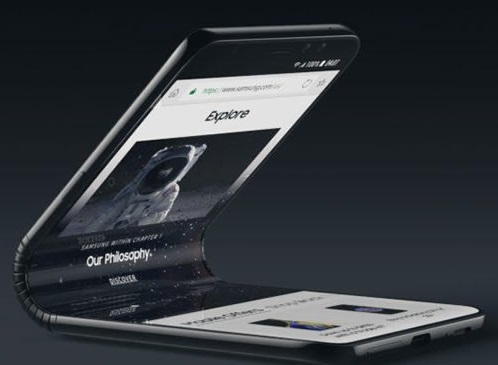
Even as we are still confronted with the allegations against Huawei, we got shown 6 months ago: “Huawei filed 2,398 patent applications with the European Patent Office in 2017 out of a total of 166,000 for the year“, basically 1.44% of ALL files European patents were from that one company. And when it comes to innovation, we were treated to: “In our first [5G] smartphone we’re going to introduce a foldable screen“, and if you think towards the old flip phones think again, you merely have to consider the concept image to see that actual innovation in not merely a jump from iPhone 6, to iPhone 7. When we start seeing Huawei optional speculated settings, we see an actual jump and we can agree that to some extent 2398 patents do make for an interesting push towards the future.

This all takes another leap forward when we consider that if we want to be players, the iterative model no longer works. We need to be first and we need to be better than everyone else and iterative thinking is what merely gets them second place. It is not merely brand marketing, it is becoming a new level of marketing all together. We merely have to see the settings and changes we see towards Neom in Saudi Arabia to see the potential there. It is Ericsson that has already set the stage where the UAE has the potential to gain business benefits of $3.3B over the next 7 years, that is an additional $500 million, nothing to sneer at and when we consider the opportunities we see when we add the stages and places that Salini Impregilo is already working on, we see the growth of a long term stage with dozens of golden parachutes for those who have the financial backers to get it up and running. Take information to a new level, not merely showing up on a display, but for you to tune in with your phone or tablet and select what you want to see, with the optional setting of “Line 3, also known as the Orange line, is 41.5km long with an 11km underground section. It will have 22 stations“, two 5G stations on the line and repeaters at every station will suddenly give you thousands of users, getting informed by you, giving them choice of what they want to be informed about and with the smart dumb devices I mentioned a month ago, you get the setting of any train with up to 250 people getting informed. It is not merely marketing at this stage; it becomes entertainment facilitation with personalised advertisements. Creating branding and loyalty at the same time, because it is the first trip, that moment when you are going to work, or going home when consistency tends to be a need for so many travelers, that is where the next stage is and that is in Riyadh, expose that to the Neom stage where the city is 32 times the size of New York, it is no longer merely on how fast people get from one place to the other, it is the setting that people will want and need information at this moment, the one giving what they need is the one with the information required. It is no longer mass media; it becomes what I would call ‘Legion media‘, a facilitated one to one media solution for all. Not one stream all watch, but hundreds of media streams interacting seamlessly on the needs of the user giving them one seamless stream of information. A fluidic setting of interactions as configured/disseminated for the viewer, all personalised and automated; a situation that requires 5G to work and a solution that remains fluidic for the changing need of the user. We know the reality of Neom being years away (apart from the act that building will take quite a while), it will be now that we see the need to prototype and pilot those new projects to get the flaws out and stage the setting for large deployment, for the mere reason that new solutions are nice to have, but when your new idea fails on day one, that entire city will switch to the next solution on day two and never consider you again, because that too is the stage of 5G. It will be more and more about getting it right the first time. I wonder how many developers have realised this and most of them will trivialise that of course, and it makes sense that they do. Yet when the backers learn that the 5G community will be a lot more critical than ever before, will they still continue backing, or will they hide behind alternative wealth bringing solutions?

You see the apps that will be the most valued and priced ones are not the ones that look cool. In 5G it will more and more about enhanced pragmatism and managing of your personal infrastructure. Did you not figure that out? When we see the options that Saudi Arabia brings, we need to also see the limitations that it has. So the right ability to manage that through domotics and smart solutions will be close to everything, pre heating, pre cooling, adjusting, shopping and groceries, all done on the fly when you have time.

Even when we see the opposition (always important) giving us: “King Abdullah Financial District north of Riyadh, meant to rival Dubai as an economic hub, is still incomplete after more than a decade. As of last April, nary a financial institution had agreed to occupy any of the district’s 73 buildings“. I think that this is important too. Is it merely the language? You see, when we see: ‘Financial District‘, we think Wall Street and consider that area. Yet when we see: “Designed by architecture firm Henning Larsen, the 17.2 million-square-foot master plan calls for over 60 residential, office, and retail towers, several schools and parking garages, a medical clinic, civic buildings, and three hotels“, we see a lot more than merely a financial district, we see an almost self-contained city. You see when we see the larger scale I see an optional obstacle, not a negative one, but one none the less. To give comparison, I need to take you back to an original game. It was called ‘Sim City’ and it was a game, but gave the player an insight into designing his city of the future. Zoning was important at this point, so it required gradual growth. By going too large in one area, you would be broke and could not gain momentum in other ways. Even as it looks amazingly beautiful, how will you get people there fast? How can you vacate 2 million people (most likely from Riyadh and other larger cities) and set them in the new stage? There are two ways. You either create a need in the new place, or you create opportunity in that place. The first requires essential growth; the second requires a staging investment drive.

In the first example, we need ‘a pressing need’, when there is an infrastructure or a structural need, you create jobs and people will move there for the new job, which is fine, but requires vast amounts of money and large players getting there. The second one is great, but is initially also costly. For the second example I will use a solution that was in South Australia some time ago. To get people there, they gave away land. They still need to build the house, but in this setting he people had 50% additional money, or lessened costs, yet to break even the government stated that the land was given, but represented value X, and when they sold the house, they would have to pay the invoice for the land first. Now consider this in the setting of the King Abdullah Financial District. And there we set the stage of ‘selling’ houses/apartments at a mere 10% of the price, yet cannot be sold until the 100% price is satisfied first. So you now have a setting where the next 10,000 apartments only seem really cheap, yet in that setting you also create need, because these 10,000 households will need infrastructure like food, water, clothing, transportation, entertainment, schooling and so on; with that we see the investors come. build their shops and grow their business, as a result housing value rises fast and creates not merely a need, but also creates additional growth, so as these houses exchange hands and new occupation, the government gets the outstanding 90% back and a thriving place. It is not a short term, or a fast solution, but it is one that brings growth, and creating larger infrastructure solutions, because at that point with the additional 10,000 people or more we see the growing need in every direction. As these elements grow other needs can grow too, when there are 10,000 potential candidates in the financial industry and a clear path of growth exists, only then would there be interest into growing the stock exchange in a new place. Yet in that setting we need to realise that for many industries the capital remains alluring. So when we are confronted with “potential tenants and investors are less optimistic than the district’s planners about its future success“, as well as “The potential is amazing. The inside is impressive,’ one Dubai-based expat, who toured the site and preferred to remain anonymous, told Reuters. But he added, ‘It will not be finished. Decision-making is very slow (on the project, and) people don’t have cash“, we see the clarity of what I described. The ‘not having cash’ can be alleviated in one way, creating additional needs. It is the ‘decision making’ part that now requires to be decided on (yes I see the trap here) and there too is a solution. If we consider the statement that Business Insider mentioned: “Some of the kingdom’s strict social codes, including one requiring women to wear dark robes, will be relaxed“, we see the option of creating an opportunity for the foreign players in Qatar to become a larger mesmerising target for ‘poaching’. When we consider the Bloomberg message earlier in May this year giving us: ‘Qatar to Allow 100% Foreign Ownership of Firms in All Sectors‘, we see the setting that there is interest, especially in the financial sector to grow options on a global scale and there too Saudi Arabia would be able to set the stage for the future. More important, once these investors see the benefit in one place, there will be an added stage towards growth towards Neom for them too. This could have additional benefits as a much larger stage between Saudi Arabia and places like Egypt could become a much more interesting choice for the future. that part is not merely seen in one way, it becomes an entirely different stage when we consider yesterday’s news with ‘Award-winning Dubbo solar home uses Tesla Powerwall 2 battery‘, you might think that this is a ‘So What?‘ stage, but it is more than you think. That part is seen with: “A building company in Dubbo says the Tesla Powerwall 2 battery in its new display home means the Dubbo solar home could potentially go off-grid. Award-winning Greenmark Homes installed a Tesla Powerwall 2 battery to boost the display home’s energy efficiency“, it becomes even more impressive when you consider the added: “Tesla big battery wins awards, prevents blackouts“, you see, even as Saudi Arabia has plenty of sunshine, at some point the sun goes down and that is where the usage changes and whilst we know that air-conditioning takes the bulk of the energy, we see that the overall need could be filled in more efficient ways and that too needs time to evolve and refine. It is taking solutions out of the box where we see the beginning of true innovation and there are plenty of places that can benefit, but we need to open the door to creativity to make it thrive and set the next stage of innovation. We can make fun of some situations as we are offered (a very old joke): ‘a new powder for hydration, to make it, merely adds water‘. It is the innovative person that uses the solution and creates a powder to capture the moist in the air and end up with water. That same application is seen when we see applications on energy and hydro needs and creates another solution, the one we forgot about. That is the nice part about these stages and on why we need to keep our focus on Neom, you see it is not about the size of the city, it will be about how certain situations get solved and how innovative those solutions are. That is where we will be able to test our creativity and optionally become an actual innovative player ourselves, driving solutions and new technologies forward, not iterative over time, but by leaps, which is how you end up with one thousand new solutions not a thousand versions of one solution.


1 Comment

Filed under Finance, Gaming, IT, Law, Media, Politics, Science

As life becomes affordable

The US is not becoming affordable. It has been affordable for some time. The issue is that America is too focused on the larger places of fame. They want to be in a place where they can get notices. Places like New York, Los Angeles, San Francisco and Houston seem to get the attention (a few more then that), and it is all about the opportunity to grow business. Yet, what happens when your life is for the most online? What happens when you are not set in a stage of location, location, location? What happens when you are the analyst that can work equally easy in a cubicle or your own living room?

When you consider that this can be the stage of tomorrow, the US starts to open up by a lot in a few ways. There is however one limitation. This is a game for the young, merely because the health system of the US is decently screwed and is unlikely to resolve itself in the next two generations. Yet consider, when you have a few years of experience and you are confronted in a place like Lancaster Pennsylvania offering a townhouse, 200 m2, with a mortgage of $1,059 per month, whilst a place half the size in Sydney costs close to $450 per week, and whether the value increases or not. You are now in a setting growing your ‘wealth’. Now, if you are all about weekend parties and clubbing these are not the places for you, yet at some stage you need to consider that some places are non-events with a $1300 a week price tag. So be honest, have you considered to be anywhere else? And that is not the only place, the US is a place of opportunity for anyone with handy to upgrade the place they get. Also consider that a simple place in Boulder, Colorado where $722 a month gets you 110 M2 with 3 bedrooms. My rent in a similar place (in Australia) was $450 a week, so there is a clear setting of ‘oops!’, for me that is.

So why are we considering this?

When we look at some of the speakers in all this, we get to see the Deloitte report (at https://www2.deloitte.com/au/en/pages/economics/articles/5g-mobile-technology.html). Here we see the first number that impacts. After the first decade, we will see a production growth, not merely more per person, but optionally more per teams in play. It equates to: ‘around $50 billion in additional GDP‘. Do you still think that it was merely about ‘security’? The entire Huawei mess gave us quotes in several places and the SMH gives us: “He noted with “not many suppliers in the marketplace”, taking out a major player “puts pressure on prices”“, when we add we see: “That leaves the Finnish and Swedish multinationals Nokia and Ericsson as the most likely developers of 5G technologies adopted by Australian telcos, potentially raising concerns of higher costs“. Even as no evidence was ever shown in the entire Australian Huawei debacle, we need to consider that Australia could lose the ‘be first, or lose market share‘ options soon enough. When the brain drain starts and certain groups of players will seek the better income in a cheaper place, how will that serve the Australian interest? For Telstra it is not a problem, they can’t go anywhere and they will not care about the fallout that is likely to hit the Australian shores. As we see the growth of new mobile set work stages, so as the plate is ‘dammed’ in stages and we are exposed to “Businesses don’t want costly 5G, new research reveals. New research shows businesses won’t upgrade from 4G to 5G if it comes at a price” (source: The Australian), we need to consider Forbes who gives us: “this time around, something has changed. When it comes to the next generation, 5G, some telecom executives seem to have lost their faith in the power of technology. A survey of recent public statements by executives of the 19 largest mobile network operators worldwide shows that more than half (53%) see no near-term business case for 5G. In a 5G network, wireless data can travel at speeds of greater than 1 gigabit per second, more than 10 times faster than most 4G networks“, so there would be a case from the earlier quote, yet when we consider the Deloite report with the quoted: ‘around $50 billion in additional GDP‘, you tell me how long it will last until the doubters and the pussy footers will no longer be players, merely runners after the fact losing market share on a near daily basis, and that is my benefit. I can slice, and dice and dashboard data anywhere on the planet. I can do technical support and customer care equally anywhere on the planet. With my half a dozen languages the customer will not care where I am as long as I speak the local language. And the larger changes are still coming, when you consider what you can get in London at an affordable price, consider where you have to live in London for £174,950, whilst it gets you a decent 1 bedroom place in Birmingham, or a 2 bedroom bungalow at £369,995 for that matter, that will not get you anywhere in London, you need 100% more to get it in London (a smaller place too) and not the greatest location either. That is the setting we seem to have forgotten about. It is the one 5G element I equally forgot about. It is not merely about making more money, it is the new stage where you can live more affordable and the same income gets you a hell of a lot more. Whilst most stuff will remain the same, your groceries would be better prices and with the housing at a much better place we see that the appeal of the larger places like Sydney and London lose their appeal. So whilst we see and accept ‘around $50 billion in additional GDP‘, it is not going arrive anywhere when the people have moved to better shores and that is the setting that MacroBusiness reported on last year. There is a brain drain and it is not only in Sydney, or merely in Australia. As the quality of life remained stagnant for the longest of times, the 5G push will also give a shift in other jobs, and the companies not ready for that accommodation will find themselves too soon in a stage where they take hit upon hit and lose more than merely short term revenue. It will be the start of losing long terms contracts because the service level agreements can no longer be met. At that point, reconsider the issues I have raised for the longest of times, also reconsider the Telstra setting and the Australian government is suddenly required (read: demanded) to provide the evidence that Huawei was insecure, I wonder what happens at that point. When the business clauses fails and we see the stage of ‘infighting like bitches‘ and some people start pointing at each other, it will be great fun to see the damage and even more damage when some media channels start trivialising certain events with the causality of ‘it’ll be all right‘. At that point, when we are confronted not with: ‘around $50 billion in additional GDP‘, but with ‘Australia is set to grow its GDP by almost $3 billion through its amazing efforts in 5G‘, at that point will someone seriously ask what happened with the other 94%, or will we see gamers getting blamed again? Perhaps with a speculated: ‘As gamers have taken usage to a new level, businesses have been losing out for too much‘. Yes at that point we will see some flames flare in all directions. As we see that we are no longer limited to a city or a country, we see that opportunity will flare in every direction and those not merely embracing 5G, but those facilitating for the move towards quality of life will end up with a better and a much larger workforce gaining even more revenue momentum. When we realise that our workflow has become global we see the additional impact of businesses, where the nation facilitating for this will end up with a much better market share than ever before. So in that end it is not better to be merely fast and early, this is the one race where being first matters more than ever before, a very new setting. That was always the stage, but never seen a clearly as recently, and when we realise that the UK is actually racing the 5G path, we see that there will be additional options there too, so in the end as 5G does not care about Brexit, it merely handles data, we see that the UK recovery will still be fast and will take them further, especially when they realise that there is more to the UK than London, even Wales has its part to play. When we see: “Vodafone has said it will test 5G in Birmingham, Bristol, Cardiff, Glasgow, Liverpool, London and Manchester from October“, so even as it is Vodafail, it still required them to put 5G option in place, and whoever has that access has a distinct advantage. When you consider that Birmingham is a mere 75 minutes from London by train, does it really matter if you only see it in the weekends, there are over 140 trains taking that route each day, implying well over 5 trains an hour.

It is my personal belief that 5G is not merely changing the game; it will create personal opportunities for anyone flexible enough to make the larger changes, even if they are merely short term, a game for the young.


Leave a comment

Filed under Finance, IT, Media, Politics, Science

2.5 Million seconds

That is the frame we are talking about. In 2.5 million seconds we will see what the people are missing out on. The News Minute gives us that we are about to witness a new phone. Were treated to “world’s first 5G-ready 7nm mobile chipset Kirin 980“, from there it is easy to become a 5G phone. This is seen with “Huawei Announces Mate 20 Phone with Upgraded Chipset“, the phone that is 5G ready, which is launching in London on October 16. This is merely the chicken feed stuff, the small fry in all this. So even as Australia became the collar of the US and banned Huawei from delivering 5G equipment, we are also treated to the setting that “Huawei P20 Pro and P20 were the world’s first devices to receive a triple-digit score by DxOMark — the industry standard for camera and lens image quality measurements and ratings“, which is nice, but as a phone not essential. Yes, it sounds like I am trivialising a little, but that is because the big part here is not the camera option, the big part is that since its release the P20 family has sold 10 million units globally and that is a n important distinction, that is the part that matters. People have embraced the Huawei as an excellent phone. For the larger part (is my personal understanding) that the undeniable fact is that the Huawei is in most cases 27% cheaper than the similar phones out there (Samsung & Apple), whilst not giving that much extra to begin with. Apart from the Huawei camera heralded as the very best (with a decent margin), it is also important to note that the Samsung has a battery delivering up to 13% less then Huawei. The Apple has even less, yet IOS is not the same as Android and comparing the two does not give what I regard to be a valid comparison, so I am not including that. Huawei seems to comprehend its customers and delivers a solution that works for them, which is shown in the speed that these 10 million units were sold. I expect that an even larger sale will be imminent by December in all this, as it might be a year to get a new phone and Huawei has their options nicely set in a row. In all this, Huawei is actually its own worst enemy. You see, for all those (like me) who needs a decent camera, good battery life and decent storage, the Huawei Nova 3i 128GB Handset fits that bill too, yet that model is new and 50% cheaper than the P20 family Oreo based and all. So for me personally, I can forego a P20 and merely use the 3i. After the P7 (which I still use, I see a massive leap forward and even as it is not the greatest Kirin processor for games, all my games will now see a 30%+ increase, so that settles it for me.

In an age where you have to turn over nearly every dollar, especially as we can expect to either freeze next winter, or stop wasting money on mobile phones at twice the price, we see that Huawei has an option for everyone. One for the mediocre users (like me) and a phone for the latest gadget lover, all addressed within a decent budget. So, even as we are confronted with faulty iPhones (which apple will replace at no cost), whilst we see that the Budget iPhone is delayed. Yet that is not merely the issue. When we are confronted with: “Owing to some instability of the production schedule, the lower priced iPhone will see the light of the day by October. On the other hand, the alleged iPhone X successor and the iPhone X Plus model should be launched by the end of September. One of these two devices and the budget variant are highly likely to offer even dual-SIM variants in a few selected countries” and we see ‘the budget variant are highly likely to offer‘, we need to step back. In this day and age, in the setting where Apple seemingly had leaked information in the past, and we have next to nothing on those models. We get phrases like ‘Apple is also rumoured to have been trying to reduce the cost of components by bargaining with its supply chain partners and Samsung as well‘, as well as ‘What we expect from the Apple line-up‘. It seems that this is a marketing ploy of ‘Let’s keep them waiting a little longer’, so in all this, whilst Huawei has been the more solid offering (as has Samsung to some degree), what on earth does Apple think it’s doing?

It is the Deccan Chronicle that gives us: ‘New budget iPhone X leak validate Apple’s serious problems‘. Yet here we need to accept that there are unknown issues, and even as we see references to Forbes, we much also recognise the use of ‘predicts‘, which implies they know nothing at all (or nothing confirmed). Here we see the one part that is a problem (a speculated one), and it is seen with ‘a low capacity battery certainly raises a few concerns‘. Yes that would be the case, if it was confirmed, but it is not. In addition we see: “the handset will feature just 3GB of RAM and a maximum of 256GB storage which is less than compared to the iPhone XS and XS Plus that are believed to have 4GB RAM and a maximum of 512GB of on-board storage“. That made me laugh, because I still have great traction with my Huawei P7 sporting 2GB Ram and 16GB storage, so this would be a step forward and a large one at that. Yes, we agree that it is way behind what Huawei offers, but in reality, the truth is that anyone requiring more than 64GB truly has a massive need for their phone and at that time, if it is so important, you basically have to shell out to the larger Apple’s and not go for any budget one. I am one who can deal with the Budget range option, so in my Case the Huawei Nova 3i 128GB Handset gets me what I need at close to 45% less, so that is actually a real budget phone, All the iPhone 8 and X models start well over a thousand dollars, so at least180% more than the Huawei offers. In light of that, what constitutes a budget phone?

This in comparison to the Samsung Note9, which in all honesty is the very latest in mobile technology, but at 300% of the price of the other phone, where do you have the cash lying about? In comparison, that new Samsung constitutes the Huawei Nova 3i 128GB, A PlayStation 4 Pro and a Nintendo Switch together. You tell me what has your preference. Now, for those eager with true technology needs, it might not be about the price. It might be what the Samsung offers with the Exynos 9810, versus the Kirin processor and that is fair enough. Some are very willing to pay for that difference. I am a more meagre user in mobile technology and I would go for the PS4pro and Switch offer if given the choice. Perhaps an idea that Huawei could float. Buy the Huawei P20 for $1400 and get a free PS4pro (first 5000 customers only). That might just sell like hotcakes, and I like it when those techno providers think outside of the product wrapping box.

The technical part that does matter is the part that Richard Yu, CEO of the Huawei Consumer Business Group gave us. With: “the Kirin 980 chip, Mali-G76 offers 46 per cent greater graphics processing power at 178 per cent improved power efficiency over the previous generation” he implies (to my limited thinking) that the processor, to limit heat and damage in that way, by making it less power consuming and there, that same battery will go heaps further, implying that a 4000 MaH battery will go close to 20% longer then before making it even more interesting to consider.

in addition the mention of “the Huawei Locator powered by Internet of Things (IoT) technology that can help people easily locate their belongings, be it their luggage or pets” implies that the phone will also have RFID tracking options, which is actually a 5G trademark. I know I am highly speculating here, but that would be an interesting first, to give the users first 5G options that can easily run on 4G, whilst demanding that the opponents to equal or better what is out there and the innovative advantage that Huawei currently has, implies that their gain will only increase and not by any small margin. The option for mothers to tag their adventurous toddler will greatly fuel the need of that function. Only yesterday was I a witness to a wandering 3 year old, when arrived at the concierge, only to see two highly panicked Asian mothers running around trying to find where the devil the little one had gone off to. Yes, the adventurous toddler was going from shop to shop trying to find mommy and adjusting course at every stand where blinking lights and noises were heard. Good luck with that one and the RFID option would be a gift from the heavenly clouds for every mom having to cope with a easily speedy distracted toddler..

They also launched the Huawei also launched at IFA 2018 AI Cube, its home speaker with 4G router and built-in Alexa that can perform several tasks such turning on the TV or playing music. Now, this is not a mobile part, but it is actually a mobile pressure release; the option not to rely on a hotspot and just get one of these puppies, as well as a second sim to not put additional pressure on your mobile. What is interesting that even as we see the frame of these speakers and the versatile options here, I am making the reference as Huawei, like Google and Apple all dropped the ball in the same way. You have all that space and you did not consider it to be a mobile charger on the side? It seems to me a first that the speaker would be awesome, especially when you rely on Spotify for music, so in that regard, making it a charger as well would have been my first thought and that is the final part in all this. When you realise that the USB-C is the weakest part in all this, giving it additional options by having some cradle charger that does not rely on that port would be a first thought for us and even as I accept that this would not have been an option for the $599 model, the bulk of all other phones are close to double that price, even the Google Pixel 3 (XL) was not on that page, so when it comes to innovation we still have plenty of places to visit, even before 5G opens the door and states that the bar is open. The charge bar that is!

Is there more?

Well yes, but that is slightly anti-Apple (unintentional). It was brought in the Business Insider by Antonio Villas-Boas and Clancy Morgan. Their article gives us “the other weird thing is, the USB cable doesn’t plug into the new MacBook Pros. I have an iPhone and out of the box, I cannot plug it into the new MacBook Pros. To me, this is absolutely nuts. It’s mind-boggling“. The issue I see here is that Apple always had the mindset that it always connected. That was a selling point and a good one. People relied on that. Here we see that Apple threw that part in the wind. Perhaps they thought that those with money will by anything, not realising that some do not buy a MacBook Pro by choice, it is by need and through the boss, so the phone does not connect, which is a larger issue over time and that does matter. Even as we complain on the USB-C, mine has worked for 3 years 24:7. It might be faltering now at times, but it does imply that I had plugged it into a cable almost 1500 times, so at some point one thing has got to give and the USB-C port is the most likely of candidates.

Whatever happens, in 2.5 Million seconds (or 28 days for those who failed calculus), we will see the actual official goods on the new P20 siblings and just in time for Christmas (and Saint Nicholas) too, which is awesome. no matter how that fares, I will have the Huawei Nova 3i 128GB to fall back on, which is also a huge step forward to me, so not matter which Huawei model comes to our mind to buy, we get to win in a life that is expensive nowadays, especially in the cold winters and that is always a good thing for everyone involved.


Leave a comment

Filed under IT, Media, Science

The future arrived Yesterday

I was at an interesting gig yesterday. I was introduced by a friend to several new options to engage with an audience, and options to interact in engagement, not mere presenting, we got to see true engagement. Several solutions that by them self are impressive enough, but combine the abilities we see options for engagement that will knock the socks off from players like Marvel and Nintendo, options that large players like Microsoft set aside for too long, options missed by some players as they are pushing for similar results again and again. Yet like the failures of Ubisoft in the past, as I stated it ‘a game that was designed to not be a failure will in equal measure never become a true winner‘, Ubisoft learned that the hard way with the their Assassins Creed franchise and now, we see opportunities that EA Games could get with FIFA19 and micro transactions, not just that, the act of engagement would allow for plenty of additional visibility towards groups that are currently not considering certain products. Engagement has always been the primary key in that and I saw a truckload of that, much of it in a new wardrobe that fits basically everyone.

So even as some are given to be a display towards retail, they have the ability to be much more, this is a marketing dream and all available for so many participants before this year’s Christmas shopping spree sets in. Options that are more than just engagement, they are optional content distributors, unlockable gems that people in certain areas love, a simple image that can immediately translate with you in the foreground and your destination in the background, combined send as a postcard to your mobile on the spot.

It is a simple setting, where an RFID scanner that could instantly reveal what the Nintendo Amiibo offers to the customer in store, not relying on dodgy third party lists, one Nintendo list and places like EB Games could in store reveal what the person is buying. The applications are here and not in the stores, not used by players that could gain the brand additional momentum, so what gives?

Well, for the most retail and larger places are seeing these devices and solutions as a cost, which they are (to some degree), but they in equal measure forget the opportunity that they bring. If we consider Market Watch (which I question), we see the setting that the games market, in particularly the Augmented reality Gaming Market, we see a forecast where we are treated to According to Infoholic Research, the “AR Gaming Market” is expected to reach $284.93 billion by 2023, growing at a CAGR of 152.7% during the forecast period 2017-2023“, I still think that this is ludicrous, I have zero percent faith in that, or to state this that I am predicting that this is 100% wrong. Gaming is a 135 billion dollar market globally, if we get “expected to reach $75 billion by 2023“, then this would be an awesome result for AR gaming. I am certain that Infoholic Research did not just get their wires crossed; I feel that they are buttering someone’s bread on both sides. In both normal gaming and gambling, we see that there is a trend on the rise and some of the systems shown yesterday can grab in on these potential markets in several ways, it is up to the creative marketing mind in the larger places to use this not merely for branding, but also for creating awareness and grow interest through engagement.

Consider that this goes further than mere advertising and branding, consider the information kiosks, you might wonder what a mere information kiosk could add. The new generation can also scan you or what you are holding. A logo, a brochure, or merely a QR code. These parts can immediately be converted to a shop with location, a digital travel brochure that can be interacted with on the screen or merely a QR code that your mobile device can scan, giving you the app, the additional information or a mere YouTube video to watch. All options actively available now and when you place such solutions in a place like Neom (for those not in the know) “Neom is a planned 26’500 sq. km transnational city and economic zone to be constructed in Tabuk, Saudi Arabia close to the border region of Saudi Arabia and Egypt“, and Saudi Arabia has set aside 500 billion for the creation of that city. The option of being the first and more important, setting up the 5G hub allowing a primary spot for a 5G growth in both Egypt and Saudi Arabia, a place where Huawei is already roaring to set up shop, they have the lead there, and now consider that the push from the Saudi Arabia government is all about being ahead of the rest, the smartest of all smart cities and it will not take long before they realise that to get ahead of all the others you need to be willing and ready to have solutions for engagement there, primed, active and ready to grow. More important, three months ago, we were treated to “Chinese tech conglomerate Huawei is already committed to training 1,500 local engineers over the next two years“, so this is one place where Telstra got in way too late, as did the European players. The hub for a 120 million customer 5G population, when I mentioned this in the beginning of this year I was not kidding. Now we see that certain paths have started, we need to look at how you can get a smart city population to engage, because that is the trigger for growth. This directly relates to gaming as gaming is the big equaliser here, it has always been that, as early as the early 90’s. For 25 years I have seen how gaming and engagement lowered the threshold for those nervous about technology and yesterday I saw a whole range of engagement opportunities. Not merely interactions and RFID application in other ways to show interaction, but a setting where it pushes non-personalised data to a tenfold and that data can push the curiosity towards engagement for everyone.

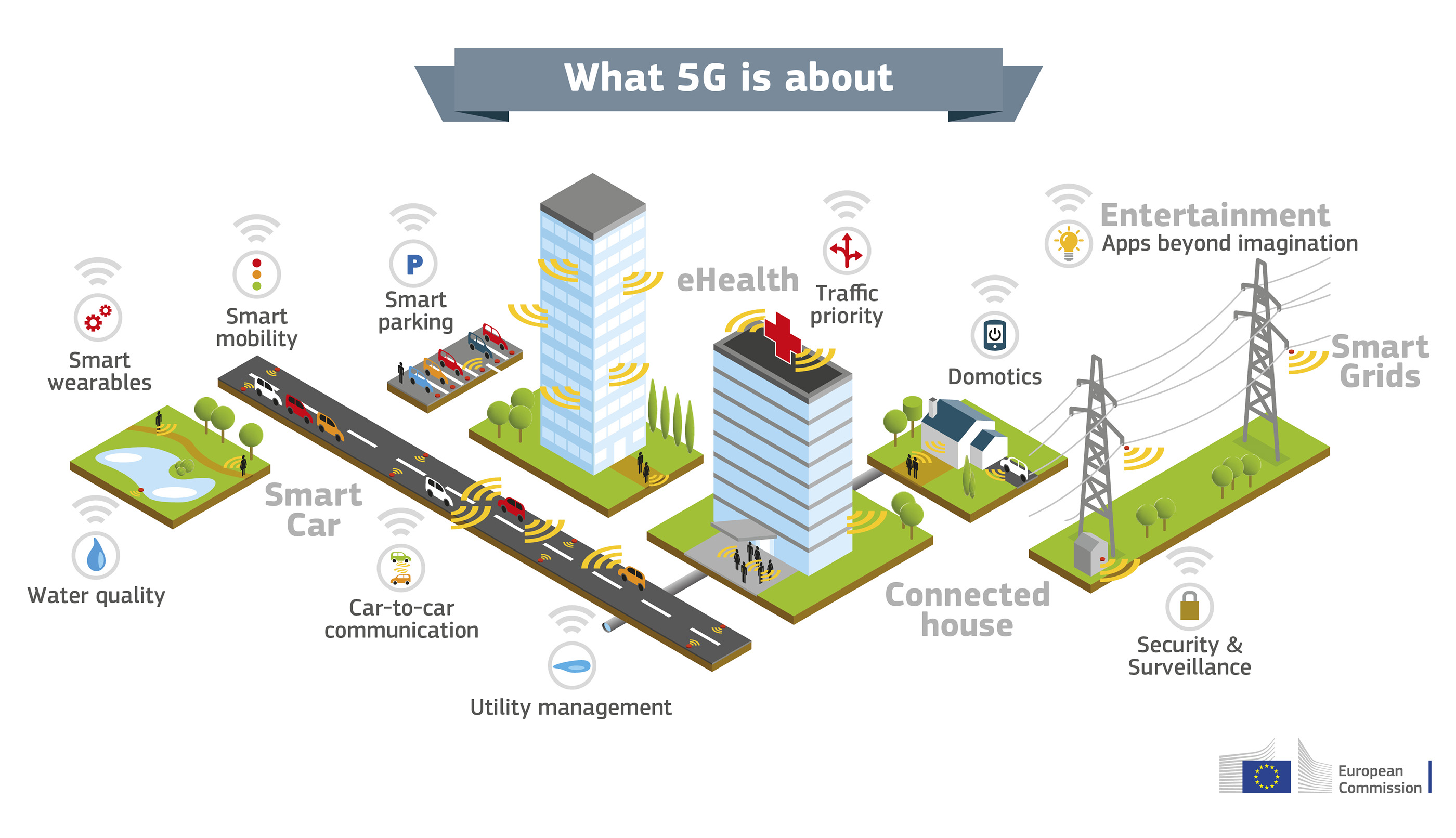
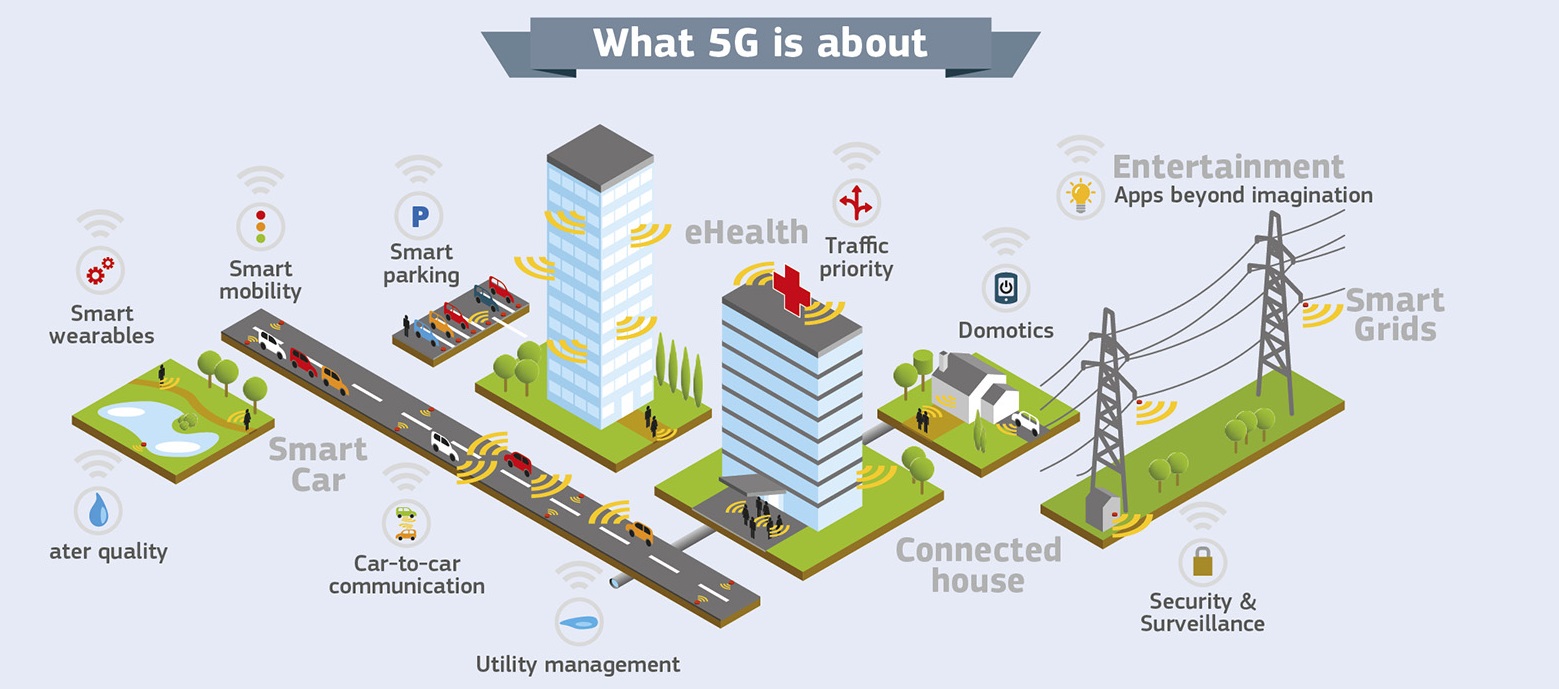
When he European commission gave us the ‘What 5G is about‘ most looked at it and thought ‘Nice!’ what they missed is that is goes beyond mere RFID and Domotics. The direct interactions of Smart Wearables, Smart Mobility, Smart Grids and Smart Parking show that when the car is low on fuel (or an almost empty battery is you have a Tesla), the SATNAV will reveal the closes fuel point, or warn you if you cannot make it to the homestead, the smart wearable can link directly to health care, the nearest pharmacy, the doctor allowing for a prescription on the spot, the phone that now shows a map and receives the information YOU wanted to engage with from a kiosk that is now also a data hub and transfer point of information, all on the fly without YOU having to type anything, all done intuitively on the spot. In all this, you remain in charge of your data and (except for the healthcare part) all null and void of actual personal data.


Let’s take this to a next level, some have seen something like this, it looks like an old amplifier volume knob, but it is actually a Bluetooth speaker, place it on nearly any table and it becomes an amazing speaker, yet the next level is not merely a speaker, it is also perfectly placed to be a data hub. Now combine that with a sheet of Perspex as a display (at https://www.youtube.com/watch?v=fdDAG0uwg3s), when we combine the three, we get the information on the kiosk, transferred instantly to your ‘speaker’ that is also the data hub and displays the information on that sheet display, wearable or other option. Maps, data, and brochures, all instantly available; Google already owns that solution, a solution that is merely awaiting implementation. A setting driven by what I would call ‘dumb’ smart devices. All the fear of personal data gone and total interactivity remains, engagement and the ultimate lure that draws consumers into your business; that is what engagement allows for, no other way will get that great result because that is the advertisement of tomorrow, not the data they hold, but the curiosity that they bring, all linked to the need for engagement. All those people, millions, who would walk in because your window had something interesting to show, yet now it is not your window, your window is also in every data kiosk, every advertiser point and every screen.
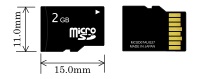
It is no longer about the mobile, people are less trusting with their data, but a smart (dumb) device, their watch, their Pendent or ring, now a data hub and consider that the 15 mm for a micro SD fits into rings, pendants and watches, all optional long term data hubs on the go, without any long interaction and we can get 32 GB for a mere $5. Picking up the ideas and interacting from place to place, our shopping needs and information on the fly when YOU want it; the data kiosks merely one of many places to interact with the addressed needs everywhere.

All settings not yet available in such an advanced state and all options out in the field for those willing to be the enterprising in the new places where they are willing to spend $500 billion in total, to make a next gen tech hub a reality. Or as Jeremy Irons stated in Margin Call: “There are three ways to make a living in this business. Be first, be smarter, or cheat“, he said it and I agree, it is always best to be first and whilst some are still trying to market what they are trying to set as 5G, we see that Huawei who are setting the stage on what 5G could be, Huawei s in the implementation stage of preparing the engineers of setting it all up in a live environment. So whilst America is still in anti-China mode, we see “Now, the whole industry is taking the final sprint towards 5G commercialization. The completion of SA specifications which complements the NSA specifications, not only gives 5G NR the ability of independent deployment, but also brings a brand new end-to-end network architecture, making 5G a facilitator and an accelerator during the intelligent information and communications technology improvement process of enterprise customers and vertical industries” and Huawei has already started in Saudi Arabia, so my other prediction is coming to pass as well, By Q1 2019, Saudi Arabia will become a market leader in 5G and will connect with Europe soon thereafter. In all this Australia things will go from bad to worse, especially as we cannot tell whether we need to consider if people like John Watters, Executive Vice President and Chief Corporate Strategy Officer of cybersecurity firm FireEye Inc is bedding Telstra or the USA, the fact that no one has been able to produce any clear evidence in Huawei’s ‘dependency’ on the Chinese government and the overly fearful US Tech as well as Telstra in all this is more than what I consider to be merely a sham, they are currently quite the opposite of embracing engagement and new tech, it will end the end make them look like the fools they should have been trademarked as in 2017.

So as we might remember Telstra at IT News with “Telstra said in a slide deck that “full commercial deployment of 5G in capital cities, major regional centres and other high demand areas” would occur in financial year 2020“, we can now see that they will be almost a year behind Huawei. Al this angers me, merely because it stops advancement and innovation, which makes Saudi Arabia the one remaining golden opportunity for true 5G innovation and yesterday’s presentations showed me how much many more avenues can be approached, because some of the innovations are out here today, in some cases, merely linking the solutions remain. It is important that we consider the Huawei part a little longer, it is important because 5G is so crucial to all this. When we see the article (at https://motherboard.vice.com/en_us/article/59w49b/huawei-surveillance-no-evidence), we see that the title gives us: ‘There’s No Public Evidence Huawei Spies on Americans‘, in addition we see “Huawei’s efforts to make inroads in the U.S. quickly resulted in numerous allegations over the company’s alleged connections to Chinese intelligence. Despite breathless hysteria, numerous investigations (one 18 months in length) found absolutely no evidence of such a threat.“, as well as “a follow up report by Reuters indicates that there has been pressure applied on U.S. telcos to avoid doing business with Huawei, with companies like Verizon and AT&T being told they risk losing their lucrative government business contracts if they strike deals with the massive Chinese multinational“, when we complete it with ““We knew certain parts of government really wanted (evidence of active spying),” one person familiar with the probe told Reuters at the time. “We would have found it if it were there”“, now we see the parts missing, in all this the Australian government needs to be optionally seen as a dog collar without a leash around the neck of a rabid dog named USA. This all smells like AT&T and Telstra in desperate need to not get drowned by an actually innovative technological opponent, who did just that, they became truly innovative. We need Huawei in all this more then most can comprehend.

To get this a little better, we need to look at ‘Media Engagement and Advertising Effectiveness‘ by Bobby J Calder and Edward C Malthouse. Here we see “Traditionally, marketers have thought about advertising as a process of translating a brand, expressed as a benefit, a promise to the consumer, a value proposition, or a positioning in the consumer’s mind into a message that is delivered to the consumer through some medium. This advertising will be effective to the extent that the consumer values the brand idea and the message does a good job creatively of communicating the idea“. Yet when we consider it more fully, we see: “It is engagement with a TV program that causes someone to want to watch it, to be attentive to it, to recommend it to a friend, or to be disappointed if it were no longer on the air“, through engagement, the TV Series Lucifer was not cancelled, it moved from Fox to Netflix, merely by the acts of engaging fans. Engagement can be that powerful and it goes beyond merely revitalising a TV series, it will be the bread and butter for most companies as growth is often seen as  linear with ‘advertising’ whilst we have to accept that exponential growth can only be achieved with an actual engaging audience. Because like in Facebook, that one engaging person is linked to dozens, if not hundreds of others, and their actions are more easily accepted by their close connections then the one advertisement is. In two stages this is seen that one engagement is optionally 900 hits in a low estimation, versus a mere advertisement that gets 5% out of 10,000 shows, so it took 10,000 attempts to get 500 people taking a second look, whilst one engagement event could be the start of 900 instant opportunities, so which option would you more likely turn to?

Yet, we must also be aware of the negative side in engagement. Calder and Malthouse give us that with: “Intrusion may produce a negative response from consumers because the advertising harms the experience of the media content. This in turn could lead to a negative reaction to the advertising, compromising its effectiveness. The consumer may feel that the ad has intruded on the experience with the content and accordingly may have a less positive reaction to the ad“, so in this the interactive kiosk becomes again not merely a vehicle, but THE vehicle in all this and Time is the one currency that is at the centre of it all, it is time that usually and largely triggers the intrusion emotion (waiting, or idle time tends to do that). With the smart ‘dumb’ devices, the automatism of storage whilst the interaction is merely a second, perhaps even two seconds. The element of intrusion decreases and engagement remains, or optionally even increases. It is achieved as the advertisement is not the focal point, but merely part of it and the experience is not impeached, as we get 125Mb in that one second, we get the brochure, the movie clip, the setting, the review and the applicability; all available to watch at our leisure and when we want to decide what to see and how to watch it. So from a $5 32GB Micro SD card, we can get more with a $100 200Gb card, and that is now, in 2-3 years we can get 5 times that storage for the same price. In this non-personalised interaction setting, we achieve to get heaps of analytical information whilst driving engagement. So in that we are confronted with all the latest trailers by merely passing a cinema. And we can just leisurely watch what we need and wipe the rest. It is a brand new day and those ahead in the game get to set that stage of new tech needs for an entire population, engagement is the key element to drive all that.

The future arrived yesterday, whatever will we get treated to tomorrow?


Leave a comment

Filed under Uncategorized

Trusting Anti-trust cases?

Today will be about Jennifer Rankin and her article ‘Google fined £3.8bn by EU over Android antitrust violations’. First off, it is a good article, she did absolutely nothing wrong (at https://www.theguardian.com/business/2018/jul/18/google-faces-record-multibillion-fine-from-eu-over-android). We get the goods (not all mind you) but a clear picture and that is what I like, a clear picture to work with.

Right off the bat we start with “Google has been hit with a landmark €4.34bn (£3.8bn) fine by the European Union over “serious illegal behaviour” to secure the dominance of its search engine on mobile phones“. Interesting setting as there are Android based phones and IOS (Apple brand X phones). The android systems ALL have full access to Google. As for the search engine, there are two elements. The first the engine for searching itself, which is in android, giving us an open source setting and (at https://searchcode.com/), you can take a look yourself, now you will still need the skills to program, but that is a discussion for another day. The second part is to find stuff, which requires the PageRank. Now we have an issue, because (as the Americans say): ‘that shit is patented!‘ plain and simple. Whilst Microsoft and IBM were belittling Google in 1999 (heard it myself in the UK) Google was working and growing in what is now defined as ‘the development of the Android mobile operating system, the Google Chrome web browser, and Chrome OS, a lightweight operating system based on the Chrome browser‘, it took 5 years for them to get serious traction and whilst they grew, the other two were marketing their BS on every level whilst trusting in VP and players who actually did not know any of their shit, people relying on PowerPoint presentations, bullet points and hype expressions. Now we get the first part that matters: “The European commission imposed the record penalty after finding that the US tech firm required smartphone manufacturers to pre-install Google’s search and browser apps on devices using its Android operating system, which is used on 80% of all phones“. This is the first part. You see, there is a merely a partial truth and it is largely incomplete. Any mobile smartphone needs an OS. So we have Apple with IOS, there is or was) Blackberry, Microsoft and Google with Android. The rest was either not willing or eager to play on any serious level. They all had this: ‘it is much better going for larger systems‘. Even the larger players ignored the power of Mobile and Smartphones for too long. That evidence is seen with NBC where we see “In a farewell post on LinkedIn, Microsoft’s former head of Windows, Terry Myerson, explained why Microsoft failed in the smartphone business“, (at https://www.cnbc.com/2018/03/29/why-microsoft-failed-in-phones.html). The quote: “It comes down to two problems: Underestimating Android’s business model, and building on an older technical platform that wasn’t quite ready for the job“. So in two mere dimensions we see the acknowledgment of large corporations set in a place of short sighted expectations whilst using a narrow minded business model. That is apart from the issues that Windows Mobile had, I wanted to add that list of issues, but I calculated that this section would be no less than 6000 words, with the additional issues on Windows 10 mobile adding a serious amount of words to the 6000 words required. Blackberry did not survive the times either. It had a good platform, but ultimately too expensive for most businesses. It is still going on, but not in the same way it was. Blackberry was not flawed, it focused on specific groups and those groups, those who choose Blackberry will love it forever, it merely could not hold up the settings there were, I reckon that the 2008 crash wiped well over 35% of their customer base instantly, a setting that many corporations tend to see as a fatal blow, Blackberry was no exception. So 50% of the ‘larger’ players are already gone, none of it had anything to do with Google, or with the patented parts. So I would love to scrutinise the Danish Margrethe Vestager (without resorting to Denmark and Hamlet). It starts with: “Google has used its Android mobile phone operating system “to cement its dominance as a search engine”, preventing rivals from innovating and competing “and this is illegal under EU antitrust rules”” No! They did not! We see the clear admission from Terry Myerson giving us ‘building on an older technical platform that wasn’t quite ready for the job‘, knowing that already sets one of the two outside of the consideration. I have given the audience evidence again and again on how stupidity rules at Microsoft. The Surface and Xbox platforms are two distinctive places where this is visible. Both have a narrow minded setting, both are short sighted and even the business approach to grow the customer base failed to do its job. Reuters gave us that last year with ‘Microsoft Surface devices fail on reliability: Consumer Reports‘, an overpriced system that cannot even get close to 80% of what Apple could do with its very first iPad in 2011. In addition Reuters gives us: “The non-profit publication surveyed 90,000 tablet and laptop owners and found that an estimated 25 percent of those with Microsoft Surface devices would be presented with “problems by the end of the second year of ownership,” according to a study published on Thursday“, how can any device with a 25% failure issue be in the market in the first place, and it is very connected, as this is the mobile industry, the mobile industry is more than merely a mobile phone, all connected devices that rely on mobile technology (Wi-Fi or cellular) are part of that failure. The Reuters article (at https://www.reuters.com/article/us-microsoft-surface-idUSKBN1AQ1EP) we also get “According to the Consumer Reports survey responses, the Microsoft devices were found to freeze, unexpectedly shut down or have issues with their touchscreens, Beilinson said. Altogether, the reliability issues made Microsoft a statistical outlier compared with other brands. Apple Inc. had the most reliable devices, Beilinson said“, so how many corporations should be considered when they are the outlier in a negative way? #JustAsking

It is time to look at article 101 (antitrust) (at https://eur-lex.europa.eu/legal-content/EN/TXT/HTML/?uri=CELEX:12008E101&from=EN). Here we see:

  1. The following shall be prohibited as incompatible with the internal market: all agreements between undertakings, decisions by associations of undertakings and concerted practices which may affect trade between Member States and which have as their object or effect the prevention, restriction or distortion of competition within the internal market, and in particular those which:
    (a) directly or indirectly fix purchase or selling prices or any other trading conditions; (not charging for a service is a right anyone has)
    (b) limit or control production, markets, technical development, or investment; (impeding your own technical development, intentional or not is merely your own visionary stupidity)
    (c) share markets or sources of supply;
    (d) apply dissimilar conditions to equivalent transactions with other trading parties, thereby placing them at a competitive disadvantage; (nope, the non-patented part of android is open to anyone)
    (e) make the conclusion of contracts subject to acceptance by the other parties of supplementary obligations which, by their nature or according to commercial usage, have no connection with the subject of such contracts.

The first issue is that the Page rank which is part of this is patented, so there is already a setting of exclusion. The fact that the others are 10 year late to the party is equally evidence that there is a wrongful conviction here. The setting that they are all scared with the coming of 5G, whilst Apple and Google are the ONLY ONES who will be decently ready, both ending up with a massive market share. We see at this point the third failure of Microsoft. You see, it was not merely the two that Terry Myerson stated at CNBC, the ‘Underestimating Android’s business model‘, as well as the ‘an older technical platform that wasn’t ready for the job‘, it is to some extent the ‘25 percent of those with Microsoft Surface devices‘ failing, they are all connected to overlapping user groups making the damage even larger. The Xbox debacle that showed a bullying setting of ‘always online’ as well as storage shortage issues (a killer in the mobile devices), their bullying setting of pushing people online is equally part of the failure. It was the fourth part that truly took Microsoft out of the race. Google (as I personally see it) looked at roughly 1.7 million university students and looked at where the future was pointing. They saw where the future was heading and they build on that long term view. Just look at the Gmail storage, the YouTube facilitation, and to openness of their business suite apps, just a few examples. Over 3 years I have only two parts where I missed Microsoft Office a little, over 3 years that is nothing. That in a setting where Microsoft went into the ‘greed’ setting it becomes a lot more funny, especially when we see students having to get by a few dollars a day, yet Microsoft has a $199 version for these students, yes it will be cloud, secure (so they say) and update cost free, a subscription service. Google merely states $0, on the cloud. You tell me what students want! The issues are linked, because Microsoft had been actively growing the anti-Microsoft feelings for almost a decade. I understand that Microsoft has a business model and ‘free software’ is an issue for them, they have a right to be like hat. Google understood that the poor students who hardly can keep a budget now, are going to be the executives of tomorrow, those people then are executives now and they all embrace Google (well, most of them anyway). There was no force, there was no (how did that Danish lady put it?) ‘Restriction or distortion of competition within the internal market‘, many went to iPhone and IOS and Google is fine with that. No, the issue is that the other players are confronted with the stupidity of the previous post holders and that is an issue now, it links together.

By not realising the future 15 years ago, the present is close to unobtainable for them. I watched how I saw again and again how some of them went by ‘We are now working on the new technology surpassing the others‘ again and again (and not delivering). You merely need to find the history of ‘SPSS Data entry for Windows‘ and realise that this was an excellent way to lose 6000 businesses, and close to 35,000 users (relabeling it ‘form design software’ was never a solution). Microsoft went in that same direction and now they are close to side lined from the next technology by their own stupidity. No resources, no ‘know-how’ and no vision, yet Google is the big bad wolf here!

This is the underlying story that links it all and some companies are merely indicative, but they overall went the same direction. So where we see ‘preventing rivals from innovating and competing‘, I see that this was not the case, they merely went a greed driven path (OK, I admit, I should say ‘revenue driven path’), whilst actual new technology is all about innovation and never about iteration. Microsoft, after IBM the larger player feeling left out has shown us on several fields that innovation is merely marketing, not actively pursuing issues and with a ‘25% failure issue’ setting in the Surface department, I believe that their flaws are clearly shown. It becomes more of a farce when we see “Vestager added: “The vast majority of users simply take what comes with their device and don’t download competing apps.”“, users want what works; we are not interesting in a $199 fee for apps that they we get for free, ask any student. There are apparently 207 million higher education students globally, ask them! In addition, that mere setting where we see the onus of the user, to not look for more is punishing a company because the users are lazy? Since when can we convict Google for not installing in the second degree, because the user was lazy?

In many situations there are no competing apps, not of any quality that is and when you look in the Google play, we see that the users are allowed to set the tone. I will be the first to agree, that there are issues and that there might have been a case to some extent. Microsoft faced that years ago when it was still in the delusional setting that they had the better browser. Now we see a different picture. Now we are faced with IBM that put everything on Watson (not sure if that was a good idea), but it can facilitate to the larger degree in every direction, including the third parties banking on 5G, IBM is eager to oblige. Microsoft has nowhere to go, they burned down their options and as they screwed up again and again, it has nothing left but to sulk like a little child. Just consider the upcoming Microsoft Surface Go, for people with budgets. Now consider the News we are given: “With a starting price of $469, the Apple iPad (with Wi-Fi connectivity only) is the winner on affordability”, “The consumer/education version is priced at $599 and will run Windows 10 Home in S mode – which only allows apps that are available in the Windows store”, all this, for a system not out yet, and the Australian Financial Review (at https://www.afr.com/technology/mobiles-and-tablets/will-the-surface-go-boldly-where-other-tablets-cannot-20180713-h12n71) gives us: “Why has Microsoft just released a tablet at a time when almost everyone is buying smartphones and almost no one is buying tablets? Sales of tablets such as Apple’s iPad have been in steep decline since 2015, a decline that shows no signs of reversing in the next four or five years, analysts say”, so in that setting another optional failure is introduced. That whilst I saw it coming, just as the short sighted failures that are part what now with giggles is called the ‘most powerful console on the market’ (The Xbox One X), that is the company that is connected to all this.

That part can be found in a few places. In this case I give you the New York Post where (at https://nypost.com/2015/04/15/microsoft-the-big-winner-in-google-antitrust-lawsuit/) we see “While Google CEO Larry Page took his lumps with the suit, Microsoft, very quietly, came out the big winner, sources said. “Microsoft complained a lot,” said a source with direct knowledge of the situation. “Microsoft definitely counselled the [EC], suggesting it made sense to send Google a statement of objections so Google would be forced to produce documents” showing its search-result recipe, another source said”, this was a joke 3 years in the making. I hope that I can turn that joke on these losers as they have diminished consumer trust in their narrow minded way (not to mention short sighted ways).

Even when we turn this in another direction through the Register two month ago (at https://www.theregister.co.uk/2018/05/21/antitrust_google_us_government/), where we see ‘On 20th anniversary of Microsoft antitrust, US Treasury Sec calls for Google monopoly probe‘, I am not arguing how right or wrong it is. I am merely pointing out that Google went in a direction that was long term, whilst all the others went into the short term path that was demanded from their board of directors, who for the most could not read a spreadsheet properly because the bullet points were missing (their optional opposition to the NRA perhaps?). That was the setting and those with vision are dumbfounded and they got hurt through the inadequacy of stupid people.

So the Danish party was already active then. What is an issue is Jeremy Stoppelman, he had vision with Yelp, even as he did not understand certain markets (miscalculated is a better word), he had faith in his product, which I applaud. it worked for a while, yet I see that bad choices (unfortunate choices is a better setting) impacted it all, so even as Yelp failed to meet expectations, if it survives and gets 5G traction, it will be ahead of others a decent amount, it turned down Google who wanted them when the going was good and he would have had a strong place if he had taken that part, but it was his decision and I applaud him for it. Yelp and Turnstyle Analytics would have an optional strong 5G setting if it had kept international operations and grow the data the way they had, it will not be easy now for them, but I digress. With: “Mnuchin’s comments on Google came after a special 60 Minutes episode that focused in part on the company and its effective search monopoly. That segment was notable for the inclusion of two people: EU competition commissioner Margrethe Vestager and Yelp founder Jeremy Stoppelman“, yet all parties have their ‘its effective search monopoly‘, what they are not telling us is that they had a vision that everyone would come with a future need and they got Stanford University to create the algorithm that got patented. All the other players remained dumb to the future. And then we get the one gem I expected: “Also, the EU announced it was launching a probe of Google’s Android operating system to see if its agreements with cellular phone makers was hurting rivals. While Microsoft likely does not care much about search preference, “the investigation throws sand in the gears of Google’s innovation,” the former FTC official said“, so there it is ‘agreements with cellular phone makers was hurting rivals‘, phone makers had options, Apple had its own system and there are NO non-Apple IOS phones. Interesting that this does not make that cut is it? An open system was offered and the alternative Microsoft (rejected because it was not up to the job), Blackberry (is only after the collapse that it became an option to others), we see that Google has an open option, yet they are the boogeymen. So we get two elements, a partially failed entrepreneur (only in part) and a limelight seeking politician. The power of the google Appeal is found in a simple statement: “Her staff ran through over a billion Google searches and found that Google was knowingly manipulating its search algorithms to promote its own products and push competitors far down the ranking“, that evidence must be shown in court and get scrutinised! You see, the timeline for a billion searches can only partially be automated and those results can be used by Google as evidence against Margrethe Vestager as well. The evidence of ‘manipulating its search algorithms‘ will be equally a discussion point putting EVERY intern and assistant of Margrethe Vestager in the witness box, no exception. A setting that I personally see as the EC has close to no chance of winning. Even as I saw the algorithm in my University classes for an assignment, I am decently certain that I did not see the whole 100% of all elements of the algorithm, one element out of place and that is as I (again: personally) see it the crushing of the EC case, the appeal will be won by Google.

The fact that Microsoft was part of this in several ways from 2015 onwards and likely before that is more than enough for me to consider the premise that trusting antitrust is not always a good thing. I do agree that antitrust should exist, yet it should be clear that this is not a handle for the narrow minded, the short sighted, the greedy and the stupid to use because they could not get their shit together. They should reread Chapter 11 of their favourite pornographic work, whether that text comes in 50 shades of mixing several combinations of white and black. A colourless equation in a setting where colour was the only part that the global users demanded, listening to them would have been a first requirement. It is the setting, which gets me to the final image.

An interesting to set the stage, because if Microsoft was a marketing firm, they would be reduced to merely being a spammer, look at the first screen of your Xbox One (X optional) for that part, also all the parts people have to go through in Windows 10 (https://www.windowscentral.com/how-remove-advertising-windows-10), so in the end, the advisors have their own games to play (quite literally at some point). The Independent was kind enough to give us this with: “In the meantime, we probably ought to do our bit to help her by making a little more use of Google’s rivals, such as Microsoft’s Bing, which is a perfectly serviceable search engine“, it is seen at (https://www.independent.co.uk/news/business/comment/google-eu-fine-margrethe-vestager-android-search-microsoft-bing-silicon-valley-mobile-phones-a8453486.html)

Just ‘Bing’ “UK Law firms”, to get a UK law firm and immediately I see 10 law firms (page top view), 50% Australian ones (3 of those advertised), so if Bing cannot give me what I am looking for, why should I even consider them? With the term “Dutch Lawyers” I get 25% fulfilling the search. I can go on for a while, but I think the case of the doubt regarding ‘a perfectly serviceable search engine’ and the case on how it isn’t one has been made. I did not need to go far. Oh, and if you do have a sense of humour, try “Microsoft guilty” (with brackets), to see Bing give you “We didn’t find any results for “Microsoft guilty””, whilst Chrome giving us an immediate 8 results, with the quotes on these links. So when it comes to censoring (or is that just their flawed algorithm), we can soon see that there is an optional setting where Margrethe Vestager could be seen as a tool for Microsoft (as they might have been ‘searching’ for optional solutions), it might not be a fair setting, yet the entirety of the Antitrust case is seen by me in that way. Microsoft and a few others need time to catch up, being stupid merely gets you at the back of the line (which is where all future opportunities are lost), they need time and they are using the EC to try to catch up. My sense of giggling will be found the moment the appeal is won by Google; we are likely to see a tsunami of ‘carefully phrased denials from European political players trying to avoid the limelight’.

Oh, and whilst we are at it, when we see ‘placing them at a competitive disadvantage‘, that in light of Huawei surpassing Apple (source: the Verge). With: “Huawei has surpassed Apple as the world’s second largest smartphone brand. Sales have overtaken Apple for the first time”, Margrethe Vestager will call it ‘proving her point’, yet the truth is that Huawei went for the affordable option, a side Apple has not considered in decades, whilst in addition, the decline of Samsung and the growth of Huawei reinforces that it was about affordability for the longest of times, those losing market shares are their own worst enemy, because the wrong people are setting the price, I added enough evidence of that for the longest of times. This all in a setting where we see that even as Huawei realises that Europe is the key, the others are isolating themselves even more. Soon enough it will no longer be about Google and Android, it will become on non-American mobile players gaining the upper hand  over all the others, I wonder what anti-trust case will be filed at that point.

#PriceDiscriminationAnyone?


Leave a comment

Filed under Finance, IT, Law, Media, Politics, Science

Chaos, benefit or danger?

As an aspiring agent of chaos, I have always been in favour of chaos. There are two quotes from the movie The Dark knight (2008) that are important here. They seem meaningless, but they are not. Consider the events surrounding Brexit. The IMF, Wall Street, the ECB all desperate to scheme through fear mongering, and they are even at it today, all so eager to keep their status quo in place. So, the first quote is: “Y’know they’re schemers. Schemers trying to control their little worlds. I try to show the schemers how pathetic their attempts to control things really are“, that is only partially true. The evidence is all around us on how Wall Street is still largely in control. I am not giving you some conspiracy theory on how they did one or the other. The news as we read it in nearly every decent newspaper gives you that evidence and they call it ‘policy’. It is fun to make a second movie reference, especially as it also included Christian Bale. The movie the Big Short (2015) shows clearly the facts of the subprime mortgage issues that unfolded and became a reality. It was based on the book by Michael Lewis called The Big Short: Inside the Doomsday Machine. I was sceptic at first, not because of the actors involved. Yet the notion that it involved Steve Carell and Ryan Gosling made me a little wary. In the end, I saw a movie that showed a Steve Carell who shows us how brilliant he actually is, more than merely a really good comedian. Even as he had already worked together with his prospective son in law (a Crazy, Stupid, Love pun), as the narrator in part of the movie Ryan Gosling gives it that extra, that part that will make you remember the movie long after you have seen it. The movie ends up being not merely an entertainer, the movie becomes an educator almost to the degree that the book was. Together with Margin Call and Inside Job you get a real grasp of the economic wasteland that 2008 created.

This part is truly important, because when you consider those facts and the mere realisation that the US, EU and many other places still have no proper protective laws in place is just scary.

Part of this is seen in the McKinsey report on June 5th 2018 where we see: “That the effects of Pillar 2 add-ons and capital buffers should result in two widely different assessments, of €56 billion and €2.2 billion, is notable, highlighting the room for national discretion during implementation. In Sweden and Norway, for example, supervisors are reflecting higher risk weights for mortgage loans in Pillar 2 capital requirements. Some analysts are therefore expecting that these add-ons will be removed, given that they are already captured by an internal model floor for mortgages under Pillar 1“, the part ‘expecting that these add-ons will be removed‘ is the danger here. You see, Bloomberg reported in January 2018 (at https://www.bloomberg.com/news/articles/2018-01-25/banks-prepare-for-battle-as-europe-readies-rules-to-cut-risk), “banks are uncertain about how Pillar 2 capital requirements — demands set over and above legal minimums — will be imposed“, the statement is odd as they were already there in Basel 2, so why is there now ‘miscommunication’? (Perhaps ‘ignorance through intentional non-comprehension‘ might be a better term).

When we look at those two pillars we see:

First Pillar: Minimum Capital Requirement
The first pillar Minimum Capital Requirement is mainly for total risk including the credit risk, market risk as well as Operational Risk.

Second Pillar: Supervisory Review Process
The second pillar i.e. Supervisory Review Process is basically intended to ensure that the banks have adequate capital to support all the risks associated in their businesses.

You see, we have seen the game of CDO’s, derivatives in many forms, sometimes being ‘diplomatically’ called Bespoke Tranche Opportunities nowadays, the Big Short mentions it at the very end. Consider that this was a 2015 movie, and Bloomberg gives us last August: “Pacific Investment Management Co., Goldman Sachs Asset Management, Columbia Threadneedle and others are snatching up bonds tied to subprime mortgages and other home loans made before the housing crisis, while selling speculative-grade company debt. They say junk yields are too low for the risk investors are taking, and securities backed by mortgages — which have already gained as much as 6.9 percent this year according to Bank of America Corp. data — offer higher potential returns given the risk“, it implies that some could get rich by taking risk on junk. So when that collapses, considering Basel 3 pillar one and two, what are the chances that pillar one, the operational side does not include such events as it is not ‘operational‘ but based on non-operational settings? Where is the risk then? In addition, when we see that now, the banks are expected to ‘expecting that these add-ons will be removed‘ from consideration, how dangerous is the balance at that point? Did we not learn enough in the years 2008-2011? Why are we allowing these gambles leaving us with nothing twice over? Why are there no clear laws banning credit swaps and BTO’s? It might sound nice and soundbyte nice when the pope makes such a claim, yet it is still legally an option, so why was this not halted? The fact that the book and movie mention this gives rise to the fact that Wall Street knew for many years, yet they let it slide. So what happens when the people DEMAND from their president that the banks will no longer bailout banks involved in that? What happens when Wall Street faces the rage of the people and there is no continuance or replay of the Emergency Economic Stabilization Act of 2008? What happens when the people have had enough and in honour of the American Civil War (1861 to 1865) decide on the American Wall Street Clambake of (20xx) where 150 million Americans decide to lynch the 63,779 bankers on Wall Street in public, would that change a few noses to be more morally inclined (of those still alive that is)?

Agustin Carstens gives us a more diplomatic view in the Financial Times (at https://www.ft.com/content/720efbe2-75fa-11e8-a8c4-408cfba4327c) where we see “the future is not pre-ordained. The right policies can help. While the path ahead is a narrow one, it can be taken. We should seize the day to rebalance the policy mix and sustain the current expansion. That means regaining room for policy manoeuvre and reviving the flagging efforts to implement structural policies. Let’s use macroprudential tools to strengthen resilience where financial vulnerabilities are building up. Let’s ensure that public finances are on a sound footing“, yet he phrases it better, but as I stated in the beginning, I am an aspiring agent of chaos after all. This gets me to the second quote in the Dark Knight. It is applicable in two settings, the one we saw and the one we are about to see. The quote: “You know what I noticed? Nobody panics when things go according to plan. Even when the plan is horrifying. If tomorrow I told the press that, like, a gang-banger would get shot, or a truckload of soldiers will be blown up, nobody panics. Because it’s all part of the plan. But when I say that one little old mayor will die, well then everybody loses their minds!

This gets me to the situation where Israel made a choice to speak, but from where I am sitting, it seems like the wrong voice to raise and it is the setting of a dangerous strategy that could backfire in ways that we cannot perceive as yet.

You see, on Wednesday afternoon Netanyahu tweeted out a video praising the Iranian soccer team for its performance in the World Cup against Portugal with “The Iranian team just did the impossible. To the Iranian people I say: You showed courage on the playing field, and today you showed the same courage in the streets of Iran.

For soccer fans it was a remarkable day, most of them did not give Iran any chance of winning, not against Morocco, who has a team that can stand up to the likes of Spain, a nation devoted to soccer, so for Iran to win, that was a really big thing. Now consider the words ‘today you showed the same courage in the streets of Iran‘. This is a reference to the Iranian currency plunging to the depths of the Mariana trench, having a massive impact on the Iranian people. ABC gave us (at http://www.abc.net.au/news/2018-06-26/thousands-protest-in-iran-over-failing-economy/9909184) ‘Thousands protest in Iran over failing economy, forcing closure of Tehran’s Grand Bazaar‘, now we can acknowledge the event, yet from the lips of PM Benjamin Netanyahu, or in this one particular case ‘PM Be not a Yahoo‘ it seems to give notification that revolution needs to be on their mind. The problems is even as they currently have a lame duck in place (President Hassan Rouhani), who is merely accepted as the temporary voice of the Clerical and Military power in Iran. Such a revolution would merely empower the military and give rise to the Clerical side to end up supporting the military

Yet the setting in the frame whilst the nuclear negotiations are still going on, Iran is under pressure. The danger we are now exposed to is that the Iranian clerics and military will not place another ‘liberal’ minded person for another 4 years, so the danger of having some short minded version of former president Ahmadinejad on steroids as the next president of Iran is not out of the question. No one can tell whether the clerics and military have prepared the next one, but to get one in their years early tends to push chaos to a level of devastation and this is not the time to make this happen. So basically we see the feeding towards ‘then everybody loses their minds!‘ Could I be wrong?

Off course I can, yet the data and events seeping towards a more extreme new president was always coming, the acceleration in Saudi Arabia and the Iranian acts in Yemen clearly point that way. We see in some sources phrases like “Iranian Foreign Ministry spokesman Bahram Qasemi told a news conference that the ongoing offensive on Hodeidah has put the country on the brink of famine“, from my point of view, the Iranians achieved that last year with the aid of a tool like Hezbollah and pointing the Houthi rebels to cause maximum damage to the people of Yemen. So when we see: “The international organizations and the UN should make an effort to end the aggression against the oppressed Yemeni people“, the UN knows perfectly well that delivered missiles firing from Houthi positions into civilian targets in Saudi Arabia made that a non-option right of the bat. Yet, we must not forget that Foreign Ministry Spokesman Bahram Qassemi played his part very well, the main players are not new to this game and merely waiving their options away is not something the UN is willing to do, in that regard we all need time to get anything proper in place and Israel just changed that instance to some degree. Chaos in Tehran can unfold in ways that cannot be predicted because several players behind the scenes cannot be identified. Yes, the top two (Ali Khamenei and Qasem Soleimani) are known, yet their inner circle is not completely known and now we are in an upcoming impasse where we could be forced to wait until their moves are done, that whilst Iran is nowhere near on the ropes, so they have what might be seen as the field advantage for a little while and that is where chaos can go unbridled and cause actual long term damage.

There is enough evidence of that in Syria, Libya, Egypt and Yemen, none coming with short term solutions to get some actual productive. the Egyptian $500 million education reform bill is only two months old and took some time to get it all in the right shape. This is long term thinking, a true working strategy where the next generation will be more educated giving additional options for long term dialogues and giving a nation options to grow economically. Now consider that any prospective improvement is now optionally off the table for Iran until 2027. This gives a long term danger to sparks evolving in a very different form of chaos, one that no one can predict how it will unfold in the end. That is the game at present. Now consider such an event happening whilst Europe and the US go through another 2008 event, something that several predict and most seem to agree that it is pretty much unavoidable.

Almost like some used to say that the Great War (1914-1918) was the war to end all wars and we were treated to a very different reality in 1938. In that year we got the very first issue of Superman and Time magazine elected Adolf Hitler as ‘Man of the Year‘, do you remember how that ended, apparently all remaining 9 million Israeli’s definitely do!

Chaos can be good, it allows for true change. In this the quote: “It’s like knocking over an ant-hill. Every new generation gets stronger, the ant-hill gets redesigned, made better” is appropriate, yet the danger is that those ants have access to an arsenal of ‘solutions’ that can make a real dent ensuring long term chaos, that is why the Israeli push is not the beneficial push that the PM thought it could be, so tweeting that video was slightly too rash (for more than one reason). In that the earlier setting where we let the banks completely collapse might be the better options (if we had to choose between the two). In the second part, the Iranian debacle is also set on how China will react. Some are speculating that Iran wants to offer an oil solution if China is the saviour that they hope it will be. I cannot tell, I never looked at any data or papers giving real light to one path towards the other path. For china it might be an option, especially after the vitriolic actions against Huawei and ZTE, yet in the end that market is for now not large enough to cause truest concern, not whilst they have plenty of options to grow 5G in Europe with a population twice the size of the US and an overwhelming desire of the local populations in western Europe and Scandinavia to adopt it, there is enough for China to focus on, they might love to help out Iran, just to spite the US and to get under-priced oil, yet that is a separate play from what is on offer.

Scandinavia is also interesting as it allows Huawei to reach the bulk of Swedes through their three cities (Stockholm, Goteborg and Malmo). As Malmo is merely a bridge crossing away from Denmark’s capital Copenhagen a growth path for Huawei could show others soon thereafter what the rest is missing out on and with Swedish Telia on board, the setting for both Denmark and Norway becomes a reality. Even as the US is all up in arms, Reuters gave us merely 4 months ago on Huawei being “the company in prime position to lead the global race for next-generation 5G networks despite U.S. allegations it poses a security threat“. So even as we see newscasts like ‘Sprint, T-Mobile merger will generate 5G powerhouse, cut costs for users‘, that setting is definitely not a given. You see the chaos is not in getting the 5G, the chaos comes from 5G as governments and large telecom companies are nowhere near dealing with the setting that cyber threats can become. this is not merely phishing, scamming or abducting accounts, this is the realistic danger that for the first two years 5G facilitators become start points of all kinds of chaos though the facilitation of non-calibrated systems, architecture lacking equilibrium. the difference between ‘a holistic approach towards DDoS attacks and 5G networks, rather than relying on outdated defence tactics‘ (source: Wireless Week). Non-repudiation would have been a quality first step in that, in a time when too many are relying on authentication, we seem to forget that it remains relatively easy to get a ‘false positive’. Please do not take my word for that, merely visit 675 N Randolph St, Arlington, VA USA (address of DARPA) and ask Dr. Steven H. Walker if you can take a look at a massive archive of false positives that their previous research gave in all kinds of fields, it is an impressive read to get your fingers on and you’ll die of old age before you even get through 30% of the materials, even if you start as a teenager.

That was the ball game from the start. A mere setting of order versus chaos; a simple setting where order could have prevailed, if not for the economic setting of greed and speed over quality. In that 5G does not open up the super highway of data, it merely opened `15 highways next to the one we cannot even properly control now and we end getting 16 highways flooding us with false positives, chaos on a new level and not chaos of the good kind. It will be the wet dream of organised crime for close to a decade to come and the larger players remain is presented denial.

For that you merely have to search Google and use the search term “Telstra non-repudiation“, you get ‘Mobile Authenticator’, which states to be ‘Enhanced non-repudiation’. These two are not the same! Now, important that this is not anti-Telstra, the bulk of all systems on a global level have these issues. My issue in this particular case is “reduce the costs associated with robust user authentication for large populations of staff or customers accessing your online service” Non-repudiation is never cheaper (for now) and in the end the flaws are not obvious, yet they are there and it takes one sloppy moment to give access. Computer world gave us last year the article by Evan Schuman involved here is Steven Sprague is the CEO of Rivetz, this project that comes the from National Institute of Standards and Technology’s National Cybersecurity Center of Excellence (yes, it’s a mouth full) is giving us: ““Software code is easily altered, and memory can be copied,” he said. “The [whole] software process can be observed. You simply cannot hide a secret in the operating system. It’s time to finally do it correctly, with hardened keys within the device.”“. It is one step stronger, yet this is still not non-repudiation, where the setting is that you and only you could have done the deed. Some go for the ‘Dual biometrics may just be the authentication answer we need‘, yet that is still ways away and in the end on the mobile path not really a good solution. One player called Sensory is making positive headway, yet they are not there yet and time ran out close to two years ago to get something really good on the roadmap. So even as we see that authentication solutions are there, in the immediate setting where mobiles can now move billions, the game is now and has always been non-repudiation. At present we move over a billion dollars a day via mobiles and ecommerce, when we consider that this push is going to fivefold in the next decade, do you really think that authentication is going to get the job done securely and on time before the big bank download begins?

Is there a connection?

Consider Bank Melli Iran: $45.5 billion, Bank Mellat: $39.7 billion and Bank Saderat Iran: $39.3 billion. Merely three banks with a few billions. Now consider the following settings. In the first we get “While the standards of the Bahrain-based Accounting and Auditing Organization for Islamic Financial Institutions (AAOIFI) are widely followed around the world, they are not enforced in Iran“, a mere setting of rules. Now we consider the resetting of Basel 3 pillars one and two, with the support from several financial sources giving us “The Central Bank of Iran has played a significant and effective role in implementing Basel II and III standards in the banking system“. Now we take those elements and add 5G, whilst non-repudiation is non-existent and some devious entrepreneurs help themselves to the $125 billion of cream. This fat cat, can we call them ‘organised cats’, could potentially use the 5G debacle to remain anonymous and sail away on their new yacht (by the way, if you guys pull that off, please remember my AU$20,000,000 consultancy fee through Riyadh, so I can use the legally available tax avoidance rules).

Do you still think I am joking?

We have heard all kinds of noise concerning security, so in addition to that, one source (Internet of business dot com) gives us “5G will enable IoT applications such as autonomous vehicles, healthcare solutions, and robotics. But the technology also poses a much larger security risk than the 2G, 3G, and 4G networks that came before it. Why is this?
Significantly, 5G represents an overhaul in the way that networks are run and managed. In contrast to the hardware-based networks of the past, the technology takes advantage of virtualisation and cloud systems, leaving it more vulnerable to breaches if not properly secured.
” There we see the connection, proclamation of proper security are at the foundation of it, whilst the systems are all about Authentication and not about clear non-repudiation, in an age where mobile hi-jacking is a reality of life, the authentications in place are often too easily avoided. In the time a person walks to the bathroom a highly jacked phone can now set up the vibe of 25 million transactions, all completed in 52 seconds, most likely at that point, the person going to the toilet barely sat down for the event to release, that’s what it took to set the Iranian coffers to ’empty’. Now, many will not react that it happens to Iran, yet the newly elected extremist will not let that slide; and what happens when it is not Iran, but another nation? What happens when we realise too late that our own banks are not up to scrap?

Only this month did we see: “Security breaches continue to be an ever-present threat for financial institutions. Defending against attacks and authenticating customers without creating undue friction is something financial institutions have not yet completely solved. Consumers seem to be willing to use more secure methods to access their accounts, but not necessarily give up on ease and speed of transacting“, and in addition ““Attacks haven’t died down,” said Will Lasala, director of security solutions at OneSpan, a cybersecurity firm. “The amount of loss is through the roof. Stopping losses and the need to analyze what’s happening in those transactions is important.”“. That was this month, whilst the FDIC (Federal Deposit Insurance Corporation) treated all willing to learn to “Internet connections establish a pathway for hackers and thieves to access and steal sensitive personal information, including the banking records that many customers store on their home computers. Phishing, pharming, spyware, malware, worms, nimdas, viruses, buffer overflows, and spam—all relatively recent entries to our vocabulary—have raised electronic/Internet banking risk levels to new highs, and financial institutions have had to increase security measures to address those risks“, that was in 2005, thirteen years ago. Welcome to the age of ‘if it costs too much, sit on the solution for now‘, you see, not much headway was made (clearly nowhere near enough) and in that result we are now on the edge of 5G where the speed and issues are driven upwards at least tenfold, so that is where non-repudiation was a solution, if only someone had gotten us there. It was a risk covered in my University IT classes in 2010, so it is not like there was no awareness, merely a path that was seen by too many decision makers as too unprofitable to consider.

Now we see chaos in its proper light. Chaos could have set the stage properly, if they only allowed the banks to collapse in 2008, yet that did not happen and some players are up to their ‘old’ tricks in a new jacket whilst the people are more likely than not having to pay for it all again.


Leave a comment

Filed under Finance, IT, Law, Military, Politics, Science

The non-knowing speak loudest

There is an old saying that goes back to the original circus, the days of Sir Alec Guiness, John Le Carre and the circus (MI6). Those who do not know speak and those who do will not. There is however a valid issue with that mindset. When it is merely intelligence and what some regard as spyshit, we tend to not care. It is their world and they tend to live by other rules even as they have the same lack of common cyber sense as some US generals, it is their choice to make. Yet when we see labour people like Michael Danby need to present evidence in regards to “an opposition Labor party MP, called on the Liberal-National coalition to block Huawei and fellow Chinese telecoms company ZTE from supplying equipment for the 5G network. “Both Huawei and ZTE must report to the Communist party cell at the top of their organisations,” he told parliament. “Let me issue a clarion call to this parliament: Australia’s 5G network must not be sold to these telcos.”” I am actually in the mindset that his seat should be put up for auction if he does not disclose a proper setting and give evidence as to the reasoning of all this. It becomes more pressing when we see “Mr Lord, a former rear admiral in the Royal Australian Navy, told Australia’s state broadcaster on Monday that these claims were “wrong”, adding that Huawei was not owned by any committee of government and posed no risk to Australia’s security“. It is not just because Mr Lord is a former rear admiral, more that the average naval midshipman tends to be more reliable than any politician. We get this from the Financial Times (at https://www.ft.com/content/1a2d19ba-67b1-11e8-8cf3-0c230fa67aec). In addition, when we get politicians start the scare tactics of ‘critical infrastructure pose a risk to national security’, there is a clear need for both Duncan Lewis and Paul Symon AO to get hauled in a chair in Canberra and ask them to openly answer the questions regarding any evidence that Huawei is a security threat. To blatantly accept the US on their ‘china fears’ is all well and good for Telstra, yet the setting is not a given and the fact that Telstra is nowhere near the technological levels of Huawei is not something that we blame them from, but they basically lost the 5G war before it started through their own actions and inactions.

Now if there is an actual national security concern, we should be open about that and when that happens, and evidence is presented, at that point we can all relax and state to Huawei that we feel sorry for the inconvenience caused, but such concerns are just too big to ignore. I think we have had quite enough of these presentations that reek of Colin Powell and his silver suitcase with evidence that no one ever saw in 2001. We cannot go in that direction ever again. We will not be the play toy of greedy telecom companies and their internal needs for stupidity and inactions; we can no longer afford such a nepotism environment.

That same issue can be said regarding Nationals MP George Christensen. Apart from him trying to undo a business deal of a 99 year lease, no matter how silly that deal was, Australia cannot be perceived as a nation that cannot be trusted at the business table. My second issue is why a maroon (Queenslander) is involving himself with NT politics. In that regard, why do we not see the responses form Vicki O’Halloran is she has any, is she not the appointed administrator? In this, the game is not over. The Australian Financial Review gives us: “Huawei faces the likelihood that Cabinet’s national security committee will veto it supplying equipment for the 5G network, based on the recommendations of security agencies, over concerns about the potential for cyber espionage at the behest of China’s leaders“. In this the question becomes, is there an actual security concern, or is it that the national concern is the devaluation of Telstra? In additional support we need to see the Sydney Morning Herald two weeks ago when they gave us (at https://www.smh.com.au/business/companies/how-a-huawei-5g-ban-is-about-more-than-espionage-20180614-p4zlhf.html): “The Sydney Morning Herald and The Age reported in March that there were serious concerns within the Turnbull government about Huawei’s potential role in 5G – a new wireless standard that could be up to 10 times as powerful as existing mobile services, and used to power internet connections for a range of consumer devices beyond phones“, as well as “the decision will have an impact on Australia’s $40 billion a year telecoms market – potentially hurting Telstra’s rivals“. the first part is something I wrote about for well over a year, the second one is important as we see ‘potentially hurting Telstra’s rivals‘, from my personal point of view it reads like the one lobotomised idiot in telecom country gets to decide through arm-twisting on how we need to remain backwards as they set the standard that they could not deliver for the longest of times (a little sarcasm regarding Telstra’s 2011 3.7G), I wrote about that recently.

ABC gave us yesterday: “it continues to be the target of criticism over its connections to the Chinese Government, including allegations it is involved in state-sponsored espionage“, yet the people have never been shown actual evidence, so where is that at? There might have been doubts to some degree for a while, but the Powell stunt is too clear in our minds and the USA does not have the credibility (or credit rating for that matter) it once had. The fact that the opposing former rear admiral of the Australian navy trumps two half bit politicians seeking the limelight any day of the week and some stay silent, the reason for that is only speculation, but we might not need to seek far and a few words ion Google Search might help find that answer (like ‘Telstra’ and ‘8000’). When we see some giving us: ‘Telstra Corporation Ltd (ASX:TLS) is betting it all on 5G‘ and we see the Telstra strategy briefing (at https://www.telstra.com.au/content/dam/tcom/about-us/investors/pdf-e/2018-Strategy-Update.pdf), we see on page 6, Leading with 5G, that would never be an option with Huawei in play as they are ahead by a lot, so the presentation given a week ago, whilst we realise that the presentation was prepared way before that is giving the setting that Huawei is no longer considered to be competition, that is what we now face! What some might call a backward organisation proclaiming to be leading whilst 8000 men will be missing through inaction. That page is even more fun when you consider the quote ‘new technologies like IoT‘, which is funny when you consider that the Internet of Things (IoT) is a system of interrelated computing devices. It is not a technology; it is a network that enables technology. In addition, when you start nit-picking in that 34 page event, we see all the bells and whistles we need to see, yet when you consider consumers and small business (the millions of people that Telstra charges) starts at page 9 and gives us 5 slides. We see ‘cutting edge 5G capability’ (by whose standards?), we see location devices (with the image of a dog), Access to rewards an tickets, a fully-digital relationship with Telstra (an implied no more personal interaction after the sales, merely a chatbot) and value added services, yet the value of a service like customer service and customer care are absent in that part of the equation, so how does this push the people forward, because I doubt that it actually will achieve anything in the long run and one flaw will anger the actual consumers without limits.

You see, personally I believe in the IoT, I believe in 5G, they are tools to enhance experiences and interactions, not make them obsolete and that is what  feel when I saw the Telstra strategy update. These two elements can enhance customer care, customer service and customer support, not replace them with ‘AI’ enhanced chatbots. So the moment we get a 2.0 version of ‘Telstra’s new chatbot, Codi, is making so many mistakes customers are furious’ (at https://www.businessinsider.com.au/telstra-codi-bot-backlash-2018-3), chatbots can be a great asset to get the information and channel the call to the right person, yet that again is merely enhancing and that can work fine. The presentation implies the loss of actual customer values and ignoring their need for interactions. That in an aging population might be the least intelligent stance to make ever.

Yet this does not give way to the issue on Telstra versus Huawei, as the Sydney Morning Herald states “Telstra has refused to exclude Huawei from its 5G tender, but that is seen more as a way of keeping its existing supplier Ericsson on its toes“, as well as “In other words, a ban could be bad news for TPG, Vodafone and Optus. Whether it is necessarily good news for Telstra – which has its own issues at the moment – is less clear“. In finality we get “Intelligence agencies tend to get their way on matters like these“, this beckons the question what are they actually after? The US seems to be in bed with Samsung and their 5G routers, so it makes sense that this will be the path that Telstra walks as well, time will tell how it ends.

So why is this such a big deal?

We are currently in danger of actually falling behind Saudi Arabia, yes, that place in a large sandbox is about to surpass us in 5G and other technologies. They had the audacity to reserve half a trillion dollars toward Vision 2030 and Neom. So when we got “Al-Khobar in the Eastern Province, of Saudi Arabia, has become the first city in the region to benefit from the fifth-generation wireless network or 5G network, according to a press statement issued by the Center of International Communication“, last month. There was not a surprise in my bone. You see, this will drive their Vision 2030 plans even further. So as Saudi Arabia is now the new pond to grow speciality in 5G, app designers can promote, test and deliver on knowledge that will be available whilst Telstra is trying to figure out how to get 5G installed. with “All the necessary national 5G policies and supporting administrative provisions are planned to be in place before the end of 2019, along with the award of initial batches of the spectrum to support the full commercial deployment of 5G technologies“, we see that Saudi Arabia had been taking this serious for a much longer time. This goes a little further when we see ‘the Middle East and Africa 5G Technology market (Egypt, Saudi Arabia, UAE, Nigeria, and South Africa)‘, so at this point, Saudi Arabia has a head start to not just push Saudi Arabia forward, they have quite literally first dibs on gaining a chunk of the 98 million Egyptians. Not all can afford 5G, we get that, but those who do are confronted with only Saudi Arabia as a Muslim player, you did not actually believe that they would run to Vodafone, did you?

So back to the 5G local ‘market’! For this we need to take a look at the Australian Financial review 2 weeks ago. Here we see (at https://www.afr.com/opinion/columnists/the-technical-reasons-why-huawei-too-great-a-5g-risk-20180614-h11e3o), with the title ‘The technical reasons why Huawei is too great a 5G risk‘, the start is good, this is what we wanted. Yet we are treated to paragraphs of emotion and alleged settings. So when we see: “Huawei presents unique additional risk beyond the “normal” risk of buying complex equipment. China has demonstrated a long-standing intent to conduct cyber-espionage“, so is ‘intent’ shown in evidence? How did the CIA and NSA acquire our data or Cambridge Analytica for that matter? ‘China is thought to be behind data breaches‘ is merely a statement ‘thought‘ is speculation, not evidence. Then we get: “The US Trade Representative’s Section 301 report from March this year details the very close cooperation between the Third Department of China’s People’s Liberation Army (3PLA is a military hacking unit, also known as Unit 61398) and Chinese enterprises“, I have to get back to this. We are treated to ‘At one extreme, Huawei could be asked‘, is a case of fear mongering and not evidence. In addition we get ‘it is certainly a possibility‘ which came after ‘Vulnerabilities may already exist. This may not be the most likely possibility‘ as well as ‘very likely‘ all emotional responses, none of them evidence in any way, so the article with included in the title ‘The technical reasons’, has pretty much zero technology and close to 90% ‘allegedly’, speculations and emotional twists, whilst we cannot deny the optional existence of vulnerabilities, yet these are found regularly in Cisco hardware and Microsoft software, so have those two been banned in Australia?

Now to get back to the Section 301 report (at https://ustr.gov/sites/default/files/Section%20301%20FINAL.PDF). It is 215 pages and I did not read that complete political US marketing behemoth. There is one that actually carries weight. On page 153 we see: “evidence from U.S. law enforcement and private sources indicates that the Chinese government has used cyber intrusions to serve its strategic economic objectives. Documented incidents of China’s cyber intrusions against U.S. commercial entities align closely with China’s industrial policy objectives. As the global economy has increased its dependence on information systems in recent years, cyber theft became one of China’s preferred methods of collecting commercial information because of its logistical advantages and plausible deniability“, which is basically good application of intelligence gathering. Please do not take my word for it, feel free to call the NSA (at +1-301-6886311, all their calls are recorded for training and quality purposes). Oh, and before I forget, the text came with footnote 970, which gave us “A number of public submissions provided to USTR state that the Chinese government has no reason to conduct cyber intrusions or commit cyber theft for commercial purposes, see CHINA GENERAL CHAMBER OF COMMERCE [hereinafter “CGCC”], Submission, Section 301 Hearing 16 (Sept. 28, 2017); that the US has not provided evidence of such actions by China, that China is also a target of cyber-attacks, and that the two countries should work together“, there is that to deal with and is that not a rare instance where we are treated to ‘the US has not provided evidence of such actions‘, how many times have we seen claims like that since 2001? Would that number be a 4 or 5 digit number?

The point is not whether it can or could happen, the question becomes did it happen here? let’s not forget that in most settings the section 301 report is about US interests and their technological advancement (which they lost by becoming iteratively stupid). Here we have a different setting. In the setting we face Huawei has a technological advance over all we have in Australia and most of Europe as well. Huawei was one of the first to realise the power of data and 5G and they are close to a market leader, the US is basically relying on Samsung to get them there. BT (British Telecom) is on the ball, but still not on par. They are in bed with Finland “BT has teamed with Nokia to collaborate on the creation of 5G proof of concept trials, the development of emerging technology standards and equipment, and potential 5G use cases“, so this sets the larger players in a field where Nokia and Huawei are now active. The SAMENA Telecom Leaders Summit 2018 and Saudi Telecom Company (STC) announced today that it is working with Nokia to launch a 5G network in 2018 within Saudi Arabia, yet the technology agreements show that it does include Huawei and Cisco, so they aren’t already active, the setting for the initial bumps in the road that Cisco, Nokia and Huawei will surely overcome is knowledge that we will not have in Australia long after someone was able to connect the 5G router to a power point (very presentable, yet the online green light seems to be broken).

So whilst politicians are considering who to be buddies with, Saudi Arabia joins the US and they will be the first 5G providers, which means that the UK and Australia are lagging behind and optionally not for the short term either.

So am I not knowing or am I all knowing? I actually prefer the first, because it is more relaxing; yet the need to speak out loud is becoming increasingly important even if it was only to place the loud mouth limelight seeking politicians like Michael Danby and George Christensen in their slightly too arrogant place. They are of course welcome to present ACTUAL evidence proving me wrong. #WishingForAMiracleHere


Leave a comment

Filed under Finance, IT, Media, Military, Politics, Science

Telstra, NATO and the USA

There are three events happening, three events that made the limelight. Only two seem to have a clear connection, yet that is not true, they all link, although not in the way you might think.

Telstra Calling

The Guardian (at https://www.theguardian.com/business/2018/jun/20/telstra-to-cut-8000-jobs-in-major-restructure) starts with ‘Telstra to cut 8,000 jobs in major restructure‘. Larger players will restructure in one way or another at some point, and it seems that Telstra is going through the same phase my old company went through 20 years ago. The reason is simple and even as it is not stated as such, it boils down to a simple ‘too many captains on one ship‘. So cut the chaff and go on. It also means that Telstra would be able to hire a much stronger customer service and customer support division. Basically, it can cut the overhead and they can proclaim that they worked on the ‘costing’ side of the corporation. It is one way to think. Yet when we see: “It plans to split its infrastructure assets into a new wholly owned business unit in preparation for a potential demerger, or the entry of a strategic investor, in a post-national broadband network rollout world. The new business unit will be called InfraCo“. That is not a reorganisation that is pushing the bad debts and bad mortgages out of the corporation and let it (optionally) collapse. The congestion of the NBN alone warrants such a move, but in reality, the entire NBN mess was delayed for half a decade, whilst relying on technology from the previous generation. With 5G coming closer and closer Telstra needs to make moves and set new goals, it cannot do that without a much better customer service and a decently sized customer support division, from there on the consultants will be highly needed, so the new hiring spree will come at some stage. The ARNnet quote from last month: “Shares of Australia’s largest telco operator Telstra (ASX:TLS) tumbled to their lowest in nearly seven years on 22 May, after the firm was hit by a second major mobile network service outage in the space of a month“, does not come close to the havoc they face, it is not often where one party pisses off the shareholders, the stakeholders and the advertisers in one go, but Telstra pulled it off!

A mere software fault was blamed. This implies that the testing and Q&A stage has issues too, if there is going to be a Telstra 5G, that is not a message you want to broadcast. The problem is that even as some say that Telstra is beginning to roll out 5G now, we am afraid that those people are about to be less happy soon thereafter. You see, Telstra did this before with 4G, which was basically 3.5G, now we see the Business Insider give us ‘Telstra will roll out 2Gbps speeds across Australian CBDs within months‘, but 2Gbps and 10Gbps are not the same, one is merely 20%, so there! Oh, and in case you forgot the previous part. It was news in 2011 when ABC gave us (at http://www.abc.net.au/technology/articles/2011/09/28/3327530.htm) “It’s worth pointing out that that what Telstra is calling 4G isn’t 4G at all. What Telstra has deployed is 1800MHz LTE or 3GPP LTE that at a specification level should cap out at a download speed of 100Mb/s and upload speed of 50Mbps [ed: and the public wonders why we can’t just call it 4G?]. Telstra’s sensibly not even claiming those figures, but a properly-certified solution that can actually lay claim to a 4G label should be capable of downloads at 1 gigabit per second; that’s the official 4G variant known as LTE-A. Telstra’s equipment should be upgradeable to LTE-A at a later date, but for now what it’s actually selling under a ‘4G’ label is more like 3.7-3.8G. “3.7ish G” doesn’t sound anywhere near as impressive on an advertising billboard, though, so Telstra 4G it is“, which reflects the words of Jeremy Irons in Margin Call when he states: “You can be the best, you can be first or you can cheat“. I personally think that Telstra is basically doing what they did as reported in 2011 and they will market it as ‘5G’, giving premise to two of the elements that Jeremy Irons mentioned.

This now gives a different visibility to the SMH article last week (at https://www.smh.com.au/business/companies/how-a-huawei-5g-ban-is-about-more-than-espionage-20180614-p4zlhf.html), where we see “The expected ban of controversial Chinese equipment maker Huawei from 5G mobile networks in Australia on fears of espionage reads like a plot point from a John le Carre novel. But the decision will have an impact on Australia’s $40 billion a year telecoms market – potentially hurting Telstra’s rivals“, as well as “The Sydney Morning Herald and The Age reported in March that there were serious concerns within the Turnbull government about Huawei’s potential role in 5G – a new wireless standard that could be up to 10 times as powerful as existing mobile services, and used to power internet connections for a range of consumer devices beyond phones“, you see I do not read it like that. From my point of view I see “There are fears within the inner circle of Telstra friends that Huawei who is expected to offer actual 5G capability will hurt Telstra as they are not ready to offer anything near those capabilities. The interconnectivity that 5G offers cannot be done in the currently upgradable Telstra setting of a mere 2bps, which is 20% of what is required. Leaving the Telstra customers outside of the full range of options in the IoT in the near future, which will cost them loads of bonus and income opportunities“. This gives two parts, apart from Optus getting a much larger slice of the cake, the setting is not merely that the consumers and 5G oriented business is missing out, private firms can only move forward to the speed that Telstra dictates. So who elected Telstra as techno rulers? As for the entire Huawei being “accused of spying by lawmakers in the US“, is still unfounded as up to now no actual evidence has been provided by anyone, whilst at the same speed only a week ago, the Guardian gave us ‘Apple to close iPhone security gap police use to collect evidence‘, giving a clear notion that in the US, the police and FBI were in a stage where they were “allowed to obtain personal information from locked iPhones without a password, a change that will thwart law enforcement agencies that have been exploiting the vulnerability to collect evidence in criminal investigations“, which basically states that the US were spying on US citizens and people with an iPhone all along (or at least for the longest of times). It is a smudgy setting of the pot calling the kettle a tea muffler.

The fact that we are faced with this and we prefer to be spied on through a phone 50% cheaper is not the worst idea. In the end, data will be collected, it is merely adhering to the US fears that there is a stronger setting that all the collected data is no longer in the US, but in places where the US no longer has access. That seems to be the setting we are confronted with and it has always been the setting of Malcolm Turnbull to cater to the Americans as much as possible, yet in this case, how exactly does Australia profit? I am not talking about the 37 high and mighty Telstra ‘friends’. I am talking about the 24,132,557 other Australians on this Island, what about their needs? If only to allow them than to merely get by on paying bills and buying food.

Short term and short sighted

This gets us to something only thinly related, when we see the US situation in ‘Nato chief warns over future of transatlantic relationship‘. The news (at https://www.theguardian.com/world/2018/jun/19/transatlantic-relationship-at-risk-says-nato-chief) has actually two sides, the US side and the side of NATO. NATO is worried on being able to function at all. It is levied up to the forehead in debts and if they come to fruition, and it will they all drown and that requires the 27 block nation to drastically reduce defence spending. It is already trying to tailor a European defence force which is a logistical nightmare 6 ways from Sunday and that is before many realise that the communication standards tend to be a taste of ‘very nationally’ standard and not much beyond that point. In that regard the US was clever with some of their ITT solutions in 1978-1983. Their corn flaky phones (a Kellogg joke) worked quite well and they lasted a decent amount of time. In Europe, most nations were bound to the local provider act and as such there were all kinds of issues and they all had their own little issues. So even as we read: “Since the alliance was created almost 70 years ago, the people of Europe and North America have enjoyed an unprecedented period of peace and prosperity. But, at the political level, the ties which bind us are under strain“, yup that sounds nice, but the alliances are under strain by how Wall Street thinks the funding needs to go and Defence is not their first priority, greed is in charge, plain and simple. Now, to be fair, on the US side, their long term commitment to defence spending has been over the top and the decade following September 11 2001 did not help. The spending went from 10% of GDP up to almost 20% of GDP between 2001 and 2010. It is currently at about 12%, yet this number is dangerous as the economy collapsed in 2008, so it basically went from $60 billion to $150 billion, which hampered the infrastructure to no end. In addition we get the splashing towards intelligence consultants (former employees, who got 350% more when they turned private), so that expenditure became also an issue, after that we see a whole range of data gathering solutions from the verbose (and not too user friendly) MIIDS/IDB.

In CONUS (or as you might understand more clearly the contiguous United 48 States; without Alaska and Hawaii), the US Army Forces Command (FORSCOM) Automated Intelligence Support Activity (FAISA) at Fort Bragg, NC, has access to the MIIDS and IDB by tactical users of the ASAS, and they maintain a complete copy of DIA’s MIIDS and IDB and update file transactions in order to support the tactical user. So there are two systems (actually there are more) and when we realise that the initial ASAS Block I software does not allow for direct access from ASAS to the FAISA System. So, to accomplish file transfer of MIIDS and IDB files, we are introduced to a whole range of resources to get to the data, the unit will need an intermediate host(s) on the LAN that will do the job. In most cases, support personnel will accomplish all the file transfers for the unit requesting that intel. Now consider 27 national defence forces, one European one and none of them has a clue how to get one to the other. I am willing to wager $50 that it will take less than 10 updates for data to mismatch and turn the FAISA system into a FAUDA (Arabic for chaos) storage system, with every update taking more and more time until the update surpasses the operational timeframe. That is ample and to the point as there is a growing concern to have better ties with both Israel and Saudi Arabia, what a lovely nightmare for the NSA as it receives (optionally on a daily basis) 9 updates all containing partially the same data (Army-Navy, Army-Air force, Army-Marines, Navy-Air force, Navy-Marines, Air force-Marines, DIA, DHS and Faisa HQ). Yes, that is one way to keep loads of people employed, the cleaning and vetting of data could require an additional 350 hours a day in people to get the vetting done between updates and packages. In all this we might see how it is about needing each other, yet the clarity for the US is mostly “Of the 29 Nato members, only eight, including the US and the UK, spend more than 2% of their GDP on defence, a threshold that the alliance agreed should be met by all the countries by 2024. Germany spent €37bn (£32.5bn), or 1.2% of GDP, on defence last year“, it amounts to the US dumping billions in an area where 28 members seem to have lost the ability to agree to standards and talk straight to one another (a France vs Germany pun). In all this there is a larger issue, but we will now see that in part three

Sometimes a cigar is an opportunity

you see, some saw the “‘Commie cadet’ who wore Che Guevara T-shirt kicked out of US army” as an issue instead of an opportunity. The article (at https://www.theguardian.com/us-news/2018/jun/19/west-point-commie-cadet-us-army-socialist-views-red-flags) gives light to some sides, but not to the option that the US basically threw out of the window. You see the Bill of rights, a mere piece of parchment that got doodled in 1789 offering things like ‘freedom to join a political party‘, as we see the setting at present. The issue as I see it is the overwhelming hatred of Russia that is in play. Instead of sacking the man, the US had an opportunity to use him to see if a dialogue with Cuba could grow into something stronger and better over time. It might work, it might not, but at least there is one person who had the option to be the messenger between Cuba and the US and that went out of the window in a heartbeat. So when we see: “Spenser Rapone said an investigation found he went online to advocate for a socialist revolution and disparage high-ranking officers and US officials. The army said in a statement only that it conducted a full investigation and “appropriate action was taken”“. Was there a full investigation? To set this in a proper light, we need to look at NBC (at https://www.nbcnews.com/news/us-news/sexual-assault-reports-u-s-military-reach-record-high-pentagon-n753566), where we see: “Service members reported 6,172 cases of sexual assault in 2016 compared to 6,082 last year, an annual military report showed. This was a sharp jump from 2012 when 3,604 cases were reported“, we all should realise that the US defence forces have issues, a few a hell of a lot bigger than a person with a Che Guevara T-Shirt. So when we ask for the full investigations reports of 6172 cases, how many have been really investigated, or prosecuted on? NBC reported that “58 percent of victims experienced reprisals or retaliation for reporting sexual assault“, so how exactly were issues resolved?

Here we see the three events come together. There is a flawed mindset at work, it is flawed through what some might call deceptive conduct. We seem to labels and when it backfires we tend to see messages like ‘there were miscommunications hampering the issues at hand‘, standards that cannot be agreed on, or after there was an agreement the individual players decide to upgrade their national documents and hinder progress. How is that ever going to resolve issues? In all this greed and political needs seem to hinder other avenues though players that should not even be allowed to have a choice in the matter. It is the setting where for close to decades the politicians have painted themselves into a corner and are no longer able to function until a complete overhaul is made and that is the problem, a solution like that costs a serious amount of funds, funds that are not available, not in the US and not in Europe. The defence spending that cannot happen, the technology that is not what is specified and marketing will merely label it into something that it is not, because it is easier to sell that way. A failing on more than one level and by the time we are all up to speed, the others (read: Huawei) passed us by because they remained on the ball towards the required goal.

So as we are treated to: “A parliamentary hearing in Sydney got an extra touch of spice yesterday, after the chief executive of NBN Co appeared to finger one group of users supposedly responsible for congestion on NBN’s fixed wireless network: gamers“, whilst the direct setting given is “Online gaming requires hardly any bandwidth ~10+ megabytes per hour. A 720p video file requires ~ 500+ megabytes per hour. One user watching a YouTube video occupies the same bandwidth as ~50 video gamers“, we can argue who is correct, yet we forgot about option 3. As was stated last week we see that the largest two users of online games were Counterstrike (250MB/hour) add Destiny 2 (300 MB/hour), whilst the smallest TV watcher ABC iView used the same as Destiny 2, the rest a multitude of that, with Netflix 4K using up to 1000% of what gamers used (in addition to the fact that there are now well over 7.5 million Netflix users, whilst the usage implies that to be on par, we need 75 million gamers, three times the Australian population). Perhaps it is not the gamers, but a system that was badly designed from the start. Political interference in technology has been a detrimental setting in the US, Europe and Australia as well, the fact that politicians decide on ‘what is safe‘ is a larger issue when you put the issues next to one another. If we openly demand that the US reveal the security danger that Huawei is according to them, will they remain silent and let a ‘prominent friend‘ of Telstra speak?

When we look one tier deeper into NATO, they themselves become the source (at https://www.nato-pa.int/document/2018-defence-innovation-capitalising-natos-science-and-technology-base-draft-report) with: ‘Capitalising on Nato’s Science and Technology Base‘. Here we see on page 5: “In an Alliance of sovereign states, the primary responsibility to maintain a robust defence S&T base and to discover, develop and adopt cutting-edge defence technologies lies with NATO member states themselves. Part of the answer lies in sufficient defence S&T and R&D budgets“. It is the part where we see: ‘adopt cutting-edge defence technologies lies with NATO member states themselves‘ as well as ‘sufficient defence S&T and R&D budgets‘. You introduce me to a person that shows a clear partnership between the needs of Philips (Netherlands) and Siemens (Germany) and I will introduce you to a person who is knowingly miscommunicating the hell out of the issue. You only need to see the 2016 financial assessment: “After divesting most of its former businesses, Philips today has a unique portfolio around healthy lifestyle and hospital solutions. Unlike competitors like GE Healthcare and Siemens Healthineers, the company covers the entire health continuum” and that is merely one field.

Rubber Duck closing in on small Destroyer.

In that consider a military equivalent. The 5th best registered CIWS solution called MK15 Phalanx (US), the 3rd position is for the Dutch Goalkeeper (Thales Netherlands) and the 2nd best CIWS solution comes from the US with the Raytheon SeaRAM. Now we would expect every nationality would have its own solution, yet we see the SeaRAM was only adopted by Germany, why is it not found in the French, Italian, Spanish and Canadian navy? Belgium has the valid excuse that the system is too large for their RIB and Dinghy fleet, but they are alone there. If there is to be true connectivity and shared values, why is this not a much better and better set partnership? Now, I get that the Dutch are a proud of their solution, yet in that entire top list of CIWS systems, a larger group of NATO members have nothing to that degree at all. So is capitalising in the title of the NATO paper actually set to ‘gain advantage from‘, or is it ‘provide (someone) with capital‘? Both are options and the outcome as well as the viability of the situation depending on which path you take. So are the Australians losing advantage from Telstra over Huawei, or are some people gaining huge lifestyle upgrades as Huawei is directed to no longer be an option?

I will let you decide, but the settings are pushing all boundaries and overall the people tend to not benefit, unless you work for the right part of Palantir inc, at which point your income could double between now and 2021.


2018 – DEFENCE INNOVATION – ALLESLEV DRAFT REPORT – 078 STC 18 E

3 Comments

Filed under Finance, Gaming, IT, Media, Military, Politics, Science

Why would we care?

New York is all up in sixes and sevens, even as they aren’t really confused, some are not seeing the steps that are following and at this point giving $65 billion for 21st Century Fox is not seen in the proper light. You see, Comcast has figured something out, it did so a little late (an assumption), but there is no replacement for experience I reckon. Yet, they are still on time to make the changes and it seems that this is the path they will be walking on. So when we see ‘Comcast launches $65bn bid to steal Murdoch’s Fox away from Disney‘, there are actually two parties to consider. The first one is Disney. Do they realise what they are walking away from? Do they realise the value they are letting go? Perhaps they do and they have decided not to walk that path, which is perfectly valid. The second is the path that Comcast is implied to be walking on. Is it the path that they are planning to hike on, or are they merely setting the path for facilitation and selling it in 6-7 years for no less than 300% of what it is now? Both perfectly valid steps and I wonder which trajectory is planned, because the shift is going to be massive.

To get to this, I will have to admit my own weakness here, because we all have filters and ignoring them is not only folly, it tends to be an anchor that never allows us to go forward. You see, in my view the bulk of the media is a collection of prostitutes. They cater in the first to their shareholders, then there stakeholders and lastly their advertisers. After that, if there are no clashes, the audience is given consideration. That has been the cornerstone of the media for at least 15 years. Media revolves around circulation, revenue and visibility, whatever is left is ‘pro’ reader, this is why you see the public ‘appeal’ to be so emotionally smitten, because when it is about emotion, we look away, we ignore or we agree. That is the setting we all face. So when a step like this is taken, it will be about the shareholders, which grows when the proper stakeholders are found, which now leads to advertising and visibility. Yet, how is this a given and why does it matters? The bottom dollar will forever be profit. Now from a business sense that is not something to argue with, this world can only work on the foundation of profit, we get that, yet newspapers and journalism should be about proper informing the people, and when did that stop? Nearly every paper has investigative journalism, the how many part is more interesting. I personally belief that Andrew Jennings might be one of the last great investigative journalists. It is the other side of the coin that we see ignored, it is the one that matters. The BBC (at https://www.bbc.co.uk/programmes/b06tkl9d) gives us: “Reporter Andrew Jennings has been investigating corruption in world football for the past 15 years“, the question we should ask is how long and how many parties have tried to stop this from becoming public, and how long did it take Andrew Jennings to finally win and this is just ONE issue. How many do not see the light of day? We look at the Microsoft licensing corruption scandal and we think it is a small thing. It is not, it was a lot larger. Here I have a memory that I cannot prove, it was in the newspapers in the Netherlands. On one day there was a small piece regarding the Buma/Stemra and the setting of accountancy reports on the overuse of Microsoft licenses in governments and municipality buildings and something on large penalty fees (it would have been astronomical). Two days later another piece was given that the matter had been resolved. The question becomes was it really? I believe that someone at Microsoft figured out that this was the one moment where on a national level a shift to Linux would have been a logical step, something Microsoft feared very very much. Yet the papers were utterly silent on many levels and true investigation never took place and after the second part, some large emotional piece would have followed.

That is the issue that I have seen and we all have seen these events, we merely wiped it from our minds as other issues mattered more (which is valid). So I have no grate faith (pun intended) into the events of ‘exposure‘ from the media. Here it is not about that part, but the parts that are to come. Comcast has figured out a few things and 21st Century Fox is essential to that. To see that picture, we need to look at another one, so it is a little more transparent. It also shows where IBM, Google, Apple and some telecom companies are tinkering now.

To see this we need to look at this first image and see what there is, it is all tag based, all data and all via mobile and wireless communication. Consider these elements; over 90% of car owners will have them: ‘Smart Mobility, Smart Parking and Traffic priority‘. Now consider the people who are not homeless: ‘Smart grids, Utility management, hose management like smart fridges, smart TV and data based entertainment (Netflix)‘ and all those having smart house devices running on what is currently labelled as Domotics, it adds up to Megabytes of data per household per day. There will be a run on that data from large supermarket to Netflix providers. Now consider the mix between Comcast and 21 Century Fox. Breaking news, new products and new solutions to issues you do not even realise in matters of eHealth, road (traffic) management and the EU set 5G Joint-Declarations in 2015, with Japan, China, Korea and Brazil. The entire Neom setup in Saudi Arabia gives way that they will soon want to join all this, or whoever facilitates for the Middle East and Saudi Arabia will. In all this with all this technology, America is not mentioned, is that not a little too strange? Consider that the given 5G vision is to give ‘Full commercial 5G infrastructure deployment after 2020‘ (expected 2020-2023).

With a 740 million people deployed, and all that data, do you really think the US is not wanting a slice of data that is three times the American population? This is no longer about billions, this will be about trillions, data will become the new corporate and governmental currency and all the larger players want to be on board. So is Disney on the moral high path, or are the requirements just too far from their own business scope? It is perhaps a much older setting that we see when it is about consumer versus supplier. We all want to consume milk, yet most of us are not in a setting where we can be the supplier of milk, having a cow on the 14th floor of an apartment tends to be not too realistic in the end. We might think that it is early days, yet systems like that require large funds and years to get properly set towards the right approach for deployment and implementation. In this an American multinational mass media corporation would fit nicely in getting a chunk of that infrastructure resolved. consider a news media tagging all the watchers on data that passes them by and more importantly the data that they shy away from, it is a founding setting in growing a much larger AI, as every AI is founded on the data it has and more important the evolving data as interaction changes and in this 5G will have close to 20 times the options that 4G has now and in all this we will (for the most) merely blindly accept data used, given and ignored. We saw this earlier this year when we learned that “Facebook’s daily active user base in the U.S. and Canada fell for the first time ever in the fourth quarter, dropping to 184 million from 185 million in the previous quarter“, yet the quarter that followed the usage was back to 185 million users a day. So the people ended up being ‘very’ forgiving, it could be stated that they basically did not care. Knowing this setting where the bump on the largest social media data owner was a mere 0.5405%; how is this path anything but a winning path with an optional foundation of trillions in revenue? There is no way that the US, India, Russia and the commonwealth nations are not part of this. Perhaps not in some 5G Joint-Declarations, but they are there and the one thing Facebook clearly taught them was to be first, and that is what they are all fighting for. The question is who will set the stage by being ahead of schedule with the infrastructure in place and as I see it, Comcast is making an initial open move to get into this field right and quick. Did you think that Google was merely opening 6 data centres, each one large enough to service the European population for close to 10 years? And from the Wall Street journal we got: “Google’s parent company Alphabet is eyeing up a partnership with one of the world’s largest oil companies, Aramco, to aid in the erection of several data centres across the Middle Eastern kingdom“, if one should be large enough to service 2300% of the Saudi Arabian population for a decade, the word ‘several‘ should have been a clear indication that this is about something a lot larger. Did no one catch up on that small little detail?

In that case, I have a lovely bridge for sale, going cheap at $25 million with a great view of Balmain, first come, first serve, and all responsibilities will be transferred to you the new predilector at the moment of payment. #ASuckerIsBornEachMinute

Oh, and this is not me making some ‘this evil Google‘ statement, because they are not. Microsoft, IBM, and several others are all in that race; the AI is merely the front of something a lot larger. Especially when you realise that data in evolution (read: in real-time motion) is the foundation of its optional cognitive abilities. The data that is updated in real-time, that is the missing gem and 5G is the first setting where that is the set reality where it all becomes feasible.

So why would we care? We might not, but we should care because we are the foundation of all that IP and it will no longer be us. It gives value to the users and consumes, whilst those who are not are no longer deemed of any value, that is not the future, it is the near future and the founding steps for this becoming an actual reality is less than 60 months away.

In the end we might have merely cared too late, how is that for the obituary of any individual?


Leave a comment

Filed under Finance, IT, Media, Science