Tag Archives: technology

As I was having coffee

I was having a coffee this morning, and as I was downing the hot brown liquid I watched two girls laughing and working a few tables onwards as they were laughing and showing their work to each other. The coffee place was empty, os it was an easy effort by them. I reckon that they were working on assignments together. But then it hit me. The ‘What If’ moment. As that went viral in my brain pretty much instantly.

So take the idea:

Here you see ‘Companion’ and it is a simple setting. You have two laptops (optionally with mobiles) and the app creates a shared workspace. A simple virtual workspace where you can share docs, sounds and whatever the laptops can provide. I know there is MS Teams, but the idea is to remove Microsoft from the equation (at any given moment), giving people what they might need (or not). A simple sharing setting when the coffeeshop is not as quiet as it might be, could be the classroom. A simple setting that gives the people a sharable workspace. As far as I know there is nothing out there at present without the ‘taint’ that Microsoft introduces. A simple setting that allows people to share their pages and keynote settings at the mere creation of the moment. Without pesky megabytes of data at the control of Microsoft.

Yup this was a simple as I got it made, In a mere second at the bequest of hot coffee (Cappuccino) in a moments’ notice. So my mind set the simple setting of laptop one (with mobile) and laptop two (also with mobile) and they create the workspace that is in both laptops and that is how you create a simple workspace at a moments notice.

Is it too much?
That is the simple setting that I see and perhaps there is something out there, but as far as I can tell Google doesn’t seemingly have it. As such I wrote it down so someone can tell Sergey Brin that there is an idea out there he might be able to use (I seem to have misplaced his mobile number) As such, this was my day and now it is time to slaughter the troops of Lord Nobunaga, I am going through the Castles of Japan like a hot knife through butter and I am laying waste of his Samurai ranks. Time to destroy whatever he has in Harima and decrease that Obunaga population to near zero. A man needs his hobby I say.

Have a great day and perhaps the coffee of tomorrow will bring another new idea.

Leave a comment

Filed under Finance, IT, Science

The alternative way

I was contemplating the issues of Data privacy and particular the issues around US customs and their intrusion on your data issues. I had a few issues with that and as America is now the least reliable side of the matter I decided on a few techniques that might allow evasion of this. This morning I decided to look a few things up and I paused at Wired (at https://www.wired.com/2017/02/guide-getting-past-customs-digital-privacy-intact/) and I got to ‘How to Enter the US With Your Digital Privacy Intact’ where my suspicions were greeted with the ideas that had not been thought of. You see I am a great fan of ‘non-repudiation’ and that gave me the idea. What if you had the greatest of data insights? What if part of this locking and unlocking the data is for example your library card? This gave me two settings. The first is the magnetic strip, you see, you never think of this and it is what YOU make of it. The first setting is that a bank card has three tracks on a magnetic strip and they are for the most employed by banks when they need it (like ATM), but that setting could be altered for YOUR needs. The second part is what the card looks like. We can use these two elements to take a new page out of a book. 

So this leaves us the corporate way and the personal way. 

As a first, we get to copy the details you need (like a contact list, app list and personal lists). The second part becomes copying hat you need to a corporate server, encrypted data that is merely there, like a backup. So how is that dat secure? Well we get to the next stage, we take one or two cards you have on you. One with a magnetic strip, one as a card (could be business card, could be staff access card, or even your library card). You will keep it on you at all time. And third a personal access number (up to 12 digits) This gives you the setting of non-repudiation.

Now we travel to a ‘no one cares where’ place in America and you pass through customs, without phones or laptops. Just a regular joey. And in the American office you go to the security office and download the essentials. Now this merely makes sense for the people who needs this. So it is not for everyone in the first stage.

You pass the credits to a scanner and there is your data, your essential data that is. Kept safe from peeking eyes, and there is a growing concern that this is becoming more and more essential. We seemingly are ‘held’ to the dangers of YOUR data, but I reckon that America is now gaining an essential need of Digital IP that they can ‘embrace’ for their broke settings soon enough. Only for you to lose the fact that your IP was hijacked and no one knows who or where. But that is the setting that I am seeing now. They need IP to survive the next year and why should they be allowed your data? At present we see nearly everyone giving us “Chinese theft of American IP currently costs between $225 billion and $600 billion annually.” But I am not so sure. We get the ‘victims’ that Nokia and other brands, all whilst Huawei is far beyond what players like Nokia and others can produce. Is there IP theft? Yes, I know there is but from fashion brands like Gucci (it might be IP brands) but the markets are making a killing on $15000 Gucci bags, now for sale in the markets at $179 dollars. As I see it, the new settings allows for America to steal what they need to avoid having to not pay their interest bills. Now this is allegedly, I have no evidence. But the setting as I see it is quite real, as such I devised a way to avoid becoming a victim. The best option is to avoid America all together. Possible for me, but not for everyone and should I get that decently paying technical support job, then I will end up working for a US firm (hopefully avoiding the US altogether) but I am not holding my breath on that. 

As such I came up with this, a first in this task. There are two settings. The first is the data and the second is the hardware. The data I describes and I am a firm believer in non-repudiation. The hardware is different. You se, the movies have this nice clean crisp solution, but we are barely there. There was Ultraviolet (2006) where we see a foam phone printed and folded. We are already at that stage where we can do that. The printed foam cover is possible, there is still the setting of the battery, but that could be overcome. We merely set the LCD print board to include the display, you won’t have a camera setting, but that wouldn’t be needed. We get the setting that the devices go back to their original platform. So you have (if needed) a camera, a battery, and whatever more you need. The printed phone will interact with it all if needed. And wouldn’t it be nice if Huawei gives you all that? American stupidity forces China to give us the next need to innovate. That is irony the size of the Titanic (in action). 

You get one republican idiot forcing the world to turn to its life long enemy (President Nixon doesn’t agree with this statement), but that is for tomorrow. There is of course the real setting. Do we still need America? They are so in denial about what is real that the current tourism news is given to you by YouTube (optionally TikTok too). 

As such my mind went wandering into the data safety setting and as the article is giving you, others have preceded me. But for now, corporations will need to adapt that same policy before they lose the data they have and personal data is currency, one that America shouldn’t possess. As such I wonder at what point these firms will avoid America altogether, setting offices up in the UAE and Saudi Arabia. And now that it seems that India is turning to Russia and China for their oil, they are likely the first to change venue towards their BRICS partners. The EU and the Commonwealth are next. As such Canada, Australia and the United Kingdom will result into making these jumps, to what extent is impossible to predict. I reckon that it depends on how they are depending of America as such. It will be a fluctuating field. But what is true is that more and more people are seeing the hardships that American corporations faces. GM has shed nearly 20,000 staff from 2018 onwards. ‘Tesla to cut 14,000 jobs as Elon Musk aims to make carmaker ‘lean and hungry’’ and that is merely in the last year. In the last 2 months we were told that Microsoft is shedding 9000 jobs. That’s over 40,000 people in merely three corporations and when we seek harder answers. Only Yesterday did Fortune give us ‘Ray Dalio says ‘most people are silent’ because they’re afraid to talk about what’s really happening with the U.S. economy’, I saw this setting months ago and the media is avoiding the issues as they are allegedly being held hostage by advertisement revenues. We aren’t given the real deals and I am not sure where the real deal stands. According to the media the setting is ‘US economy has likely stalled, with 50% risk of recession in 2 years, says Barclays’ in the meantime we are also given ‘US Economy: Jobless Claims Rise, Trade Gap Widens’ and ‘Stagflation & Recession Risks Loom Large Over US Economy’ with sources like UBS (allegedly relying on hard data), UBS gives us a 93% recession risk. If this is true, how does the Barclay setting make sense? I get it, talking about issues in two years time doesn’t mean that the risk is low in the next few months (it could be 100% by November). UBS gave three red flags, so there are all indicators. And the setting of Stagflation becomes the ‘norm’ Which gives us that growth is slowing, but the prices are rising. I am merely voicing what others are saying as I am not an economist. I reckon this is the second bullet that Canada is seemingly dodging as they elected Mark Carney (formerly Marky Mark of the British Bank). I’ll take his word over President Trump’s claims any day of the week. Moody’s speaker Mark Zandi gives us “we aren’t in a recession, but on the precipice of this recession”, OK, I am willing to go along with that, but merely as it seems sincere and I have no economic degree (Mark Zandi apparently has a stack of them). The problem is that these two sources highlight a rather large issue and the media is skating around them, they are avoiding the issue to get their alleged hands on advertisement revenue. It becomes an issue to see the real data and that is where you want to pass your IP through the borders? Not in my lifetime. I am likely to get a nice bonus if I just hand my IP to China, which sounds a lot more promising than trusting that America will do right by me. According to Zandi a third of America is already in recession or close to it and when we add the Tourism numbers I am seeing a grim picture, one that makes me plan my next vacation (whenever I can afford that one) on Yas Island in Abu Dhabi, UAE and not in America (ever). The Bank of America is blaming this on Tariffs (what a surprise). As such you might wander what one thing has to do with the other. The principle we are currently seeing at the America borders is the identification of HVT’s (High Value Targets), the second setting is IP. America needs trillions and one way to get these is by hijacking IP (making America the sole distributor of YOUR IP) Is that rally the way to go? Why don’t we ask the EU, Commonwealth and China on that issue? I think this is the one case where these three sides will speak (agree) in unison and I saw the setting coming over a decade ago and it is all over my blog. So why wasn’t the media this informative? I will let you decide.

But believe me that your IP and your personal DATA require protection and in a non-repudiating way. As such my mind went tinkering to what is possible and securing and keeping your data online was a first stop. I call it alternative way and that has a way of becoming the only or main way soon enough. 

Have a great day, I’m now a mere 90 minutes from breakfast.

Leave a comment

Filed under Finance, IT, Media, movies, Politics, Science, Tourism

Act of despair

That happens at times and I reckon that at some point I will have to give in to that setting as well. It started this morning when I was advised that I might have cancer, it might be benign, the biopsy will be done over the next week, then they know what they have. I was unusually cool about it all. As such as a friend of mine was ‘culled’ by the big C (a curry billboard shattered his skull), I can confirm that my weird sense of humor has not been devastatingly impacted at present.

So I have two ideas on my mind. The first one is that Peter Jackson (director Lord of the Rings) still owes me $17.50 He owes me that amount from 1992. But the other one is the one that matters to me. For that we need a small sidestep towards the article that Fortune gave us (at https://fortune.com/2025/08/18/mit-report-95-percent-generative-ai-pilots-at-companies-failing-cfo/) where we see ‘MIT report: 95% of generative AI pilots at companies are failing’, it is here where we see “Despite the rush to integrate powerful new models, about 5% of AI pilot programs achieve rapid revenue acceleration; the vast majority stall, delivering little to no measurable impact on P&L. The research—based on 150 interviews with leaders, a survey of 350 employees, and an analysis of 300 public AI deployments—paints a clear divide between success stories and stalled projects.” The report is two weeks old, but today I had a reason to tag it, it affects my future and as I see it, it impacts it in a positive way. As such the second quote doesn’t quite get us there, but there is an offset. It is seen in “for 95% of companies in the dataset, generative AI implementation is falling short. “The 95% failure rate for enterprise AI solutions represents the clearest manifestation of the GenAI Divide,” the report states. The core issue? Not the quality of the AI models, but the “learning gap” for both tools and organizations. While executives often blame regulation or model performance, MIT’s research points to flawed enterprise integration. Generic tools like ChatGPT excel for individuals because of their flexibility, but they stall in enterprise use since they don’t learn from or adapt to workflows, Challapally explained.” The part missing is data and verification. WE can look for other articles where we see the failures of AI. But the largest setting is never discussed. What we call AI isn’t it, they mess around with “GenAI”, they package it like it is a new version of “generative AI” but in the end it is merely DML with optional LLM in place. It is as I call it “Near Intelligent Parsing” parsing because it is existing data, it cannot leap on non existing data and the setting we see are basically a little more than predictive analytics. It is a next step.

So why is this important?
Well, for me there is a side that has worked in Technical support and customer care for nearly two decades. And as I see it, the quality people who need to act will see it. As such I think that Lawrence Ellison (Oracle) can see the light he is currently coping with. Large customers will need their technical support, their customer care and here I am ‘sneakily’ asking him for 10 million (post taxation) out of his two hundred fifty thousand million (aka $250 Billion) stockpile. Seems like the smallest of amounts. Oh, and I pride myself on being a return on investment I have proclaimed for the length of my working career going all the way back to 1982. That is 43 years of experience (twenty in technical support) and I have none in Oracle. But I know that support settings that any companies have. And Oracle will need these people soon enough. Wherever he wants to send me, it is almost fine by me. As I see it no one wants to work in Russia and America is a big no no (its a Trump card). But the UAE (ADNOC) and Saudi Arabia (ARAMCO) do make the list. And Oracle needs these large companies and especially support staff in these locations. Personally the UAE wins, but it is what Oracle needs and I am willing to move to Canberra at the earliest settings. We seen to be at an influx where the governments and large corporations need manpower. Microsoft and Amazon need to learn this and whilst they falter, Microsoft is shedding 9000 people and investing in AI, but when you consider that 95% falters, you can imagine when these systems fall short, all whilst at that same time, Windows seemingly lost 400 million users in the past three years. Do you think this is coincidence? Yes they can clean some up with NIP, but they will fill larger holes in that meantime and losing people in the process. Google and Amazon are on that same setting. But Oracle is too complex. As I see it, it needs staff in the near future and I am betting that they cannot afford to lose the manpower and I am willing to bet that as they take over clients from AWS and Azure (the latter especially) they will need more people and that’s where I come in. Not merely tech support staff, but as a trainer having made my brand of training people, I am willing to bet that Oracle might have a place for me (even a flake like me).

I have always stood my setting in this and after a long time I am proven correctly and the next generation is largely unable to deal with the support pressures and that works for me in places like ADNOC. So I believe that Oracle might be my solution towards a few settings that never worked for me. And there is something less like-able about forced to hand my IP to Microsoft whilst receiving a mere 0.001 on the dollar. I might given it away in other ways (to others) if Oracle shows to be my ‘knight on a white horse’ and there is something satisfying on that setting. I get to see Microsoft lose thrice over. 

As such those with an affinity with technical support to consider the places they can flock to. I gave some of my IP to Elon Musk (Musk already owed the ideas anyway), and I keep on fueling gaming IP to other channels too (non Microsoft systems) and there the Amazon Luna has options too. Still the news from this morning (even as it doesn’t hit me hard) it made me see that I have to put my affairs in order and one of them is to deny Microsoft my IP.

And there is a second setting, as Google and Microsoft are shedding people, the larger companies need to scoop them up quickly, because internationally these people will be wanted rather quickly. For Americans there is Canada as a first, but do you think they will spread their wings to other nations? Time will tell, but as I see it 2025/2026 will be the year where we all consider the stage of the brain drain. And take that with faltering AI projects, the turn of of places suddenly being short on tech support will falter massively and as we know: “no support, no sales” a nice catch phrase, but their AI will tell them at some point (one might hope).

So have a great day and I will ponder what will become of me when the biopsy doesn’t show a benign setting. 

Leave a comment

Filed under Finance, IT, Science

The real deal

So this happened yesterday. I was at first a little out of sort. I was surprised by a head line in the Australian giving me ‘capitalizing on a $266m IT fiasco that fueled Birmingham’s bankruptcy’ this is a setting that happens to be a weird fiasco. You see the words uniting fiasco and Oracle is nothing short of a miracle. Oracle does not usually make these kind of mistakes EVER. And this sounds like an Australian kind of advisement towards their paid wall of settings. As I am not some Australian weirdo approach to their paid wall, I had to take another look and soon enough some f the words got me to the real deal and theft that it was merely one article gave me the setting that this wasn’t real. 

The article that gave me the ‘real’ deal was found at (at https://www.cio.com/article/3830277/how-birminghams-48m-oracle-erp-project-turned-into-an-epic-failure.html) here we get the deal. It was set by ‘How Birmingham’s $48M Oracle ERP project turned into an epic failure’ which was given on February 25th 2025. Still, to see Oracle combined with ‘epic failure’ was news, so I needed to know more. And the story start ‘strong’ with “A Grant Thornton audit reveals systemic governance, expertise, and vendor management failures led to catastrophic ERP rollout.” Shows us the little setting that this tends to go the road of Birmingham and not Oracle. With the hindsight “Birmingham City Council’s (BCC) troubled enterprise resource planning (ERP) system, built on Oracle software, has become a case study of how large-scale IT projects can go awry. The system, intended to streamline payments and HR processes, is now “unlikely” to function correctly before 2026 — four years after its 2022 launch. The project involved replacing the city council’s long-standing SAP system with Oracle Cloud.” So as we see it, the setting is now set towards another setting. That setting is “The catastrophic failure of the project, which has ballooned from an initial $48 million (£38 million) investment to an estimated $114 million (£90 million) after including re-implementation costs, stands as a stark reminder of how large-scale enterprise software projects can spiral out of control.” As I see it, it is another setting. We have saw something like this in 2016 min ‘The excuse from a failed politician’ (at https://lawlordtobe.com/2016/03/27/the-excuse-from-a-failed-politician/) where the Labor government pretty much wasted £11 BILLION on a non-working NHS system, as such this is not new in political povernment (funny typo), so we have seen this before. I see this as someone in government sees this as the ‘golden’ opportunity to make his (or her) grind in the way of things and let this grow this out of hand into the behemoth the eats them alive.

So while CIO gives the right question, but they might go ‘lightly’ over the failure of the setting. And they give us “The audit revealed that the project’s budget ballooned from an initial £19 million to over £90 million, with delays pushing the system’s full functionality to 2026—four years beyond the planned 2022 launch.” As I see it, I have seen this kinda before decades ago where we get two elements together a sales person who wants to make an entry and someone in government wants to appeal to ‘their’ friends by giving the entire collective a setting that is not entirely manageable. The salesperson wants this deal as it makes his collective revenue shine and the other side as they have no clue what they are doing, but they have ‘friends’ who wants a player like Oracle to strike out. So the sales person contact everyone in support until they find that person who signs off on it (I didn’t) and they go from person to person until they get the ‘willing’ support person who gives them the heads up. I opposed as it would never work, but the sales person found the one support person who signed off on it and he avoided my assessment. You see, when the deal comes through he merely needs to keep me away from it (didn’t work) because after the quarter was finished he pays the person back but his commission is no longer touchable. And that is not how I believe things should work. The second setting is the ‘friend’ tactic. As such someone feeling ‘blue’ (subtle hint) gets to say make sure it includes A, B and C (they know it all never work) and as such Oracle goes down and they become the winner as they ‘suddenly’ have an option. This is how the players in the wrong setting are thrust upon the daily lives of government. 

Did that happen here?

Can’t tell, but the more you read here, the more you see that It was NOT the flaw that Oracle introduce, it was another flaw and you might see this when you see ““Integration with Oracle’s systems proved more complex than expected, leading to prolonged testing and spiraling costs,” the report stated. Payroll integration issues, combined with the volume and quality of data migration, required extensive retesting, further inflating costs. BCC’s heavy reliance on Oracle and external consultants became a double-edged sword. While third-party expertise was essential, it also weakened internal control over the project’s financial and operational outcomes.

So we get there with the next part. 

CIO media gives us “The governance-expertise gap

The investigation uncovered a governance structure plagued by fundamental weaknesses.  At the heart of Birmingham’s ERP crisis lies what we might term the “governance-expertise gap” – a critical disconnect between oversight responsibilities and technical understanding. The absence of Oracle expertise within the council’s digital department created a dangerous scenario where those responsible for governance lacked the technical foundation to evaluate and challenge their implementation partners effectively.” As I see it, the initial Australian setting was wrong in the very least and I recon (especially as the headline changed) that the Australian headline (which was thrust upon me on LinkedIn) as 

I added the image on how I was ‘misinformed’ and perhaps Oracle wants to have a go at these people too. 

So as CIO is giving it a realistic brush (by painting IT environment of Birmingham stupid) we see the second setting and as we approach that ‘critically’ we might see an Oracle failure or two, They did not make the actual flaw. It is seen in 

Moreover, the lack of technical oversight led to the acceptance of extensive customizations that violated their own “adopt not adapt” principle, accepting extensive customizations to align with existing business processes based on their legacy SAP system. Change requests affecting critical aspects of the solution were accepted late in the implementation cycle, creating unnecessary complexity and risk.” Where we see the adherence to a legacy system and for a council their data is their strength and “The council’s approach to governance showed a startling lack of independent oversight. Despite the program’s complexity and critical nature, no review was undertaken by Internal Audit until just before go-live.” Which is an actual failure, but not by Oracle, it is the Birmingham government that should have acted when possible, I reckon that the people involved saw the golden rainbow markers as their golden opportunity. If there is an Oracle failure it is at this point where the Oracle head honcho should have applied all breaks and talk to the Lord Mayor of Birmingham bringing his attention to the initial $48 million (£38 million) investment to an estimated $114 million (£90 million) after including re-implementation costs. I reckon that when the £60 million tag was reached someone should have drawn attention to this (perhaps they did)

It is when CIO brings attention to ‘Culture of silence and suppression’ that I wonder who was at fault, nothing here shows the flaw of Oracle, As I personally see it, the blundering setting of a seemingly absent Omnibus, a written account of what or who did what and how it was received in that office setting might be at risk of showing the real audit failure and I am willing to bet that Oracle has nothing to do with it. 

A mere collective feeling, but I have seen Oracle set the trends and projects for decades and this does not feel like an Oracle flaw, It might be as simple as Australian fear mongering advertisement settings, but there you have it. With little effort we see that the ‘Oracle Blunder’ was omitted by simple tracking and perhaps I am tracking the ‘wrong’ setting but there you have it, Australian is now getting into hot water by paid wall settings and fear mongering. So be it.

Have a great day today. It is time for some snoring if possible. Feeling a little tired today.

Leave a comment

Filed under Finance, IT, Media

Microsoft in the middle

Well, that is the setting we are given however, it is time to give them some relief. It isn’t just Microsoft, Google and all other peddlers handing over AI like it is a decent brand are involved. So the BBC article (at https://www.bbc.com/news/articles/c24zdel5j18o) giving us ‘Microsoft boss troubled by rise in reports of ‘AI psychosis’’ Is a little warped. First things first. What is Psychosis? Psychosis is a setting where we are given “Psychosis refers to a collection of symptoms that affect the mind, where there has been some loss of contact with reality. During an episode of psychosis, a person’s thoughts and perceptions are disrupted and they may have difficulty recognizing what is real and what is not.” Basically the settings most influencers like to live by. Many do this already for for the record. The media does this too.

As such people are losing grips with reality. So as we see the malleable setting that what we see is not real, we get the next setting. As people lived by the rule of “I’ll believe it when I see it” for decades, this is becomes a shifty setting. So whilst people want to ‘blame’ Microsoft for this, as I see it, the use of NIP (Near Intelligent Parsing) is getting a larger setting. Adobe, Google, Amazon. They are all equally guilty.

So as we wonder how far the media takes this?

I’ll say, this far.

But back to the article. The article also gives us “In a series of posts on X, he wrote that “seemingly conscious AI” – AI tools which give the appearance of being sentient – are keeping him “awake at night” and said they have societal impact even though the technology is not conscious in any human definition of the term.” I respond that giving any IT technology a level 8 question (user level) and it responds like it is casually true, it isn’t. It comes from my mindset that states if sarcasm bounces back, it becomes irony.

So whilst we see that setting in ““There’s zero evidence of AI consciousness today. But if people just perceive it as conscious, they will believe that perception as reality,” he wrote. Related to this is the rise of a new condition called “AI psychosis”: a non-clinical term describing incidents where people increasingly rely on AI chatbots such as ChatGPT, Claude and Grok and then become convinced that something imaginary has become real.” It is kinda true, but the most imaginative setting of the use of Grok tends to be 

I reckon we are safe for a few more years. And whilst we pour over the essentials of TRUE AI, we tend to have at least two decades and even then only the really big players can offered it, as such there is a chance the first REAL AI will respond with “我們可以為您提供什麼協助?” As I see it, we are safe for the rest of my life.

So whilst we consider “Hugh, from Scotland, says he became convinced that he was about to become a multi-millionaire after turning to ChatGPT to help him prepare for what he felt was wrongful dismissal by a former employer.” Consider that law shops and most advocacies give initial free advice, they want to ascertain if it pays to go that way for them. So whilst we are given that it doesn’t pay, a real barrister will see that this is either lawless, trivial or too hard to prove. And he will give you that answer. And that is the reality of things. Considering that ChatGPT is any kind of solution makes you eligible for the Darwin award. It is harsh, but that is the setting we are now in. It is the reality of things that matter and that is not on any of these handlers of AI (as they call it). And I have written about AI several times, so it it didn’t stick, its on you.

Have a great day and don’t let the rain bother you, just fire whomever in media told you it was gonna rain and get a better result.

Leave a comment

Filed under IT, Media, Science

A speculative nightmare for some

That is the setting I just ‘woke’ up from. A fair warning that this is all PURE speculation. There are no hidden traps, there is no revelation at the end. All this is speculation. 

You see, some will recall the builder.ai setting and there we see “Builder.ai was a smartphone application development company which claimed to use AI to massively speed up app development. The company was based mostly in the United Kingdom and the United States, with smaller subsidiaries in Singapore and India.” At this time we are given “The real catalyst wasn’t technical failure — it was financial mismanagement. According to reports, Builder.ai was involved in a round-trip billing scheme with one of its partners. Essentially, they were allegedly booking fake revenue to make the business look healthier than it was.” And the fact that Microsoft was duped here makes it hilarious. But was it? You see, as I see it AI doesn’t exist (not yet at least) so this setting didn’t make sense, it still doesn’t. Apart from the fact that there were 700 engineers involved (which made the setting weird t say the least) and that was set in a larger space. But what if there was no ‘loss’ for Microsoft? What if builder did exactly hat was required of them? When I got that thought, another beeped up. What if this setting was a mere pilot? You see, there are data issues (all over the place) and Microsoft knows this. What if these 700 engineers were setting the larger premise. What if this is the premise that Sam Altman needs? What if the enablement the is caused between Sam Altman and Satya Nadella and their needs? What if that setting isn’t merely data, but programmers? What if OpenAI is capturing all the work created by programmers? You see, data can be collected, capturing the work of programmers is a little different and OpenAI gets at present “OpenAI is set to hit 700 million weekly active users for ChatGPT this week”, as far as I can tell 90% is simple rubbish, but that 10% are setting their fingerprints on the programming of the future. And whilst this is going on, the ChatGPT funnels are working overtime. As such these programers are pushing themselves out of a job (well not exactly) they still have jobs in several places, but the winners here is team Altman/Nadella. They are about to clean house and when the bulk of the programmers is captured, automated program settings are realised. It isn’t AI, but the people will treat it as much. And this setting is really brilliant. We all contributed to a new version of Near Intelligent Parsing. One that has the frontlines of the crowds, millions of them. And no-one is the wiser as such. 

Perhaps some are and they do not care. They will have their own partitions on this all and the setting will regurgitate their logic and as such they will be the cash makers in the house. So, we are pricing ourselves out of a jobs, out of many jobs. But as I said, this is merely speculative and I have no evidence of any kind. Yet this was the setting I see coming.

Now, let see if I can dream lovely dreams involving a lovely lady, not an Grok imaginative lady of the night. You know what I mean, Twitter is filled with them at present. 

Have a great day, it’s 5:00 in the morning in Vancouver, I’m almost seeing Monday morning, less than 2 hours to go.

Leave a comment

Filed under Finance, IT, Media, Science

Inspiring the young

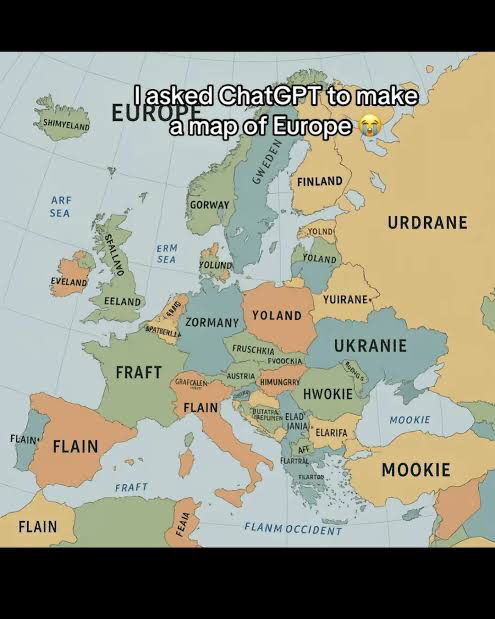
That is the setting we need to move towards and that moment will be now. It started with a simple setting, the map of Europe and the alleged accusation is seen below.

I cannot vouch for the setting, but as you see, in most languages it makes little sense. So when any AI fumbles (and that WILL happen) the ball the damage will be a lot bigger. We hear all these ‘delusional denials’ like ‘We will prepare for that’ and ‘it can’t happen to us’ you merely need to look at the Builder.ai setting and how they used 700 engineers to allegedly ‘fool’ Microsoft who backed it to the extent of a billion dollar plus. So when the ‘bigger’ players also get caught with their pants on their ankles we will have a totally new setting. As such I thought of going back to the roots of technology. Optionally as an educational setting, an optional simulator to inspire the youn to think and become creative for themselves without any AI system fumble their thinking patterns. It might not be the most eloquent setting, but creativity cannot be set in AI, as AI doesn’t exist (yet) and before it is too late, we need to create other outlets for creativity to emerge. I still like the setting that Ubisoft gave us with Assassins Creed Origins. In one of the expansions you are taken to the Tours: Beer & Bread. It shows that Egyptians ‘perfected’ the fermentation process. In my youth (a very long time ago) I went to the Open-air Museum in Arnhem (Netherlands) and this one building still reverberates in my mind over half a century later. It was a paper mill. 

On the outside it doesn’t seem like much, a lot like a really old building, but that is the hidden part. Inside there is a completely operational paper mill and it is fueled by waterpower. Now you might think that this is too old. 

But consider that Nobel invents Dynamite for the simple need of mining, Apparently Viagra had a completely different stage. It takes one mind to think “What if we did this?” and that is the ball game. That is the setting that creates new technologies. We need to get back to the old ways. And I use the paper mill as an example. Consider the Amish (all over America) who have been doing it there way for centuries. Consider how they have no fridges, or non electrical ones. We need to reconsider what we know and what is possible without some idiot telling us how to do it, because these people will come out of the woodworks pretending to voice the deities they pretend to follow (for their personal good). 

Consider that paper mill and what to do when water stops flowing. A wind vane? Giving people the idea to take the next step. And at some point power will become an issue. We see now new ways to tarmac roads making them safer, the Netherlands are exploring illuminating forms of tarmac, making electricity less of a essential need. We see all kinds of innovations and as you think it is all covered, consider that in Australia ‘relied’ on ChatGPT (as one source stated) to phrase the law and it used non-existing cases. So how do you like your chestnuts boiled in that gravy? 

The one option is to revert to earlier settings and consider what is possible without others telling us what to do. A lot will not work, but some will be true innovative steps. And that is the ballgame. As what some call AI is telling us where to go and especially where not to go we lose the creativity we have, or merely fashion it in the way other want it to be fashioned. 

That is not innovation, that is pack mentality. 

So what stages in other fields were short cut, because it never supported the then innovative choosers? We need to protect ourselves and the evidence is all over the historical buildings. The romans had two tiered bathhouses making hot water. So even as we now think that we do better, consider what happens when electricity falls away because 500,000 systems took it away fueling their AI systems taking over 250,000 times more energy than one simple brain does. 

We need to protect what is and what was, before others remove that way of thinking from us and we can go about it in different ways, I ikon that none of them are incorrect. Another example can be seen in the old pyramids. We were given (in YouTube) “Ancient Egyptian “pyramid basalt roads” refer to a network of paved roads, including the world’s oldest known paved road, that connected basalt quarries in the Fayum region to the pyramid fields like Giza. These roads, often paved with sandstone, limestone, and even petrified wood, were used to transport massive basalt blocks, likely for paving the pyramid complexes and temples. One significant road, leading from the Widan el-Faras quarry to the shores of a now-vanished lake, represents a major engineering feat from the Old Kingdom period.” I don’t believe the hype behind it, but these roads and pavements are massive undertakings that even today are unlikely to be this perfect, apart from the settings that they seemingly lacked the tools to create these slabs and make them fit this perfectly. I am not all onboard of this, but like the Game of thrones ‘Wildfire’ we see that this reflects on what was Greek Fire and it came from Byzantine. “With the decline of the Byzantine Empire, their recipe for the production of liquid fire was lost, the last documented use of Byzantine fire was in 1187. After Constantinople fell to the Ottomans, several attempts to imitate the Greek Fire were made, but none replicated the original.” So something created 1000 years ago can no longer be reproduced? I reckon that this is one of the most direct forms of creativity lost. And the fact that it has military applications implies that plenty of governments tried to get it on their side.

As such I think we need to create genuine systems to invoke creativity in the next generation before it is all lost and we all go ‘Duh!’ At the next innovation blaming it on magic and as Vernon Dursley once said “there is no such thing as magic” as I see it, magic is blamed when we no longer comprehend the technology (like the White House and 5G technology, which comes with a small giggle from me).

So the short setting is Protect the next generation now as there is no longer any later.

Have a great day.

Leave a comment

Filed under Gaming, IT, Media, Science, Tourism

By German standards

That is at time the saying, it isn’t always ‘meant’ in a positive sight and it is for you to decide what it is now. The Deutsche Welle gave me yesterday an article that made me pause. It was in part what I have been saying all along. This doesn’t mean it is therefor true, but I feel that the tone of the article matches my settings. The article (at https://www.dw.com/en/german-police-expands-use-of-palantir-surveillance-software/a-73497117) giving us ‘German police expands use of Palantir surveillance software’ doesn’t seem too interesting for anyone but the local population in Germany. But that would be erroneous. You see, if this works in Germany other nations will be eager to step in. I reckon that The Dutch police might be hopping to get involved from the earliest notion. The British and a few others will see the benefit. Yet, what am I referring to?

It sounds that there is more and there is. The article’s byline gives us the goods. The quote is “Police and spy agencies are keen to combat criminality and terrorism with artificial intelligence. But critics say the CIA-funded Palantir surveillance software enables “predictive policing.”” It is the second part that gives the goods. “predictive policing” is the term used here and it supports my thoughts from the very beginning (at least 2 years ago). You see, AI doesn’t exist. What there is (DML and LLM) are tools, really good tools, but it isn’t AI. And it is the setting of ‘predictive’ that takes the cake. You see, at present AI cannot make real jumps, cannot think things through. It is ‘hindered’ by the data it has and that is why at present its track record is not that great. And there are elements all out there, there is the famous Australian case where “Australian lawyer caught using ChatGPT filed court documents referencing ‘non-existent’ cases” there is the simple setting where an actor was claimed to have been in a movie before he was born and the lists goes on. You see, AI is novel, new and players can use AI towards the blame game. With DML the blame goes to the programmer. And as I personally see “predictive policing” is the simple setting that any reference is made when it has already happened. In layman’s terms. Get a bank robber trained in grand theft auto, the AI will not see him as he has never done this. The AI goes looking in the wrong corner of the database and it will not find anything. It is likely he can only get away with this once and the AI in the meantime will accuse any GTA persona that fits the description. 

So why this?
The simple truth is that the Palantir solution will safe resources and that is in play. Police forces all over Europe are stretched thin and they (almost desperately) need this solution. It comes with a hidden setting that all data requires verification. DW also gives us “The hacker association Chaos Computer Club supports the constitutional complaint against Bavaria. Its spokesperson, Constanze Kurz, spoke of a “Palantir dragnet investigation” in which police were linking separately stored data for very different purposes than those originally intended.” I cannot disagree (mainly because I don’t know enough) but it seems correct. This doesn’t mean that it is wrong, but there are issues with verification and with the stage of how the data was acquired. Acquired data doesn’t mean wrong data, but it does leave the user with optional wrong connections to what the data is seeing and what the sight is based on. This requires a little explanation.

Lets take two examples
In example one we have a peoples database and phone records. They can be matched so that we have links.

Here we have a customer database. It is a cumulative phonebook. All the numbers from when Herr Gothenburg got his fixed line connection with the first phone provider until today, as such we have multiple entries for every person, in addition to this is the second setting that their mobiles are also registered. As such the first person moved at some point and he either has two mobiles, or he changed mobile provider. The second person has two entries (seemingly all the same) and person moved to another address and as such he got a new fixed line and he has one mobile. It seems straight forward, but there is a snag (there always is). The snag is that entry errors are made and there is no real verification, this is implied with customer 2, the other option is that this was a woman and she got married, as such she had a name change and that is not shown here. The additional issue is that Müller (miller), is shared by around 700,000 people in Germany. So there is a likelihood that wrongly matched names are found in that database. The larger issue is that these lists are mainly ‘human’ checked and as such they will have errors. Something as simple as a phonebook will have its issues. 

Then we get the second database which is a list of fixed line connections, the place where they are connected and which provider. So we get additional errors introduced for example, customer 2 is seemingly assumed to be a woman who got married and had her name changed. When was that, in addition there is a location change, something that the first database does not support as well as she changed her fixed line to another provider. So we have 5 issues in this small list and this is merely from 8 connected records. Now, DML can be programmed to see through most of this and that is fine. DML is awesome. But consider what some called AI and it is done on unverified (read: error prone) records. It becomes a mess really fast and it will lead to wrong connections and optionally innocent people will suddenly get a request to ‘correct’ what was never correctly interpreted. 

As such we get a darker taint of “predictive policing” and the term that will come to all is “Guilty until proven innocent” a term we never accepted and one that comes with hidden flaws all over the field. Constanze Kurz makes a few additional setting, settings which I can understand, but also hindered with my lack of localised knowledge. In addition we are given “One of these was the attack on the Israeli consulate in Munich in September 2024. The deputy chairman of the Police Union, Alexander Poitz, explained that automated data analysis made it possible to identify certain perpetrators’ movements and provide officers with accurate conclusions about their planned actions.” It is possible and likely that this happens and there are intentional settings that will aide, optionally a lot quicker than not using Palantir. And Palantir can crunch data 24:7 that is the hidden gem in this. I personally fear that unless an accent to verification is made, the danger becomes that this solution becomes a lot less reliable. On the other hand data can be crushed whilst the police force is snoring the darkness away and they get a fresh start with results in their inbox. There is no doubt that this is the gain for the local police force and that is good (to some degree). As long as everyone accepts and realizes that “predictive policing” comes with soft spots and unverifiable problems and I merely am looking at the easiest setting. Add car rental data with errors from handwritings and you have a much larger problem. Add the risk of a stolen or forged drivers license and “predictive policing” becomes the achilles heel that the police wasn’t ready for and with that this solution will give the wrong connections, or worse not give any connection at all. Still, Palantir is likely to be a solution, if it is properly aligned with its strengths and weaknesses. As I personally see it, this is one setting where the SWOT solution applies. Strengths, Weaknesses, Opportunities, and Threats are the settings any Palantir solution needs and as I personally see it, Weakness and Threats require its own scenario in assessing. Politicians are likely to focus on Strength and Opportunity and diminish the danger that these other two elements bring. Even as DW gives us “an appeal for politicians to stop the use of the software in Germany was signed by more than 264,000 people within a week, as of July 30.” Yet if 225,000 of these signatures are ‘career criminals’ Germany is nowhere at present. 

Have a great day. People in Vancouver are starting their Tuesday breakfast and I am now a mere 25 minutes from Wednesday.

Leave a comment

Filed under IT, Law, Media, Politics, Science

Saudization

A term I got introduced to last week. It stands for “the Saudi nationalization scheme and also known as Nitaqat, is a policy that is implemented in the Kingdom of Saudi Arabia by the Ministry of Labor and Social Development, which requires companies and enterprises to fill their workforce with Saudi nationals up to certain levels” I think it is a great idea. I think more countries need to embrace such a scheme for a few reasons. I believe it is essential that skills are moved locally to avoid being at the massive risk of an American need and that is a bad idea on a few levels. Now, this is not an anti-America sentiment, but the media (America too) have left us with the notion that we cannot be certain of almost anything and there is the larger setting that it goes to other countries too. Perhaps there is an Emiratization, an optional Indonesization (these two words might not exist) and several others (Pakistan, Bangladesh) and so on. So why is there not an open video channel with options on both YouTube and TikTok handing these skills? If I merely push this to myself. There is the option to train people (non-Arabic) in IBM Statistics (formerly known as SPSS) I trained people for over a decade and that is a skill that can be taught. Edit the movie with a localised soundtrack and you have a solution to optionally train dozens of people.

If we create a few hundred videos we could optionally train a whole legion of people and as the elder generation (including me) could leave a footprint handing this knowledge out to others we continue training people after we are gone. I also worked in call centers and whilst the world is filled with silliness and chases after AI, the skills that are out there will be lost soon enough. As such we (read: some)  need to create the stages for the next generation. Whilst all are on the AI train we might see a setting of dwindling down sources and in a decade when AI misses its target the world will suddenly see that they lost more than they bargained for. As such a video station that allows Saudization to grow into the people who cannot see what they need and can freely learn to grow their own future is a proper way to harvest talents where they freely grow.

So you might think that this comes for free and that might be the case. Yet the older generations feels that they can contribute to any setting that will listen. As such these skills will require verification so that quality will prevail. Yet is it such a hardship on the older generation? They contribute to all kinds of non profit organisations. Is it so hard to believe that they would assist in creating the future generations? The world is not what big corporations believe it to be, it is what the next generation wants it to be and as such this idea stands a chance. In the setting we see now it might benefit Saudi Arabia. Yet when these movies get a larger setting in Pakistan, Bangladesh, Uruguay and other places, we grow the knowledge in all kinds of directions and as it should be offered free knowledge will emboss all people, not just the ones who can afford it. 

It is just a little idea I am playing with, but I reckon that some governments will embrace what hundreds of people could contribute to their national causes.

Have a great day

Leave a comment

Filed under Politics, Science

The accusers

I saw a message fly past and it took me by surprise. It was CNBC (aka Capitalistically Nothing but Crap) and the accusation was ‘Microsoft and Amazon are hurting cloud competition, UK regulator finds’ (at https://www.cnbc.com/2025/07/31/uk-cma-cloud-ruling-microsoft-amazon.html) with “The regulator is concerned that certain cloud market practices are creating a “lock-in” effect where businesses are trapped into unfavorable contractual agreements.” So, that’s a thing now? The operative word is concerned. So, is this the way former Amazon UK boss, Doug Gurr, on an interim basis is showing the world that he released the chain and necktie from Amazon?

There is ‘some’ clustering and as the setting is advocated by some the score at present is “AWS holds approximately 29-31% market share, while Microsoft Azure has around 22-24%, and Google Cloud holds about 11.5-12%” The only surprising thing here is that Google is remarkably behind Microsoft by a little over 10%. Nothing to be worried about, but still the numbers set this out. The infuriating setting by the the CMA giving us “The CMA recommended a further investigation into Microsoft and Amazon under a strict new U.K. competition law to determine whether they have “strategic market status.” I am not ‘attacking’ the CMA, but as the old credence goes “Innovators create corporations, losers create hindrance for others” I suggest you take that as it goes. 

Yet there is more behind this all. Forbes gave us last week ‘Microsoft Can’t Keep EU Data Safe From US Authorities’ (at https://www.forbes.com/sites/emmawoollacott/2025/07/22/microsoft-cant-keep-eu-data-safe-from-us-authorities/) where we see “Microsoft has admitted that it can’t protect EU data from U.S. snooping. In sworn testimony before a French Senate inquiry into the role of public procurement in promoting digital sovereignty, Anton Carniaux, Microsoft France’s director of public and legal affairs, was asked whether he could guarantee that French citizen data would never be transmitted to U.S. authorities without explicit French authorization. And, he replied, “No, I cannot guarantee it.”” And this is how Microsoft faces a near death sentence by the American administration. So much so that Microsoft seemingly is creating a data centre solely for the EU. Julia Rone gave us last year (late 2024) “It has been well acknowledged that the European Union is falling behind the US and China when it comes to cloud computing because of its lack of technological capabilities. In a recently published article, however, I argue that there is another important and often overlooked reason for EU’s laggard status: the persistent disagreement between different EU member states, which have very different visions of EU cloud policy.” I take that at face value, as I am considering (through mere speculation) that these member states are connected to American stake holders in media trying to hinder the process, but that is another matter.

So as we see ““Microsoft has openly admitted what many have long known: under laws like the Cloud Act, US authorities can compel access to data held by American cloud providers, regardless of where that data physically resides. UK or EU servers make no difference when jurisdiction lies elsewhere, and local subsidiaries or ‘trusted’ partnerships don’t change that reality,” commented Mark Boost, CEO of cloud provider Civo.” It makes me wonder how America is different from the accusations that America threw in the face of Huawei. It is like the pot calling the kettle black. And this also gives wonder where the accusation against Amazon and Microsoft ends, because the cloud field is seemingly loaded with political players. They all see that data is the ultimate currency and America (as it is near broke) needs a lot of it to pay for the lifestyle they can no longer afford. In Europe the one that stands out (at least to me) is a firm I looked at in 2023 and it is growing rapidly. It is Swedish and not connected to any of the three and could become the largest in Europe. Its long-term vision involves operating eight hyper-scale data centers and three software development hubs across Europe by 2028, employing over 3,000 people. By 2030, the company aims to operate 10 hyper-scale data centers and employ over 10,000 people. There is too much focus on 2030, as I see it the American economy collapses on itself no later than 2028 and as I speculatively see it, it will drag Japan down with itself. That setting required a larger acceleration in both Europe and Asia as America will not play nice as per late 2026. At that point too many people will see where showboat America is heading too and the reefs in that area will be phenomenal. So, as I see it, the entire political swarm behind data centers and fictive AI will require a whole new range of management and I reckon that players like Amazon and Microsoft have never been dealt these cards before, so I shudder to think what will happen when it faces accusations from the EU, the CMA and others. This aligns with the accusation (from one source) giving us “An antitrust complaint filed by Google to the European Commission in September 2024, alleging that Microsoft’s licensing terms unfairly favor its own Azure cloud platform, making it difficult and expensive to use Microsoft software like Windows Server and Office on competing clouds.” I wonder, didn’t Microsoft played a similar game with gaming?

So whilst the infighting is going on on a continued setting, I wonder where Oracle will end up being? As I see it this is rather nice, but I am accusing myself at this point that we aren’t face with a tidal wave, but merely with 5 cups of tea all stating there is a storm happening and whilst the teacups are talking to each other and showing how bad the storm is, the reality is that it is not smooth sailing, but seemingly as close to it as possible. For that you need to see where Evroc is standing, where it is going and how fast it is achieving this. The second market is Oracle, how it is progressing and who it is partnered with (pretty much everyone) and these two elements show us that there are governmental captains stating that their pond is in a dreadful state (whilst presenting their cup of tea as a much larger pool then it is) the corporate captain stating there is a storm brewing, but absent of evidence and the media is flaming every storm it can so that they can get their digital dollars. But consider that Oracle is presenting good weathers and there are alternatives whilst the media actively avoid illuminating Evroc, with only TechCrunch giving us in March “Amid calls for sovereign EU tech stack, Evroc raises $55M to build a hyper-scale cloud in Europe” there were a few more and they are all technical places. The western media is largely absent as there are no digital dollars to be made here.

So consider what you see and try to see the larger picture, because there is a lot more, but some players don’t want you to see the whole image, it distorts their profit prediction. So did you see the little hidden snag? Where is Huawei cloud? Whilst this is going on ‘Huawei hosts conference on cloud technology in Egypt’ where we see that “the event drew more than 600 government officials, business leaders, and ecosystem partners from over 10 countries and regions”, as I see it, this is a classic approach to the “While two dogs are fighting for a bone, a third runs away with it” expression. So consider that part too please.

Have a great day.

Leave a comment

Filed under Finance, IT, Politics, Science