Tag Archives: Australia

Tic Toc Ruination

There is always a next deadline, a next target and a next threshold. When we see that point, some see obstacles, some see challenges and others await opportunities. It has always been this way. In the past we had 3G, Telstra could not keep up and gave us 3.5G and called it something else. The audience was deceived and has been deceived for a while in many ways. In Australia, as I personally see it, too many politicians dance to the needs of Telstra and as such, in the long run nothing was done. As 4G matured on a global level we saw the eCommerce run and we saw growth everywhere. And as the 5G moment grew near too many were sitting on the sidelines, all talk and no hard work. Huawei, Ericsson and a few more worked hard because he fin-tech term ‘be there first‘ applied a hundred times more to mobile technologies and we saw the escalation as China went ahead of the curve. Suddenly Huawei 5G technology got banned, a bankrupt America started and soon most nations followed, now, or at least 5 hours ago, the Guardian (at https://www.theguardian.com/technology/2018/dec/05/bt-removing-huawei-equipment-from-parts-of-4g-network) reported one additional move ‘BT removing Huawei equipment from parts of 4G network‘, we see “In a statement, the UK telecoms group has confirmed it is in the process of removing Huawei equipment from the key parts of its 3G and 4G networks to meet an existing internal policy not to have the Chinese firm at the centre of its infrastructure“, all at the behest of spymaster incredibili Alex Younger. Yet actual evidence of Chinese activities was never given in evidence. Alex does something else and in retrospect to his French, American and Canadian peers something that is actually intelligent. He gives us: “the UK needed to decide if it was “comfortable” with Chinese ownership of the technology being used.” OK, in opposition of American stupidity making claims they cannot support, Alex is giving us the national need and the premise that another government should not have ownership of infrastructure this important. I can accept that, yet in that same light, that equipment should not be American or Russian either. He also gives us: “We have to keep adapting … we are evolving again to meet the threats of the hybrid age … our task now is to master the covert action of the data age“, and he is correct. It does not state that Huawei is a danger, a risk or actively undermining the UK. I get the setting of national security first and in this Huawei might optionally in the future be that risk, it is not the same setting the yanks gave us.

Yet there is the opposition as well. At present not only is Huawei ahead by a fair bit, Engineering and Technology (at https://eandt.theiet.org/content/articles/2018/12/china-continues-to-dominate-worldwide-patent-applications/) give us: ‘China continues to dominate worldwide patent applications‘, it is a lot larger than Huawei, yet the stage we need to comprehend is “China submitted 1.38 million of the total 3.17 million patent applications submitted“, and a chunk of that 43.5% is mobile and 5G technology. China is ahead in the race and as some people start living in denial, the stage we will see in 2020 is not that America will start its 5G part, there will be a moment when China lodges IP cases that oppose patents, and the optional proven stage of patent violations. At that point the nations moving in silly ways will learn the hard way that whatever they tried to overcome will cost them 200%-550% more that they thought it would. The entire patent system will be upside down as technology makers will be found to be technology breakers and that is one side why the US is so opposed to certain levels of protectionism (apart from their pharmaceutical patents). To give you a perspective, China applied for more patents than the US, Japan, South Korea and the European Patent Office combined, the difference is that big, there is a second benefit to a worldwide growth in IP filings and some technology offices will soon encounter the receiving side of a desist to move forward lawsuit. The Apple Samsung war in patents has shown that impact for years and when any firm is stopped in their tracks, for any 5G violation, you can flush that 5G implementation timeline down the toilet.

ZDNet gives us: “Sprint announced that it is now the fastest mobile carrier across New York City, providing customers with access to its gigabit-speed LTE services after upgrading its network in preparation for 5G services going live next year“, which sounds nice, yet when we see: “launching a 5G mobile service there in the first half of 2019“, the way the dates were given last week personally implies to me that any setback gives reason that there will be no 5G before Q3 2019. Now, I might be wrong here, yet in the past we have seen again and again that these timelines were never met and the pressure is really on this time around, making setbacks and delays even more likely. So a we see New York, Los Angeles, Las Vegas, Washington DC, San Francisco, Seattle, Chicago, Atlanta, Philadelphia, Detroit, Miami, Indianapolis, and Phoenix moving into the 5G realm, we now see the absence of an earlier mentioned Boston, Sacramento, Dallas, Houston, So as we see San Francisco, I see no Mountain view, no Palo Alto and no San Jose (consider https://www.youtube.com/watch?v=CnzTgUc5ycc, just a little Helix for the fans). So will San Francisco get 5G, or will Google and Facebook infested Mountain View get the5G? The problem is not whether it comes now or later, the fact remains that implementation and deployment had to be done and be past the 100% deployment preparations 6 months ago and the players left it to the final moment, whilst some of the infrastructure should have been available a long while ago.

The setting is not merely 5G, it is the availability that is connected to all this that follows. Part of this situation is given weight to issues when we consider Telecom Lead giving us (at https://www.telecomlead.com/5g/192-operators-start-5g-network-investment-gsa-87745). The quote: “192 mobile operators in 81 countries are investing in 5G network as compared with 154 operators in 66 countries in July 2018, according to the latest GSA report released in November 2018” shows us that 15 countries are already late to the start and it involves 38 operators. Now, that might be valid as some are not in the size to be the initial adopters, yet it is merely the top of the iceberg. This Titanic is showing a leak when we get to “GSA also said 80 telecom operators in 46 countries have announced their plan to launch 5G to their customers between 2018 and 2022. 37 networks will launch 5G services in 2020 alone“. If this is the stage knowing that you are in one of the 37 countries. The 9 countries that are optionally launching between 2018 and 2020 might have a local advantage, yet which of these 9 are starting fist, or get to start between 2021 and 2022 is equally an issue to explore. We see: “Telstra, TeliaSonera Finland, Ooredoo Kuwait and Qatar, Zain Kuwait, and STC Saudi Arabia have done 5G deployments using commercial 5G base stations but are waiting for devices to enable service introduction“, here we see Australia to be ahead of the curve, yet waiting for devices implies that it goes beyond the mobile phones, I reckon that there is something else missing, yet what it is and when it comes is not given. The article also gives us the entire 5G trap and the Verizon steps that are in question. It is the reason why I mentioned Telstra 3.5G in the first place. We are given “Verizon’s network is not yet 3GPP compliant. It uses Verizon’s own 5G specification, but will be upgraded to be 3GPP compliant in the future“, so does that mean that it is merely a Verizon issue opening the market for Sprint, or are they both involved in that same pool of marketed pool to some form of ‘5G’ branding, and not the standard?

If that is truly the case, if this is truly verified, will the day that the 5G switch is turned on in the US, Japan and Saudi Arabia show that Saudi Arabia and Japan gives the people true 5G and America does not, does that make them the loser in the 5G race on day one? The question now becomes is Sprint 3GPP compliant, and more important what is the failing of 3GPP compliant bringing to the table?

When I look at the data opportunities that 5G brings, the opportunities that blockchain technology can revolutionise (especially in America) in retail with 5G are unheard of. There is a true growth of investment options available, yet are these opportunities seen as such?

So where is the ruination?

You see, this is the first time in history where high-tech is running ahead in China. In the past, America had the radio, they had the TV, they had video, DVD, Japan brought the Blu-Ray, and the US had 4G first; yet it all falters when we realise that this time around China is not merely on par, they are optionally ahead in the next technology wave, we have never seen this advantage from China before, and at the speed at how they caught up in the past, is worrying many nations as they are now ahead and optionally they can create more headway as they start giving the US less and less advantages, optionally resulting in greater economic advantages for China as America ends up having to catch up now, an advantage of being first which is now optionally no longer with the US.

The question becomes, will the consumers have to pay for that lack of headway? Even as we push for the comparison in the past app stage of 4G, we see that the IP war can become a much larger headache when you are not China, it might be good, it will most likely be bad and in the end we might benefit yet the reality is that massive amount of money will start going to the far east (China) and it will impact all manners of ecommerce soon enough. Yet will that happen? We might know tomorrow as the techboys (and one techgirl), AKA Sundar Pichai, Satya Nadella, Ginni Rometty, Safra Katz and Steve Mollenkopf meet with White House officials later today. So as Google, IBM, Microsoft, Oracle and Qualcomm decide on what happens (or needs to happen) in the next 24 hours, I wonder what concessions they will get from the White House as long as they all finish second to none and give America the 5G pole position result. Ego comes at a price and I reckon that we get to know the cost of White House ego tripping before the end of the year.

In all this, I wonder, can I make matters worse when I ‘give’ 2 billion in IP value to Huawei? When we are pushed, should we not push back? When the others face too late the element of delay by not adhering to logic, and by ignoring common sense, should I give them consideration? That is actually a main point here, as technology becomes the main political pawn, how should we react? We can agree with Alex Younger that any nation needs to negate technological risk, we could consider that he seemingly had the only valid opposition against Huawei, as it was not directed at Huawei, but at the fact that the tech is not British, the others did not work that path, and as we see that technology is cornered by the big 7, those in the White House with an absent person from both Apple and Huawei. We have accepted the changed stage of technology and that might not have been a good thing (especially in light of all the cyber-crimes out there), also a larger diverse supplier group might have addressed other weak spot via their own internal policies, another path optionally not averted. So as we focus on national needs (which is always a valid path), should I hand that 2 billion dollar patent to Australia, who is too often in the pocket of Telstra (as I personally see it), or put it on the market for any to buy it, when that happens, do I create opportunity or limitations?

That is a question that most of us did not consider as the tech market had been global for the longest of times, yet as 5G comes into play, that might soon change and with that we will get new answers, new challenges and a lot more diversity (whilst having to entertain a whole range of new limitations as well). In my view there is an unseen balance between ruination and opportunity, yet this is where time is not a factor, it will be about the connectivity that one offers another and that is when we see that time influences it, but it is not the larger factor of influence. It is a market where diversity becomes an enabler against time (partially in opposition of time). I stated this before. As 4G gave us the golden path towards ‘wherever we are‘, 5G will be largely about ‘whenever we want it‘. It affects ‘on demand’, it enables ‘I need it now’ and it gives rise to security, automation and non-repudiation to a much larger extent. We have clearly seen that Huawei and China are in pole position of that race, and we must wonder who of the other players can catch up in time offering the full 5G with all elements validly in place (not using Verizon’s own 5G specification, or a version thereof).

I look forward to 2019 as I have already found 2 optional gaps; I wonder how many more I will find.
 

4 Comments

Filed under Finance, IT, Politics, Science

The economic insanity

We all have our limits, we all have parts we look at it and it just does not make sense. I am no different in that regard. I cannot fathom how a business survives at times. We all get that. I grew up having to walk to the grocer, the butcher and the general goods store when I was young. I got beef from one, I got cabbage from the other, we even had a potato vendor on a street called Vierambachtstraat (Rotterdam); this potato man had half a dozen of different kind of potatoes, sweet, non-sweet, large and small. We would pick up a bag 3-4 KG and it would be more than enough for a week (household of 5). At some point he left us, he stopped, the grocer remained for a while, yet I was still around when he left and it was replaced for a record store. The general goods store had already left. You see, a Supermarket called Albert Heijn had taken over and the other stores could no longer remain there. The butcher remained, yet over time he too would fall away it is now a furniture store I believe. My house is still there, yet none of the shops remained, over time they were replaced by other shops, a mere sign of the times.

So when I was confronted with ‘Interserve shares fall as growing debt sparks fears over its finances‘, I initially merely glanced. An outsourcer called Interserve; it seems to be something trivial. That is, until you realise the part “The Company, which carries out building work and provides services such as cleaning, said debts would be between £625m and £650m by the end of the year, having earlier said debts would be £575m to £600m“. So even if we would trivialise all this, in which universe would a company have any chance to survive with an initial debts of ‘£575m to £600m‘? The fact that it will be fifty million pounds more should be the fuel to the fire. A company will be in debt for well over half a billion pounds and people are worried? Why on earth were the members of that board of directors and their children (and grandchildren) not sold into white slavery on a market in Marrakech? You see, I get it, any company will have downturns and we should allow for repairs on that, yet when a company is the pressure on the existence of small companies, whilst it act as a behemoth with a workforce of an estimated 75,000 people worldwide, we need to up the ante. These people are pushing the envelope hoping that they would be like any bank ‘too big to fail‘ leaving it up to politics and wheeling and dealing to get them out of the hot waters, to save and saviour their hot potatoes some might say.

Even as we see: “It comes a week after Interserve was forced to comment on the state of its finances, after shares tumbled to a 30-year low over fears it was heading the same way as Carillion, the rival outsourcing firm that collapsed in January“, was that not a wakeup call to set the stage to push for oversight much faster?

We are also introduced by Russ Mould, investment director at AJ Bell to: “Chief executive Debbie White and her team are clearly doing their best to steady the ship at Interserve but the admission that net debt will end the year higher than expected, not helped by how the cash inflow from the troubled energy-from-waste business will be lower than hoped, means the company has yet to reassure shareholders and potential investors about the key issues that face it.” I am not sure how we should see this, in view of: ‘how the cash inflow from the troubled energy-from-waste business will be lower than hoped‘. When should we accept ‘lower than hoped‘? That implies speculative investment with funds that they never had and playing the gamble card in corporate expectations. So when these debts hit full on, who gets to pay for that, the taxpayer? It is my personal believe that until the debt is gone, none of the board of directors should be allowed any income above £100,000 with in addition all bonuses scrapped until the company goes out of the red. In addition, there should be no weight to the claim: “Interserve, which provides a range of services for schools, hospitals and government departments across the UK, agreed a £300m rescue plan in March, at a time of heightened pressure on the outsourcing sector and in the wake of Carillion’s collapse under a mountain of debt.” From my personal point of view, they took jobs and under-priced them forcing the small fish out of the water of revenue, and then they use that shortfall to push taxation to zero whilst walking that path too often in too many divisions. That is how I personally see this and I might be wrong. Yet in all this, that is seemingly the path too many large players play it, undermining services for the longer time whilst the others have no option to get into the business. The government might like the short sold services as it looks good on their costing spreadsheet, yet when group of 75,000 people end up to the larger extent being unemployed, the damage will merely increase for all the parties involved. Russ Mould also gives us: “some investors would wonder why Interserve was waiting until 2019 to unveil a new plan designed to reduce debt, whilst the share price slide suggests the company’s situation remains acute“. In light of that we see the urgent need for players like that to suffer a lot more oversight, the withdrawal of all bonuses and capping of income. In a state where we see an escalating stage of danger to staff members on almost every level (I did say almost), we see (at https://www.interserve.com/docs/default-source/investors/financial-reports/integrated-reporting/2017/2017-full-year-pdf’s/governance-report.pdf) the mention of something I will address shortly, whilst we see (at https://www.constructionnews.co.uk/companies/contractors/interserve/interserve-ceo-set-for-125-bonus-for-2017/10030955.article). Can anyone explain to me how well over half a billion shortfall gives rise to: ‘Interserve CEO set for 125% bonus for 2017‘, you might think that this was merely last year, yet consider that one company has a shortfall of well over half a billion in one year. That does not happen, this has been going on for a much longer time and whilst we accept that any company gets to have a hard time, it seems utterly unacceptable that its board of failures in managing that get to go home with £525,897 (the bonus of Chief executive Debbie White) for 4 months of work and if things go really south, to sit at home on the sofa optionally watching Netflix and porn for 5 years whilst the market ‘restores’ itself. It gets to be even less tasteful when we also see: “This includes an annual variable pay (AVP) bonus of £270,089, which is 125 per cent of her pro-rata base salary of £216,667 since she joined in September 2017 – the maximum available under the AVP scheme” are you feeling betrayed yet? She should be regarded as HMRC positive and kept in isolation, removed from income until the company is again in the non-red numbers zone.

Was that over the top?

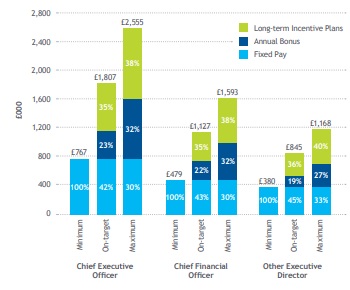
When we consider the first report which is 62 pages, we see that plenty of space was used to give rise to bonuses where three people get to go home (in a best case scenario) with £2.555, £1.593 and £1.168 million. In a setting where we see that a company minus zero setting, towards the one billion mark in the red, how is there even a case for a best case scenario? How is it that we see all kinds of share and cash deals whilst there is a real issue with this type of company? Should we not see a whole range of other questions holding the HMRC responsible for allowing this situation in the first place? Whilst the cheapest of the three (other executive director), optionally being a figure of speech for a lot more than one person the issue merely intensifies. Their minimum pay is £380K, which is close to 1,800% of the average annual UK income; giving rise that one year would enable a person to afford a person to go on a holiday for close to 10 years. I never had that option, not in two decades of loyal service, interesting how some people are just not held accountable for bad turns is it?

So whilst these high and mighty desk jockeys get to relax over Christmas, considering on how to tackle it all in 2019, as per ‘Interserve to roll-out £650m debt reduction plan‘, they will leave staff in pressure and under threat of being laid off. It gets to be even worse when they ‘hide’ behind “This deepened due to additional cash outflows on Energy from Waste as well slow payments in certain Middle Eastern markets“. If they have been there they know what the cycles of payments are. They know on what is to be expected. So if there is plenty coming in, there should not be an issue. When jobs fall through, it is known as well, so even as there is a slack from the energy from waste, it seems that merely lose statements are given and they might not hold water under accountancy scrutiny here.

As for the books

There we see that PwC are to be the financial advisors, some sources give rise to other parts. The independent report (at https://www.interserve.com/docs/default-source/investors/financial-reports/integrated-reporting/2017/2017-full-year-pdf’s/financial-reports.pdf) talks about ‘we’, but who is ‘we’? The report is 100 pages and it was set for the December 2017 point, yet there too we see a few things. If we are to accept certain previous statements, we see “We performed targeted procedures over component entities in Guernsey, Oman, Qatar, the United Arab Emirates, Saudi Arabia, Australia, Hong Kong, the Philippines and the United States of America. We performed analytical procedures over component entities in all other geographical locations“, so when we see the larger picture, how does the ‘Middle East’ reference hold water? This would imply they’re UAE, Qatar, Oman and Saudi Arabia customers. There are still plenty of other locations, even if it is largely weighted to those 4, the mention “as well slow payments in certain Middle Eastern markets” seems less valid. The shortfall of well over half a billion does not hold up, because if it was all due to investment, there would not be a shortfall to report, those debts are different. That is where the report on page 114 seems to give a little light. We see: “A further update was given to the market on 21 March 2018, indicating that short-term facilities had been extended for a further month to 30 April 2018. The Group announced that it had concluded refinancing negotiations and had arranged access to committed borrowing facilities of £834 million on 27 April 2018.“, on the other side of that page, we see: “assessing the appropriateness of sensitivities applied to the Adjusted Cash Flow Forecast to evaluate whether liquidity headroom and covenant compliance had been subjected to appropriate stress tests;” when they come up short by another £50 million, one might argue that either the stress test was wrong, or elements were unknown or merely ignored. I cannot tell what, why, who or which, yet it does not seem to add up.

So as that page ends with: “As a result of our work, we concluded that there were no matters in relation to going concern to which the ISAs (UK) require us to report to you“, I will offer that the news is giving us a £50 million reason proving that statement to be wrong (or at least partially). There is also increasing consideration that the auditing firms needs additional scrutiny, as jobs are handed over from one firm to another, there is the option that it speculatively gives rise to nepotism, as well as the danger that they all play the same game in what should not be required to be reported. The last is also highly speculative, yet the shortfall over 50 million as well as the debt surpassing half a billion proves me at least partially correct.

The question is how to move forward. There is a point of view that gives rise to a lot more than merely changing the laws towards outsourcing. There should be a long term accountability system in place, as it might all seem to be nice and correct on the balance sheet, the mere worry is that there is a long term impact. Should we see additional pressures where Interserve goes the way of Carillion, there might be a pressing point to start considering making that change. In an age of global accountancy where the costs are stored local, whilst indirectly the booked profits are staged to go to the land of the shareholder (wherever that is) we see an imbalance of accountancy that is seemingly all fine, yet makes no logical sense altogether. That might be one of the biggest settings that governments are facing in Europe and on a global stage.

Perhaps I will take tomorrow to give you a clear picture on what I mentioned here in examples. At that point I will be bringing graphics to the table as well.


Leave a comment

Filed under Finance, Media, Politics

When they are merely numbers

What if lives are not set in souls, but in numbers, simple numbers? That is the setting we see ourselves in today. A special shout out to Karl Stefanovic who rightfully backed the police and launched a scathing attack on their “timid” critics. Although I would rephrase from ‘timid critics‘ and merely categorise them as ‘fear mongering scaredy cats with a lack of knowledge‘, yet that would be merely my personal choice in the freedom of classification.

Karl is correct in a few ways, yet to see that. We need to look at the other side. My training comes from NATO and I mastered several weapons, to give you a specific setting here, which with the Remington Model 700 is really simple. The drift on 300 meters is optionally no more than 1.1936″ in a nominal setting, so if I aim for the head the brain is gone, if I aim for the chest the damage is worse as that person will not be instantly dead, but they will feel the pinch of a .308 slug and at that point, most Kevlar is useless. You see at 300 Yds the bullet impacts with 1950 lbs on roughly a square inch, in an oversimplified example a 1000 Kg hammer hits a square inch of your chest at a speed of 671 metres per second, good luck getting past that feeling! The Kevlar might slow it down but the impact will be enough to turn ribs to shrapnel and cleave its way through your chest, if the bullet gets through, it will still be mostly slim and nail shaped, leaving the recipient with plenty of optionally fatal damage. A Kevlar vest (if the person has one) might stop a pistol 9mm, even a .357, but with a .308 or .338 rifle, nope, that person becomes a write off. This is how a soldier thinks, it is them/him or me/us, we do not want to die for our country we merely make the other one die for their country/cause.

The police is a different slice of cake. They are trying to protect people from harm of self and/or protect them from harm by others. The police are there as protection for civilians, innocent or not. They have a duty to arrest and Karl is right in backing the police. The News from News.com.au is giving us “They do it sometimes with the public hating them. But they’re the first you call when you need them and they were the first to respond. I salute them this morning“, he is correct! The news also gives us: “The call comes in response to a deadly attack in Melbourne’s Bourke Street on Friday by Hassan Khalif Shire Ali — a Muslim refugee from Somalia. Ali crashed his car full of gas cylinders before stabbing three people, killing prominent Italian restaurateur Sisto Malaspina“, and at this point, the question from me is ‘At what stage was the police to assume that this was a terrorist?‘ You see ‘his car full of gas cylinders‘ was after the fact, yet when did the police know exactly what was going on? The police had a direct need to incapacitate to a degree, not to kill. It is that plain and simple! Their job is to evangelise and support the law, not enforce it through violence, even as that will be essential at that point. So the call ‘Shoot him, shoot him’ might come from outsiders, yet to shoot is not an easy task for them. Let’s not forget that the public has been willing to lynch a policeman using his firearm in the past, so the police is utterly willing to leave shooting as a final resort (and so for the most they should), or until there is a clear and present danger to others and even then it will be shoot to incapacitate, which with a Glock is a little harder then you think.

When we see Nine News (at https://www.9news.com.au/2018/11/11/19/18/bourke-street-terror-attack-family-say-hassan-khalif-shire-ali-was-mentally-ill), we see: “The family of the man responsible for Friday’s attack on Bourke Street insist he was not a terrorist but a mentally ill man “crying for help”“. This is optionally true and it also gives rise to the police and the caution used. They might have noticed symptoms that clearly called for caution and refrain from lethal force. Let’s not forget that the entire Martin Place event was a clear case of mental illness, so there is a precedent in all this. It merely makes the entire event sadder on more than one level. It will undoubtedly give false feelings of guilt to the police officer who discharged the lethal shot, it will give feelings of guilt to all the police and carers on the sidelines, and they should not feel guilt in any way. This man, no matter how we slice it has taken three lives, it comes with consequences.

We might even overreact when we see: “Islamic State claimed the attack but today Home Affairs Minister Peter Dutton said there was no confirmed link to the terror group.” Yet the truth is that until people like ASIO give clear evidence that this was the case, we are merely getting an emotional push from a terrorist organisation seeking the limelight in any way they can, it will merely complicate matters in the short term and leave us with a bitter feeling in the long run. Yet we also see that Nine News is optionally wrong. As we see: “The terrorist has been named as 30-year-old Somali-born Hassan Khalif Shire Ali“, this is optionally wrong if any clear evidence of mental health is shown to be true. There is a call in the News.com.au article (at https://www.news.com.au/news/national/security-expert-says-were-feeding-the-beasts-of-terror-with-shoottokill-policy/news-story/59f2162b3427c2e2f5d0a3e6fe1babd1) with ‘Australia is “feeding the beasts” of terror and failing to prevent future attacks‘, in this Dr Allan Orr could be correct. there is no issue labeling the right person a lone wolf, or a terrorist, yet how was it done, what was planned and what was set in an emotional stage. It is order versus chaos. In addition is the man merely a terrorist because he is Muslim? Is he not merely a murderer at this point? These what I would call intentional misclassifications are also a larger problem, the media loves it to use the terrorist tag in all the wrong places and even as it is too soon to clearly determine this, we see that a police officer was used deadly force against an alleged murderer, alleged because intent needs to be shown in court, were these three people intended victims, or where they there and the man would be clearly guilty of manslaughter. In any case the police officer would be absolved of any guilt, especially if he/she had tried to resolve the issue in a non-lethal way.

There will be a political debate that is already raging on, yet the stage is larger than merely “I’ve been very open about the cancellation of visas, the numbers have ramped up, because there are some people who should not go on to become Australian citizens,” the setting of this might not be incorrect, yet when we know that ‘Permanent residency may be revoked at the discretion of the responsible Minister, for example in cases of criminal misconduct‘, if that is correct, then why would there be a political debate? It would be merely enforcing what is stated in policy, is it not?

It gets to be even more complicated when we see: “Ali was known to federal police and had his passport cancelled in 2015 amid fears the Somali-born man would travel to Syria“, the question becomes who was he going to support? Assad, Assad opposition, perhaps the direction does not matter, yet the direction does incline towards extremism, as such it cannot be ignored. It is an issue as we see that there are more sides to all this. The fact that no action was taken (apart from removing the passport) might have sufficed to some degree, his active interest to go to Syria was never explained (needed or not), if there would have been an assessment, even a mere interview and conversation on the consequence of doing that as a non-citizen might have optionally resolved the issue to some degree (highly speculative on my side). Even a limited monitoring on media and activities might have dampened the danger (or not). If these are all acts of a mental health issue, then the entire terrorist issue falls in the water and other activities might not have helped, but the knowledge of where this person was might have optionally aided the police in a few ways, and is that not important too? To give the members of the police every inch that they can use to resolve without being force to employ deadly force? It might not have been an option here, but the lack of indicators (as presently known) seems a little too staggering at present giving us the handle that not only was Karl Stefanovic correct, the officers subjected to this ordeal might be due a commendation or two (or three).

The last part is also the biggest issue. when we see both “Prime Minister Scott Morrison said he backs religious freedoms but has also called on Islamic leaders to call out the attack“, and “Those remarks that have in turn been labelled divisive by Muslim groups who say their community is not to blame for the actions of an individual and fear it could stoke Islamophobia“. It is the partial failure of Prime Minister Scott Morrison that his call, outside if the mental health scope was plain wrong. He can make that assessment after we know enough that mental health was not the stage here, and that part is still largely in question. You see, to require any religious group to lash out at mental health issues is the larger wrong and that is not seen here. Should I be wrong and the mental health part fails, then we have another issue, yet at present there has been no clear evidence to set that and whilst we accept: “Home Affairs Minister Peter Dutton said there was no confirmed link to the terror group“, yet this is very specific, was there any other data making any extremist link likely? I get the impression that this is not the case, giving us a much larger overreaction, just like the Martin Place incident of 2014.

From my point of view, we have become Muslim polarised to a much too large extent. Consider that every religion has its mental health cases. Consider (the Times, Oct 2017) ‘Mental patient murdered neighbour hours after hospital discharged him‘, also we have ‘How 18 psychiatric patients freed by one NHS Trust ALL went on to kill‘ (Daily Mail, Jan 2018), 19 people said to have killed someone, but not terrorists as they were allegedly not Muslim. Two filters of classification in a group of people that would have been a dangerous stage in any foundation, so we need to be extra careful who gets the ‘terrorist label’ as the impact is a lot larger and the negation that actual terrorists are could also endanger a lot more lives in the future.

The victims and perpetrators might merely be numbers, yet when the numbers are wrongly stacked, the people who are forced to act might wrongly do so making matters worse for everyone around and that needs to be clearly stated, as well as the fact that Karl Stefanovic made the right call in this case and that should be recognised on a national level as well.


Leave a comment

Filed under Law, Media, Military, Politics, Religion

The stagnant life

What do you do when your life stagnates? What do you do when the next step is a smaller iteration of the previous one and the one that is coming is even less than that? Have you considered this part? It all started in the Guardian, which was soon transplanted to the Verge. Vlad Savov gave the notion with ‘What was good is still good; what was missing is still missing‘, it is about the OnePlus 6T mobile phone. Yet for the same setting it could have been our life, it could have been our career and it could have been our future. It is more of the same, yet for us it is interesting as it is cheaper, and as the Verge gives us: “starts at $549 for a sizable 128GB of storage and 6GB of RAM“, we see that it is affordable. Yet when we look deeper, what do we get?

The good gives us: ‘Strong battery life‘, which is actually important in this day and age. Yet the other side is: ‘Camera remains mediocre, lacks wireless charging, still not fully, waterproof, quiet loudspeaker‘. In this the two I care about is the camera and the quiet loudspeaker. The camera is handy to have and here we see the first part. We get a Rear camera: 16 MP + 20 MP, whilst the front camera is 16MP, which is a lot more than my three year old Huawei P7. In addition a few sources give us: “the OnePlus 6 starts at just £469 for the 64GB / 6GB model, which makes it significantly cheaper than the £869 starting price for the Pixel 3 XL“, is it about the money? For many it is. It is the loudspeaker that inhibits the phone when we see: “the loudspeaker, which sounds very nice on this phone, but is woefully inadequate in terms of volume. Even at max volume, it’s only really useful in a quiet environment“. It is an inhibitor as I have missed calls in the past because I did not hear it ring.

How does a phone set a stagnant life?

You see, the second part is seen when we see the new iPad pro and it has no ‘Home’ button. Is that what we have progressed to, a massive marketing target and the fact that we ‘wow’ the home buttons demise? So as the Guardian gave us: ‘The long-rumoured iPad Pro redesign will be the first significant change to Apple’s iOS-based tablet since the release of the 12.9in iPad Pro in 2015‘, we see the issue. That is the great progress since 2015? No home button? How stagnant are we, and how stagnant has our technology become?

For example, in 2003 I saw the first virtual keyboard. It was projection technology (see image). I saw the impact it could have, to instantly switch between Roman, Cyrillic, Hebrew, Hiragana, Katakana, perhaps even Kanji and Arabic, a true push forward for all notebooks, netbooks, laptops and even tablets. More important was the fact that it took away key logging as intrusion to a much larger extent and in addition to that, a person could start working in a truly international sphere, as well as the fact that pretty much any flat surface would do, so no keyboards to mess with. It was true innovation. So when the first iPad was launched and it had the ‘keyboard’ on screen, it was progress, as it came at the expense of the screen, which was not great, yet much better than we ever had before and now I had direct access to all the Scandinavian characters which was awesome. So in 15 years, we see Apple give us ‘no home button‘, how weird is that? And the virtual keyboard need is more of a reality; the batteries are a lot better than we had them in 2003, 15 years of battery development to work with. The laser would have been a lot better, but Apple has not gone that mile forward as an accessory (even as the smart keyboard for the iPad pro is sweet), you are restricted to ONE keyboard at that point. The union of the smart keyboard and virtual keyboard could have been so much more and in 15 years they never got there?

Is this iterative technology holding us back? Is this a lack of vision, or is it merely the need to exploit the people one keyboard per purchase? If this simple innovation is withheld, how much more are we not getting? I can state that question as the technology has been there for 15 years and I know that there are innovative people out there, brighter than me. So why is Apple trailing that curve and not heading it?

Even as I initially designed what would have been the iTome (or optionally the Google Tome) and we see no plans or patents in any stage where that solution (which could solve many NHS issues) is planned, will we need Huawei to solve it for us and when they do will the USA bitch like a little girl whilst not providing any level of evidence? So whilst we get exposed to another wave of anti-Huawei, in this case by Australian Signals’ Directorate chief Mike Burgess, and when we are given “a potential security threat anywhere in the network would threaten the entire system“, yet no evidence was added to this. So when I see: ‘Fairfax Media and the ABC reported on Tuesday‘, it personally merely reads along the lines of one working the shaft and the other one was it tickling the balls of Telstra (a slightly less diplomatic view on all this). The more irritating part is that we have seen this circus go on for months now and still no evidence was ever given, clear evidence of that risk. More important, the risk by some other players (Apple) was shown as they decreased the battery efficiency of the mobile phone. Apple got a €10 million fine and had an annual revenue of one hundred and twenty seven billion. How flaccid should we consider these governmental player fucks to be (pardon my French here)?

It is even more fun to contemplate when we take Business Insider a mere 3 hours ago (at https://www.businessinsider.com.au/top-spy-explains-huawei-ban-2018-10) and we consider the following: ‘Australia’s super-secretive communications spy agency has explained why Huawei is seen as an infrastructure risk’ (actually the ASD is at Russell Dr, Russell ACT 2600. Source: Google search). So now we get the quote, and it is a good one: “One of Australia’s top spies said the electricity grid, water supplies and other critical infrastructure could not have been adequately protected if China’s Huawei or ZTE were allowed to build the country’s new 5G mobile networks“. This is a realistic setting and it is the job of the ASD to look at this. Yet the same risk would have been there with an American or even a Scandinavian system (Ericsson), even in 5G there would have been all kinds of layers and intrusion is a realistic fact in 4G and it should similarly be so in 5G. That is why you hire the proper experts to set a secure stage. So now we get to: “His warning coincided with a new report from The Australian Strategic Policy Institute, which revealed Australian universities were collaborating with Chinese military scientists at unprecedented levels and failing to mitigate national security risks“, so where is the evidence of that? We see that the Australian Strategic Policy Institute (ASPI) is ‘overly’ advertised as independent. From my personal point of view, as I have seen some networking events. People like Michael Shoebridge and Peter Jennings would have ties with Telstra that are way too strong (merely the impact of networking). So is there a chance that they are driving Telstra opportunities? I have NO evidence of that, and I am not stating that this is happening, yet in that same regard I have seen NO evidence that Huawei is an actual risk, which is what others are stating; is that not the driving part here? Now we need to also consider the second part of Mr Burgess. He was also quoted: “Mr Burgess did not specifically mention Huawei or ZTE, but said it was no longer sufficient to confine “high-risk vendors” to the edges of a telecommunications network“. OK that is fair enough, yet I have an issue with ‘high-risk vendors‘. Not because of the vendor part, but the ‘high-risk’ setting. When exactly is a risk a high risk and is that a systemic situation, or is the lack of knowledge, a knowledge that was not pursued in time, as the foundation of evolution from risk to become ‘high-risks’?

I started to evangelise the need for true non-repudiation 5 years ago, I was confronted with the need 7 years ago and we are nowhere near that today. As the designers and greed chasers were all about facilitating for greed and maximised revenue, we saw the fall of reliability and security on a global level. Windows 10, Sony, Facebook are all events that show this. I see a lack of proper testing; a lack of proper assessing; an insatiable need to quickly patch so that revenue remains up. None of it was done with the need of protecting the consumer, merely to facilitate corporate greed.

So whilst that article ends with: “Fairfax Media is investigating cyber hacking incidents in corporate Australia. Tip off our team confidentially via this secure online system“, we are confronted with two parts, the first is that Fairfax is not the greatest channel to get stuff looked at, whoever does this could be prosecuted as a whistle-blower and more importantly that a lot of these issues would not have existed with proper non-repudiation in the first place. So whilst there is no true evidence that China is the bad individual here and that Huawei is not the great technological evil, we must not remain absent from proper scrutiny and that would have been fine, if there was only true scrutiny brought to the media and that has not been done. When you consider that part you should also give another consideration to: “a potential threat anywhere in the network will be a threat to the whole network“, exactly how badly designed does a network need to be when we see: “a threat to the whole network“?  How have corporations failed us when they have not properly instigated protection layers? And in that trend how flawed is authentication technology at present that this could happen to a governmental debilitating degree?

And it is not just Australia, with the lack of evidence in any direction; the US has been pushing for this in the UK, Australia and Canada. Merely an hour ago TechAU is giving a similar view with ‘still provides no evidence‘. There will be a point when not only will we see the demand for evidence, we will demand harsh consequences who force the people in much higher expenditure impacting their quality of life. When that happens, the tidal wave of complaints will be enough to topple any government.

In our lives we need to take leaps forward, no longer relaying on iterative solutions. If we want true new innovation that is the only path that will make sense and in all that, the old farts in 4G trying to keep their fat income in a 5G environment better get with the program faster. There is enough indication that the people are getting fed up with certain settings and the numbers given merely a day ago: “Telstra had a 7.7 per cent increase in complaints” give rise to a lot more nagging by millions soon enough. Some might think that it no longer makes sense to complain. However there is always the option to switch providers and even as most are equally unworthy of our coins, some do stand out and as some are giving us: “With a three year total loss of 31%, Telstra Corporation Limited would certainly have some dissatisfied shareholders“. For me it is different, I actually do not give a hoot about the shareholders (never did, never will). Telstra can only head this up by advancing now through frog leaped technology, to get ahead of the curve, not to follow it when it is economically terrific. It is a path that is over and done with. Huawei and Google are showing that this path will not work in the long run and the consumer will merely be reflecting this as they have to pay for an outdated solution that merely has one less button and perhaps a jack taken out of the equation. We want to see true progress where we can do what we need to do anything I need to do.

You see in 5G it will not be ‘whenever we want it‘, it will be about ‘where ever we are, whenever we ask‘, it is not the same setting and the telecom providers are just not ready. It is exactly that setting that I saw in the Neom plans of Saudi Arabia where I saw the option of solution being addressed. The new stage where we see change; not one that becomes an option to one person but a change giving availability for all. A mere information stage that might seem to start with the information pylon, it goes beyond that, these things can be seen by buildings, in elevators and on the road, a mere place where we can immediately be updated or request to be updated, on the go and on the fly (literally so) and in all that governments are not ready, they left it to people who maximised on their profits with no intent of investing, a stage now coming to fruition as Google and Huawei leaped forward (OK, Samsung too). The rest is merely staging progress through marketing like ‘the most powerful console in the world‘ whilst one game (Red Dead Redemption II) requires close to 12% of the entire console storage, merely one game! That is merely one facet of the short-sightedness that we face today and 5G will bring these issues to the surface on a much larger scale. Not on the phone, but on the total infrastructure and it gets to be worse. You see, in 5G your mobile phone is not your phone anymore. It will be your personal data server whether you like it or not. So when we see ‘high-risk vendors‘, we forgot one element. That is the element we call ‘high-risk governments‘, the players behind the players who left other to do the preparations and now that they are learning the hard way (as I personally see it) that they are not ready, we see all these delays and other 11th hour grasps regarding the definition ‘high-risk‘. So as we contemplate the excuse “a threat to the whole network“, whilst we see nothing in the air of how such threats are even possible to exist. Whilst we were shown the Sony intrusion, the Facebook screw-up (Cambridge Analytica), we see nothing in the air of ‘we are prepared‘? We saw that excuse that people were prepared often enough for many years and when we look back we see articles (Financial Times) where the discussion was already on in 2012, six years ago and in all that time the danger of “a threat to the whole network” and ‘high-risk‘ did not make the headlines in all this? Is that not weird too? I personally see it as a clear example of facilitation towards greed instead of enabling safety to a much larger degree, security and reliability on a network that should have the non-repudiation ability that 4G never had, that was the foundation of the NHS solution, a safer setting, not a faster setting (which was actually a nice bonus). This is the first part in showing the players as those who propagate a stagnant life through iteration.

This has become a stage where the next generation is worse of then the two generations before us. On the upside, no, there is no upside to any of that, it is merely the recognition of facilitation of greed driven people and have we not facilitated to them enough?


Leave a comment

Filed under Finance, IT, Media, Military, Politics, Science

Clueless to the end

That is quite the statement is it not? The question that follows is is the writer clueless (aka me) or the presenter of certain statements (aka Peter Dutton, current Home Affairs Minister). I will leave that to you as I am merely presenting the facts as I see them.

It all started on a simple Wednesday (2 days ago) when I was confronted with the statement ‘Coalition calls on Google and Facebook to get on side with encryption bill‘, just another political yada yada moment and I was about to ignore it and more to the next page when I noticed ‘the internet giants have a responsibility to help combat organised crime‘, which woke me up nice and widely. So the article (at https://www.theguardian.com/technology/2018/oct/10/coalition-calls-on-google-and-facebook-to-get-on-side-with-encryption-bill) gives us: “Australia’s law enforcement agencies have been prevented from infiltrating paedophile networks and other organised crime groups because the messages they send over encrypted electronic messaging services, such as Wickr and Whatsapp, cannot be intercepted by authorities“, in light of Australia being America’s minion in the anti-Huawei activities is admitting that mere app decryption is beyond their ability? And they have the loudly shouted notion that Huawei is a 5G risk whilst ‘basic’ skills are not in their arsenal? Apart from making a case that Huawei is now basically a political fuelled exploitation game and a setting of bias (and optionally nepotism), we are interested in learning that certain skills are beyond Australian Intelligence. I am certain that Paul Symon, Mike Burgess and Duncan Lewis would have been delighted to learn of this revelation via the Guardian, but that was merely comical relief anecdote, let’s get down to the brass of it all.

We get to see the first part in “He said a new report from the Australian Institute of Criminology, released on Wednesday, estimated the cost of serious and organised crime in Australia in 2016–17 was between $23.8bn and $47.4bn, and showed how sophisticated internet-based crimes can be“. So as we take a look at that report (attached), we take a first look at the end (just like any detective story, starting at the end we see the revelations we needed to see if the story adds up). So there we see: “This paper sought to estimate the cost of serious and organised crime in Australia for the 2016–17 financial year. It was not possible to undertake new empirical research to provide more accurate baseline data to support the estimated costs, so in most cases uprating using the RBA (2018) inflation calculator was used in conjunction with the most recent reported crime statistics to assess the prevalence of the various crime types examined“, which gives us another part. The first is on page 3 where we clearly see (in bold) ‘$31.5 BILLION for the cost of serious and organised criminal activity as well as the serious and organised component of conventional crimes‘, so now we see in opposition an amount against ‘between $23.8bn and $47.4bn‘, which I admit remains a truth, yet when we do the math, we see $15.9B for prevention and $31.5B for the so called organised and serious criminal activity, which gets us to $47.4B. At this point we could surmise that Peter Dutton passed his basic math test, was it not that the same page 3 (just like in the Sun, for the longest of times) gives us an additional $8.6 on organised Fraud (debatable), and $6.5B, $9.6B, $4.1B and others adding up to almost $2.7B, so in total we have the $31.7B, yet here is the problem, the individuals cannot clearly represent 100% of organised crime. We are now getting to the miscategorised and the miss set properties of certain players, which also deflates the issue. It becomes a larger setting when we consider the ABC, who reported in May 2017: “the Australian Cybercrime Online Reporting Network, and the reported losses from online scams across the nation come in at around $300 million“. So here we get the second part. We see ‘online scams‘ and I am willing to accept that, yet against ‘PURE CYBER CRIME‘ the question becomes what is what and where are the definitions and this gets us to page 18 where we see: “It extends the conventional understanding of organised crime groups by adding all serious crime of an entrepreneurial nature or committed to support a criminal enterprise, whether by a group or an individual“, now the entire setting changes. It optionally includes all the entrepreneurial naughty people in places like Wall Street does it not? Good luck getting anything done at that point!

Then we get to the illicit drug activity. Now, I am not debating the number overall. I do not have the data to do so, yet consider the part on page 10 where the three costs are included namely Medical costs, Lost Output and Expenditure on drugs. The items are fine, it is how you set your filter, I get that, yet in all this when we consider the numbers and the setting whilst we also have been treated to the longest time to those individuals in caravans in the middle of nowhere making their acid/ecstasy junk. So when we look at Methyl​enedioxy​methamphetamine (MDMA), we can see that it is a serious crime and that we are given a dangerous setting, no one denies that, yet in all this, those singular people who do something with gallons of cough syrup (as It was presented at one point) we should also see that at this point that Peter Dutton had all the elements added together and presents it like a Ponzi scheme, or should I say that it looks like an Amway sales presentation (the one I saw at least)? You know, the one where someone states ‘replicate, don’t reinvent‘ it is a good sales pitch, no one denies that, and it is here that we see the flaw and failing of Peter Dutton.

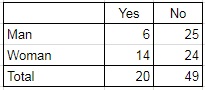
You see his presentation adds up ‘perfect’, these numbers add up, whilst a millennia of history shows us that numbers never add up, not in any criminal enterprise; to do that I have to teach you a little data basic. The best comparison is the use of a cross tabulation. Let’s take gender and shoes. For example we see 6 men and 14 women bought shoes. We also see that 24 women and 25 men did not buy shoes. So far we get the table on the left, yet now we also get the setting that a cross tabulation will not deal with.

For example the fact where we know that shoes were bought, yet the gender is unknown or we see a gender reference and that something was bought, but we cannot see if they were shoes. These are called missing values and they will not show up in that cross tabulation and there we see the first part. It gives us the setting of crimes but not by whom, they are serious in setting but that is not enough is it? You see Peter Dutton gave us ‘help combat organised crime‘, yet not all serious crime is done by organised crime and now we have a $47 billion dollar question and in addition the failing that we are now introduced to is a much larger failing. In this we now see that we saw in the beginning when we went to the end of the story. It is seen with: ‘estimated the cost of serious and organised crime‘ and that is not enough. We could argue that it should be, we can argue that (the amount involved) is way too big, but the setting is not merely that Tech companies should ‘help’, it is the prosecution setting. The setting that there is too much junk attached and the prosecution will fail in the bulk of all those cases because the evidence relies on loaded and unproven data. It is the part that we have faced for well over 7 years. The court barristers will give every jury the speech of authentication versus non-repudiation and the second one cannot be proven (in most cases), so we end up not merely not having ‘beyond all reasonable doubt‘, there will be a high and likely chance that the courts will not even be able to prove ‘on the balance of probabilities‘ or ‘is it more likely than not‘ and it is here where we see that Peter Dutton could be optionally wasting millions upon millions of costs to set the stage of presentation that will have little to no results and that is a much larger problem. The additional play is that any smudging of any presented evidence will give us the stage that a case will be thrown out of court, how is that helping anyone?

So whilst we ponder this, we need to review the statement “And it should be noted the same companies who protest about having to help police with the encryption problem, operate their business in less democratic countries and accept a compromise on privacy to allow their presence in those growth markets“. We are not those countries are we? so at this point, we get the impression that Peter Dutton is merely a minion for the intelligence services who according to him were unable to ge to places in the first place, which implies that certain players have much larger problems and the serious cirme part, which is not on their plate is already beyond them, so there!

At this point we get to the final part where we see: “It is important that tech firms understand and embrace their responsibilities to the community that has helped enrich them“, I actually do agree with that part, yet that should be set in taxation law. A flaw that I reported on yesterday (at https://lawlordtobe.com/2018/10/11/taxation-solved-the-old-way/) which I charmingly called ‘Taxation solved the old way‘ (pun intended). So when we now consider the biggest organised crime master in Common Law (Al Capone), who funny enough got scuttled not by crime fighters but by tax laws. How we get to relearn the lessons of old, do we not?

It gets us to the quote: “Currently our police and intelligence officers who have a warrant may be able to covertly recover an email or a photo or other evidence of a crime from someone’s computer, but they can’t crack encryption, which is why it is now being exploited by criminals“, so these are criminals and not organised crime. Or in a simplistic setting that every square is a rectangle, but not every rectangle is a square. It is at that point that I will teach Peter Dutton the one lesson he never learned (optionally he merely forgot the lesson).

Consider: “When sarcasm bounces it is merely irony“, a lesson that has a much wider application that the honourable youthful young Dutton might not have contemplated yet. However, we have to consider he was only reappointed his seat on August 24th, so he has time to settle in. And the lesson does not end, the second part of the lesson is not from me, it comes from Lizzie O’Shea who gives us: “they were united for the first time in their opposition to the government’s encryption bill“, when we see united tech giants, how short sighted was this encryption bill in the first place? It gets to be a larger issue when we add the setting from World Animal Day (pun intended) when we see the two parts “Telstra has won a $8.2 million contract with the Department of Foreign Affairs and Trade (DFAT) for the landing of the Coral Sea Cable System” and “Chinese technology giant Huawei was originally set to build the 2.5TB-cable linking Australia to the Pacific island nation back in July 2017. However, following concerns that Huawei’s involvement posed a security risk, the Australian government stepped in to fund the multi-million-dollar project from its foreign aid budget“, whilst clear evidence has never been presented and in that stage we see optional nepotism and ego and not fact and science based solutions. We are supposed to trust any of the reporting parties on any of this? The articles are different on different settings, yet the entire mess as it is now shows a much larger failing and a setting of doubt, not one of justified confidence and in that we see the second part of the reason why the tech giants are uniting. A certain play performed by adjusting to the notion of stupid and short sighted whilst the captains of industry have been getting their A-game in gear and others never did. It is merely another stage of the impact of iterative exploitation and profit founding, that whilst Huawei, Google, Apple and Samsung are no longer going iterative, they are now making larger leaps over the next 5 years as they want the largest slice of 5G pie possible and in an iterative setting the others can catch up and that is where we see the clash, because these hardware jumps will also prevail in software and data jumps and some players are in no way ready to play that game. That is where this so called balanced report strikes out as well. this is seen on page 21, where we see: “Because information and communications technologies are used widely throughout society and are instrumental to government, business and consumer activities, there is considerable overlap between the estimated costs of cybercrime and the costs of other crime types— particularly economic crimes, banking and financial crimes, transnational crime, online commerce and internet-facilitated crime such as consumer fraud, online dissemination of child exploitation material and intellectual property infringement“. You see in that stage we see the mention of ‘economic crimes, banking and financial crimes‘. Here we see that Financial institutions and Wall Street come into play (perhaps ‘entrepreneurial bankers’ is a much better term). This is not organised crime because Wall Street never committed any crimes did they, yet they are at the centre of a group of people in that classification are they not? And there we see not merely the adaptations of block chains, we see that organised crime will go there (as soon as they possibly can) whilst the bulk of all the players will not be ready and any encryption bill will hinder the progress of new technology as other players are not anchors of stability, they are concrete blocks of deceleration, another part not considered in any of this.

So yet, the tech companies are uniting and there is a second part in all that. When they strike a deal with Saudi Arabia and set a large part in the city of Neom; when Saudi Arabia accepts certain concessions towards the FAANG group? I personally believe that as soon as the benefit is clearly shown to the rulers of Saudi Arabia and the headway that they could make, they will adjust whatever they can according to Islamic Law, and at what point will governments realise that their only option of control will be isolation and a loss of economy? We are not that far away from that point. Even as we were told yesterday “A senior executive who works for Google’s parent company and a former US secretary of energy have dropped out of a Saudi Arabia tech and business advisory board following international outcry over the disappearance and alleged murder of a dissident Saudi journalist“, yet as Google cloud picks up more and more banks, how long until they reverse the setting? In this the Financial Times also gave us (a day earlier): “A radical blueprint to transform Saudi Arabia through socio-economic reform and ambitious development projects is persuading banks to return to Riyadh“, so at what point will we realise that Saudi Banking is growing and that all players want them as customers? It all boils to dollars and crime is merely a cost of doing business. It is that side that shows the missing data part (going back to the cross tabulation comparison). Corporations have always been about the privileges that come with a certain network and the most facilitating one is the one they will choose, that is in the heart of the flaw that I saw regarding Peter Dutton’s claims here. A bill that stops facilitation and stops optional business on much more levels, as banks need to show more and more profit. The greed driven business model will always be destructive in nature, learning that lesson 10 years ago would have made a difference, now it no longer will.

That is part of the heart of the “$40bn of foreign money is expected to flow into the stock market as a result of Saudi Arabia gaining MSCI emerging markets index status next year“, that against a flawed encryption bill, it was a bad play, played even worse on the surface of all the facts shown and I did not even bother going all the way when it comes to the initial ‘sought to estimate the cost‘, it almost reads like ‘the lady gains weight and we are trying to determine whether she is pregnant, or if she really likes pizza‘, how was that ever going to go? Perhaps asking her: ‘Have you been screwed (over) lately?‘ It could give you a truth and a lot more non-truths. That is the problem with data, whilst moulding data in one direction, you tend to open a door in another direction too, I learned to see and seek those doors, oh and that is before we consider the estimates and the application of weights to a data file, which I do not know whether it happened. this we should have consider with the statement on page 2 ‘Where data were not available for this period, the Reserve Bank of Australia (RBA) (2018) inflation calculator was used to uprate estimated costs from earlier periods‘, the part ‘uprate estimated costs‘ would have gotten us that part, also the fact that it is not data merely a ballpark idea on what the data could be, it is not the same, is it?


Leave a comment

Filed under Finance, IT, Law, Media, Military, Politics, Science

Trademarking idiocy

Is it not great that we have trademarks? You see, a trademark can be used to set a level of protection to names that are unique. Trademarks are granted to protect established brand names from inferior competition. It is in that we could trademark ‘MattHancock’, we need to protect this as such levels of what I regard to be almost Olympian levels of idiocy. When this trademark is widely known we could set the stage that people can be silly, stupid or even idiots, yet you can never get beyond a certain level of idiocy as it is limited to Matt Hancock.

Why is this?

Well, to see that we need to look at actually two elements. The first is the Independent that gives us: ‘Government orders chief medical officer to draw up guidelines on social media time limits‘ (at https://www.independent.co.uk/news/health/social-media-time-limit-facebook-instagram-twitter-snapchat-matt-hancock-a8561511.html). When has this ever worked? When we are seeing the blame game with: ““The terms of reference of Facebook and Instagram say you shouldn’t be on it if you are under the age of 13,” he said. “But they do nothing to police that. The guidelines for WhatsApp say you shouldn’t be on it unless you’re 16. But again, they don’t lift a finger.”” We get it; people need to be on a certain age. Yet, how to check it? Well, did Matt Hancock think of the most usual path? Perhaps leave it to parenting, more important, if someone is caught with these apps whilst not being of the right age, how about holding the PARENTS accountable? This is not something for the law, to prosecute, and when you get there, we get a trial that is a joke because the person was underage. How about making the parents prosecutable in all this? This is all about kicking certain players again and again, whilst they are in a corner. This is too much about getting waves and political election cloud, whilst we all know that the setting is a joke from the very beginning. To see that, we merely need to look at the BBC article (at https://www.bbc.com/news/uk-politics-45693143) give us: “A Guardian columnist highlighted the security breach on Twitter and the BBC was also able to access private details of people attending the event. The Conservative Party apologised for “any concern caused” and said “the technical issue has been resolved”. The Information Commissioner’s Office said it would be making inquiries. BBC political correspondent Chris Mason said the technical glitch was “deeply, deeply embarrassing” for the party“, so the one party that cannot get a decent grasp on common cyber sense is going to police time limits on social media? How laughingly stupid can a person get?

So when we are treated to: “One of Labour’s shadow cabinet, Jon Trickett, criticised the Conservatives for the breach and said: “How can we trust this Tory government with our country’s security when they can’t even build a conference app that keeps the data of their members, MPs and others attending safe?”“, can we also take that leap of faith that the overall comprehension of certain parts in all this is beyond the ability of politicians on both sides of the isle?

I can agree that when we see: “Meanwhile, public campaigns such as Scroll Free September have been launched to encourage the public to use social media less. The initiative, from the Royal Society for Public Health (RSPH), asked people to stop using platforms such as Facebook, Instagram, Twitter and Snapchat during September, or to cut down the amount of time they spend on them“, we need to consider that this is not the worst idea. Just like ditching the car for a day. It is not within the option for many people, but some might be able to see if they can do without social media for a day. The problem is that everyone is focussed on Facebook and Instagram, yet the setting is a lot larger than that and setting this stage to these two is one of discrimination which is a hot potato on several sides. In addition, must tertiary educations rely on social media like Facebook to get their message across not merely on events, but also on causes and interest groups that use Facebook to get their message across, what happens when you are out of time? It is an overall usage where critical analyses of how it is used is close to impossible, because that requires access to data to set the stage, and that caused most of the problems in the first place.

Yet, we also need to see and admit that Matt Hancock does have his heart in the right place. We see this with: ““I am, as a father, very worried about the growing evidence of the impact of social media on children’s mental health,” he told The Observer ahead of the start of the Conservative party conference in Birmingham. “Unrestricted use (of social media) by younger children risks being very damaging to their mental health” and it is in equal part also part of the problem. This is seen when we see ‘Unrestricted use (of social media) by younger children risks being very damaging to their mental health‘, so where is that evidence? I am not stating that it is not true; we merely want to see presented the actual evidence, is that too much to ask for? We get it, there will be risks, there will always be risks and they optionally endanger children and that is one part. Yet, since when are parents no longer accountable for the actions of their children? An entire set of messes, an entire batch of resource wasting and cost sin all this, whilst the stage is simple. The parents can be held accountable for the actions of their children, as well as the impact of these issues on their children.

An entire mess solved by setting the stage of responsibility with the parents and carers.

This gets us to the setting that matters. You see, even as I called him an idiot, he has a good degree and was educated in Oxford and Cambridge, and these two places do not seem to educate fools, so is this merely a setting of wasting our times, or is this about something else? Is this the beginning to set social media censorship on a new dock and in a new ship (the good ship lollipop) and set it afloat like a fireship? Thee tactic makes sense, yet the entire setting is too shallow as I see it. I cannot be the only person to hold the parents accountable in all this (when the social media child is under 13)? So when I see “Mr Hancock hit out at both platforms, which share an owner, over a lack of policing of their rules on age limits“. This seems less about mental health and more about collecting true identity settings in all this. It seems to me that the people behind all this require more data and they are in a nightmare scenario that they themselves created. Now that the setting is overboard the government has no path to solve it all and now they are blaming social media to a much larger extent to police using privacy based data. How can you check the age of an underage person? You cannot! That is the simple truth and holding the parents accountable in all this would have been the first and sensible part in all this, yet that was not done, was it?

So even as the conservative cannot get their own app under control, they are not demanding additional policing that is not policed (and should not) under normal conditions and is set on the same shallow state as the demand of one hour to remove certain data, and the mess is about to get worse with

You see it gets worse with: “Home Affairs Minister Peter Dutton introduced the new laws to the Parliament, saying they are needed to help police and spies catch criminals who are hiding behind encryption technology“, in this Australia is setting a more dangerous stage. When we consider the setting that we see everywhere with: “Keeping your password safe. To protect the information in your computer account from unauthorised access: Do not share your username and password with anyone. Except in the case of a shared departmental account, you should never disclose the passwords for your computer accounts to anyone“. So it might be a golden day for whistle-blowers as they claim to be working for the police getting others to give out their passwords. The mere ignorance on common cyber sense will increase the damage well over tenfold and whilst criminals move towards burner phones and more important burnable memory cores we see that the police will have truckloads of data of all people with no criminal intent. In addition, there is every chance that with: “He said this potentially compromises his business, putting it in breach of Europe’s tough new GDPR data privacy laws and he would have to give privacy breach notifications to his clients” some companies will see dangers to their IP and move away from Australia, merely letting them have third tier access and mere consumer base based products. In this setting all developers would eagerly run away from Australia to protect their IP and patent data until the patents were granted, giving Australia additional downturns soon after the bill passes. On the other side, we will start travelling without our devices and rely on an empty burner phone that allows us to work, but will not retain any data outside the cloud. In that setting how were any of these actions anything less than stupid with a capital S?

People will find a way around it giving the governments less options and a lot more headaches, it never made a difference and the dangerous elements will take additional measures leaving the prosecution services with even less evidence to work with. It is trademarking idiocy on a new level, happy Sunday!


Leave a comment

Filed under IT, Law, Media, Politics, Science

Warring consoles

There are a few wars to look at, but the setting for the consoles is one that is shifty as hell. I have been outspoken against a certain brand whose name starts with ‘M‘ and ends with ‘icrosoft‘ for a few reasons, but that is not what it is about. It starts with the Sato. A writer for Siliconera giving us the sales of consoles for last week. The systems that matter for the week of 10th to the 16th of September in this are Nintendo Switch that sold 38,738 consoles, down from 43,513 last week. The PS4 12,057 down from 12,281 last week, the Xbox One 58, up from 19 last week, the PS4 pro 4,959 down from 7,442 and the Xbox One X 159 up from 30 last week (Japanese sales numbers). So we can go with the fact that Microsoft is the only one on the rise. We can go with the optional truth that Microsoft consoles (plural) merely represent 0.5% of the Nintendo Switch sales. I did not even consider News Nintendo DS systems in all this, the number would become laughingly small (and blow away whenever you open a window), if it has not done that already. Microsoft Xbox One systems are a mere 3% of the PlayStation 4 systems and that is not a good thing either (for Microsoft that is). Yet we must also acknowledge that Nintendo is a force of nature at present. You see, at present the Nintendo Switch might merely be at 45% of all the PS4 systems sold (normal and Pro), the fact that they did this in under 2 years is an amazing achievement and there is no stopping Nintendo. I expect that they will break additional records at both Thanksgiving and Christmas this year (as well as the Saint Nicholas festivities in one or two places).

It goes even further when we see the Nintendo games exploding on the screens when it comes to the revenue. This year alone, the revenue for Nintendo went up by a cool 100% to a net value of almost 10 billion dollars, that is a massive achievement in gaming and their growth is still enduring. With online play being free and Fortnite still on the rise and with 30 titles still arriving before the end of the year. It seems to me that Nintendo figured something out and Microsoft is paying a high price for the wisdom gained (Sony gets hurt too but much less).

So whilst Xbox UK is still hiding behind what I would clearly define as ‘deceptive conduct’, they might think that it is ‘innovative thinking’ we are merely confronted with a once growing game maker that is now becoming obsolete in its thinking.

So why deceptive conduct?

You see, the people were confronted with a tweet a mere three days ago. The tweet: “Play 500+ Classic Xbox & Xbox 360 titles on your Xbox One today… totally for free“, yet when we read down the tweets, we see the hitch. We see: “If you already own them – no need to buy again! Just download or put the disc in, and away you go“, news that is 2 years old and we are still confronted with a digital department that just does not get it. They did not tell us “We have upgraded our backwards compatibility program to 500+ games“, no that would be too honest. No we get: “Play 500+ Classic Xbox & Xbox 360 titles on your Xbox One today… totally for free“, it is not merely deceptive conduct, it is what I would personally call an open blatant lie. You see: “totally for free” would have been the setting if pre-owning the game was not a requirement, so some purchase was required, giving the setting one that is a an outright lie, as I personally see it.

Getting back to the sales I mentioned earlier, we need to realise that this is not global. The numbers come from merely a Japanese source, sales in Japan. Yet the setting is still clear (to some degree), Nintendo is here to stay and it is growing its influence on a global scale and when we see the mere achievement of 58 Xbox One systems over a week in a nation that is around 130 million people, whilst some sources give us that 50% of them are into gaming. We do not have a comprehensive data file that gives us a more complete picture. Yet we see that there are around 700 million online gamers, which is well over 40% of the online population, when you consider that, we see that the numbers and the setting is massively important. Venturebeat gave us in the past that spend per person is Japan (#1) with $120 per person, the US (#3) with $62 the UK and Australia in 4th and 5th, whilst they are on equal footing with $62 and $55 per person. So at that point do you still think that all this misrepresented loot box mess is merely about gambling? So when we were given: ‘Australian Senate inquiry extended after study calls loot boxes ‘psychologically akin to gambling’‘ merely three days ago as well as both “The Australian Senate inquiry into micro-transactions is taking into consideration a large-scale study that claims “loot boxes” are psychologically akin to gambling“, as well as “The paper is the result of a paid online survey among 7422 gamers. Curiously, over 6000 responses to the survey were discarded because the answers were either not serious or incomplete“, which is interesting because I never saw that link in any place and I have been a gamer since 1984, long before the word ‘gamer’ was cool. The article is actually good and gives us one part that I can stand behind: “recommends adjustments to the current game classification system advising “parental advisories for games that feature loot boxes” as well as “a descriptor outlining that the game itself features gambling content”“. I would be willing to take it one step further. I would demand that there are two additional parts. The first is that there needs to a clear path where we can earn loot boxes for free (not unlike the Mass Effect 3 setting), in addition we need to see a clear sticker on the front of the box stating that ‘no loot boxes are required to play or complete the game‘ Several games have clearly stated that in the past, yet adding this on the front of the cover is not the worst idea.

I still disagree that it is gambling, yet having a clear mention that loot boxes are set to chance and optionally the chances of getting a certain rarity is not the worst idea either. And in all this, the console war is now setting to a much larger stage, even as they all (partially correctly) point their finger at EA Games. Ubisoft has unlockable content (at a price as well, yet they ALWAYS clearly stated ‘this item can be unlocked through regular gameplay‘ as well. So it is not immoral that they offer it as an initial unlock for $5, it merely shows us that that person is not really a gamer, merely a player.

In this there is more to Ubisoft; it is clearly seen in their Assassins Creed games. Going back to Assassins Creed 2, they had the Ubiclub. You can buy things there. Unlocking premiums and extra’s (skins, backgrounds, outfits and weapons), to buy them you play the games and when you get to a stage, like completing a set of conditions, making it to a certain point in the game you get points, these points re kept in you profile and you can unlock them for any Ubisoft game you have, giving you more and more by merely playing. It opens up the need to complete, the drive to achieve and the option to get cool things. Here I clearly state: ‘Well done Ubisoft!‘ and this is still an ongoing stage with badges and cool stuff with every additional game that they release. So as I state that loot boxes are not gambling, I am for the most not against the setting: ‘Study urges games with Loot Boxes to be Restricted to Players old enough to Gamble‘, which is not the same. The question is not merely on how to check it; the issue will soon be that abuse is harder to check. Even if they cannot be merely bought online, even when the loot box cash needs to be bought in the store, we will see the irresponsible act of the parent giving in to ‘junior’ buying more and more loot boxes. It is important to raise the issue as more and more consoles are confronted with games that depend on loot boxes, and that is not nearly the beginning. We see part of this in Eurogamer (at https://www.eurogamer.net/articles/2018-07-23-fifa-player-uses-gdpr-to-find-out-everything-ea-has-on-him-realises-hes-spent-over-usd10-000-in-two-years-on-ultimate-team), when we are given “Michael was sent a data dump by EA via two PDF files each over 100 pages long. This amounted to a huge number of files, which include engagement data, FIFA 18 stats, device information and more than 10 audio files (these are recordings of his calls to EA support). It also included details of every player Michael bought and sold over the past two years in FUT“, so beyond the setting of “EA also provided data relating to how much real world money (in dollars) Michael had spent on FIFA Points, and he told Eurogamer he was “gobsmacked” to discover he’d spent over $10,000 in just two years“. Apart from the fact that you are losing your screws, the mere fact that you are not aware wasting cash to such a degree is one part, yet in this, the part that everyone ignores is “30 days later, Michael was sent a data dump by EA via two PDF files each over 100 pages long. This amounted to a huge number of files, which include engagement data“. I never played FIFA, yet when Microsoft remained in denial that 5 GB in 10 days was uploaded without my consent or knowledge into the Azure cloud, they merely pointed at the internet provider and stated that this is their responsibility (whilst I had not played any multiplayer games), and now we see what EA collects, in all this, the collected data is not an issue in any of this?

And the console wars are not done, not by a close margin. This goes beyond which system is popular, with system has loot boxes. This is about data and with all these systems being online and optionally ending up collecting personal data, there is a larger for not merely gamers and players. It is about classifying people and the setting of how bankable have we become? We saw this a few months ago with ‘Esports streamers and gamers are among the most bankable influencers, pitching to a new generation of consumers that don’t track traditional‘, it is about finding money people, those who propel the brand and when we realise that we seem to have a few additional problems and the fact that no attention is given to that part in the equation is equally a problem.


Leave a comment

Filed under Finance, Gaming, IT, Law

The politics of 5G technology

I was watching the news and all the announcements of the new iPhone series and it dawned on me that even as they are not just the most expensive phone, they are close to 400% the price of the top Huawei P20. So why is this now a massive price jump? It is not merely that it is a 512 GB Phone, or that is has 4GB RAM, or that it is IP68 dust and water resistance (maximum depth of 2 metres for up to 30 minutes). I think that Apple is changing the game. It is realising something different, It is also why I designed the ‘dumb’ smart devices for 5G.

You see, for better or for worse, I ask you the question: ‘What is this?’ You swill respond with it is a phone (or variant of it), it is a connection to everything, it is your personal assistant. No, it is none of those. It is important that you realise that this is now becoming your personal data server. When 5G enters your life it will be the foundation of you. You must realise it now, or lose your personal value very very fast; even as we are shown the political ‘BS’ on Telstra regarding Huawei, US telecom companies and other players. This is the vault all the players want. This is the setting of the next generation. Apple is cashing in on mere then just the price of a product. They are setting a stage that Huawei is already walking (slower in some regards, faster in others). This is the future and the Apple version of that future arrives within the next 7 days.

Google is on that path too. Its mint flavoured (or is that coloured?) is arriving in 4 weeks, they too are on the path of the future. That path is you and your personal data server. You better get used to that very quickly, you better realise that you, you yourself enabled all this. So even as we will not know the specifics of the new Pixel 3 XL, we all know that this too will be the personal data server, just like the Huawei P20 series, the Apple Xs series, the Samsung Galaxy and the Google Pixel 3. No longer merely phones, no longer merely the Spotify point. You see, the steps we have had with 4G are closing down, and the marketing changes. It is no longer ‘Fastest Mobile Broadband Network‘, it is no longer ‘Live More Internet‘ (which might be Ogilvy’s worst slogan), and it was never ‘Rethink Possible‘. It will be ‘Whatever you need, anywhere you need it‘. That is the foundation of 5G, anywhere you need it is going to be your cornerstone. It is in that part, when you have transplanted yourself in that new dimension you will get exposed to the change and the need to protect your personal data server wherever you are, because your personal data server (the next mobile phone) will become to some extent: “Your Identity”. Now you will need to consider getting it properly protected, because your data value is you and you need to realise that your mobile phone will have more processing and collection power than any server that was out 10 years ago, facilitating for you and 49 other employees. This personal data server will work for you, on your behalf and to your needs. This was why I came up with the protection layer of ‘dumb’ smart devices. No matter whether you go for IOS or Android, you will be your own cornerstone to social life, to entertainment, to business ventures and to your financial pathway. Consider what you are doing now on your phone. Your banking needs, your radio, your TV, your games, your appointments, your insurances and your investment and retirement portfolio. You do it all from your mobile phone and soon with block chain added to the data stream we are now moving towards a point of non-repudiation. In non-repudiation it means that you and only you could have done this. It is the one step above authentication; it is your future of accountability. At that point you cannot go to the judge stating you lost everything, because your phone got stolen. The easy path is getting removed; that is the future of whatever you want, anywhere you need it. Because only you could have wanted it and the new phones are about setting the stage enabling you and protecting you and foremost keeping your data safe, as long as you realise what you are doing.

So that got me thinking of the old Re-Flex hit: ‘The Politics of Dancing

We got the message, I heard it on the airwaves
the politicians are now DJ’s
the broadcast was spreading, Station to station
like an infection, across the nation

We see and hear it all as these settings evolve; politicians are becoming evangelists for places like Telstra, Vodafone and T-Mobile (to coin an example). The speed and radius of influence increased with every technology jump, three times in the last 10 years alone. Forever growing, ignoring borders and natural obstacles.

When we look at the refrain we see:

The politics of dancing, the politics of ooh feeling good
the politics of moving, aha, If this message’s understood

The setting of movement, dance and self-gratification, the fastest way to move the population in the direction they needed you to go in. You better realise this now and not too late.

You see, In Australia Telstra is the best example to look at. In 2016 they themselves set the stage with: “The Connected Government Program is Telstra’s premier thought leadership program for the public sector“. You did not think this was some philanthropic society, did you? This was the initial culling of those good for the in-crowd and those who are not. And I will also include “Dramatic economic, political, cultural and technology changes are creating opportunities and risks for growth, inclusion and sustainability that are making new demands on government and the public sector which require the ability to lead for innovation in conditions of volatile change, ambiguity and fragile trust“. This is all about growing the status quo for Telstra against whatever threatens it (Huawei is a nice example). Whatever they consider to be ‘innovative‘, I personally view it to be, ‘innovative at whatever speed Telstra can manage in an optimised setting of ROI and profit from whatever was deployed before‘. That is not the same is it?

So here we see the setting of 5G, you all want it and your personal data server will be the first choice that either enables of limits you. This is why Apple has upped the ante by a lot and until the answer of Google is ready, I am unwilling to make any choice other than Huawei, especially as it is at merely 25% the price of the new iPhone. 5G is optionally 2 years away for consumers at the facilitated speed of the new apps and protections; we see that this system needs to be at full force when the City Gates of Neom opens, because that will be the first fully fledged setting of a 5G environment giving you whatever you need anywhere you need it. Interactive information posts, shops that inform you 24:7, giving you the data you needed and showing you the products and offer sales and interactivity even when the shop keeper is asleep. All setting the stage for the explosive data growth you will be faced with and your personal data server is your link to all that. In this Google has the advantage as they solved three elemental parts in that essential need, added to that the marketing agents who specialised and focused on actual engagement. That is where you see the benefit of the next generation of data and visibility at the speed it needed to be at. This is not marketing through the eyes of their clients, this is marketing through the eyes of the respondents and how they envisioned it to be. A flexible setting set to the owner of the owner of the personal data server, not the approach towards that server as players like Telstra thought it needed to be, based on their metrics and their perception. Two distinct different ways and many marketeers and self-professed evangelists never understood that part, or learned it too late.

So yes, Re-flex was partially correct when they stated: ‘The politicians are now DJ’s‘, yet they did not forgot it, it was merely in a time when that option did not yet exist. Now there is no lack of choice and the owner of that personal data server can switch channels in the blink of an eye, an engagement opportunity lost as the focus of the evangelist (read: marketeer) was set to the wrong party. The owner who gets whatever they want, whenever they want it also gains the power to decide on what they want, any time they need or desire something, so making sure that there is engagement also gives the strength of retaining that person for a much longer time and in this game in 5G time is close to absolutely everything. It is the one where we start to realise that time is the essential unit of measure. It was there in the old days. CPU time set the stage of costing; it was there in the old phones, where the duration of a call was the unit of costing. Down the road it was trivialised in most places and set to zero, but it was never zero. Now we get to the next stage, yet now it is in the hands of the consumer, because the time of engagement is the sales funnel, so engagement becomes the stage for success. It is close to the end of mass marketing. It will be the stage of smart marketing. In that setting phishing becomes the new skeleton key and there is the first clear need to protect your personal data server and to protect the data it holds. A setting of consideration in 3G and 4G becomes a setting that is essential for anyone that wants to remain in the game in the next generation with a setting of continued value.

#40800SecondsTillMondayMorning


Leave a comment

Filed under Finance, IT, Media, Politics, Science

FI01, becoming offensive

I will leave the entire Novichok alone for now, there is rustling in the weeds and it is important to look at it, but only when more actual quality information is available. It is time to take a look at the FI protocols. It is time for FI01.

This might not be the article for many of my readers, I will not shun hash words and I will not shun those wading in hypocrisy. Yet to do that, we need to look at certain definitions too and that is the part we get to after we look at the Guardian article (at https://www.theguardian.com/media/2018/sep/13/social-media-firms-could-face-huge-fines-over-terrorist-content). The article ‘Remove terror content quickly or be fined, EU tells social media firms‘. the setting given is “Social media platforms such as Facebook and Twitter will be forced to take terrorist content off their sites within an hour or face multimillion-pound fines under EU proposals“, is probably the biggest part, but let’s look on; when we see some of the parts given by Julian King, the British security commissioner in Brussels. We are given a few truths that matter. “We have got a problem with content; it is not an entirely new problem, we are not starting from scratch, we have agreed to do some voluntary stuff, and we got some good progress – but not enough” is the first part and I will get back to that, yet the more important part is “Every attack over the last 18 months or two years or so has got an online dimension. Either inciting or in some cases instructing, providing instruction, or glorifying“. I get it, something needs to be done. In the first we need to see the list and the proper setting of evidence. I get it that this is not offered online for several reasons. Yet there needs to be a lot more scrutiny. As we see the utter screw up regarding Novichoks, the lack of evidence and linked statements without evidence. We also need to state clearly that the press (to a larger extent) is part of the problem, not part of the solution. Julian King needs to realise that if his peers are dragging their heels on one side, he cannot be part of anything acceptable stating the utter impossibility of: ‘take terrorist content off their sites within an hour‘.

From my point of view, this is about something else; this is about giving governments’ direct access to social media to filter ALL content (at their leisure). To get anything done within the hour is just not realistic and they know it. It is also very clear that when 5G is here, it will be too late and that is what they fear even more, and being stupid about it is just not a solution in any place.

It becomes an even more laughable setting with: “Parties could be fined up to 5% of their annual budgets for breaching data protection rules in order to deliberately influence the outcome of the European elections, including those for the European parliament in May 2019“. So instead of making it illegal and rejecting that party from elected consideration, they get a fine? Allowing for big business to sacrifice via some small institution to cop a few million whilst still getting what they want. So when we see Julian King state: “given the track record, there has to be a chance, and we have to up our game and be more resilient“. How about setting the stage that the use of social media for elections is just out of bounds? Limit it to TV, Newspapers and magazines?

We see the problem a lot clearer when we consider the ‘High-Level Commission Expert Group on Radicalisation (HLCEG-R)‘ report from May 18th 2018. Where exactly is the definition of ‘terrorist content’? You see, the EC is all about definitions all the time. Yet here we see an interaction and a level of interchangeability of ‘terrorist content‘ and ‘illegal content‘. It is found to some extent in the report referred to in footnote 19 where we see the report ‘COMMISSION RECOMMENDATION of 1.3.2018 on measures to effectively tackle illegal content online’. So is all ‘illegal content’ ‘terrorist content’? It seems to me that this sudden trivialisation is about something else entirely (at least to some degree).

When we look at the second report, we see: “At the collective level, important progress has been made through voluntary arrangements of various kinds, including the EU Internet Forum on terrorist content online, the Code of Conduct on Countering Illegal Hate Speech Online and the Memorandum of Understanding on the Sale of Counterfeit Goods. However, notwithstanding this commitment and progress, illegal content online remains a serious problem within the Union

This is reference to Article 292. Yet now we see Illegal Hate Speech Online, the Sale of Counterfeit Goods as well as terrorist content online. So is this about a Nina Ricci bottle or a Prada backpack, because the devil is not in the details, the devil wears Prada plain and simple. We see to some extent the ‘aggregation’ of stupidity (as I personally see it) in item 32, where we are treated to: “In light of the particularities related to tackling terrorist content online, the recommendations relating to tackling illegal content generally should be complemented by certain recommendations which specifically relate to tackling terrorist content online, building on and consolidating efforts undertaken in the framework of the EU Internet Forum“, so when illegal content is online, we now see the implicated setting that these people could be regarded as terrorist. With ‘be complemented by certain recommendations‘, which now becomes a rather weird setting. You see ‘political opinion’ cannot be seen as illegal speech, so not getting to barrier one, also avoids barrier two. In this setting, any political drive must be proven to give the reading of proven the need that the speech instils the drive to act illegally. Until a clear act is connected, there will be no success.

This now gets us to paragraph 33, where we see: “Considering the particularly grave risks associated with terrorist content and hosting service providers’ central role in the dissemination of such content, hosting service providers should take all reasonable measures so that they do not allow terrorist content and if possible prevent hosting it“. So at this point what exactly is ‘terrorist content‘? And the reference to that paragraph refers to ‘without prejudice to Article 14 of Directive 2000/31/EC’, are you effing kidding me? That is the privacy part on a section in ‘legal aspects of information society services, in particular electronic commerce, in the Internal Market‘.

So we get this mess presented?

In that regard when we see: ‘Commission proposes new rules to get terrorist content off the web‘ It is my personal agitated view in the matter that protocol FI01 is set to President Jean-Claude Juncker, he is the Eff…ing Idiot number 1.

When we again look at the headline: “Terrorist content is most harmful in the first hours after it appears online because of the speed at which it spreads. This is why the Commission is proposing a legally binding one-hour deadline for content to be removed following a removal order from national competent authorities“, a one hour deadline? Really? Most EC parts have not been able to clean their act in years, so now social media gets sliced and cut? Is Europe so broke that they want the millions from the three social media providers because they cannot clean their own stables?

Consider the Statistics, Facebook has 2 billion active users a month, and this is not static. We see from sources that Five new profiles are created every second, there is a registered amount of photo uploads approaching 300 million per day as well as the setting that every minute on Facebook: 510,000 comments are posted, 293,000 statuses are updated, and 136,000 photos are uploaded and that is ignoring languages and expressions. The entire setting of removal in an hour is so unrealistic it is close to hilarious. When we are confronted with that, whilst ‘the Conservative’ (not the greatest source, I admit) gives us: “The structural defects of the European Commission are plentiful: an insurmountable democratic deficit; not a hint of accountability; and an opaque process of legislative formulation to name but a few“, that whilst labelled individual FI01 is also connected to: “The president of the European Commission is embroiled in a new criminal investigation into claims that “tampered” evidence misled an inquiry into phone-tapping. Jean-Claude Juncker faces accusations that his officials presented inaccurate information under oath in a case involving an alleged illegal wiretap more than ten years ago when he was prime minister of Luxembourg” (source: The Times, December 13th 2017), that is the person giving social media providers an ultimatum of an hour? You have got to be kidding me. The Telegraph gave us in addition: “The new evidence, which led to the postponing of a trial of three senior formers members of Luxembourg’s SREL intelligence service, according to The Times, showed that a key telephone transcript had apparently been doctored

That’s the person who is part of throwing ‘illegal content’ and ‘terrorist content’ on one pile?

Good to know!

So now we get to the fact sheet!

Here we see (at https://ec.europa.eu/commission/sites/beta-political/files/soteu2018-factsheet-terrorist-content_en_0.pdf) the setting of ‘How does the new procedure for removing terrorist content work?‘ We now see the following

  1. National authority detects and makes assessment
  2. If considered terrorist content, removal order issued to host
  3. Host must remove content within one hour

That seems almost harmless, does it not?

Yet we also see:

  • Right to challenge: Hosting service or content provider may appeal the removal order. If the appeal is successful, the content is restored; if the appeal is rejected or the deadline lapses, the removal order stands and the content must be permanently removed.
  • Obligation to report: If issued with a removal order, the host must report on proactive measures taken to address terrorist content online three months after receiving the removal order.

I am missing any level of accountability, too much ambiguity. So from my point of view, anyone abusing the ‘terrorist content’ for mere filtering and censoring on behalf of anyone else needs to be held criminally liable. I reckon that after 2-3 cases there will be suddenly a large need for postponed trials.

When we investigate the member states part in all this, we see no fine for the state when wrongful removal was done, we see a pressure on removing (or else), yet there is a shallow point when it comes the other way around. In addition, we see “coordinate with other Member States and Europol to ensure that evidence of online terrorist content is flagged, and that duplication and interference in national investigations is avoided“, yet there is no registration on who ordered the removal, also, there is no registration per removal id and in that stage set penalties for those having set the stage for recurring unjustified removals giving ample voice to the earlier: “not a hint of accountability“, if this is about terrorist content, is that part not equally important?

I am all for getting all terrorist content removed, yet the systems cannot get it all, that is too unrealistic and pushing a one hour timestamp whilst the other side has no accountability at all is just a discriminating joke in the making. It is also still interesting to see that they claim to fight terrorism and terrorist online activities, whilst Iran state sponsor of terrorism in still a welcome debate and trade partner in the EU. In addition, the entire matter of Iranian diplomat Asadollah Assadi and terrorist was given light a week before the EU approved plans for the European Investment Bank to do business with Iran. So you want to stop social media, whilst still doing business with these people? How unacceptable is that part in all this? If the EU cannot clean its stables, it has no business enforcing anything on social media that is how I personally see it. Yes, we can agree that terrorist content must be removed ASAP, yet what is that? One hour? 24 Hours? 72 hours? The fact that the EU does business as usual with a terrorist funding government implies that they are clueless on several grounds and the fact that we see an increasing amount of evidence growing on the matter of Iranian Missiles fired into Saudi Arabia is further evidence still that the EU is merely the pot calling the kettle black. It is in that setting that we should conclude that they have no business ‘fine giving’ any social media, especially in light of such a massive funding failure.

You see, what angers me so is the mere filtering of politicians and that needs to stop too! In this I present two elements. The first part comes from Bloomberg last year. We are given (at https://www.bloomberg.com/news/articles/2017-11-29/facebook-says-99-of-is-al-qaeda-content-spotted-by-ai) where we are treated to: “Today, 99 percent of Islamic State and Al Qaeda-related content Facebook removes is detected by the company’s AI before any user flags it, Monika Bickert, Facebook’s head of global policy management, and Brian Fishman, head of counter-terrorism policy, said Wednesday. They said in some cases the software was able to block the content from ever being posted in the first place“. Yet the other part that the Guardian gives us is: “We have got a problem with content; it is not an entirely new problem, we are not starting from scratch, we have agreed to do some voluntary stuff, and we got some good progress – but not enough“. Now we get to the good part, what EXACTLY is ‘not enough’? From my point of view Either Bloomberg lied to us, or Julian King is what some might consider as: ‘an unacceptable piece of trash’. If he wants 100%, he better give us clearly add a few elements of EC accountability and holding them criminally liable when they abuse their power. Also is any abuse of that ‘filtering content’ is found, he is to be dishonourably discharged and shamed in the entire EU, with a clear banning from ALL official positions in the EU and the Commonwealth.

Why the overreaction?

We have been fed two versions again and again and we see a lack of accountability on the EU side too often; for example the elitist banking group of 30 with Mario Draghi as a member. When the Financial Times gave us: “the close links between central bankers and the private sector have aroused public suspicion since the global financial crisis triggered a series of bank bailouts” we see suspected levels of nepotism that raises more issues than 50 successful Islamic State attacks. The article (at https://www.ft.com/content/dc64b6e2-8060-11e8-bc55-50daf11b720d) also gives us “The Ombudsman has also attacked the ECB’s argument that it was standard practice for top central bankers to join the club. The central bank chiefs of Germany, France, Italy, Spain, Poland, India, Brazil, Russia, Canada, and Australia are not members and Janet Yellen suspended her membership during her time at the helm of the US Federal Reserve”, showing that the European Commission has a truckload of issues, it is my personal view that it has no business acting in the way it does.

Yet, defence of the actions instigated by Julian King can be seen in Forbes. The article (at https://www.forbes.com/sites/kalevleetaru/2018/05/15/the-problem-with-using-ai-to-fight-terrorism-on-social-media), an Article from last May gives us: “the general public would be forgiven for believing that Facebook’s algorithms are vastly more effective. The New York Times summarized the statement above as “Facebook’s A.I. found 99.5 percent of terrorist content on the site, leading to the removal of roughly 1.9 million pieces of content in the first quarter,” while the BBC offered “the firm said its tools spotted 99.5% of detected propaganda posted in support of Islamic State, Al-Qaeda and other affiliated groups, leaving only 0.5% to the public.” In fact, this is not at all what the company has claimed. When asked about similar previous media characterizations of its counter-terrorism efforts, a company spokesperson clarified that such statements are incorrect, that the 99% figure refers exclusively to the percent of terrorist content deleted by the company that had been flagged by AI.

This could be easily tested and as such I decided to do so and with ‘ISIS images’ I got hundreds and hundreds of images, videos and other matters in my browser and I got even more with the search term ‘Jihad Islamic state’. The video (at https://www.youtube.com/watch?v=jzCAPJDAnQA) shows actions of Islamic State, with sounds, vision and comments. It is News from Vice News, a video from 2014, still online today. At some point you need to as just how ludicrous and useless actions are. We get it that there are actions, we see that numbers become debatable. Yet in all this the mere reported numbers are already an issue, and if I added Vice News articles to me Facebook news feed, would that constitute ‘Terrorist Content’? This small part alone shows us that this is about something else and as such we better take a real hard look at the Actions of the EC, demanding that the censoring side should be held equally liable and prosecutable for their overreaction and inaction. Yet that is never ever going to happen, is it? This is making the EC actions (in my personal opinion) a lot more questionable in all this. It was the overreaction and the emphasis of ‘One Hour’ that set the tone of mistrust, I wonder what else we will see over the coming week.


Leave a comment

Filed under Finance, IT, Law, Media, Military, Politics, Science

Liberalism overboard

We can agree that there is in many places a setting of ‘freedom of speech’. For the most, I have always supported that, and even though I know that there is an overwhelming amount of exercise in the ‘art of free speech’ for the mere setting to do harm and to inflict insult onto others, the largest portion of people are about merely voicing personal opinion, or in some cases to evangelize their version, or better stated their interpretation of events through free speech. I do still believe that freedom of speech is a much larger advocate of good then evil. The question becomes, what happens when the intent is a malicious one?

In America one of the most famous cases of free speech is still Hustler Magazine, Inc. v. Falwell, 485 U.S. 46 (1988). From the New York Times at the time we get “the Court held that the First Amendment gives speakers immunity from sanction with respect to their speech concerning public figures unless their speech is both false and made with “actual malice”, i.e., with knowledge of its falsehood or with reckless disregard for the truth of the statement“, that is the important setting in this case, and even if this is regarding a setting in different nations, it gives a clear view on where most of us are, or should be. So when I was confronted with “a Prophet Mohammed cartoon contest organized by anti-Islam PVV leader Geert Wilders“, a person who has a visible anti-Islam view, when we are clear and in the know that images of the prophet Mohammed are a massive taboo in the entire global Islamic population, why can we allow a political party leader to set a stage of mental duress to Islamic people of all ages? The fact that this competition is to be held in a closed part of Parliament closed or not reflects even worse on the Dutch government.

If I was an emotional person (which I am not), I would plead with the United Muslims of Australia (UMA) as well as a few Muslim governments on the idea of a fantasy story, the topic would be ‘How to assassinate a politician‘, it is partially important that the people realise that I am a Catholic, not a Muslim. It would be open to all Muslims from 14 to 20 years old and the story needs to surpass 8000 words. We will ask a prominent member of Muslim society to consider being the judge of all those stories.

I am as rich as a church mouse (read: therefor the opposite of rich), so I cannot make a price available, so we need sponsor willing to host the artistic exercise and the winner should get a decent award and we will send all the submissions in PDF form to the Dutch Parliament as a statement of objection on what PVV Leader Geert Wilders had set in motion.

You see, the steps are important for the mere setting that there must be a dialogue with people that is not set on hatred and in equal measure, people fuelling the fires of hatred should no longer be allowed in politics. The fact that we were offered: “In 2015 Wilders attended a Mohammed cartoon contest in Texas. He left just before jihadists tried to commit an attack“, it was a clear message (apart from the one in France). So the Dutch politician was in attendance at this event on Dutch Memorial Day (regarding WW2), when we are treated to: “Two gunmen who opened fire outside a competition for the best cartoon depicting the Muslim prophet Muhammad near Dallas in the United States on Sunday. PVV leader Geert Wilders was the keynote speaker at the event. The police shot and killed both gunmen. A security officer was injured“. It was at an American event, in America that called for, and knowingly invited for an action of extremism. A hate group hiding behind “He told the audience that most terrorists are Muslims and “the less Islam the better”. “We are here in defiance of Islam to stand for our rights and freedom of speech,” he said during his speech. “That is our duty.”“. the two sides is that we do not deny a freedom of speech, yet when you use that freedom to knowingly and intentionally inflict harm to others, how does that go over with you?

In this it is the current nightmare for Stef Blok who is currently heading the foreign office. It is a nightmare, because not only is it a setting where a politician is intentionally insulting a religion, not only is this a set stage, it is one that is ALLOWED to be done in Dutch Parliament.

No matter how good most of the Dutch are, no matter how dedicated they are to excellence. when we consider the business model (at https://www.khaleejtimes.com/business/local/dutch-model-attracts-uae-firms), when we see that the setting of “Twenty-seven of the 60 projects come from the UAE“, when the attached “Currently, we have 60 investment projects from the Mena region together investing more than 1.1 billion euros and creating more than 2,000 jobs“, when that falls away due to the insult of their national religion, when the people in the UAE are made aware of the insults that PVV Leader Geert Wilders is allowed to get away with. How long until the funds stop and the jobs go to the UK, France and perhaps Australia? When we get Jeroen C.M. Nijland, commissioner of the Ministry of Economic Affairs at the Netherlands Foreign Investment Agency (NFIA), now having to state that economic times have taken a step back due to ‘abused freedom of expression’ in a stage of intentional malignant acts against Muslim nations on a global scale. When these 2,000 jobs fall away? What will be the excuse Dutch officials will announce in line to the ‘Due to uncontrollable elements, the Dutch deficit will rise from 1.1% to an expected 1.9%‘, or perhaps “The economy will grow by 3.3% in 2017 and a projected 1.3% in 2018“. When one party represents close to 50% of the Netherlands Foreign Investment Agency, getting the scope of alienating economic partners correct tends to become extremely important.

In that regard, when the President of the United Arab Emirates, Khalifa bin Zayed Al Nahyan learns that Dutch parliament was allowed to be used for such an event. How do you expect that he is likely to react? When Saudi Arabia learns of this, a nation now ready to give reign to around one trillion dollars in projects for the next 7 years (the new Neom city included as well as other Saudi projects), in that light, just how stupid was the setting of facilitating to Geert Wilders in all this?

A setting where the technological growth, especially in 5G projects will be the largest in the history of the world (for now that is), when these projects could feed corporations for close to two generations, getting ‘political correctness’ a little better under control is close to everything. So, I do remain a ‘champion’ of free speech, but we should learn to see accountability equally important, especially when there is as what I personally see as clear intentional malice in play. In that regard it was never about ‘freedom of expression‘, was it? So, if we accept fair play, then the Dutch economy should rely on business partners that are not fundamentally Muslim and perhaps they can get the same amount of projects and revenue in Asia, or Africa, or perhaps America. Was America not that nation that has such a booming economy? You see, plenty of other nations to get the 27+ replacement contracts.

I think that this should be the impact of Liberalism when it goes overboard. When we dig deeper and we consider the Society of Personality and Social Psychology (SPSP), we see “findings confirm that conservatives, liberals, the religious and the nonreligious are each prejudiced against those with opposing views. But surprisingly, each group is about equally prejudiced. While liberals might like to think of themselves as more open-minded, they are no more tolerant of people unlike them than their conservative counterparts are” (source: Politico.com). Mark Brandt, Geoffrey Wetherell and Christine Reyna created the paper ‘Discrimination Across the Ideological Divide. The Role of Value Violations and Abstract Values in Discrimination by Liberals and Conservatives‘ (2013). Here we see “conservatives were more discriminatory than liberals toward liberal groups, and liberals were more discriminatory than conservatives toward conservative groups. Conservatives’ discrimination was driven by their higher traditionalism and by liberal groups’ apparent violation of their values. Liberals’ discrimination was driven by their lower traditionalism and by conservative groups’ apparent violation of their values. Complicating matters, conservatives highly valued self-reliance, which weakened their discrimination toward liberal groups, perhaps because self-reliance is associated with the freedom to believe or do what one wants. And liberals highly valued universalism, which weakened their discrimination toward conservative groups, likely because universalism espouses acceptance of all“. Yet the foundation is not the setting of prejudice that we all will have to some degree, what happens when this prejudice is coated in intentional malice? What happens when malice is the cornerstone of the politician and the spokesperson on an agenda that is drenched in self-interest and in that knowingly sets the stage of ‘absence for consideration‘ towards the economic setting that is part of a governing parliament, a parliament that Geert Wilders is a part of? When we see that the economic partners walk away, is that prejudice or the cost of doing business? When we accept certain cultural business partners, should we accept that a level of accountability is to be expected when the ‘freedom of expression‘ is set towards the stage of intentional malice?

You see, for me the exposure would be merely business. I can, to some degree take the slack of these 27 projects and claim my 3.75% of 1.1 billion euros and assist in getting the UAE the quality replacements that do take a level of political correctness in their stride, especially the political players that are unwilling to play fast and loose with a billion euro’s by not allowing parliament to be used for intentional malicious anti-Islam events.

So am I suddenly anti-Dutch? Am I suddenly anti freedom of speech, or anti freedom of expression? No, I am not. I merely state that ‘intent of malice’ should not be allowed, especially not in any house of parliament. I do also accept that the Charlie Hebdo case is a sensitive one, yet in that this was acting within France, in a total satirical case and it was not merely Islam. The setting was also anti Catholic and anti-Judean. One could argue that the magazine treated all religion, as well as politics and culture to a larger degree with contempt. I do not accept that the act against the Charlie Hebdo on 7 January 2015 was an acceptable one. For the most also for the driving reason that they were not singling the Muslim religion out as a target for their satire. In their setting it was about freedom of expression against all they viewed, not just one religion. There was a debatable absence of malice here.

This does get me on a slippery slope and I admit to that. You see, when we set that stage, is there intent or absence of malice? Is satire an intention of malice? No, when it is done over the top and in the staged setting of a cartoon, I remain in line of the Hustler Magazine, Inc. v. Falwell stage. It is cartoon, over the top expression of ridicule, like the two Hebdo images. And as a Catholic, I can look onto that setting and giggle. We never had the absence of icons and images towards religious Christian figures. It changes the field completely.

When liberalism allows for, and to the larger stage supports intent of malice, that is when we need to sit down and wonder just how far over the top have we gone? It is a discussion that the Dutch need to have in the very near future. That pressure will grow when it is no longer merely Pakistan formally complaining, but when Egypt, Saudi Arabia, the United Arab Emirates, Qatar, Oman, Turkey and Indonesia follow suit and stand with Pakistan. At that point it might be too late for the Netherlands to merely do this away with some political statement. At that point it will require much larger efforts by the ambassadors in those nations to go into damage control mode and fix the mess that Geert Wilders was allowed to make in the first place.

It suck to be Mr Laurens Westhoff, Mr Joost Reintjes, Dr Bahia Tahzib-Lie, Mrs Laetitia van Asch and Rob Swartbol in the coming weeks. I have no doubt that in these places there will be a lot of outrage on the matter (and a few other places too).

The fact that this started in June and was not the front page setting in many papers was to some degree an issue, the fact that Pakistan made a formal complaint about the setting and the fact that the newspapers are ignoring the issue over the past 48 hours is also an issue, especially when we are confronted with the setting “Mazari said the actions of Wilders, who heads the Dutch Freedom Party, was a clear violation of human rights of Muslims in Europe as well as a violation of the European Convention for the Protection of Human Rights and Fundamental Freedom“, so we see Human rights issues in almost every paper, yet when it is Pakistan minister Shireen Mazari, the papers set it aside? Will it all become an outspoken stage on the Pakistan blasphemy law that still attracts the death penalty? In this stage and those settings, we need to accept that there is a much larger hypocrisy in play, so when I limelight the issue, partially so that I can fly in with an option towards 3.75% of One billion Euro, I feel perfectly justified in my actions, at least I was always willing to state out the settings, even when I was wrong (the Jeremy Corbyn stage of a funeral in Tunesia), I had no issue about correcting the stage as to what it truly was (to the degree that I was able to validate).


3 Comments

Filed under Law, Media, Politics, Religion