Tag Archives: Financial Times

Cracks in the armour

That is at times the stage we see. It is not a stage where the we are concerned of the armour that is in play. It is like any soldier wanting the direct replacement of body armour when it stops a bullet. There is no logic in this. It is like the expectation that a bullet strikes perfectly the first impact. You might be more lucky to get a winning lottery ticket. So when I saw the Financial Times headline (the article is behind a paywall) we would have seen

The headline is ‘alarming’ as the banks seek out new buyers for data centre loans. But as I see it, Oracle has been in the thick of things for over 40 years and the current boss of Oracle is currently worth 250,000 million dollars. He basically is worth more than most board of directors of any bank in the United States. So the setting doesn’t make sense to me. This seemingly happens should Larry Ellison (father of David Ellison, big boss, actor, producer, chairman and CEO of Paramount Skydance) takes an equal disastrous dive. You think that this is ‘boasting’ but the setting that we see here gives us that banks are in a downward spin and the Ellison family is well insulated of the impeding downward spiral. So here we go to the next article and we get ‘Oracle issues public clarification amid reports linking AI push to job cuts’ (at https://sea.peoplemattersglobal.com/news/strategic-hr/oracle-issues-public-clarification-amid-reports-linking-ai-push-to-job-cuts-48277) where we see “In a statement posted on its official X account, Oracle said a widely discussed Nvidia–OpenAI investment proposal had “zero impact” on its financial relationship with OpenAI and insisted it remained “highly confident” in OpenAI’s ability to raise capital and meet its commitments. The clarification followed mounting speculation that Oracle could slash as many as 30,000 jobs to help fund its AI expansion.” I am not taking sides here, but as I see it, at least 5,000 employees could find a job by opening two cloud centres. One in Saudi Arabia and one in the UAE. Techies, Trainers, consultants and that could be an influence of revenue out of those two countries. So when we see “The statement came after a turbulent weekend for companies tied to OpenAI. The Wall Street Journal reported that a proposed $100 billion Nvidia investment in OpenAI had stalled and was never finalised. Nvidia chief executive Jensen Huang later confirmed that the arrangement discussed last year was non-binding and did not proceed. Despite Oracle’s attempt to reassure investors, markets reacted negatively. The company’s shares fell 2.79% to $160.06 shortly after the statement was published, highlighting ongoing concern about the scale of Oracle’s financial exposure to the AI build-out.” I have a speculative arbitrary subjective view of Sam Altman (OpenAI) that he is nothing more than a lousy second hand car dealer with too big an ego. And the setting where they are ‘closing down’ the 100 billion dollar deal sounds alarming and it seems like Oracle is left with the mess of something that is in a downward spin and continues falling downward until it splatters with a sickening thump. And when we get to “Oracle’s debt burden has expanded rapidly. The company has added about $58 billion in debt in recent months, largely to finance new data centre campuses in the US, pushing total debt above $100 billion, according to analysts. Since peaking in September 2025, Oracle’s market capitalisation has fallen sharply, erasing hundreds of billions of dollars in value.” All whilst OpenAI couldn’t exist without the Oracle framework and whilst we are given all kinds of complications but there are two settings no one seems to care about. There are plenty of reasons to have a data centre, but AI doesn’t exist yet and Deeper Machine Learning (DML) and Large Language Models (LLM) do exist and they are close to magnificent, the issue is that everyone is going with the AI setting and this AI just cannot do what AI needs to be able to do and whilst we see some excellent ideas, as I see it it doesn’t give the structural settings of an additional 770 data centres are in the making and the resources that are required are rising to the spotlight and people are unhappy with it all. All this is making OpenAI (Sam Altman) rather uneasy and whilst some are shutting down $100 billion deals whilst shouting that the processors aren’t good enough and whilst Google Gemini is outperforming whatever OpenAI has and now the banks are getting jittery and the pressure gets onto the house of Oracle. I can call it that because the Pythia of Delphi gave me permission herself. So now that the bottom of the well is showing the banks go medieval on whatever they can and they try to go out from under their arrangement. Sounds like the setting banks had in 2008, doesn’t it?

But to feed an excellent software firm to the wolves to keep safe is not the good setting. As I see it Oracle will come up from all this, whilst they will stop working with certain banks as I see it. And those banks will cry like little bitches stating that it was just business (a speculative view I am holding). And all whilst I wasn’t stating anything new. This was out in the open for over 2 years. As such the banks and the media have a few thing to explain to the people and they aren’t in the mod for what some will call BS.

Have a great day today, don’t forget to have some Ice Coffee if you are in a 30 degrees plus environment (like me) and feel free to ask the media all kinds of nasty questions. 

Leave a comment

Filed under Finance, IT, Media, Science

There is a problem

These are words you are unlikely to hear from tourist boards and they don’t like to give out that kind of information, because when you go on vacation, the numbers are always good. That has been the setting for almost 2 months, but today the Financial Times (at https://www.ft.com/content/5230100f-dfbd-428a-a554-f671e46ba3db) gives its readers ‘Disney warns of hit to US theme parks as foreign tourist numbers fall’, I saw the writing on that wall the moment we saw YouTube videos on how deserted the Epic Universe was. We saw the ‘negative’ views on rides and many other settings, the kind which puzzled me because that should have been addressed at the staging times and the makers of Epic Universe should have known better, but now we see “Disney said there would only be modest growth in its experiences business in the current quarter. The guidance comes after a 6 per cent drop in foreign visitors to the US last year, according to industry body the World Travel & Tourism Council, amid tensions between the Trump administration and other countries, including Mexico and Canada.” I personally believe that the damage is greater, but that might be a pure subjective thought process. There are a few thoughts that “Some investors, analysts and former company executives see D’Amaro, who is expanding the cruise fleet to 13 and overseeing the construction of a new theme park in Abu Dhabi, as the likeliest internal candidate to succeed Iger. “Investors are expecting it to be Josh D’Amaro,” said Rich Greenfield, veteran media analyst at LightShed Partners. “I don’t think anyone owns Disney [stock] for any reason other than the theme parks now.” Revenue from Disney’s streaming business, led by Walden, rose 11 per cent in the quarter. The company’s film studios had a number of hits in the holiday season, including Avatar: Fire and Ash and Zootopia 2. But marketing costs for the new releases offset the higher theatrical revenue in the quarter” evoke, but that too is subjective. As I see it, Disney lucked out by setting the Abu Dhabi stage, but there is seemingly more. We see this from “marketing costs for the new releases offset the higher theatrical revenue in the quarter” it hands the setting that I have been seeing over the last two years. It isn’t the marketing cost, it has been the turnaround from awareness to booking the outing (or vacation) and it is based on numbers and thoughts that are the foundations of a relic. You see, it comes back to the old Direct Marketing setting of the 90’s. People thought that throwing more money at it gets you the numbers, but in this instance there are two hindrances. The first is the Trump administration and the negativity that ‘America’ now brings. Add to that issues with rides and costs. A new kind of marketing is required and tourism isn’t ready for that, just like the Direct Marketeers had in the 90’s. In the marketing industry is was the step that augmented ‘engagement’, that is now the number one setting, not blatant advertising. And it comes with a hindsight issue. The numbers they are collecting now no longer suffices, but that is a lesson they will learn soon enough. So even if the negativity is dealt with, there is still the catering to engagement. I gave a few ideas in the past (in my blog) and there are further needs. As places like Disney is catering to children, that needs to come across as essential. Weirdly enough Supermarkets are doing it to engage with the children thought Disney and Harry Potter collections, I saw that as key to engagement, by catering to that side and one example I had given was to create placemats that could be used as ‘stages’ in this with the characters in this. Like Disney or Harry Potter characters that were handed out. The stage was to set the background of the event you catered to and as younger ones now had access to mobiles to create their own movies, these elements could be used to create an imaginary repartee. Get influencers to create settings that these younger targets could use to boost creativity because that is pure engagement. The job for Disney and like minded places need to create optional software (a mere example) that gives these people that creativity, and the nice part is that these solutions have no ‘use by’ data and they could be expanded through every event a year has. By tapping into that creativity you will be creating yearning and desire to be part of that story. And you know when a younger player wants it bad enough, it tends to happen, no matter that it costs the parents $209-$229 per person (less for kids 3-9 years old) and that is merely the beginning. You see food and snacks will set you back around $100 per adult per day for a mix of snacks and meals. So at $700 you are out of pocket for two adults and additional cost for the child and in this economy you need a more than mere awareness. That is the setting that Abu Dhabi seems to be avoiding, but it comes at other prices. And engagement can solve a lot of these issues right of the bat. As such operators like Miral have a steep path to go, but the fun pat is that they can use the approach of all their parks and that implies to some degree that one solution serves all, a pretty nice setting to have. But that is merely the first step, to get the younger players on board, get the right influencers to head the engagement setting all using the nearly same solution to cater to all.

Is this a figment?

That is the right question, but when we consider player like Cristiano Ronaldo (with 670,000,000 followers) we get ‘smaller’ influencers like Selena Gomez, Lionel Messi, MrBeast, but we aren’t vying to them, you see getting the people behind Bluey, PAW Patrol, Gabby’s Dollhouse, Numberblocks, and Sesame Street, can be much more effective and they can be found in any country and seeing where your people are coming from is a first to set up that requirement and other countries have other favourite but the same solution applies. Get these people to drive engagement and you get a new engine of engagement, because the TV is already vying for engagement, as such why invent the wheel two times over? Use that solution to create engagement. 

And as we see the stage of engagement, we can wonder what solutions will be invoked by Disney, Universal and Warner Brothers and as such places like Miral can head them all off by heading that way before the others have figured out what they need to do. A seemingly simple setting, but it comes with the hidden traps that need to be avoided, a stage all trendsetters face.

Have a great day.

Leave a comment

Filed under Finance, IT, Media, Tourism

The wrong focus

Two messages passed me by today. The first one was given to us by CNBC (at https://www-cnbc-com.cdn.ampproject.org/c/s/www.cnbc.com/amp/2025/12/17/oracle-stock-blue-owl-michigan-data-center.html) with the headline ‘Oracle stock dips 5% as Blue Owl Capital pulls out of funding $10 billion data center’ and I wonder why the headline wasn’t ‘Blue Owl Capital pulls out of funding $10 billion data center’ with the optional added “the project remains “on schedule” but that Blue Owl was out of funding talks.” And as we see “Blue Owl had been in talks with Oracle about funding a 1-gigawatt facility for OpenAI in Saline Township, Michigan, according to the Financial Times.” And when we see “the plans fell through due to concerns about Oracle’s rising debt levels and extensive artificial intelligence spending, the FT reported, citing people familiar with the matter. This comes as some investors raise red flags about the funding behind the rush to build ever more data centers. The concern is that some hyperscalers are turning to private equity markets rather than funding the buildings themselves, and entering into lease agreements that could prove risky.” I am wondering why the focus is Oracle and not Blue Owl Capital. Even as others give us ‘Blue Owl Capital (OWL) Is Down 7.1% After Liquidity And BDC-Merger Lawsuits Surface – What’s Changed’ (at https://simplywall.st/stocks/us/diversified-financials/nyse-owl/blue-owl-capital/news/blue-owl-capital-owl-is-down-71-after-liquidity-and-bdc-merg/amp) with “Blue Owl Capital has faced multiple securities class action lawsuits alleging that it misled investors about liquidity pressures tied to redemptions and the planned merger of its business development companies, following weaker-than-expected third-quarter 2025 results and contentious merger terms for OBDC II shareholders.” As well as “Beyond the legal claims, the controversy has highlighted how liquidity constraints, redemption limits, and potential valuation “haircuts” inside key private credit vehicles can affect confidence in Blue Owl’s broader fee-based asset management model.” So the setting could be “Oracle dips because Capital Asset Management cannot get their settings right” it is a speculative statement, but it does hold water in light of what we are shown, so why CNBC focusses on Oracle and not on Blue Owl Capital is beyond me. Is it because kicking a true innovator is more sexy than a Capital Asset Management player? I feel slightly protective of real innovators and as far as I can tell Oracle has been a power for innovation for over 45 years (yes I am that old).

So when we see “Blue Owl Capital’s narrative projects $4.2 billion revenue and $5.1 billion earnings by 2028. This requires 17.5% yearly revenue growth and about a $5.0 billion earnings increase from $75.4 million today.” And there is the real culprit, players like Blue Owl need to make money and the entire setting for what they call ‘AI’ will not show revenue for over 2 years and that is what is hampering these players (as I personally see it).

So when we see “The person added that Blue Owl was also concerned that local politics in Michigan would cause construction delays. Oracle later responded to the FT report, saying the project was moving forward and that Blue Owl was not part of equity talks.” I reckon that Blue Owl will move out of at least one other project, as such some players need to step up and it goes without saying that these ‘money makers’ will see stretch marks in their projected revenue womb and it will be a nasty setting for those that are relying on profit per quarter and that was the setting I foresaw almost a year ago and a setting that will bare scrutiny because there are trillions invested and some makers of money will start to realise that as they aren’t making enough money for their shareholders, they will become nervous and as I see it, Google has the inside track now and those relying on OpenAI and Sam Altman will start to see their revenue falter, it is no longer a one player game and that is before we consider where Huawei is going in all this. 

The second article ‘Amazon Set to Waste $10 Billion on OpenAI’ (at https://247wallst.com/technology-3/2025/12/17/amazon-set-to-waste-10-billion-on-openai/) the question becomes. Is it really wasted? We see the first setting “OpenAI, which until recently has been the leading artificial intelligence (AI) company in the world, has raised money from a long list of investors. Some are venture capitalists who are simply writing checks to get returns. However, another list consists of money or strategic deals with Microsoft, Oracle, Softbank, Nvidia, and, soon, Disney.” This part raises a question “Some are venture capitalists who are simply writing checks to get returns” the question is part of a timeline. When they get the money is another part of this equation and time is  the factor that holds these money loving parties in check, or not as the timeline shifts towards 2028/2029. So as we consider “Bloomberg reports, “OpenAI is in initial discussions to raise at least $10 billion from Amazon.com Inc. and use its chips, a potential win for the online retailer’s effort to broaden its AI industry presence and compete with Nvidia Corp.” Amazon is a tiny player in the AI chip business. Nvidia Corp. (NASDAQ: NVDA) dominates, with a market cap of $4.33 trillion, which makes it the most valuable company in the world. Put plainly, the Amazon deal is part of the dangerous “round tripping” that goes on in the industry. One company invests in another. The company that gets the investment uses the money to buy products or services from the investor.” I see something else. Whilst we get that $4.33 trillion is an important part, the larger setting is becoming “Amazon deal is part of the dangerous “round tripping” that goes on in the industry” this implies that “a company selling “an unused asset to another company, while at the same time agreeing to buy back the same or similar assets at about the same price.”” I see it as double dipping, so we have now (apparently ) arrived to the point where the double dipping is greedily seen on 10 billion, whist the invested setting is over 900 times larger. I personally see that as a new venue towards the bottom of the creamy barrel that everyone wants to dip their wallet in, the setting is spend and the money is gone (or at least locked into a set stage of non-revenue) and that is the second setting I see breaking the economic settings apart in 2026, because this will erupt into something a lot less nice long before we reach 2027 and that is close to 2 years ahead of incoming revenue. Do you still think I am boasting? This is not a boast. It is disappointment, because that setting was clear to me almost a year ago when I wrote ‘And the bubble said ‘Bang’’ (at https://lawlordtobe.com/2025/01/29/and-the-bubble-said-bang/) So I saw this coming a mile away and the others were in the dark? I am not that intelligent, I am pretty clever sop these high paid economists should have see this long before me, or were they hoping that THIS time they could outsmart others? Greed is a vicious circle and will only propagate further greed a game without winners and all who play it lose, or they sell others down the river to get their goods. So how did that end in 2008? The movie Inside Job has a few markers, but who ended the game with a full purse tended to be awfully little and they wasted trillions on that idea and now we get a setting more intense and with more money at play all whilst the previous setting is still hurting a lot of people. Now, the impact will be a lot more dangerous with too many people relying on the setting others give whilst not giving them the full story. How does that usually go over?

A stage that could sink America as I see it, but perhaps I am just a radical depressed individual. Have a great day you all. My Friday begins in less than 5 minutes.

Leave a comment

Filed under Finance, IT, Media

Big in Japan

It is not a song by Alphaville, they did that in 1983 I believe. But a few months ago (May 4th, at https://lawlordtobe.com/2025/05/04/the-nature-of-things/) I raised a setting that gave us “Japanese finance minister says selling U.S. bonds a “card on the table”’ with the yowza response “Japanese Finance Minister Katsunobu Kato said Friday that the country’s $1.13 trillion in Treasury holdings were a “card on the table” in trade talks, The Associated Press reported.” Talking about the tiger that feeds himself with your hand, and the added text becomes “Japan is one of the five largest U.S. trading partners, as well as a rock-solid ally in the region, so there was some surprise when the U.S. hit the country with a 24% reciprocal tariff in early April.”” I had Axios and a few other sources. And that was all there was to it, the news simmered down and the news was forgotten, except that is why I have my blog. I don’t tend to forget things. So when I got the news a few days ago I saw a YouTube video that Japan was dumps its US bonds. A fear that many have. And I started to seek that news from more reputable sources. Most had nothing, but (at https://medium.com/@nationalgoldgroup/japan-is-dumping-us-debt-and-americans-will-feel-it-31ec6a1f3870) But Medium gave us ‘Japan Is Dumping US Debt — And Americans Will Feel It’ but that is all there is. Now, I would be hesitant to give this out, especially as the Financial Times and the WSJ have nothing on this, even the Japanese Times (an English version) has nothing. So what gives? Are these doom speakers? Because that news would be grim for America. They give us “That’s basically what Japan has been doing with US Treasuries since the 1990s. They’d print Yen at 0% interest rates (basically free money), convert it to dollars, and buy up American debt in the form of US Treasuries. Then they’d sit back and collect the interest payments. This strategy pumped trillions of dollars into global markets over the years.

And more importantly, this arrangement made everything in America artificially cheap.” But as we see the next bit “suddenly, the cheat code stopped working. The math that made the carry trade profitable for 30 years just flipped upside down. Japanese pension funds looked at their spreadsheets and realized they were losing money on US Treasuries. So they started selling. Billions of dollars worth. Every single day. Imagine you’ve been lending money to a friend for years, making a nice return. Then one day, you realize you could make better returns just keeping the money in your own savings account. What would you do? You’d ask for your money back.” So, is this true? America could ask Mark Carney as he is an excellent economist, but there is a chance he is not taking their calls. What surprises me is that all the media is silent on it. But 2 days after my article, on May 6th we got “If Japan sold massive amounts of US debt, it would very likely spark a massive Treasury selloff. Treasury rates would in turn sharply increase, making it more expensive for Washington to borrow and freaking out investors along the way” (source: CNN) but at present, these YouTube and their allotment of ‘financial show’ jokers are seemingly doom speaking, because as I see it, this is all it is. The problem is that doom speakers tend to make others jittery and China has over $700 billon of those puppies. The Medium ‘knowledge’ comes from the National Gold Group and I am not setting any value on that, but the fact that the ‘set’ financial newspapers (Guardian, Wall Street Journal, Financial Times) have nothing on this, they do not even debunk that news. So I am looking at the playing field with a dim look (as I have an absent economic degree). And I am not joining any doomsayer on their doom binge. But YouTube has a few more sources and they are all dancing around the setting, like they ant to refer to news they had given, but they are not giving it. As I see it, if it isn’t in the newspaper (online or not) it doesn’t exist, but the news is a little unsettling, because if Japan goes, so does China soon thereafter and America has 2 trillion in US treasury bonds that no one wants. So, what do you think that does to the American economy? I reckon that China likes the idea, but it doesn’t want to start it and that is where Japan comes in. Is it real? I honestly do not know, but I do know that after the shenanigans America did to others, there is a hidden glimmer of fun to several people should this happen. So I have concerns on this, but I am adamant in saying that there is no verifiable setting that this is actually happening at present. And I feel strongly about giving this additional message.

I will report on happening, not create fictive settings that start something.

Have a great day, it’s fish day here now. I might go for some today. So, make sure you find a reputable source if you are going to be panic stricken because anything else might cost you a lot more than you think and in case of doubt, Ask the former Marky Mark of the British Bank (at +1-613-957-5555) he knows a lot more about this than I do.

1 Comment

Filed under Finance, Law, Media, Politics

I lost my marbles

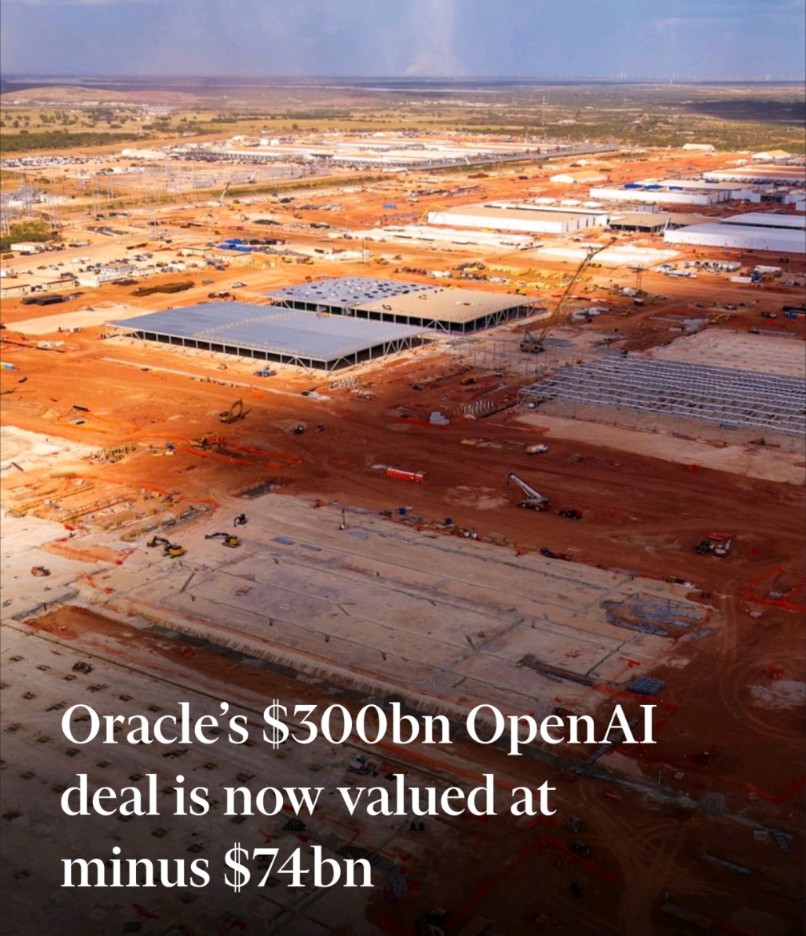
Like Poodles, I seem to have misplaced my marbles. AKA I lost them completely. Now only 9 hours ago I shouted that I am sick of the AI bubble, but a few minutes ago I got called back into that fray. You see, I was woken up by an image.

This is the image and it gives us ‘Oracle’s $300bn OpenAI deal is now valued at minus $74bn’ there is no way this is happening. You see, I have clearly stated that the bubble is coming. But in this, Oracle has a set state of technologies it is contributing. As such, where is the bubble blowing up in the face of OpenAI and Microsoft? In this, the Financial Times (at https://www.ft.com/content/064bbca0-1cb2-45ab-85f4-25fdfc318d89) is giving us ‘Oracle is already underwater on its ‘astonishing’ $300bn OpenAI deal’. So where is the damager to the other two? We are given “OK, yes, it’s a gross simplification to just look at market cap. But equivalents to Oracle shares are little changed over the same period (Nasdaq Composite, Microsoft, Dow Jones US Software Index), so the $60bn loss figure is not entirely wrong. Oracle’s “astonishing quarter” really has cost it nearly as much as one General Motors, or two Kraft Heinz. Investor unease stems from Big Red betting a debt-financed data farm on OpenAI, as MainFT reported last week. We’ve nothing much to add to that report other than the below charts showing how much Oracle has, in effect, become OpenAI’s US public market proxy:” There might be some loss on Oracle (if that happens) and later on we were given (after a stack of graphics, see the story for that) “But Oracle is not the only laggard. Broadcom and Amazon are both down following OpenAI deal news, while Nvidia’s barely changed since its investment agreement in September. Without a share price lift, what’s the point? A combined trillion dollars of AI capex might look like commitment, but investment fashions are fickle.” And in this, I still have doubts on the reporting side of things. From my own feelings (not hard core numbers) that Oracle and Amazon are the best players to survive this as their technology is solid. When AI does come, they are likely the only two to set it right and the entire article goes out of its way to mention Microsoft. But in all this Microsoft has made significant investments in OpenAI and has rights to OpenAI’s Intellectual Property (IP). This comes down to Microsoft holding a stake in OpenAI’s for-profit arm, OpenAI Group PBC, valued at approximately $135 billion, which represents about 27% of the company. So how is Microsoft not mentioned? 

As such how come Oracle is underwater? Is it testing scuba gear? And if the article is indeed true, what is the value of OpenAI now? Because that will also drown the 27% of it (holding the name Microsoft) and that image is missing from that equation. If this is the bubble bursting, which might be true (a year before I predicted it) then it stands to rights that this is also impacting Amazon, Google, IBM, Microsoft and OpenAI. As such this article seems a little far fetched, a little immature and largely premature by now naming all the players in this game. I personally thought that Oracle would be one of the winners in all of this, or better stated a smallest loser in this multi trillion bubble.

So what gives?
And in this I might be incorrect and largely missing the point, but a write-off to the amount of nearly half a trillion dollars has more underwriters and mentioning merely Oracle is a little far fetched, no matter how fashionable they all seem to be and for that matter as Microsoft has been ‘advocating’ their copilot program, how deep are they in? Because the Oracle write-off will be squarely in the face of that Nadella dude. As he seemingly already missed the builder.ai setting, this might be the one ending his career and whatever comes next might want to commit suicide instead of accepting whatever promotion is coming his way. (I know it is a dark setting) but the image is a little disconcerting at present. And the images that the Financial Times give us, like the Hyperscaler capex, show Microsoft to be 3 times in deeper water than Oracle is, so why aren’t they mentioned in the text? And in those same images Amazon are in way over their heads and that is merely the beginning of a bubble going sideways on everyone. As such, is this a storm in a cup of water? If that is so, why is Oracle underwater? And there is ample reason to see me as a non-economist, I never was on wanted to be one. But the media as gives raises questions. And I agree, Oracle is on a long way to break even, but if they do not, neither are Amazon, Microsoft and OpenAi and that part is seemingly missing too. If anything, Larry Ellison could pay the shortcomings with his petty cash (he allegedly has 250,000 million) that is how own die and the others won’t even come near that amount. 

So whilst we wait for someone to make sense of this all, we need to walk carefully and not panic, because these settings tend to be the stage where the panicky people sell what they can for dimes to the dollar and that is not how I want to see players like Microsoft jump that shark. This is not any kind of anti-Microsoft deal, it is them calling the others not innovative whilst there isn’t a innovative bone in that cadaver. So whilst we want to call the cards. The only thing I do is calling the cards of the Financial Times and likewise reporting media calling out the missing settings of loss towards Microsoft and OpenAI. It is the best I can do, I know an economic major who could easily do that, but he is busy running Canada at the moment.

Have a great day and I apologize for causing an optional panic, which was not my intention.

Leave a comment

Filed under Finance, IT, Science

Trumping it along

That is the setting as President Trump proclaimed publicly “We don’t need Canadian lumber” and then Canadian wood product (lumber and utensils too) got a tariff hike. So as American lumber is needed in construction it would not be starting at a 25% depletion of that market (12 billion board feet) is now going somewhere else, Canada has had enough of this bully tactic and that is going to cost America a lot more than ever considered. It is about to cost America well over an additional $23 billion (source: Capital Briefs) and that was merely the start of this. Now the Financial Times gives us ‘Canada to reroute lumber exports as Trump’s tariffs bite’ (at https://www.ft.com/content/e56e8bb0-6dc0-4447-a907-e95164cec8e5) where we see “Canadian producers are seeking to divert around 10 per cent of the lumber normally sent south of the border to new buyers in the UK, EU and Middle East after the US president in September added a 10 per cent tariff on lumber, on top of an existing 35 per cent duty. The aim to send some 1bn board feet to alternative markets — enough to build at least 75,000 average size American homes — underscores how Trump’s tariffs are starting to reshape some global supply chains, although tensions between the US and Canada over wood exports have simmered for more than half a century.” With the added ““The US simply needs to fact-check better before they end up with a large shortage of lumber that may cause further housing shortages,” said Rick Doman, chair of the Forestry Innovation Investment board of British Columbia, which produces over half of Canada’s lumber. Washington’s escalating trade measures towards Ottawa have led to shutdowns and job losses in Canada’s C$87bn ($63bn) forestry industry, one of the country’s largest employers.” We see that Canadians have had enough of the voice from Washington DC, with Canada shifting towards Europe and Asian Markets, as well as stocking up on renewable products the setting becomes a global setting where America can now no longer fuel its own softwood needs driving housing prices through the roof (except for Florida where the Canadian snowbirds are putting their  houses up for sale, leaving in excess of 175,000 houses empty and deserted). That is the setting America no faces and whilst America accuses Canada itself as a dumping ground, they better come up with the evidence and as we see “Zoltan van Heyningen, executive director of the US Lumber Coalition, a lobby group, said the American timber industry could replace 1bn board feet of Canadian imports “without batting an eyelid”” that person better prove to be true to his word, because as it stands Canada is withdrawing over 3 billion board feet of wood. And the NAHB gives us that  “With American sawmills operating at just 64 per cent of capacity it “will take years” for US domestic lumber production to expand to meet industry demands” and in that meantime it will be shredding nearly every environmental document it has, because as I see it, the nearest place it can go to is Washington State and I reckon it will cost a few more pennies to get all these trucks up and going. In the meantime we see that “the US relies on a further 12bn board feet of softwood lumber from Canada for use mostly in housebuilding. Even allowing for spare US sawmill capacity and average recent American exports of 1.3bn board feet a year, the US is currently 3.2bn board feet short of meeting current demand, according to analysis by Fastmarkets, a price reporting agency.” And the ‘graphs’ all show that America depends on almost 30% Canadian wood, when that all falls away its own wood export collapses to zero. And that gives America a new mess to deal with, because Canada is eager to make long term agreements with Europe and Asia, which means that the next administration inherits this mess in 2028 and there is no going back. And as I see it, the bill will be passed on to Weyerhaeuser, West Fraser and Sierra Pacific Industries who will have to increase their produce by almost 50%, to make up for the shortages it faces, so in what reality did you ever see that happen? 

It might sound like an amazing option for these three, but in the American setting it does mean that nearly every environmental agreement will have to be torn up to even make this work. In the meantime Canada is expertly drilling into a $280 billion market and is seemingly doubling that within the next decade, as Canada is now moving from a resource player to more highly valued products, its margins will increase nearly exponentially and is becoming the new innovator on the block and that will ease the pressures that America thought they would hand them, their plan for Canada becoming the 51st state is blowing up in the faces of Politicians in Washington DC and that is the short and sweet of it for Canada. The hardship handed by president Trump is becoming the opportunity for PM Mark Carney. And Canada is loving the outcome of this setting, because as such high value products are to be made in Canada, giving them the setting from $255.20 towards a more then doubled market that is to come and as China replaces America as the number one export country, there will be additional settings there too. An opportunity that Canada will handle with care while in the same time increasing its export to Europe. As I see it, America merely shot itself in the foot (yet again) and that setting is to be crowned as the number one achievement for the Administration carrying that royal crown. It tried to diminish the economic footprint of its northern partner, instead it opened a new revenue handle and increased its export standing with both the EU and China. And as I see it, at no significant initial loss to Canada and over the next few years it will show a significant surplus to boot. 

A setting the Commonwealth prices and a big round of applause is handed in the direction of Prime Minister Mark Carney who is now seen as the big winner (perhaps he will accept a Nobel peace price in 2026?)

Well, you all have a great day and special mention for Capitol Brief and the Financial Times for their support in this. It is 02:00 now. Time for me to introduce myself to the procedure of snoring.

Leave a comment

Filed under Finance, Media, Politics

Balance of the matter

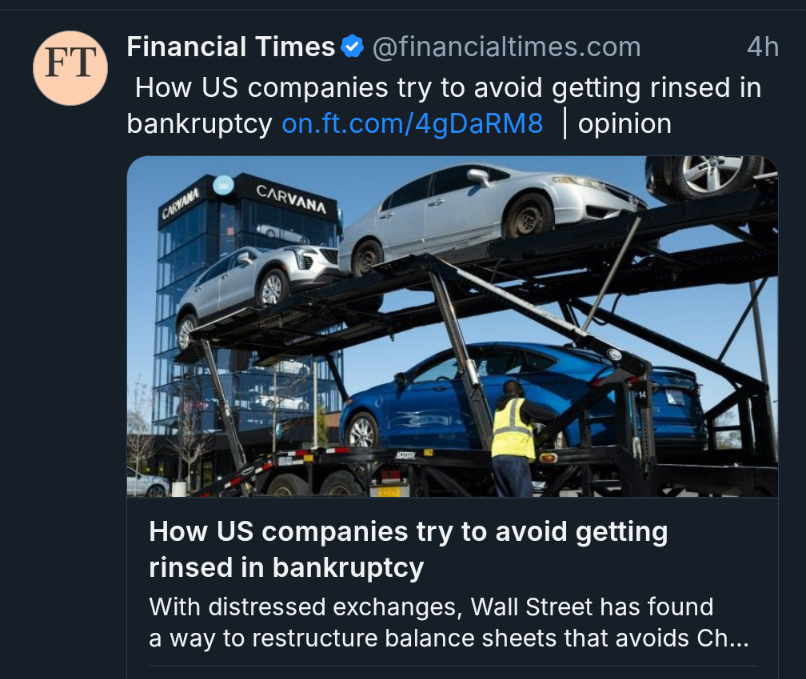
That is the setting as I see it, the balance and in particularly the Sheets balance is under attack. As we saw in Social Media

We are given “With distressed exchanges, Wall Street has found a way to restructure balance sheets that avoids Chapter 11” does this mean that financial means are no longer to be trusted in America? We get that people want to avoid their business to be seen as bankrupt, but to rebalance their books and with the approval of Wall Street is taking it a little bit far. I am not completely surprised with this action as I have said on several occasions that America is bankrupt, but to see it in action, for financial institutions like Wall Street to sound the clarion call to make it so that they appear not to be in ‘distress’ is a first clear setting for other people to take their investments out of America as soon as possible. And I get it, it is merely my point of view. So, tell me how do you react to the setting that the Financial Times is giving you? I did not read the article as it is behind a paywall, but the gist of the story is clear. And it is not about the ‘subtle’ setting of tax avoidance versus tax evasion. It is about restructuring your balance sheet. Like the Dutch banks did in 2013, the SNS bank put all the buildings in their care under a ‘bad investment’ book and the Dutch bank SNS Reaal and its banking operations, which was nationalized by the Dutch government on February 1, 2013, to prevent its insolvency and support the financial sector. As it was said (from sources) This action led to shareholders and subordinated bondholders losing their entire investments, as the Dutch state stepped in to prevent a larger financial crisis. The bad investments, primarily in real estate, led to substantial write-downs and ultimately forced the government to intervene and restructure the company. That happened before and I never accepted that action, now we see this in America on a much larger scale and it would be my (non-expert advice) to get out of their as quick as your legs (and privet jets) can take you and invest it somewhere more worthy.

This now gets me to the second setting I saw in Social Media. As some might say, Microsoft is at it again.

With ‘Microsoft said to block IDF from cloud system over use in surveillance of Palestinians’ we are given that “unit 8200 ‘violated terms of service’ in storing of phone recordings; military officials say unit backed data up ahead of time, no info lost” it is a simple setting that the backups are set towards ‘other’ sources like MySQL (or something like that) and fir the record, what evidence is there? I am not saying it isn’t true, I am asking what evidence did Microsoft have? Were they looking into the accounts of their customers? I am asking because that would be the first reason that people would drive their business to Amazon/Google/IBM/Oracle/Snowflake at the first light of day. I personally think it is the Microsoft way to make political statements and as they can slap Israel around and looking good doing it, that is what they are likely to do. Not an innovative bone in that rotten carcass (at present). And the media display is on my side of the cookie. They give us “Microsoft recently terminated the Israeli military’s main signals intelligence unit’s access to some of its services, after it allegedly used the Azure cloud platform for expansive surveillance of Palestinians, according to a Thursday report. According to the UK’s The Guardian, Microsoft told Israeli officials last week that the IDF’s Unit 8200 had “violated the company’s terms of service by storing the vast trove of surveillance data” on Azure.” (Source: times of Israel) and how was this data ‘begotten’? I reckon that the IP engines are running 24:7 to get the next iteration that Microsoft doesn’t have (this is speculative). As such there is a massive run for all IP holding cloud users to run away from Microsoft and go somewhere else. I already listed the top 4 above (in alphabetical order) and that is before we consider MySQL and whatever else is in the field. I reckon that the IDF needs to reevaluate its connections to Microsoft. I remember the IDF to be massively aware of what its technical abilities were and to see “far-left activist outlet +972 Magazine said Microsoft’s Azure software was used by Unit 8200 to store countless recordings of mobile phone calls made by Palestinians living in the West Bank and the Gaza Strip” implies that either Microsoft has too many zero day issues or there is an informer in Microsoft. My personal view is that there is no Israeli stupid enough to give +972 Magazine a hand. So my view is a little biased, but the is where I am at this time. And that will impact America too. Perhaps Amy Hood and Satya Nadella need to have a meeting with Wall Street and the Financial Times to restructure their balance sheets too, as is, they might need that assistance before too long. 

And this is where the American economy is heading it seems. So whilst we are ‘given’ ‘US economy expanded at a surprising 3.8% pace in significant upgrade of second quarter growth’ I have to wonder, is that because of the new balance sheet settings?

And if you have not used the new balance sheet methodology, have a great weekend and enjoy your coffee, for the rest I say, are you sure you can afford the coffee today?

Leave a comment

Filed under Finance, IT, Media, Politics

Setting to lull

That is not a setting I usually entertain, but the stage is now that I am. In the first the alcoholic across the hall decided to play his music 50 dB over the allowed limit and the land lord does nothing. He is the guy who casually mentioned that he went to school with the Beatle (he does not have a Liverpool accent) and he filmed President Putin topless on a horse. He is that kind of useless. 

In the meantime I could bash the idiots brain in, but then I go to prison and I am hoping that some of my irons will result in revenue making this place a massive part of me immediate past. So I need to suck it up, which in this setting of ageism is not easy. I am still working on two other scripts, but my lack of Final Draft exposure makes it a little hard. Redesigning blog articles into script parts is not a clear cut as it should be. I might redo part in pages and then import it into Final Draft, but that is for another day. As I was looking into these scripts (I have currently 4 scripts), one has been submitted to Channels in Saudi Arabia and the UAE as this script would appeal to an Islamic population. I might want to learn the setting of Indonesia, but I reckon that these two will also show my work to the audiences in Indonesia, Bangladesh and Egypt. That is the first. The second one is Vitam Exhauriens which played in part in New Orleans and in part all over the world. Then there is Keno Diastimas which is in an undisclosed location under water. And that has a few lovely twists. That one is an open-ended three seasons part with the open ending (I thought it was better that way and a wink in the direction of Terry Gilliam A director I have admired for a long time. The fourth one is the one that is ‘now’ in season three and is called Engonos. That one is in part in London, in part in Greece and in part in Turkey (so these parts need to be found in one locations), but that is not my problem, my ‘challenge’ is the story and these three are on my plate. I have progression in both Vitam Exhauriens and Keno Diastimas, but they have different ‘challenges’ the second one is pretty complete, but I am still uncertain about some of the elements, to make it fit better as a story and as a TV show, but that is my challenge.

The second setting is about making some issues work (not the scripts). As I see the world going to hell in a hand basket, I can merely look at what happens and see how it unfolds. There is nothing I can do about it. As Reuters is giving us ‘US unemployment rate near 4-year high as labor market hits stall speed’ as well as ‘Wall Street Week ahead inflation data looms for markets’ and that happens whilst we also get Goldman Sachs as Reuters gives us ‘Goldman takes $1 billion stake in T. Rowe to tap retirement money’ and there we get “Big financial firms such as Goldman, BlackRock and Morgan Stanley are making a big push into alternative assets, an area dominated by private equity firms, to capitalize on their growth potential and attract new clients.” And that has to go at the cost of retirement money? I am not an economist and I do not claim to be one, but there is something ‘shoddy’ (in my mind) that a bank would invest a billion dollars. It usually is to get more in return. So how does this help retirees? I made mention that the BIGFIN and government would shake the retirement tree at some point. Is this the beginning?

I do not know, but it makes me uneasy. You see, if this is happening in America now, then soon enough (I have no idea when) it will happen to the United Kingdom, Australia and Europe as well. When? That is anyones guess and I reckon that the American setting is dire enough to do this now, but it takes a lot more knowledge to confirm or scuttle the setting we see here. The Financial Times is hanging the question whether the America economy is already in recession and the should know, so it seems like the economists at large are playing musical chairs. All that whilst the Economist comes with ‘What if the AI Stockmarket blows up?’ With the byline that “We find that the potential cost has risen alarmingly high” I could have told them that over a year ago and the entire builder.ai with the setting of Microsoft pumping it up to a billion dollars wasn’t a nearly dead giveaway? 

It is now as we approach Q4 that the ‘high’ costs are ‘suddenly’ getting the forefront news. And this happens in a time when America is getting hit with negative news after negative news. I saw most parts of this coming, but now we seemingly get it all in one quarter and I reckon that is the moment the larger companies start shedding more and more jobs whilst hiding behind the nonexistent AI wall. Yup, that will give several people a bloody nose to begin with and when the media wakes up from all this screaming “What’s this, how could this happen?” You know you’ve been had because they (the media) merely care about their digital dollars. So whilst we get all this, The Financial Times also gives us ‘Peter Mandelson warns US and UK must unite to halt Chinese tech supremacy’, I could not read the article as I am not a member, but here is a thought. How about becoming an actual ‘innovative’ force. Not claiming that you are, but becoming one. I am hoping that Peter Mandelson refers to the British Ambassador to the United States. You see, China is at least a furlong ahead of the rest and when we see a race that is merely 5 furlongs you are already losing that race. If the race is 12 furlongs you are less likely to become winner, at best you can hope to come a contender and I have shown that Amazon and Google dropped the ball a few times leaving billions on the floor. Al claiming that they had the AI field in hand. But there is no AI field, not yet and that realisation gives the setting. I basically handed the open victory to Al Waleed bin Talal Al Saud as well as Tencent. Whether they would grab that open ball for the win is anyone’s guess, but that is where we stand. So whilst we see all kinds of places shedding thousands of people, I cannot vouch for Google doing that. There is talks that thousands were shed, but it is specific (and I do not know all the details), so whilst we see that these people are shed, we see ‘their’ reasons for shedding sales people and being replaced by AI agents. That is out in the open. I am not judging as DML is a setting that can be applied to advertising. So how that goes will be in the corridors of awaiting judgment.

Still we see a massive change happening and I am (fiercely) hoping that people like Al Waleed bin Talal Al Saud see the wisdom that I bring (it would make my retirement a decent certainty). But that too is out in the open. I do know that if my retirement depends on the American setting that I end up working until the day I die in hunger. Not a setting I relish mind you.

So I end up in a waiting pattern for now. Have a great day. My Monday is off to a rocky start.

Leave a comment

Filed under Finance, IT, Media, movies, Stories

In other bad news

That is how it reads, is this the reality of things? That remains to be seen, but as I see it, there is a rolling effect. A news source gave me this morning that IndiGo is starting two new routes. One between Abu Dhabi and Visakhapatnam, the other one is between Abu Dhabi and Bhubaneswar. They represent populations up to 3.2 million people, and that is the direct surroundings of these places. It is important to see that, as that implies that the setting that I predicted that America will lose more and more tourists is starting in this kind of situation. You might give credence to the ‘mumblings’ that this will soon pass over, and perhaps it will. But the direct setting is that those that rely on their one vacation a year, they are choosing Abu Dhabi (and Dubai) over American destinations. So when you decide to trust ‘The US tourism slump that never happened’ (source: Financial Times), or perhaps ‘Desperate U.S. Hotels And Tourism Operators Continue ‘Come Back’ Deals For Canadians’ (source: The travel) you are looking in the wrong direction. Yes, in a few years travel to the USA will bounce back, it is the next three years that matter and in the meantime the UAE is gaining traction in many ways. And over the next three years it will develop into a main destination for the better part of the globe. In the meantime America will be bleeding losses on all sides. And when the bounce back ‘fails’ or more precisely is delayed. The losses for America will merely add up to a lot more. 

That is beside the larger setting. You see, Visakhapatnam was in 2020 a finalist in the Living and Inclusion category of the World Smart City Awards. As such travel is interesting both ways, it also has its own share of beaches and it is the 5th busiest port in India, as such commerce is likely to blossom between the two nations. As for Bhubaneswar, is a hub of sports and IT in the country. As such there is a larger interaction possible between the two places. All options that are now a moot setting for the EU and America. And the fact that IndiGo is a low cost airline, the tourists cluster that will have the UAE on their international dreamless will increase rather sharply. We might look at all the ‘wealth’ that travels. But for every wealthy traveller the UAE sees, there will be 50 non-wealthy tourists and this amounts to a lot of visitors. I reckon that IndiGo is merely the first to see that influx of tickets sold. I reckon that by late November everything Indian who dreamt of seeing a Formula 1 race with his or her own eyes will flock to the UAE and that is just for starters. As I see it tickets for Yas Island will be the hottest ticket of the year. With all the extras you get to enjoy, the need for hotels and especially low cost hotels will explode in no time flat. 

Just two settings that America is currently missing out on and for the next three years. Have you considered the impact that VISA’s and ‘integrity fee’ options that America thought to help to guide them through. And more bad news in this category (as stated by some for 2026) are discouraging more and more tourists to America and now they have a stellar place to go from March 2024 onwards. And now the setting becomes that more and more are discouraged to visit America as it is seen. The larger setting becomes that Saudi Arabia will from 2027 onwards the next competitors for all these tourists who need a place to go. I reckon that some will chose China as a destination, but the numbers on that remain speculative and is not supported by factual data at present.

Have a great holiday to come in 2025

Leave a comment

Filed under Finance, Media, Tourism

Lies of the present

That is what I saw hours ago, lies of the present. We all know that tourism in America is down. The strongest influencer in this is Canada and the impact is larger. There is Flight center with the $100M income wallet bash. But no, here is the Financial Times giving us this ‘presented truth’ 

So, when we see another source give us “The tourism industry in the United States is witnessing a notable downturn, with a 17% reduction in European visitors in March 2025 compared to the previous year. This decline is alarming, given the tourism sector’s contribution of approximately 2.5% to the U.S. GDP. The decrease isn’t limited to European visitors; the overall number of foreign tourists fell by 12%, marking a significant drop since the post-pandemic recovery period of 2021.” As such, we only see the little text the FT gives us with the headline ‘The US tourism slump that never happened’ and that is it. I didn’t read the article because I never paid and this is how the FT leaves us hanging. And in light of this ‘debatable’ presentation towards income, the Financial Times can be accused of nearly anything. The downside of throwing teasers to the public to gain fees. With the text “Leading travel industry players are expressing concern over declining interest in U.S. destinations among European travelers. Accor, a French hotel group with a significant presence in the United States, reported a 25% decrease in summer bookings from Europe. Similarly, Voyageurs du Monde noted a 20% drop in bookings since the onset of the current U.S. administration, reflecting a growing disinterest among European tourists.” As such, what slump never happened? So whilst we read “this shift signifies a broader sentiment of dissatisfaction with U.S. policies and highlights the need for a reassessment of strategies to attract European tourists. Industry leaders emphasize the importance of addressing international perceptions to rebuild confidence in the U.S. as a welcoming and diverse destination”, whilst other places (like Abu Dhabi) is showing themselves like a more willing host to tourists all over the world. What possessed the FT to give us this (unread by me) article? As I see it, you cannot play ‘upside’ boy using presented advertising without getting hurt. The Financial Times Is according to some “a renowned British daily newspaper and digital publication that provides in-depth coverage of business, economic, and financial news on a global scale” So what does that bring us “Despite fears of a sharp downturn amid foreign visitor boycotts, the sector has had a decent summer”? In a setting where we see places like NPR gives us ‘Far fewer Canadians are visiting the U.S. this year, new numbers show’ with the added text ““It’s tough, because we’ve developed this relationship with the cross-border economy,” Dame said. “And now here we are, the rug getting pulled out from underneath us.” New data confirms that far fewer Canadians are making trips south. Canadian residents made just 1.7 million return trips by motor vehicle back into their country from the U.S. in July, a nearly 37% drop from the same month in 2024, according to a report published this month by Statistics Canada.” So how exactly is this ‘the slump that never happened’? Then when we see ““It’s a decline that’s not stopping things from happening, but it is affecting the revenue that people are collecting,” she said. The U.S. saw 20.4 million visits from Canadians last year, making Canada the top source of international tourists to the United States, the U.S. Travel Association reported. The group said in February that those visits generated $20.5 billion in spending and supported 140,000 U.S. jobs.” I see that as a slump and it is happening all over the place (Florida is a ‘great’ example), my issue is that America can be delusional all it wants to be, but when the media is catering to certain aspects like catering to big corporations and big tech, they are hindering the truth from reaching us. A nice example is the Chinese mega corporation Evergrande, who crossed all three red lines, resulting in a liquidity crisis and its later insolvency. In summer of 2021, payments due on its debt, estimated in the hundreds of billions of dollars, resulted in the Evergrande liquidity crisis. So how many people were hit by that setting? How many people are investing now on bed and breakfast investments in America will be seeking a Chapter 11? (Apparently only the first 10 chapters are worth reading) We the people are depending on correct news and when we are given dubious articles by the people who used to inform us, what hopes do we have to evade any financial fallback? 

It is about the accountability of the media, ‘filtering’ information to give us the information that makes us jump as to what the ‘big dogs’ wants us to do. On June 19th 2012, I wrote ‘The accountability act – 2015’ (at https://lawlordtobe.com/2012/06/). It never came, and now 10 years later we need to start asking questions, where is the responsibility of the press? Where is the accountability of the media? And this is not just the Financial Times, it is the bulk of the media that is the question. Can we allow the media to play courtesan to big tech and big corporations for the need of digital dollars? Have we become that dim?

Questions that are not answered by anyone as the political players hide behind the ‘game that is played, as business as usual’ whilst they are all arranging the chessboard like a game of blindman chess, with only big business getting to see both chessboards and depriving us of the real deal. So how is that valid? Because when the setting is that we need to pay to see it all, and they deprive us of a fair view, is that not some form of discrimination? What happens when an audience of billions see that big corporations made themselves the royalty they were never supposed to be, that they replaced real royalty in places they could and as they lived through the settings of ‘live like presented’ and than change the presentation so that only ‘they’ could remain is not a way to live, not for the others. And this has been going on for decades, all presenting ‘partners’ having each others back. Often hiding behind ‘the people have a right to know’ but in the underline it is given in the way of ‘the people have a right to know what we want them to know’ and as such the filtering goes on and now that the economies of this world are in turmoil, the cracks start showing. You see World Association of Newspapers and News Publishers represented over 18,000 publications in 2011, and Wikipedia notes that in 2005 there were approximately 6,580 daily newspaper titles globally, with 1,450 in the U.S. alone. There is no real up to date number. But consider that there are 340 million people in America, there are 1450 newspapers, which means that there are 234.5K readers per newspaper (through pig latin analyses) but that is never true, as such they ALL want to get their advertisement money, that is the rule of newspapers, not the news, the advertisements. And as the media exploded in size, it stood to reason (their reason) that this income increased, it did not. So as more and more were deciding that chasing the digital dollar was the way to go, the intent and the credibility of the media decreased. As advertisement evolved and digital advertising was the next new thing, the media exploded into the field of exploiting digital advertising. And here the setting changed. As the media is now ‘depending’ on that setting, the news takes a turn for the bad of the land and can now be influenced by big business and as such we get the setting we see now all over the place. People like Murdoch live of this venture and it is their right, but the larger media, the media that is ‘depending’ on credibility, what about them? I am not saying that all media need to adhere to ‘old’ standards, but we now have an issue. When we are given ‘the slump that never happened’ all whilst we see others give us ‘US Tourism in Peril as Decline in Foreign Visitors, Soaring Visa Fees, and Stricter Travel Policies Drive Away International Travelers’, so did the slump never happen?

I’ll let you decide. Have a great day.

Leave a comment

Filed under Finance, Media, Tourism