That was always in the works, especially as those so called ‘influencers’ were trying to get traction at the expanse of both Saudi Arabia and the UAE on LinkedIn and YouTube (optionally also on TikTok, but I do not venture there). So as we see the Defense Post (at https://thedefensepost.com/2026/03/25/lig-nex1-palantir-defense-uae/) give us ‘LIG Nex1, Palantir Expand Defense Cooperation in UAE’ which comes with the hidden byline, the image shows a soldier with a Saudi patch, but that might have a different alignment issue. Where we see “The deal was signed at Palantir’s headquarters in Palo Alto, California, with senior executives present, but no details on programs, timelines, or contract value were disclosed. Under the initiative, South Korean firm LIG Nex1 will contribute its experience in integrated air defense and unmanned systems. US-based Palantir will provide data integration and analytics software designed to support defense operations and connect sensors, platforms, and command systems.” And it seems that there are optionally additional settings. The Dutch organisation Trollrensics might be well suited to expand its horizons to both Saudi Arabia and the UAE. That firm has had expertise in dealing with the data to ‘unveil’ Russian trolls and give defense abilities to the Ukrainian IT forces. As I see it, it also has seen its shares of Chinese trolls and when comparing Palantir to Trollrensics there is no question that Palantir wins. But taken the price of a seat, I reckon that Trollrensics would be great at prototyping the requirements to unveil these fake influencers. And rolling out Palantir to an organisation is kinda big. Getting a small team onto Trollrensics seems a little easier. As such both nations could be deploying both solutions in the field giving prototyping abilities in almost no time flat and when more is needed in comes Palantir with the the driven questions that have been parsed to some extent, without draining the AI pool of credits (as the saying goes) a simple setting that I was aware of at least. So as we are given that the Dubai mall is empty (according to an influencer on YouTube) we need to realise that this was in the middle of Ramadan. I reckon that most Muslims will avoid the temptations that the Dubai Mall gives the fasting Muslim community. It might be small, but the underlying setting is ‘abused’ by that influencer giving the watcher that the mall was empty for another reason. So as I give the world
The image of Gulf News that the crowds at the Dubai Mall (Dubai) are just fine, remember that you also get loads of information from people who have no idea what they are doing and they are merely in it to get the numbers and their YouTube Subscriber Milestone award, all whilst they have no idea what they are doing to the truth of the matter.
So, you all have a great day and consider where you are in the larger setting of things.
That is at time the saying, it isn’t always ‘meant’ in a positive sight and it is for you to decide what it is now. The Deutsche Welle gave me yesterday an article that made me pause. It was in part what I have been saying all along. This doesn’t mean it is therefor true, but I feel that the tone of the article matches my settings. The article (at https://www.dw.com/en/german-police-expands-use-of-palantir-surveillance-software/a-73497117) giving us ‘German police expands use of Palantir surveillance software’ doesn’t seem too interesting for anyone but the local population in Germany. But that would be erroneous. You see, if this works in Germany other nations will be eager to step in. I reckon that The Dutch police might be hopping to get involved from the earliest notion. The British and a few others will see the benefit. Yet, what am I referring to?
It sounds that there is more and there is. The article’s byline gives us the goods. The quote is “Police and spy agencies are keen to combat criminality and terrorism with artificial intelligence. But critics say the CIA-funded Palantir surveillance software enables “predictive policing.”” It is the second part that gives the goods. “predictive policing” is the term used here and it supports my thoughts from the very beginning (at least 2 years ago). You see, AI doesn’t exist. What there is (DML and LLM) are tools, really good tools, but it isn’t AI. And it is the setting of ‘predictive’ that takes the cake. You see, at present AI cannot make real jumps, cannot think things through. It is ‘hindered’ by the data it has and that is why at present its track record is not that great. And there are elements all out there, there is the famous Australian case where “Australian lawyer caught using ChatGPT filed court documents referencing ‘non-existent’ cases” there is the simple setting where an actor was claimed to have been in a movie before he was born and the lists goes on. You see, AI is novel, new and players can use AI towards the blame game. With DML the blame goes to the programmer. And as I personally see “predictive policing” is the simple setting that any reference is made when it has already happened. In layman’s terms. Get a bank robber trained in grand theft auto, the AI will not see him as he has never done this. The AI goes looking in the wrong corner of the database and it will not find anything. It is likely he can only get away with this once and the AI in the meantime will accuse any GTA persona that fits the description.
So why this? The simple truth is that the Palantir solution will safe resources and that is in play. Police forces all over Europe are stretched thin and they (almost desperately) need this solution. It comes with a hidden setting that all data requires verification. DW also gives us “The hacker association Chaos Computer Club supports the constitutional complaint against Bavaria. Its spokesperson, Constanze Kurz, spoke of a “Palantir dragnet investigation” in which police were linking separately stored data for very different purposes than those originally intended.” I cannot disagree (mainly because I don’t know enough) but it seems correct. This doesn’t mean that it is wrong, but there are issues with verification and with the stage of how the data was acquired. Acquired data doesn’t mean wrong data, but it does leave the user with optional wrong connections to what the data is seeing and what the sight is based on. This requires a little explanation.
Lets take two examples In example one we have a peoples database and phone records. They can be matched so that we have links.
Here we have a customer database. It is a cumulative phonebook. All the numbers from when Herr Gothenburg got his fixed line connection with the first phone provider until today, as such we have multiple entries for every person, in addition to this is the second setting that their mobiles are also registered. As such the first person moved at some point and he either has two mobiles, or he changed mobile provider. The second person has two entries (seemingly all the same) and person moved to another address and as such he got a new fixed line and he has one mobile. It seems straight forward, but there is a snag (there always is). The snag is that entry errors are made and there is no real verification, this is implied with customer 2, the other option is that this was a woman and she got married, as such she had a name change and that is not shown here. The additional issue is that Müller (miller), is shared by around 700,000 people in Germany. So there is a likelihood that wrongly matched names are found in that database. The larger issue is that these lists are mainly ‘human’ checked and as such they will have errors. Something as simple as a phonebook will have its issues.
Then we get the second database which is a list of fixed line connections, the place where they are connected and which provider. So we get additional errors introduced for example, customer 2 is seemingly assumed to be a woman who got married and had her name changed. When was that, in addition there is a location change, something that the first database does not support as well as she changed her fixed line to another provider. So we have 5 issues in this small list and this is merely from 8 connected records. Now, DML can be programmed to see through most of this and that is fine. DML is awesome. But consider what some called AI and it is done on unverified (read: error prone) records. It becomes a mess really fast and it will lead to wrong connections and optionally innocent people will suddenly get a request to ‘correct’ what was never correctly interpreted.
As such we get a darker taint of “predictive policing” and the term that will come to all is “Guilty until proven innocent” a term we never accepted and one that comes with hidden flaws all over the field. Constanze Kurz makes a few additional setting, settings which I can understand, but also hindered with my lack of localised knowledge. In addition we are given “One of these was the attack on the Israeli consulate in Munich in September 2024. The deputy chairman of the Police Union, Alexander Poitz, explained that automated data analysis made it possible to identify certain perpetrators’ movements and provide officers with accurate conclusions about their planned actions.” It is possible and likely that this happens and there are intentional settings that will aide, optionally a lot quicker than not using Palantir. And Palantir can crunch data 24:7 that is the hidden gem in this. I personally fear that unless an accent to verification is made, the danger becomes that this solution becomes a lot less reliable. On the other hand data can be crushed whilst the police force is snoring the darkness away and they get a fresh start with results in their inbox. There is no doubt that this is the gain for the local police force and that is good (to some degree). As long as everyone accepts and realizes that “predictive policing” comes with soft spots and unverifiable problems and I merely am looking at the easiest setting. Add car rental data with errors from handwritings and you have a much larger problem. Add the risk of a stolen or forged drivers license and “predictive policing” becomes the achilles heel that the police wasn’t ready for and with that this solution will give the wrong connections, or worse not give any connection at all. Still, Palantir is likely to be a solution, if it is properly aligned with its strengths and weaknesses. As I personally see it, this is one setting where the SWOT solution applies. Strengths, Weaknesses, Opportunities, and Threats are the settings any Palantir solution needs and as I personally see it, Weakness and Threats require its own scenario in assessing. Politicians are likely to focus on Strength and Opportunity and diminish the danger that these other two elements bring. Even as DW gives us “an appeal for politicians to stop the use of the software in Germany was signed by more than 264,000 people within a week, as of July 30.” Yet if 225,000 of these signatures are ‘career criminals’ Germany is nowhere at present.
Have a great day. People in Vancouver are starting their Tuesday breakfast and I am now a mere 25 minutes from Wednesday.
Yup, this happens to us all. Even the non-dancers. Twinkletoes means “used to refer to someone who is a good dancer or who moves lightly on their feet”, I accept that, but as I personally see it, it Also stages the person who has the situation that the person “who is a thinker or who moves swiftly in their brain” the same situation applies. I have been iterating new IP through existing games for over two days now (and it is really exhausting). I have been making new iterations to my version of Elder Scrolls 6: Restoration, a new FarCry (based on the legendary FarCry 3), the new RPG I have set on paper here, new iterations of commerce (in the RPG’s) and added a setting to a new stealth RPG (not a new Assassins Creed) and a very new approach to Watchdogs 5: Observations (in its earliest infancy), I had already commenced Watchdogs 4 to paper (somewhere on this blog) and it plays in modern day Japan. I changed the setting to Sapporo, as this is relatively new in gaming and as such there is novelty in new locations and the story requires a harbor setting. And this has been merely the last two days, although the original setting were created up to 5 years ago, with the setting of Restoration (TES6) almost 10 years ago. So as I am driven to near exhaustion as my brain is in twinkletoe mode, I can assure you that it is merely my version of overly active brain syndrome (perhaps there is a medical term for it) and it is leaving me a little tired. As it the case, it did give me the setting of Watchdogs 5, the issue here that it is a networking setting as the game goes in pairs.
It is also less action driven, but more activity driven, as such you can be the hacker or the Agent in this game, there is a larger setting that you as one or the other can give clues to a fellow on the other side of the isle and the goal is to create a more robust observation and detection system. The frail setting of certain systems allows for actions to be monitored on CCTV, the internet and personal observations. The thought came to me as I was remembering 1985 video game Hacker by Activision. It was designed by Steve Cartwright and he got it done on a system with a mere 64KB, too what happens when we throw some real power to it? What happens when we unite agents and hackers and run the system from both ends? Can this result in a much more robust system? What happened when the game adds zero day faults (Apple has a few, Microsoft has tons as I personally see it). So what happens when we set these stages in motion and it is not merely point and click, so why happens when a Palantir (Gotham) system is thrown into the mix? I am merely postulating now, the reasoning that games could also instruct or teach people on how vulnerable they are in real life.
As we move from station to station, some might remember the game V (based on the 1983 TV series), you merely run to a point and activate that system to let the red fumes inhabit the space station (I think that was what I was supposed to do), but add a section based on Portal (by Rob Swigart, 1986) you can get a lot more. That is the setting that I see when we set a game like Hacker to a much larger stage and at that point it is new IP, not merely some variation of IP, but a much larger stage and totally new. A game that teaches, informs and trains the next stage. As we now see that programmers are programming bots to keep scammers uselessly busy, we can grow more mundane and more intense in almost any direction. And it is a new endeavor, not some wannabe drip drip copy, but something totally new. Just like the makers of Chipwits (by Epyx, 1984) made a new version a larger and more enticing version on these newer systems, we can grow many games in new jackets and larger premises to new heights. And these systems have the computation powers to net the stage much larger. We can use the setting of the Balance of Power and add a few cogs to make it a much larger machine. And as Chipwits has a new version 42 years later in a much larger setting, we can do this in many ways and I wrote about them around 4 years ago. The new IP set on original ideas and stupidly discarded by this who thought the new horizons require better games, all whilst these games are the timeless golden oldies. We saw and forgot what Millennium 2.2 brought on the Commodore Amiga with 1024 KB on 150ns. Now we have systems (and mobiles) with 32000 times more memory and more than 15000 times more storage whilst the processors are over 250,000 times faster. You can really go to town on those merits and create the larger setting on several stages. I said that this was part of the 50 million Amazon Luna sales that I foresaw and some are in such stages now, but as I saw it Amazon stayed asleep and like Alexandre Auguste Ledru-Rollin (1864) they went with that setting in the trend of “There go my people. I must find out where they are going so I can lead them” and the left billion on the floor all relying on the AI hype. I was thinking on that last week, there is no AI and I see it as NIP, Near Intelligent Parsing (making it NIP avoiding the confusion with IP). A setting that is overlooked, because as there is no AI, they all shout, so what is it then? Well, it is near intelligent, there is no real intelligence at present and it is set to the programmers who are parsing data and ideas into new (flawed) data. You see, a lot of this is intelligence and it almost get you there, but not entirely, the training models are set to more and more likely outcomes but there are percentages that are off and that is where the shoe becomes the wrong fit and I reckon that when these errors hit ADNOC and ARAMCO both will want some legal satisfaction and it might be a few years away, but it will happen, because the distance between real AI and NIP will be the size of the Grand Canyon (which these AI proclaimers will deny) and as they throw more complex legal documents at the customers they will get out to ‘their’ field retired and non-accountable to any legal discourse. It is almost like bad mortgages sold (or swapped) to new owners and they get out. Yet this field is the new wild west and I refuse to become part of it. And what happens, I saw the new stages of income based on old software. The Atari 600/800, Atari ST, CBM64 and CBM Amiga gave us over 10,000 games between 1983 and 1999. So if we only take the highest scoring 10% we get 1000 games. Now 30%-50% have IP protection, but I saw the override in new IP in a few ways and these are valid options as I see it and that implies that that ‘great’ (not really) game brand Microsoft, left thousands of options on the floor whilst they went to spend billions on something that I not panning out. You see, where it all becomes a new kind of hustle, all whilst for over two years I have written on other means to get revenue? And I am not done yet, because as I see it, the more I write here, the more revenue I show and the more IP I give here, the weaker the bog tech firms show themselves to be. A simple setting with simple outcomes and the best gig becomes that should someone copy the IP I set here, the bigger the losers biotech becomes. A simple equation to the question what makes for a good game?
That leaves me with the question, is there a mental setting to Twinkletoes? It is merely a mental thing in me, the question I cannot answer has a larger appeal than most other things in life. Have a great day and if you wonder what bag I left here? I do some things with intent, you can’t give away the game and here is the setting. In November 2018 I wrote ‘It’s about time, slappers only’ (at https://lawlordtobe.com/2018/11/29/its-about-time-slappers-only/) the premise to Watchdogs 4, and the larger player would be the one with Meta Glasses, before Meta even had glasses, I call them Google Glasses. As such I was ahead from META by years. And as I see it, I have done so a few times with games and when we see Software companies make ‘innovative’ claims (hardware suppliers too) I get to be front and central in their claims showing them what I had created years ago. I reckon that I am mere steps to show what I had months if not years from what Bernard Arnault apparently had created whilst I had the setup in my bog (and more) close to a year before they made their AR (Augmented Reality) claims through LVMH. I was a few steps ahead of them and I made it common goods in my blog before March 21st 2023 in ‘The unplanned story’ (at https://lawlordtobe.com/2023/03/21/the-unplanned-story/) and all the wannabe innovators (no referral to Bernard Arnault) can go suck an egg. As I said, have a great day with an optional game or two, because gaming makes the brain go in innovative mode.
Well, the answer is simple. It is +1 202-346-1100 (aka Google DC – Massachusetts Ave). As such the Pentagon has a few more techies in service. Yes, we all know that according to the BBC (at https://www.bbc.com/news/articles/cy081nqx2zjo) that they are there for the AI concerns and the setting ‘given’ is “Alphabet has rewritten its guidelines on how it will use AI, dropping a section which previously ruled out applications that were “likely to cause harm”.” And we also heard the ‘other’ side with “Human Rights Watch has criticised the decision, telling the BBC that AI can “complicate accountability” for battlefield decisions that “may have life or death consequences.”” So here comes my question “What will you do about that?” You have done extremely little to the Hamas setting, to the Syrian setting and to the Houthi setting, not to mention acts against Iran, its IRGC, Hamas, PLO, Houthi terrorists, Hezbollah and a few other parties.
I think it is time for the Human Right Watch to set next to a set of tea grannies and debate ‘normalcies’ with these grannies over tea with a bicky.
In the mean time people within or outside of Google will face the challenges of the world and as I see it the Pentagon is short on people. So until that gets resolved Google does what it needs to de and create a work sphere that can service its people. Let’s not forget that Amazon, IBM, Meta, Microsoft and a few others are ‘departing’ with thousands of people and placing them outside the workforce. Google adjusted its view to include a set of duties that are extremely unlikely to do harm (there is a 0.0001% chance a person gets executed by messing with the back of a server rack). As such I think that Google has the better mindset. Oh, and before you complain. With all these firms dumping staff on the ‘reduction’ line, they will most likely be out of a job for several years. So good luck with that setting, especially if you are in California.
And as we are given “In a blog post Google defended the change, arguing that businesses and democratic governments needed to work together on AI that “supports national security”.” We could surmise that there is a small chance that Google will be the go-to guy for Palantir settings, upping the value of Google by a fair bit (and giving Palantir the people the desperately require). There is another side, but that is pure speculation on my side. Google will enable the US Administration to make bigger inroads into exporting this knowhow to Saudi Arabia, UAE, NATO (all over Europe) and a few other places. As such Google will enable American growth. So what have these naggers (HRG’s) achieved?
So whilst they (via BBC) give us “Experts say AI could be widely deployed on the battlefield – though there are fears about its use too, particularly with regard to autonomous weapons systems. “For a global industry leader to abandon red lines it set for itself signals a concerning shift, at a time when we need responsible leadership in AI more than ever,” said Anna Bacciarelli, senior AI researcher at Human Rights Watch.” Consider what ‘red lines’ are. You didn’t hold Apple account for pushing advertisements of gambling to children, You never held parties that are a clear and present danger to any level of account. So it is time to consider the Human Rights Groups for the windbags they actually are. Spreading unease and flaming what they can (which never did them any good) as such Anna Bacciarelli, got here name mentioned one more time and people (specifically Googlers) need to get back to the business at hand before China gets too much of the world in its grasp. I personally don’t care about AI (as it doesn’t exist) but the world is now revolving around Deeper Machine Learning, Advanced Deeper Machine Learning and LLM’s and here Google can impact all kind of business and it is clear that The Pentagon needs that knowledge if it is to keep on standing. And before these grannies start crying foul bicky, consider the line ‘California Wildfires: How exci’s AI Technology is Revolutionising the Fight’ Do you think that this was possible with just public spendings? Do you think that “An estimated 12,000 houses, businesses, schools and other structures have been damaged or destroyed, at least 24 people have died and about 150,000 people were ordered or warned to evacuate.” This will continue? The next setting, which is optionally a year away will remain, he next time the casualties will run into the hundreds. And ‘AI’ will diminish these casualties to approaching zero. That is the other side and only larger settings (like the military) have the processing power to do something about it. So, the social news setting was ‘Amazon, Google, Meta, Microsoft, Apple and Uber haven’t donated anything toward LA fire relief, but Taylor Swift donated $10 million.’ (Source: Politifact) Which could be true (it was not, as stated by themselves as “Swift’s donations to 10 organizations for wildfire relief efforts.”), but Meta set up systems so that people could stay in touch, set up the markers for people to warn families and friends. I am not sure what they others did, but they did something. Even Microsoft (as I saw a notice) gave ‘Wildfire Risk Predictive Modeling via Historical Climate Data’ You don’t think this was an intern with HWG sympathy did this. This was at least a team busy crunching data and verifying number for days effort. California was the first hit and this will not be enough. Google might become a power for good on several fields. We can’t steal the thunder from Exci who have their abilities, but one player is not enough and this military needs to become multitasking. The Dutch clearly saw this need in the 80’s and 90’s and they reacted. Now Google is setting a new frame pushing new boundaries. Two little fields that Anna Bacciarelli overlooked. How Human Rights was that. Oh, I forgot fires are natural and people have a right to be baked to a crisps BBQ style.
And in other news, consider the stage that they gave with “battlefield decisions that “may have life or death consequences.”” The Pentagon doesn’t need Google for that, they can do that all by themselves. I reckon that a few more ethical hurdles are added when Google gets entered into that frame. I might be wrong but that is how I see it.
Have a great day and enjoy tea with a bicky as tea grannies and HRG members tend to do.
This is what we usually see, or at times hear as well. Now I am not an AI expert, not even a journeyman in the ways of AI, But the father of AI namely Alan Turing stated the setting of AI. He was that good as he set the foundation of AI in the 50’s, half a century before we were able to get a handle on this. Oh, and in case you forget what he looks like, he has been immortalised on the £50 note.
And as such I feel certain that there is no AI (at present) and now this bubble comes banging on the doors of big-tech as they just lost a trillion dollars in market value. Are you interested in seeing what that looks like? Well see below and scratch the back of your heads.
We start with Business Insider (at https://markets.businessinsider.com/news/stocks/tech-stock-sell-off-deepseek-ai-chatgpt-china-nvidia-chips-2025-1) where we are given ‘DeepSeek tech wipeout erases more than $1 trillion in market cap as AI panic grips Wall Street’ and I find it slightly hilarious as we see “AI panic”, you see, bubbles have that effect on markets. This takes me back to 2012 when the Australian Telstra had no recourse at that point to let the waves of 4G work for them (they had 3.5G at best) so what did they do? They called the product 4G, problem solved. I think they took some damage over time, but they prevented others taking the lead as they were lagging to some extent. Here in this case we are given “US stocks plummeted on Monday as traders fled the tech sector and erased more than $1 trillion in market cap amid panic over a new artificial intelligence app from a Chinese startup.” Now let me be clear, there is no AI. Not in America and not in China. What both do have is Deeper Machine Learning and LLM’s and these parts would in the end be part of a real AI. Just not the primary part (see my earlier works). Why has happened (me being speculative) is that China had an innovative idea of Deeper Machine Learning and package this innovatively with LLM modules so that the end result would be a much more efficient system. The Economic Times (at https://economictimes.indiatimes.com/markets/stocks/news/worlds-richest-people-lose-108-billion-after-deepseek-selloff/articleshow/117615451.cms) gives us ‘World’s richest people lose $108 billion after DeepSeek selloff’ what is more prudent is “DeepSeek’s dark-horse entry into the AI race, which it says cost just $5.6 million to develop, is a challenge to Silicon Valley’s narrative that massive capital spending is essential to developing the strongest models.” So all these ‘vendors’ and especially President Trump who stated “Emergence of cheaper Chinese rival has wiped $1tn off the value of leading US tech companies” (source: the Guardian). And with the Stargate investment on the mark for about 500 billion dollars it comes as a lightning strike. I wonder what the world makes of this. In all honesty I do not know what to believe and the setting of DeepSeek the game will change. In the first there are dozens of programers who need to figure out how the cost cutting was possible. Then there is the setting of what DeepSeek can actually do and here is the kicker. DeepSeek is free as such there will be a lot of people digging into that. What I wonder is what data is being collected by Chinese artificial intelligence company Hangzhou DeepSeek Artificial Intelligence Co., Ltd. It would be my take on the matter. When something is too cheap to be true, you better believe that there is a snag on the road making you look precisely in the wrong direction. I admit it is the cynic in me speaking, but the stage that they made a solution for 6 million (not Lee Majors) against ChatGPT coming at 100 million, the difference is just too big and I don’t like the difference. I know I might be all wrong here, but that is the initial intake I take in the matter.
If it all works out there is a massive change in the so called AI field. A Chinese party basically sunk the American opposition. In other news, there is possibly reason to giggle here. You see, Microsoft Invested Nearly $14 Billion In OpenAI and that was merely months ago and now we see that someone else did it at 43% of the investment and after all the hassles they had (Xbox) they shouldn’t be spending recklessly I get it, they merely all had that price picture and now we see another Chinese firm playing the super innovator. It is making me giggle. In opposition to this, we see all kind of player (Google, IBM, Meta, Oracle, Palantir) playing a similar game of what some call AI and they have set the bar really high, as such I wonder how they will continue the game if it turns out that DeepSeek really is the ‘bomb’ of Deeper Machine Learning. I reckon there will be a few interesting weeks coming up.
Have fun, I need to lie still for 6 hours until breakfast (my life sucks).
This is a new side to some, the people know one side to any person and at some point that person reveals another side. This is whaat we see (at https://www.ndtv.com/world-news/how-ukraine-war-has-turned-ex-google-ceo-eric-schmidt-into-licensed-arms-dealer-6372469) and the title ‘How Ukraine War Has Turned Ex Google CEO Into “Licensed Arms Dealer”’ now some will all up in arms (to turn a phrase), but the story is a lot more interesting. We are given “Mr Schmidt said that he is now a licensed arms dealer “because of the way the system works”” there is more to this. You see at some point I had the idea to sell the idea of the Chengdu J-20 to Saudi Arabia (for China), it was merely a thought and my ideas are not merely as noble as it might seem. My simple idea was that Saudi Arabia should be able to defend itself from the aggressors (Iran and Houthi forces in Yemen). When America and Europe wanted to halt the defending options for Saudi Arabia. I saw a simple economic option. The defense budget for Saudi Arabia goes into the dozens of billions (all 127 of them) and me getting a mere 0.1% of that gets me 127 million dollars, simple clean and a nice setting to make really strong friends in the Middle East. This was before the idea I designed, optionally for Kingdom Holding. And lets face it 127 million makes for a nice retirement package. Eric Schmidt has other reasons (he was already rich enough). He and Sebastian Thrun, CEO of Udacity, are making a new venture namely White Stork. The setting we are given is “The idea basically is to do two things- use AI in complicated, powerful ways for these essentially robotic wars and the second one is to lower the cost of robots,” I see an adaptation to the learning (read: Deeper Machine Learning and LLM’s) that Palantir currently has. I think that a union of the two has far reaching possibilities. So what if the Palantir deployed systems are directly updated by drone systems? We are also given “Mr Schmidt reportedly informed that White Stork will mass-produce drones equipped with Artificial Intelligence to identify targets to eliminate the need for ground battles with tanks, artillery and mortar.” I think it goes further (read: presumed) You see, you can set the cost down but the military are more interested in keeping the timeline as short as possible.
Screenshot
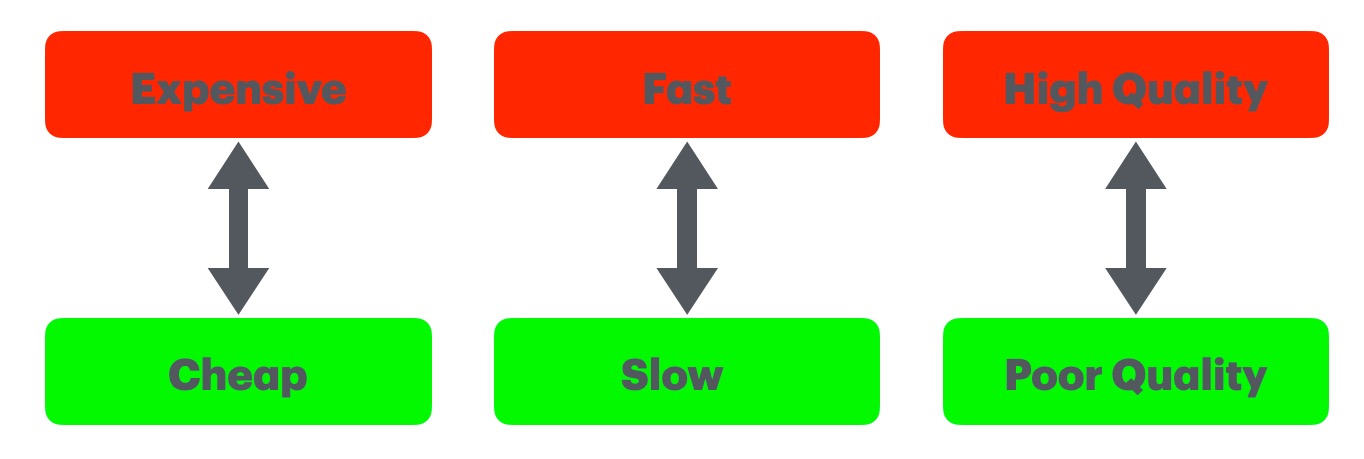
You will have seen this, or something like this before. You have three components, the green ones are low in cost, the red ones high in cost. You want them all to be in the red, but the stage is set that you can only have two, the third one should always be in the other field. As people chase to get high quality and fast systems, that solution will always be an expensive item. Armies are not interested in (to some degree) cheap solutions. Not as long as these solutions are fast and high quality. Now White stork is going to seek fast systems and in robotics this will mean integration of information systems, like robotic intelligence systems that can connect to a secure cloud solution, updating the cloud instantaneously by all systems all at the same time. It become (for the lack of a better term) intelligence by wire. Nations will fork over billions to get it and to that degree no one has this. Not the US (DARPA apparently has some developing stage), not Russia and not China. They all have some kind of wannabe status, but they lack a high tech captain of industry like Eric Schmidt. If I can see this correctly within a few years they would all want him White Stork could be worth a whole lot more than anyone ever thought it could be and I think getting this connected to a system like Palantir is close to the only solution out there and the people at the centre of that axial know this. As I see it the biggest bottleneck in the short term will be an evolved non-repudiation system. We can cyber strike as much as we can but that first defence is a non-repudiation system to ward of attacks and that is where Palantir optionally has the system to make it work. Not for one or two systems, but like 200 drones in different campaigns all at the same time. These systems need more than a simple deeper machine language, it needs LLM learnings and advance machine learning. With cyber systems that cab keep track of it all. This is not a simple solution but a person like Eric Schmidt could keep track of what was needed he might not be alone, but he is the only one in the stage of these arms of technology.
His wealth might soon equal that of Bill Gates, the arms industry will pay heavily to get this far ahead. Consider that Saudi Arabia increased its military spending by 50 percent to $69 billion in 2023, approximately 23 percent of its total budget. That is to merely get on par with the America, Russia and China. How much do you think these three would pay to get ahead of the other two? The US is requesting $849.8 billion for next year. With White Stork they could easily double that amount. It is that much money that is in the view of some.
Just my two cents on the matter. Have a great day.
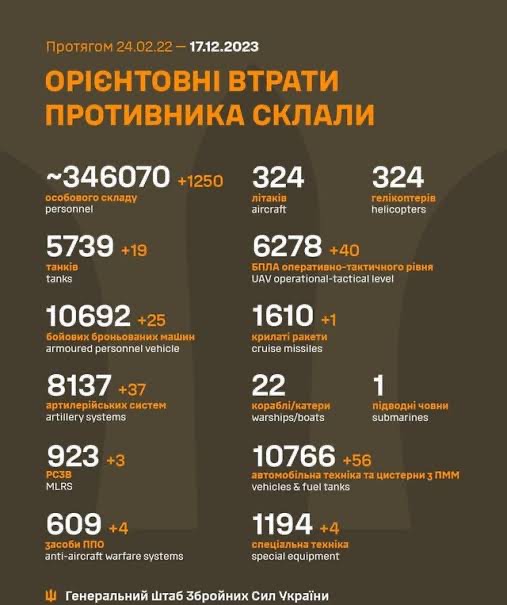
This is the call, it is a simple one. In this I believe it should have started well over a year ago, but that is just me. Perhaps it has already started, but I wouldn’t know that. The setting started with an image
There was also a text. The text was that a Russian Troll was able to shutdown an Ukrainian information channel on YouTube. Interesting how Google wasn’t able to disseminate information. Yet this opened up a new need.
The Commonwealth needs to set a rather large collection system. It needs to collect all relevant data from all relevant social media sources on who is spreading what. And there is no freedom of speech, when you tally towards terrorist organisations you become the problem. Another source (Newsweek) gives us ‘Russia Loses 37 Artillery Systems, 1,250 Troops and 19 Tanks in a Day: Kyiv’ (at https://www.newsweek.com/russia-artillery-systems-casualty-count-tanks-avdiivka-ukraine-1853110) that news is less than 12 hours old. The losses in Russia are adding up to something surpassing the total of losses from WW2 (German and allied) and the losses in tanks surpass the total tank stock of several NATO nations. Russia is about to get desperate and internet lies are cheap. As such the Commonwealth (Australia, Canada, India, New Zealand and United Kingdom) will need to keep tabs on what is being spread. When you consider the abilities of a software solution like Trollrensics and the modelling setting of Palantir you should be able to get a lot more aggregated intelligence. Those who cannot afford Palantir could look at IBM modeller. A setting that has now become essential. You see, from disinformation comes the setting of lone wolves and that is the next step that Russia will rely on and that chaos will hamper any nation, as such there needs to be a clear data collection and the laws need to be equally adjusted, so that some 17 year old idiot cannot hide behind “I wanted to look cool”. Siding with terrorism needs to come at a price and as we want to reduce their rights (I believe it to be a valid option) we need to collect that data to make sense of it all. It remains a tall order in light of troll farms and identity theft, but a longer term data collection setting should allow us to see the true data and make sense of it all. You see, we get that some people accidentally or not get one message wrong, but to get a whole range wrong is a much larger problem and I reckon that Russia could be relying on lone wolves from mid 2024 onwards. They are already (according to some sources) pushing expats and now that their losses include the purchase of 346,000 body bags (from start until now) that setting becomes even more an issue. The 135,000 new conscriptions doesn’t even come close to what they need, especially as their deployment and resources are dwindling down to alarming rates as well. You can see this in whatever way you want, yet the setting is that the 20th largest army brought the second largest army to their knees and even if tougher times are ahead. Even when US support falls on its knees, the setting does become that Russia will need to rely on lone wolves and misinformation making the needs for a CII essential. I reckon that a player like GCHQ will hoist the banners on how it should be run, but the other nations need to get on board fast. The US is not much of an ally in all this and the Commonwealth better get ready when the others are all about the talk and not much about actions. The fact that YouTube (read: Google) was unable to see the truth behind Russian trolls is further evidence still in the need for additional social media data collection.
Think of this what you will, but in your heart I believe you know that I am right, or at least not entirely incorrect. I see that there is a chasm between the two, any critical thinker would see that.
I am confronted with 2 issues. The first one passed my eyes a few days ago. It came from Arab News (at https://arab.news/946db) where we are given ‘Saudi authorities seize 3.8 million amphetamine tablets in Riyadh’. This is the second event in a year and my doubts are increasing. Not on the Saudi government. What drug dealer ships in one go enough tablets to make over 10% of a population an addict? Weirdly apart from having no knowledge in this, the little knowledge I have comes from a video game named Elite. There we could ‘smuggle’ decently safe 2% of the cargo as narcotics. As such you could ‘decently’ safe smuggle up to 500Kg in a 20 ton carbo haul. There is another matter. This is either done by a really stupid Saudi (with a lot more money than common sense) or this is something else. I personally belief that this is something else. We see the ‘market’ value, but the people with other interests will merely have the manufacturing costs as an expense.
You see, if this was a real exercise, it would have made sense to merely smuggle 0.1% of that haul per shipping and it would most likely go right, as such I personally feel that these people were always going to get caught, especially in a nation like Saudi Arabia, a nation with zero tolerance towards narcotics.
Then the quote “Eleven defendants involved in these activities were arrested. They include seven residents of Syrian nationality, one resident of Nepalese nationality, and three citizens in Makkah, Riyadh, Qassim, Hail and Al-Jawf.” My personal belief is that a government hostile to Saudi Arabia is trying to make Saudi Arabia look bad. This might account for the 7 Syrians and one Nepalese. At that point I wonder how the remaining three were EXACTLY involved. Consider that this is a highly volatile situation. Would YOU trust foreigners to make you run such a risk on you? This is not about foreigners, but lets face it, Saudi’s are for all the right reasons not the most trusting in the world and I expect that the Nepalese person might not be Islamic. Too many red flags are going up and I cannot shake them.
I wonder what deep investigations with something like Palantir Gotham (if it is still called that) would uncover. My thoughts go towards the manufacturer, 3.8 million tablets is (according to some) set to a manufacturing cost of $3 per tablet. So someone handed over $12 million with a 99% certainty to get caught. It does not make sense, $12,000,000 leaves a trail. There is close to no way that it remains invisible, as such Palantir Gotham is one solution to get somewhere. The reason for thinking in this direction is that this is the second catch within a year. Someone has too much money and someone else acquired a lot of money, way more than some hauls. The largest bust in America was a year ago and involved a little over 650,000 pills. That in a nation with over 300,000,000 people makes ‘sense’, still it was a lot, so to see over 600% in a nation with only 10% of that population makes absolutely no sense at all to me. So, I am in a setting where I believe that someone is out there making Saudi Arabia look bad. I have no idea who, or why. My blinkers make me think the only direct (former) enemy is Iran, but that has no foundation in evidence of any kind, merely a gut feeling. But someone was willing to spend well over 10 million twice over to get that done, it is more than I will ever make in a lifetime (unless Amazon, Kingdom Holdings or Tencent Technologies buys my IP). And all this is based on the purity being average, if these pills were more pure, the price tag changes a lot.
I was honestly a little surprised this morning when I saw the news pass by. The BBC (at https://www.bbc.co.uk/news/technology-67137773) gives us ‘Twitter glitch allows CIA informant channel to be hijacked’. To be honest, I have no idea why they would take this road, but part of me gets it. Perhaps in the stream of all those messages, a few messages might never be noticed. The best way to hide a needly is to drop it in a haystack. Yet the article gives us “But Kevin McSheehan was able to redirect potential CIA contacts to his own Telegram channel” giving us a very different setting to the next course of a meal they cannot afford. So when we are given “At some point after 27 September, the CIA had added to its X profile page a link – https://t.me/securelycontactingcia – to its Telegram channel containing information about contacting the organisation on the dark net and through other secretive means”, most of us will overlook the very setting that we see here and it took me hours to trip over myself and take a walk on the previous street to reconsider this. So when we are given “a flaw in how X displays some links meant the full web address had been truncated to https://t.me/securelycont – an unused Telegram username” the danger becomes a lot more visible. And my first thought was that a civilian named McSheehan saw this and the NSA did not? How come the NSA missed this? I think that checking its own intelligence systems is a number one is stopping foreign powers to succeed there and that was either not done, or the failing is a lot bigger then just Twitter. So even as the article ends with “The CIA did not reply to a BBC News request for comment – but within an hour of the request, the mistake had been corrected” we should see the beginning not the end of something. So, it was a set of bungles that starts with the CIA IT department, that goes straight into the NSA servers, Defence Cyber command and optionally the FBI cyber routines as well. You see, the origin I grasp at is “Installation of your defences against enemy retaliation” and it is not new, It goes back to Julius Caesar around 52BC (yes, more then two millennia ago). If I remember it correctly he wrote about it in Commentarii de Bello Gallico. Make sure your defences are secure before you lash out is a more up to date setting and here American intelligence seemingly failed.
Now, we get it mistakes will be made, that happens. But for the IT department of several intelligence departments to miss it and for a civilian in Maine to pick it up is a bit drastic an error and that needs to be said. This is not some Common Cyber Sense setting, this is a simple mistake, one that any joker could make, I get that. My issue is that the larger collection of intelligence departments missed it too and now we have a new clambake.
Yes, the CIA can spin this however they want, but the quote “within an hour of the request, the mistake had been corrected” implies that they had not seen this and optionally have made marked targets of whomever has linked their allegiance to the CIA. That is not a good thing and it is a setting where (according to Sun Tzu) dead spies are created. Yet they are now no longer in service of America, but they are optionally in service of the enemies of the USA and I cannot recall a setting where that ever was a good thing. You see, there was a stage that resembles this. In 942 the Germans instigated Englandspiel. A setting where “the Abwehr (German military intelligence) from 1942 to 1944 during World War II. German forces captured Allied resistance agents operating in the Netherlands and used the agents’ codes to dupe the United Kingdom’s clandestine organisation, the Special Operations Executive (SOE), into continuing to infiltrate agents, weapons, and supplies into the Netherlands. The Germans captured nearly all the agents and weapons sent by the United Kingdom” For two years the Germans had the upper hand, for two years the SOE got the short end of that stick and this might not be the same, but there is a setting where this could end up being the same and I cannot see that being a good thing for anyone (except the enemies of America). Now, I will not speculate on the possible damage and I cannot speculate on the danger optional new informants face or the value of their intelligence. Yet at this point I think that America needs to take a hard look at the setting that they played debutante too. I get it, it is not clear water, with any intelligence operation it never is. Yet having a long conversation with the other cyber units is not the worst idea to have. You see, there is a chance someone copied the CIA idea and did EXACTLY the same thing somewhere else. As such how much danger is the intelligence apparatus in? Come to think of it, if Palantir systems monitor certain server actions, how did they miss it too? This is not an accusation, it is not up to Palantir to patrol the CIA, but these systems are used to monitor social media and no one picked up on this?
Just a thought to have on the middle of this week.
Yup, In succession to part one. I decided to think through the characters. I am not putting it all here (for obvious reasons) yet when you think it through, I set up the larger station in merely a few hours. As such, any Canadian TV channel can pick this up. The reason is simple and two fold. In the first there is a writers strike in the USA. I will not assist any TV station there whilst the strike is going on. The second is that this event plays in Toronto, it seems logical that a Canadian TV stations could have a go at this.
Vasileios He is the main character, not much is known about him and in the beginning the setting is that he travelled in time. Over the course of the movie we get more and the end has a twist (as one expects). He is driven to solve this event for reasons unknown.
Olivia She is the liaison officer connected to our main character. She sports a heavy Taurus Raging Hunter 357 Mag 7-Round Revolver. The gun is specific and this has a reason. Her father was a police officer who was killed in the line of duty. What she knows that other corrupt officers got him killed and she vowed to kill them with that gun. She is a crack shot, slightly rude mannered on speak and actions. She does genuinely care for justice and people. She cares for victims and she does not stand for bullshit.
Michel Coulombe He is a twist. I wanted to get the actual former director of the CSIS involved. This is largely an intelligence gathering operation, as such he would be a great consultant. Also, who is better equiped and trained to play head of the CSIS then the former director of the CSIS? From the beginning when our main character stops the initial terrorist event the CSIS gets involved and the fact that they were unaware that this was about to happen gives Vasileios a foot in the door.
Police Captain The involved police captain is there to smooth things over and set the larger operation to get things done. I thought of John Larroquette or Patrick Labyorteaux to fill this role. The elected person is there to manage the police forces and to keep tabs on the two main characters.
MAGA The nice part of these MAGA people is that they tend to be conspiracy theorists and that works for me. It is hard to find a decently believable opponent. The setting of the stage is that MAGA is ‘working’ with(or for) the Canadian Conservative Party. What none of them know is that MAGA is pushed by American Industrials to create enough panic and chaos so that America can push in and make Canada a republic. It adheres to the old golden rule ‘in confusion there is profit’ and with the US running out of space and resources expanding to the north is a simple business decision. I have set that stage in a few stages the conspiracy people, their support system, the conservative players and the conservative party. There needs to be clear separation so that the detection feels real.
Unknown player This person is unknown (for now) because I do not have the larger setting here. It is why there were two names for the police captain. The other one becomes the head of CSIS data analyses. I was thinking that they would have a data room with actual Palantir servers crunching the numbers. During the events we learn that data is ‘misplaced’ and this gets us to the corrupt police officers who were filling their pockets wherever they could, as such they are involved and we get to see Olivia being a crack shot. There is no denying that seeing a corrupt police officer executed is more satisfying than some organised crime figure (not by much though).
Location 1 This is Bloor–Yonge Station. Here we see the initial attack stopped. The detonation (with hydrogen cyanide) is stopped. The event would have killed all the people in the subway station and the tanks were large enough to flow the gas into the street, which would be a first chaos point. With the subways out of commission and a massive cornerstone of Toronto traffic stopped in the heart of the city would create massive amounts of panic. As this is stopped the CSIS enables Vasileios to proceed, but only with Olivia locked at the hip to him. This gets the police in the mix as well and the CSIS data centre will be looking over every byte of data, to see what they missed.
Location 2 It is a house, and I think it should be in Rockwood village. It allows for a later link to business conferences and Mississauga. The house is the impact of a shootout between parties and our two characters. He is sporting a Cretan knife which he buys in an earlier scene. Olivia was unwilling to hand him a gun. The scene starts with them sneaking into the back and he starts silently and indiscriminately killing the people there. Olivia shoots three and calls for backup. We see the cellar has a bomb factory, the police shows up a minute later. Vasileios grabs a gun from the table and kills the police officers. He states that these cops are corrupt, at that point the police commissioner calls and states that the reinforcements are 10 minutes out. This convinces Olivia this is about more and we see all kinds of evidence that bombs were made.
Location 3 the CSIS ‘server room’ where the data is crunched, the captain there is starting to find ‘mislabelled’ data and now he knows that there is a larger problem. He gets 3-4 most trusted people in a separate server room and they start crunching the data differently, which is time consuming, but they do not know what is missing. As the story continues we see the crunching of locations and people on every bit of data.
There is of course more, but two locations are key to the story. Seems weird to give away the plot ahead of schedule. I am still mulling over the option of how to include the conservative party without getting slammed with slander (or whatever claim they will make), for me the larger reason was their ‘worshipping’ of Donald Trump and MAGA. I still need to figure out a setting where Olivia executes the three corrupt officers that killed her father. It needs to read that it could have been a justifiable killing or a mere execution and it could be seen as either way. I personally believe it spices up the story a bit at the end.








 Lawrence van Rijn - Law Lord to be
X to the power of sneaky
I was honestly a little surprised this morning when I saw the news pass by. The BBC (at https://www.bbc.co.uk/news/technology-67137773) gives us ‘Twitter glitch allows CIA informant channel to be hijacked’. To be honest, I have no idea why they would take this road, but part of me gets it. Perhaps in the stream of all those messages, a few messages might never be noticed. The best way to hide a needly is to drop it in a haystack. Yet the article gives us “But Kevin McSheehan was able to redirect potential CIA contacts to his own Telegram channel” giving us a very different setting to the next course of a meal they cannot afford. So when we are given “At some point after 27 September, the CIA had added to its X profile page a link – https://t.me/securelycontactingcia – to its Telegram channel containing information about contacting the organisation on the dark net and through other secretive means”, most of us will overlook the very setting that we see here and it took me hours to trip over myself and take a walk on the previous street to reconsider this. So when we are given “a flaw in how X displays some links meant the full web address had been truncated to https://t.me/securelycont – an unused Telegram username” the danger becomes a lot more visible. And my first thought was that a civilian named McSheehan saw this and the NSA did not? How come the NSA missed this? I think that checking its own intelligence systems is a number one is stopping foreign powers to succeed there and that was either not done, or the failing is a lot bigger then just Twitter. So even as the article ends with “The CIA did not reply to a BBC News request for comment – but within an hour of the request, the mistake had been corrected” we should see the beginning not the end of something. So, it was a set of bungles that starts with the CIA IT department, that goes straight into the NSA servers, Defence Cyber command and optionally the FBI cyber routines as well. You see, the origin I grasp at is “Installation of your defences against enemy retaliation” and it is not new, It goes back to Julius Caesar around 52BC (yes, more then two millennia ago). If I remember it correctly he wrote about it in Commentarii de Bello Gallico. Make sure your defences are secure before you lash out is a more up to date setting and here American intelligence seemingly failed.
Now, we get it mistakes will be made, that happens. But for the IT department of several intelligence departments to miss it and for a civilian in Maine to pick it up is a bit drastic an error and that needs to be said. This is not some Common Cyber Sense setting, this is a simple mistake, one that any joker could make, I get that. My issue is that the larger collection of intelligence departments missed it too and now we have a new clambake.
Yes, the CIA can spin this however they want, but the quote “within an hour of the request, the mistake had been corrected” implies that they had not seen this and optionally have made marked targets of whomever has linked their allegiance to the CIA. That is not a good thing and it is a setting where (according to Sun Tzu) dead spies are created. Yet they are now no longer in service of America, but they are optionally in service of the enemies of the USA and I cannot recall a setting where that ever was a good thing. You see, there was a stage that resembles this. In 942 the Germans instigated Englandspiel. A setting where “the Abwehr (German military intelligence) from 1942 to 1944 during World War II. German forces captured Allied resistance agents operating in the Netherlands and used the agents’ codes to dupe the United Kingdom’s clandestine organisation, the Special Operations Executive (SOE), into continuing to infiltrate agents, weapons, and supplies into the Netherlands. The Germans captured nearly all the agents and weapons sent by the United Kingdom” For two years the Germans had the upper hand, for two years the SOE got the short end of that stick and this might not be the same, but there is a setting where this could end up being the same and I cannot see that being a good thing for anyone (except the enemies of America). Now, I will not speculate on the possible damage and I cannot speculate on the danger optional new informants face or the value of their intelligence. Yet at this point I think that America needs to take a hard look at the setting that they played debutante too. I get it, it is not clear water, with any intelligence operation it never is. Yet having a long conversation with the other cyber units is not the worst idea to have. You see, there is a chance someone copied the CIA idea and did EXACTLY the same thing somewhere else. As such how much danger is the intelligence apparatus in? Come to think of it, if Palantir systems monitor certain server actions, how did they miss it too? This is not an accusation, it is not up to Palantir to patrol the CIA, but these systems are used to monitor social media and no one picked up on this?
Just a thought to have on the middle of this week.
Leave a comment
Filed under IT, Military
Tagged as Abwehr, BBC, CIA, Commentarii de Bello Gallico, Common Cyber Sense, DoD, Englandspiel, FBI, Julius Caesar, Kevin McSheehan, Maine, NSA, Palantir, SOE, Special Operations Executive, Sun Tzu, Twitter