Tag Archives: Optus

They just won’t learn

That happens, people Incapable of learning. IT people listening to salespeople because these sales people know what buttons to push. Board members pushing for changes so that their peer will see that they are up to speed on the inter-nest of things (no typo) and there are all other kinds of variation and pretty much every company has them. Even as Australia is still reeling from the Optus debacle, Telstra joins the stupid range (at https://www.abc.net.au/news/2022-10-04/telstra-staff-have-details-hacked/101499920). So explain to me why an HR system needs to be online? OK, you will get away with that and there is a need for some to access it, but in what universe does this need to be so open that EVERYONE can get to it? That is the question we see raised with ‘Telstra data breach sees names and email addresses of staff uploaded online’, a blunder of unimaginable proportions. On the other hand, Telstra will be bleeding staff members left, right and forward pretty soon. You see, this list is well desired by over a dozen telecoms in Europe, North America, the Middle East and Asia. They all need staff all over the place and now their headhunters know EXACTLY where to dig. Even as the article gives us two parts. The first part is “a third party which was offering a rewards program for staff had the data breach in 2017” as well as “Telstra has not used the rewards program since 2017, the spokesperson said” in all this the question that matters are not asked. We get Bill Shorten trying to change the conversation back to Optus with: “get the information so I can stop hackers from hacking into government data and further compromising people’s privacy”. The massive part is “Why was a reward program not used for 5 years still linked to HR data?” It seems that ABC does not ask this and the others do not either. So even if we get “Attorney-General Mark Dreyfus has said he will review Australia’s privacy laws and tighter protections could be brought in by the end of the year” Yet the larger question remains unanswered. How to protect these systems from STUPID people? A reward system that has a direct link to the HR data and was not used for 5 years is stupid, plain and simple stupid. As such this affects their IT and their HR department. Yet the people (politicians and media are not asking these questions are they? They let Labor loser Shorten change the conversation. Oh, do not worry we are not even close to done with Optus, but the setting that the conversation is pushed away from Telstra allegedly implies that Telstra has too large a hold on Media and politicians. So whilst the media allowed Telstra to hide behind “while the data is of minimal risk to former employees” they fail to see the larger picture. In an age brain drains these people are worth their eight in Lithium (more valuable than gold) and it seems to me that an employment database of 30,000 telecom people will be eagerly mined in the three earlier mentioned regions. These hackers were smart, they can get a million easily (over 10-15 customers) and these customers will not care where that data comes from, they need personnel and they needs them now. So it seems that certain people just ill not learn and there is no hiding behind “in an attempt to profit from the Optus breach” Telstra claims to be so superior, of that is so either the hack would not have affected them, or these systems are in a worse shape than ever before and that is also missing from the article. Two competitors successfully hit by the same flaw? It seems that too many people are asleep at the wheel. And no one is asking the right questions, not even the media, why is that?

Leave a comment

Filed under IT, Media, Politics

Optus seems more stupid

I wrote about this earlier, I had concerns, I had questions and I had to some degree accusations. Yet that is nothing compared to now. The BBC gives us (at https://www.bbc.com/news/world-australia-63056838) ‘Optus: How a massive data breach has exposed Australia’ this shows a few sides, I was unaware of earlier. They start with “about 40% of the population – had personal data stolen in what it calls a cyber-attack” that is a lot, but Optus has a large user population. It is “Those whose passport or licence numbers were taken – roughly 2.8 million people – are at a “quite significant” risk of identity theft and fraud, the government has since said” which is close to everyone, to become most telecom members, you need 200 points of identification, which tends to include a passport or a drivers license. So when we get to “In an emotional apology, Optus chief executive Kelly Bayer Rosmarin called it a “sophisticated attack”, saying the company has very strong cybersecurity”, is that so? So when the BBC treats us to “Sydney-based tech reporter Jeremy Kirk contacted the purported hacker and said the person gave him a detailed explanation of how they stole the data. The user contradicted Optus’s claims the breach was “sophisticated”, saying they pulled the data from a freely accessible software interface. “No authenticate needed… All open to internet for any one to use,” they said in a message, according to Kirk.” This seems like there is a serious flaw in the Optus system, and when we revisit the statement from Kelly Bayer Rosmarin “I’m disappointed that we couldn’t have prevented it,” she said on Friday

I tend to side with the less diplomatic version of me stating to Kelly Bayer Rosmarin “Do you know that the condom is also used to stop making you fat? It is not just for the prevention of STD’s” now I might be ejaculating a bit premature (aka was Jeremy Kirk told a BS story or the truth) but if this is true, then Optus failed on a few levels. Protecting the data, protecting the servers and protecting their customer base. You see, the software interface might have allowed for injection of a backdoor making the Optus system now close to completely unreliable. The fact that there is a freely accessible software interface in play implies that its IT security failed, the data was collected and that happened without any red flags on access and transfer of data and we see the fact that all the data is accessible, from way too many places and that is the telecom company that Australia trusts? It gets to be even worse when we look at the article (at https://www.afr.com/companies/telecommunications/optus-hack-could-happen-to-anyone-ex-telstra-boss-warns-20220928-p5blrg) where we are given ‘Optus hack ‘could happen to anyone’ ex-Telstra boss warns’, a wannabe from the stables of Telstra, an immature greedy Microsoft minded telecom. There we see “Former Telstra chief executive David Thodey says the cyberattack on Optus “could happen to anyone” and urged all big and small organisations to be “vigilant” about online security”, Well David, if the information from Jeremy Kirk holds true, you better hope that you have a better cyber and IT security division, more importantly if this level of stupidity can happen to EVERONE, your systems ALL SUCK! And in my personal opinion you all need an overhaul and a 80% wage reduction. This level of stupidity when it comes to personal data is too stupid for any of you to be taken seriously as so called ‘captains of industry’ as such, please apply for an Uber or barber position. 

Now this seems overly emotional, but these are the kind of people who judged me a not being professional and THEY set data next to an open interface? This is the 101 of stupidity. OK, if JK was told a bag of lies I would owe a few people an apology, but that is for tomorrow, for now it seems that a lot of people are not aware of the level of stupid their telecom company hung their personal data on and that is more than a simple investigation, there are plenty who will pay handsomely for that much personal data. The US, Russia, India and China. 4 players willing to pay twice what the hacker wanted and they will not ask questions. A whole collection of personal data that can aid in creating deeper learning personalised rainbow tables, a whole battery of data from all kinds of social media that can now be used for granularity and a whole range of other data sets that can now be completed. And it all hangs on a (currently unconfirmed) version of a freely accessible software interface. “No authenticate needed”. How angry would you be hen these so called professionals charged you again and again and as they changed membership status so that they had more legal options. And they are not held to account? Yes, I would be angry and I am (for now still) with Optus, I get to be angry, my data is out there. So how would you feel?

Leave a comment

Filed under Finance, IT, Media, Politics, Science

Corporate noun of stupid

Yes, that is the thought. You see, I have had a few issues with Optus recently, the first one is that customer care went into the basement and took the elevator down from there, the second one is that I can get NO information on my account events in the shop, some lesser setting of an individual stopping people and pointing them towards their ‘customer care’, but organised crime and hackers, they get ALL the assistance. Information like email, date of birth, phone number, ID document. Yes they get all the information. And it goes beyond that. If all that information is available to hackers and organised crime, it implies that basic cyber security failed.

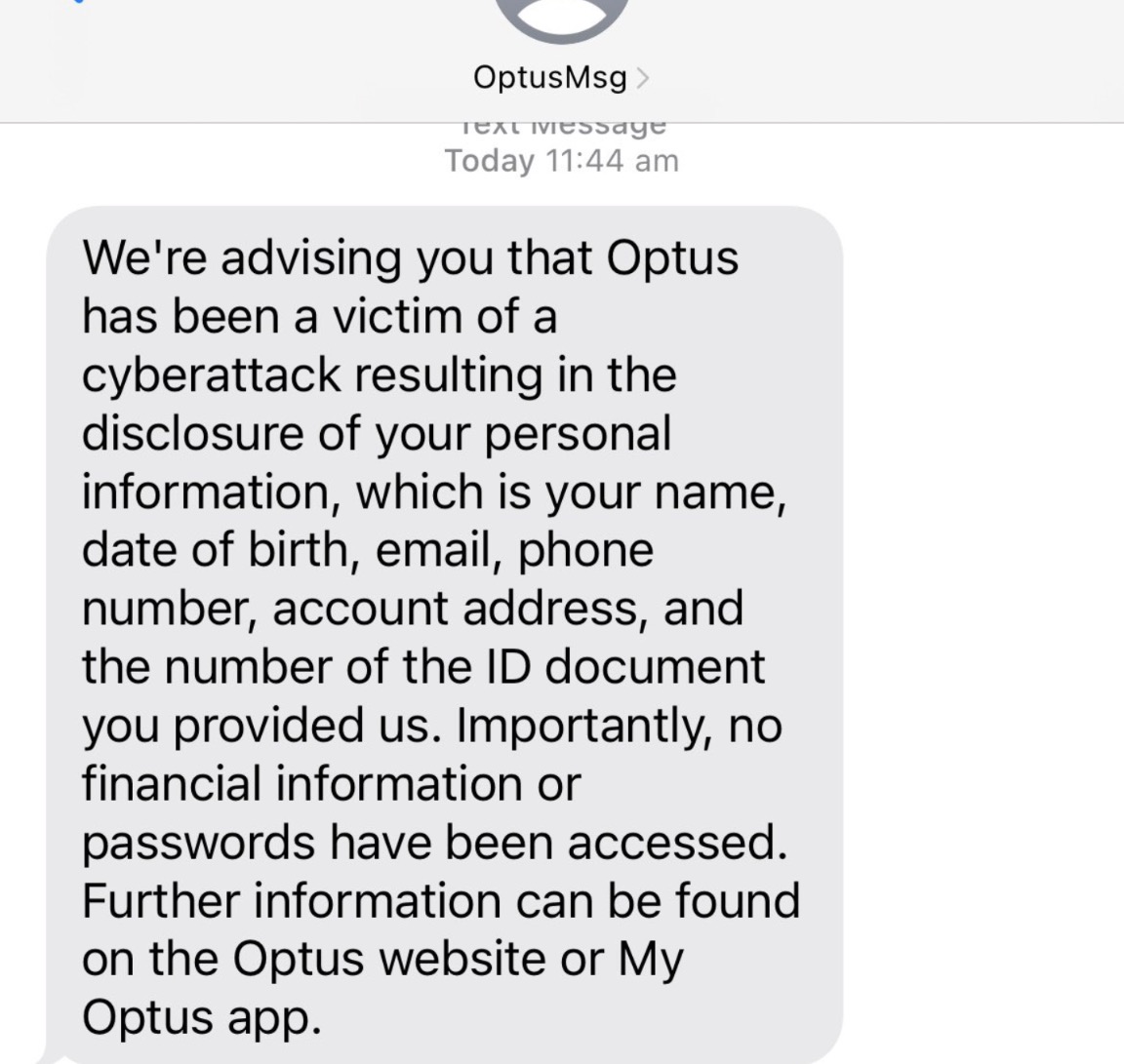
And the most stupid of all (as corporate idiots go) we get “no financial information or passwords have been accessed”. We didn’t merely loose something, all the elements to create fake accounts and make fake creation is out and about. For some it will take months to clean up the mess others made, if it can be cleaned up at all. Fake mortgages tend to follow the victim around for the rest of their lives. So the idiot that approved THAT message will be looking for a job soon enough. To trivialise such a massive blunder needs a much larger response and some article stating “However, this breach, like most, appears to come down to human error,” the Optus insider told the ABC.” That with the headline ‘Optus rejects insider claims of ‘human error’ as possible factor in hack affecting millions of Australians’ yes, give it a human error side, but the larger issue might be the insufficient cyber defences at Optus were overcome by hackers endangering the economic lives of millions. So my version is a lot darker than ‘affecting millions of Australians’ but which one will be more accurate? That is the larger stage and that is where the media is very supportive of Optus, but I have seen three issues in one week, so I am not certain it will be this easy. And this is all over the field, it is all over Australia and it will cross borders, especially when we second wave of events pass us by, when? That is anyones guess, but that much identity information is not merely to create a rainbow table, this is optionally the prelude of something more, what? I cannot tell, but you do not get this kind of information to simply show that Optus is asleep at the wheel, this implies purpose, but that is merely my point of view.

As to the answer of the header: “a group of people who are all stupid

Leave a comment

Filed under Finance, IT, Science

Clusters

Clusters are a weird concept. There is the science, the art and the personal which tends to be a blend of both. We think that we love that one person more than all the other grapes in the bunch. We think that we know more than all the other grapes in the cluster of grapes and we watch how all the grapes get squished and we avoided that wreck. Clusters are weird, they are at times like Horoscopes. We merely ‘believe’ them when they are positive. And we are all the same, I in this am no different. I know more than a lot of people in certain areas but not all areas and still I am like all the others, I am the one grape aside from the other grapes in a cluster of idiots. There is no delusional side, it merely is what it is. Yet when you realise this and you start to dimensionalise that cluster of grapes, it is then that you might see structure and that structure is important. It gives size and shape of what you contemplate. I might compare myself to Amazon and Google, but the reality is that my solutions merely outstrip the one grape that Google or Amazon hired to make sense of that structure. When you realise that part you start to understand the company and now you have a new setting. That setting can help you to see what they are missing and optionally where else they are not looking. Yet the cluster is more dangerous than you think. You see one grape, but you do not see the other 143 grapes and what THEY see. That is the larger stage. And it is not limited to Google and Amazon. There is Apple who merely focus on the white grapes, there is Microsoft who is blind to all other grapes, and then there is IBM, SalesForce, SAP, Adobe and many others, all focussing on THEIR vintage, THEIR strengths and that is how it is, but for you it matters where these focal points are. Google is in the news about the news, and when we try to look at the Australian in google search when we click on ‘Google’s ‘News Showcase’ stalls in US as media outlets balk at terms’ we merely get what we see below.

This is the larger stage, the news makes claims but then uses the news to advertise and even as the Australian is the most visible, they are not alone and lets be clear I wanted to see what the news war regarding Google. And yes, others gave me ‘Google films people reacting to the Pixel 7 Pro, confirms pre-order start date’, I was merely curious. I recently got the Pixel 6 and I am happy with that one, the camera is heaps better, the battery is good, the phone is faster and the screen is better. For amount X I got a mobile phone that is well over 3X better. So I doubt I will get the Pixel Pro 7, I will most likely wait for the Pixel Pro 8, or perhaps 9. The previous phone laster me well over 6 years and it did its work. No regrets on previous phones, no regret on this phone. Merely Optus making a mess of too many things, but that is not on Google. Amazon announces its new kindle and the first thing I notice is that it ‘only’ has 32Gb, double the previous one, but instead of just adding 64GB or even 128GB, it keeps the pressure on and I reckon that it will bite them soon enough. In SD card settings it is $10 versus $19, less then twice the price and when you offer something for long term use, storage matters. It gets to be even less nice when you consider “The Kindle Paperwhite 8gb does not have the ability to add more memory via an sd card like the Fire Tablets” this is not asleep at the wheel, this is creating one brand dependancy and that is not a good thing. It does not matter for my IP, but the fact that Amazon is optionally (make sure you see the word optionally) brand dependancy matters, it makes Amazon a lesser choice and they did this too themselves, as such my advice to the Kingdom of Saudi Arabia could go “For the future of your 50,000,000 subscriptions there is now added value of selecting the Google Stadia choice over the Amazon Luna as a choice for the future of your IP. One selection could have that large an impact and as such it is important to see as much of the Kindle cluster as possible, because this could reflect back to people like Andy Jassy. Is it fair? That is not the question. He allowed this to happen on his watch, it is that simple. And it matters because the 32GB would seem enough, but we are not always in reach of decent internet, and as 32GB allows for a decent amount of books, 128GB allows for 400% more and is that not why you travel with your Kindle? It was a simple equation and the grapes of that cluster either missed it, or the grape in the cluster had its own agenda. It sounds simple, too simple. Yet that was where Microsoft was in 2012 and in a decade they are close to going tits up (not in a nice way). They are not a player in the gaming market (no matter what their marketing states), the tablet market went past them and they are close to lose 15% of their cornerstones. Of and when we add Adobe to the mix, they lose even more. This is what asleep at the wheel looks like (or the wrong grape in charge of the bunch, or cluster). So clusters matter. They are often not scientific, but they rely a larger story and that matters too, it also gives rise to other choices YOU will have to make and not all of them can be made on solid numbers, as such the cluster view tends to have a larger or weightier effect. 

There are clearly times when the media cannot be trusted, or the numbers they bring. That is not really their fault at times. Too many stakeholders, too many mouths to go after the Microsoft grape-juice, or whatever grape pie they serve.  We need to make up our own minds and at times the cluster view is not as scientific as we would like it, but it does tend to give a much better view when we realise how to see all (or as many as possible) grapes in the cluster. At times that is all we have, especially when we solely rely on our instincts.

Leave a comment

Filed under Finance, IT, Media, Science

As the shoe drops

Yes, there is a lot of anger in Bethesda land. As we take notice of “We have tried to be as clear as possible, not a timed exclusive, this is simply where the game is being made.” Starfield is a Microsoft exclusive and the fans are angry. I get it, I am not angry, it was a brilliant move by Microsoft, it is why I placed all kinds of IP on the public domain (here in my blog) for Sony and Amazon (Luna) so that their independent developers can make a totally new RPG game and the IP is free for them, it is my way to giving Microsoft the bird. These developers are not out of pocket for $8,500,000,000. And they deserve it (I hope). 

So whilst we take notice of “Hines went on to point out that Bethesda fans on PlayStation consoles might not be shut out entirely from playing future titles from the studio”, we do understand that the PS5 is outselling the Xbox 2:1 and it will take some time before cloud gaming is expected to become congestion free, and that is providing that you have a true unlimited account, as some give us the stage of Xcloud on about 3GB per hour, so someone with a new 200GB account will run out of data in about 65 hours, that is likely less then 2 weeks for average gamers and 1 week for what some call the true gamers. After that it will be $30 per hour to game. And that is if it all goes correctly, I feel certain that congestion will hit soon enough. You see some sources give me “Optus now offers unlimited data across its range of postpaid mobile plans. As with Telstra, if you go over your data allowance, you’ll be capped to speeds of 1.5Mbps.” so if it is unlimited, how can you go over your data allowance? And consider that capped data does not allow gaming, not at 1.5Mbps. So we are (for now) locked to our consoles and PC’s. Is it a wonder that Amazon gives you Ubisoft+ at $1? The end is nowhere near here and it is a lot worse in places where you are rural, especially the US, Canada, France, Germany and several others. And in that light we need to see Bethesda. And they do give clarity with “Certainly, there are going to be things that you’re not going to be able to play [on PlayStation]” that is why Microsoft paid billions. They had a bad setting an inferior system and they got the people addicted to certain games across. Even though it is not a given, I feel certain that the new none online Elder Scrolls is most likely going to be a Microsoft exclusive. It makes no sense to get angry, they paid billions and the people on Sony will have to make a choice and I helped them by handing the independent developers on Sony and Amazon IP for free. I will try to add a few more titles and it is up to the developers to create them, but at least I handed them an alternative and I did mention a few more titles for consideration to remaster. 

So whilst some people will get needlessly angry over “I want to be careful. I know it’s a question people care a lot about. It’s also a tricky one for us to answer because, frankly, it can get sensationalised on the internet”, I see it as a BS answer. It is not tricky to answer, it is the result of a $8.5 billion takeover, there was never any tricky setting. The only tricky setting was Deathloop as it was already a PS5 exclusive. At present PS5 is looking at 25 exclusive titles (until mid 2022) and that is not including a few titles that have no clear release date. In addition, the PS5 has crossed the 10,000,000 units sold line whilst Microsoft is nowhere near that, and as we see in some sources “the Xbox team has made it a policy in recent years to not disclose exact hardware sales numbers”, which makes sense when you are the number three console trailing PS5 AND Nintendo  Switch. So the Bethesda move was the only one that made sense for them and they had to pay a massive amount for it (because Bethesda is worth it), and yes, there will be a group of people who will switch as they are dedicated as well as bug nuts for the Bethesda games and that is fine, it is what Microsoft paid for, as such I handed my creativity to Indie developers so that they can make a new RPG on PS5 and Amazon Luna. Will it happen? I cannot tell, I do not know, but at least I did not resort to anger, I merely gave others the chance to take a slice of the RPG cake on two platforms. Perhaps that is not the right sentiment, I offered IP so that they could consider going there. And if I find my IP on these two systems I can raise my glass and give Microsoft the bird. 

No matter how many how many games Bethesda will make Xbox Exclusive (the right Microsoft paid for) it will hurt them to lose out of millions of gamers who will stick with Sony and that is the stage that they overlooked. When Sony gets a new RPG that is Sony exclusive and it does catch on (one hopes) Bethesda will lose out on a lot more and Microsoft will taste the sour grapes that come with a $8.5 billion investment, it was as I state before a brilliant move, and in this day and age as we are in lockdowns, I will add as much Gaming IP for Sony and Amazon developers (for free) and let that be the lesson Microsoft gets to learn the hard way.

Leave a comment

Filed under Gaming

Facebook Folly and 5G

There was an article in the Guardian last Thursday. I had initially ignored it for all the usual reasons, yet when I sat down this morning, there was something that made me take another look and the article is actually a lot more important than most people would think. The article (at https://www.theguardian.com/technology/2019/jan/31/apple-facebook-campus-permissions-revoked-teens-access-data-iphone-app) named ‘Apple leaves Facebook offices in disarray after revoking app permissions‘ shows a different side that goes a lot further than merely Facebook. We see this with: “We designed our Enterprise Developer Program solely for the internal distribution of apps within an organisation. Facebook has been using their membership to distribute a data-collecting app to consumers, which is a clear breach of their agreement with Apple”, this statement alone shows the failing of their legal department, as well as their senior board that works under the strict sense of assumptions. We see this not merely with ‘Facebook had allegedly exploited a loophole in Apple’s approval system to bypass rules that banned the harvesting of data about what apps are installed on a user’s phone.‘ We see another level when we reconsider “Facebook Research, an app the company paid users as young as 13 to install that routed their iPhone traffic through the company’s own servers“. This is not merely about hijacking data; it is about the fact that both the IOS and Android paths are a little too transparent. Academically speaking it would be possible for Apple to distribute a similar app guiding Android people to the IOS data path.

The fact that we now see that others are affected through: “According to an internal memo, obtained by Business Insider, apps including Ride, which lets employees take shuttles between buildings on the company’s sprawling campus, and Mobile Home, an employee information portal, were down“. And it is not merely the Guardian, the Apple Insider gives us: “A report from December claimed Facebook had made special data sharing arrangements with other tech companies, enabling Facebook to collect more data on its users generated on Apple devices, without either Apple or the users’ permission or knowledge.” This now gives the setting that Facebook is getting desperate, when any company needs to rely on Data snooping to keep their momentum up that is the moment we see that any tower, data based or not will fall over.

Part of that came from an article last December giving us: “A damning report on Tuesday provides further details on Facebook’s shady data sharing practices, already under intense scrutiny for the Cambridge Analytica fiasco, suggesting the social media giant enabled Apple devices to surreptitiously collect information about users without their — or apparently Apple’s — knowledge” and the nightmare scenario is not merely that Facebook is gathering data, it is the ‘data sharing‘ part and more important, who it is shared with. This has over the last two months changed my position from waiting what is actually afoot into investigation into actively prosecute Facebook for their actions.

I am certain that the prosecution goes nowhere, mainly because the legal departments allowed for the loopholes to get into position in the first place. It enables the train of thought on how involved Apple was in all that. That train of thought continues when we revisit the Apple Insider quote: “It was revealed yesterday Facebook paid users $20 to sideload a VPN onto their devices, allowing the social network to monitor what participants aged 17 to 35 did online. Claimed to be a “social media research study,” the Facebook Research iOS app took advantage of Apple’s Enterprise Developer Certificates to allow the apps to be distributed separately from the main App Store, as well as effectively providing root access to a user’s device.” In all this the legal teams did not consider the usage and installation of linked VPN applications? Is that not weird?

Bloomberg is trying to water down the event with “Facebook seems clearly to have earned its latest privacy black eye, but it’s important not to overstate what’s going on here. This is essentially a contract dispute“, is it? It seems that the users are victims of deceptive conduct; it seems to me that root access clearly implies that all data and content of the mobile device was made available to Facebook, was that ever clearly communicated to the users installing that?

It is my sincere belief that this was never ever done. So as Bloomberg in trying to add more water to the wine with “Apple’s concern about it’s “users and their data” might well be sincere, but this particular dispute isn’t about the fact that Facebook collected user data; it’s about the way that Facebook collected user data.” Here we see more than merely deceptive conduct, or to use the quote: “I’m not suggesting that what Facebook has done isn’t serious. But neither is it the end of user privacy as we know it“. You see, when you had over root access it means that you had over everything and at that point you have revoked your own right to privacy. And at the top of the watering down of wine, making it impossible to distinguish between the taste of either we see: “But users seemed to know what they were getting into — and were also paid for the privilege“, likely to be Bloomberg foulest statement of the day. Not only do they knowingly hide behind ‘seemingly’ they know for certain that no one will ever knowingly and willingly hand over root access to an unknown third party. It also tends to introduce security flaws to any phone it was installed to, when exactly were the users informed of that part?

So whilst we get another version of: “Twenty dollars per month might not sound like a lot to, say, the typical Bloomberg reader. So imagine Facebook instead had promised one free local Uber ride per month” you all seemingly forget about the international community, who like all others will never get to cash in on those events, or paid responses or alleged dollars for donuts deals. That becomes for the most direct profit for Facebook, access without a fee, how many of those people were part of that event?

Cnet phrases it a lot better with: “I think it’s highly unlikely that the vast majority of the people who went through this whole process really knew the kind of power they were giving Facebook when they clicked OK to install this (app),“, which we see (at https://www.cnet.com/news/facebook-shuts-down-ios-research-app-it-used-to-access-user-data/) by Bennett Cyphers, a staff technologist for the Electronic Frontier Foundation.

And that is not the only part, not when we enlarge the circle. Two days ago, my predictions become fact after the Sydney Morning Herald gives us: ‘Optus concedes 5G service without best technology after Huawei ban‘, which is awesome, as the IP I came up with does not affect either and allows for Global Huawei (or Google) continued growth. So as we are treated to: “”From a pure technology perspective, Huawei is probably ahead of the other three “Mr Lew said after Optus unveiled plans for a $70-a-month unlimited service with guaranteed minimum speeds of 50Mbps. “But what we’ve got from the other suppliers will enable us to provide a globally competitive service.”” This is actually a lot more important than you think, when mobile app users seek the fastest solution, the more bang per gigabyte, the Huawei solution was essential in all this. So as Optus chief executive Allen Lew now concedes that those not using Huawei technology will be second best in the game at best, my solution will set a new level of e-commerce and information on a global scale and all I asked for was $25M upfront and 10% of the patents, the rest was for Google (or Huawei). It is a great deal for them and a really nice deal for me to, a win-win-win, because the consumer and SMB communities will equally profit. I merely circumvented paths that were not strictly legally required; merely a second tier to equal the first tier and when the speed map drives us forward, the players using second rate materials will end up losing customers like nothing they have ever seen. It’s good to use political short sighted policies against them. So whilst the world is listening on how Apple and Facebook values are affected, no one is properly looking on how Huawei and Google have a much clearer playing field on how 5G can be innovated for the consumers and small businesses. It will be on them to restart economies and they will. They are moving from ‘Wherever the consumer is‘ to ‘Whenever the consumer wants it‘, the systems are there and ready to be switched on, which will be disastrous for many wannabe 5G players. I am giving a speculative part now. I predict that Huawei holding players will be able to gain speed over all others by 0.01% a day when they go life. This implies that within 6 months after going life they can facilitate 2% better than the others and within a year is double that. These are numbers that matter, because that means that the businesses depending on speed will vacate to the better provider a hell of a lot faster than with other players. This effect will be seen especially in the Middle East and Europe. And before you start screaming ‘Huawei’ and ‘security threat’ consider that the entire Facebook mess was happening under the noses of that so called cyber aware place America. It happened under their noses and they were seemingly unaware (for the longest of time), so as security threats go, they are more clueless than most others at present. It boils down to the boy howling Huawei, whilst his sheep are getting eaten by fellow shepherds, that is what is at stake and it shows just how delusional the Huawei accusations have been form many nations. How many of them were aware of the Facebook data syphoning actions?

This gives us the final part where we see the growth of Huawei as we see ‘Saudi-based Telco opens joint ICT Academy with Huawei‘, you might not find it distinct and that is fine, yet this is the same path Cisco took a decade ago to grow the size it has now and it was an excellent example for Huawei to adopt. The middle East is the global 5G growth center and with Qatar 2022 introducing maximised 5G events, we will see that Huawei took the better path, feel free to disagree and rely on AT&T and their 5G Evolution, yet when you learn the hard way that it is merely 4G LTE and now that we also see that ‘Verizon likely halting its ‘5G Home’ service roll-out after test cities, waiting for 5G hardware to actually exist‘, we see the events come into play as I have said it would, America is lagging and it is now likely to lag between 12 and 18 months at the very least, so whilst the world is starting their 5G solutions, America gets to watch from the sidelines, how sad it all is, but then they could still intervene into the Facebook events. They are not likely to do so as they do not see that as a ‘security threat‘. So as we are given: “As reported by VentureBeat, Verizon has detailed that it won’t have true 5G hardware for its 5G Home service ready until later this year. That means expansion to more markets beyond Indianapolis, Los Angeles, Sacramento, and Houston won’t be likely until the second half of 2019“, how many people have figured out that ‘expansion to more markets beyond Indianapolis, Los Angeles, Sacramento, and Houston‘ implies the largest part of the USA and they are not up for anything before 2020 (and that is me being optimistic).

It is he direct impact of a stupid policy, which in the end was not policy at all, it was merely stupid and we all get to witness the impact and the carefully phrased political denials linked to all that; funny how evidence can be used to sink a politician.

This reminds me of my blog of August 2018 (at https://lawlordtobe.com/2018/08/23/liberalism-overboard/) where I opened the premise of “the topic would be ‘How to assassinate a politician‘“, I should sell it to Alibaba Pictures or Netflix, it could be my Oscar moment (and cash in the wallet). So, it is true, political folly is good for the wallet, who would have thunk it?


1 Comment

Filed under Finance, Law, Media, Politics, Science

Crime as a business model

Have you considered that yet? Have you considered that turning towards the criminal side of revenue (and additional spiking profits) you could gain a bundle? That question came to mind when I saw ‘Apple and Samsung fined for deliberately slowing down phones‘. The guardian (at https://www.theguardian.com/technology/2018/oct/24/apple-samsung-fined-for-slowing-down-phones) gives us: “Apple and Samsung are being fined €10m and €5m respectively in Italy for the “planned obsolescence” of their smartphones“, So when we see that Apple got a €10m for their application of creative endeavours. Now consider that Apple makes about €450 per iPhone, or €625 after all the tax write-offs and other offsets that they can legally employ. So in all, to break even Apple required the sale of 16,000 phones just to break even on that fine. Now look at the numbers from Statista (at https://www.statista.com/statistics/804398/us-iphone-sales-by-model/). There we see that the latest three models model 8, model 8 plus and model X represented over 60% of their sales share up to December 2017 and 54% up to June 2018. Now consider that this represents 41.03, 46.68, 77.32 and 52.22 million units. So the stage is close to 60% of 88 million units (almost 53 million units), as well as 54% of 129.5 million units giving us almost 70 million units. So there we have it. The stage where the means to sell 123 million iPhones through what the court is seen as deceptive conduct gets a fine that amounts to 16,000 units. A fine received that represents a mere 0.013% of their cost of doing business. How much of a joke does it need to be before we see proper legal reprimanding large corporations? The governments will not properly tax them; the legal institutions will not properly fine them. The fact that the people do not to a much larger degree realise that crime is the only way to pay your bills is basically beyond me. And this is not even including the latest model iPhone which is a lot more expensive (the cost of making one is likely to be equally expensive though). That whilst Samsung and Apple are seen as the only two bad guys seems not entirely correct. Because if Samsung (an Android phone) has it, I feel certain that other Android phones might have a similar setting in play (speculated, not proven or documented), so it is not merely Apple with its IOS. Yet the stage of Apple is now not how they got rich, we see that their unscrupulous practices is an optional the reason why they are the richest company on the planet, and governments are letting them get away with it. When a criminal is allowed to keep 99.987% of their ill-gotten gains, why not merely become a criminal? I myself send my resume to the GRU (a Russian punitive monitoring government corporation relying on creative solutions), for the mere reason that if I can do a better job than Igor Valentinovich Korobov, why not? Not sure if they are allowing an Australian to run their military intelligence operations, but hey! If Apple can think outside of the ethical box, than so can I.

But this is not about me; this is about a growing amount of corporations looking to stage retail growth. Even as we see that this is going on in many retail segments, The path pushed onto people in places like gaming where at the mere saving of $15 Microsoft gave its players an Xbox One (and Xbox One X) with merely 50% of its capacity. Yes as I calculated it for consumers the difference was $15 to get twice the storage, it was that bad and the media trivialised it for the longest of times. So it is not a surprise that 70% of the life sales cycle of the Microsoft consoles was surpassed by Nintendo with its Switch in 15 months, the most powerful console in the world (and initially its less powerful brother) has been around since June 2014, and in 15 months the bulk of all sales is close to being equalled by the weakest console of the three large players. Yet the issue is not that Microsoft had a bad idea, they have had plenty of those. When a console maker knowingly and willingly undercharges a system, is that not deceptive conduct too? The problem is to prove it. Yet when we realise that a 1TB drive gives you less than 1,000 GB, merely because of the operating system (which makes perfect sense). Some give that reserved space to approximately 140GB leaving you with 860GB. Now consider that games like HALO5 and Gears of War 4 are each 100GB, Forza Horizons 4 is said to be 95GB, that gives us 34% for these three games alone and we are already getting the news that Fallout 76 and Red Dead Redemption 2 will be massive too, as are AC Origin and AC Odyssey. So we are looking at an optional 76% filled hard drive with these 7 games. Seven games to fill the drive. OK, I am the first one to admit that not all games are this big. The Lego games are Tiny in comparison, many other games like the EA sports games are between 38-45GB (normal edition) I did not find reliable information on how much extra the 4K part is, but usually the size doubles. So at this point, when that hits you, can we consider (not agree, merely consider) that Microsoft could optionally have been engaging in deceptive conduct as well? It is all around us and there is too much of it. Also, I am not ignoring Sony in this, they solved it by allowing people to change the hard drive from a 1TB to a 2TB (at their own expense), which is currently $119, so 100% more storage, which initially putting it in would have been a mere $15 difference on consumer levels. Yet the question there is did Microsoft do anything illegal or merely something really stupid? If they had allowed for personal upgrades there would have been a much larger Xbox One wave, I am certain of it. The Sony tray solution could have been equalled by the Xbox One X from Day one, giving the gamers actual value for money. That part will of course be looked at when Xbox One Scarlett comes out, which is still set (according to some sources) to 2020, yet this is not about gaming, or merely the Xbox. There is a group of people that is finally becoming savvy enough to look at what they require to have something worth their time and money. We see a growing group of people knowing what to ask on their new mobile, their new console, their new tablet and their new notebook/netbook.

So how does this relate back to the optionally ‘criminally implied through innuendo‘ business model? This is actually more important than you think. There was an additional reason for all this. You see a shop named JB Hifi (the most visible one in Australia) gives the consumer: “Across town or around the world, the new Surface Pro 6 is your perfectly light, incredibly powerful travel partner — now with the latest 8th Generation Intel® Core™ processor and up to 13.5 hours of all-day battery life.“, they even added the footnote: “Surface Pro 6battery life: Up to 13.5 hours of video playback. Testing conducted by Microsoft in August 2018 using preproduction Intel® Core™ i5, 256GB, 8 GB RAM device. Testing consisted of full battery discharge during video playback. All settings were default except: Wi-Fi was associated with a network and Auto-Brightness disabled. Battery life varies significantly with settings, usage, and other factors“, you see, TechRadar gives us another story: “Microsoft promises up to 13 hours and 30 minutes of local video playback from the new Surface Pro. That’s a lofty claim and one that our test unit failed to live up to. That being said, based on our tests of the previous model’s battery, we no doubt see a noticeable improvement. Test results came in 24% and 32% longer than the previous model at 4 hours and 3 minutes, and 6 hours and 58 minutes, respectively, this is a long way off from the “up to 13.5 hours of all-day battery life“, which is also deceptive (to some degree); you see when we look for ‘all-day battery life‘ ZDNet gives us (relating to the Samsung Note 9: “it seems that what ‘all-day battery’ means is that if you are an average or typical user, then the Note 9 should last you all day without needing a recharge, but a whole bunch of real-world factors can get in the way of that.“, this translates to the Surface Pro that you need to be able to get through the day without needing a recharge when you are an average user, when we see an initial 13.5 hours, we all would agree, yet TechRadar gives us a mere ‘6 hours and 58 minutes‘ (the longest version) which is less than a working day, especially when you are using it on your trip from and to the office (or was that the other way around). Now we get to see the other side of it all and even as the iPads are better, but not by much, it is the marketing usage of ‘all-day battery life‘ that is becoming a much greater issue, in this case (even as I concede that there are several models of the Surface Pro, also there are issues with different models and usage, places like JB Hifi uses that same setting for the Microsoft Surface Pro 6 i7 512GB, and as we acknowledge that the i7 needs more power than the i5, we see that that battery life is optionally misrepresented and it is odd that at this point Microsoft conveniently does not seem to check on how their devices are sold. When we look at The Verge, which gives us: “Thurrott reports that Microsoft CEO Satya Nadella met with Lenovo last year and quizzed the company over how it was responding to Skylake problems. “Lenovo was confused,” claims Thurrott. “No one was having any issues.” It appears Microsoft’s own problems were the result of the company’s unique approach to the Surface Book, with custom firmware and drivers. While other, more experienced, hardware makers were able to respond quickly, Microsoft’s delay impacted reliability“, this is not the end, especially when you consider that the article is a year ago and is a reflection on the ‘Leaked Microsoft memo reveals high Surface Book return rates‘, and whilst this was the Surface Pro 4, a system two generations old, we see that basic stages have not been met with better quality control and a much better information control setting. In addition, the ‘party line‘ response on battery life is as I personally see it a much larger issue that seems to be determined to sell more and hope that the consumers will not bring it back. I believe that there is a failing in the UK and Australia, a fact that is shown in the Daily Mail (at https://www.dailymail.co.uk/sciencetech/article-6233259/Microsoft-unveils-899-Surface-Pro-6-iPad-killer-alongside-new-999-Surface-Laptop-2.html), where we were treated to “The Surface Laptop 2 now gets 14.5 hours of battery life, while the Surface Pro 6 still gets a solid 13.5 hours on a single charge“, a quote that should be enough to get the Daily Mail in hot waters with a whole league of unsatisfied users and if the Daily Mail concedes that they were merely going by Microsoft numbers, it will be Microsoft taking a hot bath of people demanding that level of battery performance. Or it is entirely possible that Microsoft will claim that there was an unfortunate miscommunication between their marketing department and Annie Palmer, the Daily Mail article writer. In the end the setting should be regarded as sales through deceptive conduct and even as these two players are the most visible ones, they are not the only ones. There has been the Apple Error 53 issue, Telstra with their interpretation of ‘unlimited’ and Optus with their interpretation of DCB (Direct Carrier Billing) and the less said about my interactions with Vodaphone (aka Vodafail) the better, all whilst that list of corporations that are graduating summa cum laude on the art of miscommunications keeps on growing too.

A lot of it is only visible after a long time and after the damage is done. We all agree something needs to be done, yet when we realise that the fine is merely 0.013% of what some end up gaining, there is absolutely zero chance that this situation will be rectified within the lifespan of us, or our children, the profit margins are just too large.

for me, my interactions with Apple costed me $5599 in the end, money I did not have to spare and even as I still love my G5 PowerMac and my iPad one, I remain sceptical and cautious of anything new that Apple released after 2006, the price has been too high and I am merely 1 of one billion active Apple users, they have that much to gain by continuing on the path they currently are.

The law is seemingly slightly too flaccid to resolve the situation at present, how sad is that?


1 Comment

Filed under Finance, IT, Law, Media, Science

Telstra, NATO and the USA

There are three events happening, three events that made the limelight. Only two seem to have a clear connection, yet that is not true, they all link, although not in the way you might think.

Telstra Calling

The Guardian (at https://www.theguardian.com/business/2018/jun/20/telstra-to-cut-8000-jobs-in-major-restructure) starts with ‘Telstra to cut 8,000 jobs in major restructure‘. Larger players will restructure in one way or another at some point, and it seems that Telstra is going through the same phase my old company went through 20 years ago. The reason is simple and even as it is not stated as such, it boils down to a simple ‘too many captains on one ship‘. So cut the chaff and go on. It also means that Telstra would be able to hire a much stronger customer service and customer support division. Basically, it can cut the overhead and they can proclaim that they worked on the ‘costing’ side of the corporation. It is one way to think. Yet when we see: “It plans to split its infrastructure assets into a new wholly owned business unit in preparation for a potential demerger, or the entry of a strategic investor, in a post-national broadband network rollout world. The new business unit will be called InfraCo“. That is not a reorganisation that is pushing the bad debts and bad mortgages out of the corporation and let it (optionally) collapse. The congestion of the NBN alone warrants such a move, but in reality, the entire NBN mess was delayed for half a decade, whilst relying on technology from the previous generation. With 5G coming closer and closer Telstra needs to make moves and set new goals, it cannot do that without a much better customer service and a decently sized customer support division, from there on the consultants will be highly needed, so the new hiring spree will come at some stage. The ARNnet quote from last month: “Shares of Australia’s largest telco operator Telstra (ASX:TLS) tumbled to their lowest in nearly seven years on 22 May, after the firm was hit by a second major mobile network service outage in the space of a month“, does not come close to the havoc they face, it is not often where one party pisses off the shareholders, the stakeholders and the advertisers in one go, but Telstra pulled it off!

A mere software fault was blamed. This implies that the testing and Q&A stage has issues too, if there is going to be a Telstra 5G, that is not a message you want to broadcast. The problem is that even as some say that Telstra is beginning to roll out 5G now, we am afraid that those people are about to be less happy soon thereafter. You see, Telstra did this before with 4G, which was basically 3.5G, now we see the Business Insider give us ‘Telstra will roll out 2Gbps speeds across Australian CBDs within months‘, but 2Gbps and 10Gbps are not the same, one is merely 20%, so there! Oh, and in case you forgot the previous part. It was news in 2011 when ABC gave us (at http://www.abc.net.au/technology/articles/2011/09/28/3327530.htm) “It’s worth pointing out that that what Telstra is calling 4G isn’t 4G at all. What Telstra has deployed is 1800MHz LTE or 3GPP LTE that at a specification level should cap out at a download speed of 100Mb/s and upload speed of 50Mbps [ed: and the public wonders why we can’t just call it 4G?]. Telstra’s sensibly not even claiming those figures, but a properly-certified solution that can actually lay claim to a 4G label should be capable of downloads at 1 gigabit per second; that’s the official 4G variant known as LTE-A. Telstra’s equipment should be upgradeable to LTE-A at a later date, but for now what it’s actually selling under a ‘4G’ label is more like 3.7-3.8G. “3.7ish G” doesn’t sound anywhere near as impressive on an advertising billboard, though, so Telstra 4G it is“, which reflects the words of Jeremy Irons in Margin Call when he states: “You can be the best, you can be first or you can cheat“. I personally think that Telstra is basically doing what they did as reported in 2011 and they will market it as ‘5G’, giving premise to two of the elements that Jeremy Irons mentioned.

This now gives a different visibility to the SMH article last week (at https://www.smh.com.au/business/companies/how-a-huawei-5g-ban-is-about-more-than-espionage-20180614-p4zlhf.html), where we see “The expected ban of controversial Chinese equipment maker Huawei from 5G mobile networks in Australia on fears of espionage reads like a plot point from a John le Carre novel. But the decision will have an impact on Australia’s $40 billion a year telecoms market – potentially hurting Telstra’s rivals“, as well as “The Sydney Morning Herald and The Age reported in March that there were serious concerns within the Turnbull government about Huawei’s potential role in 5G – a new wireless standard that could be up to 10 times as powerful as existing mobile services, and used to power internet connections for a range of consumer devices beyond phones“, you see I do not read it like that. From my point of view I see “There are fears within the inner circle of Telstra friends that Huawei who is expected to offer actual 5G capability will hurt Telstra as they are not ready to offer anything near those capabilities. The interconnectivity that 5G offers cannot be done in the currently upgradable Telstra setting of a mere 2bps, which is 20% of what is required. Leaving the Telstra customers outside of the full range of options in the IoT in the near future, which will cost them loads of bonus and income opportunities“. This gives two parts, apart from Optus getting a much larger slice of the cake, the setting is not merely that the consumers and 5G oriented business is missing out, private firms can only move forward to the speed that Telstra dictates. So who elected Telstra as techno rulers? As for the entire Huawei being “accused of spying by lawmakers in the US“, is still unfounded as up to now no actual evidence has been provided by anyone, whilst at the same speed only a week ago, the Guardian gave us ‘Apple to close iPhone security gap police use to collect evidence‘, giving a clear notion that in the US, the police and FBI were in a stage where they were “allowed to obtain personal information from locked iPhones without a password, a change that will thwart law enforcement agencies that have been exploiting the vulnerability to collect evidence in criminal investigations“, which basically states that the US were spying on US citizens and people with an iPhone all along (or at least for the longest of times). It is a smudgy setting of the pot calling the kettle a tea muffler.

The fact that we are faced with this and we prefer to be spied on through a phone 50% cheaper is not the worst idea. In the end, data will be collected, it is merely adhering to the US fears that there is a stronger setting that all the collected data is no longer in the US, but in places where the US no longer has access. That seems to be the setting we are confronted with and it has always been the setting of Malcolm Turnbull to cater to the Americans as much as possible, yet in this case, how exactly does Australia profit? I am not talking about the 37 high and mighty Telstra ‘friends’. I am talking about the 24,132,557 other Australians on this Island, what about their needs? If only to allow them than to merely get by on paying bills and buying food.

Short term and short sighted

This gets us to something only thinly related, when we see the US situation in ‘Nato chief warns over future of transatlantic relationship‘. The news (at https://www.theguardian.com/world/2018/jun/19/transatlantic-relationship-at-risk-says-nato-chief) has actually two sides, the US side and the side of NATO. NATO is worried on being able to function at all. It is levied up to the forehead in debts and if they come to fruition, and it will they all drown and that requires the 27 block nation to drastically reduce defence spending. It is already trying to tailor a European defence force which is a logistical nightmare 6 ways from Sunday and that is before many realise that the communication standards tend to be a taste of ‘very nationally’ standard and not much beyond that point. In that regard the US was clever with some of their ITT solutions in 1978-1983. Their corn flaky phones (a Kellogg joke) worked quite well and they lasted a decent amount of time. In Europe, most nations were bound to the local provider act and as such there were all kinds of issues and they all had their own little issues. So even as we read: “Since the alliance was created almost 70 years ago, the people of Europe and North America have enjoyed an unprecedented period of peace and prosperity. But, at the political level, the ties which bind us are under strain“, yup that sounds nice, but the alliances are under strain by how Wall Street thinks the funding needs to go and Defence is not their first priority, greed is in charge, plain and simple. Now, to be fair, on the US side, their long term commitment to defence spending has been over the top and the decade following September 11 2001 did not help. The spending went from 10% of GDP up to almost 20% of GDP between 2001 and 2010. It is currently at about 12%, yet this number is dangerous as the economy collapsed in 2008, so it basically went from $60 billion to $150 billion, which hampered the infrastructure to no end. In addition we get the splashing towards intelligence consultants (former employees, who got 350% more when they turned private), so that expenditure became also an issue, after that we see a whole range of data gathering solutions from the verbose (and not too user friendly) MIIDS/IDB.

In CONUS (or as you might understand more clearly the contiguous United 48 States; without Alaska and Hawaii), the US Army Forces Command (FORSCOM) Automated Intelligence Support Activity (FAISA) at Fort Bragg, NC, has access to the MIIDS and IDB by tactical users of the ASAS, and they maintain a complete copy of DIA’s MIIDS and IDB and update file transactions in order to support the tactical user. So there are two systems (actually there are more) and when we realise that the initial ASAS Block I software does not allow for direct access from ASAS to the FAISA System. So, to accomplish file transfer of MIIDS and IDB files, we are introduced to a whole range of resources to get to the data, the unit will need an intermediate host(s) on the LAN that will do the job. In most cases, support personnel will accomplish all the file transfers for the unit requesting that intel. Now consider 27 national defence forces, one European one and none of them has a clue how to get one to the other. I am willing to wager $50 that it will take less than 10 updates for data to mismatch and turn the FAISA system into a FAUDA (Arabic for chaos) storage system, with every update taking more and more time until the update surpasses the operational timeframe. That is ample and to the point as there is a growing concern to have better ties with both Israel and Saudi Arabia, what a lovely nightmare for the NSA as it receives (optionally on a daily basis) 9 updates all containing partially the same data (Army-Navy, Army-Air force, Army-Marines, Navy-Air force, Navy-Marines, Air force-Marines, DIA, DHS and Faisa HQ). Yes, that is one way to keep loads of people employed, the cleaning and vetting of data could require an additional 350 hours a day in people to get the vetting done between updates and packages. In all this we might see how it is about needing each other, yet the clarity for the US is mostly “Of the 29 Nato members, only eight, including the US and the UK, spend more than 2% of their GDP on defence, a threshold that the alliance agreed should be met by all the countries by 2024. Germany spent €37bn (£32.5bn), or 1.2% of GDP, on defence last year“, it amounts to the US dumping billions in an area where 28 members seem to have lost the ability to agree to standards and talk straight to one another (a France vs Germany pun). In all this there is a larger issue, but we will now see that in part three

Sometimes a cigar is an opportunity

you see, some saw the “‘Commie cadet’ who wore Che Guevara T-shirt kicked out of US army” as an issue instead of an opportunity. The article (at https://www.theguardian.com/us-news/2018/jun/19/west-point-commie-cadet-us-army-socialist-views-red-flags) gives light to some sides, but not to the option that the US basically threw out of the window. You see the Bill of rights, a mere piece of parchment that got doodled in 1789 offering things like ‘freedom to join a political party‘, as we see the setting at present. The issue as I see it is the overwhelming hatred of Russia that is in play. Instead of sacking the man, the US had an opportunity to use him to see if a dialogue with Cuba could grow into something stronger and better over time. It might work, it might not, but at least there is one person who had the option to be the messenger between Cuba and the US and that went out of the window in a heartbeat. So when we see: “Spenser Rapone said an investigation found he went online to advocate for a socialist revolution and disparage high-ranking officers and US officials. The army said in a statement only that it conducted a full investigation and “appropriate action was taken”“. Was there a full investigation? To set this in a proper light, we need to look at NBC (at https://www.nbcnews.com/news/us-news/sexual-assault-reports-u-s-military-reach-record-high-pentagon-n753566), where we see: “Service members reported 6,172 cases of sexual assault in 2016 compared to 6,082 last year, an annual military report showed. This was a sharp jump from 2012 when 3,604 cases were reported“, we all should realise that the US defence forces have issues, a few a hell of a lot bigger than a person with a Che Guevara T-Shirt. So when we ask for the full investigations reports of 6172 cases, how many have been really investigated, or prosecuted on? NBC reported that “58 percent of victims experienced reprisals or retaliation for reporting sexual assault“, so how exactly were issues resolved?

Here we see the three events come together. There is a flawed mindset at work, it is flawed through what some might call deceptive conduct. We seem to labels and when it backfires we tend to see messages like ‘there were miscommunications hampering the issues at hand‘, standards that cannot be agreed on, or after there was an agreement the individual players decide to upgrade their national documents and hinder progress. How is that ever going to resolve issues? In all this greed and political needs seem to hinder other avenues though players that should not even be allowed to have a choice in the matter. It is the setting where for close to decades the politicians have painted themselves into a corner and are no longer able to function until a complete overhaul is made and that is the problem, a solution like that costs a serious amount of funds, funds that are not available, not in the US and not in Europe. The defence spending that cannot happen, the technology that is not what is specified and marketing will merely label it into something that it is not, because it is easier to sell that way. A failing on more than one level and by the time we are all up to speed, the others (read: Huawei) passed us by because they remained on the ball towards the required goal.

So as we are treated to: “A parliamentary hearing in Sydney got an extra touch of spice yesterday, after the chief executive of NBN Co appeared to finger one group of users supposedly responsible for congestion on NBN’s fixed wireless network: gamers“, whilst the direct setting given is “Online gaming requires hardly any bandwidth ~10+ megabytes per hour. A 720p video file requires ~ 500+ megabytes per hour. One user watching a YouTube video occupies the same bandwidth as ~50 video gamers“, we can argue who is correct, yet we forgot about option 3. As was stated last week we see that the largest two users of online games were Counterstrike (250MB/hour) add Destiny 2 (300 MB/hour), whilst the smallest TV watcher ABC iView used the same as Destiny 2, the rest a multitude of that, with Netflix 4K using up to 1000% of what gamers used (in addition to the fact that there are now well over 7.5 million Netflix users, whilst the usage implies that to be on par, we need 75 million gamers, three times the Australian population). Perhaps it is not the gamers, but a system that was badly designed from the start. Political interference in technology has been a detrimental setting in the US, Europe and Australia as well, the fact that politicians decide on ‘what is safe‘ is a larger issue when you put the issues next to one another. If we openly demand that the US reveal the security danger that Huawei is according to them, will they remain silent and let a ‘prominent friend‘ of Telstra speak?

When we look one tier deeper into NATO, they themselves become the source (at https://www.nato-pa.int/document/2018-defence-innovation-capitalising-natos-science-and-technology-base-draft-report) with: ‘Capitalising on Nato’s Science and Technology Base‘. Here we see on page 5: “In an Alliance of sovereign states, the primary responsibility to maintain a robust defence S&T base and to discover, develop and adopt cutting-edge defence technologies lies with NATO member states themselves. Part of the answer lies in sufficient defence S&T and R&D budgets“. It is the part where we see: ‘adopt cutting-edge defence technologies lies with NATO member states themselves‘ as well as ‘sufficient defence S&T and R&D budgets‘. You introduce me to a person that shows a clear partnership between the needs of Philips (Netherlands) and Siemens (Germany) and I will introduce you to a person who is knowingly miscommunicating the hell out of the issue. You only need to see the 2016 financial assessment: “After divesting most of its former businesses, Philips today has a unique portfolio around healthy lifestyle and hospital solutions. Unlike competitors like GE Healthcare and Siemens Healthineers, the company covers the entire health continuum” and that is merely one field.

Rubber Duck closing in on small Destroyer.

In that consider a military equivalent. The 5th best registered CIWS solution called MK15 Phalanx (US), the 3rd position is for the Dutch Goalkeeper (Thales Netherlands) and the 2nd best CIWS solution comes from the US with the Raytheon SeaRAM. Now we would expect every nationality would have its own solution, yet we see the SeaRAM was only adopted by Germany, why is it not found in the French, Italian, Spanish and Canadian navy? Belgium has the valid excuse that the system is too large for their RIB and Dinghy fleet, but they are alone there. If there is to be true connectivity and shared values, why is this not a much better and better set partnership? Now, I get that the Dutch are a proud of their solution, yet in that entire top list of CIWS systems, a larger group of NATO members have nothing to that degree at all. So is capitalising in the title of the NATO paper actually set to ‘gain advantage from‘, or is it ‘provide (someone) with capital‘? Both are options and the outcome as well as the viability of the situation depending on which path you take. So are the Australians losing advantage from Telstra over Huawei, or are some people gaining huge lifestyle upgrades as Huawei is directed to no longer be an option?

I will let you decide, but the settings are pushing all boundaries and overall the people tend to not benefit, unless you work for the right part of Palantir inc, at which point your income could double between now and 2021.


2018 – DEFENCE INNOVATION – ALLESLEV DRAFT REPORT – 078 STC 18 E

3 Comments

Filed under Finance, Gaming, IT, Media, Military, Politics, Science

The smokescreen of a Smartphone War

Yesterday’s news gives us ‘The secret smartphone war over the struggle for control of the user’ (at https://www.theguardian.com/technology/2016/sep/29/smartphone-war-operators-user-phone-service) held my initial interest for about 7.0 seconds. You see, it is an interesting story, but it is not the real battle that is being fought. As I personally see it, the secondary war is about the agreements that the Android phone makers seem to have with one another. That war we are kept in the dark about. In the end, the Telecom companies want you to be dependent on them, their products and their solutions. They give you some BS reasoning of ‘we weren’t offered that option‘, whilst their head office is all about containment. They only hold they have is by pushing you in a position where you need a new phone EVERY year. That is the service path we are all getting pushed into. Which is one reason why outright buy seems to be so overpriced in many cases. For the next bit we need to see GSMArena.com. There we find the following parts:

32/64 GB, 4 GB RAM
32/64 GB, 4 GB RAM
32 GB, 3 GB RAM (EVA-L19/EVA-L09)
64 GB, 4 GB RAM (EVA-L29)

You would think it is all the same, right? The last two are the same brand. I will get back to the list, but for now, what you would like to do is to check where you can get a 64GB edition, and for some that list is zero, you see, in Australian (not the only place) they are making sure that you cannot get the 64GB edition, in an age of consumerism, is that not weird? In that regard, Apple is the only one offering this, because of different reasons.

In all this, I have used my phone with a philosophy. It is a simple one and in my life of budgets an essential one. In the past, I learned the hard way early in life that chasing technology is a race that costs money and never leaves you with a true advantage, the gaming industry in the 90’s on PC were all about that. The mobile industry, like the PC industry learned this from the arms industry and they were really good students. So no matter what competitiveness they have, if they agree on a few ground rules, there will be enough space for exploitation for all of them. Now, in 2015, Huawei decided to rock the boat and as such they got a larger share than ever before, now that they are on par, they seem to go with the average lot of them. My hopes are that LG tries a same approach, which will cost Huawei et al dearly this year.

When you have been around your mobile for a little while, you will see that storage is (nearly) everything on a mobile and with marshmallow, a 32GB system will end up having about 22GB space left. There is the Android system and the mandatory apps, the amount leaves you with 10GB less. This is not a big deal you think, but over the year we will see an exponential growth of apps and they cost space too. Some people already learned this lesson with Pokémon Go and all the pics that were taken. They were realising how much space was lost. Now, we know that you can add a SD card and store pictures there, but apps must be run from the main storage and those apps are growing too. So over 2 years you would have run out of space. Meaning that you either clean up your system, or buy a mobile with more space. This you might have learned if you had an iPad or iPod. Storage was running low for some a lot faster than they bargained for.

So in this age, when the difference between 32GB and 64GB is one component which is in total a mere $32.87 more expensive, why would we even consider a 32GB system? Because at this point, the mobile warranty of 24 months could be served completely and we would not need another phone one year later! In addition, after 2 years we would have the freedom to choose a better and cheaper provider, so as I see it, neither Optus nor Telstra wants a 64GB phone in their arsenal and the only reason is that the iPhone is that size is because Apple has in general a global approach to their hardware.

Now let’s look again:

32/64 GB, 4 GB RAM – Samsung
32/64 GB, 4 GB RAM – LG
32 GB, 3 GB RAM (EVA-L19/EVA-L09) – Huawei P9
64 GB, 4 GB RAM (EVA-L29) – Huawei P9

Unless LG takes advantage of the option they have now, none of them offers the 64GB version in Australia! Is that not weird? Amazon UK offers both, and at times the 64GB is definitely more expensive, yet consider that at $100 more (for some a little more), you have peace of mind that this phone can last you 2 years without storage issues. That seems a pretty big deal to me. In addition, unless Android past Nougat (V7) grows a massive part, the user will have plenty of space to update their system, if the update would be offered. In addition, with all the other stuff we carry (photo’s music and so on), twice the size is pretty much the only way to go.

So why the mobile providers refuse their product to be on sale is just beyond me and the fact that none of them are offering a product in a place seems to be massively out of bounds. With Huawei the fact that there is a single slot and duo slot 32GB option makes even less sense to me. In my mind, this is all about control of the users, and controlling where the users go, which is a limitation on freedom devices have never offered before, so in my mind it was not with the consumers consent. The fact that Samuel Gibbs did not mention that part in their article is not as quoted “Fewer purchases mean the big smartphone players are now under pressure to extract more revenue from their existing user base, which is easier for Apple and its App Store than others reliant on Google’s Play Store, and to try to convince users that life is greener on their side of the smartphone divide“, it is to make sure that continuity prevails, to some extent for the smartphone makers, to the larger extent to mobile providers to keep them in their not seeking another providers place!

In addition the quote “At the same time, the mobile phone operators are in a similar competition. Switching between the major phone networks has always been an issue, whether it’s over price, customer service or the latest handset“, more important it is over bandwidth and facilitation, the more limits the hardware has, the less issues of competition the provider needs to deal with. So is Samuel Gibbs informing you on some ‘secret war’ or is he trying to keep your sight away from the options that matter? The fact that phone limitations is not part of his view (which could be because the UK offers both models) is equally disturbing that he did not look at this from a global point of view, when you are not made aware of what is by me expected and therefore implied is the limitation of hardware offered is as I see it, part of a secret war that they require you not to be aware of. If that is done intentionally, what do you think is in play?

So as the Samsung Note 7 is now an ISIS tool (when you install the 10 second countdown app) and only LG remains to go public with their new model, they now have an option to capture a much larger share of the audience as several of the participating parties refused to consider the consumers’ needs and seems to cater to the telecom request of limitation. LG has an option to grow much stronger in this market than ever before. Apple as IOS has a different situation and as seen on many fronts they have created their own walls of disturbance, so LG could even go after that lot, but we must respect that there is a huge offset between IOS and Android and as such, people are at times less willing to switch there. For now the latest rumours are that the V20 will start the pre-orders this Sunday in the US and European markets will be getting them, yet there is at present no confirmation for both the UK and Australia. So we will have to see about that part too.

The article had more. So consider my words and now see this quote: “Bibby says: “Imitation is the sincerest form of flattery. Flexibility like this is just the next stage of innovation so we’re not surprised to see others adopting it. Manufacturers are trying to ensure that more of their own handsets are sold in the market. They’re trying to clearly compete with each other.”” I disagree with Nina Bibby, marketing and consumer director for O2. The quote is not untrue, but incorrect. It is the presentation of what they want the issue to be, because is sets our mind at rest. I believe that the more correct quote is “They’re trying to clearly compete with each other within the agreed limits of the presented options“, which is not entirely the same! In that same view, the limitations due to the telecom agreements are equally in question. The fact that none offered the complete spectrum is just as much of a worry. Because it is like a corporation trying to make sure that its employees can never truly become independent, because that would be too dangerous for their own continuation. The second part in all this is the entire upgrade service program. It creates brand dependency, which is not essentially a bad thing, but guess what! I reckon that soon thereafter the 64GB option will come and there will be a churn for 12 and 24 months. At that point, the telecom providers would want a phone to last as long as possible. It could be in different ways. For example after 12 months 65% off and a $1 upgrade after 24 months. This is just speculation, so this is not a given, yet overall not that far-fetched.

The most interesting quote is at the end “For now, the battle for control of the phone in your hand is happening behind closed doors. Soon we’ll begin to see the phone-as-a-service idea pushed by one of the big manufacturers, but only once the operators are no longer crucial to sales“. The first part is that not all of the closed doors is about the phone, bandwidth has been a forever war between iiNet, Optus and Telstra in Australia, and the phone-as-a-service is not all in the hands of the manufacturers, that will come soon enough (in one case it already is) in hands of the Telecom companies, because that is a direct factor for customer loyalty, who does not see the $45 a month phone as the margin, it is the $90 a month subscription where their margin is and that part can be set to non-taxation a lot faster too. The phone is merely a hardware write-off, increasing their ROI.

So when you consider your new phone do not be fooled by the SD slot, wonder why the full version is out nearly everywhere else, except Australia? For Australians, consider one nice issue, the Kiwi’s do get the 64GB edition several stores have it available to order. So, do you feel special now, of just used by both the handset sales people and your telecom provider? More important, what other issues did that secret war of smart phones not inform you about? Perhaps you haven’t seen the implications of not having a choice in certain cases. People have been so busy bashing iPhone’s Apple that they forget that Android phones have their own collection of imposed limitations for the consumer.


1 Comment

Filed under Finance, IT, Media

Optus Yes = Optus WTF

You know, I have been in this field for quite some time and for the most I tend to give people (and organisations) the benefit of the doubt. Yet what should we think of an organisation that does not have its act together, seems to be clueless what it is doing, or should be regarded as massively incompetent?

I’ll let you decide on the following facts.

Fact one. The bulk of the Optus Shops, as well as nearly every other shop that deals in Optus mobile internet is out of stock.

This literally amounts to the notion that at Optus, at least two boss levels above the store keeper, people are either incompetent or asleep (which amounts to the same thing). The Huawei E5377 WIFI Modem is registered to be out of stock. How can a mobile provider like Optus continue without sellable product? To be this unable to service your customers, without any alternative is just beyond stupid. In addition, the fact that Optus stores are still in ‘Yes’ advertisement mode could be construed as misleading conduct. When we consider Australian Consumer Law, we see in section 18 Misleading or deceptive conduct “A person must not, in trade or commerce, engage in conduct that is misleading or deceptive or is likely to mislead or deceive“. Stating ‘yes’ and then not have it in stock, seems to be just that.

This is however not enough. You see, one product does not make for issues, this should be regarded as just a case of bad luck, which we all have that at times.

When people pay for services that cannot be upheld, we have an entirely different matter.

That part seems to be an additional issue that hit me like a steel mace across the chops. You see, I had a case of bad luck, I had to get a new phone, in my case the Huawei P7, which was on special. Less than three months later the battery buckles. I now only get 10 hours standby from a battery. This is massively unacceptable! So, I go to Optus and fair enough, they take it into repair under warranty. I cannot ask for more, which is fair enough, so now I am stuck with my old phone, which is a major concern on several levels. I got lucky, because I got to borrow a Huawei E5251 with 8 GB. The first file goes swimmingly, which means 700 Mb all done. Now the problem starts! Even though powered, it takes three attempts to get a 4.8 GB file, 1.7 GB, 3.8 GB, and after that at a little over 1.3 GB the system stops, failed attempts with corrupt data. No way to save it, this now implies that Optus can no longer maintain a functional 3G wireless connection. This now has large repercussions for the consumers, because the consumer pays for 8 GB of data, whilst it was never functional. The lobotomised excuse from ‘customer care’ is ‘you used your data’, whilst we now have an issue with the reliability of the Optus network. The half-baked excuse they gave that ‘this can happen’ holds little water when the consumer gets to pay for functionality that cannot be met.

The question in my mind now becomes, is this isolated or is this a symptom of a much larger issue? This now takes us to the Australian Financial Review of May 18th 2015, where we see “Singtel-Optus chief executive Allen Lew will focus on keeping costs down by providing more customer services via the internet and run a “hard-nosed” review of its 160 retail stores” (at http://www.afr.com/business/telecommunications/optus-in-hardnosed-retail-review-to-keep-costs-down-20150517-gh3h5q). Yet, when we consider the hard-nosed part. Is that the case or has the upper staff ignored infrastructure issues? When I cannot rely on 3G networks in Sydney city to download data (speed was not an issue), we must consider that the objective of ‘keeping cost down’ is now at the expense of its consumers, a part that was not that clear in the Financial Review. This makes the quote “yes, we will grow but we will make sure that the growth is profitable growth” debatable at best, and concerning at the very least. Another quote is “an Optus spokeswoman later told Fairfax Media that cutting costs would not lead to any decrease in service quality or an overall fall in jobs“, well the service levels are not met, whether the job situation remains good, is something for the future to be decided.

So, is there a pure stock issue, or is there more? The latter remains the more likely than not scenario as my personal point of view, for all shops to be without 4G wireless routers implies that that the stocktake part does not work or the shortage is nothing more than a signal that the Optus network is starting to get really congested. That last part is of course a speculation on my side, but doesn’t it make sense? Virgin and Telstra are selling their 4G modem plans, yet in the case of Virgin, they too ‘suddenly’ ran out of the Huawei E5377 WIFI Modem. Which would seem to give strength to the thought that this is a mere ‘stock’ issue. Yet, if that is so, how incompetent was the executive to let it go this far? In addition, the issue of the unstable 3G is not addressed.

For this I have to make a jump back to 2010, when this was posted “Optus is known to put a lot of its web data through a proxy which reduces the packet size and makes it seem like your connection is faster. This comes at the cost of reduced quality in the form of images and the like“, important to know here is that the source is not reliable, but it is one of many voices. In 2011 the Sydney Morning Herald gave us (at http://www.smh.com.au/digital-life/mobiles/optus-makes-customers-pay-to-fix-its-blackspots-20110411-1da6b.html), with the quote “But analysts believe the real reason behind launching the product is that the Optus mobile network is struggling and Optus would prefer to make consumers fork out money to ensure their mobile phones work at home, as opposed to the Telco investing in more mobile towers“, which now gives us a clearer view, a view that is more reliable at least, in addition we get “Foad Fadaghi, a telecommunications analyst at Telsyte, said femtocells had typically been used in the US by poor quality carriers that had not invested enough in the capacity of their networks” which is an additional tone to the previous quote. The Optus response was “Optus said in response to the criticisms that the new technology was designed to ensure customers received “the best value and experience from their mobile devices”. It said it had invested over $2 billion in its mobile network over the past five years and built over 600 mobile sites in 2010, with a similar number of mobile sites planned to be built this year“, yet consider the issue when we read “Telco’s needed to be upfront from the start about coverage and the capacity of their networks and the onus should be on them, not the customer“, an issue I basically faced as no uncorrupted data house arrived at my station. The mention of ‘capacity of their networks‘ is now in play. For a 4G tower to scale back to 3G is one thing, yet do they process basic 3G in the same way? 600 towers is a massive amount, and that article is a few years old, but the final part in all this was at http://www.pocket-lint.com/news/133245-4g-vs-3g-it-s-not-just-download-speed-you-know, as well as the Telstra site (which I will ignore for now). A 4G network should be able to offer data at 15.1Mbps, which is only barely above normal broadband. 3G gives data at 6.1Mbps, which is considerable slower, yet if time was not an issue, 3G should work, but in my case it did not. I reckon that we are starting to see congestion where 3G is sacrificed to maintain the 4G standards. This is pure speculation on my side, but is that such a stretch? There were clear indications for half a decade that Optus was a failing network, now they thought they were back, but the deals offered through Optus Yes were so ‘fashionable’ that millions switched, now we see that adding a thousand towers whilst the data need of millions went up by 250% could be a clear indication of massive congestion dangers, which will now lead to dropped data packages and in some cases corrupt packages, which gave me my aggravating position. 8 GB to download 5 GB and none of it survived the trip. Now this month (actually this week) we see “Optus launches tri-band carrier aggregation“, which shows increased speeds. The quote “It is a more efficient use of our spectrum bands and will provide a more consistent and better experience for our customers“, it is the ‘more efficient use of our spectrum bands’ that flagged it for me. Is this truly about ‘speed’ for the customer or to deal with congestion? If congestion is a problem in Sydney, than we have new worries, more important, we will soon have a lot less stability. In all this I will state again, that some of these views are speculative and of course they are tainted due to issues I faced, but are they less of an issue because of that? Now let’s see if the same problem persists with Telstra, I know a guy with an extra wireless router, let’s see what happens tonight!

I try to stay on the fence and fair (even though I am very much pissed off), I just wonder who else has been faced with corrupted downloads whilst having to pay for the download. I reckon Optus has a problem and they still have to find a way to address it.


Leave a comment

Filed under IT, Science