That is a weird setting, but that might be the case for a lot of people. It is the Financial Express who gives us (at https://www.financialexpress.com/life/technology-ibm-to-skill-5-million-indian-youth-in-ai-cybersecurity-and-quantum-computing-by-2030-details-inside-4082018/) the headline ‘IBM to skill 5 million Indian youth in AI, cybersecurity and quantum computing by 2030’ you might think it is nothing to get hung over about, but you would be wrong. Even as some ‘claim’ to give good courses (some actually do), it is IBM who has had that inside track in several ways. As such (or perhaps to consider as I see it), the labour market will be drowning in Indian entrepreneurs by 2032 (and a whole before that). I reckon that these people will bolster the Indian go getter market and they will branch out to Saudi Arabia, the UAE and a few other places. As such if you think the US labour market is merely cooling, think again. These people will be highly wanted in India, Saudi Arabia, the Emirates, UK, Australia, Canada and the EU long before we get to 2030. There will be an Indian wave of go getters all over the world and the places that needed to get active weren’t for much too long. So as we see “India possesses the talent and ambition to lead the world in AI & Quantum. Fluency in frontier technologies will define economic competitiveness, scientific progress and societal transformation,” said Arvind Krishna, IBM Chairman, President and Chief Executive Officer. “Our commitment to skill five million people is an investment in that future. By democratizing access to advanced skills, we are enabling the youth and students to build, innovate and accelerate India’s growth.”” And these people will be highly skilled in all things IBM (perhaps not in IBM Statistics or IBM Miner) but that is little cause for alarm. These people will also bring forth IBM skills and products, so this setting takes care of two pipelines, skills and products. And all that time AWS was hounding the AI field. It is nice, but as these people are highly skilled in whatever IBM holds, there is a mismatch on what is required. OK, that last part is speculative, but that is what I would do.
I reckon that Microsoft and OpenAI also might have a problem here. You see we also get “IBM also continues to strengthen school-level readiness by co-developing the AI curriculum for senior secondary students, along with teaching resources including the AI Project Cookbook, Teacher Handbook and explainer modules. These programs are designed to embed computational thinking and responsible AI principles early, while enabling teachers to deliver AI education confidently and at scale.” As such these people get a schooling in evolved from famous systems like Deep Blue and Watson and as such IBM provides a flexible ecosystem allowing choice from various foundation models (like Granite, Llama, Mistral). Whatever they partnered with doesn’t matter. This is the IBM show, partners take a second stage chair. And as I see it, IBM did something nicely spectacular because they get a choir of 5 million evangelizing Watsoners all over the world and in that instance Watson grows from niche to mainstream and that will feel good for all the shareholders who kept their trust in Arvind Krishna (I will give a nice ‘Well done sir’) in this instance. Because it is starting to look like the old premise ‘When two dogs fight over a bone, the third one takes it gone’ So in the fight we saw with OpenAI and Google, we now see that the future is banked on by IBM. This doesn’t make the others useless in any way, but IBM set the future towards Watson in a rather nice way and that has to count for something.
What a nice end of year this will be this year. Because at the drop of a hat, it wasn’t merely Google or OpenAI, as I see it now IBM because the third major player in this duet and as I see innovation, this is how innovative strides are made, by having to refocus your tasks, that is the real innovation maker in this world.
A lovely ending to Christmas Day. Have a great upcoming boxing day you all.
That is the setting and I introduce the readers to this setting yesterday, but there was more and there always is. Labels is how we tend to communicate, there is the label of ‘Orange baboon’ there is the label of ‘village idiot’ and there are many more labels. They tend to make life ‘easy’ for us. They are also the hidden trap we introduce to ourselves. In the ‘old’ days we even signify Business Intelligence by this, because it was easy for the people running these things.
And example can be seen in
TABLES / v1 v2 v3 v4 v5 BY (LABELS) / count.
And we would see the accommodating table with on one side completely agree, agree, neutral, disagree and completely disagree, if that was the 5 point labeling setting we embraced and as such we saw a ‘decently’ complete picture and we all agreed that this was that is had to be.
But the not so hidden snag is that in the first these labels are ordinal (at best) and the setting of Likert scales (their official name) are not set in a scientific way, there is no equally adjusted difference between the number 1,2,3,4,5. That is just the way it is. And in the old days this was OK (as the feeling went). But today in what she call the AI setting and I call it NIP at best, the setting is too dangerous. Now, set this by ‘todays’ standards.
The simple question “Is America bankrupt?” Gets all kinds of answers and some will quite correctly give us “In contrast, the financial health of the United States is relatively healthy within the context of the total value of U.S. assets. A much different picture appears once one looks at the underlying asset base of the private and public economy.” I tend to disagree, but that is me without me economic degrees. But in the AI world it is a simple setting of numbers and America needs Greenland and Canada to continue the retention that “the United States is relatively healthy within the context of the total value of U.S. assets”, yes that would be the setting but without those two places America is likely around bankrupt and the AI bubble will push them over the edge. At least that is how I see it and yesterday I gave one case (or the dozen or so cases that will follow in 2026) in that stage this startup is basically agreeing to a larger then 2 billion settlement. So in what universe does a startup have this money? That is the constriction of AI, and in that setting of unverified and unscaled data the presence gets to be worse. And I remember a answer given to me at a presentation, the answer was “It is what it is” and I kinda accepted it, but an AI will go bonkers and wrong in several ways when that is handed to it. And that is where the setting of AI and NIP (Near Intelligent Parsing) becomes clear. NIP is merely a 90’s chess game that has been taught (trained) every chess game possible and it takes from that setting, but the creative intellect does an illogical move and the chess game loses whatever coherency it has, that move was never programmed and that is where you see the difference between AI and NIP. The AI will creatively adjust its setting, the NIP cannot and that is what will set the stage for all these class actions.
The second setting is ‘human’ error. You see, I placed the Likert scale intentionally, because in between the multitude of 1-5 scales there is one likely variable that was set to 5-1 and the programmers overlooked them and now when you see these AI training grounds at least one variable is set in the wrong direction, tainting the others and massing with the order of the adjusted personal scales. And that is before we get to the result of CLUSTER and QUICKCLUSTER results where a few more issues are introduced to the algorithm of the entire setting and that is where the verification of data becomes imperative and at present.
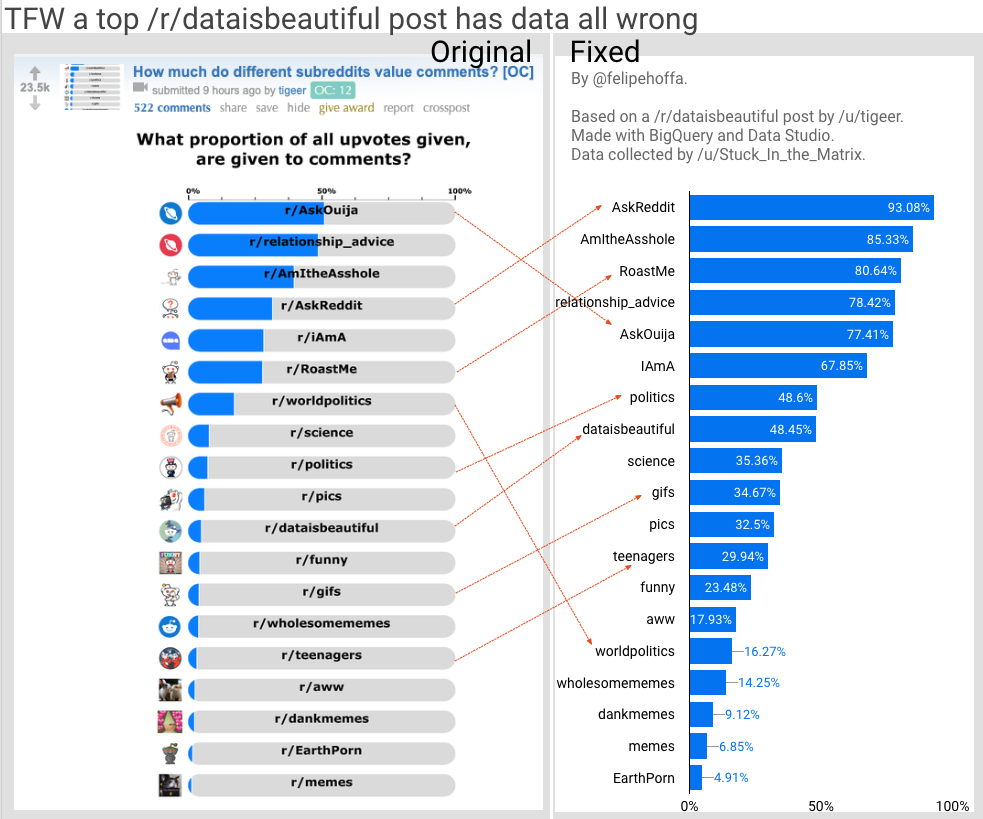
So here is a sort of random image, but the question it needs to raise is what makes these different sources in any way qualified to be a source? In this case if the data is skewed in Ask Reddit, 93% of the data is basically useless and that is missed on a few levels. There are quality high data sources, but these are few and far in-between, in the mean time these sources get to warp any other data we have. And if you are merely looking at legacy data, there is still the Likert scale data you in your own company had and that data is debatable at best.
Labels are dangerous and they are inherently based on the designer of that data source (possible even long dead) and it tends to be done in his of her early stages of employment, making the setting even more debatable as it was ‘influenced’ by greedy CEO’s and CFO’s and they had their bonus in mind. A setting mostly ignored by all involved.
As such are you surprised that I see the AI bubble to what it is? A dangerous reality coming our way in sudden likely unforeseen ways and it is the ‘unforeseen way’ that is the danger, because when these disgruntled employees talk to those who want to win a class action, all kinds of data will come to the surface and that is how these class actions are won.
It was a simple setting I saw coming a mile away and whilst you wandered by I added the Dr. Strange part, you merely thought you had the labels thought through but the setting was a lot more dangerous and it is heading straight to your AI dataset. All wrongly thought through, because training data needs to have something verifiable as ‘absolutely true’ and that is the true setting and to illustrate this we can merely make a stop at Elon Musk inc. Its ‘AI’ grok having the almost prefect setting. We are given from one source “The bot has generated various controversial responses, including conspiracy theories, antisemitism, and praise of Adolf Hitler, as well as referring to Musk’s views when asked about controversial topics or difficult decisions.” Which is almost a dangerous setting towards people fueling Grok in a multitude of ways and ‘Hundreds of thousands of Grok chats exposed in Google results’ (at https://www.bbc.com/news/articles/cdrkmk00jy0o) where we see “The appearance of Grok chats in search engine results was first reported by tech industry publication Forbes, which counted more than 370,000 user conversations on Google. Among chat transcripts seen by the BBC were examples of Musk’s chatbot being asked to create a secure password, provide meal plans for weight loss and answer detailed questions about medical conditions.” Is there anybody willing to do the honors of classifying that data (I absolutely refuse to do so) and I already gave you the headwind in the above story. In the fist how many of these 370,000 users are medical professionals? I think you know where this is going. And I think Grok is pretty neat as a result, but it is not academically useful. At best it is a new form of Wikipedia, at worst it is a round data system (trashcan) and even though it sounds nice, it is as nice as labels can be and that is exactly why these class cases will be decided out of court and as I personally see it when these hit Microsoft and OpenAI will shell over trillions to settle out of court, because the court damage will be infinitely worse. And that is why I see 2026 as the year the graded driven get to start filling to fill their pockets, because the mindful hurt that is brought to court is as academic as a Likert scale, not a scientific setting among them and the pre-AI setting of Mental harm as ““Mental damage” in court refers to psychological injury, such as emotional trauma or psychiatric conditions, that can be the basis for legal claims, either as a plaintiff seeking compensation or as a criminal defendant. In civil cases, plaintiffs may seek damages for mental harm like PTSD, depression, or anxiety if they can prove it was caused by another party’s negligent or wrongful actions, provided it results in a recognizable psychiatric illness.” So as you see it, is this enough or do you want more? Oh, screw that, I need coffee now and I have a busy day ahead, so this is all you get for now.
Have a great day, I am trying to enjoy Thursday, Vancouver is a lot behind me on this effort. So there is a time scale we all have to adhere to (hidden nudge) as such enjoy the day.
A term I got introduced to last week. It stands for “the Saudi nationalization scheme and also known as Nitaqat, is a policy that is implemented in the Kingdom of Saudi Arabia by the Ministry of Labor and Social Development, which requires companies and enterprises to fill their workforce with Saudi nationals up to certain levels” I think it is a great idea. I think more countries need to embrace such a scheme for a few reasons. I believe it is essential that skills are moved locally to avoid being at the massive risk of an American need and that is a bad idea on a few levels. Now, this is not an anti-America sentiment, but the media (America too) have left us with the notion that we cannot be certain of almost anything and there is the larger setting that it goes to other countries too. Perhaps there is an Emiratization, an optional Indonesization (these two words might not exist) and several others (Pakistan, Bangladesh) and so on. So why is there not an open video channel with options on both YouTube and TikTok handing these skills? If I merely push this to myself. There is the option to train people (non-Arabic) in IBM Statistics (formerly known as SPSS) I trained people for over a decade and that is a skill that can be taught. Edit the movie with a localised soundtrack and you have a solution to optionally train dozens of people.
If we create a few hundred videos we could optionally train a whole legion of people and as the elder generation (including me) could leave a footprint handing this knowledge out to others we continue training people after we are gone. I also worked in call centers and whilst the world is filled with silliness and chases after AI, the skills that are out there will be lost soon enough. As such we (read: some) need to create the stages for the next generation. Whilst all are on the AI train we might see a setting of dwindling down sources and in a decade when AI misses its target the world will suddenly see that they lost more than they bargained for. As such a video station that allows Saudization to grow into the people who cannot see what they need and can freely learn to grow their own future is a proper way to harvest talents where they freely grow.
So you might think that this comes for free and that might be the case. Yet the older generations feels that they can contribute to any setting that will listen. As such these skills will require verification so that quality will prevail. Yet is it such a hardship on the older generation? They contribute to all kinds of non profit organisations. Is it so hard to believe that they would assist in creating the future generations? The world is not what big corporations believe it to be, it is what the next generation wants it to be and as such this idea stands a chance. In the setting we see now it might benefit Saudi Arabia. Yet when these movies get a larger setting in Pakistan, Bangladesh, Uruguay and other places, we grow the knowledge in all kinds of directions and as it should be offered free knowledge will emboss all people, not just the ones who can afford it.
It is just a little idea I am playing with, but I reckon that some governments will embrace what hundreds of people could contribute to their national causes.
That is at times the question and the BBC is introducing us to a hell of a tradeoff. The story (at https://www.bbc.com/news/articles/c0kglle0p3vo) is giving us ‘Meta considers charging for ad-free Facebook and Instagram in the UK’, the setting is not really a surprise. On April 10th 2018 we were clearly given “Senator, we run ads” and we all laughed. Congress is trying to be smart over and over again and Mark Zuckerberg was showing them the ropes. Every single time. There was little or no question on this on how they were making money. Yet now the game changes. You see, in the past Facebook (say META) was the captain of their data vessel. A system where they had the power and the collective security of our data in hands. There was no question on any setting and even I was in the assumption that they had firm hands on a data repository a lot larger than the vault if the Bank of England. That was until Cambridge Analytica and in March 2018 their business practices were shown the limelight and it also meant that Facebook no longer had control of their ship of data, which meant that their ‘treasure’ was fading.
So now we get “Facebook and Instagram owner Meta is considering a paid subscription in the UK which would remove adverts from its platforms. Under the plans, people using the social media sites could be asked to pay for an ad-free experience if they do not want their data to be tracked.” It makes perfect sense that under the guise of no advertising, the mention of paid services make perfect sense. This is given to us via the setting of “It comes as the company agreed to stop targeting ads at a British woman last week following a protracted legal battle.” I don’t get it, the protracted legal battle seems odd as this was the tradeoff for a free service. Is this a woke thing? You get a free service and the advertising is the process for this. As such I do not get the issue of “Guidance issued by the regulator in January states that users must be presented with a genuine free choice.” This makes some kind of sense, so it is either pay for the service or suffer the consequences of advertising. And lets be clear the value of META relies on targeted advertising. What is the use of targeting everyone for a car ad when it includes the 26% of the people who do not have a drivers license. There is the addition that these people need to have an income of over $45,000 to afford the 2025 Lexus RX $90,350 which is about 30%. We can (presumptively) assume that this get us a population of about 20%-25%, so does it make any sense for Lexus to address the 100% whilst only one in four or one in five is optionally in the market? Makes no sense does it? As such META needs to rely on as much targeted advertising as it can. And as you can see, The advertising model, known as “consent or pay”, has become increasingly popular. And at some point they were giving the people “But it reduced its prices and said it would provide a way for users not willing to pay to opt to see adverts which are “less personalised”, in response to regulatory concerns.” That is partially acceptable, but I have a different issue. You see, I foresee issues with “less personalised”, apart from gambling sites, there is a larger concern that even as Facebook (or META) isn’t capturing some data. There is the larger fear that some will offer some services and now care about capturing collected data. For example sites outside the EU (or UK). Sites in China and Russia like their social sites that collect this data and optionally sell it to META. You see, there is as I currently see it no defense on this. Like in the 90’s when American providers made some agreement, but some of them did not qualify the stage of what happened to the data backups and those were not considered, when they were addressed it was years later and the data had left the barn (almost everywhere).
There is a fear (a personal fear) that the so called captains of industry have not considered (I reckon intentionally) the need of replacing and protecting aggregated data and aggregated results. Which allows for a whole battery of additional statistics. Another personal fear is the approach to data and what they laughingly call AI. It is hard to set a stage, but I will try.
To get this I will refer to a program called SPSS (now IBM Statistics) so called {In SPSS, cluster analysis groups similar data points into clusters, while discriminant analysis classifies data points into pre-defined groups based on predictor variables.}
So to get data points into a grouping like income to household types, this is a cluster analyses.
And to get household types onto data points like income to household types, is called a discriminant analyses. Now as I personally see it (I am definitely not a statistician) If one direction is determined, the other one should always fail. It is a one direction solution. So a cluster analyses is proven, a discriminant analyses to income ill always fail and vice versa. Now with NIP (Near Intelligent Parsing, which is what these AI firms do) They will try to set a stage to make this work. And that is how the wheels come of the wagon and we get a whole range of weird results. But now as people set the stage for contributing to third party parsing and resource aggregation, I feel that a dangerous setting could evolve and there is no defense against that. As I see it, the ‘data boys’ need to isolate the chance of us being aggregated through third parties and as I see it META needs to be isolated from that level of data ‘intrusion’. A dangerous level of data to say the least.
There is always a downside to a tradeoff and too many aren’t aware of the downside of that tradeoff. So have a great day and try to have a half cup of good coffee (data boys get that old premise)
You have probably seen it, I definitely have and they all call it “A call to AI arms” or something of that sort. It started an hour ago. I saw a security guard and I said “That shop is deceiving us, they say 50% of everything and they are still wearing all their clothes”, the guard was not amused, or perhaps his sense of humour doesn’t go that far. It might not have been overly funny, but at that moment a few things clicked together. And I was of to the races. You see, a few things clicked together and it started yesterday, but my subconscious had figured a few things out that my brain was still working on.
Part 1 Part 1 woke me up to what some laughingly call AI. It was shown to me as a YouTube video. The video (at https://youtube.com/shorts/Kt_oGa4jLik) gives us an “AI” version of the statue.
Screenshot
There is a setting that could work. Consider the increase of interest in Latin and Roman ways of life. To get these statues ‘brought’ to life has advantages. In the first we would not need to rely on actors for all of it and it would be one way to give more impact to the work of Edward Gibbon (1776) published the first volume of his The History of the Decline and Fall of the Roman Empire, Decline and Fall has been the theme around which much of the history of the Roman Empire has been structured. And it doesn’t click with too many of us, but when these statues come to life and as they give life to the writings something more comes to us, especially when it is in Latin. Now you see the first constraint. To see a few seconds of LLM on a statue is one thing, to get people to watch 24 times 45 minutes the constraint will become visible to all. Constraints are seen when the technology just isn’t ready and the utter bull we see on LinkedIn on a daily basis that our future is AI, when it doesn’t exist (yet) gives you a clear pause. But some people need this bubble to exist, their livelihood actually depends on this.
Part 2 Part 2 is LinkedIn. You see, I get a regular image on whether I am hiring. And the options are Yes and Not right now. This isn’t AI, or any kind of AI. This is Direct Marketing and that is what you resort to when you have no data. In 1998 I got a nice taste of that. Someone told me “You either bombard someone with DM, or you start getting clever about who you address the marketing to” it was a clever setting because that was when SPSS launched Answertree. The selected choice for those who wanted to waste as little as possible and when the penetration is a mere 4%, being clever will pay off nicely.
The setting we see now is a combination of constraints and abilities. We have no AI abilities and neither do the computers. As such certain people are trying to sell you a concept, an idea on how things will go and as such they create models that learn everything. So as such they are trying to WOW you with examples on YouTube and LinkedIn on how to do that, but the constraints are there and when you see the constraints you will try to get off that train and the people will have gotten you invested at boarding that train. As such you are hooked and then the limits become visible.
Part 3 The third part came yesterday in a dream, but the setting was seen at least a month ago. I saw it somewhere in November when I stumbled upon it, but it never clicked, because I wasn’t looking for it. But yesterday in that dream I saw the interaction of SPSS (AS400 version) with an export via EXCEL into SAP Dashboard. I had not used that combination in over a decade, but the image was there. Now, I get that these numbers aren’t ‘inspiring’ to anyone else than investors and the board of directors at ADNOC, but to create traction you need inspiring views and the report (added below) doesn’t have that and that is not on ADNOC, you need a better setting for that and that is usually where the car sinks (or strands).
As I personally see it, constraints are surpassed when you give free reign to data to create interest and one place to do this is using SAP Dashboard to create this (originally called xcelcius). That is when market research used the combination to create visible waves in a new setting that people had not seen before and that creates the traction they needed. So what about the numbers shown via a dashboard? It isn’t just oil that requires presentation. You see Abu Dhabi has International Holding Company (IHC), Abu Dhabi National Energy Company (TAQA), ADNOC Gas L.C. and First Abu Dhabi Bank (FAB). These four represent 1.5 trillion in revenue. I reckon that they could use a more visible setting in presenting self and that is merely in one location. And no AI was needed here. A mere look at presenting different and showing themself in other ways. When you realise what dashboard can achieve, they will achieve more all whilst AI is still being created. So whilst we applaud the LLM (and DML) of statues, the moment one person states that Julius Caesar can give voice to his work (for example Commentarii de Bello Gallico) and the constraints make it fall short, you will realise that there is some length to go until AI is an actual reality.
That was the parts my dream didn’t give me and a simple sign that bustled with inaccuracies (of everything) that was when my brain clicked the part together. OK, I can be slow too. Yet I take pride in my slowness, especially when my brain refuses to wake up, which it did to me today.
So have a great day and remember that tomorrow is the last day to learn what sex 2024 was about.
Yup, we all do it, we all like to taste from the bowl of speculation. I am no different, in my case that bowl can be as yummy as a leek potato soup, on other days it is like a thick soup of peas, potato with beef sausages. It tends to depend on the side of the speculation (science, engineering or Business Intelligence) today is Business Intelligence, which tends to be a deep tomato soup with croutons, almost like a thick minestra pomodore. I saw two articles today. The first one is seen (at https://www.bbc.co.uk/news/technology-64917397) and comes from the BBC giving us ‘Meta exploring plans for Twitter rival’, no matter that we are given “It could rival both Twitter and its decentralised competitor, Mastodon. A spokesperson told the BBC: “We’re exploring a standalone decentralised social network for sharing text updates. “We believe there’s an opportunity for a separate space where creators and public figures can share timely updates about their interests.”” Whatever they are spinning here, make no mistake. This is about DATA, this is about AGGREGATION and about linking people, links that too often Twitter has and LinkedIn and Facebook does not. A stage where the people needs clustering to see how to profiles can be linked with minimum connectivity. It is what SPSS used to call PLANCARDS (conjoint module). In this by keeping the links as simple as possible, their deeper machine learning will learn new stage of connectivity. That is my speculated view. You see this is the age where those without exceptional deeper machine learning, new models need to be designed to catch up with players like Google and Amazon, so the larger speculation is that somehow Microsoft is involved, but I tell you now that this speculation is based on very thin and very slippery ice, it merely makes sense that these to will find some kind of partnership. The speculation is not based on pure logic, if that were true Microsoft would not be a factor at all.
But the second article (from a less reliable source is giving us (at https://newsroomodisha.com/meta-to-begin-laying-off-another-11k-employees-in-multiple-waves-next-week/) so they are investigating a new technology all whilst shedding 11% of their workforce. A workforce that is already strained to say the least and this new project will not rely on a dozen people, that project will involve a lot more people, especially if my PLANCARDS speculation is correct. That being said, if Microsoft is indeed a factor, the double stump might make more sense, hence the larger speculative side. Even as the second source gives us ““We’re continuing to look across the company, across both Family of Apps and Reality Labs, and really evaluate whether we are deploying our resources toward the highest leverage opportunities,” Meta Chief Financial Officer Susan Li said at an Morgan Stanley conference on Thursday. “This is going to result in us making some tough decisions to wind down projects in some places, to shift resources away from some teams,” Li added.” Now when we consider the words of Susan Li, the combination does not make too much sense. The chance of shedding the wrong people would give the game away, yes Twitter is in a bind, but it will add full steam in this case and they will find their own solutions (not sure where they will look), a stage that is coming and the two messages make very little sense. Another side might be pushing it if Meta is shedding jobs to desperately reduce cost, which is possible. I cannot tell at present, their CFO is not handing me their books for some weird reason.
Still, the speculation is real as the setting seems unnatural, but in IT that is nothing new, we have seen enough examples of that. So, enjoy your Saturday and feel free to speculate yourself, we all need that at times to TLC our own ego’s.
Why? Because train of thought reads too boring, thats why! So this all happened, or better stated started happening a few hours ago. Someone stated that IBM Z Mainframes are in 96% of all mainframe places. Now, I have no problem with this, I moved out of mainframes 30 years ago, and I still respect what these things can do (they are just too big for my desk). Yet in this, my first question was, what do the other 4% use? A simple question. I got all kinds of answers, yet none of them answered my question ‘What do the other 4% use’, in this it does not matter if it is known, but it is essential to look at.
Why? Well, in this IBM has a luxury problem, they basically own 96% of that market, but the 4% can become 8% then 16%, at that point the message from IBM becomes 4 out of 5 use our mainframe. When the 96% is 120,000 mainframes it is one thing, when it is based on 960 mainframes it is a whole different story. The numbers matter, that has always been the case (even if Microsoft is in denial now they are shedding market share).
Reasons There can be a simple reason. For one epidemiology, if it is about real time numbers, the market is slim, massively slim, compared to that market a size zero model is a mere chunky blobernaut. Cray is one of the few players in that setting and it makes sense that a Cray is there where an IBM is optionally not. Still, I would want to know.
You see, in strategic thinking we have two elements we ALWAYS need to keep one eye on. One is threat the other is weakness. In this example real-time data management is a weakness. Now we need to understand that this market is set to billions and those who desperately need it, that number is not an issue, yet for IBM investing that much for 4% is tactically not sound, not until that marketshare is a lot larger. That makes perfect sense and let’s face it no one owns 100% of a market, if that ever happens we will have a lot more problems than we could possibly understand.
Why do I care? Well, for the most I do not, but at present I am not to involved with any SWOT analyses, and the ones I did lately was done for wannabe managers who seemingly only understand bulletpoint memo’s. The idea of any strengths, weaknesses, opportunities, and threats (SWOT) analyses that is related to business competition, project planning and capability planning is more important than most people realise. We see it in intelligence, business intelligence and market intelligence. And now we see two new real markets emerging where it is important too. Gaming and SAAS/GAAS. Even as GAAS is still some time away, the need to actively SWOT in all three is there and I believe the players are not too finicky about that and they need to be. As the cloud is oversold and the dangers are underestimated their board of directors need to hold up a mirror where they can tell themselves that it doesn’t matter, and when we understand how completely those people are lying to themselves, at that point you might get the idea that there is a problem. The SWOT has more sides, it tests your capability, your software (Strengths and opportunities) but that needs to be levelled by weaknesses and strength.
800 years ago To understand this we need to go back to the good old days (Ghengis Khan). It was he who stated “It is not enough for me to win, my opponents must all fail”. Yes, I admit it is a massively loose translation but it applies to the now. When we stumble over sales people and their unnatural large ego’s, we tend to listen because they make the loudest claims, yet are they valid? Consider Solarwinds and what they enabled criminals to do, when you consider the news last week when we were given ‘SolarWinds hackers stole US sanctions policy data, Microsoft confirms’, it was a weakness and a threat, so when we how long the hack was active and that we now see that policy data is online and open for anyone to look into, what other sides are not yet known? It is not enough for SAAS vendors to look at SWOT, their customers need to do the same thing. So when I considered the 4% is was not because I need to know everything (which at times is still nice as a high executive CIA decision maker has a girlfriend that has size 6 lingerie, his wife is size 11), so who needed to do the SWOT, someone at the CIA or me? One could say both as I am his threat and he is my opportunity.
The stage of what is what could be remains forever in motion.
So where from here? That remains open. For players like Amazon, the enabling of GAAS becomes more and more important, especially when you see the blunders that players like Ubisoft makes, they need to be aware of where their customers are, especially when Netflix becomes active in gaming too. They will have an advantage, but Amazon can counter it, yet there are sides that remain unknown for now and they should not be (not on that level) and there is the rub. Too many rely on external solutions when that solution needs to be in-house. And we can disperse with all the marketing BS that some give like “We are a better company now”, when you drop the ball to that degree there was a massive space for improvement and you merely are on par for not being where you should have been a year ago. An old IBM Statistics wisdom was “You’ll know when you measure”. This sounds corny but it is true, you cannot anticipate and adjust when there is no data and in all this any SWOT analyses would have been usable data. So where was the 4%? I do not know and the poster seemingly did not know either. It might be fair enough, yet when that 4% becomes 8%, when should you have known? It is a question with a subjective answer. Yet in gaming it is less so, especially as I am becoming aware (unproven at present) that Microsoft has one nice trick up their sleeve. There is partial evidence out there that Skyrim will be on PS5 in digital formal only. Several shops now have a ‘DO NOT USE’ for any physical PS5 format of Skyrim. Now, there might be an easy answer for this after all these lockdowns, but it is only 4 weeks away now, so you tell me. Is Microsoft playing its ‘bully’ card? Are they trying to push people to Xbox? It is a fair approach, they did pay 8 billion and change for it, but consider that their actions are set to a larger stage. A stage of millions of angry fans. I solved it for them by creating public domain gaming ideas for any Sony exclusive RPG game. I am not Bethesda, I am a mere IP creator, but when software makers are given a free ride towards Sony exclusives and even if one game hits the mark, the Bethesda market share dwindles to a lower number. Now consider what happens when that happens on Amazon Luna too? I might be a mere 1% factor, but if another one joins me I grow 100% whilst Microsoft dwindles more. For Microsoft Amazon is becoming a real threat and a weakness, for Amazon Netflix is optionally a threat and a weakness whilst Google Stadia is optionally the opportunity for Amazon.
All SWOT settings that could have been seen from afar from the beginning. It is not everyones train of thought, yet in this day and age, I think it needs to be, the markets and our lives are changing in all kinds of ways too quickly and too large, we need to think head and having a clear grasp on how to apply SWOT in our lives might become essential.
The difference? That is a much harder line to follow. It comes down to the word ‘Insight’ and it is a dangerous, a very dangerous word. Because depending on the person this can be Insight, speculated insight, expected insight, and adjusted insight and more than once they are all on one pile making the data less reliable. Insight is also subjective, we all see it differently and that does not mean that I am right and everyone else has a wrong station. No, it is all subjective and most CAN be correct, but as the insight is disturbed by speculated, adjusted and expected versions, the numbers alter slightly. And now we see that 4% was not 4%, is was 7% and 5%, 5% because there were other IBM mainframes in play (adjusted) and 4% was the speculated number and 7% was the expected number. Now we have a very different station, the expected moves us from 96% use our product, towards 9 out of 10 are our customers, which is now a mere step towards 4 out of 5 use IBM. So would you like to bring that conversation to any board of directors? They’ll serve your balls for dinner (see image).
Still feel certain that you do not want to know? In reality most SWOT analyses are seemingly pointless and often amazingly boring, yet in this day and age they are an essential part of business and gaming at $130 billion a year is facing that side as well. So when you consider what I gave you also consider the impact that some shops have ‘DO NOT USE’ for Skyrim preorders, 4 weeks before release, lockdown or not, it beckons all kinds of questions. And to be fair, there could be a simple explanation for all of it, but that too is the consequence of trying to create hypes via YouTube without clearly informing the audience. It is a weakness Microsoft has shown a few times (Bethesda was never completely innocent, but equally never this guilty).
So what has a game in common with a business setting? It is simple, they both need to manage expectations and that too is a side of SWOT, even as marketing often merely focusses on opportunity, there is a weakness and a threat. The lack of clarity and misinformation are both a weakness (angry customers) and a threat (churning customers) and in the world of gaming the churners are the real danger, they can get the flocking population of angry gamers to come with them and really make numbers spiral downward. In this day and age SWOT is an additional essential way to go, in nearly all walks of life. We simply can not avoid being that naive anymore, not with spiralling energy prices and more and more articles that can at present no longer be found in any supermarket, all whilst plenty of people are in a holding pattern for their incomes.
It is a train of thought and it is up to you to decide if you want to do it or not, because that was always your right, the right to ignore, but it must be said that it will be at your own peril.
Yes, that happens, we all consider it, but did anyone thought it through? You see, innovation is essential in staying ahead, iteration tends to give you a 2 year advantage, innovation gives you a 5-7 years leap. That is not new, it has been a ‘fact’ of life for 3-4 decades. Yet that premise is about to change, it will change a lot and it will change towards the bad side of the pool. To see this we need a few items, the first is an article, an article that the Guardian gave us with ‘I’m sorry Dave I’m afraid I invented that: Australian court finds AI systems can be recognised under patent law’ (at https://www.theguardian.com/technology/2021/jul/30/im-sorry-dave-im-afraid-i-invented-that-australian-court-finds-ai-systems-can-be-recognised-under-patent-law), you see there is a danger here, even as the Guardian gives us “Allowing machine inventors could have numerous consequences, both foreseeable and unforeseeable. Allowing patents for inventions churned out by tireless machines with virtually unlimited capacity, without the further exercise of any human ingenuity, judgment, or intellectual effort, may simply incentivise large corporations to build ‘patent thicket generators’ that could only serve to stifle, rather than encourage, innovation overall.” This we get in the article from Australian patent attorney Dr Mark Summerfield, and he is right, you see, there is a larger danger here. It is not merely that only a few companies can AFFORD such an AI, the larger stage is that if we combine this and we add a little statistics to the pile, we get a new setting.
SPSS (now IBM Statistics) has something called the conjoint analyses. To understand this, we need to take a look at the manual. There we see:
Conjoint analysis presents choice alternatives between products defined by sets of attributes. This is illustrated by the following choice: would you prefer a flight that is cramped, costs $225, and has one layover, or a flight that is spacious, costs $800, and is direct? If comfort, price, and duration are the relevant attributes, there are potentially eight products:
Given the above alternatives, product 4 is probably the least preferred, while product 5 is probably the most preferred. The preferences of respondents for the other product offerings are implicitly determined by what is important to the respondent. Using conjoint analysis, you can determine both the relative importance of each attribute as well as which levels of each attribute are most preferred.
This is all statistical science and it works, but the application can be changed. If data is the only premise here, we see the application in another way. What if the AI is taught the categories that enable a unique stage to own ANY patent field. Consider that this is not about a flight, what if this is about a processor.
Product Speed Processor Sampling 1 X Sycamore Bozon 2 X Sycamore Instantaneous Quantum Polynomial 3 X Tangle Bozon 4 X Tangle Instantaneous Quantum Polynomial 5 Y Sycamore Bozon 6 Y Sycamore Instantaneous Quantum Polynomial 7 Y Tangle Bozon 8 Y Tangle Instantaneous Quantum Polynomial
I am merely making a fictive sample with existing names, but what if the math of conjoint is tweaked to cover the quantum field to a larger degree, a computer can do this faster than any person and it can even start making the documents, so the AI can create a set of patents that cover the entire field, with a setting where less than 20 patents will stop commercial competitors to get traction in this field and this is not merely speculation, I feel that this is where we go to and now the big tech companies will own it all and the AI’s will have the entire patent field. Yes, there will be holes in the beginning, but as patent filing will overturn normal filings, the patent field will end up being owned by Google, IBM and Amazon. I have nothing against any of these three, but this is not what I (or anyone else) signed up for. I might just put all my 5G IP online making it all public domain, just to temporarily deflate the AI premise.
And personally, there is no way that either of the three had not considered this application, making the AI patent field a lot more debatable and I reckon that the larger law field is looking into that. In 2012 a total of 1,892 filings were made, now consider that an AI could cover a larger field with a mere 300 filings. That is not out of the realm of considerations, as such the Australian case we see in the Guardian could well end up with all kinds of nasty surprises if the stage of “The decision by the Australian deputy commissioner of patents in February this year found that although “inventor” was not defined in the Patents Act when it was written in 1991 it would have been understood to mean natural persons – with machines being tools that could be used by inventors” is not overturned. Will it? I cannot tell, but it opens a whole range of doors and some of them will end up being rather nasty.
Yup, one sees a game, the other sees an application and the third sees a solution, that is how it is, how it, for the most has always been. I got introduced to Palantir in 1998 or 1999, I got access and took a look at it. At the time I was working for other parties and I noticed that Palantir government had a setup the was nice, it was not what we now call IBM Miner, but it had potential. So when I got introduced to the news giving me ‘Secret and unprofitable Palantir goes public’ I took notice. You see, I started to wonder what was happening, the quote “Seventeen years after it was born with the help of the CIA seed money, data-mining outfit Palantir Technologies is finally going public in the biggest Wall Street tech offering since last year’s debut of Slack and Uber”, it gets to be a little worse when we consider “Never profitable and dogged by ethical objections for assisting in the Trump administration’s deportation crackdown, Palantir has forged ahead with a direct listing of its stock, which is set to begin trading on Wednesday”. You see the setting is not great for Palantir and as I see it, over 17 years they made their own bed, this is seen with “The company has just 125 customers in 150 countries”. Now, I can claim that I am not the brightest person (even though I passed the Mensa requirements), but the stage of 125 customers in 150 countries is not manageable. Even as they ‘hide’ behind “Our software is used to target terrorists and to keep soldiers safe”, you see, the software has a foundation and a base. Even as one foundation part is to hunt terrorists, the base is to analyse data. I can hunt terrorists with IBM Statistics, IBM Miner and Mapping software, it might not be fast, but it will get me there (well, mostly anyway), so in the setting we see with Palantir, we see a larger failing, especially over 17 years. They had well over a decade to extent the bae and create an additional foundation, optionally getting another 125 customers, yet that was not what they did, is it? So when we see “Palantir paints a dark picture of faltering government agencies and institutions in danger of collapse and ripe for rescue by a “central operating system” forged under Thiel’s auspices”, I merely see an excuse. You see Palantir has no need or reason to rely on a station with ‘faltering government agencies’, by extending the base and creating another foundation they would not need to rely on the side and add an optional third foundation called reporting. The need for washboarding and sliceable presentations have been a larger requirement for close to a decade, these options are required in the intelligence world as well, leaving it up to others means the the slippery slope of business intelligence becomes smaller and less pronounced, a place that relies on long term vision has been lacking that a lot, has it not?
Even as Scott Galloway from New York University gives us “They’re massively unprofitable and they’ve never been able to figure it out”, the obvious question becomes, were they unfocussed, uncaring or just lazy? The vendor the relies on government jobs can’t rely on them for more than 2 years, if the program is not showing forward movement, there is no long term justification and when we see “Palantir has accumulated $3.8bn in losses, raised about $3bn and listed $200m in outstanding debt as of July 31”, we see the faltering position that Palantir is in. It cannot rely on the customer base it has, because well over a third has extended its credit card too much, as such they need to adapt to a form of Business Intelligence gathering, data mining, slicing and washboarding and set a new stage in long term reporting. As I see it, Banks and financial institutions will have extended Business intelligence needs and additional needs as well. If you think that financial fraud is big now, wait until banks automate under 5G, it will be a tidal wave 5-10 times the one the banks face now and they will need to have additional ways to find the transgressors, relying on the police will be a monumental waste of time, which is not the flaw of the police, it is the consequence of the times and their needs. I state financial institutions, because it is not merely the banks, it is the credit crunch seekers that will need to find the people with outlandish debts and as the laws will adjust because the banks will no longer accept that the wife gets the house so that they can live in luxury of what they could not afford, the game ends soon enough, the credit drive will force change and there would be a market for Palantir if they adjust. They need to adjust faster the they are ready for, but the current agenda does not allow sleeping at the helm. As I personally see it (on small and debatable data), Peter Thiel took too long and even as we are being told “winning a modest contract early in the COVID-19 pandemic for helping the White House gather data on the coronavirus’s impact”, I wonder how the data collection part was achieved, in light of all the places where no data gathering correctly existed, the stage of the gathered data becomes debatable.
The article (at https://www.aljazeera.com/economy/2020/9/30/palantir-goes-public-in-biggest-wall-street-tech-offering-of-2020) as a lot more debatable parts, in all they are tracks that could have been highlighted by adding a few commercial data gatherers to the fold from day one. There is the other need for a setting of adjustment and weighing of origin data, all whilst all the data is scrutinised. I reckon that this would set a stage where the findings of Sarah Brayne would be considered in house and not after certain stages went live (or perhaps they were merely ignored). She found “the Los Angeles Police Department’s use of Gotham, found the software could lead to a proliferation of unregulated personal data collected by police from commercial and law enforcement database”, I will add to this, the setting that the software was designed to people employing trade craft, they would be outliers on the entire board, a setting that rates questions on people who seek cheap solutions because of budget, seek evasion because of divorce and outstanding bills, the acts are similar but not terrorist in nature.
OK, I admit, I do not know the exact setting in LA (other that Lucifer is their consultant), but the setting of outlier data came to mind in the first 10 seconds, and the finding of Sarah Brayne and ‘proliferation of unregulated personal data’ supports that, apart from the fact that unregulated data tends to be debatable and optionally in part or completely incorrect, data mining gives us the option to clean if the sources are known, unregulated personal data takes the out of the equation because the origin of the data (the person adding and manipulating data) is unknown and as such the data becomes unreliable.
That is a lesson that banks would have told them quickly, if not them, then players like Equifax, because Palantir will end up in their fairway, the odds would not be even for Palantir. Yet Palantir needs to grow if they are to exist in a stage after tomorrow, to the there is no doubt, the US, UK and most EU nations cannot continue on the intelligence data foundations that they currently are. So as we see that, how many customers could Palantir lose? Growth is as I see it the only path that remains, banks are the most visible needling of more intelligence gathering, but they are not alone and Palantir needs to gird their loins.
As we stepwise push forward towards 5G, we think that it all stays the same, it will not. A few parts will change forever. Google has an enormous advantage, yet they too are now pushing for different changes, changes that they had not seen coming a mere year ago. In this case there is no direct link to my IP, so I am happy to give you all the inns and outs of that part (pun intended).
To start this we need to consider a few sides, all with their own premise. The first is the focal point:
4G: Wherever I am 5G: Whenever I want it
That first premise is a large one, it is not a simple localisation part, it is all about getting access at a moment’s notice, yet what we need access to changes with the push we face. The initial part is the creation and the impact of awareness. As we re-distinguish ‘awareness’ the metrics on awareness will also change and for the first year (at the very least) market research companies on a global stage will be chasing the facts. They have become so reliant on dash boarding, Tableau, Q-view and Q Research Software will all have to re-engineer aspects of their software as they fall short. Even the larger players like SAS and IBM Statistics will require an overhaul in this market space. They have been ‘hiding’ behind the respondent, responses and their metrics for too long, the entire matter when the respondent becomes the passive part in awareness is new to them, and that is all it is, it will be new to them and the constructs that are behind the active and passive interactions will change the metrics, the view and the way we register things.
Google has the advantage, yet the stage for them will take a few turns too. Their initial revenue stream will change. Consider the amount of data we are passing now, that amount also links to the amount of ads we see. Now consider that everything in 5G is 10 times faster, yet 10 times more ads is not an option, so they now face revenue from 10% of the ads compared to what we see now. In addition to that, as we adjust our focus on the amounts we face implies that more advertisement space is optionally lost to the larger players like Google and this too impacts the stats for all involved. Google will adjust and change, in what way, I cannot tell yet, but the opposition is starting to become clear a in this example we see Heineken, a global established brand who now has the option to take the lead in 5G awareness.
Introducing
Ladies and gentleman, I am hereby introducing to you the Brotherhood of Heineken, in this fraternity / maternity, we invite all the lords and ladies of their household to become awareness creators towards their brand. In the Netherlands thousands are linked through a company like Havenstad and similar operations, this stretches through Europe and all over the place going global. These lords and ladies can earn points in the simplest thing, by setting a stage for Heineken to spread the message, we see that the initial power is with the consumer to support their brand. Awareness and clicks are converted to points and that leads to exclusive offers and rewards. Consider the unique stuff that Heineken has given to its professional public now for all to get, to buy and to earn. Bags, coolers, clothing, accessories. For decades we saw the materials created and most of us were envious of anyone who had that part others did not, now we could all earn it and because Heineken (Coca Cola too) have created such an arsenal, these players could take the lead in pushing their own awareness to new levels.
Now it is easy to say that Google is already doing this and that is partially true, but that equation will change under 5G and these really large brands could pay a fortune to Google or take the lead and create their own powerhouse and in this day and age that powerhouse will become more and more an essential need. Anyone not looking and preparing to this will hand over opinion and choice to Google and watch how that goes, yet consider that some sources gave us a quarter ago: “Google will remain the largest digital ad seller in the world in 2019, accounting for 31.1% of worldwide ad spending, or $103.73 billion“, now consider that they need to grow 20% quarter on quarter and that in two years that metric has changed and as such the ads could cost up to 30% more, now do the math on how YOU will survive in that environment.
Samsung, Proctor & Gamble, Coca Cola, Nike, Heineken, Sony, Microsoft will all face that premise and that is how it all changes. As we see that the metrics will have reduced reliability, the market research players will need time to adjust and in that lull a player like Heineken can create its own future and set its digital future in another direction to exceed their required expectations. This step seems short now, but as the stage alters it becomes an essential stage. Google may remain in denial and oppose that this will never happen, but the data and metrics are already suggesting this path and that is where we are now; the option to be first or pay the invoice, what would you do?
I believe that the visibility starts to get a little focal just before 2020 games, and it is in full view before the 2022 Beijing Winter Olympics, and in full swing by the time the 2022 FIFA World Cup in Qatar starts. These two are close together and the people will pay through the nose for that visibility, especially the European parties in all this. I expect a more evolved 5G advertising stage via apps as well, seeing ads to unlock premium view and data is likely to happen, all this is coming to us and our view of advertisement will alter to a larger extent. We will be told that this will never happen, it is not how they work, yet they are deceiving and lying to us. Consider that change in the last 25 years alone, in 1994 advertisement through printed medium and TV was at an all-time high, they all claimed it remained this way, within 5 years that stage was already changing with online ads to some extent and the slowing of printed medium, in addition the international channels would push into national advertisement. A mere 5 years after that (in 2004) it started to take off in earnest and would increase revenue to over 100% in the 4 years that followed. Between 2005 and 2017 that would push from $6 billion to 26 billion, do you really think that their words holds true? To keep that growth and their need for greed the metrics and approach has to change, there is 0% chance that these players will accept a growth of data based impact of a mere 10% of what is was in 4G, there is too much riding on this.
For the largest players there is an alternative and it will not take long for them to set the stage to this and start finding their own solution to keep awareness as high as possible. If you have to pay through the nose to keep awareness or create the environment to reward achieved awareness, what path would you choose?
Let’s not forget players like Heineken did not get to the top by merely offering a really good product, they offered a lot more, a view, an awareness that all embraced; Sony learned that lesson the hard way by losing with a superior product against the inferior competition (Betamax versus VHS). 5G will set a similar yet new battle ground and for the most the media is seemingly steering clear for now.
That is with the nice exception of Marketing Interactive, who gives us (at https://www.marketing-interactive.com/going-beyond-the-big-idea-creative-leads-on-5gs-impact-on-advertising/) “There is no denying that the rollout of 5G will change storytelling and the consumer journey“, it is a true and utterly correct view. They also give us: “creatives need to evolve from old habits and stop hiding behind “the big idea”. “We, as creatives, need to evolve from old habits, stop hiding behind “The Big Idea” and evolve our creative process and creative structures to be based on this new digital reality, to create content based on this new innovative context“, this is the view from Joao Flores, head of creative, dentsu X Singapore and he is right. We also get “For agencies, the opportunity calls for unorthodox alliances to make sure our creativity is the beating heart of this quiet revolution“, which is true, but it ignores the alternative path where the largest players start getting this path in house and in light of the two revelations, we see that during the last decades players like Heineken had been doing just that and that makes them ready to take on the 5G behemoth and push the others into second place or worse. There is a need to have expertise and many do not have it, but in that Heineken has been different for the longest times. It is most likely due to the unique view that people like Freddie Heineken had on their market and consumers. You merely have to realise that they were the first to embrace ‘Geniet, maar drink met mate‘ (enjoy, temper your drinking) it was a slogan that came into play around 1990, as well as ‘Drink verantwoord. Geniet meer‘ (drink responsibly, enjoy it more). All pushes to set a better stage, it is there that we see that a new push could be produced by players like Heineken.
We see so many more paths opening, but in all this the one overwhelming side is not what paths there are, but the stage of metrics that they all rely on, as such having control on the expenses as well as the foundation to create a reliable stage for their metrics will be a first soon enough. Not merely: ‘Who is your population?‘, it is the stage where the passive and active awareness can be differentiated on, that too will push advertisements and the applied visibility through 5G apps and 5G advertising and how the funds are spent, that will be the question that impacts player like Google Ads on the next 24 months, because if they do not do that, their quarter on quarter growth will suddenly take a very different spin, and they are not the only ones affected.





 Lawrence van Rijn - Law Lord to be