Tag Archives: Apple

Crime as a business model

Have you considered that yet? Have you considered that turning towards the criminal side of revenue (and additional spiking profits) you could gain a bundle? That question came to mind when I saw ‘Apple and Samsung fined for deliberately slowing down phones‘. The guardian (at https://www.theguardian.com/technology/2018/oct/24/apple-samsung-fined-for-slowing-down-phones) gives us: “Apple and Samsung are being fined €10m and €5m respectively in Italy for the “planned obsolescence” of their smartphones“, So when we see that Apple got a €10m for their application of creative endeavours. Now consider that Apple makes about €450 per iPhone, or €625 after all the tax write-offs and other offsets that they can legally employ. So in all, to break even Apple required the sale of 16,000 phones just to break even on that fine. Now look at the numbers from Statista (at https://www.statista.com/statistics/804398/us-iphone-sales-by-model/). There we see that the latest three models model 8, model 8 plus and model X represented over 60% of their sales share up to December 2017 and 54% up to June 2018. Now consider that this represents 41.03, 46.68, 77.32 and 52.22 million units. So the stage is close to 60% of 88 million units (almost 53 million units), as well as 54% of 129.5 million units giving us almost 70 million units. So there we have it. The stage where the means to sell 123 million iPhones through what the court is seen as deceptive conduct gets a fine that amounts to 16,000 units. A fine received that represents a mere 0.013% of their cost of doing business. How much of a joke does it need to be before we see proper legal reprimanding large corporations? The governments will not properly tax them; the legal institutions will not properly fine them. The fact that the people do not to a much larger degree realise that crime is the only way to pay your bills is basically beyond me. And this is not even including the latest model iPhone which is a lot more expensive (the cost of making one is likely to be equally expensive though). That whilst Samsung and Apple are seen as the only two bad guys seems not entirely correct. Because if Samsung (an Android phone) has it, I feel certain that other Android phones might have a similar setting in play (speculated, not proven or documented), so it is not merely Apple with its IOS. Yet the stage of Apple is now not how they got rich, we see that their unscrupulous practices is an optional the reason why they are the richest company on the planet, and governments are letting them get away with it. When a criminal is allowed to keep 99.987% of their ill-gotten gains, why not merely become a criminal? I myself send my resume to the GRU (a Russian punitive monitoring government corporation relying on creative solutions), for the mere reason that if I can do a better job than Igor Valentinovich Korobov, why not? Not sure if they are allowing an Australian to run their military intelligence operations, but hey! If Apple can think outside of the ethical box, than so can I.

But this is not about me; this is about a growing amount of corporations looking to stage retail growth. Even as we see that this is going on in many retail segments, The path pushed onto people in places like gaming where at the mere saving of $15 Microsoft gave its players an Xbox One (and Xbox One X) with merely 50% of its capacity. Yes as I calculated it for consumers the difference was $15 to get twice the storage, it was that bad and the media trivialised it for the longest of times. So it is not a surprise that 70% of the life sales cycle of the Microsoft consoles was surpassed by Nintendo with its Switch in 15 months, the most powerful console in the world (and initially its less powerful brother) has been around since June 2014, and in 15 months the bulk of all sales is close to being equalled by the weakest console of the three large players. Yet the issue is not that Microsoft had a bad idea, they have had plenty of those. When a console maker knowingly and willingly undercharges a system, is that not deceptive conduct too? The problem is to prove it. Yet when we realise that a 1TB drive gives you less than 1,000 GB, merely because of the operating system (which makes perfect sense). Some give that reserved space to approximately 140GB leaving you with 860GB. Now consider that games like HALO5 and Gears of War 4 are each 100GB, Forza Horizons 4 is said to be 95GB, that gives us 34% for these three games alone and we are already getting the news that Fallout 76 and Red Dead Redemption 2 will be massive too, as are AC Origin and AC Odyssey. So we are looking at an optional 76% filled hard drive with these 7 games. Seven games to fill the drive. OK, I am the first one to admit that not all games are this big. The Lego games are Tiny in comparison, many other games like the EA sports games are between 38-45GB (normal edition) I did not find reliable information on how much extra the 4K part is, but usually the size doubles. So at this point, when that hits you, can we consider (not agree, merely consider) that Microsoft could optionally have been engaging in deceptive conduct as well? It is all around us and there is too much of it. Also, I am not ignoring Sony in this, they solved it by allowing people to change the hard drive from a 1TB to a 2TB (at their own expense), which is currently $119, so 100% more storage, which initially putting it in would have been a mere $15 difference on consumer levels. Yet the question there is did Microsoft do anything illegal or merely something really stupid? If they had allowed for personal upgrades there would have been a much larger Xbox One wave, I am certain of it. The Sony tray solution could have been equalled by the Xbox One X from Day one, giving the gamers actual value for money. That part will of course be looked at when Xbox One Scarlett comes out, which is still set (according to some sources) to 2020, yet this is not about gaming, or merely the Xbox. There is a group of people that is finally becoming savvy enough to look at what they require to have something worth their time and money. We see a growing group of people knowing what to ask on their new mobile, their new console, their new tablet and their new notebook/netbook.

So how does this relate back to the optionally ‘criminally implied through innuendo‘ business model? This is actually more important than you think. There was an additional reason for all this. You see a shop named JB Hifi (the most visible one in Australia) gives the consumer: “Across town or around the world, the new Surface Pro 6 is your perfectly light, incredibly powerful travel partner — now with the latest 8th Generation Intel® Core™ processor and up to 13.5 hours of all-day battery life.“, they even added the footnote: “Surface Pro 6battery life: Up to 13.5 hours of video playback. Testing conducted by Microsoft in August 2018 using preproduction Intel® Core™ i5, 256GB, 8 GB RAM device. Testing consisted of full battery discharge during video playback. All settings were default except: Wi-Fi was associated with a network and Auto-Brightness disabled. Battery life varies significantly with settings, usage, and other factors“, you see, TechRadar gives us another story: “Microsoft promises up to 13 hours and 30 minutes of local video playback from the new Surface Pro. That’s a lofty claim and one that our test unit failed to live up to. That being said, based on our tests of the previous model’s battery, we no doubt see a noticeable improvement. Test results came in 24% and 32% longer than the previous model at 4 hours and 3 minutes, and 6 hours and 58 minutes, respectively, this is a long way off from the “up to 13.5 hours of all-day battery life“, which is also deceptive (to some degree); you see when we look for ‘all-day battery life‘ ZDNet gives us (relating to the Samsung Note 9: “it seems that what ‘all-day battery’ means is that if you are an average or typical user, then the Note 9 should last you all day without needing a recharge, but a whole bunch of real-world factors can get in the way of that.“, this translates to the Surface Pro that you need to be able to get through the day without needing a recharge when you are an average user, when we see an initial 13.5 hours, we all would agree, yet TechRadar gives us a mere ‘6 hours and 58 minutes‘ (the longest version) which is less than a working day, especially when you are using it on your trip from and to the office (or was that the other way around). Now we get to see the other side of it all and even as the iPads are better, but not by much, it is the marketing usage of ‘all-day battery life‘ that is becoming a much greater issue, in this case (even as I concede that there are several models of the Surface Pro, also there are issues with different models and usage, places like JB Hifi uses that same setting for the Microsoft Surface Pro 6 i7 512GB, and as we acknowledge that the i7 needs more power than the i5, we see that that battery life is optionally misrepresented and it is odd that at this point Microsoft conveniently does not seem to check on how their devices are sold. When we look at The Verge, which gives us: “Thurrott reports that Microsoft CEO Satya Nadella met with Lenovo last year and quizzed the company over how it was responding to Skylake problems. “Lenovo was confused,” claims Thurrott. “No one was having any issues.” It appears Microsoft’s own problems were the result of the company’s unique approach to the Surface Book, with custom firmware and drivers. While other, more experienced, hardware makers were able to respond quickly, Microsoft’s delay impacted reliability“, this is not the end, especially when you consider that the article is a year ago and is a reflection on the ‘Leaked Microsoft memo reveals high Surface Book return rates‘, and whilst this was the Surface Pro 4, a system two generations old, we see that basic stages have not been met with better quality control and a much better information control setting. In addition, the ‘party line‘ response on battery life is as I personally see it a much larger issue that seems to be determined to sell more and hope that the consumers will not bring it back. I believe that there is a failing in the UK and Australia, a fact that is shown in the Daily Mail (at https://www.dailymail.co.uk/sciencetech/article-6233259/Microsoft-unveils-899-Surface-Pro-6-iPad-killer-alongside-new-999-Surface-Laptop-2.html), where we were treated to “The Surface Laptop 2 now gets 14.5 hours of battery life, while the Surface Pro 6 still gets a solid 13.5 hours on a single charge“, a quote that should be enough to get the Daily Mail in hot waters with a whole league of unsatisfied users and if the Daily Mail concedes that they were merely going by Microsoft numbers, it will be Microsoft taking a hot bath of people demanding that level of battery performance. Or it is entirely possible that Microsoft will claim that there was an unfortunate miscommunication between their marketing department and Annie Palmer, the Daily Mail article writer. In the end the setting should be regarded as sales through deceptive conduct and even as these two players are the most visible ones, they are not the only ones. There has been the Apple Error 53 issue, Telstra with their interpretation of ‘unlimited’ and Optus with their interpretation of DCB (Direct Carrier Billing) and the less said about my interactions with Vodaphone (aka Vodafail) the better, all whilst that list of corporations that are graduating summa cum laude on the art of miscommunications keeps on growing too.

A lot of it is only visible after a long time and after the damage is done. We all agree something needs to be done, yet when we realise that the fine is merely 0.013% of what some end up gaining, there is absolutely zero chance that this situation will be rectified within the lifespan of us, or our children, the profit margins are just too large.

for me, my interactions with Apple costed me $5599 in the end, money I did not have to spare and even as I still love my G5 PowerMac and my iPad one, I remain sceptical and cautious of anything new that Apple released after 2006, the price has been too high and I am merely 1 of one billion active Apple users, they have that much to gain by continuing on the path they currently are.

The law is seemingly slightly too flaccid to resolve the situation at present, how sad is that?


1 Comment

Filed under Finance, IT, Law, Media, Science

Game of Pawns

Most people have heard of the Game of Thrones, George R.R. Martin’s masterpiece filmed and shown by HBO. Its final season will come in 2019 and the air is filled with teasers, speculated spoilers and optional fan made false trailers. Yet have you heard of the game of pawns? This goes directly towards the entire Australian Encryption Bill. I spoke about it 2 days ago in ‘Clueless to the end‘, where we are introduced to the misrepresented views of Peter Dutton. On how he plays the system on getting the FAANG group to help him a little, which is exactly what the FAANG group is unwilling to do. In addition to what I wrote there is the voice of Paul Brookes, chair of Internet Australia. He gave us: “it is important for law enforcement to find ways to improve their capabilities for intercepting criminal activities through the communications sectors, “they must not do so via hastily enacted legislation which fails to consider the legitimate concerns and advice of global technology experts, and carries the very clear risk of creating more problems than it solves”“, in this Paul is right and the issue is growing on other settings too. In the last three days we have been made privy to: ‘Hackers stole millions of Facebook users’ highly sensitive data — and the FBI has asked it not to say who might be behind it‘. Optionally because they cannot unsubstantiated blame Russia again, yet in the much larger setting it seems that they do not have a clue. In addition, we see evolving today: ‘PS4 Users Are Claiming That Malicious Messages Are Breaking Their Consoles‘. The last one seemingly has a solution as reported by Kotaku: “It does seem that the exploit is purely text-based, so changing your PlayStation messenger privacy settings should prevent it from happening. You can do that by going to Account Management in your console Settings, heading to the Privacy Settings submenu, and changing Messaging settings to “Friends Only” or “No One,” meaning that only your pre-selected friends or no one at all can message you“. Two attacks, the second one without knowing the extent of the attack in a setting that could not have been prevented by the encryption bill, the fact that the authorities have been grasping in the dark gives a very clear view on how short the authorities are on the ability to stop these events. All the BS short-sighted attempts to access data whilst the entire communication system is flawed beyond belief shows just how clueless the governmental players have become.

So as this week is likely to be about: “It appears to be the worst hack in Facebook’s 14-year history“, many will all go into the blame game against Cambridge Analytical, ye the foundation is that the internet was always flawed, and again we see a setting where the failing of non-repudiation is at the core of certain events. A setting where ““access tokens” – essentially digital keys that give them full access to compromised users’ accounts“, done through hacks into vulnerabilities into a setting of ‘authentication’, where the optional ‘non-repudiation’ might have optionally prevented it. That basic flaw has been around for over a decade and the tech companies are unwilling to fix it, because it makes them accountable in several additional ways.

Non-Repudiation

In a setting where you and you alone could have done certain things, is stage against the setting of someone with the claimed authority has staged the deletion of all you created. That is the stage we are in and the damage is increasing. As more and more vulnerabilities are brought to light, the lack of actions are beyond belief.

The NPR reported something interesting that the initial sources did not give me. They give us: “the hack exploited three separate bugs in Facebook’s code. No passwords were compromised, but the hackers were able to gain “access tokens” that let them use accounts as though they were logged in as another person“, as far as I can speculate, non-Repudiation might not have allowed that, making non-repudiation a much larger priority for social media than ever before. The fact that the data captures are getting larger makes the change also a lot more important. If the value of Facebook is data, keeping that secure should be their first priority, the Encryption bill would also be a void part if non-repudiation becomes an actual part of our lives. The dire need of Common Cyber Sense is seen everywhere and we need to give less consideration to people who cannot keep their Common Cyber Sense.

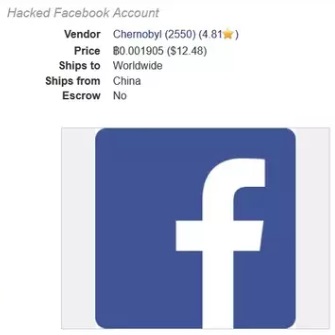
You see, the issue is becoming a lot more important. The fact that these accounts are now sold on the dark web, with the by-line: “If sold individually at these prices, the value of the stolen data on the black market would be somewhere between $150m and $600m“, we are certain that this will get a lot worse before there is any improvement. It is my personal view that actively seeking a non-repudiation setting will hasten that process of making your data more secure.

It is in addition the setting that the Dream Market offers, which by the way is useless. The Chinese vendor offering the data, could in the end merely be an expelled student from any US university living in Dublin, there is at present no way to tell who Chernobyl 2550 actually is.

Finding and exploiting three bugs in Facebook gets you optionally half a billion, the governments are that far behind and there is no indication that they will catch up any day soon. When going back to the Facebook setting, we also saw “Facebook said third-party apps and Facebook apps like WhatsApp and Instagram were unaffected by the breach“, yet another source gives us: ‘WhatsApp Bug Allowed Hackers To Hack Your Account With Just A Video Call’ (at https://www.valuewalk.com/2018/10/whatsapp-bug-video-call-fixed/) implying that Facebook users are in a lot more peril then shown from the different media. We are given: “A security researcher at Google’s Project Zero discovered a strange bug in WhatsApp that allowed hackers to take control of the app if they just knew your phone number. All they had to do was placing you a video call and getting you to answer it. Though the WhatsApp bug was disclosed only on Tuesday, Google researcher Natalie Silvanovich had discovered and reported it to the Facebook-owned company back in August“. So even as it seems that Facebook is not giving us ‘faulty’ information; the mere fact on the existence of the flaw as seen with: “She disclosed the WhatsApp bug to the public only after the company fixed it via a software update. Silvanovich wrote in a bug report that heap corruption could occur when the WhatsApp app “receives a malformed RTP packet.” The bug affects only the Android and iOS versions of WhatsApp because they use the Real-time Transport Protocol (RTP) for video calling” is showing a dangerous setting where a number of failings within this year alone gives rise to the flaws in security and proper testing of apps and the stage of security is failing faster than we should be comfortable with.

So even as CBS News was all about hacking elections last week, giving us: “These cyber-attackers are driven by a variety of motivations, says Andrea Little Limbago, the chief social scientist at data security firm Endgame. “As long as attackers find it in their best interests or find the motivation to want to have some sort of effect … they’re going to think about what they could do with that access,” she says. “Especially China, Russia, and Iran.”“, the failing we see that there is a flaw in the system, it is not merely on pointing at the wrong players, it is about the flawed setting that some systems were breached in the first place. The larger setting is not the hack, it is access and the need for non-repudiation is growing at an alarming rate, in a setting where none of the players are ready to accept non-repudiation, we see a faulty authentication approach and that is the cost of doing business. So when you consider it a sign of the times, consider that I personally witnessed a bug that Whatsapp showed over 27 years ago, when a financial package on DEC VAX/VMS has something called Ross Systems. An intentional illegal action would crash your terminal program and leave any user in the VAX/VMS system with supervisor rights, with total access to every file on the server and every drive. Would it be nice if certain lessons were learned over a quarter of a century?

That is the issue sand the opposition of those who want to push out new features as soon as possible and that danger will only increase in a 5G setting, so when your mobile becomes your personal data server and someone does get access to all your credit card and health data, you only have yourself to blame, good luck trying to sue the technology companies on that. Actually that is exactly what Google is facing with class actions against both the Pixel and Pixel 2 at present. Should they lose these, then the ante goes up, because any case involving flawed data security, when flagged as inappropriately dealt with could cost Google a lot more than they are bargaining for, and it is not just Google, Apple, and Facebook will be in equal settings of discomfort.

If only they had properly looked at the issues, instead of seeking the limelight with a new fab. In the end, are we mere pawns to them, to be exploited and under secured for their short terms needs of clicks and sales pitches? What happens when it falls? They will still get their golden handshakes and a life without complications for decades, what are we left with when our value in data is sold on?

We are merely pawns in a game and no one wants the throne, they merely want to be the second fiddle and walk away overly rich (or own the Iron Bank), we enabled this, and we get to live with the fallout that comes next, all because non-repudiation was too hard for these players.


Leave a comment

Filed under IT, Media, Politics, Science

Clueless to the end

That is quite the statement is it not? The question that follows is is the writer clueless (aka me) or the presenter of certain statements (aka Peter Dutton, current Home Affairs Minister). I will leave that to you as I am merely presenting the facts as I see them.

It all started on a simple Wednesday (2 days ago) when I was confronted with the statement ‘Coalition calls on Google and Facebook to get on side with encryption bill‘, just another political yada yada moment and I was about to ignore it and more to the next page when I noticed ‘the internet giants have a responsibility to help combat organised crime‘, which woke me up nice and widely. So the article (at https://www.theguardian.com/technology/2018/oct/10/coalition-calls-on-google-and-facebook-to-get-on-side-with-encryption-bill) gives us: “Australia’s law enforcement agencies have been prevented from infiltrating paedophile networks and other organised crime groups because the messages they send over encrypted electronic messaging services, such as Wickr and Whatsapp, cannot be intercepted by authorities“, in light of Australia being America’s minion in the anti-Huawei activities is admitting that mere app decryption is beyond their ability? And they have the loudly shouted notion that Huawei is a 5G risk whilst ‘basic’ skills are not in their arsenal? Apart from making a case that Huawei is now basically a political fuelled exploitation game and a setting of bias (and optionally nepotism), we are interested in learning that certain skills are beyond Australian Intelligence. I am certain that Paul Symon, Mike Burgess and Duncan Lewis would have been delighted to learn of this revelation via the Guardian, but that was merely comical relief anecdote, let’s get down to the brass of it all.

We get to see the first part in “He said a new report from the Australian Institute of Criminology, released on Wednesday, estimated the cost of serious and organised crime in Australia in 2016–17 was between $23.8bn and $47.4bn, and showed how sophisticated internet-based crimes can be“. So as we take a look at that report (attached), we take a first look at the end (just like any detective story, starting at the end we see the revelations we needed to see if the story adds up). So there we see: “This paper sought to estimate the cost of serious and organised crime in Australia for the 2016–17 financial year. It was not possible to undertake new empirical research to provide more accurate baseline data to support the estimated costs, so in most cases uprating using the RBA (2018) inflation calculator was used in conjunction with the most recent reported crime statistics to assess the prevalence of the various crime types examined“, which gives us another part. The first is on page 3 where we clearly see (in bold) ‘$31.5 BILLION for the cost of serious and organised criminal activity as well as the serious and organised component of conventional crimes‘, so now we see in opposition an amount against ‘between $23.8bn and $47.4bn‘, which I admit remains a truth, yet when we do the math, we see $15.9B for prevention and $31.5B for the so called organised and serious criminal activity, which gets us to $47.4B. At this point we could surmise that Peter Dutton passed his basic math test, was it not that the same page 3 (just like in the Sun, for the longest of times) gives us an additional $8.6 on organised Fraud (debatable), and $6.5B, $9.6B, $4.1B and others adding up to almost $2.7B, so in total we have the $31.7B, yet here is the problem, the individuals cannot clearly represent 100% of organised crime. We are now getting to the miscategorised and the miss set properties of certain players, which also deflates the issue. It becomes a larger setting when we consider the ABC, who reported in May 2017: “the Australian Cybercrime Online Reporting Network, and the reported losses from online scams across the nation come in at around $300 million“. So here we get the second part. We see ‘online scams‘ and I am willing to accept that, yet against ‘PURE CYBER CRIME‘ the question becomes what is what and where are the definitions and this gets us to page 18 where we see: “It extends the conventional understanding of organised crime groups by adding all serious crime of an entrepreneurial nature or committed to support a criminal enterprise, whether by a group or an individual“, now the entire setting changes. It optionally includes all the entrepreneurial naughty people in places like Wall Street does it not? Good luck getting anything done at that point!

Then we get to the illicit drug activity. Now, I am not debating the number overall. I do not have the data to do so, yet consider the part on page 10 where the three costs are included namely Medical costs, Lost Output and Expenditure on drugs. The items are fine, it is how you set your filter, I get that, yet in all this when we consider the numbers and the setting whilst we also have been treated to the longest time to those individuals in caravans in the middle of nowhere making their acid/ecstasy junk. So when we look at Methyl​enedioxy​methamphetamine (MDMA), we can see that it is a serious crime and that we are given a dangerous setting, no one denies that, yet in all this, those singular people who do something with gallons of cough syrup (as It was presented at one point) we should also see that at this point that Peter Dutton had all the elements added together and presents it like a Ponzi scheme, or should I say that it looks like an Amway sales presentation (the one I saw at least)? You know, the one where someone states ‘replicate, don’t reinvent‘ it is a good sales pitch, no one denies that, and it is here that we see the flaw and failing of Peter Dutton.

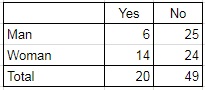
You see his presentation adds up ‘perfect’, these numbers add up, whilst a millennia of history shows us that numbers never add up, not in any criminal enterprise; to do that I have to teach you a little data basic. The best comparison is the use of a cross tabulation. Let’s take gender and shoes. For example we see 6 men and 14 women bought shoes. We also see that 24 women and 25 men did not buy shoes. So far we get the table on the left, yet now we also get the setting that a cross tabulation will not deal with.

For example the fact where we know that shoes were bought, yet the gender is unknown or we see a gender reference and that something was bought, but we cannot see if they were shoes. These are called missing values and they will not show up in that cross tabulation and there we see the first part. It gives us the setting of crimes but not by whom, they are serious in setting but that is not enough is it? You see Peter Dutton gave us ‘help combat organised crime‘, yet not all serious crime is done by organised crime and now we have a $47 billion dollar question and in addition the failing that we are now introduced to is a much larger failing. In this we now see that we saw in the beginning when we went to the end of the story. It is seen with: ‘estimated the cost of serious and organised crime‘ and that is not enough. We could argue that it should be, we can argue that (the amount involved) is way too big, but the setting is not merely that Tech companies should ‘help’, it is the prosecution setting. The setting that there is too much junk attached and the prosecution will fail in the bulk of all those cases because the evidence relies on loaded and unproven data. It is the part that we have faced for well over 7 years. The court barristers will give every jury the speech of authentication versus non-repudiation and the second one cannot be proven (in most cases), so we end up not merely not having ‘beyond all reasonable doubt‘, there will be a high and likely chance that the courts will not even be able to prove ‘on the balance of probabilities‘ or ‘is it more likely than not‘ and it is here where we see that Peter Dutton could be optionally wasting millions upon millions of costs to set the stage of presentation that will have little to no results and that is a much larger problem. The additional play is that any smudging of any presented evidence will give us the stage that a case will be thrown out of court, how is that helping anyone?

So whilst we ponder this, we need to review the statement “And it should be noted the same companies who protest about having to help police with the encryption problem, operate their business in less democratic countries and accept a compromise on privacy to allow their presence in those growth markets“. We are not those countries are we? so at this point, we get the impression that Peter Dutton is merely a minion for the intelligence services who according to him were unable to ge to places in the first place, which implies that certain players have much larger problems and the serious cirme part, which is not on their plate is already beyond them, so there!

At this point we get to the final part where we see: “It is important that tech firms understand and embrace their responsibilities to the community that has helped enrich them“, I actually do agree with that part, yet that should be set in taxation law. A flaw that I reported on yesterday (at https://lawlordtobe.com/2018/10/11/taxation-solved-the-old-way/) which I charmingly called ‘Taxation solved the old way‘ (pun intended). So when we now consider the biggest organised crime master in Common Law (Al Capone), who funny enough got scuttled not by crime fighters but by tax laws. How we get to relearn the lessons of old, do we not?

It gets us to the quote: “Currently our police and intelligence officers who have a warrant may be able to covertly recover an email or a photo or other evidence of a crime from someone’s computer, but they can’t crack encryption, which is why it is now being exploited by criminals“, so these are criminals and not organised crime. Or in a simplistic setting that every square is a rectangle, but not every rectangle is a square. It is at that point that I will teach Peter Dutton the one lesson he never learned (optionally he merely forgot the lesson).

Consider: “When sarcasm bounces it is merely irony“, a lesson that has a much wider application that the honourable youthful young Dutton might not have contemplated yet. However, we have to consider he was only reappointed his seat on August 24th, so he has time to settle in. And the lesson does not end, the second part of the lesson is not from me, it comes from Lizzie O’Shea who gives us: “they were united for the first time in their opposition to the government’s encryption bill“, when we see united tech giants, how short sighted was this encryption bill in the first place? It gets to be a larger issue when we add the setting from World Animal Day (pun intended) when we see the two parts “Telstra has won a $8.2 million contract with the Department of Foreign Affairs and Trade (DFAT) for the landing of the Coral Sea Cable System” and “Chinese technology giant Huawei was originally set to build the 2.5TB-cable linking Australia to the Pacific island nation back in July 2017. However, following concerns that Huawei’s involvement posed a security risk, the Australian government stepped in to fund the multi-million-dollar project from its foreign aid budget“, whilst clear evidence has never been presented and in that stage we see optional nepotism and ego and not fact and science based solutions. We are supposed to trust any of the reporting parties on any of this? The articles are different on different settings, yet the entire mess as it is now shows a much larger failing and a setting of doubt, not one of justified confidence and in that we see the second part of the reason why the tech giants are uniting. A certain play performed by adjusting to the notion of stupid and short sighted whilst the captains of industry have been getting their A-game in gear and others never did. It is merely another stage of the impact of iterative exploitation and profit founding, that whilst Huawei, Google, Apple and Samsung are no longer going iterative, they are now making larger leaps over the next 5 years as they want the largest slice of 5G pie possible and in an iterative setting the others can catch up and that is where we see the clash, because these hardware jumps will also prevail in software and data jumps and some players are in no way ready to play that game. That is where this so called balanced report strikes out as well. this is seen on page 21, where we see: “Because information and communications technologies are used widely throughout society and are instrumental to government, business and consumer activities, there is considerable overlap between the estimated costs of cybercrime and the costs of other crime types— particularly economic crimes, banking and financial crimes, transnational crime, online commerce and internet-facilitated crime such as consumer fraud, online dissemination of child exploitation material and intellectual property infringement“. You see in that stage we see the mention of ‘economic crimes, banking and financial crimes‘. Here we see that Financial institutions and Wall Street come into play (perhaps ‘entrepreneurial bankers’ is a much better term). This is not organised crime because Wall Street never committed any crimes did they, yet they are at the centre of a group of people in that classification are they not? And there we see not merely the adaptations of block chains, we see that organised crime will go there (as soon as they possibly can) whilst the bulk of all the players will not be ready and any encryption bill will hinder the progress of new technology as other players are not anchors of stability, they are concrete blocks of deceleration, another part not considered in any of this.

So yet, the tech companies are uniting and there is a second part in all that. When they strike a deal with Saudi Arabia and set a large part in the city of Neom; when Saudi Arabia accepts certain concessions towards the FAANG group? I personally believe that as soon as the benefit is clearly shown to the rulers of Saudi Arabia and the headway that they could make, they will adjust whatever they can according to Islamic Law, and at what point will governments realise that their only option of control will be isolation and a loss of economy? We are not that far away from that point. Even as we were told yesterday “A senior executive who works for Google’s parent company and a former US secretary of energy have dropped out of a Saudi Arabia tech and business advisory board following international outcry over the disappearance and alleged murder of a dissident Saudi journalist“, yet as Google cloud picks up more and more banks, how long until they reverse the setting? In this the Financial Times also gave us (a day earlier): “A radical blueprint to transform Saudi Arabia through socio-economic reform and ambitious development projects is persuading banks to return to Riyadh“, so at what point will we realise that Saudi Banking is growing and that all players want them as customers? It all boils to dollars and crime is merely a cost of doing business. It is that side that shows the missing data part (going back to the cross tabulation comparison). Corporations have always been about the privileges that come with a certain network and the most facilitating one is the one they will choose, that is in the heart of the flaw that I saw regarding Peter Dutton’s claims here. A bill that stops facilitation and stops optional business on much more levels, as banks need to show more and more profit. The greed driven business model will always be destructive in nature, learning that lesson 10 years ago would have made a difference, now it no longer will.

That is part of the heart of the “$40bn of foreign money is expected to flow into the stock market as a result of Saudi Arabia gaining MSCI emerging markets index status next year“, that against a flawed encryption bill, it was a bad play, played even worse on the surface of all the facts shown and I did not even bother going all the way when it comes to the initial ‘sought to estimate the cost‘, it almost reads like ‘the lady gains weight and we are trying to determine whether she is pregnant, or if she really likes pizza‘, how was that ever going to go? Perhaps asking her: ‘Have you been screwed (over) lately?‘ It could give you a truth and a lot more non-truths. That is the problem with data, whilst moulding data in one direction, you tend to open a door in another direction too, I learned to see and seek those doors, oh and that is before we consider the estimates and the application of weights to a data file, which I do not know whether it happened. this we should have consider with the statement on page 2 ‘Where data were not available for this period, the Reserve Bank of Australia (RBA) (2018) inflation calculator was used to uprate estimated costs from earlier periods‘, the part ‘uprate estimated costs‘ would have gotten us that part, also the fact that it is not data merely a ballpark idea on what the data could be, it is not the same, is it?


Leave a comment

Filed under Finance, IT, Law, Media, Military, Politics, Science

Taxation solved the old way

Yes, that is a nice weird way is it not? It all started yesterday when I was confronted in the Guardian with: ‘‘McMafia’ law: woman who spent £16m at Harrods is jailed banker’s wife‘ (at https://www.theguardian.com/uk-news/2018/oct/10/wife-of-mcmafia-banker-with-16m-harrods-spending-habit-named). The article by itself was not the issue; it woke up a spark in me. Now, I have nothing against wealth, I do not have any and that is fine (for the most mind you). Yet we all have ‘duties’ that we should be bound to and that is fine for the most as well. So as we understand that the UK is close to two thousand billion in debt, does it not seem fair that we all pay our share? From the HRMC point of view, especially those who should be regarded (to its wielding commander Jon Thompson, formerly Permanent Secretary of the Ministry of Defence) as an HRMC positive and subjects of interest. So as such, it was interesting to read that Zamira Hajiyeva, wife of Azerbaijani banker jailed for defrauding his state-owned bank out of as much as £2.2bn gets to live her life with a monthly spending spree of well over £100,000 a month at Harrods alone. So as we are introduced to: “The court of appeal has lifted a veil of secrecy to allow the publication of details of the UK’s first unexplained wealth order (UWO), in which the National Crime Agency alleges that stolen funds were used to buy a £11.5m, five-bedroom property in Knightsbridge, 100 yards from the doors of Harrods“. How is this even possible? And when you consider “The NCA also claims suspect cash funded the £10.5m purchase of Mill Ride golf and country club in Ascot via a company based in Guernsey. The Knightsbridge home was allegedly bought via a firm in the British Virgin Islands, which the NCA alleges is controlled by Hajiyeva“, which for me implies that she will optionally be my neighbour (or nearby neighbour) in the future (nudge, nudge, wink, wink). So when we are casually told that “Hajiyeva’s lawyers had convinced a judge to impose reporting restrictions that prevented the woman, her husband, his bank or their nationality from being reported“, I merely contemplate on how the HRMC has been wasting the time of too many people. When we see that a court ruling gives us: “Hajiyeva could only be referred to as “Mrs A”“. How does any of that make sense? So after well over ten years we see: “The court also heard that Hajiyeva had access to a $42m Gulfstream G550 jet and had a wine cellar stocked with some of the world’s most expensive bottles. Mr Justice Supperstone has ordered that Hajiyeva must comply with the UWO and explain how she amassed the money used to fund the property purchases. If she is unable to prove the legitimate source of the funds, the properties could be seized“. You would think that I care, but I do not, because it all dwarves against ‘Facebook’s UK tax bill rises to £15.8m – but it is still just 1% of sales‘, which implies that the HRMC did more damage to the UK treasury in one year then the labour party could have achieved in a decade of ambitious overspending. OK, that was an exaggeration, but the message is clear. This is an amazing amount of wrong issues regarding corporate taxation and it is time that it is addressed. The mere fact that certain political players have been paying a fast and loose game whilst we all facilitate to keep the treasury coffers in deep debt is just too large an issue. So when we see: “Margaret Hodge, a Labour MP and former chairman of the public accounts committee, said it was “absolutely outrageous that Facebook’s UK tax bill is 0.62% of their revenue here; on an income of £1.2bn they really should be paying much more than £7.4m”“, we can agree that Margaret Hodge is not whistling Dixie, yet her own party did their share of damage between 1997 and 2010, if they had ACTUALLY stepped up to the task, this situation might not have as dire as it seemingly is at present. So both isles are in the wrong here and have been so since close to 1995. When I see: “The chancellor, Philip Hammond, has pledged to push ahead with a new “digital services tax” to force the US firms to pay more tax. He said the UK would introduce its own levy if other countries fail to follow through with a globally coordinated tax plan” I would optionally refer to him as a pussy and a whimp. You see, this could have been solved by taxing at the moment of sales, in the country of the purchasing customer from the get go. Sales tax on anything sold, online through ITunes, Google Play, Facebook and all parts. It would have been so simple, but we see: ‘the UK would introduce its own levy if other countries fail to follow through with a globally coordinated tax plan‘ sounds nice, but that takes years and by the time it is implemented there is a new administration and we see delays and other objections; politicians (mostly) with the spine of a paperback, not one solid spine among them. It has gone on for way too long.

So how does one compare to the other?

Consider: “Hajiyeva is the wife of Jahangir Hajiyev, 57, the former chairman of the state-owned International Bank of Azerbaijan. In 2016 he was sentenced to 15 years in jail for defrauding the bank out of up to 5bn manat (£2.2bn)“, so someone walks into the UK, her husband in jail for allegedly stealing over £2,000,000,000, his wife is  spending well over £100,000 a month for over a decade in one shop alone and no one acts? You tell me! Who has been on social services in the UK and got a sly look for spending an additional £200 on a birthday? And it gets better! That we get from Out-Law (at https://www.out-law.com/en/articles/2018/october/new-uk-offshore-tax-evasion-and-avoidance-measures-/). Here we are ‘treated’ to: “longer time limits for assessment are being introduced for those who do not voluntarily settle past non-compliance. Criminal prosecutions will also be easier. A register of people with significant control over non-UK companies owning UK real estate is to be introduced in 2021. It will also become mandatory to disclose cross border tax planning“, so the wealthy and the creative with access to accountant and tax lawyers will get three years to plan additional barricades and avoidance discussions, as well as contemplate life outside of the UK.

So how long until we get the news that delays and bad investment timing rears its ugly head from some MP who is required to keep the wealthy just where they are? After all how can we ever afford: “£65 per person including a glass of Harrods Premier Cru Brut, NV Champagne“, well the answer is simple merely because a rough 78.4% of the British tax paying audience will never really be able comfortably be able to afford that unless they give in on essential needs, optionally for months.

In all this there is a wave of not mere injustice, it is seemingly a wave of facilitation towards the overly wealthy, criminal or not. The fact that we are seemingly lulled to sleep by too many is an additional worry. So even as we thought that the police was on top of things with the August article of the Daily Mail (not the greatest source, mind you) giving us: ‘Roll up, roll up for the criminal auction! More than £2.4million worth of crooks’ ill-gotten gains to go under the hammer including a house, diamonds, emeralds, a luxury‘ and we see: “Luxury ill-gotten goods with an estimated value of £2.4 million that were once owned by criminals are set to go under the hammer this month. The expensive items that were seized by police include Rolex watches, gold jewellery, Cartier and Hermes belts and a diamond worth £22,000“, yet this optionally alleged spender of ill-gotten gains (Zamira Hajiyeva) got to spend 15 times the confiscated auctioned amount all by herself, which includes the five-bedroom property in Knightsbridge, and a lot more that is not part of the amount I mentioned here. So, even as we are introduced to a banker who has the wealth levels of a Rothschild, we are seemingly in the dark how this is achieved. You see, I do not care about her or her husband and how they got to do it, I truly do not. The fact that for well over a decade this level of facilitation is possible in the UK and Europe is just insane. And the issue is not that there is an optional solution from 2021 onwards. Italy did something ‘innovative’ years ago. There we see: “For at least a decade, the European Parliament has approved documents that specifically ask to extend the offence of mafia association to all member states – a law that is known as 416 bis in the Italian penal code. The parliament also calls to allow unexplained assets to be confiscated, even without a criminal conviction, which is another cutting-edge “innovation” of Italian legislation to combat organised crime. But these documents, despite being approved by the parliament, have all remained dead in the water due to the opposition of several member states, and despite constant requests from Europol and Eurojust – the EU’s police and judicial cooperation agencies.” Let’s call this: ‘all shout and no progress, welcome to the EU‘, or as we saw it in the US in the 70’s with their mafia cowboy senate events, all air and no prosecution. That is what we face and before we consider going after Zamira Hajiyeva, consider that politicians are enabling Facebook, Apple, Amazon, Netflix and Google to get away with hundreds times more then we could ever collect from the Hajiyeva family. Are you still wondering why government treasury coffers are so empty? So as we were treated in March to ‘The European Union will propose a 3% tax on digital revenue this week‘, the fact that it is below 10% should be hanging offense, a hanging offense for the majority of ALL EU politicians mind you. It is time to get serious, but we are shouting against a group of people who need that FAANG group for juicy connections down the road, so I do not believe that something actually will be achieved before 2030, and as the head of Facebook northern Europe, Steve Hatch gives us: ““By the end of 2018 we will employ 2,300 people in the UK and we are doubling our office space in London’s King’s Cross, with capacity for more than 6,000 workstations by 2022. “We have also changed the way we report tax so that revenue from customers supported by our UK teams is recorded in the UK and any taxable profit is subject to UK corporation tax.”“, we are already seemingly informed of an optional one year delay regarding cross border tax planning for Facebook. Funny how that would work out, is it not?

so when you read another headline like: ‘Fury as Starbucks pays just £4.5m tax on £162m profits‘, you might feel that there is a need for fury, also realise that there will be no results, not any day soon and that should anger you a lot more and the Labour side is just as guilty as the Conservatives are, I would claim that Labour is more guilty because at the dawn of the digital age they had the option to set up a fence from the very beginning and they decided not to do that, or claim to do and fail to do, whatever seems more correct to you.

So as you were contemplating how naughty some bankers are, consider how weak politicians have been for the longest times as billions that should have been collected got facilitated for and pushed to the board of directors of corporations in America (read: their ‘fat cat’ bonus).

In the end, we could use statistics and get creative, when we consider that between 1620 and 1725, women without brothers or sons to share their inheritance comprised 89 percent of the women executed for witchcraft in New England. When you consider that, do you still think that those witch trials in Salem were stupid and narrow minded? Perhaps they were in the end really creative in legislatively through allowed legal means, acquiring large shares of wealth, who was going to stop them? Perhaps Facebook with a: ‘share if you care’ option?

Nowadays we see that ‘criminal’ has become for the most a person who got convicted, because they did not have the right tax lawyer & barrister in his/her arsenal, how the times have changed. In this we merely have to hold a candle to the thoughts of Oscar Wilde who stated: “Morality is simply the attitude we adopt towards people we personally dislike“. So as our acceptance of wealth and money takes over, morality becomes a mere obstruction towards further gains.

I should have applied to Mossack Fonseca with my Law degree when I had the chance.


1 Comment

Filed under Finance, Law, Media, Politics

The FX slogan in action

I always loved the FX slogan, it is true, and it is at the centre of entertainment. Yet is it at the centre of viable analytics? Is a result merely presented as an anecdote more acceptable? We seem to lack the ability to take a step back and look at it in a clinical setting, because it is not always about the mere setting.

A scientist will show you how expensive progress exactly is.
A diplomat makes you look forward to the invoice attached to it.

This is a setting that we seem to laugh at. Now take this in a very different direction: ‘A person who is 30% white is still 70% guilty‘. You are not laughing now are you? Take this to the next level with KTVU naming the crew of a plane crash (at https://www.youtube.com/watch?v=gpP2S6c74Ts), still having fun? The people connected to Asiana Flight 214 are not, I am certain of that. So when we see this, where do we go? Well we need to take a short pit stop when we address something that I have seen in my surrounding. The practice is not wrong, it can be loaded and it can blow up in your face if you do it wrong.

To get this we need to look at 2009, when Google’s Chief Economist Dr. Hal R. Varian told the audience: “The ability to take data—to be able to understand it, to process it, to extract value from it, to visualize it, to communicate it—that’s going to be a hugely important skill in the next decades“, this is true, it has been true for decades. So as data becomes is found everywhere it becomes the setting of an almost opposition. To get data from almost common sense (where everyone seemingly gets it, to a stage that the presentation of numbers, with a story, almost any story that fits we get to see that companies are desperately searching for talent with data skills and they make it worse by trying to find people who can tell a story. Yet where is the story the value? Is that because it is more believable, or because it fits the moment? Yet that danger is now growing as well. You see each quarter the story needs to be amended and builds upon the previous story and investors have a much better memory than some realise. This is where Forbes gets us with “Interestingly, much of the current hiring emphasis has centered on the data preparation and analysis skills—not the “last mile” skills that help convert insights into actions. Many of the heavily-recruited individuals with advanced degrees in economics, mathematics, or statistics struggle with communicating their insights to others effectively—essentially, telling the story of their numbers.” I am not sure that this is a correct path. Instead of focussing on the communication skill, we are given data presentations by Mother Goose and Mr Grimm and in all that, will we get the story that is told correctly? I have prepared dashboards and data reports for decades. I have seen how some jumps were made on the assumption of one result, whilst the data was not supporting it, or it was, yet only after targeted weighting? In that we get the story that is a partial truth, yet it is in that same instant a partial lie too and that part will no longer get the proper scrutiny that is required.

So now we get to the good stuff. Now we get to the Guardian that treated us to: ‘China planted chips in Apple and Amazon servers, report claims‘ (at https://www.theguardian.com/technology/2018/oct/04/china-planted-chips-on-apple-and-amazon-servers-report-claims). Is it possible? Yes it is, yet the numbers and the speculative sides in all this is a larger problem, or better stated it is a large issue in a much larger universe and we are merely shown the keyhole view with the audio of two moaning people. Yet whether they are having sex or are pushing the bed around cannot be stated as we merely see a wall and part of a piece of furniture and we go by the sounds we hear. So when we consider that the corn borer can make the identical sound of a bat, so much so that the female corn borer moths cannot distinguish between the sound of a real bat and the sound of a male moth imitating a bat. Which quite literally gets her screwed, it’s merely how he gets lucky.

This now relates to the article, where we see: “A Chinese military unit has been inserting tiny microchips into computer servers used by companies including Apple and Amazon that give China unprecedented backdoor access to computers and data, according to a new Bloomberg report“, yet when we are also told “The attack was reportedly discovered in 2015 by the US intelligence services, as well as by Apple and Amazon as the companies purchased servers made by Super Micro Computer“, yet companies stay in the dark on this? So first it is Russia, now it is China? Consider the next quote “Amazon, Apple and Super Micro have all denied Bloomberg’s report. Amazon said: “It’s untrue that AWS knew about a supply chain compromise, an issue with malicious chips, or hardware modifications when acquiring Elemental.

Furthermore, we see both “As we shared with Bloomberg BusinessWeek multiple times over the last couple months, at no time, past or present, have we ever found any issues relating to modified hardware or malicious chips in SuperMicro motherboards in any Elemental or Amazon systems“, as well as “Apple said: “On this we can be very clear: Apple has never found malicious chips, ‘hardware manipulations’ or vulnerabilities purposely planted in any server.“. Is this an issue about what exactly?

This we see in the consideration of: “There have been increased concerns about foreign intelligence agencies infiltrating US and other companies via so-called “supply chain attacks”“. This is not unique. The American nagging and the nagging by its bitches (aka Australian Intelligence) is becoming a much larger setting as to the stage on where economic prosperity goes to. This is as I personally see it, the setting of a stage on where outsourcing goes to. This seems to be much more realistic and much more believable. You see, if there was truth in the Bloomberg part, if there was the real setting of “Apple had reportedly bought around 7,000 Super Micro servers when its security teams discovered the chips“, in that setting 7,000 server boards would have been shown to the world, it would have changed everything, places like Stanford, Harvard, Cambridge, Oxford and UTS (which has Apple co-founder Steve “Woz” Wozniak as a professor). They would be showing you the high and low of it all, yet that did not happen did it? So when we are seeing “Technology shares in Hong Kong fell sharply on Friday led by Lenovo, which lost 23% in morning trade. The Hong Kong-listed shares of Chinese telecommunications equipment maker ZTE Corp lost more than 14%“, which is interesting as ZTE was a thorn in the 5G side of the US and a few other players (like Telstra for example) for a much longer time, so is that a mere coincidence? What story telling sides are we not exposed to?

However, this is not the end. It is important to look at Bloomberg, because Bloomberg is not really the ‘storyteller’ of the century. We get introduced (at https://www.bloomberg.com/news/features/2018-10-04/the-big-hack-how-china-used-a-tiny-chip-to-infiltrate-america-s-top-companies) to the quotes “In late spring of 2015, Elemental’s staff boxed up several servers and sent them to Ontario, Canada, for the third-party security company to test, the person says“, as well as “Nested on the servers’ motherboards, the testers found a tiny microchip, not much bigger than a grain of rice, that wasn’t part of the boards’ original design“, which also gets us: “During the ensuing top-secret probe, which remains open more than three years later, investigators determined that the chips allowed the attackers to create a stealth doorway into any network that included the altered machines“. This is a much more frightening setting, yet why was this kept in the dark for so long? Not because of any matter that can be attributed to common sense. You see, I find “Still, to actually accomplish a seeding attack would mean developing a deep understanding of a product’s design, manipulating components at the factory, and ensuring that the doctored devices made it through the global logistics chain to the desired location—a feat akin to throwing a stick in the Yangtze River upstream from Shanghai and ensuring that it washes ashore in Seattle” an acceptable tactic, yet it opens the door on multiple places, places that are implied but not shown into the limelight. The first and perhaps the most visible one is: ‘timeline to design a chip‘. If that is so small, how can we be certain that the CIA did not do this to every Apple and IBM device ahead of fabrication? So when we get to “But that’s just what U.S. investigators found: The chips had been inserted during the manufacturing process, two officials say, by operatives from a unit of the People’s Liberation Army“, why them? Why not the Ministry of State Security? When we look in those directions, I personally find Chen Wenqing has a much more deceptive look then Xi Jinping. For either, funding would never have been the issue. And in the end Bloomberg gives us: “Three senior insiders at Apple say that in the summer of 2015, it, too, found malicious chips on Supermicro motherboards. Apple severed ties with Supermicro the following year, for what it described as unrelated reasons“. So yes, Bloomberg is raising questions, questions on where we need to consider ourselves in regards to China, an issue not properly raised by the Guardian this time around. Yet in both cases we end up with questions. We know that 5G will be a multi trillion industry and the US is desperate to melt the cogs of Chinese industry here, they have a backlog that is too large, there is at present no chance that the US, or Europe could catch up with China. The Chinese focus had been on 5G for too long, production is nowhere near it needs to be to go up against China. Yet this story, this event 3 years old and never in the limelight until now, that is impacting Lenovo and ZTE, so one of the 5G drivers is now as they call it: ‘In the shits‘, a 14% loss is nothing to get sneered at. And this optionally links back to the accusations against China in 5G, yet they are all still stories. The evidence was never handed into the limelight, and it also squarely lands the entire matter into the pond of former President Barack Obama, who still wanted to get trade deals going at that stage, so the Democratic party is going to get pushed into this mud pool sooner rather than later, because corporations at a global scale will feel betrayed in this mess. It gets fuelled more when we go back to September 2015, after this mess started and the people (via Reuters) get treated to: “President Barack Obama announced on Friday that he had reached a “common understanding” with Chinese President Xi Jinping on curbing economic cyber espionage, but threatened to impose U.S. sanctions on Chinese hackers who persist with cybercrimes.” So, did it happen? Was the story on the servers a ruse? Seems interesting that when placed in the proper timeline, against other news, we see a different setting do we not?

That is the stage we see when we add an element, any linked element to the story, it changes the preface of it and it changes the conclusions of it all. Any story with incomplete data is not a story, it degrades into a fairy tale, and both Mother Goose and Jacob Grimm both had their end of the spectrum when we watched their stories unfold. So where do the Guardian and Bloomberg stand? They go with sources that gave them news, yet when those sources cooperate in getting a particular story told, where do we get to stand, being told a story?

The server boards are evidence, yet where are they? If it is in 7000 server boards, there should be plenty to go around and show the world what was going on, but that did not happen, did it? So even as we were made aware a mere 5 hours ago of: “Huawei is trying to convince the U.S. government that Trump’s trade wars with China might slow down 5G adoption on American soil“, we now see that this is exactly what the US needed, time to catch up, or at least get a bigger slice of the 5G pie chart. You see a nation that is to be regarded as bankrupt cannot rely on importing goods; it needs US based goods to use a circle of non-cycled currency to keep its government running. And the 5G wave will go on for some time, the more time they get, the longer they can negate their official moment of being bankrupt. I am not the only one with that view, the same view is given (with a better economic handling) by Economist Laurence Kotlikoff who gives us: “While the United States’ official debt is $20 trillion, the fiscal gap is really 10 times larger — $200 trillion. That comes from adding in off-the-book liabilities, including debt that’s in the Federal Reserve’s hands, Kotlikoff said“, who also gives us: ““The evidence is in front of our eyes that we’re bankrupt,” Kotlikoff said. “It’s not bankrupt in the future. It’s bankrupt right now.”” A stage that I had mentioned three years ago, it might have been 4 years ago. I mentioned the settings and the consequences and I only needed an abacus to get there, but according to all the newspapers, I was wrong. Now we see more storytelling games and more pushes by large corporations to keep the current machine switches on, because once it is switched off, it ends for them, they will have no options and the markets will collapse soon thereafter wiping ours (and partially their) retirements away. That is the realism of our day and age and it is a story that I am telling, just like the others. I merely believe that I have seen more data, more complete data and I see the interactions on a wider scale. From that assumption my story is (seemingly) better, truer and more believable, is that the case, is it that for you?

You see, that is the danger with stories, it all hangs on the evidence that we are given and for the longest of times, the supporting evidence has been lacking, or basically completely absent on their side of the discussion. When we watch the Grimm in the TV Series Nick Burkhardt we accept it, because it is entertainment, and when the Grimm kills the Hundjägers, we know it is fabrication, entertaining fabrication mind you. Yet when we see the mention of Lenovo and ZTE, when we realise that 128,000 people are now in a state with an endangered job, families in danger of social security, as well as the impact on a larger scale, are we happy with the tale when it is the story and the non-shown evidence that is the matter. The fact that more parties are in denial is also an issue, but that could be for a whole host of reasons. It is the lack of evidence that is open for scrutiny that becomes the larger issue and that is an issue, it is an issue in every story, so whilst I embrace the FX slogan: ‘the story is everything‘ it is the lack of supported reality that makes it an issue in business intelligence and actual intelligence analyses. A setting that was 3 years in the open and we only get it partially served now, now that the need of America is becoming more and more dire.

The math does not add up and that has a much larger setting in all this than most are willing to admit to at present.


Leave a comment

Filed under Finance, IT, Media, Military, Politics, Science

Deadlock removed

Forbes gave us news in several ways. It merely flared my nostrils for 0.337 seconds (roughly) and after that I saw opportunity knock. In all this Microsoft has been short-sighted for the longest of times and initially that case could be made in this instance too. Yet, I acknowledge that there is a business case to be made. The news on Forbes with the title ‘Why Microsoft ‘Confirmed’ Windows 7 New Monthly Charges‘ (at https://www.forbes.com/sites/gordonkelly/2018/09/15/microsoft-windows-7-monthly-charge-windows-10-free-upgrade-cost-2) gives us a few parts. First there is “Using Windows 7 was meant to be free, but shortly after announcing new monthly charges for Windows 10, Microsoft confirmed it would also be introducing monthly fees for Windows 7 and “the price will increase each year”. Understandably, there has been a lot of anger“. There is also “News of the monthly fees was quietly announced near the bottom of a September 6th Microsoft blog post called “Helping customers shift to a modern desktop”“, so it is done in the hush hush style, quietly, like thieves in the night so to say. In addition there is “Jared Spataro, Corporate Vice President for Office and Windows Marketing, explained: “Today we are announcing that we will offer paid Windows 7 Extended Security Updates (ESU) through January 2023. The Windows 7 ESU will be sold on a per-device basis and the price will increase each year.” No pricing details were revealed“. This is not meant for the home users, it is the professional versions and enterprise editions, that is meant for volumes and large businesses. So they now get a new setting. Leaving pricing in the middle, in the air and unspoken will only add stress to all kinds of places, but not to fret.

It is a good thing (perhaps not for Microsoft). You see, just like the ‘always online’ folly that Microsoft pushed for with the Xbox, we now see that in the home sphere a push for change will be made and that is a good thing. We all still have laptops and we all still have our Windows editions, but we forgot that we had been lulled to sleep for many years and it is time to wake up. This is a time for praise, glory, joy and all kinds of positive parts. You see, Google had the solution well over 5 years ago, and as we are pushed for change, we get to have a new place for it all.

Introducing Google Chromebook

You might have seen it, you might have ignored it, but in the cast of it all. Why did you not consider it? Now, off the bat, it is clear if you have a specific program need, you might not have that option. In my case, I have no need for a lot of it on my laptop, yes to the desktop, but that is a different setting altogether.

So with a Chromebook, I get to directly work with Docs (Word), Sheets (Excel) and Slides (PowerPoint) and they read and export to the Microsoft formats (as well as PDF). There is Photos, Gmail, Contacts and Calendar, taking care of the Outlook part, even Keep (Notes), Video Calling and a host of other parts that Microsoft does not offer within the foundation of their Office range. More important, there is more than just the Google option. Asus has one with a card reader allowing you to keep your files on a SD card, and a battery that offers 7-10 hours, which in light of the Surface Go that in one test merely gave 5 hours a lot better and the Chromebook is there for $399, a lot cheaper as well. In this it was EndGadet that labelled it: ‘It’s not perfect, but it’s very close.

Asus has several models, so a little more expensive, but comes with added features. In the bare minimum version it does over 90% of whatever a student needs to do under normal conditions. It is a market that Microsoft could lose and in that setting lose a lot more than merely some users. These will be users looking for alternatives in the workplace, the optional setting for loss that Microsoft was unable to cope with; it will now be on the forefront of their settings. In my view the direct consequence of iterative thinking.

And in this it is not merely Asus in the race, HP has a competitive Chromebook, almost the same price, they do have a slightly larger option 14″ (instead of 11.9″) for a mere $100 more, which also comes with a stronger battery, and there is also Acer. So the market is there. I get it, for many people those with stronger database needs, those with accounting software needs, for them it is not an option and we need to recognise that too. Yet the fact that in a mobile environment I have had no need for anything Microsoft Specific and that there Surface Go is twice the price of a Chromebook, yet not offering anything I would need makes me rethink my entire Microsoft needs. In addition, I can get a much better performance out of my old laptop by switching to Linux, who has a whole range of software options. So whilst it has been my view that Microsoft merely pushed a technological armistice race for the longest time, I merely ignored them as my windows 7 did what it needed to do and did it well, getting bullied into another path was never my thing, hence I am vacating to another user realm, a book with a heart of Chrome. So whilst we look at one vendor, we also see the added ‘Microsoft Office 365 Home 1 Year Subscription‘ at $128, so what happens after that year? Another $128, that whilst Google offers it for free? You do remember that Students have really tight budgets, do you not? And after that, students, unless business related changes happen, prefer a free solution as well. So whilst Microsoft is changing its premise, it seems to have found the setting of ‘free software’ offensive. You see, I get it when we never paid for it, but I bought almost every office version since Office 95. For the longest times issues were not resolved and the amount of security patches still indicates that Windows NT version 4 was the best they ever got to. I get that security patches are needed, yet the fact that some users have gone through thousands of patches only to get charge extra now feels more like treason then customer care and that is where they will lose the war and lose a lot.

So when you see subscription, you also need to consider the dark side of Microsoft. You partially see that with: “If you choose to let your subscription expire, the Office software applications enter read-only mode, which means that you can view or print documents, but you can’t create new documents or edit existing documents.” Now we agree that they clearly stated ‘subscription’, yet they cannot give any assurances that it will still be $128 next year, it could be $199, or even $249. I do not know and they shall not tell, just like in Forbes, where we saw ‘News of the monthly fees was quietly announced‘.

When we dig deeper and see: ‘Predicting the success of premium Chromebooks‘, LapTopMag treats us to: “The million-dollar question is whether these new, more expensive Chrome OS laptops can find a foothold in a market dominated by Windows 10 and Mac OS devices. Analysts are bullish about Chromebook’s potential to make a dent in the laptop market share“, which was given to us yesterday. Yet in this, the missing element is that Windows will now come with subscriptions to some and to more down the track, or lose the security of windows, now that picture takes a larger leap and the more expensive Google Pixelbooks (much higher specs then the others mentioned) will suddenly become a very interesting option. One review stated on the Pixelbook: “the Pixelbook is an insanely overpowered machine. And, lest we forget, overpriced“, which might be true, yet the little lower Atlas Chromebook was $439. So yes, the big one might not be for all and let’s face it. A 4K screen is for some overkill. That’s like needing to watch homemade porn in an IMAX theatre. The true need for 4K is gaming and high end photography/film editing, two elements that was never really for the Chromebook. At that point a powerful MacBook or MacBook pro will be essential setting you back $2900-$11400. So, loads of options and variations, at a price mind you. As I see it, the Microsoft market is now close to officially dissolving. There is a whole host of people that cannot live without it, and that is fine. I am officially still happy with my Windows 7, always have been. Yet when I see the future and my non-gaming life, Linux will be a great replacement and when being mobile a Chromebook will allow me to do what I need to do. It is only in spreadsheets that I will miss out a little at time, I acknowledge that too, but in all this there is no comparison with the subscription form and as it comes from my own pocket is see no issues with the full on and complete switch to Google and its apps in the immediate future. I feel close to certain that my loss will minimal at the most. A path that not all will have, I see that too, but when thinking the hundreds of thousands of students that are about to start University, they for the most can make that switch with equal ease and there we see the first crux. It was the setting that Microsoft in a position of strength had for the longest time, enabling students so that they are ready for the workplace changes. They will now grow up with the Chromebooks being able to do what they need and they will transfer that to the workplace too. Giving us that the workplace will be scattered with Chromebooks and with all kinds of SaaS solutions that can connect to the Chromebook too. The Chromebook now becomes some terminal to server apps enabling more and more users towards a cloud server software solution. As these solutions are deployed, more and more niche markets will move in nibbling on the Market share that Microsoft had, diminishing that once great company to a history, to being pushed beyond that towards being forgotten and at some point being a myth, one that is no longer in the game. It is also the first step that IBM now has to bank in on that setting and push for the old mainframe settings, yet they will not call it a mainframe, they will call it the Watson cloud, performing, processing and storing, available data on any Chromebook at the mere completion of a login. It is not all there yet, but SPSS created their Client server edition a decade ago, so as the client becomes slimmer, the Chromebook could easily deal with it and become even more powerful, that is beside the optional dashboard evolutions in the SaaS market, the same could be stated for IBM Cloud and databases. That is the one part that should be embraced by third party designers. As SaaS grows the need to look in Chromebook, Android and IOS solutions will grow exponentially. All this, with the most beautiful of starting signals ever given: ‘Windows 7 New Monthly Charges‘, the one step that Microsoft did not consider in any other direction and with G5 growing in 2021-2023 that push will only increase. If only they had not stuffed up their mobile market to the degree they had (my personal view). I see the Windows Mobile as a security risk, plain and simple. I could be wrong here, but there is too much chaff on Windows and as I cannot see what the wheat is (or if there is any at all), and as Microsoft has been often enough in the ‘quietly announcing‘ stage and that is not a good thing either.

Should you doubt my vision (always a valid consideration), consider that Veolia Environnement S.A. is already on this path. Announced less than two weeks ago we see “So we propose a global migration program to Chromebooks and we propose to give [our employees] a collaborative workplace. “We want to enable new, modern ways of working”“, linked to the article: ‘Veolia to be ‘data centre-less’ within two years‘ (at https://www.itnews.com.au/news/veolia-to-be-data-centre-less-within-two-years-499453), merely one of the first of many to follow. As the SaaS for Chromebooks increases, they will end up with a powerful workforce, more secure data and a better management of resources. Add to this the Google ID-Key solution and the range of secure connections will go up by a lot, diminishing a whole host of security issues (or security patches for that matter). All options available now and have been for a few years now. So when we see the Chromebook market push forward, we should thank Microsoft for enabling exponential growth; it is my personal believe that the absence of a monthly fee would have slowed that process considerably in a whole range of markets.

So thanks Microsoft! You alienated gamers for years, and now we see that you are repeating that same silly path with both starting students and businesses that are trying to grow.

I’ll ask Sundar Pichai to send you a fruit basket, it’s the least I can do (OK, the least I can do is nothing, but that seems so mean).


Leave a comment

Filed under IT, Media, Science

The politics of 5G technology

I was watching the news and all the announcements of the new iPhone series and it dawned on me that even as they are not just the most expensive phone, they are close to 400% the price of the top Huawei P20. So why is this now a massive price jump? It is not merely that it is a 512 GB Phone, or that is has 4GB RAM, or that it is IP68 dust and water resistance (maximum depth of 2 metres for up to 30 minutes). I think that Apple is changing the game. It is realising something different, It is also why I designed the ‘dumb’ smart devices for 5G.

You see, for better or for worse, I ask you the question: ‘What is this?’ You swill respond with it is a phone (or variant of it), it is a connection to everything, it is your personal assistant. No, it is none of those. It is important that you realise that this is now becoming your personal data server. When 5G enters your life it will be the foundation of you. You must realise it now, or lose your personal value very very fast; even as we are shown the political ‘BS’ on Telstra regarding Huawei, US telecom companies and other players. This is the vault all the players want. This is the setting of the next generation. Apple is cashing in on mere then just the price of a product. They are setting a stage that Huawei is already walking (slower in some regards, faster in others). This is the future and the Apple version of that future arrives within the next 7 days.

Google is on that path too. Its mint flavoured (or is that coloured?) is arriving in 4 weeks, they too are on the path of the future. That path is you and your personal data server. You better get used to that very quickly, you better realise that you, you yourself enabled all this. So even as we will not know the specifics of the new Pixel 3 XL, we all know that this too will be the personal data server, just like the Huawei P20 series, the Apple Xs series, the Samsung Galaxy and the Google Pixel 3. No longer merely phones, no longer merely the Spotify point. You see, the steps we have had with 4G are closing down, and the marketing changes. It is no longer ‘Fastest Mobile Broadband Network‘, it is no longer ‘Live More Internet‘ (which might be Ogilvy’s worst slogan), and it was never ‘Rethink Possible‘. It will be ‘Whatever you need, anywhere you need it‘. That is the foundation of 5G, anywhere you need it is going to be your cornerstone. It is in that part, when you have transplanted yourself in that new dimension you will get exposed to the change and the need to protect your personal data server wherever you are, because your personal data server (the next mobile phone) will become to some extent: “Your Identity”. Now you will need to consider getting it properly protected, because your data value is you and you need to realise that your mobile phone will have more processing and collection power than any server that was out 10 years ago, facilitating for you and 49 other employees. This personal data server will work for you, on your behalf and to your needs. This was why I came up with the protection layer of ‘dumb’ smart devices. No matter whether you go for IOS or Android, you will be your own cornerstone to social life, to entertainment, to business ventures and to your financial pathway. Consider what you are doing now on your phone. Your banking needs, your radio, your TV, your games, your appointments, your insurances and your investment and retirement portfolio. You do it all from your mobile phone and soon with block chain added to the data stream we are now moving towards a point of non-repudiation. In non-repudiation it means that you and only you could have done this. It is the one step above authentication; it is your future of accountability. At that point you cannot go to the judge stating you lost everything, because your phone got stolen. The easy path is getting removed; that is the future of whatever you want, anywhere you need it. Because only you could have wanted it and the new phones are about setting the stage enabling you and protecting you and foremost keeping your data safe, as long as you realise what you are doing.

So that got me thinking of the old Re-Flex hit: ‘The Politics of Dancing

We got the message, I heard it on the airwaves
the politicians are now DJ’s
the broadcast was spreading, Station to station
like an infection, across the nation

We see and hear it all as these settings evolve; politicians are becoming evangelists for places like Telstra, Vodafone and T-Mobile (to coin an example). The speed and radius of influence increased with every technology jump, three times in the last 10 years alone. Forever growing, ignoring borders and natural obstacles.

When we look at the refrain we see:

The politics of dancing, the politics of ooh feeling good
the politics of moving, aha, If this message’s understood

The setting of movement, dance and self-gratification, the fastest way to move the population in the direction they needed you to go in. You better realise this now and not too late.

You see, In Australia Telstra is the best example to look at. In 2016 they themselves set the stage with: “The Connected Government Program is Telstra’s premier thought leadership program for the public sector“. You did not think this was some philanthropic society, did you? This was the initial culling of those good for the in-crowd and those who are not. And I will also include “Dramatic economic, political, cultural and technology changes are creating opportunities and risks for growth, inclusion and sustainability that are making new demands on government and the public sector which require the ability to lead for innovation in conditions of volatile change, ambiguity and fragile trust“. This is all about growing the status quo for Telstra against whatever threatens it (Huawei is a nice example). Whatever they consider to be ‘innovative‘, I personally view it to be, ‘innovative at whatever speed Telstra can manage in an optimised setting of ROI and profit from whatever was deployed before‘. That is not the same is it?

So here we see the setting of 5G, you all want it and your personal data server will be the first choice that either enables of limits you. This is why Apple has upped the ante by a lot and until the answer of Google is ready, I am unwilling to make any choice other than Huawei, especially as it is at merely 25% the price of the new iPhone. 5G is optionally 2 years away for consumers at the facilitated speed of the new apps and protections; we see that this system needs to be at full force when the City Gates of Neom opens, because that will be the first fully fledged setting of a 5G environment giving you whatever you need anywhere you need it. Interactive information posts, shops that inform you 24:7, giving you the data you needed and showing you the products and offer sales and interactivity even when the shop keeper is asleep. All setting the stage for the explosive data growth you will be faced with and your personal data server is your link to all that. In this Google has the advantage as they solved three elemental parts in that essential need, added to that the marketing agents who specialised and focused on actual engagement. That is where you see the benefit of the next generation of data and visibility at the speed it needed to be at. This is not marketing through the eyes of their clients, this is marketing through the eyes of the respondents and how they envisioned it to be. A flexible setting set to the owner of the owner of the personal data server, not the approach towards that server as players like Telstra thought it needed to be, based on their metrics and their perception. Two distinct different ways and many marketeers and self-professed evangelists never understood that part, or learned it too late.

So yes, Re-flex was partially correct when they stated: ‘The politicians are now DJ’s‘, yet they did not forgot it, it was merely in a time when that option did not yet exist. Now there is no lack of choice and the owner of that personal data server can switch channels in the blink of an eye, an engagement opportunity lost as the focus of the evangelist (read: marketeer) was set to the wrong party. The owner who gets whatever they want, whenever they want it also gains the power to decide on what they want, any time they need or desire something, so making sure that there is engagement also gives the strength of retaining that person for a much longer time and in this game in 5G time is close to absolutely everything. It is the one where we start to realise that time is the essential unit of measure. It was there in the old days. CPU time set the stage of costing; it was there in the old phones, where the duration of a call was the unit of costing. Down the road it was trivialised in most places and set to zero, but it was never zero. Now we get to the next stage, yet now it is in the hands of the consumer, because the time of engagement is the sales funnel, so engagement becomes the stage for success. It is close to the end of mass marketing. It will be the stage of smart marketing. In that setting phishing becomes the new skeleton key and there is the first clear need to protect your personal data server and to protect the data it holds. A setting of consideration in 3G and 4G becomes a setting that is essential for anyone that wants to remain in the game in the next generation with a setting of continued value.

#40800SecondsTillMondayMorning


Leave a comment

Filed under Finance, IT, Media, Politics, Science

2.5 Million seconds

That is the frame we are talking about. In 2.5 million seconds we will see what the people are missing out on. The News Minute gives us that we are about to witness a new phone. Were treated to “world’s first 5G-ready 7nm mobile chipset Kirin 980“, from there it is easy to become a 5G phone. This is seen with “Huawei Announces Mate 20 Phone with Upgraded Chipset“, the phone that is 5G ready, which is launching in London on October 16. This is merely the chicken feed stuff, the small fry in all this. So even as Australia became the collar of the US and banned Huawei from delivering 5G equipment, we are also treated to the setting that “Huawei P20 Pro and P20 were the world’s first devices to receive a triple-digit score by DxOMark — the industry standard for camera and lens image quality measurements and ratings“, which is nice, but as a phone not essential. Yes, it sounds like I am trivialising a little, but that is because the big part here is not the camera option, the big part is that since its release the P20 family has sold 10 million units globally and that is a n important distinction, that is the part that matters. People have embraced the Huawei as an excellent phone. For the larger part (is my personal understanding) that the undeniable fact is that the Huawei is in most cases 27% cheaper than the similar phones out there (Samsung & Apple), whilst not giving that much extra to begin with. Apart from the Huawei camera heralded as the very best (with a decent margin), it is also important to note that the Samsung has a battery delivering up to 13% less then Huawei. The Apple has even less, yet IOS is not the same as Android and comparing the two does not give what I regard to be a valid comparison, so I am not including that. Huawei seems to comprehend its customers and delivers a solution that works for them, which is shown in the speed that these 10 million units were sold. I expect that an even larger sale will be imminent by December in all this, as it might be a year to get a new phone and Huawei has their options nicely set in a row. In all this, Huawei is actually its own worst enemy. You see, for all those (like me) who needs a decent camera, good battery life and decent storage, the Huawei Nova 3i 128GB Handset fits that bill too, yet that model is new and 50% cheaper than the P20 family Oreo based and all. So for me personally, I can forego a P20 and merely use the 3i. After the P7 (which I still use, I see a massive leap forward and even as it is not the greatest Kirin processor for games, all my games will now see a 30%+ increase, so that settles it for me.

In an age where you have to turn over nearly every dollar, especially as we can expect to either freeze next winter, or stop wasting money on mobile phones at twice the price, we see that Huawei has an option for everyone. One for the mediocre users (like me) and a phone for the latest gadget lover, all addressed within a decent budget. So, even as we are confronted with faulty iPhones (which apple will replace at no cost), whilst we see that the Budget iPhone is delayed. Yet that is not merely the issue. When we are confronted with: “Owing to some instability of the production schedule, the lower priced iPhone will see the light of the day by October. On the other hand, the alleged iPhone X successor and the iPhone X Plus model should be launched by the end of September. One of these two devices and the budget variant are highly likely to offer even dual-SIM variants in a few selected countries” and we see ‘the budget variant are highly likely to offer‘, we need to step back. In this day and age, in the setting where Apple seemingly had leaked information in the past, and we have next to nothing on those models. We get phrases like ‘Apple is also rumoured to have been trying to reduce the cost of components by bargaining with its supply chain partners and Samsung as well‘, as well as ‘What we expect from the Apple line-up‘. It seems that this is a marketing ploy of ‘Let’s keep them waiting a little longer’, so in all this, whilst Huawei has been the more solid offering (as has Samsung to some degree), what on earth does Apple think it’s doing?

It is the Deccan Chronicle that gives us: ‘New budget iPhone X leak validate Apple’s serious problems‘. Yet here we need to accept that there are unknown issues, and even as we see references to Forbes, we much also recognise the use of ‘predicts‘, which implies they know nothing at all (or nothing confirmed). Here we see the one part that is a problem (a speculated one), and it is seen with ‘a low capacity battery certainly raises a few concerns‘. Yes that would be the case, if it was confirmed, but it is not. In addition we see: “the handset will feature just 3GB of RAM and a maximum of 256GB storage which is less than compared to the iPhone XS and XS Plus that are believed to have 4GB RAM and a maximum of 512GB of on-board storage“. That made me laugh, because I still have great traction with my Huawei P7 sporting 2GB Ram and 16GB storage, so this would be a step forward and a large one at that. Yes, we agree that it is way behind what Huawei offers, but in reality, the truth is that anyone requiring more than 64GB truly has a massive need for their phone and at that time, if it is so important, you basically have to shell out to the larger Apple’s and not go for any budget one. I am one who can deal with the Budget range option, so in my Case the Huawei Nova 3i 128GB Handset gets me what I need at close to 45% less, so that is actually a real budget phone, All the iPhone 8 and X models start well over a thousand dollars, so at least180% more than the Huawei offers. In light of that, what constitutes a budget phone?

This in comparison to the Samsung Note9, which in all honesty is the very latest in mobile technology, but at 300% of the price of the other phone, where do you have the cash lying about? In comparison, that new Samsung constitutes the Huawei Nova 3i 128GB, A PlayStation 4 Pro and a Nintendo Switch together. You tell me what has your preference. Now, for those eager with true technology needs, it might not be about the price. It might be what the Samsung offers with the Exynos 9810, versus the Kirin processor and that is fair enough. Some are very willing to pay for that difference. I am a more meagre user in mobile technology and I would go for the PS4pro and Switch offer if given the choice. Perhaps an idea that Huawei could float. Buy the Huawei P20 for $1400 and get a free PS4pro (first 5000 customers only). That might just sell like hotcakes, and I like it when those techno providers think outside of the product wrapping box.

The technical part that does matter is the part that Richard Yu, CEO of the Huawei Consumer Business Group gave us. With: “the Kirin 980 chip, Mali-G76 offers 46 per cent greater graphics processing power at 178 per cent improved power efficiency over the previous generation” he implies (to my limited thinking) that the processor, to limit heat and damage in that way, by making it less power consuming and there, that same battery will go heaps further, implying that a 4000 MaH battery will go close to 20% longer then before making it even more interesting to consider.

in addition the mention of “the Huawei Locator powered by Internet of Things (IoT) technology that can help people easily locate their belongings, be it their luggage or pets” implies that the phone will also have RFID tracking options, which is actually a 5G trademark. I know I am highly speculating here, but that would be an interesting first, to give the users first 5G options that can easily run on 4G, whilst demanding that the opponents to equal or better what is out there and the innovative advantage that Huawei currently has, implies that their gain will only increase and not by any small margin. The option for mothers to tag their adventurous toddler will greatly fuel the need of that function. Only yesterday was I a witness to a wandering 3 year old, when arrived at the concierge, only to see two highly panicked Asian mothers running around trying to find where the devil the little one had gone off to. Yes, the adventurous toddler was going from shop to shop trying to find mommy and adjusting course at every stand where blinking lights and noises were heard. Good luck with that one and the RFID option would be a gift from the heavenly clouds for every mom having to cope with a easily speedy distracted toddler..

They also launched the Huawei also launched at IFA 2018 AI Cube, its home speaker with 4G router and built-in Alexa that can perform several tasks such turning on the TV or playing music. Now, this is not a mobile part, but it is actually a mobile pressure release; the option not to rely on a hotspot and just get one of these puppies, as well as a second sim to not put additional pressure on your mobile. What is interesting that even as we see the frame of these speakers and the versatile options here, I am making the reference as Huawei, like Google and Apple all dropped the ball in the same way. You have all that space and you did not consider it to be a mobile charger on the side? It seems to me a first that the speaker would be awesome, especially when you rely on Spotify for music, so in that regard, making it a charger as well would have been my first thought and that is the final part in all this. When you realise that the USB-C is the weakest part in all this, giving it additional options by having some cradle charger that does not rely on that port would be a first thought for us and even as I accept that this would not have been an option for the $599 model, the bulk of all other phones are close to double that price, even the Google Pixel 3 (XL) was not on that page, so when it comes to innovation we still have plenty of places to visit, even before 5G opens the door and states that the bar is open. The charge bar that is!

Is there more?

Well yes, but that is slightly anti-Apple (unintentional). It was brought in the Business Insider by Antonio Villas-Boas and Clancy Morgan. Their article gives us “the other weird thing is, the USB cable doesn’t plug into the new MacBook Pros. I have an iPhone and out of the box, I cannot plug it into the new MacBook Pros. To me, this is absolutely nuts. It’s mind-boggling“. The issue I see here is that Apple always had the mindset that it always connected. That was a selling point and a good one. People relied on that. Here we see that Apple threw that part in the wind. Perhaps they thought that those with money will by anything, not realising that some do not buy a MacBook Pro by choice, it is by need and through the boss, so the phone does not connect, which is a larger issue over time and that does matter. Even as we complain on the USB-C, mine has worked for 3 years 24:7. It might be faltering now at times, but it does imply that I had plugged it into a cable almost 1500 times, so at some point one thing has got to give and the USB-C port is the most likely of candidates.

Whatever happens, in 2.5 Million seconds (or 28 days for those who failed calculus), we will see the actual official goods on the new P20 siblings and just in time for Christmas (and Saint Nicholas) too, which is awesome. no matter how that fares, I will have the Huawei Nova 3i 128GB to fall back on, which is also a huge step forward to me, so not matter which Huawei model comes to our mind to buy, we get to win in a life that is expensive nowadays, especially in the cold winters and that is always a good thing for everyone involved.


Leave a comment

Filed under IT, Media, Science

A short sighted Senate?

This was always going to happen. Whenever there is a political setting, it will always be about the money. In this, I will be trying to have a field day. So, a paper will be drawn, demanding that the Australian psychiatrists and researchers will have to sign; they will not get a choice in the matter. They do not deserve a choice in the matter. It will be fun for them to openly condemn Telstra, Apple, Amazon, JB Hi-fi, David Jones and a few other places, because in the end they are all linked in this, even though they do not even realise that yet. It is as I see it, the consequence of a biased setting and we need to make sure that these people will not merely get the limelight, they will, in this setting be responsible for the economic fallout. That is as I personally see it the consequence of greed driven bias.

You see, it is clear that this is about money. The fact that we see the flock gather around a person, who is so stupid that I equally demand that this British person, who is clearly too stupid for his own thoughts must be barred from credit cards for life! If he cannot control himself to that degree, we must protect him from being that stupid ever again.

You see, you think that it is an emotional part, but it is not. Even as I accept “Video games have generally been considered games of skill rather than games of chance and thus are unregulated under most gambling laws, but researchers from New Zealand and Australia, writing in Nature Human Behaviour, concluded that “loot boxes are psychologically akin to gambling”“, a setting that I do not agree with (explanation to follow), the quote coming from Aaron Drummond and James D Sauer, which was published in ‘Nature human behaviour‘, I feel uncertain to comment on, or oppose that part as I lack the proper psychological education in this.

Why is it not gambling?

That is the important part. Yes, there is a setting of luck, but ever loot box has a similar setting. We see one rare element, 2-3 uncommon elements and the rest will be common elements. So how did this come to be? For that we need to look at the father of loot boxes, the game Magic the gathering. Consider that on a piece of paper (size A0) cards are printed. An A0 page (841 x 1189 mm) will fit 12 cards per row, and 12 rows. The cards (usually 63 x 88 mm) get 144 cards on one page. In this setting we work with 288 cards, and if printed on 4 pages, we get 576 cards. So here we see the initial setting where we see that on these pages, the rare cards would be printed once, for example, two columns of 12 per page, in total 96 cards, the uncommon would be there twice, which gets us 192 cards and the remaining cards three times getting us the 576 cards, a set of 288 cards. So we always know that we get a certain combination, but we merely cannot tell which one. So this Australian government that allegedly is ruled through law, sets the stage (at http://www.abc.net.au/news/2018-02-02/crown-casino-pokies-maker-aristocrat-court-decision/9387168), where pokies are not deceptive, whilst loot boxes are?

Am I digressing?

No, you see, in the CCG we see that there is a physical part to all the cards, with the virtual loot box it is not entirely the same setting. So even when we consider the ABC Quote “It argued the Dolphin Treasure machine, which is manufactured by Aristocrat and available to players at Crown, had been deceptively designed to give players the impression they had won, when they had in fact lost money“, yet in that same light, we see that a loot box, always gives a price, yet is it the price the buyer wanted? In this case I revert to the previous setting, now we add what is called a booster box. In a box are 35 packs (can be 30-36 depending on the CCG game), so we could argue that when we buy 3 boxes, we should have the complete set, yet with the 105 packs, we do get 105 rare items, but in that same setting, over the 96 rare items needed, if only 10% is double, we no longer get the complete set and we will have to swap with others. With physical cards that is an option, with virtual items that is not always possible. This is indeed the trap, yet is that gambling? When we know that we get a rare item, yet we cannot guarantee that item is that gambling? That is the question, yet in the case of the Crown Casino, the judges stated that that there was no deceptive conduct, and neither is there in this case. With Loot boxes you are ALWAYS a winner, but is winning and winning the price you want enough difference to warrant it gambling?

The economic setting

That is also part of this, because some power players are all about facilitating towards casino’s (go to Barangaroo if you doubt me), and we are also treated to “This is a win for 140,000 Australians who have jobs because of poker machines,“, as well as “Every year Victorians lose more than $2.6 billion on the state’s 27,000 poker machines that operate outside of Crown Casino“. This hypocritical setting is about money, plain and simple. This is a setting where the loot boxes are funds that go directly to the makers of those games and they are not in Australia. Unlike the other setting where we see “The State Government receives more than $1 billion in tax revenue from pokies every year“, yes all things are definitely not equal!

Are there issues?

Well, the quote “Games with loot box mechanics have long proven controversial” is actually true. There are two settings. Loot boxes you can earn and those you can buy. We will forever hear the argument of the game Mass Effect 3, for all, the golden standard. They could be bought, or won, the same loot box. Earn enough points in the game in multiplayer mode and you had the option to buy a golden box with earned points, instead of purchased credits. That was the best of all settings. Now we have these boxes that can be bought only, yet the foundation is that the game can be played and completed WITHOUT EVER buying a loot box, so those people are merely buying the boxes to get the insane chance of getting an over the top powerful item, which is weird in some ways. In support of some we must also acknowledge that EA Games as one of the players in all this decided to cut themselves in the finger and that is all on them. End Gadget gives u that (at https://www.engadget.com/2018/06/13/electronic-arts-loot-box-mea-culpa-e3/), so when we see ‘How EA talks about loot boxes depends on who’s listening‘, which might be good business practice, but it is really really stupid. You see, with “EA wants you to know that it has changed; that it isn’t the same company that put pay-to-win progression systems and loot boxes in two of its biggest games last fall. “We are always trying to learn and listen, and are striving to be better,” CEO Andrew Wilson said before closing out the keynote address“, we see one side, and with: “He thanked the investor for his question, saying that EA was working with “all the industry associations globally” and talking with regulators in territories where loot boxes had been deemed gambling, without naming any specific regions. He said that his company and the regulatory bodies concluded that Ultimate Team wasn’t gambling. Since players know they’ll get a certain amount of cards in each pack, and that the distribution of each pack is the same (i.e. one rare footballer, three uncommon, two common in each) it doesn’t break any laws“, here we see the part that I partially agree with, but it also shows that EA Games is all about the money and the ‘FIFA Ultimate Team‘ part of all this represents billions, billions that they do not want to lose.

There are two big parts in all of this, that is aside for that one person who could optionally be the most stupid person in the United Kingdom, especially when he ‘discovers’ he’s spent £7,500+ on FUT Ultimate Team cards (source: Daily Star 29th July 2018). The first is that FIFA is a game played by non-adults, so they will desire to optionally spend on these cards. The fact that there is no limit set is optionally an issue, if EA Games has set the stage where per month no more than £25 would be spend, that is close to half the cost of the full game, so it might need to be lowered. The second is the chance to swap any double won, so the fact that you are missing a Beckham, but have two Pele’s, you can seek someone who had the opposite setting. That could have saved a lot of issues, possibly all issues and EA Games merely made it harder by (as I personally see it) being stupid. That evidence is seen (at https://www.fifauteam.com/best-packs-fifa-18-ultimate-team/), Yet is also gives us that EA Games has free packs and they also give us “FREE PACKS. Not available to purchase on the store. They are assigned to you in the beginning of the game, as daily gifts and as draft, SBC, FUT Champions, objectives and seasons rewards“, so if free packs can be won, why is the entire matter still an issue? We also are given “Jumbo Premium Gold pack and Silver Upgrade pack both cost 15,000 coins but the first one may be purchased with 300 FIFA Points while for the second we only need 50 FIFA Points. Players should also pay attention to this aspect“, Yet I am also given “You can earn FUT Coins by playing FIFA Ultimate Team (FUT) and trading within the Transfer Market, but you can’t buy them. Buying coins from a third party, promoting coin buying, or coin distribution is against our rules“, so we can transfer? Then again, why is there an issue, when there are so many factors that are not funds driven?

There is an interesting video on this (at https://www.youtube.com/watch?time_continue=25&v=Igs5Ca9Nw4M), the man talks too fast for his own good, but it is very informative, giving us a clear view that there is a clear way to get items and players making it weird on how someone would have paid £7,500+ on FUT Ultimate Team cards. I do not doubt that this was done, yet it asks a few additional serious questions on the mental status of some video gamers. In all this I see several issues on both sides, but for the most, the entire setting is gambling and with the options for free packs and transfers, there is less and less a setting of gambling, merely the oversized need of greed by a government wanting non-taxable parts to stop. Yet at the bottom of the FIFA team page is also a comments section and we see the most interesting part that was also on the video.

Q: You say that we can buy coins directly?

A (Admin): My main suggestion is to trade. Buying low and selling higher is easier than most of the people think.

All given actions based on common sense, a part that someone paying £7,500+ for these cards is the setting of a person lacking common sense in spades, diamond and in clubs, basically the buyer was seemingly without hearts and common sense. Reverting to overspending and hiding behind gambling statements when there are trades and free options is overly unbalanced.

Yet I agree that this is all mostly based on FIFA, so how does that fare in other parts? With Overwatch (at http://overwatch.wikia.com/wiki/Loot_Box), we see that they are bought, yet they are also awarded.

  • One Loot Box is earned every time a player levels up.
  • One seasonal Loot Box is earned for the first time accessing the game in a seasonal event.
  • One Loot Box is earned for the first time winning some game modes in the Arcade, for example 1v1 Mystery Duel or 3v3 Elimination.
  • One Loot Box is earned for the 3rd, 6th, and 9th winning by playing Arcade game modes within the time between 2 resets. This cycle resets every week whether or not you win 9 games.

So these are options that do not require funds (yet can also be bought). It merely requires you to be a decent player. A decent player will have the option to three boxes a week by winning enough times, in all this, we see skill based progression.

This is the setting that we are faced with, and in this I wonder how thoroughly is the issue investigated, or will this merely be a senate exercise on lost (read: non-taxable) revenue?

In the end, when we move back to the Guardian (at https://www.theguardian.com/games/2018/aug/17/video-game-loot-boxes-addictive-and-a-form-of-simulated-gambling-senate-inquiry-told) and we see no mention whatsoever that loot boxes could be earned, or are optional (under the right setting free), what other parts is the writer Patrick Lum not informing us on? In addition, when I see “Australian psychiatrists and researchers have called for greater regulation of video games that encourage players to purchase chance-based items“, whilst there is no mention on the earning option, or the initial free options that pretty much every game seems to have offered. When that part is equally missing, how fair will this inquiry be?

The article has two additional issues. the first is seen with: “The Office of the eSafety Commissioner estimated that 34% of young people made in-game purchases in the 12 months before June 2017, while the Association of Heads of Independent Schools of Australia cited research finding that around 20% of simulated gambling players moved on to online commercial gambling and 5% of young Australians would develop gambling problems before they were 25 years old“. When we see ‘estimated‘, it should be made clear that this is not factual evidence, more important, what was the estimation based on? We are unlikely to get clearly informed on that part. In addition, the part ‘the Association of Heads of Independent Schools of Australia cited research finding that around 20% of simulated gambling players moved on to online commercial gambling‘, is under scrutiny, because in that regard, I would want those so called ‘Association of Heads of Independent Schools of Australia‘ to produce the evidence and the raw data on how the ”around 20%” was obtained.

The second issue is seen with “Dr Marcus Carter, a former president of the Digital Games Research Association of Australia, argued that “predatory” practices were “pervasive”, citing potential variable odds manipulation, push notifications about limited-time offers and other player retention mechanics“, although I find his setting a much better one, there are still issues with the use of ‘potential’ in that, without evidence it is merely highly speculative and even as I would accept the danger of ‘variable odds manipulation‘, that part can be addressed clearly enough. The requirement is that there needs to be evidence that this is happening and a pre-emptive setting of making the optional issue of ‘variable odds manipulation‘ unacceptable in legislation is not wrong, yet requires proof. In addition, the entire setting of ‘push notifications about limited-time offers and other player retention mechanics‘ is equally valid, but can be stopped by an opt-in setting, in addition if that is addressed, we need to accept that all ‘limited-time offers’ in advertisement on media and TV are to be equally banned, because we could optionally get a ‘buy a new pair of shoes’ addiction (for a limited time that is). If that is to be accepted (cheating small time businesses out of advertising as well as taxable advertisement funds go right ahead, Or perhaps make it illegal to have ‘limited-time mobile offers‘, and we leave Dr Marcus Carter to explain that change to mobile providers, who will be crying over lost revenue. You see, when all players are equal there is no setting of fair play at all, merely the setting of expedited needs, in this case the government. All that when it was made aware of lines like “EA earns $1.68 billion in micro transactions in FY2017“, that whilst Australia’s biggest super villain (read: Taxman) never got a cent of any of that.

That is the actual setting and that got all those trying to set this all to gambling. Including the Netherlands, the United Kingdom and now Australia, they are all about getting a slice of that micro transaction pie, all that could have been prevented 15-20 years ago by them using their brains. Yet at that time ego and greed got the better of them and they were unwilling to kick Apple, Microsoft, Amazon and all other e-store players where it would have hurt, they were in my personal view mere cowards letting actual physical shops fend for themselves, as their business was pushed online and away from them. Now we see patch upon patch, all players trying to get as much of the cream as possible whilst trying to hide the fact that they had no backbone in the first place, all merely equipped with paper backs ready for recycling.

The mere setting of ‘All online items are GST set and paid for in the country of the purchasing consume by that nations legal setting‘ would have sorted 98% of all this, but the politicians in those global nations were, in the end merely as ‘solid’ and morally strong as wet tissue paper.

So in all this there is a huge issue with the loot box and gambling setting, merely from the point of view that I have that this is not about gambling, it is about non-taxable income, a very different issue to say the least.


Leave a comment

Filed under Finance, Gaming, Law, Media, Politics

Rocking the bullshit

There has been a massive issue with Huawei, the accusations by the US is the largest one, one of its sheep (aka Australia) has been on the same post on how Huawei is such a large danger to the safety and security of a nation. It gets ‘worse’ when we see ‘The DNC tells Democrats not to buy Huawei or ZTE devices ever’, (at https://www.theverge.com/2018/8/3/17649920/dnc-democrats-huawei-zte-devices-ban-china-hacking-threat). Here we see the quote “people shouldn’t be using devices from either Chinese company for work or personal use. The words echo what federal officials have already said about Huawei and ZTE posing possible security threats to the US. In February, CIA, NSA, and FBI chiefs testified in front of a Senate committee that the two companies were beholden to the Chinese government and the devices could become tools for undetected espionage“, my issue has always been: ‘show me the evidence!’ Basically EVERY phone can be used as a spying device, that is one clear thing we got out of the Cambridge Analytica part, in addition, the Fitness tracking app Strava was a great way to find CIA black ops bases, so even as Strava merely mapped ‘a regular jogging route’, using Google or Apple maps, you would be able to map out the base, the supply routes and so on, the Apple Fitbit would be there for the Russian government knowing where these specialists were and when the were there. So in all that, and all the security transgressions seen here, not of the were Huawei or ZTE, yet, how much noise have you heard from the CIA, NSA, or FBI on Apple? Even now, they are that one Trillion dollar company, are they too big to mention?

I wonder why?

Yet, Huawei is not out of the hot water yet, they are actually in deeper hot waters now but this time it is allegedly by their own actions. Reuters is giving u mere hours ago: ‘Huawei in British spotlight over use of U.S. firm’s software’, the news (at https://www.reuters.com/article/huawei-security-britain-usa/huawei-in-british-spotlight-over-use-of-us-firms-software-idUSL5N1US343) gives us: “One of those is due to Huawei’s use of the VxWorks operating system, which is made by California-based Wind River Systems, said three people with knowledge of the matter, all of whom spoke on condition of anonymity when discussing details which were not made public in the report“, which now leads me to the setting that the American accusations are set on the premise of American Software used? How dopey is that?

Then we get: “the version of VxWorks being used by Huawei will stop receiving security patches and updates from Wind River in 2020, even though some of the products it is embedded in will still be in service“. In all this, the fact that it is still serviced for another 2 years, how are we now in the stage of: “potentially leaving British telecoms networks vulnerable to attack“? Is that not equally a questioning setting? Do we not have enough issues out there with Microsoft which has been nearly forever a security concerns, at this point, 2 years early we get the security warning on Huawei, yet not on Microsoft or Apple for that matter, in all this Google is equally a place of patches, and in all this, Huawei is the one getting unbalanced and unfairly burned at the stake like a Catholic at an Elisabeth I barbecue gathering.

Yet the good stuff is “All three sources said there was no indication that the VxWorks mismatch was deliberate. There is also no suggestion that the software itself represents a security risk“, this now leads us to two parts. The first is if it is true that ‘no suggestion that the software itself represents a security risk‘, does this mean that Huawei never had a security risk and if that is incorrect, why not present that evidence so that every Huawei Owner can test for this transgressions ending whatever future Huawei had in the first place.

In the second part, if there is no proven security flaw in the Huawei on hardware, is the security flaw a software one, or better stated an American software one, and if so, why are these people only going after Huawei and not after a dozen American firms?

The one part that we see in Channel News Asia is “Consultant Edward Amoroso, a former chief security officer at AT&T, said Huawei’s experience in Britain showed the challenges of securing international supply chains. Although no one should dismiss Huawei as a supplier solely because of its geographical location, reliance on software that is going out of support is a legitimate concern, Amoroso said“, the news (at https://www.channelnewsasia.com/news/business/huawei-in-british-spotlight-over-use-of-us-firm-s-software-10590268) gives the part that does matter, in this Edward Amoroso is right, software at the end of its reign is often the true safety concern, not merely because of the time frame, but in extent the time required to properly update the software on all the devices, which is not always a smooth path and tends to open up additional security gaps. In that part of the equation Huawei does have a legitimate problem to address. The second part to all that is “In addition to the issue with VxWorks, this year’s report also cited technical issues which limited security researchers’ ability to check internal product code“, I believe it to be a minor part and the proper investigators could seek or test for the issues, not merely that, the limitations also remove whatever options there are for zero day breaches, which has a much larger legal frame to address. So even as we agree that the US setting of accusation without evidence (proper presented evidence is merely the stuff that makes the grass grow in Texas). We also get that the US is giving us: “In the United States, the Pentagon is working on a “do not buy” list to block vendors who use software code originating from Russia and China“, there is an actual thing called national security and as such, it is their right to implement that part, I do believe that in the end it might be somewhat counterproductive, but it is still within their rights to be in such a setting nor no other reasons.

In the end there are a few issues in the field and some are out there, but with a lack of technical details, some cannot be proven, yet the fact of what some have done in the past might give the setting of ‘is it more likely than not that some do not really have 5G‘ is a true setting, yet I prefer to have the actual evidence, that some are trying to keep buried, and the media is part of that chase, which is odd to say the least. Huawei is bouncing back and forth and their hold to grow fast via the UK will be there, but from my point of view, they will need to fix the VxWorks part a lot faster than they think they need. From my estimation a new software solution should be well beyond the Beta stage in Q1 2019 if they want to have any chance of keeping their lucrative growth contracts in place. In equal measure we need to look at Canada and Australia, as they are currently set to be nothing more than US tools in all this. In all respects no actual and factual evidence was thrown out in the open. If that was done Huawei would have lost pretty much every non-Chinese contract, the fact that the BS is spread even larger with absence of evidence gives more reliability that there is no real security danger and it is more a tool for some to get the slice of 5G pie, probably at the expense of a monthly data dump, nicely mailed via UPS to: N 11600 W, Saratoga Springs, UT 84045, USA. That alone should give us the goods on who to trust and who to be cautious of. In all this, no evidence has been presented to the public (and their right to know) on how Huawei is a threat to our security. The fact that I believe that this is all bogus in one thing, the issues seems to be blown up as everyone takes a queue from John Bolton, that whilst the setting “Five Eyes is an alliance between Canada, New Zealand, the United States, Australia, and the United Kingdom that facilitates collaboration in intelligence activities” gives us that there are three in the dark, the UK might be around with the knowledge and the rest merely takes a queue form the US, which has seemingly been whispering like they did in the WMD in Iraq phase, you do remember that in the end, they were never found and it was merely bad intel. So in that setting whilst Corporate America, Canada and Australia are all in fear of their gap against leading Huawei, in that setting we are supposed to have faith on the American gospel on what constitutes a danger from Huawei? And now that we are made aware that the software solution used is an American one?

Yup, we have all kinds of problems and some are valid issues of concern as Edward Amoroso phrases it. Yet between a setting of concern and an actual concern is a mile long gap and whilst we acknowledge that Huawei has some fixing to do, until actual evidence is shown that there is a security breach, the only thing that the US can do is to offer a $229 instant price match for the Apple, or an $100 instant price match for the Google Pixel 2, or a $400 instant price match for the Samsung 9, why would anyone in this day and age pay more for the same, actually, with the enhanced batteries of Huawei you will still miss out, but that might be the smallest cross to bear. All this because some players just didn’t get the pricing right, too many fingers on the margin pie, that alone seems to unbalance the entire equation, because all these players will miss out when Huawei is given free reign there. In this the equation is no longer about security, it will be merely about greed and those enabling for it. Is that not equally important an element to consider?

I’ll be honest, I am still happy with my Huawei P7, it was really affordable against anyone offering anything and after 3 years working 24:7, where would you think I would look first? The one who had proven himself, or the one overpricing its brand (OK, with the Pixel at a mere $100 more, that is still an awesome deal).

When we decide on pricing it is one, when unreliable players in the game force us away from the affordable option it becomes a different stage and so far, the US has proven to lose reliability again and again when it comes to their version of security. To emphasize on that, check on all the printing regarding the Landmines in Yemen placed by the Houthi and the amount of articles that we see in the NY Times, the LA Times and the Washington Post. Now consider the impact of mines and why Americans seem to be eager not to inform you. By the way, that setting was almost certain a setting that Iran enabled, if you questions that (which is fair) then answer the simple question, where did the Houthi forces get 1,000,000 mines from?

We are kept in the dark on the wrong topics and it is time to set the limelight on those people keeping us knowingly in the dark.


Leave a comment

Filed under Finance, IT, Law, Media, Politics, Science