Tag Archives: Playstation

Another online danger

It seems that we the consumers are soon in danger of being left out in the offline cold. You might not realise it, you might not even worry, but your money, your payments online are finite!

You see, not only are the events of last week troubling (not the UK election mind you), the consequence of allowing this to move forward unanswered could be a costly one.

With online presence there is the additional danger of non-online absence.

For this I will emphasize it with one example. The game is from Enix and the title is ‘Order of War: Challenge‘, if you had bought it from Steam, then you have a possible issue, because the game has been wiped of your account. Now, this is not a massive issue of today, this is an issue from the sheer point of view called ‘You paid for it!’ and now it is no more and you can never play it again. An important fact is that this issue played in 2013, so you might wonder what gives!

That is an excellent question. I for one would not care too much for Steam, I never did. Yet the issue of yesterday is now quickly progressing towards issues out today and even more important those who are out tomorrow and after that. This goes far beyond the wiping of a ‘Silent Hill Playable Demo’. Some changes are made because the circumstances changes, which is fair enough. That is not the true issue (even though the Silent Hill fans who missed out would be miffed).

The issue is found in the mobile and console games out now and more important those released after tomorrow.

Let me give you an example.

The mobile/Tables environment has a game called ‘Dungeon Keeper’. Many of those who loved that game when it was originally released on the PC went nuts the moment that game reappeared. Yet, in hindsight this new game was a massive failure on many levels. The game had actually destroyed the image the masterful game maker Peter Molyneux had built. The game is now all about delaying events and forcing people to make very expensive purchases online in the form of Gems. As micro transactions go, this game is the one example why micro transactions should be illegal. A nice view is given at https://www.youtube.com/watch?v=GpdoBwezFVA. Yet compared to the pc edition of the second game (at https://www.youtube.com/watch?v=6DJmS7prcmE), the mobile game is horrendous.

Now we have an additional side, I cannot tell when this happened, but several people (including me) have only had access to the game once in the last two weeks, there have been ongoing server connection issues. In light of the issues that have been mentioned in the past there is now a matter for other cause. You see, if there is an issue with a game, if you had purchased enough gems, the issue at hand is not just that you are forced to a server, the fact that the server is no longer there and the player can no longer play gives weight to the question whether there should be legal consequences for those eager to sell a micro transaction relying game. Can something offered as ‘freemium’ but will only work smoothly when purchases be made, should that game be allowed to be non-functional?  Should the makers not offer an offline side to the game? That is at the foundation of what is wrong. The danger of consumers paying for something that can be removed as soon as the exploiters no longer consider the product to be viable and it stops working for various reasons.

What are those reasons?

Well Dungeon Keeper is a first example. The fact that a server is down is one thing, the fact that the server cannot be reached for two weeks is an entirely other matter. Which leads us to the question, should games that only have online server options be allowed? Beyond that, when gameplay is removed, are those who paid for additional gaming experience be entitled to credit vouchers?

This is the loaded question because basically it is payment for a service, which should be regarded as temporary, however, was that clearly communicated to those buying the service? Now we have ourselves a different video game altogether!

You see, this part will be a growing issue as people are dependent on downloads and could storage of games that are not played on a daily basis. There is the added consideration that these providers never did anything wrong as they might have specified that in the terms of service, yet who reads them? This is not a business agreement, or isn’t it?

Let me move on (for now to another example).

Now we have (or better states we used to have) the PlayStation 3. It has the option of PSN and PlayStation Home. PlayStation Home was discontinued, but what about those people who have spent money for years on the locations there? There had always been an implied assumption that there would be PlayStation Home in PS4. Clearly implied is not correct, too many sources stated most options in silence. Then when the PS4 came it was initially incomplete and in 2014 the verdict was final, no PlayStation Home on the PS4. And recently PlayStation Home was also removed from the PlayStation 3. There was no fault here, there was never any clear agreement that PlayStation Home was to be ported to the PS4, but to lose it on PS3 would never be an acceptable option to those who like it.

I thought it was a cool place, it was partially useless, yet it had the option of being a playful marketing tool. Trailers, unlockable extra’s for games and so on, there were even a few decent games in that environment. Because it had channels so that people could chat, it was something that is out there that would forever be an option. Now it seems that Sony is mostly rejecting the social media, or it is partially doing that. PlayStation home is not the only place, the profiles are a second part, but here we are forced online and in an almost ‘anti-social network’ situation.

This is where the wheels come off the wagon, you see there is another side to all this!

This all links to the previous as there is a real danger that someone at some point will deactivate a service, then what? There is currently an uneven, unequal and a dangerous push to force people online. There is now a second part that has massive consequences for gamers on a global scale. I have made references with the TPP (Trans Pacific Partnership) before, and it seems that several other sources are now on the bandwagon regarding the dangers here, gaming is only one aspect (and not even close to the biggest one, but because of the global setting of gamers a lot easier to spot). It is not just the ‘profile’ issue, that is the least of it all, but it is a driving force around it. More important, the cost of being ‘online’ could soon be another matter altogether.

It would be too simple to state that the TPP is just a bad consequence of a group of utterly incompetent politicians, mostly staying presently at 1600 Pennsylvania Avenue, but that would be not entirely correct either. You see, their inadequacies resulted in a group of industrials to change the premise on Digital Rights Management (DRM) on a massive scale. For the most, I have mixed feelings. I believe that it is perfectly legit for a corporation to protect their product from being illegally copied. Now, the internet providers (ISP’s) are all about bandwidth, so as such, they like people who copy movies, they love it even better when people copy Blu-rays, because 100,000,000 people going for 2-3 blu-rays every night is a massive amount of bandwidth. There is to the smaller extent that a DRM is all about setting up who can legally use something and who cannot, but that seems to be the smallest tip of the iceberg.

An article in the Sydney Morning Herald gives us ‘http://www.smh.com.au/federal-politics/politicalnews/trans-pacific-partnership-will-push-medicine-prices-up-review-finds-20150303-13sxty.html‘. This is not entirely correct, but not wrong either. If we take this quote “The leaked treaty text also reveals new American and Japanese proposals designed to enhance the ability of pharmaceutical manufacturers to extend and widen their patents on drugs and medicines“, it is the word ‘extend’ that is the issue. Because some pharmaceuticals are all about prolonging, we see more and more new patent additions to give any drug a longer exclusivity, which means that generic medication will be less and less of an option. There is in addition the quote “Jeffrey Bleich, accused Australian consumers of habitually stealing copyrighted content and of being some of the worst offenders with amongst the highest piracy rates … in the world“, that statement makes Jeffrey Bleich an idiot to some degree (not the worst he’s ever been called), because his peers in the Netherlands, Denmark and Sweden say exactly the same and he should properly investigate these matters before making those statements.

Now, he was not being too bright (or massively misinformed) and a mere voicer for large corporations, which is to some degree his job I reckon, but he could have been a smudge more thoughtful in that regard. You see, the American side has been utterly stupid for a long time. Because it was always American first, then ‘whomever is left’! We have seen that in Movies, Music and games. Although music not as much. It started in the mid 80’s when Greed took over and American corporations were utterly clueless on global corporate actions from day one. I am not just talking about Games, or movies (even though they are the most visible ones). No the utter consumer disrespect shown by Ashton-Tate, IBM, Lotus Development Corporation, Oracle, Novell and Adobe was beyond belief in those days. You would actually look forward to meeting with Macromedia, WordPerfect and Corel to see that humanity in IT was an option. Now many of them changed tunes over time, the movie and games industry stayed behind for a long time, it is only recently that the US is seeing that the money of their blockbusters are coming from outside the US in some cases in excess of 75%. Now we have ourselves a ballgame! Now we see the shift some are making, but in other ways.

You see, there is a reason why some people have an aversion to buying a game at 40%-70% more. In my early days, I had no options, a game advertised in the American magazines at $19.95 would cost me $69, that’s a not so nice 300%, so America changed the environment from the very beginning. Even today, Australian gamers will pay 40%-70% more for a new game. Now, we will see casual mention on how it is all about shipping. Well guess again. PSN (PS4) was offering games on day one in a shop for $89, On Amazon it was $59 and guess what, the download in Australia was priced at $99.

How do these elements link?

There are two parts. First the quote by Julian Assange “The TPP has developed in secret an unaccountable supranational court for multinationals to sue states. This system is a challenge to parliamentary and judicial sovereignty. Similar tribunals have already been shown to chill the adoption of sane environmental protection, public health and public transport policies“. It is actually not that far a stretch, you only need to consider the legal disagreements between Apple and Samsung to see the dangers here.

After which the following claim is made “The leaked text shows that this agreement is more about corporate power than “free trade”. Investor-state dispute settlement is really a form of corporate sovereignty“. That part can be found here (at https://wikileaks.org/tpp-investment/WikiLeaks-TPP-Investment-Chapter/page-1.html).

Basically, in there you can find the issue “where foreign firms can ‘sue’ states and obtain taxpayer compensation for ‘expected future profits’“, this now reverts back to the earlier mention of games, movies and especially music. A false dimension of revenue has been maintained by corporate ‘baboons’, claiming ‘loss of revenue’. Relying on incomplete information from Napster, Kazaa and a few others players in the peer to peer networking solution. They basically went on the premise, one download means one sale lost. I believe that this was never a reality. People might download and listed, but would never have bought the bulk of it in the first case. That same premise of certain lacks is seen when we see the quote “Attorney-General George Brandis has signalled his intention to introduce more stringent copyright laws to crack down on online piracy“. In that regard the attorney general does not seem to strike too high on the academic scale of logic (on any given day for that matter). I posted an article on September 10th 2014 called ‘Changing topics?‘, in there the issue is better shown, you see it is not just about copyright, because that could have been dealt with quite easily. It was about Malcolm Turnbull’s anti-piracy forum. You see, if copyright was truly the issue, which would have been easy. But in that event the words ‘revenue‘ and ‘bandwidth‘ were very much skated around. Telstra was extremely cautious (and eager) to steer clear of that because in the case of Telstra, monitoring bandwidth, people actually stopping copying movies will cost Telstra billions! Now we see the consequence!

You see, America is figuring out that it cannot deal with its own ISP’s and they definitely cannot deal with the others like Telstra, Tele 2, Com Hem, KPN, TDC and a few others. They are doing it stepwise and the TPP will give them some options. Now back to that term that is laughingly referred to as ‘expected future profits‘.

One source states: “Losses to Video Game Makers Due to Piracy: $8.1 Billion“, based on what numbers? ISP’s state they cannot monitor. Then we get “Pirated Software Impact to Businesses: $63 Billion“. Again on what premise and how?

Well the first one gives us: “Video game piracy of hand-held games leads to the loss of about $8.1 Billion a year, as losses due to pirating of Sony PSP and Nintendo DS games between 2004 and 2009 lead to worldwide losses of nearly $42 Billion“. Here we see an interesting side. These are only two consoles. More important, these consoles have again and again limited legitimate access to games released in US and Japan again and again. So is this truly about piracy, or is the decision as seen here “Monster Hunter 3rd is the best-selling PSP game ever in Japan with 4,780,000 copies sold. Its PS3 HD remaster sold an excellent 500,000 copies as well, yet neither version is scheduled for an international release“. By the way, is the maker not guilty of discrimination? Let me be frank, I will not and have never condoned pirated games. I believe in getting a game and playing the original (I rarely buy games, so when I do, I will go for the VIP options that an original game brings). So, is this about piracy, or about segregation?

That part is harder to prove in the business case. The source “Business Software Alliance, “2011 BSA Global Software Piracy Study,” May 2012” is an issue. I cannot be certain how they got to $63 billion, but with so many illegal versions of Office, that number seems a lot more plausible. It is funny that there, US and China are the biggest transgressors representing a little less than one third of the entire lost stack. The UK is set at 1.9 billion and Australia less than a billion, yet how were these numbers achieved, through ‘rough’ estimation perhaps?

Now we get to the monkey’s banana moment “Losses due to Music Piracy: $12.5 Billion“, which is stated “According to the Recording Industry Association of America (RIAA)“, yes, they wanted the number to be as high as possible, because it made bad productions and louse representatives look a little better. In addition, some of these numbers cannot be decently vouched for in any way, shape or form. It boils down to well over 500 million CD’s, in a numbers game that number on a population of 7 billion seems small, but here is the kicker, that same source had the following, which I found illuminating: “In a survey of over 6,000 people in Finland between the ages of 7 to 84, researchers found that on average each person who downloaded pirated content online had about 2,900 pirated music files and 90 pirated movie files. The researchers who conducted the study believes that downloaders have more music files is due to the ease of downloading pirated music. According to the study, downloading movie files require faster internet speeds, more digital storage space, as well as a higher technological ability to playback movies“.

The term ‘each person’ now becomes really interesting, because 90 movies boils down to 360 Gb, and 2900 songs come to an rough (very rough) estimation of 14.5 Gb. A person downloading that much would be visible on the ISP counter. You see, you buy bandwidth monthly and downloading this much, as well as watching online and perhaps stuff they no longer have, you are looking at $80 a month, however, only 6 years ago, I paid $70 for 25Gb. you see how the picture changes? That is centre here. By the way, if you think that 25 Gb is little, consider that I have only hit that maximum once during my entire contract with my ISP and that was because on a Friday my system decided to update Windows 7, Office 2013 and my Adobe Master collection, which was quite the resource drain that evening.

Your online presence is now a danger in more than one way. In the first more and more ‘providers’ are forcing us to save on the cloud, forcing us using bandwidth. Now, I understand the first download, but many systems are now gearing towards less memory and more reliant on cloud drives. Which was my issue with the Microsoft Xbox One even before that system was launched.  Are those not streamed services? More important, my issue there was that once a service is disconnected, would we just lose it all overnight? Consider your movie and TV series collection. What happens when your old versions of Star Trek, Dexter and Game of Thrones are discontinued?

In addition, if online presence is essential for our services to run, how will that be monitored? I only need to refer to the Sony hack, to give you a first fright that certain owned items could be lost by a mere scripted command. Again, a situation the consumer is not ready and not prepared for. Now, in the case of PlayStation Home, there is some understanding that certain services will be lost, could a local copy have solved it? (I am asking, not telling). There are unresolved issues, mainly because the new technologies move so fast and to be quite honest, some considerations are new, we never had to make them before. We the consumer must accept that some parts are lost to us at some point. Yes, I loved HERO on the Atari 2600, but to expect that game to function 30 years later is not that realistic either. In that regard, we have attached to software (especially games) to the same extent we hold onto a book. They are not the same, which is a simple reality.

But the dangers of online remain, or do they? In that regard, the issues I raise are mostly about time. We see the failing of a game and losing out on what we spend within a year totally unacceptable, yet in that same notion, we should find peace in the notion that nothing lasts, it is all a mere matter of time. Yet, there we see a partial solution, we cannot realistically expect the provider to give ‘eternal’ support, but is a local version (no servers) after a while, or before the service is pulled a possible solution? That I have yet to see and it is not that far-fetched, because in the end, with the amounts of products and the change of IP, that part is slowly but certainly becoming an essential step to consider, especially in light for the business model of any software corporation. Consider you the player with your game of Halo, or Gears of War. I reckon that at some point, you will accept that online mode falls away, but how would you feel is the single player option falls away too, especially if you still have the console or PC to run it on?

A gaming dimension that will fall away at some point, but are we ready to let go of those moments? Now consider that your console/PC can no longer link to the service, even though you have the original disc. In the new DRM, it is entirely possible that no online verification means no playing the game. This is the certainty that we face and the TPP will push us there a lot faster than you realise. Should you doubt any of the last part, then consider the site gog.com. It holds some of the most brilliant games ever created (sold at very low prices), people still revere these games and many of them (especially the original dungeon keeper) will find a place in the heart of gamers. Moreover, several of these would make fine console games when adapted (higher graphics in most cases). I believe that the MSDOS Dungeon Keeper could be a hit 3DS game (like many other games on that site), even today.

Gaming is not about the latest game (decent graphics and sound aside) it is about joy and the games on that site are most pure joy to play.

Now you might all think that this is about games and many of you readers do not care about games, but now consider that same step when you look at your Office 365 account and the fact that you are pushed away from a version that works perfect for you (like the nightmare Office 2007 users faced in the past). There is an abundance of programs that offer a similar scary outlook.

Now translate this to collections you do care about. Your music, your TV shows, perhaps even your digital books. Do not take the word of those stating that it will not happen, because it will, it has happened in the past, it is happening now and it will happen in the future. The DVD and book on your shelf are a touchable item, that part is (if you treat them properly) secure, something online can be lost by merely removing a server or damaging its data. If someone states that this can never happen, then look at Sony, they experienced that event first hand.

Leave a comment

Filed under Finance, IT, Law, Media, Politics

No Press, No Facebook!

So, another day in the life of you, the reader, me the blogger and us, the victims of big business in a way that neither of us expected.

Why are we in a stage of No Press? Well, I cannot confirm this for the UK, Canada or Europe at large, yet in Australia it started last year, the second week of November.

Most did not ever bother to look at this, but one I found (at http://www.cinemablend.com/games/PS4-Doesn-t-Block-Used-Games-Game-Rentals-60480.html) wrote the following: “A new last minute reputation management troll-rumor has surfaced online in an attempt to curb Sony’s momentum leading up to their big launch later this week“.

This is a hilarious ‘sucking-up-to-Sony’ response! So what actually happened?

In the two weeks before the launch of the PS4, Sony decided to change the terms of service (at https://www.playstation.com/en-gb/legal/software-usage-terms). I gave the information to Channel 7, Channel 9, Channel 10 and the Sydney Morning Herald.

NONE!
I say again NONE of them did anything about it. There was a flaccid message (to follow shortly).

So what is so important?

Sony wanted to start putting in place several issues to enforce DRM and to end certain practices. As the PS4 had not launched yet, they could not be too vocal about it, which meant that those claiming to be journalists had a duty to look into it, especially as these changes affected well over 80 million consumers globally. So either journalists only care about the boobs of Rihanna and on how people prefer fake boobs (of course, the possible silicone in a chest is always more newsworthy then the silicon chip that holds an economy).

So what is the exact issue?

Two points from the terms of agreement

  1. 3. You must not lease, rent, sublicense, publish, modify, adapt, or translate any portion of the Software.
  2. 1. You must not resell either Disc-based Software or Software Downloads, unless expressly authorised by us and, if the publisher is another company, additionally by the publisher.

I will admit that 6.3 is badly phrased (a big no-no in any term of service agreement), but in this form it specifically targets one area of usage, which where at blockbusters one could rent a game for a week. An interesting try before you buy approach (not debating the validity or invalidity of this).

It is 7.1 that is the big issue, by agreeing to this (if you do not you lose your PSN account and online abilities) you confirm that you will not resell your games or buy second hand games. This was the big killer for Microsoft in the beginning in addition to the fact that this issue hits 80 million consumers. How is this not in EVERY newspaper? Perhaps their bosses where in the act of ‘hustle for advertisement coin’ (whoring seems like such a harsh word here).

When we look at Eurogamer (at http://www.eurogamer.net/articles/2013-11-12-sony-reiterates-you-can-sell-and-share-your-ps4-games), we see the following: “Sony Worldwide Studios boss Shuhei Yoshida added on Twitter: ‘If you are concerned about our new European TOS, we confirm that you are able to sell or share your disc PS4 products, including in EU.’” This is the flaccid response I referred to. If this is the case, then WHY make it part of the terms of agreement? Because Sony lawyers are perhaps cheap? (They really are not!)

We do not doubt the words of the Sony CEO, yet his word can be changed in a simple board meeting, the terms of service is a legally binding document between the consumer and the corporation offering the device and the service. Why am I the one person explaining this ‘oversight’ to the press?

This is a massive issue! The impact on the software industry would be felt in several countries. The fact is that many shops are in business only because they make a few extra dollars of second hand games. If not, new games would have to rise in price. Also, there is, especially in these economic times a large group depending on cheaper game solutions. A pre-owned game, which is at times at least 50% cheaper than the new alternative is one way for some to play a few games. The simple truth is that many cannot afford a $120 game, more often; their parents also are not in possession of such spending sprees, which makes the pre-owned game market an essential part to cater for a sizeable chunk of these consumers.

The second issue is the one that we see evolving now.

I was confronted with this almost two weeks ago, but something about the list of changes seemed so horrifying that I decided not to upgrade. This is still evolving and there are genuine concerns. Yet, what is the actual truth?

If we look at the Bull (at http://thebull.cbslocal.com/2014/08/07/facebook-crosses-the-line-with-new-facebook-messenger-app/) we see the following:

  • Facebook can change or alter your connection to the Internet or cell service without telling you.
  • Facebook can send text messages to your contacts on your behalf.
  • Facebook can record audio, and take pictures and videos, at any time
  • Facebook can read your phone’s call log, including info about incoming and outgoing calls
  • Facebook can read your contact data, including who you call and email and how often
  • Facebook can read personal profile information stored on your device
  • Facebook can get a list of accounts known by the phone, or other apps you use, it can connect all your accounts and Intel together.

It is in part the worry I had when I was looking through the rights I had to agree to when installing the Facebook Messenger app, which I decided against. If I lose my messenger history, so be it!

If we consider the Sydney Morning Herald (at http://www.smh.com.au/digital-life/smartphone-apps/facebook-is-forcing-messenger-app-on-users-and-they-arent-happy-about-it-20140729-zycfb.html), we see the following quote “CEO Mark Zuckerberg revealed during last week’s earnings call that the company eventually wants to monetise Messenger and the app will eventually ‘overlap’ with payments, though, as TechCrunch notes, he acknowledged the company still has a lot of work to do before users will see payments cropping up in the app“. It is fair enough that people will get to pay at some point. At that point people can return to the old Yahoo Messenger, which has forever been free!

My issue here is that there is a lot more visibility here, yet why this is not the lead with every news channel as this affects BILLIONS of people is also a little beyond me.

There is of course the other side. Is what ‘the Bull’ stated true? I am not stating that they were lying, but the android permissions are at times a little out there. This view is actually reinforced by CNBC (at http://www.cnbc.com/id/101911170).

The confusion seems to have stemmed from Android. “The app when you install it, it explains in a list what it needs permission to do, and this is the list that frightened a lot people initially,’ Simons said. ‘That doesn’t mean it sort of willy nilly goes about contacting friends or recording you as you go about your day using your phone camera,’ he added.

I cannot disagree with this view, yet the truth is that just like with Sony, we agreed on something, we made a binding pact and that what is and that what could be are now intertwined and as such it is not about handholding, it is about clarity! When Big Business forces you the consumer, they will be precise (example: ‘we hereby charge you $11,732.34 to be deposited within the next 10 days‘). Yet when they would like something from you, they hide in ambiguity (example: ‘we can change all your savings into a fortune, deposit all today and the larger returns could be yours quite soon’). So, how large a deposit, how much larger, how soon? These answers would not be forthcoming until AFTER the deposit I reckon.

So where do we stand?

When we consider the issues that have plagued the tech savvy population, like the TPP, Sony, even government spending seems to be missing on the glasses of those ‘considering’ themselves to be Journalists. Another bash of that seems to have missed the larger view in news (at http://www.usatoday.com/story/news/politics/2014/08/05/federal-spending-transparency-money-missing/13485581/).

The first quote is “the data that does exist is wildly inaccurate, according to the Government Accountability Office, which looked at 2012 spending data. Only 2% to 7% of spending data on USASpending.gov is ‘fully consistent with agencies records,’ according to the report“, which makes me wonder who is keeping track of the deficit and how much larger could it be?

The second one is “The Department of Health and Human Services failed to report nearly $544 billion, mostly in direct assistance programs like Medicare. The department admitted that it should have reported aggregate numbers of spending on those programs“, which reads like, if we aggregate numbers, you are less likely to find anything and we can hide it under a total header. Failing to report on half a trillion is a big thing, it is well over $1000 for every resident in America.

So, does that mean that the deficit of the US is a lot larger? That would indeed be news as it would put the US in a peculiar financial position, or better a position they no longer hold. I am not stating that I am right or that I am wrong (both are an option). It seems that the papers and newscasts we get bombarded with every day seem to become more and more selective on what they consider important. One article affecting 80 million (the combined population of Australia and the UK) as well as the new issue which hits over a billion people does not seems to be important. The last news of last week is one that does bear scrutiny, yet to get something from USA Today and not the Guardian or any of the Australian news bringers does pose questions.

The Facebook issue will hit us for some time and it might result in something different. The issue linked to this is whether Android has a registration system that bears scrutiny. Android has its own faults (also not too overly reported on by journalists) and just pointing the finger at Facebook is also not entirely the right thing to do.

There is also the difference on what some will do and what some could do. It is the ambiguity that is slowly getting to more and more people.

So what should the journalists be doing and what should Facebook not be doing?


3 Comments

Filed under IT, Law, Media, Science

First day peril

What do you do when you like a game? The initial answer is to buy and play it. Yet, this was not the case in the past and there are now growing issues that allows for the creation of a situation where might soon be the case again.

In my youth I had hundreds of games on my Commodore 64, many of them were less hindered by original packaging. I knew it was not quite right, but I did not think I was breaking any laws. Reasoning? I did buy original games, however many of them were not for sale and would never be for sale.

When I look back at my second computer I was happy to have bought the Commodore 64 with a 1541 disk drive for the price of almost $1500 dollars, those were the days! I also bought four games in the first 3 weeks. Loderunner by Broderbund, Suspended by Infocom, US Mail by US Gold and the Flight Simulator 2. The FS2 was the big one at $200, the other games were $90 each and I do not regret buying these games. US gold was a low level entry into flying, the FS2 was a high end flight simulator with all kinds of maps and Infocom was a challenge unlike any I would play for a long time. Loderunner was the odd duck in that list. I got so hooked on it that I had to take a sickie, so that I could play through the entire game in one go (no save and continue options in those days), all 150 levels, level 151 was the first level on a higher speed. It took the best part of a day and most of the night to get through it all. When I stopped I had well over 65 million points, 80 lives and no physical energy left, those were the days. In those days I also learned the hard way how distribution exploitation worked. The games that we all read about we could never order and the some games were 200%-500% more expensive in the Netherlands then they were in the US. So for a long time, there were no games to get. I remember these issues, because I was truly happy to get the original game (Ultima 3 by Origin) 2 years after I had already finished the game. This is however not about the legality of gaming.

This is about gaming itself. When I go through the ages of the games I bought on the CBM-64, Atari ST and CBM Amiga. The games had a massive amount of value. This only increased when the Nintendo N-64 and the PlayStation arrived. I am talking about good quality graphics (for those days) and the amount of game time a game offered. The Ultima series offered weeks of fun (if you are into RPG games), Ultima 3 on CBM-64 and Ultima 4 on Atari ST. I will go one step further stating that this last game had so much depth and story line that it is still for the most equaled, but not surpassed on today’s RPG games. If you are into a more active role in gaming then we had Boulder Dash, Ghosts and Goblins, Sentinel, Green Beret, Iridium and Rambo, each of these games offering well over 20 hours of gaming pleasure. Not to mention the pleasure you got from replaying at times.

So here it is: How come that a new PS4 game named Infamous: Second Son only offers 15 hours (1 play through) at $109? I did this in one weekend and I am not the best when it comes to action shooter games. This is at the heart of gaming now. Marketing gives us the ‘flim-flam’ of graphics, the storyline is decent, but the amount of play time is basically in the basement. With the engine in place, they could have offered an easy 10-20 hours of additional game play, so why are they not giving the consumer that? More important, as this is the first year for the new PlayStation, why is Sony not taking a better look at the games that are slowly pushing people to the Xbox One?

Yes, I did read that Sony is happy about the 6 million consoles and they think they are the clear winner now. This is an error that could prove to be fatal! Consider the PS2 (over 150 million), the PlayStation (the first one) over 100 million. The PS3 only sold 80 million, which is roughly the same as the Xbox 360, so 6 million consoles is no victory. The current lack of releases, the delays and now the released games are not the incentive Sony should be hoping for.

There is an overall lack of quality gaming and both big players (Sony and Microsoft) need to get their thinking caps on and consider the implications that a lack of quality brings. No matter how secure you make your system, people have almost no money to spend and spending $100 for something that represents less than a day of fun will not cut it. People (read students) will find a way around it. They do not just want to play games, they are quite right to demand value for money and that is what is found lacking more and more, no matter how good the graphics are.

I understand that an RPG is not for all, but then consider the amount of time it took just to finish the very first Tomb Raider. The second Tomb Raider took almost the same amount of time, each offering well over 300% of the fun that current games seem to bring (including the latest Tomb raider). Next gen consoles are one, but a regression of gaming quality is not what we wanted to see. This evidence can also be seen when we see the launch of remastered games from one console to the other one. The fact that Banjo had a huge following was shown as many bought the game on Microsoft Live Arcade (I reckon many of them former N-64 owners). So when we consider the games of Rare (a truly rare high quality developer for the Nintendo) and the need for gaming, compared to the pale imitations of games we see nowadays, I cannot stop wondering who is behind the lacking vision of some games and why some games just do not make a decent quality cut.

This last part can be countered or defended when we look at what I regard to be a questionable game. Metal Gear Solid 5, Ground Zero is an introduction game that is coming out this week for $50. Now, I still consider MGS4: Games of the patriot to be one of the best games the PS3 ever released and it was released in the first year of the PS3. With MGS5 however, there is a video out that completes the main game in only 10 minutes (when bypassing cut scenes and side missions), it is at http://www.gamespot.com/articles/you-can-finish-metal-gear-solid-5-ground-zeroes-in-10-minutes/1100-6418384/

I get that MGS fans might have missed their favourite character, but can anyone explain how a game can remain interesting when the main mission is so small? It comes down to a $300 an hour game and that is asking us to hand over cash for all the wrong reasons.

Gaming is taking a turn for the worst for now. Yes, better games will come, but how? We see more and more games relying on micro transactions. Either, you pay $3-$5 for additional outfits, weapons and downloads that give you additional missions at $5-15, yet when we add this to the base game, does the consumer still get value for money? In this day and age of economic hardship, that is the true issue that counts for families having a console and that demand is not being met, not even close. There is a reason for giving the spotlight to Metal Gear Solid in this case. The fact that a franchise that had a game that ended up being regarded as the best on a console twice is not a fluke. MGS on PS1 and MGS4 on PS3 showed that the makers knew games; they understood their gamers and they drove a console forward. It is slightly worrying that the bosses at Sony behind the PS4 have not been on top of this, because games do not appear overnight, it took more than a year of planning. When we see the amount of delays now, we can only conclude that someone was not paying attention and we are all paying the price for that.

So what will happen to console gaming next?

I do not pretend to have the answer here, but consider the releases and the marketing we saw on new Sony games, then consider the amount of time Infamous is offering us; what else will we learn after the fact?

In the end, good games might come, but realise that the two anticipated games (Thief and Infamous) are mediocre to fair at best. Sony still has the lead in regard of number of games released, yet, if the next one is found to be mediocre then Microsoft could take the lead in next gen gaming. Let’s not forget that the 360 became a contender because of the games they offered, the tables could turn on Sony with this system before the end of 2014. My personal belief is that Sony could pull through; it just takes some quality daylight (pardon the pun) to make all the difference.

Leave a comment

Filed under Gaming

Fifth in a trilogy!

Yes, there is a new PlayStation and it stands to reason that Ubi-soft would be there trying to cash in on a relic item. Yes, it is time to use the Assassins Creed brand to pass of some buccaneer’s game.
First, let’s look at the good part. The graphics! There is no doubt that the graphics are of an entirely different level. This game, in that regard stands out, or perhaps better, the PS4 does. They took Abstergo to another field and I must admit that this part works out. So as we get into the game we see the first Island which is the intro; it shows one small flaw which AC always had when you try to manoeuvre a running person. I reckon that this is just what it is and that is fair enough. So, we see the intro where we climb, where we look and synchronise. Yes, it looks like an Assassin’s Creed game. Now we go into that ruddy Prince of Persia approach and we have to run after another person and of course we miss and we synchronize. The first irritation comes. Now we go towards the sneaking which is fair enough and we slaughter. That is the intro! We now know how to proceed.  I have no issue with this part. It is not the worst part in teaching a player the controls of the game.

We swim to the boat and the next stop is Havana!

So here we need to deal with the graphic people of this game. The intro showed that they were good, but here we have evidence that they cheated! I accuse those graphic designers that they traveled back in time, the used their Handycam to film Havana and then they just rendered it. It looks THAT authentic. It must be said, graphically the AC series never disappointed. This is just way beyond that! Walking through the streets is a joy. We now get the repetition of viewpoints, which in truth is the one repetition I do enjoy. We see groups of dancers that we can hire (that is what they seem to call courtesans in Havana in 1715 apparently) and there are others around. We need to save pirates, to get them to become part of the crew and we need to chase shanties like the pages of an almanac. The one idiotic part I truly hate! At least in this game they are much clearer to see. We see the return of the pigeon nests for assassination jobs. We have seen it all before and there is no new part so far. Beyond the graphics this game is to be regarded as redundant! The stupid part (as I see it) is that if Yves Guillemot had thought this trough (always blame the guy at the top), he could have made it into a legendary pirate game! Veering away from the AC logo, whether it was Abstergo founded or not could have made this a truly great start, now it is a faded repetition at best. The unworthy end of what was once a great brand. I get the issues they have since Watchdogs has been delayed, but this could and should have gone a lot better. So, as I moved through several chapters, I see the missions for what they are, utterly repetitive! Apart from the graphics there is nothing to different this from Assassins Creed 3, which was already a letdown of what was once a great brand.

If I go over all of this, then what was unique has evolved into nothingness. My reasoning in this is? Well, when you try to get all kind of groups into one game, you end up pleasing no one at all. This is what I personally think had happened. Instead of pleasing a group, they wanted to please the AC group, the Prince of Persia group and the slice and dice group.

The reason why this angers me is because this could have been a truly great game (and it currently does NOT deserve the 89 rating Gamespot gave it). Consider this could have been a Pirate RPG. The elements are mostly there. This could have been the true Pirate game that Sid Meier wished for (but was stopped from making due to the technology in the 80’s). There is another side to all this. That side is actually Gamespot. I do not always agree with their ratings, but for the most they are within a certain scope. This rating is way overboard. Perhaps the relentless advertising of this game on Gamespot (whenever you refreshed the browser window) had something to do with it. I am not kidding! For weeks Black Flag was the ONLY trailer we got to see. Perhaps their deck was stacked?

It related to all this because the hype for a fake game had to be maintained (for the shareholders).

What could have been the start of a third line of RPG, one that would show Bethesda that they are not alone in the RPG field, turned out to be slightly less than mediocre. Ubi-soft had turned the coward card (IMHO)! This is likely due to an age where the billion dollar company needs to appease the shareholders (who mostly are clueless on games). That wild step, if they had taken it, might have been proof why Ubi-soft had become so big. And it could have been a legendary launch for the PS4. Yet, no! It had to be bland and repetitive. I reckon that Watchdogs might soon be the last big hit if the game actually delivers on the hype that we were shown. Because from what I saw, Ubi needs a big win in a massive way. However, no matter what, the one team that did truly deliver in this game was the graphic team. They are the only reason that this game stands out at all.

There will be another consequence for them. If the game ‘Thief’ does indeed deliver next march, then those who turned to the AC game because they loved Thief, will walk away from the AC ‘brand’. If that happens, what will be the consequence for Assassins Creed as Ubi-soft did not step up to the plate when they were supposed to do? Time will tell!

Leave a comment

Filed under Gaming, Media

A joke called ‘the Press’!

There is an absolute air of disillusion within me. I knew for some time that the press, claiming to be so worthy of self-regulation seems to look at the things that matter, but on which scale? This is of course their rights, but it seems wrong to ignore a market that impacted over 32 million in the EU, with a large chunk of that in the UK. When changes are being made on several levels, impacting millions, the silence is way too weird. Could they perhaps gain Advertisement space?

You see, Sony is in serious trouble. They have made a step, perhaps even a final step. The market of over a hundred million is gone. The PS3 sold less than their first PlayStation and they barely passed the 50% sales mark of the PlayStation 2. Questions on several levels are made and even though the PS4 launch price is only 75% of the price of the PlayStation 2, the stakes are high!

My PlayStation 2, which I got on day 1 (European launch date) had lived through the years until last year, when I donated it with a ton of games (still functioning perfectly) to the children’s ward of a hospital. Even the original controllers had never failed me. So, I have been a faithful fan for almost 4 generations of consoles. Consider that this is a multimillion user market (with according to the latest numbers almost 95 million people with a PSN account), it becomes a worry when Sony changes the rules, making it illegal to sell your games (trade in) and no one takes a hard look at it. It will impact us here, but it will hit our smaller island (aka United Kingdom) a lot harder, with millions of gamers in financial hardship. Many will not be able to buy a PlayStation 4, and now, with the pre-owned market under attack, the papers, the news and others remain silent.

It is unsettling to say the least.

Why is it such a big deal?

Consider that the Commonwealth economy gets hit, losing in one area a few million consumers because pre owned games are now illegal, more shops need to get closed as they lose revenue. We see more and more articles via game sites (not by the renowned press places) stating ‘Sony reiterates that PlayStation 4 supports used games’, then why make selling your game illegal in the Sony User agreement? This is all in the week before launch, this is all about getting traction and this happens under the allowing and supporting eyes of the press. No questions are asked! Big business calls the shots and changes the market.

This paraphrased quote came from Ethical consumer: “Sony received Ethical Consumer’s middle rating. Sony had subsidiaries in tax havens which were considered to be at lower risk of being used for tax avoidance strategies. However due to a lack of country-by-country reporting it is hard to tell whether a company is paying the correct tax or not. Multinational companies often shift profits between subsidiaries in different jurisdictions, allowing them to dump their costs into high-tax jurisdictions which can be deducted against tax, and shift their profits to tax havens, where they pay little or no tax.

So Sony is no Google or Amazon, but it does play the legally allowed tax game. That is not a crime mind you, but avoiding tax on one side, and then slice the commerce that does pay taxation on the other side is getting a bit rich. In the end, governing costs money, not paying it means less to support. Worried about the lessened legal aid? Then look at the people using tax shelters!

So as we see the issues of pre-owned games, we see that MCV UK had the same issue, they had the quote from Sony Boss Shuhei Yoshida stating “If you are concerned about our new European TOS, we confirm that you are able to sell or share your disc PS4 products, including in EU.“, so again the issue remains, why make it illegal in the user agreement? A statement can be regarded as ‘erroneous’; an agreement is a binding contract. So the issue remains, can Sony be trusted and why is the press not all over this?

MCV (by Intent Media) is not the upscale journalism place on the grand journalistic scale of things, yet they are all over something the press in general should not be ignoring, so why is the press doing that? There is a third side to this that makes the silence of the press (with the almost unique exclusion from Brendan Molloy of the Guardian in this instance) even more worrying. The statement given by Shuhei Yoshida, should after that fact be regarded as a joke (and a bad one at that).

The TPP (Trans Pacific Partnership) is linked as this charter when we look at one part that set to the following “Criminalise the activities of small business by making every single infringement with the slightest commercial element into a criminal act“.

This means that breaking the user agreement, no matter what Shuhei Yoshida states, means that reselling your game makes that person eligible for criminal prosecution (and in other paragraphs, the shops selling them could find themselves in a similar predicament).

It is important to note that these thoughts come from other sources and even though Wiki leaks presented the full document confirming this, the fact remains that this is not the final published document. What is important to know is that steps are taken to gratify the agreement within the next 6 weeks, whilst according to the Guardian (at http://www.theguardian.com/commentisfree/2013/oct/30/trans-pacific-partnership-tpp-dfat)

The Australian political players involved were either not thinking straight or way too eager to please Microsoft and Sony in these matters, because those are the two players DIRECTLY benefiting from this in a massive way and this goes far beyond their consoles, this is a massive play for profit! Not only will they avoid trade tariffs by 90% at present, they pay almost zero taxation after the fact as well (at present). It seems utterly unacceptable that we open doors to government sanctioned tax havens whilst those big businesses pluck us clean and remain empty on responsibilities on the other hand. With Australia getting 30% – 60% more charged on games and other digital media, we seem to be getting the short end of the stick on many levels. This TPP is a bad idea on many levels and the impression is given that Australia seems to accept the advice from the US. I find it interesting to see a picture of a smiling Foreign Minister Julie Bishop, as she makes small talk with one of the two partners that cannot seem to get their own house in order, at minus 17 trillion the US might not be the actual player in charge. This TPP reads like a joke; it gives additional powers to big business, whilst that big business avoids billions in taxation (in the US alone). In my personal view, how stupid do you need to get here? America has done NOTHING to take on big business and tax avoidance. All their promises have been hollow at best! Acts that have been years in the drawer, issues are ignored and no one take the dangers we are getting to at present serious (they claim to do so and then shelf any acts until the 11th hour). The second partner I referred to is Japan, a nation that is presently holding on to a debt twice the size of their own GDP. So why are John Kerry and Fumio Kishida there, when their governments are basically bankrupt? Doesn’t it make for more honesty to have the TPP with Bill Gates and Kazuo Hirai? They seem to have ended up with the non-taxed revenues.

If we look at the world we just gave away and the innovative world we always fought for, it seems we are making several steps backward, steps that will hurt us for a long time to come, whilst the benefactors are those who remain behind the screens already owning more than god ever did. The greed game usually ends up having roughly up to 99.9992% of the affected being victims, why enforce it even further?

Even though the TPP will not hit the UK directly, these events will lead up to changes that also hit the UK shores sooner rather than later. Even though Tax avoidance seems to be ‘sexy’ enough for the press in general, the Microsoft tax avoidance issues (in the UK around AU$ 2 billion), seems to remain ignored when we consider that Microsoft is all about becoming ‘the entertainment system’ and as such we will soon enough buy TV series and movies online, whilst taxation loses out, which means that at almost no tax, consumers will end up with a temporary product whilst the government gets nil, shops will be driven back even further in economic despair, whilst ‘retransmission laws’ are changing giving the consumer less and less options to see that what they desire (and when they do, likely only by certain rules and certain providers).

All this hits back to the press remaining silent on many of these events. Why?


Leave a comment

Filed under Finance, Gaming, Law, Media, Politics

Protecting Consumers!

I am still on the Sony horse! It is interesting to see how consumers are do not seem to be protected and how little visibility some cases seem to get. I seem to have found what I consider to be severe consumer injustice!

This injustice is on two levels. The first level is on the side of ‘the small print approach’, the second side is on the consumer side through the shops. So as discussed in my previous blog (pricing a Sony game), where they changed the user agreement to make illegal the reselling of games and on the other side the TPP will allow them big companies to charge us more.

At the DPP, no one was willing to take any calls (they apparently do not take any calls ever). They referred me to the ASIC and the Law society of NSW. They were little help, however the Law Society did what it service minded does, and they would be able to refer me to private solicitors. This is what they do (and what they are supposed to do), so there is no case here, other that they were willing to give all the assistance they could. From there I ended up with the fair trades commission who listened and explained on how I had to go to the ACCC.

The ACCC logged the issue and it is now investigated internally.

I also talked to Channel 7, Channel 9 as well as the Sydney Morning Herald. They were all interested, but seemingly unaware to the issues that are going on at present. In my view I have always be loudly outspoken against this and I did so against the acts of Don Mattrick when he was with Microsoft. It seems hypocrite not to speak out against Sony when they try to hide in the weeds not quaking!

I am all for protecting gamers, if the little time I have left on this earth is to get some protection for them against injustice and greed, then this is a fight worth fighting. The gamers are now swiftly placed between the TPP (Trans Pacific Pact), raising the price of entertainment even further and the forces crushing the options of pre-owned games for those not being able to afford full priced games, something must clearly be done.

It is also interesting how the government and the Fair Trade commission remain silent on these matters. Shops rely on pre-owned games to survive after the margins of new games are reduced to an absolute minimum. The pre-owned games keep them into business. As large companies are paying less and less corporate tax as their offers go to downloaded revenue (which often goes via non-commonwealth tax shelters). We see that they are paying less and they are the cause of shutting down local shops with these new arrangements. I believe in fairness and at present there is no fairness in any of this.

Too squeeze a population already in hardship, to hurt them even further with these events is beyond acceptable!

In case you see some response on ‘generic’ or some party line response how this is not the intent of the Sony User agreement, then consider one other piece of information. PlayStation Home offered an amazing private space for sale. It was by loot and it is a graphic and technological highlight. You buy the private space where you can walk around. It is so amazing as this is a new form of private space. Not only is it graphically superior on many levels, it has a new level of interactivity. The private space allows you to monitor twitter via a light bar in your apartment. It offers LOOT™ Radios (music) and EOD TV (movies, TV shows). This is a new era in entertainment, yet not everywhere available. They were very clear in communicating that part. I get that part! Yet, consider that Loot is part of Sony, and that the TPP is about to limit retransmissions of broadcasts even further, how long until consumers ‘lose’ those options? In addition some places cost US$2.99, whilst in Australia the same places cost AU$4.99 and in the UK GBP 2.39. So, when we set this all to the same (US) currency we see:

United States $2.99, Australia $4.61 (+54%), United Kingdom $4.19 (+40%). So not only do we pay on average a lot more, we get less for the overall package. Interesting how this lacks the visibility it deserves!

I wonder how much visibility the press and the news casts will give all this in the coming days. In my eyes it might be an interesting stretch to see how much power they have over the press, in case of the UK we should look at how much visibility they give all this. They claim that they could regulate themselves? Well, if this is true, how come that NO ONE (of the big newspapers in the UK) has had any visibly outspoken view on these matters by Sony? I saw a few sources like ‘reddit’ and other bloggers pick this up, but that is about it. If you are wondering on the size of these matters, I am not a journalist, I am not some high powered media mogul, I am just a blogger who knows games. The gaming industry encompasses a market in extent of 20 billion dollars a year. That is a market big enough for ALL newspapers to keep one eagle eye on any news that impacts it. No visibility seems to have been given at present. A questionable turn of events!

Who is looking out for the consumers, especially those who do not have that much to spend?

Leave a comment

Filed under Finance, Gaming, IT, Media, Politics

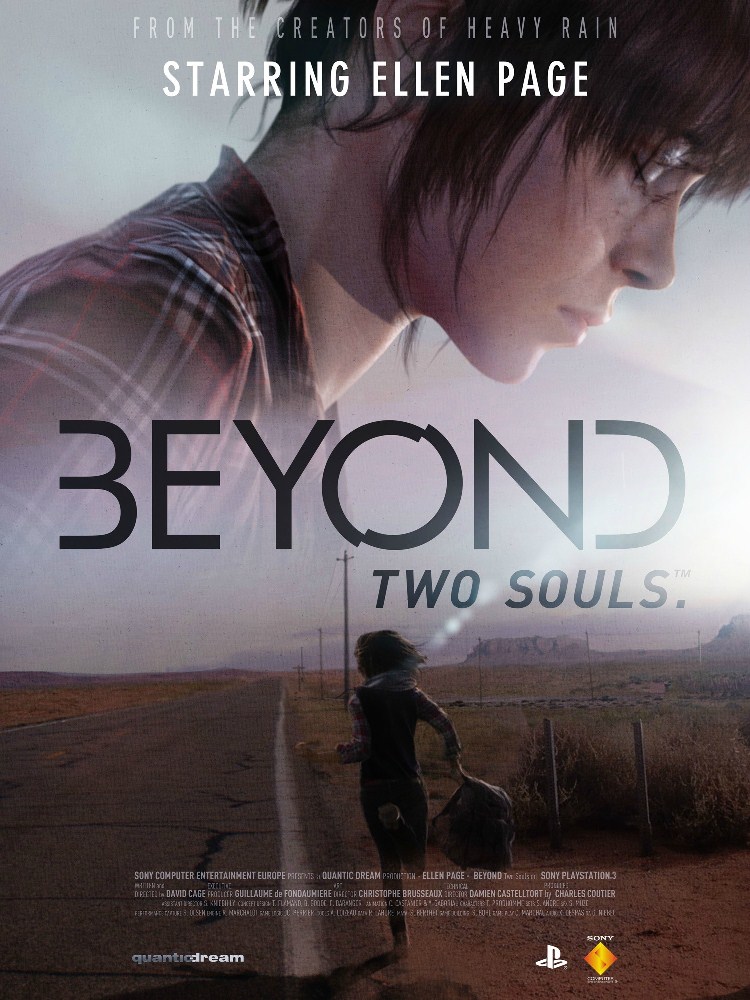
Beyond Two Souls

Beyond Two SoulsIt is hard not to be trivial about a new game. It is always a new version of…. or a sequel of…or in this case, an evolution of…

If you want the short and sweet of this game then think Dragons Lair mixed with Half Life/Resident Evil. Beyond Two Souls is from the makers of Heavy Rain, and many would like to compare that, but I never played it, so that part we (me and my keyboard) will skip that comparison in its entirety.

For those under 30+, when Dragons Lair was first released it was like nothing you had ever seen. Consider the early 80’s, console games were in 8-bits. In that same year, EA releases the pinball construction kit and Origin Systems released Ultima 3. 8-bit graphics were not really that great, and in that same year Disney’s Famous Don Bluth is centre to a game that has Disney quality graphics using a laser disc. To give you an idea, consider Xbox graphics in the time of the CBM-64. All our minds were blown. The game was simple, you see segments of a cartoon, and by pressing the right direction on your joystick, you continue, or you die. The system was simple, but the result would not be equalled for at least 15 years (without a laser disc).

Now take that concept and take it in a more modern and more interactive setting and you get Beyond Two Souls.

Wait!

Do not think of this as a simple game, as I said, it was trivialised!

The reality is that this is more than a mere evolution! This game is the first one I witness that uses the 6-axis controller to the maximum degree it can. I want to add to that, that the interactivity between the player and the game is the most complete I have ever seen. It is almost the game Nintendo could imagine, but could never make into a reality!

This game is something else. The story is given to you in a shuffled way! Frank Miller thinks more linear then that, but that does not matter, the story holds on to you like a jigsaw and the picture it paints slowly evolves into a masterpiece, a chronological approach would never have worked this well. Ellen Page IS the real star, as both actress and as character. Willem Dafoe is the supporting character, and as such he is the support, however he is also the glue that holds many of the pieces together. The voices and the looks give you a view into this story like you never seen it before. You control Ellen/Jodie in an amazing way. Like my favourite slogan from FX, ‘The story is everything’ and this story does not fail to deliver.

So, you control Jodie through events with an ‘assistant’ and as such you control where she walks, how she drives and how she interacts. In action scenes your controller becomes control, and as such you interfere with what she does, do it wrong and she does get hurt. This is actually most awesome during fight training. Get it wrong and she gets dropped to the floor, hard! That sequence is actually one of the cooler moments. You get to do it again and again, until you get it 100% right. It actually felt like you were experiencing a martial workout. Very cool!

There are other moments where it is a little unsettling as you might achieve the control over it. The directions for a new player seem a little ‘off’ in the beginning. As I said, the 6-axis controller had never been used to THIS degree before. Tilting it to the left or right (the entire controller), to empty a bucket. To sharply lower the controller as you jump of a wall. Shake when you are being held. It was an awesome experience.

As stated, you get a disjointed story, chapter by chapter and as you start at the end, you jump forward and backwards into the story, it really works! Without linearity you see parts and not know what does and does not connect. As you take control of Jodie or the ‘assistant’ the story unfolds. Uniquely, this game can be played by two, so if you do that, then one controls Jodie, the other the ‘assistant’, a pretty unique experience for this type of game.

Then the graphics, they are high in standard; however there are moments that will do more than blow you away. In a few close-up cut scenes, you control Jodie, and in those moments Ellen Page looks better and clearer than she does on Blu-ray. These are uncanny moments.

I am not giving anything away at this point, so you’ll need to get through it yourself. However, there are ‘hidden’ or hard to spot interacting points. If you get to them you can unlock a bonus. Not sure yet what they are and I only found one so far, but that means that this game has more to offer then you think. I am also predicting that when I was offered a certain choice, I unlocked an achievement. I feel a certainty that going another way will give a different achievement, so replay and experimenting is a part of all this.

So, what about the verdict?

It is a top notch game with a 90% rating. It is no ‘Last of us’, it is no ‘GTA’, it is an evolved game and this game is nothing less than a master evolution of whatever it used to be and the game is better for it. This leaves me with certainty that we will see more versions of this game, especially considering the optional additional interactions on a PlayStation 4 controller, which means that Beyond 2 Souls is only the tip of the iceberg and that already blew me away on the PlayStation 3. So the future of the PlayStation 4 seems to be a solid one. The music which involved Hans Zimmer, a legend in soundtracks, gives this game the atmosphere it deserves. So was this an interactive movie?

No, it is a game where you move, walk around and interact/search for clues and events. In addition it must be said that it has a few really small flaws. At times her movement seems a little less liquid, but not as irritating as we saw with Resident Evil. In addition, the move you make is depending on what you see that means if you are ready to punch and the camera shifts to the other side, that you move you had in mind would be the wrong one. That is part of the gameplay challenge and this game plays that part without a flaw. Whatever flaw it had, was purely the user of the controller. In the end, you will have taken Jodie, from being a small girl of 6-8, to a battle hardened, beat the crap out of anything goddess though places from Urban, to Military complex, to the middle of the desert. The story remains an awesome experience.

There is one other side to all this, it is one that is futuristic. As we see more and more of these games evolve with the use of professional actors, it will not an unrealistic thought that the Videogame industry will actually get its own Oscar category. If so, then Ellen Page might become its first recipient.

Leave a comment

Filed under Gaming

Control and Censorship

I am a simple person. I use an iPad, and I use it in a standard way. I synch, I play, I read, I listen! (Yes, I know such a selfish user I am). So when I read about the jailbreak issue I was actually surprised. Most of us never bothered with 3rd party software or other solutions. Yet, overall I do understand that some people might want to. I also do not see the issue for Apple or others to intervene. Some valid reasons might exist, and some might want this to develop their dreams, all valid reasons why a jailbreak system might be needed.

So the issue I read about today was that a game (Deus Ex) would not function on a jailbroken system. This might have been a simple issue with compatibility. No, this was not the case, as it was stated in the article the non-functionality was intentional. The person gets the message “We are sorry but you can’t fire on jailbroken devices.” So it is not just a bug but an intentional act to ‘sift out‘ certain users.

This does not make sense to me. So a person wanting the freedom to do certain things is now punished? I think it is high time that both Apple and Enix have some explaining to do. (Source: http://au.gamespot.com/news/deus-ex-the-fall-disables-firing-on-jailbroken-devices-6411343) the reader should especially accept the idea that there is a group of ‘legally jailbroken devices’ and they are in the same predicament.

It seems that the IT field is changing. This field is now more and more about personal data collection, discriminating groups and limiting the freedom of choice. At least, that is how I see it. But is this true?

When we see the jailbroken system then the following had occurred. The IOS has been modified. When we look at Apple support we see the following at http://support.apple.com/kb/ht3743. This is fair enough. It is nothing short of a person disassembling a television, then wanting it fixed under warrantee. So, I cannot fault apple for not fixing it. Yet the software gave us another issue. This is intentional intervention against those who ‘altered’ their system.

There are two sides to these events. On one side, I can understand why a system might be jailbroken. The immediate reason is that I was in the past the victim of Apple’s short-sightedness and their own party line flaws. It actually costed me thousands of dollars, so at that point, I feel that I am justified when I state ‘Apple Get Fu$#d!‘ (In regards to the lost $$$$).

The first part is the one some might remember from the PlayStation and PlayStation 2. Because some people were unacceptably greed driven, they forced many in a place where they decided what we were allowed to have and when. In the early days, games would appear in US and Japan almost a year early. To circumvent this, a ‘mod chip’ was available and as such people could order their games on Amazon in the US. Not only were the games up to a year early, in addition these games were 40%-65% cheaper, which was a massive benefit for many. Weirdly enough, the first reason was to many gamers more important than the price issue, but they happily took that benefit on board.

The second part of the ‘mod chip’ was alas less noble. It allowed people to copy original games and they would work on any modified system. For the most on the PlayStation 1, yet it had a large following in the PlayStation 2 as well. In my mind the second part was mainly due because of greed driven marketing, to exploit every person, wherever they lived to the fullest. The same was evident in the DVD market, however, there was a valid issue that Asian copyright violation was so strong that something needed to be done, yet overall the events seemed to have made little difference.

Are these dangers the same for jailbroken systems?

Because of the term ‘legally jailbroken devices’, I wonder what those were. The answer was found at the core of all hardware knowledge, a magazine called wired (at http://www.wired.com/threatlevel/2010/07/feds-ok-iphone-jailbreaking/). This is the interesting crux! This verdict came out in 2010. So the fact that Enix had been adding a certain ‘limit’ could be read as intentional discrimination.

In the end, the quote I personally cannot disagree with Natalie Kerris said Apple won’t change its policy that voids iPhone warranties if a phone has been jail broken. “It can violate the warranty and cause the iPhone to become unstable and not work reliable”, this is fair enough, and should a jail broken system be used to play games people did not pay for, then this would be a violation, yet that was not the case in the game Deux Ex ‘the Fall’.

There is a new side to all this. Even though no longer an issue (likely only temporarily), the Xbox One with their need to connect, the Apple with jail breaking and all kinds of likely issues the PS4 will have (because even though we do not know at present, they will have their own issues), we are looking at new developments involving Digital Rights Management (DRM), deployment on the cloud via UltraViolet and the Keychest system. You the users are about to get hit by levels of user-based licensing and limitations unlike any w have ever experienced. More important, users are likely to get hit a lot harder on user license agreements then companies have ever faced over the last 15 years. In my view 99% of the population will press an ‘I agree‘ button and have no clue what they agreed to. The fact that the users who signed the apple user license and then ‘jailbroke’ their system should be ample proof of that.

Leave a comment

Filed under Gaming, IT, Law

Spin dryers by Microsoft

Some might have heard the news and some might not. Microsoft will be launching their new console by the end of this year. Sony will come with one too, but about that more at a later time.

So, I did watch the presentation, and it is not unlike an American based company to take on so much more than they are likely to chew when they go up against a population of gamers. This has been proven in several occasions and as such this moment was no different.

The new system is called Xbox One (sounds like a Star Wars episode copy).

This system is supposed to be the new revelations that evangelical gamers will pray too. Yet, this is no longer a gaming console. They now call it an all in one entertainment system.

It is a fair step to extend boundaries. Any business minded person will do that whenever possible. Yet, at this time, with the current available information, many wonder why things were not thought through on many levels is slightly baffling.

Even though Microsoft is releasing information on many planes, I would be in remiss if I did not mention that Gamespot (www.gamespot.com) is a massive centre player when it comes to console information, so they are an important source of information for all readers.

There is one part where Microsoft is right, and it is only fair I mention it. Microsoft’s Don Mattrick stated “If you’re backwards compatible, you’re really backwards.” I grant him that one. Even if I was opposed in the past, in combination with statements made from those who made the ‘promise’ at that point (a promise both Microsoft and Sony royally broke). Where we saw the Xbox 360 and PlayStation 3 to be required to be backwards compatible to PlayStation 2 and Xbox, is just not realistic to expect at this time. So, as such, I will agree on that, even if several gamers might not agree with me.

My first issue is with the hardware that is central to the new Xbox One. If this is supposed to be an all in one entertainment solution, always connected, always cloud ready for downloading of Movies, TV, Games and so on, then whomever lacked the synapses to decide on a 500 Gb drive had clearly been watching a little too many Xbox-Files (like the TV series from the 90’s with Box Mulder and Data Scully). Then 500 Gb would then have been mucho alien. Now, the difference between 500 Gb and 1 Tb is about $20, so when they state it cannot be upgraded, in a time when we are all overloaded with data, we should start asking serious questions. Their statement that we can add a USB3 drive just does not hold water. Consider that they called it an all-in-one entertainment system; consider that a Blue-Ray can contain up to 50 Gb and consider that the operating system and temporary files for this system takes up some space too. Then this system has space for 9 movies in high res (worst case scenario). Even less if we consider the need for our music on MP3, out private photo collection(s) and a few games, then this drive will be choc-a-block stuffed full really quickly.

In opposition, as a start, I might not object to a 500 Gb start. Yet, the non-upgrade limit means that we will need extra external drives; so in addition needing power, needing cables and one young player accidently yanking the wrong cable might make things go wrong fast. This is also the first of many points where your internet data plan will cut in (or cut out might be a better phrase). You see, data plans cost money, and considering the plans some are on now, then the added changes would also mean you might on average pay $30 a month extra to keep being online. So that goes towards $400 in extra costs each year (not including the annual fee for Xbox live). Mind you, this is the INCREASE, not the bare cost. In some cases some would go from $69 to $99 a month. That should go over well with the millions of students all over the globe who are already in dire need just to make ends meet. If you think that this is an exaggeration. Think again. The system that now boasts on 3D gaming possibilities will need data to get this all rolling out. So either you accept time for a dozen DVD’s to install, or you’ll have to get to the cloud. In addition, they might offer the ‘normal’ version on 1-2 DVD’s and the rest needs downloading. This is a bigger deal then you realise. For example, consider the option of starting World of Warcraft on the PC as a new gamer. It is really nice that they offer it for free to new gamers to try. I am honest; it is a really nice gesture. Yet the initial download is 22 Gb. For some that is almost half their monthly download allowance. The second part of their entertainment boast is that they will support 4K. 4K is a resolution for TV meaning 4000 pixels per line. In all fairness there was a mention that this is for photos and movies only, not for games, yet, the 4K trailer of Spiderman (trailer, not movie) was said to need almost 500 Gb. That much for a 3 minute trailer? Is anyone waking up considering the ridiculous limitation of a 500 Gb hard drive?

Realistically, we are not ready for 4K resolution, as this goes beyond the ability of Blu-Ray, which of course makes me wonder why the 4K mention was such an effort? 3D is more and more added to the consumer’s home, yet at this point, we see an unbalanced situation between the offered hypes and the offered hardware. Not a good thing Microsoft!

So let us take a gander in the second division of MS issues (This applies to Sony too by the way). This new-gaming wave seems to cross several borders. What is advertised as new gaming, what others call entertainment, what few see and should see as the end of privacy! Microsoft is now offering a solution that is always on, always connected and remembering and learning from you all the time. Most laws are not ready.

The one thing that we hold dear, that we protect, we seem to give away when playing a game.

The new systems are all about data collecting. They call it ‘trending’, it is in reality a ‘personalised’ form of mass-advertisement. The abundance of hype created whilst stating interaction through the cloud is in fact nothing less than a new form of data collection as Skype, TV, movies and your choice of gaming is at all times stored and saved on the cloud. A system that interacts as per now on multiple levels, unhindered by privacy laws as we surrender to that extra little ‘benefit’ where we forget that others get access too.

Their on-line system is now getting grown from the initial 15000 servers now that Xbox 360 uses, to 300,000 servers from the moment the next Xbox is launched. It is a 2,000% growth in data collection and over 200,000% storage capacity. If foundations of business are set to return-on-investment, then ask yourself why a gaming system requires that level of growth. Intellectual property that is no longer bought, but rented on a temporary basis as the cloud keeps what we buy, yet we will pay more per hour and hand over our identity in the process.

Most laws are not ready, with these new systems starting to get pushed out as per this year. Consider this; the presentation had a quote in relation to the collected information “Game developers can take advantage of our data centres“, is anyone else getting access?

As Justice continues a losing battle against cybercrime, corporate entertainment is about to hand the keys over to a group that can really use all that input. Should you consider that this would not happen, then remember how Sony lost the security of a few million accounts which included credit card information, affecting many in Australia. When this level of collection happens, when consumers connect devices, then consider the added interest cybercrime will get as many will want these amounts of data for several reasons and most laws are not ready.

In less than 6 months we will see a new age where many willingly, unaware of the consequences will give out their details, their personality and their identity to a data cloud where we can all be statistically weighted. The haves and have nots will see their private lives classified into moments of targeting, some of it likely questionable. The laws are not ready, the justice system is not ready and law enforcement is not even close to ready.

So we are faced with the cloud, space and privacy. Consider that the new console was announced to be cheaper than the 360 initially was. Consider that Microsoft is adding hundreds of thousands of servers. Then consider that thy need to make a profit. So how will this happen? More important what extra costs will you the consumer get when their marketing will start making statements like the one we heard when the 360 was about to be launched “Each console has a variety of games. Most games released on the original Xbox are backwards compatible and can be played directly on its successor, Xbox 360” This did not pan out so well. Sony was just as bad, if not worse as millions signed up for the PlayStation 3, selling (or trading in) their PlayStation 2, only to learn that this backward compatibility was not ever working correctly.

Now, as stated earlier, the new consoles will NOT be backward compatible, yet Marketing is making all kinds of statements again. The Telegraph reported in (Source: http://www.telegraph.co.uk/technology/video-games/Xbox/10075540/Xbox-One-gamer-backlash-over-fee-for-pre-owned-titles.html) that gamers will see a fee coming their way when they are playing pre-owned titles. How fun is that? I admit, I am not yet aware what Sony does, yet this could tip the scales in a major way. I all honesty Microsoft Marketing did state that there will be pre-owned possibilities, yet they have not officially stated how this EXACTLY will play out, so we await clarity by Microsoft (be really really patient)

Personally I am on the fence in this regard. I never liked pre-owned games. And as such it never really hit me. When we look at off line gaming, my thoughts are that this is none of Microsoft’s business. If I give a game I am done with to a niece, a nephew, or even the neighbours so their kids can play a game without having to pay for it, then so what? I do agree with Microsoft that the one who buys the game gets access to on-line gaming. If someone else wants to go on-line, then they should by an access pass for the on-line part. They reserved the gaming server for me the buyer, the next person will need to pay for that service. So off line gaming, patching and so on, they should stay away from charging. That is my personal view.

So here we are, Microsoft marketing spinning their party lines fast enough to get your clothes dry, it does however gives more and more pause to the quality of gaming we have to look forward to. This is how I currently see the gamers market go backwards. A business approach to a consumer world, pushing through all kinds of idea’s the youthful player never signed up for.

So Microsoft calls it an entertainment system. Entertainment? For who?

2 Comments

Filed under Gaming, IT, Law, Media

Tomb Raider, A game the wrong way round.

Image

This is for those who play/played games (on a console or PC). I have been involved in the gaming industry for a long time. I have tested them, reviewed them and been in contact with original game creators since 1989. No matter who we applaud for whatever game started what, there is no denying a basic fact. When Sony released the first PlayStation the world of gaming changed forever.

This console came in the beginning with a minimum amount of games; however gaming changed forever one year after the PlayStation was released when a game named Tomb Raider was released. This game was in no uncertain terms the pinnacle of gaming in many ways. It was puzzling, Action, exploring and extremely exciting. It had 4 area’s comprising of 18 levels. It was a massive game filled with so many things that replaying was essential. The game that followed was even bigger and more challenging. I reckon it took no less than 3 weeks to get through either game. I was mesmerised. It was there for a shock that I got through this new game for almost 90% in just two days.

The new Tomb Raider is served like an expensive meal. Nice plate, exquisite display of eatable items, but a nice plate does not necessarily leave you filled and in this case it leaves you hungry soon after dinner. The game is rocky in several places. It is repetitive; at times it has the same shock effect again and again and at times too cinematographic where you must push a button at the exact time.

So, what are the good parts?

Yes, they had so much to work with. Enough so, that I am very concerned on how this was messed up to that extent. The premise that it is on ONE island was pretty brilliant, the idea of a Tomb Raider zero is pretty decent and one thing MUST be stated at the very beginning is that the graphics are UNREAL! That is the one part that is beyond exceptional. The graphics show utter perfection. Especially when you get to a level called coastal base, you have no idea what you are in for. The graphical part of the game is without a doubt utterly perfect. To give you a little more, this is from the same house that brought Deus Ex. A game that brought several times the satisfaction this game brings. Square Enix is a house that has a high quality established name, so what went wrong? WHY is this game so mediocre in my mind?

Let us take a look at the first level. It is decent and a good introduction to this game. It gives the person a way to control and move through the introduction. In the end of this short run we will have seen how easy the game is controlled and that is what any good introduction does. From there we stop at our first camp. The camps are important and it is a good way to progress and safe a game. All that is fine. Next we get to get the bow and do a little hunting. Soon thereafter you will get a first feel on how good the game might be. You as a gamer will quickly become hungry for more. After a day, when you see your progress you realise that overall this game could have been a lot more, and it is without a doubt way too small. The indication that ‘downloaded’ tombs are coming might not even be a consolation, especially if those tombs cost extra (unknown at this time whether it will cost). I do not know whether the failing is due to timing, due to marketing or just a lack of creativity. The art and graphics are so amazing that the third option is not likely the case.

Levels are overall not that bad and the hidden tombs are nice. The change that the entire game plays on One Island gives the game a good feel, and soon the story will narrate into a supernatural field that is well known and a source of fame for the Tomb Raider series. So, the elements of a great Tomb Raider game are definitely there. However, some levels could have been a lot larger, making the game a lot more and especially longer challenging. I reckon that this is one of the two great flaws in this game. The game does have many decent sides, again, it tends to get repetitive when Lara is dumped in the deep end, suddenly surrounded by overwhelming forces and then the fight starts again. I can understand that approach to happen once or twice, but it happens too often, I would state that this is a big No in my book. This repetition becomes tedious after a while. This is odd way to go, because the approach with stealth kills with a bow is actually a very nice twist for the player. In addition we soon have an idea who is two-timing us, so the average gamer will not get too much of a surprise.

What was good is in some levels there is a running need to jump, climb and skip in a cinematographic approach. This is not bad, but it again happens too often and then it is all about timing the button correctly, or to shoot the right obstacles. 2-3 might be nice, but it happens slightly too often with too many cut scenes.

What could have been done better? Larger playing levels are a definite! 2 of them, like the Coastal area and the climb to the monastery are sizeable area’s to see. However, getting through the levels is at times slightly too fast. If we look at places like the Research Station, we see a place that was way too small. Even additional puzzles in all areas would have been a good thing. Additional levels and depths as well as puzzles to get through the hidden tombs would have given this game additional weight; those additions would have dramatically driven the score of the game. In one weekend I got up to the final temple, and most areas were 100% completed.

I am a decent gamer, but not a great one. I am certain several gamers could have done the same game 1-2 hours quicker on the highest setting, which again is shown in my low score. The hidden tombs are a fun idea; however, for the most each one has one small puzzle and not a challenging one at that. Only the fishery tomb is slightly challenging at first. But all levels do show utter perfection in its graphical and artistic environment. That makes it all so upsetting.

I would rate this game a 7.5 out of 10. With a little more effort it could have been an easy 9.4 out of 10. Which begs the question, why the failing effort? Tomb Raider, of all games should be better than this in my mind. The second question is how the critics came to a score so high, way higher then it currently deserves.

Important that this review is based on the single player ONLY! This game has an additional multi-player option which was not tested.


Leave a comment

Filed under Gaming, IT